LEARNING
AND
DEVELOPMENT
MODULE 1 - INTRODUCTION TO LEARNING AND
DEVELOPMENT
By- Dr. Anushree Singh
Associate Professor
SOM-OMBR Campus
CMR University
Learning:
 Refers to the process of acquiring the response adequately to a situation
which may or may not have previously encountered.
 A widely accepted simple definition of ‘learning’ is any relatively permanent
change in behaviour that occurs as a result of experience.
 learning is a relatively permanent change in the frequency of occurrence of a
specific individual behaviour.
 In an organisational setting, it is the work-set and organisational norms, which
will act as objective bases for determining whether an employee’s behaviour is
desirable or undesirable and whether he or she needs to learn and practise
productive work behaviour.
 Thus, it is the process by which skills, knowledge, attitudes and behaviour are
formed and developed as a result of education, training, socialisation and
experience
Features of Learning
1. Learning involves change, although the change may be for good or bad from
an organisation’s point of view.
2. Not all changes reflect learning. To constitute learning, change should be
relatively permanent.
3. Learning is reflected in behaviour. A change in an individual’s thought
process or attitudes, not accompanied by behaviour, is no learning.
4. The change in behaviour should occur as a result of experience, practice, or
training.
5. The practice or experience must be reinforced in order for learning to occur.
If reinforcement does not accompany the practice or experience, the
behaviour will eventually disappear.
6. Learning occurs throughout one’s life.
Significance of Learning
 The importance of learning was first put forward by a Chinese philosopher,
Confucius (551-479 BC) in these words: “Without learning, the wise
become foolish; by learning, the foolish become wise”.
 Ross, Smith, Roberts and Kleiner advocate this definition: “Learning in an
organization means the continuous testing of experience and the
transformation of that experience into knowledge - accessible to the whole
organization and relevant to its core purpose.”
 Organisational learning means the process of improving actions through
better knowledge acquisition, clearer understanding, and improved
performance. It is a method of detecting and correcting errors.
Significance of Learning
The importance of organizational learning is shown by the various
benefits that occur in organizations that develop a learning
culture:
 Increased employee job satisfaction
 Lower turnover rates
 Increased productivity, profits and efficiency
 Developing leaders at all levels
 Enhanced adaptability throughout the organization
Gagné's Five Learned Capabilities
The classification of learning according to Robert Gagne
includes five kinds of learned capabilities:
 intellectual skills,
 cognitive strategies,
 verbal information,
 attitudes, and
 motor skills.
Learning Capabilities:
 Motor Skills refers to bodily movements involving muscular
activity. Examples might be: Starting a car, shooting a target,
swinging a golf club.
 Attitude is an internal state which affects an indiviudal’s choice
of action toward some object, person, or event. Examples might
be: Choosing to visit an art museum, writing letters in pursuit of
a cause.
Learning Capabilities:
 Verbal Information include: 1) Labels and Facts and 2) Bodies
of Knowledge.
 1) Labels and facts refer to naming or making a verbal response
to a specific input. The response may be naming or citing a fact
or set of facts. The respsonse may be vocal or written.
Examples: Naming objects, people, or events. Recalling a person's
birthday or hobbies. Stating the capitals of the United States.
 2) Bodies of Knowledge refers to recalling a large body of
interconnected facts.
Example: paraphrasing the menaing of textual materials or stating
rules and regulations.
Learning Capabilities:
 Cognitive Strategy is an internal process by which the learner controls
his/her own ways of thinking and learning.
Example: Engaging in self-testing to decide how much study is needed;
knowing what sorts of questions to ask to best define a domain of knowledge;
ability to form a mental model of the problem.
 Intellectual Skills include
1) Discrimination
2) 2) Concrete concept
3) 3) Rule using and
4) 4) Problem solving.
These are the four levels within the intellectual skills domain that Gagne
identified as his taxonomy.
Learning Capabilities:
 Discrimination is making different responses to the different members of a
particular class. Seeing the essential differences between inputs and
responding differently to each.
Example: Distinguishing yellow finches from house finches on the basis of
markings; having to tell the differences between gauges on an instrument
panel.
 Concrete concept is responding in a single way to all members of a
particular class of observable events. Seeing the essential similarity among a
class of objects, people, or events, which calls for a single response.
Example: Classifying music as jazz, country western, rock, etc.; saying "round
upon seeing a manhole cover, a penny, and the moon.
Learning Capabilities:
 Rule using is applying a rule to a given situation or condition by responding
to a class of inputs with a class of actions. Relating two or more simpler
concepts in the particular manner of a rule. A rule states the relationship
among concepts.
Examples: It is helpful to think of rules or principles as "if-then" statements. "If
a task is a procedure, then use flowcharting to analyze the task." "If you can
convert a statement into an 'if-then' statement, then it is a rule or principle.“
 Problem solving is combining lower level rules to solve problems in a
situation never encountered by the person solving the problem. May involve
generating new rules which receive trial and error use until the one that
solves the problem is found.
Principles of Learning
5 principles of learning are;
1. Participation
2. Repetition
3. Relevance
4. Transference
5. Feedback
Participation
 Learning should permit and encourage the active participation of the learner.
 Participation improves motivation and apparently engages more senses that
reinforce the learning process.
 As a result of participation, people learn more quickly and retain that learning
longer.
 For example, most people never forget how to ride a bicycle because they
actively participated in the learning process.
 The learning activities should be experiential rather than just informational.
 Therefore, the trainers should arrange the physical surroundings to facilitate
small group interaction and promote the sharing of ideas.
Repetition
 An important principle of learning is to provide the
learner with the opportunity for practice and repetition.
 To gain the full benefit of training, learned behaviors
must be overlearned to ensure smooth performance and
a minimum of forgetting at a later date.
 Proficiency in learning and retaining new skills is
improved when individuals visualize themselves
performing the new behavior.
Relevance
 Learning is helped when the material to be learned is
meaningful. The learning should be problem-
centered rather than content centered.
 People are motivated to learn when training is
immediately relevant to help them solve a current
problem. Learning something just because someone
says “it is important” is not as motivating.
Transference
 Because the training occurs in a special environment, an important question to ask is
whether learning will transfer to the actual job situation.
 Transfer of training occurs when trainees can apply the knowledge and skills learned in
training courses to their jobs. The training has failed if the learning in one setting does not
transfer to the actual job situation.
 Three transfers training situations are possible;
 Positive transfer of training when the training activities enhance performance in the new situation;
 negative transfer of training, when the training activities inhibit performance in a new situation;
and
 no observable effect of training.
Feedback
 Feedback gives learners information on their progress. Performance feedback is a
necessary prerequisite for learning. Feedback improves performance not only by
helping learners correct their mistakes but also by providing reinforcement for
learning.
 Knowledge of results is a positive reinforcement in itself. Learning activities have
more intrinsic interest if feedback is available.
 Nevertheless, performance feedback should do more than inform learners whether
they are right or wrong.
 Merely informing the trainees that they were wrong is not as effective as telling them
why they were wrong and how they can avoid making mistakes in the future. In
general, knowledge of results is an essential feature of learning, and this knowledge
comes after the learner’s response.
LEARNING PROCESS
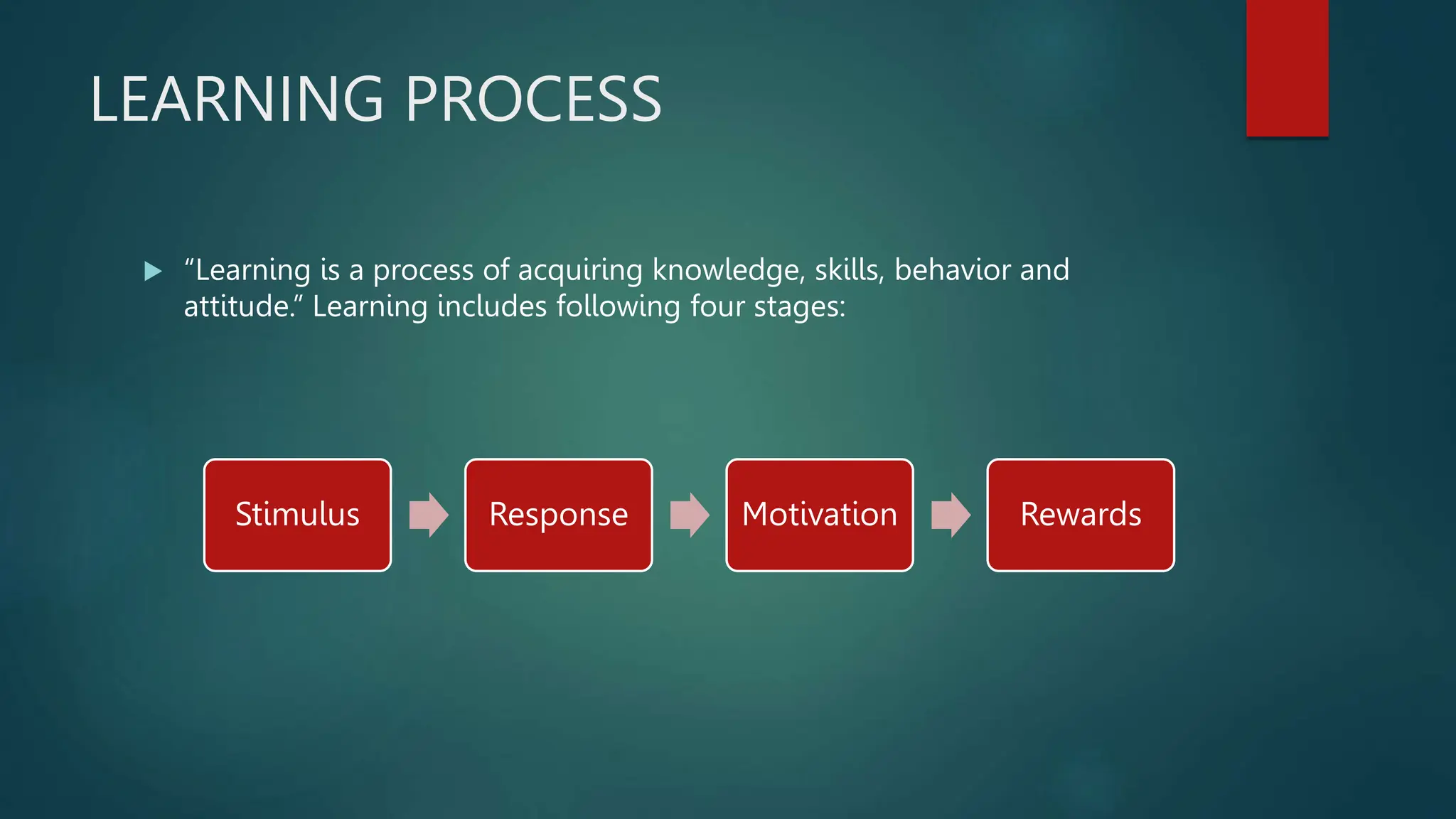
 “Learning is a process of acquiring knowledge, skills, behavior and
attitude.” Learning includes following four stages:
Stimulus Response Motivation Rewards
LEARNING PROCESS
 1. Stimulus
Everyone needs a source of motivation to perform something
and Stimulus is a motivating source or an incentive. Learners
should have a good perception of stimuli, as the learner should
be supported in the learning process. When there are no triggers
there is no thought. Stimulus can take the form of 'knowledge
expansion,' 'abilities and skills,' 'job quality improvement,'
'productivity and profitability,' 'effectiveness,' 'career
development,' and 'financial and non-financial incentives.'
LEARNING PROCESS
 2. Response
In theory, reaction is the result of the learner to the stimulus.
When the result is reached, response is the first step in the
process of learning. Learner will respond positively, because only
then does the learning process take place and can he / she
respond positively to certain negative reactions only if the
learner is persuaded of positive behavioral changes
LEARNING PROCESS
 3. Motivation
Motivation is the key catalyst to motivate individuals to learn,
because learning cannot take place without motivation. It's the
enthusiasm for learning that boosts curiosity and attitude. No
one can learn without willingness and this willingness comes
from motivation because we all know that whatever thinking and
understanding capacity an one has without motivation, nobody
can learn.
LEARNING PROCESS
 4. Rewards
In learning process, rewards are incentives which learner gets. In
learning process, there should be a clear incentive scheme, and it
should be straightforward and predictive. Employees should be
well aware in advance when studying at various rates of what
they can get as return or bonuses. Rewards can come in both
financial and non-financial form. For examples, praise is the
incentive and salary increment etc.
LEARNING THEORIES
 reinforcement theory,
 Social learning theory,
 goal theories,
 expectancy,
 adult learning theory,
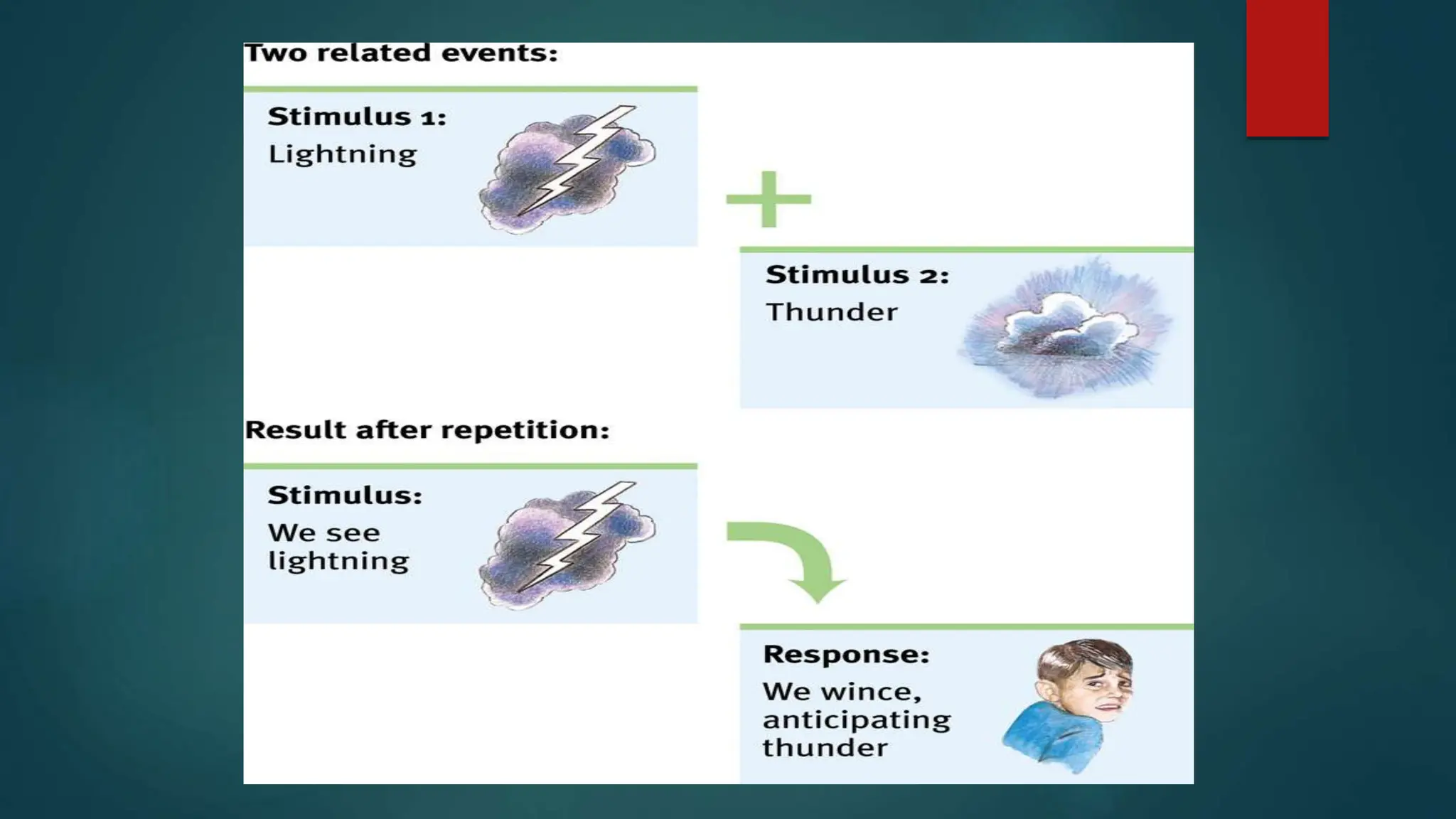
CLASSICAL CONDITIONING
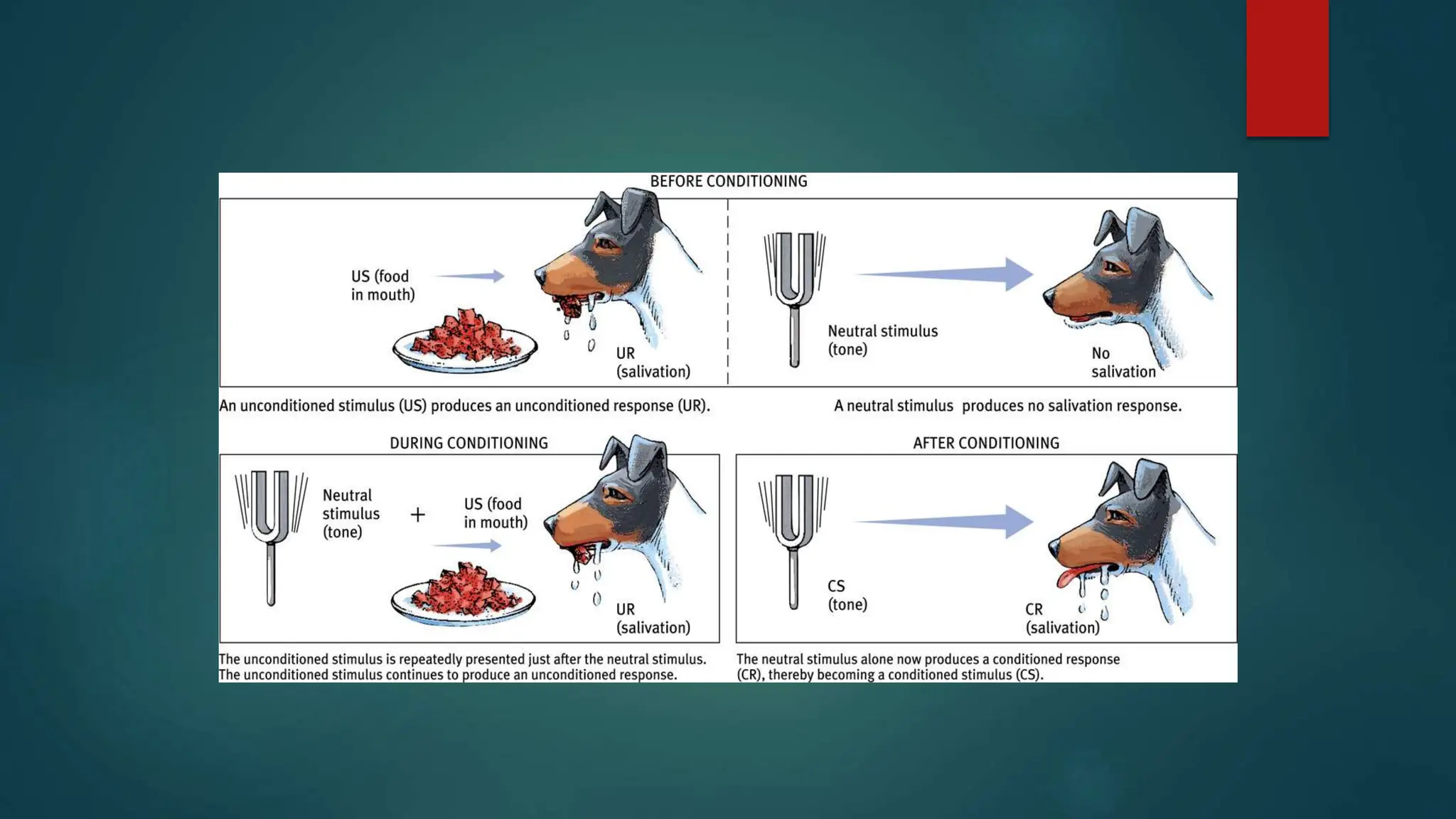
 Given by Ivan Pavlov
 People (and animals) acquire certain behaviors
through classical conditioning
Learning process in which associations are made
between an unconditioned stimulus and a neutral
stimulus.
STIMULI
 Something that elicits a response.
 NEUTRAL STIMULUS:
 Initially does not elicit a response.
 UNCONDITIONED STIMULUS (UCS):
 elicits a predictable response w/o training.
 UNCONDITIONED RESPONSE (UCR):
 automatic or natural reaction to a stimulus w/o training
STIMULI cont.
CONDITIONED STIMULUS (CS):
 elicits a response due to being paired with an UCS.
CONDITIONED RESPONSE (CR):
 the learned reaction to a CS
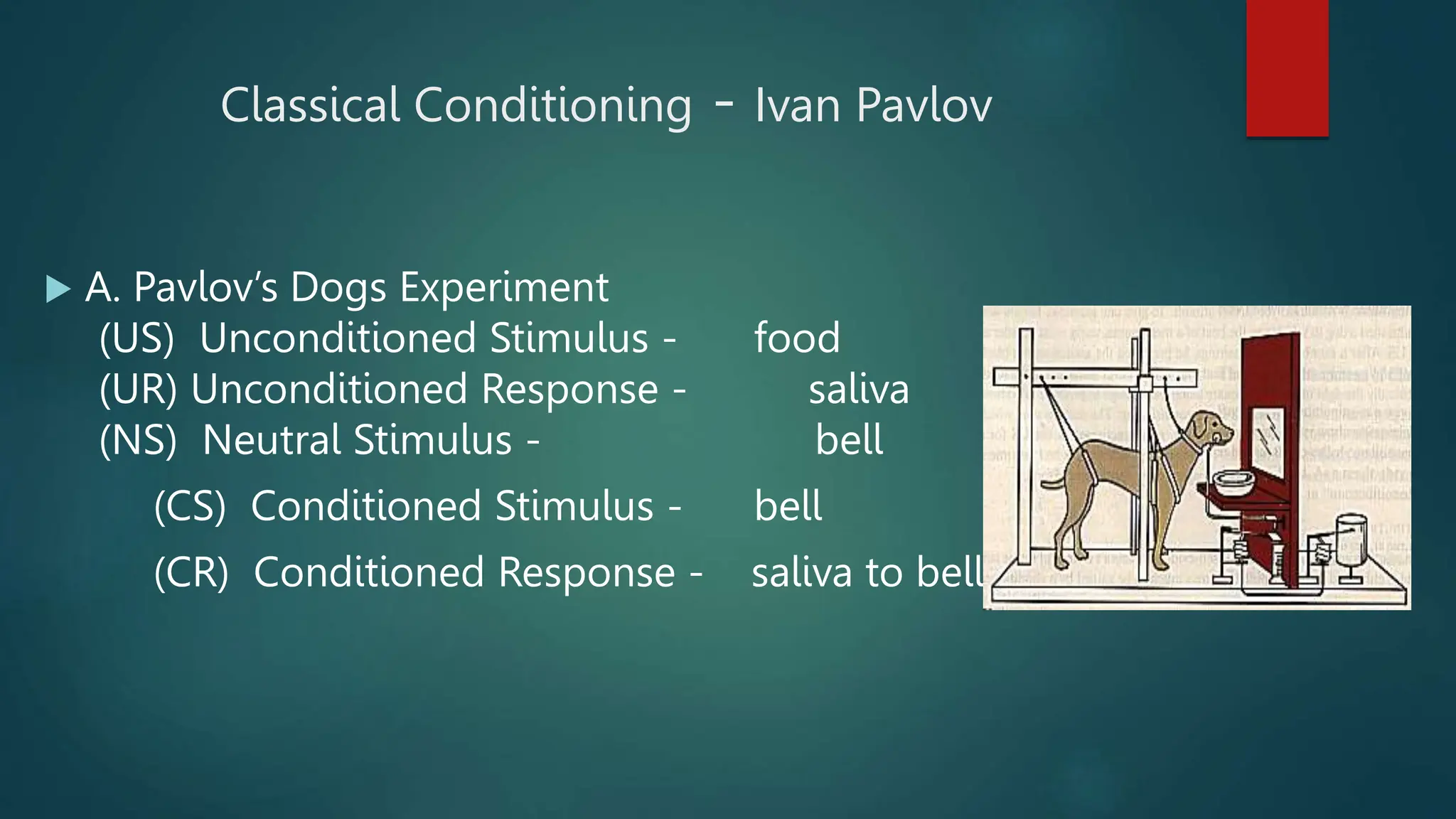
Classical Conditioning - Ivan Pavlov
 A. Pavlov’s Dogs Experiment
(US) Unconditioned Stimulus - food
(UR) Unconditioned Response - saliva
(NS) Neutral Stimulus - bell
(CS) Conditioned Stimulus - bell
(CR) Conditioned Response - saliva to bell
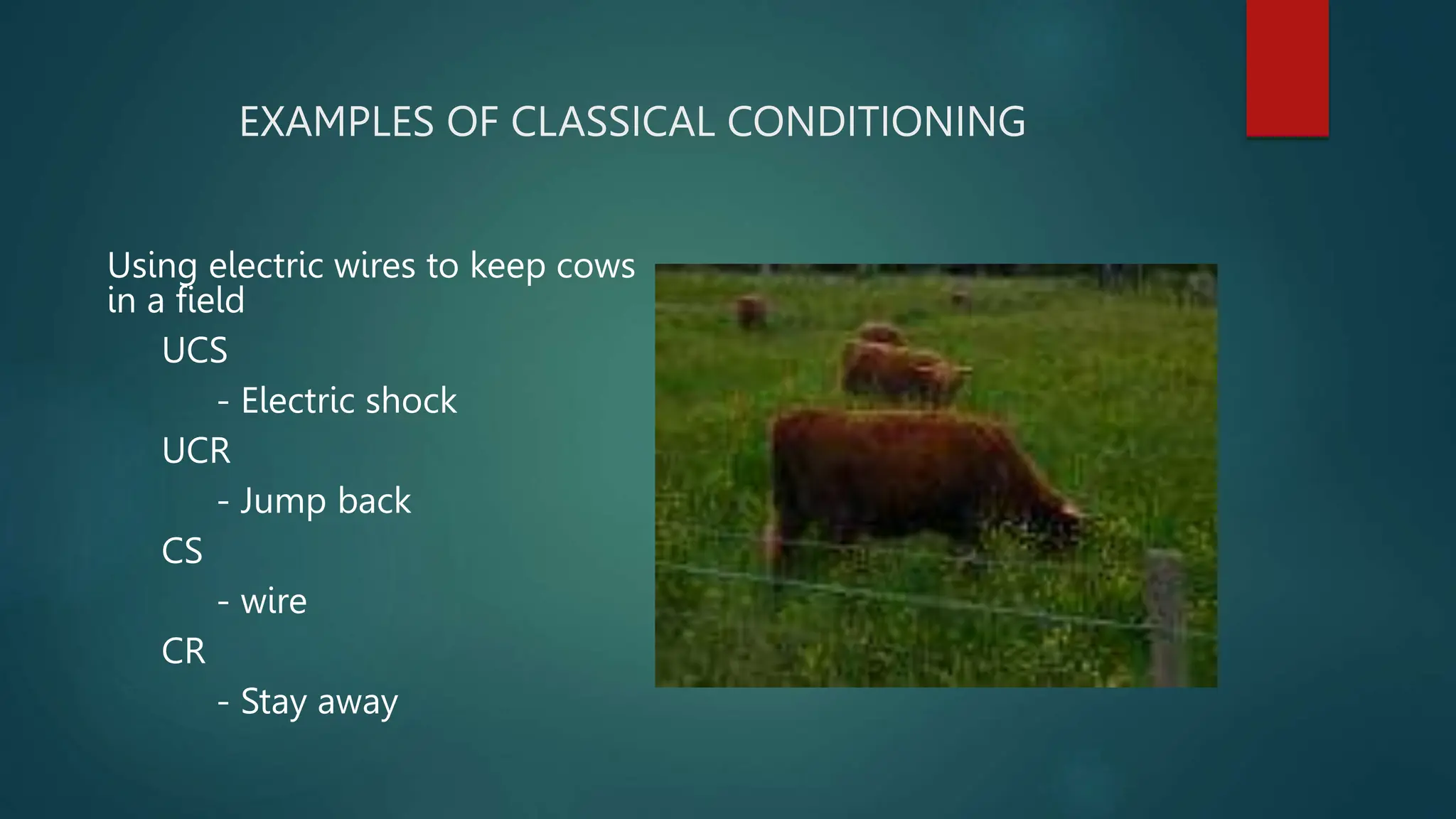
EXAMPLES OF CLASSICAL CONDITIONING
Using electric wires to keep cows
in a field
UCS
- Electric shock
UCR
- Jump back
CS
- wire
CR
- Stay away
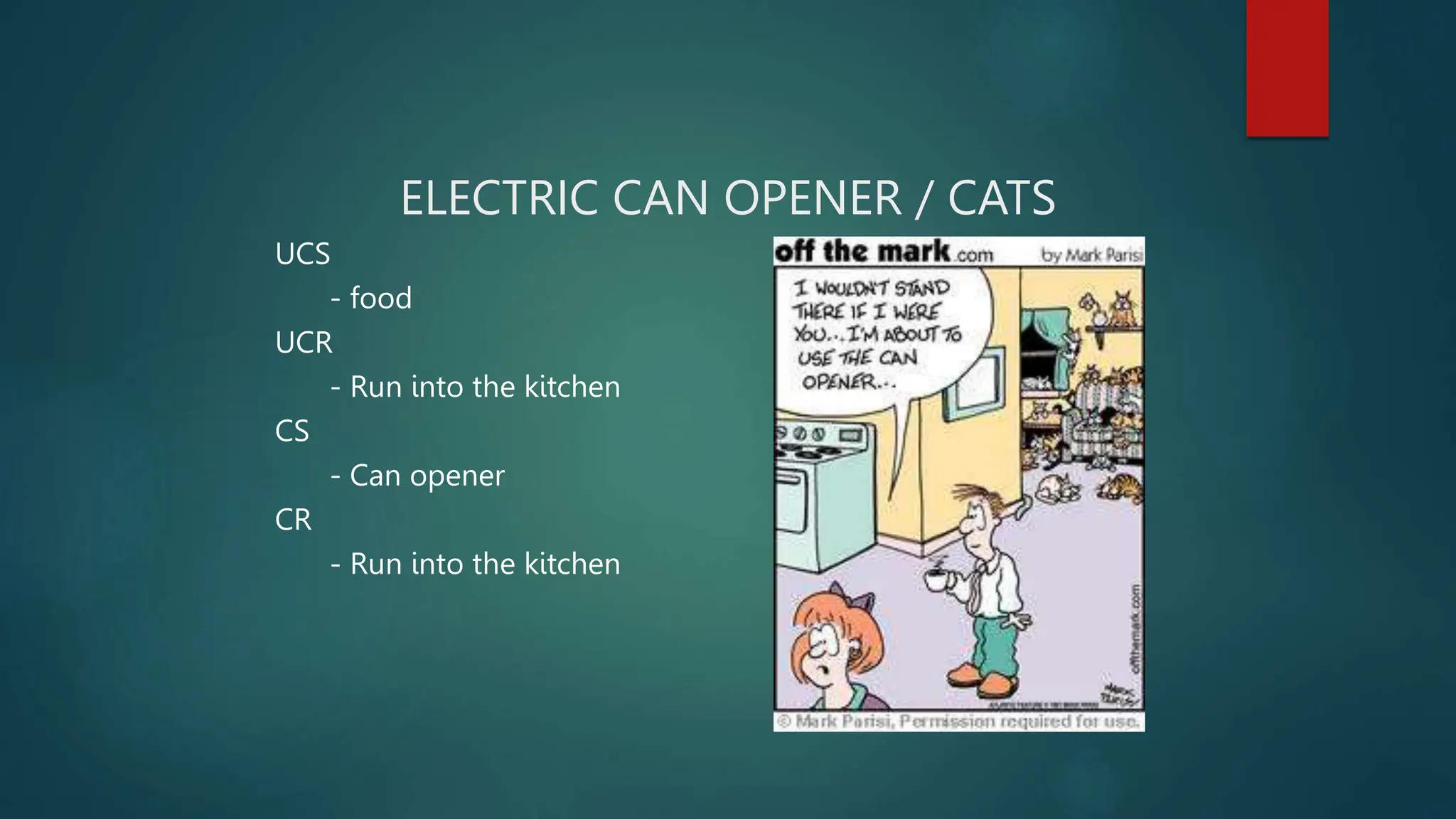
ELECTRIC CAN OPENER / CATS
UCS
- food
UCR
- Run into the kitchen
CS
- Can opener
CR
- Run into the kitchen
Operant Conditioning Theory
(Reinforcement Theory)
 Operant conditioning, or instrumental
conditioning, is a theory of learning where
behavior is influenced by its consequences.
 Behavior that is reinforced (rewarded) will likely be
repeated, and behavior that is punished will occur
less frequently.
Operant Conditioning
 Skinner is regarded as the father of Operant Conditioning, but his work
was based on Thorndike’s (1898) law of effect.
 According to this principle, behavior that is followed by pleasant
consequences is likely to be repeated, and behavior followed by
unpleasant consequences is less likely to be repeated.
 Skinner introduced a new term into the Law of Effect – Reinforcement.
 behavior which is reinforced tends to be repeated (i.e., strengthened);
 behavior which is not reinforced tends to die out-or be extinguished (i.e.,
weakened).
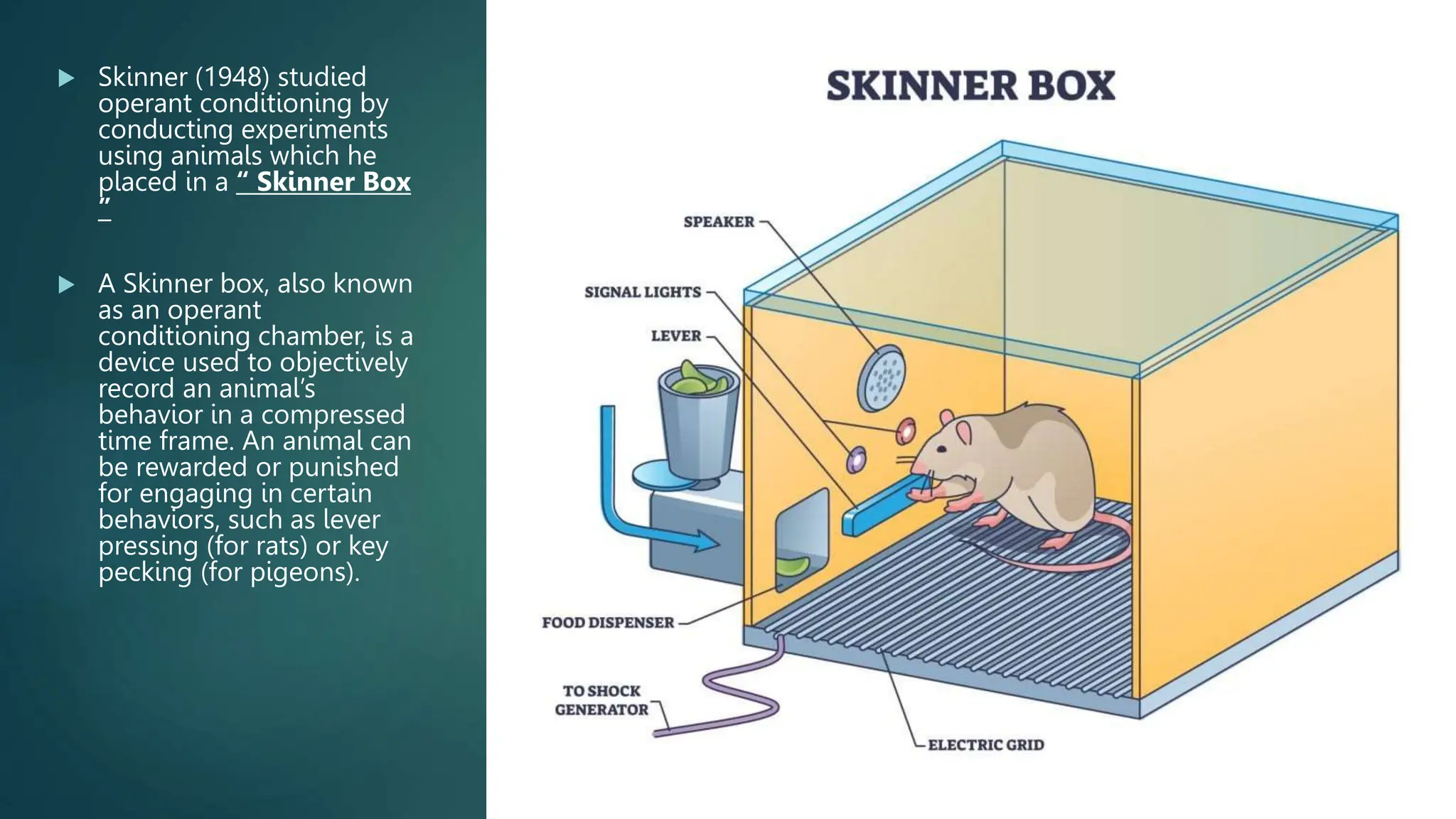
 Skinner (1948) studied
operant conditioning by
conducting experiments
using animals which he
placed in a “ Skinner Box
”
 A Skinner box, also known
as an operant
conditioning chamber, is a
device used to objectively
record an animal’s
behavior in a compressed
time frame. An animal can
be rewarded or punished
for engaging in certain
behaviors, such as lever
pressing (for rats) or key
pecking (for pigeons).
Operant Conditioning
 Skinner identified three types of responses, or operant, that can follow
behavior.
 Neutral operants: responses from the environment that neither increase nor
decrease the probability of a behavior being repeated.
 Reinforcers: Responses from the environment that increase the probability
of a behavior being repeated. Reinforcers can be either positive or negative.
 Punishers: Responses from the environment that decrease the likelihood of
a behavior being repeated. Punishment weakens behavior.
Positive Reinforcement
 In positive reinforcement, a response or behavior is strengthened by rewards,
leading to the repetition of desired behavior. The reward is a reinforcing stimulus.
 Primary reinforcers are stimuli that are naturally reinforcing because they are not
learned and directly satisfy a need, such as food or water.
 Secondary reinforcers are stimuli that are reinforced through their association with
a primary reinforcer, such as money, school grades. They do not directly satisfy an
innate need but may be the means. So a secondary reinforcer can be just as
powerful a motivator as a primary reinforcer.
Positive Reinforcement
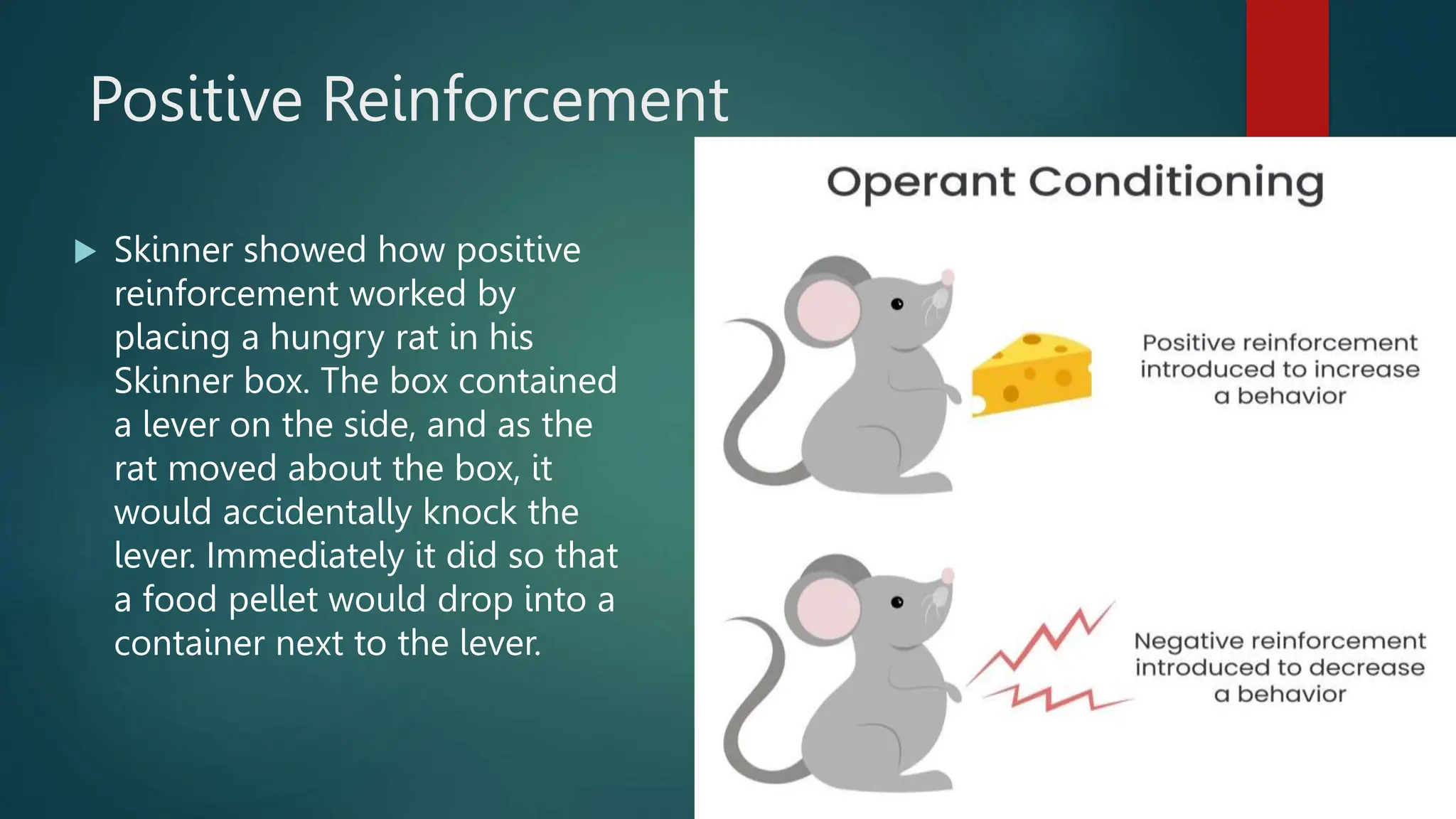
 Skinner showed how positive
reinforcement worked by
placing a hungry rat in his
Skinner box. The box contained
a lever on the side, and as the
rat moved about the box, it
would accidentally knock the
lever. Immediately it did so that
a food pellet would drop into a
container next to the lever.
Negative Reinforcement
 Negative reinforcement is the termination of an unpleasant state
following a response.
 This is known as negative reinforcement because it is the removal of an
adverse stimulus which is ‘rewarding’ to the animal or person. Negative
reinforcement strengthens behavior because it stops or removes an
unpleasant experience.
For example, if you do not complete your homework, you give your teacher £5. You will
complete your homework to avoid paying £5, thus strengthening the behavior of
completing your homework.
Negative Reinforcement
 Skinner showed how negative reinforcement worked by placing a rat in his Skinner box
and then subjecting it to an unpleasant electric current which caused it some discomfort.
As the rat moved about the box it would accidentally knock the lever.
 Immediately it did so the electric current would be switched off. The rats quickly learned
to go straight to the lever after a few times of being put in the box. The consequence of
escaping the electric current ensured that they would repeat the action again and again.
 In fact Skinner even taught the rats to avoid the electric current by turning on a light just
before the electric current came on. The rats soon learned to press the lever when the
light came on because they knew that this would stop the electric current being
switched on.
These two learned responses are known as Escape Learning and Avoidance Learning.
Punishment (Weakens Behavior)
 Punishment is the opposite of reinforcement since it is designed to
weaken or eliminate a response rather than increase it. It is an aversive
event that decreases the behavior that it follows.
 Like reinforcement, punishment can work either by directly applying an
unpleasant stimulus like a shock after a response or by removing a
potentially rewarding stimulus, for instance, deducting someone’s pocket
money to punish undesirable behavior.
 Note: It is not always easy to distinguish between punishment and
negative reinforcement.
Punishment (Weakens Behavior)
 There are many problems with using punishment, such as:
 Punished behavior is not forgotten, it’s suppressed – behavior returns
when punishment is no longer present.
 Causes increased aggression – shows that aggression is a way to cope with
problems.
 Creates fear that can generalize to undesirable behaviors, e.g., fear of
school.
 Does not necessarily guide toward desired behavior – reinforcement tells
you what to do, punishment only tells you what not to do.
Examples Of Operant Conditioning
 Positive Reinforcement: Suppose you are a coach and want your
team to improve their passing accuracy in soccer. When the players
execute accurate passes during training, you praise their technique.
This positive feedback encourages them to repeat the correct
passing behavior.
 Negative Reinforcement: If you notice your team working together
effectively and exhibiting excellent team spirit during a tough
training session, you might end the training session earlier than
planned, which the team perceives as a relief. They understand that
teamwork leads to positive outcomes, reinforcing team behavior.
Examples Of Operant Conditioning
 Negative Punishment: If an office worker continually arrives late, their
manager might revoke the privilege of flexible working hours. This removal of
a positive stimulus encourages the employee to be punctual.
 Positive Reinforcement: Training a cat to use a litter box can be achieved by
giving it a treat each time it uses it correctly. The cat will associate the
behavior with the reward and will likely repeat it.
 Negative Punishment: If teenagers stay out past their curfew, their parents
might take away their gaming console for a week. This makes the teenager
more likely to respect their curfew in the future to avoid losing something
they value.
Examples Of Operant Conditioning
 Ineffective Punishment: Your child refuses to finish their vegetables at
dinner. You punish them by not allowing dessert, but the child still
refuses to eat vegetables next time. The punishment seems ineffective.
 Premack Principle Application: You could motivate your child to eat
vegetables by offering an activity they love after they finish their meal.
For instance, for every vegetable eaten, they get an extra five minutes
of video game time. They value video game time, which might
encourage them to eat vegetables.
SOCIAL LEARNING THEORY
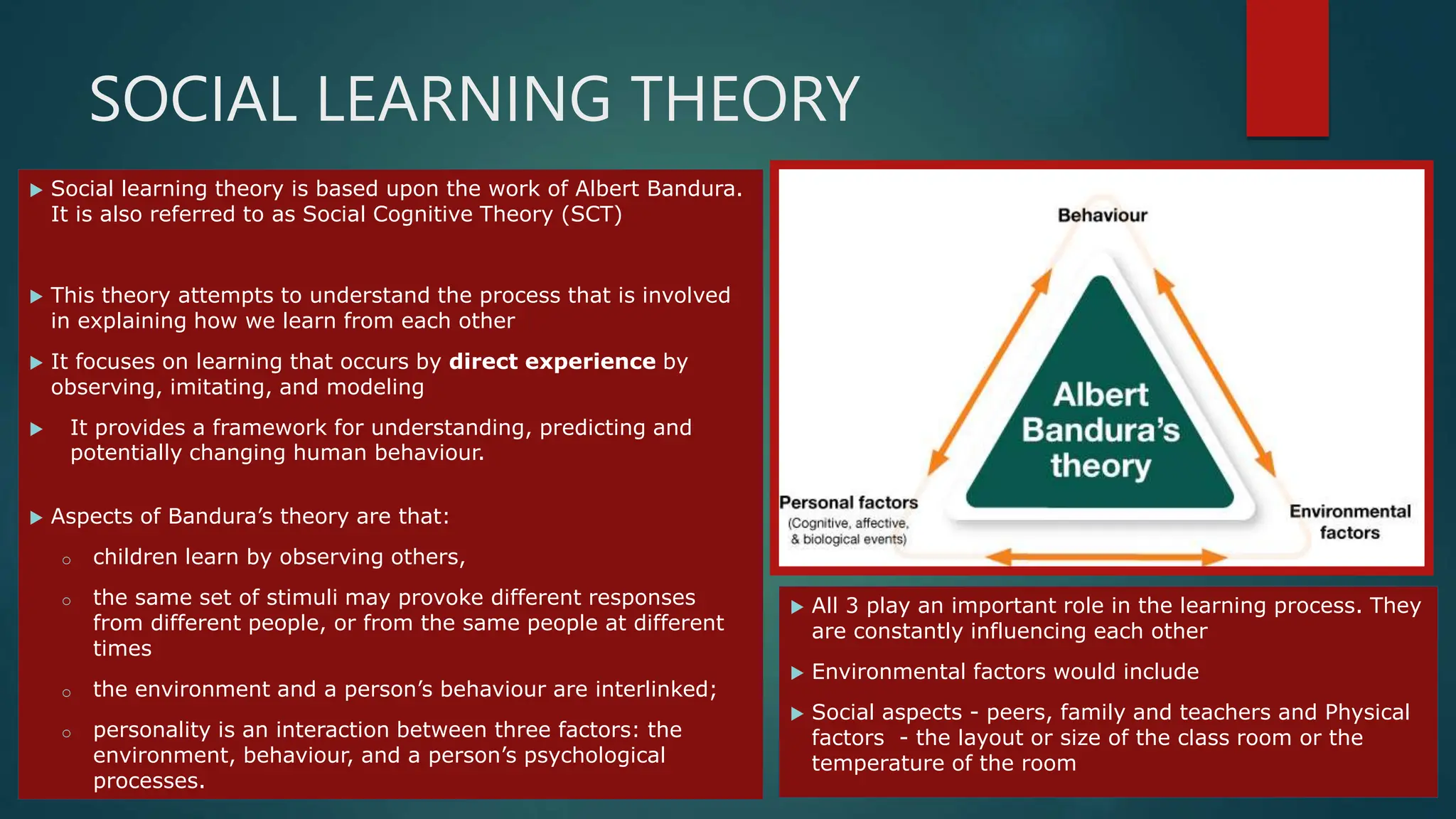
 Social learning theory is based upon the work of Albert Bandura.
It is also referred to as Social Cognitive Theory (SCT)
 This theory attempts to understand the process that is involved
in explaining how we learn from each other
 It focuses on learning that occurs by direct experience by
observing, imitating, and modeling
 It provides a framework for understanding, predicting and
potentially changing human behaviour.
 Aspects of Bandura’s theory are that:
o children learn by observing others,
o the same set of stimuli may provoke different responses
from different people, or from the same people at different
times
o the environment and a person’s behaviour are interlinked;
o personality is an interaction between three factors: the
environment, behaviour, and a person’s psychological
processes.
 All 3 play an important role in the learning process. They
are constantly influencing each other
 Environmental factors would include
 Social aspects - peers, family and teachers and Physical
factors - the layout or size of the class room or the
temperature of the room
SOCIAL LEARNING THEORY
 His research suggests that 70% of a person’s learning happens through
personal experience, 20% through interactions with peers, and 10% in
instructor-led classroom environments.
 Some of the examples of observed behavior and social learning include
motivation and work ethics. It is the process of changing our behavior by
modeling it on the behavior of a successful person like a manager who has
achieved an end that is desired. Social learning is complementary to
specific learning contexts. However, it is a subconscious action which is
part of everyday life.
 Applications of social learning in organizations are workshops, mentoring,
coaching, group discussions and panels.
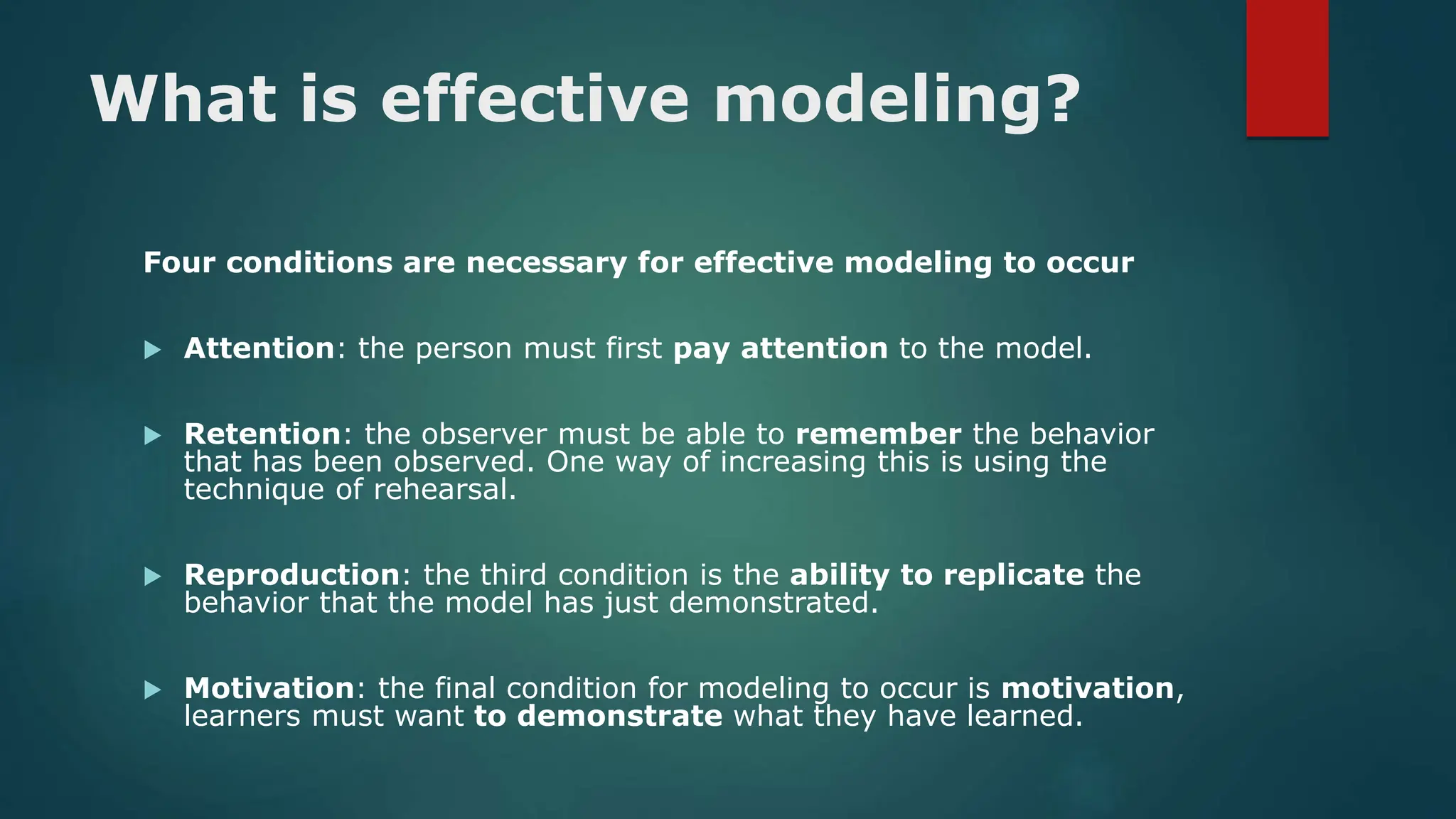
What is effective modeling?
Four conditions are necessary for effective modeling to occur
 Attention: the person must first pay attention to the model.
 Retention: the observer must be able to remember the behavior
that has been observed. One way of increasing this is using the
technique of rehearsal.
 Reproduction: the third condition is the ability to replicate the
behavior that the model has just demonstrated.
 Motivation: the final condition for modeling to occur is motivation,
learners must want to demonstrate what they have learned.
Implications for teaching
 Social learning theory has numerous implications for classroom use. The
theory revolves around the notion that learning correlates to the observation
of role models. In education, for example, teachers play the role of a model in a
child’s learning acquisition.
 Students often learn a great deal simply by observing other people.
 Describing the consequences of behavior can effectively increase the
appropriate behaviors and decrease inappropriate ones. Discussing with
learners about the rewards and consequences of various behaviors.
Implications for teaching
 Teachers and parents must model appropriate behaviors and take care that they do
not model inappropriate behaviors.
 Effective modelling teaches general rules and strategies for dealing with different
situations. Teachers should model the behaviors and cognitive processes they want
students to learn. Effective instruction, moreover, should include multiple types of
models (e.g., teacher, peers, parents) and various forms of modeling (e.g. cognitive,
verbal, mastery, coping).
 goal setting is another central process within SCT (Bandura, 1986; Schunk, 1990).
Goals reflect cognitive representations of anticipated, desired, or preferred outcomes.
Hence, goals exemplify the agency view within SCT that people not only learn, they
use forethought to envision the future, identify desired outcomes, and generate plans
of action.
Implications for teaching
 In practice this theory will involve:
 children working together on collaborative tasks
 the less able working with more able children
 teacher demonstrations
 peer support
Benefits of social learning theory
in the workplace
 Communication and Collaboration
Social learning enables a culture of collaboration and learning
from others. Ultimately, it can contribute to seamless and
authentic communication among colleagues, which can foster
a strong sense of team spirit.
Benefits of social learning theory
in the workplace
 Responsibility
Social learning has the power to encourage and empower
employees to take responsibility for their learning and even
contribute to their peers’ growth. That’s because people invariably
learn by observing peers and become driven in meeting their own
learning needs. This self-learning empowers them to own their
learning needs and, ultimately, their career development.
Benefits of social learning theory
in the workplace
 Motivation
The desire to imitate in social learning induces
feelings of motivation. This can lead to better
organizational productivity, more opportunities for
employee recognition, and – in the long run – better
employee retention rates.
Benefits of social learning theory
in the workplace
 Multi-modalities and channels
Modern employees go beyond the traditional
classroom to learn a skill or knowledge. By opening up
social learning, you expand the number of learning
avenues your employees can choose from in terms of
both formats and people.
How to apply social learning theory in
the workplace
 Make knowledge sharing part of business as usual
It’s important to make knowledge sharing an essential part of the job
description for employees. The more routine knowledge sharing
becomes, the lower the threshold, and the more likely employees will
take part.
 Make knowledge sharing user-friendly
The best way to share knowledge today is to use simple e-learning authoring
tools and online platforms like Easygenerator. This enables employees to capture
their knowledge, publish, and share it with their coworkers. To get the most out of
knowledge sharing, it’s essential to have software with a zero learning curve; one
that’s easy for anyone in the organization to master.
How to apply social learning theory in
the workplace
 Lead by example
As a manager, you have a strong influence over your team. Your actions
speak louder than your words. That’s why it’s important for you not only to
tell your team to share their knowledge but also to lead by example.
Practicing what you preach will show other employees how seriously you
take the expectations you set.
 Share relevant knowledge
Start by identifying what knowledge your colleagues are missing, and
what they would most benefit from. That way, you can decide what
knowledge is the most relevant and valuable to share.
Case Study-Microelectronics
 Microelectronics, a California-based electronics defense contractor, has enjoyed a smooth
growth curve over the past five years, primarily because of favourable defense funding
during the Reagan administration’s build-up of U.S. Military defenses. Microelectronics
has had numerous contracts to design and develop guidance and radar systems for
military weaponry.
 Although the favourable funding cycle has enabled. Microelectronics to grow at a steady
rate, the company is finding it increasingly difficult to keep its really good engineers.
Based on extensive turnover analyses conducted by Ned Jackson, the human resources
planning manager. Microelectronics’ problem seems to be its inability to keep engineers
beyond the ‘critical’ five year point. Apparently, the probability of turnover drops
dramatically after five years of service. Ned’s conclusion is that Microelectronics has been
essentially serving as an industry college. Their staffing strategy has always been to hire
the best and brightest engineers from the best engineering schools in the United States.
Case Study
 Ned believes that these engineers often get lost in the shuffle at the time they
join the firm. For example, most (if not all) of the new hires must work on non-
classified projects until cleared by security to join a designated major project.
 Security clearance usually takes anywhere from six to ten months. In the
meantime the major project has started, and these young engineers frequently
miss out on its design phase, considered the most creative and challenging
segment of the program. Because of the nature of project work, new engineers
often have difficulty learning the organizational culture–such as who to ask
when you have a problem, what the general do’s and don’ts are, and why the
organization does things in a certain way.
Case Study
 After heading a task force of human resource professionals within Microelectronics, Ned has
been designated to present to top management a proposal designed to reduce turnover among
young engineering recruits. The essence of his plan is to create a mentor program, except that
in this plan the mentors will not be the seasoned graybeards of Microelectronics, but rather
those engineers in the critical three-to-five-year service window, the period of highest turnover.
These engineers will be paired with new engineering recruits before the recruits actually report
to Microelectronics for work.
 According to the task force, the programme is two fold : (1) it benefits the newcomer by easing
the transition into the company, and (2) it helps the three-to-five-year service engineers by
enabling them to serve an important role for the company. Be performing the mentor role,
these engineers will become more committed and hence less likely to leave. As Ned prepared
his fifteen-minute presentation for top management, he wondered if he had adequately
anticipated the possible objections to the program in order to make an intelligent defense of it.
Only time would tell
Questions:
 If you were to study this turnover problem, how
would you solve the problem? Explain.
 Do you find the mentoring programme suitable to
reduce turnover ? Justify your answer.

Module 1.pptx

  • 1.
    LEARNING AND DEVELOPMENT MODULE 1 -INTRODUCTION TO LEARNING AND DEVELOPMENT By- Dr. Anushree Singh Associate Professor SOM-OMBR Campus CMR University
  • 2.
    Learning:  Refers tothe process of acquiring the response adequately to a situation which may or may not have previously encountered.  A widely accepted simple definition of ‘learning’ is any relatively permanent change in behaviour that occurs as a result of experience.  learning is a relatively permanent change in the frequency of occurrence of a specific individual behaviour.  In an organisational setting, it is the work-set and organisational norms, which will act as objective bases for determining whether an employee’s behaviour is desirable or undesirable and whether he or she needs to learn and practise productive work behaviour.  Thus, it is the process by which skills, knowledge, attitudes and behaviour are formed and developed as a result of education, training, socialisation and experience
  • 3.
    Features of Learning 1.Learning involves change, although the change may be for good or bad from an organisation’s point of view. 2. Not all changes reflect learning. To constitute learning, change should be relatively permanent. 3. Learning is reflected in behaviour. A change in an individual’s thought process or attitudes, not accompanied by behaviour, is no learning. 4. The change in behaviour should occur as a result of experience, practice, or training. 5. The practice or experience must be reinforced in order for learning to occur. If reinforcement does not accompany the practice or experience, the behaviour will eventually disappear. 6. Learning occurs throughout one’s life.
  • 4.
    Significance of Learning The importance of learning was first put forward by a Chinese philosopher, Confucius (551-479 BC) in these words: “Without learning, the wise become foolish; by learning, the foolish become wise”.  Ross, Smith, Roberts and Kleiner advocate this definition: “Learning in an organization means the continuous testing of experience and the transformation of that experience into knowledge - accessible to the whole organization and relevant to its core purpose.”  Organisational learning means the process of improving actions through better knowledge acquisition, clearer understanding, and improved performance. It is a method of detecting and correcting errors.
  • 5.
    Significance of Learning Theimportance of organizational learning is shown by the various benefits that occur in organizations that develop a learning culture:  Increased employee job satisfaction  Lower turnover rates  Increased productivity, profits and efficiency  Developing leaders at all levels  Enhanced adaptability throughout the organization
  • 6.
    Gagné's Five LearnedCapabilities The classification of learning according to Robert Gagne includes five kinds of learned capabilities:  intellectual skills,  cognitive strategies,  verbal information,  attitudes, and  motor skills.
  • 7.
    Learning Capabilities:  MotorSkills refers to bodily movements involving muscular activity. Examples might be: Starting a car, shooting a target, swinging a golf club.  Attitude is an internal state which affects an indiviudal’s choice of action toward some object, person, or event. Examples might be: Choosing to visit an art museum, writing letters in pursuit of a cause.
  • 8.
    Learning Capabilities:  VerbalInformation include: 1) Labels and Facts and 2) Bodies of Knowledge.  1) Labels and facts refer to naming or making a verbal response to a specific input. The response may be naming or citing a fact or set of facts. The respsonse may be vocal or written. Examples: Naming objects, people, or events. Recalling a person's birthday or hobbies. Stating the capitals of the United States.  2) Bodies of Knowledge refers to recalling a large body of interconnected facts. Example: paraphrasing the menaing of textual materials or stating rules and regulations.
  • 9.
    Learning Capabilities:  CognitiveStrategy is an internal process by which the learner controls his/her own ways of thinking and learning. Example: Engaging in self-testing to decide how much study is needed; knowing what sorts of questions to ask to best define a domain of knowledge; ability to form a mental model of the problem.  Intellectual Skills include 1) Discrimination 2) 2) Concrete concept 3) 3) Rule using and 4) 4) Problem solving. These are the four levels within the intellectual skills domain that Gagne identified as his taxonomy.
  • 10.
    Learning Capabilities:  Discriminationis making different responses to the different members of a particular class. Seeing the essential differences between inputs and responding differently to each. Example: Distinguishing yellow finches from house finches on the basis of markings; having to tell the differences between gauges on an instrument panel.  Concrete concept is responding in a single way to all members of a particular class of observable events. Seeing the essential similarity among a class of objects, people, or events, which calls for a single response. Example: Classifying music as jazz, country western, rock, etc.; saying "round upon seeing a manhole cover, a penny, and the moon.
  • 11.
    Learning Capabilities:  Ruleusing is applying a rule to a given situation or condition by responding to a class of inputs with a class of actions. Relating two or more simpler concepts in the particular manner of a rule. A rule states the relationship among concepts. Examples: It is helpful to think of rules or principles as "if-then" statements. "If a task is a procedure, then use flowcharting to analyze the task." "If you can convert a statement into an 'if-then' statement, then it is a rule or principle.“  Problem solving is combining lower level rules to solve problems in a situation never encountered by the person solving the problem. May involve generating new rules which receive trial and error use until the one that solves the problem is found.
  • 12.
    Principles of Learning 5principles of learning are; 1. Participation 2. Repetition 3. Relevance 4. Transference 5. Feedback
  • 13.
    Participation  Learning shouldpermit and encourage the active participation of the learner.  Participation improves motivation and apparently engages more senses that reinforce the learning process.  As a result of participation, people learn more quickly and retain that learning longer.  For example, most people never forget how to ride a bicycle because they actively participated in the learning process.  The learning activities should be experiential rather than just informational.  Therefore, the trainers should arrange the physical surroundings to facilitate small group interaction and promote the sharing of ideas.
  • 14.
    Repetition  An importantprinciple of learning is to provide the learner with the opportunity for practice and repetition.  To gain the full benefit of training, learned behaviors must be overlearned to ensure smooth performance and a minimum of forgetting at a later date.  Proficiency in learning and retaining new skills is improved when individuals visualize themselves performing the new behavior.
  • 15.
    Relevance  Learning ishelped when the material to be learned is meaningful. The learning should be problem- centered rather than content centered.  People are motivated to learn when training is immediately relevant to help them solve a current problem. Learning something just because someone says “it is important” is not as motivating.
  • 16.
    Transference  Because thetraining occurs in a special environment, an important question to ask is whether learning will transfer to the actual job situation.  Transfer of training occurs when trainees can apply the knowledge and skills learned in training courses to their jobs. The training has failed if the learning in one setting does not transfer to the actual job situation.  Three transfers training situations are possible;  Positive transfer of training when the training activities enhance performance in the new situation;  negative transfer of training, when the training activities inhibit performance in a new situation; and  no observable effect of training.
  • 17.
    Feedback  Feedback giveslearners information on their progress. Performance feedback is a necessary prerequisite for learning. Feedback improves performance not only by helping learners correct their mistakes but also by providing reinforcement for learning.  Knowledge of results is a positive reinforcement in itself. Learning activities have more intrinsic interest if feedback is available.  Nevertheless, performance feedback should do more than inform learners whether they are right or wrong.  Merely informing the trainees that they were wrong is not as effective as telling them why they were wrong and how they can avoid making mistakes in the future. In general, knowledge of results is an essential feature of learning, and this knowledge comes after the learner’s response.
  • 18.
    LEARNING PROCESS  “Learningis a process of acquiring knowledge, skills, behavior and attitude.” Learning includes following four stages: Stimulus Response Motivation Rewards
  • 19.
    LEARNING PROCESS  1.Stimulus Everyone needs a source of motivation to perform something and Stimulus is a motivating source or an incentive. Learners should have a good perception of stimuli, as the learner should be supported in the learning process. When there are no triggers there is no thought. Stimulus can take the form of 'knowledge expansion,' 'abilities and skills,' 'job quality improvement,' 'productivity and profitability,' 'effectiveness,' 'career development,' and 'financial and non-financial incentives.'
  • 20.
    LEARNING PROCESS  2.Response In theory, reaction is the result of the learner to the stimulus. When the result is reached, response is the first step in the process of learning. Learner will respond positively, because only then does the learning process take place and can he / she respond positively to certain negative reactions only if the learner is persuaded of positive behavioral changes
  • 21.
    LEARNING PROCESS  3.Motivation Motivation is the key catalyst to motivate individuals to learn, because learning cannot take place without motivation. It's the enthusiasm for learning that boosts curiosity and attitude. No one can learn without willingness and this willingness comes from motivation because we all know that whatever thinking and understanding capacity an one has without motivation, nobody can learn.
  • 22.
    LEARNING PROCESS  4.Rewards In learning process, rewards are incentives which learner gets. In learning process, there should be a clear incentive scheme, and it should be straightforward and predictive. Employees should be well aware in advance when studying at various rates of what they can get as return or bonuses. Rewards can come in both financial and non-financial form. For examples, praise is the incentive and salary increment etc.
  • 23.
    LEARNING THEORIES  reinforcementtheory,  Social learning theory,  goal theories,  expectancy,  adult learning theory,
  • 24.
    CLASSICAL CONDITIONING  Givenby Ivan Pavlov  People (and animals) acquire certain behaviors through classical conditioning Learning process in which associations are made between an unconditioned stimulus and a neutral stimulus.
  • 25.
    STIMULI  Something thatelicits a response.  NEUTRAL STIMULUS:  Initially does not elicit a response.  UNCONDITIONED STIMULUS (UCS):  elicits a predictable response w/o training.  UNCONDITIONED RESPONSE (UCR):  automatic or natural reaction to a stimulus w/o training
  • 26.
    STIMULI cont. CONDITIONED STIMULUS(CS):  elicits a response due to being paired with an UCS. CONDITIONED RESPONSE (CR):  the learned reaction to a CS
  • 28.
    Classical Conditioning -Ivan Pavlov  A. Pavlov’s Dogs Experiment (US) Unconditioned Stimulus - food (UR) Unconditioned Response - saliva (NS) Neutral Stimulus - bell (CS) Conditioned Stimulus - bell (CR) Conditioned Response - saliva to bell
  • 30.
    EXAMPLES OF CLASSICALCONDITIONING Using electric wires to keep cows in a field UCS - Electric shock UCR - Jump back CS - wire CR - Stay away
  • 31.
    ELECTRIC CAN OPENER/ CATS UCS - food UCR - Run into the kitchen CS - Can opener CR - Run into the kitchen
  • 32.
    Operant Conditioning Theory (ReinforcementTheory)  Operant conditioning, or instrumental conditioning, is a theory of learning where behavior is influenced by its consequences.  Behavior that is reinforced (rewarded) will likely be repeated, and behavior that is punished will occur less frequently.
  • 33.
    Operant Conditioning  Skinneris regarded as the father of Operant Conditioning, but his work was based on Thorndike’s (1898) law of effect.  According to this principle, behavior that is followed by pleasant consequences is likely to be repeated, and behavior followed by unpleasant consequences is less likely to be repeated.  Skinner introduced a new term into the Law of Effect – Reinforcement.  behavior which is reinforced tends to be repeated (i.e., strengthened);  behavior which is not reinforced tends to die out-or be extinguished (i.e., weakened).
  • 34.
     Skinner (1948)studied operant conditioning by conducting experiments using animals which he placed in a “ Skinner Box ”  A Skinner box, also known as an operant conditioning chamber, is a device used to objectively record an animal’s behavior in a compressed time frame. An animal can be rewarded or punished for engaging in certain behaviors, such as lever pressing (for rats) or key pecking (for pigeons).
  • 35.
    Operant Conditioning  Skinneridentified three types of responses, or operant, that can follow behavior.  Neutral operants: responses from the environment that neither increase nor decrease the probability of a behavior being repeated.  Reinforcers: Responses from the environment that increase the probability of a behavior being repeated. Reinforcers can be either positive or negative.  Punishers: Responses from the environment that decrease the likelihood of a behavior being repeated. Punishment weakens behavior.
  • 36.
    Positive Reinforcement  Inpositive reinforcement, a response or behavior is strengthened by rewards, leading to the repetition of desired behavior. The reward is a reinforcing stimulus.  Primary reinforcers are stimuli that are naturally reinforcing because they are not learned and directly satisfy a need, such as food or water.  Secondary reinforcers are stimuli that are reinforced through their association with a primary reinforcer, such as money, school grades. They do not directly satisfy an innate need but may be the means. So a secondary reinforcer can be just as powerful a motivator as a primary reinforcer.
  • 37.
    Positive Reinforcement  Skinnershowed how positive reinforcement worked by placing a hungry rat in his Skinner box. The box contained a lever on the side, and as the rat moved about the box, it would accidentally knock the lever. Immediately it did so that a food pellet would drop into a container next to the lever.
  • 38.
    Negative Reinforcement  Negativereinforcement is the termination of an unpleasant state following a response.  This is known as negative reinforcement because it is the removal of an adverse stimulus which is ‘rewarding’ to the animal or person. Negative reinforcement strengthens behavior because it stops or removes an unpleasant experience. For example, if you do not complete your homework, you give your teacher £5. You will complete your homework to avoid paying £5, thus strengthening the behavior of completing your homework.
  • 39.
    Negative Reinforcement  Skinnershowed how negative reinforcement worked by placing a rat in his Skinner box and then subjecting it to an unpleasant electric current which caused it some discomfort. As the rat moved about the box it would accidentally knock the lever.  Immediately it did so the electric current would be switched off. The rats quickly learned to go straight to the lever after a few times of being put in the box. The consequence of escaping the electric current ensured that they would repeat the action again and again.  In fact Skinner even taught the rats to avoid the electric current by turning on a light just before the electric current came on. The rats soon learned to press the lever when the light came on because they knew that this would stop the electric current being switched on. These two learned responses are known as Escape Learning and Avoidance Learning.
  • 40.
    Punishment (Weakens Behavior) Punishment is the opposite of reinforcement since it is designed to weaken or eliminate a response rather than increase it. It is an aversive event that decreases the behavior that it follows.  Like reinforcement, punishment can work either by directly applying an unpleasant stimulus like a shock after a response or by removing a potentially rewarding stimulus, for instance, deducting someone’s pocket money to punish undesirable behavior.  Note: It is not always easy to distinguish between punishment and negative reinforcement.
  • 41.
    Punishment (Weakens Behavior) There are many problems with using punishment, such as:  Punished behavior is not forgotten, it’s suppressed – behavior returns when punishment is no longer present.  Causes increased aggression – shows that aggression is a way to cope with problems.  Creates fear that can generalize to undesirable behaviors, e.g., fear of school.  Does not necessarily guide toward desired behavior – reinforcement tells you what to do, punishment only tells you what not to do.
  • 42.
    Examples Of OperantConditioning  Positive Reinforcement: Suppose you are a coach and want your team to improve their passing accuracy in soccer. When the players execute accurate passes during training, you praise their technique. This positive feedback encourages them to repeat the correct passing behavior.  Negative Reinforcement: If you notice your team working together effectively and exhibiting excellent team spirit during a tough training session, you might end the training session earlier than planned, which the team perceives as a relief. They understand that teamwork leads to positive outcomes, reinforcing team behavior.
  • 43.
    Examples Of OperantConditioning  Negative Punishment: If an office worker continually arrives late, their manager might revoke the privilege of flexible working hours. This removal of a positive stimulus encourages the employee to be punctual.  Positive Reinforcement: Training a cat to use a litter box can be achieved by giving it a treat each time it uses it correctly. The cat will associate the behavior with the reward and will likely repeat it.  Negative Punishment: If teenagers stay out past their curfew, their parents might take away their gaming console for a week. This makes the teenager more likely to respect their curfew in the future to avoid losing something they value.
  • 44.
    Examples Of OperantConditioning  Ineffective Punishment: Your child refuses to finish their vegetables at dinner. You punish them by not allowing dessert, but the child still refuses to eat vegetables next time. The punishment seems ineffective.  Premack Principle Application: You could motivate your child to eat vegetables by offering an activity they love after they finish their meal. For instance, for every vegetable eaten, they get an extra five minutes of video game time. They value video game time, which might encourage them to eat vegetables.
  • 45.
    SOCIAL LEARNING THEORY Social learning theory is based upon the work of Albert Bandura. It is also referred to as Social Cognitive Theory (SCT)  This theory attempts to understand the process that is involved in explaining how we learn from each other  It focuses on learning that occurs by direct experience by observing, imitating, and modeling  It provides a framework for understanding, predicting and potentially changing human behaviour.  Aspects of Bandura’s theory are that: o children learn by observing others, o the same set of stimuli may provoke different responses from different people, or from the same people at different times o the environment and a person’s behaviour are interlinked; o personality is an interaction between three factors: the environment, behaviour, and a person’s psychological processes.  All 3 play an important role in the learning process. They are constantly influencing each other  Environmental factors would include  Social aspects - peers, family and teachers and Physical factors - the layout or size of the class room or the temperature of the room
  • 46.
    SOCIAL LEARNING THEORY His research suggests that 70% of a person’s learning happens through personal experience, 20% through interactions with peers, and 10% in instructor-led classroom environments.  Some of the examples of observed behavior and social learning include motivation and work ethics. It is the process of changing our behavior by modeling it on the behavior of a successful person like a manager who has achieved an end that is desired. Social learning is complementary to specific learning contexts. However, it is a subconscious action which is part of everyday life.  Applications of social learning in organizations are workshops, mentoring, coaching, group discussions and panels.
  • 47.
    What is effectivemodeling? Four conditions are necessary for effective modeling to occur  Attention: the person must first pay attention to the model.  Retention: the observer must be able to remember the behavior that has been observed. One way of increasing this is using the technique of rehearsal.  Reproduction: the third condition is the ability to replicate the behavior that the model has just demonstrated.  Motivation: the final condition for modeling to occur is motivation, learners must want to demonstrate what they have learned.
  • 48.
    Implications for teaching Social learning theory has numerous implications for classroom use. The theory revolves around the notion that learning correlates to the observation of role models. In education, for example, teachers play the role of a model in a child’s learning acquisition.  Students often learn a great deal simply by observing other people.  Describing the consequences of behavior can effectively increase the appropriate behaviors and decrease inappropriate ones. Discussing with learners about the rewards and consequences of various behaviors.
  • 49.
    Implications for teaching Teachers and parents must model appropriate behaviors and take care that they do not model inappropriate behaviors.  Effective modelling teaches general rules and strategies for dealing with different situations. Teachers should model the behaviors and cognitive processes they want students to learn. Effective instruction, moreover, should include multiple types of models (e.g., teacher, peers, parents) and various forms of modeling (e.g. cognitive, verbal, mastery, coping).  goal setting is another central process within SCT (Bandura, 1986; Schunk, 1990). Goals reflect cognitive representations of anticipated, desired, or preferred outcomes. Hence, goals exemplify the agency view within SCT that people not only learn, they use forethought to envision the future, identify desired outcomes, and generate plans of action.
  • 50.
    Implications for teaching In practice this theory will involve:  children working together on collaborative tasks  the less able working with more able children  teacher demonstrations  peer support
  • 51.
    Benefits of sociallearning theory in the workplace  Communication and Collaboration Social learning enables a culture of collaboration and learning from others. Ultimately, it can contribute to seamless and authentic communication among colleagues, which can foster a strong sense of team spirit.
  • 52.
    Benefits of sociallearning theory in the workplace  Responsibility Social learning has the power to encourage and empower employees to take responsibility for their learning and even contribute to their peers’ growth. That’s because people invariably learn by observing peers and become driven in meeting their own learning needs. This self-learning empowers them to own their learning needs and, ultimately, their career development.
  • 53.
    Benefits of sociallearning theory in the workplace  Motivation The desire to imitate in social learning induces feelings of motivation. This can lead to better organizational productivity, more opportunities for employee recognition, and – in the long run – better employee retention rates.
  • 54.
    Benefits of sociallearning theory in the workplace  Multi-modalities and channels Modern employees go beyond the traditional classroom to learn a skill or knowledge. By opening up social learning, you expand the number of learning avenues your employees can choose from in terms of both formats and people.
  • 55.
    How to applysocial learning theory in the workplace  Make knowledge sharing part of business as usual It’s important to make knowledge sharing an essential part of the job description for employees. The more routine knowledge sharing becomes, the lower the threshold, and the more likely employees will take part.  Make knowledge sharing user-friendly The best way to share knowledge today is to use simple e-learning authoring tools and online platforms like Easygenerator. This enables employees to capture their knowledge, publish, and share it with their coworkers. To get the most out of knowledge sharing, it’s essential to have software with a zero learning curve; one that’s easy for anyone in the organization to master.
  • 56.
    How to applysocial learning theory in the workplace  Lead by example As a manager, you have a strong influence over your team. Your actions speak louder than your words. That’s why it’s important for you not only to tell your team to share their knowledge but also to lead by example. Practicing what you preach will show other employees how seriously you take the expectations you set.  Share relevant knowledge Start by identifying what knowledge your colleagues are missing, and what they would most benefit from. That way, you can decide what knowledge is the most relevant and valuable to share.
  • 57.
    Case Study-Microelectronics  Microelectronics,a California-based electronics defense contractor, has enjoyed a smooth growth curve over the past five years, primarily because of favourable defense funding during the Reagan administration’s build-up of U.S. Military defenses. Microelectronics has had numerous contracts to design and develop guidance and radar systems for military weaponry.  Although the favourable funding cycle has enabled. Microelectronics to grow at a steady rate, the company is finding it increasingly difficult to keep its really good engineers. Based on extensive turnover analyses conducted by Ned Jackson, the human resources planning manager. Microelectronics’ problem seems to be its inability to keep engineers beyond the ‘critical’ five year point. Apparently, the probability of turnover drops dramatically after five years of service. Ned’s conclusion is that Microelectronics has been essentially serving as an industry college. Their staffing strategy has always been to hire the best and brightest engineers from the best engineering schools in the United States.
  • 58.
    Case Study  Nedbelieves that these engineers often get lost in the shuffle at the time they join the firm. For example, most (if not all) of the new hires must work on non- classified projects until cleared by security to join a designated major project.  Security clearance usually takes anywhere from six to ten months. In the meantime the major project has started, and these young engineers frequently miss out on its design phase, considered the most creative and challenging segment of the program. Because of the nature of project work, new engineers often have difficulty learning the organizational culture–such as who to ask when you have a problem, what the general do’s and don’ts are, and why the organization does things in a certain way.
  • 59.
    Case Study  Afterheading a task force of human resource professionals within Microelectronics, Ned has been designated to present to top management a proposal designed to reduce turnover among young engineering recruits. The essence of his plan is to create a mentor program, except that in this plan the mentors will not be the seasoned graybeards of Microelectronics, but rather those engineers in the critical three-to-five-year service window, the period of highest turnover. These engineers will be paired with new engineering recruits before the recruits actually report to Microelectronics for work.  According to the task force, the programme is two fold : (1) it benefits the newcomer by easing the transition into the company, and (2) it helps the three-to-five-year service engineers by enabling them to serve an important role for the company. Be performing the mentor role, these engineers will become more committed and hence less likely to leave. As Ned prepared his fifteen-minute presentation for top management, he wondered if he had adequately anticipated the possible objections to the program in order to make an intelligent defense of it. Only time would tell
  • 60.
    Questions:  If youwere to study this turnover problem, how would you solve the problem? Explain.  Do you find the mentoring programme suitable to reduce turnover ? Justify your answer.