PERFECT TENSES


   Miguel Ángel Rodríguez López
Present Perfect
FORM
[has/have + past participle]

Examples:
• You have seen that movie many times.
• Have you seen that movie many times?
• You have not seen that movie many
  times.
Present Perfect
USE 1 Unspecified Time Before Now
We use the Present Perfect to say that an action
 happened at an unspecified time before now.
 The exact time is not important.


I have been to France.
Doctors have cured many deadly diseases.
                               diseases
Present Perfect
USE 2 Duration From the Past Until
 Now
We use the Present Perfect to show that something started
 in the past and has continued up until now. "For five
 minutes," "for two weeks," and "since Tuesday" are all
 durations which can be used with the Present Perfect.


I have had a cold for two weeks.
Mary has loved chocolate since she was a
  little girl.
Present Perfect Continuous
FORM
[has/have + been + present participle]
Examples:
• You have been waiting here for two
  hours.
• Have you been waiting here for two
  hours?
• You have not been waiting here for two
  hours.
Present Perfect Continuous
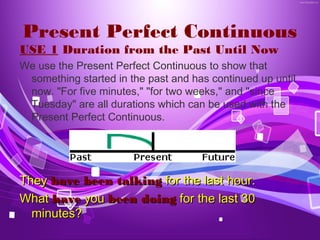
USE 1 Duration from the Past Until Now
We use the Present Perfect Continuous to show that
 something started in the past and has continued up until
 now. "For five minutes," "for two weeks," and "since
 Tuesday" are all durations which can be used with the
 Present Perfect Continuous.


They have been talking for the last hour.
What have you been doing for the last 30
  minutes?
Present Perfect Continuous
USE 2 Recently, Lately
You can also use the Present Perfect Continuous
  WITHOUT a duration such as "for two weeks." Without
  the duration, the tense has a more general meaning of
  "lately." We often use the words "lately" or "recently" to
  emphasize this meaning.


Recently, I have been feeling really tired.
She has been watching too much
 television lately.
Past Perfect
FORM
[had + past participle]
Examples:
• You had studied English before you
  moved to New York.
• Had you studied English before you
  moved to New York?
• You had not studied English before you
  moved to New York.
Past Perfect
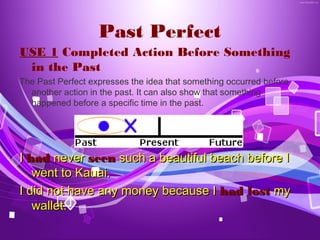
USE 1 Completed Action Before Something
 in the Past
The Past Perfect expresses the idea that something occurred before
  another action in the past. It can also show that something
  happened before a specific time in the past.


I had never seen such a beautiful beach before I
   went to Kauai.
I did not have any money because I had lost my
   wallet.
Past Perfect
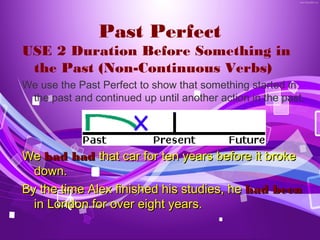
USE 2 Duration Before Something in
 the Past (Non-Continuous Verbs)
We use the Past Perfect to show that something started in
 the past and continued up until another action in the past.


We had had that car for ten years before it broke
  down.
By the time Alex finished his studies, he had been
  in London for over eight years.
Past Perfect Continuous
FORM
[had been + present participle]
You had been waiting there for more than
  two hours when she finally arrived.
Had you been waiting there for more than
  two hours when she finally arrived?
You had not been waiting there for more
  than two hours when she finally arrived.
Past Perfect Continuous
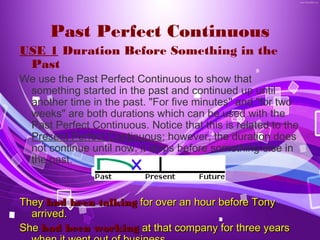
USE 1 Duration Before Something in the
 Past
We use the Past Perfect Continuous to show that
 something started in the past and continued up until
 another time in the past. "For five minutes" and "for two
 weeks" are both durations which can be used with the
 Past Perfect Continuous. Notice that this is related to the
 Present Perfect Continuous; however, the duration does
 not continue until now, it stops before something else in
 the past.


They had been talking for over an hour before Tony
  arrived.
She had been working at that company for three years
Past Perfect Continuous
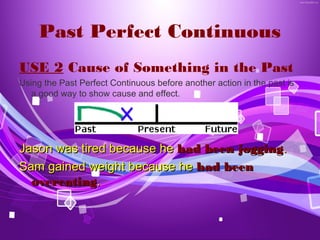
USE 2 Cause of Something in the Past
Using the Past Perfect Continuous before another action in the past is
   a good way to show cause and effect.


Jason was tired because he had been jogging.
Sam gained weight because he had been
  overeating.
Future Perfect
FORM Future Perfect
[will have + past participle]
Examples:
• You will have perfected your English by
  the time you come back from the U.S.
• Will you have perfected your English by
  the time you come back from the U.S.?
• You will not have perfected your
  English by the time you come back from
  the U.S.
Future Perfect
USE 1 Completed Action Before
 Something in the Future
The Future Perfect expresses the idea that something will
  occur before another action in the future. It can also
  show that something will happen before a specific time in
  the future.


By next November, I will have received my promotion.
Will she have learned enough Chinese to communicate
  before she moves to Beijing?
Future Perfect
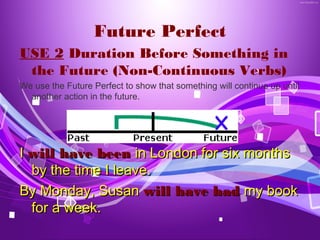
USE 2 Duration Before Something in
 the Future (Non-Continuous Verbs)
We use the Future Perfect to show that something will continue up until
  another action in the future.


I will have been in London for six months
  by the time I leave.
By Monday, Susan will have had my book
  for a week.
Notice:
Future Perfect Continuous:
You will have been waiting for more than two hours when
  her plane finally arrives.
Will you have been waiting for more than two hours when
  her plane finally arrives?
You will not have been waiting for more than two hours when
  her plane finally arrives.


  The particles for, since, already, yet, ever (never)… are normally used with
                                 perfect tenses
The end

Perfect tenses

  • 1.
    PERFECT TENSES Miguel Ángel Rodríguez López
  • 2.
    Present Perfect FORM [has/have +past participle] Examples: • You have seen that movie many times. • Have you seen that movie many times? • You have not seen that movie many times.
  • 3.
    Present Perfect USE 1Unspecified Time Before Now We use the Present Perfect to say that an action happened at an unspecified time before now. The exact time is not important. I have been to France. Doctors have cured many deadly diseases. diseases
  • 4.
    Present Perfect USE 2Duration From the Past Until Now We use the Present Perfect to show that something started in the past and has continued up until now. "For five minutes," "for two weeks," and "since Tuesday" are all durations which can be used with the Present Perfect. I have had a cold for two weeks. Mary has loved chocolate since she was a little girl.
  • 5.
    Present Perfect Continuous FORM [has/have+ been + present participle] Examples: • You have been waiting here for two hours. • Have you been waiting here for two hours? • You have not been waiting here for two hours.
  • 6.
    Present Perfect Continuous USE1 Duration from the Past Until Now We use the Present Perfect Continuous to show that something started in the past and has continued up until now. "For five minutes," "for two weeks," and "since Tuesday" are all durations which can be used with the Present Perfect Continuous. They have been talking for the last hour. What have you been doing for the last 30 minutes?
  • 7.
    Present Perfect Continuous USE2 Recently, Lately You can also use the Present Perfect Continuous WITHOUT a duration such as "for two weeks." Without the duration, the tense has a more general meaning of "lately." We often use the words "lately" or "recently" to emphasize this meaning. Recently, I have been feeling really tired. She has been watching too much television lately.
  • 8.
    Past Perfect FORM [had +past participle] Examples: • You had studied English before you moved to New York. • Had you studied English before you moved to New York? • You had not studied English before you moved to New York.
  • 9.
    Past Perfect USE 1Completed Action Before Something in the Past The Past Perfect expresses the idea that something occurred before another action in the past. It can also show that something happened before a specific time in the past. I had never seen such a beautiful beach before I went to Kauai. I did not have any money because I had lost my wallet.
  • 10.
    Past Perfect USE 2Duration Before Something in the Past (Non-Continuous Verbs) We use the Past Perfect to show that something started in the past and continued up until another action in the past. We had had that car for ten years before it broke down. By the time Alex finished his studies, he had been in London for over eight years.
  • 11.
    Past Perfect Continuous FORM [hadbeen + present participle] You had been waiting there for more than two hours when she finally arrived. Had you been waiting there for more than two hours when she finally arrived? You had not been waiting there for more than two hours when she finally arrived.
  • 12.
    Past Perfect Continuous USE1 Duration Before Something in the Past We use the Past Perfect Continuous to show that something started in the past and continued up until another time in the past. "For five minutes" and "for two weeks" are both durations which can be used with the Past Perfect Continuous. Notice that this is related to the Present Perfect Continuous; however, the duration does not continue until now, it stops before something else in the past. They had been talking for over an hour before Tony arrived. She had been working at that company for three years
  • 13.
    Past Perfect Continuous USE2 Cause of Something in the Past Using the Past Perfect Continuous before another action in the past is a good way to show cause and effect. Jason was tired because he had been jogging. Sam gained weight because he had been overeating.
  • 14.
    Future Perfect FORM FuturePerfect [will have + past participle] Examples: • You will have perfected your English by the time you come back from the U.S. • Will you have perfected your English by the time you come back from the U.S.? • You will not have perfected your English by the time you come back from the U.S.
  • 15.
    Future Perfect USE 1Completed Action Before Something in the Future The Future Perfect expresses the idea that something will occur before another action in the future. It can also show that something will happen before a specific time in the future. By next November, I will have received my promotion. Will she have learned enough Chinese to communicate before she moves to Beijing?
  • 16.
    Future Perfect USE 2Duration Before Something in the Future (Non-Continuous Verbs) We use the Future Perfect to show that something will continue up until another action in the future. I will have been in London for six months by the time I leave. By Monday, Susan will have had my book for a week.
  • 17.
    Notice: Future Perfect Continuous: Youwill have been waiting for more than two hours when her plane finally arrives. Will you have been waiting for more than two hours when her plane finally arrives? You will not have been waiting for more than two hours when her plane finally arrives. The particles for, since, already, yet, ever (never)… are normally used with perfect tenses
  • 18.