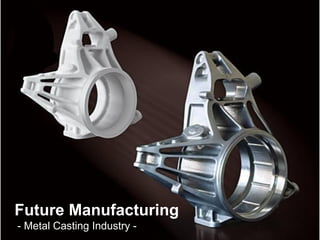
Future Manufacturing
- Metal Casting Industry -
ADVANCES IN
CAE & MANUFACTURING TECHNOLOGY
and the opportunities for the Casting Industry
South African Institute of Foundrymen
16 February 2016
Gronum Smith – Altair Engineering (agsmith@altair.co.za)
Adriaan van Der Walt - Access CAD/CAM (info@accesscadcam.co.za)
David Bullock - Rapid3D (david@rapid3d.co.za)
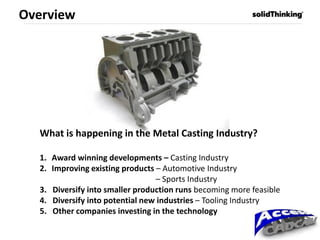
What is happening in the Metal Casting Industry?
1. Award winning developments – Casting Industry
2. Improving existing products – Automotive Industry
– Sports Industry
3. Diversify into smaller production runs becoming more feasible
4. Diversify into potential new industries – Tooling Industry
5. Other companies investing in the technology
Overview
1. Award winning developments – Casting Industry
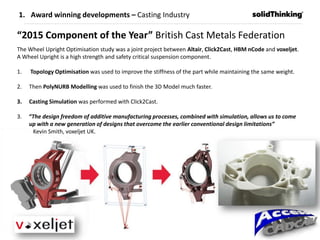
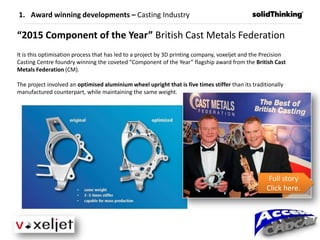
“2015 Component of the Year” British Cast Metals Federation
The Wheel Upright Optimisation study was a joint project between Altair, Click2Cast, HBM nCode and voxeljet.
A Wheel Upright is a high strength and safety critical suspension component.
1. Topology Optimisation was used to improve the stiffness of the part while maintaining the same weight.
2. Then PolyNURB Modelling was used to finish the 3D Model much faster.
3. Casting Simulation was performed with Click2Cast.
3. “The design freedom of additive manufacturing processes, combined with simulation, allows us to come
up with a new generation of designs that overcome the earlier conventional design limitations”
Kevin Smith, voxeljet UK.
“2015 Component of the Year” British Cast Metals Federation
It is this optimisation process that has led to a project by 3D printing company, voxeljet and the Precision
Casting Centre foundry winning the coveted “Component of the Year” flagship award from the British Cast
Metals Federation (CM).
The project involved an optimised aluminium wheel upright that is five times stiffer than its traditionally
manufactured counterpart, while maintaining the same weight.
1. Award winning developments – Casting Industry
Full story
Click here.
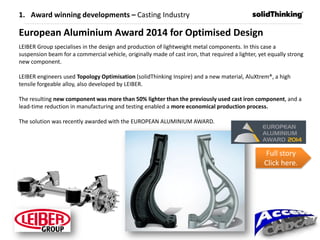
European Aluminium Award 2014 for Optimised Design
LEIBER Group specialises in the design and production of lightweight metal components. In this case a
suspension beam for a commercial vehicle, originally made of cast iron, that required a lighter, yet equally strong
new component.
LEIBER engineers used Topology Optimisation (solidThinking Inspire) and a new material, AluXtrem®, a high
tensile forgeable alloy, also developed by LEIBER.
The resulting new component was more than 50% lighter than the previously used cast iron component, and a
lead-time reduction in manufacturing and testing enabled a more economical production process.
The solution was recently awarded with the EUROPEAN ALUMINIUM AWARD.
Full story
Click here.
1. Award winning developments – Casting Industry
2. Improving existing products – Automotive Industry
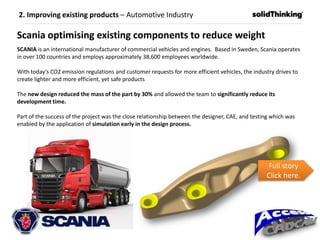
Scania optimising existing components to reduce weight
SCANIA is an international manufacturer of commercial vehicles and engines. Based in Sweden, Scania operates
in over 100 countries and employs approximately 38,600 employees worldwide.
With today’s CO2 emission regulations and customer requests for more efficient vehicles, the industry drives to
create lighter and more efficient, yet safe products
The new design reduced the mass of the part by 30% and allowed the team to significantly reduce its
development time.
Part of the success of the project was the close relationship between the designer, CAE, and testing which was
enabled by the application of simulation early in the design process.
Full story
Click here.
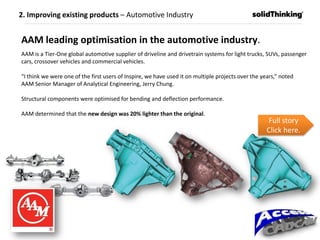
AAM leading optimisation in the automotive industry.
AAM is a Tier-One global automotive supplier of driveline and drivetrain systems for light trucks, SUVs, passenger
cars, crossover vehicles and commercial vehicles.
“I think we were one of the first users of Inspire, we have used it on multiple projects over the years,” noted
AAM Senior Manager of Analytical Engineering, Jerry Chung.
Structural components were optimised for bending and deflection performance.
AAM determined that the new design was 20% lighter than the original.
Full story
Click here.
2. Improving existing products – Automotive Industry
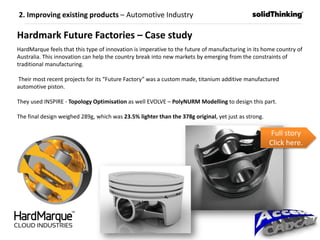
Hardmark Future Factories – Case study
HardMarque feels that this type of innovation is imperative to the future of manufacturing in its home country of
Australia. This innovation can help the country break into new markets by emerging from the constraints of
traditional manufacturing.
Their most recent projects for its “Future Factory” was a custom made, titanium additive manufactured
automotive piston.
They used INSPIRE - Topology Optimisation as well EVOLVE – PolyNURM Modelling to design this part.
The final design weighed 289g, which was 23.5% lighter than the 378g original, yet just as strong.
Full story
Click here.
2. Improving existing products – Automotive Industry
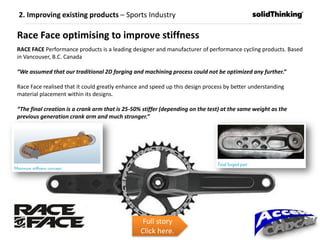
Race Face optimising to improve stiffness
RACE FACE Performance products is a leading designer and manufacturer of performance cycling products. Based
in Vancouver, B.C. Canada
“We assumed that our traditional 2D forging and machining process could not be optimized any further.”
Race Face realised that it could greatly enhance and speed up this design process by better understanding
material placement within its designs.
“The final creation is a crank arm that is 25-50% stiffer (depending on the test) at the same weight as the
previous generation crank arm and much stronger.”
Full story
Click here.
2. Improving existing products – Sports Industry
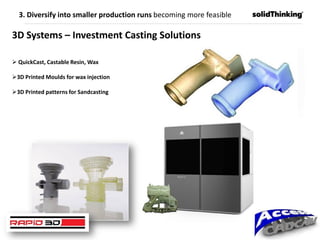
3D Systems – Investment Casting Solutions
 QuickCast, Castable Resin, Wax
3D Printed Moulds for wax injection
3D Printed patterns for Sandcasting
3. Diversify into smaller production runs becoming more feasible
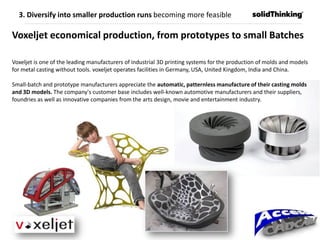
Voxeljet economical production, from prototypes to small Batches
Voxeljet is one of the leading manufacturers of industrial 3D printing systems for the production of molds and models
for metal casting without tools. voxeljet operates facilities in Germany, USA, United Kingdom, India and China.
Small-batch and prototype manufacturers appreciate the automatic, patternless manufacture of their casting molds
and 3D models. The company's customer base includes well-known automotive manufacturers and their suppliers,
foundries as well as innovative companies from the arts design, movie and entertainment industry.
3. Diversify into smaller production runs becoming more feasible
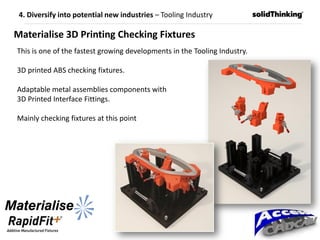
This is one of the fastest growing developments in the Tooling Industry.
3D printed ABS checking fixtures.
Adaptable metal assemblies components with
3D Printed Interface Fittings.
Mainly checking fixtures at this point
Materialise 3D Printing Checking Fixtures
4. Diversify into potential new industries – Tooling Industry
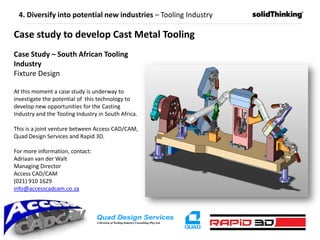
Case Study – South African Tooling
Industry
Fixture Design
At this moment a case study is underway to
investigate the potential of this technology to
develop new opportunities for the Casting
Industry and the Tooling Industry in South Africa.
This is a joint venture between Access CAD/CAM,
Quad Design Services and Rapid 3D.
For more information, contact:
Adriaan van der Walt
Managing Director
Access CAD/CAM
(021) 910 1629
info@accesscadcam.co.za
Case study to develop Cast Metal Tooling
4. Diversify into potential new industries – Tooling Industry
5. Other companies investing in this technology
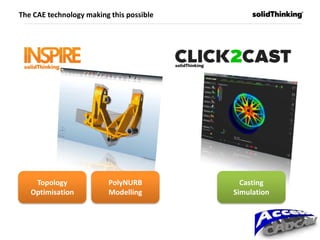
The CAE technology making this possible
Topology
Optimisation
PolyNURB
Modelling
Casting
Simulation
Click Here
What is Topology Optimisation?
Faster Smarter Lighter
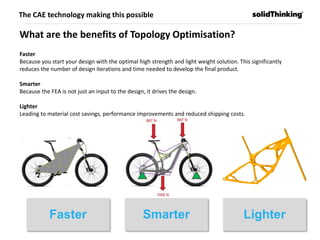
What are the benefits of Topology Optimisation?
Faster
Because you start your design with the optimal high strength and light weight solution. This significantly
reduces the number of design iterations and time needed to develop the final product.
Smarter
Because the FEA is not just an input to the design, it drives the design.
Lighter
Leading to material cost savings, performance improvements and reduced shipping costs.
The CAE technology making this possible
What is new for Casting Simulation?
Click Here
AnalyzeVisualize Validate
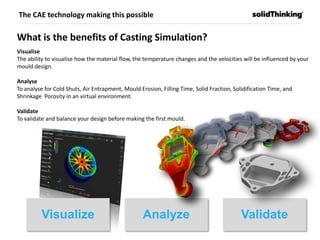
What is the benefits of Casting Simulation?
Visualise
The ability to visualise how the material flow, the temperature changes and the velocities will be influenced by your
mould design.
Analyse
To analyse for Cold Shuts, Air Entrapment, Mould Erosion, Filling Time, Solid Fraction, Solidification Time, and
Shrinkage Porosity in an virtual environment.
Validate
To validate and balance your design before making the first mould.
The CAE technology making this possible
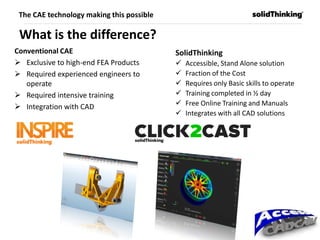
What is the difference?
Conventional CAE
 Exclusive to high-end FEA Products
 Required experienced engineers to
operate
 Required intensive training
 Integration with CAD
SolidThinking
 Accessible, Stand Alone solution
 Fraction of the Cost
 Requires only Basic skills to operate
 Training completed in ½ day
 Free Online Training and Manuals
 Integrates with all CAD solutions
The CAE technology making this possible
solidThinking – an Altair company
Channel Partner
About the Company
For more information:
Web: http://www.accesscadcam.co.za/
Email: info@accesscadcam.co.za
Phone: (021) 910 1629

Future Manufacturing - Metal Casting Industry

  • 1.
    Future Manufacturing - MetalCasting Industry -
  • 2.
    ADVANCES IN CAE &MANUFACTURING TECHNOLOGY and the opportunities for the Casting Industry South African Institute of Foundrymen 16 February 2016 Gronum Smith – Altair Engineering (agsmith@altair.co.za) Adriaan van Der Walt - Access CAD/CAM (info@accesscadcam.co.za) David Bullock - Rapid3D (david@rapid3d.co.za)
  • 3.
    What is happeningin the Metal Casting Industry? 1. Award winning developments – Casting Industry 2. Improving existing products – Automotive Industry – Sports Industry 3. Diversify into smaller production runs becoming more feasible 4. Diversify into potential new industries – Tooling Industry 5. Other companies investing in the technology Overview
  • 4.
    1. Award winningdevelopments – Casting Industry “2015 Component of the Year” British Cast Metals Federation The Wheel Upright Optimisation study was a joint project between Altair, Click2Cast, HBM nCode and voxeljet. A Wheel Upright is a high strength and safety critical suspension component. 1. Topology Optimisation was used to improve the stiffness of the part while maintaining the same weight. 2. Then PolyNURB Modelling was used to finish the 3D Model much faster. 3. Casting Simulation was performed with Click2Cast. 3. “The design freedom of additive manufacturing processes, combined with simulation, allows us to come up with a new generation of designs that overcome the earlier conventional design limitations” Kevin Smith, voxeljet UK.
  • 5.
    “2015 Component ofthe Year” British Cast Metals Federation It is this optimisation process that has led to a project by 3D printing company, voxeljet and the Precision Casting Centre foundry winning the coveted “Component of the Year” flagship award from the British Cast Metals Federation (CM). The project involved an optimised aluminium wheel upright that is five times stiffer than its traditionally manufactured counterpart, while maintaining the same weight. 1. Award winning developments – Casting Industry Full story Click here.
  • 6.
    European Aluminium Award2014 for Optimised Design LEIBER Group specialises in the design and production of lightweight metal components. In this case a suspension beam for a commercial vehicle, originally made of cast iron, that required a lighter, yet equally strong new component. LEIBER engineers used Topology Optimisation (solidThinking Inspire) and a new material, AluXtrem®, a high tensile forgeable alloy, also developed by LEIBER. The resulting new component was more than 50% lighter than the previously used cast iron component, and a lead-time reduction in manufacturing and testing enabled a more economical production process. The solution was recently awarded with the EUROPEAN ALUMINIUM AWARD. Full story Click here. 1. Award winning developments – Casting Industry
  • 7.
    2. Improving existingproducts – Automotive Industry Scania optimising existing components to reduce weight SCANIA is an international manufacturer of commercial vehicles and engines. Based in Sweden, Scania operates in over 100 countries and employs approximately 38,600 employees worldwide. With today’s CO2 emission regulations and customer requests for more efficient vehicles, the industry drives to create lighter and more efficient, yet safe products The new design reduced the mass of the part by 30% and allowed the team to significantly reduce its development time. Part of the success of the project was the close relationship between the designer, CAE, and testing which was enabled by the application of simulation early in the design process. Full story Click here.
  • 8.
    AAM leading optimisationin the automotive industry. AAM is a Tier-One global automotive supplier of driveline and drivetrain systems for light trucks, SUVs, passenger cars, crossover vehicles and commercial vehicles. “I think we were one of the first users of Inspire, we have used it on multiple projects over the years,” noted AAM Senior Manager of Analytical Engineering, Jerry Chung. Structural components were optimised for bending and deflection performance. AAM determined that the new design was 20% lighter than the original. Full story Click here. 2. Improving existing products – Automotive Industry
  • 9.
    Hardmark Future Factories– Case study HardMarque feels that this type of innovation is imperative to the future of manufacturing in its home country of Australia. This innovation can help the country break into new markets by emerging from the constraints of traditional manufacturing. Their most recent projects for its “Future Factory” was a custom made, titanium additive manufactured automotive piston. They used INSPIRE - Topology Optimisation as well EVOLVE – PolyNURM Modelling to design this part. The final design weighed 289g, which was 23.5% lighter than the 378g original, yet just as strong. Full story Click here. 2. Improving existing products – Automotive Industry
  • 10.
    Race Face optimisingto improve stiffness RACE FACE Performance products is a leading designer and manufacturer of performance cycling products. Based in Vancouver, B.C. Canada “We assumed that our traditional 2D forging and machining process could not be optimized any further.” Race Face realised that it could greatly enhance and speed up this design process by better understanding material placement within its designs. “The final creation is a crank arm that is 25-50% stiffer (depending on the test) at the same weight as the previous generation crank arm and much stronger.” Full story Click here. 2. Improving existing products – Sports Industry
  • 11.
    3D Systems –Investment Casting Solutions  QuickCast, Castable Resin, Wax 3D Printed Moulds for wax injection 3D Printed patterns for Sandcasting 3. Diversify into smaller production runs becoming more feasible
  • 12.
    Voxeljet economical production,from prototypes to small Batches Voxeljet is one of the leading manufacturers of industrial 3D printing systems for the production of molds and models for metal casting without tools. voxeljet operates facilities in Germany, USA, United Kingdom, India and China. Small-batch and prototype manufacturers appreciate the automatic, patternless manufacture of their casting molds and 3D models. The company's customer base includes well-known automotive manufacturers and their suppliers, foundries as well as innovative companies from the arts design, movie and entertainment industry. 3. Diversify into smaller production runs becoming more feasible
  • 13.
    This is oneof the fastest growing developments in the Tooling Industry. 3D printed ABS checking fixtures. Adaptable metal assemblies components with 3D Printed Interface Fittings. Mainly checking fixtures at this point Materialise 3D Printing Checking Fixtures 4. Diversify into potential new industries – Tooling Industry
  • 14.
    Case Study –South African Tooling Industry Fixture Design At this moment a case study is underway to investigate the potential of this technology to develop new opportunities for the Casting Industry and the Tooling Industry in South Africa. This is a joint venture between Access CAD/CAM, Quad Design Services and Rapid 3D. For more information, contact: Adriaan van der Walt Managing Director Access CAD/CAM (021) 910 1629 info@accesscadcam.co.za Case study to develop Cast Metal Tooling 4. Diversify into potential new industries – Tooling Industry
  • 15.
    5. Other companiesinvesting in this technology
  • 16.
    The CAE technologymaking this possible Topology Optimisation PolyNURB Modelling Casting Simulation
  • 17.
    Click Here What isTopology Optimisation?
  • 18.
    Faster Smarter Lighter Whatare the benefits of Topology Optimisation? Faster Because you start your design with the optimal high strength and light weight solution. This significantly reduces the number of design iterations and time needed to develop the final product. Smarter Because the FEA is not just an input to the design, it drives the design. Lighter Leading to material cost savings, performance improvements and reduced shipping costs. The CAE technology making this possible
  • 19.
    What is newfor Casting Simulation? Click Here
  • 20.
    AnalyzeVisualize Validate What isthe benefits of Casting Simulation? Visualise The ability to visualise how the material flow, the temperature changes and the velocities will be influenced by your mould design. Analyse To analyse for Cold Shuts, Air Entrapment, Mould Erosion, Filling Time, Solid Fraction, Solidification Time, and Shrinkage Porosity in an virtual environment. Validate To validate and balance your design before making the first mould. The CAE technology making this possible
  • 21.
    What is thedifference? Conventional CAE  Exclusive to high-end FEA Products  Required experienced engineers to operate  Required intensive training  Integration with CAD SolidThinking  Accessible, Stand Alone solution  Fraction of the Cost  Requires only Basic skills to operate  Training completed in ½ day  Free Online Training and Manuals  Integrates with all CAD solutions The CAE technology making this possible
  • 22.
    solidThinking – anAltair company Channel Partner About the Company For more information: Web: http://www.accesscadcam.co.za/ Email: info@accesscadcam.co.za Phone: (021) 910 1629