1
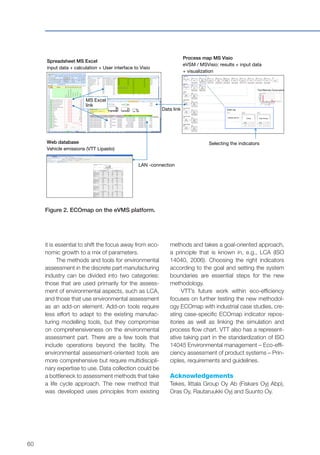
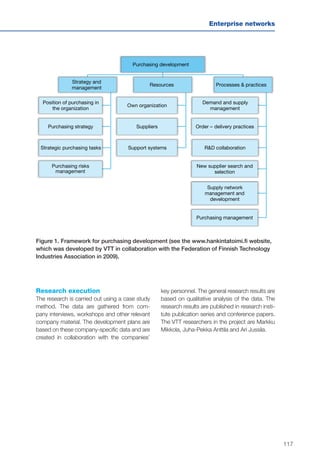
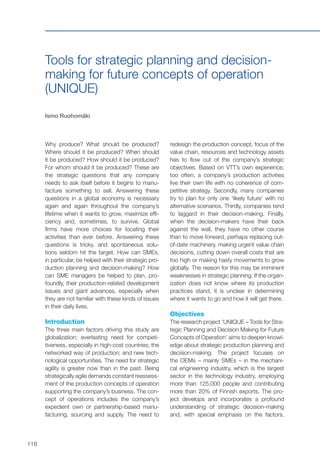
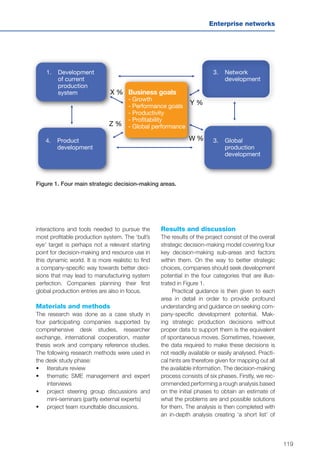
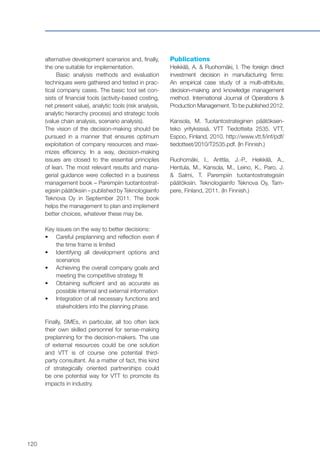
VTT RESEARCH HIGHLIGHTS 3
	
		
	 	 Production
		 Matters
		– VTT in global trends			
	
VISIONS
•SCIENCE•TECH
N
OLOGY•RESE
ARCHHIGHLI
GHTS•
3
Production
matters
VTT in global trends
VTTRESEARCHHIGHLIGHTS3ProductionMatters.VTTinglobaltrends
Production
matters
VTT in global trends
VTT RESEARCH HIGHLIGHTS 3
4
ISBN 978-951-38-7859-7 (softback ed.)
ISBN 978-951-38-7860-3 (URL: http://www.vtt.fi/publications/index.jsp)
ISSN 2242-1173 (soft back ed.)
ISSN 2242-1181 (URL: http://www.vtt.fi/publications/index.jsp)
Copyright © VTT 2012
PUBLISHER
VTT Technical Research Centre of Finland
P.O. Box 1000 (Tekniikantie 4 A, Espoo)
FI-02044 VTT, Finland
Tel. +358 20 722 111, fax +358 20 722 4374
EDITOR: Kai Häkkinen
Technical editing: Marika Leppilahti
GRAPHIC DESIGN: Kaisa Kuisma and Sari Halme
COVER PICTURE: Risto Lehtinen, “Micro chip”, 2012
Printed in Kopijyvä Oy, Kuopio 2012
5
Preface
The price of work in low-knowledge production is too high in many Western European countries.
After the recession in 2008, structural change has speeded up, and many companies are moving
their activities from Europe to low-salary countries, such as China and India. Mass production in
particular is facing problems. Furthermore, in many countries the exodus of the manufacturing
industry has led design and other industrial activities to relocate as well. All possible actions and
means of research should be employed to avoid this.
The speed of globalisation is increasing and at the same time the economy has been highly
uncertain. For several years the business environment has been struggling to avoid a new crisis
instead of pursuing sustainable growth. These days have been exceptionally hard for the industry
– companies have been waiting for better days, and have thus postponed ordinary investments
and decisions for too long. That has prevented them from focusing on long-term business visions.
The best way to ensure that manufacturing remains a major part of industry in Europe is to
specialise in types of production in which special skills are required and the price of the workforce
is not a key factor. This is easiest with products that are highly innovative. Due to historical rea-
sons, the industrial forms of manufacturing activities are quite different in different parts of Europe.
The global factory of the future will comprise a company network that extends to countries where
salaries are low, to countries where levels of competence are high, and to expanding market
areas. It is vital to have effective business models.
We must have confidence that it is possible to create successful business in Europe also in
the field of manufacturing, because production will still be a vital element in creating national wel-
fare. To maintain and enhance the competitiveness of production, new innovative approaches
and methods should be developed and implemented. Companies have taken a particular inter-
est in investigating and developing new approaches, such as network manufacturing and broad-
ranging implementation of industrial information technology.
Digital factory solutions that react quickly to unplanned events and challenges will ensure the
economical and technical feasibility of individualised production. Unique and eco-efficient mate-
rial design – including raw material selection, material performance and recycling aspects – is an
essential part of manufacturing. In future, additive manufacturing may give the ability to produce
highly complex designs. This will have a huge effect on resource use and logistics – and lead to
radical changes in value networks and business models.
The great challenges facing the manufacturing industry are the transition from resource-ori-
ented production to knowledge-oriented production and the transition from goods-oriented logic
to service-oriented logic. This report describes VTT’s research results that will help the manufac-
turing industry to deal with these challenges.
Production matters.
Risto Kuivanen
Rauno Heinonen
6
Contents
Manufacturing methods
Augmented assembly (Augasse)................................................................................................ 8
Transferable and reconfigurable production systems (LIIKU) .................................................... 12
Picking of randomly oriented parts with machine vision (bin picking) ....................................... 15
Direct colour marking of metals with fibre lasers (DIME) .......................................................... 17
Nano structures and applications with fs laser technology (FinFem) ........................................ 20
Flexible tailored serial production of 3D sheet metal products and new
processes of automated manufacturing (Joyrem)..................................................................... 23
An interactive 3D sensor system and its programming for target localizing in
robotics applications (Luovi)..................................................................................................... 27
Manufacturing low-cost miniaturized disposable ‘Lab-on-a-Chip’ plastic
cartridges by injection moulding (RUISKUCHIP)....................................................................... 30
Exploitation of MIM production technology in Finland – project in
the SISU 2010 Technology Programme by Tekes (SISU-MIM).................................................. 33
High-power laser welding for demanding applications (TriLaser)............................................... 36
Flexible and autonomous small batch welding production (Sisuhitsi)........................................ 38
Direct write techniques for competitiveness and increased product functionality (SUORA)....... 41
Factory and enterprise systems
More intelligence for laser processes (ÄLLI).............................................................................. 46
Optimization of autonomous production cells – real time production intelligence (ATOR).......... 49
Desktop assembly (DeskAssy)................................................................................................. 53
Eco-efficient production........................................................................................................... 56
Development of a manufacturing information portal for SMEs in
traditional industries (Eskale)..................................................................................................... 60
Flexible and self-learning production systems in the sawmill industry (SisuPUU)...................... 63
Rapid economic production of Special products (SPECIAL)..................................................... 66
Merging paradigms: engineering for a managed product life cycle (systems engineering)........ 69
Automation isles for the future (TUAUSA)................................................................................. 72
Ubiquitous manufacturing concept for SMEs (Umanu)............................................................. 75
New joint production concepts for machine manufacturers and the foundry industry (VATU)... 79
Manual work support throughout the system life cycle by exploiting
Virtual and Augmented Reality (ManuVAR)............................................................................... 82
7
Enterprise networks
Strategic development of enterprise networks (Verka).............................................................. 88
Management of dynamic networks and the performance of industrial systems (Dynamo)........ 91
Virtual organization management (ECOLEAD).......................................................................... 95
Collaborative Project Management (COIN)............................................................................... 99
Management of subcontracting cooperation in the metal industry (JOHTO)........................... 102
Partnership networks of the Finnish maritime cluster – Research focus on
Chinese markets (SeaChi)...................................................................................................... 106
Developing the strategic innovation capabilities of enterprises (InnoPro)................................. 108
BestServ business models II (BeSeL)..................................................................................... 111
Developing purchasing in industrial SMEs (SSOC2)............................................................... 114
Tools for strategic planning and decision-making for future concepts
of operation (UNIQUE)............................................................................................................ 116
Manufacturing methods
10
One of the main challenges of introducing
Augmented Reality technology into industrial
applications is fast, reliable, low-cost authoring
of animated AR content of product data created
in 3D CAD systems. Here, a product data infor-
mation pipeline from commercial CAD systems
Augmented assembly (Augasse)
Tapio Salonen
used in industry to a marker-based augmented
reality system is presented. The pipeline uses
the ISO 10303 (STEP) data protocol, Design for
Assembly Tool and VTT’s proprietary content-
creation and augmenting software. The pipeline
is verified with a real industrial application.
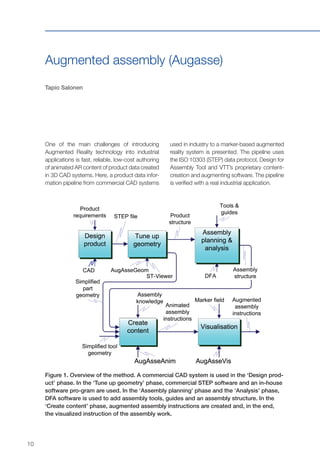
Figure 1. Overview of the method. A commercial CAD system is used in the ‘Design prod-
uct’ phase. In the ‘Tune up geometry’ phase, commercial STEP software and an in-house
software pro-gram are used. In the ‘Assembly planning’ phase and the ‘Analysis’ phase,
DFA software is used to add assembly tools, guides and an assembly structure. In the
‘Create content’ phase, augmented assembly instructions are created and, in the end,
the visualized instruction of the assembly work.
11
Manufacturing methods
Introduction
The development of Augmented Reality (AR)
technology was initiated in the 1990s as a
parallel technology to Virtual Reality. In Aug-
mented Reality, virtual objects are combined
with the real surroundings seen with the
human eye. The augmented view is projected
onto, for example, a computer screen or min-
iature PC, or seen through data glasses. In
Augmented Reality, VTT’s main focus is on
industrial applications in which augmenting is
believed to have major potential and provide
strong benefits.
Methodology
Figure 1 shows the proposed methodology for
creating the AR instructions from the product’s
3D model. First, the CAD model is exported
to a standard STEP (ISO 10303 203) format
file that includes the product structure and 3D
geometry model of the product.
The 3D model is first triangulated to the
appropriate coarseness level and the prod-
uct structure extracted. The 3D model is split
into 3D part models that refer to the product
structure.
As a result of the designer’s preferences
for company-specific part libraries and fea-
tures of typical CAD systems, the generated
product structure usually does not conform to
the real parts to be assembled in manufactur-
ing. The assembly structure and order there-
fore have to be re-created from the product
structure. The assembly tools, operations and
guides also have to be added. As well as cre-
ating the right assembly structure and adding
assembly instructions, the main purpose of
the DFA Tool is to analyse the created assem-
bly. The basic idea is to simplify the assembly
and product structure.
In the ‘Create content’ phase, anima-
tions of the parts are created for the assembly
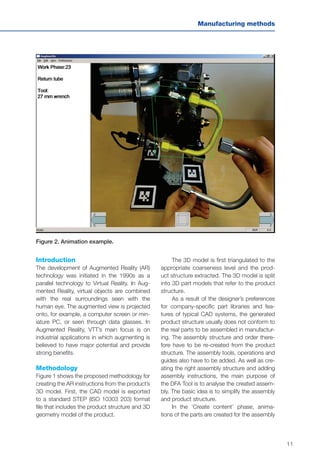
Figure 2. Animation example.
12
work. When the animations have been defined
for each assembly phase, the whole assem-
bly process can be simulated. The user can
see any animated assembly work phase or the
whole animated assembly work.
In the ‘Visualization’ phase, the user can
see animations that demonstrate the assem-
bly work of a device (Figure 2). The 3D model
of each assembly part is in a separate file and
the assembly order, animation definitions,
assembly instructions and references to the
part files are contained in another file.
In this project, a standard USB webcam
and markers are used for tracking 3D models
in the real environment.
Results
In this project, we have developed a method-
ology for applying 3D product data created
in commercial CAD systems to AR applica-
tions and then to the AR instructions [1]. The
data pipeline exploits the STEP data protocol
available in practically all CAD systems. The
data pipeline is tested in a real industry case,
in the assembly of the power unit of a tractor
accessory at the Finnish tractor factory Valtra
Plc. The project also examined how modern
smartphones could be used in augmented
reality devices. Currently, the biggest lack of
use of AR technology is on the hardware side.
Head-mounted displays felt uncomfortable
(weight, screen alignment of the eye, wires).
Students carried out the assembly work
of the hydraulic block in spring 2008 at Tam-
pere University of Technology. Eighty-nine per-
sons (74 men and 15 women) participated in
this experiment over three weeks. The assem-
bly work of the hydraulic block was carried out
using the paper instructions (assembly draw-
ing, parts list, assembly instructions) and the
AR-based instructions. In the test, the paper
instructions were compared with the assem-
bly AR instructions, including the assembly time
and the number of errors. The results were sig-
nificant. The assembly work was accelerated by
15% and the number of errors reduced by 84%.
Users generally admired that the AR tech-
nology was visual and easy to understand.
The AR technology was considered excellent.
Tough things were simple and clear with the
help of the AR animations. In fact, the work
seemed straightforward and fun. In sum-
mary, it could be said that the AR technology
enhanced work, showing a part/component of
the assembly in the right place. Unproductive
contemplation will end. Showing the correct
order of the work phase will also accelerate
the work.
Discussion and conclusions
Future research should explore whether the
described augmentation process for assem-
bly instructions improves assembly planning
and whether the process might reveal errors in
the assembly process earlier than in the prod-
uct design process when design changes are
easier and less expensive to make.
Exploitation potential
AR technology is a new interactive way of man-
machine interaction. Digital information can be
displayed to the user, combined with the right
environment. The information may be text data,
images, 3D models or any other visualized
material. With AR technology, the information
can be direct in a real environment and just to
the right point, for example, the information of
the part shown on the part etc. AR systems will
reduce assembly times, accelerate learning of
the assembly tasks and provide more quality
assurance on the factory floor.
Augmented reality may be used in many
other fields, such as education, training, weld-
ing, service, packaging and maintenance. For
example, the employee typically does certain
maintenance work only once. The AR-based
guidance would then really help him/her. Simi-
larly, the AR instructions in the training are very
visual and effective.
13
Manufacturing methods
Acknowledgements
This contract-based research project is
funded by Tekes, the Finnish Agency for Tech-
nology and Innovation. VTT and key industrial
companies also partially covered the costs of
this work. The research team is grateful for the
contributions.
Publications
Pyykkö, T. Lisätyn todellisuuden hyö-
dyntäminen kokoonpanossa, Master’s thesis.
Tampere University of Technology, Tampere,
Finland, 2008. (In Finnish.)
Salonen, T., Sääski, J., Woodward, C.,
Hakkarainen, M., Korkalo, O. & Rainio, K. Aug-
mented assembly – Ohjaava kokoonpano. VTT
Working Papers 138. VTT, Espoo, Finland,
2008. 32 p. + app. 36 p. (In Finnish.)
Sääski, J., Salonen, T., Liinasuo, M. Kuu-
tion kokoaminen AR-teknologian avulla. VTT
Working Papers 89. VTT, Espoo, Finland,
2008. 27 p. + app. 1 p. (In Finnish.)
References
[1]	Salonen, T., Sääski, J., Woodward, C.,
Korkalo, O., Marstio, I. & Rainio, K. Data
Pipeline from Cad to AR Based Assem-
bly Instructions. Proceedings of the 2009
World Conference of Innovative Virtual
Reality, WINVR09. 25–26 February, 2009,
Chaton-sur-Chaone, France.
14
Transferable and reconfigurable production
systems (LIIKU)
Timo Salmi
Introduction
Today, production faces increasing require-
ments for flexibility and productivity: product
life cycles are shortening, variety is increasing
and production volumes are fluctuating, while
production costs should be reduced. The com-
petition puts pressure on automation, while, at
the same time, the flexibility needs make auto-
mation more difficult. Transferable or mobile
production machines have been suggested as
a potential solution to flexible and cost-effective
production with the following advantages:
•	 Enabling reconfiguring of production
systems, lines and workshops, and fast
ramp-ups of new lines.
•	 Automation can be used according to the
current needs.
•	 In the case of a varying production load,
the capacity can be transferred where it
is needed.
•	 The investment risks are reduced when
the capacity is easily transferred and used
somewhere else.
•	 When processing big products, the nec-
essary large movements are achieved by
mobile devices and the production devices
are transferred instead of the product.
•	 Transferable production systems offer
possibilities to make the product on site
or near the customer through tailoring
with industrial methods.
The aim of our research was to develop meth-
ods and tools that enable fast building and
transfer of production capacity according to the
changing production situations and to develop
concept solutions for different application areas.
Our approach was to find practical, cost-
efficient solutions to industrial environments
and situations in which production volumes
vary and the number of diverse products and
variants is high. Our aim was to cover different
types of flexibilities, from pure volume increase
to one-of-a-kind type production [1].
Methods
This project has a mostly constructive research
approach, a concept development with analytic
reasoning. The project started with an analy-
sis of different application areas in order to find
the solutions with most potential for transfer-
able robotic systems and their restrictions and
to define the requirements. The second phase
was a survey of potential enabling technolo-
gies and the selection of the building blocks for
the concept. The main focus has been on the
development of the different technological solu-
tions for the concept of the transferable robotic
system. A practical touch of real industrial needs
was obtained in case studies.
Results
Our research found the solutions with most
potential for the transferable robotic systems
to be:
•	 easily transferable ready-to-use produc-
tion cells
•	 a transferable universal robotic mod-
ule/platform for the material handling of
machine tools; see Figure 1
15
Manufacturing methods
•	 welding or other processing tasks of big
products with a transferable robot sys-
tem; see Figure 2.
It seems that the requirements of the main
application areas are quite congruent while the
focus varies from case to case:
•	 well-functioning, fast calibration routines,
adaptability to inac-curacies
•	 ability to produce different products – ver-
satility
•	 non-part-specific mechanics – especially
in material handling
•	 the ability to adapt new products
•	 easy programming of new products –
especially in process applications
•	 transferability and compact design
•	 easily made interconnections, integration
to other systems
•	 easily transferable safety arrangements
•	 reconfigurability.
According to our technology survey, the
required functions can be achieved using a
variety of advanced technologies:
•	 	a robot is a basic system component
•	 	calibration methods and different sensor
technologies are essential components:
2D and 3D machine vision, seam-tracking
and other types of intelligent sensors
Figure 1. A conceptual picture of a trans-
ferable universal robotic platform for the
material handling of machine tools.
Figure 2. A conceptual picture of a freely
transformable robot platform used in a
welding application.
•	 	versatile technologies for material han-
dling, e.g. servo grippers for a large
variety of parts and sensor-based mate-
rial handling methods
•	 	advanced programming methods to
achieve easier new product implemen-
tation, at least partly automated off-line
programming, e.g. CAD or module-based
or parametric programming or sensor-
based program creation, task-oriented
programming or guiding
•	 	a compact, integrated, easy-to-transfer
platform using a modular structure in the
mechanics, control system hardware and
software could achieve reconfigurability
•	 instead, the self-navigation or self-move-
ment functions are not the preliminary needs
•	 	new types of safety sensors, laser scan-
ners or vision-based safety systems are
able to be integrated into the transferable
platform, and with the new safety robot
controllers it is possible to build space-
saving, fenceless, intelligent and dynamic
safety areas.
Many of the building blocks have similarities with
those of modular ultra-flexible production units
presented as Automation Islands [2]. The devel-
opment work focused on several areas, e.g. the
safety design met complicated challenges.
16
As a result, the project introduced two con-
ceptual solutions with several stages according
to the needs of the applications.
Discussion, conclusions and
exploitation potential
Transferable robotic systems offer new pos-
sibilities to minimize investment risks and to
find a new type of cost-effective solution to
change the production environment. There
are also several challenges to be solved, but
application areas were found where this type
of solutions has special potential. As a result,
some concept solutions have been presented.
The development work also has meaning in a
wider perspective: most results are relevant
in production systems in which flexibility,
changeability and reactability are favourable.
The concept has combined the approaches of
Reconfigurable Manufacturing Systems (RMS)
and Flexible Manufacturing systems (FMS) [3].
The work is still in progress and the final
results will be published during 2012.
Acknowledgements
This project was part of the National Research
Programme SISU 2010 – Innovative Manu-
facture. The project was funded by Tekes, the
Finnish Funding Agency for Technology and
Innovation, VTT Technical Research Centre of
Finland and several industrial partners.
References
[1]	Salmi, T., Heikkilä, T., Leino, K. & Väätäinen,
O. Transferable and reconfigurable robot-
based production units. Proceedings of the
3rd International Conference on Changeable,
Agile, Reconfigurable and Virtual Production,
CARV 2009, Munich, Germany. 10 p.
[2]	Salmi, T., Haataja, K., Sallinen, M., Göös, J. &
Voho, P. Automation Islands – Requirements
and solutions for a highly flexible concept
of robotic systems. The 2nd International
Conference on Changeable, Agile, Reconfig-
urable and Virtual Production, CARV 2007,
Toronto, Canada. 10 p.
[3]	ElMaraghy, H.A. Flexible and reconfigurable
manufacturing systems paradigms. Inter-
national Journal of Flexible Manufacturing
Systems, Special Issue on Reconfigurable
Manufacturing Systems 17, October 2005,
pp. 261–276.
17
Manufacturing methods
Picking of randomly oriented parts with
machine vision (bin picking)
Ilari Marstio
Introduction
When automating short-run production, one
of the greatest obstacles is the need for part-
specific mechanical handling devices. One
solution to this problem is to introduce an
industrial robot with machine vision and flex-
ible gripper for picking randomly oriented work
parts from a bin with-out the need to organ-
ize the parts. Traditionally, parts have needed
to be organized before they can be fed to the
machining or the automated assembly line.
Random bin picking has been researched
since computer vision started to gain ground
in the 1980s. A lack of computation power,
good algorithms and sensors has constricted
the industrial applications of bin picking.
The project goal was to determine the
current state of bin-picking technology and
introduce this technology to Finnish compa-
nies.
Methods
The technology behind bin picking was
researched. The suitability of different sen-
sors including cameras and 3D sensors was
investigated. Modern gripper technology was
also researched. The software or algorithms
that actually located the pickable part from the
stack had a very important role.
All the commercial bin-picking systems to
be reckoned with were benchmarked along-
side the current research applications.
Different kinds of parts were classified
according to the bin-picking method that was
most suitable for the part. The shape and
material of the part determine which method
should be used.
Tests were conducted to compare differ-
ent methods and products.
Results
There is no universal solution to bin picking, at
least not yet. In many cases, bin picking is prac-
ticable, but all cases need a tailored solution. An
analysis of the picked part is necessary. A cam-
era or stereo camera can be used if the part has
distinct features. If a camera is used, the lighting
is crucial. Dynamic lighting is one option: several
images can be made from the object with light
coming from different angles. 3D sensors can be
con-sidered if there are no reflective surfaces.
The best 3D sensors for bin picking are the laser-
line triangulation scanner and scanners based
on structured light, unless the picked objects are
very big. If large parts are picked, time of flight
laser scanners and structured light scanners can
be used. When using structured light, ambient
light may be a problem. There are very effective
algorithms for 3D point clouds but good solid
scan data are needed.
The leading commercial bin-picking com-
panies are Scape Technologies, Binar and IH
Tech, which all provide complete solutions with
sensors, robots and integration. Software for
bin picking is provided by 3ideo and MVTec.
Binar with its SensActive (Figure 1) and IH Tech
in cooperation with PROFACTOR with its iRob-
Feeder provide a system based on laser light tri-
angulation, whereas Scape Technologies pro-
vides many different methods from dynamic
lighting to 3D scanning. All the companies have
18
their own algorithms, which work nicely on cer-
tain workpieces. 3ideo’s Pick3D provides tools
for bin picking. The 3D data are fed into the
Pick3D and it returns the place and orienta-
tion of the part to be picked. MVTec’s Halcon
is a machine vision library with many 3D algo-
rithms. Two of the most interesting algorithms,
which can be used in bin picking, are shape-
based matching and surface-based matching.
Shape-based matching will read the CAD model
of the picked part and try to find such parts in
the analysed image (Figure 2). Shape-based
matching needs optimal lighting conditions and
takes quite a long time. Accuracy-wise it is best
if the camera is mounted on the robot to obtain
images from as close a range as possible even
though the cycle time will be reduced drastically.
Surface-based matching is a robust algorithm to
localize parts from a point cloud. It works in a
similar manner to Pick3D. The cycle time is good
but it needs good 3D data. Most of the time is
taken by the actual scanning process.
In most cases, the most cost-effective
way is to use standard grippers. Great atten-
tion should be paid to good gripper design.
The accuracy is often no better than a couple
of millimetres and the gripper should be able
to cope with that. Different gripping positions in
the workpiece should also be considered. If a
vacuum gripper is an option, it should be used.
It can pick from the top and will avoid collisions
with siding parts. If there are different parts, the
picked gripper should be designed accordingly.
Conclusions
As a rule of thumb: do not use bin picking if
you do not have to. It is still quite laborious
to realize bin picking and thus expensive. One
step towards flexibility by dedicated feeders is
the flexible feeder with which parts are fed to
a lit surface and localized with machine vision.
Bin picking is a functional technology, but
there are still some limitations part-wise and
cycle-time-wise. In some cases, it can signifi-
cantly reduce the need for manual labour.
Future research will continue in this area.
Some research institutes are researching the
possibilities of using cheap sensors like Micro-
Figure 1. Tests in Binar, Sweden.
Figure 2. Halcon shape-based matching.
soft Kinect for bin picking. More and more indus-
trial applications are popping up and speeding
up the development in providing companies.
More information can be found in the final
report of the project [1].
Publications
Final report of the project: Sekaisin olevien
kappaleiden käsittely konenäön avustamana
– Bin-Picking. (Picking of randomly oriented
parts with machine vision – BinPicking.) Avail-
able on request. (In Finnish.)
References
[1]	Sekaisin olevien kappaleiden käsittely
konenäön avustamana – Bin-Picking.
(Picking of randomly oriented parts with
machine vision – BinPicking.) Available on
request. (In Finnish.)
19
Manufacturing methods
Direct colour marking of metals with fibre
lasers (DIME)
Petri Laakso
Introduction
In most applications, laser marking is the fast-
est and cheapest method. The flexibility of
laser marking is based on writing with a laser
beam without the need for chemicals or tools.
Laser marking has had its limitations produc-
ing graphics and colours. Colour marking on
stainless steel and titanium has been avail-
able for some time but has not yet been used
widely in consumer products. There have
been some industrial applications however.
New fibre lasers allow independent tuning
of the pulse width, and the marking process
can be optimized to produce colours with
better quality and visual appearance. In this
study, the visual appearance of laser-marked
surfaces was optimized by varying the pulse
width, laser power, pulse energy and scanning
velocity. The aim was to create uniform oxide
layers on the surface that would appear as
high-quality colour markings.
Methods
In the beginning, the laser equipment used
in the project was the IPG 20W pulsed fibre
laser. A more tunable SPI-pulsed fibre laser
was used in most of the tests. As a reference,
a 20W Nd:YVO4
laser was tested to see the
difference between traditional and fibre lasers.
The surface characterization included surface
roughness, oxide thickness measurements
and an elementary analysis.
The materials tested were AISI grade
304L. The surface quality was 2B and the thick-
nesses 1 and 2 mm. Another selected material
was titanium of commercial purity 1 grade. The
thickness was 0.5 mm. The actual grade was
ASTM B265-99 G1/ASTM F67-00 G1.
Three different instruments were used to
measure the colours of the laser-marked sam-
ples. First, the spectrophotometer was used
to measure the total reflectance of the sam-
ples. Second, the fibre spectrometer was
used to measure the reflectance in multian-
gle measurements. Third, the spectral camera
was used to measure spectral images through
a microscope.
Results
Laser colour marking of metals has been used
for more than ten years with a variety of differ-
ent laser sources [1, 2, 3, 4].
The typical laser of choice for marking is
a q-switched crystal laser, which produces
pulses in the nanosecond regime. These
lasers do not allow independent adjustment
of the processing parameters, but the pulse
width is dependent on the repetition frequency
and as the frequency changes so does the
pulse width. Lasers that allow adjustment of
the pulse width regardless of the frequency
may therefore give an advantage in marking.
Some metals can be marked so that the
surface appears coloured. This is based on
oxidation and the following thin film effect. In
order to create a uniform and high quality mark,
the laser used must have good enough beam
quality and stability. A high quality mark results
in a smooth and uniform oxide layer. Oxide
formation during the laser process involves,
among other things, transport of oxygen from
the medium to the solid surface, adsorption of
20
molecular oxygen and electric field-enhanced
diffusion of species through the oxide layer [5].
The laser-induced temperature rise enhances
the diffusion flux and the reaction rate within
the scanned area.
From the look of the laser-marked sam-
ples (Figure 1), it is not possible to say whether
they are good or bad in terms of corrosion.
The smooth oxide surface may look good, but
in the wear test, the oxide may be seriously
damaged. Roughness measurements do not
reveal any explanation of which surface may
be good or bad. It is therefore not easy to pre-
dict which colour or parameter setup will lead
to a good combination of all the properties.
When some colour is wanted on the sur-
face, the laser parameter may have to be set to
a particular parameter range and there may not
be any alternative parameters for doing this if
speed has to be maximized. If a slightly slower
marking speed is used, it is easier to tune the
parameters and different marking strategies to
also keep wear and corrosion in mind.
During the project, a wide variety of differ-
ent lasers were used. Commercially available
lasers kept improving during the project.
Conclusions
In this project, laser colour marking was further
developed and the marked areas were exam-
ined for wear, corrosion and colour. Before this
project, colour marking was available but the
colours could only be produced in a limited
way with one laser system, and another laser
might have been needed for other colours.
Good beam properties and tunability of the
laser make high quality marking with afford-
able equipment possible.
During the project, a wide variety of col-
ours was found. Almost all colours can be
marked on a stainless steel surface, though
Figure 1. Sample with different colours
marked on it.
the different shades of a colour may be chal-
lenging. From the corrosion results, we can
see that the marking speed has a big effect
on corrosion resistance, even if the heat input
remains the same. The wear tests clearly
showed that the laser colour marking param-
eters have a significant influence on the wear
behaviour of both the colour-marked stainless
steel surface and the counterpart surface.
The colours of the surfaces can be
explained by the thin film interference. The
thickness of the film together with the illumi-
nation angle determines the visible colour.
According to the results of the modelling, it
can be concluded that the thin film is com-
posed of chromium oxide, Cr2
O3
. Colours are
best defined if they are measured spectrally
under some CIE standard geometries.
21
Manufacturing methods
Publications
Laakso, P., Pantsar, H., Leinonen, H. & Helle,
A. Preliminary study on corrosion and wear
properties of laser color marked stainless
steel. Proceedings of the 27th International
Congress on Applications of Lasers and
Electro-Optics, ICALEO, Temecula, CA, USA,
20–23 October, 2008. The Laser Institute of
America (LIA). Orlando, USA, pp. 212–221.
Laakso, P., Pantsar, H. & Mehtälä, V. Mark-
ing decorative features to stainless steel with
fiber laser. Advanced Laser Applications Con-
ference and Exposition, 1–3 October, 2008,
Minneapolis, MN, USA. The International
Laser Users Council (ILUC), Saline, Michigan,
pp. 29–36.
Laakso, P., Ruotsalainen, S., Leinonen, H.,
Helle, A., Penttilä, R., Lehmuskero, A., Hil-
tunen, J. DIME project report. Research
report; VTT-R-02403-09. VTT, Lappeenranta,
Finland, 2009. 65 p.
Laakso, P., Ruotsalainen, S., Pantsar, H. &
Penttilä, R. Relation of laser parameters in
color marking of stainless steel. 12th NOLAMP
Conference in Laser Processing of Materials,
Copenhagen, Denmark, 24–26 August, 2009.
ATV, SEMAPP, Copenhagen.
Westin, E.M., Laakso, P., Oliver, J. & Pent-
tilä, R. Effect of laser color marking on the
corrosion performance of stainless steel. Pro-
ceedings of the 28th International Congress
on Applications of Lasers and Electro-Optics,
ICALEO, Orlando USA, FL, 2–5 November,
2009. The Laser Institute of America (LIA), Vol.
102, pp. 1245–1250.
References
[1]	Carey, A.M., Steen, W.M. & Watkins, D.
Laser Surface Ornamentation. Proceedings
of International Congress on Application of
Lasers & Electro-Optics, ICALEO 1998,
	 pp. 170–178.
[2]	Hongyu, Z. Laser-induced colours on
metal surfaces. SIMTech Technical Report
PT/01/005/AM 2001.
[3]	Ruston, R. & Gold, J. Color marking. Indus-
trial Laser Solutions, December 2005,
	 pp. 16–18.
[4]	 Ming, L., Hoult A. & TSE, A. Colour marking
of metals with fiber lasers. Proceedings of
the 3rd Pacific International Conference on
Application of Lasers and Optics 2008.
[5]	 Bäuerle, D. Laser Processing and Chemis-
try. 3rd edition. Springer, Berlin-Heidelberg,
2000.
22
Nano structures and applications with fs
laser technology (FinFem)
Petri Laakso, Raimo Penttilä and Ilkka Vanttaja
The aim of the FINFEM project is to create new
nano- and microscale laser processing tech-
niques using a femtosecond laser to map out
the possible applications and specific advan-
tages that ablation can bring to the industrial
processes. The objectives defined by the
industrial partners range from the traditional
material removal to the generation of func-
tional surfaces.
Introduction
Joensuu University conducted basic research
on laser-matter interaction together with inter-
national partner Laser-Laboratorium Göttingen.
The VTT Laser processing team assisted in the
basic research and developed the micro- and
nanomachining processes for the industrial
applications. The industrial partners in the pro-
ject were Okmetic, Thermo Fischer Scientific,
Stora Enso, Modines and Cencorp.
The nanoscale features could be used
when combining electronics and mechan-
ics (MEMS), and electronics and biotechnol-
ogy (diagnostics), and when making medical
implants and instruments, optical compo-
nents and functional surfaces (lubrication,
friction control, lotus effect, optical functional
surfaces, chemical catalysts and bioactive
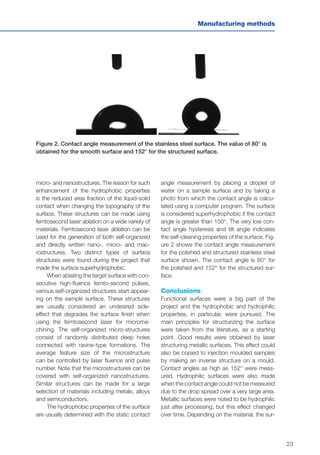
surfaces). In Figure 1, these nanoscale fea-
tures are used to make holographic marks on
polished metal surfaces.
Methods
VTT’s femtosecond laser is the Integra C2.0
with a maximum pulse energy of 2 mJ at a 1
kHz repetition rate. The pulse width is 130 fs.
The wavelength of the laser is 790 nm. The
pulse energy is attenuated with an external
polarization-dependant cube and computer-
controlled polarizing window. After the pulse
energy is attenuated, the beam is divided into
two beams. One part of the beam goes to the
scan head and the other to the normal pro-
cessing head. VTT implemented on-line vision
for the fixed optics after delivery.
The x-y axes are used for sample position-
ing and movement in the plane together with
the software. The beam focus was adjusted to
the sample surface (z movement) by a man-
ual axis. The scanhead is also controlled via
software. Joensuu UEF also had a laboratory
workstation with constantly changing setups.
Example of the results
The wetting properties of the material can
be altered by changing the surface topogra-
phy. The superhydrophobic surfaces can be
obtained using surface topography combining
Figure 1. VTT logo made with grating-like
structures.
23
Manufacturing methods
micro- and nanostructures. The reason for such
enhancement of the hydrophobic properties
is the reduced area fraction of the liquid-solid
contact when changing the topography of the
surface. These structures can be made using
femtosecond laser ablation on a wide variety of
materials. Femtosecond laser ablation can be
used for the generation of both self-organized
and directly written nano-, micro- and mac-
rostructures. Two distinct types of surface
structures were found during the project that
made the surface superhydrophobic.
When ablating the target surface with con-
secutive high-fluence femto-second pulses,
various self-organized structures start appear-
ing on the sample surface. These structures
are usually considered an undesired side-
effect that degrades the surface finish when
using the femtosecond laser for microma-
chining. The self-organized micro-structures
consist of randomly distributed deep holes
connected with ravine-type formations. The
average feature size of the microstructure
can be controlled by laser fluence and pulse
number. Note that the microstructures can be
covered with self-organized nanostructures.
Similar structures can be made for a large
selection of materials including metals, alloys
and semiconductors.
The hydrophobic properties of the surface
are usually determined with the static contact
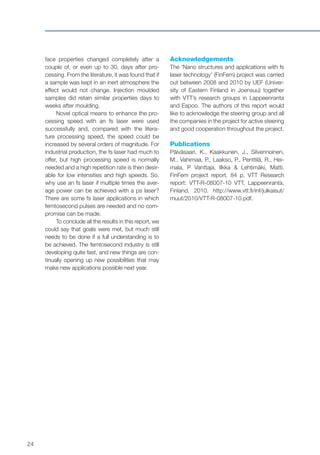
Figure 2. Contact angle measurement of the stainless steel surface. The value of 80° is
obtained for the smooth surface and 152° for the structured surface.
angle measurement by placing a droplet of
water on a sample surface and by taking a
photo from which the contact angle is calcu-
lated using a computer program. The surface
is considered superhydrophobic if the contact
angle is greater than 150°. The very low con-
tact angle hysteresis and tilt angle indicates
the self-cleaning properties of the surface. Fig-
ure 2 shows the contact angle measurement
for the polished and structured stainless steel
surface shown. The contact angle is 80° for
the polished and 152° for the structured sur-
face.
Conclusions
Functional surfaces were a big part of the
project and the hydrophobic and hydrophilic
properties, in particular, were pursued. The
main principles for structurizing the surface
were taken from the literature, as a starting
point. Good results were obtained by laser
structuring metallic surfaces. This effect could
also be copied to injection moulded samples
by making an inverse structure on a mould.
Contact angles as high as 152° were meas-
ured. Hydrophilic surfaces were also made
when the contact angle could not be measured
due to the drop spread over a very large area.
Metallic surfaces were noted to be hydrophilic
just after processing, but this effect changed
over time. Depending on the material, the sur-
24
face properties changed completely after a
couple of, or even up to 30, days after pro-
cessing. From the literature, it was found that if
a sample was kept in an inert atmosphere the
effect would not change. Injection moulded
samples did retain similar properties days to
weeks after moulding.
Novel optical means to enhance the pro-
cessing speed with an fs laser were used
successfully and, compared with the litera-
ture processing speed, the speed could be
increased by several orders of magnitude. For
industrial production, the fs laser had much to
offer, but high processing speed is normally
needed and a high repetition rate is then desir-
able for low intensities and high speeds. So,
why use an fs laser if multiple times the aver-
age power can be achieved with a ps laser?
There are some fs laser applications in which
femtosecond pulses are needed and no com-
promise can be made.
To conclude all the results in this report, we
could say that goals were met, but much still
needs to be done if a full understanding is to
be achieved. The femtosecond industry is still
developing quite fast, and new things are con-
tinually opening up new possibilities that may
make new applications possible next year.
Acknowledgements
The ‘Nano structures and applications with fs
laser technology’ (FinFem) project was carried
out between 2008 and 2010 by UEF (Univer-
sity of Eastern Finland in Joensuu) together
with VTT’s research groups in Lappeenranta
and Espoo. The authors of this report would
like to acknowledge the steering group and all
the companies in the project for active steering
and good cooperation throughout the project.
Publications
Päiväsaari, K., Kaakkunen, J., Silvennoinen,
M., Vahimaa, P., Laakso, P., Penttilä, R., Hei-
mala, P Vanttaja, Ilkka & Lehtimäki, Matti.
FinFem project report. 84 p. VTT Research
report: VTT-R-08007-10 VTT, Lappeenranta,
Finland, 2010. http://www.vtt.fi/inf/julkaisut/
muut/2010/VTT-R-08007-10.pdf.
25
Manufacturing methods
Flexible tailored serial production of 3D
sheet metal products and new processes
of automated manufacturing (Joyrem)
Timo Savinainen
Introduction
The wavelength, great power and good beam
quality of new single mode lasers will revolu-
tionize remote laser cutting and welding based
on robotics. It is known that very little heat is
transferred to the material when the material
surface is removed by vaporizing. Material
cutting with a single mode laser based on
scanning works with almost no thermal effect
on thin sheet metals, resulting in accurate and
thin cutting grooves.
New powerful 2–5 kW single mode fibre
lasers and high-power scan heads have
entered the market. The production benefits
of this new technology are obvious, though
very few research results were available when
the project started. The good beam quality of
single mode lasers allows greater focal lengths
and working distances. Easily programmed
high-power scanner optics makes the beam
more movable and allows the beam to be
scanned flexibly on the workpiece. The work-
ing area can also be increased by moving the
scanner with a robot or a workstation.
Material-vaporizing remote laser cutting of
sheet metals, based on a single mode laser
and scanning technique, was also studied in
the project. The studied materials were car-
bon steel, coated carbon steel, stainless steel,
electrical steel and aluminium.
The project was coordinated by VTT and
associated with the Lappeenranta University
of Technology (LUT). The industrial partners
were ABB Oy Motors, Patricomp Oy, Pivatic
Oy, Laserplus Oy and Prolaser Oy.
Methods
Remote laser cutting was tested with two laser
systems. In Germany, the Mittweida University
of Applied Sciences Laser Application Cen-
tre had a 3 kW IPG Photonics YLR-3000-SM
laser with a Raylase Superscan-SS-LD 30
scan head and a 3D workstation. The scan-
ner’s focal length was 200 mm with max.
speed 15 m/s, max. power density on work-
piece surface 7.6 x 10⁸ W/mm2
and scanning
field 50 x 50 mm.
The Lappeenranta LPC had a 2 kW IPG
Photonics YLS-2000-SM laser with an Arges
3D-Elephant FE50 scan head in the KUKA
robot. The scanner’s focal length was 650 mm,
work distance 350 mm, max. speed 2 m/s,
max. power density on the workpiece 9.4 x
107 W/cm2
and scanning field 300 x 300 mm.
Both lasers had M2 =1.1 and wavelength
1070 nm.
An accurate figure, including straight lines,
curves and straight an-gles, was cut in tests
with different sheet metals. The groove widths,
burrs on the upper and lower surfaces, surface
roughness, cut angles and corner radius were
measured in the grooves. The heat effects, the
through-cut scanning repeat numbers and cut
roundness as well as the effects of the focal
position, repeat frequency and laser power
were also studied. Comparison tests were
conducted with identical materials and cutting
figures using a 1.8 kW Bystronic Bysprint CO2
laser (with nitrogen and oxygen) and an IPG
Photonics YLR-5000-S 5 kW multi-mode fibre
laser with a Precitec OT YW50 scanner (melt-
26
ing remote cutting). Optional comparison tests
were also carried out with an IPG 400 W CV
fibre laser, a 4 kW Trumpf Trucell 5020 disc
laser and a 100 W pulsed Nd:YAG laser.
Examples of results
The remote laser cutting scanning removes
material from the groove at 30–200 µm per
scanning cycle, depending on the process
parameters, material and thickness. Up to
1 mm thickness, the through-cut scanning
number has an almost linear dependence on
the thickness. On thicker materials, the num-
ber increases non-linearly as the laser beam
intensity is smaller in deeper grooves and it
is more difficult to remove the melted metal.
Cutting of forms needs more through-cut
scanning cycles than cutting of straight lines.
All test materials except aluminium are similar
to cut because the vaporizing temperatures
and liquid metal viscosities are similar.
1.4301
0,5mm
1.4301
0,88mm
M400-50A
(1)
0,52mm
M400-50A
(2)
0,52mm
S235
0,76mm
S235
1mm
DC01
1mm
DX51D+Z
1 40-M-C
1mm
Aluminium
1
1mm
Upper surface 85,4 82,9 70,2 78,3 83,3 85,5 65,8 62,8 90,4
Bottom surface 69,9 63,9 60,0 60,5 46,6 49,4 56,2 53,1 72,8
0
10
20
30
40
50
60
70
80
90
100Groovewidth,µm
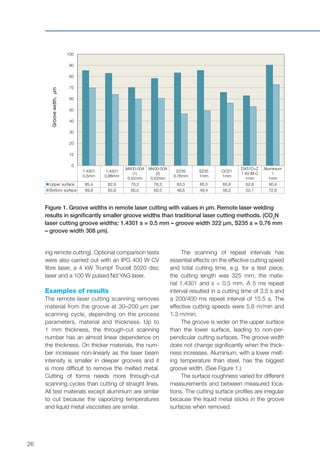
Figure 1. Groove widths in remote laser cutting with values in µm. Remote laser welding
results in significantly smaller groove widths than traditional laser cutting methods. (CO2
N
laser cutting groove widths: 1.4301 s = 0.5 mm – groove width 322 µm, S235 s = 0.76 mm
– groove width 308 µm).
The scanning of repeat intervals has
essential effects on the effective cutting speed
and total cutting time, e.g. for a test piece,
the cutting length was 325 mm, the mate-
rial 1.4301 and s = 0.5 mm. A 5 ms repeat
interval resulted in a cutting time of 3.5 s and
a 200/400 ms repeat interval of 15.5 s. The
effective cutting speeds were 5.6 m/min and
1.3 m/min.
The groove is wider on the upper surface
than the lower surface, leading to non-per-
pendicular cutting surfaces. The groove width
does not change significantly when the thick-
ness increases. Aluminium, with a lower melt-
ing temperature than steel, has the biggest
groove width. (See Figure 1.)
The surface roughness varied for different
measurements and between measured loca-
tions. The cutting surface profiles are irregular
because the liquid metal sticks in the groove
surfaces when removed.
27
Manufacturing methods
Figure 2. Corner radius of cutting surfaces with 90 degree corners on the upper and
lower surfaces [µm]. (CO2
N laser cutting results in the corner radius 1.4301 s = 0.5 mm – r
upper/lower surface = 175/162.5 µm).
1.4301
0,5 mm
1.4301
0,88 mm
M400-50A
(1)
0,52 mm
M400-50A
(2)
0,52 mm
S235
0,76 mm
S235
1 mm
DC01
0,5 mm
DX51D+Z
1 40-M-C
0,64 mm
Aluminium
1
0,16 mm
Upper surface 137,5 156,25 150 100 131,25 137,5 137,5 162,5 208,33
Bottom surface 125 156,25 131,25 68,75 112,5 131,25 100 81,25 150
0
50
100
150
200
250
Cornerradius,µm
Remote laser cutting results in good cut-
ting groove surface perpendicularity, and the
differences in perpendicularity are small.
The corner sharpness was determined by
measuring the corner radius r [µm]. The corner
radius was bigger on the upper surface than
on lower surface. The corner sharpness qual-
ity was good. The smallest corner radius was
100 µm on the upper surfaces and 69 µm on
the lower surfaces. (See Figure 2.)
Burr appears on both sides of the groove
on the upper and lower surfaces, and the burr
dimensions vary on different materials, e.g.
material 1.4301 has wider burr than the other
materials. [1]
Conclusions
Remote laser cutting demands good beam
quality in single mode lasers as well as quality
optics to reach a small focal spot and material-
vaporizing power intensity. The process works
very well on thin materials. Thicker materials
cause lower power densities and difficulties
removing liquid metal from the groove.
The laser beam power and quality, scan-
ning speed, scanning sequence repeat num-
ber and scanning repeat interval are the most
important remote laser cutting parameters. The
effective cutting speed depends significantly on
the time between scanning repeats.
In through-cut scanning, the repeat num-
ber of thin sheet metals depends more on
the thickness than the material because the
power intensity decreases when the groove
becomes deeper.
The heat effects in the material depend
on the number of scanning repeats (thickness)
and scanning intervals. A shorter repeat inter-
val reduces the scanning repeat number but
has more heat effects and widens the groove.
The groove widths are very small in remote
laser cutting because of the good beam qual-
ity. The groove is wider on the upper surface
than the lower surface, but the thickness does
28
not have much effect on the groove width (on
thin materials).
The surface roughness varies and is
worse than, e.g., CO2
N laser cutting.
Perpendicularity is good on low (> 1 mm)
thicknesses and similar to CO2
N laser cutting.
The remote laser-cut 90 degree corners are
significantly sharper than in CO2
N laser cutting.
The corner radius depends more on the mate-
rial than the thickness (in thin materials).
The burr layer appears on both sides of
the groove on the upper surface while in CO2
N
laser cutting, the burr appears on the lower sur-
face. The burr is thicker on thicker materials. [2]
Acknowledgements
The project ‘Flexible tailored serial production
of 3D sheet metal products and new pro-
cesses of automated manufacturing’ (Joyrem)
was executed during 2009–2011 by research
groups at VTT and LUT in Lappeenranta. The
authors of this report would like to acknowl-
edge the steering group and all the companies
in the project for active steering and good
cooperation throughout the project.
References
[1]	Pihlava, A. Remote laser welding of sheet
metals. Master’s thesis. Lappeenranta, Uni-
versity of Technology, Lappeenranta, 2010.
110 p. (In Finnish.)
[2]	Savinainen, T., Kujanpää, V. & Salminen, A.
Internal reports of Joyrem project. VTT and
Lappeenranta University of Technology,
Finland, 2009–2011. (In Finnish.)
29
Manufacturing methods
An interactive 3D sensor system and
its programming for target localizing in
robotics applications (Luovi)
Tapio Heikkilä and Esa Viljamaa
Due to the cost level, the production of goods in
developed countries favours shorter series over
mass production. This sets strong demands
for more flexible means of production. Interac-
tive robotics introduces high flexibility to robotic
task execution, relying on human intelligence
and understanding.
Introduction
Due to the needs for flexibility in production by
Western countries, new methods to leverage
flexibility are needed.
An interactive sensor system for robotic
applications with easy and flexible planning
and programming enables flexible feedback
from the process to the robot. This results
in cost-effective, easy-to-use and accurate
object localizing [1, 2].
The aim of the research has been to use
human intelligence and skills to reduce haz-
ardous manual work and introduce flexibility to
robotic tasks. Flexible measurement technolo-
gies with optical sensors supervised by human
operators are used to adapt to the variation in
target object locations and robot paths. This
is supported by CAD-based programming of
sensory operations.
Methods
The full use of the measurement system is
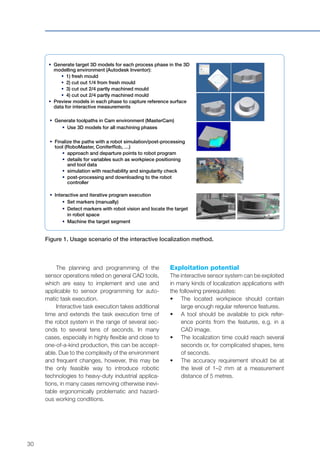
explained in Figure 1.
The localizing in the robot task execution is
based on the initial estimate of the target object
location, the set of programmed geometric refer-
ence features and the results from the interactive
measurements. The interactive measurements
(2D or 3D points) are fitted to the reference fea-
ture models and a Localizing algorithm calcu-
lates the position and orientation (pose) of the
target object. This is then loaded into the robot
controller and used to adapt the robot work
paths to the real location of the target object.
The accuracy of the measurement system
was verified with reference measurements by
an industrial level tachometer and accurately
calibrated robot.
Results
A main scientific result of the project was a
new method and tested prototype system for
interactive object localization for the needs of
flexible manufacturing. The system was easy
to use and worked as expected. The system
reached 1–2 mm relative accuracy at a sensor
(camera) distance of 5 m for the 4 m x 4 m
measured workpiece.
The novelty of the work, especially the easy
programming of the sensor tasks, lies in the use
of standard CAD tools. The full application of
the interactive sensor scheme with dynamic
formation of the measurement model in a real
experimental test environment is also new.
Discussion
The interactive sensor system has been
implemented, is working and easy to use. It
is based mostly on commercial HW and SW
tools, with an extension to estimate planned
feature parameters and an estimation of the
target object location during task execution.
30
The planning and programming of the
sensor operations relied on general CAD tools,
which are easy to implement and use and
applicable to sensor programming for auto-
matic task execution.
Interactive task execution takes additional
time and extends the task execution time of
the robot system in the range of several sec-
onds to several tens of seconds. In many
cases, especially in highly flexible and close to
one-of-a-kind production, this can be accept-
able. Due to the complexity of the environment
and frequent changes, however, this may be
the only feasible way to introduce robotic
technologies to heavy-duty industrial applica-
tions, in many cases removing otherwise inevi-
table ergonomically problematic and hazard-
ous working conditions.
Exploitation potential
The interactive sensor system can be exploited
in many kinds of localization applications with
the following prerequisites:
•	 The located workpiece should contain
large enough regular reference features.
•	 A tool should be available to pick refer-
ence points from the features, e.g. in a
CAD image.
•	 The localization time could reach several
seconds or, for complicated shapes, tens
of seconds.
•	 The accuracy requirement should be at
the level of 1–2 mm at a measurement
distance of 5 metres.
Figure 1. Usage scenario of the interactive localization method.
 Generate target 3D models for each process phase in the 3D
modelling environment (Autodesk Inventor):
 1) fresh mould
 2) cut out 1/4 from fresh mould
 3) cut out 2/4 partly machined mould
 4) cut out 2/4 partly machined mould
 Preview models in each phase to capture reference surface
data for interactive measurements
 Generate toolpaths in Cam environment (MasterCam)
 Use 3D models for all machining phases
 Finalize the paths with a robot simulation/post-processing
tool (RoboMaster, ConiferRob, …)
 approach and departure points to robot program
 details for variables such as workpiece positioning
and tool data
 simulation with reachability and singularity check
 post-processing and downloading to the robot
controller
 Interactive and iterative program execution
 Set markers (manually)
 Detect markers with robot vision and locate the target
in robot space
 Machine the target segment
31
Manufacturing methods
References
[1]	Heikkilä, T., Ahola, J.M., Viljamaa, E., Järvi-
luoma, M. An interactive 3D sensor system
and its programming for target localizing
in robotics applications. In: Proceedings
of the IASTED International Conference on
Robotics, Robo 2010, Phuket, Thailand,
24–26 November, 2010. Pp. 89–96.
[2]	Heikkilä, T., Ahola, J.M., Viljamaa, E.,
Järviluoma, M. Vuorovaikutteisen 3D
mittausjärjestelmän CAD-perusteinen
ohjelmointi ja liittäminen robotin ohjauk-
seen. Automaatio 2011, Helsinki, Finland,
15–16 March, 2011. (In Finnish.)
32
Manufacturing low-cost miniaturized
disposable ‘Lab-on-a-Chip’ plastic
cartridges by injection moulding
(RUISKUCHIP)
Antero Jokinen and Topi Kosonen
Introduction
The ageing of the population is leading to a
huge increase in health care costs, and it has
led to a special need for ‘Point Of Care’ (POC)
testing, which means that people can moni-
tor their health condition at home and even, in
some cases, diagnose diseases automatically
and quickly with low-cost devices.
In environmental control, e.g. water qual-
ity testing and many other areas like food, and
the chemical and process industry, there is
also a strong demand for automatic, fast, reli-
able and portable analysis of the composition
and condition of raw materials, including the
quality of the products.
The aim is ‘sample in, answer out’ with a
low-cost disposable cartridge that automatically
takes care of sampling, dosing, transferring and
mixing the required liquids, analytes and rea-
gents and also carries out the analysis so that
the result can be read simply and quickly.
The main issue is to develop sample han-
dling to be automatic and simple enough that
no expertise is needed and practically everyone
can carry out the analysis. This means that no
pipetting or handling of test tubes is needed
and that all the reagents and analytes are inte-
grated into a disposable plastic cartridge.
To ensure commercial application, these
kinds of disposable high-volume and high-
technology products should be suitable for
low-cost mass manufacturing, which means
that the design of the functions and compo-
nent inside the cartridge should be done care-
fully, and they should be integrated into the
moulding process and the moulded parts so
that the need for separate components and
assembling steps is minimized.
VTT is conducting research in many areas
of miniaturized systems and micro-manufac-
turing and has long experience of microfluidics
and of developing low-cost disposable micro-
total analysing products to meet the needs of
medical diagnostic companies and the chemi-
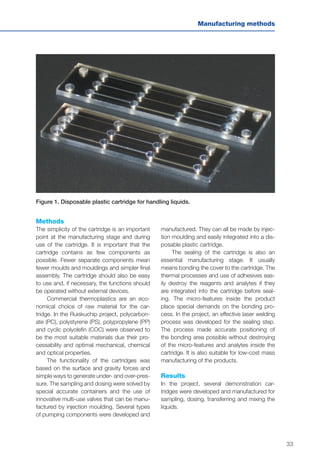
cal and process industry. Figure 1 shows an
example of a disposable plastic cartridge for
handling liquids.
In the Ruiskuchip project, the aim was to
develop the manufacturing of disposable plas-
tic cartridges for automatic sampling, dosing,
transferring and mixing of liquids.
33
Manufacturing methods
Methods
The simplicity of the cartridge is an important
point at the manufacturing stage and during
use of the cartridge. It is important that the
cartridge contains as few components as
possible. Fewer separate components mean
fewer moulds and mouldings and simpler final
assembly. The cartridge should also be easy
to use and, if necessary, the functions should
be operated without external devices.
Commercial thermoplastics are an eco-
nomical choice of raw material for the car-
tridge. In the Ruiskuchip project, polycarbon-
ate (PC), polystyrene (PS), polypropylene (PP)
and cyclic polyolefin (COC) were observed to
be the most suitable materials due their pro-
cessability and optimal mechanical, chemical
and optical properties.
The functionality of the cartridges was
based on the surface and gravity forces and
simple ways to generate under- and over-pres-
sure. The sampling and dosing were solved by
special accurate containers and the use of
innovative multi-use valves that can be manu-
factured by injection moulding. Several types
of pumping components were developed and
manufactured. They can all be made by injec-
tion moulding and easily integrated into a dis-
posable plastic cartridge.
The sealing of the cartridge is also an
essential manufacturing stage. It usually
means bonding the cover to the cartridge. The
thermal processes and use of adhesives eas-
ily destroy the reagents and analytes if they
are integrated into the cartridge before seal-
ing. The micro-features inside the product
place special demands on the bonding pro-
cess. In the project, an effective laser welding
process was developed for the sealing step.
The process made accurate positioning of
the bonding area possible without destroying
of the micro-features and analytes inside the
cartridge. It is also suitable for low-cost mass
manufacturing of the products.
Results
In the project, several demonstration car-
tridges were developed and manufactured for
sampling, dosing, transferring and mixing the
liquids.
Figure 1. Disposable plastic cartridge for handling liquids.
34
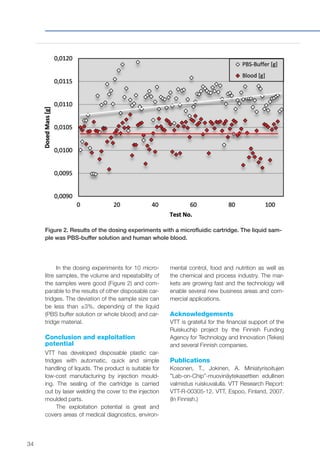
In the dosing experiments for 10 micro-
litre samples, the volume and repeatability of
the samples were good (Figure 2) and com-
parable to the results of other disposable car-
tridges. The deviation of the sample size can
be less than ±3%, depending of the liquid
(PBS buffer solution or whole blood) and car-
tridge material.
Conclusion and exploitation
potential
VTT has developed disposable plastic car-
tridges with automatic, quick and simple
handling of liquids. The product is suitable for
low-cost manufacturing by injection mould-
ing. The sealing of the cartridge is carried
out by laser welding the cover to the injection
moulded parts.
The exploitation potential is great and
covers areas of medical diagnostics, environ-
mental control, food and nutrition as well as
the chemical and process industry. The mar-
kets are growing fast and the technology will
enable several new business areas and com-
mercial applications.
Acknowledgements
VTT is grateful for the financial support of the
Ruiskuchip project by the Finnish Funding
Agency for Technology and Innovation (Tekes)
and several Finnish companies.
Publications
Kosonen, T., Jokinen, A. Miniatyrisoitujen
”Lab-on-Chip”-muovinäytekasettien edullinen
valmistus ruiskuvalulla. VTT Research Report:
VTT-R-00305-12. VTT, Espoo, Finland, 2007.
(In Finnish.)
Figure 2. Results of the dosing experiments with a microfluidic cartridge. The liquid sam-
ple was PBS-buffer solution and human whole blood.
35
Manufacturing methods
Exploitation of MIM production technology
in Finland – project in the SISU 2010
Technology Programme by Tekes (SISU-MIM)
Jouko Virta
Introduction
Complicated metal components can be man-
ufactured cost-effectively using metal injection
moulding (MIM). The MIM process consists
of injection moulding feedstock composed
of metal powder and binder, debinding and
sintering. The processing parameters of each
phase depend on the binder and sintering
characteristics of the metal powder alloy. The
manufacturing technology is a typical mass
production method suitable for a production
series of about a few thousand to millions.
The typical MIM components are small, from
a micro size of 0.5 g to 100 g. The produc-
tion costs of MIM are considerably lower than
those of traditional manufacturing methods
machining or casting. The reduction in costs
can be as much as 70%.
The MIM markets have grown by 15–20%
annually. The automotive industry has been
one of the sectors with a high demand
because of the many actuators needed in
modern cars. Small metal components have
beaten plastic components because they are
stronger and more reliable. MIM has facilitated
the complicated geometry and freedom of
design of metal parts at low costs.
In Finland and other the Scandinavian
countries, there is no industrial production of
MIM components. In other European countries
(France, Germany, Italy, Spain, Switzerland, etc.)
there are several production lines. Globally, MIM
components are mostly manufactured in Asia.
Japan and the USA are also strong in MIM.
One manufacturer of technical plas-
tic components, Plastoco Oy AB in Porvoo,
saw the potential of the new technology and
decided to investigate the possibility of start-
ing MIM production. Plastoco is a joint VTT-
MIM project to gain detailed knowledge of the
processing, quality costs and experience.
Methods
In the project, the general boundary conditions
of MIM production in Finland were clarified as
well as the quality and cost structure of the MIM
technology. The demonstration components
were manufactured and tested at VTT. The
three production phases of injection moulding,
debinding and sintering were developed for the
demonstration components. There was interna-
tional cooperation with MIM feedstock producers
in Germany. Supplementary processing experi-
ments were performed at their premises.
Results, discussion and conclusion
The production costs of MIM components
proved significantly lower than those of the
same component machined. The quality of
the MIM components met the requirements
when the processing was carried out using the
proper material-specific parameters. Sintering
was the most demanding process phase con-
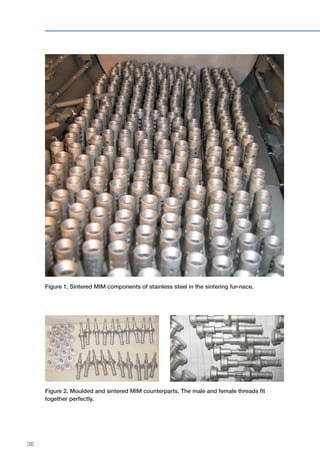
sidering quality and costs. Figure 1 presents
closely charged MIM components in the sin-
tering furnace.
The processing of the trial components
demonstrated that very accurate and compli-
36
Figure 1. Sintered MIM components of stainless steel in the sintering fur-nace.
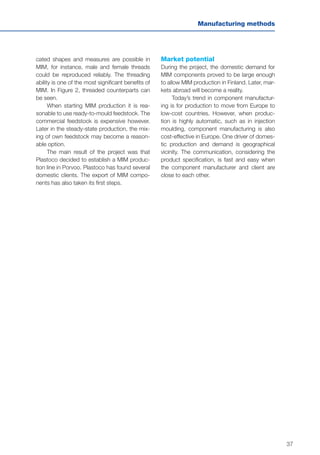
Figure 2. Moulded and sintered MIM counterparts. The male and female threads fit
together perfectly.
37
Manufacturing methods
cated shapes and measures are possible in
MIM, for instance, male and female threads
could be reproduced reliably. The threading
ability is one of the most significant benefits of
MIM. In Figure 2, threaded counterparts can
be seen.
When starting MIM production it is rea-
sonable to use ready-to-mould feedstock. The
commercial feedstock is expensive however.
Later in the steady-state production, the mix-
ing of own feedstock may become a reason-
able option.
The main result of the project was that
Plastoco decided to establish a MIM produc-
tion line in Porvoo. Plastoco has found several
domestic clients. The export of MIM compo-
nents has also taken its first steps.
Market potential
During the project, the domestic demand for
MIM components proved to be large enough
to allow MIM production in Finland. Later, mar-
kets abroad will become a reality.
Today’s trend in component manufactur-
ing is for production to move from Europe to
low-cost countries. However, when produc-
tion is highly automatic, such as in injection
moulding, component manufacturing is also
cost-effective in Europe. One driver of domes-
tic production and demand is geographical
vicinity. The communication, considering the
product specification, is fast and easy when
the component manufacturer and client are
close to each other.
38
High-power laser welding for demanding
applications (TriLaser)
Kalervo Leino and Miikka Karhu
Introduction
Laser welding has long been widely used in
sheet metal product manufacturing, e.g. the
automobile industry. Applications in heavier
industries, however, have been much more
limited. This is largely due to the strict accu-
racy requirements that laser welding places on
the preparation of the parts to be welded.
The development of hybrid laser welding
and the introduction of cost-effective high-
power fibre and disc lasers have made laser
welding a serious alternative to traditional
high-quality welding pro-cesses in heavy metal
industries and highly demanding applications.
Hybrid laser welding is a novel welding pro-
cess in which a laser beam and an arc welding
process are coupled together and directed to a
single spot in the weld groove. The arc welding
process in hybrid laser welding is usually gas
metal arc (MIG/MAG) welding.
Hybrid laser welding combines the advan-
tages of laser and arc welding. The welding
speed equals that of laser welding, and the
melting efficiency that of gas metal arc weld-
ing. The heat input and welding distortions are
only slightly higher than with laser welding.
The accuracy tolerance requirements of weld
grooves are much more forgiving than in laser
welding.
Methods
The welding tests are conducted when: a)
preparing thick-walled (multi-pass) austenitic
stainless steel joints representing demanding
energy equipment applications, and b) fabri-
cating multi-metal joints.
When welding thick sections, hybrid laser
welding is challenging, e.g. narrow gap TIG
welding, is the standard welding method in
power plant engineering. The benefits of laser
hybrid welding in-clude high cost-efficiency
and minimal welding distortions.
At the first stage, moderate laser power of
3 kW was used, but the acquisition of a more
powerful 10–15 kW fibre laser is under way.
Plans also include combining the power of
three 10+ kW laser power sources to conduct
tests with laser power in excess of 30 kW.
In multi-metal joints, the attraction of laser
welding derives from the narrow weld profile,
which means minimal melting of the materi-
als, and the possibility of positioning the weld
accurately to control the composition of the
weld metal much better than with arc welding
processes. The use of hybrid welding further
improves the possibilities of weld metal com-
position control.
Results
Welding tests, even with relatively low laser
power, have shown that hybrid laser welding
is very competitive with the traditional high-
quality arc welding processes. Laser hybrid
welding with a laser power of 3 kW is more
than five times faster than narrow-gap TIG
welding in the corresponding conditions.
With low laser power, hybrid laser weld-
ing has drawbacks however. Low laser power
results in relatively small penetration depth,
which leads to a substantial number of filling
passes and the use of filler material. With a
low laser power welding parameter, tolerances
39
Manufacturing methods
are very small to guarantee high quality of the
whole weld.
In multi-metal joining, the deep penetra-
tion profile and low and well-controlled dilu-
tion of the metals offer good possibilities of
joining materials that are difficult to weld with
traditional arc welding processes. The use of
hybrid welding facilitates further weld metal
composition control. Due to the low heat input
of hybrid laser welding, the properties of the
metals are less affected and the heat-affected
zone much narrower than with arc welding
processes.
Discussion
The project is still ongoing, and the results pre-
sented above are of a provisory nature. Increasing
the laser power from 3 kW to 10+ kW (and fur-
ther to 30+ kW) will most probably not only
increase the performance and cost-efficiency
of the process but also eliminate the draw-
backs experienced with low laser power.
An increase in laser power may, however,
introduce new development needs to hybrid
laser welding. The laser power handling ca-
pacity of laser welding optics may prove insuf-
ficient to laser powers in excess of 10 kW. The
development of optical materials and coatings
will be needed to cope with the most recent
high-power laser sources.
The high-power hybrid laser welding appli-
cation range still needs to be determined. In
principle, an increase in laser power results in
increased penetration, which means improved
productivity in thick-section welding. The behav-
iour of the weld pool may, however, set limits
for the maximum penetration depth that can
be used in workshop conditions. This will limit
the application range somewhat as well as the
investment costs of the hybrid laser welding
equipment to a reasonable level.
Exploitation potential
Hybrid laser welding may be considered one
of the developments with most potential in
welding, especially in welding productivity dur-
ing the last two decades. With arc welding
processes, welding productivity can be maxi-
mized with automation, but, in spite of this, the
cost level of industrializing countries is hard to
achieve. The productivity of high-power hybrid
laser welding is multifold compared with tradi-
tional welding processes and it provides the
Finnish industry with much-improved competi-
tiveness over countries with low labour costs.
Hybrid laser welding is most applicable
to welding long and/or thick welds that have
strict quality requirements. The manufactur-
ing of machinery for the process and energy
industry, mining and construction equipment,
shipbuilding and pressure equipment manu-
facturing are potential uses of hybrid laser
welding. It is a good alternative to the pre-
sent welding methods in the manufacturing of
semi-finished metal products such as welded
profile beams and pipes.
Hybrid laser welding is still a relatively
novel welding process that will involve a sub-
stantial amount of qualification and accept-
ance work. This will inevitably delay its exploi-
tation in applications that are controlled or
regulated by third parties. The benefits of the
process are such, however, that the process
qualification process will be very profitable.
Publications
Karhu, M. 2011. Narrow Gap Laser-Cold Wire
and Laser-Arc Hybrid Welding Process Devel-
opment for 60 mm Thick Austenitic Stainless
Steel Joints. Tri-Laser Research Report. VTT,
Lappeenranta, Espoo, Finland. 23 p.
40
Flexible and autonomous small batch
welding production (Sisuhitsi)
Markku Hentula
Introduction
The aim of the project was to develop a model
of means and possibilities for success in the
Finnish welding industry: a) by which pro-
ductivity can be increased to a level at which
the performance of welding production will
approach the automated production cells of
machining, b) that will enable cost-efficient
manufacturing of welded products, especially
in small batch production, and c) by which the
ability of companies to react to product and
production changes will increase to a new level.
Methods
A questionnaire was conducted in the pro-
ject with the purpose of collecting as much
information as possible about the state-of-
the-art and future expectations of the Finnish
welding industry. The questionnaire was sent
to 316 companies, and 105 replies from 87
companies were received. The questionnaire
was aimed specifically at welding companies
that represented the main suppliers, contract
manufacturers and subcontractors.
Welding automation of big products made
of heavy plate constructions was studied in a
master thesis. In the case part of the master
thesis, a welding concept was determined for
one company. The most important aims of
the concept were to decrease the throughput
time, and increase welding productivity and
profit by reducing the total work hours. The
final goal was to implement mechanization
and automation welding as far as possible.
A research exchange was carried out
in cooperation between Aachen University
(RWTH, ISF) and VTT. The aim of the exchange
was to further the development of the welding
simulation software, SimWeld, developed by
RWTH (Figure 1).
Four case projects (that supported the
research work) were also carried out for the fol-
lowing companies: TTP-Yhtiöt Oy, STX Finland
Cruise Oy, Paramet Konepaja Oy and Halikko
Works Oy. The most important aim of the
case projects was study usability and restric-
tions of welding automation at different stages
for use in small batch and one-off production.
One essential challenge discovered was quick
and simple programming of welding robots
between product changes. The feasibility of
the machine vision to increase robotic welding
productivity was studied. Other research areas
were hybrid laser welding, sheet metal material
handling and forming before welding produc-
tion, and welding and control of weld deforma-
tion in big steel structure welding.
Results, discussion and conclusion
In Finland, the essential competition factors
of welded products and welding produc-
tion are quality and features (performance)
of products, delivery time and reliability,
cost-effectiveness, productivity and manufac-
turing expertise. The price of the product is an
important but not essential competition factor.
No major changes in the competition factors
are expected in the future, but the importance
of delivery time is expected to increase.
The market areas of the Finnish welding
companies are global. The biggest portion is
still domestic deliveries (which may even be
41
Manufacturing methods
Figure 1. WeldSim software redeveloped by Aachen University and VTT.
highlighted by the fact that big main manu-
facturers have outsourced their production to
SME-sized subcontractors and system sup-
pliers, in which case the client of the weld-
ing companies is domestic, even though the
product is exported), but Asia has risen after
Europe and the Nordic Countries to the fourth
most important market area ahead of North
and South America.
The most important problems in the welding
industry were discovered to be:
1.	 	a large number of project products, which
leads to small manufacturing series (typi-
cally < 5),
2.	 	the dominant role of manual welding
(degree of automation < 20%), which is
partly due to R&D (products not suitable
for automation) and faults in job planning
(large portion of position welding),
3.	 	low welding output (< 500 g/h) and
4.	 difficulties hiring welding manpower and
shortages in basic welding education.
It was positively noted that welding quality
management is in a good shape in Finland:
a quality management system, a named and
qualified welding coordinator and a welder
qualification system are in use in most of
the companies. The conditions of welding
automation have also improved: welding com-
panies are able to influence product design,
the number of accurate component manufac-
turing methods has increased and the growth
in production volume has enabled profitable
automation.
The main development aims for the future are:
1.	marketing
2.	 better manufacturing networks,
3.	 assembly (from welding component
manufacturers to system deliverers of
assemblies) and
4.	 the welding itself, especially increased
automation. The development of weld-
ing technologies was not seen as that
important.
42
The most important means to increase weld-
ing productivity are automation and products
designed to be feasible for automation. Auto-
mated and robotized welding requires actions
that are anomalous to the familiar equipment
purchasing process because an optimized
turnkey supply for a specific purpose is very
limited. For large constructions and small
batches of robotized case-specific welding,
custommade system solutions have to be
built. Commercial components and systems
can be used in these but connecting them to a
solution is more like a production development
project than plain machine building.
Welding productivity can be increased in
many and different size steps. A significant
technology leap (e.g. from manual welding
to robotized welding) can be made or smaller
steps taken towards the same goal. The big-
gest outcome/input ratio can be achieved just
by migrating from manual welding to simple
mechanized welding. The cost-efficiency of
welding can still be increased through a greater
degree of automation and welding process
optimization, but the additional outcome per
input will not rise by the same ratio. The com-
petitive situation of the company defines how
much welding automation should be used.
The starting point of welding development
is the decision to invest in welding in the long
term. Increasing the rate of welding automa-
tion is a long-term and demanding process. It
should be designed carefully, beginning with
defining targets and ending with measuring
the results and defining further development
steps. Development work is a non-stop pro-
cess, and it has to be carried out to maintain
competitiveness.
Exploitation potential
The project results can be used by welding
companies, welding automation system dis-
tributors and VTT.
43
Manufacturing methods
Direct write techniques for competitiveness
and increased product functionality
(SUORA)
Helena Ronkainen
Introduction
Direct Write (DW) techniques belong to the
Additive Manufacturing technologies and
enable completely new solutions for electronic
and mechanical components. The DW tech-
nique allows electronics to be integrated into
mechanical components and systems, thus
facilitating the fabrication of electronic compo-
nents, such as sensors, wirings and antenna
structures, during the machine and instrument
manufacturing process. With DW techniques
it is possible to deposit different material layers
and structures directly onto straight, curved
and three-dimensional component surfaces
rapidly and efficiently. The process does not
require masks or other complex tools either,
which has a beneficial environmental impact.
DW technology facilitates efficient produc-
tion of tailor-made functional solutions and
enhances the competitiveness and reliabil-
ity of products. DW also lowers production
costs and simplifies logistics chains. It can
also improve the environmental friendliness of
products and production methods.
In 2009, VTT invested in two different DW
techniques, namely the Direct Write Thermal
Spray (DWTS) and Direct Write Paste (DWP)
techniques (Figure 1). The objective of the
SUORA project is to facilitate the effective use
of DW techniques in research and develop-
ment and to study the feasibility of the DW
techniques for different applications.
Methods of the projects
The basic process parameters affecting the
performance of the two DW techniques were
studied. The parameters, such as pumping
pressure, speed, dispensing height and sur-
face energy, affect the dispensing quality of
the DWP technique. With the DWP, paste or
ink-type materials are dispensed with high
accuracy to create fine lines and features.
One typical material studied in the project is
the conductive silver paste that can be used
to fabricate conductive lines and structures.
Different conductive pastes have been dem-
onstrated and the post-sintering processes
developed. Different polymer-based materials
have also been dispensed to create 2D and
3D structures. The DWTS is based on ther-
mal spraying and, due to the melting of the
powder material in the spray process, no post
treatments are required. The DWTS spraying
of different materials is studied in the project.
The dielectrics, such as spinel (Mg-Al2
O3
), can
be used for insulating layers on metal surfaces.
Typical conductive materials are copper, which
can be used for conductive lines, and different
sensor materials, such as alumel and chromel
used in thermocouples. The process parame-
ters for different materials were tuned to obtain
good material quality.
The feasibility of DW techniques for dif-
ferent application areas was evaluated by
developing demos covering a wide techno-
logical field. The performance and quality of
the demos were tested in a laboratory and in
some cases in field tests.
Results
The conductive silver materials dispensed
by DWP reached conductivities in the range
44
of 5 to 50% of the bulk Cu conductivity with
post-sintering temperatures in the range of
120 to 300ºC, and the DWTS copper had a
conductivity of about 40% of the bulk copper
conductivity. The DWTS spinel has good elec-
trical insulating properties on metal surfaces
thus providing the dielectric properties for dif-
ferent sensor structures.
To demonstrate the feasibility of DWP, sil-
ver paste was used to fabricate conductive
structures on polymer substrates. The other
demo consisted of both 2D and 3D polymer
structures. A 3D structure dispensed for the
polycaprolactone (PCL) polymer is presented
in Figure 2.
Different sensor structures were fabri-
cated and tested with the DWTS technique.
Thermocouples (TC) sprayed on 2D samples
were tested in the laboratory giving reasona-
ble repeatability. Figure 2 shows TCs depos-
ited on curved surfaces for temperature dem-
onstration purposes. The strain gauges were
fabricated on 2D samples and tested by Mes-
oScribe Technologies Inc. The strain gauges
performed in a similar way to those fabricated
by MesoScribe. However, some needs for
more tuning and material improvement were
distinguished for more stable and repeatable
measurement results. Strain gauges to meas-
ure torque were also fabricated on a cylindri-
cal shaft. Since the spray gun is manipulated
by a robot, it is possible to make deposits on
complicated component structures. The sen-
sors were evaluated with a repeated pulsating
load. The results showed good performance
for the sensors compared with the reference
sensors and proved the feasibility of using
DWTS technology to fabricate stain gauges
for, e.g., torque measurement [1].
Discussion and conclusions
The results and demo evaluations showed
good performance by DW materials and struc-
tures. Several demonstrations provided good
insights into the capability of techniques and
proved the huge potential the DW techniques
have for future manufacturing. However, more
research and development of the material
used is needed in order to improve the mate-
rial performance.
Exploitation potential
As Direct Write (DW) technology enables new
production techniques and solutions for elec-
tronics and the integration of electronics onto
mechanical components it has a wide applica-
tion field and huge potential in the future. The
DWP technique enables miniaturization in elec-
Figure 1. (a) The DWTS manufacturing cell with a 6-axis robot. (b) The DWP (nScrypt)
CAD/CAM compatible facility with a two pump system.
a) b)
45
Manufacturing methods
tronics as well as a generation of 3D electronics.
The new technique can also shorten the pro-
duction chain and provide savings in component
production. With DW, electronic components,
such as sensors, wirings and antenna struc-
tures, can be fabricated directly onto surfaces
during machine and instrument manufacture. It
is also possible to integrate the DWTS facility as
one part of the production chain. The sensors
and other electric components fabricated with
DWTS are robust and can thus provide sensor-
ing solutions for harsh conditions.
Acknowledgements
The project work was carried out by the VTT
personnel Mika Jokipii, Virpi Kupiainen, Sini
Metsä-Kortelainen, Jukka Paro, Kimmo Ruu-
suvuori, Seppo Vasarainen and Jukka Vuorio.
Their effort in the project and the financial sup-
port of Tekes, VTT, Andritz, ELE Products,
Gemalto, Metso Automation, Pulse and Wärt-
silä are greatly appreciated.
References
[1]	Tervo, J., Paro, J., Ruusuvuori, K. & Ron-
kainen, H., Plasmaruiskutus sulautettujen
antureiden valmistusmenetelmänä. Pro-
maint 1, 2012, pp. 52–45. (In Finnish.)
a) b)
Figure 2. (a) Thermocouples fabricated on curved surfaces by the DWTS technique. (b)
3D structures dispensed from PCL with the DWP technique.
Factory and enterprise systems
48
More intelligence for laser processes (ÄLLI)
Jouko Viitanen
Introduction
The ÄLLI project ran during 2009–2010. It was
funded by Tekes in the SISU 2010 Technol-
ogy Programme and by five laser technology
companies: Corelase Oy (www.corelase.fi),
TH-Tools Oy (www.th-tools .fi), Nanofoot Fin-
land Oy (www.nanofoot.fi), Cavitar Oy (www.
cavitar.com) and Technology Center Hermia
Oy (www.hermia.fi, http://lccfinland.nettisivut.
fi). The research partners were VTT and Tam-
pere University of Technology. The objectives
included:
•	 	Development of laser processes and their
automation software, including measure-
ment and control, and modular software
for 3D laser beam steering.
•	 	Four selected laser processes were devel-
oped as demonstrators of the developed
technology:
-- accurate surface coating
-- glass-to-silicon or glass-to-glass join-
ing and welding
-- direct writing of thin films
-- two photon polymerization.
Methods
The software development work used indus-
trystandard visual programming tools and a
hard real time kernel to implement synchro-
nized motion control for beam steering and
workpiece motion platforms. The modu-
lar implementation allows fast configuration
of optomechanical setups that consist of
scanned mirrors, stepper or servomotor
stages, laser shutters, and electrical control of
lasers. The methods also included experimen-
tal process development for high-speed pulse
lasers in selected material processing tasks.
Results
The modular software development approach
was demonstrated by building a worksta-
tion for a two-photon polymerization (2PP)
laser process. It included databases and
visualization of 3D CAD designs (left side in
Figure 1) and real time process monitoring
through microscope optics of the polymer-
ized structures (right side). 2PP allows additive
manufacturing in a microscale rapid prototyp-
ing or ‘3D printing’ device: arbitrary objects
designed in a 3D CAD can be formed using
2PP in a sub-micron resolution. Common
photoresists or even biomaterials can be
polymerized with a high-speed pulse laser. At
VTT, there are various alternative pulse lasers
within the femtosecond-picosecond ranges
that can concentrate high optical intensity in a
small volume that initiates multiphoton excita-
tion of monomers.
The SEM picture in Figure 2 shows one
precision polymerized structure. This work
was commercialized by Nanofoot Oy. In addi-
tion to 2PP, other laser processes were also
developed. In the project, thin film patterning
was also performed, as seen in Figure 3.
In the work packages coordinated by TUT,
an axially symmetric high-power diode laser
by Cavitar Oy was tested in the tasks of weld-
ing and high accuracy powder deposition, and
high-speed pulse lasers by Corelase Oy were
49
Factory and enterprise systems
Figure 1. The graphical user interface of the 2-photon polymerization workstation. On the
left side, the 3D CAD model, and on the right side, the polymerized structure.
Figure 2. Polymerized 3D structure in a
SEM picture (courtesy of Elli Käpylä in the
joint project BioPulse that also used the
software developed in ÄLLI).
used for joining silicon with glass. Real time
measurement and control of the distance of
the laser optics and the high-speed scanning
stage were developed. An accuracy of 1 µm
at the speed of 600 mm/s was achieved. A
confocal sensor was interfaced to perform the
profile imaging during scanning. At VTT, glass-
to-glass welding was also developed. The
work was reported in publications below.
Discussion
The ÄLLI project responded to the need of
the industry to manage complex laser pro-
cessing tasks by easily configurable, modular
software. Interfaces to model CAD databases,
intuitive user interfaces and real time control of
50
the laser processes were developed for sev-
eral different laser applications. In most cases,
such facilities are crucial to the efficient use of
modern high-speed pulse lasers.
Publications
Latokartano, J., Pajukoski, H. & Vuoristo, P.
Axially symmetric Laser in surface treatment
applications. 12th Nordic Conference on
Laser Materials Processing, NOLAMP Con-
ference 2009, Copenhagen, Denmark, 24–26
August, 2009. 10 p.
Pajukoski, H. Aksiaalisymmetrisen diodilaserin
lisäaineen syöttö. Master’s thesis. Tampere
University of Technology, Finland, 2009. (In
Finnish.)
Peltola, S., Kellomäki, M. & Viitanen, J. Two-
photon polymerization of protein patterns with
Nd: YAG pulsed laser, ICALEO 2008 Congress
Proceedings, Nanomanufacturing Confer-
ence, pp. 93–98.
Vihinen, J., Latokartano, J., Pajukoski, H.,
Siekkinen, T. & Lassila, E. Direct Diode Laser
with coaxial material feeding. Proceedings
of the 5th International WLT-Conference on
Lasers in Manufacturing 2009, Munich, Ger-
many, June 2009. Pp. 257–261.
Figure 3. Transparent conductive ITO thin
film patterned with a picosecond range
laser without damaging the underlying
glass surface.
51
Factory and enterprise systems
Optimization of autonomous production
cells – real time production intelligence
(ATOR)
Juhani Heilala and Jari Montonen
VTT has developed customizable simulation
software for use in production planning and
capacity control for discrete part-manufac-
turing. Based on the production information,
GeSIM simulates and visualizes resource use,
work in process and delivery accuracy in the
production system.
Introduction
Agile, fast and flexible production networks
are a must for companies facing today’s global
competition. Delivering on the stated order
date is the key element to customer satisfac-
tion. In lean manufacturing, material stocks
are kept as small as possible, while expensive
resource use is kept as high as possible. One
important decision in production planning is the
scheduling and synchronization of activities,
resources and material flow. The produc-
tion personnel must seek a balance between
customer orders and limited resources. The
connections between manufacturing systems
and processes are becoming more complex
and the amount of data required for decision-
making is growing.
Production planners need accurate and
dynamic models of production, i.e. simulation
models that use a production network and real
shop floor data in near real time. The basic
idea is to combine the strengths of automatic
data analysis, calculations and simulation re-
sults with the visual perception and analysis
capabilities of the human user who makes the
final decisions. The use of simulation with an
easy-to-use graphical user interface provides
tools and methods for a manufacturing sce-
nario evaluation, scheduling optimization and
production planning even for simulation non-
experts (Figure 1).
Methods
Discrete-event simulation (DES) has mainly
been used as a production system analysis tool
to evaluate new production system concepts,
layout and control logic. Recent develop-
ments have made DES models feasible for
use in the day-to-day operational produc-
tion and planning of manufacturing facilities
[1]. Manufacturing system simulation with
planned future operations, relevant resource
and material data is a suitable management
and evaluation tool to help production man-
agers. These dedicated ‘as built’ simulation
and calculation models provide manufactur-
ers with the ability to evaluate the capacity of
the system for new orders, unforeseen events
such as equipment downtime, and changes
in operations. The major challenges for such
system (e.g. GeSIM) development are:
1. Data integration: Manufacturing operations
planning is typically performed in a heterogene-
ous information system environment. Examples
of such systems include: Enterprise Resource
Planning (ERP), Manufacturing Execution Sys-
tem (MES), job shop supervisory and data
acquisition systems, maintenance management
systems, etc. GeSIM does not replace these
existing systems; they remain in place as parallel
systems, serving as sources of information for
decision-making and means to implement the
decisions. There is a need to transfer and share
52
data between GeSIM and other manufacturing
software applications. Custombuilt proprietary
interfaces do require customization, but GeSIM
is quite flexible.
2. Automated simulation model creation
and updates: There is a need for perma-
nent, alwayson, synchronized factory models
or models that can be created automatically
on demand from ERP and other interoper-
able data sources and that are used for the
manufacturing process and operations plan-
ning. GeSIM does support automated model
building using selected data sources as input.
3. The visualization of results for interactive
and effective decision-making: Simulation
analysis produces a great deal of numerical
??
??
PAST
NOW
Customer
orders
Limited
Resources
New orders Late orders
CapacityDelivery time
LOAD
Scheduling
Subcontracting
overtime/shifts
Rescheduling
of old orders
vs. CAPACITY
Figure 1. Simulation-based production planning.
information consisting of tables, listings and
reports. It is difficult for a human decision-maker
to locate the relevant pieces of information.
Thus, the simulation results have to be pre-
sented in a visually effective way to speed up
and improve the way the results will be under-
stood. Different users require, or are allowed
access to, different types of information, or the
same information is presented differently. Time
is an important factor in defining how much and
what kind of data should be aggregated for the
upper levels of the organization: a manager
cannot afford to be ‘swimming in data’ when
making a quick decision.
The efforts at VTT to overcome these
challenges during the ATOR project are shown
[1, 2, 3, 4].
53
Factory and enterprise systems
Results
The aim of the ATOR project was to develop
and demonstrate production simulation
interfaces, autonomous product line/cell man-
agement with simulation methods to increase
production efficiency and to build a Decision
Support System (DSS) for production man-
agers and supervisors in two industrial cases.
The developed tool GeSIM (see Figure 2)
is useful in customer-driven manufacturing
because it adds features for production plan-
ners and capacity managers that have not
Figure 2. Simulation-based DSS; GeSIM user interface example.
been provided by standard tools in the past.
By integrating discrete-event simulation and
traditional production planning methods, it is
possible to forecast the required workloads
with given input values. The simulation model
and the developed graphical user interface
make it possible to visualize the occurrence
of potential bottlenecks or other production
problems and to take corrective actions.
During the project, user-centric develop-
ment process guidelines for such simulation
application development were also evaluated
54
with a real industrial case study [2, 4], and the
standardization landscape was evaluated [3].
Discussion and exploitation
potential
Some of the benefits of implementing an
operational simulation scheduling system (e.g.
GeSIM) include: less effort to plan day-to-day
scheduling, customer order due date con-
formance, synchronization of flow through the
plant, minimization of setups/changeovers,
early warnings of potential problems, checks of
critical resources and materials and, naturally,
a ‘what-if’ scenario analysis for capacity plan-
ning. The presented methodology harmonizes
the decision-support system for production
and capacity management and uses near
real time production status information. This
type of operational decision-support system
has many potential users, from operators on
the production line to the plant manager and
even upper management. The use of this kind
of method can be applied to extended enter-
prises. External resources can also be shown,
if the necessary information is available.
Acknowledgements
The research was carried out as part of
the national research project ‘Optimiza-
tion of autonomous production cell – real
time production intelligence’ (2009–2011).
The industrial partners, VTT and TEKES (the
Finnish Funding Agency for Technology and
Innovation) have funded the work carried out
by VTT. The project was part of the national
SISU 2010 – Innovative Manufacture program.
References
[1]	Heilala, J., Montonen, J., Järvinen, P. &
Kivikunnas, S. 2010. Decision Support
Using Simulation for Customer-Driven
Manufacturing System Design and
Operations Planning. (Chapter 15). In:
Devlin, G. (ed.). Decision Support Sys-
tems Advances in. Intech. Pp. 235–260.
http://www.intechopen.com/books/
decision-support-systems-advances-in/
decision-support-using-simulation-for-
customer-driven-manufacturing-system-
design-and-operations-pla.
[2]	Heilala, J., Montonen, J., Järvinen, P.,
Kivikunnas, S., Maantila, M., Sillanpää, J.
& Jokinen, T. 2010. Developing Simulation-
Based Decision Support Systems for
Customer-Driven Manufacturing Operation
Planning. Proceedings of the 2010 Winter
Simulation Conference, WSC ‘10, Baltimore
Marriot Waterfront, Baltimore, MD, USA, 5–8
December, 2010. Johansson, B., Jain, S.,
Montoya-Torres, J., Hugan J. & Yücesan, E.
(eds.). IEEE. Pp. 3363–3375. http://www.
informs-sim.org/wsc10papers/311.pdf.
[3]	Kivikunnas, S. & Heilala, J. 2011.
Tuotantosimuloinnin tietointegraatio. Stan-
dardikatsaus. VTT Working Papers 172.
VTT, Espoo, Finland. 29 p. http://www.vtt.fi/
inf/pdf/workingpapers/2011/W172.pdf. (In
Finnish.)
[4]	Heilala, J., Montonen, J., Usenius, T.,
Kuula, T., Maantila, M. & Sillanpää, J. User-
centric development of simulation based
manufacturing operation planning and
scheduling system. Proceedings – 2011
IEEE International Symposium on Assembly
and Manufacturing, ISAM 2011, Tampere,
Finland, 25–27 May, 2011. IEEE Com-
puter Society, p. 5942346. Doi: 10.1109/
ISAM.2011.5942346.
55
Factory and enterprise systems
Desktop assembly (DeskAssy)
Ilari Marstio
Introduction
Production philosophies have changed
from traditional mass volume production to
assemble-to-order-type thinking. This raises
challenges for automated production lines.
Moreflexibilityisneededtohandleshortbatches
and ever-changing customized products. Many
companies have fled to cheap labour countries
and continued production manually.
New technologies and approaches clear
the way fo r novel assembly con-cepts. The
aim of this project was to create an assem-
bly system concept for light and small prod-
ucts. This Desktop Light Assembly platform is
based on plug ‘n’ produce modules in which
process and part-specific production equip-
ment are independent of each other. The
modules are floor space-saving, easily mova-
ble and changeable units. The degree of auto-
mation and capacity can be altered by adding
modules or manual labour.
Results
A comprehensive technology survey was con-
ducted on assembly technology. Based on the
latest technology, a study from academia and
fresh ideas, the Desktop Light Assembly Con-
cept was invented. The concept is illustrated
in Figure 1.
The ground-breaking Desktop Light Assem-
bly Concept was created and demonstrated
(Figure 3). Equipment can be freely modified and
the assembly line can be customized according
to the needs of the concept. The assembly line
is constructed around the conveyor, which gives
pneumatics, electrical connectors and the field-
bus to the modules that are attached to it. The
conveyor system controls the flow of material.
The assembled parts can be conveyed with pal-
ettes or by a belt conveyor. The modules can
be attached to both sides of the conveyor. The
modules consist of the intelligence needed to
control the equipment on top of it, which means
the PLC, IO signals and servo controllers. A pro-
cess plate on which the actual process equip-
ment sits can be attached on top of the mod-
ule. The interface between the module and the
process plate is only two pneumatic and electri-
cal signals. In the fieldbus, there is a PC from
which the system can be monitored, controlledFigure 1. The Desktop Light Assembly
Concept.
56
and programmed. There is a database on the
PC in which all the created programs for differ-
ent process plates exist. The modules are iden-
tical. Based on the process plate connected to
a module, the right program is fetched from the
database.
It is easy to make production changes with
the concept. New process plates can be pro-
grammed offline and simulated. Changing the
process plates requires minimal time. New
modules can easily be added and the configu-
ration of the assembly line is simple to change.
The end-user will ultimately have a library of
process plates and be able to build the required
line configuration almost like with Lego blocks.
The space-savings and functionality are
better than with a traditional robot cell. Pre-
viously, modifications had to be made to the
whole cell and its software, but now only one
part has to be changed. As modules are only
Figure 2. The Desktop Light Assembly user interface.
one-quarter of the size of a traditional robot
cell, much factory floor space can be saved.
The concept is a hybrid between central-
ized and distributed control systems. Control
is distributed to the modules. This level of dis-
tribution was considered the most cost-effec-
tive. There is still one centralized control sys-
tem from the PC that runs on top of the Visual
Components’ 3D Create to build the user
interface (Figure 2). The models in the interface
update according to the actual line changes.
The simulation can also be run before realizing
the actual line. With this virtual environment,
the new programs are made for the new pro-
cess plates and distributed to the modules.
Compared with traditional assembly sys-
tems (assembly lines, robot cells, manual work-
stations), the Desktop Light Assembly concept
offers more flexibility to production. The line
changes are easy and do not take up produc-
57
Factory and enterprise systems
tion time. The concept also saves expensive
production space. Changes are cost-effective
to realize when only the equipment part needs
to be replaced. Much research has recently
been put into completely distributed systems in
which intelligence has been distributed to indi-
vidual components (grippers etc.) and, accord-
ing to our study, this kind of approach did not
seem to be realistic because of the complexity
and sky-high costs.
Conclusions
The new production concept has been cre-
ated. It is more expensive to realize than
dedicated assembly lines, but in the long run
the DeskAssy concept is more cost-effective.
The ultimate vision would be to build an as-
sembly line that is like plugging USB devices
into the computer, with the connected devices
being fully functional right after connection. It
is a long way to that vision, many obstacles
need to be crossed and big companies will
need to agree to some new standards.
Publications
Malm, T., Viitaniemi, J., Marstio, I., Toivonen, S.,
Koskinen, J., Venho, O., Salmi, T., Laine, E.
& Latokartano, J. Vuorovaikutteisen robotiikan
turvallisuus. Suomen Robotiikkayhdistys Ry,
Helsinki, Finland, 2008. 123 p. + app. 73 p.
(In Finnish.)
Marstio, I., Haag, M. & Väätäinen, O. Self-con-
figuring control system for modular assembly
system. 2009 IEEE International Symposium
on Assembly and Manufacturing, ISAM 2009,
Seoul, Korea, 17–20 November, 2009, Pp.
379–382. Doi: 10.1109/ISAM.2009.5376972.
Salmi, T., Marstio, I., Malm, T. & Laine, E. Man-
Robot Cooperation – New Technologies and
New Solutions. Micro-Assembly Technolo-
gies and Applications. IFIP TC5 WG5.5 Fourth
International Precision Assembly Seminar,
IPAS’2008, Chamonix, France. Pp. 385–394.
Springer, New York, 2008.
Figure 3. Desktop Light Assembly Plat-
form demonstration.
58
Eco-efficient production
Marja Paju
Introduction
Eco-efficiency is based on ‘more from less’
thinking. It means reducing the use of mate-
rial and energy, reducing the environmental
impacts during a product’s life cycle and main-
taining the same time-efficient production.
Eco-efficiency has a positive impact on a com-
pany’s ecological competitiveness through the
reduction in material needed by products,
production and services, the reduction in the
energy needed to produce products and ser-
vices, and the reduction in the use of harmful
materials and substances. Eco-efficiency
can also mean improving the recyclability or
durability of products. By examining produc-
tion as a whole through a life cycle approach,
it is possible to identify the different states of
processes and logistics that are essential to
developing eco-efficiency.
An eco-efficient production project was
part of the Tekes SISU 2010 – Innovative Man-
ufacture technology programme. The aim of
the project was to test and develop existing
eco-efficiency analysis methods for evaluating
and improving eco-efficiency of production in
the Finnish manufacturing industry. The pro-
ject was coordinated by VTT and carried out
between 08/2008 and 11/2010. The funding
came from Tekes, VTT and four industrial part-
ners: Iittala Group Oy Ab (Fiskars Oyj Abp),
Oras Oy, Rautaruukki Oyj and Suunto Oy. The
total budget was 667,000 €.
Methods
The framework of the Eco-efficient production
project is presented in Figure 1. The project
was carried out in five work packages (WP),
which were:
•	 WP1: State of the art: Eco-efficiency in
discrete manufacturing industry
•	 WP2: State of the art: Existing methods
for evaluation of eco-efficiency
•	 WP3: Caste studies: Testing the chosen
existing methods in industrial cases
•	 WP4: New methodology creation: Devel-
opment of a new method to evaluate
eco-efficiency
•	 WP5: New methodology testing: Evalua-
tion and testing of the developed method.
The state of the art studies (WP1 and WP2)
focused on methods and tools for discrete
event simulation, sustainable value-stream
mapping, life cycle assessment, material flow
analysis and the carbon footprint. The case
studies were conducted in WP3.
Internationalcollaborationwasanimportant
part of the project and one goal was to include
a total of 12 months of researcher exchange in
the project. The planned researcher exchange
was carried out with NIST (National Institute of
Standards and Technology), the USA, and AIST
(National Institute of Advanced Industrial Sci-
ence and Technology), Japan.
Results
The differences and similarities between the
selected, existing eco-efficiency assessment
methods were studied and identified. Life
cycle assessment is the only ISO standardized
method. Life cycle assessment and carbon
footprint are useful methods to cover opera-
59
Factory and enterprise systems
Figure 1. Framework of the eco-efficient production project.
Manufacturing technique and
production methods
Production
planning and
framework
Component
production
Production
and logistics
Mainte-
nance
Legislation, e.g.
EuP, RoHS,
WEEE, REACH
Material
streams
Costs
Energy flows
Methods and tools
Environmental strategic goals
Material flow analysis
Carbon footprint
Energy review
Value-stream mapping
Productivity
Information
flows
Product
planning
Production strategy
Use
Re-use,
recycle
Best Available
Technique BAT
Life cycle assessment
Production process
modelling
MIPS
Ecological footprint
Eco-efficient
production
tions systematically throughout a product’s
value chain. The environmental assessment
methods focused solely on the environmental
indicators and they were based on material
and energy balances. Production-oriented
assessment methods including discrete event
simulation and value-stream mapping focus
on time and volumes but can be employed
in light environmental assessments, adding
environmental indicators into the assessment.
They commonly focus on the production floor
operations. In spite of the method looked at,
careful consideration of the objectives and the
use of applications are determinants.
In the Ekoteho project, four industrial case
studies were completed and a new methodol-
ogy, ECOmap, created and tested. Four con-
fidential industrial case studies were carried
out, and the final research report, four confer-
ence papers and one master’s thesis resulted
from the project.
The ECOmap, shown in Figure 2, works
on an existing commercial software platform,
eVSM, and uses the process flow chart and
worksheet. It is a simplified and connective
process flow chart method. The platform uses
pre-selected indicators. The method uses a
limited number of visible parameters. The plat-
form has connections to web databases to
import data.
Discussion and exploitation
potential
It is becoming more important to control
environmental impacts in the manufacturing
industry, as the goal is shifting from conven-
tional end-of-pipe technology to life cycle
thinking. This shift can be accelerated with the
right tools and methods.
Manufacturing systems, processes, prod-
ucts and related data are becoming more
complex. Thus, product and manufactur-
ing engineering and production management
decisions require many interdependent fac-
tors and variables to be considered. To be
able to consider the environmental impacts of
a production process, it is important to assess
the environmental parameters simultaneously
in the same model along with the process
parameters. Thus, the environmental consid-
erations can be made in conjunction with pro-
duction system planning. The development
of a sustainable manufacturing system adds
parameters that must be handled simultane-
ously. To incorporate environmental consider-
ations while analysing manufacturing systems,
60
Process map MS Visio
eVSM / MSVisio: results + input data
+ visualization
Spreadsheet MS Excel
input data + calculation + User interface to Visio
Web database
Vehicle emissions (VTT Lipasto)
LAN -connection
MS Excel
link
Data link
Selecting the indicators
Figure 2. ECOmap on the eVMS platform.
it is essential to shift the focus away from eco-
nomic growth to a mix of parameters.
The methods and tools for environmental
assessment in the discrete part manufacturing
industry can be divided into two categories:
those that are used primarily for the assess-
ment of environmental aspects, such as LCA,
and those that use environmental assessment
as an add-on element. Add-on tools require
less effort to adapt to the existing manufac-
turing modelling tools, but they compromise
on comprehensiveness on the environmental
assessment part. There are a few tools that
include operations beyond the facility. The
environmental assessment-oriented tools are
more comprehensive but require multidiscipli-
nary expertise to use. Data collection could be
a bottleneck to assessment methods that take
a life cycle approach. The new method that
was developed uses principles from existing
methods and takes a goal-oriented approach,
a principle that is known in, e.g., LCA (ISO
14040, 2006). Choosing the right indicators
according to the goal and setting the system
boundaries are essential steps for the new
methodology.
VTT’s future work within eco-efficiency
focuses on further testing the new methodol-
ogy ECOmap with industrial case studies, cre-
ating case-specific ECOmap indicator repos-
itories as well as linking the simulation and
process flow chart. VTT also has a represent-
ative taking part in the standardization of ISO
14045 Environmental management – Eco-effi-
ciency assessment of product systems – Prin-
ciples, requirements and guidelines.
Acknowledgements
Tekes, Iittala Group Oy Ab (Fiskars Oyj Abp),
Oras Oy, Rautaruukki Oyj and Suunto Oy.
61
Factory and enterprise systems
Publications
Heilala, J., Paju, M., Montonen, J., Hentula, M.
& Heikkilä, A. Modelling and Simulation for Lean
and Sustainable Manufacturing System Devel-
opment, APMS 2010, International Conference,
Competitive and Sustainable Manufacturing,
Products and Services, Como, Italy.
Heilala, J., Paju, M. & Tonteri, H. Environmental
Aspects Analysis of Products and Production
Systems. EcoDesign 2009, 6th International
Symposium on Environmentally Conscious
Design and Inverse Manufacturing. Sapporo,
Japan, 7–9 December, 2009. 6 p.
Paju, M. Tarkkuuselektroniikkatuotteen elinkaa-
riarviointi tuotesuunnittelun tueksi (Life Cycle
Assessment of Electronic Precision Instrument
as a Support for Product Development).
Paju, M., Heilala, J., Hentula, M., Heikkilä, A.,
Johansson, B., Leong, S.K. & Lyons, K.W.
Framework and Indicators for a Sustainable
Manufacturing Mapping Methodology. 2010
Winter Simulation Conference, Baltimore, MD,
USA. Includes description of the new meth-
odology.
Paju, M. & Tonteri, H. Cradle-to-Customer
Life Cycle Assessment for environmental con-
scious operations and product development:
Case study of two precision instruments.
In: Koukkari, H. & Nors, M. (eds.). Life cycle
assessment of products and technologies.
LCA Symposium. VTT Symposium 262. VTT,
Espoo, Finland, 2009. 142 p.
62
Development of a manufacturing
information portal for SMEs in traditional
industries (Eskale)
Jukka Hemilä
Abstract
Today, markets offer a variety of enterprise
information systems for manufacturing indus-
tries. In many cases, these systems are
independent solutions without any communi-
cation links between them. In global business,
in which SMEs in the manufacturing industry
are today deeply involved, the requirements
for information sharing are increasing. Infor-
mation should be seamlessly available at all
times for enterprises as a whole, as well as
for the individual employees’ needs. SMEs are
facing the challenge of needing a common
ICT solution to support their business func-
tions; however, the applications available on
the market are too complex for the purposes
of an SME and any tailor-made solution tends
to be too expensive for SMEs. This challenge
has been the motivation for this research and
development project, which aims to develop a
supply-chain-oriented information platform for
SMEs in the manufacturing industry.
Introduction
In this study we identified two ways for SMEs
to take part in the global supply chain: 1) by
supplying their own products to the global
markets, and 2) by being a supplier to global
customers. To ensure material or product
availability in both cases, SMEs need informa-
tion from the customer side, but they should
also inform the customer about production
and deliveries. The manufacturing SME’s
needs for information and its challenging role
in global supply chains was the starting point
for our ESKALE (Trans-European Sustain-
able Knowledge-Based Manufacturing for
Small and Medium Sized Enterprises in Tra-
ditional Industries) project. The needs of the
companies being studied are the basis of the
requirements for the development of the Man-
ufacturing Information Portal (MIP).
Methodology
This study was based on Yin’s multiple case
study definition [1]. We have developed a
common framework for analysing end-user
companies’ needs. From the discovered
needs, we developed a new method for han-
dling information management in SMEs in the
manufacturing industry. That method was
tested with case study companies in order to
see if and how it fits their needs. After the case
test, the software developer created a work-
ing demo and, finally, a real solution for market
needs.
Information systems for SMEs in
the manufacturing industry
For the management of production-related
information, SMEs could have Enterprise
Resource Planning (ERP) systems. SMEs could
have different operational tools for product
design, CAD/CAM systems. The Product Data/
Lifecycle Management (PDM/PLM) system is
used for tracking the configuration of the part,
billing the material, tracking the revisions and
history of the design, and building the condi-
tions. The product integration between the
CAD and PDM systems improves the quality
of design and the response time to market.
Customer Relationship Management (CRM) is
63
Factory and enterprise systems
a business strategy aimed at organizing and
handling the business actions connected to
customer relationships through the whole life
cycle of the partnership with customers [2].
CRM systems are used to support marketing,
sales and service processes. Supply Chain
Management systems are used to handle and
manage supply chains and, especially, the sup-
ply processes. Good SCM systems include
acquisition (source), manufacturing (make) and
logistics (deliver), but there could also be ware-
housing (store) and markets (sell). SCM systems
are not widely used in small and medium-sized
manufacturing companies. The SME usually
only has production-related information tools,
not supply chain-level management tools.
One method for analysing ICT in SMEs
in the manufacturing industry is the process
of flow analysis. Okrent and Vokurka [3] have
defined the six core business processes in
ERP systems: quote to cash, procure to pay,
plan to perform, manufacturing operations,
product life cycle and financial management
(Figure 1). In our context of the traditional
manufacturing industry there could be individ-
ual ICT tools to manage these processes and
not only the ERP.
Planning and forecasting
Manage Finances
Order Flow
Manage Inventory
Manage Product Lifecycle
Manage Production
6
1
2
5
3
4
Plan to Perform
Financial Support
Quote to Cash
Manufacturing
Operations
Product Life Cycle
The lack of an existing common solu-
tion for supply chain-level in-formation, espe-
cially according to the needs of SMEs, was
one of the main sources of motivation for the
ESKALE project.
Development and requirements
analysis of end-user companies
Four end-user companies were involved in
our project. Two of them were from Finland
and two from Germany. Three of the end-user
companies were traditional manufacturers and
one a logistics service provider. All manufac-
turers have their own products for the global
and national markets, and all of the final prod-
ucts from the end-user companies could be
sold directly to distributors; additionally, they
all took the role of supplier in business with
bigger global customers.
The analysis of end-user requirements and
development challenges was carried out by an
‘as-is’ and ‘to-be’ process mapping analysis.
The starting point of the analysis was the defi-
nition of the ‘process reference model’ (PRM).
We created a common template for business
processes in manufacturing companies. Then,
with the end-user companies, their business
Figure 1. Key business flows (Modified from [3]).
64
processes are described by selecting process
phases from the PRM. In this way we created
a common understanding of the business envi-
ronments in end-user companies. The next
phase was the analysis of existing information
tools in end-user companies. That analysis was
carried out by first defining the ‘information ref-
erence model’ (IRM), and then by fulfilling the
IRM with end-user companies.
Discussion and conclusions
Globally operating companies should manage
all supply chain processes (purchasing, mak-
ing, delivering and planning), which requires
a large amount of information. Lefebvre and
Lefebvre [4] argue that SMEs can be more
innovative than large organizations because
they are less bound by bureaucracy and
cumbersome organizational systems. SMEs
will be able to be more competitive as they
can introduce new technologies quickly, both
manufacturing and supporting technologies.
Investment in new technologies could be
equally hard for SMEs however, due to their
lack of resources. Companies have various
sets of individual solutions without communi-
cation links to each other. The ESKALE project
developed a solution called the Manufacturing
Information Portal targeted at traditional SMEs
in the manufacturing industry. The develop-
ment of the MIP consisted of an existing
business process analysis, ICT requirement
analysis and literature survey of existing solu-
tions targeted at manufacturing companies. All
the ideas from the process analysis and the lit-
erature survey were included in the operational
and technical requirements of the MIP. The
ESKALE end-user companies implemented
and evaluated the new MIP. The software pro-
vider was responsible for further development
and commercialization of the MIP.
Acknowledgement
ESKALE was a transnational research pro-
ject funded by the Finnish Funding Agency
for Technology and Innovation (Tekes, FI) and
Projektträger Forschungszentrum Karlsruhe
(PTKA, DE). The project consisted of four end-
user SMEs: Hubstock Oy (FI), Ovitor Oy (FI),
Gleistein Ropes (DE) and Bischoff International
AG (DE), and one software provider, CAS soft-
ware AG (DE). Two research institutes were also
involved in the project: the Technical Research
Centre of Finland (VTT, FI) and the Bremen Insti-
tute for Production and Logistics (BIBA, DE).
References
[1]	Yin, R. Case study research: design and
methods. 3rd edition, Applied social
research methods series; v. 5. Sage Publi-
cations, Inc., 2003.
[2]	Hemilä, J. Information technologies for
value network integration. VTT Research
Notes 2149. VTT, Espoo, Finland, 2002.
[3]	Okrent, M., Vokurka, R. Process mapping
in successful ERP implementations. Indus-
trial Management & Data Systems, Vol.
104, No. 8, 2004, pp. 637–643.
[4]	 Lefebvre, E. & Lefebvre, L. Firm Innovative-
ness and CEO Characteristics in Small
Manufacturing Firms. Journal Engineering
and Technology Management 9(3–4), 1992,
pp. 243–272.
65
Factory and enterprise systems
Flexible and self-learning production
systems in the sawmill industry (SisuPUU)
Arto Usenius, Antti Heikkilä and Timo Usenius
Present manufacturing systems in sawmills
are highly automated and very cost-effective
but inflexible. The products are mainly sensi-
tive to economic fluctuations and competing
standard products. Due to non-homogenous
wood raw material, processing typically also
produces secondary products that are not
in demand. There is not necessarily a good
match between available wood raw material
and desired products. The missmatch causes
economic losses and waste.
Considerable improvements in sawmill
businesses can be achieved by moving for-
wards in the value chain – from standard prod-
ucts to wood products that provide added
value to customers by developing:
1.	 New advanced and knowledge-intensive
manufacturing system concepts based
on systematic gathering and processing
of data into information and knowledge
for use in the effective processing of wood
raw material into customer-specific,
niche wood products – components and
special sawn timber in order to achieve
significant improvements in profitability
and flexibility compared with the present
manufacturing systems.
2.	 Scanning and measuring methods,
integrated control systems, self-learn-
ing procedures for upgrading present
manufacturing and strongly improv-
ing customer orientation and business
economy.
3.	 Road maps for moving smoothly from
the present production systems to future
flexible and self-learning manufacturing
systems.
Research results prove clearly that comprehen-
sive exploitation of the properties and quality
features of wood raw material and maximiza-
tion of the value yield are not possible using the
current sawing methods and systems.
Losses in value yield come from saw-
ing batches of logs with fixed, pre-selected
blade settings to try to maximize volume yield
instead of value yield and from failures in the
sawing processes. The focuses of this re-
Figure 1. Advanced manufacturing technology and modelling of value chains play an
essential role in the management and optimization of future value chains.
66
search project were on new manufacturing
concepts (Figure 1). Through the implemen-
tation of advanced scanning and optimization
technologies it is possible to execute individual
sawing operations log by log and to optimize
the quality and value of sawn timber and com-
ponents. This also makes it possible to mini-
mize the amount of low-grade and value tim-
ber pieces. According to the research results,
by changing the processing concepts it is
possible to increase the value of sawn timber
production by at least 20 per cent. Halving the
faults in manufacturing would provide poten-
tial for 10 per cent improvement in the sales
value of production.
Sorting the logs into homogenous
batches to be sawn by a more or less fixed
blade setting is a very important part of the
sawing process. Log sorting can be upgraded
considerable by scanning the geometrical and
internal properties of the logs instead of using
conventional shape scanning. X-ray measur-
ing technologies have shown to be an effec-
tive tool for detecting internal log properties
like knots. The classification of logs should be
done based on the sawing setup, sawn timber
product properties or by picking logs based
on their properties.
In theory, the best sawing method with
regard to value yield is live sawing. Accurate
scanning of the log provides information for
the optimization of saw blade distances as well
as positioning and feeding of the log into the
sawing machine. The primary sawing operation
produces flitches. After the sawing machine
flitches are measured using a multisensory sys-
tem, the resulting information shows how to
split flitches into one or several wooden bars
that will be cross cut into the desired lengths.
The sawmill company can improve the
economic results considerably by moving for-
ward in the value chain and manufacturing
value-added wooden components itself or
through networking. The sales value of low-
quality sawn timber products can be improved
by over 100 per cent if they are first converted
into component-type products.
The key issue in new production and busi-
ness concepts is the widespread use of infor-
mation technology in the management, plan-
ning and control of conversion and delivery
chains. VTT’s WoodCIM® simulation and opti-
mization models that support decision-making
in the sawmill business applied to the Sisu-
PUU research project are examples of models
that can provide radically more information for
optimization activities compared with manual
planning operations. In the future, there will be
many more operation alternatives to choose
from than in the present situation.
Technologies for identification, i.e. through
the marking of pieces, offer the possibility of
linking together the products, wood raw mate-
rial (logs) and processing parameters. It is pos-
sible to create feedback information by compar-
ing realized processing results and estimated
results. This strongly supports improvements
in planning operations, processes and quality
control. Based on the feedback information, it
is possible to design and implement self-learn-
ing systems in which control parameter val-
ues are changed if there is a large enough cap
between the realized and planned output result.
There have to be decision rules for changing
parameter values. A data mining approach can
be used by developing the rules.
In the future, the sawmill will serve refiners
and customers much better than today, i.e.
by producing precise piece- and batch-based
information on the properties of sawn timber
and components and by transferring informa-
tion forwards using making technologies.
The results produced in the SisuPUU
project provide roadmaps towards the future.
Part of the research results can be imple-
mented without heavy investments, for exam-
ple, by changing boarders of log classes. Part
of the practical implementations requires fur-
ther development, productization and com-
mercialization.
Sawmills and technology providers have
already shown great interest. Sawmills should
execute analyses, as carried out in this research,
in order to develop their own business proce-
67
Factory and enterprise systems
dures: find out how potential, realistic changes
influence the economic results, which depends
on the customer structure, product specifica-
tions, properties of wood raw material, manu-
facturing technology, capacities, etc. Very good
modelling methods and data bases have been
created in SisuPUU in order to study new com-
pany-specific production systems.
Publications
Lyhykäinen, H., Mäkinen, H., Mäkelä, A. &
Usenius, A. Predicting lumber grade and by-
product yields for standing scots pine trees. In:
Dykstra, D.P. & Monserud, R.A. (eds.). Forest
Growth and Timber Quality: Crown Mod-
els and Simulation Methods for Sustainable
Forest Management. USDA Forest Service –
General Technical Report Report PNW-GTR.
Vol. 791, 2009, 157–166.
Usenius, A. Adaptive and flexible production
systems for woodworking industry. Proceedings
Abstract. IUFRO All Division 5 Conference, Tai-
pei, Taiwan, 29 October – 2 November, 2007.
Usenius, A. Flexible and Adaptive Produc-
tion Systems for Manufacturing of Wooden
Components. Proceedings Volume 1 of 18th
International Wood Machining Seminar, Van-
couver, Canada, 7–9 May, 2007, pp. 187–196.
Usenius, A. Puutuoteteollisuuden jalostusketju-
jen optimointi metsästä tuotteeksi (Optimization
of conversion chains in wood products industry
– from the forest to the end products). Finnish
Operations research Society, INFORS 1/2007,
pp. 20–29. (In Finnish.)
Usenius, A. & Heikkilä, A. WoodCIM® – model
system for optimization activities through-
out supply chain. COST E 44 Conference
proceedings on Modelling the Wood Chain
Forestry – Wood Industry – Wood Products
Markets. Helsinki, Finland, 17–19 September,
2007. Pp. 173–183.
Usenius, A., Heikkilä, A., Song T., Fröblom J.
& Usenius T. Joustavat ja itseoppivat tuotan-
tojärjestelmät sahateollisuudessa (Flexible and
Adaptive Manufacturing Systems for Sawmill
Industry). VTT Research Notes 2544. VTT,
Espoo, Finland, 2010. 217 p. http://www.vtt.fi/
inf/pdf/tiedotteet/2010/T2544.pdf. (In Finnish.)
Usenius, A., Heikkilä, A., Song, T. & Usenius, T.
Improvement potential of value yield in sawmill-
ing through scanning of internal knot structure
of round wood [keynotes speak]. Proceedings
of the COST E 53 Conference and meeting
in Lisbon, Portugal, 22–23 October, 2009.
Santos, J.A. (ed.). Economic and Technical
aspects of quality control for wood and wood
products. COST, European Cooperation in the
field of Science and Technical Research. 20 p.
Usenius, A., Heikkilä, A. & Usenius, T. Future
Processing of Wood Raw Material. Key note
paper. Proceedings of the 20th International
Wood Machining Seminar. Skellefteå, Swe-
den, 7–10 June, 2011.
Usenius, A., Heikkilä, A., Usenius, T. & Hol-
mila, P. Sawmilling and Sawing Process in the
Future. Proceedings of the final conference of
COST Action E53: Quality control for wood
& wood products, Edinburgh, UK, 4–7 May,
2010. Incorporating the European Wood Dry-
ing Group workshop. Pp. 163–172.
Usenius, A., Song, T. & Heikkilä, A. Optimiza-
tion of activities throughout the wood supply
chain. Proceedings International Scientific
Conference on Hardwood Processing. Que-
bec City, Canada, 24–26 September, 2007.
Pp. 199–205.
68
Rapid economic production of Special
products (SPECIAL)
Stephen Fox
Introduction
Products can be called Special when indi-
vidual customers are given authority over their
design and/or production. Smaller special
products, such as jewellery and clothes, are
made using bespoke processes. Larger spe-
cial products, such as industrial engines and
ships, are made using engineer-to-order pro-
cesses.
Often, the production times and costs
of special products are much higher than the
production times and costs of mass-custom
products. This is because mass customizers
do NOT offer authority to individual customers.
Rather, mass customizers offer choices from
their pre-determined list of options. This means
that mass customizers, such as Dell and Toy-
ota, know the geometry of their products and
configuration of components before any orders
are received. As a result, they have been able to
drive down their production times and costs by
investing in near net shape manufacturing pro-
cesses and assembly automation. In contrast,
companies that make special products cannot
predict the geometry of products and the con-
figuration of components. Rather, they have to
Figure 1. R&D direction of a special project.
BEST
SPECIAL R&D direction
All of Design
and Produtction
Details of Design
and Production
Conficuration of
Pre-Desingned
Comments
Selection of
Pre-Desingned
Products
BEST
Individual
Customer
Operational
69
Factory and enterprise systems
Figure 2. Enabling distributed capture and communication of manual skills [3].
Formulating
Training
(ITS at training centres)
Training
(JITT in site offices)
Supplementing
(PUI at workface)
SkillWiki
Knowledge base
on server
wait to find out what each individual customer
wants. This means that investments in near net
shape manufacturing processes and assembly
automation are often neither technically feasible
nor economically viable.
Consequently, the companies that make
special products continue to be reliant on
subtractive manufacturing processes, such
as cutting and drilling, and on the manual
skills of human operatives. Moreover, the
planning and costing of special production is
extremely challenging because each product
has to be engineered individually. This means
that standard bills of materials and process
routes cannot be developed once and used
repeatedly. As illustrated in Figure 1, the
R&D direction of the Special project was to
improve the speed and economy of special
production.
Results
Five Finnish companies that offer special
products and face global competition partici-
pated in the SISU project SPECIAL. Experts
from VTT contributed to a range of process
improvements within these companies. In
particular, dynamic systems modelling and
activity-based costing exercises were carried
out to improve planning and costing [1].
Foreign collaboration focused on develop-
ing innovative solutions to the companies’ reli-
ance on the manual skills of human operatives
[2]. Research and development was carried
out with the Fraunhofer Institute in Germany
and Stanford University in USA. As illustrated
in Figure 2 [3], due to the limited potential of
assembly automation in special production,
innovation has focused on enabling the real
time communication of skill knowledge with-
out human instructors.
70
Exploitation potential
Special Products are growing in importance
as customers demand increasingly individual
goods. The range of solutions developed
during the Special Project can enable more
companies to make more money from offering
greater authority to individual customers.
References
[1]	Fox, S., Jokinen, T., Lindfors, N. & Ylen, J.-P.
Formulation of robust strategies for pro-
ject manufacturing business. International
Journal for Managing Projects in Business,
2(2), 2009, pp. 217–237.
[2]	Fox, S. The importance of information and
communication design for manual skills
instruction with augmented reality. Journal
of Manufacturing Technology Management,
21(2), 2010, pp. 188–205.
[3]	Fox, S., Ehlen, P. & Purver, M. Enabling dis-
tributed communication of manual skills.
International Journal for Managing Projects
in Business, 4(1), 2011, pp. 49–63.
71
Factory and enterprise systems
Merging paradigms: engineering for a
managed product life cycle (systems
engineering)
Göran Granholm
Running a successful business in a world of
constant change is a great challenge for all
enterprises, not least within the manufacturing
industry. Globally networked organizations do
their best to adjust to new situations in order
to launch new products fast and efficiently to
a global market with rapidly changing cus-
tomer preferences and fierce competition. The
required speed of product development and
production together with continuously evolv-
ing enterprise networks and business mergers
generates an environment in which long-term
strategic planning and well-managed prod-
uct processes are difficult to establish and
maintain. The risk is that processes remain
suboptimal, leading to decreased productiv-
ity, quality problems and, in the end, higher
cost of ownership for the customer. In order to
deal with these challenges, a holistic approach
must be applied that considers all aspects of
the product life cycle from concept to dis-
posal. This must be based on a management
system for dealing with product and process
data throughout the life cycle.
Introduction
A project called ‘Systems Engineering – PLM
integration’ has been launched to deal with
two seemingly different views of the product
process. With a background in defence and
aerospace sectors, Systems Engineering (SE)
has a long tradition as a systematic approach
to developing high complexity products. One
of the cornerstones of SE is the focus on sys-
tematic verification and validation against a
comprehensive set of requirements covering
all phases of the product’s life. PLM, or prod-
uct life cycle management, on the other hand,
has developed from the need to manage
product- and process-related data throughout
the product’s life.
Essentially, SE focuses on the pro-
cess whereas PLM focuses on the method
and data. Consequently, Systems Engineer-
ing has remained more theoretical while the
current understanding of PLM is still largely
based on IT and PLM systems [1]. Recently,
SE and PLM have both been developing
towards a more holistic view of the product
life cycle (Figure 1). Despite increasing over-
laps of scope, SE and PLM have not fre-
quently been studied together as synergistic
approaches. This is now rapidly changing as
an increasing number of PLM system provid-
ers have introduced support for SE-based
processes in their products.
A prerequisite for increased automation
and efficiency is a harmonization of processes,
data representations and supporting tools.
One of the most significant developments
relating to the interoperability of tools and the
integration of different engineering disciplines
is the increasing use of models [2]. The mod-
els range from conceptual representations to
functional simulation models and virtual real-
ity. The development and standardization of
models has been treated in some recent pub-
lications, mainly from a technical point of view
[3, 4]. In addition to the technical issues, the
adoption of these emerging tools and meth-
odologies throughout the networked enter-
prise remains a challenge.
72
Methods and goals
The aim of the project is to help companies
in the manufacturing industry to find tools
and methods suited to their specific needs
to manage an integrated product design and
life cycle management processes. Based on
a comprehensive overview of current Systems
Engineering practices and future trends, a
model is developed that helps companies to
focus their activities on important develop-
ment targets.
One of the main challenges is to find ways
to adopt the System Engineering processes to
smaller enterprises operating in different roles
in a networked business environment. Another
important challenge is related to the imple-
mentation of new methodology, processes
and data management in a network of inde-
pendent companies. This and other identified
research topics are treated in seminars and
internal discussions in which best practices
are sought through benchmarking with other
Figure 1. Systems Engineering – PLM integration.
companies. The project also aims to draw
from the experience and knowledge gained
from related research projects by establishing
cross-project interest groups.
As a concrete goal, the project will pro-
duce practical guidance on the implementa-
tion of a managed product development and
life cycle process targeting SMEs.
Partners
The project is funded by the Finnish Fund-
ing Agency for Technology and Innovation
(TEKES) through the Digital Product Process
research programme together with VTT and
the participating companies Cargotec Oy,
Insta DefSec, Oy, Patria Land Systems Oy,
and Dassault Systèmes Finland Oy. The pro-
ject has also invited a number of non-funding
members representing Aalto University, Euro-
step Oy and Finnish Defence Command with
key knowledge in the area of research.
73
Factory and enterprise systems
References
[1]	Sääksvuori, A. PLM Vision 2016 and
Beyond, Sirrus Publishing, April, 2011.
[2]	International Council on Systems Engineer-
ing. INCOSE Systems Engineering Vision
2020, INCOSE-TP-2004-004-02, Septem-
ber, 2007.
[3]	Fasoli, T., Terzi, S., Jantunen, E., Korte-
lainen, J., Sääski, J. & Salonen, T.
Challenges in Data Management in Prod-
uct Life Cycle Engineering. The 18th CIRP
International Conference on Life Cycle
Engineering, Technische Universität Braun-
schweig, Braunschweig, Germany, May
2–4, 2011.
[4]	Alanen, J., Vidberg, I., Nikula, H., Papa-
konstantinou, N., Pirttioja, T. & Sierla, S.
Engineering Data Model for Machine
Automation Systems. VTT Research Notes
2583. VTT, Espoo, Finland, 2011. 129 p.
http://www.vtt.fi/inf/pdf/tiedotteet/2011/
T2583.pdf.
74
Automation isles for the future (TUAUSA)
Sauli Kivikunnas, Timo Salmi, Topi Pulkkinen and Mikko Sallinen
We present a concept for short-series pro-
duction using industrial robots and advanced
control systems and illustrate the operation
in the pilot case. We call and define this sys-
tem as ‘isles of automation’. The concept is
beyond the current robot work cells by the
properties of flexibility, reconfigurability, con-
text awareness and programmability. In the
concept, modules are defined for program-
ming, sensing, material handling and flow as
well as communication. The overall architec-
ture defines how these modules work together.
Introduction
Modern production is facing growing require-
ments for flexibility and productivity. Product
life cycles are becoming shorter, the variety of
products is increasing and the production costs
should be reduced. At the same time, when the
pressure to automate has risen, it is more dif-
ficult with well-established technologies. There
is an obvious demand for new solutions that
will open up new possibilities for flexibility. The
requirements for short-series production are
high-level flexibility for production changes and
on-line adaptation for deviations in the work-
pieces. The production platform should be as
reconfigurable as possible. This means that the
requirements of flexibility concern solutions to
hardware, software and communication. Fea-
tures like reconfigurability, modularity, adaptivity
and autonomy are desirable in all these solu-
tions. The flexibility needs are mostly based on
the parameters of batch size, the total volume of
the product and the width of the differences in
the part geometries. In modern manufacturing
devices and systems, flexibility and versatility of
automated production are largely defined by a
priori order, task planning and programming.
This is extended by their level of communica-
tion and autonomy to react in real time to initially
unforeseen part tolerances and position devia-
tions, not to mention, the escalating problem
of scheduling in a highly dynamic environment.
However, operations like this are too often far
from the reality.
Methods
The concept of ‘isles of automation’ for short-
series production has a modular structure, and
it is realized as a highly flexible and controlla-
ble robotized system. It exploits the features
of ubiquitous technology, including flexibility,
adaptivity, context awareness and reactivity,
which are beyond the current automation solu-
tions. The production system easily adapts
to new products or product variants and to
deviation in workpieces. The data acquisition
presents new possibilities when open inter-
faces are offered down to the sensor level. This
means that sensors offer services and are vis-
ible to the whole control system. Sensors can
be used for on-line purposes such as control
but also off-line monitoring such as quality
control and prognosis of the maintenance of
the machines. This kind of features cannot be
found in the current systems. The development
of manufacturing systems has had two main
approaches: Flexible Manufacturing Systems
(FMS) and Reconfigurable Manufacturing Sys-
tems (RMS) [1]. The concept presented here
has adapted features from both. The basic ele-
75
Factory and enterprise systems
ment of the automation island is an industrial
robot equipped with different kinds of exter-
nal sensors and auxiliary devices combining
mechanics, sensor technology and software
together with intelligence in the form of a con-
trol and decision-making system. This gives
high-level flexibility in terms of programmabil-
ity, reusability and price. The operation of the
automation island (see Figure 1) is managed
by control software, the ‘isle manager’, which
controls the execution of tasks. It also manages
the sensing and reactions to unexpected situa-
tions in the robot cell. The work is carried out by
communicating with distributed modules and
providing the ways to carry out the tasks. The
‘isle manager’ is located in the application layer
in the production cell and communicates within
a production call and workflow manager in the
engineering resources. [2, 3]
Results
The proposed concept was demonstrated in a
pilot case [4] that considered the implementa-
tion of different parts of the concept, i.e., the
production cell and engineering resources. The
aim of the demonstration task was to deburr
the bevels of a work object. As source informa-
tion, there was a 2D drawing of the work object
and information on the bevels. In the engineer-
Figure 1. Automation island.
Off-line programming
Simulation
Virtual Sensors
Order parameters
3D CAD
Materials
Control Layer
Mechanics Layer
Manipulator
Fixtures, grippers,
material handing devices, ...
Monitoring Data
Final Products
Learnig
Quality Management
Harware CommunicationSensors
Adaption Software
ing resources, the programming of the robot
motion paths was based on 2D CAD draw-
ings. Sensing planning can also be carried out
for the localization measurements of the work
object. For the robot programming, a converter
was developed to transform the 2D CAD data
into 3D format. In the demonstration, the task-
related tool tags were automatically generated
for the surface of the CAD model, after which
they were transformed into paths for the robot.
This phase was supported by a robot motion
path planner that calculated the paths for the
robot motion such that all the points were
reachable in a same joint configuration. Engi-
neering resources would generate programs for
the application layer in the production cell. This
robot programming demonstration was carried
out in the VTT laboratory. We used the ENVI-
SION off-line programming tool by Delmia for
visualizing the virtual robot cell and the trans-
formation of the work object from 2D to 3D
data. As a robot, we used the KUKA KR150-
L110 industrial robot, and the deburring of the
bevelling was done by a tool emulator. In the
demonstration, we were content to show that
the interfacing between the different parts of
the system could easily be done. The genera-
tion of motion paths from 2D data was also
successful.
76
Conclusions and exploitation
potential
We presented a concept for a short series of
manufacturing. The concept defines a system
structure composed of engineering resources
and production cells. We described the content
of these in detail and illustrated a demonstra-
tion case in the laboratory in which selected
parts of the concept were implemented in a
robot cell. The demonstration gave very prom-
ising results on the usability of the concept. The
overall idea behind it is to be able to respond
to very challenging manufacturing problems
to automatically process complicated objects
and carry out reconfigurations between the
products. In the future, the concept will also be
implemented in several demonstration cases in
different application areas. We can use addi-
tional tests to obtain feedback on the usability
of the concept and iteratively improve it. In the
future, the concept will also serve as a tool for
design engineers to support the design of new
flexible robot systems.
References
[1]	 Maraghy, H.A. Flexible and reconfigurable
manufacturing systems paradigms. Inter-
national Journal of Flexible Manufacturing
Systems 17, Springer Science Business
Media, 2006. Pp. 261–276.
[2]	Salmi, T., Haataja, K., Sallinen, M., Göös, J.
& Voho, P. Isles of automation – require-
ments and solutions for a high flexible
concept of robotic systems. 2nd Interna-
tional Conference on Changeable, Agile,
Reconfigurable and Virtual Production
(CARV 2007). Toronto, Canada, 22–24 July,
2007. Pp. 894–903.
[3]	Sallinen, M., Heikkilä, T., Salmi, T., Kivi-
kunnas, S. & Pulkkinen, T. A concept for
isles of automation: ubiquitous robot cell
for flexible manufacturing. International
Conference on Control, Automation and
Systems, COEX, Seoul, Korea, 14–17 Octo-
ber, 2008. IEEE. Pp. 2246–2250.
[4]	Pulkkinen, T., Heikkilä, T., Sallinen, M., Kivi-
kunnas, S. & Salmi, T. 2D CAD based robot
programming for processing metal profiles
in short series manufacturing. International
Conference on Control, Automation and
Systems, COEX, Seoul, Korea, 14–17 Octo-
ber, 2008. IEEE. Pp. 156–162.
77
Factory and enterprise systems
Ubiquitous manufacturing concept for
SMEs (Umanu)
Mikael Haag
Introduction
The Umanu research studied the impact and
applications of the ubiquitous manufacturing
concept. In this sense, ubiquitous manufactur-
ing means the usage and utility of ubiquitous
computing concepts and technologies in a
manufacturing environment. Simply put, this
means embedding more intelligence into
objects on the production line, making them
communicate and using all the data this gen-
erates to further enhance the functionality and
visibility of the production.
Methods
The basis of the ubiquitous manufacturing
system is that all single key objects and pro-
cesses also have a digital identity/identifier.
The information relating to them can therefore
easily be retrieved from the database, and all
the relevant real world information should also
be tracked and stored into these same data
models. Some example queries that a system
like this could handle are to find all of a certain
type of tool in the plant or the exact location
and stage of a single order.
The availability of all this information in digi-
tal form has been regarded by various sources
with various terms, such as real-world visibil-
ity [1] or high resolution management [2]. This
information supplied by the manufacturing pro-
cesses is generated by discrete events and
can include data such as a timestamp, loca-
tion, resource identifier or object name and its
state. These events can be combined to form
a big picture that describes what is actually
happening in the manufacturing line, and this
big picture constitutes the data pool for high-
resolution management. Here, the key factor is
making all the real time information about the
actual state of the manufacturing plant avail-
able, which works as a foundation for many
potential enhancements for production.
This high resolution information should
be generated automatically from the pro-
cesses, thus there is no need to have exter-
nal measurements on the functionality of the
system. The methods for collecting the data
from the production line can also include loca-
tion-based systems and unique identifiers for
actors, such as bar codes or RFID tags.
Results
In the analytical utility, the main advantages to
which this abundance of information leads are
enhanced decision-making and more control-
lable manufacturing. Besides allowing a more
detailed view of manufacturing, the information
generated by ubiquitous manufacturing can
potentially allow previously hidden details to be
found. The increased knowledge of the status
of objects in the manufacturing plant naturally
opens up possibilities in process automation
and better visibility through transparency [3].
Moreover the transparency enables a large
number of possibilities for recording data from
the processes for analysis, for example, in
order to find the bottlenecks and other criti-
cal points in the processes [3]. This recorded
information can also be used in real time to
further evaluate and evolve processes. These
data can be used at plant level for making
better calculations on the current capacity,
78
more accurate simulations and reality-based
cost estimations and calculations. Real time
real data knowledge can be used instead of
estimates. The collectible data for these cal-
culations could include, for example, process
run times, material consumption, product
manufacturing times phase to phase, the load
and usage percentage of resources, idle times
and time spent in queues, waste and loss of
resources, number of defects and quality anal-
ysis of output. The generated meta-data also
enhances traceability of the products.
Some operative possibilities enabled by
transparency on the shop floor include real time
information about the phase of production and
the estimates of throughput time. This is natu-
rally reflected in better tracking of orders and
more timely deliveries, as the real time informa-
tion is used to answer all the queries.
Plant-level operative applications can
include, for example, automatic calculation
of loading, materials management and man-
Figure 1. Ubiquitous assembly cell.
Assembly stations
MultiTouch display
Production space
Warehouse space
Ubisense sensors
ufacturing control. Other operative planning
actions can include automatic (crude) allo-
cation of resources, work planning optimiza-
tion, cost and time estimates based on real
data instead of speculation and more timely
resource usage.
The research also included a single demo
of a demonstrated ubiquitous assembly cell to
portray ubiquitous manufacturing. Visualiza-
tion of the whole cell can be seen in Figure 1.
The example focuses on robot-assisted manual
work in which the worker is constantly located
with machine vision and instructed according
to the location and the phase of assembly. The
system assists the worker by indicating which
components to collect and from where and
how to add them to the assembly. Component
picking instructions are shown as component
names, pictures and locations, and also indicate
the correct picking location with lights. Assembly
instructions are shown at the assembly station
with an augmented reality application, indicat-
79
Factory and enterprise systems
ing the correct way to insert the component. A
visualization of a single workstation can be seen
in Figure 2. Aiding the worker eases the load
on the worker’s memory, as it eliminates obso-
lete tasks such as choosing and remembering.
The proposed assembly cell aims to shorten
the ramp-up times of new products, add flex-
ibility to the use of the work-force by enhancing
worker training and improving quality.
Discussion and conclusions
Part of the findings from the study are that
current technologies allow implementation of
ubiquitous assembly environments but that
there are two key requirements for the data
modelling and management systems that still
prevent the real applications on the factory
floor. These requirements for enabling ubiqui-
tous assembly cells in practice are:
•	 interoperating data models (ontologies)
for integrating product data and produc-
tion data
RFID
Antenna
Wagon for
component kits
Wagon for hand
tool kits
UWB Tag
Display PC
with WLAN
Kanban
components
Periodically ordered
components
RFID reader
PC
Figure 2. Single assembly station.
•	 singular lever item management, required
for sensing and identifying discrete events
from the assembly process.
These two requirements need to be tackled in
order to create a fluent data flow from the pro-
cess planning to the factory floor and to supply
decision-making with higher resolution real time
data instead of estimates. The research also
studied preliminary solutions to fulfil these two
requirements. These solutions include collec-
tion and usage of discrete events data from the
assembly process, ranging from simple device
outputs to the use of specific positioning and
locating systems and RTLS. These collected
data, which in themselves are rather meaning-
less, are combined with a digital representation
of the factory resources, work plans and instruc-
tions enabling the identification of the exact real
time state of all the items related to the assem-
bly process, which, in turn, forms the basis for
applications of ubiquitous assembly cells.
80
Exploitation potential
In a knowledge management sense, the ubiq-
uitous manufacturing concept can yield high
gains when correctly implemented. Although
the implementation can be seen as very heavy
and thorough, it should be possible to test it
out by implementing it only partially in selected
areas and using it only as an analytic applica-
tion instead of an operative one. The operative
planning applications can also be used with
the addition of existing systems and human
expertise to verify planning.
As ubiquitous manufacturing makes pro-
duction more controllable and accurate in the
sense of orders, it enhances the ability to fulfil
orders, including specific ones by customers.
Controllable production also makes it easier
for the plant to adapt to changes in the event
of reconfiguration and in the sense that it can
ease the need for buffer stocks, reducing the
amount of work in progress (WIP).
References
[1]	Haller, S., Karnouskos, S. & Schroth, C. The
Internet of Things in an Enterprise Context.
Future Internet – FIS 2008, First Future
Internet Symposium, revised selected
papers. Springer-Verlag, 2008. 15 p.
[2]	Subirana, B., Sarma, S., Fleisch, E. 2006.
High-Resolution Management. IESE Alumni
Magazine, July/September, 2006, pp. 8–13.
[3]	 Lucke, D. & Constantinescu, C. Smart
Factory Data Model: Foundation of Con-
text-Aware Applications for Manufacturing.
7th International Conference on Intelligent
Computation in Manufacturing Engineer-
ing, CIRP ICME ’10, 23–25 June, 2010. 4 p.
81
Factory and enterprise systems
New joint production concepts for machine
manufacturers and the foundry industry
(VATU)
Jukka Väinölä and Mika Siren
Introduction
In the past few years, subcontracting in the
metal industry has shifted significantly to for-
eign subcontractors, mainly due to the high
labour costs in Finland. The metal subcontrac-
tors’ distress has been deepened further by
the global recession and the reduced demand
for workshops. One of the sectors suffering the
effects of globalization is the foundry industry.
Production in low-cost countries (LCCs) and
current trends in supply chain management
and procurement are challenging traditional
casting producers in countries with high
labour costs, like Finland. Mass production
and easy-to-cast components, in particular,
are increasingly moving to foundries in LCCs.
The labour-intensive foundry sector has
been forced to improve its performance and
concentrate on more demanding materials,
products and methods, small series, and pro-
totype and single casting production. On the
other hand, customer needs are increasing:
shorter delivery times, higher quality and deliv-
ery reliability requirements are necessitating
more efficient production and management,
and a higher degree of processing require-
ments is calling for investment in new knowl-
edge, equipment in production technology
or production networks, and network man-
agement skills. The aging of skilled personnel
is one of the threats of the near future to the
labour-intensive sector. The commitment of the
workers and the attractiveness of the industry
sector will play a key role when looking for the
next generation of foundry experts.
The three most important factors in cur-
rent casting procurement are quality, delivery
reliability and cost-effectiveness. Suppliers are
expected to focus on customer needs, and
deeper cooperation with suppliers should be
of mutual interest. Manufacturing that remains
near R&D is vital when seeking future suc-
cess factors. To survive, the Finnish foundry
industry has to find ways to improve its perfor-
mance and develop new business concepts
based on cooperation and serving customers.
The project ‘New joint production con-
cepts for machine manufacturers and foundry
industry’ was established in 2009 to improve
cooperation between customers and found-
ries. Nineteen partners, seven foundries, four
machine manufacturers, a trade union, the
Federation of Finnish Technology Industries,
TEKES, and the research partners Aalto Uni-
versity and VTT started the process to ana-
lyse and improve cooperation between Finnish
industrial companies. As a result, advantages
and disadvantages were found in the industry.
Methods
A survey among casting users and foundries
was carried out to find the strengths and weak-
nesses of the Finnish foundries as suppliers.
The participating companies were interviewed
and a survey among the participants of the
Annual Casting Users’ Seminar 2010 was car-
ried out to find answers and opinions to some
specific questions. Workshops with partners
focused on cooperation and its difficulties,
best practices and experiences. Based on
82
surveys, interviews and workshops, the weak
points and focus areas were identified and an
overall picture built up of the state of the Finn-
ish foundry industry together with the latest
developments in cooperation.
Several hot-spots were selected to improve
the competitiveness and attractiveness of Finn-
ish casting suppliers. Tools and documentation
to improve the trust level between parties were
developed; the available tools, methods and
practices outside Finland were evaluated; and
workshops for different business groups were
organized to add interaction. Trust and com-
mitment were identified as essential factors to
be developed in mutual cooperation. Separate
studies were carried out on specific issues,
including risk management, the environment
and sustainability, robotics, networking, cost
analysis, etc.
Results
The foundry industry in Finland is extremely
diverse. The second largest foundry company
in Europe is Finnish, but there are also sev-
eral small and family-owned companies in the
business. The variety of methods, materials
and practices in foundries is wide and het-
erogeneous and there is a lack of common
well-established practices and documentation
in the business. One focus of the project was
on developing better documentation covering
the whole delivery process.
Improvements in employee commitment
reflect directly on quality and delivery reliability.
One focus point was commitment and the image
question. Automation and robotics allow avoid-
ance of heavy and risky stages and improve the
efficiency of, for example, cleaning work. They
also improve the image of the foundry.
The level of trust between cooperation
parties in Finland often seems low. This weak-
ens the supplier-customer relationship sig-
nificantly. Improving trust is of mutual inter-
est. A long-term partnership enables better
understanding of the customer process and
early supplier involvement in the design pro-
cess. This can lead to savings that cannot be
achieved with remote suppliers.
This research showed that foundries and
their customers use a wide range of different
types of tools and processes to estimate manu-
facturing and purchasing costs for castings. The
method may be a homemade Excel algorithm, a
comparison with older similar castings or com-
mercial calculation software based on activity
costing. The method, which is used by compa-
nies, does not come from the size or type of the
company or any other particular factor.
Surprisingly, the delivery times of Finn-
ish foundries tend to be longer than the deliv-
ery times from LCCs, which, combined with
a higher price and low delivery reliability, does
not make Finnish suppliers more attractive
than their competitors. Geographical vicinity
combined with an understanding of customer
needs must be exploited in the delivery times,
together with cultural and lingual unity. If not,
there is no factor that makes a local supplier
more attractive than one abroad. Proximity, flex-
ibility and professional, skilled workers are the
biggest advantages of Finnish foundries. In the
future, Finnish foundries should invest in cus-
tomer service and in cutting the delivery times.
The ability of foundries to react quickly
to volume changes is known to be generally
poor. The importance of the agility aspects of
the castings supply chain and foundry produc-
tion is increasing. A foundry company that is
restricted to using a single specialized non-
agile foundry production unit may experience
enormous difficulties satisfying its custom-
ers’ needs and delivering a wide range (size,
series size, material, complexity, etc.) of cast-
ings. Thus, it will exhibit low agility. However,
a foundry company using multiple delivery
channels with an agile supply system will excel
in markets with frequent changes in terms of
demand and production volume.
One way to survive is to adjust the casting
production to prototype castings, zero series
and single castings. The competitiveness
and service capabilities of Finnish subcon-
tractors can be improved to better meet the
83
Factory and enterprise systems
Finnish workshop demands and expectations
by directing the production processes and
strengthening the cooperation already from
the design phase. The lack of trust between
cooperating parties is limiting Early Supplier
Involvement (ESI). In the project, the best
available practices for ESI were collected and
a basic agreement structured based on the
collected available materials and experiments.
As a result of the project, several devel-
opment projects were proposed. A project
concentrating on cooperation and quality
improvements between Finnish steel found-
ries and customers was launched. The use
of force control in robotized casting cleaning
was one of the development targets. Envi-
ronmental considerations and sustainability in
casting supply chain management are a future
research goal, and the use of LEAN methods
in the Finnish foundry industry will allow it to
concentrate on various technical and man-
agement improvements required in the supply
chain and networks.
Publications
Angelva, O. Valutuotteen hankkiminen ja
kustannuslaskenta. Master’s thesis. University
of Oulu, Finland, 2011.
Orkas, J., Piha, O. & Vainola, J. 2011. How
to compete against global Competition. 51st
International Foundry Conference Portoroz,
2011.
Piha, O., Niini, E. & Orkas, J. Agility in volume
changes as a success factor in the future
global foundry industry. World Foundry Con-
gress, 2010.
Saarelainen, T., Piha, O., Orkas, J., Makkonen,
P.E. Issues on procurement of castings. Inter-
national Journal of Social Sciences 3:2, 2008,
pp. 121–126.
Virta, J., Paro, J. & Vainola, J. Valutuoteteol-
lisuuden tilanne Suomessa. Confidential project
report. VTT, Espoo, Finland, 2011. (In Finnish.)
84
Manual work support throughout the
system life cycle by exploiting Virtual and
Augmented Reality (ManuVAR)
Boris Krassi
Introduction
ManuVAR is an EU research and development
project [1, 2]. It focuses on the high value of
high-knowledge manual work that cannot be
offshored or automated because it constitutes
the core of the business operation. It has to be
made locally and manually with highly expe-
rienced and knowledgeable personnel. The
success of the business relies on the knowl-
edge and skills of the personnel rather than on
minimizing labour costs.
The project aims to develop new tech-
nology and methods to improve manual work
across five industry domains: terrestrial satel-
lite assembly, design of assembly lines in small
enterprises, maintenance in the railway sec-
tor, training in non-destructive techniques in
power plant maintenance, and heavy machin-
ery productization and maintenance.
Methods
ManuVAR combines several disciplines:
•	 	Product life cycle management (PLM)
•	 	Virtual and augmented reality technolo-
gies (VR/AR)
•	 	Ergonomics methods and knowledge
management.
The project workflow includes the following
stages:
•	 	identify the most common problem areas
regarding manual work across industries
•	 	design and implement a set of tools and
methods to address these problem areas
•	 	test the tools and methods in the labora-
tory and on the factory floor.
Results
ManuVAR has identified seven key problem
areas regarding high knowledge, high-value
manual work that is common to all five indus-
try areas [2]:
1.	 	problems with communication throughout
the life cycle
2.	 	poor interfaces to complex information
systems
3.	 	an inflexible design process in terms of
adaptation to system customization and
changes
4.	 	inefficient knowledge management
5.	 	low productivity
6.	 	lack of technology acceptance of VR/AR
technology
7.	 	physical and cognitive stress.
To respond to these problem areas, the following
three groups of results have been developed:
1.	 Technological: the platform of modu-
lar reconfigurable VR/AR tools; system
architecture based on the ‘virtual model’;
and tested technical prototypes [5, 11].
2.	 Methodological: the key problem areas
regarding manual work; the Manu-
VAR PLM model and its application
methodology; the framework of ergo-
nomics methods to support manual work
throughout the system life cycle; training
and implementation support methodol-
ogy; and the knowledge management
concept [4, 10].
3.	Policy: recommendations and evidence
for policymakers (industry, community,
political) that high knowledge, high-value
85
Factory and enterprise systems
manual work can be an opportunity for
European industries.
The main characteristics of the ManuVAR sys-
tem architecture include (Figure 1):
•	 	Bi-directional communication through-
out the system life cycle (e.g. workers’
feedback to the designers, the design-
ers’ recommendations to the workers)
is accomplished by means of a ‘virtual
model’. The virtual model plays the role of
a communication mediator – a single sys-
temic access point to the variety of data,
information, models on the system for all
users in the life cycle – accessed as an
integral system by ‘virtual experiments’ [5].
•	 	Adaptive VR/AR user interfaces to the
complex virtual model that fits all actors
in the life cycle from workers to engineers
and managers. The VR/AR interfaces are
implemented through component reconfig-
uration with low-delay middleware (haptics,
tracking, VR/AR visualization, application
logic, connection to PLM systems) [3].
Figure 1. The ManuVAR PLM model and the concept of bi-directional communication
through the life cycle. Several actors (a worker, a designer and a human factors expert)
located at different stages of the life cycle (outer layer) communicate off-line or on-line
with each other via the virtual model (in the centre). Each actor has a customized view
(user interface) of the shared virtual model. As soon as one actor affects the virtual
model, all other actors are able to perceive the result. Compared with the process-driven
communication in a chain, this communication is more flexible and allows easier change
management and synchronization among multiple actors. Source: [5]
86
•	 	Four groups of human factor methods
to cluster the principal ways to improve
manual work from the system-cybernet-
ics perspective [4]: workplace design,
ergonomics evaluation, instruction deliv-
ery and training.
•	 The knowledge management con-
cept based on Nonaka’s organizational
knowledge creation theory [12] with each
modality of knowledge creation sup-
ported: externalization and internalization
(adaptive and natural user interfaces with
VR/AR), socialization (bi-directional com-
munication and the virtual model) and
combination (linking in the virtual model
and connection to PLM systems).
The project has implemented four reconfigur-
able application tools that can be combined
Figure 2. An example of the combined ManuVAR tool – participatory cross-disciplinary
design review of a new product. Several experts – engineers, workers and managers – inves-
tigate a shared virtual environment view of the product (assembly sequence, ergonomics
issues) before it is brought into production to find possible design faults. Source: [13]
via the virtual model to solve a given industrial
case (Figure 2):
•	 	Contextual instruction delivery: AR, track-
ing; remote and local versions [7]
•	 	Ergonomics evaluation: automatic physi-
cal and cognitive load analysis, full body
motion capture [6]
•	 Task analysis and procedure validation:
hierarchical task analysis tool, VR with
haptics [8]
•	 	Motor skill training: VR with haptics, preci-
sion-teaching theory [9].
Conclusions
Offshoring is a natural phenomenon. It will exist
while there are big differences in labour costs,
but European industries could turn their atten-
tion to business that cannot be offshored, e.g.
unique or deeply customized products, main-
87
Factory and enterprise systems
tenance of fixed installations, and operation
and maintenance of machinery. This business
is an opportunity for Europe because it relies
on the knowledge and skills of people rather
than on minimizing labour costs. ManuVAR has
developed methods and tools for bi-directional
communication and knowledge management
for all actors in the life cycle, adaptive user inter-
faces with AR/VR, and application tools based
on ergonomic methods improving high knowl-
edge, high-value manual work.
Acknowledgements
The results presented in this paper are the
outcome of the joint efforts of the ManuVAR
Consortium. The research leading to these
results has received funding from the European
Commission’s Seventh Framework Programme
FP7/2007–2013 under grant agreement
211548 ‘ManuVAR’.
References
[1]	 ManuVAR website: http://www.manuvar.eu.
[2]	Krassi, B., D’Cruz, M. & Vink, P. Manu-
VAR: a framework for improving manual
work through virtual and augmented real-
ity. Proceedings of the 3rd International
Conference on Applied Human Factors
and Ergonomics, AHFE2010, Miami, FL,
USA, 17–20 July, 2010. Published in:
Vink, P., Kantola, J. (eds.). Advances in
Occupational, Social, and Organizational
Ergonomics. CRC Press, 2010.
[3]	Krassi, B., Kiviranta, S., Liston, P., Leino,
S.-P., Strauchmann, M., Reyes-Lecuona,
A., Viitaniemi, J., Sääski, J., Aromaa, S. &
Helin, K. ManuVAR PLM model, method-
ology, architecture, and tools for manual
work support throughout system lifecycle.
[4]	Aromaa, S., Viitaniemi, J., Leva, C. &
Krassi, B. Integration of Human Factors
methods to the ManuVAR Product Lifecy-
cle Management model.
[5]	Krassi, B., Strauchmann, M., Kiviranta, S.,
Leino, S.-P., Viitaniemi, J., Reyes-Lecuona,
A. & Sääski, J. Virtual Model for Supporting
Communication of Manual Work Information
Throughout System Lifecycle. Fraunhofer
Institute for Factory Operation and Automa-
tion (IFF) days 2010, Magdeburg, Germany,
15–17 June, 2010. Pp. 228–233. Full text:
www.vtt.fi/inf/julkaisut/muut/2010/Krassi_
et_al.pdf.
[6]	 van Rhijn, G., Bosch, T. & de Looze, M.
Mixed Reality System and objective ergo-
nomics evaluation for designing work
stations in manufacturing industry. Joint
VR Conference of euroVR and EGVE, Not-
tingham, UK, 2011. http://www.vtt.fi/inf/
pdf/symposiums/2011/S269.pdf
[7]	Azpiazu, J., Siltanen, S., Multanen, P.,
Mäkiranta, A., Barrena, N., Díez, A., Agirre, J.,
Smith, T. Remote support for maintenance
tasks by the use of Augmented Reality: the
ManuVAR project // ibid.
[8]	Gaia, E., Basso, V., Vizzi, C., Virtual Reality
for planning and validating spacecraft inte-
grating procedures in Thales Alenia Space
Italia // ibid.
[9]	Poyade, M., Reyes-Lecuona, A., Frutos, E.,
Flores, S., Langley, A., D’Cruz, M., Valdina,
A., Tosolin, F. Using virtual reality for the
training of the Metallographic Replica
technique used to inspect power plants by
TECNATOM S.A. // ibid.
[10]	Liston, P., Kay, A., Cromie, S., Leva, C.,
D’Cruz, M., Patel, H., Langley, A., Sharp-
les, S., Aromaa, S. Evaluating the iterative
development of VR/AR human factors tools
for manual work. 18th World Congress of
Ergonomics, 2012.
[11]	Leino, S-P., Pulkkinen, A. Design for
Human-Virtual Engineering is a Media for
88
Knowledge Transfer. International Design
Conference, DESIGN2012, Dubrovnik,
Croatia, 21–24 May, 2012.
[12]	Nonaka, I., Takeuchi, H.A. Dynamic Theory
of Organisational Knowledge Creation.
Organisational Sciences, Vol. 5, Iss. 1,
1994, pp. 14–37.
[13] Heikkilä, J., Helin, K. & Leino, S.-P. Cus-
tomer Requirements Validation with VR
Technologie – Case Metso Minerals. In:
Helin, K. & D’Cruz, M. (eds.). VR Confer-
ence of euroVR and EGVE. Current and
Future Perspectives of Virtual Reality,
Augmented Reality and Mixed Reality:
Industrial and Poster Track, Nottingham,
UK, 20–21 September, 2011. http://www.
vtt.fi/inf/pdf/symposiums/2011/S269.pdf.
Enterprise networks
90
Strategic development of enterprise
networks (Verka)
Katri Valkokari
Introduction
The rules of the game have changed dra-
matically in the past 15 years. The ability to
build up effective and mutually beneficial part-
nerships and networks is the foundation of
current business success. The key success
factors of networks are the willingness and
ability of companies to participate in them and
the ability to use future business opportunities
together with other companies entering the
networks and business alliances. The com-
pany’s own strategic decisions on networks
(which networks to enter and why, in which
role and with whom) should form the basis of
network development.
The scope of the Verka project was the
research of the network’s growth and devel-
opment dynamics. The aim was to configure
new network development methods based on
the theoretical background and the compa-
ny’s needs defined in eight Finnish technology
industry case networks.
A need for new strategic network devel-
opment methods was recognized, e.g. how
to analyse a company’s network relations in
complex dynamic networks and how to find
optimal partners and a common network strat-
egy. There is a need to find ways to enhance
the competitiveness of networks and organize
long-term multilateral cooperation and devel-
opment work in an effective way.
The Verka tools can be divided in two
groups: 1) tools to describe the network envi-
ronment and choose suitable partners to start
the cooperation, and 2) tools to create the net-
work strategy and agree on the ground rules
of the cooperation.
Methods
The Verka toolbox for strategic network
development is constructed based on previ-
ous network development cases in which
researchers from the VTT Business and Tech-
nology Management Knowledge Centre have
participated. The core companies in the pre-
vious case networks were HT Lasertekniikka
Oy, Juha Lemponen Oy, Maaseudun Kone Oy
and Nautor Oy, Reikälevy Oy ja Verkko A ry.
The structures of the networks, network
life cycle phases, methods used and devel-
opment themes of the case-networks were
analysed. As a result, a new network life cycle
model was developed and the needs for new
network development methods were defined.
The tools were further developed and
tested in three cases during the Verka project.
Nekos (formerly Nekomat belos), Purso Tools
and Arla-Ingman took part in the testing and
development of the tools. The development
work and the cases were presented in [1]. The
Verka tools were also published in the working
book and on the web pages (www.verka.fi).
Results
The toolbox for strategic network development is
tailored for network developers. It offers tools to:
•	 	identify the company’s network portfolio
and partnerships
•	 	shape an optimal network structure and
joint vision
91
Enterprise networks
•	 	identify network business opportunities
and business concepts
•	 	create a network strategy and competitive
advantages
•	 	organize a network operations model and
systematic network development work
•	 	manage and evaluate networks.
The toolbox includes three main modules
(Figure 1): project planning for network devel-
opment, company-level network analysis and
collaborative network development. These
three modules and each of the tools can be
used separately.
The set of company-level tools includes
the definition of a network portfolio, roles, capa-
bilities and tactics. These tools can be used for
the company’s internal strategizing, position-
ing and decision-making. Network-level devel-
opment work can be started from the vision of
the network, and the network SWOT, strategy,
evaluation and measurement methods, and
business model of the network are thereby the
network-level tools. The first part of the toolbox
summarized the researchers’ experiences and
knowledge of planning and implementing a net-
work development project.
The Verka tools were published in 2007
and re-worked into an electronic format
(mainly Word documents) with the SME Foun-
dation and Onway Oy in 2009.
Discussions and conclusions
The Verka toolbox is based on the nine inde-
pendent business network development
projects. Several network companies also
took part in the development and evaluation
of the tools. Understanding the dynamics is
vital for any strategic network development,
including networks and communities focused
on creating new knowledge.
The toolbox helps companies to negotiate
roles, resources and operation models, and
to demonstrate their value in different func-
tions within the network. It supports a system
approach to the business network.
Business Model
of Network
Network
evaluation and
measurements
Network
strategy
Network SWOT
Network
portfolio
PART III
PART II
PART I
COMPANY LEVEL ANALYSIS
Vision of
network
Network
roles
Network
capabilities
Network
tactics
COLLABORATION NETWORK
DEVELOPMENT
Network development project
Figure 1. Structure of the Verka toolbox.
92
Exploitation potential
The Verka toolbox is suited to strategic analy-
ses and development of different kinds of
business and development networks. It can
broadly be used in innovation, R&D, produc-
tion, sales and marketing networks in different
branches and at different levels of networks.
The systematic development work sup-
ported by the toolbox enables the creation of
the network’s joint interests and shared inten-
tion. The tools support collaborative develop-
ment work between the network partners.
Acknowledgements
The Verka project was mainly funded by Tykes,
the workplace development programme of the
Finnish Ministry of Labour. The representatives
of the Tykes Program and the steering group of
the Verka project also supported the develop-
ment work with their valuable comments. The
researchers would like to thank all the repre-
sentatives of the participating networks: their
willingness to engage in open but challenging
discussions was a prerequisite of the develop-
ment work. The author also wishes to thank the
Verka researcher group and other colleagues
involved for their contribution to this work.
Publications
Hyötyläinen, R., Anttila, J.-P., Hakanen, T.,
Kalliokoski, P., Poikkimäki, J., Valjakka, T. &
Valkokari, K. PARTNET – Kehittyminen järjes-
telmätoimittajana. Tykes julkaisut, raportti 43.
Helsinki, 2005. http://www.tekes.fi/ohjelmat/
Tyke/Aineistot/Tykes+-ohjelman+raportit.
Valkokari, K., Kulmala H.I. & Ruohomäki I. Toi-
mittajaverkoston johtamisen työkalut – Case
Ruukin Kattoasennuspalvelun verkoston kehit-
täminen. Tykes julkaisut, raportti 44. Helsinki,
2006. http://www.tekes.fi/ohjelmat/Tyke/Aine-
istot/Tykes+-ohjelman+raportit.
Verkoston strategisen kehittämisen työkirja &
Verka tool box (Menetelmiä verkostojen kehit-
tämiseen). http://www.vtt.fi/proj/verka/index.
jsp. (In Finnish.)
References
[1]	 Valkokari, K., Hakanen, T., Airola, M. Yrity-
sverkoston strateginen kehittäminen. VTT
Research Notes 2348. VTT, Espoo, Finland,
2006. http://www.vtt.fi/inf/pdf/tiedot-
teet/2006/T2348.pdf.
93
Enterprise networks
Management of dynamic networks and
the performance of industrial systems
(Dynamo)
Katri Valkokari
Introduction
“Strategic networks are long-term, purpose-
ful arrangements among distinct but related
for-profit organizations that allow those firms
in them to gain or sustain competitive advan-
tage vis-à-vis their competitors outside the
network”
	 Jarillo, 1988
The main aim of the Dynamo research project
was to create new concepts and methods for
the management and control of business rela-
tionships and networks. A broader vision of
the project is to identify the general trends of
future success factors of the management of
business relationships and networks.
The dynamo project aims to build prac-
tical tools especially for the management of
performance and growth in a networked envi-
ronment in order to find answers to a wide
variety of questions in the context of industrial
networks:
•	 	How should a network that includes many
kinds of partners be managed?
•	 	What is the benefit to a company of
belonging to a network?
•	 	How can many different networks be
joined at the same time?
•	 	How can growth and economies of scale
be gained through networking?
•	 	How can new business ideas be devel-
oped through networking?
•	 	Why invest in joint operations if it calls for
resources?
•	 How can core competence be retained
while cooperating with network partners?
The project was executed in cooperation
with the Helsinki School of Economics, the
University of Vaasa, the Helsinki University of
Technology (BIT Research Centre) and the
Research Institute of the Finnish Economy
(ETLA).
Methods
The research strategy employed in our study
was a qualitative multiple case study. An
action research approach was used in order to
research the phenomenon of network dynam-
ics inside. Understanding the differences
between the practical reasoning of managers
and the academic interpretation also requires
researchers to use second-order questions to
determine local meanings.
Ten actors, with an interest in the man-
agement of networks, and their networks
attended the Dynamo project. The actors
were from various industries and very differ-
ent in size and network position. The project
was therefore able to have a broad view of
the challenges and opportunities for network
development. Compared with a single-case
study, the advantage of a multiple-case study
is that it gathers evidence from multiple cases
and is thus regarded as more robust.
The summary of the case studies is pre-
sented in Table 1.
94
Table 1. Summary of case studies in the Dynamo project.
Actors Challenges Activities Results
City of Mikkeli Public and private
partnerships and
network
Development of a
cooperation forum
for the technical
service unit
New operating
model and network
platform for PPP
Coor Service
Management Oy
Public and private
partnerships
Collaboration and
formation of shared
understanding
within a
development
platform
New operating
model and network
platform for PPP
Fibox Oy Ab Internal
collaboration and
development of
solution business
Workshops to
develop solution
business and team
working
Team-based
collaboration
model for the
development of a
solution business
for selected key
customers
Metso Minerals
(Tampere) Oy
Management and
development of a
supplier network
Analyses and
workshops’
top defined
network-level joint
processes
Model for
supplier network
development
Process
development with
key suppliers
Oy Kohiwood Ltd Global material
supplier’s network
strategy in furniture
industry
Country-level
review of strategic
options’
pricing tool for
optimization of
product mix
Customer
co-operation model
Global network
strategy
implementation
start
TietoEnator Oyj
Healthcare &
Welfare
Customer
co-operation in
global markets,
evaluation of new
market areas
Internal expert
interviews with-in
the interviews of
IT management in
German hospitals
Development of
operation model
and offerings
in a changing
environment
Vaisala Oyj Knowledge
management within
an internal network
organization,
cooperation of
global teams
Analyses of teams’
operation models
for their reformation
and development
Knowledge
management tool
(an open-house
portal) to support
development of
team work
Open House Portal
and new operation
model for internal
global teams
95
Enterprise networks
Wärtsilä Finland Oy
(Ship Power)
Re-organization of
global sourcing and
the challenges of
a rapidly growing
business in the
context of the
project business
Analysis of
more than 20
co-relationships
Portfolio for a
supplier of network
development tools
Model of Supplier’s
development
discussions
Cost structure
opening with the
pilot supplier
SOP Metal Oy Management
and development
of customer
partnerships
Systematic analysis
of partnership and
defining the
development need
in key customer
relationships
Model for
development
discussions of
partnerships
VM Group Oy Strategic
co-operation in the
horizontal network
Developing the
network strategy
process
Prioritization of
partners and
development of
partnerships
Model for network’s
strategy process
Results
The project examined the networks as a
dynamic framework linked to the business
development of network actors. The rich
empirical data deepened the understanding
of network dynamics, and the development
activities varied from the efficiency of sup-
plier networks to the search for new business
opportunities in customer networks. The net-
work’s development framework can contribute
to actors learning as well as operational effi-
ciency. On the other hand, it can also create
innovation and new business opportunities.
The results point out the importance
of contingency theory within both network
research and practice. The starting point of
the analysis was the positioning of the net-
works as a hybrid form of organizing between
the markets and the hierarchies (Figure 1).
Discussion and conclusions
The Dynamo project provided theoretical and
managerial contributions to the management
and development of business networks. It
created a vision for development paths and
solutions to the future success of business
relationships and networks.
As prior literature typically focused on the
characteristics and development processes
within one network type, this comparison
between network types contributes to the exist-
ing literature of network management. Thereby,
the study also proves that the different network
types distinguished in several network typolo-
gies also exist in practice. Moreover, viewing
business networks in terms of concurrently
open and closed systems leads us to a new
understanding of the role and limits of network
management and different network forms.
96
Figure 1. Network models.
Exploitation potential
Firms and their managers typically have more
experience of certain business networks, and
one important challenge is to understand that
different network situations require different
approaches. In order to use networks as a
means of their business development, actors
have to be able to analyse different network
situations and their roles in different networks.
First, the development of closed, vertical and
rather hierarchical supplier networks focuses
on the operation models of the network. Sec-
ond, the development of more open horizontal
networks between equal partners focuses on
continuous development, joint problem solving
and learning between network actors. Third,
the development of multidimensional innova-
tion networks focuses on emergent strategies
and the interpretation of the future business
opportunities of network actors.
Acknowledgements
The Dynamo project is funded by Tekes
(Finnish Funding Agency for Technology and
Innovation), VTT (Technical Research Centre
of Finland) and partner companies.
Publications
Valkokari, K. Yhteisten tavoitteiden ja jaetun
näkemyksen muodostuminen kolmessa eri-
tyyppisessä verkostossa. VTT Publications
715. Dissertation. VTT, Espoo, Finland, 2009.
278 p. + app. 21 p. http://www.vtt.fi/inf/pdf/
publications/2009/P715.pdf. (In Finnish.)
Valkokari, K., Anttila, J.-P., Hakala, T., Hyö-
tyläinen, R., Korhonen, H., Kulmala, H.I.,
Lappeteläinen, I., Lappalainen, I. & Ruohomäki,
I. Muutos on pysyvää – entä verkostot? Kol-
men liiketoimintaverkoston kehityspolut.
2009. Raportteja 67. Tykes-ohjelma. http://
www.tekes.fi/ohjelmat/Tyke/Aineistot/Tykes+-
ohjelman+raportit. (in Finnish.)
Valkokari, K., Hyötyläinen, R., Kulmala, H.I.,
Malinen, P., Möller, K. & Vesalainen, J. (eds.).
Verkostot liiketoiminnan kehittämisessä. WSOY
Pro, Helsinki, 2009. 241 p. (In Finnish.)
97
Enterprise networks
Virtual organization management
(ECOLEAD)
Martin Ollus and Iris Karvonen
Introduction
Today, the competitive environment in manu-
facturing and service industries is forcing
these industries to change their operations.
To be successful in a very competitive and
rapidly changing environment, significantly
improved competencies are needed. Small
and medium-sized organizations, in par-
ticular, participate in networks to achieve
a differentiated competitive advantage. By
collaborating, they can rapidly respond to
market demands by sharing competencies
and resources. The new forms of operation
affect business models, strategies, organiza-
tional and governance principles, processes
and technological capabilities. Companies
are increasingly restructuring their internal
operating and information systems and re-
engineering production processes to eliminate
waste and lower costs. New organizational
forms naturally emerge supported by col-
laborative tools based on the Internet, mobile
computing and a better understanding of the
mechanisms of collaborative networks [1].
There is growing awareness that the col-
laboration in networks has a multidisciplinary
nature based on information and communica-
tion technologies, socio-economics, opera-
tions research, organizational business man-
agement, and legal, social security and ethical
areas, among others. The European project
ECOLEAD (European Leadership Initiative in
Collaborative Network Organisations, 2004–
2008) was launched to create the neces-
sary strong foundations and mechanisms for
establishing an advanced collaborative and
network-based industry society, taking a holis-
tic view on concepts, methods and tools for
collaborative networked organizations.
As part of ECOLEAD, the Management
of Virtual Organizations (VO) was studied.
A Virtual Organization is defined as a set of
col-laborating independent organizations,
which, to the outside world, provide services
and functionality as if they were one organiza-
tion, supported by computer networks [2]. A
VO is created within a collaboration network,
called a Virtual Organization Breeding Environ-
ment (VBE). The VO is usually formed to create
value for a customer [3]. It is a temporary con-
sortium and is dissolved after the delivery of
its product/service. Its duration may vary from
very short-term tasks (hours or days) to exten-
sive deliveries (years). New VOs can be formed
for new emerging needs. The composition of
the VO may vary even for similar tasks.
When a VO is closed, the possible contin-
uation of similar tasks is not necessarily known
and the dissolution phase ends the concrete
collaboration. Actions to maintain the experi-
ence and collaboration potential are essential
in this phase.
VO management
The main challenges for VO management
(VOM) come from the temporary nature and
distribution of operations in independent or-
ganizations with their own aims, behaviour
and culture. VOM is defined to contain the
organization, allocation and coordination of
resources and their activities as well as their
inter-organizational dependencies to achieve
98
the objectives of the VO within the required
time, cost and quality frame [4]. It cannot nec-
essarily be managed like a single organization.
In ECOLEAD, a concept of ‘Real time
VO management’ was used for the develop-
ment of e-services to support the VO manag-
er’s decision-making [5]. The management of
collaboration requires continuous awareness
of the state of the activities and tools for the
implementation of the necessary actions. In
most tasks, the managers are interested in
the main status information, as in shown in
Figure 1.
The necessary interventions have to be
implemented taking into account the specific
features of each VO, like the type of its objec-
tives, its preparedness level, the risk involved
in the objectives and the level of dependencies
between the partners and tasks [4].
“Are we earning
or wasting money?”
“Are we in line
with our plan?”
“What (where) is the reason
for the problem?”
Finance
Monitor
Activities
Monitor
Operations & Performance
Monitor
Figure 1. Management and monitoring activities.
The developed management support con-
tained a dashboard helping the VO manager(s)
to define the necessary interventions. The dash-
board is illustrated in Figure 2.
A distributed monitoring and management
support system was developed and tested in a
distributed environment with VO partners in sev-
eral European countries.
VO inheritance
By definition, the VO is a temporary activity.
Its disclosure may lead to a risk of losses of
information, knowledge or other values. To
reduce this risk, an activity called VO inher-
itance was developed. It is defined as ‘the
practice of storing and forwarding experi-
ences and other non-proprietary assets
created through collaboration in a VO’ [6].
The aim is to strengthen the Network or VBE
99
Enterprise networks
Figure 2. Management dashboard.
by preserving common valuable outcomes
(‘VO heritage’). When the VO is dissolved,
useful outcomes should be returned, ‘inher-
ited’ by the VBE. In addition to the individual
benefits for the VO members, the inherited
assets can be used to improve the prepar-
edness of the VBE. Furthermore, references
and the reputation created by successful VOs
can be used as promotional information for
customers. Currently, most operating net-
works do not have systematic management
of VO inheritance.
In ECOLEAD, components of VO inher-
itance were identified and inheritance pro-
cesses, methods and mechanisms studied.
In addition to intellectual inheritance, there
are also other types of inheritance, such as
financial and relational or social inheritance
that need to be considered [7].
Conclusions
The preparedness of the network (VBE) impacts
significantly on the success of VO management
and VO inheritance. The VOs should be created
fast. Consequently, VO management practices
and principles should be prepared in advance
within the VBE. The VO inheritance can be seen
as an enabling activity for continuous improve-
ment in the VBE using the experience gained in
dissolved VOs.
In network collaboration, decisions are
made in a decentralized manner. The intangi-
ble assets and collaboration ability have to be
emphasized, although most coordination activi-
ties focus on the achievement of measurable
aims and necessary management interven-
tions, and actions focus on the enhancement of
collaboration performance. This area seems to
be an important issue for further development.
100
References
[1]	Camarinha-Matos, L.M., Afsarmanesh,
H. 2006. Collaborative networks: Value
creation in a knowledge society. (Invited
keynote paper). In: Proceedings of PROLA-
MAT 2006, IFIP Int. Conf. On Knowledge
Enterprise – New Challenges, Shanghai,
China, Jun 2006, Springer.
[2]	Camarinha-Matos, L.M., Afsarmanesh H.,
Ollus M. (eds.). 2008. Methods and tools
for collaborative networked organizations.
New York: Springer, ISBN: 978-0-387-
79423-5.
[4]	Karvonen, I., Salkari, I., Ollus, M. 2005.
Characterizing virtual organization and
their management. In: Camarinha-Matos,
L., Afsarmanesh, H. & Ortiz, A. (ed.). Col-
laborative Networks and Their Breeding
Environment. Springer. Pp. 193–204.
[5]	Negretto, U., Hodik, J., Kral, L., Mulder, W.,
Ollus, M., Pondrelli, L., Westphal, I. 2008. VO
Management Solutions. VO Management
e-Services. In: Camarinha-Matos, L.M.,
Afsarmanesh H., Ollus, M. (Eds.) Methods
and Tools for Collaborative Networked
Organizations, New York: Springer. ISBN
978-0-387-79423-5.
[6]	Karvonen, I., Salkari, I., Ollus, M. 2007.
Identification of forms and components of
VO inheritance. In: IFIP International Fed-
eration for Information Processing. Volume
243, Establishing the Foundation of Col-
laborative Networks. Camarinha-Matos, L.,
Afsarmanesh, H., Novais, P., Analide, C.,
(eds.). Boston, Springer. Pp 253–262.
[7]	Karvonen, I., Salkari, I., Ollus, M. 2010.
Increasing collaboration preparedness and
performance through VO inheritance. Inter-
national Journal of Services and Operations
Management (IJSOM), Special Issue on
Modelling and Management of Knowledge
in Collaborative Networks. Vol. 6, No. 3, pp.
293–312.
[3]	Kürümlüoglu, M., Nostdal, R., Karvonen,
I. Base concepts. 2005. In: Virtual
organizations. Systems and practices.
Camarinha-Matos, L.M., Afsarmanesh, H.,
Ollus, M. (eds.). Springer. Pp. 11–28.
101
Enterprise networks
Collaborative Project Management (COIN)
Kim Jansson, Iris Karvonen, Mikko Uoti and Martin Ollus
Introduction
Today, many business activities are performed
as collaborations in net-works. Dispersed
partners come together to perform a spe-
cific task. Large-scale projects also consist
of partners from a wide variety of organiza-
tions collaborating towards a common goal,
despite different backgrounds, cultures and
business behaviours. The success of the
project depends heavily on the collaborative
performance. Project management consists,
to a large extent, of support and guidance for
collaboration. In a distributed environment, the
project management needs support from ser-
vices for monitoring status and performance
and for the implementation of its own actions.
The EU COIN Integrated Research Project
has designed and developed prototypes and
services for Enterprise Collaboration (EC) and
Enterprise Interoperability (EI). Research in EC
comes from a business perspective and iden-
tifies the process of enterprises – mainly SMEs
– to set up and manage cross-enterprise win-
win business relations in response to busi-
ness opportunities. Research in EI originated
in the IT world, and it identifies the capabil-
ity of enterprise software and applications to
be integrated at the level of data, applications,
processes and models.
Services for Collaborative Project
Management
The discipline of project management (PM) is
well established, and it is an application area
that is well supported by software solutions.
However, the developments in Internet tech-
nology, social media, participative co-creation
and Web 2.0 applications also enable new
working methods in the PM area. Based on
industrial requirements and analyses of the
current state of the art and research, the COIN
project has recognized a real need for devel-
opment in the area of Collaborative Project
Management (c-PM).
c-PM is the discipline of planning, organ-
izing and managing resources to obtain suc-
cessful completion of specific project goals
and objectives while adhering to the classic
project constraints of scope, quality, time and
budget. Collaborative Management of pro-
jects involves shared and delegated project
management responsibility, often self-organ-
ized and trusted approaches, and non-hierar-
chical and participative management organi-
zation. VTT, as a partner in the COIN project,
has developed services for c-PM. The devel-
oped innovative c-PM services are grouped
into the Project Alignment Booster (PAB)
and Collaborative Project Meeting Pro-
cess Management (PMPM). The objective is
to support ‘social and collaborative Internet-
based project management’.
Project alignment
Collaborative project management requires
the participating organizations and peo-
ple to share a common commitment and
understanding of the project objectives,
requirements and practices, and the partners
to have sufficient competencies and skills for
the project tasks. Project alignment is the
process of ensuring that key stakeholders, in
102
geographically distributed projects, share a
common understanding of project work pro-
cesses, operational procedures, objectives
and plans. The ideal situation is a completely
unified project work process. Project align-
ment in a Collaborative Project is even more
important. Alignment is not just a matter of
agreement of certain project working habits,
norms and styles: it often requires participation
in a learning process. To build and increase
the project alignment level, the working and
experience level of project partners have to be
analysed and measured.
PM software is a term commonly used
to cover software targeted at aiding the pro-
ject managers in managing their projects. This
type of software usually covers functions of
scheduling, budgeting, forecasting, resource
allocation, progress monitoring, quality man-
agement, communication and documenta-
tion. The developed methodology and the
Project Alignment Booster services include the
following innovations and new development:
•	 	The project alignment process.
•	 	A collaborative and participative definition
of unified and shared project work pro-
cesses.
•	 	A self-evaluation methodology to announce
the partners’ capabilities and engineering
competencies.
•	 	The possibility to analyse gaps between
project-demanded skills and capabilities
offered by the project partners. Based
on the analysis, the collaborative project
management can identify the need for
additional capabilities and competencies.
The monitoring of deviations assists in
detecting project risks and possible tim-
ing problems.
•	 	The Project Alignment Model (PAM) is a
configurable framework that describes
how alignment tasks and elements at dif-
ferent levels can be carried out.
•	 	The inclusion of organizational culture ele-
ments into the PAM.
Collaborative Project Meeting
Process Management
In project meetings involving participants from
different time zones and latitudes, all the meet-
ing participants cannot always be present at
the same time, for many reasons. The par-
ticipants may have different national and local
habits with respect to patterns of religious holi-
days and vacations. The participants should be
given the opportunity to contribute to project
management decisions beforehand. Partici-
pants should contribute asynchronously to the
meeting, independent of time and location.
The fundamental concept of developing
services is to manage the whole of the long
meeting process. The process extends from
the planning of the meeting all the way to the
finalization, e.g. from the agenda planning to
the distribution of the meeting minutes. The
individual steps in the meting process will
invoke existing tools and services, preferably
opening source-based services.
The development of the PMPM is based
on the vision that globally distributed meetings
should be conducted more efficiently than tra-
ditional local meetings through new processes
and IT tools. The main concept of the devel-
oped services is to support the management
of the whole of the long meeting process.
The process extends from the planning of the
meeting all the way to the finalization of the
meeting, e.g. from the agenda planning to the
distribution of the meeting minutes.
The development contains the following inno-
vations:
•	 	Support for the management of asyn-
chronous and long meeting processes
involving steps, e.g. participative defini-
tions of agenda, call for participation,
scheduling, standard agenda, contribution
asynchronously in advance, reminders of
meetings, on-line meeting, follow-up. The
innovation is in the management of the
whole meeting process.
103
Enterprise networks
•	 	The establishment of application domain-
specific process libraries for typical
project meetings, for example, complex
engineering projects.
•	 	The best-suited tool for each step is based
on the partners’ ‘on-line’ status, role in
the project, importance, etc. The tools
used in the various steps can be defined
beforehand or dynamically selected dur-
ing the process execution.
Experience of using the c-PM
services
The developed PAB and PMPM software has
been evaluated in a global engineering com-
pany. The company is active in the pulp and
paper, energy and infrastructure engineering
domains. The business eco-system consists
of 10–30 different organizations (owners, sup-
pliers, engineering consultants, authorities,
etc.), which are globally distributed to the most
competent and cost-efficient project partners
available. The company is building its future suc-
cess on state-of-the-art engineering IT solutions
deployed over an efficient network of partners.
The project partners and participants must be
able to communicate and announce their skills,
knowledge and other intangible assets.
The company has had very positive expe-
rience of using the new tools. Project align-
ment services ensure that the project start-
up is fast and smooth. The project members
gain common knowledge and understanding
of the project aims and tasks. Reservation and
acquisition of the right resources for the pro-
ject require less time and effort. Project align-
ment services offer an efficient way to find the
best resources and how to use them in the
most efficient way. No extra time is needed to
acquire sufficient project work practice and
engineering knowledge. Visualization of the
project alignment status makes it easy for the
project manager to monitor project resource
availability. The PAM is a unified way to present
knowledge and skill levels. The model can be
used in work sharing between all the engineer-
ing offices worldwide. The PMPM make set-
ting up and managing the meeting processes
more efficient and reduces the need for travel.
Publications
IST FP7 IP Project 216256 COIN, Collabo-
ration and Interoperability for Networked
Enterprises. http://www.coin-ip.eu.
Jansson, K., Karvonen. I., Ollus. M. & Uoti, M.
Collaborative project alignment, Proceedings
of the 18th IFAC World Congress, Milano, Italy,
28 August – 2 September, 2011. Università
Cattolica del Sacro Cuore. Vol. 18.
Jansson, K., Ollus, M.K., Karvonen, I., Uoti, M.
& Riikonen, H. Social and Collaborative inter-
net based project management. Proceedings
of 15th International Conference on Concur-
rent Enterprising, ICE 2009, Leiden, Holland,
22–24 June, 2009.
Ollus, M., Jansson, K., Karvonen, I., Uoti, M. &
Riikonen, H. H. Supporting Collaborative Pro-
ject Management. Int. Journal on Production
Planning & Control. Special issue ‘Co-Innova-
tion and Collaborative Networks’, 2011. Guest
Editors: David Romero, Arturo Molina, Luis
Camarinha-Matos.
Sitek, P., Gusmeroli, P., Conte, M., Jansson,
K. & Karvonen, I. (eds.). The COIN Book,
Enterprise Collaboration and Interoperability,
November 2011. Mainz Verlag, Germany.
104
Management of subcontracting
cooperation in the metal industry (JOHTO)
Kai Häkkinen
Introduction
As subcontracting has increased and produc-
tion has shifted to a networked and dispersed
environment, the number of different problems
has gradually increased, in particular with
regard to the operation of the subcontractor
network.
Dispersion often slows down opera-
tions and product development, which in turn
weakens agility and competitiveness. This is
because dispersed organizations work sepa-
rately, with very limited hands-on cooperation.
The intensity and innovativeness of sub-
contracting cooperation can vary greatly. On
the one hand, cooperation boosts operational
efficiency, but, on the other, it requires various
types of meetings, coordination and control,
thus incurring so-called transaction costs.
The operational differences between the
organizations are typically described in agree-
ments, and, when necessary, the parties
establish case-specific rules and guidelines.
However, practical experience shows that
such amendments and additions to agree-
ments have not done much to improve the sit-
uation. It may be said that a joint management
approach is required in addition to agreements
in order to cover any contractual omissions
and to take account of possible changes in
conditions and the development point of view.
Methods
The problems of subcontracting cooperation
have been researched, and there is research
and practical data in this area. Practical lit-
erature is almost non-existent however. The
aim of this research project was to develop
practical applications for the subcontracting
management concept and to test them with
companies.
The research aim was to create practical
guidelines for manufacturing companies while
leveraging currently available theories and
information. Discussions in brainstorming and
planning sessions between the researchers
and company representatives were the main
research method.
Results
Several areas in subcontracting cooperation
require control and management, which calls
for joint management organization. However,
this requires investment of time by numerous
people. A principal typically has several sub-
contractors and cannot maintain continuous
discussions with all of them. Only issues that
are of strategic importance should be dis-
cussed together with the subcontractors, and
the operational organizations should deal with
any other issues.
The research participants decided to
divide the jointly managed issues into two
main categories: 1) management of routines
and 2) management of development issues.
Management of routines
Once routines become well established and
effective, there is usually no need to invest a
105
Enterprise networks
Figure 1. Management of routines. Figure 2. Management of development
issues.
Figure 3. Joint management model.
Ground
Rules
Common
Management
Organisation
Principal
Common Agenda
• Heading 1
• Heading 2
• ...
• ...
• Heading n
Subcontractor
Data Flows
and Information
Systems
Communication
Platform
106
Figure 4. Normet Oy’s Anniversary clock for improvement (http://www.nikolaisourcing.
com/alihankinta2010/Normet.pdf).
large amount of resources in their manage-
ment (Figure 1). The management of routines
mostly consists of continuous monitoring to
ensure that operations run as planned. Only
deviations trigger action so that their causes
can be identified and rectified.
Management of development issues
The development of products and operations
is of vital importance. In this context, develop-
ment issues are those that are the main focus
of the joint management organization.
In the management of development issues
(Figure 2), it is important to strike the right bal-
ance in each specific situation. During an eco-
nomic upturn, for example, it often makes
sense to tie fewer resources into development
and to focus on delivering current orders. Dur-
ing a downturn and slower seasons, it makes
sense to focus on development.
As a main rule, it is recommended that
the joint management organization only
discuss issues for which the promotion
or development requires resources from
both parties.
The research project developed a joint
management model for subcontracting man-
agement (Figure 3). A common agenda is a
central tool in the model, referring to the key
issues in the parties’ subcontracting coop-
eration. A joint management organization is
also required, consisting of resources from
both parties.
The joint management model requires
efficient communication and data transfer
between parties. Different information sys-
tems are required for different communication
needs. At present, Internet-based solutions
are of vital importance to the increasingly dis-
persed manufacturing operations.
Q4 Q1
Q3 Q2
Costs
Agreements
Investments
Targets
Capacity
Forecasts
Invoicing
Roles
Strategy
Delivery Accuracy
R&D
Changes
Quality
Logistics
ICT-systems
Efficiency
Anniversary Clock for Inprovment
Capacity
Roles
Invoicing
Forecasts
Targets
Costs
Agreements
Investments Changes
StrategyDeliv.Accuracy
R&D
Efficiency
Quality
LogisticsICT-systems
Short Term Improvement of Capability
107
Enterprise networks
Discussion
The management of subcontracting coopera-
tion in the Finnish metal industry has improved
continuously. A good example is the sub-
contracting network management system
developed by Normet Oy, which builds on the
use of a so-called anniversary clock (Figure 4).
The management system is organized
according to a schedule in which a network
meeting bringing together all the main sub-
contractors is organized four times a year. The
issues on the agenda include new develop-
ment ideas, currently ongoing development
projects, any new problems, currently ongo-
ing problem-solving projects and other issues.
The anniversary clock specifies which topics
are discussed at each network meeting.
The development roadmap for the sub-
contracting network is based on Normet’s
strategy. Implementation is driven by the
anniversary clock. By specifying the meet-
ing agendas in the anniversary clock, Normet
has created a dynamic management system
in which the joint agenda comprises the four
quarterly agendas. The anniversary clock
introduces continuity and dynamics to the
management system.
Publications
Häkkinen, K. Alihankintayhteistyön johtami-
sesta metalliteollisuudessa. VTT Tiedotteita
2588. VTT, Espoo, Finland, 2011. http://www.
vtt.fi/inf/pdf/tiedotteet/2011/T2588.pdf.
Häkkinen, K. Managerial approach to subcon-
tract manufacture cooperation in the metal
industry. Doctoral dissertation. VTT Publica-
tions 676. VTT, Espoo, Finland, 2008. http://
www.vtt.fi/inf/pdf/publications/2008/P676.pdf.
108
Partnership networks of the Finnish
maritime cluster – Research focus on
Chinese markets (SeaChi)
Kim Jansson
The Chinese economy is continuing to grow
rapidly. The large size of China and its enor-
mous population guarantee that the market
volumes are always large in any business
sector. Large multinational enterprises have
grabbed this opportunity. The development
must also be followed by Finnish SME compa-
nies operating as suppliers to the big players.
The growth of the Chinese market also pro-
vides business expansion opportunities for
SMEs.
China has declared that its objective
is to be the leading shipbuilding nation by
2015. As a result, more and more ships and
marine equipment manufacturing will transfer
to China. The development also provides an
opportunity for Finnish companies in the mari-
time sector. Many components are already
delivered from Finland to China, but in the
future there could be a need and pressure to
manufacture the products closer to the mar-
ket. Thus, Finnish suppliers need to watch the
development of the Chinese market and cre-
ate strategies to take advantage of it. SME
companies have more limited resources than
multinational enterprises. Cooperation with
partners can lower the barrier to their estab-
lishment in China.
Objectives
The objective of the SeaChi project is to pro-
mote the competitive-ness of the Finnish
marine industries on international markets,
with special focus on partnership networks on
the Chinese markets. Partial objectives are to:
•	 	maintain up-to-date information about
the development of the Chinese Maritime
industry
•	 	acquire information about the activities of
the Finnish Marine Industries in relation
to China
•	 	support a successful entry to the Chinese
markets by developing mutual networks
and operating methods between Finnish
companies
•	 	develop a plan for the partnership net-
work to establish in the Chinese markets
•	 	improve the ability of Finnish companies
to procure high-quality subcontracting
cost-effectively from China.
It should be noted that actual establishment in
China was not a project objective. Companies
need to make separate decisions and make
business plans to take that step.
Participants
VTT played two roles: it worked as a coordina-
tor of the project and as a business networks
expert. VTT’s interest is in increasing the
companies’ expertise in entering the Chinese
markets successfully and in extending its own
knowledge of the establishment process. The
project involved seven Finnish companies in the
Maritime Cluster (ABB Marine, Wärtsila, Purso-
Tools, Bodycote Lämpökäsittely, Paramet
Konepaja, KMT Group Oy and Insinööritoimisto
Comatec Oy). The main financing body of the
project was the Finnish Funding Agency for
Technology and Innovation (Tekes).
109
Enterprise networks
Method
VTT developed and used a method for manag-
ing group work processes that take place on
the network and at corporate level in a multi-
organizational team. It combines qualitative
and quantitative tools to manage information.
The method connects information processed
at different levels and in different phases of the
process and creates an ‘audit trail’ through the
process. The project arranged industrial work-
shops, trading sessions, company interviews
and fact-finding tours to China.
Results
The main result by the participating SME com-
panies was raised awareness of possibilities
and obstacles in Chinese operations. The
SeaChi project also developed guidelines for
the establishment of partnership networks in
the Finnish Maritime Cluster.
Establishment in a new market area is
always challenging. China is no exception.
Based on the SeaChi project knowledge, the
central questions for a manufacturing SME
company that wants to establish Chinese
operations are:
•	 	secure a sufficient customer base and
customer commitment
•	 	total management of quality issues
•	 	the location of the factory and logistics
•	 	knowledge about labour markets
•	 	training of own staff
•	 	management of economic risks
•	 	management of local support networks
•	 	practical issue in the start-up process
•	 	financing operation
•	 	supporting the remote options from Finland.
Publications
Jansson, K., Mikkola, M., Ryynänen, T. Verko-
stoyhteistyöllä Kiinaan? SeaChi-projektin
loppuraportti. VTT Tiedotteita – Research
Notes 2398. VTT, Espoo, Finland, 2007. (In
Finnish.)
Ryynänen, T., Jansson, K. A method to
advance mutual understanding in a multi
partnership project. The Business Review
Cambridge, Vol. 8, No. 1, 2007, pp. 326–331.
110
Developing the strategic innovation
capabilities of enterprises (InnoPro)
Tapio Koivisto
Introduction
Innovation and innovativeness are key to
economic vitality. Given the new competitive
conditions in the global economy, innovation
is a crucial factor that affects the ability of firms
to adapt to new constraints, take advantage
of new business opportunities and create new
business concepts. It also contributes signifi-
cantly to company growth.
Innovation can take many forms. The
argument for strategic innovation is voiced
by a number of academics and consultants
(see e.g. [1, 2, 3]). Strategic innovation can
occur when a company identifies gaps in the
industry positioning map and decides to fill
them [4]. Gaps refer to: 1) new, emerging cus-
tomer segments that other competitors have
neglected; 2) new, emerging customer needs
or existing customer needs not served well by
other competitors; and 3) new ways of pro-
ducing, delivering or distributing existing or
new products or services to existing or new
customer segments. Gaps appear for a num-
ber of reasons, such as changing consumer
tastes and preferences, changing technolo-
gies, changing policies, etc. Gaps can be cre-
ated by external changes or proactively by the
company.
Purposes of the project
This paper is based on the project named
‘Innovation Capability of Enterprises – InnoPro’.
The project was implemented by the Strategic
Innovations team of VTT Industrial System. The
purpose of the InnoPro project was to develop a
workable approach and method of intervention
for developing the innovation capability of SMEs.
A central issue was to develop an enterprise-
and futures-oriented approach and method,
considering the fact that firms are essentially
heterogeneous [5]. Since firms are heterogene-
ous, there is no single correct model, method or
‘best practice’ for strategizing innovation. From
the point of view of the enterprises, it is also
essential to bear in mind that innovation involves
a fundamental element of complexity and uncer-
tainty (see e.g. [6]).
Most prescriptive text on strategic plan-
ning presumes that triggering change is simply
a matter of environmental scanning and analy-
sis and then paying heed to the often subtle
signals of significant threats or opportunities.
However, this view ignores the fact that mem-
bers of social practices interact not with an
objectively given environment but rather with
perceptions of the ‘environment’. They act the
way they do because they think the way they
do, and they think the way they do because
they act the way they do.
The method of strategy sounding
The concrete strategy and method of inter-
vention of our project is based on Jan-Peter
Vos’s [7, 8, 9] analysis of strategy making. The
method of strategy sounding was developed
to support identification, selection and reten-
tion of strategic opportunities.
The method of strategy sounding links
together the six important strategic choices of
an enterprise: the business choice, the vision
choice, the tactics choice, the competence
choice, the asset choice and the performance
111
Enterprise networks
choice. The method of strategy sounding
represents a both/and approach to strategy
making by combining the resource-/compe-
tence-based view and outside-in approach
(e.g. Porter) to strategy. The method can be
described by the cycle presented in Figure 1.
Results
According to our experiences, the theoretical
and methodological outlines presented above
are an appropriate point of departure in devel-
oping the strategic innovation capabilities of
enterprises.
The strategy sounding method was imple-
mented in the eight Finnish SMEs. The experi-
ences from the cases contributed to the prac-
tising and elaboration of the method in relation
to the strategic opportunity identification. With
some of the companies, we started a more
detailed collaborative development project
based on opportunity selection and retention.
According to our experiences, a sys-
temic approach to innovation seems to be an
 
The Business
Choice
The Vision
Choice
The Tactics
Choice
The 
Competence
Choice
The Assets
Choice
The Performance
Choice
Market Demands
Market Supplies
Added values Competitive moves
Operations
Capabilities
Investments
 What, who, how?
 Trends in technology,
economy, etc.?
 Strategic resources
and networks?
 Internal functions?
 Strategic players,
competitive forces?
 Performance indicators?
Figure 1. The method of strategy sounding.
appropriate point of departure in developing
the strategic innovation capabilities of enter-
prises. The strategy sounding method helped
managers to reflect on the company’s com-
petences and to estimate the strengths and
weaknesses from a real time perspective. Fur-
thermore, it positively triggered the manage-
ment of the case companies to reflect on their
strategic opportunities. With regard to the
problems of path dependency and self-refer-
ence, it is essential to examine the compa-
ny’s identity and internal and external environ-
ments from the perspective of the others and
of collaboratively identifiable alternative oppor-
tunities. In this way, it is possible to develop,
collaboratively, path-breaking and innovative
abilities of enterprises.
Further research should be directed at
enriching, expanding and deepening this
approach and method. For example, the
focuses required by large-scale enterprises,
the fuzzy front end of R&D and the networked
enterprises may differ in the detail.
112
References
[1]	Hamel, G. & Prahalad, C.K. Competing for
the Future. Harvard Business School Press,
Boston, MA, USA, 1994.
[2]	Drucker, P.F. The discipline of innovation.
Harvard Business Review, 76(6), 1998,
	 pp. 149–157.
[3]	Styles, C. & Seymour, R. 2004. Creativity and
Strategic Innovation. Proceedings of the
ANZMAC 2004 Conference, Wellington, New
Zealand, 29 November – 1 December, 2004.
[4]	 Markides, C. Strategic innovation. In: E.B.
Roberts (ed.). Innovation. Driving Product,
Process, and Market Change. Jossey-Bass,
San Francisco, CA, USA, 2002. Pp. 9–40.
[5]	Penrose, E. The Theory of the Growth of
the Firm. Basil Blackwell, Oxford, UK, 1959.
[6]	Dosi, G. The nature of innovative process.
In: Dosi, G., Freeman, C., Nelson, R., Silver-
berg G. & Soete L. (eds.). Technical Change
and Economic Theory. Pinter Publishers,
London & New York, 1988. Pp. 221–238.
[7]	 Vos, J.-P. The making of strategic realities:
An application of the social systems theory
of Niklas Luhmann. Eindhoven University
Press, Holland, 2002.
[8]	 Vos, J.-P. Developing strategic self-
descriptions of SMEs. Technovation, 25,
2005, pp. 989–999.
[9]	 Vos, J.-P. Strategic Management from a Sys-
tems-Theoretical Perspective. In: Seidl, D.
& Becker K.H. (eds.). Niklas Luhmann and
Organization Studies. Kristianstad: Liber &
Copenhagen Business School Press, Den-
mark, 2005. Pp. 365–385.
113
Enterprise networks
BestServ business models II (BeSeL)
Tapani Ryynänen
The transition by industrial companies from
product-centric businesses to service-centric
businesses has gained momentum over the
last decades. The BestServ Business Models II
project – BeSeL II – focused on understanding
how this transition really affects companies,
customer relations, management, processes,
supplier networks, etc.
Introduction
Services – as an ‘industry’ – have become the
engine of global business, especially in West-
ern markets, in which services have become
the key asset for gaining a competitive advan-
tage. When the manufacturing industry has
largely moved into low-cost and growing mar-
ket countries, service-centric business models
have enabled the creation and maintenance of
successful businesses in developed countries.
However, as always in global business, these
business models are also quickly emerging in
developing markets.
The BeSeL II project has aimed to under-
stand the complex challenges and business
potential of service-centric business mod-
els. The project was initiated by the Best-
Serv Forum (http://www.bestserv.fi). The first
phase, BeSeL I, started in 2005, and the
second phase started in 2007 and ended in
December 2009. In BeSeL I, HANKEN and
TKK-BIT Research Centre were also members
of the research consortium. LTT-Research had
a parallel research project that collaborated
closely with BeSeL I.
Methods
Several research methods and theories have
been put to use in both phases of the BeSeL
Collaboration pattern Value constellation
Organizing Value maximization
Value capturing
Strategic level
Business process level
Strategic positioning
Collaboration business
processes
Operational level
Specification Work flow
Phased piloting
Business process
drivers
Figure 1. Relationship framework.
114
project, e.g. value creation and capture, eco-
nomic modelling, process and system theories,
innovation theories, service classification (e.g.
SPA matrix), relationship marketing, service
management and knowledge management.
Research material has been collected by
means of interviews and collaborative group
work. Qualitative analysis has then been
applied.
Results
Several methods and tools have been devel-
oped. They have been published in research
papers, seminar papers and publications. One
example of a model from BeSeL I is a rela-
tionship framework that pinpoints the most
important topics that should be focused on in
customer relationships when developing new
industrial services (Figure 1).
Conclusions
Over this four-year period, it has become quite
clear that although many companies have
decided to opt for service-centric business
models, practical implementation and real oper-
ational changes take time. The service business
requires systemic innovations and an iterative
learning process, not only within a company but
also across the business network.
The service business approach makes it
possible for a company to pursue new reve-
nue streams and customer segments by deliv-
ering total solutions. Value creation through
service-based customerships provides a
competitive edge that many system suppliers
in particular need when a low-cost strategy
leads companies to move their business into
areas specializing in manufacturing or close to
the end customer.
Exploitation
Dissemination allows industry to benefit from
the BeSeL results. Several articles and semi-
nar papers have been published. A book on
the topic was published by Teknova: ‘From
Industrial Favours to Industrial Services – Prof-
itable Growth as a Challenge’ [1].
Acknowledgements
We would like to acknowledge the partici-
pating companies TEKES and VTT Technical
Research Centre of Finland for funding, par-
ticipating in and supporting this work. The
companies participating in the BeSeL I or the
Besel II project are Vaisala Oyj, M-real Oyj,
Fastems Oy, Onninen Oy, Lappset Group Oy,
Hydnum Oy, Wärtsilä Oyj, Oy International
Business Machines Ab (IBM), Altia 1888 and
Nordea Markets Finland.
Key Researchers
Tapani Ryynänen, Iiro Salkari, Heidi Korhonen,
Jari Kettunen, Raimo Hyötyläinen and Henri
Hytönen from VTT, and Christian Grönroos,
Pekka Helle and Robert Wendelin from Hanken
Publications
de Brentani, U. Innovative versus incremental
new business services: Different keys for achiev-
ing success. The Journal of Product Innovation
Management, 18, 2001, pp. 169–187.
Grönroos, C. & Helle, P. Adopting a service
logic in manufacturing: conceptual foundation
and metrics for mutual value creation. Journal
of Service Management, Vol. 21, No. 5, 2010,
pp. 564–590.
115
Enterprise networks
Helle, P. Re-conceptualizing value creation:
from industrial business logic to service busi-
ness logic, working paper, Hanken School of
Economics Finland, 2010.
Helle, P. Towards understanding value crea-
tion from the point of view of service provision,
conference report, EIASM Marketing Forum,
Capri, 2009.
Hytönen, H., Jarimo, T. & Salkari, I. A model for
value-based pricing of industrial services, 2nd
POMS College of Service Operations Confer-
ence, Carmel, CA, USA, 2–3 June, 2006.
Korhonen, H., Piispa, T. & Salkari, Iiro. Organi-
zational Challenges for a Supplier of Physical
Goods Turning Service Provider. 6th Interna-
tional Conference on Knowledge, Culture and
Change in Organizations, Prato, Italy, 2006.
Korhonen, T. Arvomallin soveltaminen palve-
luliiketoiminnan kehittämisessä. (Using Value
Model in Industrial Service Development.)
Master’s thesis. BeSel project, Helsinki Uni-
versity of Technology, BIT Research Centre,
Espoo, 2010. (In Finnish.)
Lehtiö, T. & Nopanen, E. Aineeton potentiaali
palvelukokonaisuudessa, Mittausmenetelmiä
ja tunnuslukuja. Helsinki University of Tech-
nology, BIT Research Centre, Report Series
2009/2, Espoo, Finland, 2009. (In Finnish.)
Ryynänen, T. Survival challenges of an in-
house service innovation in traditional industrial
context. Proceedings of the 2nd ISPIM Inno-
vation Symposium, New York City, NY, USA,
6–9 December, 2009.
Ryynänen, T. & Malinen, P. Using Decision
Point framework to analyse evolutionary steps
in industrial service business. IFKAD Forum,
2008.
Ryynänen, T. & Salkari, I. A Systemic Meth-
odology for Facilitating Service Innovations.
ERIMA Conference, 2007.
Salkari, I. & Ryynänen, T. Getting a Grip of
Customer Value Creation in Developing Indus-
trial Services. ERIMA Conference, 2008.
References
[1]	Grönroos, C., Helle, P., Tinnilä, M., Hyö-
tyläinen, R., Apilo, T., Korhonen, H.,
Malinen, P., Piispa, T., Ryynänen, T. &
Salkari, I. Teollisuuden palveluksista
palveluliiketoimintaan – haasteena kan-
nattava kasvu. (From Industrial Favours to
Industrial Services – Profitable Growth as
a Challenge.) Teknologiainfo Teknova, Hel-
sinki, Finland, 2007. (In Finnish.)
116
Developing purchasing in industrial SMEs
(SSOC2)
Markku Mikkola and Juha Pekka Anttila
Introduction
Agile and flexible manufacturing strategies are
emphasized in Finnish manufacturing indus-
tries. This is due to the low volume characteristic
of products, which also means that production
batch sizes are relatively small. Companies
have to adapt to this kind of environment by
developing their operations accordingly. On the
one hand, Finnish principal companies require
broader supply entities (e.g. system deliveries)
from their suppliers. On the other hand, they
require further specialization (e.g. prototype
manufacturing). Alongside toughening global
competition, these demands also set a sig-
nificant development challenge for the SME
suppliers’ purchasing development.
As companies grow and the proportion of
purchases of the revenue increases, the impor-
tance of purchasing to making a profit also
grows. Purchasing either creates or destroys
the competitive advantage of the company.
The question is not only about purchase prices
but also about systematic purchasing methods
and practices. The challenge for SME suppliers
is how to apply efficient purchasing methods
when the business environment demands flex-
ibility and management of a large variety of pur-
chase items. Developing appropriate purchas-
ing methods and practices is important for a
single SME as well as the whole industry.
Research problem and goals
The research aims to study and develop effi-
cient purchasing applicable to companies
that face the flexibility and agility challenge in
their operations. The focus is on technology
industry SMEs whose purchasing requires
systematic development and which manage a
relatively large supply base themselves. Pur-
chasing is considered holistically, covering
purchasing practices, organization and strat-
egy (Figure 1).
The research questions are as follows:
•	 	How can efficient purchasing practices be
applied and implemented in technology
industry SMEs while simultaneously main-
taining flexibility and agility?
•	 How and with what steps can the role of
purchasing be in-creased to the same level
as other key functions in an organization
and how can its seamless collaboration be
ensured?
•	 How and with which kind of models can
a SME use its own partners (customers,
suppliers) in developing its purchasing
function and participating in the develop-
ment of the whole supply chain?
Results and benefits for companies
The research results contribute to the appli-
cation and implementation of appropriate
purchasing models in the context of flexible
manufacturing strategy companies. During the
project, the participating companies can use
the expertise of the researchers in the analysis
and development of their purchasing opera-
tions. An appropriate purchasing strategy and
development plan are created for the com-
pany and selected development actions are
also supported by the researchers.
117
Enterprise networks
Figure 1. Framework for purchasing development (see the www.hankintatoimi.fi website,
which was developed by VTT in collaboration with the Federation of Finnish Technology
Industries Association in 2009).
Research execution
The research is carried out using a case study
method. The data are gathered from com-
pany interviews, workshops and other relevant
company material. The development plans are
based on these company-specific data and are
created in collaboration with the companies’
key personnel. The general research results are
based on qualitative analysis of the data. The
research results are published in research insti-
tute publication series and conference papers.
The VTT researchers in the project are Markku
Mikkola, Juha-Pekka Anttila and Ari Jussila.
Purchasing development
Strategy and
management
Position of purchasing in
the organization
Purchasing strategy
Strategic purchasing tasks
Purchasing risks
management
Resources
Own organization
Suppliers
Support systems
Processes & practices
Demand and supply
management
Order – delivery practices
R&D collaboration
New supplier search and
selection
Supply network
management and
development
Purchasing management
118
Tools for strategic planning and decision-
making for future concepts of operation
(UNIQUE)
Ismo Ruohomäki
Why produce? What should be produced?
Where should it be produced? When should
it be produced? How should it be produced?
For whom should it be produced? These are
the strategic questions that any company
needs to ask itself before it begins to manu-
facture something to sell. Answering these
questions in a global economy is necessary
again and again throughout the company’s
lifetime when it wants to grow, maximize effi-
ciency and, sometimes, to survive. Global
firms have more choices for locating their
activities than ever before. Answering these
questions is tricky, and spontaneous solu-
tions seldom hit the target. How can SMEs,
in particular, be helped with their strategic pro-
duction planning and decision-making? How
can SME managers be helped to plan, pro-
foundly, their production-related development
issues and giant advances, especially when
they are not familiar with these kinds of issues
in their daily lives.
Introduction
The three main factors driving this study are
globalization; everlasting need for competi-
tiveness, especially in high-cost countries; the
networked way of production; and new tech-
nological opportunities. The need for strategic
agility is greater now than in the past. Being
strategically agile demands constant reassess-
ment of the production concepts of operation
supporting the company’s business. The con-
cept of operations includes the company’s
expedient own or partnership-based manu-
facturing, sourcing and supply. The need to
redesign the production concept, focus of the
value chain, resources and technology assets
has to flow out of the company’s strategic
objectives. Based on VTT’s own experience,
too often, a company’s production activities
live their own life with no coherence of com-
petitive strategy. Secondly, many companies
try to plan for only one ‘likely future’ with no
alternative scenarios. Thirdly, companies tend
to laggard in their decision-making. Finally,
when the decision-makers have their back
against the wall, they have no other course
than to move forward, perhaps replacing out-
of-date machinery, making urgent value chain
decisions, cutting down overall costs that are
too high or making hasty movements to grow
globally. The reason for this may be imminent
weaknesses in strategic planning. If the organ-
ization does not know where its production
practices stand, it is unclear in determining
where it wants to go and how it will get there.
Objectives
The research project ‘UNIQUE – Tools for Stra-
tegic Planning and Decision Making for Future
Concepts of Operation’ aims to deepen knowl-
edge about strategic production planning and
decision-making. The project focuses on
the OEMs – mainly SMEs – in the mechani-
cal engineering industry, which is the largest
sector in the technology industry, employing
more than 125,000 people and contributing
more than 20% of Finnish exports. The pro-
ject develops and incorporates a profound
understanding of strategic decision-making
and, with special emphasis on the factors,
119
Enterprise networks
interactions and tools needed to pursue the
most profitable production system. The ‘bull’s
eye’ target is perhaps not a relevant starting
point for decision-making and resource use in
this dynamic world. It is more realistic to find
a company-specific way towards better deci-
sions that may lead to manufacturing system
perfection. Companies planning their first
global production entries are also in focus.
Materials and methods
The research was done as a case study in
four participating companies supported by
comprehensive desk studies, researcher
exchange, international cooperation, master
thesis work and company reference studies.
The following research methods were used in
the desk study phase:
•	 	literature review
•	 	thematic SME management and expert
interviews
•	 	project steering group discussions and
mini-seminars (partly external experts)
•	 	project team roundtable discussions.
Figure 1. Four main strategic decision-making areas.
1. Development
of current
production
system X %
Y %
Z %
W %4. Product
development
3. Global
production
development
3. Network
development
Business goals
- Growth
- Performance goals
- Productivity
- Profitability
- Global performance
Results and discussion
The results of the project consist of the overall
strategic decision-making model covering four
key decision-making sub-areas and factors
within them. On the way to better strategic
choices, companies should seek development
potential in the four categories that are illus-
trated in Figure 1.
Practical guidance is then given to each
area in detail in order to provide profound
understanding and guidance on seeking com-
pany-specific development potential. Mak-
ing strategic production decisions without
proper data to support them is the equivalent
of spontaneous moves. Sometimes, however,
the data required to make these decisions is
not readily available or easily analysed. Practi-
cal hints are therefore given for mapping out all
the available information. The decision-making
process consists of six phases. Firstly, we rec-
ommended performing a rough analysis based
on the initial phases to obtain an estimate of
what the problems are and possible solutions
for them. The analysis is then completed with
an in-depth analysis creating ‘a short list’ of
120
alternative development scenarios and, finally,
the one suitable for implementation.
Basic analysis methods and evaluation
techniques were gathered and tested in prac-
tical company cases. The basic tool set con-
sists of financial tools (activity-based costing,
net present value), analytic tools (risk analysis,
analytic hierarchy process) and strategic tools
(value chain analysis, scenario analysis).
The vision of the decision-making should be
pursued in a manner that ensures optimum
exploitation of company resources and maxi-
mizes efficiency. In a way, decision-making
issues are closed to the essential principles
of lean. The most relevant results and mana-
gerial guidance were collected in a business
management book – Parempiin tuotantostrat-
egisiin päätöksiin – published by Teknologiainfo
Teknova Oy in September 2011. The book
helps the management to plan and implement
better choices, whatever these may be.
Key issues on the way to better decisions:
•	 	Careful preplanning and reflection even if
the time frame is limited
•	 	Identifying all development options and
scenarios
•	 	Achieving the overall company goals and
meeting the competitive strategy fit
•	 	Obtaining sufficient and as accurate as
possible internal and external information
•	 	Integration of all necessary functions and
stakeholders into the planning phase.
Finally, SMEs, in particular, all too often lack
their own skilled personnel for sense-making
preplanning for the decision-makers. The use
of external resources could be one solution
and VTT is of course one potential third-
party consultant. As a matter of fact, this kind
of strategically oriented partnerships could
be one potential way for VTT to promote its
impacts in industry.
Publications
Heikkilä, A. & Ruohomäki, I. The foreign direct
investment decision in manufacturing firms:
An empirical case study of a multi-attribute,
decision-making and knowledge management
method. International Journal of Operations &
Production Management. To be published 2012.
Kansola, M. Tuotantostrateginen päätöksen-
teko yrityksissä. VTT Tiedotteita 2535. VTT,
Espoo, Finland, 2010. http://www.vtt.fi/inf/pdf/
tiedotteet/2010/T2535.pdf. (In Finnish.)
Ruohomäki, I., Anttila, J.-P., Heikkilä, A.,
Hentula, M., Kansola, M., Leino, K., Paro, J.
& Salmi, T. Parempiin tuotantostrategisiin
päätöksiin. Teknologiainfo Teknova Oy, Tam-
pere, Finland, 2011. (In Finnish.)
Series title and number
VTT Research Highlights 3
Title Production matters
VTT in global trends
Author(s) Kai Häkkinen (ed.)
Abstract Finnish industry primarily manufactures various investment goods for
companies and individual consumers. High-quality products have
been successfully developed for what are often very narrow niche mar-
kets. In today’s rapidly globalising world, however, companies are fac-
ing full-scale competition in all markets. To deal with these challenges,
industry now needs new knowledge and know-how more than ever.
This change has been brought about by the general digitalisation
of both products and production processes. Digitalisation requires
continuous competence development among company personnel. To
acquire new knowledge to meet industry’s current and future needs,
VTT researchers must provide the utmost efficiency in the research
and development of manufacturing methods, production processes
and corporate networks.
Major challenges facing manufacturing industry include the transi-
tion from resource-oriented production to knowledge-oriented produc-
tion, and that from goods-oriented logic to service-oriented logic.
VTT moves with the times and contributes to finding solutions to
industry’s problems.
This report describes VTT’s research results. These will help manu-
facturing industry to deal with the above challenges.
ISBN, ISSN ISBN 978-951-38-7859-7 (softback ed.)
ISBN 978-951-38-7860-3 (URL: http://www.vtt.fi/publications/index.jsp)
ISSN 2242-1173 (softback ed.)
ISSN 2242-1181 (URL: http://www.vtt.fi/publications/index.jsp)
Date September 2012
Language English
Pages 124 p.
Name of the project Industrial biomaterials
Keywords production, manufacturing, methods, factory, enterprise, networks,
management, sme, assembly, organization
Publisher VTT Technical Research Centre of Finland
P.O. Box 1000
FI-02044 VTT, Finland
Tel. +358 20 722 111
VTT Technical Research Centre of Finland is a globally networked
multitechnological contract research organization. VTT provides high-end technology
solutions, research and innovation services. We enhance our customers’ competitiveness,
thereby creating prerequisites for society’s sustainable development, employment, and
wellbeing.
Turnover: 	 EUR 300 million
Personnel: 	 3,200
VTT publications
VTT employees publish their research results in Finnish and foreign scientific journals, trade
periodicals and publication series, in books, in conference papers, in patents and in VTT’s
own publication series. The VTT publication series are VTT Visions, VTT Science, VTT
Technology and VTT Research Highlights. About 100 high-quality scientific and profes-
sional publications are released in these series each year. All the publications are released
in electronic format and most of them also in print.
VTT Visions
This series contains future visions and foresights on technological, societal and business
topics that VTT considers important. It is aimed primarily at decision-makers and experts
in companies and in public administration.
VTT Science
This series showcases VTT’s scientific expertise and features doctoral dissertations and
other peer-reviewed publications. It is aimed primarily at researchers and the scientific
community.
VTT Technology
This series features the outcomes of public research projects, technology and market
reviews, literature reviews, manuals and papers from conferences organised by VTT. It is
aimed at professionals, developers and practical users.
VTT Research Highlights
This series presents summaries of recent research results, solutions and impacts in
selected VTT research areas. Its target group consists of customers, decision-makers and
collaborators.
Production Matters
VTT in global trends
Finnish industry primarily manufactures various investment goods
for companies and individual consumers. High-quality products
have been successfully developed for what are often very narrow
niche markets. In today’s rapidly globalising world, however,
companies are facing full-scale competition in all markets. To deal
with these challenges, industry now needs new knowledge and
know-how more than ever.
This change has been brought about by the general digitalisation
of both products and production processes. Digitalisation requires
continuous competence development among company personnel.
To acquire new knowledge to meet industry’s current and future
needs, VTT researchers must provide the utmost efficiency in the
research and development of manufacturing methods, production
processes and corporate networks.
Major challenges facing manufacturing industry include the transition
from resource-oriented production to knowledge-oriented production,
and that from goods-oriented logic to service-oriented logic.
VTT moves with the times and contributes to finding solutions to
industry’s problems.
This report describes VTT’s research results. These will help
manufacturing industry to deal with the above challenges.
ISBN 978-951-38-7859-7 (softback ed.)
ISSN 2242-1173 (soft back ed.)
ISBN 978-951-38-7860-3 (URL: http://www.vtt.fi/publications/index.jsp)
ISSN 2242-1181 (URL: http://www.vtt.fi/publications/index.jsp)
VTTRESEARCHHIGHLIGHTS3ProductionMatters.VTTinglobaltrends

Production matters. VTT in global trends

  • 1.
    1 VTT RESEARCH HIGHLIGHTS3 Production Matters – VTT in global trends VISIONS •SCIENCE•TECH N OLOGY•RESE ARCHHIGHLI GHTS• 3 Production matters VTT in global trends VTTRESEARCHHIGHLIGHTS3ProductionMatters.VTTinglobaltrends
  • 3.
    Production matters VTT in globaltrends VTT RESEARCH HIGHLIGHTS 3
  • 4.
    4 ISBN 978-951-38-7859-7 (softbacked.) ISBN 978-951-38-7860-3 (URL: http://www.vtt.fi/publications/index.jsp) ISSN 2242-1173 (soft back ed.) ISSN 2242-1181 (URL: http://www.vtt.fi/publications/index.jsp) Copyright © VTT 2012 PUBLISHER VTT Technical Research Centre of Finland P.O. Box 1000 (Tekniikantie 4 A, Espoo) FI-02044 VTT, Finland Tel. +358 20 722 111, fax +358 20 722 4374 EDITOR: Kai Häkkinen Technical editing: Marika Leppilahti GRAPHIC DESIGN: Kaisa Kuisma and Sari Halme COVER PICTURE: Risto Lehtinen, “Micro chip”, 2012 Printed in Kopijyvä Oy, Kuopio 2012
  • 5.
    5 Preface The price ofwork in low-knowledge production is too high in many Western European countries. After the recession in 2008, structural change has speeded up, and many companies are moving their activities from Europe to low-salary countries, such as China and India. Mass production in particular is facing problems. Furthermore, in many countries the exodus of the manufacturing industry has led design and other industrial activities to relocate as well. All possible actions and means of research should be employed to avoid this. The speed of globalisation is increasing and at the same time the economy has been highly uncertain. For several years the business environment has been struggling to avoid a new crisis instead of pursuing sustainable growth. These days have been exceptionally hard for the industry – companies have been waiting for better days, and have thus postponed ordinary investments and decisions for too long. That has prevented them from focusing on long-term business visions. The best way to ensure that manufacturing remains a major part of industry in Europe is to specialise in types of production in which special skills are required and the price of the workforce is not a key factor. This is easiest with products that are highly innovative. Due to historical rea- sons, the industrial forms of manufacturing activities are quite different in different parts of Europe. The global factory of the future will comprise a company network that extends to countries where salaries are low, to countries where levels of competence are high, and to expanding market areas. It is vital to have effective business models. We must have confidence that it is possible to create successful business in Europe also in the field of manufacturing, because production will still be a vital element in creating national wel- fare. To maintain and enhance the competitiveness of production, new innovative approaches and methods should be developed and implemented. Companies have taken a particular inter- est in investigating and developing new approaches, such as network manufacturing and broad- ranging implementation of industrial information technology. Digital factory solutions that react quickly to unplanned events and challenges will ensure the economical and technical feasibility of individualised production. Unique and eco-efficient mate- rial design – including raw material selection, material performance and recycling aspects – is an essential part of manufacturing. In future, additive manufacturing may give the ability to produce highly complex designs. This will have a huge effect on resource use and logistics – and lead to radical changes in value networks and business models. The great challenges facing the manufacturing industry are the transition from resource-ori- ented production to knowledge-oriented production and the transition from goods-oriented logic to service-oriented logic. This report describes VTT’s research results that will help the manufac- turing industry to deal with these challenges. Production matters. Risto Kuivanen Rauno Heinonen
  • 6.
    6 Contents Manufacturing methods Augmented assembly(Augasse)................................................................................................ 8 Transferable and reconfigurable production systems (LIIKU) .................................................... 12 Picking of randomly oriented parts with machine vision (bin picking) ....................................... 15 Direct colour marking of metals with fibre lasers (DIME) .......................................................... 17 Nano structures and applications with fs laser technology (FinFem) ........................................ 20 Flexible tailored serial production of 3D sheet metal products and new processes of automated manufacturing (Joyrem)..................................................................... 23 An interactive 3D sensor system and its programming for target localizing in robotics applications (Luovi)..................................................................................................... 27 Manufacturing low-cost miniaturized disposable ‘Lab-on-a-Chip’ plastic cartridges by injection moulding (RUISKUCHIP)....................................................................... 30 Exploitation of MIM production technology in Finland – project in the SISU 2010 Technology Programme by Tekes (SISU-MIM).................................................. 33 High-power laser welding for demanding applications (TriLaser)............................................... 36 Flexible and autonomous small batch welding production (Sisuhitsi)........................................ 38 Direct write techniques for competitiveness and increased product functionality (SUORA)....... 41 Factory and enterprise systems More intelligence for laser processes (ÄLLI).............................................................................. 46 Optimization of autonomous production cells – real time production intelligence (ATOR).......... 49 Desktop assembly (DeskAssy)................................................................................................. 53 Eco-efficient production........................................................................................................... 56 Development of a manufacturing information portal for SMEs in traditional industries (Eskale)..................................................................................................... 60 Flexible and self-learning production systems in the sawmill industry (SisuPUU)...................... 63 Rapid economic production of Special products (SPECIAL)..................................................... 66 Merging paradigms: engineering for a managed product life cycle (systems engineering)........ 69 Automation isles for the future (TUAUSA)................................................................................. 72 Ubiquitous manufacturing concept for SMEs (Umanu)............................................................. 75 New joint production concepts for machine manufacturers and the foundry industry (VATU)... 79 Manual work support throughout the system life cycle by exploiting Virtual and Augmented Reality (ManuVAR)............................................................................... 82
  • 7.
    7 Enterprise networks Strategic developmentof enterprise networks (Verka).............................................................. 88 Management of dynamic networks and the performance of industrial systems (Dynamo)........ 91 Virtual organization management (ECOLEAD).......................................................................... 95 Collaborative Project Management (COIN)............................................................................... 99 Management of subcontracting cooperation in the metal industry (JOHTO)........................... 102 Partnership networks of the Finnish maritime cluster – Research focus on Chinese markets (SeaChi)...................................................................................................... 106 Developing the strategic innovation capabilities of enterprises (InnoPro)................................. 108 BestServ business models II (BeSeL)..................................................................................... 111 Developing purchasing in industrial SMEs (SSOC2)............................................................... 114 Tools for strategic planning and decision-making for future concepts of operation (UNIQUE)............................................................................................................ 116
  • 9.
  • 10.
    10 One of themain challenges of introducing Augmented Reality technology into industrial applications is fast, reliable, low-cost authoring of animated AR content of product data created in 3D CAD systems. Here, a product data infor- mation pipeline from commercial CAD systems Augmented assembly (Augasse) Tapio Salonen used in industry to a marker-based augmented reality system is presented. The pipeline uses the ISO 10303 (STEP) data protocol, Design for Assembly Tool and VTT’s proprietary content- creation and augmenting software. The pipeline is verified with a real industrial application. Figure 1. Overview of the method. A commercial CAD system is used in the ‘Design prod- uct’ phase. In the ‘Tune up geometry’ phase, commercial STEP software and an in-house software pro-gram are used. In the ‘Assembly planning’ phase and the ‘Analysis’ phase, DFA software is used to add assembly tools, guides and an assembly structure. In the ‘Create content’ phase, augmented assembly instructions are created and, in the end, the visualized instruction of the assembly work.
  • 11.
    11 Manufacturing methods Introduction The developmentof Augmented Reality (AR) technology was initiated in the 1990s as a parallel technology to Virtual Reality. In Aug- mented Reality, virtual objects are combined with the real surroundings seen with the human eye. The augmented view is projected onto, for example, a computer screen or min- iature PC, or seen through data glasses. In Augmented Reality, VTT’s main focus is on industrial applications in which augmenting is believed to have major potential and provide strong benefits. Methodology Figure 1 shows the proposed methodology for creating the AR instructions from the product’s 3D model. First, the CAD model is exported to a standard STEP (ISO 10303 203) format file that includes the product structure and 3D geometry model of the product. The 3D model is first triangulated to the appropriate coarseness level and the prod- uct structure extracted. The 3D model is split into 3D part models that refer to the product structure. As a result of the designer’s preferences for company-specific part libraries and fea- tures of typical CAD systems, the generated product structure usually does not conform to the real parts to be assembled in manufactur- ing. The assembly structure and order there- fore have to be re-created from the product structure. The assembly tools, operations and guides also have to be added. As well as cre- ating the right assembly structure and adding assembly instructions, the main purpose of the DFA Tool is to analyse the created assem- bly. The basic idea is to simplify the assembly and product structure. In the ‘Create content’ phase, anima- tions of the parts are created for the assembly Figure 2. Animation example.
  • 12.
    12 work. When theanimations have been defined for each assembly phase, the whole assem- bly process can be simulated. The user can see any animated assembly work phase or the whole animated assembly work. In the ‘Visualization’ phase, the user can see animations that demonstrate the assem- bly work of a device (Figure 2). The 3D model of each assembly part is in a separate file and the assembly order, animation definitions, assembly instructions and references to the part files are contained in another file. In this project, a standard USB webcam and markers are used for tracking 3D models in the real environment. Results In this project, we have developed a method- ology for applying 3D product data created in commercial CAD systems to AR applica- tions and then to the AR instructions [1]. The data pipeline exploits the STEP data protocol available in practically all CAD systems. The data pipeline is tested in a real industry case, in the assembly of the power unit of a tractor accessory at the Finnish tractor factory Valtra Plc. The project also examined how modern smartphones could be used in augmented reality devices. Currently, the biggest lack of use of AR technology is on the hardware side. Head-mounted displays felt uncomfortable (weight, screen alignment of the eye, wires). Students carried out the assembly work of the hydraulic block in spring 2008 at Tam- pere University of Technology. Eighty-nine per- sons (74 men and 15 women) participated in this experiment over three weeks. The assem- bly work of the hydraulic block was carried out using the paper instructions (assembly draw- ing, parts list, assembly instructions) and the AR-based instructions. In the test, the paper instructions were compared with the assem- bly AR instructions, including the assembly time and the number of errors. The results were sig- nificant. The assembly work was accelerated by 15% and the number of errors reduced by 84%. Users generally admired that the AR tech- nology was visual and easy to understand. The AR technology was considered excellent. Tough things were simple and clear with the help of the AR animations. In fact, the work seemed straightforward and fun. In sum- mary, it could be said that the AR technology enhanced work, showing a part/component of the assembly in the right place. Unproductive contemplation will end. Showing the correct order of the work phase will also accelerate the work. Discussion and conclusions Future research should explore whether the described augmentation process for assem- bly instructions improves assembly planning and whether the process might reveal errors in the assembly process earlier than in the prod- uct design process when design changes are easier and less expensive to make. Exploitation potential AR technology is a new interactive way of man- machine interaction. Digital information can be displayed to the user, combined with the right environment. The information may be text data, images, 3D models or any other visualized material. With AR technology, the information can be direct in a real environment and just to the right point, for example, the information of the part shown on the part etc. AR systems will reduce assembly times, accelerate learning of the assembly tasks and provide more quality assurance on the factory floor. Augmented reality may be used in many other fields, such as education, training, weld- ing, service, packaging and maintenance. For example, the employee typically does certain maintenance work only once. The AR-based guidance would then really help him/her. Simi- larly, the AR instructions in the training are very visual and effective.
  • 13.
    13 Manufacturing methods Acknowledgements This contract-basedresearch project is funded by Tekes, the Finnish Agency for Tech- nology and Innovation. VTT and key industrial companies also partially covered the costs of this work. The research team is grateful for the contributions. Publications Pyykkö, T. Lisätyn todellisuuden hyö- dyntäminen kokoonpanossa, Master’s thesis. Tampere University of Technology, Tampere, Finland, 2008. (In Finnish.) Salonen, T., Sääski, J., Woodward, C., Hakkarainen, M., Korkalo, O. & Rainio, K. Aug- mented assembly – Ohjaava kokoonpano. VTT Working Papers 138. VTT, Espoo, Finland, 2008. 32 p. + app. 36 p. (In Finnish.) Sääski, J., Salonen, T., Liinasuo, M. Kuu- tion kokoaminen AR-teknologian avulla. VTT Working Papers 89. VTT, Espoo, Finland, 2008. 27 p. + app. 1 p. (In Finnish.) References [1] Salonen, T., Sääski, J., Woodward, C., Korkalo, O., Marstio, I. & Rainio, K. Data Pipeline from Cad to AR Based Assem- bly Instructions. Proceedings of the 2009 World Conference of Innovative Virtual Reality, WINVR09. 25–26 February, 2009, Chaton-sur-Chaone, France.
  • 14.
    14 Transferable and reconfigurableproduction systems (LIIKU) Timo Salmi Introduction Today, production faces increasing require- ments for flexibility and productivity: product life cycles are shortening, variety is increasing and production volumes are fluctuating, while production costs should be reduced. The com- petition puts pressure on automation, while, at the same time, the flexibility needs make auto- mation more difficult. Transferable or mobile production machines have been suggested as a potential solution to flexible and cost-effective production with the following advantages: • Enabling reconfiguring of production systems, lines and workshops, and fast ramp-ups of new lines. • Automation can be used according to the current needs. • In the case of a varying production load, the capacity can be transferred where it is needed. • The investment risks are reduced when the capacity is easily transferred and used somewhere else. • When processing big products, the nec- essary large movements are achieved by mobile devices and the production devices are transferred instead of the product. • Transferable production systems offer possibilities to make the product on site or near the customer through tailoring with industrial methods. The aim of our research was to develop meth- ods and tools that enable fast building and transfer of production capacity according to the changing production situations and to develop concept solutions for different application areas. Our approach was to find practical, cost- efficient solutions to industrial environments and situations in which production volumes vary and the number of diverse products and variants is high. Our aim was to cover different types of flexibilities, from pure volume increase to one-of-a-kind type production [1]. Methods This project has a mostly constructive research approach, a concept development with analytic reasoning. The project started with an analy- sis of different application areas in order to find the solutions with most potential for transfer- able robotic systems and their restrictions and to define the requirements. The second phase was a survey of potential enabling technolo- gies and the selection of the building blocks for the concept. The main focus has been on the development of the different technological solu- tions for the concept of the transferable robotic system. A practical touch of real industrial needs was obtained in case studies. Results Our research found the solutions with most potential for the transferable robotic systems to be: • easily transferable ready-to-use produc- tion cells • a transferable universal robotic mod- ule/platform for the material handling of machine tools; see Figure 1
  • 15.
    15 Manufacturing methods • weldingor other processing tasks of big products with a transferable robot sys- tem; see Figure 2. It seems that the requirements of the main application areas are quite congruent while the focus varies from case to case: • well-functioning, fast calibration routines, adaptability to inac-curacies • ability to produce different products – ver- satility • non-part-specific mechanics – especially in material handling • the ability to adapt new products • easy programming of new products – especially in process applications • transferability and compact design • easily made interconnections, integration to other systems • easily transferable safety arrangements • reconfigurability. According to our technology survey, the required functions can be achieved using a variety of advanced technologies: • a robot is a basic system component • calibration methods and different sensor technologies are essential components: 2D and 3D machine vision, seam-tracking and other types of intelligent sensors Figure 1. A conceptual picture of a trans- ferable universal robotic platform for the material handling of machine tools. Figure 2. A conceptual picture of a freely transformable robot platform used in a welding application. • versatile technologies for material han- dling, e.g. servo grippers for a large variety of parts and sensor-based mate- rial handling methods • advanced programming methods to achieve easier new product implemen- tation, at least partly automated off-line programming, e.g. CAD or module-based or parametric programming or sensor- based program creation, task-oriented programming or guiding • a compact, integrated, easy-to-transfer platform using a modular structure in the mechanics, control system hardware and software could achieve reconfigurability • instead, the self-navigation or self-move- ment functions are not the preliminary needs • new types of safety sensors, laser scan- ners or vision-based safety systems are able to be integrated into the transferable platform, and with the new safety robot controllers it is possible to build space- saving, fenceless, intelligent and dynamic safety areas. Many of the building blocks have similarities with those of modular ultra-flexible production units presented as Automation Islands [2]. The devel- opment work focused on several areas, e.g. the safety design met complicated challenges.
  • 16.
    16 As a result,the project introduced two con- ceptual solutions with several stages according to the needs of the applications. Discussion, conclusions and exploitation potential Transferable robotic systems offer new pos- sibilities to minimize investment risks and to find a new type of cost-effective solution to change the production environment. There are also several challenges to be solved, but application areas were found where this type of solutions has special potential. As a result, some concept solutions have been presented. The development work also has meaning in a wider perspective: most results are relevant in production systems in which flexibility, changeability and reactability are favourable. The concept has combined the approaches of Reconfigurable Manufacturing Systems (RMS) and Flexible Manufacturing systems (FMS) [3]. The work is still in progress and the final results will be published during 2012. Acknowledgements This project was part of the National Research Programme SISU 2010 – Innovative Manu- facture. The project was funded by Tekes, the Finnish Funding Agency for Technology and Innovation, VTT Technical Research Centre of Finland and several industrial partners. References [1] Salmi, T., Heikkilä, T., Leino, K. & Väätäinen, O. Transferable and reconfigurable robot- based production units. Proceedings of the 3rd International Conference on Changeable, Agile, Reconfigurable and Virtual Production, CARV 2009, Munich, Germany. 10 p. [2] Salmi, T., Haataja, K., Sallinen, M., Göös, J. & Voho, P. Automation Islands – Requirements and solutions for a highly flexible concept of robotic systems. The 2nd International Conference on Changeable, Agile, Reconfig- urable and Virtual Production, CARV 2007, Toronto, Canada. 10 p. [3] ElMaraghy, H.A. Flexible and reconfigurable manufacturing systems paradigms. Inter- national Journal of Flexible Manufacturing Systems, Special Issue on Reconfigurable Manufacturing Systems 17, October 2005, pp. 261–276.
  • 17.
    17 Manufacturing methods Picking ofrandomly oriented parts with machine vision (bin picking) Ilari Marstio Introduction When automating short-run production, one of the greatest obstacles is the need for part- specific mechanical handling devices. One solution to this problem is to introduce an industrial robot with machine vision and flex- ible gripper for picking randomly oriented work parts from a bin with-out the need to organ- ize the parts. Traditionally, parts have needed to be organized before they can be fed to the machining or the automated assembly line. Random bin picking has been researched since computer vision started to gain ground in the 1980s. A lack of computation power, good algorithms and sensors has constricted the industrial applications of bin picking. The project goal was to determine the current state of bin-picking technology and introduce this technology to Finnish compa- nies. Methods The technology behind bin picking was researched. The suitability of different sen- sors including cameras and 3D sensors was investigated. Modern gripper technology was also researched. The software or algorithms that actually located the pickable part from the stack had a very important role. All the commercial bin-picking systems to be reckoned with were benchmarked along- side the current research applications. Different kinds of parts were classified according to the bin-picking method that was most suitable for the part. The shape and material of the part determine which method should be used. Tests were conducted to compare differ- ent methods and products. Results There is no universal solution to bin picking, at least not yet. In many cases, bin picking is prac- ticable, but all cases need a tailored solution. An analysis of the picked part is necessary. A cam- era or stereo camera can be used if the part has distinct features. If a camera is used, the lighting is crucial. Dynamic lighting is one option: several images can be made from the object with light coming from different angles. 3D sensors can be con-sidered if there are no reflective surfaces. The best 3D sensors for bin picking are the laser- line triangulation scanner and scanners based on structured light, unless the picked objects are very big. If large parts are picked, time of flight laser scanners and structured light scanners can be used. When using structured light, ambient light may be a problem. There are very effective algorithms for 3D point clouds but good solid scan data are needed. The leading commercial bin-picking com- panies are Scape Technologies, Binar and IH Tech, which all provide complete solutions with sensors, robots and integration. Software for bin picking is provided by 3ideo and MVTec. Binar with its SensActive (Figure 1) and IH Tech in cooperation with PROFACTOR with its iRob- Feeder provide a system based on laser light tri- angulation, whereas Scape Technologies pro- vides many different methods from dynamic lighting to 3D scanning. All the companies have
  • 18.
    18 their own algorithms,which work nicely on cer- tain workpieces. 3ideo’s Pick3D provides tools for bin picking. The 3D data are fed into the Pick3D and it returns the place and orienta- tion of the part to be picked. MVTec’s Halcon is a machine vision library with many 3D algo- rithms. Two of the most interesting algorithms, which can be used in bin picking, are shape- based matching and surface-based matching. Shape-based matching will read the CAD model of the picked part and try to find such parts in the analysed image (Figure 2). Shape-based matching needs optimal lighting conditions and takes quite a long time. Accuracy-wise it is best if the camera is mounted on the robot to obtain images from as close a range as possible even though the cycle time will be reduced drastically. Surface-based matching is a robust algorithm to localize parts from a point cloud. It works in a similar manner to Pick3D. The cycle time is good but it needs good 3D data. Most of the time is taken by the actual scanning process. In most cases, the most cost-effective way is to use standard grippers. Great atten- tion should be paid to good gripper design. The accuracy is often no better than a couple of millimetres and the gripper should be able to cope with that. Different gripping positions in the workpiece should also be considered. If a vacuum gripper is an option, it should be used. It can pick from the top and will avoid collisions with siding parts. If there are different parts, the picked gripper should be designed accordingly. Conclusions As a rule of thumb: do not use bin picking if you do not have to. It is still quite laborious to realize bin picking and thus expensive. One step towards flexibility by dedicated feeders is the flexible feeder with which parts are fed to a lit surface and localized with machine vision. Bin picking is a functional technology, but there are still some limitations part-wise and cycle-time-wise. In some cases, it can signifi- cantly reduce the need for manual labour. Future research will continue in this area. Some research institutes are researching the possibilities of using cheap sensors like Micro- Figure 1. Tests in Binar, Sweden. Figure 2. Halcon shape-based matching. soft Kinect for bin picking. More and more indus- trial applications are popping up and speeding up the development in providing companies. More information can be found in the final report of the project [1]. Publications Final report of the project: Sekaisin olevien kappaleiden käsittely konenäön avustamana – Bin-Picking. (Picking of randomly oriented parts with machine vision – BinPicking.) Avail- able on request. (In Finnish.) References [1] Sekaisin olevien kappaleiden käsittely konenäön avustamana – Bin-Picking. (Picking of randomly oriented parts with machine vision – BinPicking.) Available on request. (In Finnish.)
  • 19.
    19 Manufacturing methods Direct colourmarking of metals with fibre lasers (DIME) Petri Laakso Introduction In most applications, laser marking is the fast- est and cheapest method. The flexibility of laser marking is based on writing with a laser beam without the need for chemicals or tools. Laser marking has had its limitations produc- ing graphics and colours. Colour marking on stainless steel and titanium has been avail- able for some time but has not yet been used widely in consumer products. There have been some industrial applications however. New fibre lasers allow independent tuning of the pulse width, and the marking process can be optimized to produce colours with better quality and visual appearance. In this study, the visual appearance of laser-marked surfaces was optimized by varying the pulse width, laser power, pulse energy and scanning velocity. The aim was to create uniform oxide layers on the surface that would appear as high-quality colour markings. Methods In the beginning, the laser equipment used in the project was the IPG 20W pulsed fibre laser. A more tunable SPI-pulsed fibre laser was used in most of the tests. As a reference, a 20W Nd:YVO4 laser was tested to see the difference between traditional and fibre lasers. The surface characterization included surface roughness, oxide thickness measurements and an elementary analysis. The materials tested were AISI grade 304L. The surface quality was 2B and the thick- nesses 1 and 2 mm. Another selected material was titanium of commercial purity 1 grade. The thickness was 0.5 mm. The actual grade was ASTM B265-99 G1/ASTM F67-00 G1. Three different instruments were used to measure the colours of the laser-marked sam- ples. First, the spectrophotometer was used to measure the total reflectance of the sam- ples. Second, the fibre spectrometer was used to measure the reflectance in multian- gle measurements. Third, the spectral camera was used to measure spectral images through a microscope. Results Laser colour marking of metals has been used for more than ten years with a variety of differ- ent laser sources [1, 2, 3, 4]. The typical laser of choice for marking is a q-switched crystal laser, which produces pulses in the nanosecond regime. These lasers do not allow independent adjustment of the processing parameters, but the pulse width is dependent on the repetition frequency and as the frequency changes so does the pulse width. Lasers that allow adjustment of the pulse width regardless of the frequency may therefore give an advantage in marking. Some metals can be marked so that the surface appears coloured. This is based on oxidation and the following thin film effect. In order to create a uniform and high quality mark, the laser used must have good enough beam quality and stability. A high quality mark results in a smooth and uniform oxide layer. Oxide formation during the laser process involves, among other things, transport of oxygen from the medium to the solid surface, adsorption of
  • 20.
    20 molecular oxygen andelectric field-enhanced diffusion of species through the oxide layer [5]. The laser-induced temperature rise enhances the diffusion flux and the reaction rate within the scanned area. From the look of the laser-marked sam- ples (Figure 1), it is not possible to say whether they are good or bad in terms of corrosion. The smooth oxide surface may look good, but in the wear test, the oxide may be seriously damaged. Roughness measurements do not reveal any explanation of which surface may be good or bad. It is therefore not easy to pre- dict which colour or parameter setup will lead to a good combination of all the properties. When some colour is wanted on the sur- face, the laser parameter may have to be set to a particular parameter range and there may not be any alternative parameters for doing this if speed has to be maximized. If a slightly slower marking speed is used, it is easier to tune the parameters and different marking strategies to also keep wear and corrosion in mind. During the project, a wide variety of differ- ent lasers were used. Commercially available lasers kept improving during the project. Conclusions In this project, laser colour marking was further developed and the marked areas were exam- ined for wear, corrosion and colour. Before this project, colour marking was available but the colours could only be produced in a limited way with one laser system, and another laser might have been needed for other colours. Good beam properties and tunability of the laser make high quality marking with afford- able equipment possible. During the project, a wide variety of col- ours was found. Almost all colours can be marked on a stainless steel surface, though Figure 1. Sample with different colours marked on it. the different shades of a colour may be chal- lenging. From the corrosion results, we can see that the marking speed has a big effect on corrosion resistance, even if the heat input remains the same. The wear tests clearly showed that the laser colour marking param- eters have a significant influence on the wear behaviour of both the colour-marked stainless steel surface and the counterpart surface. The colours of the surfaces can be explained by the thin film interference. The thickness of the film together with the illumi- nation angle determines the visible colour. According to the results of the modelling, it can be concluded that the thin film is com- posed of chromium oxide, Cr2 O3 . Colours are best defined if they are measured spectrally under some CIE standard geometries.
  • 21.
    21 Manufacturing methods Publications Laakso, P.,Pantsar, H., Leinonen, H. & Helle, A. Preliminary study on corrosion and wear properties of laser color marked stainless steel. Proceedings of the 27th International Congress on Applications of Lasers and Electro-Optics, ICALEO, Temecula, CA, USA, 20–23 October, 2008. The Laser Institute of America (LIA). Orlando, USA, pp. 212–221. Laakso, P., Pantsar, H. & Mehtälä, V. Mark- ing decorative features to stainless steel with fiber laser. Advanced Laser Applications Con- ference and Exposition, 1–3 October, 2008, Minneapolis, MN, USA. The International Laser Users Council (ILUC), Saline, Michigan, pp. 29–36. Laakso, P., Ruotsalainen, S., Leinonen, H., Helle, A., Penttilä, R., Lehmuskero, A., Hil- tunen, J. DIME project report. Research report; VTT-R-02403-09. VTT, Lappeenranta, Finland, 2009. 65 p. Laakso, P., Ruotsalainen, S., Pantsar, H. & Penttilä, R. Relation of laser parameters in color marking of stainless steel. 12th NOLAMP Conference in Laser Processing of Materials, Copenhagen, Denmark, 24–26 August, 2009. ATV, SEMAPP, Copenhagen. Westin, E.M., Laakso, P., Oliver, J. & Pent- tilä, R. Effect of laser color marking on the corrosion performance of stainless steel. Pro- ceedings of the 28th International Congress on Applications of Lasers and Electro-Optics, ICALEO, Orlando USA, FL, 2–5 November, 2009. The Laser Institute of America (LIA), Vol. 102, pp. 1245–1250. References [1] Carey, A.M., Steen, W.M. & Watkins, D. Laser Surface Ornamentation. Proceedings of International Congress on Application of Lasers & Electro-Optics, ICALEO 1998, pp. 170–178. [2] Hongyu, Z. Laser-induced colours on metal surfaces. SIMTech Technical Report PT/01/005/AM 2001. [3] Ruston, R. & Gold, J. Color marking. Indus- trial Laser Solutions, December 2005, pp. 16–18. [4] Ming, L., Hoult A. & TSE, A. Colour marking of metals with fiber lasers. Proceedings of the 3rd Pacific International Conference on Application of Lasers and Optics 2008. [5] Bäuerle, D. Laser Processing and Chemis- try. 3rd edition. Springer, Berlin-Heidelberg, 2000.
  • 22.
    22 Nano structures andapplications with fs laser technology (FinFem) Petri Laakso, Raimo Penttilä and Ilkka Vanttaja The aim of the FINFEM project is to create new nano- and microscale laser processing tech- niques using a femtosecond laser to map out the possible applications and specific advan- tages that ablation can bring to the industrial processes. The objectives defined by the industrial partners range from the traditional material removal to the generation of func- tional surfaces. Introduction Joensuu University conducted basic research on laser-matter interaction together with inter- national partner Laser-Laboratorium Göttingen. The VTT Laser processing team assisted in the basic research and developed the micro- and nanomachining processes for the industrial applications. The industrial partners in the pro- ject were Okmetic, Thermo Fischer Scientific, Stora Enso, Modines and Cencorp. The nanoscale features could be used when combining electronics and mechan- ics (MEMS), and electronics and biotechnol- ogy (diagnostics), and when making medical implants and instruments, optical compo- nents and functional surfaces (lubrication, friction control, lotus effect, optical functional surfaces, chemical catalysts and bioactive surfaces). In Figure 1, these nanoscale fea- tures are used to make holographic marks on polished metal surfaces. Methods VTT’s femtosecond laser is the Integra C2.0 with a maximum pulse energy of 2 mJ at a 1 kHz repetition rate. The pulse width is 130 fs. The wavelength of the laser is 790 nm. The pulse energy is attenuated with an external polarization-dependant cube and computer- controlled polarizing window. After the pulse energy is attenuated, the beam is divided into two beams. One part of the beam goes to the scan head and the other to the normal pro- cessing head. VTT implemented on-line vision for the fixed optics after delivery. The x-y axes are used for sample position- ing and movement in the plane together with the software. The beam focus was adjusted to the sample surface (z movement) by a man- ual axis. The scanhead is also controlled via software. Joensuu UEF also had a laboratory workstation with constantly changing setups. Example of the results The wetting properties of the material can be altered by changing the surface topogra- phy. The superhydrophobic surfaces can be obtained using surface topography combining Figure 1. VTT logo made with grating-like structures.
  • 23.
    23 Manufacturing methods micro- andnanostructures. The reason for such enhancement of the hydrophobic properties is the reduced area fraction of the liquid-solid contact when changing the topography of the surface. These structures can be made using femtosecond laser ablation on a wide variety of materials. Femtosecond laser ablation can be used for the generation of both self-organized and directly written nano-, micro- and mac- rostructures. Two distinct types of surface structures were found during the project that made the surface superhydrophobic. When ablating the target surface with con- secutive high-fluence femto-second pulses, various self-organized structures start appear- ing on the sample surface. These structures are usually considered an undesired side- effect that degrades the surface finish when using the femtosecond laser for microma- chining. The self-organized micro-structures consist of randomly distributed deep holes connected with ravine-type formations. The average feature size of the microstructure can be controlled by laser fluence and pulse number. Note that the microstructures can be covered with self-organized nanostructures. Similar structures can be made for a large selection of materials including metals, alloys and semiconductors. The hydrophobic properties of the surface are usually determined with the static contact Figure 2. Contact angle measurement of the stainless steel surface. The value of 80° is obtained for the smooth surface and 152° for the structured surface. angle measurement by placing a droplet of water on a sample surface and by taking a photo from which the contact angle is calcu- lated using a computer program. The surface is considered superhydrophobic if the contact angle is greater than 150°. The very low con- tact angle hysteresis and tilt angle indicates the self-cleaning properties of the surface. Fig- ure 2 shows the contact angle measurement for the polished and structured stainless steel surface shown. The contact angle is 80° for the polished and 152° for the structured sur- face. Conclusions Functional surfaces were a big part of the project and the hydrophobic and hydrophilic properties, in particular, were pursued. The main principles for structurizing the surface were taken from the literature, as a starting point. Good results were obtained by laser structuring metallic surfaces. This effect could also be copied to injection moulded samples by making an inverse structure on a mould. Contact angles as high as 152° were meas- ured. Hydrophilic surfaces were also made when the contact angle could not be measured due to the drop spread over a very large area. Metallic surfaces were noted to be hydrophilic just after processing, but this effect changed over time. Depending on the material, the sur-
  • 24.
    24 face properties changedcompletely after a couple of, or even up to 30, days after pro- cessing. From the literature, it was found that if a sample was kept in an inert atmosphere the effect would not change. Injection moulded samples did retain similar properties days to weeks after moulding. Novel optical means to enhance the pro- cessing speed with an fs laser were used successfully and, compared with the litera- ture processing speed, the speed could be increased by several orders of magnitude. For industrial production, the fs laser had much to offer, but high processing speed is normally needed and a high repetition rate is then desir- able for low intensities and high speeds. So, why use an fs laser if multiple times the aver- age power can be achieved with a ps laser? There are some fs laser applications in which femtosecond pulses are needed and no com- promise can be made. To conclude all the results in this report, we could say that goals were met, but much still needs to be done if a full understanding is to be achieved. The femtosecond industry is still developing quite fast, and new things are con- tinually opening up new possibilities that may make new applications possible next year. Acknowledgements The ‘Nano structures and applications with fs laser technology’ (FinFem) project was carried out between 2008 and 2010 by UEF (Univer- sity of Eastern Finland in Joensuu) together with VTT’s research groups in Lappeenranta and Espoo. The authors of this report would like to acknowledge the steering group and all the companies in the project for active steering and good cooperation throughout the project. Publications Päiväsaari, K., Kaakkunen, J., Silvennoinen, M., Vahimaa, P., Laakso, P., Penttilä, R., Hei- mala, P Vanttaja, Ilkka & Lehtimäki, Matti. FinFem project report. 84 p. VTT Research report: VTT-R-08007-10 VTT, Lappeenranta, Finland, 2010. http://www.vtt.fi/inf/julkaisut/ muut/2010/VTT-R-08007-10.pdf.
  • 25.
    25 Manufacturing methods Flexible tailoredserial production of 3D sheet metal products and new processes of automated manufacturing (Joyrem) Timo Savinainen Introduction The wavelength, great power and good beam quality of new single mode lasers will revolu- tionize remote laser cutting and welding based on robotics. It is known that very little heat is transferred to the material when the material surface is removed by vaporizing. Material cutting with a single mode laser based on scanning works with almost no thermal effect on thin sheet metals, resulting in accurate and thin cutting grooves. New powerful 2–5 kW single mode fibre lasers and high-power scan heads have entered the market. The production benefits of this new technology are obvious, though very few research results were available when the project started. The good beam quality of single mode lasers allows greater focal lengths and working distances. Easily programmed high-power scanner optics makes the beam more movable and allows the beam to be scanned flexibly on the workpiece. The work- ing area can also be increased by moving the scanner with a robot or a workstation. Material-vaporizing remote laser cutting of sheet metals, based on a single mode laser and scanning technique, was also studied in the project. The studied materials were car- bon steel, coated carbon steel, stainless steel, electrical steel and aluminium. The project was coordinated by VTT and associated with the Lappeenranta University of Technology (LUT). The industrial partners were ABB Oy Motors, Patricomp Oy, Pivatic Oy, Laserplus Oy and Prolaser Oy. Methods Remote laser cutting was tested with two laser systems. In Germany, the Mittweida University of Applied Sciences Laser Application Cen- tre had a 3 kW IPG Photonics YLR-3000-SM laser with a Raylase Superscan-SS-LD 30 scan head and a 3D workstation. The scan- ner’s focal length was 200 mm with max. speed 15 m/s, max. power density on work- piece surface 7.6 x 10⁸ W/mm2 and scanning field 50 x 50 mm. The Lappeenranta LPC had a 2 kW IPG Photonics YLS-2000-SM laser with an Arges 3D-Elephant FE50 scan head in the KUKA robot. The scanner’s focal length was 650 mm, work distance 350 mm, max. speed 2 m/s, max. power density on the workpiece 9.4 x 10⁷ W/cm2 and scanning field 300 x 300 mm. Both lasers had M2 =1.1 and wavelength 1070 nm. An accurate figure, including straight lines, curves and straight an-gles, was cut in tests with different sheet metals. The groove widths, burrs on the upper and lower surfaces, surface roughness, cut angles and corner radius were measured in the grooves. The heat effects, the through-cut scanning repeat numbers and cut roundness as well as the effects of the focal position, repeat frequency and laser power were also studied. Comparison tests were conducted with identical materials and cutting figures using a 1.8 kW Bystronic Bysprint CO2 laser (with nitrogen and oxygen) and an IPG Photonics YLR-5000-S 5 kW multi-mode fibre laser with a Precitec OT YW50 scanner (melt-
  • 26.
    26 ing remote cutting).Optional comparison tests were also carried out with an IPG 400 W CV fibre laser, a 4 kW Trumpf Trucell 5020 disc laser and a 100 W pulsed Nd:YAG laser. Examples of results The remote laser cutting scanning removes material from the groove at 30–200 µm per scanning cycle, depending on the process parameters, material and thickness. Up to 1 mm thickness, the through-cut scanning number has an almost linear dependence on the thickness. On thicker materials, the num- ber increases non-linearly as the laser beam intensity is smaller in deeper grooves and it is more difficult to remove the melted metal. Cutting of forms needs more through-cut scanning cycles than cutting of straight lines. All test materials except aluminium are similar to cut because the vaporizing temperatures and liquid metal viscosities are similar. 1.4301 0,5mm 1.4301 0,88mm M400-50A (1) 0,52mm M400-50A (2) 0,52mm S235 0,76mm S235 1mm DC01 1mm DX51D+Z 1 40-M-C 1mm Aluminium 1 1mm Upper surface 85,4 82,9 70,2 78,3 83,3 85,5 65,8 62,8 90,4 Bottom surface 69,9 63,9 60,0 60,5 46,6 49,4 56,2 53,1 72,8 0 10 20 30 40 50 60 70 80 90 100Groovewidth,µm Figure 1. Groove widths in remote laser cutting with values in µm. Remote laser welding results in significantly smaller groove widths than traditional laser cutting methods. (CO2 N laser cutting groove widths: 1.4301 s = 0.5 mm – groove width 322 µm, S235 s = 0.76 mm – groove width 308 µm). The scanning of repeat intervals has essential effects on the effective cutting speed and total cutting time, e.g. for a test piece, the cutting length was 325 mm, the mate- rial 1.4301 and s = 0.5 mm. A 5 ms repeat interval resulted in a cutting time of 3.5 s and a 200/400 ms repeat interval of 15.5 s. The effective cutting speeds were 5.6 m/min and 1.3 m/min. The groove is wider on the upper surface than the lower surface, leading to non-per- pendicular cutting surfaces. The groove width does not change significantly when the thick- ness increases. Aluminium, with a lower melt- ing temperature than steel, has the biggest groove width. (See Figure 1.) The surface roughness varied for different measurements and between measured loca- tions. The cutting surface profiles are irregular because the liquid metal sticks in the groove surfaces when removed.
  • 27.
    27 Manufacturing methods Figure 2.Corner radius of cutting surfaces with 90 degree corners on the upper and lower surfaces [µm]. (CO2 N laser cutting results in the corner radius 1.4301 s = 0.5 mm – r upper/lower surface = 175/162.5 µm). 1.4301 0,5 mm 1.4301 0,88 mm M400-50A (1) 0,52 mm M400-50A (2) 0,52 mm S235 0,76 mm S235 1 mm DC01 0,5 mm DX51D+Z 1 40-M-C 0,64 mm Aluminium 1 0,16 mm Upper surface 137,5 156,25 150 100 131,25 137,5 137,5 162,5 208,33 Bottom surface 125 156,25 131,25 68,75 112,5 131,25 100 81,25 150 0 50 100 150 200 250 Cornerradius,µm Remote laser cutting results in good cut- ting groove surface perpendicularity, and the differences in perpendicularity are small. The corner sharpness was determined by measuring the corner radius r [µm]. The corner radius was bigger on the upper surface than on lower surface. The corner sharpness qual- ity was good. The smallest corner radius was 100 µm on the upper surfaces and 69 µm on the lower surfaces. (See Figure 2.) Burr appears on both sides of the groove on the upper and lower surfaces, and the burr dimensions vary on different materials, e.g. material 1.4301 has wider burr than the other materials. [1] Conclusions Remote laser cutting demands good beam quality in single mode lasers as well as quality optics to reach a small focal spot and material- vaporizing power intensity. The process works very well on thin materials. Thicker materials cause lower power densities and difficulties removing liquid metal from the groove. The laser beam power and quality, scan- ning speed, scanning sequence repeat num- ber and scanning repeat interval are the most important remote laser cutting parameters. The effective cutting speed depends significantly on the time between scanning repeats. In through-cut scanning, the repeat num- ber of thin sheet metals depends more on the thickness than the material because the power intensity decreases when the groove becomes deeper. The heat effects in the material depend on the number of scanning repeats (thickness) and scanning intervals. A shorter repeat inter- val reduces the scanning repeat number but has more heat effects and widens the groove. The groove widths are very small in remote laser cutting because of the good beam qual- ity. The groove is wider on the upper surface than the lower surface, but the thickness does
  • 28.
    28 not have mucheffect on the groove width (on thin materials). The surface roughness varies and is worse than, e.g., CO2 N laser cutting. Perpendicularity is good on low (> 1 mm) thicknesses and similar to CO2 N laser cutting. The remote laser-cut 90 degree corners are significantly sharper than in CO2 N laser cutting. The corner radius depends more on the mate- rial than the thickness (in thin materials). The burr layer appears on both sides of the groove on the upper surface while in CO2 N laser cutting, the burr appears on the lower sur- face. The burr is thicker on thicker materials. [2] Acknowledgements The project ‘Flexible tailored serial production of 3D sheet metal products and new pro- cesses of automated manufacturing’ (Joyrem) was executed during 2009–2011 by research groups at VTT and LUT in Lappeenranta. The authors of this report would like to acknowl- edge the steering group and all the companies in the project for active steering and good cooperation throughout the project. References [1] Pihlava, A. Remote laser welding of sheet metals. Master’s thesis. Lappeenranta, Uni- versity of Technology, Lappeenranta, 2010. 110 p. (In Finnish.) [2] Savinainen, T., Kujanpää, V. & Salminen, A. Internal reports of Joyrem project. VTT and Lappeenranta University of Technology, Finland, 2009–2011. (In Finnish.)
  • 29.
    29 Manufacturing methods An interactive3D sensor system and its programming for target localizing in robotics applications (Luovi) Tapio Heikkilä and Esa Viljamaa Due to the cost level, the production of goods in developed countries favours shorter series over mass production. This sets strong demands for more flexible means of production. Interac- tive robotics introduces high flexibility to robotic task execution, relying on human intelligence and understanding. Introduction Due to the needs for flexibility in production by Western countries, new methods to leverage flexibility are needed. An interactive sensor system for robotic applications with easy and flexible planning and programming enables flexible feedback from the process to the robot. This results in cost-effective, easy-to-use and accurate object localizing [1, 2]. The aim of the research has been to use human intelligence and skills to reduce haz- ardous manual work and introduce flexibility to robotic tasks. Flexible measurement technolo- gies with optical sensors supervised by human operators are used to adapt to the variation in target object locations and robot paths. This is supported by CAD-based programming of sensory operations. Methods The full use of the measurement system is explained in Figure 1. The localizing in the robot task execution is based on the initial estimate of the target object location, the set of programmed geometric refer- ence features and the results from the interactive measurements. The interactive measurements (2D or 3D points) are fitted to the reference fea- ture models and a Localizing algorithm calcu- lates the position and orientation (pose) of the target object. This is then loaded into the robot controller and used to adapt the robot work paths to the real location of the target object. The accuracy of the measurement system was verified with reference measurements by an industrial level tachometer and accurately calibrated robot. Results A main scientific result of the project was a new method and tested prototype system for interactive object localization for the needs of flexible manufacturing. The system was easy to use and worked as expected. The system reached 1–2 mm relative accuracy at a sensor (camera) distance of 5 m for the 4 m x 4 m measured workpiece. The novelty of the work, especially the easy programming of the sensor tasks, lies in the use of standard CAD tools. The full application of the interactive sensor scheme with dynamic formation of the measurement model in a real experimental test environment is also new. Discussion The interactive sensor system has been implemented, is working and easy to use. It is based mostly on commercial HW and SW tools, with an extension to estimate planned feature parameters and an estimation of the target object location during task execution.
  • 30.
    30 The planning andprogramming of the sensor operations relied on general CAD tools, which are easy to implement and use and applicable to sensor programming for auto- matic task execution. Interactive task execution takes additional time and extends the task execution time of the robot system in the range of several sec- onds to several tens of seconds. In many cases, especially in highly flexible and close to one-of-a-kind production, this can be accept- able. Due to the complexity of the environment and frequent changes, however, this may be the only feasible way to introduce robotic technologies to heavy-duty industrial applica- tions, in many cases removing otherwise inevi- table ergonomically problematic and hazard- ous working conditions. Exploitation potential The interactive sensor system can be exploited in many kinds of localization applications with the following prerequisites: • The located workpiece should contain large enough regular reference features. • A tool should be available to pick refer- ence points from the features, e.g. in a CAD image. • The localization time could reach several seconds or, for complicated shapes, tens of seconds. • The accuracy requirement should be at the level of 1–2 mm at a measurement distance of 5 metres. Figure 1. Usage scenario of the interactive localization method.  Generate target 3D models for each process phase in the 3D modelling environment (Autodesk Inventor):  1) fresh mould  2) cut out 1/4 from fresh mould  3) cut out 2/4 partly machined mould  4) cut out 2/4 partly machined mould  Preview models in each phase to capture reference surface data for interactive measurements  Generate toolpaths in Cam environment (MasterCam)  Use 3D models for all machining phases  Finalize the paths with a robot simulation/post-processing tool (RoboMaster, ConiferRob, …)  approach and departure points to robot program  details for variables such as workpiece positioning and tool data  simulation with reachability and singularity check  post-processing and downloading to the robot controller  Interactive and iterative program execution  Set markers (manually)  Detect markers with robot vision and locate the target in robot space  Machine the target segment
  • 31.
    31 Manufacturing methods References [1] Heikkilä, T.,Ahola, J.M., Viljamaa, E., Järvi- luoma, M. An interactive 3D sensor system and its programming for target localizing in robotics applications. In: Proceedings of the IASTED International Conference on Robotics, Robo 2010, Phuket, Thailand, 24–26 November, 2010. Pp. 89–96. [2] Heikkilä, T., Ahola, J.M., Viljamaa, E., Järviluoma, M. Vuorovaikutteisen 3D mittausjärjestelmän CAD-perusteinen ohjelmointi ja liittäminen robotin ohjauk- seen. Automaatio 2011, Helsinki, Finland, 15–16 March, 2011. (In Finnish.)
  • 32.
    32 Manufacturing low-cost miniaturized disposable‘Lab-on-a-Chip’ plastic cartridges by injection moulding (RUISKUCHIP) Antero Jokinen and Topi Kosonen Introduction The ageing of the population is leading to a huge increase in health care costs, and it has led to a special need for ‘Point Of Care’ (POC) testing, which means that people can moni- tor their health condition at home and even, in some cases, diagnose diseases automatically and quickly with low-cost devices. In environmental control, e.g. water qual- ity testing and many other areas like food, and the chemical and process industry, there is also a strong demand for automatic, fast, reli- able and portable analysis of the composition and condition of raw materials, including the quality of the products. The aim is ‘sample in, answer out’ with a low-cost disposable cartridge that automatically takes care of sampling, dosing, transferring and mixing the required liquids, analytes and rea- gents and also carries out the analysis so that the result can be read simply and quickly. The main issue is to develop sample han- dling to be automatic and simple enough that no expertise is needed and practically everyone can carry out the analysis. This means that no pipetting or handling of test tubes is needed and that all the reagents and analytes are inte- grated into a disposable plastic cartridge. To ensure commercial application, these kinds of disposable high-volume and high- technology products should be suitable for low-cost mass manufacturing, which means that the design of the functions and compo- nent inside the cartridge should be done care- fully, and they should be integrated into the moulding process and the moulded parts so that the need for separate components and assembling steps is minimized. VTT is conducting research in many areas of miniaturized systems and micro-manufac- turing and has long experience of microfluidics and of developing low-cost disposable micro- total analysing products to meet the needs of medical diagnostic companies and the chemi- cal and process industry. Figure 1 shows an example of a disposable plastic cartridge for handling liquids. In the Ruiskuchip project, the aim was to develop the manufacturing of disposable plas- tic cartridges for automatic sampling, dosing, transferring and mixing of liquids.
  • 33.
    33 Manufacturing methods Methods The simplicityof the cartridge is an important point at the manufacturing stage and during use of the cartridge. It is important that the cartridge contains as few components as possible. Fewer separate components mean fewer moulds and mouldings and simpler final assembly. The cartridge should also be easy to use and, if necessary, the functions should be operated without external devices. Commercial thermoplastics are an eco- nomical choice of raw material for the car- tridge. In the Ruiskuchip project, polycarbon- ate (PC), polystyrene (PS), polypropylene (PP) and cyclic polyolefin (COC) were observed to be the most suitable materials due their pro- cessability and optimal mechanical, chemical and optical properties. The functionality of the cartridges was based on the surface and gravity forces and simple ways to generate under- and over-pres- sure. The sampling and dosing were solved by special accurate containers and the use of innovative multi-use valves that can be manu- factured by injection moulding. Several types of pumping components were developed and manufactured. They can all be made by injec- tion moulding and easily integrated into a dis- posable plastic cartridge. The sealing of the cartridge is also an essential manufacturing stage. It usually means bonding the cover to the cartridge. The thermal processes and use of adhesives eas- ily destroy the reagents and analytes if they are integrated into the cartridge before seal- ing. The micro-features inside the product place special demands on the bonding pro- cess. In the project, an effective laser welding process was developed for the sealing step. The process made accurate positioning of the bonding area possible without destroying of the micro-features and analytes inside the cartridge. It is also suitable for low-cost mass manufacturing of the products. Results In the project, several demonstration car- tridges were developed and manufactured for sampling, dosing, transferring and mixing the liquids. Figure 1. Disposable plastic cartridge for handling liquids.
  • 34.
    34 In the dosingexperiments for 10 micro- litre samples, the volume and repeatability of the samples were good (Figure 2) and com- parable to the results of other disposable car- tridges. The deviation of the sample size can be less than ±3%, depending of the liquid (PBS buffer solution or whole blood) and car- tridge material. Conclusion and exploitation potential VTT has developed disposable plastic car- tridges with automatic, quick and simple handling of liquids. The product is suitable for low-cost manufacturing by injection mould- ing. The sealing of the cartridge is carried out by laser welding the cover to the injection moulded parts. The exploitation potential is great and covers areas of medical diagnostics, environ- mental control, food and nutrition as well as the chemical and process industry. The mar- kets are growing fast and the technology will enable several new business areas and com- mercial applications. Acknowledgements VTT is grateful for the financial support of the Ruiskuchip project by the Finnish Funding Agency for Technology and Innovation (Tekes) and several Finnish companies. Publications Kosonen, T., Jokinen, A. Miniatyrisoitujen ”Lab-on-Chip”-muovinäytekasettien edullinen valmistus ruiskuvalulla. VTT Research Report: VTT-R-00305-12. VTT, Espoo, Finland, 2007. (In Finnish.) Figure 2. Results of the dosing experiments with a microfluidic cartridge. The liquid sam- ple was PBS-buffer solution and human whole blood.
  • 35.
    35 Manufacturing methods Exploitation ofMIM production technology in Finland – project in the SISU 2010 Technology Programme by Tekes (SISU-MIM) Jouko Virta Introduction Complicated metal components can be man- ufactured cost-effectively using metal injection moulding (MIM). The MIM process consists of injection moulding feedstock composed of metal powder and binder, debinding and sintering. The processing parameters of each phase depend on the binder and sintering characteristics of the metal powder alloy. The manufacturing technology is a typical mass production method suitable for a production series of about a few thousand to millions. The typical MIM components are small, from a micro size of 0.5 g to 100 g. The produc- tion costs of MIM are considerably lower than those of traditional manufacturing methods machining or casting. The reduction in costs can be as much as 70%. The MIM markets have grown by 15–20% annually. The automotive industry has been one of the sectors with a high demand because of the many actuators needed in modern cars. Small metal components have beaten plastic components because they are stronger and more reliable. MIM has facilitated the complicated geometry and freedom of design of metal parts at low costs. In Finland and other the Scandinavian countries, there is no industrial production of MIM components. In other European countries (France, Germany, Italy, Spain, Switzerland, etc.) there are several production lines. Globally, MIM components are mostly manufactured in Asia. Japan and the USA are also strong in MIM. One manufacturer of technical plas- tic components, Plastoco Oy AB in Porvoo, saw the potential of the new technology and decided to investigate the possibility of start- ing MIM production. Plastoco is a joint VTT- MIM project to gain detailed knowledge of the processing, quality costs and experience. Methods In the project, the general boundary conditions of MIM production in Finland were clarified as well as the quality and cost structure of the MIM technology. The demonstration components were manufactured and tested at VTT. The three production phases of injection moulding, debinding and sintering were developed for the demonstration components. There was interna- tional cooperation with MIM feedstock producers in Germany. Supplementary processing experi- ments were performed at their premises. Results, discussion and conclusion The production costs of MIM components proved significantly lower than those of the same component machined. The quality of the MIM components met the requirements when the processing was carried out using the proper material-specific parameters. Sintering was the most demanding process phase con- sidering quality and costs. Figure 1 presents closely charged MIM components in the sin- tering furnace. The processing of the trial components demonstrated that very accurate and compli-
  • 36.
    36 Figure 1. SinteredMIM components of stainless steel in the sintering fur-nace. Figure 2. Moulded and sintered MIM counterparts. The male and female threads fit together perfectly.
  • 37.
    37 Manufacturing methods cated shapesand measures are possible in MIM, for instance, male and female threads could be reproduced reliably. The threading ability is one of the most significant benefits of MIM. In Figure 2, threaded counterparts can be seen. When starting MIM production it is rea- sonable to use ready-to-mould feedstock. The commercial feedstock is expensive however. Later in the steady-state production, the mix- ing of own feedstock may become a reason- able option. The main result of the project was that Plastoco decided to establish a MIM produc- tion line in Porvoo. Plastoco has found several domestic clients. The export of MIM compo- nents has also taken its first steps. Market potential During the project, the domestic demand for MIM components proved to be large enough to allow MIM production in Finland. Later, mar- kets abroad will become a reality. Today’s trend in component manufactur- ing is for production to move from Europe to low-cost countries. However, when produc- tion is highly automatic, such as in injection moulding, component manufacturing is also cost-effective in Europe. One driver of domes- tic production and demand is geographical vicinity. The communication, considering the product specification, is fast and easy when the component manufacturer and client are close to each other.
  • 38.
    38 High-power laser weldingfor demanding applications (TriLaser) Kalervo Leino and Miikka Karhu Introduction Laser welding has long been widely used in sheet metal product manufacturing, e.g. the automobile industry. Applications in heavier industries, however, have been much more limited. This is largely due to the strict accu- racy requirements that laser welding places on the preparation of the parts to be welded. The development of hybrid laser welding and the introduction of cost-effective high- power fibre and disc lasers have made laser welding a serious alternative to traditional high-quality welding pro-cesses in heavy metal industries and highly demanding applications. Hybrid laser welding is a novel welding pro- cess in which a laser beam and an arc welding process are coupled together and directed to a single spot in the weld groove. The arc welding process in hybrid laser welding is usually gas metal arc (MIG/MAG) welding. Hybrid laser welding combines the advan- tages of laser and arc welding. The welding speed equals that of laser welding, and the melting efficiency that of gas metal arc weld- ing. The heat input and welding distortions are only slightly higher than with laser welding. The accuracy tolerance requirements of weld grooves are much more forgiving than in laser welding. Methods The welding tests are conducted when: a) preparing thick-walled (multi-pass) austenitic stainless steel joints representing demanding energy equipment applications, and b) fabri- cating multi-metal joints. When welding thick sections, hybrid laser welding is challenging, e.g. narrow gap TIG welding, is the standard welding method in power plant engineering. The benefits of laser hybrid welding in-clude high cost-efficiency and minimal welding distortions. At the first stage, moderate laser power of 3 kW was used, but the acquisition of a more powerful 10–15 kW fibre laser is under way. Plans also include combining the power of three 10+ kW laser power sources to conduct tests with laser power in excess of 30 kW. In multi-metal joints, the attraction of laser welding derives from the narrow weld profile, which means minimal melting of the materi- als, and the possibility of positioning the weld accurately to control the composition of the weld metal much better than with arc welding processes. The use of hybrid welding further improves the possibilities of weld metal com- position control. Results Welding tests, even with relatively low laser power, have shown that hybrid laser welding is very competitive with the traditional high- quality arc welding processes. Laser hybrid welding with a laser power of 3 kW is more than five times faster than narrow-gap TIG welding in the corresponding conditions. With low laser power, hybrid laser weld- ing has drawbacks however. Low laser power results in relatively small penetration depth, which leads to a substantial number of filling passes and the use of filler material. With a low laser power welding parameter, tolerances
  • 39.
    39 Manufacturing methods are verysmall to guarantee high quality of the whole weld. In multi-metal joining, the deep penetra- tion profile and low and well-controlled dilu- tion of the metals offer good possibilities of joining materials that are difficult to weld with traditional arc welding processes. The use of hybrid welding facilitates further weld metal composition control. Due to the low heat input of hybrid laser welding, the properties of the metals are less affected and the heat-affected zone much narrower than with arc welding processes. Discussion The project is still ongoing, and the results pre- sented above are of a provisory nature. Increasing the laser power from 3 kW to 10+ kW (and fur- ther to 30+ kW) will most probably not only increase the performance and cost-efficiency of the process but also eliminate the draw- backs experienced with low laser power. An increase in laser power may, however, introduce new development needs to hybrid laser welding. The laser power handling ca- pacity of laser welding optics may prove insuf- ficient to laser powers in excess of 10 kW. The development of optical materials and coatings will be needed to cope with the most recent high-power laser sources. The high-power hybrid laser welding appli- cation range still needs to be determined. In principle, an increase in laser power results in increased penetration, which means improved productivity in thick-section welding. The behav- iour of the weld pool may, however, set limits for the maximum penetration depth that can be used in workshop conditions. This will limit the application range somewhat as well as the investment costs of the hybrid laser welding equipment to a reasonable level. Exploitation potential Hybrid laser welding may be considered one of the developments with most potential in welding, especially in welding productivity dur- ing the last two decades. With arc welding processes, welding productivity can be maxi- mized with automation, but, in spite of this, the cost level of industrializing countries is hard to achieve. The productivity of high-power hybrid laser welding is multifold compared with tradi- tional welding processes and it provides the Finnish industry with much-improved competi- tiveness over countries with low labour costs. Hybrid laser welding is most applicable to welding long and/or thick welds that have strict quality requirements. The manufactur- ing of machinery for the process and energy industry, mining and construction equipment, shipbuilding and pressure equipment manu- facturing are potential uses of hybrid laser welding. It is a good alternative to the pre- sent welding methods in the manufacturing of semi-finished metal products such as welded profile beams and pipes. Hybrid laser welding is still a relatively novel welding process that will involve a sub- stantial amount of qualification and accept- ance work. This will inevitably delay its exploi- tation in applications that are controlled or regulated by third parties. The benefits of the process are such, however, that the process qualification process will be very profitable. Publications Karhu, M. 2011. Narrow Gap Laser-Cold Wire and Laser-Arc Hybrid Welding Process Devel- opment for 60 mm Thick Austenitic Stainless Steel Joints. Tri-Laser Research Report. VTT, Lappeenranta, Espoo, Finland. 23 p.
  • 40.
    40 Flexible and autonomoussmall batch welding production (Sisuhitsi) Markku Hentula Introduction The aim of the project was to develop a model of means and possibilities for success in the Finnish welding industry: a) by which pro- ductivity can be increased to a level at which the performance of welding production will approach the automated production cells of machining, b) that will enable cost-efficient manufacturing of welded products, especially in small batch production, and c) by which the ability of companies to react to product and production changes will increase to a new level. Methods A questionnaire was conducted in the pro- ject with the purpose of collecting as much information as possible about the state-of- the-art and future expectations of the Finnish welding industry. The questionnaire was sent to 316 companies, and 105 replies from 87 companies were received. The questionnaire was aimed specifically at welding companies that represented the main suppliers, contract manufacturers and subcontractors. Welding automation of big products made of heavy plate constructions was studied in a master thesis. In the case part of the master thesis, a welding concept was determined for one company. The most important aims of the concept were to decrease the throughput time, and increase welding productivity and profit by reducing the total work hours. The final goal was to implement mechanization and automation welding as far as possible. A research exchange was carried out in cooperation between Aachen University (RWTH, ISF) and VTT. The aim of the exchange was to further the development of the welding simulation software, SimWeld, developed by RWTH (Figure 1). Four case projects (that supported the research work) were also carried out for the fol- lowing companies: TTP-Yhtiöt Oy, STX Finland Cruise Oy, Paramet Konepaja Oy and Halikko Works Oy. The most important aim of the case projects was study usability and restric- tions of welding automation at different stages for use in small batch and one-off production. One essential challenge discovered was quick and simple programming of welding robots between product changes. The feasibility of the machine vision to increase robotic welding productivity was studied. Other research areas were hybrid laser welding, sheet metal material handling and forming before welding produc- tion, and welding and control of weld deforma- tion in big steel structure welding. Results, discussion and conclusion In Finland, the essential competition factors of welded products and welding produc- tion are quality and features (performance) of products, delivery time and reliability, cost-effectiveness, productivity and manufac- turing expertise. The price of the product is an important but not essential competition factor. No major changes in the competition factors are expected in the future, but the importance of delivery time is expected to increase. The market areas of the Finnish welding companies are global. The biggest portion is still domestic deliveries (which may even be
  • 41.
    41 Manufacturing methods Figure 1.WeldSim software redeveloped by Aachen University and VTT. highlighted by the fact that big main manu- facturers have outsourced their production to SME-sized subcontractors and system sup- pliers, in which case the client of the weld- ing companies is domestic, even though the product is exported), but Asia has risen after Europe and the Nordic Countries to the fourth most important market area ahead of North and South America. The most important problems in the welding industry were discovered to be: 1. a large number of project products, which leads to small manufacturing series (typi- cally < 5), 2. the dominant role of manual welding (degree of automation < 20%), which is partly due to R&D (products not suitable for automation) and faults in job planning (large portion of position welding), 3. low welding output (< 500 g/h) and 4. difficulties hiring welding manpower and shortages in basic welding education. It was positively noted that welding quality management is in a good shape in Finland: a quality management system, a named and qualified welding coordinator and a welder qualification system are in use in most of the companies. The conditions of welding automation have also improved: welding com- panies are able to influence product design, the number of accurate component manufac- turing methods has increased and the growth in production volume has enabled profitable automation. The main development aims for the future are: 1. marketing 2. better manufacturing networks, 3. assembly (from welding component manufacturers to system deliverers of assemblies) and 4. the welding itself, especially increased automation. The development of weld- ing technologies was not seen as that important.
  • 42.
    42 The most importantmeans to increase weld- ing productivity are automation and products designed to be feasible for automation. Auto- mated and robotized welding requires actions that are anomalous to the familiar equipment purchasing process because an optimized turnkey supply for a specific purpose is very limited. For large constructions and small batches of robotized case-specific welding, custommade system solutions have to be built. Commercial components and systems can be used in these but connecting them to a solution is more like a production development project than plain machine building. Welding productivity can be increased in many and different size steps. A significant technology leap (e.g. from manual welding to robotized welding) can be made or smaller steps taken towards the same goal. The big- gest outcome/input ratio can be achieved just by migrating from manual welding to simple mechanized welding. The cost-efficiency of welding can still be increased through a greater degree of automation and welding process optimization, but the additional outcome per input will not rise by the same ratio. The com- petitive situation of the company defines how much welding automation should be used. The starting point of welding development is the decision to invest in welding in the long term. Increasing the rate of welding automa- tion is a long-term and demanding process. It should be designed carefully, beginning with defining targets and ending with measuring the results and defining further development steps. Development work is a non-stop pro- cess, and it has to be carried out to maintain competitiveness. Exploitation potential The project results can be used by welding companies, welding automation system dis- tributors and VTT.
  • 43.
    43 Manufacturing methods Direct writetechniques for competitiveness and increased product functionality (SUORA) Helena Ronkainen Introduction Direct Write (DW) techniques belong to the Additive Manufacturing technologies and enable completely new solutions for electronic and mechanical components. The DW tech- nique allows electronics to be integrated into mechanical components and systems, thus facilitating the fabrication of electronic compo- nents, such as sensors, wirings and antenna structures, during the machine and instrument manufacturing process. With DW techniques it is possible to deposit different material layers and structures directly onto straight, curved and three-dimensional component surfaces rapidly and efficiently. The process does not require masks or other complex tools either, which has a beneficial environmental impact. DW technology facilitates efficient produc- tion of tailor-made functional solutions and enhances the competitiveness and reliabil- ity of products. DW also lowers production costs and simplifies logistics chains. It can also improve the environmental friendliness of products and production methods. In 2009, VTT invested in two different DW techniques, namely the Direct Write Thermal Spray (DWTS) and Direct Write Paste (DWP) techniques (Figure 1). The objective of the SUORA project is to facilitate the effective use of DW techniques in research and develop- ment and to study the feasibility of the DW techniques for different applications. Methods of the projects The basic process parameters affecting the performance of the two DW techniques were studied. The parameters, such as pumping pressure, speed, dispensing height and sur- face energy, affect the dispensing quality of the DWP technique. With the DWP, paste or ink-type materials are dispensed with high accuracy to create fine lines and features. One typical material studied in the project is the conductive silver paste that can be used to fabricate conductive lines and structures. Different conductive pastes have been dem- onstrated and the post-sintering processes developed. Different polymer-based materials have also been dispensed to create 2D and 3D structures. The DWTS is based on ther- mal spraying and, due to the melting of the powder material in the spray process, no post treatments are required. The DWTS spraying of different materials is studied in the project. The dielectrics, such as spinel (Mg-Al2 O3 ), can be used for insulating layers on metal surfaces. Typical conductive materials are copper, which can be used for conductive lines, and different sensor materials, such as alumel and chromel used in thermocouples. The process parame- ters for different materials were tuned to obtain good material quality. The feasibility of DW techniques for dif- ferent application areas was evaluated by developing demos covering a wide techno- logical field. The performance and quality of the demos were tested in a laboratory and in some cases in field tests. Results The conductive silver materials dispensed by DWP reached conductivities in the range
  • 44.
    44 of 5 to50% of the bulk Cu conductivity with post-sintering temperatures in the range of 120 to 300ºC, and the DWTS copper had a conductivity of about 40% of the bulk copper conductivity. The DWTS spinel has good elec- trical insulating properties on metal surfaces thus providing the dielectric properties for dif- ferent sensor structures. To demonstrate the feasibility of DWP, sil- ver paste was used to fabricate conductive structures on polymer substrates. The other demo consisted of both 2D and 3D polymer structures. A 3D structure dispensed for the polycaprolactone (PCL) polymer is presented in Figure 2. Different sensor structures were fabri- cated and tested with the DWTS technique. Thermocouples (TC) sprayed on 2D samples were tested in the laboratory giving reasona- ble repeatability. Figure 2 shows TCs depos- ited on curved surfaces for temperature dem- onstration purposes. The strain gauges were fabricated on 2D samples and tested by Mes- oScribe Technologies Inc. The strain gauges performed in a similar way to those fabricated by MesoScribe. However, some needs for more tuning and material improvement were distinguished for more stable and repeatable measurement results. Strain gauges to meas- ure torque were also fabricated on a cylindri- cal shaft. Since the spray gun is manipulated by a robot, it is possible to make deposits on complicated component structures. The sen- sors were evaluated with a repeated pulsating load. The results showed good performance for the sensors compared with the reference sensors and proved the feasibility of using DWTS technology to fabricate stain gauges for, e.g., torque measurement [1]. Discussion and conclusions The results and demo evaluations showed good performance by DW materials and struc- tures. Several demonstrations provided good insights into the capability of techniques and proved the huge potential the DW techniques have for future manufacturing. However, more research and development of the material used is needed in order to improve the mate- rial performance. Exploitation potential As Direct Write (DW) technology enables new production techniques and solutions for elec- tronics and the integration of electronics onto mechanical components it has a wide applica- tion field and huge potential in the future. The DWP technique enables miniaturization in elec- Figure 1. (a) The DWTS manufacturing cell with a 6-axis robot. (b) The DWP (nScrypt) CAD/CAM compatible facility with a two pump system. a) b)
  • 45.
    45 Manufacturing methods tronics aswell as a generation of 3D electronics. The new technique can also shorten the pro- duction chain and provide savings in component production. With DW, electronic components, such as sensors, wirings and antenna struc- tures, can be fabricated directly onto surfaces during machine and instrument manufacture. It is also possible to integrate the DWTS facility as one part of the production chain. The sensors and other electric components fabricated with DWTS are robust and can thus provide sensor- ing solutions for harsh conditions. Acknowledgements The project work was carried out by the VTT personnel Mika Jokipii, Virpi Kupiainen, Sini Metsä-Kortelainen, Jukka Paro, Kimmo Ruu- suvuori, Seppo Vasarainen and Jukka Vuorio. Their effort in the project and the financial sup- port of Tekes, VTT, Andritz, ELE Products, Gemalto, Metso Automation, Pulse and Wärt- silä are greatly appreciated. References [1] Tervo, J., Paro, J., Ruusuvuori, K. & Ron- kainen, H., Plasmaruiskutus sulautettujen antureiden valmistusmenetelmänä. Pro- maint 1, 2012, pp. 52–45. (In Finnish.) a) b) Figure 2. (a) Thermocouples fabricated on curved surfaces by the DWTS technique. (b) 3D structures dispensed from PCL with the DWP technique.
  • 47.
  • 48.
    48 More intelligence forlaser processes (ÄLLI) Jouko Viitanen Introduction The ÄLLI project ran during 2009–2010. It was funded by Tekes in the SISU 2010 Technol- ogy Programme and by five laser technology companies: Corelase Oy (www.corelase.fi), TH-Tools Oy (www.th-tools .fi), Nanofoot Fin- land Oy (www.nanofoot.fi), Cavitar Oy (www. cavitar.com) and Technology Center Hermia Oy (www.hermia.fi, http://lccfinland.nettisivut. fi). The research partners were VTT and Tam- pere University of Technology. The objectives included: • Development of laser processes and their automation software, including measure- ment and control, and modular software for 3D laser beam steering. • Four selected laser processes were devel- oped as demonstrators of the developed technology: -- accurate surface coating -- glass-to-silicon or glass-to-glass join- ing and welding -- direct writing of thin films -- two photon polymerization. Methods The software development work used indus- trystandard visual programming tools and a hard real time kernel to implement synchro- nized motion control for beam steering and workpiece motion platforms. The modu- lar implementation allows fast configuration of optomechanical setups that consist of scanned mirrors, stepper or servomotor stages, laser shutters, and electrical control of lasers. The methods also included experimen- tal process development for high-speed pulse lasers in selected material processing tasks. Results The modular software development approach was demonstrated by building a worksta- tion for a two-photon polymerization (2PP) laser process. It included databases and visualization of 3D CAD designs (left side in Figure 1) and real time process monitoring through microscope optics of the polymer- ized structures (right side). 2PP allows additive manufacturing in a microscale rapid prototyp- ing or ‘3D printing’ device: arbitrary objects designed in a 3D CAD can be formed using 2PP in a sub-micron resolution. Common photoresists or even biomaterials can be polymerized with a high-speed pulse laser. At VTT, there are various alternative pulse lasers within the femtosecond-picosecond ranges that can concentrate high optical intensity in a small volume that initiates multiphoton excita- tion of monomers. The SEM picture in Figure 2 shows one precision polymerized structure. This work was commercialized by Nanofoot Oy. In addi- tion to 2PP, other laser processes were also developed. In the project, thin film patterning was also performed, as seen in Figure 3. In the work packages coordinated by TUT, an axially symmetric high-power diode laser by Cavitar Oy was tested in the tasks of weld- ing and high accuracy powder deposition, and high-speed pulse lasers by Corelase Oy were
  • 49.
    49 Factory and enterprisesystems Figure 1. The graphical user interface of the 2-photon polymerization workstation. On the left side, the 3D CAD model, and on the right side, the polymerized structure. Figure 2. Polymerized 3D structure in a SEM picture (courtesy of Elli Käpylä in the joint project BioPulse that also used the software developed in ÄLLI). used for joining silicon with glass. Real time measurement and control of the distance of the laser optics and the high-speed scanning stage were developed. An accuracy of 1 µm at the speed of 600 mm/s was achieved. A confocal sensor was interfaced to perform the profile imaging during scanning. At VTT, glass- to-glass welding was also developed. The work was reported in publications below. Discussion The ÄLLI project responded to the need of the industry to manage complex laser pro- cessing tasks by easily configurable, modular software. Interfaces to model CAD databases, intuitive user interfaces and real time control of
  • 50.
    50 the laser processeswere developed for sev- eral different laser applications. In most cases, such facilities are crucial to the efficient use of modern high-speed pulse lasers. Publications Latokartano, J., Pajukoski, H. & Vuoristo, P. Axially symmetric Laser in surface treatment applications. 12th Nordic Conference on Laser Materials Processing, NOLAMP Con- ference 2009, Copenhagen, Denmark, 24–26 August, 2009. 10 p. Pajukoski, H. Aksiaalisymmetrisen diodilaserin lisäaineen syöttö. Master’s thesis. Tampere University of Technology, Finland, 2009. (In Finnish.) Peltola, S., Kellomäki, M. & Viitanen, J. Two- photon polymerization of protein patterns with Nd: YAG pulsed laser, ICALEO 2008 Congress Proceedings, Nanomanufacturing Confer- ence, pp. 93–98. Vihinen, J., Latokartano, J., Pajukoski, H., Siekkinen, T. & Lassila, E. Direct Diode Laser with coaxial material feeding. Proceedings of the 5th International WLT-Conference on Lasers in Manufacturing 2009, Munich, Ger- many, June 2009. Pp. 257–261. Figure 3. Transparent conductive ITO thin film patterned with a picosecond range laser without damaging the underlying glass surface.
  • 51.
    51 Factory and enterprisesystems Optimization of autonomous production cells – real time production intelligence (ATOR) Juhani Heilala and Jari Montonen VTT has developed customizable simulation software for use in production planning and capacity control for discrete part-manufac- turing. Based on the production information, GeSIM simulates and visualizes resource use, work in process and delivery accuracy in the production system. Introduction Agile, fast and flexible production networks are a must for companies facing today’s global competition. Delivering on the stated order date is the key element to customer satisfac- tion. In lean manufacturing, material stocks are kept as small as possible, while expensive resource use is kept as high as possible. One important decision in production planning is the scheduling and synchronization of activities, resources and material flow. The produc- tion personnel must seek a balance between customer orders and limited resources. The connections between manufacturing systems and processes are becoming more complex and the amount of data required for decision- making is growing. Production planners need accurate and dynamic models of production, i.e. simulation models that use a production network and real shop floor data in near real time. The basic idea is to combine the strengths of automatic data analysis, calculations and simulation re- sults with the visual perception and analysis capabilities of the human user who makes the final decisions. The use of simulation with an easy-to-use graphical user interface provides tools and methods for a manufacturing sce- nario evaluation, scheduling optimization and production planning even for simulation non- experts (Figure 1). Methods Discrete-event simulation (DES) has mainly been used as a production system analysis tool to evaluate new production system concepts, layout and control logic. Recent develop- ments have made DES models feasible for use in the day-to-day operational produc- tion and planning of manufacturing facilities [1]. Manufacturing system simulation with planned future operations, relevant resource and material data is a suitable management and evaluation tool to help production man- agers. These dedicated ‘as built’ simulation and calculation models provide manufactur- ers with the ability to evaluate the capacity of the system for new orders, unforeseen events such as equipment downtime, and changes in operations. The major challenges for such system (e.g. GeSIM) development are: 1. Data integration: Manufacturing operations planning is typically performed in a heterogene- ous information system environment. Examples of such systems include: Enterprise Resource Planning (ERP), Manufacturing Execution Sys- tem (MES), job shop supervisory and data acquisition systems, maintenance management systems, etc. GeSIM does not replace these existing systems; they remain in place as parallel systems, serving as sources of information for decision-making and means to implement the decisions. There is a need to transfer and share
  • 52.
    52 data between GeSIMand other manufacturing software applications. Custombuilt proprietary interfaces do require customization, but GeSIM is quite flexible. 2. Automated simulation model creation and updates: There is a need for perma- nent, alwayson, synchronized factory models or models that can be created automatically on demand from ERP and other interoper- able data sources and that are used for the manufacturing process and operations plan- ning. GeSIM does support automated model building using selected data sources as input. 3. The visualization of results for interactive and effective decision-making: Simulation analysis produces a great deal of numerical ?? ?? PAST NOW Customer orders Limited Resources New orders Late orders CapacityDelivery time LOAD Scheduling Subcontracting overtime/shifts Rescheduling of old orders vs. CAPACITY Figure 1. Simulation-based production planning. information consisting of tables, listings and reports. It is difficult for a human decision-maker to locate the relevant pieces of information. Thus, the simulation results have to be pre- sented in a visually effective way to speed up and improve the way the results will be under- stood. Different users require, or are allowed access to, different types of information, or the same information is presented differently. Time is an important factor in defining how much and what kind of data should be aggregated for the upper levels of the organization: a manager cannot afford to be ‘swimming in data’ when making a quick decision. The efforts at VTT to overcome these challenges during the ATOR project are shown [1, 2, 3, 4].
  • 53.
    53 Factory and enterprisesystems Results The aim of the ATOR project was to develop and demonstrate production simulation interfaces, autonomous product line/cell man- agement with simulation methods to increase production efficiency and to build a Decision Support System (DSS) for production man- agers and supervisors in two industrial cases. The developed tool GeSIM (see Figure 2) is useful in customer-driven manufacturing because it adds features for production plan- ners and capacity managers that have not Figure 2. Simulation-based DSS; GeSIM user interface example. been provided by standard tools in the past. By integrating discrete-event simulation and traditional production planning methods, it is possible to forecast the required workloads with given input values. The simulation model and the developed graphical user interface make it possible to visualize the occurrence of potential bottlenecks or other production problems and to take corrective actions. During the project, user-centric develop- ment process guidelines for such simulation application development were also evaluated
  • 54.
    54 with a realindustrial case study [2, 4], and the standardization landscape was evaluated [3]. Discussion and exploitation potential Some of the benefits of implementing an operational simulation scheduling system (e.g. GeSIM) include: less effort to plan day-to-day scheduling, customer order due date con- formance, synchronization of flow through the plant, minimization of setups/changeovers, early warnings of potential problems, checks of critical resources and materials and, naturally, a ‘what-if’ scenario analysis for capacity plan- ning. The presented methodology harmonizes the decision-support system for production and capacity management and uses near real time production status information. This type of operational decision-support system has many potential users, from operators on the production line to the plant manager and even upper management. The use of this kind of method can be applied to extended enter- prises. External resources can also be shown, if the necessary information is available. Acknowledgements The research was carried out as part of the national research project ‘Optimiza- tion of autonomous production cell – real time production intelligence’ (2009–2011). The industrial partners, VTT and TEKES (the Finnish Funding Agency for Technology and Innovation) have funded the work carried out by VTT. The project was part of the national SISU 2010 – Innovative Manufacture program. References [1] Heilala, J., Montonen, J., Järvinen, P. & Kivikunnas, S. 2010. Decision Support Using Simulation for Customer-Driven Manufacturing System Design and Operations Planning. (Chapter 15). In: Devlin, G. (ed.). Decision Support Sys- tems Advances in. Intech. Pp. 235–260. http://www.intechopen.com/books/ decision-support-systems-advances-in/ decision-support-using-simulation-for- customer-driven-manufacturing-system- design-and-operations-pla. [2] Heilala, J., Montonen, J., Järvinen, P., Kivikunnas, S., Maantila, M., Sillanpää, J. & Jokinen, T. 2010. Developing Simulation- Based Decision Support Systems for Customer-Driven Manufacturing Operation Planning. Proceedings of the 2010 Winter Simulation Conference, WSC ‘10, Baltimore Marriot Waterfront, Baltimore, MD, USA, 5–8 December, 2010. Johansson, B., Jain, S., Montoya-Torres, J., Hugan J. & Yücesan, E. (eds.). IEEE. Pp. 3363–3375. http://www. informs-sim.org/wsc10papers/311.pdf. [3] Kivikunnas, S. & Heilala, J. 2011. Tuotantosimuloinnin tietointegraatio. Stan- dardikatsaus. VTT Working Papers 172. VTT, Espoo, Finland. 29 p. http://www.vtt.fi/ inf/pdf/workingpapers/2011/W172.pdf. (In Finnish.) [4] Heilala, J., Montonen, J., Usenius, T., Kuula, T., Maantila, M. & Sillanpää, J. User- centric development of simulation based manufacturing operation planning and scheduling system. Proceedings – 2011 IEEE International Symposium on Assembly and Manufacturing, ISAM 2011, Tampere, Finland, 25–27 May, 2011. IEEE Com- puter Society, p. 5942346. Doi: 10.1109/ ISAM.2011.5942346.
  • 55.
    55 Factory and enterprisesystems Desktop assembly (DeskAssy) Ilari Marstio Introduction Production philosophies have changed from traditional mass volume production to assemble-to-order-type thinking. This raises challenges for automated production lines. Moreflexibilityisneededtohandleshortbatches and ever-changing customized products. Many companies have fled to cheap labour countries and continued production manually. New technologies and approaches clear the way fo r novel assembly con-cepts. The aim of this project was to create an assem- bly system concept for light and small prod- ucts. This Desktop Light Assembly platform is based on plug ‘n’ produce modules in which process and part-specific production equip- ment are independent of each other. The modules are floor space-saving, easily mova- ble and changeable units. The degree of auto- mation and capacity can be altered by adding modules or manual labour. Results A comprehensive technology survey was con- ducted on assembly technology. Based on the latest technology, a study from academia and fresh ideas, the Desktop Light Assembly Con- cept was invented. The concept is illustrated in Figure 1. The ground-breaking Desktop Light Assem- bly Concept was created and demonstrated (Figure 3). Equipment can be freely modified and the assembly line can be customized according to the needs of the concept. The assembly line is constructed around the conveyor, which gives pneumatics, electrical connectors and the field- bus to the modules that are attached to it. The conveyor system controls the flow of material. The assembled parts can be conveyed with pal- ettes or by a belt conveyor. The modules can be attached to both sides of the conveyor. The modules consist of the intelligence needed to control the equipment on top of it, which means the PLC, IO signals and servo controllers. A pro- cess plate on which the actual process equip- ment sits can be attached on top of the mod- ule. The interface between the module and the process plate is only two pneumatic and electri- cal signals. In the fieldbus, there is a PC from which the system can be monitored, controlledFigure 1. The Desktop Light Assembly Concept.
  • 56.
    56 and programmed. Thereis a database on the PC in which all the created programs for differ- ent process plates exist. The modules are iden- tical. Based on the process plate connected to a module, the right program is fetched from the database. It is easy to make production changes with the concept. New process plates can be pro- grammed offline and simulated. Changing the process plates requires minimal time. New modules can easily be added and the configu- ration of the assembly line is simple to change. The end-user will ultimately have a library of process plates and be able to build the required line configuration almost like with Lego blocks. The space-savings and functionality are better than with a traditional robot cell. Pre- viously, modifications had to be made to the whole cell and its software, but now only one part has to be changed. As modules are only Figure 2. The Desktop Light Assembly user interface. one-quarter of the size of a traditional robot cell, much factory floor space can be saved. The concept is a hybrid between central- ized and distributed control systems. Control is distributed to the modules. This level of dis- tribution was considered the most cost-effec- tive. There is still one centralized control sys- tem from the PC that runs on top of the Visual Components’ 3D Create to build the user interface (Figure 2). The models in the interface update according to the actual line changes. The simulation can also be run before realizing the actual line. With this virtual environment, the new programs are made for the new pro- cess plates and distributed to the modules. Compared with traditional assembly sys- tems (assembly lines, robot cells, manual work- stations), the Desktop Light Assembly concept offers more flexibility to production. The line changes are easy and do not take up produc-
  • 57.
    57 Factory and enterprisesystems tion time. The concept also saves expensive production space. Changes are cost-effective to realize when only the equipment part needs to be replaced. Much research has recently been put into completely distributed systems in which intelligence has been distributed to indi- vidual components (grippers etc.) and, accord- ing to our study, this kind of approach did not seem to be realistic because of the complexity and sky-high costs. Conclusions The new production concept has been cre- ated. It is more expensive to realize than dedicated assembly lines, but in the long run the DeskAssy concept is more cost-effective. The ultimate vision would be to build an as- sembly line that is like plugging USB devices into the computer, with the connected devices being fully functional right after connection. It is a long way to that vision, many obstacles need to be crossed and big companies will need to agree to some new standards. Publications Malm, T., Viitaniemi, J., Marstio, I., Toivonen, S., Koskinen, J., Venho, O., Salmi, T., Laine, E. & Latokartano, J. Vuorovaikutteisen robotiikan turvallisuus. Suomen Robotiikkayhdistys Ry, Helsinki, Finland, 2008. 123 p. + app. 73 p. (In Finnish.) Marstio, I., Haag, M. & Väätäinen, O. Self-con- figuring control system for modular assembly system. 2009 IEEE International Symposium on Assembly and Manufacturing, ISAM 2009, Seoul, Korea, 17–20 November, 2009, Pp. 379–382. Doi: 10.1109/ISAM.2009.5376972. Salmi, T., Marstio, I., Malm, T. & Laine, E. Man- Robot Cooperation – New Technologies and New Solutions. Micro-Assembly Technolo- gies and Applications. IFIP TC5 WG5.5 Fourth International Precision Assembly Seminar, IPAS’2008, Chamonix, France. Pp. 385–394. Springer, New York, 2008. Figure 3. Desktop Light Assembly Plat- form demonstration.
  • 58.
    58 Eco-efficient production Marja Paju Introduction Eco-efficiencyis based on ‘more from less’ thinking. It means reducing the use of mate- rial and energy, reducing the environmental impacts during a product’s life cycle and main- taining the same time-efficient production. Eco-efficiency has a positive impact on a com- pany’s ecological competitiveness through the reduction in material needed by products, production and services, the reduction in the energy needed to produce products and ser- vices, and the reduction in the use of harmful materials and substances. Eco-efficiency can also mean improving the recyclability or durability of products. By examining produc- tion as a whole through a life cycle approach, it is possible to identify the different states of processes and logistics that are essential to developing eco-efficiency. An eco-efficient production project was part of the Tekes SISU 2010 – Innovative Man- ufacture technology programme. The aim of the project was to test and develop existing eco-efficiency analysis methods for evaluating and improving eco-efficiency of production in the Finnish manufacturing industry. The pro- ject was coordinated by VTT and carried out between 08/2008 and 11/2010. The funding came from Tekes, VTT and four industrial part- ners: Iittala Group Oy Ab (Fiskars Oyj Abp), Oras Oy, Rautaruukki Oyj and Suunto Oy. The total budget was 667,000 €. Methods The framework of the Eco-efficient production project is presented in Figure 1. The project was carried out in five work packages (WP), which were: • WP1: State of the art: Eco-efficiency in discrete manufacturing industry • WP2: State of the art: Existing methods for evaluation of eco-efficiency • WP3: Caste studies: Testing the chosen existing methods in industrial cases • WP4: New methodology creation: Devel- opment of a new method to evaluate eco-efficiency • WP5: New methodology testing: Evalua- tion and testing of the developed method. The state of the art studies (WP1 and WP2) focused on methods and tools for discrete event simulation, sustainable value-stream mapping, life cycle assessment, material flow analysis and the carbon footprint. The case studies were conducted in WP3. Internationalcollaborationwasanimportant part of the project and one goal was to include a total of 12 months of researcher exchange in the project. The planned researcher exchange was carried out with NIST (National Institute of Standards and Technology), the USA, and AIST (National Institute of Advanced Industrial Sci- ence and Technology), Japan. Results The differences and similarities between the selected, existing eco-efficiency assessment methods were studied and identified. Life cycle assessment is the only ISO standardized method. Life cycle assessment and carbon footprint are useful methods to cover opera-
  • 59.
    59 Factory and enterprisesystems Figure 1. Framework of the eco-efficient production project. Manufacturing technique and production methods Production planning and framework Component production Production and logistics Mainte- nance Legislation, e.g. EuP, RoHS, WEEE, REACH Material streams Costs Energy flows Methods and tools Environmental strategic goals Material flow analysis Carbon footprint Energy review Value-stream mapping Productivity Information flows Product planning Production strategy Use Re-use, recycle Best Available Technique BAT Life cycle assessment Production process modelling MIPS Ecological footprint Eco-efficient production tions systematically throughout a product’s value chain. The environmental assessment methods focused solely on the environmental indicators and they were based on material and energy balances. Production-oriented assessment methods including discrete event simulation and value-stream mapping focus on time and volumes but can be employed in light environmental assessments, adding environmental indicators into the assessment. They commonly focus on the production floor operations. In spite of the method looked at, careful consideration of the objectives and the use of applications are determinants. In the Ekoteho project, four industrial case studies were completed and a new methodol- ogy, ECOmap, created and tested. Four con- fidential industrial case studies were carried out, and the final research report, four confer- ence papers and one master’s thesis resulted from the project. The ECOmap, shown in Figure 2, works on an existing commercial software platform, eVSM, and uses the process flow chart and worksheet. It is a simplified and connective process flow chart method. The platform uses pre-selected indicators. The method uses a limited number of visible parameters. The plat- form has connections to web databases to import data. Discussion and exploitation potential It is becoming more important to control environmental impacts in the manufacturing industry, as the goal is shifting from conven- tional end-of-pipe technology to life cycle thinking. This shift can be accelerated with the right tools and methods. Manufacturing systems, processes, prod- ucts and related data are becoming more complex. Thus, product and manufactur- ing engineering and production management decisions require many interdependent fac- tors and variables to be considered. To be able to consider the environmental impacts of a production process, it is important to assess the environmental parameters simultaneously in the same model along with the process parameters. Thus, the environmental consid- erations can be made in conjunction with pro- duction system planning. The development of a sustainable manufacturing system adds parameters that must be handled simultane- ously. To incorporate environmental consider- ations while analysing manufacturing systems,
  • 60.
    60 Process map MSVisio eVSM / MSVisio: results + input data + visualization Spreadsheet MS Excel input data + calculation + User interface to Visio Web database Vehicle emissions (VTT Lipasto) LAN -connection MS Excel link Data link Selecting the indicators Figure 2. ECOmap on the eVMS platform. it is essential to shift the focus away from eco- nomic growth to a mix of parameters. The methods and tools for environmental assessment in the discrete part manufacturing industry can be divided into two categories: those that are used primarily for the assess- ment of environmental aspects, such as LCA, and those that use environmental assessment as an add-on element. Add-on tools require less effort to adapt to the existing manufac- turing modelling tools, but they compromise on comprehensiveness on the environmental assessment part. There are a few tools that include operations beyond the facility. The environmental assessment-oriented tools are more comprehensive but require multidiscipli- nary expertise to use. Data collection could be a bottleneck to assessment methods that take a life cycle approach. The new method that was developed uses principles from existing methods and takes a goal-oriented approach, a principle that is known in, e.g., LCA (ISO 14040, 2006). Choosing the right indicators according to the goal and setting the system boundaries are essential steps for the new methodology. VTT’s future work within eco-efficiency focuses on further testing the new methodol- ogy ECOmap with industrial case studies, cre- ating case-specific ECOmap indicator repos- itories as well as linking the simulation and process flow chart. VTT also has a represent- ative taking part in the standardization of ISO 14045 Environmental management – Eco-effi- ciency assessment of product systems – Prin- ciples, requirements and guidelines. Acknowledgements Tekes, Iittala Group Oy Ab (Fiskars Oyj Abp), Oras Oy, Rautaruukki Oyj and Suunto Oy.
  • 61.
    61 Factory and enterprisesystems Publications Heilala, J., Paju, M., Montonen, J., Hentula, M. & Heikkilä, A. Modelling and Simulation for Lean and Sustainable Manufacturing System Devel- opment, APMS 2010, International Conference, Competitive and Sustainable Manufacturing, Products and Services, Como, Italy. Heilala, J., Paju, M. & Tonteri, H. Environmental Aspects Analysis of Products and Production Systems. EcoDesign 2009, 6th International Symposium on Environmentally Conscious Design and Inverse Manufacturing. Sapporo, Japan, 7–9 December, 2009. 6 p. Paju, M. Tarkkuuselektroniikkatuotteen elinkaa- riarviointi tuotesuunnittelun tueksi (Life Cycle Assessment of Electronic Precision Instrument as a Support for Product Development). Paju, M., Heilala, J., Hentula, M., Heikkilä, A., Johansson, B., Leong, S.K. & Lyons, K.W. Framework and Indicators for a Sustainable Manufacturing Mapping Methodology. 2010 Winter Simulation Conference, Baltimore, MD, USA. Includes description of the new meth- odology. Paju, M. & Tonteri, H. Cradle-to-Customer Life Cycle Assessment for environmental con- scious operations and product development: Case study of two precision instruments. In: Koukkari, H. & Nors, M. (eds.). Life cycle assessment of products and technologies. LCA Symposium. VTT Symposium 262. VTT, Espoo, Finland, 2009. 142 p.
  • 62.
    62 Development of amanufacturing information portal for SMEs in traditional industries (Eskale) Jukka Hemilä Abstract Today, markets offer a variety of enterprise information systems for manufacturing indus- tries. In many cases, these systems are independent solutions without any communi- cation links between them. In global business, in which SMEs in the manufacturing industry are today deeply involved, the requirements for information sharing are increasing. Infor- mation should be seamlessly available at all times for enterprises as a whole, as well as for the individual employees’ needs. SMEs are facing the challenge of needing a common ICT solution to support their business func- tions; however, the applications available on the market are too complex for the purposes of an SME and any tailor-made solution tends to be too expensive for SMEs. This challenge has been the motivation for this research and development project, which aims to develop a supply-chain-oriented information platform for SMEs in the manufacturing industry. Introduction In this study we identified two ways for SMEs to take part in the global supply chain: 1) by supplying their own products to the global markets, and 2) by being a supplier to global customers. To ensure material or product availability in both cases, SMEs need informa- tion from the customer side, but they should also inform the customer about production and deliveries. The manufacturing SME’s needs for information and its challenging role in global supply chains was the starting point for our ESKALE (Trans-European Sustain- able Knowledge-Based Manufacturing for Small and Medium Sized Enterprises in Tra- ditional Industries) project. The needs of the companies being studied are the basis of the requirements for the development of the Man- ufacturing Information Portal (MIP). Methodology This study was based on Yin’s multiple case study definition [1]. We have developed a common framework for analysing end-user companies’ needs. From the discovered needs, we developed a new method for han- dling information management in SMEs in the manufacturing industry. That method was tested with case study companies in order to see if and how it fits their needs. After the case test, the software developer created a work- ing demo and, finally, a real solution for market needs. Information systems for SMEs in the manufacturing industry For the management of production-related information, SMEs could have Enterprise Resource Planning (ERP) systems. SMEs could have different operational tools for product design, CAD/CAM systems. The Product Data/ Lifecycle Management (PDM/PLM) system is used for tracking the configuration of the part, billing the material, tracking the revisions and history of the design, and building the condi- tions. The product integration between the CAD and PDM systems improves the quality of design and the response time to market. Customer Relationship Management (CRM) is
  • 63.
    63 Factory and enterprisesystems a business strategy aimed at organizing and handling the business actions connected to customer relationships through the whole life cycle of the partnership with customers [2]. CRM systems are used to support marketing, sales and service processes. Supply Chain Management systems are used to handle and manage supply chains and, especially, the sup- ply processes. Good SCM systems include acquisition (source), manufacturing (make) and logistics (deliver), but there could also be ware- housing (store) and markets (sell). SCM systems are not widely used in small and medium-sized manufacturing companies. The SME usually only has production-related information tools, not supply chain-level management tools. One method for analysing ICT in SMEs in the manufacturing industry is the process of flow analysis. Okrent and Vokurka [3] have defined the six core business processes in ERP systems: quote to cash, procure to pay, plan to perform, manufacturing operations, product life cycle and financial management (Figure 1). In our context of the traditional manufacturing industry there could be individ- ual ICT tools to manage these processes and not only the ERP. Planning and forecasting Manage Finances Order Flow Manage Inventory Manage Product Lifecycle Manage Production 6 1 2 5 3 4 Plan to Perform Financial Support Quote to Cash Manufacturing Operations Product Life Cycle The lack of an existing common solu- tion for supply chain-level in-formation, espe- cially according to the needs of SMEs, was one of the main sources of motivation for the ESKALE project. Development and requirements analysis of end-user companies Four end-user companies were involved in our project. Two of them were from Finland and two from Germany. Three of the end-user companies were traditional manufacturers and one a logistics service provider. All manufac- turers have their own products for the global and national markets, and all of the final prod- ucts from the end-user companies could be sold directly to distributors; additionally, they all took the role of supplier in business with bigger global customers. The analysis of end-user requirements and development challenges was carried out by an ‘as-is’ and ‘to-be’ process mapping analysis. The starting point of the analysis was the defi- nition of the ‘process reference model’ (PRM). We created a common template for business processes in manufacturing companies. Then, with the end-user companies, their business Figure 1. Key business flows (Modified from [3]).
  • 64.
    64 processes are describedby selecting process phases from the PRM. In this way we created a common understanding of the business envi- ronments in end-user companies. The next phase was the analysis of existing information tools in end-user companies. That analysis was carried out by first defining the ‘information ref- erence model’ (IRM), and then by fulfilling the IRM with end-user companies. Discussion and conclusions Globally operating companies should manage all supply chain processes (purchasing, mak- ing, delivering and planning), which requires a large amount of information. Lefebvre and Lefebvre [4] argue that SMEs can be more innovative than large organizations because they are less bound by bureaucracy and cumbersome organizational systems. SMEs will be able to be more competitive as they can introduce new technologies quickly, both manufacturing and supporting technologies. Investment in new technologies could be equally hard for SMEs however, due to their lack of resources. Companies have various sets of individual solutions without communi- cation links to each other. The ESKALE project developed a solution called the Manufacturing Information Portal targeted at traditional SMEs in the manufacturing industry. The develop- ment of the MIP consisted of an existing business process analysis, ICT requirement analysis and literature survey of existing solu- tions targeted at manufacturing companies. All the ideas from the process analysis and the lit- erature survey were included in the operational and technical requirements of the MIP. The ESKALE end-user companies implemented and evaluated the new MIP. The software pro- vider was responsible for further development and commercialization of the MIP. Acknowledgement ESKALE was a transnational research pro- ject funded by the Finnish Funding Agency for Technology and Innovation (Tekes, FI) and Projektträger Forschungszentrum Karlsruhe (PTKA, DE). The project consisted of four end- user SMEs: Hubstock Oy (FI), Ovitor Oy (FI), Gleistein Ropes (DE) and Bischoff International AG (DE), and one software provider, CAS soft- ware AG (DE). Two research institutes were also involved in the project: the Technical Research Centre of Finland (VTT, FI) and the Bremen Insti- tute for Production and Logistics (BIBA, DE). References [1] Yin, R. Case study research: design and methods. 3rd edition, Applied social research methods series; v. 5. Sage Publi- cations, Inc., 2003. [2] Hemilä, J. Information technologies for value network integration. VTT Research Notes 2149. VTT, Espoo, Finland, 2002. [3] Okrent, M., Vokurka, R. Process mapping in successful ERP implementations. Indus- trial Management & Data Systems, Vol. 104, No. 8, 2004, pp. 637–643. [4] Lefebvre, E. & Lefebvre, L. Firm Innovative- ness and CEO Characteristics in Small Manufacturing Firms. Journal Engineering and Technology Management 9(3–4), 1992, pp. 243–272.
  • 65.
    65 Factory and enterprisesystems Flexible and self-learning production systems in the sawmill industry (SisuPUU) Arto Usenius, Antti Heikkilä and Timo Usenius Present manufacturing systems in sawmills are highly automated and very cost-effective but inflexible. The products are mainly sensi- tive to economic fluctuations and competing standard products. Due to non-homogenous wood raw material, processing typically also produces secondary products that are not in demand. There is not necessarily a good match between available wood raw material and desired products. The missmatch causes economic losses and waste. Considerable improvements in sawmill businesses can be achieved by moving for- wards in the value chain – from standard prod- ucts to wood products that provide added value to customers by developing: 1. New advanced and knowledge-intensive manufacturing system concepts based on systematic gathering and processing of data into information and knowledge for use in the effective processing of wood raw material into customer-specific, niche wood products – components and special sawn timber in order to achieve significant improvements in profitability and flexibility compared with the present manufacturing systems. 2. Scanning and measuring methods, integrated control systems, self-learn- ing procedures for upgrading present manufacturing and strongly improv- ing customer orientation and business economy. 3. Road maps for moving smoothly from the present production systems to future flexible and self-learning manufacturing systems. Research results prove clearly that comprehen- sive exploitation of the properties and quality features of wood raw material and maximiza- tion of the value yield are not possible using the current sawing methods and systems. Losses in value yield come from saw- ing batches of logs with fixed, pre-selected blade settings to try to maximize volume yield instead of value yield and from failures in the sawing processes. The focuses of this re- Figure 1. Advanced manufacturing technology and modelling of value chains play an essential role in the management and optimization of future value chains.
  • 66.
    66 search project wereon new manufacturing concepts (Figure 1). Through the implemen- tation of advanced scanning and optimization technologies it is possible to execute individual sawing operations log by log and to optimize the quality and value of sawn timber and com- ponents. This also makes it possible to mini- mize the amount of low-grade and value tim- ber pieces. According to the research results, by changing the processing concepts it is possible to increase the value of sawn timber production by at least 20 per cent. Halving the faults in manufacturing would provide poten- tial for 10 per cent improvement in the sales value of production. Sorting the logs into homogenous batches to be sawn by a more or less fixed blade setting is a very important part of the sawing process. Log sorting can be upgraded considerable by scanning the geometrical and internal properties of the logs instead of using conventional shape scanning. X-ray measur- ing technologies have shown to be an effec- tive tool for detecting internal log properties like knots. The classification of logs should be done based on the sawing setup, sawn timber product properties or by picking logs based on their properties. In theory, the best sawing method with regard to value yield is live sawing. Accurate scanning of the log provides information for the optimization of saw blade distances as well as positioning and feeding of the log into the sawing machine. The primary sawing operation produces flitches. After the sawing machine flitches are measured using a multisensory sys- tem, the resulting information shows how to split flitches into one or several wooden bars that will be cross cut into the desired lengths. The sawmill company can improve the economic results considerably by moving for- ward in the value chain and manufacturing value-added wooden components itself or through networking. The sales value of low- quality sawn timber products can be improved by over 100 per cent if they are first converted into component-type products. The key issue in new production and busi- ness concepts is the widespread use of infor- mation technology in the management, plan- ning and control of conversion and delivery chains. VTT’s WoodCIM® simulation and opti- mization models that support decision-making in the sawmill business applied to the Sisu- PUU research project are examples of models that can provide radically more information for optimization activities compared with manual planning operations. In the future, there will be many more operation alternatives to choose from than in the present situation. Technologies for identification, i.e. through the marking of pieces, offer the possibility of linking together the products, wood raw mate- rial (logs) and processing parameters. It is pos- sible to create feedback information by compar- ing realized processing results and estimated results. This strongly supports improvements in planning operations, processes and quality control. Based on the feedback information, it is possible to design and implement self-learn- ing systems in which control parameter val- ues are changed if there is a large enough cap between the realized and planned output result. There have to be decision rules for changing parameter values. A data mining approach can be used by developing the rules. In the future, the sawmill will serve refiners and customers much better than today, i.e. by producing precise piece- and batch-based information on the properties of sawn timber and components and by transferring informa- tion forwards using making technologies. The results produced in the SisuPUU project provide roadmaps towards the future. Part of the research results can be imple- mented without heavy investments, for exam- ple, by changing boarders of log classes. Part of the practical implementations requires fur- ther development, productization and com- mercialization. Sawmills and technology providers have already shown great interest. Sawmills should execute analyses, as carried out in this research, in order to develop their own business proce-
  • 67.
    67 Factory and enterprisesystems dures: find out how potential, realistic changes influence the economic results, which depends on the customer structure, product specifica- tions, properties of wood raw material, manu- facturing technology, capacities, etc. Very good modelling methods and data bases have been created in SisuPUU in order to study new com- pany-specific production systems. Publications Lyhykäinen, H., Mäkinen, H., Mäkelä, A. & Usenius, A. Predicting lumber grade and by- product yields for standing scots pine trees. In: Dykstra, D.P. & Monserud, R.A. (eds.). Forest Growth and Timber Quality: Crown Mod- els and Simulation Methods for Sustainable Forest Management. USDA Forest Service – General Technical Report Report PNW-GTR. Vol. 791, 2009, 157–166. Usenius, A. Adaptive and flexible production systems for woodworking industry. Proceedings Abstract. IUFRO All Division 5 Conference, Tai- pei, Taiwan, 29 October – 2 November, 2007. Usenius, A. Flexible and Adaptive Produc- tion Systems for Manufacturing of Wooden Components. Proceedings Volume 1 of 18th International Wood Machining Seminar, Van- couver, Canada, 7–9 May, 2007, pp. 187–196. Usenius, A. Puutuoteteollisuuden jalostusketju- jen optimointi metsästä tuotteeksi (Optimization of conversion chains in wood products industry – from the forest to the end products). Finnish Operations research Society, INFORS 1/2007, pp. 20–29. (In Finnish.) Usenius, A. & Heikkilä, A. WoodCIM® – model system for optimization activities through- out supply chain. COST E 44 Conference proceedings on Modelling the Wood Chain Forestry – Wood Industry – Wood Products Markets. Helsinki, Finland, 17–19 September, 2007. Pp. 173–183. Usenius, A., Heikkilä, A., Song T., Fröblom J. & Usenius T. Joustavat ja itseoppivat tuotan- tojärjestelmät sahateollisuudessa (Flexible and Adaptive Manufacturing Systems for Sawmill Industry). VTT Research Notes 2544. VTT, Espoo, Finland, 2010. 217 p. http://www.vtt.fi/ inf/pdf/tiedotteet/2010/T2544.pdf. (In Finnish.) Usenius, A., Heikkilä, A., Song, T. & Usenius, T. Improvement potential of value yield in sawmill- ing through scanning of internal knot structure of round wood [keynotes speak]. Proceedings of the COST E 53 Conference and meeting in Lisbon, Portugal, 22–23 October, 2009. Santos, J.A. (ed.). Economic and Technical aspects of quality control for wood and wood products. COST, European Cooperation in the field of Science and Technical Research. 20 p. Usenius, A., Heikkilä, A. & Usenius, T. Future Processing of Wood Raw Material. Key note paper. Proceedings of the 20th International Wood Machining Seminar. Skellefteå, Swe- den, 7–10 June, 2011. Usenius, A., Heikkilä, A., Usenius, T. & Hol- mila, P. Sawmilling and Sawing Process in the Future. Proceedings of the final conference of COST Action E53: Quality control for wood & wood products, Edinburgh, UK, 4–7 May, 2010. Incorporating the European Wood Dry- ing Group workshop. Pp. 163–172. Usenius, A., Song, T. & Heikkilä, A. Optimiza- tion of activities throughout the wood supply chain. Proceedings International Scientific Conference on Hardwood Processing. Que- bec City, Canada, 24–26 September, 2007. Pp. 199–205.
  • 68.
    68 Rapid economic productionof Special products (SPECIAL) Stephen Fox Introduction Products can be called Special when indi- vidual customers are given authority over their design and/or production. Smaller special products, such as jewellery and clothes, are made using bespoke processes. Larger spe- cial products, such as industrial engines and ships, are made using engineer-to-order pro- cesses. Often, the production times and costs of special products are much higher than the production times and costs of mass-custom products. This is because mass customizers do NOT offer authority to individual customers. Rather, mass customizers offer choices from their pre-determined list of options. This means that mass customizers, such as Dell and Toy- ota, know the geometry of their products and configuration of components before any orders are received. As a result, they have been able to drive down their production times and costs by investing in near net shape manufacturing pro- cesses and assembly automation. In contrast, companies that make special products cannot predict the geometry of products and the con- figuration of components. Rather, they have to Figure 1. R&D direction of a special project. BEST SPECIAL R&D direction All of Design and Produtction Details of Design and Production Conficuration of Pre-Desingned Comments Selection of Pre-Desingned Products BEST Individual Customer Operational
  • 69.
    69 Factory and enterprisesystems Figure 2. Enabling distributed capture and communication of manual skills [3]. Formulating Training (ITS at training centres) Training (JITT in site offices) Supplementing (PUI at workface) SkillWiki Knowledge base on server wait to find out what each individual customer wants. This means that investments in near net shape manufacturing processes and assembly automation are often neither technically feasible nor economically viable. Consequently, the companies that make special products continue to be reliant on subtractive manufacturing processes, such as cutting and drilling, and on the manual skills of human operatives. Moreover, the planning and costing of special production is extremely challenging because each product has to be engineered individually. This means that standard bills of materials and process routes cannot be developed once and used repeatedly. As illustrated in Figure 1, the R&D direction of the Special project was to improve the speed and economy of special production. Results Five Finnish companies that offer special products and face global competition partici- pated in the SISU project SPECIAL. Experts from VTT contributed to a range of process improvements within these companies. In particular, dynamic systems modelling and activity-based costing exercises were carried out to improve planning and costing [1]. Foreign collaboration focused on develop- ing innovative solutions to the companies’ reli- ance on the manual skills of human operatives [2]. Research and development was carried out with the Fraunhofer Institute in Germany and Stanford University in USA. As illustrated in Figure 2 [3], due to the limited potential of assembly automation in special production, innovation has focused on enabling the real time communication of skill knowledge with- out human instructors.
  • 70.
    70 Exploitation potential Special Productsare growing in importance as customers demand increasingly individual goods. The range of solutions developed during the Special Project can enable more companies to make more money from offering greater authority to individual customers. References [1] Fox, S., Jokinen, T., Lindfors, N. & Ylen, J.-P. Formulation of robust strategies for pro- ject manufacturing business. International Journal for Managing Projects in Business, 2(2), 2009, pp. 217–237. [2] Fox, S. The importance of information and communication design for manual skills instruction with augmented reality. Journal of Manufacturing Technology Management, 21(2), 2010, pp. 188–205. [3] Fox, S., Ehlen, P. & Purver, M. Enabling dis- tributed communication of manual skills. International Journal for Managing Projects in Business, 4(1), 2011, pp. 49–63.
  • 71.
    71 Factory and enterprisesystems Merging paradigms: engineering for a managed product life cycle (systems engineering) Göran Granholm Running a successful business in a world of constant change is a great challenge for all enterprises, not least within the manufacturing industry. Globally networked organizations do their best to adjust to new situations in order to launch new products fast and efficiently to a global market with rapidly changing cus- tomer preferences and fierce competition. The required speed of product development and production together with continuously evolv- ing enterprise networks and business mergers generates an environment in which long-term strategic planning and well-managed prod- uct processes are difficult to establish and maintain. The risk is that processes remain suboptimal, leading to decreased productiv- ity, quality problems and, in the end, higher cost of ownership for the customer. In order to deal with these challenges, a holistic approach must be applied that considers all aspects of the product life cycle from concept to dis- posal. This must be based on a management system for dealing with product and process data throughout the life cycle. Introduction A project called ‘Systems Engineering – PLM integration’ has been launched to deal with two seemingly different views of the product process. With a background in defence and aerospace sectors, Systems Engineering (SE) has a long tradition as a systematic approach to developing high complexity products. One of the cornerstones of SE is the focus on sys- tematic verification and validation against a comprehensive set of requirements covering all phases of the product’s life. PLM, or prod- uct life cycle management, on the other hand, has developed from the need to manage product- and process-related data throughout the product’s life. Essentially, SE focuses on the pro- cess whereas PLM focuses on the method and data. Consequently, Systems Engineer- ing has remained more theoretical while the current understanding of PLM is still largely based on IT and PLM systems [1]. Recently, SE and PLM have both been developing towards a more holistic view of the product life cycle (Figure 1). Despite increasing over- laps of scope, SE and PLM have not fre- quently been studied together as synergistic approaches. This is now rapidly changing as an increasing number of PLM system provid- ers have introduced support for SE-based processes in their products. A prerequisite for increased automation and efficiency is a harmonization of processes, data representations and supporting tools. One of the most significant developments relating to the interoperability of tools and the integration of different engineering disciplines is the increasing use of models [2]. The mod- els range from conceptual representations to functional simulation models and virtual real- ity. The development and standardization of models has been treated in some recent pub- lications, mainly from a technical point of view [3, 4]. In addition to the technical issues, the adoption of these emerging tools and meth- odologies throughout the networked enter- prise remains a challenge.
  • 72.
    72 Methods and goals Theaim of the project is to help companies in the manufacturing industry to find tools and methods suited to their specific needs to manage an integrated product design and life cycle management processes. Based on a comprehensive overview of current Systems Engineering practices and future trends, a model is developed that helps companies to focus their activities on important develop- ment targets. One of the main challenges is to find ways to adopt the System Engineering processes to smaller enterprises operating in different roles in a networked business environment. Another important challenge is related to the imple- mentation of new methodology, processes and data management in a network of inde- pendent companies. This and other identified research topics are treated in seminars and internal discussions in which best practices are sought through benchmarking with other Figure 1. Systems Engineering – PLM integration. companies. The project also aims to draw from the experience and knowledge gained from related research projects by establishing cross-project interest groups. As a concrete goal, the project will pro- duce practical guidance on the implementa- tion of a managed product development and life cycle process targeting SMEs. Partners The project is funded by the Finnish Fund- ing Agency for Technology and Innovation (TEKES) through the Digital Product Process research programme together with VTT and the participating companies Cargotec Oy, Insta DefSec, Oy, Patria Land Systems Oy, and Dassault Systèmes Finland Oy. The pro- ject has also invited a number of non-funding members representing Aalto University, Euro- step Oy and Finnish Defence Command with key knowledge in the area of research.
  • 73.
    73 Factory and enterprisesystems References [1] Sääksvuori, A. PLM Vision 2016 and Beyond, Sirrus Publishing, April, 2011. [2] International Council on Systems Engineer- ing. INCOSE Systems Engineering Vision 2020, INCOSE-TP-2004-004-02, Septem- ber, 2007. [3] Fasoli, T., Terzi, S., Jantunen, E., Korte- lainen, J., Sääski, J. & Salonen, T. Challenges in Data Management in Prod- uct Life Cycle Engineering. The 18th CIRP International Conference on Life Cycle Engineering, Technische Universität Braun- schweig, Braunschweig, Germany, May 2–4, 2011. [4] Alanen, J., Vidberg, I., Nikula, H., Papa- konstantinou, N., Pirttioja, T. & Sierla, S. Engineering Data Model for Machine Automation Systems. VTT Research Notes 2583. VTT, Espoo, Finland, 2011. 129 p. http://www.vtt.fi/inf/pdf/tiedotteet/2011/ T2583.pdf.
  • 74.
    74 Automation isles forthe future (TUAUSA) Sauli Kivikunnas, Timo Salmi, Topi Pulkkinen and Mikko Sallinen We present a concept for short-series pro- duction using industrial robots and advanced control systems and illustrate the operation in the pilot case. We call and define this sys- tem as ‘isles of automation’. The concept is beyond the current robot work cells by the properties of flexibility, reconfigurability, con- text awareness and programmability. In the concept, modules are defined for program- ming, sensing, material handling and flow as well as communication. The overall architec- ture defines how these modules work together. Introduction Modern production is facing growing require- ments for flexibility and productivity. Product life cycles are becoming shorter, the variety of products is increasing and the production costs should be reduced. At the same time, when the pressure to automate has risen, it is more dif- ficult with well-established technologies. There is an obvious demand for new solutions that will open up new possibilities for flexibility. The requirements for short-series production are high-level flexibility for production changes and on-line adaptation for deviations in the work- pieces. The production platform should be as reconfigurable as possible. This means that the requirements of flexibility concern solutions to hardware, software and communication. Fea- tures like reconfigurability, modularity, adaptivity and autonomy are desirable in all these solu- tions. The flexibility needs are mostly based on the parameters of batch size, the total volume of the product and the width of the differences in the part geometries. In modern manufacturing devices and systems, flexibility and versatility of automated production are largely defined by a priori order, task planning and programming. This is extended by their level of communica- tion and autonomy to react in real time to initially unforeseen part tolerances and position devia- tions, not to mention, the escalating problem of scheduling in a highly dynamic environment. However, operations like this are too often far from the reality. Methods The concept of ‘isles of automation’ for short- series production has a modular structure, and it is realized as a highly flexible and controlla- ble robotized system. It exploits the features of ubiquitous technology, including flexibility, adaptivity, context awareness and reactivity, which are beyond the current automation solu- tions. The production system easily adapts to new products or product variants and to deviation in workpieces. The data acquisition presents new possibilities when open inter- faces are offered down to the sensor level. This means that sensors offer services and are vis- ible to the whole control system. Sensors can be used for on-line purposes such as control but also off-line monitoring such as quality control and prognosis of the maintenance of the machines. This kind of features cannot be found in the current systems. The development of manufacturing systems has had two main approaches: Flexible Manufacturing Systems (FMS) and Reconfigurable Manufacturing Sys- tems (RMS) [1]. The concept presented here has adapted features from both. The basic ele-
  • 75.
    75 Factory and enterprisesystems ment of the automation island is an industrial robot equipped with different kinds of exter- nal sensors and auxiliary devices combining mechanics, sensor technology and software together with intelligence in the form of a con- trol and decision-making system. This gives high-level flexibility in terms of programmabil- ity, reusability and price. The operation of the automation island (see Figure 1) is managed by control software, the ‘isle manager’, which controls the execution of tasks. It also manages the sensing and reactions to unexpected situa- tions in the robot cell. The work is carried out by communicating with distributed modules and providing the ways to carry out the tasks. The ‘isle manager’ is located in the application layer in the production cell and communicates within a production call and workflow manager in the engineering resources. [2, 3] Results The proposed concept was demonstrated in a pilot case [4] that considered the implementa- tion of different parts of the concept, i.e., the production cell and engineering resources. The aim of the demonstration task was to deburr the bevels of a work object. As source informa- tion, there was a 2D drawing of the work object and information on the bevels. In the engineer- Figure 1. Automation island. Off-line programming Simulation Virtual Sensors Order parameters 3D CAD Materials Control Layer Mechanics Layer Manipulator Fixtures, grippers, material handing devices, ... Monitoring Data Final Products Learnig Quality Management Harware CommunicationSensors Adaption Software ing resources, the programming of the robot motion paths was based on 2D CAD draw- ings. Sensing planning can also be carried out for the localization measurements of the work object. For the robot programming, a converter was developed to transform the 2D CAD data into 3D format. In the demonstration, the task- related tool tags were automatically generated for the surface of the CAD model, after which they were transformed into paths for the robot. This phase was supported by a robot motion path planner that calculated the paths for the robot motion such that all the points were reachable in a same joint configuration. Engi- neering resources would generate programs for the application layer in the production cell. This robot programming demonstration was carried out in the VTT laboratory. We used the ENVI- SION off-line programming tool by Delmia for visualizing the virtual robot cell and the trans- formation of the work object from 2D to 3D data. As a robot, we used the KUKA KR150- L110 industrial robot, and the deburring of the bevelling was done by a tool emulator. In the demonstration, we were content to show that the interfacing between the different parts of the system could easily be done. The genera- tion of motion paths from 2D data was also successful.
  • 76.
    76 Conclusions and exploitation potential Wepresented a concept for a short series of manufacturing. The concept defines a system structure composed of engineering resources and production cells. We described the content of these in detail and illustrated a demonstra- tion case in the laboratory in which selected parts of the concept were implemented in a robot cell. The demonstration gave very prom- ising results on the usability of the concept. The overall idea behind it is to be able to respond to very challenging manufacturing problems to automatically process complicated objects and carry out reconfigurations between the products. In the future, the concept will also be implemented in several demonstration cases in different application areas. We can use addi- tional tests to obtain feedback on the usability of the concept and iteratively improve it. In the future, the concept will also serve as a tool for design engineers to support the design of new flexible robot systems. References [1] Maraghy, H.A. Flexible and reconfigurable manufacturing systems paradigms. Inter- national Journal of Flexible Manufacturing Systems 17, Springer Science Business Media, 2006. Pp. 261–276. [2] Salmi, T., Haataja, K., Sallinen, M., Göös, J. & Voho, P. Isles of automation – require- ments and solutions for a high flexible concept of robotic systems. 2nd Interna- tional Conference on Changeable, Agile, Reconfigurable and Virtual Production (CARV 2007). Toronto, Canada, 22–24 July, 2007. Pp. 894–903. [3] Sallinen, M., Heikkilä, T., Salmi, T., Kivi- kunnas, S. & Pulkkinen, T. A concept for isles of automation: ubiquitous robot cell for flexible manufacturing. International Conference on Control, Automation and Systems, COEX, Seoul, Korea, 14–17 Octo- ber, 2008. IEEE. Pp. 2246–2250. [4] Pulkkinen, T., Heikkilä, T., Sallinen, M., Kivi- kunnas, S. & Salmi, T. 2D CAD based robot programming for processing metal profiles in short series manufacturing. International Conference on Control, Automation and Systems, COEX, Seoul, Korea, 14–17 Octo- ber, 2008. IEEE. Pp. 156–162.
  • 77.
    77 Factory and enterprisesystems Ubiquitous manufacturing concept for SMEs (Umanu) Mikael Haag Introduction The Umanu research studied the impact and applications of the ubiquitous manufacturing concept. In this sense, ubiquitous manufactur- ing means the usage and utility of ubiquitous computing concepts and technologies in a manufacturing environment. Simply put, this means embedding more intelligence into objects on the production line, making them communicate and using all the data this gen- erates to further enhance the functionality and visibility of the production. Methods The basis of the ubiquitous manufacturing system is that all single key objects and pro- cesses also have a digital identity/identifier. The information relating to them can therefore easily be retrieved from the database, and all the relevant real world information should also be tracked and stored into these same data models. Some example queries that a system like this could handle are to find all of a certain type of tool in the plant or the exact location and stage of a single order. The availability of all this information in digi- tal form has been regarded by various sources with various terms, such as real-world visibil- ity [1] or high resolution management [2]. This information supplied by the manufacturing pro- cesses is generated by discrete events and can include data such as a timestamp, loca- tion, resource identifier or object name and its state. These events can be combined to form a big picture that describes what is actually happening in the manufacturing line, and this big picture constitutes the data pool for high- resolution management. Here, the key factor is making all the real time information about the actual state of the manufacturing plant avail- able, which works as a foundation for many potential enhancements for production. This high resolution information should be generated automatically from the pro- cesses, thus there is no need to have exter- nal measurements on the functionality of the system. The methods for collecting the data from the production line can also include loca- tion-based systems and unique identifiers for actors, such as bar codes or RFID tags. Results In the analytical utility, the main advantages to which this abundance of information leads are enhanced decision-making and more control- lable manufacturing. Besides allowing a more detailed view of manufacturing, the information generated by ubiquitous manufacturing can potentially allow previously hidden details to be found. The increased knowledge of the status of objects in the manufacturing plant naturally opens up possibilities in process automation and better visibility through transparency [3]. Moreover the transparency enables a large number of possibilities for recording data from the processes for analysis, for example, in order to find the bottlenecks and other criti- cal points in the processes [3]. This recorded information can also be used in real time to further evaluate and evolve processes. These data can be used at plant level for making better calculations on the current capacity,
  • 78.
    78 more accurate simulationsand reality-based cost estimations and calculations. Real time real data knowledge can be used instead of estimates. The collectible data for these cal- culations could include, for example, process run times, material consumption, product manufacturing times phase to phase, the load and usage percentage of resources, idle times and time spent in queues, waste and loss of resources, number of defects and quality anal- ysis of output. The generated meta-data also enhances traceability of the products. Some operative possibilities enabled by transparency on the shop floor include real time information about the phase of production and the estimates of throughput time. This is natu- rally reflected in better tracking of orders and more timely deliveries, as the real time informa- tion is used to answer all the queries. Plant-level operative applications can include, for example, automatic calculation of loading, materials management and man- Figure 1. Ubiquitous assembly cell. Assembly stations MultiTouch display Production space Warehouse space Ubisense sensors ufacturing control. Other operative planning actions can include automatic (crude) allo- cation of resources, work planning optimiza- tion, cost and time estimates based on real data instead of speculation and more timely resource usage. The research also included a single demo of a demonstrated ubiquitous assembly cell to portray ubiquitous manufacturing. Visualiza- tion of the whole cell can be seen in Figure 1. The example focuses on robot-assisted manual work in which the worker is constantly located with machine vision and instructed according to the location and the phase of assembly. The system assists the worker by indicating which components to collect and from where and how to add them to the assembly. Component picking instructions are shown as component names, pictures and locations, and also indicate the correct picking location with lights. Assembly instructions are shown at the assembly station with an augmented reality application, indicat-
  • 79.
    79 Factory and enterprisesystems ing the correct way to insert the component. A visualization of a single workstation can be seen in Figure 2. Aiding the worker eases the load on the worker’s memory, as it eliminates obso- lete tasks such as choosing and remembering. The proposed assembly cell aims to shorten the ramp-up times of new products, add flex- ibility to the use of the work-force by enhancing worker training and improving quality. Discussion and conclusions Part of the findings from the study are that current technologies allow implementation of ubiquitous assembly environments but that there are two key requirements for the data modelling and management systems that still prevent the real applications on the factory floor. These requirements for enabling ubiqui- tous assembly cells in practice are: • interoperating data models (ontologies) for integrating product data and produc- tion data RFID Antenna Wagon for component kits Wagon for hand tool kits UWB Tag Display PC with WLAN Kanban components Periodically ordered components RFID reader PC Figure 2. Single assembly station. • singular lever item management, required for sensing and identifying discrete events from the assembly process. These two requirements need to be tackled in order to create a fluent data flow from the pro- cess planning to the factory floor and to supply decision-making with higher resolution real time data instead of estimates. The research also studied preliminary solutions to fulfil these two requirements. These solutions include collec- tion and usage of discrete events data from the assembly process, ranging from simple device outputs to the use of specific positioning and locating systems and RTLS. These collected data, which in themselves are rather meaning- less, are combined with a digital representation of the factory resources, work plans and instruc- tions enabling the identification of the exact real time state of all the items related to the assem- bly process, which, in turn, forms the basis for applications of ubiquitous assembly cells.
  • 80.
    80 Exploitation potential In aknowledge management sense, the ubiq- uitous manufacturing concept can yield high gains when correctly implemented. Although the implementation can be seen as very heavy and thorough, it should be possible to test it out by implementing it only partially in selected areas and using it only as an analytic applica- tion instead of an operative one. The operative planning applications can also be used with the addition of existing systems and human expertise to verify planning. As ubiquitous manufacturing makes pro- duction more controllable and accurate in the sense of orders, it enhances the ability to fulfil orders, including specific ones by customers. Controllable production also makes it easier for the plant to adapt to changes in the event of reconfiguration and in the sense that it can ease the need for buffer stocks, reducing the amount of work in progress (WIP). References [1] Haller, S., Karnouskos, S. & Schroth, C. The Internet of Things in an Enterprise Context. Future Internet – FIS 2008, First Future Internet Symposium, revised selected papers. Springer-Verlag, 2008. 15 p. [2] Subirana, B., Sarma, S., Fleisch, E. 2006. High-Resolution Management. IESE Alumni Magazine, July/September, 2006, pp. 8–13. [3] Lucke, D. & Constantinescu, C. Smart Factory Data Model: Foundation of Con- text-Aware Applications for Manufacturing. 7th International Conference on Intelligent Computation in Manufacturing Engineer- ing, CIRP ICME ’10, 23–25 June, 2010. 4 p.
  • 81.
    81 Factory and enterprisesystems New joint production concepts for machine manufacturers and the foundry industry (VATU) Jukka Väinölä and Mika Siren Introduction In the past few years, subcontracting in the metal industry has shifted significantly to for- eign subcontractors, mainly due to the high labour costs in Finland. The metal subcontrac- tors’ distress has been deepened further by the global recession and the reduced demand for workshops. One of the sectors suffering the effects of globalization is the foundry industry. Production in low-cost countries (LCCs) and current trends in supply chain management and procurement are challenging traditional casting producers in countries with high labour costs, like Finland. Mass production and easy-to-cast components, in particular, are increasingly moving to foundries in LCCs. The labour-intensive foundry sector has been forced to improve its performance and concentrate on more demanding materials, products and methods, small series, and pro- totype and single casting production. On the other hand, customer needs are increasing: shorter delivery times, higher quality and deliv- ery reliability requirements are necessitating more efficient production and management, and a higher degree of processing require- ments is calling for investment in new knowl- edge, equipment in production technology or production networks, and network man- agement skills. The aging of skilled personnel is one of the threats of the near future to the labour-intensive sector. The commitment of the workers and the attractiveness of the industry sector will play a key role when looking for the next generation of foundry experts. The three most important factors in cur- rent casting procurement are quality, delivery reliability and cost-effectiveness. Suppliers are expected to focus on customer needs, and deeper cooperation with suppliers should be of mutual interest. Manufacturing that remains near R&D is vital when seeking future suc- cess factors. To survive, the Finnish foundry industry has to find ways to improve its perfor- mance and develop new business concepts based on cooperation and serving customers. The project ‘New joint production con- cepts for machine manufacturers and foundry industry’ was established in 2009 to improve cooperation between customers and found- ries. Nineteen partners, seven foundries, four machine manufacturers, a trade union, the Federation of Finnish Technology Industries, TEKES, and the research partners Aalto Uni- versity and VTT started the process to ana- lyse and improve cooperation between Finnish industrial companies. As a result, advantages and disadvantages were found in the industry. Methods A survey among casting users and foundries was carried out to find the strengths and weak- nesses of the Finnish foundries as suppliers. The participating companies were interviewed and a survey among the participants of the Annual Casting Users’ Seminar 2010 was car- ried out to find answers and opinions to some specific questions. Workshops with partners focused on cooperation and its difficulties, best practices and experiences. Based on
  • 82.
    82 surveys, interviews andworkshops, the weak points and focus areas were identified and an overall picture built up of the state of the Finn- ish foundry industry together with the latest developments in cooperation. Several hot-spots were selected to improve the competitiveness and attractiveness of Finn- ish casting suppliers. Tools and documentation to improve the trust level between parties were developed; the available tools, methods and practices outside Finland were evaluated; and workshops for different business groups were organized to add interaction. Trust and com- mitment were identified as essential factors to be developed in mutual cooperation. Separate studies were carried out on specific issues, including risk management, the environment and sustainability, robotics, networking, cost analysis, etc. Results The foundry industry in Finland is extremely diverse. The second largest foundry company in Europe is Finnish, but there are also sev- eral small and family-owned companies in the business. The variety of methods, materials and practices in foundries is wide and het- erogeneous and there is a lack of common well-established practices and documentation in the business. One focus of the project was on developing better documentation covering the whole delivery process. Improvements in employee commitment reflect directly on quality and delivery reliability. One focus point was commitment and the image question. Automation and robotics allow avoid- ance of heavy and risky stages and improve the efficiency of, for example, cleaning work. They also improve the image of the foundry. The level of trust between cooperation parties in Finland often seems low. This weak- ens the supplier-customer relationship sig- nificantly. Improving trust is of mutual inter- est. A long-term partnership enables better understanding of the customer process and early supplier involvement in the design pro- cess. This can lead to savings that cannot be achieved with remote suppliers. This research showed that foundries and their customers use a wide range of different types of tools and processes to estimate manu- facturing and purchasing costs for castings. The method may be a homemade Excel algorithm, a comparison with older similar castings or com- mercial calculation software based on activity costing. The method, which is used by compa- nies, does not come from the size or type of the company or any other particular factor. Surprisingly, the delivery times of Finn- ish foundries tend to be longer than the deliv- ery times from LCCs, which, combined with a higher price and low delivery reliability, does not make Finnish suppliers more attractive than their competitors. Geographical vicinity combined with an understanding of customer needs must be exploited in the delivery times, together with cultural and lingual unity. If not, there is no factor that makes a local supplier more attractive than one abroad. Proximity, flex- ibility and professional, skilled workers are the biggest advantages of Finnish foundries. In the future, Finnish foundries should invest in cus- tomer service and in cutting the delivery times. The ability of foundries to react quickly to volume changes is known to be generally poor. The importance of the agility aspects of the castings supply chain and foundry produc- tion is increasing. A foundry company that is restricted to using a single specialized non- agile foundry production unit may experience enormous difficulties satisfying its custom- ers’ needs and delivering a wide range (size, series size, material, complexity, etc.) of cast- ings. Thus, it will exhibit low agility. However, a foundry company using multiple delivery channels with an agile supply system will excel in markets with frequent changes in terms of demand and production volume. One way to survive is to adjust the casting production to prototype castings, zero series and single castings. The competitiveness and service capabilities of Finnish subcon- tractors can be improved to better meet the
  • 83.
    83 Factory and enterprisesystems Finnish workshop demands and expectations by directing the production processes and strengthening the cooperation already from the design phase. The lack of trust between cooperating parties is limiting Early Supplier Involvement (ESI). In the project, the best available practices for ESI were collected and a basic agreement structured based on the collected available materials and experiments. As a result of the project, several devel- opment projects were proposed. A project concentrating on cooperation and quality improvements between Finnish steel found- ries and customers was launched. The use of force control in robotized casting cleaning was one of the development targets. Envi- ronmental considerations and sustainability in casting supply chain management are a future research goal, and the use of LEAN methods in the Finnish foundry industry will allow it to concentrate on various technical and man- agement improvements required in the supply chain and networks. Publications Angelva, O. Valutuotteen hankkiminen ja kustannuslaskenta. Master’s thesis. University of Oulu, Finland, 2011. Orkas, J., Piha, O. & Vainola, J. 2011. How to compete against global Competition. 51st International Foundry Conference Portoroz, 2011. Piha, O., Niini, E. & Orkas, J. Agility in volume changes as a success factor in the future global foundry industry. World Foundry Con- gress, 2010. Saarelainen, T., Piha, O., Orkas, J., Makkonen, P.E. Issues on procurement of castings. Inter- national Journal of Social Sciences 3:2, 2008, pp. 121–126. Virta, J., Paro, J. & Vainola, J. Valutuoteteol- lisuuden tilanne Suomessa. Confidential project report. VTT, Espoo, Finland, 2011. (In Finnish.)
  • 84.
    84 Manual work supportthroughout the system life cycle by exploiting Virtual and Augmented Reality (ManuVAR) Boris Krassi Introduction ManuVAR is an EU research and development project [1, 2]. It focuses on the high value of high-knowledge manual work that cannot be offshored or automated because it constitutes the core of the business operation. It has to be made locally and manually with highly expe- rienced and knowledgeable personnel. The success of the business relies on the knowl- edge and skills of the personnel rather than on minimizing labour costs. The project aims to develop new tech- nology and methods to improve manual work across five industry domains: terrestrial satel- lite assembly, design of assembly lines in small enterprises, maintenance in the railway sec- tor, training in non-destructive techniques in power plant maintenance, and heavy machin- ery productization and maintenance. Methods ManuVAR combines several disciplines: • Product life cycle management (PLM) • Virtual and augmented reality technolo- gies (VR/AR) • Ergonomics methods and knowledge management. The project workflow includes the following stages: • identify the most common problem areas regarding manual work across industries • design and implement a set of tools and methods to address these problem areas • test the tools and methods in the labora- tory and on the factory floor. Results ManuVAR has identified seven key problem areas regarding high knowledge, high-value manual work that is common to all five indus- try areas [2]: 1. problems with communication throughout the life cycle 2. poor interfaces to complex information systems 3. an inflexible design process in terms of adaptation to system customization and changes 4. inefficient knowledge management 5. low productivity 6. lack of technology acceptance of VR/AR technology 7. physical and cognitive stress. To respond to these problem areas, the following three groups of results have been developed: 1. Technological: the platform of modu- lar reconfigurable VR/AR tools; system architecture based on the ‘virtual model’; and tested technical prototypes [5, 11]. 2. Methodological: the key problem areas regarding manual work; the Manu- VAR PLM model and its application methodology; the framework of ergo- nomics methods to support manual work throughout the system life cycle; training and implementation support methodol- ogy; and the knowledge management concept [4, 10]. 3. Policy: recommendations and evidence for policymakers (industry, community, political) that high knowledge, high-value
  • 85.
    85 Factory and enterprisesystems manual work can be an opportunity for European industries. The main characteristics of the ManuVAR sys- tem architecture include (Figure 1): • Bi-directional communication through- out the system life cycle (e.g. workers’ feedback to the designers, the design- ers’ recommendations to the workers) is accomplished by means of a ‘virtual model’. The virtual model plays the role of a communication mediator – a single sys- temic access point to the variety of data, information, models on the system for all users in the life cycle – accessed as an integral system by ‘virtual experiments’ [5]. • Adaptive VR/AR user interfaces to the complex virtual model that fits all actors in the life cycle from workers to engineers and managers. The VR/AR interfaces are implemented through component reconfig- uration with low-delay middleware (haptics, tracking, VR/AR visualization, application logic, connection to PLM systems) [3]. Figure 1. The ManuVAR PLM model and the concept of bi-directional communication through the life cycle. Several actors (a worker, a designer and a human factors expert) located at different stages of the life cycle (outer layer) communicate off-line or on-line with each other via the virtual model (in the centre). Each actor has a customized view (user interface) of the shared virtual model. As soon as one actor affects the virtual model, all other actors are able to perceive the result. Compared with the process-driven communication in a chain, this communication is more flexible and allows easier change management and synchronization among multiple actors. Source: [5]
  • 86.
    86 • Four groupsof human factor methods to cluster the principal ways to improve manual work from the system-cybernet- ics perspective [4]: workplace design, ergonomics evaluation, instruction deliv- ery and training. • The knowledge management con- cept based on Nonaka’s organizational knowledge creation theory [12] with each modality of knowledge creation sup- ported: externalization and internalization (adaptive and natural user interfaces with VR/AR), socialization (bi-directional com- munication and the virtual model) and combination (linking in the virtual model and connection to PLM systems). The project has implemented four reconfigur- able application tools that can be combined Figure 2. An example of the combined ManuVAR tool – participatory cross-disciplinary design review of a new product. Several experts – engineers, workers and managers – inves- tigate a shared virtual environment view of the product (assembly sequence, ergonomics issues) before it is brought into production to find possible design faults. Source: [13] via the virtual model to solve a given industrial case (Figure 2): • Contextual instruction delivery: AR, track- ing; remote and local versions [7] • Ergonomics evaluation: automatic physi- cal and cognitive load analysis, full body motion capture [6] • Task analysis and procedure validation: hierarchical task analysis tool, VR with haptics [8] • Motor skill training: VR with haptics, preci- sion-teaching theory [9]. Conclusions Offshoring is a natural phenomenon. It will exist while there are big differences in labour costs, but European industries could turn their atten- tion to business that cannot be offshored, e.g. unique or deeply customized products, main-
  • 87.
    87 Factory and enterprisesystems tenance of fixed installations, and operation and maintenance of machinery. This business is an opportunity for Europe because it relies on the knowledge and skills of people rather than on minimizing labour costs. ManuVAR has developed methods and tools for bi-directional communication and knowledge management for all actors in the life cycle, adaptive user inter- faces with AR/VR, and application tools based on ergonomic methods improving high knowl- edge, high-value manual work. Acknowledgements The results presented in this paper are the outcome of the joint efforts of the ManuVAR Consortium. The research leading to these results has received funding from the European Commission’s Seventh Framework Programme FP7/2007–2013 under grant agreement 211548 ‘ManuVAR’. References [1] ManuVAR website: http://www.manuvar.eu. [2] Krassi, B., D’Cruz, M. & Vink, P. Manu- VAR: a framework for improving manual work through virtual and augmented real- ity. Proceedings of the 3rd International Conference on Applied Human Factors and Ergonomics, AHFE2010, Miami, FL, USA, 17–20 July, 2010. Published in: Vink, P., Kantola, J. (eds.). Advances in Occupational, Social, and Organizational Ergonomics. CRC Press, 2010. [3] Krassi, B., Kiviranta, S., Liston, P., Leino, S.-P., Strauchmann, M., Reyes-Lecuona, A., Viitaniemi, J., Sääski, J., Aromaa, S. & Helin, K. ManuVAR PLM model, method- ology, architecture, and tools for manual work support throughout system lifecycle. [4] Aromaa, S., Viitaniemi, J., Leva, C. & Krassi, B. Integration of Human Factors methods to the ManuVAR Product Lifecy- cle Management model. [5] Krassi, B., Strauchmann, M., Kiviranta, S., Leino, S.-P., Viitaniemi, J., Reyes-Lecuona, A. & Sääski, J. Virtual Model for Supporting Communication of Manual Work Information Throughout System Lifecycle. Fraunhofer Institute for Factory Operation and Automa- tion (IFF) days 2010, Magdeburg, Germany, 15–17 June, 2010. Pp. 228–233. Full text: www.vtt.fi/inf/julkaisut/muut/2010/Krassi_ et_al.pdf. [6] van Rhijn, G., Bosch, T. & de Looze, M. Mixed Reality System and objective ergo- nomics evaluation for designing work stations in manufacturing industry. Joint VR Conference of euroVR and EGVE, Not- tingham, UK, 2011. http://www.vtt.fi/inf/ pdf/symposiums/2011/S269.pdf [7] Azpiazu, J., Siltanen, S., Multanen, P., Mäkiranta, A., Barrena, N., Díez, A., Agirre, J., Smith, T. Remote support for maintenance tasks by the use of Augmented Reality: the ManuVAR project // ibid. [8] Gaia, E., Basso, V., Vizzi, C., Virtual Reality for planning and validating spacecraft inte- grating procedures in Thales Alenia Space Italia // ibid. [9] Poyade, M., Reyes-Lecuona, A., Frutos, E., Flores, S., Langley, A., D’Cruz, M., Valdina, A., Tosolin, F. Using virtual reality for the training of the Metallographic Replica technique used to inspect power plants by TECNATOM S.A. // ibid. [10] Liston, P., Kay, A., Cromie, S., Leva, C., D’Cruz, M., Patel, H., Langley, A., Sharp- les, S., Aromaa, S. Evaluating the iterative development of VR/AR human factors tools for manual work. 18th World Congress of Ergonomics, 2012. [11] Leino, S-P., Pulkkinen, A. Design for Human-Virtual Engineering is a Media for
  • 88.
    88 Knowledge Transfer. InternationalDesign Conference, DESIGN2012, Dubrovnik, Croatia, 21–24 May, 2012. [12] Nonaka, I., Takeuchi, H.A. Dynamic Theory of Organisational Knowledge Creation. Organisational Sciences, Vol. 5, Iss. 1, 1994, pp. 14–37. [13] Heikkilä, J., Helin, K. & Leino, S.-P. Cus- tomer Requirements Validation with VR Technologie – Case Metso Minerals. In: Helin, K. & D’Cruz, M. (eds.). VR Confer- ence of euroVR and EGVE. Current and Future Perspectives of Virtual Reality, Augmented Reality and Mixed Reality: Industrial and Poster Track, Nottingham, UK, 20–21 September, 2011. http://www. vtt.fi/inf/pdf/symposiums/2011/S269.pdf.
  • 89.
  • 90.
    90 Strategic development ofenterprise networks (Verka) Katri Valkokari Introduction The rules of the game have changed dra- matically in the past 15 years. The ability to build up effective and mutually beneficial part- nerships and networks is the foundation of current business success. The key success factors of networks are the willingness and ability of companies to participate in them and the ability to use future business opportunities together with other companies entering the networks and business alliances. The com- pany’s own strategic decisions on networks (which networks to enter and why, in which role and with whom) should form the basis of network development. The scope of the Verka project was the research of the network’s growth and devel- opment dynamics. The aim was to configure new network development methods based on the theoretical background and the compa- ny’s needs defined in eight Finnish technology industry case networks. A need for new strategic network devel- opment methods was recognized, e.g. how to analyse a company’s network relations in complex dynamic networks and how to find optimal partners and a common network strat- egy. There is a need to find ways to enhance the competitiveness of networks and organize long-term multilateral cooperation and devel- opment work in an effective way. The Verka tools can be divided in two groups: 1) tools to describe the network envi- ronment and choose suitable partners to start the cooperation, and 2) tools to create the net- work strategy and agree on the ground rules of the cooperation. Methods The Verka toolbox for strategic network development is constructed based on previ- ous network development cases in which researchers from the VTT Business and Tech- nology Management Knowledge Centre have participated. The core companies in the pre- vious case networks were HT Lasertekniikka Oy, Juha Lemponen Oy, Maaseudun Kone Oy and Nautor Oy, Reikälevy Oy ja Verkko A ry. The structures of the networks, network life cycle phases, methods used and devel- opment themes of the case-networks were analysed. As a result, a new network life cycle model was developed and the needs for new network development methods were defined. The tools were further developed and tested in three cases during the Verka project. Nekos (formerly Nekomat belos), Purso Tools and Arla-Ingman took part in the testing and development of the tools. The development work and the cases were presented in [1]. The Verka tools were also published in the working book and on the web pages (www.verka.fi). Results The toolbox for strategic network development is tailored for network developers. It offers tools to: • identify the company’s network portfolio and partnerships • shape an optimal network structure and joint vision
  • 91.
    91 Enterprise networks • identifynetwork business opportunities and business concepts • create a network strategy and competitive advantages • organize a network operations model and systematic network development work • manage and evaluate networks. The toolbox includes three main modules (Figure 1): project planning for network devel- opment, company-level network analysis and collaborative network development. These three modules and each of the tools can be used separately. The set of company-level tools includes the definition of a network portfolio, roles, capa- bilities and tactics. These tools can be used for the company’s internal strategizing, position- ing and decision-making. Network-level devel- opment work can be started from the vision of the network, and the network SWOT, strategy, evaluation and measurement methods, and business model of the network are thereby the network-level tools. The first part of the toolbox summarized the researchers’ experiences and knowledge of planning and implementing a net- work development project. The Verka tools were published in 2007 and re-worked into an electronic format (mainly Word documents) with the SME Foun- dation and Onway Oy in 2009. Discussions and conclusions The Verka toolbox is based on the nine inde- pendent business network development projects. Several network companies also took part in the development and evaluation of the tools. Understanding the dynamics is vital for any strategic network development, including networks and communities focused on creating new knowledge. The toolbox helps companies to negotiate roles, resources and operation models, and to demonstrate their value in different func- tions within the network. It supports a system approach to the business network. Business Model of Network Network evaluation and measurements Network strategy Network SWOT Network portfolio PART III PART II PART I COMPANY LEVEL ANALYSIS Vision of network Network roles Network capabilities Network tactics COLLABORATION NETWORK DEVELOPMENT Network development project Figure 1. Structure of the Verka toolbox.
  • 92.
    92 Exploitation potential The Verkatoolbox is suited to strategic analy- ses and development of different kinds of business and development networks. It can broadly be used in innovation, R&D, produc- tion, sales and marketing networks in different branches and at different levels of networks. The systematic development work sup- ported by the toolbox enables the creation of the network’s joint interests and shared inten- tion. The tools support collaborative develop- ment work between the network partners. Acknowledgements The Verka project was mainly funded by Tykes, the workplace development programme of the Finnish Ministry of Labour. The representatives of the Tykes Program and the steering group of the Verka project also supported the develop- ment work with their valuable comments. The researchers would like to thank all the repre- sentatives of the participating networks: their willingness to engage in open but challenging discussions was a prerequisite of the develop- ment work. The author also wishes to thank the Verka researcher group and other colleagues involved for their contribution to this work. Publications Hyötyläinen, R., Anttila, J.-P., Hakanen, T., Kalliokoski, P., Poikkimäki, J., Valjakka, T. & Valkokari, K. PARTNET – Kehittyminen järjes- telmätoimittajana. Tykes julkaisut, raportti 43. Helsinki, 2005. http://www.tekes.fi/ohjelmat/ Tyke/Aineistot/Tykes+-ohjelman+raportit. Valkokari, K., Kulmala H.I. & Ruohomäki I. Toi- mittajaverkoston johtamisen työkalut – Case Ruukin Kattoasennuspalvelun verkoston kehit- täminen. Tykes julkaisut, raportti 44. Helsinki, 2006. http://www.tekes.fi/ohjelmat/Tyke/Aine- istot/Tykes+-ohjelman+raportit. Verkoston strategisen kehittämisen työkirja & Verka tool box (Menetelmiä verkostojen kehit- tämiseen). http://www.vtt.fi/proj/verka/index. jsp. (In Finnish.) References [1] Valkokari, K., Hakanen, T., Airola, M. Yrity- sverkoston strateginen kehittäminen. VTT Research Notes 2348. VTT, Espoo, Finland, 2006. http://www.vtt.fi/inf/pdf/tiedot- teet/2006/T2348.pdf.
  • 93.
    93 Enterprise networks Management ofdynamic networks and the performance of industrial systems (Dynamo) Katri Valkokari Introduction “Strategic networks are long-term, purpose- ful arrangements among distinct but related for-profit organizations that allow those firms in them to gain or sustain competitive advan- tage vis-à-vis their competitors outside the network” Jarillo, 1988 The main aim of the Dynamo research project was to create new concepts and methods for the management and control of business rela- tionships and networks. A broader vision of the project is to identify the general trends of future success factors of the management of business relationships and networks. The dynamo project aims to build prac- tical tools especially for the management of performance and growth in a networked envi- ronment in order to find answers to a wide variety of questions in the context of industrial networks: • How should a network that includes many kinds of partners be managed? • What is the benefit to a company of belonging to a network? • How can many different networks be joined at the same time? • How can growth and economies of scale be gained through networking? • How can new business ideas be devel- oped through networking? • Why invest in joint operations if it calls for resources? • How can core competence be retained while cooperating with network partners? The project was executed in cooperation with the Helsinki School of Economics, the University of Vaasa, the Helsinki University of Technology (BIT Research Centre) and the Research Institute of the Finnish Economy (ETLA). Methods The research strategy employed in our study was a qualitative multiple case study. An action research approach was used in order to research the phenomenon of network dynam- ics inside. Understanding the differences between the practical reasoning of managers and the academic interpretation also requires researchers to use second-order questions to determine local meanings. Ten actors, with an interest in the man- agement of networks, and their networks attended the Dynamo project. The actors were from various industries and very differ- ent in size and network position. The project was therefore able to have a broad view of the challenges and opportunities for network development. Compared with a single-case study, the advantage of a multiple-case study is that it gathers evidence from multiple cases and is thus regarded as more robust. The summary of the case studies is pre- sented in Table 1.
  • 94.
    94 Table 1. Summaryof case studies in the Dynamo project. Actors Challenges Activities Results City of Mikkeli Public and private partnerships and network Development of a cooperation forum for the technical service unit New operating model and network platform for PPP Coor Service Management Oy Public and private partnerships Collaboration and formation of shared understanding within a development platform New operating model and network platform for PPP Fibox Oy Ab Internal collaboration and development of solution business Workshops to develop solution business and team working Team-based collaboration model for the development of a solution business for selected key customers Metso Minerals (Tampere) Oy Management and development of a supplier network Analyses and workshops’ top defined network-level joint processes Model for supplier network development Process development with key suppliers Oy Kohiwood Ltd Global material supplier’s network strategy in furniture industry Country-level review of strategic options’ pricing tool for optimization of product mix Customer co-operation model Global network strategy implementation start TietoEnator Oyj Healthcare & Welfare Customer co-operation in global markets, evaluation of new market areas Internal expert interviews with-in the interviews of IT management in German hospitals Development of operation model and offerings in a changing environment Vaisala Oyj Knowledge management within an internal network organization, cooperation of global teams Analyses of teams’ operation models for their reformation and development Knowledge management tool (an open-house portal) to support development of team work Open House Portal and new operation model for internal global teams
  • 95.
    95 Enterprise networks Wärtsilä FinlandOy (Ship Power) Re-organization of global sourcing and the challenges of a rapidly growing business in the context of the project business Analysis of more than 20 co-relationships Portfolio for a supplier of network development tools Model of Supplier’s development discussions Cost structure opening with the pilot supplier SOP Metal Oy Management and development of customer partnerships Systematic analysis of partnership and defining the development need in key customer relationships Model for development discussions of partnerships VM Group Oy Strategic co-operation in the horizontal network Developing the network strategy process Prioritization of partners and development of partnerships Model for network’s strategy process Results The project examined the networks as a dynamic framework linked to the business development of network actors. The rich empirical data deepened the understanding of network dynamics, and the development activities varied from the efficiency of sup- plier networks to the search for new business opportunities in customer networks. The net- work’s development framework can contribute to actors learning as well as operational effi- ciency. On the other hand, it can also create innovation and new business opportunities. The results point out the importance of contingency theory within both network research and practice. The starting point of the analysis was the positioning of the net- works as a hybrid form of organizing between the markets and the hierarchies (Figure 1). Discussion and conclusions The Dynamo project provided theoretical and managerial contributions to the management and development of business networks. It created a vision for development paths and solutions to the future success of business relationships and networks. As prior literature typically focused on the characteristics and development processes within one network type, this comparison between network types contributes to the exist- ing literature of network management. Thereby, the study also proves that the different network types distinguished in several network typolo- gies also exist in practice. Moreover, viewing business networks in terms of concurrently open and closed systems leads us to a new understanding of the role and limits of network management and different network forms.
  • 96.
    96 Figure 1. Networkmodels. Exploitation potential Firms and their managers typically have more experience of certain business networks, and one important challenge is to understand that different network situations require different approaches. In order to use networks as a means of their business development, actors have to be able to analyse different network situations and their roles in different networks. First, the development of closed, vertical and rather hierarchical supplier networks focuses on the operation models of the network. Sec- ond, the development of more open horizontal networks between equal partners focuses on continuous development, joint problem solving and learning between network actors. Third, the development of multidimensional innova- tion networks focuses on emergent strategies and the interpretation of the future business opportunities of network actors. Acknowledgements The Dynamo project is funded by Tekes (Finnish Funding Agency for Technology and Innovation), VTT (Technical Research Centre of Finland) and partner companies. Publications Valkokari, K. Yhteisten tavoitteiden ja jaetun näkemyksen muodostuminen kolmessa eri- tyyppisessä verkostossa. VTT Publications 715. Dissertation. VTT, Espoo, Finland, 2009. 278 p. + app. 21 p. http://www.vtt.fi/inf/pdf/ publications/2009/P715.pdf. (In Finnish.) Valkokari, K., Anttila, J.-P., Hakala, T., Hyö- tyläinen, R., Korhonen, H., Kulmala, H.I., Lappeteläinen, I., Lappalainen, I. & Ruohomäki, I. Muutos on pysyvää – entä verkostot? Kol- men liiketoimintaverkoston kehityspolut. 2009. Raportteja 67. Tykes-ohjelma. http:// www.tekes.fi/ohjelmat/Tyke/Aineistot/Tykes+- ohjelman+raportit. (in Finnish.) Valkokari, K., Hyötyläinen, R., Kulmala, H.I., Malinen, P., Möller, K. & Vesalainen, J. (eds.). Verkostot liiketoiminnan kehittämisessä. WSOY Pro, Helsinki, 2009. 241 p. (In Finnish.)
  • 97.
    97 Enterprise networks Virtual organizationmanagement (ECOLEAD) Martin Ollus and Iris Karvonen Introduction Today, the competitive environment in manu- facturing and service industries is forcing these industries to change their operations. To be successful in a very competitive and rapidly changing environment, significantly improved competencies are needed. Small and medium-sized organizations, in par- ticular, participate in networks to achieve a differentiated competitive advantage. By collaborating, they can rapidly respond to market demands by sharing competencies and resources. The new forms of operation affect business models, strategies, organiza- tional and governance principles, processes and technological capabilities. Companies are increasingly restructuring their internal operating and information systems and re- engineering production processes to eliminate waste and lower costs. New organizational forms naturally emerge supported by col- laborative tools based on the Internet, mobile computing and a better understanding of the mechanisms of collaborative networks [1]. There is growing awareness that the col- laboration in networks has a multidisciplinary nature based on information and communica- tion technologies, socio-economics, opera- tions research, organizational business man- agement, and legal, social security and ethical areas, among others. The European project ECOLEAD (European Leadership Initiative in Collaborative Network Organisations, 2004– 2008) was launched to create the neces- sary strong foundations and mechanisms for establishing an advanced collaborative and network-based industry society, taking a holis- tic view on concepts, methods and tools for collaborative networked organizations. As part of ECOLEAD, the Management of Virtual Organizations (VO) was studied. A Virtual Organization is defined as a set of col-laborating independent organizations, which, to the outside world, provide services and functionality as if they were one organiza- tion, supported by computer networks [2]. A VO is created within a collaboration network, called a Virtual Organization Breeding Environ- ment (VBE). The VO is usually formed to create value for a customer [3]. It is a temporary con- sortium and is dissolved after the delivery of its product/service. Its duration may vary from very short-term tasks (hours or days) to exten- sive deliveries (years). New VOs can be formed for new emerging needs. The composition of the VO may vary even for similar tasks. When a VO is closed, the possible contin- uation of similar tasks is not necessarily known and the dissolution phase ends the concrete collaboration. Actions to maintain the experi- ence and collaboration potential are essential in this phase. VO management The main challenges for VO management (VOM) come from the temporary nature and distribution of operations in independent or- ganizations with their own aims, behaviour and culture. VOM is defined to contain the organization, allocation and coordination of resources and their activities as well as their inter-organizational dependencies to achieve
  • 98.
    98 the objectives ofthe VO within the required time, cost and quality frame [4]. It cannot nec- essarily be managed like a single organization. In ECOLEAD, a concept of ‘Real time VO management’ was used for the develop- ment of e-services to support the VO manag- er’s decision-making [5]. The management of collaboration requires continuous awareness of the state of the activities and tools for the implementation of the necessary actions. In most tasks, the managers are interested in the main status information, as in shown in Figure 1. The necessary interventions have to be implemented taking into account the specific features of each VO, like the type of its objec- tives, its preparedness level, the risk involved in the objectives and the level of dependencies between the partners and tasks [4]. “Are we earning or wasting money?” “Are we in line with our plan?” “What (where) is the reason for the problem?” Finance Monitor Activities Monitor Operations & Performance Monitor Figure 1. Management and monitoring activities. The developed management support con- tained a dashboard helping the VO manager(s) to define the necessary interventions. The dash- board is illustrated in Figure 2. A distributed monitoring and management support system was developed and tested in a distributed environment with VO partners in sev- eral European countries. VO inheritance By definition, the VO is a temporary activity. Its disclosure may lead to a risk of losses of information, knowledge or other values. To reduce this risk, an activity called VO inher- itance was developed. It is defined as ‘the practice of storing and forwarding experi- ences and other non-proprietary assets created through collaboration in a VO’ [6]. The aim is to strengthen the Network or VBE
  • 99.
    99 Enterprise networks Figure 2.Management dashboard. by preserving common valuable outcomes (‘VO heritage’). When the VO is dissolved, useful outcomes should be returned, ‘inher- ited’ by the VBE. In addition to the individual benefits for the VO members, the inherited assets can be used to improve the prepar- edness of the VBE. Furthermore, references and the reputation created by successful VOs can be used as promotional information for customers. Currently, most operating net- works do not have systematic management of VO inheritance. In ECOLEAD, components of VO inher- itance were identified and inheritance pro- cesses, methods and mechanisms studied. In addition to intellectual inheritance, there are also other types of inheritance, such as financial and relational or social inheritance that need to be considered [7]. Conclusions The preparedness of the network (VBE) impacts significantly on the success of VO management and VO inheritance. The VOs should be created fast. Consequently, VO management practices and principles should be prepared in advance within the VBE. The VO inheritance can be seen as an enabling activity for continuous improve- ment in the VBE using the experience gained in dissolved VOs. In network collaboration, decisions are made in a decentralized manner. The intangi- ble assets and collaboration ability have to be emphasized, although most coordination activi- ties focus on the achievement of measurable aims and necessary management interven- tions, and actions focus on the enhancement of collaboration performance. This area seems to be an important issue for further development.
  • 100.
    100 References [1] Camarinha-Matos, L.M., Afsarmanesh, H.2006. Collaborative networks: Value creation in a knowledge society. (Invited keynote paper). In: Proceedings of PROLA- MAT 2006, IFIP Int. Conf. On Knowledge Enterprise – New Challenges, Shanghai, China, Jun 2006, Springer. [2] Camarinha-Matos, L.M., Afsarmanesh H., Ollus M. (eds.). 2008. Methods and tools for collaborative networked organizations. New York: Springer, ISBN: 978-0-387- 79423-5. [4] Karvonen, I., Salkari, I., Ollus, M. 2005. Characterizing virtual organization and their management. In: Camarinha-Matos, L., Afsarmanesh, H. & Ortiz, A. (ed.). Col- laborative Networks and Their Breeding Environment. Springer. Pp. 193–204. [5] Negretto, U., Hodik, J., Kral, L., Mulder, W., Ollus, M., Pondrelli, L., Westphal, I. 2008. VO Management Solutions. VO Management e-Services. In: Camarinha-Matos, L.M., Afsarmanesh H., Ollus, M. (Eds.) Methods and Tools for Collaborative Networked Organizations, New York: Springer. ISBN 978-0-387-79423-5. [6] Karvonen, I., Salkari, I., Ollus, M. 2007. Identification of forms and components of VO inheritance. In: IFIP International Fed- eration for Information Processing. Volume 243, Establishing the Foundation of Col- laborative Networks. Camarinha-Matos, L., Afsarmanesh, H., Novais, P., Analide, C., (eds.). Boston, Springer. Pp 253–262. [7] Karvonen, I., Salkari, I., Ollus, M. 2010. Increasing collaboration preparedness and performance through VO inheritance. Inter- national Journal of Services and Operations Management (IJSOM), Special Issue on Modelling and Management of Knowledge in Collaborative Networks. Vol. 6, No. 3, pp. 293–312. [3] Kürümlüoglu, M., Nostdal, R., Karvonen, I. Base concepts. 2005. In: Virtual organizations. Systems and practices. Camarinha-Matos, L.M., Afsarmanesh, H., Ollus, M. (eds.). Springer. Pp. 11–28.
  • 101.
    101 Enterprise networks Collaborative ProjectManagement (COIN) Kim Jansson, Iris Karvonen, Mikko Uoti and Martin Ollus Introduction Today, many business activities are performed as collaborations in net-works. Dispersed partners come together to perform a spe- cific task. Large-scale projects also consist of partners from a wide variety of organiza- tions collaborating towards a common goal, despite different backgrounds, cultures and business behaviours. The success of the project depends heavily on the collaborative performance. Project management consists, to a large extent, of support and guidance for collaboration. In a distributed environment, the project management needs support from ser- vices for monitoring status and performance and for the implementation of its own actions. The EU COIN Integrated Research Project has designed and developed prototypes and services for Enterprise Collaboration (EC) and Enterprise Interoperability (EI). Research in EC comes from a business perspective and iden- tifies the process of enterprises – mainly SMEs – to set up and manage cross-enterprise win- win business relations in response to busi- ness opportunities. Research in EI originated in the IT world, and it identifies the capabil- ity of enterprise software and applications to be integrated at the level of data, applications, processes and models. Services for Collaborative Project Management The discipline of project management (PM) is well established, and it is an application area that is well supported by software solutions. However, the developments in Internet tech- nology, social media, participative co-creation and Web 2.0 applications also enable new working methods in the PM area. Based on industrial requirements and analyses of the current state of the art and research, the COIN project has recognized a real need for devel- opment in the area of Collaborative Project Management (c-PM). c-PM is the discipline of planning, organ- izing and managing resources to obtain suc- cessful completion of specific project goals and objectives while adhering to the classic project constraints of scope, quality, time and budget. Collaborative Management of pro- jects involves shared and delegated project management responsibility, often self-organ- ized and trusted approaches, and non-hierar- chical and participative management organi- zation. VTT, as a partner in the COIN project, has developed services for c-PM. The devel- oped innovative c-PM services are grouped into the Project Alignment Booster (PAB) and Collaborative Project Meeting Pro- cess Management (PMPM). The objective is to support ‘social and collaborative Internet- based project management’. Project alignment Collaborative project management requires the participating organizations and peo- ple to share a common commitment and understanding of the project objectives, requirements and practices, and the partners to have sufficient competencies and skills for the project tasks. Project alignment is the process of ensuring that key stakeholders, in
  • 102.
    102 geographically distributed projects,share a common understanding of project work pro- cesses, operational procedures, objectives and plans. The ideal situation is a completely unified project work process. Project align- ment in a Collaborative Project is even more important. Alignment is not just a matter of agreement of certain project working habits, norms and styles: it often requires participation in a learning process. To build and increase the project alignment level, the working and experience level of project partners have to be analysed and measured. PM software is a term commonly used to cover software targeted at aiding the pro- ject managers in managing their projects. This type of software usually covers functions of scheduling, budgeting, forecasting, resource allocation, progress monitoring, quality man- agement, communication and documenta- tion. The developed methodology and the Project Alignment Booster services include the following innovations and new development: • The project alignment process. • A collaborative and participative definition of unified and shared project work pro- cesses. • A self-evaluation methodology to announce the partners’ capabilities and engineering competencies. • The possibility to analyse gaps between project-demanded skills and capabilities offered by the project partners. Based on the analysis, the collaborative project management can identify the need for additional capabilities and competencies. The monitoring of deviations assists in detecting project risks and possible tim- ing problems. • The Project Alignment Model (PAM) is a configurable framework that describes how alignment tasks and elements at dif- ferent levels can be carried out. • The inclusion of organizational culture ele- ments into the PAM. Collaborative Project Meeting Process Management In project meetings involving participants from different time zones and latitudes, all the meet- ing participants cannot always be present at the same time, for many reasons. The par- ticipants may have different national and local habits with respect to patterns of religious holi- days and vacations. The participants should be given the opportunity to contribute to project management decisions beforehand. Partici- pants should contribute asynchronously to the meeting, independent of time and location. The fundamental concept of developing services is to manage the whole of the long meeting process. The process extends from the planning of the meeting all the way to the finalization, e.g. from the agenda planning to the distribution of the meeting minutes. The individual steps in the meting process will invoke existing tools and services, preferably opening source-based services. The development of the PMPM is based on the vision that globally distributed meetings should be conducted more efficiently than tra- ditional local meetings through new processes and IT tools. The main concept of the devel- oped services is to support the management of the whole of the long meeting process. The process extends from the planning of the meeting all the way to the finalization of the meeting, e.g. from the agenda planning to the distribution of the meeting minutes. The development contains the following inno- vations: • Support for the management of asyn- chronous and long meeting processes involving steps, e.g. participative defini- tions of agenda, call for participation, scheduling, standard agenda, contribution asynchronously in advance, reminders of meetings, on-line meeting, follow-up. The innovation is in the management of the whole meeting process.
  • 103.
    103 Enterprise networks • Theestablishment of application domain- specific process libraries for typical project meetings, for example, complex engineering projects. • The best-suited tool for each step is based on the partners’ ‘on-line’ status, role in the project, importance, etc. The tools used in the various steps can be defined beforehand or dynamically selected dur- ing the process execution. Experience of using the c-PM services The developed PAB and PMPM software has been evaluated in a global engineering com- pany. The company is active in the pulp and paper, energy and infrastructure engineering domains. The business eco-system consists of 10–30 different organizations (owners, sup- pliers, engineering consultants, authorities, etc.), which are globally distributed to the most competent and cost-efficient project partners available. The company is building its future suc- cess on state-of-the-art engineering IT solutions deployed over an efficient network of partners. The project partners and participants must be able to communicate and announce their skills, knowledge and other intangible assets. The company has had very positive expe- rience of using the new tools. Project align- ment services ensure that the project start- up is fast and smooth. The project members gain common knowledge and understanding of the project aims and tasks. Reservation and acquisition of the right resources for the pro- ject require less time and effort. Project align- ment services offer an efficient way to find the best resources and how to use them in the most efficient way. No extra time is needed to acquire sufficient project work practice and engineering knowledge. Visualization of the project alignment status makes it easy for the project manager to monitor project resource availability. The PAM is a unified way to present knowledge and skill levels. The model can be used in work sharing between all the engineer- ing offices worldwide. The PMPM make set- ting up and managing the meeting processes more efficient and reduces the need for travel. Publications IST FP7 IP Project 216256 COIN, Collabo- ration and Interoperability for Networked Enterprises. http://www.coin-ip.eu. Jansson, K., Karvonen. I., Ollus. M. & Uoti, M. Collaborative project alignment, Proceedings of the 18th IFAC World Congress, Milano, Italy, 28 August – 2 September, 2011. Università Cattolica del Sacro Cuore. Vol. 18. Jansson, K., Ollus, M.K., Karvonen, I., Uoti, M. & Riikonen, H. Social and Collaborative inter- net based project management. Proceedings of 15th International Conference on Concur- rent Enterprising, ICE 2009, Leiden, Holland, 22–24 June, 2009. Ollus, M., Jansson, K., Karvonen, I., Uoti, M. & Riikonen, H. H. Supporting Collaborative Pro- ject Management. Int. Journal on Production Planning & Control. Special issue ‘Co-Innova- tion and Collaborative Networks’, 2011. Guest Editors: David Romero, Arturo Molina, Luis Camarinha-Matos. Sitek, P., Gusmeroli, P., Conte, M., Jansson, K. & Karvonen, I. (eds.). The COIN Book, Enterprise Collaboration and Interoperability, November 2011. Mainz Verlag, Germany.
  • 104.
    104 Management of subcontracting cooperationin the metal industry (JOHTO) Kai Häkkinen Introduction As subcontracting has increased and produc- tion has shifted to a networked and dispersed environment, the number of different problems has gradually increased, in particular with regard to the operation of the subcontractor network. Dispersion often slows down opera- tions and product development, which in turn weakens agility and competitiveness. This is because dispersed organizations work sepa- rately, with very limited hands-on cooperation. The intensity and innovativeness of sub- contracting cooperation can vary greatly. On the one hand, cooperation boosts operational efficiency, but, on the other, it requires various types of meetings, coordination and control, thus incurring so-called transaction costs. The operational differences between the organizations are typically described in agree- ments, and, when necessary, the parties establish case-specific rules and guidelines. However, practical experience shows that such amendments and additions to agree- ments have not done much to improve the sit- uation. It may be said that a joint management approach is required in addition to agreements in order to cover any contractual omissions and to take account of possible changes in conditions and the development point of view. Methods The problems of subcontracting cooperation have been researched, and there is research and practical data in this area. Practical lit- erature is almost non-existent however. The aim of this research project was to develop practical applications for the subcontracting management concept and to test them with companies. The research aim was to create practical guidelines for manufacturing companies while leveraging currently available theories and information. Discussions in brainstorming and planning sessions between the researchers and company representatives were the main research method. Results Several areas in subcontracting cooperation require control and management, which calls for joint management organization. However, this requires investment of time by numerous people. A principal typically has several sub- contractors and cannot maintain continuous discussions with all of them. Only issues that are of strategic importance should be dis- cussed together with the subcontractors, and the operational organizations should deal with any other issues. The research participants decided to divide the jointly managed issues into two main categories: 1) management of routines and 2) management of development issues. Management of routines Once routines become well established and effective, there is usually no need to invest a
  • 105.
    105 Enterprise networks Figure 1.Management of routines. Figure 2. Management of development issues. Figure 3. Joint management model. Ground Rules Common Management Organisation Principal Common Agenda • Heading 1 • Heading 2 • ... • ... • Heading n Subcontractor Data Flows and Information Systems Communication Platform
  • 106.
    106 Figure 4. NormetOy’s Anniversary clock for improvement (http://www.nikolaisourcing. com/alihankinta2010/Normet.pdf). large amount of resources in their manage- ment (Figure 1). The management of routines mostly consists of continuous monitoring to ensure that operations run as planned. Only deviations trigger action so that their causes can be identified and rectified. Management of development issues The development of products and operations is of vital importance. In this context, develop- ment issues are those that are the main focus of the joint management organization. In the management of development issues (Figure 2), it is important to strike the right bal- ance in each specific situation. During an eco- nomic upturn, for example, it often makes sense to tie fewer resources into development and to focus on delivering current orders. Dur- ing a downturn and slower seasons, it makes sense to focus on development. As a main rule, it is recommended that the joint management organization only discuss issues for which the promotion or development requires resources from both parties. The research project developed a joint management model for subcontracting man- agement (Figure 3). A common agenda is a central tool in the model, referring to the key issues in the parties’ subcontracting coop- eration. A joint management organization is also required, consisting of resources from both parties. The joint management model requires efficient communication and data transfer between parties. Different information sys- tems are required for different communication needs. At present, Internet-based solutions are of vital importance to the increasingly dis- persed manufacturing operations. Q4 Q1 Q3 Q2 Costs Agreements Investments Targets Capacity Forecasts Invoicing Roles Strategy Delivery Accuracy R&D Changes Quality Logistics ICT-systems Efficiency Anniversary Clock for Inprovment Capacity Roles Invoicing Forecasts Targets Costs Agreements Investments Changes StrategyDeliv.Accuracy R&D Efficiency Quality LogisticsICT-systems Short Term Improvement of Capability
  • 107.
    107 Enterprise networks Discussion The managementof subcontracting coopera- tion in the Finnish metal industry has improved continuously. A good example is the sub- contracting network management system developed by Normet Oy, which builds on the use of a so-called anniversary clock (Figure 4). The management system is organized according to a schedule in which a network meeting bringing together all the main sub- contractors is organized four times a year. The issues on the agenda include new develop- ment ideas, currently ongoing development projects, any new problems, currently ongo- ing problem-solving projects and other issues. The anniversary clock specifies which topics are discussed at each network meeting. The development roadmap for the sub- contracting network is based on Normet’s strategy. Implementation is driven by the anniversary clock. By specifying the meet- ing agendas in the anniversary clock, Normet has created a dynamic management system in which the joint agenda comprises the four quarterly agendas. The anniversary clock introduces continuity and dynamics to the management system. Publications Häkkinen, K. Alihankintayhteistyön johtami- sesta metalliteollisuudessa. VTT Tiedotteita 2588. VTT, Espoo, Finland, 2011. http://www. vtt.fi/inf/pdf/tiedotteet/2011/T2588.pdf. Häkkinen, K. Managerial approach to subcon- tract manufacture cooperation in the metal industry. Doctoral dissertation. VTT Publica- tions 676. VTT, Espoo, Finland, 2008. http:// www.vtt.fi/inf/pdf/publications/2008/P676.pdf.
  • 108.
    108 Partnership networks ofthe Finnish maritime cluster – Research focus on Chinese markets (SeaChi) Kim Jansson The Chinese economy is continuing to grow rapidly. The large size of China and its enor- mous population guarantee that the market volumes are always large in any business sector. Large multinational enterprises have grabbed this opportunity. The development must also be followed by Finnish SME compa- nies operating as suppliers to the big players. The growth of the Chinese market also pro- vides business expansion opportunities for SMEs. China has declared that its objective is to be the leading shipbuilding nation by 2015. As a result, more and more ships and marine equipment manufacturing will transfer to China. The development also provides an opportunity for Finnish companies in the mari- time sector. Many components are already delivered from Finland to China, but in the future there could be a need and pressure to manufacture the products closer to the mar- ket. Thus, Finnish suppliers need to watch the development of the Chinese market and cre- ate strategies to take advantage of it. SME companies have more limited resources than multinational enterprises. Cooperation with partners can lower the barrier to their estab- lishment in China. Objectives The objective of the SeaChi project is to pro- mote the competitive-ness of the Finnish marine industries on international markets, with special focus on partnership networks on the Chinese markets. Partial objectives are to: • maintain up-to-date information about the development of the Chinese Maritime industry • acquire information about the activities of the Finnish Marine Industries in relation to China • support a successful entry to the Chinese markets by developing mutual networks and operating methods between Finnish companies • develop a plan for the partnership net- work to establish in the Chinese markets • improve the ability of Finnish companies to procure high-quality subcontracting cost-effectively from China. It should be noted that actual establishment in China was not a project objective. Companies need to make separate decisions and make business plans to take that step. Participants VTT played two roles: it worked as a coordina- tor of the project and as a business networks expert. VTT’s interest is in increasing the companies’ expertise in entering the Chinese markets successfully and in extending its own knowledge of the establishment process. The project involved seven Finnish companies in the Maritime Cluster (ABB Marine, Wärtsila, Purso- Tools, Bodycote Lämpökäsittely, Paramet Konepaja, KMT Group Oy and Insinööritoimisto Comatec Oy). The main financing body of the project was the Finnish Funding Agency for Technology and Innovation (Tekes).
  • 109.
    109 Enterprise networks Method VTT developedand used a method for manag- ing group work processes that take place on the network and at corporate level in a multi- organizational team. It combines qualitative and quantitative tools to manage information. The method connects information processed at different levels and in different phases of the process and creates an ‘audit trail’ through the process. The project arranged industrial work- shops, trading sessions, company interviews and fact-finding tours to China. Results The main result by the participating SME com- panies was raised awareness of possibilities and obstacles in Chinese operations. The SeaChi project also developed guidelines for the establishment of partnership networks in the Finnish Maritime Cluster. Establishment in a new market area is always challenging. China is no exception. Based on the SeaChi project knowledge, the central questions for a manufacturing SME company that wants to establish Chinese operations are: • secure a sufficient customer base and customer commitment • total management of quality issues • the location of the factory and logistics • knowledge about labour markets • training of own staff • management of economic risks • management of local support networks • practical issue in the start-up process • financing operation • supporting the remote options from Finland. Publications Jansson, K., Mikkola, M., Ryynänen, T. Verko- stoyhteistyöllä Kiinaan? SeaChi-projektin loppuraportti. VTT Tiedotteita – Research Notes 2398. VTT, Espoo, Finland, 2007. (In Finnish.) Ryynänen, T., Jansson, K. A method to advance mutual understanding in a multi partnership project. The Business Review Cambridge, Vol. 8, No. 1, 2007, pp. 326–331.
  • 110.
    110 Developing the strategicinnovation capabilities of enterprises (InnoPro) Tapio Koivisto Introduction Innovation and innovativeness are key to economic vitality. Given the new competitive conditions in the global economy, innovation is a crucial factor that affects the ability of firms to adapt to new constraints, take advantage of new business opportunities and create new business concepts. It also contributes signifi- cantly to company growth. Innovation can take many forms. The argument for strategic innovation is voiced by a number of academics and consultants (see e.g. [1, 2, 3]). Strategic innovation can occur when a company identifies gaps in the industry positioning map and decides to fill them [4]. Gaps refer to: 1) new, emerging cus- tomer segments that other competitors have neglected; 2) new, emerging customer needs or existing customer needs not served well by other competitors; and 3) new ways of pro- ducing, delivering or distributing existing or new products or services to existing or new customer segments. Gaps appear for a num- ber of reasons, such as changing consumer tastes and preferences, changing technolo- gies, changing policies, etc. Gaps can be cre- ated by external changes or proactively by the company. Purposes of the project This paper is based on the project named ‘Innovation Capability of Enterprises – InnoPro’. The project was implemented by the Strategic Innovations team of VTT Industrial System. The purpose of the InnoPro project was to develop a workable approach and method of intervention for developing the innovation capability of SMEs. A central issue was to develop an enterprise- and futures-oriented approach and method, considering the fact that firms are essentially heterogeneous [5]. Since firms are heterogene- ous, there is no single correct model, method or ‘best practice’ for strategizing innovation. From the point of view of the enterprises, it is also essential to bear in mind that innovation involves a fundamental element of complexity and uncer- tainty (see e.g. [6]). Most prescriptive text on strategic plan- ning presumes that triggering change is simply a matter of environmental scanning and analy- sis and then paying heed to the often subtle signals of significant threats or opportunities. However, this view ignores the fact that mem- bers of social practices interact not with an objectively given environment but rather with perceptions of the ‘environment’. They act the way they do because they think the way they do, and they think the way they do because they act the way they do. The method of strategy sounding The concrete strategy and method of inter- vention of our project is based on Jan-Peter Vos’s [7, 8, 9] analysis of strategy making. The method of strategy sounding was developed to support identification, selection and reten- tion of strategic opportunities. The method of strategy sounding links together the six important strategic choices of an enterprise: the business choice, the vision choice, the tactics choice, the competence choice, the asset choice and the performance
  • 111.
    111 Enterprise networks choice. Themethod of strategy sounding represents a both/and approach to strategy making by combining the resource-/compe- tence-based view and outside-in approach (e.g. Porter) to strategy. The method can be described by the cycle presented in Figure 1. Results According to our experiences, the theoretical and methodological outlines presented above are an appropriate point of departure in devel- oping the strategic innovation capabilities of enterprises. The strategy sounding method was imple- mented in the eight Finnish SMEs. The experi- ences from the cases contributed to the prac- tising and elaboration of the method in relation to the strategic opportunity identification. With some of the companies, we started a more detailed collaborative development project based on opportunity selection and retention. According to our experiences, a sys- temic approach to innovation seems to be an   The Business Choice The Vision Choice The Tactics Choice The  Competence Choice The Assets Choice The Performance Choice Market Demands Market Supplies Added values Competitive moves Operations Capabilities Investments  What, who, how?  Trends in technology, economy, etc.?  Strategic resources and networks?  Internal functions?  Strategic players, competitive forces?  Performance indicators? Figure 1. The method of strategy sounding. appropriate point of departure in developing the strategic innovation capabilities of enter- prises. The strategy sounding method helped managers to reflect on the company’s com- petences and to estimate the strengths and weaknesses from a real time perspective. Fur- thermore, it positively triggered the manage- ment of the case companies to reflect on their strategic opportunities. With regard to the problems of path dependency and self-refer- ence, it is essential to examine the compa- ny’s identity and internal and external environ- ments from the perspective of the others and of collaboratively identifiable alternative oppor- tunities. In this way, it is possible to develop, collaboratively, path-breaking and innovative abilities of enterprises. Further research should be directed at enriching, expanding and deepening this approach and method. For example, the focuses required by large-scale enterprises, the fuzzy front end of R&D and the networked enterprises may differ in the detail.
  • 112.
    112 References [1] Hamel, G. &Prahalad, C.K. Competing for the Future. Harvard Business School Press, Boston, MA, USA, 1994. [2] Drucker, P.F. The discipline of innovation. Harvard Business Review, 76(6), 1998, pp. 149–157. [3] Styles, C. & Seymour, R. 2004. Creativity and Strategic Innovation. Proceedings of the ANZMAC 2004 Conference, Wellington, New Zealand, 29 November – 1 December, 2004. [4] Markides, C. Strategic innovation. In: E.B. Roberts (ed.). Innovation. Driving Product, Process, and Market Change. Jossey-Bass, San Francisco, CA, USA, 2002. Pp. 9–40. [5] Penrose, E. The Theory of the Growth of the Firm. Basil Blackwell, Oxford, UK, 1959. [6] Dosi, G. The nature of innovative process. In: Dosi, G., Freeman, C., Nelson, R., Silver- berg G. & Soete L. (eds.). Technical Change and Economic Theory. Pinter Publishers, London & New York, 1988. Pp. 221–238. [7] Vos, J.-P. The making of strategic realities: An application of the social systems theory of Niklas Luhmann. Eindhoven University Press, Holland, 2002. [8] Vos, J.-P. Developing strategic self- descriptions of SMEs. Technovation, 25, 2005, pp. 989–999. [9] Vos, J.-P. Strategic Management from a Sys- tems-Theoretical Perspective. In: Seidl, D. & Becker K.H. (eds.). Niklas Luhmann and Organization Studies. Kristianstad: Liber & Copenhagen Business School Press, Den- mark, 2005. Pp. 365–385.
  • 113.
    113 Enterprise networks BestServ businessmodels II (BeSeL) Tapani Ryynänen The transition by industrial companies from product-centric businesses to service-centric businesses has gained momentum over the last decades. The BestServ Business Models II project – BeSeL II – focused on understanding how this transition really affects companies, customer relations, management, processes, supplier networks, etc. Introduction Services – as an ‘industry’ – have become the engine of global business, especially in West- ern markets, in which services have become the key asset for gaining a competitive advan- tage. When the manufacturing industry has largely moved into low-cost and growing mar- ket countries, service-centric business models have enabled the creation and maintenance of successful businesses in developed countries. However, as always in global business, these business models are also quickly emerging in developing markets. The BeSeL II project has aimed to under- stand the complex challenges and business potential of service-centric business mod- els. The project was initiated by the Best- Serv Forum (http://www.bestserv.fi). The first phase, BeSeL I, started in 2005, and the second phase started in 2007 and ended in December 2009. In BeSeL I, HANKEN and TKK-BIT Research Centre were also members of the research consortium. LTT-Research had a parallel research project that collaborated closely with BeSeL I. Methods Several research methods and theories have been put to use in both phases of the BeSeL Collaboration pattern Value constellation Organizing Value maximization Value capturing Strategic level Business process level Strategic positioning Collaboration business processes Operational level Specification Work flow Phased piloting Business process drivers Figure 1. Relationship framework.
  • 114.
    114 project, e.g. valuecreation and capture, eco- nomic modelling, process and system theories, innovation theories, service classification (e.g. SPA matrix), relationship marketing, service management and knowledge management. Research material has been collected by means of interviews and collaborative group work. Qualitative analysis has then been applied. Results Several methods and tools have been devel- oped. They have been published in research papers, seminar papers and publications. One example of a model from BeSeL I is a rela- tionship framework that pinpoints the most important topics that should be focused on in customer relationships when developing new industrial services (Figure 1). Conclusions Over this four-year period, it has become quite clear that although many companies have decided to opt for service-centric business models, practical implementation and real oper- ational changes take time. The service business requires systemic innovations and an iterative learning process, not only within a company but also across the business network. The service business approach makes it possible for a company to pursue new reve- nue streams and customer segments by deliv- ering total solutions. Value creation through service-based customerships provides a competitive edge that many system suppliers in particular need when a low-cost strategy leads companies to move their business into areas specializing in manufacturing or close to the end customer. Exploitation Dissemination allows industry to benefit from the BeSeL results. Several articles and semi- nar papers have been published. A book on the topic was published by Teknova: ‘From Industrial Favours to Industrial Services – Prof- itable Growth as a Challenge’ [1]. Acknowledgements We would like to acknowledge the partici- pating companies TEKES and VTT Technical Research Centre of Finland for funding, par- ticipating in and supporting this work. The companies participating in the BeSeL I or the Besel II project are Vaisala Oyj, M-real Oyj, Fastems Oy, Onninen Oy, Lappset Group Oy, Hydnum Oy, Wärtsilä Oyj, Oy International Business Machines Ab (IBM), Altia 1888 and Nordea Markets Finland. Key Researchers Tapani Ryynänen, Iiro Salkari, Heidi Korhonen, Jari Kettunen, Raimo Hyötyläinen and Henri Hytönen from VTT, and Christian Grönroos, Pekka Helle and Robert Wendelin from Hanken Publications de Brentani, U. Innovative versus incremental new business services: Different keys for achiev- ing success. The Journal of Product Innovation Management, 18, 2001, pp. 169–187. Grönroos, C. & Helle, P. Adopting a service logic in manufacturing: conceptual foundation and metrics for mutual value creation. Journal of Service Management, Vol. 21, No. 5, 2010, pp. 564–590.
  • 115.
    115 Enterprise networks Helle, P.Re-conceptualizing value creation: from industrial business logic to service busi- ness logic, working paper, Hanken School of Economics Finland, 2010. Helle, P. Towards understanding value crea- tion from the point of view of service provision, conference report, EIASM Marketing Forum, Capri, 2009. Hytönen, H., Jarimo, T. & Salkari, I. A model for value-based pricing of industrial services, 2nd POMS College of Service Operations Confer- ence, Carmel, CA, USA, 2–3 June, 2006. Korhonen, H., Piispa, T. & Salkari, Iiro. Organi- zational Challenges for a Supplier of Physical Goods Turning Service Provider. 6th Interna- tional Conference on Knowledge, Culture and Change in Organizations, Prato, Italy, 2006. Korhonen, T. Arvomallin soveltaminen palve- luliiketoiminnan kehittämisessä. (Using Value Model in Industrial Service Development.) Master’s thesis. BeSel project, Helsinki Uni- versity of Technology, BIT Research Centre, Espoo, 2010. (In Finnish.) Lehtiö, T. & Nopanen, E. Aineeton potentiaali palvelukokonaisuudessa, Mittausmenetelmiä ja tunnuslukuja. Helsinki University of Tech- nology, BIT Research Centre, Report Series 2009/2, Espoo, Finland, 2009. (In Finnish.) Ryynänen, T. Survival challenges of an in- house service innovation in traditional industrial context. Proceedings of the 2nd ISPIM Inno- vation Symposium, New York City, NY, USA, 6–9 December, 2009. Ryynänen, T. & Malinen, P. Using Decision Point framework to analyse evolutionary steps in industrial service business. IFKAD Forum, 2008. Ryynänen, T. & Salkari, I. A Systemic Meth- odology for Facilitating Service Innovations. ERIMA Conference, 2007. Salkari, I. & Ryynänen, T. Getting a Grip of Customer Value Creation in Developing Indus- trial Services. ERIMA Conference, 2008. References [1] Grönroos, C., Helle, P., Tinnilä, M., Hyö- tyläinen, R., Apilo, T., Korhonen, H., Malinen, P., Piispa, T., Ryynänen, T. & Salkari, I. Teollisuuden palveluksista palveluliiketoimintaan – haasteena kan- nattava kasvu. (From Industrial Favours to Industrial Services – Profitable Growth as a Challenge.) Teknologiainfo Teknova, Hel- sinki, Finland, 2007. (In Finnish.)
  • 116.
    116 Developing purchasing inindustrial SMEs (SSOC2) Markku Mikkola and Juha Pekka Anttila Introduction Agile and flexible manufacturing strategies are emphasized in Finnish manufacturing indus- tries. This is due to the low volume characteristic of products, which also means that production batch sizes are relatively small. Companies have to adapt to this kind of environment by developing their operations accordingly. On the one hand, Finnish principal companies require broader supply entities (e.g. system deliveries) from their suppliers. On the other hand, they require further specialization (e.g. prototype manufacturing). Alongside toughening global competition, these demands also set a sig- nificant development challenge for the SME suppliers’ purchasing development. As companies grow and the proportion of purchases of the revenue increases, the impor- tance of purchasing to making a profit also grows. Purchasing either creates or destroys the competitive advantage of the company. The question is not only about purchase prices but also about systematic purchasing methods and practices. The challenge for SME suppliers is how to apply efficient purchasing methods when the business environment demands flex- ibility and management of a large variety of pur- chase items. Developing appropriate purchas- ing methods and practices is important for a single SME as well as the whole industry. Research problem and goals The research aims to study and develop effi- cient purchasing applicable to companies that face the flexibility and agility challenge in their operations. The focus is on technology industry SMEs whose purchasing requires systematic development and which manage a relatively large supply base themselves. Pur- chasing is considered holistically, covering purchasing practices, organization and strat- egy (Figure 1). The research questions are as follows: • How can efficient purchasing practices be applied and implemented in technology industry SMEs while simultaneously main- taining flexibility and agility? • How and with what steps can the role of purchasing be in-creased to the same level as other key functions in an organization and how can its seamless collaboration be ensured? • How and with which kind of models can a SME use its own partners (customers, suppliers) in developing its purchasing function and participating in the develop- ment of the whole supply chain? Results and benefits for companies The research results contribute to the appli- cation and implementation of appropriate purchasing models in the context of flexible manufacturing strategy companies. During the project, the participating companies can use the expertise of the researchers in the analysis and development of their purchasing opera- tions. An appropriate purchasing strategy and development plan are created for the com- pany and selected development actions are also supported by the researchers.
  • 117.
    117 Enterprise networks Figure 1.Framework for purchasing development (see the www.hankintatoimi.fi website, which was developed by VTT in collaboration with the Federation of Finnish Technology Industries Association in 2009). Research execution The research is carried out using a case study method. The data are gathered from com- pany interviews, workshops and other relevant company material. The development plans are based on these company-specific data and are created in collaboration with the companies’ key personnel. The general research results are based on qualitative analysis of the data. The research results are published in research insti- tute publication series and conference papers. The VTT researchers in the project are Markku Mikkola, Juha-Pekka Anttila and Ari Jussila. Purchasing development Strategy and management Position of purchasing in the organization Purchasing strategy Strategic purchasing tasks Purchasing risks management Resources Own organization Suppliers Support systems Processes & practices Demand and supply management Order – delivery practices R&D collaboration New supplier search and selection Supply network management and development Purchasing management
  • 118.
    118 Tools for strategicplanning and decision- making for future concepts of operation (UNIQUE) Ismo Ruohomäki Why produce? What should be produced? Where should it be produced? When should it be produced? How should it be produced? For whom should it be produced? These are the strategic questions that any company needs to ask itself before it begins to manu- facture something to sell. Answering these questions in a global economy is necessary again and again throughout the company’s lifetime when it wants to grow, maximize effi- ciency and, sometimes, to survive. Global firms have more choices for locating their activities than ever before. Answering these questions is tricky, and spontaneous solu- tions seldom hit the target. How can SMEs, in particular, be helped with their strategic pro- duction planning and decision-making? How can SME managers be helped to plan, pro- foundly, their production-related development issues and giant advances, especially when they are not familiar with these kinds of issues in their daily lives. Introduction The three main factors driving this study are globalization; everlasting need for competi- tiveness, especially in high-cost countries; the networked way of production; and new tech- nological opportunities. The need for strategic agility is greater now than in the past. Being strategically agile demands constant reassess- ment of the production concepts of operation supporting the company’s business. The con- cept of operations includes the company’s expedient own or partnership-based manu- facturing, sourcing and supply. The need to redesign the production concept, focus of the value chain, resources and technology assets has to flow out of the company’s strategic objectives. Based on VTT’s own experience, too often, a company’s production activities live their own life with no coherence of com- petitive strategy. Secondly, many companies try to plan for only one ‘likely future’ with no alternative scenarios. Thirdly, companies tend to laggard in their decision-making. Finally, when the decision-makers have their back against the wall, they have no other course than to move forward, perhaps replacing out- of-date machinery, making urgent value chain decisions, cutting down overall costs that are too high or making hasty movements to grow globally. The reason for this may be imminent weaknesses in strategic planning. If the organ- ization does not know where its production practices stand, it is unclear in determining where it wants to go and how it will get there. Objectives The research project ‘UNIQUE – Tools for Stra- tegic Planning and Decision Making for Future Concepts of Operation’ aims to deepen knowl- edge about strategic production planning and decision-making. The project focuses on the OEMs – mainly SMEs – in the mechani- cal engineering industry, which is the largest sector in the technology industry, employing more than 125,000 people and contributing more than 20% of Finnish exports. The pro- ject develops and incorporates a profound understanding of strategic decision-making and, with special emphasis on the factors,
  • 119.
    119 Enterprise networks interactions andtools needed to pursue the most profitable production system. The ‘bull’s eye’ target is perhaps not a relevant starting point for decision-making and resource use in this dynamic world. It is more realistic to find a company-specific way towards better deci- sions that may lead to manufacturing system perfection. Companies planning their first global production entries are also in focus. Materials and methods The research was done as a case study in four participating companies supported by comprehensive desk studies, researcher exchange, international cooperation, master thesis work and company reference studies. The following research methods were used in the desk study phase: • literature review • thematic SME management and expert interviews • project steering group discussions and mini-seminars (partly external experts) • project team roundtable discussions. Figure 1. Four main strategic decision-making areas. 1. Development of current production system X % Y % Z % W %4. Product development 3. Global production development 3. Network development Business goals - Growth - Performance goals - Productivity - Profitability - Global performance Results and discussion The results of the project consist of the overall strategic decision-making model covering four key decision-making sub-areas and factors within them. On the way to better strategic choices, companies should seek development potential in the four categories that are illus- trated in Figure 1. Practical guidance is then given to each area in detail in order to provide profound understanding and guidance on seeking com- pany-specific development potential. Mak- ing strategic production decisions without proper data to support them is the equivalent of spontaneous moves. Sometimes, however, the data required to make these decisions is not readily available or easily analysed. Practi- cal hints are therefore given for mapping out all the available information. The decision-making process consists of six phases. Firstly, we rec- ommended performing a rough analysis based on the initial phases to obtain an estimate of what the problems are and possible solutions for them. The analysis is then completed with an in-depth analysis creating ‘a short list’ of
  • 120.
    120 alternative development scenariosand, finally, the one suitable for implementation. Basic analysis methods and evaluation techniques were gathered and tested in prac- tical company cases. The basic tool set con- sists of financial tools (activity-based costing, net present value), analytic tools (risk analysis, analytic hierarchy process) and strategic tools (value chain analysis, scenario analysis). The vision of the decision-making should be pursued in a manner that ensures optimum exploitation of company resources and maxi- mizes efficiency. In a way, decision-making issues are closed to the essential principles of lean. The most relevant results and mana- gerial guidance were collected in a business management book – Parempiin tuotantostrat- egisiin päätöksiin – published by Teknologiainfo Teknova Oy in September 2011. The book helps the management to plan and implement better choices, whatever these may be. Key issues on the way to better decisions: • Careful preplanning and reflection even if the time frame is limited • Identifying all development options and scenarios • Achieving the overall company goals and meeting the competitive strategy fit • Obtaining sufficient and as accurate as possible internal and external information • Integration of all necessary functions and stakeholders into the planning phase. Finally, SMEs, in particular, all too often lack their own skilled personnel for sense-making preplanning for the decision-makers. The use of external resources could be one solution and VTT is of course one potential third- party consultant. As a matter of fact, this kind of strategically oriented partnerships could be one potential way for VTT to promote its impacts in industry. Publications Heikkilä, A. & Ruohomäki, I. The foreign direct investment decision in manufacturing firms: An empirical case study of a multi-attribute, decision-making and knowledge management method. International Journal of Operations & Production Management. To be published 2012. Kansola, M. Tuotantostrateginen päätöksen- teko yrityksissä. VTT Tiedotteita 2535. VTT, Espoo, Finland, 2010. http://www.vtt.fi/inf/pdf/ tiedotteet/2010/T2535.pdf. (In Finnish.) Ruohomäki, I., Anttila, J.-P., Heikkilä, A., Hentula, M., Kansola, M., Leino, K., Paro, J. & Salmi, T. Parempiin tuotantostrategisiin päätöksiin. Teknologiainfo Teknova Oy, Tam- pere, Finland, 2011. (In Finnish.)
  • 121.
    Series title andnumber VTT Research Highlights 3 Title Production matters VTT in global trends Author(s) Kai Häkkinen (ed.) Abstract Finnish industry primarily manufactures various investment goods for companies and individual consumers. High-quality products have been successfully developed for what are often very narrow niche mar- kets. In today’s rapidly globalising world, however, companies are fac- ing full-scale competition in all markets. To deal with these challenges, industry now needs new knowledge and know-how more than ever. This change has been brought about by the general digitalisation of both products and production processes. Digitalisation requires continuous competence development among company personnel. To acquire new knowledge to meet industry’s current and future needs, VTT researchers must provide the utmost efficiency in the research and development of manufacturing methods, production processes and corporate networks. Major challenges facing manufacturing industry include the transi- tion from resource-oriented production to knowledge-oriented produc- tion, and that from goods-oriented logic to service-oriented logic. VTT moves with the times and contributes to finding solutions to industry’s problems. This report describes VTT’s research results. These will help manu- facturing industry to deal with the above challenges. ISBN, ISSN ISBN 978-951-38-7859-7 (softback ed.) ISBN 978-951-38-7860-3 (URL: http://www.vtt.fi/publications/index.jsp) ISSN 2242-1173 (softback ed.) ISSN 2242-1181 (URL: http://www.vtt.fi/publications/index.jsp) Date September 2012 Language English Pages 124 p. Name of the project Industrial biomaterials Keywords production, manufacturing, methods, factory, enterprise, networks, management, sme, assembly, organization Publisher VTT Technical Research Centre of Finland P.O. Box 1000 FI-02044 VTT, Finland Tel. +358 20 722 111
  • 123.
    VTT Technical ResearchCentre of Finland is a globally networked multitechnological contract research organization. VTT provides high-end technology solutions, research and innovation services. We enhance our customers’ competitiveness, thereby creating prerequisites for society’s sustainable development, employment, and wellbeing. Turnover: EUR 300 million Personnel: 3,200 VTT publications VTT employees publish their research results in Finnish and foreign scientific journals, trade periodicals and publication series, in books, in conference papers, in patents and in VTT’s own publication series. The VTT publication series are VTT Visions, VTT Science, VTT Technology and VTT Research Highlights. About 100 high-quality scientific and profes- sional publications are released in these series each year. All the publications are released in electronic format and most of them also in print. VTT Visions This series contains future visions and foresights on technological, societal and business topics that VTT considers important. It is aimed primarily at decision-makers and experts in companies and in public administration. VTT Science This series showcases VTT’s scientific expertise and features doctoral dissertations and other peer-reviewed publications. It is aimed primarily at researchers and the scientific community. VTT Technology This series features the outcomes of public research projects, technology and market reviews, literature reviews, manuals and papers from conferences organised by VTT. It is aimed at professionals, developers and practical users. VTT Research Highlights This series presents summaries of recent research results, solutions and impacts in selected VTT research areas. Its target group consists of customers, decision-makers and collaborators.
  • 124.
    Production Matters VTT inglobal trends Finnish industry primarily manufactures various investment goods for companies and individual consumers. High-quality products have been successfully developed for what are often very narrow niche markets. In today’s rapidly globalising world, however, companies are facing full-scale competition in all markets. To deal with these challenges, industry now needs new knowledge and know-how more than ever. This change has been brought about by the general digitalisation of both products and production processes. Digitalisation requires continuous competence development among company personnel. To acquire new knowledge to meet industry’s current and future needs, VTT researchers must provide the utmost efficiency in the research and development of manufacturing methods, production processes and corporate networks. Major challenges facing manufacturing industry include the transition from resource-oriented production to knowledge-oriented production, and that from goods-oriented logic to service-oriented logic. VTT moves with the times and contributes to finding solutions to industry’s problems. This report describes VTT’s research results. These will help manufacturing industry to deal with the above challenges. ISBN 978-951-38-7859-7 (softback ed.) ISSN 2242-1173 (soft back ed.) ISBN 978-951-38-7860-3 (URL: http://www.vtt.fi/publications/index.jsp) ISSN 2242-1181 (URL: http://www.vtt.fi/publications/index.jsp) VTTRESEARCHHIGHLIGHTS3ProductionMatters.VTTinglobaltrends