By-
Ranit Karmakar
M.Tech in Manufacturing Technology
2nd Semester
Mechanical Engineering Department
April,2018
4/17/2018
1
Contents
1. What is 3D Printing
2. Type of Additive Manufacturing
3. Categories of Additive Manufacturing
4. Extrusion Deposit
5. Powder Bed Fusion
6. Vat Photopolymerisation
7. Vat Photopolymerisation
8. Binder Jetting
9. 3D Model Creation & File Format
10.Advanced Manufacturing
11.Selective Laser Sintering / Laser additive manufacturing
12.Summery
4/17/2018
2
What is 3D Printing?
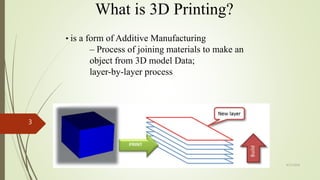
• is a form of Additive Manufacturing
– Process of joining materials to make an
object from 3D model Data;
layer-by-layer process
4/17/2018
3
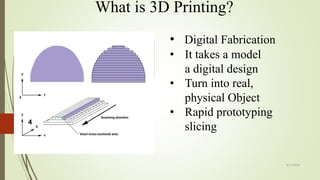
What is 3D Printing?
• Digital Fabrication
• It takes a model
a digital design
• Turn into real,
physical Object
• Rapid prototyping
slicing
4/17/2018
4
Type of Additive Manufacturing
•SLS (Selective Laser Sintering)
•FDM (Fused Deposition Modeling)
•SLA (Sterolithography)
4/17/2018
5
Categories of Additive Manufacturing
(American Society for Testing and Materials)
•Extrusion Deposit
•Vat Photopolymerisation
•Material Jetting
•Binder Jetting
•Powder Bed Fusion
•Sheet Lamination
•Directed Energy Deposition
4/17/2018
6
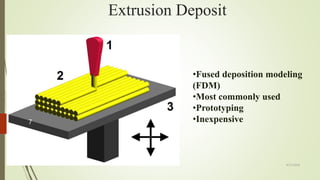
Extrusion Deposit
•Fused deposition modeling
(FDM)
•Most commonly used
•Prototyping
•Inexpensive
4/17/2018
7
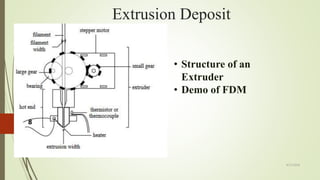
Extrusion Deposit
• Structure of an
Extruder
• Demo of FDM
4/17/2018
8
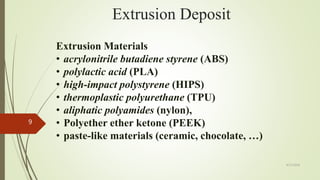
Extrusion Materials
• acrylonitrile butadiene styrene (ABS)
• polylactic acid (PLA)
• high-impact polystyrene (HIPS)
• thermoplastic polyurethane (TPU)
• aliphatic polyamides (nylon),
• Polyether ether ketone (PEEK)
• paste-like materials (ceramic, chocolate, …)
Extrusion Deposit
4/17/2018
9
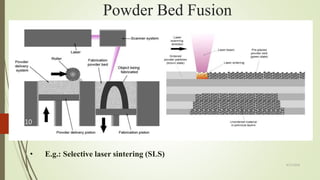
Powder Bed Fusion
• E.g.: Selective laser sintering (SLS)
4/17/2018
10
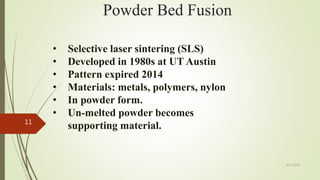
Powder Bed Fusion
• Selective laser sintering (SLS)
• Developed in 1980s at UT Austin
• Pattern expired 2014
• Materials: metals, polymers, nylon
• In powder form.
• Un-melted powder becomes
supporting material.
4/17/2018
11
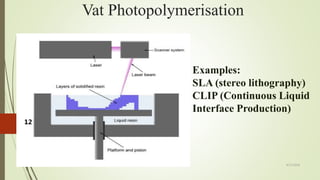
Vat Photopolymerisation
Examples:
SLA (stereo lithography)
CLIP (Continuous Liquid
Interface Production)
4/17/2018
12
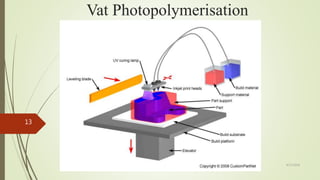
Vat Photopolymerisation
4/17/2018
13
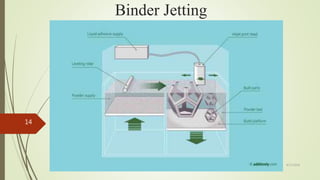
Binder Jetting
4/17/2018
14
3D Model Creation & File Format
• 3D Scanners
e.g.: Kinect
• CAD (Computer-Aided Design) software
e.g.: AutoCAD (free for students)
http://www.autodesk.com/education/free-software/all
• Visualization software
e.g. VTK
• File format is: STL: Stereo Lithography
4/17/2018
15
Advanced Manufacturing
Airbus would like to make a 3D printer that is large enough to
make planes from the ground up – a hangar-size printer as large as
80m x 80m.
Made In Space is a US company experimenting with zero-gravity
3D printing. The process could potentially allow astronauts to print
objects as required in space, saving valuable weight at launch.
NASA has been looking at 3D printing for some time now, and
considering the technology for long missions where astronauts
could create their own equipment during the trip.
4/17/2018
16
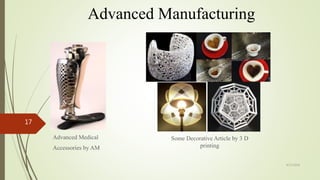
Advanced Medical
Accessories by AM
Some Decorative Article by 3 D
printing
Advanced Manufacturing
4/17/2018
17
Selective Laser Sintering
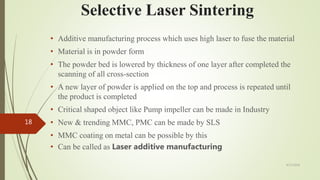
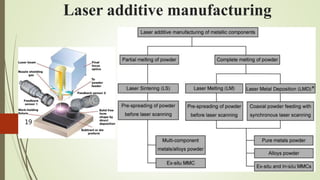
• Additive manufacturing process which uses high laser to fuse the material
• Material is in powder form
• The powder bed is lowered by thickness of one layer after completed the
scanning of all cross-section
• A new layer of powder is applied on the top and process is repeated until
the product is completed
• Critical shaped object like Pump impeller can be made in Industry
• New & trending MMC, PMC can be made by SLS
• MMC coating on metal can be possible by this
• Can be called as Laser additive manufacturing
4/17/2018
18
Laser additive manufacturing
4/17/2018
19
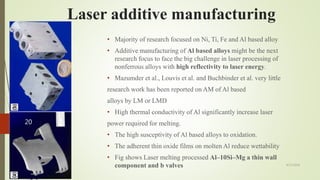
• Majority of research focused on Ni, Ti, Fe and Al based alloy
• Additive manufacturing of Al based alloys might be the next
research focus to face the big challenge in laser processing of
nonferrous alloys with high reflectivity to laser energy.
• Mazumder et al., Louvis et al. and Buchbinder et al. very little
research work has been reported on AM of Al based
alloys by LM or LMD
• High thermal conductivity of Al significantly increase laser
power required for melting.
• The high susceptivity of Al based alloys to oxidation.
• The adherent thin oxide films on molten Al reduce wettability
• Fig shows Laser melting processed Al–10Si–Mg a thin wall
component and b valves
Laser additive manufacturing
4/17/2018
20
Fe based alloys
• Though research reports on AM of Fe based alloys (typically steels) are
abundant
• The progress is not very significant
• The obtained density of AM processed steels generally cannot reach a
full density
Ni based alloys
• e.g. Inconel 625, 718 and Rene 41due to an improved balance of creep,
damage tolerance, tensile properties and corrosion/oxidation resistance, are
normally developed for high performance components in jet engines and
gas turbines
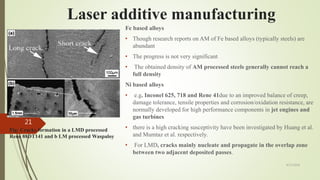
• there is a high cracking susceptivity have been investigated by Huang et al.
and Mumtaz et al. respectively.
• For LMD, cracks mainly nucleate and propagate in the overlap zone
between two adjacent deposited passes.
Fig: Cracks formation in a LMD processed
Rene 88DT141 and b LM processed Waspaloy
Laser additive manufacturing
4/17/2018
21
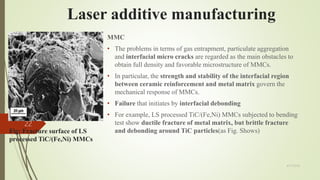
Fig: Fracture surface of LS
processed TiC/(Fe,Ni) MMCs
MMC
• The problems in terms of gas entrapment, particulate aggregation
and interfacial micro cracks are regarded as the main obstacles to
obtain full density and favorable microstructure of MMCs.
• In particular, the strength and stability of the interfacial region
between ceramic reinforcement and metal matrix govern the
mechanical response of MMCs.
• Failure that initiates by interfacial debonding
• For example, LS processed TiC/(Fe,Ni) MMCs subjected to bending
test show ductile fracture of metal matrix, but brittle fracture
and debonding around TiC particles(as Fig. Shows)
Laser additive manufacturing
4/17/2018
22
Summery
• 3 D printing is a Rapid prototyping technology by which
3 d object can be made by layer by layer fashion
•It is done by 3 types- SLS, FDM, SLA
•Pure metal or alloy metal part can be made by it
•Ni base metal by SLS is susceptible to crack
•Fe base alloy can not be successfully made owing to less
Densification factor
•MMC can also be made with some little difficulty
•MMCs by LS are susceptible to interfacial micro crack in
between Matrix and Reinforcement material.
4/17/2018
23
References
1. “A Review on 3D Printing Technology”, Swati B. Nale et.al.,
International Journal of Innovative and Emerging Research in
Engineering Volume 2, Issue 9, 2015
2. Zhong Xun Khoo, Joanne Ee Mei Teoh, Yong Liu, Chee Kai Chua,
Shoufeng Yang, Jia An, Kah Fai Leong & Wai Yee Yeong (2015) 3D
printing of smart materials: A review on recent progresses in 4D printing,
Virtual and Physical Prototyping, 10:3, 103-122, DOI:
10.1080/17452759.2015.1097054
3. D D Gu, W Meiners, K Wissenbach & R Poprawe (2012) Laser additive
manufacturing of metallic components: materials, processes and
mechanisms, International Materials Reviews, 57:3, 133-164, DOI:
10.1179/1743280411Y.0000000014
4. www.Wikipedia.com
4/17/2018
24
4/17/2018
25

3 d printing & its development

  • 1.
    By- Ranit Karmakar M.Tech inManufacturing Technology 2nd Semester Mechanical Engineering Department April,2018 4/17/2018 1
  • 2.
    Contents 1. What is3D Printing 2. Type of Additive Manufacturing 3. Categories of Additive Manufacturing 4. Extrusion Deposit 5. Powder Bed Fusion 6. Vat Photopolymerisation 7. Vat Photopolymerisation 8. Binder Jetting 9. 3D Model Creation & File Format 10.Advanced Manufacturing 11.Selective Laser Sintering / Laser additive manufacturing 12.Summery 4/17/2018 2
  • 3.
    What is 3DPrinting? • is a form of Additive Manufacturing – Process of joining materials to make an object from 3D model Data; layer-by-layer process 4/17/2018 3
  • 4.
    What is 3DPrinting? • Digital Fabrication • It takes a model a digital design • Turn into real, physical Object • Rapid prototyping slicing 4/17/2018 4
  • 5.
    Type of AdditiveManufacturing •SLS (Selective Laser Sintering) •FDM (Fused Deposition Modeling) •SLA (Sterolithography) 4/17/2018 5
  • 6.
    Categories of AdditiveManufacturing (American Society for Testing and Materials) •Extrusion Deposit •Vat Photopolymerisation •Material Jetting •Binder Jetting •Powder Bed Fusion •Sheet Lamination •Directed Energy Deposition 4/17/2018 6
  • 7.
    Extrusion Deposit •Fused depositionmodeling (FDM) •Most commonly used •Prototyping •Inexpensive 4/17/2018 7
  • 8.
    Extrusion Deposit • Structureof an Extruder • Demo of FDM 4/17/2018 8
  • 9.
    Extrusion Materials • acrylonitrilebutadiene styrene (ABS) • polylactic acid (PLA) • high-impact polystyrene (HIPS) • thermoplastic polyurethane (TPU) • aliphatic polyamides (nylon), • Polyether ether ketone (PEEK) • paste-like materials (ceramic, chocolate, …) Extrusion Deposit 4/17/2018 9
  • 10.
    Powder Bed Fusion •E.g.: Selective laser sintering (SLS) 4/17/2018 10
  • 11.
    Powder Bed Fusion •Selective laser sintering (SLS) • Developed in 1980s at UT Austin • Pattern expired 2014 • Materials: metals, polymers, nylon • In powder form. • Un-melted powder becomes supporting material. 4/17/2018 11
  • 12.
    Vat Photopolymerisation Examples: SLA (stereolithography) CLIP (Continuous Liquid Interface Production) 4/17/2018 12
  • 13.
  • 14.
  • 15.
    3D Model Creation& File Format • 3D Scanners e.g.: Kinect • CAD (Computer-Aided Design) software e.g.: AutoCAD (free for students) http://www.autodesk.com/education/free-software/all • Visualization software e.g. VTK • File format is: STL: Stereo Lithography 4/17/2018 15
  • 16.
    Advanced Manufacturing Airbus wouldlike to make a 3D printer that is large enough to make planes from the ground up – a hangar-size printer as large as 80m x 80m. Made In Space is a US company experimenting with zero-gravity 3D printing. The process could potentially allow astronauts to print objects as required in space, saving valuable weight at launch. NASA has been looking at 3D printing for some time now, and considering the technology for long missions where astronauts could create their own equipment during the trip. 4/17/2018 16
  • 17.
    Advanced Medical Accessories byAM Some Decorative Article by 3 D printing Advanced Manufacturing 4/17/2018 17
  • 18.
    Selective Laser Sintering •Additive manufacturing process which uses high laser to fuse the material • Material is in powder form • The powder bed is lowered by thickness of one layer after completed the scanning of all cross-section • A new layer of powder is applied on the top and process is repeated until the product is completed • Critical shaped object like Pump impeller can be made in Industry • New & trending MMC, PMC can be made by SLS • MMC coating on metal can be possible by this • Can be called as Laser additive manufacturing 4/17/2018 18
  • 19.
  • 20.
    • Majority ofresearch focused on Ni, Ti, Fe and Al based alloy • Additive manufacturing of Al based alloys might be the next research focus to face the big challenge in laser processing of nonferrous alloys with high reflectivity to laser energy. • Mazumder et al., Louvis et al. and Buchbinder et al. very little research work has been reported on AM of Al based alloys by LM or LMD • High thermal conductivity of Al significantly increase laser power required for melting. • The high susceptivity of Al based alloys to oxidation. • The adherent thin oxide films on molten Al reduce wettability • Fig shows Laser melting processed Al–10Si–Mg a thin wall component and b valves Laser additive manufacturing 4/17/2018 20
  • 21.
    Fe based alloys •Though research reports on AM of Fe based alloys (typically steels) are abundant • The progress is not very significant • The obtained density of AM processed steels generally cannot reach a full density Ni based alloys • e.g. Inconel 625, 718 and Rene 41due to an improved balance of creep, damage tolerance, tensile properties and corrosion/oxidation resistance, are normally developed for high performance components in jet engines and gas turbines • there is a high cracking susceptivity have been investigated by Huang et al. and Mumtaz et al. respectively. • For LMD, cracks mainly nucleate and propagate in the overlap zone between two adjacent deposited passes. Fig: Cracks formation in a LMD processed Rene 88DT141 and b LM processed Waspaloy Laser additive manufacturing 4/17/2018 21
  • 22.
    Fig: Fracture surfaceof LS processed TiC/(Fe,Ni) MMCs MMC • The problems in terms of gas entrapment, particulate aggregation and interfacial micro cracks are regarded as the main obstacles to obtain full density and favorable microstructure of MMCs. • In particular, the strength and stability of the interfacial region between ceramic reinforcement and metal matrix govern the mechanical response of MMCs. • Failure that initiates by interfacial debonding • For example, LS processed TiC/(Fe,Ni) MMCs subjected to bending test show ductile fracture of metal matrix, but brittle fracture and debonding around TiC particles(as Fig. Shows) Laser additive manufacturing 4/17/2018 22
  • 23.
    Summery • 3 Dprinting is a Rapid prototyping technology by which 3 d object can be made by layer by layer fashion •It is done by 3 types- SLS, FDM, SLA •Pure metal or alloy metal part can be made by it •Ni base metal by SLS is susceptible to crack •Fe base alloy can not be successfully made owing to less Densification factor •MMC can also be made with some little difficulty •MMCs by LS are susceptible to interfacial micro crack in between Matrix and Reinforcement material. 4/17/2018 23
  • 24.
    References 1. “A Reviewon 3D Printing Technology”, Swati B. Nale et.al., International Journal of Innovative and Emerging Research in Engineering Volume 2, Issue 9, 2015 2. Zhong Xun Khoo, Joanne Ee Mei Teoh, Yong Liu, Chee Kai Chua, Shoufeng Yang, Jia An, Kah Fai Leong & Wai Yee Yeong (2015) 3D printing of smart materials: A review on recent progresses in 4D printing, Virtual and Physical Prototyping, 10:3, 103-122, DOI: 10.1080/17452759.2015.1097054 3. D D Gu, W Meiners, K Wissenbach & R Poprawe (2012) Laser additive manufacturing of metallic components: materials, processes and mechanisms, International Materials Reviews, 57:3, 133-164, DOI: 10.1179/1743280411Y.0000000014 4. www.Wikipedia.com 4/17/2018 24
  • 25.