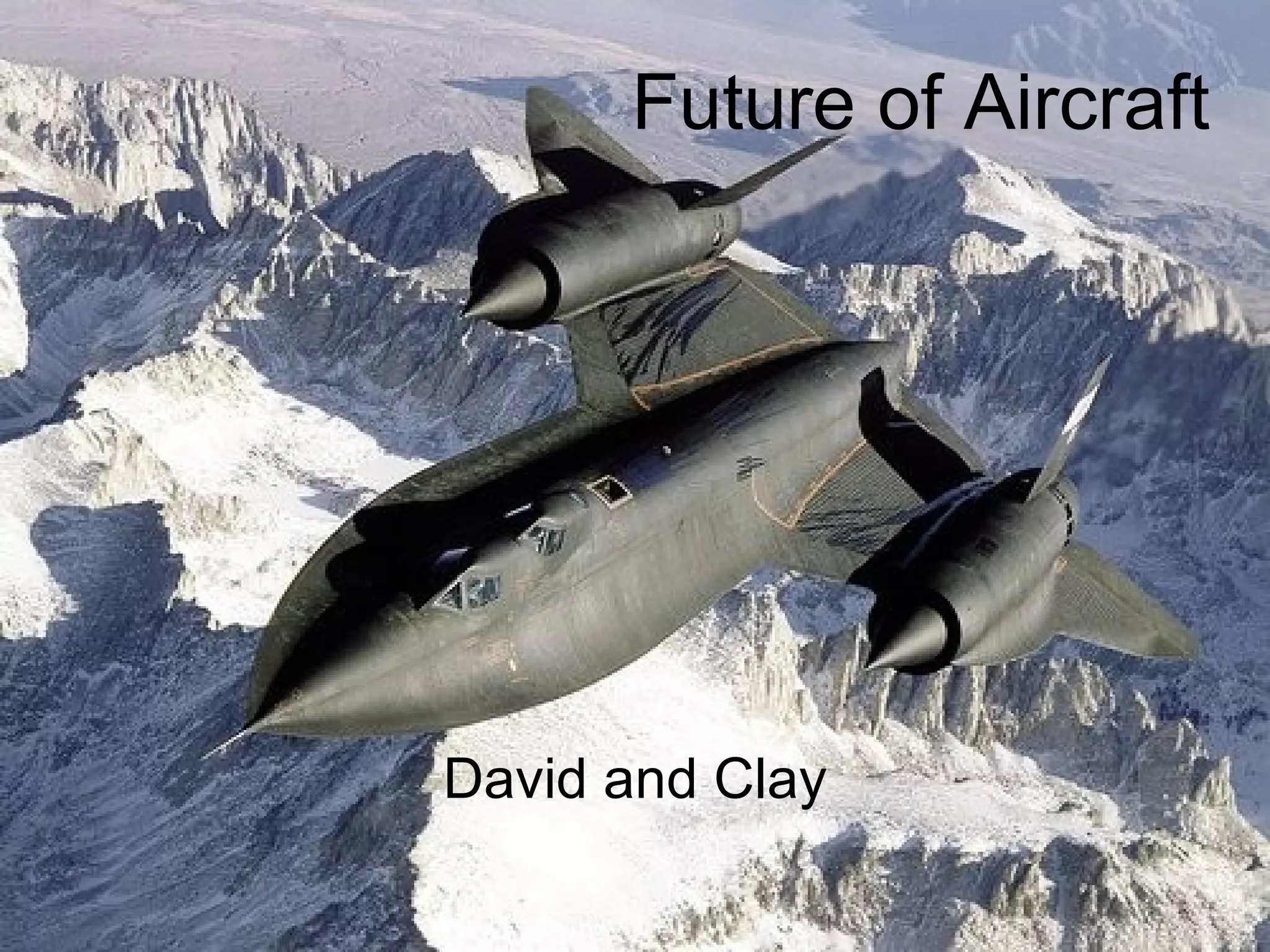
Future of Aircraft David and Clay
Past Aircraft Things have changed a immensely from when heavier then air aircraft started flying such as: Jet propulsion Commercial use Airframe Flight time
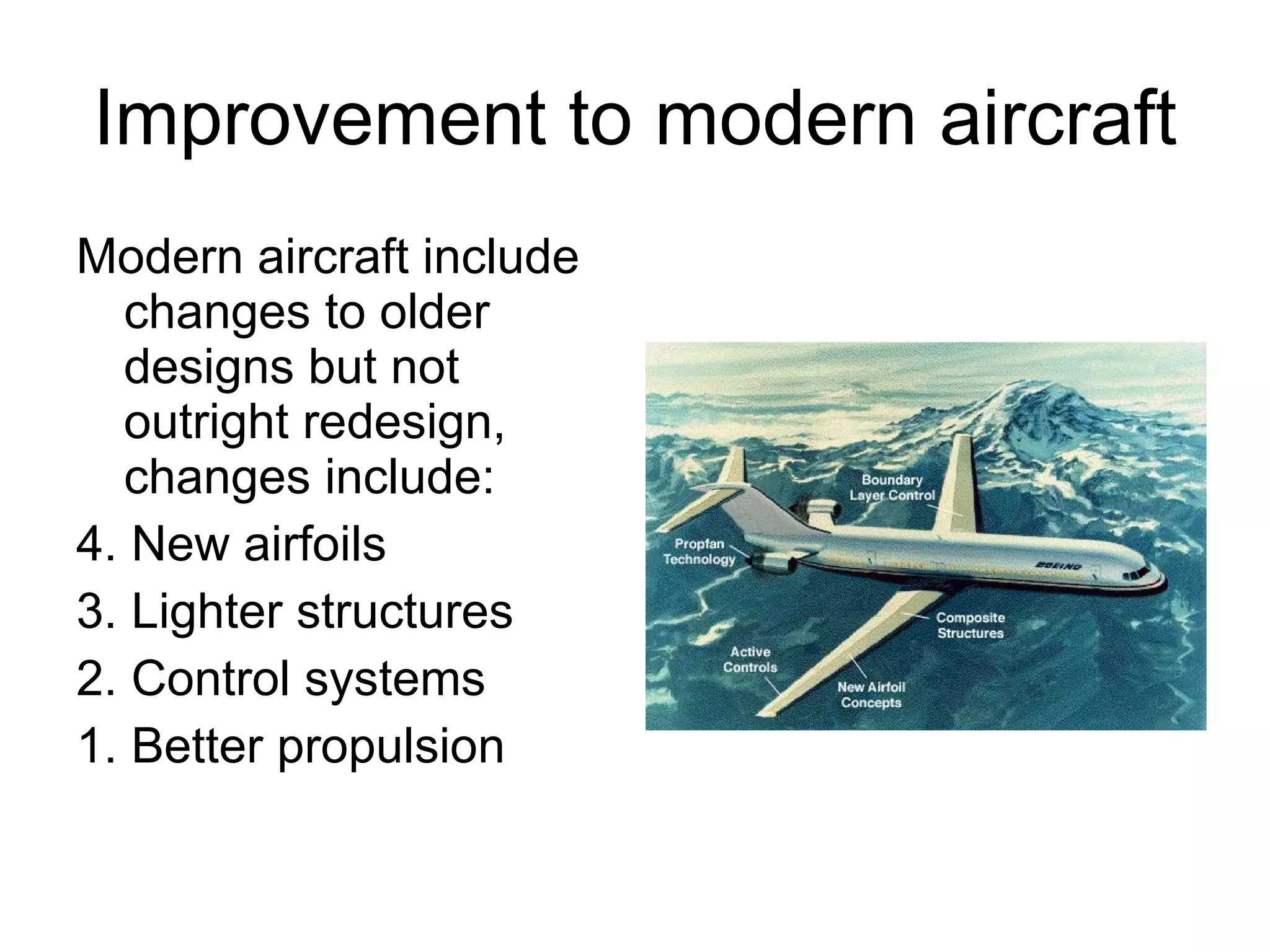
Improvement to modern aircraft Modern aircraft include changes to older designs but not outright redesign, changes include: 4. New airfoils 3. Lighter structures 2. Control systems 1. Better propulsion
Better propulsion Piston engines were used first. Now gas turbines also known as jet engines are used
Control systems Then: To control old aircraft a pilot must shift his weight. Now: Everything is fly-by-wire, meaning that it is computer or cable controlled.
Lighter Structures Airplanes were made out of wood and canvas until the 1930’s modern equivalents are: Aluminum alloys and materials with reinforcing fibers
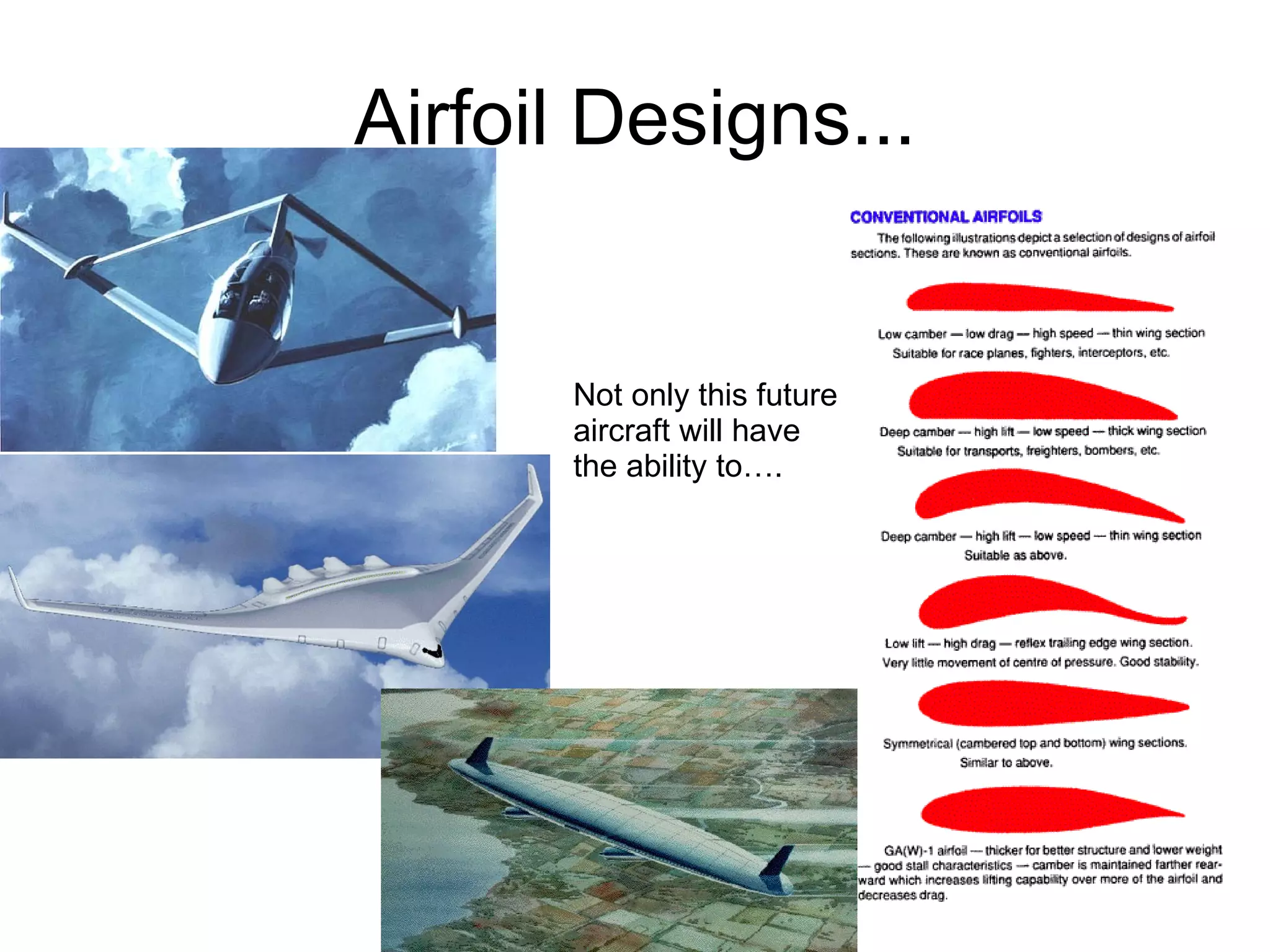
New Airfoil Designs Future aircraft will have many changes and will most likely look nothing like today's planes just as ours do not look like the Wright flyer.  These types of designs will become the next generation of flyers, but they are not truly the future of aircraft.
Airfoil Designs... Not only this future aircraft will have the ability to….
Repair Themselves  This will be possible because of new building ideas, imbedding resin that oozes into cracks on demand.  This is currently in prototype and it mimics nature in how it heals it self.
Access to Space New designs are making what once seemed impossible possible. The Space shuttle now becoming obsolete.
Replacing the Space Shuttle The X-33 is a single stage orbiter that is 1/10 th  as costly to send into space as a space shuttle. The project was shut down.
Sources http://www.livescience.com/technology/080520-selfrepairing-aircraft.html In a world that is flat communications among people are getting better. This creates new designs and breaks all barriers.  http://adg.stanford.edu/aa241/intro/futureac.html http://www.epsrc.ac.uk/ResearchHighlights/Timelines/Aircraft/LighterStructures.htm
More on the Horizon No prediction of the future is ever correct but as seen the future of aircraft is a bright one.

Future Of Aircraft

  • 1.
    Future of AircraftDavid and Clay
  • 2.
    Past Aircraft Thingshave changed a immensely from when heavier then air aircraft started flying such as: Jet propulsion Commercial use Airframe Flight time
  • 3.
    Improvement to modernaircraft Modern aircraft include changes to older designs but not outright redesign, changes include: 4. New airfoils 3. Lighter structures 2. Control systems 1. Better propulsion
  • 4.
    Better propulsion Pistonengines were used first. Now gas turbines also known as jet engines are used
  • 5.
    Control systems Then:To control old aircraft a pilot must shift his weight. Now: Everything is fly-by-wire, meaning that it is computer or cable controlled.
  • 6.
    Lighter Structures Airplaneswere made out of wood and canvas until the 1930’s modern equivalents are: Aluminum alloys and materials with reinforcing fibers
  • 7.
    New Airfoil DesignsFuture aircraft will have many changes and will most likely look nothing like today's planes just as ours do not look like the Wright flyer. These types of designs will become the next generation of flyers, but they are not truly the future of aircraft.
  • 8.
    Airfoil Designs... Notonly this future aircraft will have the ability to….
  • 9.
    Repair Themselves This will be possible because of new building ideas, imbedding resin that oozes into cracks on demand. This is currently in prototype and it mimics nature in how it heals it self.
  • 10.
    Access to SpaceNew designs are making what once seemed impossible possible. The Space shuttle now becoming obsolete.
  • 11.
    Replacing the SpaceShuttle The X-33 is a single stage orbiter that is 1/10 th as costly to send into space as a space shuttle. The project was shut down.
  • 12.
    Sources http://www.livescience.com/technology/080520-selfrepairing-aircraft.html Ina world that is flat communications among people are getting better. This creates new designs and breaks all barriers. http://adg.stanford.edu/aa241/intro/futureac.html http://www.epsrc.ac.uk/ResearchHighlights/Timelines/Aircraft/LighterStructures.htm
  • 13.
    More on theHorizon No prediction of the future is ever correct but as seen the future of aircraft is a bright one.