Plant pathology:
Fungal Genetics
Presented By:
N.Karunakar Reddy
RAM /2017-66
Department of plant
pathology
College Of Agriculture
Rajendaranagar.
Hyderabad-500030
Presented to:
Dr.B.Vidyasagar
Professor
Department of Plant pathology
College Of Agriculture, Rajendranagar
Hyderabad-500030
Vigilance points:
• Man’s interest in fugi started with the observation of beautiful ,
umbrella shaped mushrooms and toadstools growing on soils forming
‘fairy rings’.
• P.A. Micheli got the honour of being called the founder of mycology;
mycology being the science of fungal studies.
• Fungi:
“eukaryotic,achrophyllous with absorptive mode of nutrition ,
spore bearing and reproducing asexually and sexually and whose
filamentous , branched somatic structures and surrounded by cellwall
containing chitin with many other complex carbohydrates.
Salient features of fungi:
Vegetative body (thallus) represented by a filament called
hypha.
Cellwall –chitin often called ‘fungal cellulose’.
Heterotrophs.
Food is stored in the form of ‘glycogen’.
Asexual reproduction –by sporangiospores and conidia.
Sexual reproduction –by antheridia and oogonia or
ascogonia.
Enjoy extracellular digestion of food material.
General characteristics:
 Somatic body of fungus –thallus.
 Loosely aggregated somatic hyphae –mycelium.
 Septation – aseptate/coenocytic or septate.
 Simple pore septum.
 Dolipore septum.
 Haustoria –organ for absorption of nutrition.
Mode of nutrition:
Obligate saprophytes: e.g. Mucor, Rhizopus.
Obligate parasites: e.g., rusts and smuts.
Facultative parasites: e.g., Fusarium, Botrytis.
Facultative saprophytes: e.g., Taphrina.
Nutrition of biotrophs:
• Components are extracted through haustoria.
• Nutrients are soluble and organic.
• Extracellular degradation for cell penetration.
• Extracellular factors establish /maintain a compatible infection.
• Supress senescence.
SIGNIFICANCE:
• fungal cells are useful in the study of rare events (such as mutations and
recombinations).
• The concepts and techniques of fungal asexual and parasexual genetics have been
applied to the genetic manipulation of cultured cells of higher eukaryotes such as
humans and green plants. However, the techniques remain much easier to perform
with fungi.
• The fact that each enzyme is coded by its own specific gene was first recognized in
fungi and was of paramount importance because it showed how the many
chemical reactions that take place in a living cell could be controlled by the genetic
apparatus.
• The discovery arose from a biochemical study of nutritional mutants
in Neurospora.
Genetics –study of heredity and variation.
 Transmission-the passage of traits from one generation to next
generation.
 Population-genetic diversity and change within natural populations.
 Molecular-details of gene structures and function.
 Our focus:transmission and molecular genetics in experimental
systems.
 Transmission genetics:
similar to more familiar mammalian systems , with bulk of life cycle
haploid.
‘genders’ are ‘mating types’-cells are biochemically distinct but
morphologically identical
• Fungal nuclei are predominantly hapliod; that they contain
only one set of chromosome.
This character is useful in the study of mutations. Which are
usually recessive and therefore masked in dipliod
organisms.
• Mutational dissection is an important technique for the
study of biological processes,and the use of hapliod
organisms conveniently allows for the immediate expression
of mutant genes.
Typical characterstics of fungal genomes:
 Sacharomyces cerevisiae- 6MB-6000 genes.
 Aspergillus nidulans-13MB-12000 genes.
 Homo sapiens-1300MB- 3000 genes.
Little repetitive DNA- single copy genes.
-50-60% of nuclear genome is transcribed into mRNA in S.
cerevisiae.
-33% in S. commune.
- 1% in humans.
Introns
-few,often none.
-small -50-200bp.
Most higher fungi are vegetative haploids,
 One genome copy per nucleus.
 Altrnatives ?
-plants?
-algae?
-animals?
Risky of haploidy:
No back up copy in case of genetic damage from UV or
chemical mutagens.
Yeasts tend to be diploid ( S .cerevisiae except for lab
strains) or have short G1(S. pombe)
Advantages of haploidy:
 A mulinucleate cell can expose genome to
mutagens.
-most mutations are deleterious
- select for advantageous mutations in a
heterokaryotic system.
 Phenotypes of recessive mutations are obvious in
the vegetative state, without generating
homozygous recessives.
 Lab strains of S. cerevisiae now generally include a
mutation which stabilizes the haploid state.
NUCLEAR STATES:
Introduction
 Each fungus can be found in a variety of nuclear states.
 That is, the number of nuclei (ploidy) and the degree of duplication
(haploid/diploid) can vary throughout the life cycle of the fungus. Though most
commonly haploid, each fungus may have significant periods in each part of the life
cycle.
Cell Cycle:
 A haploid organism contains a single set of chromosomes in each of its nuclei.
 Following plasmogamy (fusion of cytoplasm) in filamentous fungi, the number of
nuclei doubles, though these need not necessarily go through karyogamy (fusion of
the nuclei) immediately.
 The state where two genetically distinct haploid nuclei coexist in one cell is called a
dikaryon (adj. dikaryotic). When the nuclei fuse in karyogamy, the nucleus becomes
diploid.
 In this cycle, fungi are similar to most organisms. However, diploid fungi almost
always then pass immediately into meiosis, resulting in the formation of spores
with a single haploid nucleus.
Variations:
The fungi have a number of variations on this simple theme and
these variations provide some interesting potential advantages.
Some fungi lack septa in their hyphae.
Thus, the fungus is multinucleate, and the nuclei are usually haploid.
The nuclei may be of the same, or compatible and different types.
For instance, the thallus of fungi in Zygomycota and Glomeromycota
is non-septate, and multinucleate. The diploid state is only found in
the sexual zygospore, such as in members of the Mucorales.
Most fungi have significant periods as haploid thalli. The vegetative
states of most Ascomycota are haploid.
The fungus goes through plasmogamy and passes immediately to
karyogamy, followed by meiosis and the formation of ascospores.
These fungi are only diploid for very short periods of time, and only
in very limited parts of the thallus.
A variety of nuclear states in compartments has been reported
among the Basidiomycota. Spores germinate to form a haploid
mycelium.
Plasmogamy with a compatible haploid mycelium results in a
dikaryotic mycelium, where both nuclei may be functional.
The dikaryotic mycelium may never pass into the diploid state.
However, if it does, then the sexual phase may be reached, where
karyogamy might be followed by meiosis, though these states may be
separated in time and space.
Continued………..
multinucleate mycelia indicate that more than two haploid nuclei
may coexist in a cell. Indeed, haploid and diploid nuclei may coexist in
one compartment.
The nuclear state of most fungi is regulated. One species is
commonly found with one nuclear state. This is particularly evident in
fungi with secondary homothallism (the fungus can mate with itself
in the absence of a compatible mating type).
The variation from common behaviour is possible because nuclei may
move from compartment to compartment, and the expression of
mating type need not necessarily be found at one locus. Indeed,
nuclei can function independently of one another.
Continued…….
Following formation of a compatible dikaryon, the incoming nucleus
passes through mitosis independently of the second nucleus, with
one of the resultant nuclei passing through to the next
compartment.
The variation in ploidy through the life cycle is enormously
important. If fungi exist as haploids for significant periods, then
selection against specific alleles will ensure thalli with deleterious
alleles will be removed from the population.
Thus subsequent diploids will have only neutral or beneficial alleles
for that specific environment
Continued…….
 Homokaryotic refers to multinucleate cells (multiple
nuclei share one common cytoplasm as it is found in
hyphal cells or mycelium of filamentous fungi) where
all nuclei are genetically identical.
 Heterokaryotic refers to cells where two or more
genetically different nuclei share one
common cytoplasm. It is neither 1n or 2n.
Homo& hetero karyons
Fungal mating systems
Reproduction in fungi can be asexual, sexual, or para
sexual.
Asexual reproduction: It involves mitotic nuclear
division during the growth of hyphae, cell division or
the production of asexual spores like Sporangiospores
and Conidia.
 Sporangiospores are non-motile spores produced
inside structures called sporangia in fungi such as
Rhizopus and Mucor. These spores are dispersed by
wind.
Fungal reproduction
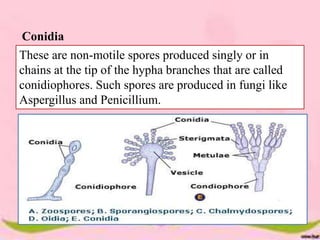
These are non-motile spores produced singly or in
chains at the tip of the hypha branches that are called
conidiophores. Such spores are produced in fungi like
Aspergillus and Penicillium.
Conidia
Sexual reproduction: It is based on meiotic nuclear
divisions fairly typical of eukaryotes in general.
 The fungal sexual cycle is essentially the same as in higher
plants and animals.
 with fusion of haploid gamete nuclei (karyogamy) to give
diploidy, and meiosis to restore haploidy.
 Where most fungi differ from ‘higher’ eukaryotes is that,
meiosis follows immediately after karyogamy, so that the
diploid phase is confined to the meiotic cell. In the most
studied groups of fungi.
• Ascomycetes and Basidiomycetes, which are sexually
reproducing, there are differences in their modes of
formation of haploid spores.
• It containing nuclei that are four products of single
meiosis, remain together in a group called a tetrad.
• It permit the study of the genetic events occurring in
individual meiosis.
• Ascomycetes bears its sexual (meiotic) ascospores in a sac
called an ascus. In turn, the asci are borne in a special
fruiting structure called a perithecium.
Sexual reproduction:
1.Plasmogamy:takes place in following manner;
I. Planogametic copulation
II. Gamentangial contact.
III. Gamentangial copulation
IV. Spermatization
V. Somatogamy.
2.Karyogamy
3.meiosis.
Parasexual cycle:
 The parasexual cycle (or parasexuality),a process peculiar
to fungi and single-celled organisms, is a nonsexual
mechanism for transferring genetic material
without meiosis or the development of sexual structures.
 The parasexual cycle resembles sexual reproduction. In
both cases, unlike hyphae (or modifications thereof) may
fuse (plasmogamy) and their nuclei will occupy the same
cell.
 The unlike nuclei fuse (karyogamy) to form a diploid
(zygote) nucleus.
 In contrast to the sexual cycle, in the parasexual cycle
recombination takes place during mitosis followed by
haploidization (but without meiosis).
 A type of recombination, found in certain heterokaryotic
fungi.
 Genetically distinct hapliod nuclei fuse in the heterokaryon.
 The resulting dipliod nuclei multiply by mitotic division,
with some crossing over , and a dipliod homokaryon
develops from a dipliod conidium.
 While the parasexual cycle appears to be a viable mechanism by
which genetic recombination occurs, many mycologist believe that
it does not play a role in maintaining genetic diversity in fungi that
have lost their ability to reproduce, sexually.
 Instead, this has been looked upon as a laboratory phenomenon
and that heterokaryon formation, in nature, is not a common
event. Thus, the parasexual cycle must also be a rare event.
Sexual
Reproduction
Leads to
Recombination
(R)of Genes at
Meiosis
Asexual
Reproduction
Usually
Reproduces the
Gene set
Faithfully
Parasexual
Reproduction
Derives from
an Atypical
Mitotic Division
of an Unstable
Cell
Three different kinds of reproduction occurring in fungi, each of which provides opportunities for
genetic analysis. (a) Sexual reproduction leads to recombination (R) of genes at meiosis. (b)
Asexual reproduction (shown here in a typical haploid fungal cell) usually reproduces the gene
set faithfully. (c) Parasexual reproduction derives from an atypical mitotic division of an unstable
cell that produces haploid cells and other aneuploid (deviating from normal chromosome
complement) unstable intermediates
Three different kinds of reproduction occurring in fungi, each
of which provides opportunities of genetic analysis.
A) Sexual reproduction leads to recombination (R)of genes at
meiosis
B) Asexual reproduction (typical hapliod fungal cell)usually
reproduce the gene set faithfully.
c)Para sexual reproduction derives from an a typical mitotic
division of an unstable cell that produces haploid cells and
other unstable intermediates.
The nucleus contains most of the genetic material of the cell. The
nucleus controls the function of the cell.
In fungi, the thallus is commonly haploid for a significant part of
the life cycle, and thus selection against undesirable mutations is
immediate.
However, a wide range of variations on the basic theme in a cell
cycle indicate that more than one strategy of nuclear behaviour
can lead to successful outcomes.
Conclusion:
Refrences :
1. Microbiology-R.P.SINGH.
2. Fungal genetics :principles and practices-cees bos.
3. Principles of plant pathology-R.S.Singh.
Thank you
THANK

Fungal genetics

  • 2.
    Plant pathology: Fungal Genetics PresentedBy: N.Karunakar Reddy RAM /2017-66 Department of plant pathology College Of Agriculture Rajendaranagar. Hyderabad-500030 Presented to: Dr.B.Vidyasagar Professor Department of Plant pathology College Of Agriculture, Rajendranagar Hyderabad-500030
  • 3.
    Vigilance points: • Man’sinterest in fugi started with the observation of beautiful , umbrella shaped mushrooms and toadstools growing on soils forming ‘fairy rings’. • P.A. Micheli got the honour of being called the founder of mycology; mycology being the science of fungal studies. • Fungi: “eukaryotic,achrophyllous with absorptive mode of nutrition , spore bearing and reproducing asexually and sexually and whose filamentous , branched somatic structures and surrounded by cellwall containing chitin with many other complex carbohydrates.
  • 4.
    Salient features offungi: Vegetative body (thallus) represented by a filament called hypha. Cellwall –chitin often called ‘fungal cellulose’. Heterotrophs. Food is stored in the form of ‘glycogen’. Asexual reproduction –by sporangiospores and conidia. Sexual reproduction –by antheridia and oogonia or ascogonia. Enjoy extracellular digestion of food material.
  • 7.
    General characteristics:  Somaticbody of fungus –thallus.  Loosely aggregated somatic hyphae –mycelium.  Septation – aseptate/coenocytic or septate.  Simple pore septum.  Dolipore septum.  Haustoria –organ for absorption of nutrition.
  • 8.
    Mode of nutrition: Obligatesaprophytes: e.g. Mucor, Rhizopus. Obligate parasites: e.g., rusts and smuts. Facultative parasites: e.g., Fusarium, Botrytis. Facultative saprophytes: e.g., Taphrina. Nutrition of biotrophs: • Components are extracted through haustoria. • Nutrients are soluble and organic. • Extracellular degradation for cell penetration. • Extracellular factors establish /maintain a compatible infection. • Supress senescence.
  • 9.
    SIGNIFICANCE: • fungal cellsare useful in the study of rare events (such as mutations and recombinations). • The concepts and techniques of fungal asexual and parasexual genetics have been applied to the genetic manipulation of cultured cells of higher eukaryotes such as humans and green plants. However, the techniques remain much easier to perform with fungi. • The fact that each enzyme is coded by its own specific gene was first recognized in fungi and was of paramount importance because it showed how the many chemical reactions that take place in a living cell could be controlled by the genetic apparatus. • The discovery arose from a biochemical study of nutritional mutants in Neurospora.
  • 10.
    Genetics –study ofheredity and variation.  Transmission-the passage of traits from one generation to next generation.  Population-genetic diversity and change within natural populations.  Molecular-details of gene structures and function.  Our focus:transmission and molecular genetics in experimental systems.  Transmission genetics: similar to more familiar mammalian systems , with bulk of life cycle haploid. ‘genders’ are ‘mating types’-cells are biochemically distinct but morphologically identical
  • 11.
    • Fungal nucleiare predominantly hapliod; that they contain only one set of chromosome. This character is useful in the study of mutations. Which are usually recessive and therefore masked in dipliod organisms. • Mutational dissection is an important technique for the study of biological processes,and the use of hapliod organisms conveniently allows for the immediate expression of mutant genes.
  • 12.
    Typical characterstics offungal genomes:  Sacharomyces cerevisiae- 6MB-6000 genes.  Aspergillus nidulans-13MB-12000 genes.  Homo sapiens-1300MB- 3000 genes. Little repetitive DNA- single copy genes. -50-60% of nuclear genome is transcribed into mRNA in S. cerevisiae. -33% in S. commune. - 1% in humans. Introns -few,often none. -small -50-200bp.
  • 13.
    Most higher fungiare vegetative haploids,  One genome copy per nucleus.  Altrnatives ? -plants? -algae? -animals? Risky of haploidy: No back up copy in case of genetic damage from UV or chemical mutagens. Yeasts tend to be diploid ( S .cerevisiae except for lab strains) or have short G1(S. pombe)
  • 14.
    Advantages of haploidy: A mulinucleate cell can expose genome to mutagens. -most mutations are deleterious - select for advantageous mutations in a heterokaryotic system.  Phenotypes of recessive mutations are obvious in the vegetative state, without generating homozygous recessives.  Lab strains of S. cerevisiae now generally include a mutation which stabilizes the haploid state.
  • 15.
    NUCLEAR STATES: Introduction  Eachfungus can be found in a variety of nuclear states.  That is, the number of nuclei (ploidy) and the degree of duplication (haploid/diploid) can vary throughout the life cycle of the fungus. Though most commonly haploid, each fungus may have significant periods in each part of the life cycle. Cell Cycle:  A haploid organism contains a single set of chromosomes in each of its nuclei.  Following plasmogamy (fusion of cytoplasm) in filamentous fungi, the number of nuclei doubles, though these need not necessarily go through karyogamy (fusion of the nuclei) immediately.  The state where two genetically distinct haploid nuclei coexist in one cell is called a dikaryon (adj. dikaryotic). When the nuclei fuse in karyogamy, the nucleus becomes diploid.  In this cycle, fungi are similar to most organisms. However, diploid fungi almost always then pass immediately into meiosis, resulting in the formation of spores with a single haploid nucleus.
  • 16.
    Variations: The fungi havea number of variations on this simple theme and these variations provide some interesting potential advantages. Some fungi lack septa in their hyphae. Thus, the fungus is multinucleate, and the nuclei are usually haploid. The nuclei may be of the same, or compatible and different types. For instance, the thallus of fungi in Zygomycota and Glomeromycota is non-septate, and multinucleate. The diploid state is only found in the sexual zygospore, such as in members of the Mucorales. Most fungi have significant periods as haploid thalli. The vegetative states of most Ascomycota are haploid.
  • 17.
    The fungus goesthrough plasmogamy and passes immediately to karyogamy, followed by meiosis and the formation of ascospores. These fungi are only diploid for very short periods of time, and only in very limited parts of the thallus. A variety of nuclear states in compartments has been reported among the Basidiomycota. Spores germinate to form a haploid mycelium. Plasmogamy with a compatible haploid mycelium results in a dikaryotic mycelium, where both nuclei may be functional. The dikaryotic mycelium may never pass into the diploid state. However, if it does, then the sexual phase may be reached, where karyogamy might be followed by meiosis, though these states may be separated in time and space. Continued………..
  • 18.
    multinucleate mycelia indicatethat more than two haploid nuclei may coexist in a cell. Indeed, haploid and diploid nuclei may coexist in one compartment. The nuclear state of most fungi is regulated. One species is commonly found with one nuclear state. This is particularly evident in fungi with secondary homothallism (the fungus can mate with itself in the absence of a compatible mating type). The variation from common behaviour is possible because nuclei may move from compartment to compartment, and the expression of mating type need not necessarily be found at one locus. Indeed, nuclei can function independently of one another. Continued…….
  • 19.
    Following formation ofa compatible dikaryon, the incoming nucleus passes through mitosis independently of the second nucleus, with one of the resultant nuclei passing through to the next compartment. The variation in ploidy through the life cycle is enormously important. If fungi exist as haploids for significant periods, then selection against specific alleles will ensure thalli with deleterious alleles will be removed from the population. Thus subsequent diploids will have only neutral or beneficial alleles for that specific environment Continued…….
  • 20.
     Homokaryotic refersto multinucleate cells (multiple nuclei share one common cytoplasm as it is found in hyphal cells or mycelium of filamentous fungi) where all nuclei are genetically identical.  Heterokaryotic refers to cells where two or more genetically different nuclei share one common cytoplasm. It is neither 1n or 2n. Homo& hetero karyons
  • 22.
  • 23.
    Reproduction in fungican be asexual, sexual, or para sexual. Asexual reproduction: It involves mitotic nuclear division during the growth of hyphae, cell division or the production of asexual spores like Sporangiospores and Conidia.  Sporangiospores are non-motile spores produced inside structures called sporangia in fungi such as Rhizopus and Mucor. These spores are dispersed by wind. Fungal reproduction
  • 25.
    These are non-motilespores produced singly or in chains at the tip of the hypha branches that are called conidiophores. Such spores are produced in fungi like Aspergillus and Penicillium. Conidia
  • 26.
    Sexual reproduction: Itis based on meiotic nuclear divisions fairly typical of eukaryotes in general.  The fungal sexual cycle is essentially the same as in higher plants and animals.  with fusion of haploid gamete nuclei (karyogamy) to give diploidy, and meiosis to restore haploidy.  Where most fungi differ from ‘higher’ eukaryotes is that, meiosis follows immediately after karyogamy, so that the diploid phase is confined to the meiotic cell. In the most studied groups of fungi.
  • 27.
    • Ascomycetes andBasidiomycetes, which are sexually reproducing, there are differences in their modes of formation of haploid spores. • It containing nuclei that are four products of single meiosis, remain together in a group called a tetrad. • It permit the study of the genetic events occurring in individual meiosis. • Ascomycetes bears its sexual (meiotic) ascospores in a sac called an ascus. In turn, the asci are borne in a special fruiting structure called a perithecium.
  • 28.
    Sexual reproduction: 1.Plasmogamy:takes placein following manner; I. Planogametic copulation II. Gamentangial contact. III. Gamentangial copulation IV. Spermatization V. Somatogamy. 2.Karyogamy 3.meiosis.
  • 30.
    Parasexual cycle:  Theparasexual cycle (or parasexuality),a process peculiar to fungi and single-celled organisms, is a nonsexual mechanism for transferring genetic material without meiosis or the development of sexual structures.  The parasexual cycle resembles sexual reproduction. In both cases, unlike hyphae (or modifications thereof) may fuse (plasmogamy) and their nuclei will occupy the same cell.  The unlike nuclei fuse (karyogamy) to form a diploid (zygote) nucleus.
  • 31.
     In contrastto the sexual cycle, in the parasexual cycle recombination takes place during mitosis followed by haploidization (but without meiosis).  A type of recombination, found in certain heterokaryotic fungi.  Genetically distinct hapliod nuclei fuse in the heterokaryon.  The resulting dipliod nuclei multiply by mitotic division, with some crossing over , and a dipliod homokaryon develops from a dipliod conidium.
  • 32.
     While theparasexual cycle appears to be a viable mechanism by which genetic recombination occurs, many mycologist believe that it does not play a role in maintaining genetic diversity in fungi that have lost their ability to reproduce, sexually.  Instead, this has been looked upon as a laboratory phenomenon and that heterokaryon formation, in nature, is not a common event. Thus, the parasexual cycle must also be a rare event.
  • 33.
    Sexual Reproduction Leads to Recombination (R)of Genesat Meiosis Asexual Reproduction Usually Reproduces the Gene set Faithfully Parasexual Reproduction Derives from an Atypical Mitotic Division of an Unstable Cell Three different kinds of reproduction occurring in fungi, each of which provides opportunities for genetic analysis. (a) Sexual reproduction leads to recombination (R) of genes at meiosis. (b) Asexual reproduction (shown here in a typical haploid fungal cell) usually reproduces the gene set faithfully. (c) Parasexual reproduction derives from an atypical mitotic division of an unstable cell that produces haploid cells and other aneuploid (deviating from normal chromosome complement) unstable intermediates
  • 34.
    Three different kindsof reproduction occurring in fungi, each of which provides opportunities of genetic analysis. A) Sexual reproduction leads to recombination (R)of genes at meiosis B) Asexual reproduction (typical hapliod fungal cell)usually reproduce the gene set faithfully. c)Para sexual reproduction derives from an a typical mitotic division of an unstable cell that produces haploid cells and other unstable intermediates.
  • 35.
    The nucleus containsmost of the genetic material of the cell. The nucleus controls the function of the cell. In fungi, the thallus is commonly haploid for a significant part of the life cycle, and thus selection against undesirable mutations is immediate. However, a wide range of variations on the basic theme in a cell cycle indicate that more than one strategy of nuclear behaviour can lead to successful outcomes. Conclusion:
  • 36.
    Refrences : 1. Microbiology-R.P.SINGH. 2.Fungal genetics :principles and practices-cees bos. 3. Principles of plant pathology-R.S.Singh.
  • 37.