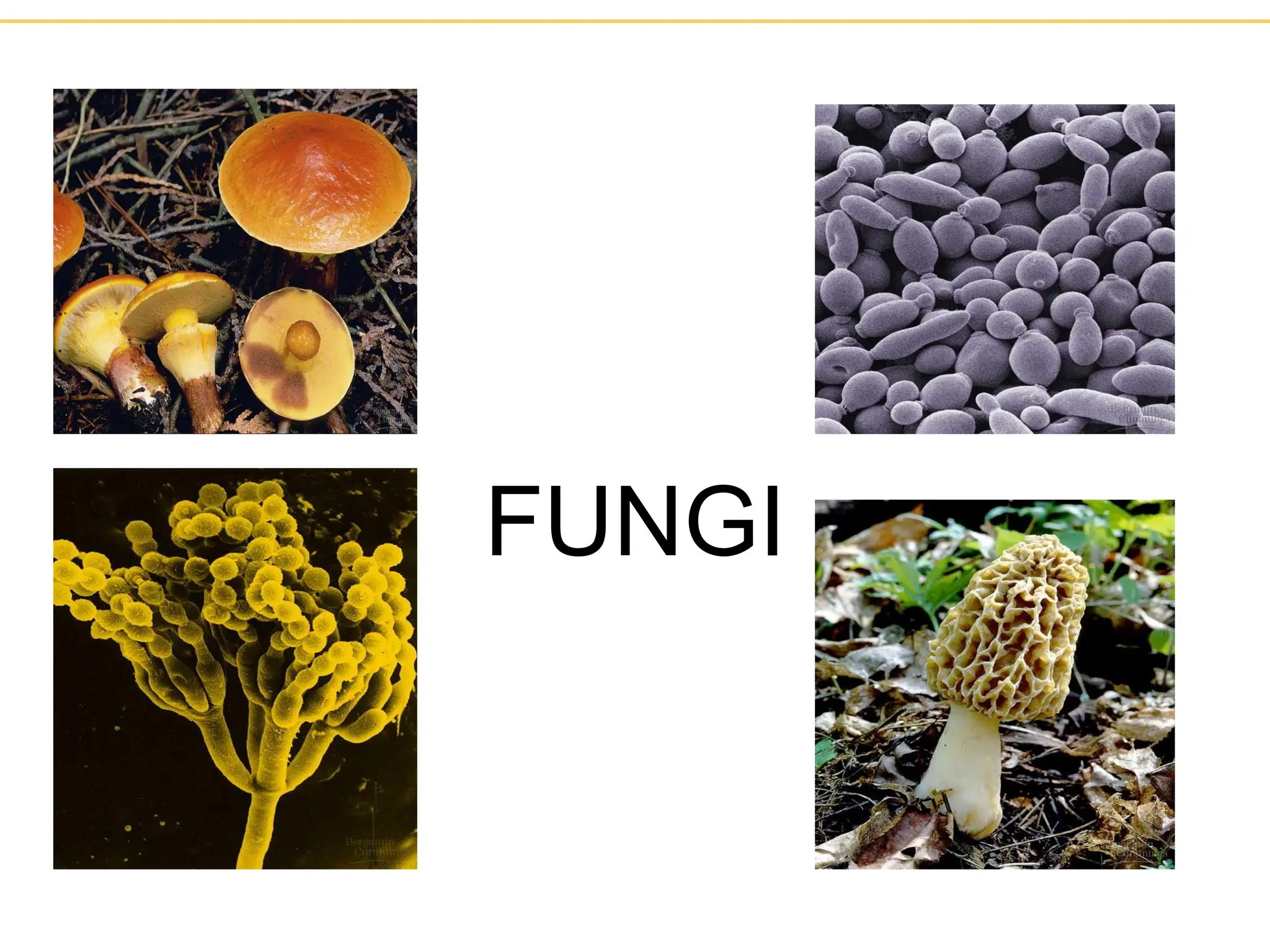
FUNGI
Overview: Fungi The Mighty
Mushrooms
• Fungi are diverse and widespread
• They are essential for the well-being of most
terrestrial ecosystems because they break
down organic material and recycle vital
nutrients
Fungi are heterotrophs that feed by
absorption
• Despite their diversity, fungi share key traits, most importantly the way
in which they derive nutrition
• Fungi are heterotrophs and absorb nutrients from outside of their body
• Fungi use enzymes to break down a large variety of complex
molecules into smaller organic compounds
• The versatility of these enzymes contributes to fungi’s ecological
success
• Fungi exhibit diverse lifestyles:
– Decomposers
– Parasites
– Mutualists
• What are fungi?
• Eukaryotic, spore-bearing, heterotrophic organisms that produce
extracellular enzymes and absorb their nutrition.
• What is mycology?
• Mycology is the study of fungi. The disease caused by fungi is
called MYCOSES.
General information's about FUNGI:
• Fungi are not plants or animals, they form a separate group of
higher organisms, distinct from both plants and animals, which
differ from other groups of organisms in several major respects:
First:
• Fungal cells are encased within a rigid cell wall, mostly composed
of chitin and glycan. These features contrast with animals, which
have no cell walls, and plants, which have cellulose as the major
cell wall component.
• Second:
• Fungi are heterotrophic. This means that they are
lacking in chlorophyll and cannot make their organic food
as plants can, through photosynthesis. Fungi live
embedded in a food source or medium, and obtain their
nourishment by secreting enzymes for external digestion
and by absorbing the nutrients that are released from the
medium. Some live on humans e.g. the cause ringworm
infections. Some live on insects, or plants.
•
• Third:
• Fungi are simpler in structure than plants or animals.
There is no division of cells into organs or tissues.
Structure of Fungi
The basic structure of the fungi:
• The basic structural unit of fungi is either a chain of
tubular, filament-like cells, termed a hypha or hyphae
(plural) or an independent single cell.
• The living body of a fungus is called a mycelium which is
made up of a branching network of filaments known as
hyphae.
• Fungal cell differentiation is no less complicated than is
found in plants or animals, but it is different. Many fungal
pathogens of humans and animals change their growth
form during the process of tissue invasion. These
dimorphic pathogens usually change from a multicellular
hyphal form in the natural environment to a budding,
single-celled form in tissue.
The Fungal Cell Wall
Rigid structure
surrounding the cell
Fungal Morphology
• The morphology of multicellular fungi enhances
their ability to absorb nutrients
• Fungi consist of mycelia, networks of
branched hyphae adapted for absorption
• Most fungi have cell walls made of chitin
• hyphae - the vegetative bodies of most
fungi, constructed of tiny filaments
• mycelium -an interwoven mat of hyphae
Septate hypha:
• multicellular
• walls divided by septa
Ceonocytic hypha:
• continuous cytoplasm
mass
• multinucleate
• no septa
Haustoria:
• Modified hyphae found in parasitic fungi
• Function: absorb nutrients from host
• Some fungi even have hyphae adapted for
preying on animals.
Specialized Hyphae in Mycorrhizal Fungi
• Some unique fungi have specialized hyphae
called haustoria that allow them to penetrate
the tissues of their host and extract nutrients
plant cell wall
haustorium
plant cell plasma membrane
hypha
modified portions of the hyphae can constrict
arround a nematode in less than a second
• Mycorrhizae are mutually beneficial
relationships between fungi and plant roots
• Ectomycorrhizal fungi form sheaths of
hyphae over a root and also grow into the
extracellular spaces of the root cortex
• Arbuscular mycorrhizal fungi extend hyphae
through the cell walls of root cells and into
tubes formed by invagination of the root cell
membrane
Reproduction
• Most fungi reproduce both sexually and asexually.
• Asexual reproduction – production of various types of
spores
– Sporangiophores- upright stalk with an enclosed sac (
bread mold)
– Conidia - upright stalk with no enclosed sac (penicillin)
– Fragmentation – hyphae dry out and shatter releasing
individual cells that act like spores (athlete’s foot)
– Budding – small offspring
• Sexual reproduction
– “plus and minus” mating types
– Hyphae of different mating types fuse and give rise to
a specialized structure that produces spores ( diploid)
– Most fungi are haploid throughout most of their life
cycle
• When environmental conditions are favorable, asexual
reproduction occurs rapidly. When unfavorable
conditions stress the organism, sexual reproduction
occurs and the offspring have an increased likehood that
they will be better suited for the environment.
Morphological groups of Fungi
1. The single-celled fungi are yeasts
2. The multicellular fungi are molds
3. Dimorphism
– Grow as molds in vitro on artificial culture medium, but as
yeasts in vivo in infected tissue.
• Unicellular fungi (nonfilamentous)
• Can use oxygen
• Capable of facultative anaerobic growth
• Asaxual reproduction - mitosis
– Fission yeasts divide symmetrically
• daughter cells separated by formation of a septa in the center (fission)
– Budding yeasts divide asymmetrically
• protuberance(bud)
• elongates
• parent cell’s nucleus divides
• one nuclei migrate to the bud
• cell wall material is then laid down between the bud and parent cell
• the bud eventually breaks away
• If fails to separate - pseudohyphae
• Sexual reproduction - meiosis
– Form zygote
– Form spores
1. Yeasts
2. Multicellular Fungi
• The fungal thallus (body) consists of
hyphae ( long filaments of cells joined
together)
• A mass of hyphae is called mycelium.
Figure 12.1a
Figure 12.1b
• A hypha is a tubular structure that grows by
elongation.
– Septate hyphae - contain cross-walls (septa)
– Coenocytic hyphae - contain no septa (long,
continuous cells with many nuclei)
• Vegetative hyphae
• The portion that obtain nutrients
• Fungal hyphae have a small volume but
large surface area, enhancing the fungal absorptive capacity
• Aerial hyphae
• The portion concerned with reproduction
• Produce spores
Mold mycelium
Figure 12.2
• Pathogenic dimorphic fungi are yeast like at 37°C and mold
like at 25°C
3. Dimorphic fungi
Dimorphic fungi:
• Dimorphism this term is used to describe
a fungus which occurs in two different
forms (temperature and place), for
example, some pathogenic fungi are
filamentous in culture(Labs) and yeast-like
in infected tissues.
• 37°C yeast
• 20 – 30° C moulds.
• Examples:
– Paracoccidioides brasiliensis
Fungi produce spores through sexual or
asexual life cycles
• Fungi propagate themselves by producing vast
numbers of spores, either sexually or asexually
• Fungi can produce spores from different types
of life cycles
Zygomycete
Basidiomycete
Ascomycete
* Formation of spores within
zygosporangium.
* No cross walls between cells.
Formation of spores in
ascus.
Formation of spores on
basidium.
Classification
using sexual reproduction
(more later)
Modified from Outlaw lecture
Spores
Spore-producing
structures
GERMINATION
ASEXUAL
REPRODUCTION
1.Mycelium
Key
Heterokaryotic
(unfused nuclei from
different parents)
Haploid (n)- most of the life cycle
Diploid (2n)
SEXUAL
REPRODUCTION
KARYOGAMY
(fusion of nuclei)
PLASMOGAMY
(fusion of cytoplasm)
Heterokaryotic
stage
Zygote
Spores
GERMINATION
MEIOSIS
from hours to centuries
can go by before this
takes effect
different hypha attracted
by pheromones fuse
although the cells fuse
the nuclei don't; it is
said to be dikaryotic
Generalized Cycle of Fungi
Mitosis
• Many molds and yeasts have no known sexual
stage
• Mycologists have traditionally called these
deuteromycetes, or imperfect fungi
The ancestor of fungi was an aquatic, single-
celled, flagellated protist
• Fungi and animals are more closely related to
each other than they are to plants or other
eukaryotes
• Fungi, animals, and their protistan relatives
form the opisthokonts clade
• DNA evidence suggests that fungi are most
closely related to unicellular nucleariids while
animals are most closely related to unicellular
choanoflagellates
Animals (and their close
protistan relatives)
Other fungi
Nucleariids
Chytrids
UNICELLULAR,
FLAGELLATED
ANCESTOR
Opisthokonts
• This suggests that fungi and animals evolved
from a common flagellated unicellular ancestor
and multicellularity arose separately in the two
groups
• The oldest undisputed fossils of fungi are only
about 460 million years old
Fossil fungal hyphae and spores
from the Ordovician period (~460
mya)
The Move to Land
• Fungi were among the earliest colonizers of
land and probably formed mutualistic
relationships with early land plants
Fungi have radiated into a diverse set of
lineages
• Molecular analyses have helped clarify
evolutionary relationships among fungal
groups, although areas of uncertainty remain
Chytrids
Zygomycetes
Glomeromycetes
Ascomycetes
Basidiomycetes
Chytrids (1,000 species)
Chytrids phylum Chytridiomycota
• Found in freshwater and terrestrial habitats
• Decomposers, parasites, or mutualists
• According to molecular evidence chytrids diverged in early evolution
• Chytrids are unique among fungi in having flagellated spores, zoospores
• Molecular data indicate that some “chytrids” are actually more closely
related to another fungal group, the zygomycetes; chytrids are a
paraphyletic group
hyphae
zoospore
1,000 species
Zygomycetes (1,000 species)
Zygomycetes (phylum Zygomycota, zygo=egg) exhibit great diversity
of life histories
They include fast-growing molds, parasites, and commensal symbionts
The zygomycetes are named for their sexually produced zygosporangia
which are resistant to freezing and drying, can survive unfavorable
conditions
•The life cycle of black bread mold (Rhizopus stolonifer) is fairly typical of
the phylum
1,000 species
sporebearing hypha
Rhizopus
growing
on bread
SEXUAL
REPRODUCTION
Young
zygosporangium
(heterokaryotic)
Gametangia with
haploid nuclei
Mating
type (–)
Mating
type (+)
Diploid (2n)
Haploid (n)
Heterokaryotic (n + n)
PLASMOGAMY
Key
Diploid
nuclei
Zygosporangium
100 µm
KARYOGAMY
MEIOSIS
Sporangium
Spores
Dispersal and
germination
ASEXUAL
REPRODUCTION
Dispersal and
germination
Sporangia
Mycelium
50 µm Life Cycle of Zygomycete
1. mycella of different mating types
(+) and (-) mate
hyphal extensions
enclosing haploid nuclei
meat
zygosporangium forms
containing multiple
haploid nuclei from
both parents
tough wall is developed to protect
the zygosporangium
when conditions are favorable,
karyogamy occurs
sporangia produces identical
haploid spores
160 species
Fungal hypha
The glomeromycetes (phylum Glomeromycota, glomero= round) were
once considered zygomycetes
They are now classified in a separate clade
Glomeromycetes form arbuscular mycorrhizae
plant root
mycelum
Ascomycetes (65,000 species)
Ascomycetes (phylum Ascomycota, asca=sac) live in marine, freshwater,
and terrestrial habitats; include plant pathogens, decomposers, and
symbionts
The phylum is defined by production of sexual spores in saclike asci,
contained in fruiting bodies called ascocarps
Commonly called sac fungi ascomycetes vary in size and complexity from
unicellular yeasts to elaborate cup fungi and morels
Asexual spores called conidia are not formed inside sporangia; they are
produced asexually at the tips of specialized hyphae called conidiophores
65,000 species
ascocarp
Key
Haploid (n)
Diploid (2n)
Dikaryotic (n + n)
Conidiophore
Mycelium
ASEXUAL
REPRODUCTION
Germination
Hypha PLASMOGAMY
Conidia;
mating type (–)
Mating
type (+)
SEXUAL
REPRODUCTION
Dikaryotic
hyphae
Ascus (dikaryotic)
Mycelia
KARYOGAMY
Diploid nucleus
(zygote)
Germination
Asci
Dispersal
Dispersal
Ascocarp
Eight
ascospores
Four
haploid
nuclei
MEIOSIS
conidia (n)
1.pigmented haploid spores
known as conidia are
produced
Life Cycle of the Ascomycete Neurospora crassa
specialized hyphae fuse
after plasmogamy dikaryotic
asci are produced
karyogamy occurs
within each ascus
producing 2n nucleus
each haploid nucleus divides once by
mitosis yealding 8 nuclei, cell walls
develop forming the 8 spores
ascospores are discharged
through an opening, new
mycelia will be generated
Common edible morel, Morchella esculenta (ascomycete)
World’s most expensive truffle
White Alba
Almost 3 pounds
$112, 000
Photo from Wikipedia
Truffles
Black truffle
(Tuber melanosporum)
Botryosphaeria dothidea on Adina apple
Thanks to Robert Hebert and Kim Riddle for this image.
Basidiomycetes (30,000 species)
Basidomycetes (phylum Basidiomycota, basidia= little pedestal)
include mushrooms, puffballs, shelf fungi
Mutualists, and plant parasites
The phylum is defined by a clublike structure called a basidium, a
transient diploid stage in the life cycle
The basidiomycetes are also called club fungi
30,000 species
Maiden veil fungus
(Dictyphora), a
fungus with an odor
like rotting meat
Basidium
SEXUAL
REPRODUCTION
Diploid (2n)
Haploid (n)
Dikaryotic (n+n)
Key
PLASMOGAMY
Mating
type (+)
Dikaryotic mycelium
Mating
type (–)
Basidia
(n+n)
Gills lined
with basidia
Basidiocarp
(n+n)
KARYOGAMY
Diploid
nuclei
MEIOSIS
Basidium
Dispersal and
germination
Basidiospores
(n)
Basidium with
four basidiospores
1 µm
Haploid
mycelia
1.2 haploid mycelia undergo plasmogamy
environmental cues induce
the growth of basidiocarp
karyogamy produces
diploid nucleus which
will undergo meiosis
basidiospore product of meiosis
Polypore example
Polyporus arcularius
Shelf fungus example
Ganoderma applanatum
Puffball
Calostoma cinnabarina
Netted stinkhorn
Dictyophora duplicata
White-egg bird’s-nest
Crucibulum laeve
Earthstar
Geastrum saccatum
Corn smut
Ustilago maydis
Fungi play key roles in nutrient cycling,
ecological interactions, and human welfare
• Fungi interact with other organisms in many ways
• Fungi are efficient decomposers
• They perform essential recycling of chemical elements
between the living and nonliving world
• Fungi form mutualistic relationships with plants, algae,
cyanobacteria, and animals
• All of these relationships have profound ecological effects
Fungus-Plant Mutualisms
• Mycorrhizae are enormously important in
natural ecosystems and agriculture
• Plants harbor harmless symbiotic endophytes
that live inside leaves or other plant parts
• Endophytes make toxins that deter herbivores
and defend against pathogens
Fungus-Animal Symbioses
• Some fungi share their digestive services with
animals
• These fungi help break down plant material in
the guts of cows and other grazing mammals
• Many species of ants and termites use the
digestive power of fungi.
Lichens
• A lichen is a symbiotic association between a
photosynthetic microorganism and a fungus in
which millions of photosynthetic cells are held
in a mass of fungal hyphae
fruticose lichen
crustose lichen
foliose lichen
• The fungal component of a lichen is most often
an ascomycete
• Algae or cyanobacteria occupy an inner layer
below the lichen surface
ascocarp
algal layer
hyphae
soredia
• The fungi of lichens can reproduce sexually and asexually
• Asexual reproduction is by fragmentation or the formation
of soredia, small clusters of hyphae with embedded algae
• Lichens are important pioneers on new rock and soil
surfaces
• Lichens are sensitive to pollution, and their death can be a
warning that air quality is deteriorating
Fungi as Pathogens
• About 30% of known fungal species are
parasites or pathogens, mostly on or in plants
• Some fungi that attack food crops are toxic to
humans
• Animals are much less susceptible to parasitic
fungi than are plants
• The general term for a fungal infection in
animals is mycosis
Disseminated Histoplasma
capsulatum, skin infection.
Ringworm skin infection: Tinea corporis
Dermatophytes
Tinea pedis
Onychomycosis
Tinea corporis
Fig. 31-25
(c) Ergots on rye
(a) Corn smut on corn (b) Tar spot fungus on
maple leaves

Lecture on fungi Part-I.pdf

  • 1.
  • 2.
    Overview: Fungi TheMighty Mushrooms • Fungi are diverse and widespread • They are essential for the well-being of most terrestrial ecosystems because they break down organic material and recycle vital nutrients
  • 3.
    Fungi are heterotrophsthat feed by absorption • Despite their diversity, fungi share key traits, most importantly the way in which they derive nutrition • Fungi are heterotrophs and absorb nutrients from outside of their body • Fungi use enzymes to break down a large variety of complex molecules into smaller organic compounds • The versatility of these enzymes contributes to fungi’s ecological success • Fungi exhibit diverse lifestyles: – Decomposers – Parasites – Mutualists
  • 4.
    • What arefungi? • Eukaryotic, spore-bearing, heterotrophic organisms that produce extracellular enzymes and absorb their nutrition. • What is mycology? • Mycology is the study of fungi. The disease caused by fungi is called MYCOSES. General information's about FUNGI: • Fungi are not plants or animals, they form a separate group of higher organisms, distinct from both plants and animals, which differ from other groups of organisms in several major respects: First: • Fungal cells are encased within a rigid cell wall, mostly composed of chitin and glycan. These features contrast with animals, which have no cell walls, and plants, which have cellulose as the major cell wall component.
  • 5.
    • Second: • Fungiare heterotrophic. This means that they are lacking in chlorophyll and cannot make their organic food as plants can, through photosynthesis. Fungi live embedded in a food source or medium, and obtain their nourishment by secreting enzymes for external digestion and by absorbing the nutrients that are released from the medium. Some live on humans e.g. the cause ringworm infections. Some live on insects, or plants. • • Third: • Fungi are simpler in structure than plants or animals. There is no division of cells into organs or tissues.
  • 6.
  • 7.
    The basic structureof the fungi: • The basic structural unit of fungi is either a chain of tubular, filament-like cells, termed a hypha or hyphae (plural) or an independent single cell. • The living body of a fungus is called a mycelium which is made up of a branching network of filaments known as hyphae. • Fungal cell differentiation is no less complicated than is found in plants or animals, but it is different. Many fungal pathogens of humans and animals change their growth form during the process of tissue invasion. These dimorphic pathogens usually change from a multicellular hyphal form in the natural environment to a budding, single-celled form in tissue.
  • 8.
    The Fungal CellWall Rigid structure surrounding the cell
  • 9.
    Fungal Morphology • Themorphology of multicellular fungi enhances their ability to absorb nutrients • Fungi consist of mycelia, networks of branched hyphae adapted for absorption • Most fungi have cell walls made of chitin
  • 10.
    • hyphae -the vegetative bodies of most fungi, constructed of tiny filaments • mycelium -an interwoven mat of hyphae
  • 11.
    Septate hypha: • multicellular •walls divided by septa Ceonocytic hypha: • continuous cytoplasm mass • multinucleate • no septa
  • 12.
    Haustoria: • Modified hyphaefound in parasitic fungi • Function: absorb nutrients from host • Some fungi even have hyphae adapted for preying on animals.
  • 13.
    Specialized Hyphae inMycorrhizal Fungi • Some unique fungi have specialized hyphae called haustoria that allow them to penetrate the tissues of their host and extract nutrients plant cell wall haustorium plant cell plasma membrane hypha modified portions of the hyphae can constrict arround a nematode in less than a second
  • 14.
    • Mycorrhizae aremutually beneficial relationships between fungi and plant roots • Ectomycorrhizal fungi form sheaths of hyphae over a root and also grow into the extracellular spaces of the root cortex • Arbuscular mycorrhizal fungi extend hyphae through the cell walls of root cells and into tubes formed by invagination of the root cell membrane
  • 15.
    Reproduction • Most fungireproduce both sexually and asexually. • Asexual reproduction – production of various types of spores – Sporangiophores- upright stalk with an enclosed sac ( bread mold) – Conidia - upright stalk with no enclosed sac (penicillin) – Fragmentation – hyphae dry out and shatter releasing individual cells that act like spores (athlete’s foot) – Budding – small offspring
  • 16.
    • Sexual reproduction –“plus and minus” mating types – Hyphae of different mating types fuse and give rise to a specialized structure that produces spores ( diploid) – Most fungi are haploid throughout most of their life cycle • When environmental conditions are favorable, asexual reproduction occurs rapidly. When unfavorable conditions stress the organism, sexual reproduction occurs and the offspring have an increased likehood that they will be better suited for the environment.
  • 17.
    Morphological groups ofFungi 1. The single-celled fungi are yeasts 2. The multicellular fungi are molds 3. Dimorphism – Grow as molds in vitro on artificial culture medium, but as yeasts in vivo in infected tissue.
  • 18.
    • Unicellular fungi(nonfilamentous) • Can use oxygen • Capable of facultative anaerobic growth • Asaxual reproduction - mitosis – Fission yeasts divide symmetrically • daughter cells separated by formation of a septa in the center (fission) – Budding yeasts divide asymmetrically • protuberance(bud) • elongates • parent cell’s nucleus divides • one nuclei migrate to the bud • cell wall material is then laid down between the bud and parent cell • the bud eventually breaks away • If fails to separate - pseudohyphae • Sexual reproduction - meiosis – Form zygote – Form spores 1. Yeasts
  • 19.
    2. Multicellular Fungi •The fungal thallus (body) consists of hyphae ( long filaments of cells joined together) • A mass of hyphae is called mycelium. Figure 12.1a Figure 12.1b • A hypha is a tubular structure that grows by elongation. – Septate hyphae - contain cross-walls (septa) – Coenocytic hyphae - contain no septa (long, continuous cells with many nuclei)
  • 20.
    • Vegetative hyphae •The portion that obtain nutrients • Fungal hyphae have a small volume but large surface area, enhancing the fungal absorptive capacity • Aerial hyphae • The portion concerned with reproduction • Produce spores Mold mycelium Figure 12.2
  • 21.
    • Pathogenic dimorphicfungi are yeast like at 37°C and mold like at 25°C 3. Dimorphic fungi
  • 22.
    Dimorphic fungi: • Dimorphismthis term is used to describe a fungus which occurs in two different forms (temperature and place), for example, some pathogenic fungi are filamentous in culture(Labs) and yeast-like in infected tissues. • 37°C yeast • 20 – 30° C moulds. • Examples: – Paracoccidioides brasiliensis
  • 23.
    Fungi produce sporesthrough sexual or asexual life cycles • Fungi propagate themselves by producing vast numbers of spores, either sexually or asexually • Fungi can produce spores from different types of life cycles
  • 24.
    Zygomycete Basidiomycete Ascomycete * Formation ofspores within zygosporangium. * No cross walls between cells. Formation of spores in ascus. Formation of spores on basidium. Classification using sexual reproduction (more later) Modified from Outlaw lecture
  • 25.
    Spores Spore-producing structures GERMINATION ASEXUAL REPRODUCTION 1.Mycelium Key Heterokaryotic (unfused nuclei from differentparents) Haploid (n)- most of the life cycle Diploid (2n) SEXUAL REPRODUCTION KARYOGAMY (fusion of nuclei) PLASMOGAMY (fusion of cytoplasm) Heterokaryotic stage Zygote Spores GERMINATION MEIOSIS from hours to centuries can go by before this takes effect different hypha attracted by pheromones fuse although the cells fuse the nuclei don't; it is said to be dikaryotic Generalized Cycle of Fungi Mitosis
  • 26.
    • Many moldsand yeasts have no known sexual stage • Mycologists have traditionally called these deuteromycetes, or imperfect fungi
  • 27.
    The ancestor offungi was an aquatic, single- celled, flagellated protist • Fungi and animals are more closely related to each other than they are to plants or other eukaryotes • Fungi, animals, and their protistan relatives form the opisthokonts clade • DNA evidence suggests that fungi are most closely related to unicellular nucleariids while animals are most closely related to unicellular choanoflagellates
  • 28.
    Animals (and theirclose protistan relatives) Other fungi Nucleariids Chytrids UNICELLULAR, FLAGELLATED ANCESTOR Opisthokonts
  • 29.
    • This suggeststhat fungi and animals evolved from a common flagellated unicellular ancestor and multicellularity arose separately in the two groups • The oldest undisputed fossils of fungi are only about 460 million years old Fossil fungal hyphae and spores from the Ordovician period (~460 mya)
  • 30.
    The Move toLand • Fungi were among the earliest colonizers of land and probably formed mutualistic relationships with early land plants
  • 31.
    Fungi have radiatedinto a diverse set of lineages • Molecular analyses have helped clarify evolutionary relationships among fungal groups, although areas of uncertainty remain Chytrids Zygomycetes Glomeromycetes Ascomycetes Basidiomycetes
  • 32.
    Chytrids (1,000 species) Chytridsphylum Chytridiomycota • Found in freshwater and terrestrial habitats • Decomposers, parasites, or mutualists • According to molecular evidence chytrids diverged in early evolution • Chytrids are unique among fungi in having flagellated spores, zoospores • Molecular data indicate that some “chytrids” are actually more closely related to another fungal group, the zygomycetes; chytrids are a paraphyletic group hyphae zoospore 1,000 species
  • 33.
    Zygomycetes (1,000 species) Zygomycetes(phylum Zygomycota, zygo=egg) exhibit great diversity of life histories They include fast-growing molds, parasites, and commensal symbionts The zygomycetes are named for their sexually produced zygosporangia which are resistant to freezing and drying, can survive unfavorable conditions •The life cycle of black bread mold (Rhizopus stolonifer) is fairly typical of the phylum 1,000 species sporebearing hypha
  • 34.
    Rhizopus growing on bread SEXUAL REPRODUCTION Young zygosporangium (heterokaryotic) Gametangia with haploidnuclei Mating type (–) Mating type (+) Diploid (2n) Haploid (n) Heterokaryotic (n + n) PLASMOGAMY Key Diploid nuclei Zygosporangium 100 µm KARYOGAMY MEIOSIS Sporangium Spores Dispersal and germination ASEXUAL REPRODUCTION Dispersal and germination Sporangia Mycelium 50 µm Life Cycle of Zygomycete 1. mycella of different mating types (+) and (-) mate hyphal extensions enclosing haploid nuclei meat zygosporangium forms containing multiple haploid nuclei from both parents tough wall is developed to protect the zygosporangium when conditions are favorable, karyogamy occurs sporangia produces identical haploid spores
  • 35.
    160 species Fungal hypha Theglomeromycetes (phylum Glomeromycota, glomero= round) were once considered zygomycetes They are now classified in a separate clade Glomeromycetes form arbuscular mycorrhizae plant root mycelum
  • 36.
    Ascomycetes (65,000 species) Ascomycetes(phylum Ascomycota, asca=sac) live in marine, freshwater, and terrestrial habitats; include plant pathogens, decomposers, and symbionts The phylum is defined by production of sexual spores in saclike asci, contained in fruiting bodies called ascocarps Commonly called sac fungi ascomycetes vary in size and complexity from unicellular yeasts to elaborate cup fungi and morels Asexual spores called conidia are not formed inside sporangia; they are produced asexually at the tips of specialized hyphae called conidiophores 65,000 species ascocarp
  • 37.
    Key Haploid (n) Diploid (2n) Dikaryotic(n + n) Conidiophore Mycelium ASEXUAL REPRODUCTION Germination Hypha PLASMOGAMY Conidia; mating type (–) Mating type (+) SEXUAL REPRODUCTION Dikaryotic hyphae Ascus (dikaryotic) Mycelia KARYOGAMY Diploid nucleus (zygote) Germination Asci Dispersal Dispersal Ascocarp Eight ascospores Four haploid nuclei MEIOSIS conidia (n) 1.pigmented haploid spores known as conidia are produced Life Cycle of the Ascomycete Neurospora crassa specialized hyphae fuse after plasmogamy dikaryotic asci are produced karyogamy occurs within each ascus producing 2n nucleus each haploid nucleus divides once by mitosis yealding 8 nuclei, cell walls develop forming the 8 spores ascospores are discharged through an opening, new mycelia will be generated
  • 38.
    Common edible morel,Morchella esculenta (ascomycete)
  • 39.
    World’s most expensivetruffle White Alba Almost 3 pounds $112, 000 Photo from Wikipedia Truffles Black truffle (Tuber melanosporum)
  • 40.
    Botryosphaeria dothidea onAdina apple Thanks to Robert Hebert and Kim Riddle for this image.
  • 41.
    Basidiomycetes (30,000 species) Basidomycetes(phylum Basidiomycota, basidia= little pedestal) include mushrooms, puffballs, shelf fungi Mutualists, and plant parasites The phylum is defined by a clublike structure called a basidium, a transient diploid stage in the life cycle The basidiomycetes are also called club fungi 30,000 species
  • 42.
    Maiden veil fungus (Dictyphora),a fungus with an odor like rotting meat
  • 43.
    Basidium SEXUAL REPRODUCTION Diploid (2n) Haploid (n) Dikaryotic(n+n) Key PLASMOGAMY Mating type (+) Dikaryotic mycelium Mating type (–) Basidia (n+n) Gills lined with basidia Basidiocarp (n+n) KARYOGAMY Diploid nuclei MEIOSIS Basidium Dispersal and germination Basidiospores (n) Basidium with four basidiospores 1 µm Haploid mycelia 1.2 haploid mycelia undergo plasmogamy environmental cues induce the growth of basidiocarp karyogamy produces diploid nucleus which will undergo meiosis basidiospore product of meiosis
  • 45.
  • 46.
  • 47.
  • 48.
  • 49.
  • 50.
  • 51.
  • 52.
    Fungi play keyroles in nutrient cycling, ecological interactions, and human welfare • Fungi interact with other organisms in many ways • Fungi are efficient decomposers • They perform essential recycling of chemical elements between the living and nonliving world • Fungi form mutualistic relationships with plants, algae, cyanobacteria, and animals • All of these relationships have profound ecological effects
  • 53.
    Fungus-Plant Mutualisms • Mycorrhizaeare enormously important in natural ecosystems and agriculture • Plants harbor harmless symbiotic endophytes that live inside leaves or other plant parts • Endophytes make toxins that deter herbivores and defend against pathogens
  • 54.
    Fungus-Animal Symbioses • Somefungi share their digestive services with animals • These fungi help break down plant material in the guts of cows and other grazing mammals • Many species of ants and termites use the digestive power of fungi.
  • 55.
    Lichens • A lichenis a symbiotic association between a photosynthetic microorganism and a fungus in which millions of photosynthetic cells are held in a mass of fungal hyphae fruticose lichen crustose lichen foliose lichen
  • 56.
    • The fungalcomponent of a lichen is most often an ascomycete • Algae or cyanobacteria occupy an inner layer below the lichen surface ascocarp algal layer hyphae soredia
  • 57.
    • The fungiof lichens can reproduce sexually and asexually • Asexual reproduction is by fragmentation or the formation of soredia, small clusters of hyphae with embedded algae • Lichens are important pioneers on new rock and soil surfaces • Lichens are sensitive to pollution, and their death can be a warning that air quality is deteriorating
  • 58.
    Fungi as Pathogens •About 30% of known fungal species are parasites or pathogens, mostly on or in plants • Some fungi that attack food crops are toxic to humans • Animals are much less susceptible to parasitic fungi than are plants • The general term for a fungal infection in animals is mycosis
  • 59.
    Disseminated Histoplasma capsulatum, skininfection. Ringworm skin infection: Tinea corporis
  • 60.
  • 61.
    Fig. 31-25 (c) Ergotson rye (a) Corn smut on corn (b) Tar spot fungus on maple leaves