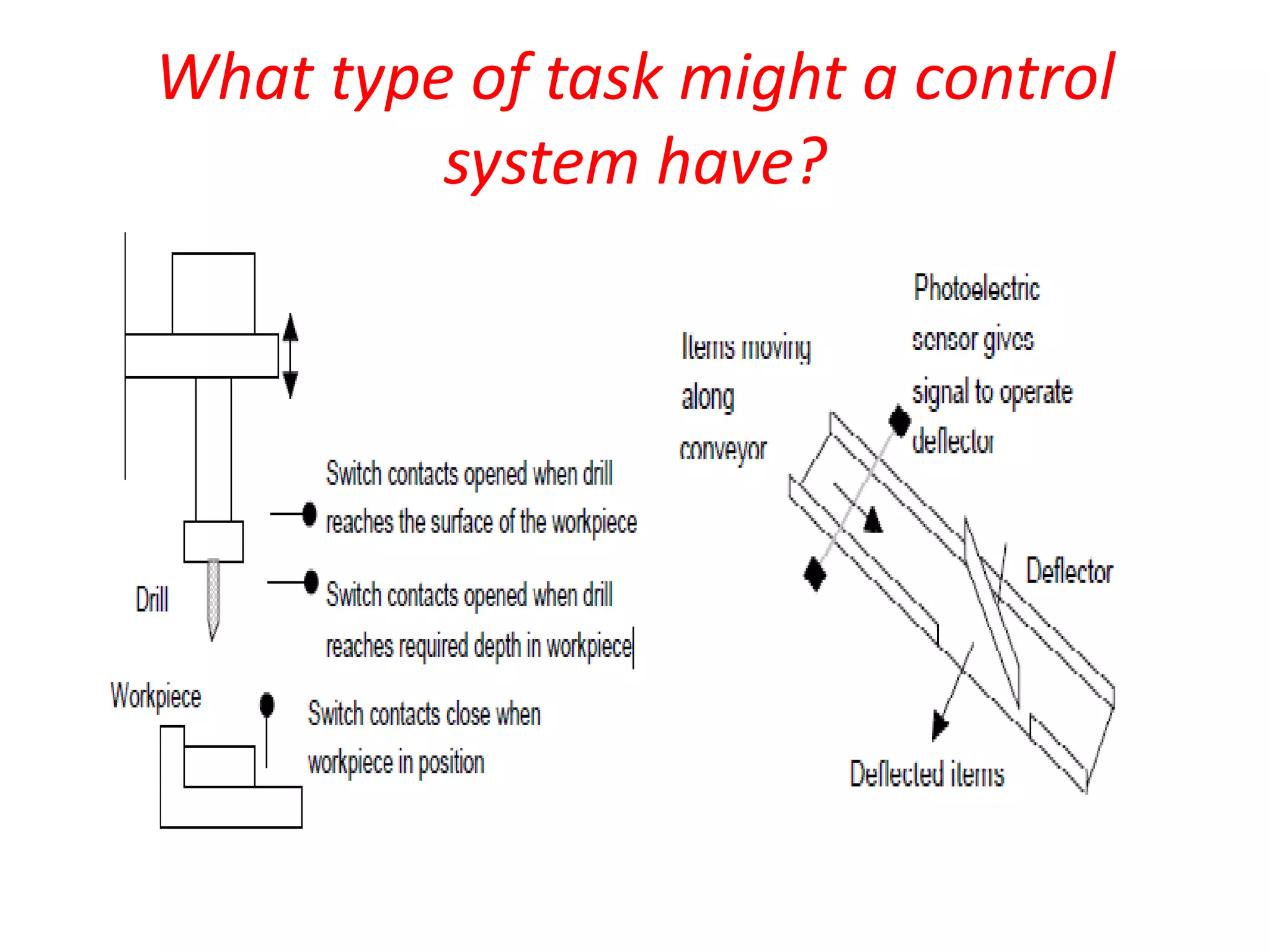
What type of task might a control
system have?
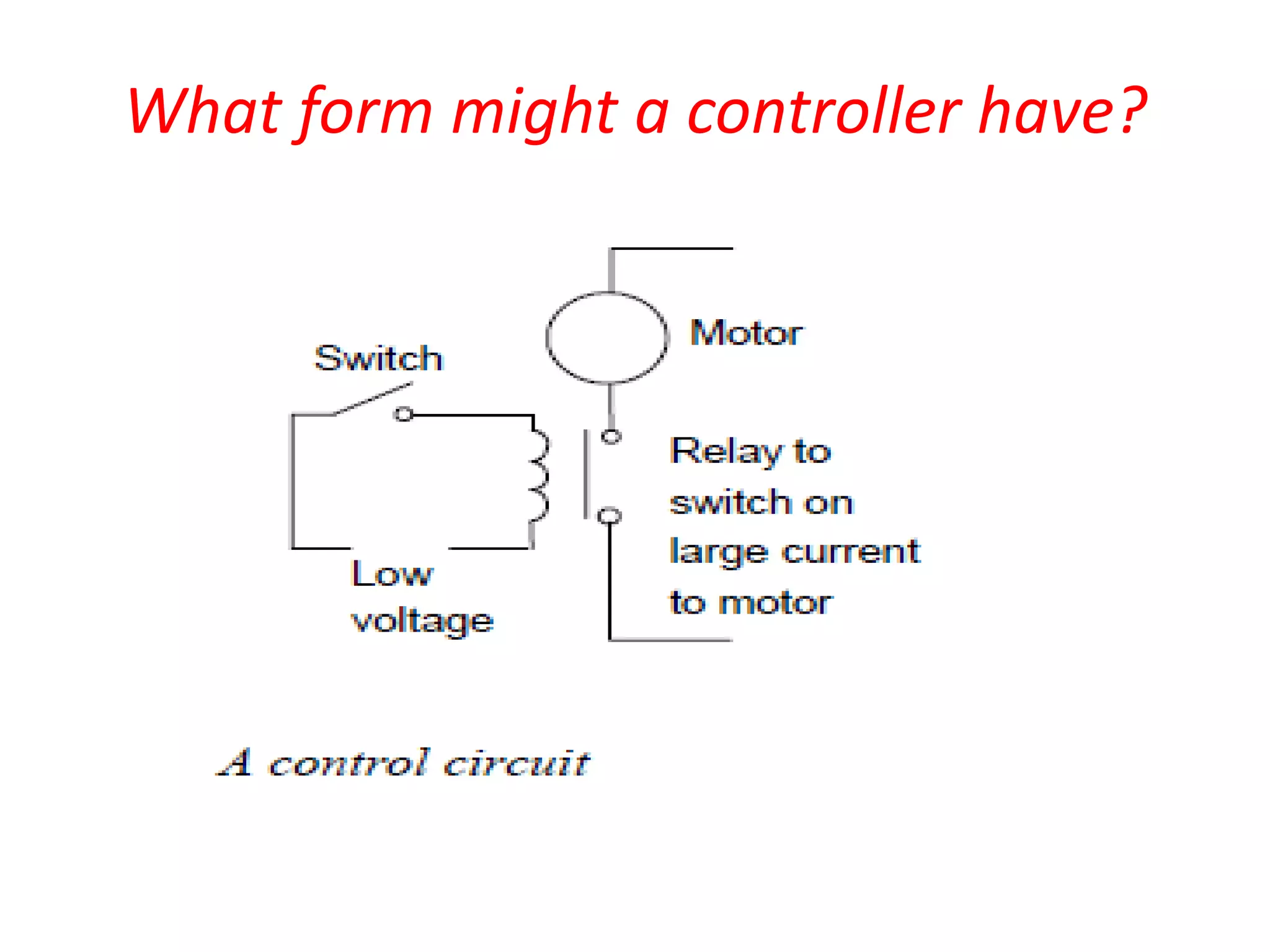
What form might a controller have?
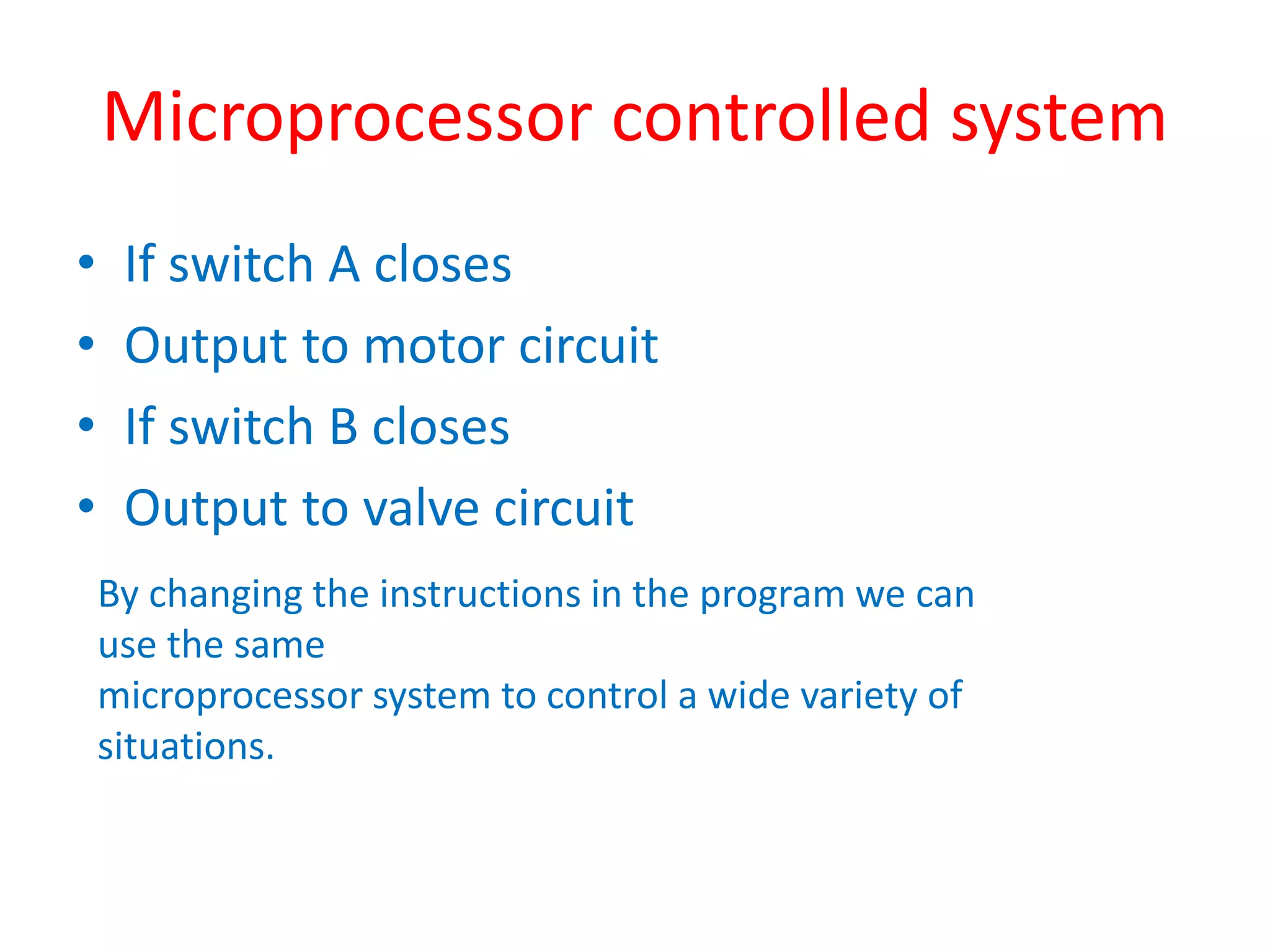
Microprocessor controlled system
• If switch A closes
• Output to motor circuit
• If switch B closes
• Output to valve circuit
By changing the instructions in the program we can
use the same
microprocessor system to control a wide variety of
situations.
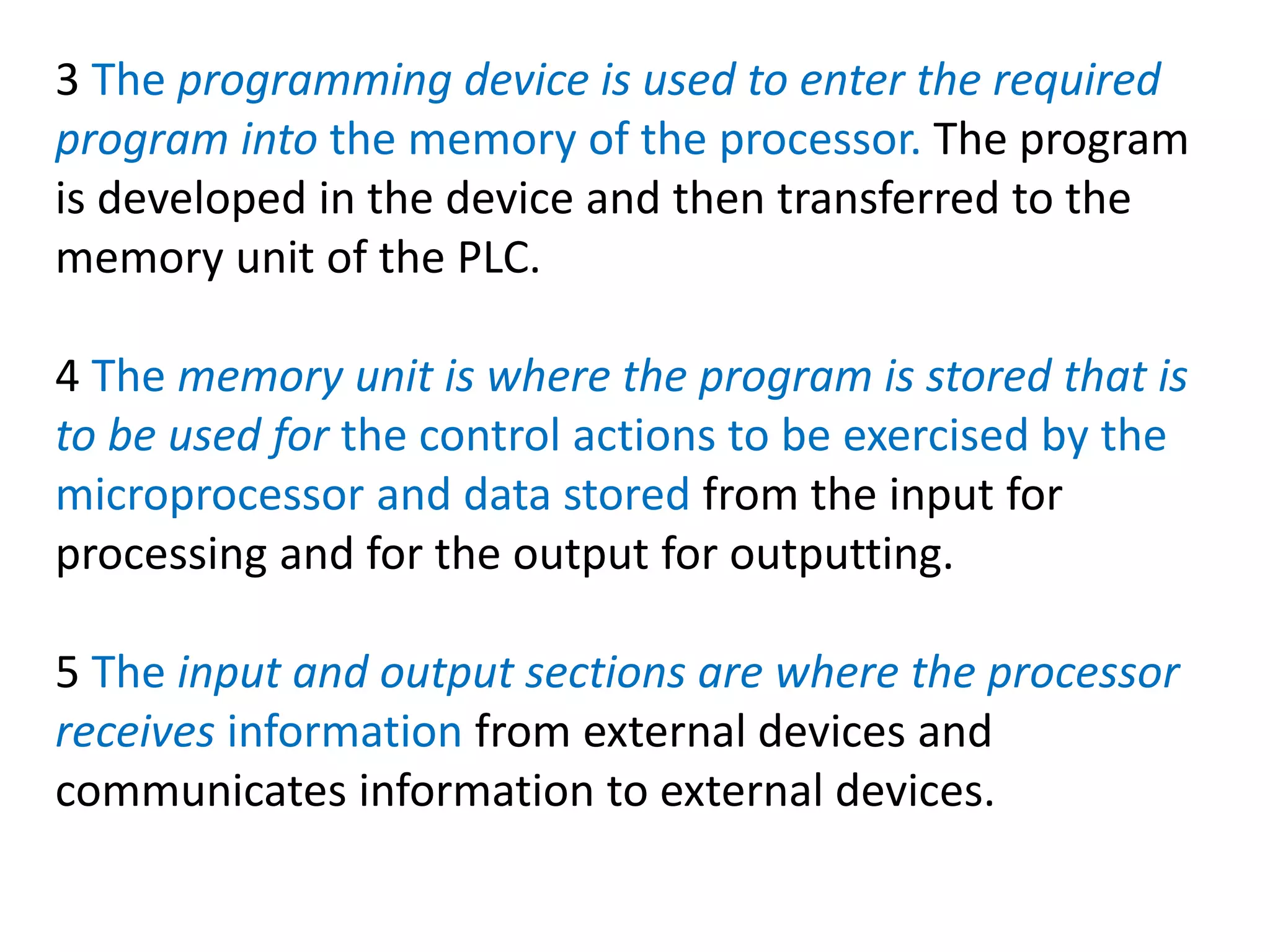
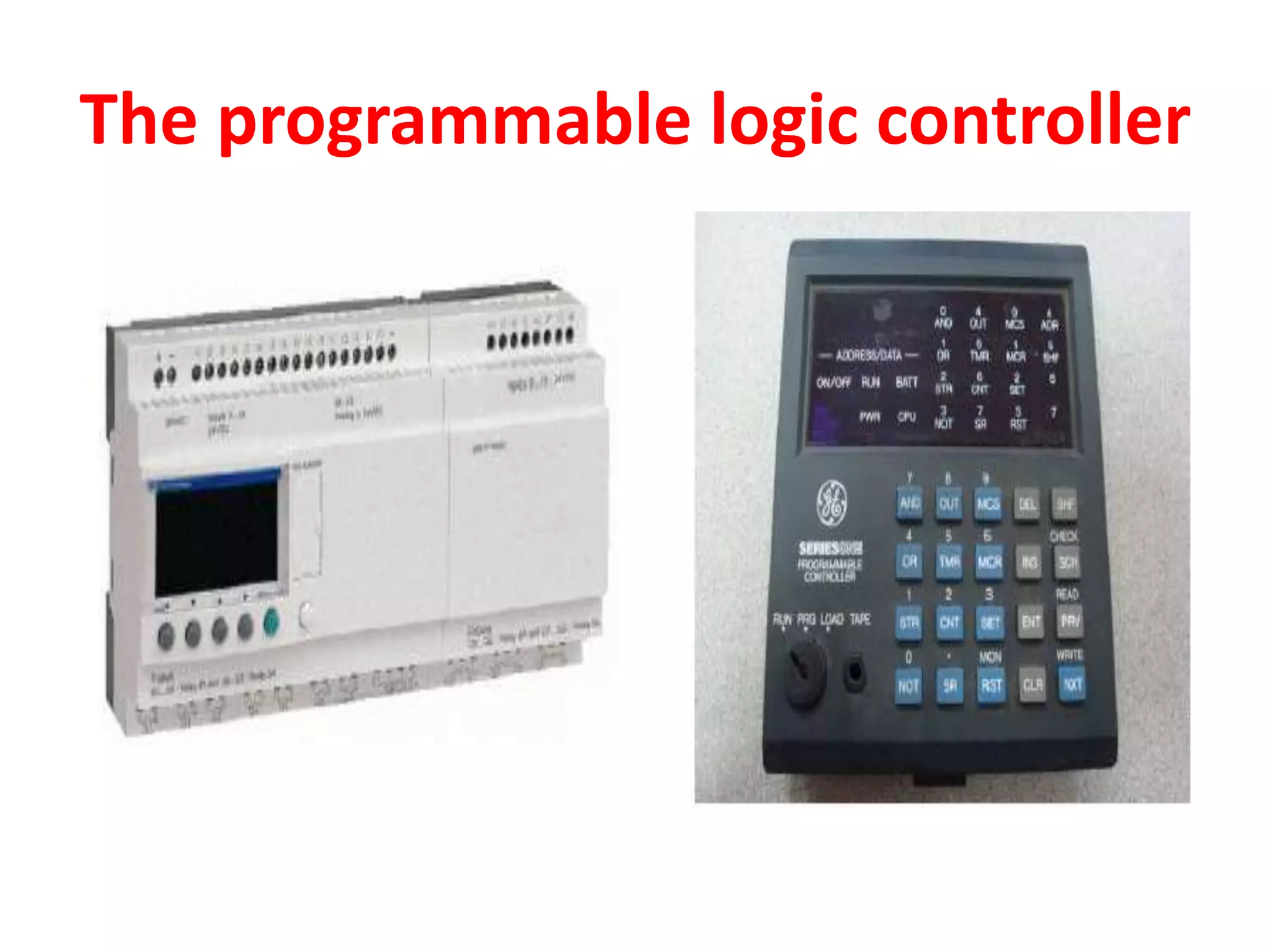
The programmable logic controller
A programmable logic controller (PLC)
is a special form of microprocessor-
based controller that uses a
programmable memory to store
instructions and to implement
functions such as logic, sequencing,
timing,
counting and arithmetic in order to
control machines and processes
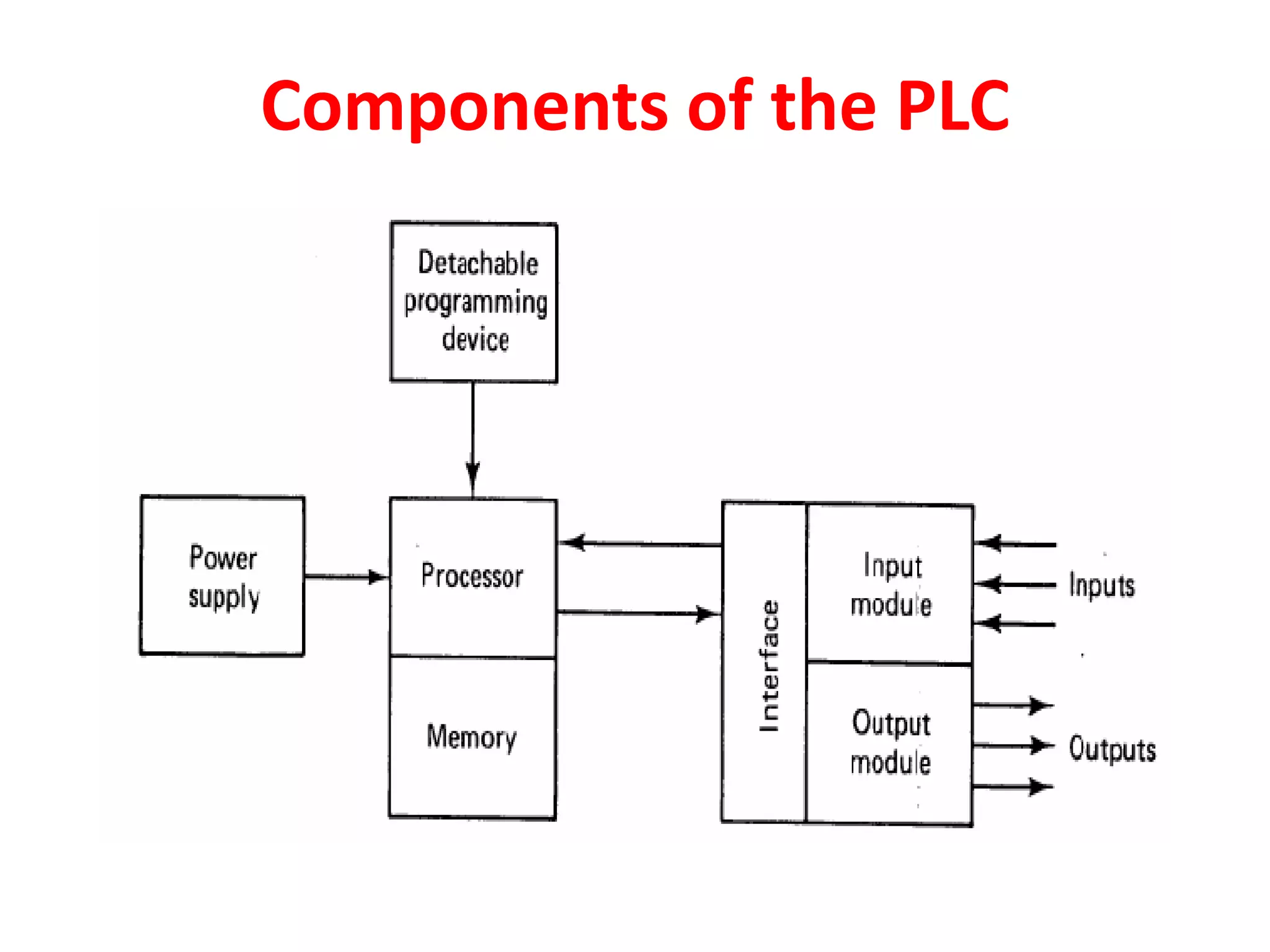
Components of the PLC
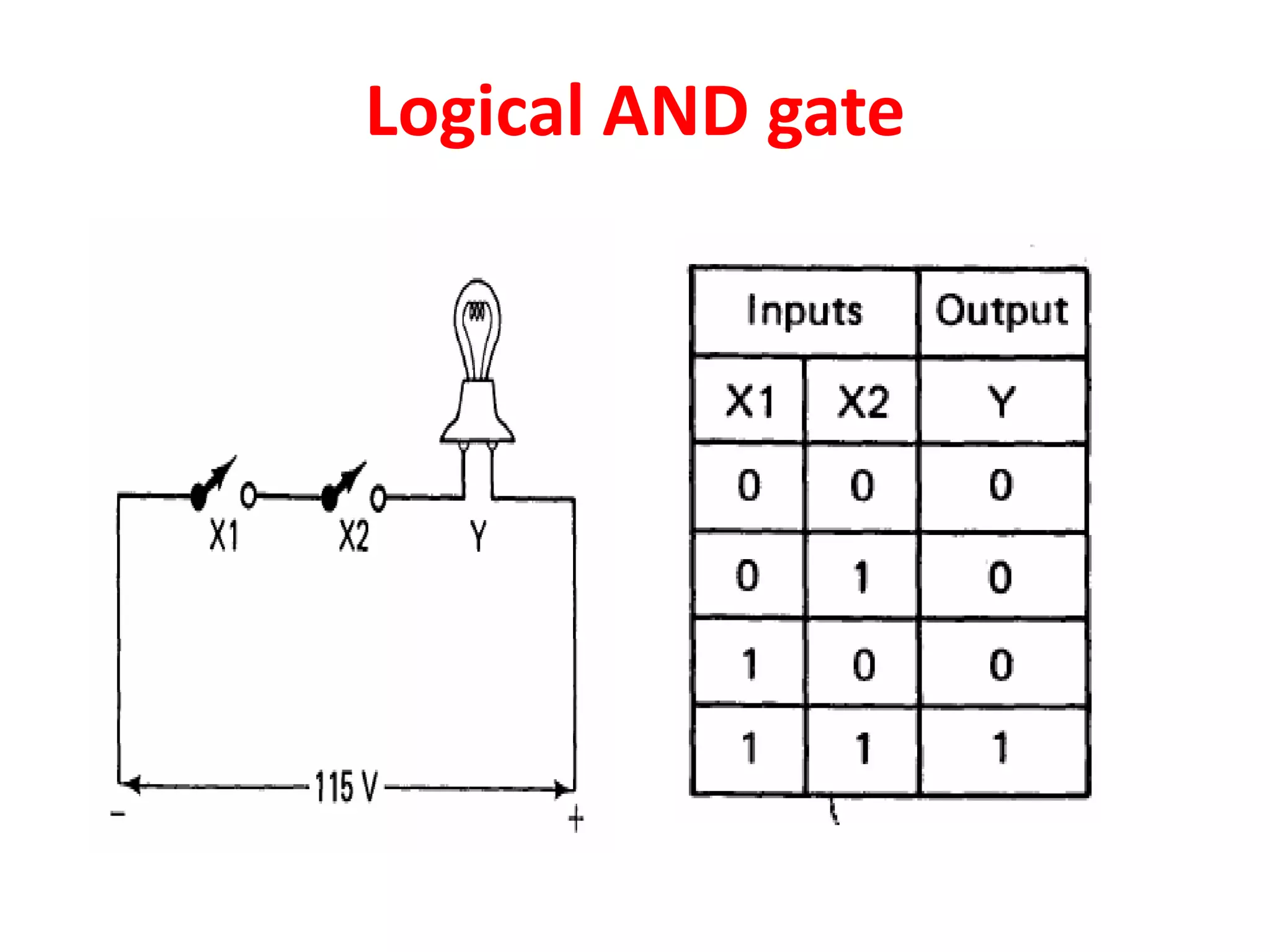
Logical AND gate
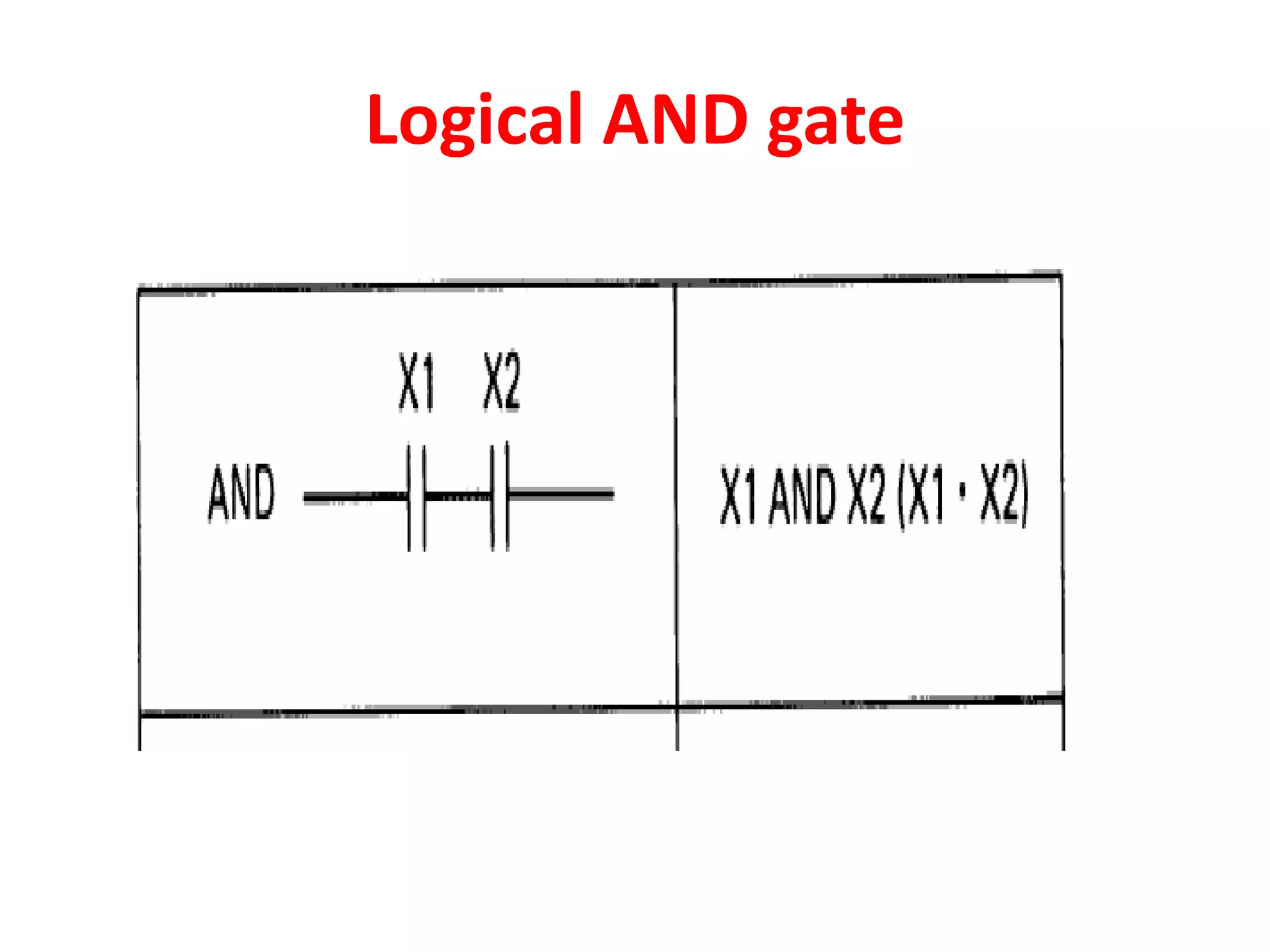
Logical AND gate
1 The processor unit or central processing unit (CPU) is
the unit containing the microprocessor and this
interprets the input signals and carries out the control
actions, according to the program stored in its memory,
communicating the decisions as action signals to the
outputs.
2 The power supply unit is needed to convert the mains
a.c. voltage to the low d.c. voltage (5 V) necessary for
the processor and the circuits in the input and output
interface modules.
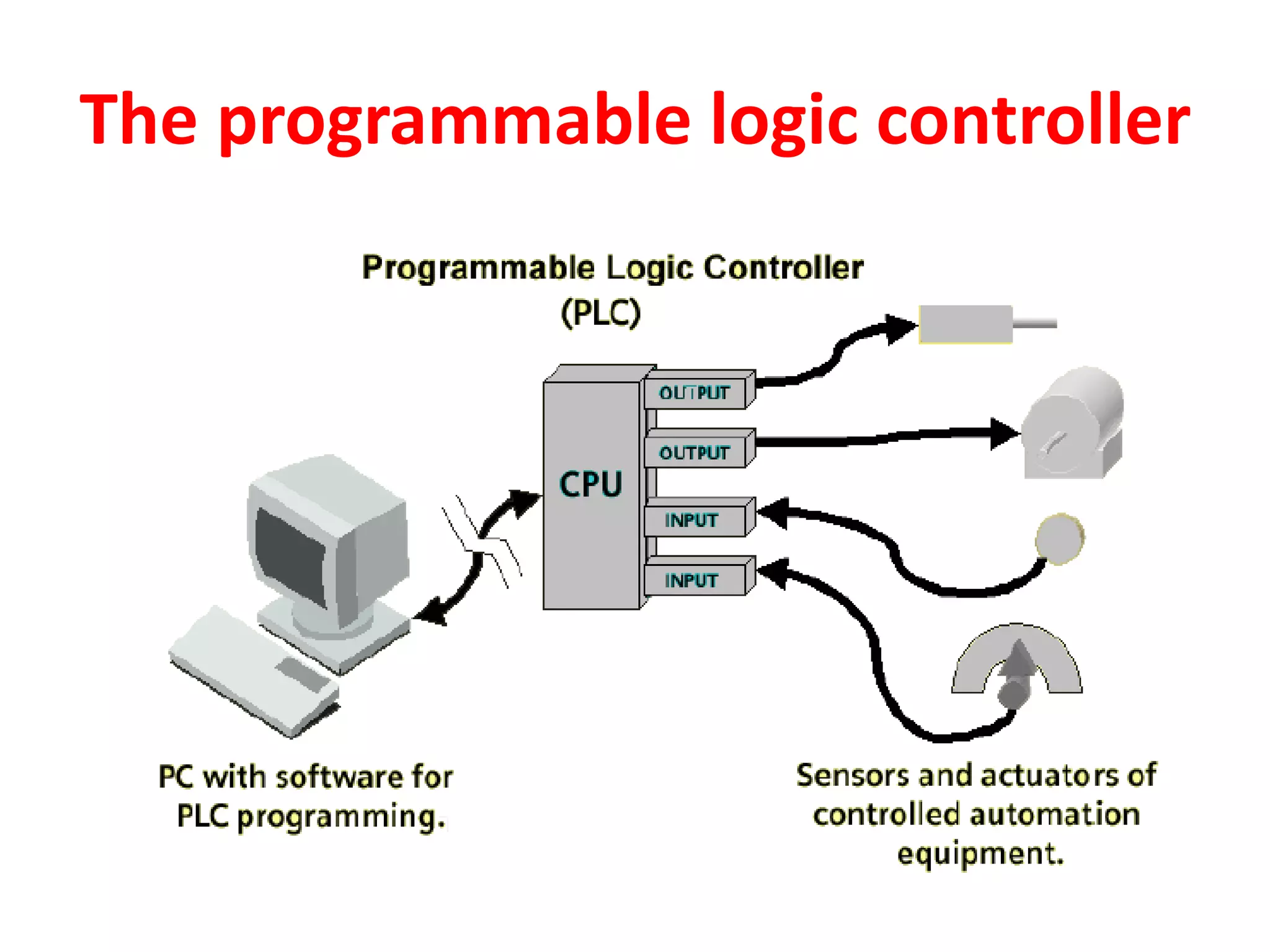
3 The programming device is used to enter the required
program into the memory of the processor. The program
is developed in the device and then transferred to the
memory unit of the PLC.
4 The memory unit is where the program is stored that is
to be used for the control actions to be exercised by the
microprocessor and data stored from the input for
processing and for the output for outputting.
5 The input and output sections are where the processor
receives information from external devices and
communicates information to external devices.
The programmable logic controller
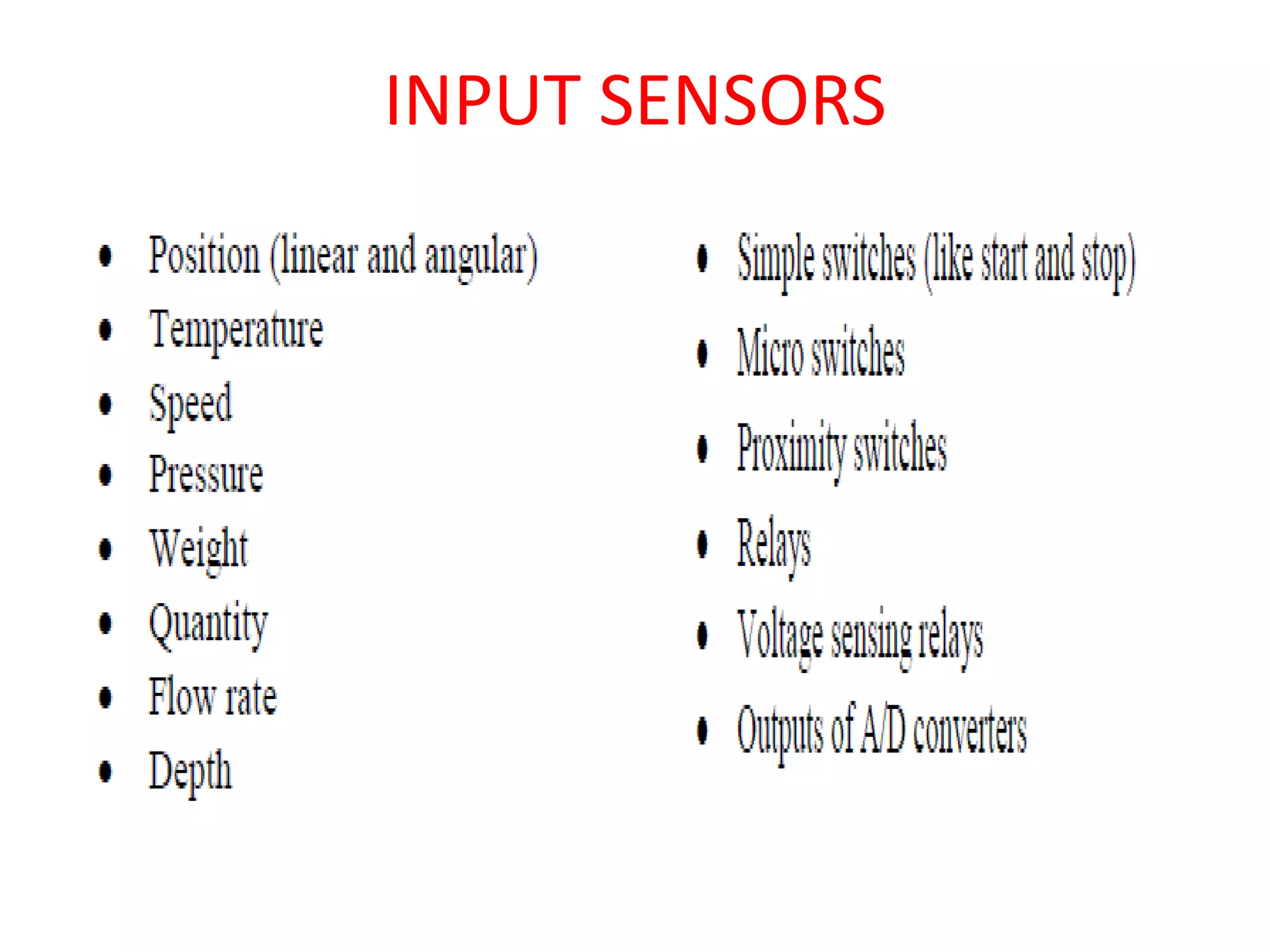
INPUT SENSORS
OUTPUT DEVICES
• - DC MOTOR
• -AC MOTOR
• LIGHTS
• ALARMS
• HEATING ELEMENTS
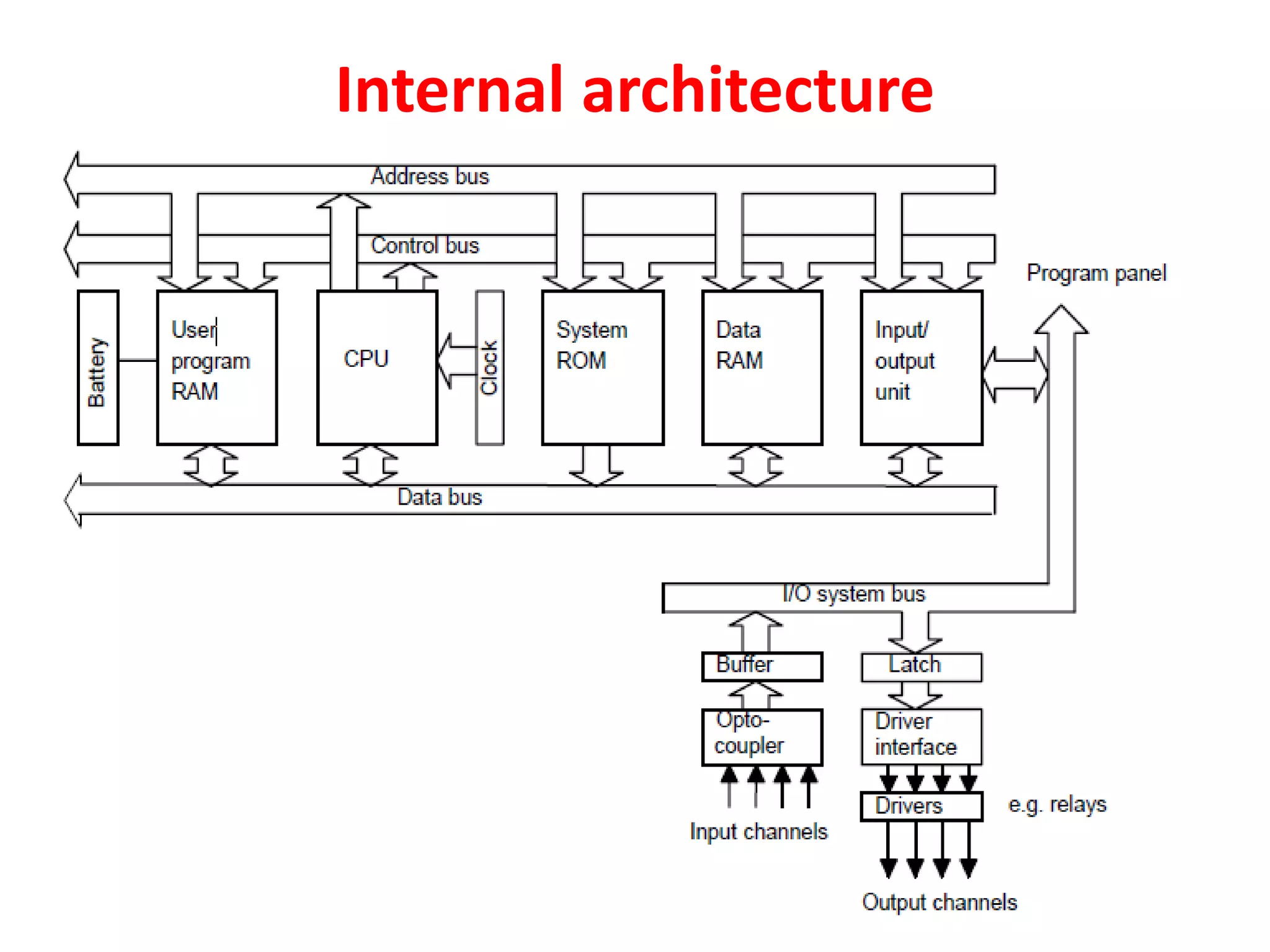
Internal architecture
The CPU
1 An arithmetic and logic unit (ALU) which is
responsible for data manipulation and carrying
out arithmetic operations of addition and
subtraction and logic operations of AND, OR, NOT
and EXCLUSIVE-OR.
2 Memory, termed registers, located within the
microprocessor and used to store information
involved in program execution.
3 A control unit which is used to control the timing
of operations.
The buses
DATA BUS
ADDRESS BUS
CONTROL BUS
Memory
1 System read-only-memory (ROM) to give
permanent storage for the operating system
and fixed data used by the CPU.
2 Random-access memory (RAM) for the user’s
program.
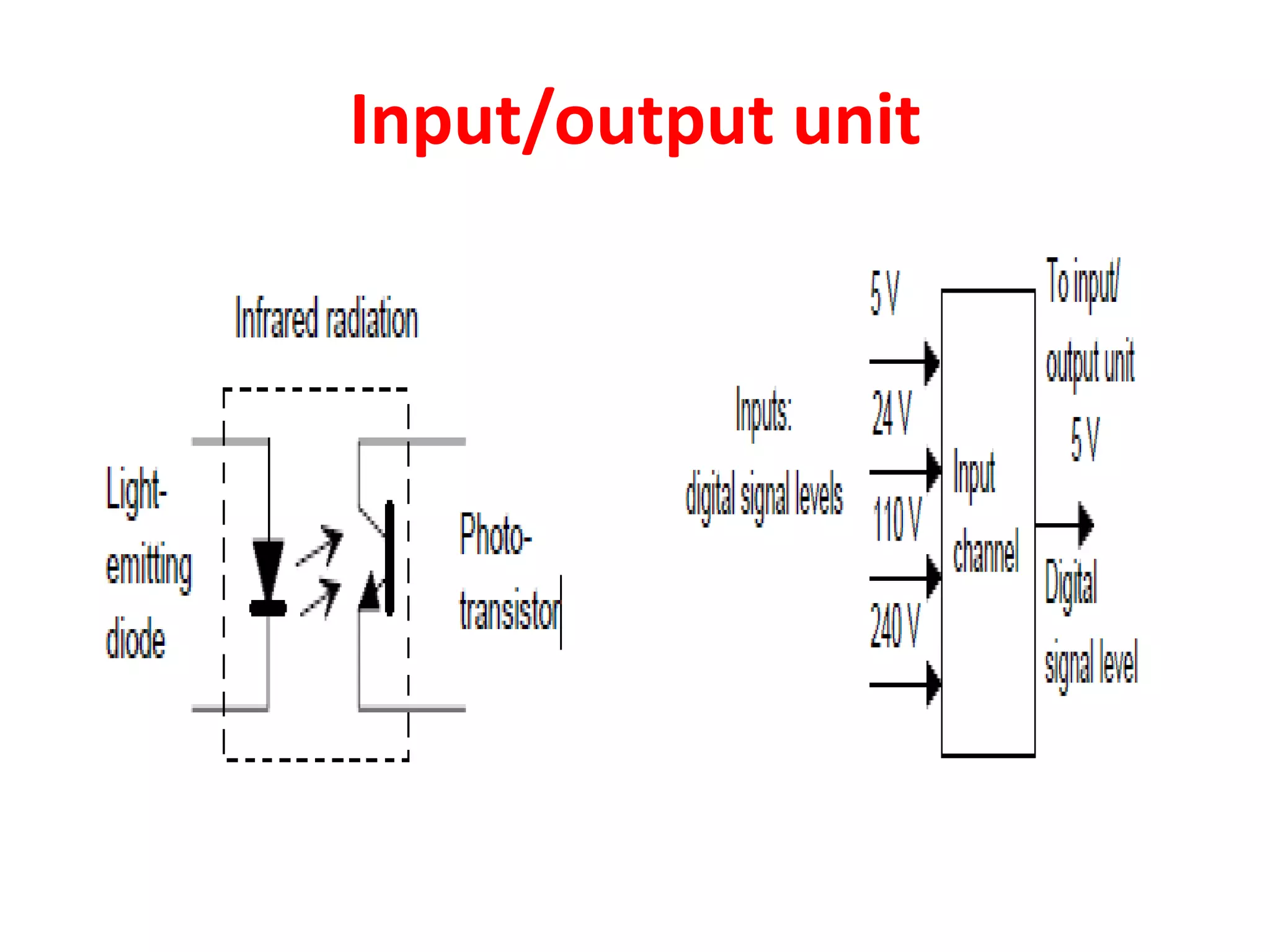
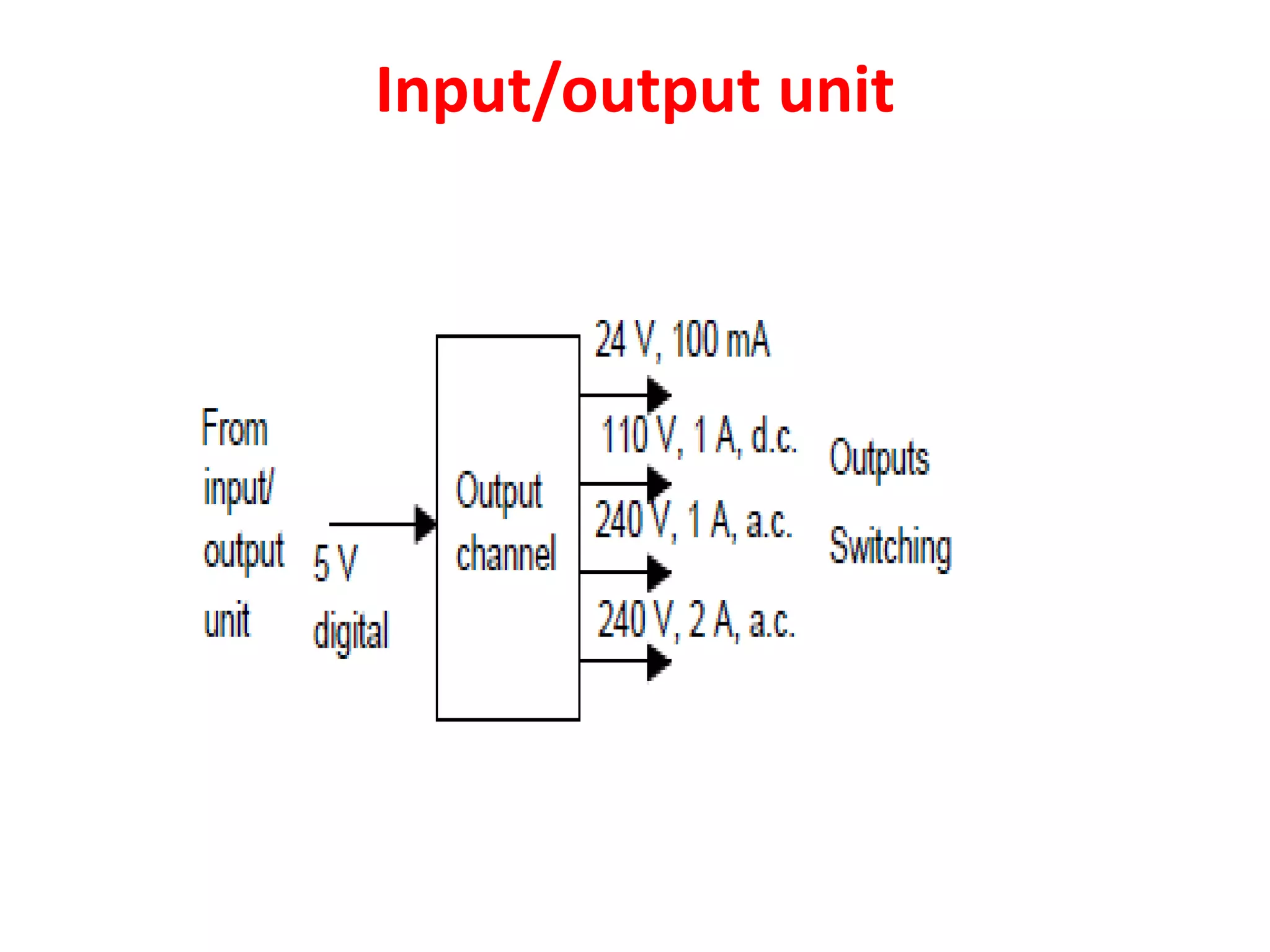
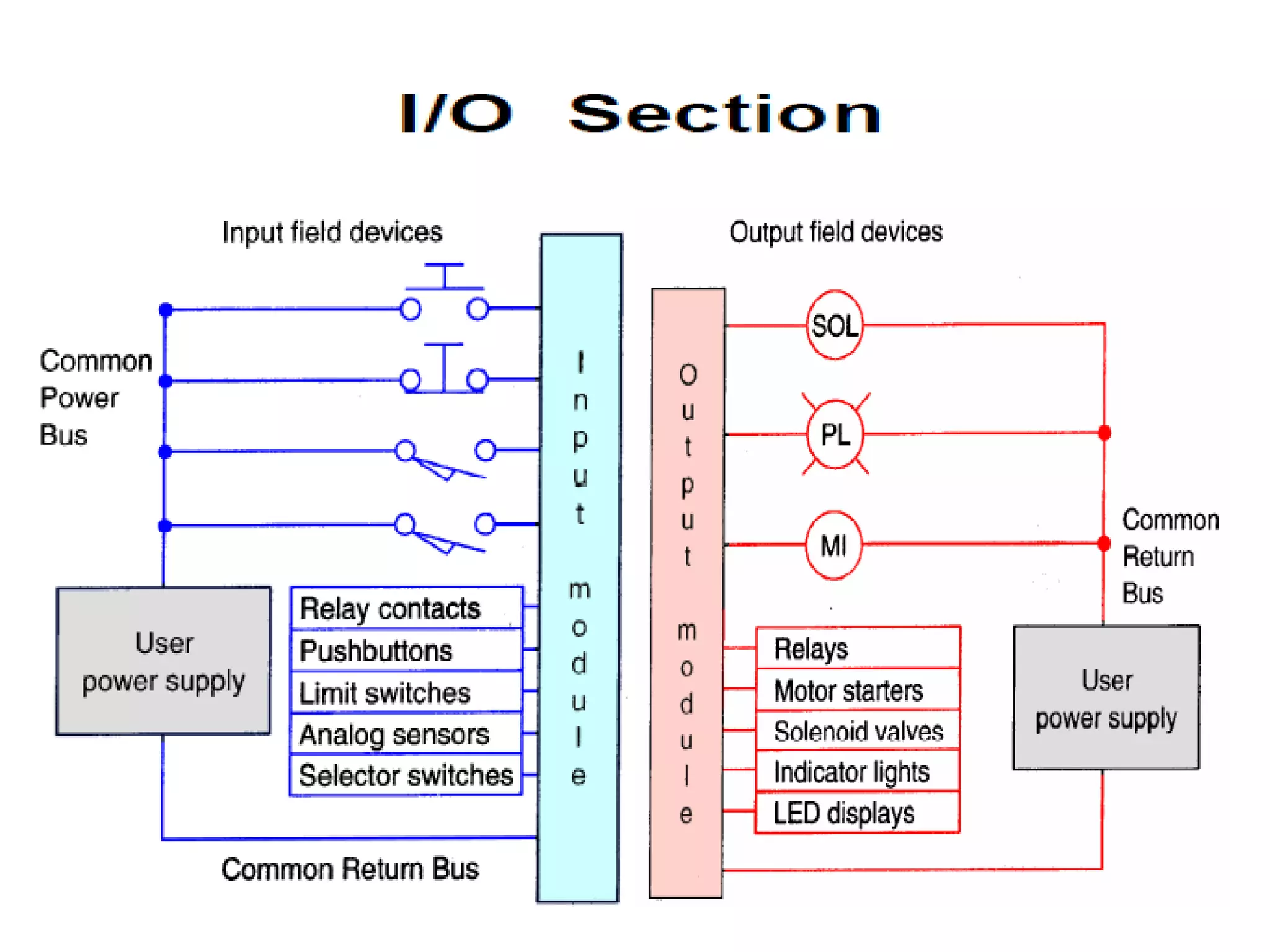
Input/output unit
1. The input/output unit provides the interface
between the system and the outside world,
allowing for connections to be made through
input/output channels to input devices such as
sensors and output devices such as motors and
solenoids.
2. The input/output channels provide isolation and
signal conditioning functions so that sensors and
actuators can often be directly connected to
them without the need for other circuitry.
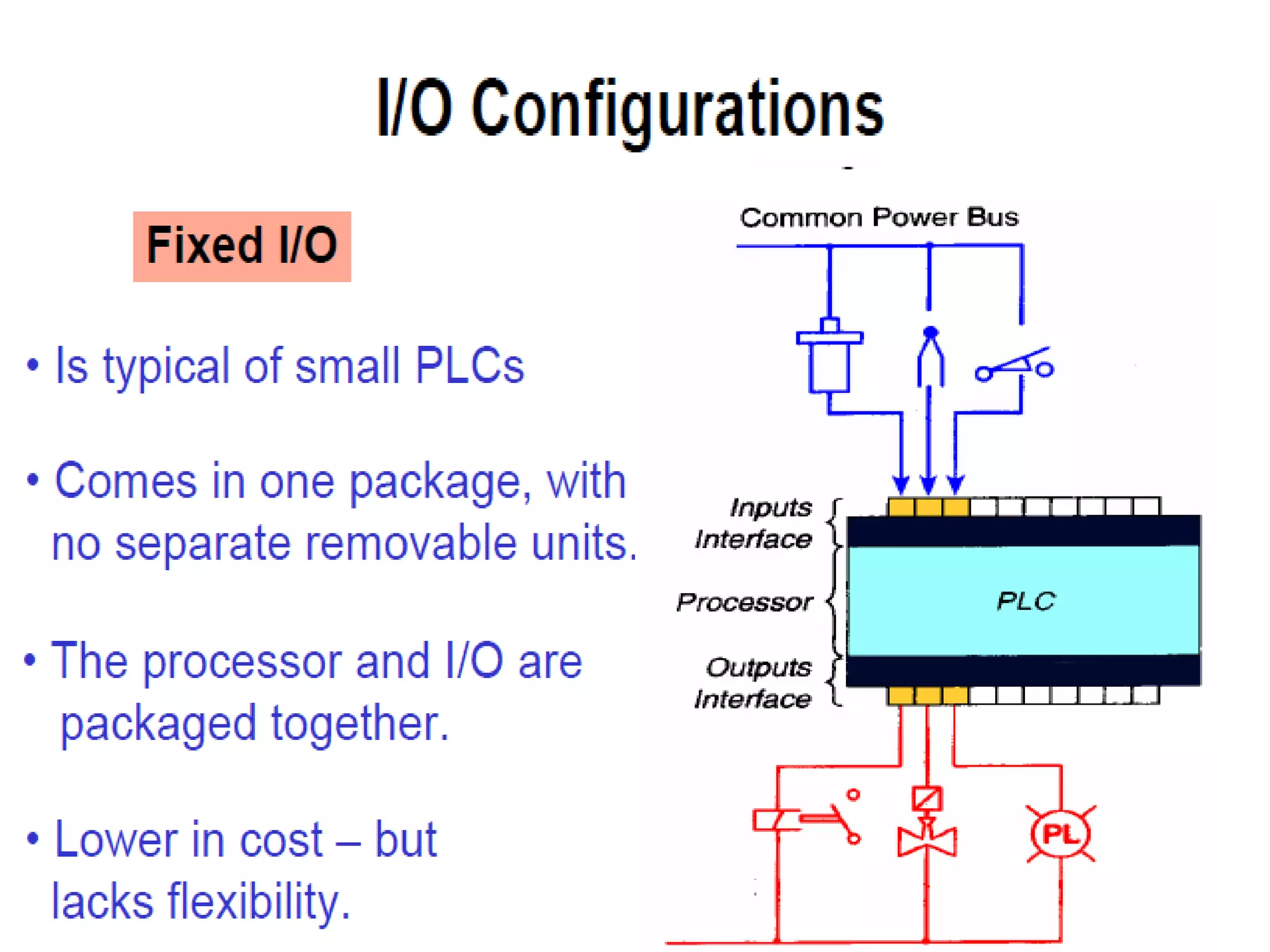
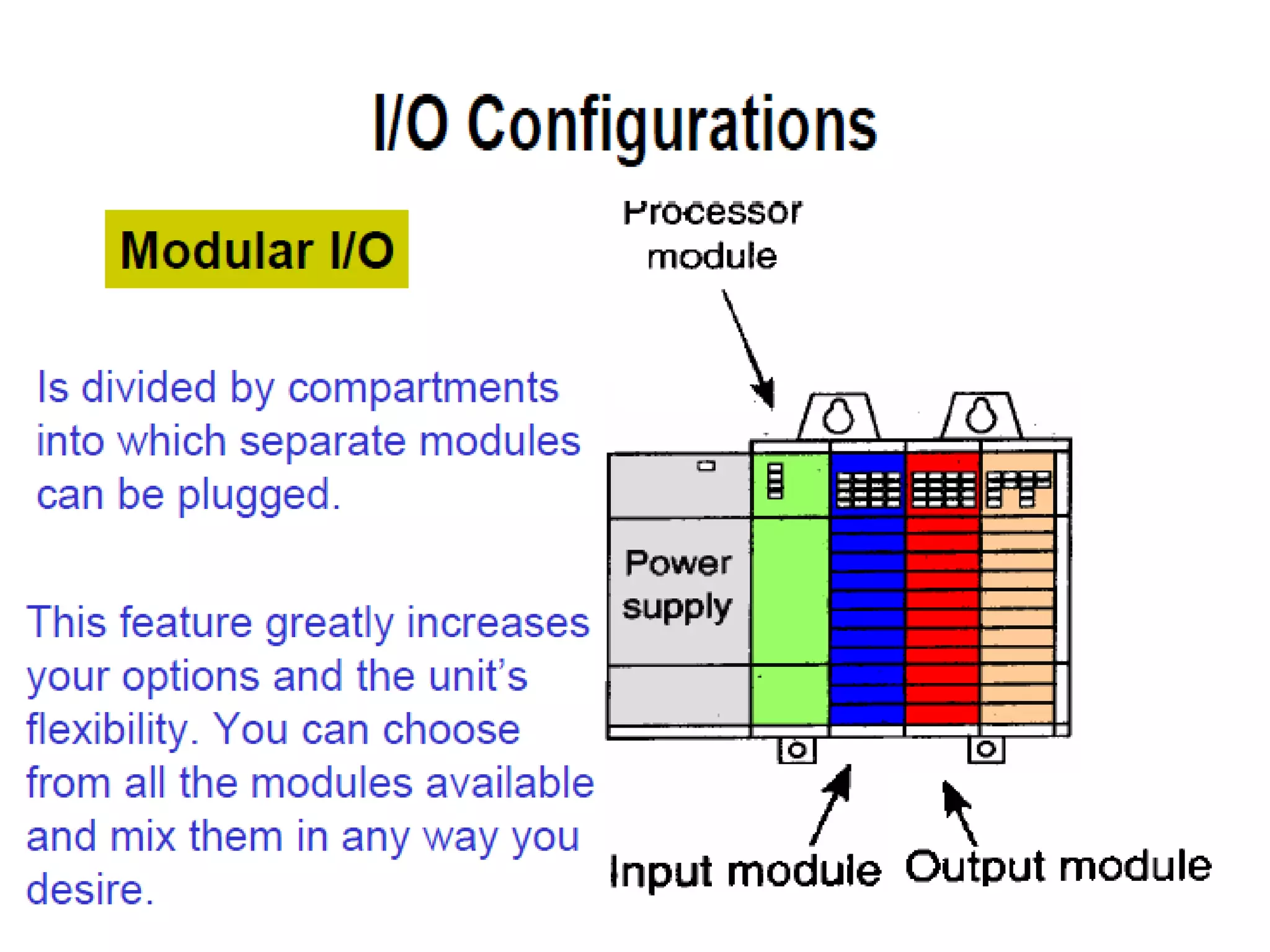
Input/output unit
Input/output unit
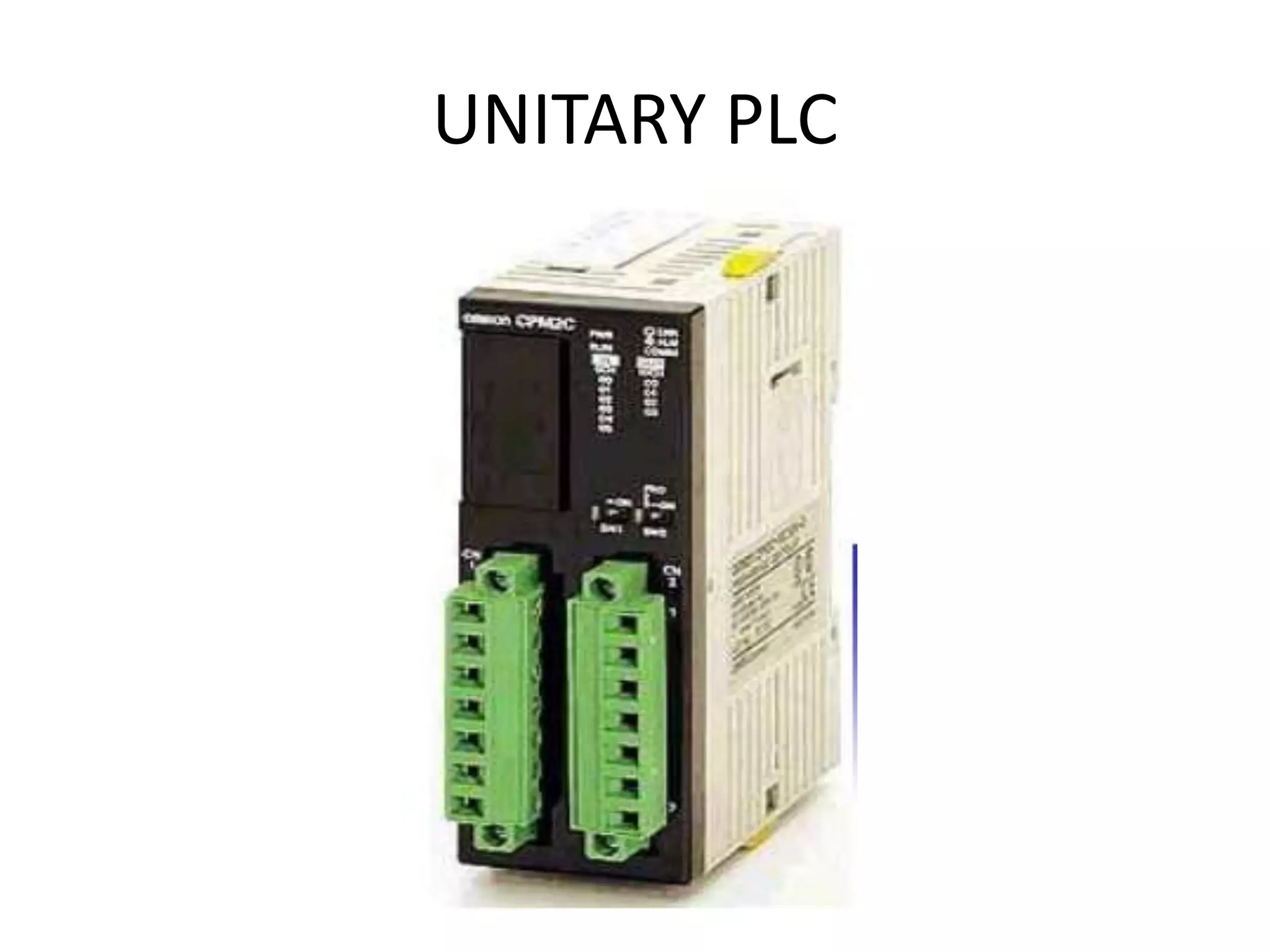
UNITARY PLC
MODULAR PLC
PLC BOTTLE FILLING PLANT
User program execution
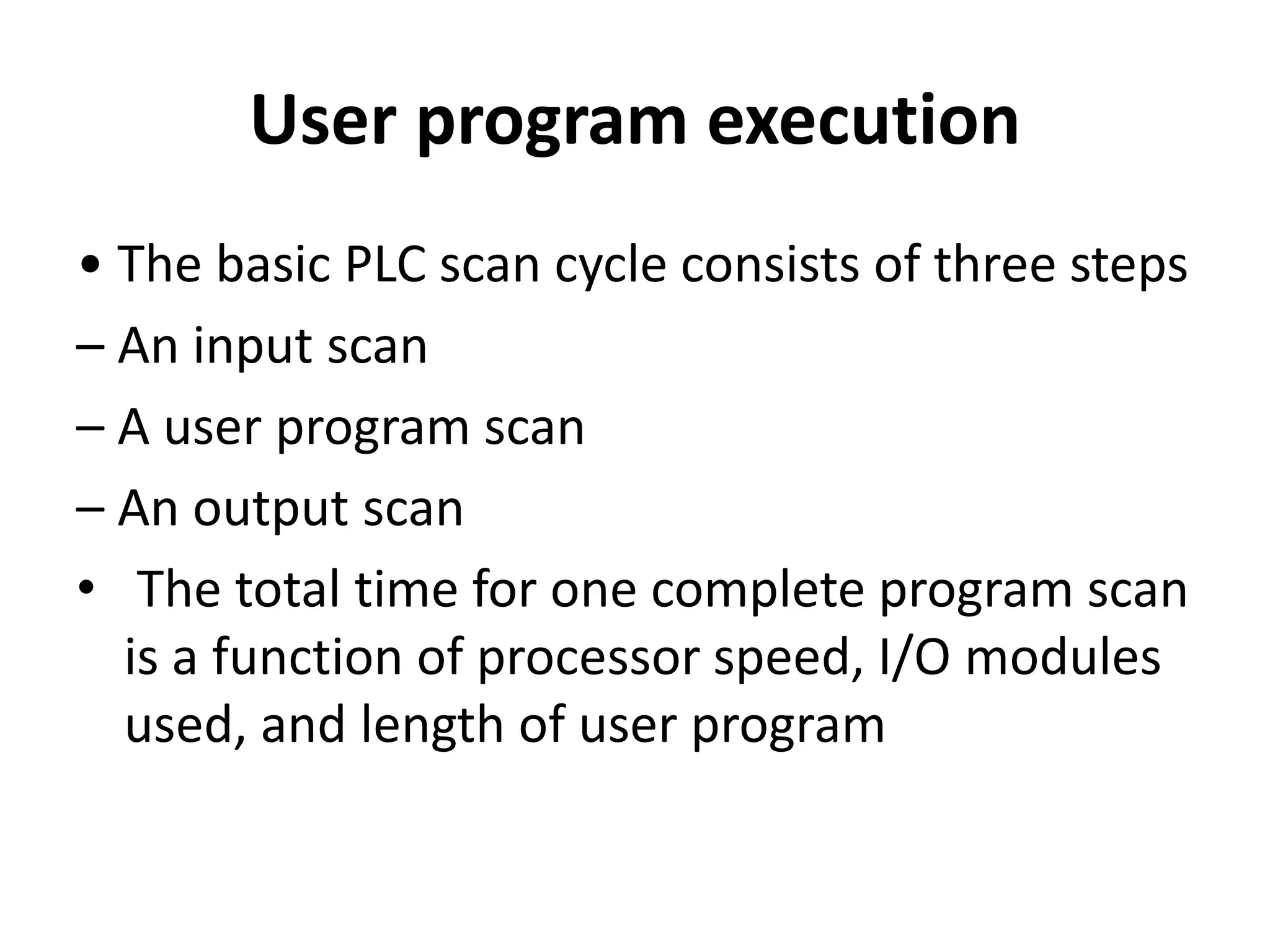
• The basic PLC scan cycle consists of three steps
– An input scan
– A user program scan
– An output scan
• The total time for one complete program scan
is a function of processor speed, I/O modules
used, and length of user program
Input scan
• During the input scan, data is taken from all
input modules in the system and placed into
an area of PLC memory referred to as the
input image area
Input scan
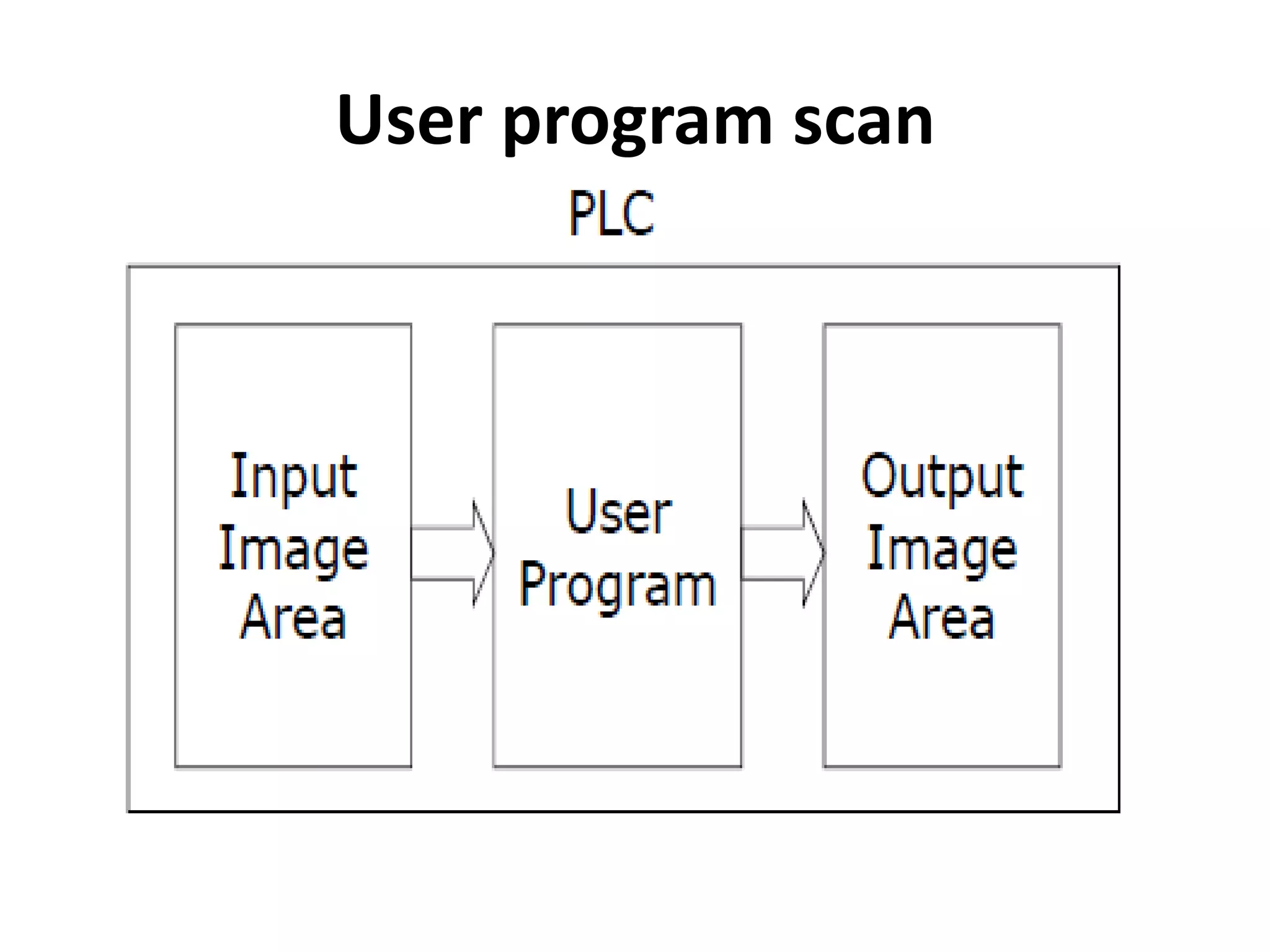
User program scan
• During the program scan, data in the input
image area is applied to the user program, the
user program is executed and the output
image area is updated
User program scan
Output scan
• During the output scan, data is taken from the
output image area and sent to all output
modules in the system
Output scan
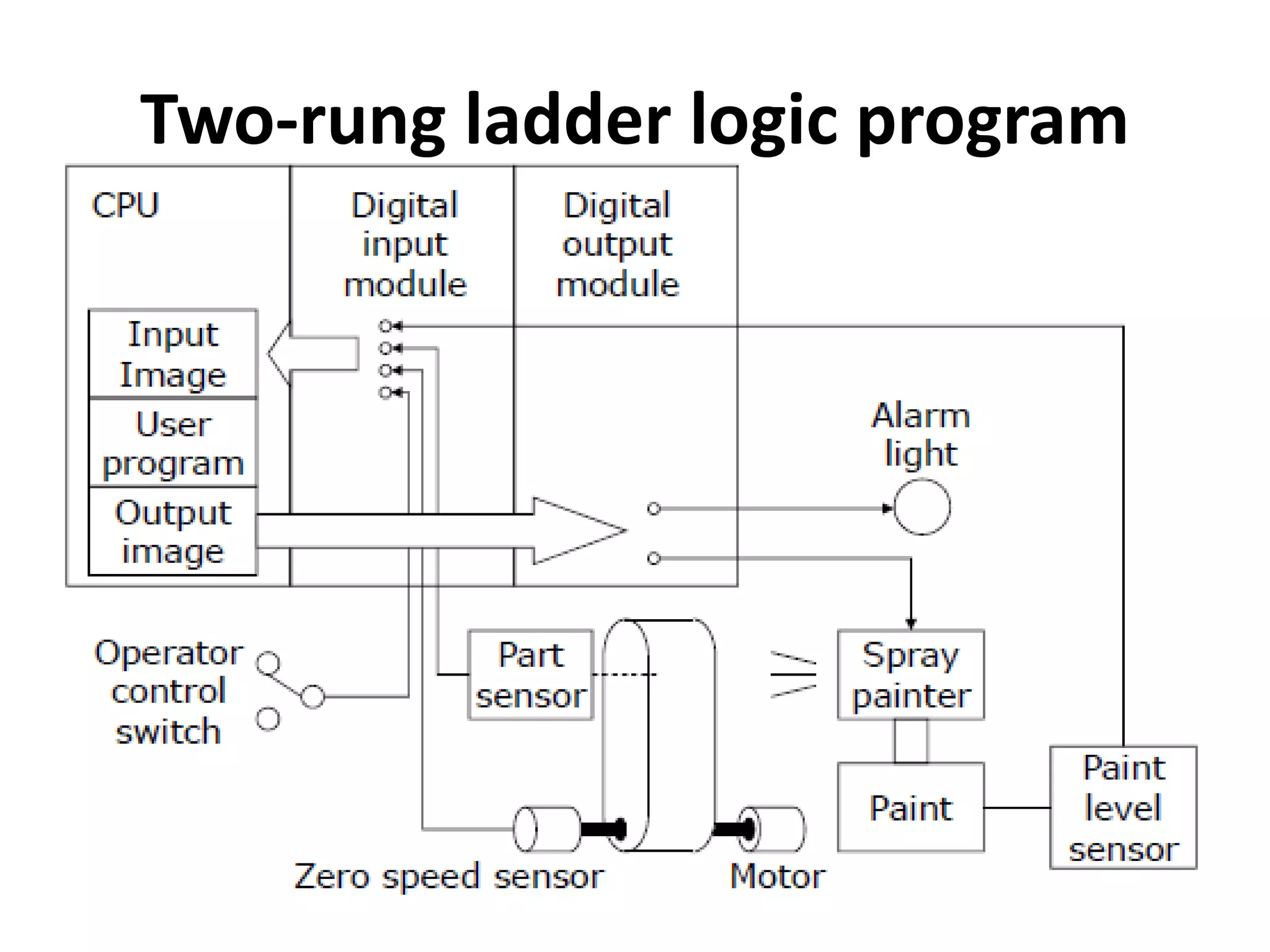
PLC scanning considerations
• During the input scan, input terminals are read and the
input image area is updated accordingly.
• During the program scan
– data in the input image area is applied to the user
program
– the program is executed (instructions carried out
in sequence)
– the output image area is updated appropriately
• During the output scan, data associated with the
output image area is transferred to output terminals
• Any changes in the status of input devices
during
the program or output scan are not
recognized until the next input scan
• Furthermore, data changes in the output table
are not transferred to the output terminals
during the input and program scans
• The transfer affecting the output devices
takes place only during the output scan
PLC scanning considerations
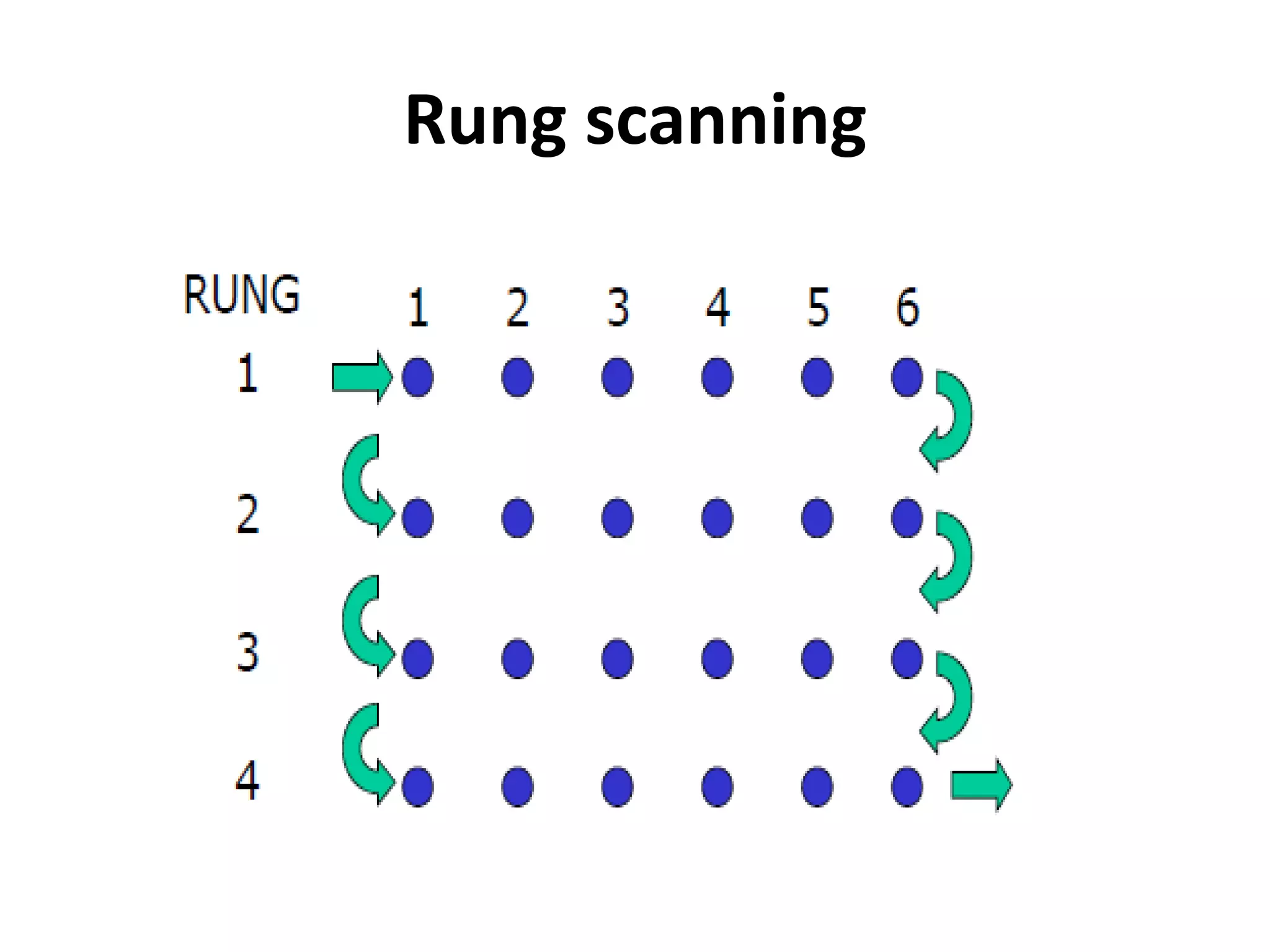
• Typically, the program scanning takes place
left to right across each rung and from the top
to bottom rungs, in order
• Usually, the complete ladder scan time is a
few milliseconds
Rung scanning
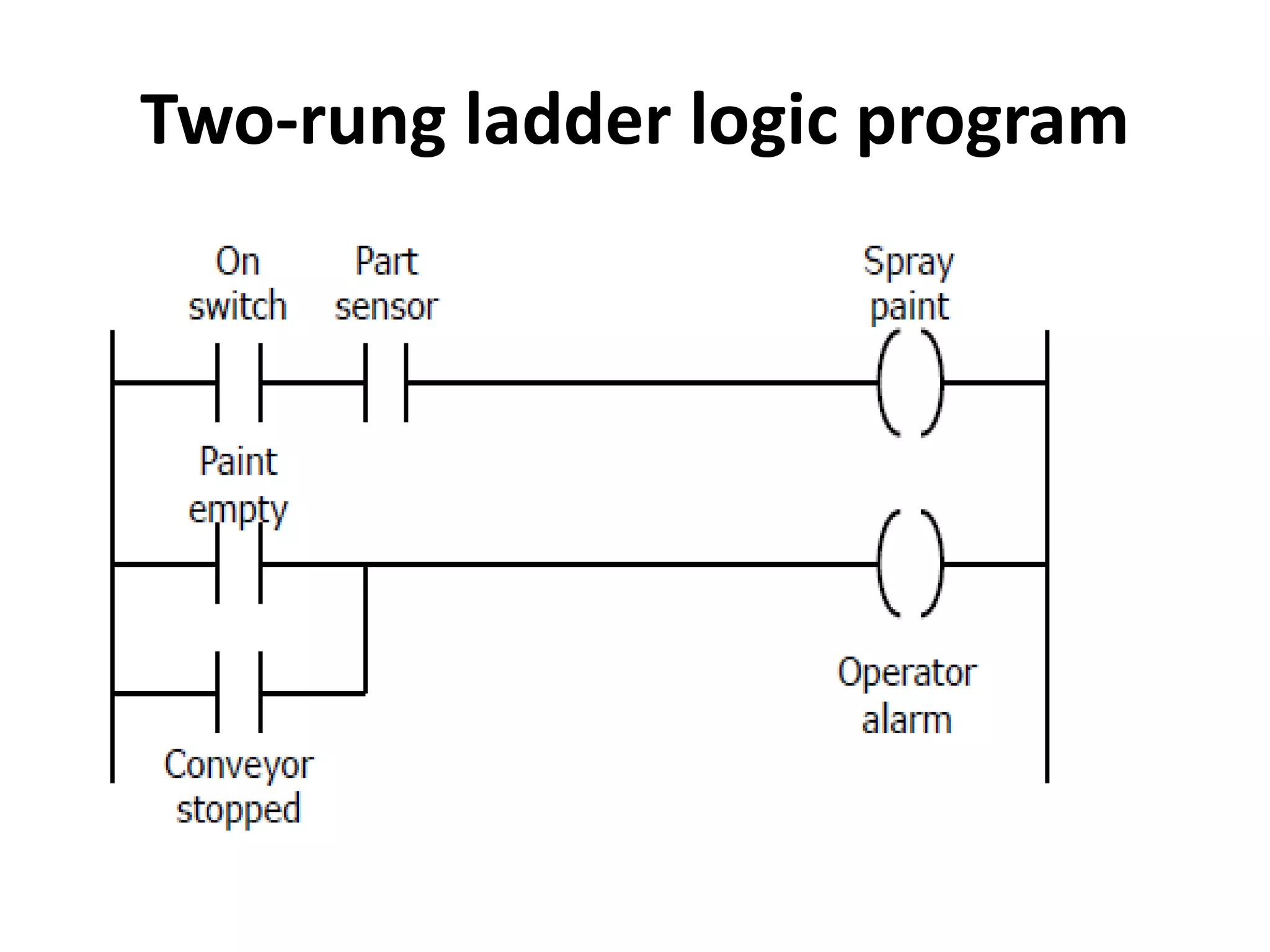
Two-rung ladder logic program
Scan cycle
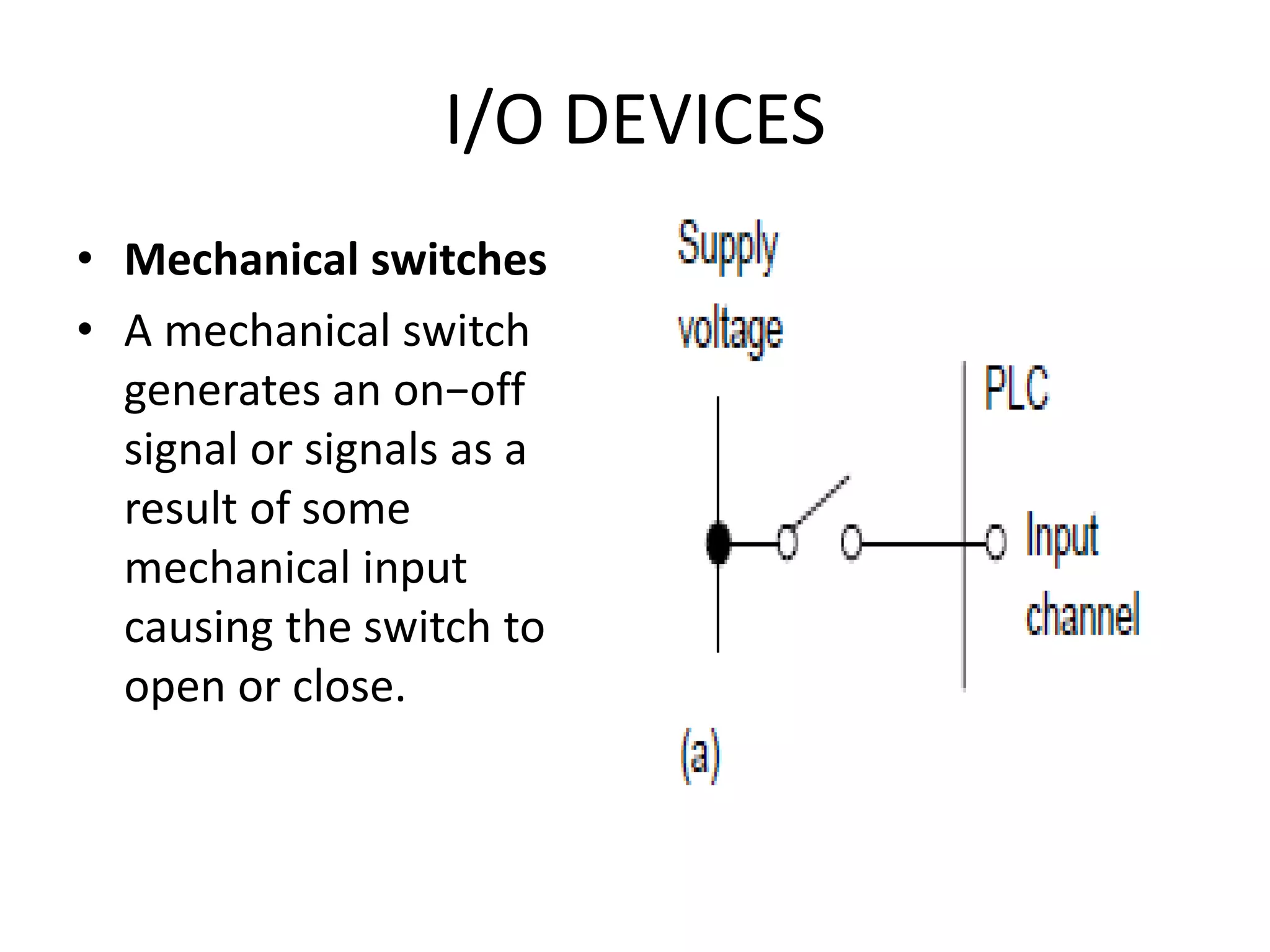
I/O DEVICES
• Mechanical switches
• A mechanical switch
generates an on−off
signal or signals as a
result of some
mechanical input
causing the switch to
open or close.
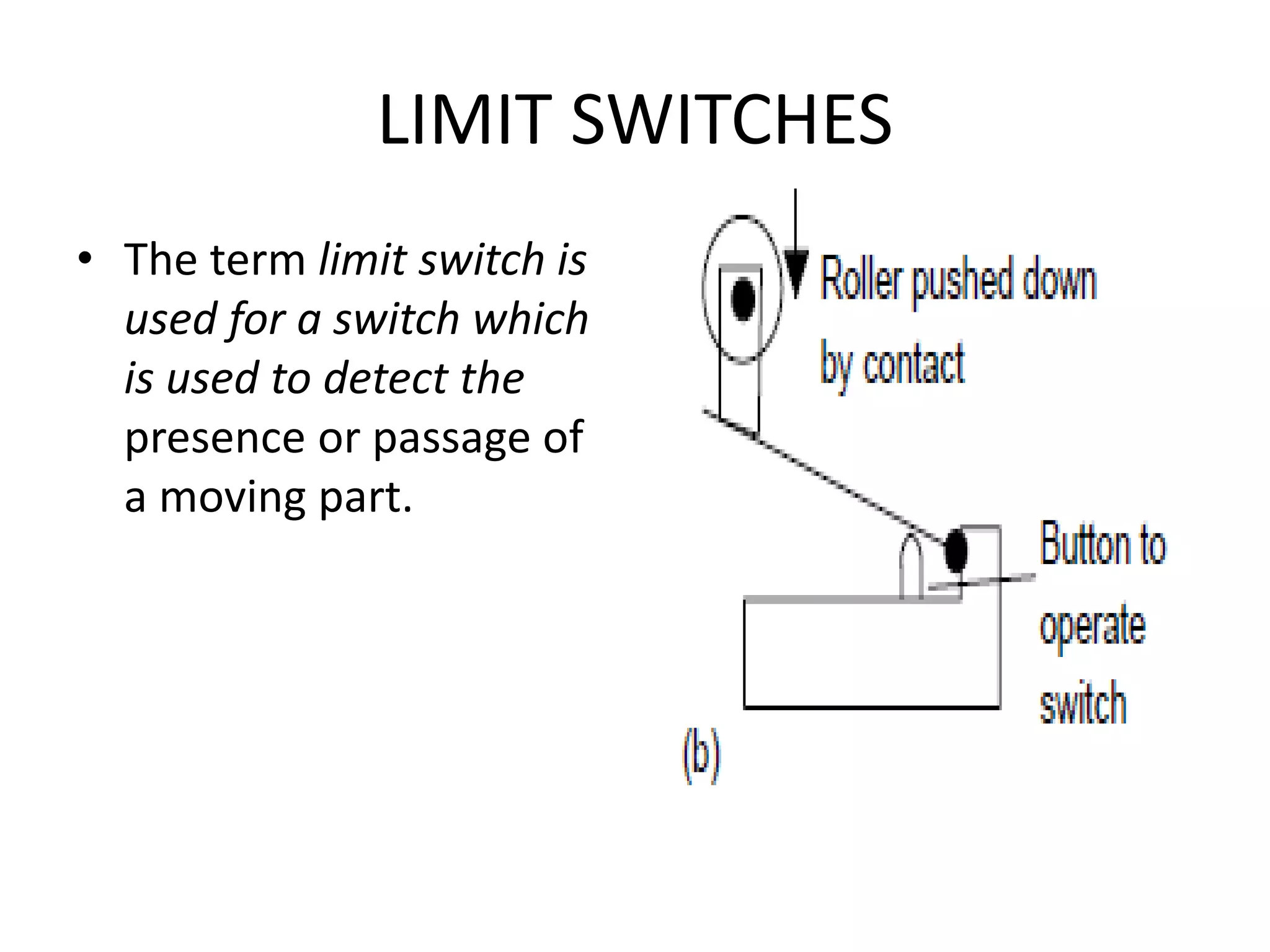
LIMIT SWITCHES
• The term limit switch is
used for a switch which
is used to detect the
presence or passage of
a moving part.
Proximity switches
• Proximity switches are
used to detect the
presence of an item
without making contact
with it.
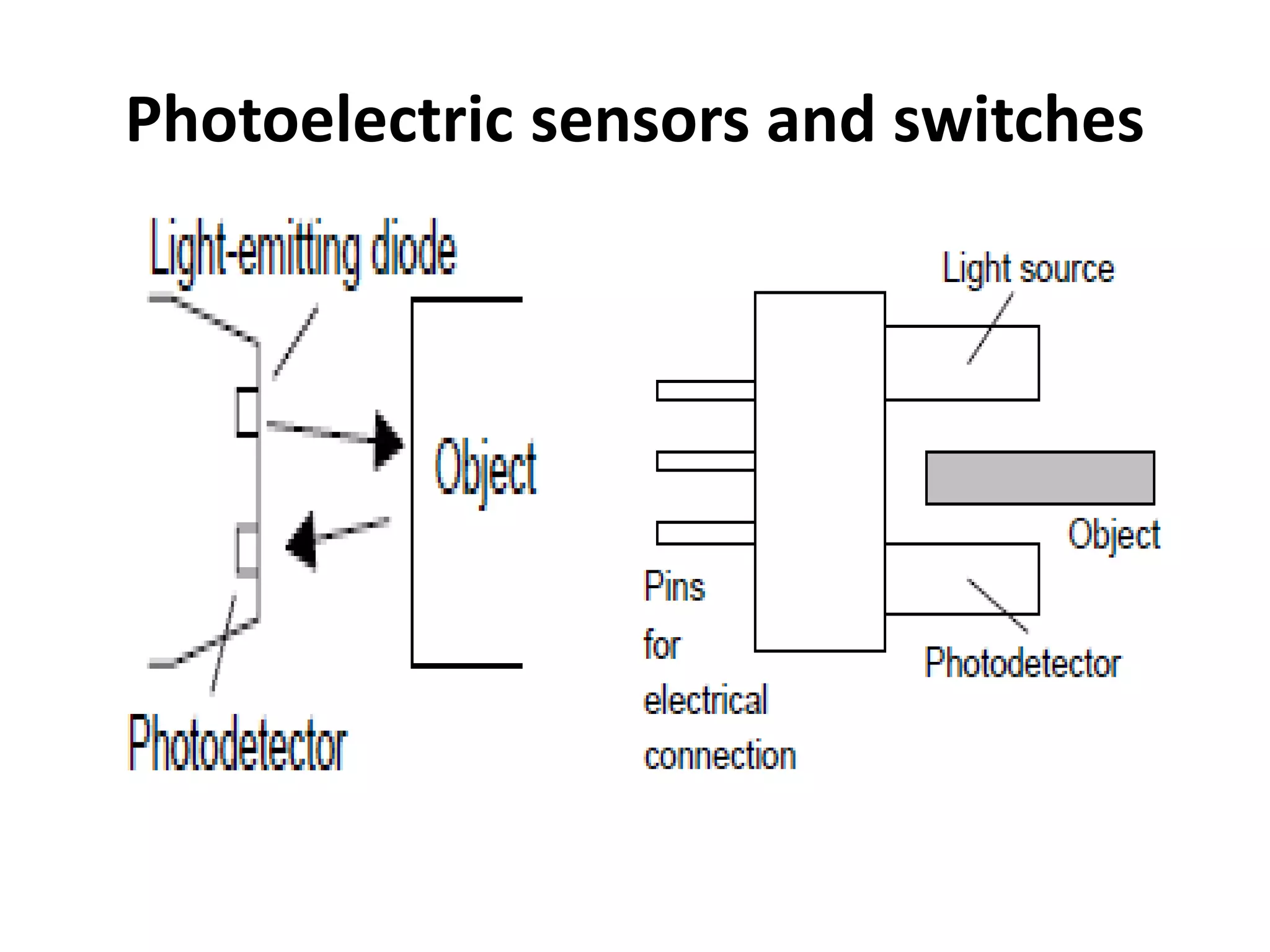
Photoelectric sensors and switches
• Photoelectric switch
devices can either
operate as transmissive
types where the object
being detected breaks a
beam of light, usually
infrared radiation, and
stops it reaching the
detector or reflective
types where the object
being detected reflects a
beam of light onto the
detector.
Photoelectric sensors and switches
Encoders
• The term encoder is used for a device that provides a
digital output as a result of angular or linear
displacement.
• With 60 slots then, since one revolution is a Rotation
of 360, a movement from one slot to the next is a
rotation of 6.
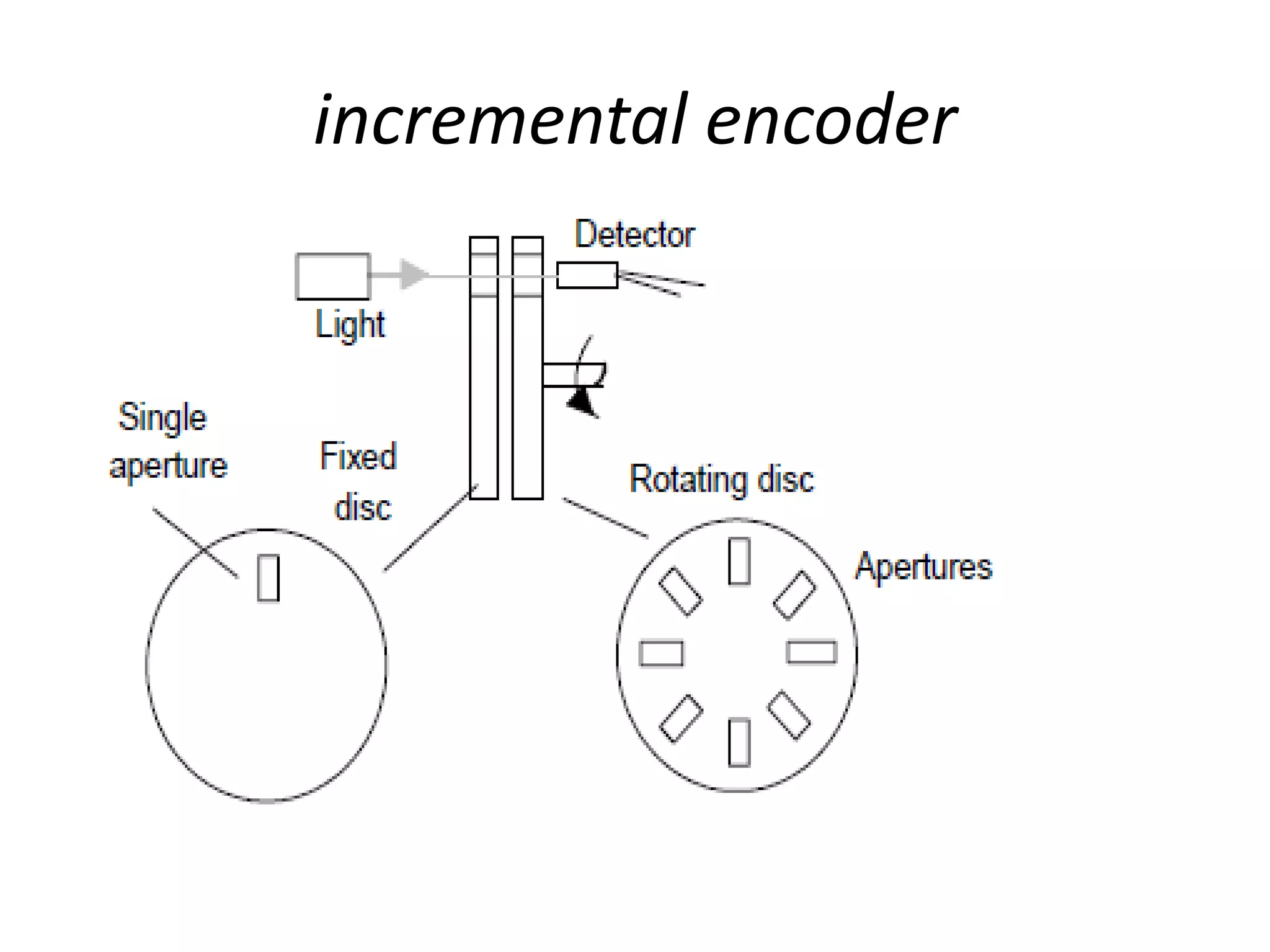
incremental encoder
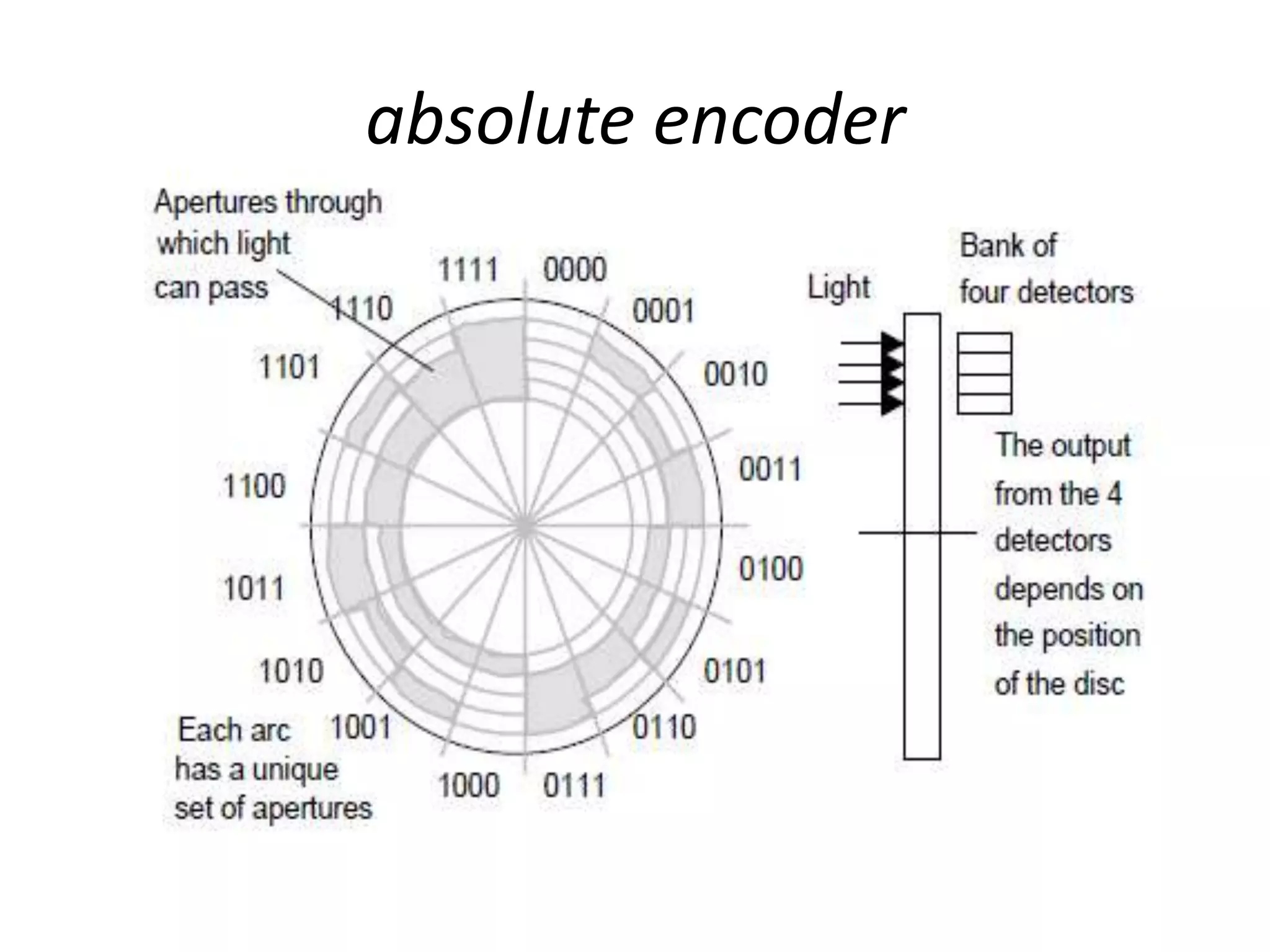
absolute encoder
• With 4 tracks there will be 4 bits and so the
number of positions that can be detected is 24
= 16, i.e. a resolution of 360/16 = 22.5.
• An absolute encoder gives the actual angular
or linear position
absolute encoder
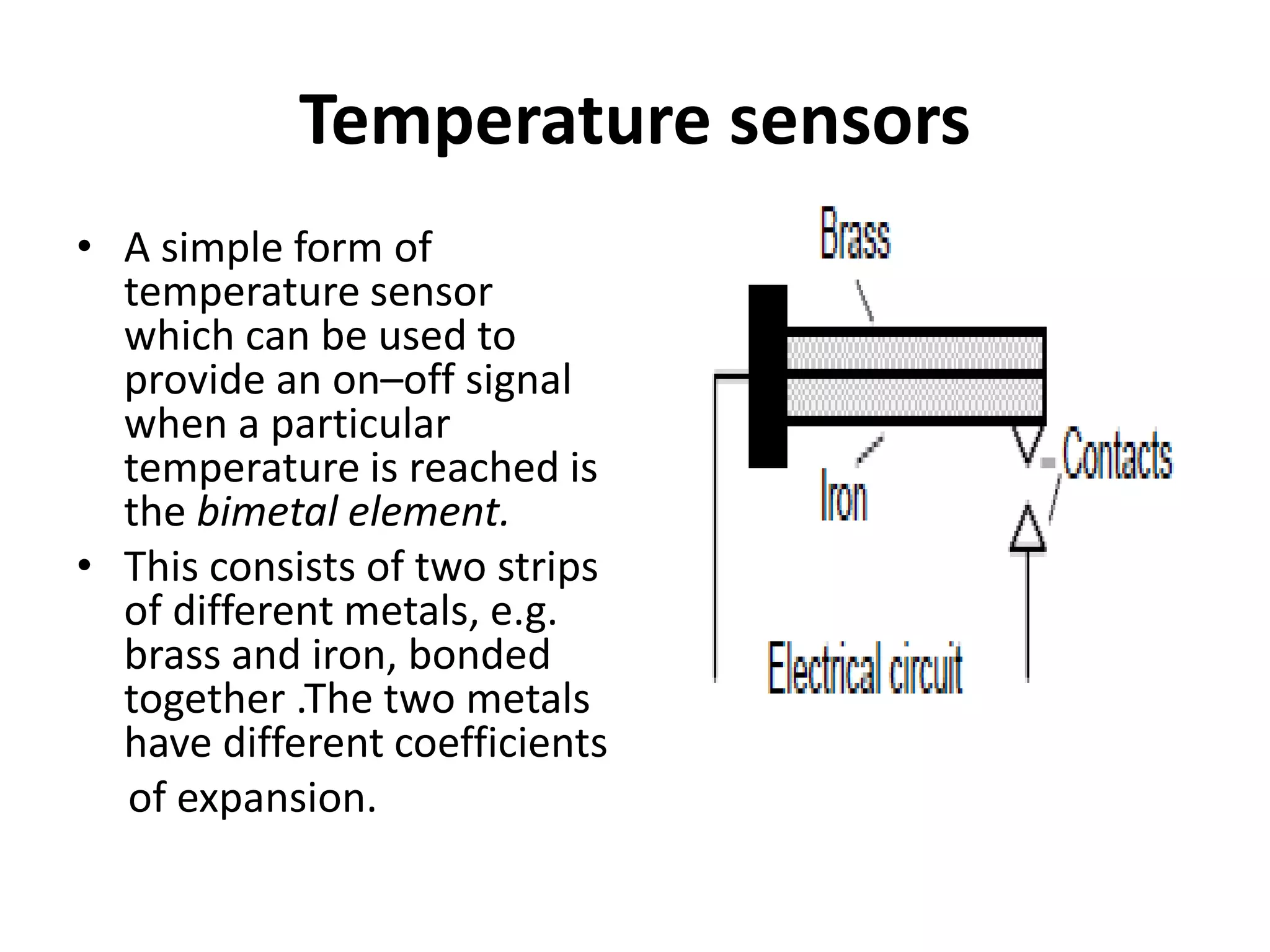
Temperature sensors
• A simple form of
temperature sensor
which can be used to
provide an on–off signal
when a particular
temperature is reached is
the bimetal element.
• This consists of two strips
of different metals, e.g.
brass and iron, bonded
together .The two metals
have different coefficients
of expansion.
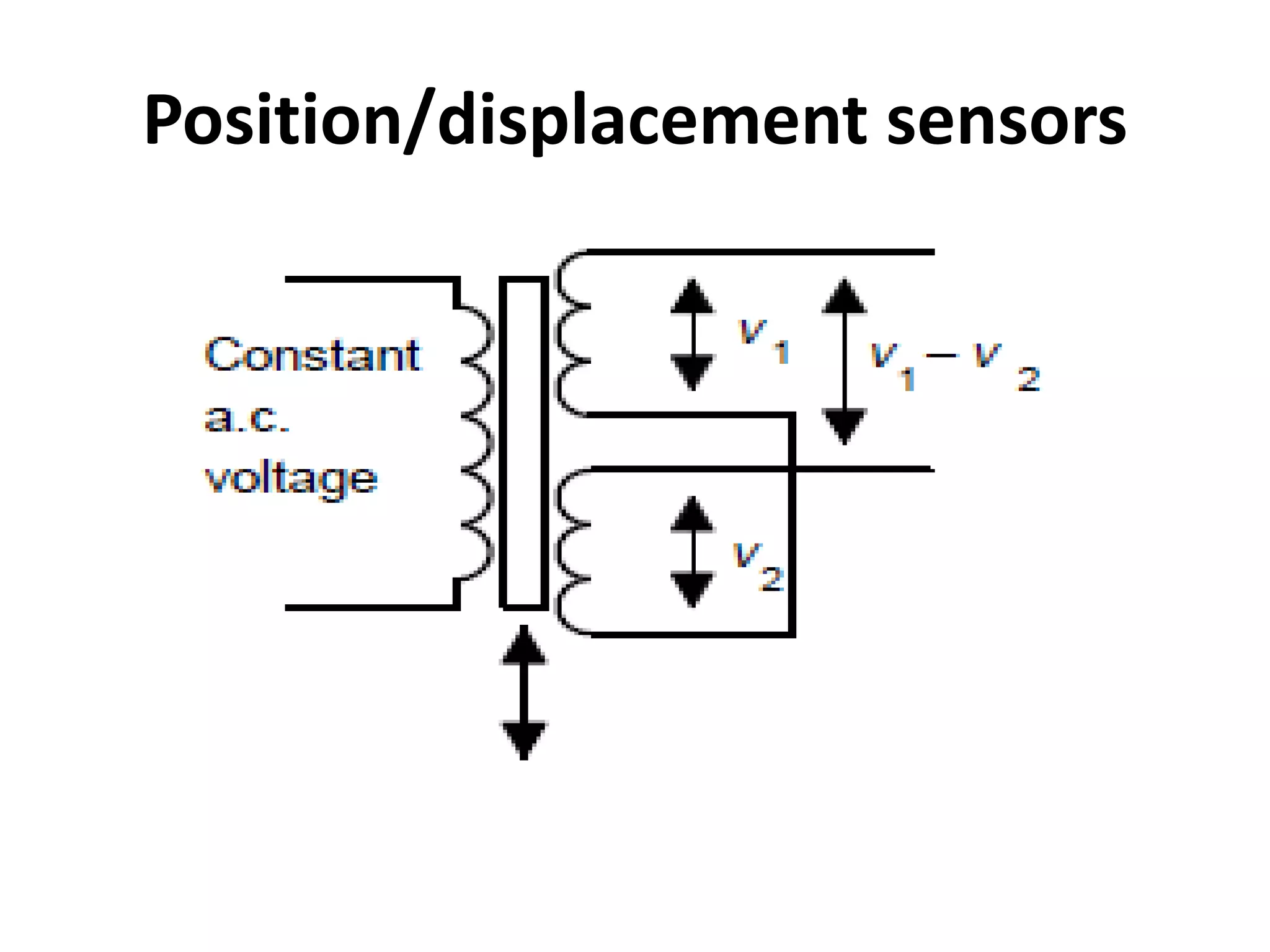
Position/displacement sensors
• The term position sensor is used for a sensor
that gives a measure of the
• distance between a reference point and the
current location of the target
Position/displacement sensors
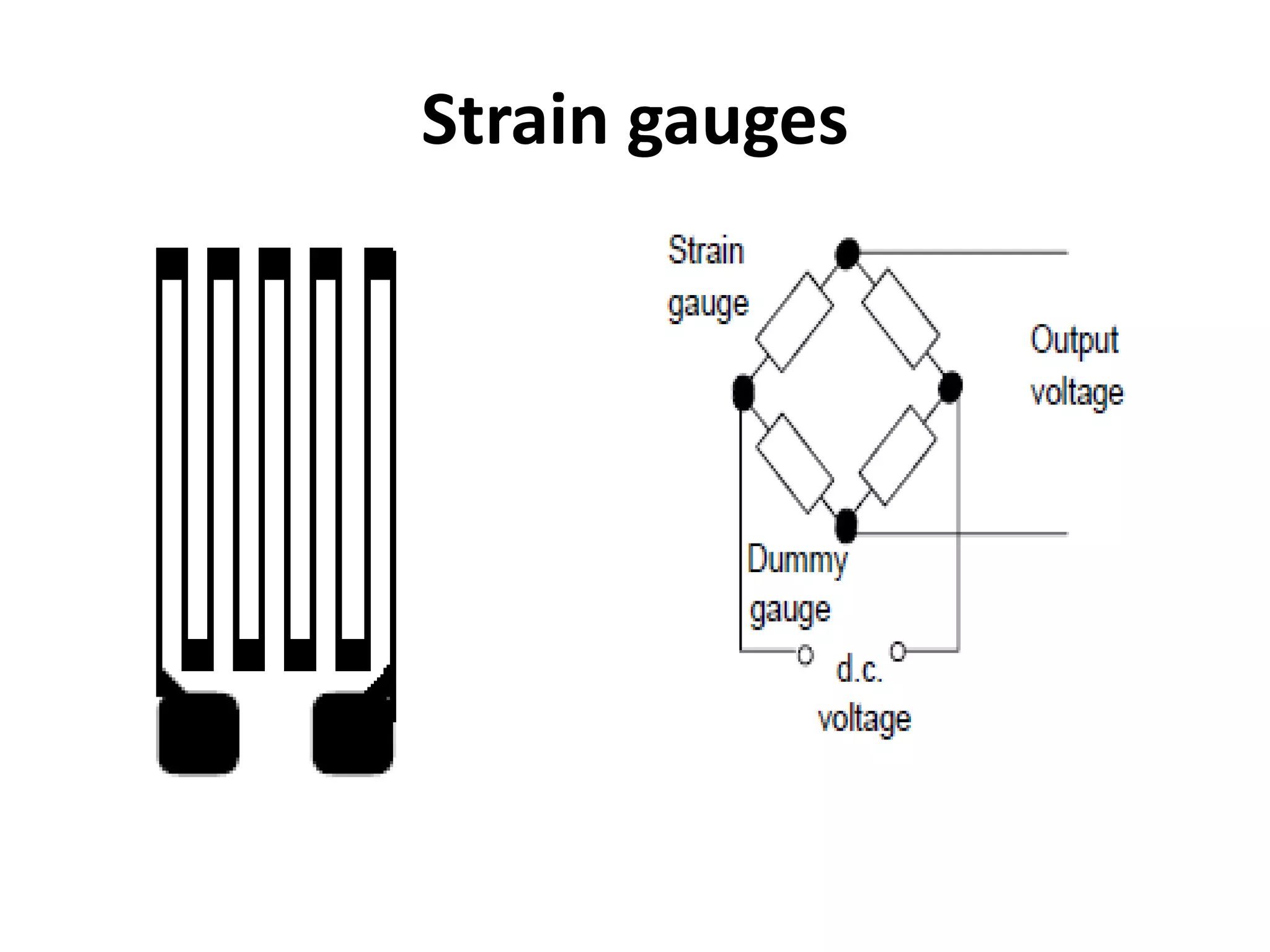
Strain gauges
• When a wire or strip of semiconductor is
stretched, its resistance changes.
• The fractional change in resistance is
proportional to the fractional change
in length, i.e. strain.
Strain gauges
Pressure sensors
• When a piezoelectric
crystal is squeezed, there
is a relative displacement
of positive and negative
charges within the crystal
and the outer surfaces of
the crystal become
charged. Hence a
potential difference
appears across it.
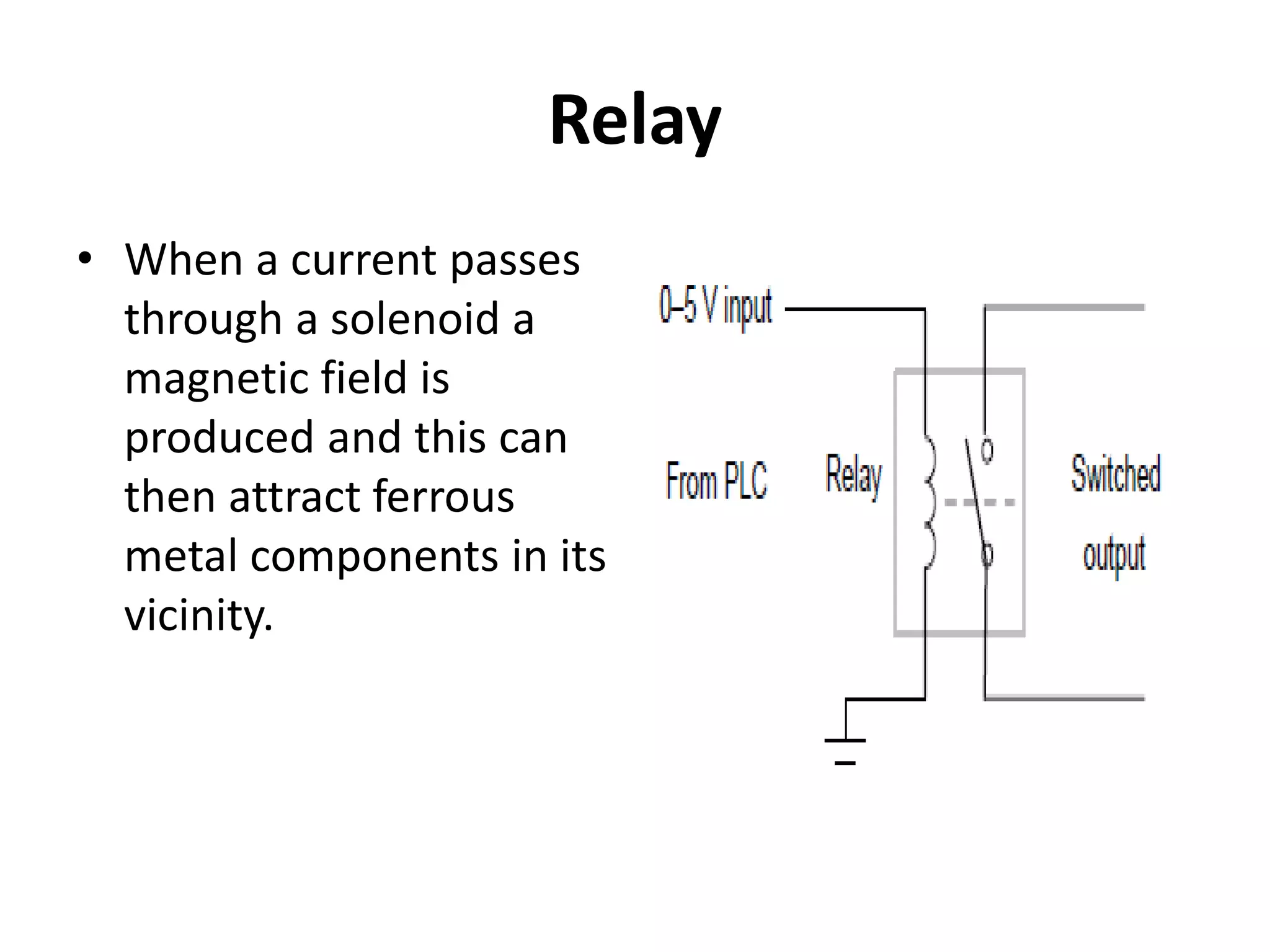
Relay
• When a current passes
through a solenoid a
magnetic field is
produced and this can
then attract ferrous
metal components in its
vicinity.
Motors
• A d.c. motor has coils of wire mounted in slots
on a cylinder of ferromagnetic material, this
being termed the armature. The armature is
mounted on bearings and is free to rotate. It is
mounted in the magnetic field produced by
permanent magnets or current passing
through coils of wire, these being termed the
field coils. When a current passes through the
armature coil, forces act on the coil and result
in rotation.
Motors
Stepper motors
• When one pair of poles is activated, a
magnetic field is produced which attracts the
nearest pair of rotor teeth so that the teeth
and poles line up. This is termed the position
of minimum reluctance.
Stepper motors
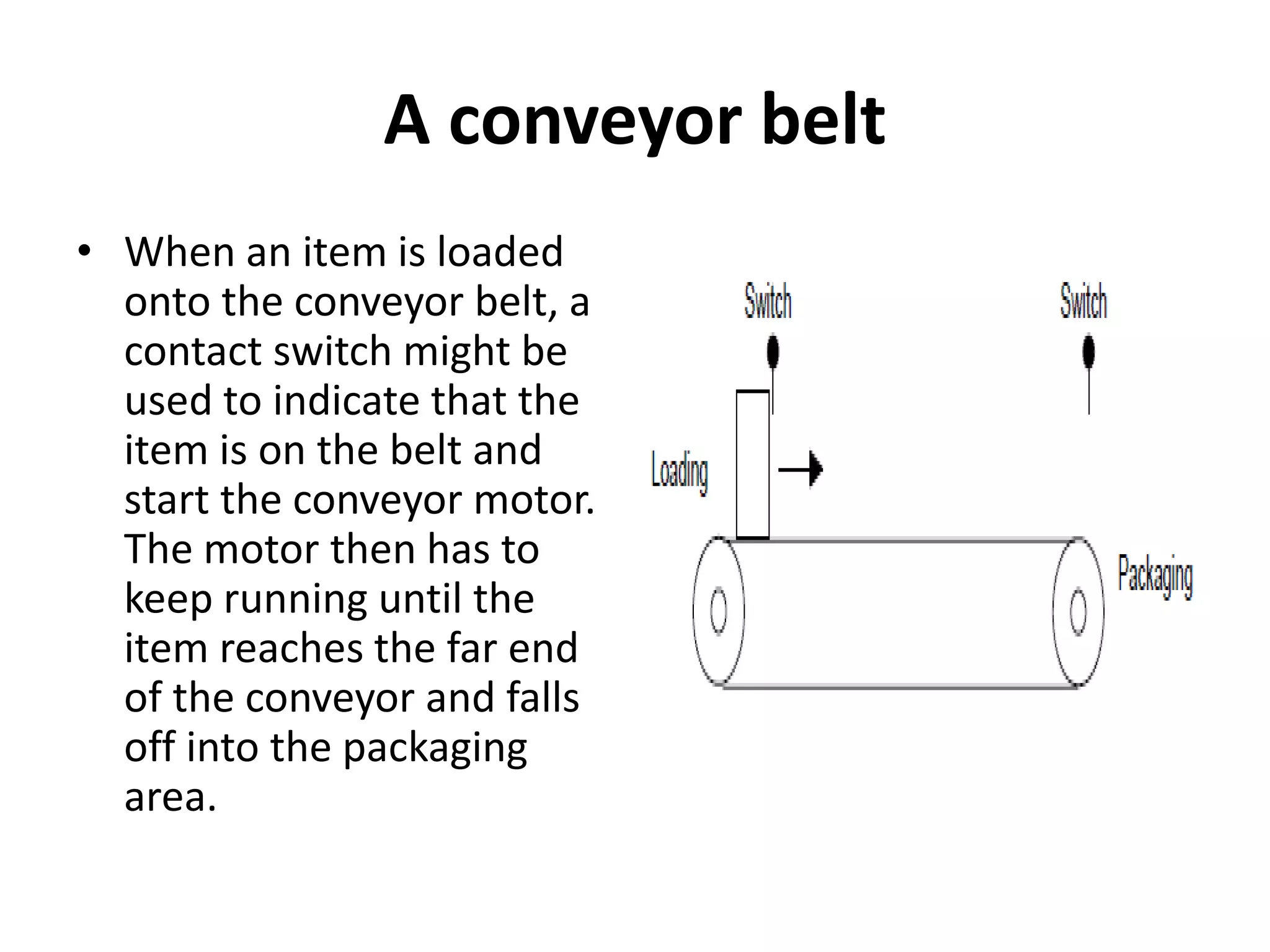
A conveyor belt
• When an item is loaded
onto the conveyor belt, a
contact switch might be
used to indicate that the
item is on the belt and
start the conveyor motor.
The motor then has to
keep running until the
item reaches the far end
of the conveyor and falls
off into the packaging
area.

Fundamentals of plc 1

  • 1.
    What type oftask might a control system have?
  • 2.
    What form mighta controller have?
  • 3.
    Microprocessor controlled system •If switch A closes • Output to motor circuit • If switch B closes • Output to valve circuit By changing the instructions in the program we can use the same microprocessor system to control a wide variety of situations.
  • 4.
    The programmable logiccontroller A programmable logic controller (PLC) is a special form of microprocessor- based controller that uses a programmable memory to store instructions and to implement functions such as logic, sequencing, timing, counting and arithmetic in order to control machines and processes
  • 5.
  • 6.
  • 7.
  • 8.
    1 The processorunit or central processing unit (CPU) is the unit containing the microprocessor and this interprets the input signals and carries out the control actions, according to the program stored in its memory, communicating the decisions as action signals to the outputs. 2 The power supply unit is needed to convert the mains a.c. voltage to the low d.c. voltage (5 V) necessary for the processor and the circuits in the input and output interface modules.
  • 9.
    3 The programmingdevice is used to enter the required program into the memory of the processor. The program is developed in the device and then transferred to the memory unit of the PLC. 4 The memory unit is where the program is stored that is to be used for the control actions to be exercised by the microprocessor and data stored from the input for processing and for the output for outputting. 5 The input and output sections are where the processor receives information from external devices and communicates information to external devices.
  • 10.
  • 11.
  • 12.
  • 13.
    OUTPUT DEVICES • -DC MOTOR • -AC MOTOR • LIGHTS • ALARMS • HEATING ELEMENTS
  • 14.
  • 15.
    The CPU 1 Anarithmetic and logic unit (ALU) which is responsible for data manipulation and carrying out arithmetic operations of addition and subtraction and logic operations of AND, OR, NOT and EXCLUSIVE-OR. 2 Memory, termed registers, located within the microprocessor and used to store information involved in program execution. 3 A control unit which is used to control the timing of operations.
  • 16.
  • 17.
    Memory 1 System read-only-memory(ROM) to give permanent storage for the operating system and fixed data used by the CPU. 2 Random-access memory (RAM) for the user’s program.
  • 18.
    Input/output unit 1. Theinput/output unit provides the interface between the system and the outside world, allowing for connections to be made through input/output channels to input devices such as sensors and output devices such as motors and solenoids. 2. The input/output channels provide isolation and signal conditioning functions so that sensors and actuators can often be directly connected to them without the need for other circuitry.
  • 19.
  • 20.
  • 24.
  • 25.
  • 26.
  • 27.
    User program execution •The basic PLC scan cycle consists of three steps – An input scan – A user program scan – An output scan • The total time for one complete program scan is a function of processor speed, I/O modules used, and length of user program
  • 28.
    Input scan • Duringthe input scan, data is taken from all input modules in the system and placed into an area of PLC memory referred to as the input image area
  • 29.
  • 30.
    User program scan •During the program scan, data in the input image area is applied to the user program, the user program is executed and the output image area is updated
  • 31.
  • 32.
    Output scan • Duringthe output scan, data is taken from the output image area and sent to all output modules in the system
  • 33.
  • 34.
    PLC scanning considerations •During the input scan, input terminals are read and the input image area is updated accordingly. • During the program scan – data in the input image area is applied to the user program – the program is executed (instructions carried out in sequence) – the output image area is updated appropriately • During the output scan, data associated with the output image area is transferred to output terminals
  • 35.
    • Any changesin the status of input devices during the program or output scan are not recognized until the next input scan • Furthermore, data changes in the output table are not transferred to the output terminals during the input and program scans • The transfer affecting the output devices takes place only during the output scan
  • 36.
    PLC scanning considerations •Typically, the program scanning takes place left to right across each rung and from the top to bottom rungs, in order • Usually, the complete ladder scan time is a few milliseconds
  • 37.
  • 38.
  • 39.
  • 40.
  • 41.
    I/O DEVICES • Mechanicalswitches • A mechanical switch generates an on−off signal or signals as a result of some mechanical input causing the switch to open or close.
  • 42.
    LIMIT SWITCHES • Theterm limit switch is used for a switch which is used to detect the presence or passage of a moving part.
  • 43.
    Proximity switches • Proximityswitches are used to detect the presence of an item without making contact with it.
  • 44.
    Photoelectric sensors andswitches • Photoelectric switch devices can either operate as transmissive types where the object being detected breaks a beam of light, usually infrared radiation, and stops it reaching the detector or reflective types where the object being detected reflects a beam of light onto the detector.
  • 45.
  • 46.
    Encoders • The termencoder is used for a device that provides a digital output as a result of angular or linear displacement. • With 60 slots then, since one revolution is a Rotation of 360, a movement from one slot to the next is a rotation of 6.
  • 47.
  • 48.
    absolute encoder • With4 tracks there will be 4 bits and so the number of positions that can be detected is 24 = 16, i.e. a resolution of 360/16 = 22.5. • An absolute encoder gives the actual angular or linear position
  • 49.
  • 50.
    Temperature sensors • Asimple form of temperature sensor which can be used to provide an on–off signal when a particular temperature is reached is the bimetal element. • This consists of two strips of different metals, e.g. brass and iron, bonded together .The two metals have different coefficients of expansion.
  • 51.
    Position/displacement sensors • Theterm position sensor is used for a sensor that gives a measure of the • distance between a reference point and the current location of the target
  • 52.
  • 53.
    Strain gauges • Whena wire or strip of semiconductor is stretched, its resistance changes. • The fractional change in resistance is proportional to the fractional change in length, i.e. strain.
  • 54.
  • 55.
    Pressure sensors • Whena piezoelectric crystal is squeezed, there is a relative displacement of positive and negative charges within the crystal and the outer surfaces of the crystal become charged. Hence a potential difference appears across it.
  • 56.
    Relay • When acurrent passes through a solenoid a magnetic field is produced and this can then attract ferrous metal components in its vicinity.
  • 57.
    Motors • A d.c.motor has coils of wire mounted in slots on a cylinder of ferromagnetic material, this being termed the armature. The armature is mounted on bearings and is free to rotate. It is mounted in the magnetic field produced by permanent magnets or current passing through coils of wire, these being termed the field coils. When a current passes through the armature coil, forces act on the coil and result in rotation.
  • 58.
  • 59.
    Stepper motors • Whenone pair of poles is activated, a magnetic field is produced which attracts the nearest pair of rotor teeth so that the teeth and poles line up. This is termed the position of minimum reluctance.
  • 60.
  • 61.
    A conveyor belt •When an item is loaded onto the conveyor belt, a contact switch might be used to indicate that the item is on the belt and start the conveyor motor. The motor then has to keep running until the item reaches the far end of the conveyor and falls off into the packaging area.