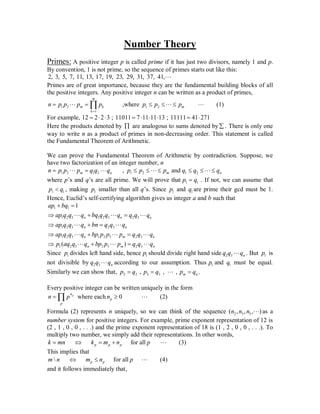
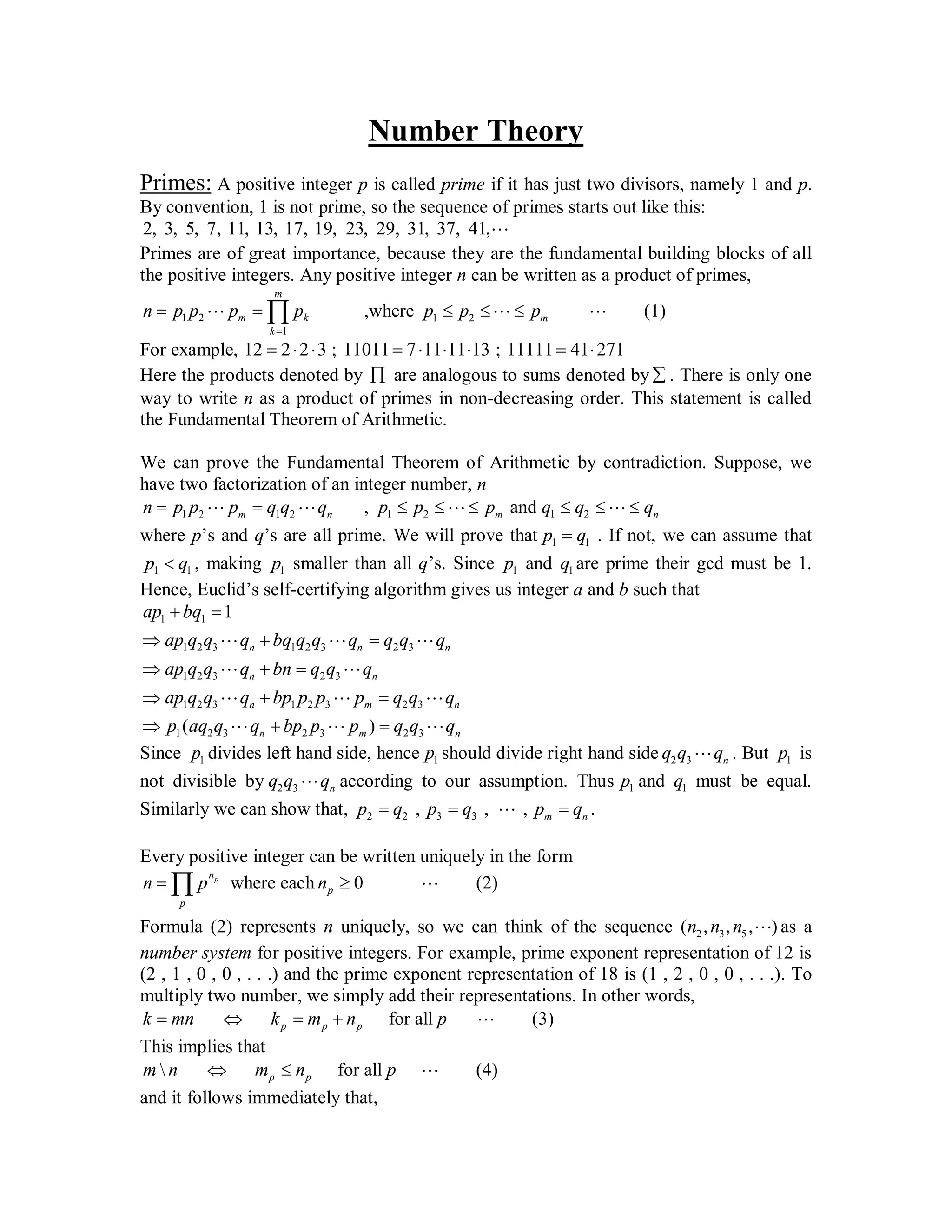
1) Primes are positive integers greater than 1 that are only divisible by 1 and themselves. The fundamental theorem of arithmetic states that every positive integer can be uniquely expressed as the product of primes.
2) Euclid's proof shows there are infinitely many primes. Euclid numbers form a sequence where each term is the sum of the previous terms plus 1, and the early terms are prime. However, not all Euclid numbers are prime.
3) The largest power of a prime p that divides n! is given by the sum of the number of times p divides the numbers from 1 to n in their prime factorizations. This can be determined from the number of 1s in the binary representation
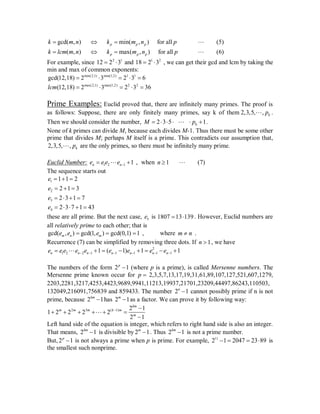
![We merely drop the least significant bit from one term to get the next. The binary
representation shows us how to derive another formula,
2 2( !) ( )n n v n , where 2 ( )v n is the number of 1’s in the binary representation of n.
Generalizing our findings to an arbitrary prime p, we have
2 3
1
( !)p k
k
n n n n
n
p p p p
We can find out the upper bound of ( !)p n by simply removing the floor from the
summand and then summing an infinite geometric progression.
2 3 2
1 1
( !) 1p
n n n n
n
p p p p p p
1
1
1 1
1 ;[ <1]
1
1
1
n
p p p
n p
p p
n p
p p
n
p
For example, when p = 2 and n = 100, this inequality says that 97 < 100. Thus the upper
bound 100 is not only correct but also close to the true value 97.
☺Good Luck☺
Prove
that ...](https://image.slidesharecdn.com/04bnumbertheory-191203122908/85/Number-theory-4-320.jpg)
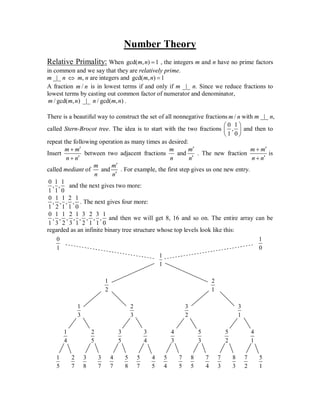
![If /m n and /m n are consecutive fractions at any stage of the construction, we have
1m n mn . We can prove it by induction.
Basis: Initially,
0 1
and
1 0
m m
n n
. Thus 1 1 0 0 1m n mn
Hypothesis: Let, 1m n mn is true for two consecutive fractions / and /m n m n at
any stage of the Stern-Brocot tree.
Induction: Consider, we have new mediant ( ) / ( )m m n n between / and /m n m n .
( ) ( ) 1
( ) ( ) 1 (Proved)
m m n m n n mn m n mn mn m n mn
m n n m m n m n m n mn m n m n mn
If
m m
n n
and if all values are nonnegative, it’s easy to verify that
m m m m
n n n n
.
1
( ) ( ) ( )
m m m mn m n mn mn m n mn
n n n n n n n n n n n n
.
Again,
1
( ) ( ) ( )
m m m m n m n mn m n m n mn
n n n n n n n n n n n n
.
Though 0n and 0n . we can write,
1 1
0 and 0
( ) ( )n n n n n n
which concludes
the prove
m m m m
n n n n
.
Is there any positive fraction /a b with a _|_ b possibly omitted from Stern-Brocot tree?
Let, /a b is a positive fraction. Thus,
0 1
1 0
m a m
n b n
. The construction forms
( ) / ( )m m n n and there are three cases. Either ( ) / ( ) /m m n n a b and we win;
or ( ) / ( ) /m m n n a b and we can set ,m m m n n n ;
or( ) / ( ) /m m n n a b and we can set ,m m m n n n . The process can’t go
infinitely because of the conditions
0 0 (1) and 0 0 (2)
a m m a
an bm bm an
b n n b
.
(1) ( ) (2) ( ) ( ) ( )( )
( ) ( )
( )( )
m n m n m n an bm m n bm an m n m n
am n bmm ann bmn bmm amn bm n ann m n m n
am n bmn amn bm n m n m n
m n a b mn a b m n m n
a b m n mn m n m n
a b m
; [ 1]n m n m n mn
Either m or n or morn increases at each step, so we must win after at most (a + b) steps.
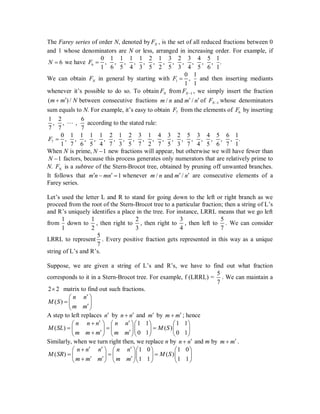
m/n, m+m'/n+n', m'/n'
Proof 1:
Proof 2:
Proof 3:
m/n < a/b < m'/n' and the inequality gradually comes closer and closer to equality to a/b as
SKIP the
Calculation
(i.e., Move to the
Right SubTree)
(Move to Left Subtree)
*Important *
*Important*](https://image.slidesharecdn.com/04bnumbertheory-191203122908/85/Number-theory-6-320.jpg)


![[Deck] What's New in Spark-Iceberg Integration via DSV2.pptx](https://cdn.slidesharecdn.com/ss_thumbnails/deckwhatsnewinspark-icebergintegrationviadsv2-260210005337-25955b12-thumbnail.jpg?width=640&height=640&fit=bounds)


