BRIAN STROKE
What is stroke?
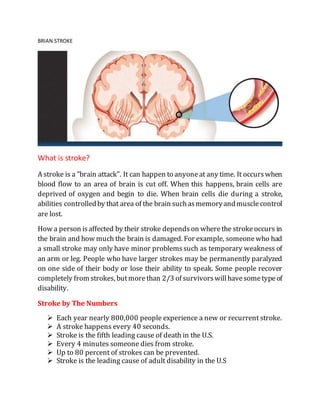
A stroke is a "brain attack". It can happen to anyoneat any time. It occurswhen
blood flow to an area of brain is cut off. When this happens, brain cells are
deprived of oxygen and begin to die. When brain cells die during a stroke,
abilities controlledby that area of the brain suchasmemoryandmusclecontrol
are lost.
How a person isaffected by their stroke dependson wherethe strokeoccurs in
the brain and how much the brain is damaged. For example, someonewho had
a small stroke may only have minor problemssuch as temporary weakness of
an arm or leg. People who have larger strokes may be permanently paralyzed
on one side of their body or lose their ability to speak. Some people recover
completely from strokes, butmorethan 2/3 of survivorswillhavesometypeof
disability.
Stroke by The Numbers
 Each year nearly 800,000 people experience a new or recurrent stroke.
 A stroke happens every 40 seconds.
 Stroke is the fifth leading cause of death in the U.S.
 Every 4 minutes someone dies from stroke.
 Up to 80 percent of strokes can be prevented.
 Stroke is the leading cause of adult disability in the U.S
TYPES OF STROKE:
Hemorrhagic stroke
There are two typesof stroke, hemorrhagic and ischemic. Hemorrhagicstrokes
areless common,infact only15percentof allstrokesarehemorrhagic, butthey
are responsible for about 40 percent of all stroke deaths.
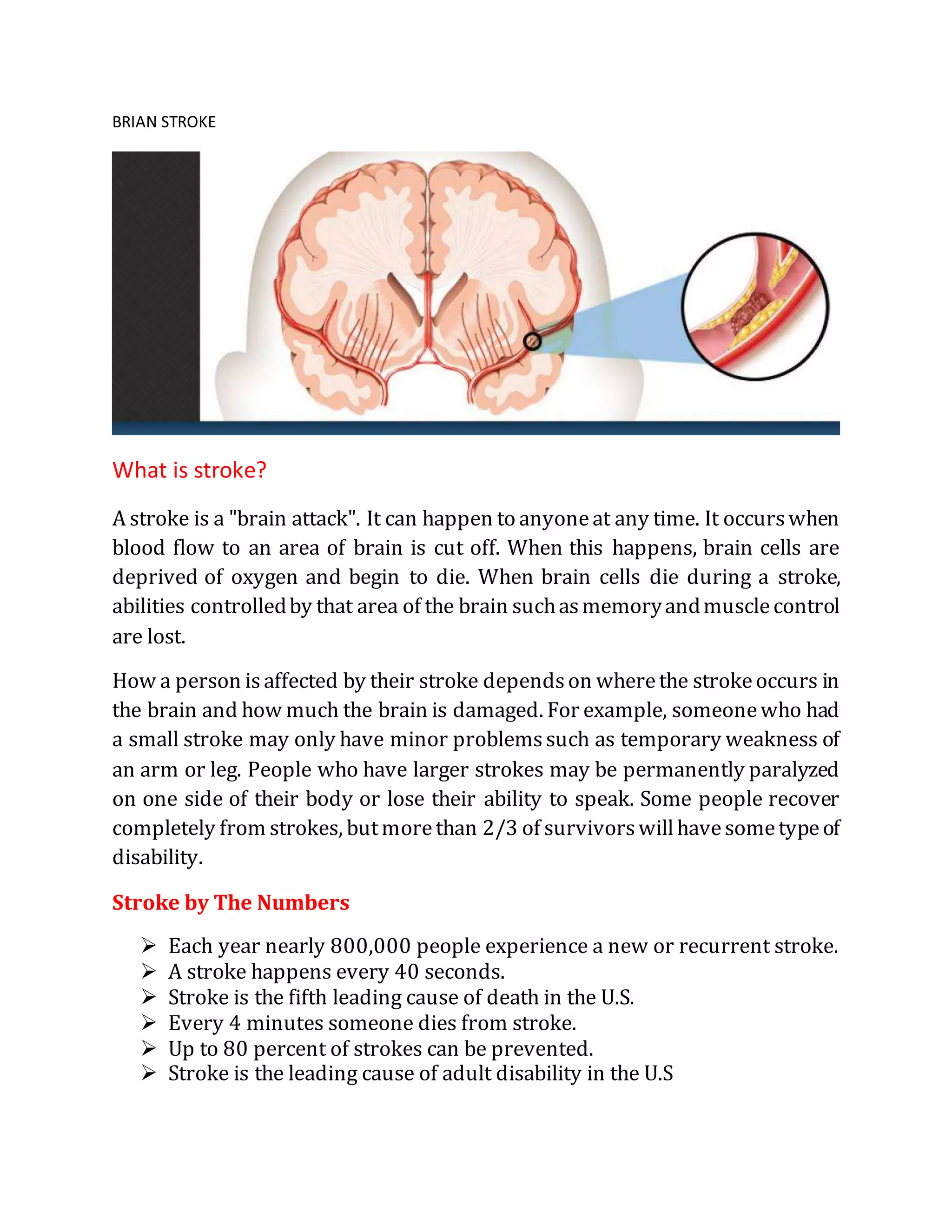
A hemorrhagic stroke is either a brain aneurism burst or a weakened blood
vessel leak. Blood spills into or around the brain and creates swelling and
pressure, damaging cells and tissue in the brain. There are two types of
hemorrhagic stroke called intracerebral and subarachnoid.
INTRACEREBRAL HEMORRHAGE
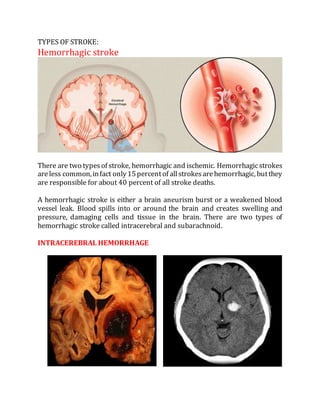
The most common hemorrhagicstroke happenswhen a blood vessel inside the
brain bursts and leaks blood into surrounding brain tissue (intracerebral
hemorrhage). The bleeding causesbrain cells to die and the affected partof the
brain stops workingcorrectly. High blood pressureand agingblood vesselsare
the most common causes of this type of stroke.
Sometimes intracerebral hemorrhagic stroke can be caused by an
arteriovenous malformation (AVM). AVM is a genetic condition of abnormal
connection between arteries and veins and most often occurs in the brain or
spine. If AVM occurs in the brain, vessels can break and bleed into the brain.
The cause of AVM is unclear but once diagnosed it can be treated successfully.
SUBARACHNOID HEMORRHAGE:
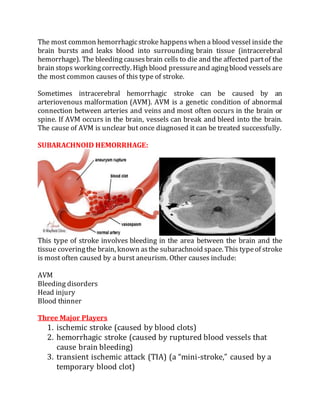
This type of stroke involves bleeding in the area between the brain and the
tissue coveringthe brain, known asthe subarachnoid space. This typeof stroke
is most often caused by a burst aneurism. Other causes include:
AVM
Bleeding disorders
Head injury
Blood thinner
Three Major Players
1. ischemic stroke (caused by blood clots)
2. hemorrhagic stroke (caused by ruptured blood vessels that
cause brain bleeding)
3. transient ischemic attack (TIA) (a “mini-stroke,” caused by a
temporary blood clot)
Stroke Symptoms
No matter which type of stroke you have, many of the symptoms
are the same. If you notice someone experiencing any of these
symptoms,
1. numbness or weakness that starts suddenly, most
commonly on either the left or right side of the body (face,
arms, or legs are often affected)
2. confusion, difficulty comprehending language, or trouble
talking that begins without warning
3. sudden vision problems (in one eye or both)
4. severe, piercing headache, with no clear cause, that starts
suddenly
5. difficulty walking because of sudden loss of balance or
dizziness
6. Trouble with speaking and understanding
7. Paralysis or numbness of the face, arm or leg.
8.
Warning Stroke
While the three main types of stroke share the same symptoms, they
differ in the duration of time the symptoms occur.
In a TIA, symptoms generally last only about one minute, according
to the American Stroke Association (ASA). Some can last up to five
minutes.
The difference between the other types of strokes and a TIA is the
temporary nature of the blood clot that caused it. While ischemic
and hemorrhagic strokes can cause permanent brain damage, TIAs
usually don’t.
Risk factors
Many factors can increase your risk of a stroke. Some factors can
also increase your chances of having a heart attack. Potentially
treatable stroke risk factors include:
Lifestyle risk factors
1. Being overweight or obese
2. Physical inactivity
3. Heavy or binge drinking
4. Use of illicit drugs such as cocaine and methamphetamines
Medical risk factors
1. High blood pressure — the risk of stroke begins to increase at
blood pressure readings higher than 120/80 millimeters of
mercury (mm Hg). Your doctor will help you decide on a target
blood pressure based on your age, whether you have diabetes
and other factors.
2. Cigarette smoking or exposure to secondhand smoke.
3. High cholesterol.
4. Diabetes.
5. Obstructive sleep apnea — a sleep disorder in which the
oxygen level intermittently drops during the night.
6. Cardiovascular disease, including heart failure, heart defects,
heart infection or abnormal heart rhythm.
7. Other factors associated with a higher risk of stroke include:
8. Personal or family history of stroke, heart attack or transient
ischemic attack.
9. Being age 55 or older.
10. Race — African-Americans have a higher risk of stroke
than do people of other races.
11-Gender — Men have a higher risk of stroke than women.
Women are usually older when they have strokes, and they're
more likely to die of strokes than are men. Also, they may have
some risk from some birth control pills or hormone therapies
that include estrogen, as well as from pregnancy and
childbirth.
Complications
11. A stroke can sometimes cause temporary or permanent
disabilities, depending on how long the brain lacks blood flow
and which part was affected. Complications may include:
12. Paralysis or loss of muscle movement. You may become
paralyzed on one side of your body, or lose control of certain
muscles, such as those on one side of your face or one arm.
Physical therapy may help you return to activities hampered
by paralysis, such as walking, eating and dressing.
13. Difficulty talking or swallowing. A stroke may cause you
to have less control over the way the muscles in your mouth
and throat move, making it difficult for you to talk clearly
(dysarthria), swallow or eat (dysphagia). You also may have
difficulty with language (aphasia), including speaking or
understanding speech, reading or writing. Therapy with a
speech and language pathologist may help.
14. Memory loss or thinking difficulties. Many people who
have had strokes experience some memory loss. Others may
have difficulty thinking, making judgments, reasoning and
understanding concepts.
15. Emotional problems. People who have had strokes may
have more difficulty controlling their emotions, or they may
develop depression.
16. Pain. People who have had strokes may have pain,
numbness or other strange sensations in parts of their bodies
affected by stroke. For example, if a stroke causes you to lose
feeling in your left arm, you may develop an uncomfortable
tingling sensation in that arm.
17. People also may be sensitive to temperature changes,
especially extreme cold after a stroke. This complication is
known as central stroke pain or central pain syndrome. This
condition generally develops several weeks after a stroke, and
it may improve over time. But because the pain is caused by a
problem in your brain, rather than a physical injury, there are
few treatments.
18. Changes in behavior and self-care ability. People who
have had strokes may become more withdrawn and less social
or more impulsive. They may need help with grooming and
daily chores.
Practice Prevention
1. Strokes are often deadly—but they can be prevented. The NSA
states that around 80 percent of all strokes can be avoided by
taking some steps:
2. check your blood pressure and cholesterol levels regularly
3. don’t smoke, and drink alcohol only in moderation
4. exercise regularly
5. eat a low-fat, low-salt diet
6. Managing your risk for stroke with simple but important
lifestyle changes can go a long way towards prevention.
Medications
Your doctor will probably prescribe several medicines after you
have had a stroke. Medicines to prevent blood clots are typically
used, because blood clots can cause TIAs and strokes.
The types of medicines that prevent clotting are:
Anticoagulant medicines.
Antiplatelet medicines.
Cholesterol-lowering and blood-pressure–lowering medicines are
also used to prevent TIAs and strokes.
Anticoagulant medicines
Anticoagulants such as warfarin (for example, Coumadin) prevent
blood clots from forming and keep existing blood clots from getting
bigger.
You may need to take this type of medicine after a stroke if you have
atrial fibrillation or another condition that makes you more likely to
have another stroke. For more information, see the topic Atrial
Fibrillation.
Antiplatelet medicines
Antiplatelet medicines keep platelets in the blood from sticking
together.
Aspirin (for example, Bayer) is most often used to prevent TIAs and
strokes.
Aspirin combined with dipyridamole (Aggrenox) is a safe and
effective alternative to aspirin.
Clopidogrel (Plavix) may be used for people who cannot take
aspirin.
Statins
Statins lower cholesterol and your risk for another stroke.
Blood pressure medicines
If you have high blood pressure, your doctor may want you to take
medicines to lower it. Blood pressure medicines include:
Angiotensin II receptor blockers (ARBs).
Angiotensin-converting enzyme (ACE) inhibitors.
Beta-blockers.
Calcium channel blockers.
Diuretics.

Brian stoke

  • 1.
    BRIAN STROKE What isstroke? A stroke is a "brain attack". It can happen to anyoneat any time. It occurswhen blood flow to an area of brain is cut off. When this happens, brain cells are deprived of oxygen and begin to die. When brain cells die during a stroke, abilities controlledby that area of the brain suchasmemoryandmusclecontrol are lost. How a person isaffected by their stroke dependson wherethe strokeoccurs in the brain and how much the brain is damaged. For example, someonewho had a small stroke may only have minor problemssuch as temporary weakness of an arm or leg. People who have larger strokes may be permanently paralyzed on one side of their body or lose their ability to speak. Some people recover completely from strokes, butmorethan 2/3 of survivorswillhavesometypeof disability. Stroke by The Numbers  Each year nearly 800,000 people experience a new or recurrent stroke.  A stroke happens every 40 seconds.  Stroke is the fifth leading cause of death in the U.S.  Every 4 minutes someone dies from stroke.  Up to 80 percent of strokes can be prevented.  Stroke is the leading cause of adult disability in the U.S
  • 2.
    TYPES OF STROKE: Hemorrhagicstroke There are two typesof stroke, hemorrhagic and ischemic. Hemorrhagicstrokes areless common,infact only15percentof allstrokesarehemorrhagic, butthey are responsible for about 40 percent of all stroke deaths. A hemorrhagic stroke is either a brain aneurism burst or a weakened blood vessel leak. Blood spills into or around the brain and creates swelling and pressure, damaging cells and tissue in the brain. There are two types of hemorrhagic stroke called intracerebral and subarachnoid. INTRACEREBRAL HEMORRHAGE
  • 3.
    The most commonhemorrhagicstroke happenswhen a blood vessel inside the brain bursts and leaks blood into surrounding brain tissue (intracerebral hemorrhage). The bleeding causesbrain cells to die and the affected partof the brain stops workingcorrectly. High blood pressureand agingblood vesselsare the most common causes of this type of stroke. Sometimes intracerebral hemorrhagic stroke can be caused by an arteriovenous malformation (AVM). AVM is a genetic condition of abnormal connection between arteries and veins and most often occurs in the brain or spine. If AVM occurs in the brain, vessels can break and bleed into the brain. The cause of AVM is unclear but once diagnosed it can be treated successfully. SUBARACHNOID HEMORRHAGE: This type of stroke involves bleeding in the area between the brain and the tissue coveringthe brain, known asthe subarachnoid space. This typeof stroke is most often caused by a burst aneurism. Other causes include: AVM Bleeding disorders Head injury Blood thinner Three Major Players 1. ischemic stroke (caused by blood clots) 2. hemorrhagic stroke (caused by ruptured blood vessels that cause brain bleeding) 3. transient ischemic attack (TIA) (a “mini-stroke,” caused by a temporary blood clot)
  • 4.
    Stroke Symptoms No matterwhich type of stroke you have, many of the symptoms are the same. If you notice someone experiencing any of these symptoms, 1. numbness or weakness that starts suddenly, most commonly on either the left or right side of the body (face, arms, or legs are often affected) 2. confusion, difficulty comprehending language, or trouble talking that begins without warning 3. sudden vision problems (in one eye or both) 4. severe, piercing headache, with no clear cause, that starts suddenly 5. difficulty walking because of sudden loss of balance or dizziness 6. Trouble with speaking and understanding 7. Paralysis or numbness of the face, arm or leg. 8. Warning Stroke While the three main types of stroke share the same symptoms, they differ in the duration of time the symptoms occur. In a TIA, symptoms generally last only about one minute, according to the American Stroke Association (ASA). Some can last up to five minutes. The difference between the other types of strokes and a TIA is the temporary nature of the blood clot that caused it. While ischemic and hemorrhagic strokes can cause permanent brain damage, TIAs usually don’t.
  • 5.
    Risk factors Many factorscan increase your risk of a stroke. Some factors can also increase your chances of having a heart attack. Potentially treatable stroke risk factors include: Lifestyle risk factors 1. Being overweight or obese 2. Physical inactivity 3. Heavy or binge drinking 4. Use of illicit drugs such as cocaine and methamphetamines Medical risk factors 1. High blood pressure — the risk of stroke begins to increase at blood pressure readings higher than 120/80 millimeters of mercury (mm Hg). Your doctor will help you decide on a target blood pressure based on your age, whether you have diabetes and other factors. 2. Cigarette smoking or exposure to secondhand smoke. 3. High cholesterol. 4. Diabetes. 5. Obstructive sleep apnea — a sleep disorder in which the oxygen level intermittently drops during the night. 6. Cardiovascular disease, including heart failure, heart defects, heart infection or abnormal heart rhythm. 7. Other factors associated with a higher risk of stroke include: 8. Personal or family history of stroke, heart attack or transient ischemic attack. 9. Being age 55 or older. 10. Race — African-Americans have a higher risk of stroke than do people of other races.
  • 6.
    11-Gender — Menhave a higher risk of stroke than women. Women are usually older when they have strokes, and they're more likely to die of strokes than are men. Also, they may have some risk from some birth control pills or hormone therapies that include estrogen, as well as from pregnancy and childbirth. Complications 11. A stroke can sometimes cause temporary or permanent disabilities, depending on how long the brain lacks blood flow and which part was affected. Complications may include: 12. Paralysis or loss of muscle movement. You may become paralyzed on one side of your body, or lose control of certain muscles, such as those on one side of your face or one arm. Physical therapy may help you return to activities hampered by paralysis, such as walking, eating and dressing. 13. Difficulty talking or swallowing. A stroke may cause you to have less control over the way the muscles in your mouth and throat move, making it difficult for you to talk clearly (dysarthria), swallow or eat (dysphagia). You also may have difficulty with language (aphasia), including speaking or understanding speech, reading or writing. Therapy with a speech and language pathologist may help. 14. Memory loss or thinking difficulties. Many people who have had strokes experience some memory loss. Others may have difficulty thinking, making judgments, reasoning and understanding concepts. 15. Emotional problems. People who have had strokes may have more difficulty controlling their emotions, or they may develop depression. 16. Pain. People who have had strokes may have pain, numbness or other strange sensations in parts of their bodies
  • 7.
    affected by stroke.For example, if a stroke causes you to lose feeling in your left arm, you may develop an uncomfortable tingling sensation in that arm. 17. People also may be sensitive to temperature changes, especially extreme cold after a stroke. This complication is known as central stroke pain or central pain syndrome. This condition generally develops several weeks after a stroke, and it may improve over time. But because the pain is caused by a problem in your brain, rather than a physical injury, there are few treatments. 18. Changes in behavior and self-care ability. People who have had strokes may become more withdrawn and less social or more impulsive. They may need help with grooming and daily chores. Practice Prevention 1. Strokes are often deadly—but they can be prevented. The NSA states that around 80 percent of all strokes can be avoided by taking some steps: 2. check your blood pressure and cholesterol levels regularly 3. don’t smoke, and drink alcohol only in moderation 4. exercise regularly 5. eat a low-fat, low-salt diet 6. Managing your risk for stroke with simple but important lifestyle changes can go a long way towards prevention. Medications Your doctor will probably prescribe several medicines after you have had a stroke. Medicines to prevent blood clots are typically used, because blood clots can cause TIAs and strokes.
  • 8.
    The types ofmedicines that prevent clotting are: Anticoagulant medicines. Antiplatelet medicines. Cholesterol-lowering and blood-pressure–lowering medicines are also used to prevent TIAs and strokes. Anticoagulant medicines Anticoagulants such as warfarin (for example, Coumadin) prevent blood clots from forming and keep existing blood clots from getting bigger. You may need to take this type of medicine after a stroke if you have atrial fibrillation or another condition that makes you more likely to have another stroke. For more information, see the topic Atrial Fibrillation. Antiplatelet medicines Antiplatelet medicines keep platelets in the blood from sticking together. Aspirin (for example, Bayer) is most often used to prevent TIAs and strokes. Aspirin combined with dipyridamole (Aggrenox) is a safe and effective alternative to aspirin. Clopidogrel (Plavix) may be used for people who cannot take aspirin. Statins Statins lower cholesterol and your risk for another stroke. Blood pressure medicines If you have high blood pressure, your doctor may want you to take medicines to lower it. Blood pressure medicines include: Angiotensin II receptor blockers (ARBs).
  • 9.
    Angiotensin-converting enzyme (ACE)inhibitors. Beta-blockers. Calcium channel blockers. Diuretics.