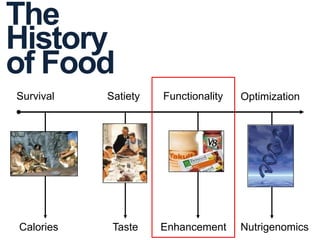
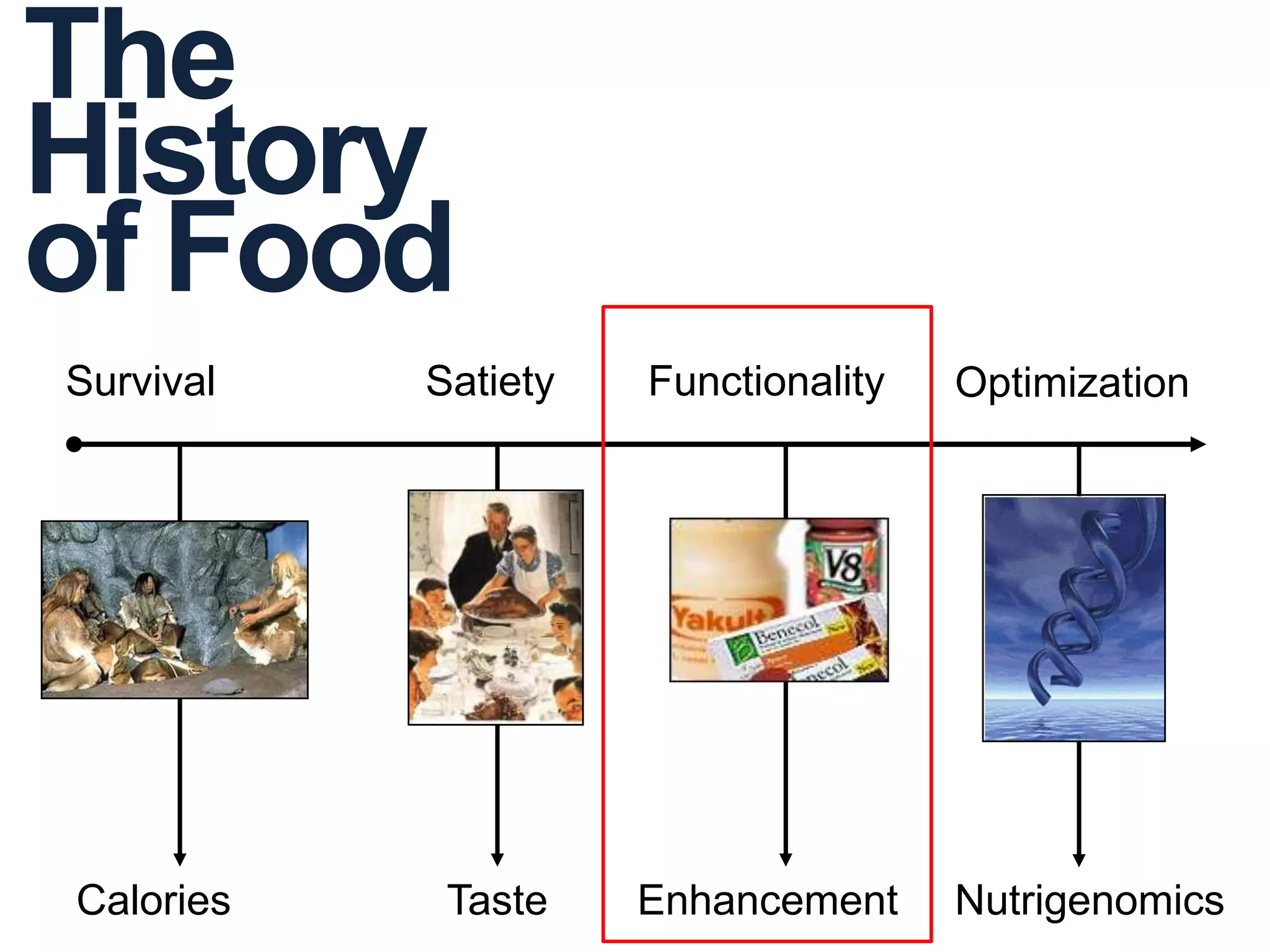
The
of Food
History
Survival
Calories
Satiety
Taste
Functionality
Enhancement
Optimization
Nutrigenomics
Malnutrition
of Affluence
The more affluent we have become, the less nutritious our
diet…..
Man’s Diet Then And Now
Pre-Industrial:
 Calorie rich, nutrient dense
 Biodiversity in diet
 Significant exercise
Post-Industrial:
 Calorie rich, nutrient poor
 Lack of biodiversity in diet
 Limited exercise
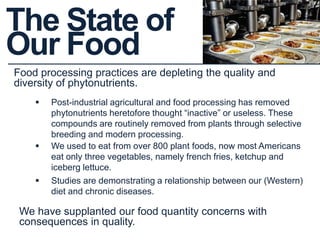
The State of
Our Food
Food processing practices are depleting the quality and
diversity of phytonutrients.
 Studies are demonstrating a relationship between our (Western)
diet and chronic diseases.
 Post-industrial agricultural and food processing has removed
phytonutrients heretofore thought “inactive” or useless. These
compounds are routinely removed from plants through selective
breeding and modern processing.
 We used to eat from over 800 plant foods, now most Americans
eat only three vegetables, namely french fries, ketchup and
iceberg lettuce.
We have supplanted our food quantity concerns with
consequences in quality.
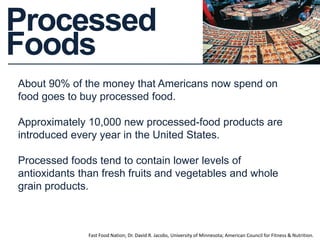
Processed
Foods
About 90% of the money that Americans now spend on
food goes to buy processed food.
Approximately 10,000 new processed-food products are
introduced every year in the United States.
Processed foods tend to contain lower levels of
antioxidants than fresh fruits and vegetables and whole
grain products.
Fast Food Nation; Dr. David R. Jacobs, University of Minnesota; American Council for Fitness & Nutrition.
Functional
Foods
Consumers are recognizing the deficiencies in their diet
and wish to take an active role in maintaining their
wellness and maximize performance.
Food technology and nutritional science allow us to
address these issues in a convenient and well-adopted
manner:
Functional Foods & Beverages
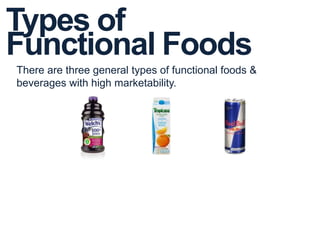
There are three general types of functional foods &
beverages with high marketability.
Types of
Functional Foods
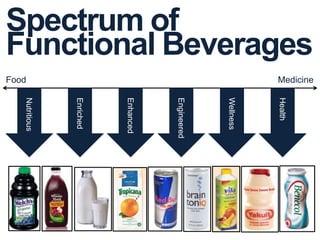
Food Medicine
Nutritious
Enriched
Enhanced
Engineered
Wellness
Health
Spectrum of
Functional Beverages
Gut Health
Market
In the United States alone, around 70 million adults suffer
from digestive problems caused by poor consumption
habits, high usage of additives for processing of food, and a
high rate of antibiotic intake.
1 in 7 people suffers a chronic GI disorder.
76 million get food borne illnesses in the US annually & 40
million travelers get diarrhea.
Why
Probiotics
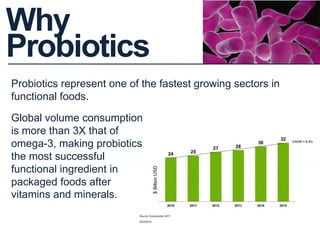
Probiotics represent one of the fastest growing sectors in
functional foods.
Global volume consumption
is more than 3X that of
omega-3, making probiotics
the most successful
functional ingredient in
packaged foods after
vitamins and minerals.
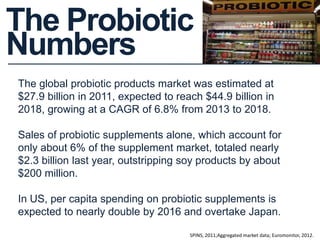
The Probiotic
Numbers
The global probiotic products market was estimated at
$27.9 billion in 2011, expected to reach $44.9 billion in
2018, growing at a CAGR of 6.8% from 2013 to 2018.
Sales of probiotic supplements alone, which account for
only about 6% of the supplement market, totaled nearly
$2.3 billion last year, outstripping soy products by about
$200 million.
In US, per capita spending on probiotic supplements is
expected to nearly double by 2016 and overtake Japan.
SPINS, 2011;Aggregated market data; Euromonitor, 2012.
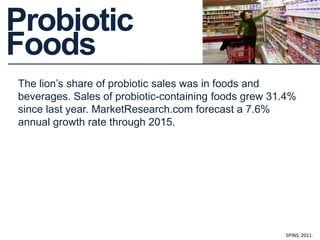
Probiotic
Foods
The lion’s share of probiotic sales was in foods and
beverages. Sales of probiotic-containing foods grew 31.4%
since last year. MarketResearch.com forecast a 7.6%
annual growth rate through 2015.
SPINS, 2011.
Probiotic
Products
North America has tremendous growth potential because of
consumers’ natural predisposition to taking supplements
and consuming dairy products. Also probiotics are
increasingly being used for specific conditions such as
allergies, travelers’ diarrhea, etc.
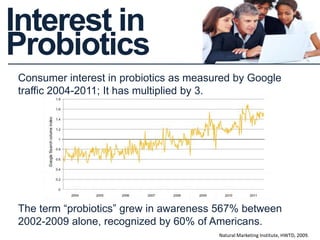
Interest in
Probiotics
Consumer interest in probiotics as measured by Google
traffic 2004-2011; It has multiplied by 3.
The term “probiotics” grew in awareness 567% between
2002-2009 alone, recognized by 60% of Americans.
Natural Marketing Institute, HWTD, 2009.
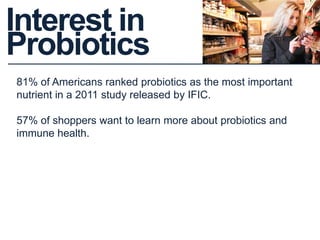
Interest in
Probiotics
81% of Americans ranked probiotics as the most important
nutrient in a 2011 study released by IFIC.
57% of shoppers want to learn more about probiotics and
immune health.
Probiotic
Beverages
A look at a few good examples of probiotic beverages…
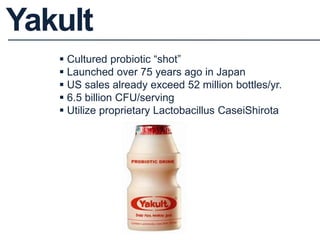
 Cultured probiotic “shot”
 Launched over 75 years ago in Japan
 US sales already exceed 52 million bottles/yr.
 6.5 billion CFU/serving
 Utilize proprietary Lactobacillus CaseiShirota
Yakult
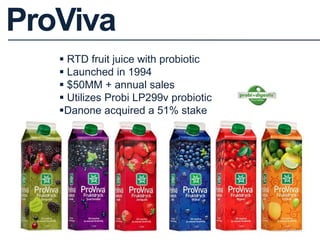
 RTD fruit juice with probiotic
 Launched in 1994
 $50MM + annual sales
 Utilizes Probi LP299v probiotic
Danone acquired a 51% stake
ProViva
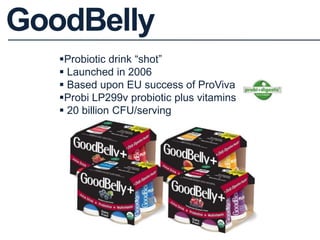
Probiotic drink “shot”
 Launched in 2006
 Based upon EU success of ProViva
Probi LP299v probiotic plus vitamins
 20 billion CFU/serving
GoodBelly
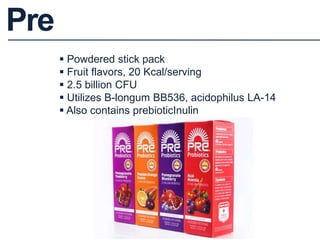
 Powdered stick pack
 Fruit flavors, 20 Kcal/serving
 2.5 billion CFU
 Utilizes B-longum BB536, acidophilus LA-14
 Also contains prebioticInulin
Pre
According to the 2007 National Health
Interview Survey,
“prebiotics/probiotics” ranked fifth
among natural products used for
children.
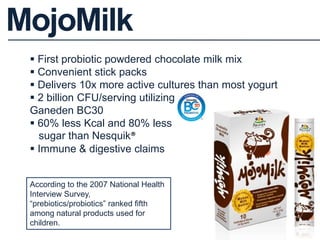
MojoMilk
 First probiotic powdered chocolate milk mix
 Convenient stick packs
 Delivers 10x more active cultures than most yogurt
 2 billion CFU/serving utilizing
Ganeden BC30
 60% less Kcal and 80% less
sugar than Nesquik®
 Immune & digestive claims
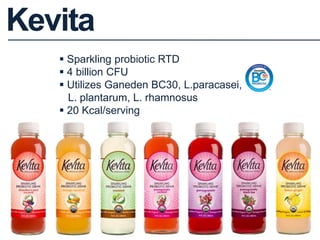
 Sparkling probiotic RTD
 4 billion CFU
 Utilizes Ganeden BC30, L.paracasei,
L. plantarum, L. rhamnosus
 20 Kcal/serving
Kevita
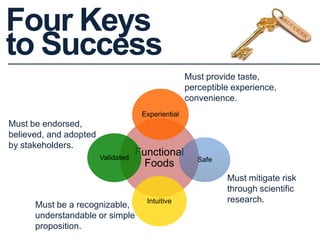
Four Keys
to Success
Functional
Foods Safe
Experiential
Intuitive
Validated
Must be endorsed,
believed, and adopted
by stakeholders.
Must provide taste,
perceptible experience,
convenience.
Must mitigate risk
through scientific
research.
Must be a recognizable,
understandable or simple
proposition.
Food vs.
Drug
Successful functional products provide a wellness benefit but
don’t masquerade as a therapeutic. Consumers don’t want to
eat from their medicine cabinets.
They rely on science for validation, not as a primary selling
point.
For “serious” health conditions, consumers have Rx options
that are more validated and reimbursed by insurance.
Consumers need drugs, but they want foods.
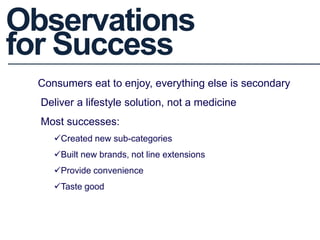
Consumers eat to enjoy, everything else is secondary
Deliver a lifestyle solution, not a medicine
Most successes:
Created new sub-categories
Built new brands, not line extensions
Provide convenience
Taste good
Observations
for Success
Peter Leighton
Abunda Functional Foods, Inc.
peter@abundafoods.com
(801) 550-6962
Contact

Functional Beverages for Gut Health

  • 1.
  • 2.
    Malnutrition of Affluence The moreaffluent we have become, the less nutritious our diet….. Man’s Diet Then And Now Pre-Industrial:  Calorie rich, nutrient dense  Biodiversity in diet  Significant exercise Post-Industrial:  Calorie rich, nutrient poor  Lack of biodiversity in diet  Limited exercise
  • 3.
    The State of OurFood Food processing practices are depleting the quality and diversity of phytonutrients.  Studies are demonstrating a relationship between our (Western) diet and chronic diseases.  Post-industrial agricultural and food processing has removed phytonutrients heretofore thought “inactive” or useless. These compounds are routinely removed from plants through selective breeding and modern processing.  We used to eat from over 800 plant foods, now most Americans eat only three vegetables, namely french fries, ketchup and iceberg lettuce. We have supplanted our food quantity concerns with consequences in quality.
  • 4.
    Processed Foods About 90% ofthe money that Americans now spend on food goes to buy processed food. Approximately 10,000 new processed-food products are introduced every year in the United States. Processed foods tend to contain lower levels of antioxidants than fresh fruits and vegetables and whole grain products. Fast Food Nation; Dr. David R. Jacobs, University of Minnesota; American Council for Fitness & Nutrition.
  • 5.
    Functional Foods Consumers are recognizingthe deficiencies in their diet and wish to take an active role in maintaining their wellness and maximize performance. Food technology and nutritional science allow us to address these issues in a convenient and well-adopted manner: Functional Foods & Beverages
  • 6.
    There are threegeneral types of functional foods & beverages with high marketability. Types of Functional Foods
  • 7.
  • 8.
    Gut Health Market In theUnited States alone, around 70 million adults suffer from digestive problems caused by poor consumption habits, high usage of additives for processing of food, and a high rate of antibiotic intake. 1 in 7 people suffers a chronic GI disorder. 76 million get food borne illnesses in the US annually & 40 million travelers get diarrhea.
  • 9.
    Why Probiotics Probiotics represent oneof the fastest growing sectors in functional foods. Global volume consumption is more than 3X that of omega-3, making probiotics the most successful functional ingredient in packaged foods after vitamins and minerals.
  • 10.
    The Probiotic Numbers The globalprobiotic products market was estimated at $27.9 billion in 2011, expected to reach $44.9 billion in 2018, growing at a CAGR of 6.8% from 2013 to 2018. Sales of probiotic supplements alone, which account for only about 6% of the supplement market, totaled nearly $2.3 billion last year, outstripping soy products by about $200 million. In US, per capita spending on probiotic supplements is expected to nearly double by 2016 and overtake Japan. SPINS, 2011;Aggregated market data; Euromonitor, 2012.
  • 11.
    Probiotic Foods The lion’s shareof probiotic sales was in foods and beverages. Sales of probiotic-containing foods grew 31.4% since last year. MarketResearch.com forecast a 7.6% annual growth rate through 2015. SPINS, 2011.
  • 12.
    Probiotic Products North America hastremendous growth potential because of consumers’ natural predisposition to taking supplements and consuming dairy products. Also probiotics are increasingly being used for specific conditions such as allergies, travelers’ diarrhea, etc.
  • 13.
    Interest in Probiotics Consumer interestin probiotics as measured by Google traffic 2004-2011; It has multiplied by 3. The term “probiotics” grew in awareness 567% between 2002-2009 alone, recognized by 60% of Americans. Natural Marketing Institute, HWTD, 2009.
  • 14.
    Interest in Probiotics 81% ofAmericans ranked probiotics as the most important nutrient in a 2011 study released by IFIC. 57% of shoppers want to learn more about probiotics and immune health.
  • 15.
    Probiotic Beverages A look ata few good examples of probiotic beverages…
  • 16.
     Cultured probiotic“shot”  Launched over 75 years ago in Japan  US sales already exceed 52 million bottles/yr.  6.5 billion CFU/serving  Utilize proprietary Lactobacillus CaseiShirota Yakult
  • 17.
     RTD fruitjuice with probiotic  Launched in 1994  $50MM + annual sales  Utilizes Probi LP299v probiotic Danone acquired a 51% stake ProViva
  • 18.
    Probiotic drink “shot” Launched in 2006  Based upon EU success of ProViva Probi LP299v probiotic plus vitamins  20 billion CFU/serving GoodBelly
  • 19.
     Powdered stickpack  Fruit flavors, 20 Kcal/serving  2.5 billion CFU  Utilizes B-longum BB536, acidophilus LA-14  Also contains prebioticInulin Pre
  • 20.
    According to the2007 National Health Interview Survey, “prebiotics/probiotics” ranked fifth among natural products used for children. MojoMilk  First probiotic powdered chocolate milk mix  Convenient stick packs  Delivers 10x more active cultures than most yogurt  2 billion CFU/serving utilizing Ganeden BC30  60% less Kcal and 80% less sugar than Nesquik®  Immune & digestive claims
  • 21.
     Sparkling probioticRTD  4 billion CFU  Utilizes Ganeden BC30, L.paracasei, L. plantarum, L. rhamnosus  20 Kcal/serving Kevita
  • 22.
    Four Keys to Success Functional FoodsSafe Experiential Intuitive Validated Must be endorsed, believed, and adopted by stakeholders. Must provide taste, perceptible experience, convenience. Must mitigate risk through scientific research. Must be a recognizable, understandable or simple proposition.
  • 23.
    Food vs. Drug Successful functionalproducts provide a wellness benefit but don’t masquerade as a therapeutic. Consumers don’t want to eat from their medicine cabinets. They rely on science for validation, not as a primary selling point. For “serious” health conditions, consumers have Rx options that are more validated and reimbursed by insurance. Consumers need drugs, but they want foods.
  • 24.
    Consumers eat toenjoy, everything else is secondary Deliver a lifestyle solution, not a medicine Most successes: Created new sub-categories Built new brands, not line extensions Provide convenience Taste good Observations for Success
  • 25.
    Peter Leighton Abunda FunctionalFoods, Inc. peter@abundafoods.com (801) 550-6962 Contact