

Prepared By:
MOHAMMAD KHALID
(Assistant Professor)
Krishna Pharmacy College, Bijnor (UP)
Overview on supplements
Definition
Facts about Supplements
Should you be taking supplements?
What about protein powders?
Regulation of dietary Supplements
Dietary Supplement and Health Education Act
References
Thursday, April 16, 2020 Krishna Pharmacy College 2
Overview on supplements
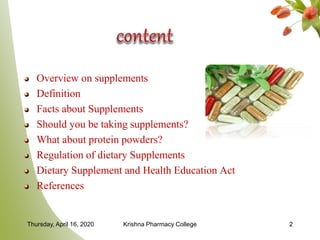
Nutritional supplements are often times referred to as “dietary
supplements.”
“A dietary supplement is a product intended for ingestion that
contains a “dietary ingredient” intended to add further
nutritional value to (supplement) the diet. (www.fda.gov)
Often time the ingredient will include one or more of the
following substances:
minerals, vitamins, herb, a concentrate (metabolite, constituent,
or extract), an amino acid.
Supplements are found in forms such as capsules, gelcaps,
liquids, tablets, or powders.
Supplements can help you get adequate dietary intake of
essential nutrients and help reduce your risk of disease.
Thursday, April 16, 2020 Krishna Pharmacy College 3
Continue….
The word “supplement” means a nutrient or
group of nutrients that are meant to
supplement.
This does not mean it is meant to substitute
a healthy diet you can eat on a regular basis.
Do you view supplements as an “easy way out” in
regards to healthy eating and living?
Thursday, April 16, 2020 Krishna Pharmacy College 4
Definition
A dietary supplement, also known as food supplement or nutritional
supplement, is a preparation intended to supplement the diet and
provide nutrients, such as vitamins, minerals, fiber, fatty acids, or
amino acids, that may be missing or may not be consumed in
sufficient quantities in a person's diet.
In the United States, a dietary supplement is defined under the
Dietary Supplement Health and Education Act of 1994 (DSHEA) as
a product that is intended to supplement the diet and contains any of
the following dietary ingredients:
- a vitamin
- a mineral
- a herb or other botanical (excluding tobacco)
- an amino acid
- a concentrate, metabolite, constituent, extract, or combination of any of the above
- a substance historically used by humans to supplement the diet
Thursday, April 16,
2020
Krishna Pharmacy College 5
Continue…..
It must also conform to the following criteria:
Intended for ingestion in pill, capsule, tablet,
powder or liquid form
Not represented for use as a conventional food
or as the sole item of a meal or diet
Labeled as a "dietary supplement"
Thursday, April 16,
2020
Krishna Pharmacy College 6
Facts about Supplements
More than 1000 new supplements are developed each year.
Large and small companies produce supplements.
Supplements have been touted to treat almost every
condition known to man.
Claims by those who market supplements frequently have
no basis in science.
People take supplements for a variety of reasons.
Only about a third of dietary supplements have scientific
evidence of safety and effectiveness.
Supplements can interact with medications.
Thursday, April 16,
2020
Krishna Pharmacy College 7
Should you be taking supplements?
IF you are eating a reasonable variety of fruits,
vegetables, proteins, carbohydrates, and healthy
fats you probably do not need a general vitamin-
mineral supplement.
Often time they way you eat and what you eat will
play a key role in how you feel physically and
mentally. If you are physically tired from a poor
diet, a supplement will not add extra energy. Only
better nutrition can help you.
Supplements can NEVER make up for poor eating
habits.
Thursday, April 16, 2020 Krishna Pharmacy College 8
That being said….
Because of food allergies, the inability to obtain needed nutrients, or
medical conditions, some people do need specific supplements.
Calcium, Iron, Vitamin C, and Folate are some examples of vitamins
that are often times supplemented along with a healthy diet. It is
always encouraged that you try your best to get these vitamins
strictly from food. But if you find you are lacking in certain areas,
then it is best to add a vitamin along with your healthy eating.
IF you fall into any of the following groups, you may require
supplements. Of course always talk to your Doctor before starting a
supplement!
Pregnant women
Nursing mothers
Strict vegetarians
People with food allergies
Senior Citizens
Thursday, April 16, 2020 Krishna Pharmacy College 9
What about protein powders?
People spend so much money on protein supplements
hoping it will help build muscle fast! However this
just isn’t the case.
When you take a high level of protein it is actually
converted to fats and carbohydrates in the body.
Excess protein can cause too much burden on your
kidneys, cause calcium loss and dehydration.
By simply increasing protein in your diet slightly,
you can meet your protein needs.
Thursday, April 16, 2020 Krishna Pharmacy College 10
Regulation of dietary Supplements
The U.S. Federal Trade Commission has primary
responsibility for regulating advertisement and
labeling.
Aside from advertising, regulation is by the Food
and Drug Administration.
FDA regulation is hampered by the fact that
supplements are usually treated as foods, not drugs.
FDA does not analyze the content of supplements
and cannot insure the ingredients or their amounts
listed on the label are accurate.
Thursday, April 16, 2020 Krishna Pharmacy College 11
Dietary Supplement and Health Education Act
Governs federal regulation of dietary supplements.
Limits FDA ability to regulate supplements.
Prohibits the FDA from banning suspicious
ingredients.
Allows label statements about effects on the structure
or functioning of the body if they contain a
disclaimer statement.
Expanded the types of products that can be marketed
as supplements.
Thursday, April 16, 2020 Krishna Pharmacy College 12
References
www.fda.gov
"What Is a Dietary Supplement?" What Is a Dietary Supplement? N.p., 29
Apr Web. 19 May 2015.
The Health Professional’s Guide to Popular Dietary Supplements, by
Allison Sarubin.
"Nutrition Supplements." Nutrition Supplements. N.p., n.d. Web. 19 May
2015.
https://www.slideserve.com/susan/chapter-7-dietary-supplements
https://www.researchgate.net/profile/Anthony_Fardet2/publication/256443294_C
omplex_foods_vs_supplements_influence_of_the_food_matrix_on_the_nutritiona
l_effects_of_vitamins_minerals_trace_elements_and_other_biofactors_in_human
s/links/53ef77340cf23733e812d4c4/Complex-foods-vs-supplements-influence-of-
the-food-matrix-on-the-nutritional-effects-of-vitamins-minerals-trace-elements-
and-other-biofactors-in-humans.pdf
Thursday, April 16, 2020 Krishna Pharmacy College 13
Thursday, April 16, 2020 Krishna Pharmacy College
14
Thursday, April 16, 2020 Krishna Pharmacy College 15

Dietary supplements (unit 3)

  • 1.
    Prepared By: MOHAMMAD KHALID (AssistantProfessor) Krishna Pharmacy College, Bijnor (UP)
  • 2.
    Overview on supplements Definition Factsabout Supplements Should you be taking supplements? What about protein powders? Regulation of dietary Supplements Dietary Supplement and Health Education Act References Thursday, April 16, 2020 Krishna Pharmacy College 2
  • 3.
    Overview on supplements Nutritionalsupplements are often times referred to as “dietary supplements.” “A dietary supplement is a product intended for ingestion that contains a “dietary ingredient” intended to add further nutritional value to (supplement) the diet. (www.fda.gov) Often time the ingredient will include one or more of the following substances: minerals, vitamins, herb, a concentrate (metabolite, constituent, or extract), an amino acid. Supplements are found in forms such as capsules, gelcaps, liquids, tablets, or powders. Supplements can help you get adequate dietary intake of essential nutrients and help reduce your risk of disease. Thursday, April 16, 2020 Krishna Pharmacy College 3
  • 4.
    Continue…. The word “supplement”means a nutrient or group of nutrients that are meant to supplement. This does not mean it is meant to substitute a healthy diet you can eat on a regular basis. Do you view supplements as an “easy way out” in regards to healthy eating and living? Thursday, April 16, 2020 Krishna Pharmacy College 4
  • 5.
    Definition A dietary supplement,also known as food supplement or nutritional supplement, is a preparation intended to supplement the diet and provide nutrients, such as vitamins, minerals, fiber, fatty acids, or amino acids, that may be missing or may not be consumed in sufficient quantities in a person's diet. In the United States, a dietary supplement is defined under the Dietary Supplement Health and Education Act of 1994 (DSHEA) as a product that is intended to supplement the diet and contains any of the following dietary ingredients: - a vitamin - a mineral - a herb or other botanical (excluding tobacco) - an amino acid - a concentrate, metabolite, constituent, extract, or combination of any of the above - a substance historically used by humans to supplement the diet Thursday, April 16, 2020 Krishna Pharmacy College 5
  • 6.
    Continue….. It must alsoconform to the following criteria: Intended for ingestion in pill, capsule, tablet, powder or liquid form Not represented for use as a conventional food or as the sole item of a meal or diet Labeled as a "dietary supplement" Thursday, April 16, 2020 Krishna Pharmacy College 6
  • 7.
    Facts about Supplements Morethan 1000 new supplements are developed each year. Large and small companies produce supplements. Supplements have been touted to treat almost every condition known to man. Claims by those who market supplements frequently have no basis in science. People take supplements for a variety of reasons. Only about a third of dietary supplements have scientific evidence of safety and effectiveness. Supplements can interact with medications. Thursday, April 16, 2020 Krishna Pharmacy College 7
  • 8.
    Should you betaking supplements? IF you are eating a reasonable variety of fruits, vegetables, proteins, carbohydrates, and healthy fats you probably do not need a general vitamin- mineral supplement. Often time they way you eat and what you eat will play a key role in how you feel physically and mentally. If you are physically tired from a poor diet, a supplement will not add extra energy. Only better nutrition can help you. Supplements can NEVER make up for poor eating habits. Thursday, April 16, 2020 Krishna Pharmacy College 8
  • 9.
    That being said…. Becauseof food allergies, the inability to obtain needed nutrients, or medical conditions, some people do need specific supplements. Calcium, Iron, Vitamin C, and Folate are some examples of vitamins that are often times supplemented along with a healthy diet. It is always encouraged that you try your best to get these vitamins strictly from food. But if you find you are lacking in certain areas, then it is best to add a vitamin along with your healthy eating. IF you fall into any of the following groups, you may require supplements. Of course always talk to your Doctor before starting a supplement! Pregnant women Nursing mothers Strict vegetarians People with food allergies Senior Citizens Thursday, April 16, 2020 Krishna Pharmacy College 9
  • 10.
    What about proteinpowders? People spend so much money on protein supplements hoping it will help build muscle fast! However this just isn’t the case. When you take a high level of protein it is actually converted to fats and carbohydrates in the body. Excess protein can cause too much burden on your kidneys, cause calcium loss and dehydration. By simply increasing protein in your diet slightly, you can meet your protein needs. Thursday, April 16, 2020 Krishna Pharmacy College 10
  • 11.
    Regulation of dietarySupplements The U.S. Federal Trade Commission has primary responsibility for regulating advertisement and labeling. Aside from advertising, regulation is by the Food and Drug Administration. FDA regulation is hampered by the fact that supplements are usually treated as foods, not drugs. FDA does not analyze the content of supplements and cannot insure the ingredients or their amounts listed on the label are accurate. Thursday, April 16, 2020 Krishna Pharmacy College 11
  • 12.
    Dietary Supplement andHealth Education Act Governs federal regulation of dietary supplements. Limits FDA ability to regulate supplements. Prohibits the FDA from banning suspicious ingredients. Allows label statements about effects on the structure or functioning of the body if they contain a disclaimer statement. Expanded the types of products that can be marketed as supplements. Thursday, April 16, 2020 Krishna Pharmacy College 12
  • 13.
    References www.fda.gov "What Is aDietary Supplement?" What Is a Dietary Supplement? N.p., 29 Apr Web. 19 May 2015. The Health Professional’s Guide to Popular Dietary Supplements, by Allison Sarubin. "Nutrition Supplements." Nutrition Supplements. N.p., n.d. Web. 19 May 2015. https://www.slideserve.com/susan/chapter-7-dietary-supplements https://www.researchgate.net/profile/Anthony_Fardet2/publication/256443294_C omplex_foods_vs_supplements_influence_of_the_food_matrix_on_the_nutritiona l_effects_of_vitamins_minerals_trace_elements_and_other_biofactors_in_human s/links/53ef77340cf23733e812d4c4/Complex-foods-vs-supplements-influence-of- the-food-matrix-on-the-nutritional-effects-of-vitamins-minerals-trace-elements- and-other-biofactors-in-humans.pdf Thursday, April 16, 2020 Krishna Pharmacy College 13
  • 14.
    Thursday, April 16,2020 Krishna Pharmacy College 14
  • 15.
    Thursday, April 16,2020 Krishna Pharmacy College 15