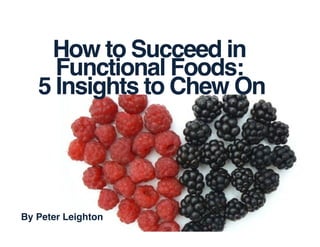
How to Succeed in!
Functional Foods:!
5 Insights to Chew On	
  
By Peter Leighton!
unctional foods & beverages have demonstrated not only their staying power as a new category of products, but
they have actually been driving growth in the food industry.!
Consumers don’t want to eat !
from their medicine cabinet.!
Successful functional products provide a
wellness benefit but they don’t masquerade as
a therapeutic. Rely on science for validation,
not as a primary selling point. For “serious”
health conditions, consumers have Rx options
that are more validated and reimbursed by
insurance.!
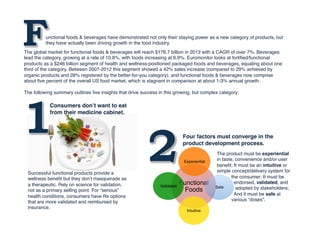
Four factors must converge in the
product development process.!
Functional
Foods! Safe!
Experiential!
Intuitive!
Validated!
The product must be experiential
in taste, convenience and/or user
benefit; It must be an intuitive or
simple concept/delivery system for
!the consumer; It must be !
! endorsed, validated, and
! adopted by stakeholders;
! And it must be safe at
!various “doses”.!
The global market for functional foods & beverages will reach $176.7 billion in 2013 with a CAGR of over 7%. Beverages
lead the category, growing at a rate of 10.8%, with foods increasing at 6.9%. Euromonitor looks at fortified/functional
products as a $246 billion segment of health and wellness-positioned packaged foods and beverages, equaling about one
third of the category. Between 2007-2012 this segment showed a 42% sales increase (compared to 29% achieved by
organic products and 28% registered by the better-for-you category), and functional foods & beverages now comprise
about five percent of the overall US food market, which is stagnant in comparison at about 1-3% annual growth.!
The following summary outlines five insights that drive success in this growing, but complex category: !
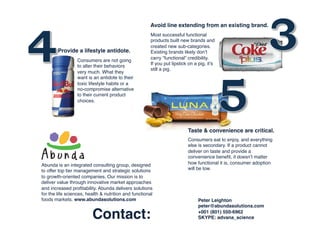
Avoid line extending from an existing brand.!
Most successful functional
products built new brands and
created new sub-categories.
Existing brands likely don’t
carry “functional” credibility. !
If you put lipstick on a pig, it’s
still a pig. !
Provide a lifestyle antidote.!
Consumers eat to enjoy, and everything
else is secondary. If a product cannot
deliver on taste and provide a
convenience benefit, it doesn’t matter
how functional it is, consumer adoption
will be low.!
Consumers are not going
to alter their behaviors
very much. What they
want is an antidote to their
toxic lifestyle habits or a
no-compromise alternative
to their current product
choices. !
Taste & convenience are critical.!
Abunda is an integrated consulting group, designed
to offer top tier management and strategic solutions
to growth-oriented companies. Our mission is to
deliver value through innovative market approaches
and increased profitability. Abunda delivers solutions
for the life sciences, health & nutrition and functional
foods markets. www.abundasolutions.com! Peter Leighton!
peter@abundasolutions.com!
+001 (801) 550-6962!
SKYPE: advana_science!Contact:!

Functional foods 5 insights

  • 1.
    How to Succeedin! Functional Foods:! 5 Insights to Chew On   By Peter Leighton!
  • 2.
    unctional foods &beverages have demonstrated not only their staying power as a new category of products, but they have actually been driving growth in the food industry.! Consumers don’t want to eat ! from their medicine cabinet.! Successful functional products provide a wellness benefit but they don’t masquerade as a therapeutic. Rely on science for validation, not as a primary selling point. For “serious” health conditions, consumers have Rx options that are more validated and reimbursed by insurance.! Four factors must converge in the product development process.! Functional Foods! Safe! Experiential! Intuitive! Validated! The product must be experiential in taste, convenience and/or user benefit; It must be an intuitive or simple concept/delivery system for !the consumer; It must be ! ! endorsed, validated, and ! adopted by stakeholders; ! And it must be safe at !various “doses”.! The global market for functional foods & beverages will reach $176.7 billion in 2013 with a CAGR of over 7%. Beverages lead the category, growing at a rate of 10.8%, with foods increasing at 6.9%. Euromonitor looks at fortified/functional products as a $246 billion segment of health and wellness-positioned packaged foods and beverages, equaling about one third of the category. Between 2007-2012 this segment showed a 42% sales increase (compared to 29% achieved by organic products and 28% registered by the better-for-you category), and functional foods & beverages now comprise about five percent of the overall US food market, which is stagnant in comparison at about 1-3% annual growth.! The following summary outlines five insights that drive success in this growing, but complex category: !
  • 3.
    Avoid line extendingfrom an existing brand.! Most successful functional products built new brands and created new sub-categories. Existing brands likely don’t carry “functional” credibility. ! If you put lipstick on a pig, it’s still a pig. ! Provide a lifestyle antidote.! Consumers eat to enjoy, and everything else is secondary. If a product cannot deliver on taste and provide a convenience benefit, it doesn’t matter how functional it is, consumer adoption will be low.! Consumers are not going to alter their behaviors very much. What they want is an antidote to their toxic lifestyle habits or a no-compromise alternative to their current product choices. ! Taste & convenience are critical.! Abunda is an integrated consulting group, designed to offer top tier management and strategic solutions to growth-oriented companies. Our mission is to deliver value through innovative market approaches and increased profitability. Abunda delivers solutions for the life sciences, health & nutrition and functional foods markets. www.abundasolutions.com! Peter Leighton! peter@abundasolutions.com! +001 (801) 550-6962! SKYPE: advana_science!Contact:!