



APAC Functional Beverage Industry: Exploring Trends, Challenges & Developments 
January 2014
2 
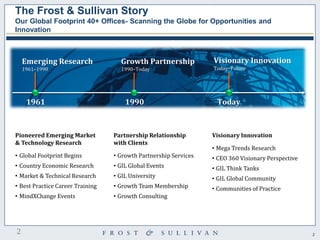
The Frost & Sullivan Story Our Global Footprint 40+ Offices- Scanning the Globe for Opportunities and Innovation 
2 
1961 
1990 
Today 
Emerging Research 
1961–1990 
Pioneered Emerging Market & Technology Research 
•Global Footprint Begins 
•Country Economic Research 
•Market & Technical Research 
•Best Practice Career Training 
•MindXChange Events 
Partnership Relationship with Clients 
•Growth Partnership Services 
•GIL Global Events 
•GIL University 
•Growth Team Membership 
•Growth Consulting 
Growth Partnership 
1990–Today 
Visionary Innovation 
Today–Future 
Visionary Innovation 
•Mega Trends Research 
•CEO 360 Visionary Perspective 
•GIL Think Tanks 
•GIL Global Community 
•Communities of Practice
3 
Chemicals, Materials & 
Foods 
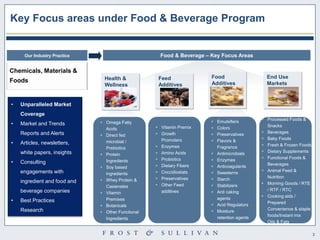
Our Industry Practice Food & Beverage – Key Focus Areas 
 Omega Fatty 
Acids 
 Direct fed 
microbial / 
Prebiotics 
 Protein 
Ingredients 
 Soy based 
ingredients 
 Whey Protein & 
Casienates 
 Vitamin 
Premixes 
 Botanicals 
 Other Functional 
Ingredients 
Health & 
Wellness 
Feed 
Additives 
Food 
Additives 
End Use 
Markets 
 Vitamin Premix 
 Growth 
Promoters 
 Enzymes 
 Amino Acids 
 Probiotics 
 Dietary Fibers 
 Coccidiostats 
 Preservatives 
 Other Feed 
additives 
 Emulsifiers 
 Colors 
 Preservatives 
 Flavors & 
Fragrance 
 Antimicrobials 
 Enzymes 
 Anticoagulants 
 Sweeterns 
 Starch 
 Stabilizers 
 Anti caking 
agents 
 Acid Regulators 
 Moisture 
retention agents 
 Processed Foods & 
Snacks 
 Beverages 
 Baby Foods 
 Fresh & Frozen Foods 
 Dietary Supplements 
 Functional Foods & 
Beverages 
 Animal Feed & 
Nutrition 
• Morning Goods / RTE 
/ RTF / RTC 
• Cooking aids / 
Prepared 
Convenience & staple 
foods/Instant mix 
• Oils & Fats 
Key Areas under Food & Beverage 
• Unparalleled Market 
Coverage 
• Market and Trends 
Reports and Alerts 
• Articles, newsletters, 
white papers, insights 
• Consulting 
engagements with 
ingredient and food and 
beverage companies 
• Best Practices 
Research 
Key Focus areas under Food & Beverage Program
4 
•Introduction— Health and Wellness Mega Trend 
•The Nutraceutical Market : Food Fortification Driving APAC Growth 
•Trend Watch: What’s HOT Globally and in APAC 
To Do List
5 
Food Safety 
Globalization and Changing Economy 
Health & Wellness 
Sustainability 
Consumer 
Seeds and Traits $43 
Agricultural Production (Includes Animal Feeds) $3,917 
Agricultural Logistics 
$646 
Food and Beverage Logistics 
$168 
Retail Grocery (Food at Home) 
$7,664 
Retail Food Service 
(Food Away From Home) 
$3,544 
Food Processing 
$4,841 
Software for Ag $2.15 
Software for Logistics $2.89 
Software for Processing $7.94 
Software for Retail 
$18.05 
Food Packaging 
$261 
Processing Equipment 
$223 
Food Additives and Supplements 
+$300 
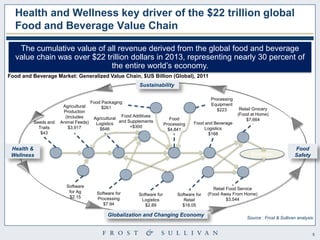
The cumulative value of all revenue derived from the global food and beverage value chain was over $22 trillion dollars in 2013, representing nearly 30 percent of the entire world’s economy. 
Food and Beverage Market: Generalized Value Chain, $US Billion (Global), 2011 
Source : Frost & Sullivan analysis. 
Health and Wellness key driver of the $22 trillion global Food and Beverage Value Chain
6 
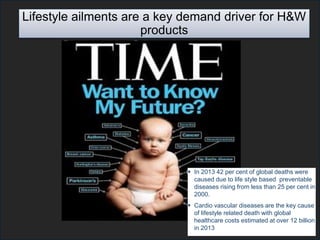
Lifestyle ailments are a key demand driver for H&W products 
In 2013 42 per cent of global deaths were caused due to life style based preventable diseases rising from less than 25 per cent in 2000. 
Cardio vascular diseases are the key cause of lifestyle related death with global healthcare costs estimated at over 12 billion in 2013
7 
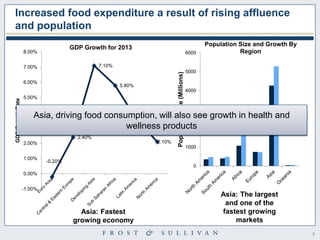
Increased food expenditure a result of rising affluence and population 
0 
1000 
2000 
3000 
4000 
5000 
6000 
Population Size (Millions) 
Population Size and Growth By Region 
2012 
2050 
Asia: The largest and one of the fastest growing markets 
-0.20% 
2.40% 
7.10% 
5.80% 
3.60% 
2.10% 
-1.00% 
0.00% 
1.00% 
2.00% 
3.00% 
4.00% 
5.00% 
6.00% 
7.00% 
8.00% 
GDP Growth Rate 
GDP Growth for 2013 
Asia: Fastest growing economy 
Food today is thus expected to perform the dual role of providing nutrition as well as preventive medication as part of the growing demand for health and wellness based food 
Asia, driving food consumption, will also see growth in health and wellness products
8 
0% 
10% 
20% 
30% 
40% 
50% 
60% 
70% 
80% 
90% 
100% 
2013 
2025 
2013 
2025 
2013 
2025 
2013 
2025 
2013 
2025 
2013 
2025 
2013 
2025 
2013 
2025 
2013 
2025 
2013 
2025 
2013 
2025 
2013 
2025 
2013 
2025 
Poor (<6K) 
Working class (6K- 29K) 
Middle Class (30K -60K) 
Upper middle Class (60K-95K) 
Rich (>96K) 
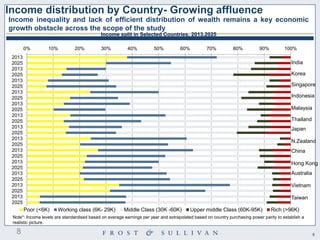
Income distribution by Country- Growing affluence 
Income inequality and lack of efficient distribution of wealth remains a key economic growth obstacle across the scope of the study 
8 
Note*: Income levels are standardised based on average earnings per year and extrapolated based on country purchasing power parity to establish a realistic picture. 
Korea 
Singapore 
Indonesia 
Malaysia 
India 
Thailand 
Japan 
N.Zealand 
China 
Hong Kong 
Australia 
Vietnam 
Taiwan 
Income split in Selected Countries, 2013,2025
9 
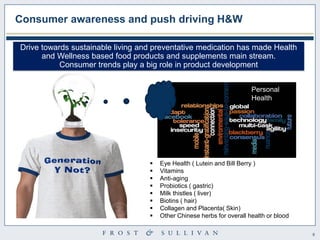
Personal Health 
Eye Health ( Lutein and Bill Berry ) 
Vitamins 
Anti-aging 
Probiotics ( gastric) 
Milk thistles ( liver) 
Biotins ( hair) 
Collagen and Placenta( Skin) 
Other Chinese herbs for overall health or blood 
Consumer awareness and push driving H&W 
Drive towards sustainable living and preventative medication has made Health and Wellness based food products and supplements main stream. 
Consumer trends play a big role in product development
10 
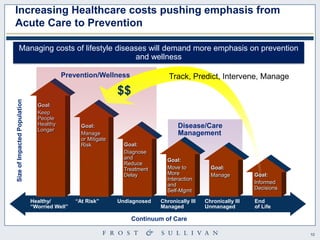
Managing costs of lifestyle diseases will demand more emphasis on prevention 
and wellness 
Disease/Care 
Management 
Healthy/ 
―Worried Well‖ 
―At Risk‖ Undiagnosed Chronically Ill 
Managed 
Chronically Ill 
Unmanaged 
End 
of Life 
Continuum of Care 
Size of Impacted Population 
Goal: 
Keep 
People 
Healthy 
Longer 
Goal: 
Manage 
or Mitigate 
Risk Goal: 
Diagnose 
and 
Reduce 
Treatment 
Delay 
Goal: 
Manage 
Goal: 
Move to 
More 
Interaction 
and 
Self-Mgmt 
Goal: 
Informed 
Decisions 
Increasing Healthcare costs pushing emphasis from 
Acute Care to Prevention 
Prevention/Wellness Track, Predict, Intervene, Manage 
$$
11 
Treating Sickness 
Move to 
Health and Wellness 
Self Care 
Diet 
& 
Nutrition 
Humor 
& 
Joy 
Lifestyle 
& Stress Reduction 
Mind 
Body & Spirit 
Exercise & Fitness 
My Health & Wellbeing Databases 
Nutraceuticals
12 
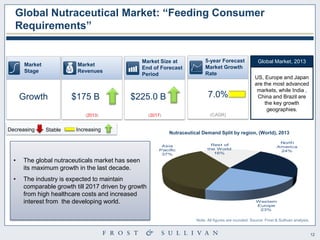
North 
America 
24% 
Western 
Europe 
23% 
Asia 
Pacific 
37% 
Rest of 
the World 
16% 
Note: All figures are rounded. Source: Frost & Sullivan analysis. 
Decreasing Stable Increasing 
Market 
Stage 
Growth 
Market 
Revenues 
$175 B 
(2013) 
Market Size at 
End of Forecast 
Period 
$225.0 B 
(2017) 
5-year Forecast 
Market Growth 
Rate 
7.0% 
(CAGR) 
US, Europe and Japan 
are the most advanced 
markets, while India , 
China and Brazil are 
the key growth 
geographies. 
Global Market, 2013 
• The global nutraceuticals market has seen 
its maximum growth in the last decade. 
• The industry is expected to maintain 
comparable growth till 2017 driven by growth 
from high healthcare costs and increased 
interest from the developing world. 
Nutraceutical Demand Split by region, (World), 2013 
Global Nutraceutical Market: ―Feeding Consumer 
Requirements‖
13 
Bakery 
Confectionery 
Dairy 
Energy Drinks 
0% 
2% 
4% 
6% 
8% 
10% 
12% 
14% 
16% 
18% 
0% 20% 40% 60% 80% 100% 
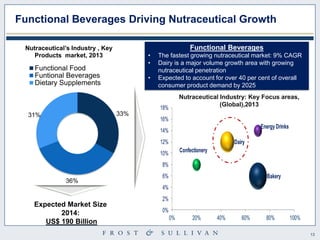
33% 
36% 
31% 
Nutraceutical’s Industry , Key 
Products market, 2013 
Functional Food 
Funtional Beverages 
Dietary Supplements 
Expected Market Size 
2014: 
US$ 190 Billion 
Functional Beverages Driving Nutraceutical Growth 
Functional Beverages 
• The fastest growing nutraceutical market: 9% CAGR 
• Dairy is a major volume growth area with growing 
nutraceutical penetration 
• Expected to account for over 40 per cent of overall 
consumer product demand by 2025 
Nutraceutical Industry: Key Focus areas, 
(Global),2013
14 
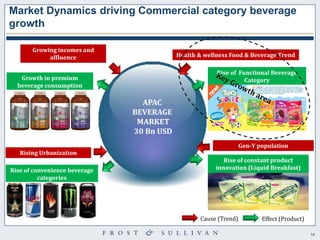
Market Dynamics driving Commercial category beverage growth 
APAC BEVERAGE MARKET 30 Bn USD 
Health & wellness Food & Beverage Trend 
Gen-Y population 
Growing incomes and affluence 
Growth in premium beverage consumption 
Rise of Functional Beverage Category 
Rise of constant product innovation (Liquid Breakfast) 
Rising Urbanization 
Rise of convenience beverage categories 
Cause (Trend) 
Effect (Product)
15 
FICCI 
Effective Global marketing Strategies and their APAC impact
16 
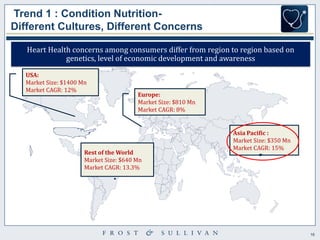
USA: Market Size: $1400 Mn Market CAGR: 12% 
Europe: 
Market Size: $810 Mn 
Market CAGR: 8% 
Trend 1 : Condition Nutrition- Different Cultures, Different Concerns 
Asia Pacific : Market Size: $350 Mn Market CAGR: 15% 
Rest of the World 
Market Size: $640 Mn 
Market CAGR: 13.3% 
Heart Health concerns among consumers differ from region to region based on genetics, level of economic development and awareness
17 
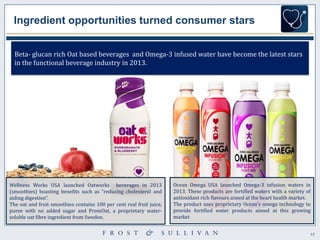
Ingredient opportunities turned consumer stars 
Wellness Works USA launched Oatworks beverages in 2013 (smoothies) boasting benefits such as “reducing cholesterol and aiding digestion”. The oat and fruit smoothies contains 100 per cent real fruit juice, puree with no added sugar and PromOat, a proprietary water- soluble oat fibre ingredient from Sweden. 
Beta- glucan rich Oat based beverages and Omega-3 infused water have become the latest stars in the functional beverage industry in 2013. 
Ocean Omega USA launched Omega-3 infusion waters in 2013. These products are fortified waters with a variety of antioxidant rich flavours aimed at the heart health market. The product uses proprietary Ocean's omega technology to provide fortified water products aimed at this growing market
18 
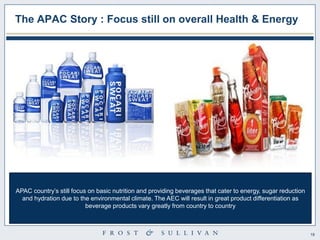
The APAC Story : Focus still on overall Health & Energy 
APAC country’s still focus on basic nutrition and providing beverages that cater to energy, sugar reduction and hydration due to the environmental climate. The AEC will result in great product differentiation as beverage products vary greatly from country to country
19 
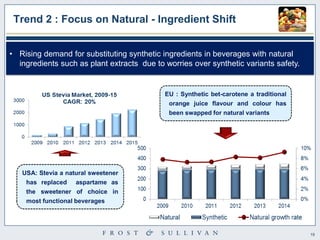
Trend 2 : Focus on Natural - Ingredient Shift 
USA: Stevia a natural sweetener has replaced aspartame as the sweetener of choice in most functional beverages 
EU : Synthetic bet-carotene a traditional orange juice flavour and colour has been swapped for natural variants 
•Rising demand for substituting synthetic ingredients in beverages with natural ingredients such as plant extracts due to worries over synthetic variants safety.
20 
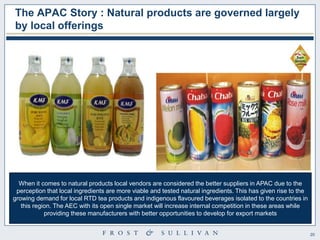
The APAC Story : Natural products are governed largely by local offerings 
When it comes to natural products local vendors are considered the better suppliers in APAC due to the perception that local ingredients are more viable and tested natural ingredients. This has given rise to the growing demand for local RTD tea products and indigenous flavoured beverages isolated to the countries in this region. The AEC with its open single market will increase internal competition in these areas while providing these manufacturers with better opportunities to develop for export markets
21 
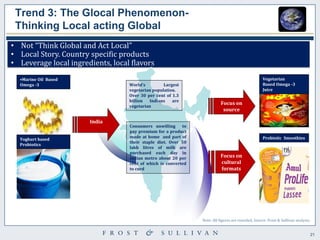
•Not “Think Global and Act Local” 
•Local Story. Country specific products 
•Leverage local ingredients, local flavors 
Note: All figures are rounded, Source: Frost & Sullivan analysis. 
Trend 3: The Glocal Phenomenon- Thinking Local acting Global 
Key Trends India Functional F&B Market 
•Marine Oil Based Omega -3 
India 
World’s Largest vegetarian population. 
Over 30 per cent of 1.3 billion Indians are vegetarian 
Focus on source 
Vegetarian Based Omega -3 Juice 
Yoghurt based Probiotics 
Consumers unwilling to pay premium for a product made at home and part of their staple diet. Over 50 lakh litres of milk are purchased each day in Indian metro about 20 per cent of which is converted to curd 
Focus on cultural formats 
Probiotic Smoothies
22 
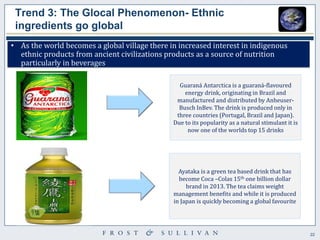
Trend 3: The Glocal Phenomenon- Ethnic ingredients go global 
•As the world becomes a global village there in increased interest in indigenous ethnic products from ancient civilizations products as a source of nutrition particularly in beverages 
Guaraná Antarctica is a guaraná-flavoured energy drink, originating in Brazil and manufactured and distributed by Anheuser- Busch InBev. The drink is produced only in three countries (Portugal, Brazil and Japan). Due to its popularity as a natural stimulant it is now one of the worlds top 15 drinks 
Ayataka is a green tea based drink that has become Coca –Colas 15th one billion dollar brand in 2013. The tea claims weight management benefits and while it is produced in Japan is quickly becoming a global favourite
23 
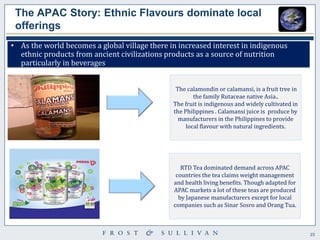
The APAC Story: Ethnic Flavours dominate local offerings 
•As the world becomes a global village there in increased interest in indigenous ethnic products from ancient civilizations products as a source of nutrition particularly in beverages 
The calamondin or calamansi, is a fruit tree in the family Rutaceae native Asia.. The fruit is indigenous and widely cultivated in the Philippines . Calamansi juice is produce by manufacturers in the Philippines to provide local flavour with natural ingredients. 
RTD Tea dominated demand across APAC countries the tea claims weight management and health living benefits. Though adapted for APAC markets a lot of these teas are produced by Japanese manufacturers except for local companies such as Sinar Sosro and Orang Tua.
24 
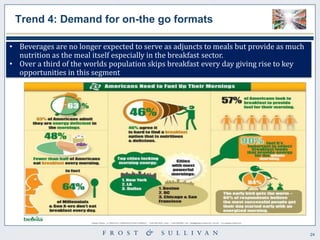
Trend 4: Demand for on-the go formats 
•Beverages are no longer expected to serve as adjuncts to meals but provide as much nutrition as the meal itself especially in the breakfast sector. 
•Over a third of the worlds population skips breakfast every day giving rise to key opportunities in this segment
25 
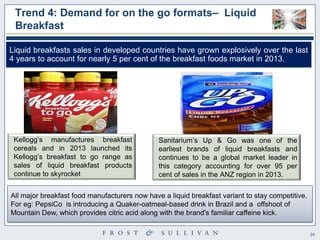
Trend 4: Demand for on the go formats– Liquid Breakfast 
Liquid breakfasts sales in developed countries have grown explosively over the last 4 years to account for nearly 5 per cent of the breakfast foods market in 2013. 
Kellogg’s manufactures breakfast cereals and in 2013 launched its Kellogg’s breakfast to go range as sales of liquid breakfast products continue to skyrocket 
Sanitarium’s Up & Go was one of the earliest brands of liquid breakfasts and continues to be a global market leader in this category accounting for over 95 per cent of sales in the ANZ region in 2013. 
All major breakfast food manufacturers now have a liquid breakfast variant to stay competitive. For eg: PepsiCo is introducing a Quaker-oatmeal-based drink in Brazil and a offshoot of Mountain Dew, which provides citric acid along with the brand's familiar caffeine kick.
26 
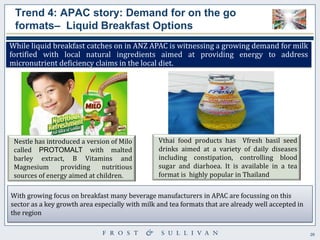
Trend 4: APAC story: Demand for on the go formats– Liquid Breakfast Options 
While liquid breakfast catches on in ANZ APAC is witnessing a growing demand for milk fortified with local natural ingredients aimed at providing energy to address micronutrient deficiency claims in the local diet. 
Nestle has introduced a version of Milo called PROTOMALT with malted barley extract, B Vitamins and Magnesium providing nutritious sources of energy aimed at children. 
Vthai food products has Vfresh basil seed drinks aimed at a variety of daily diseases including constipation, controlling blood sugar and diarhoea. It is available in a tea format is highly popular in Thailand 
With growing focus on breakfast many beverage manufacturers in APAC are focussing on this sector as a key growth area especially with milk and tea formats that are already well accepted in the region
27 
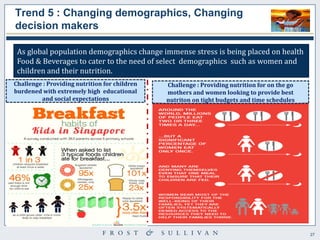
Trend 5 : Changing demographics, Changing decision makers 
As global population demographics change immense stress is being placed on health Food & Beverages to cater to the need of select demographics such as women and children and their nutrition. 
Challenge : Providing nutrition for children burdened with extremely high educational and social expectations 
Challenge : Providing nutrition for on the go mothers and women looking to provide best nutriton on tight budgets and time schedules
28 
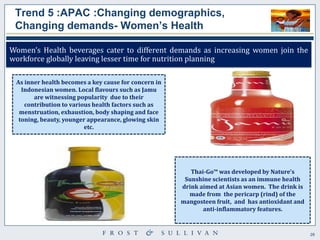
Trend 5 :APAC :Changing demographics, Changing demands- Women’s Health 
Women’s Health beverages cater to different demands as increasing women join the workforce globally leaving lesser time for nutrition planning 
As inner health becomes a key cause for concern in Indonesian women. Local flavours such as Jamu are witnessing popularity due to their contribution to various health factors such as menstruation, exhaustion, body shaping and face toning, beauty, younger appearance, glowing skin etc. 
Thai-Go™ was developed by Nature's Sunshine scientists as an immune health drink aimed at Asian women. The drink is made from the pericarp (rind) of the mangosteen fruit, and has antioxidant and anti-inflammatory features.
29 
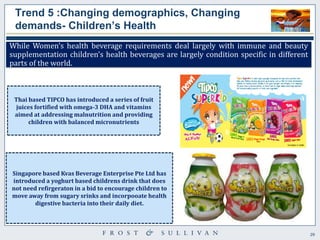
Trend 5 :Changing demographics, Changing demands- Children’s Health 
While Women’s health beverage requirements deal largely with immune and beauty supplementation children's health beverages are largely condition specific in different parts of the world. 
Thai based TIPCO has introduced a series of fruit juices fortified with omega-3 DHA and vitamins aimed at addressing malnutrition and providing children with balanced micronutrients 
Singapore based Kvas Beverage Enterprise Pte Ltd has introduced a yoghurt based childrens drink that does not need refirgeraton in a bid to encourage children to move away from sugary srinks and incorpooate health digestive bacteria into their daily diet.
30 
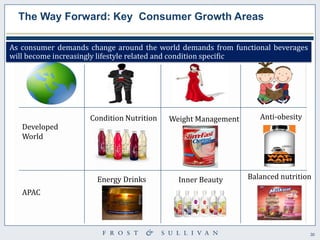
The Way Forward: Key Consumer Growth Areas 
Developed World 
Condition Nutrition 
APAC 
Energy Drinks 
Weight Management 
Inner Beauty 
Balanced nutrition 
Anti-obesity 
As consumer demands change around the world demands from functional beverages will become increasingly lifestyle related and condition specific
31 
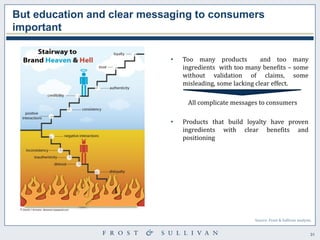
But education and clear messaging to consumers important 
•Too many products and too many ingredients with too many benefits – some without validation of claims, some misleading, some lacking clear effect. All complicate messages to consumers 
•Products that build loyalty have proven ingredients with clear benefits and positioning 
Source: Frost & Sullivan analysis.
32 
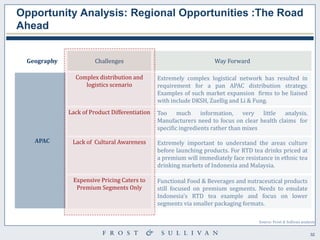
Geography 
Challenges 
Way Forward 
APAC 
Complex distribution and logistics scenario 
Extremely complex logistical network has resulted in requirement for a pan APAC distribution strategy. Examples of such market expansion firms to be liaised with include DKSH, Zuellig and Li & Fung. 
Lack of Product Differentiation 
Too much information, very little analysis. Manufacturers need to focus on clear health claims for specific ingredients rather than mixes 
Lack of Cultural Awareness 
Extremely important to understand the areas culture before launching products. For RTD tea drinks priced at a premium will immediately face resistance in ethnic tea drinking markets of Indonesia and Malaysia. 
Expensive Pricing Caters to Premium Segments Only 
Functional Food & Beverages and nutraceutical products still focused on premium segments. Needs to emulate Indonesia's RTD tea example and focus on lower segments via smaller packaging formats. 
Opportunity Analysis: Regional Opportunities :The Road Ahead 
Source: Frost & Sullivan analysis.
33 
For Additional Information 
Natasha Telles D’Costa 
Research Manager 
Chemicals, Materials and Food & Beverage Practice 
natasha.d’costa@frost.com 
Donna Jeremiah Director Corporate Communications djeremiah@frost.com

Functional Beverage Industry-Trends Challenges & Developments_2014

  • 1.
    APAC Functional BeverageIndustry: Exploring Trends, Challenges & Developments January 2014
  • 2.
    2 The Frost& Sullivan Story Our Global Footprint 40+ Offices- Scanning the Globe for Opportunities and Innovation 2 1961 1990 Today Emerging Research 1961–1990 Pioneered Emerging Market & Technology Research •Global Footprint Begins •Country Economic Research •Market & Technical Research •Best Practice Career Training •MindXChange Events Partnership Relationship with Clients •Growth Partnership Services •GIL Global Events •GIL University •Growth Team Membership •Growth Consulting Growth Partnership 1990–Today Visionary Innovation Today–Future Visionary Innovation •Mega Trends Research •CEO 360 Visionary Perspective •GIL Think Tanks •GIL Global Community •Communities of Practice
  • 3.
    3 Chemicals, Materials& Foods Our Industry Practice Food & Beverage – Key Focus Areas  Omega Fatty Acids  Direct fed microbial / Prebiotics  Protein Ingredients  Soy based ingredients  Whey Protein & Casienates  Vitamin Premixes  Botanicals  Other Functional Ingredients Health & Wellness Feed Additives Food Additives End Use Markets  Vitamin Premix  Growth Promoters  Enzymes  Amino Acids  Probiotics  Dietary Fibers  Coccidiostats  Preservatives  Other Feed additives  Emulsifiers  Colors  Preservatives  Flavors & Fragrance  Antimicrobials  Enzymes  Anticoagulants  Sweeterns  Starch  Stabilizers  Anti caking agents  Acid Regulators  Moisture retention agents  Processed Foods & Snacks  Beverages  Baby Foods  Fresh & Frozen Foods  Dietary Supplements  Functional Foods & Beverages  Animal Feed & Nutrition • Morning Goods / RTE / RTF / RTC • Cooking aids / Prepared Convenience & staple foods/Instant mix • Oils & Fats Key Areas under Food & Beverage • Unparalleled Market Coverage • Market and Trends Reports and Alerts • Articles, newsletters, white papers, insights • Consulting engagements with ingredient and food and beverage companies • Best Practices Research Key Focus areas under Food & Beverage Program
  • 4.
    4 •Introduction— Healthand Wellness Mega Trend •The Nutraceutical Market : Food Fortification Driving APAC Growth •Trend Watch: What’s HOT Globally and in APAC To Do List
  • 5.
    5 Food Safety Globalization and Changing Economy Health & Wellness Sustainability Consumer Seeds and Traits $43 Agricultural Production (Includes Animal Feeds) $3,917 Agricultural Logistics $646 Food and Beverage Logistics $168 Retail Grocery (Food at Home) $7,664 Retail Food Service (Food Away From Home) $3,544 Food Processing $4,841 Software for Ag $2.15 Software for Logistics $2.89 Software for Processing $7.94 Software for Retail $18.05 Food Packaging $261 Processing Equipment $223 Food Additives and Supplements +$300 The cumulative value of all revenue derived from the global food and beverage value chain was over $22 trillion dollars in 2013, representing nearly 30 percent of the entire world’s economy. Food and Beverage Market: Generalized Value Chain, $US Billion (Global), 2011 Source : Frost & Sullivan analysis. Health and Wellness key driver of the $22 trillion global Food and Beverage Value Chain
  • 6.
    6 Lifestyle ailmentsare a key demand driver for H&W products In 2013 42 per cent of global deaths were caused due to life style based preventable diseases rising from less than 25 per cent in 2000. Cardio vascular diseases are the key cause of lifestyle related death with global healthcare costs estimated at over 12 billion in 2013
  • 7.
    7 Increased foodexpenditure a result of rising affluence and population 0 1000 2000 3000 4000 5000 6000 Population Size (Millions) Population Size and Growth By Region 2012 2050 Asia: The largest and one of the fastest growing markets -0.20% 2.40% 7.10% 5.80% 3.60% 2.10% -1.00% 0.00% 1.00% 2.00% 3.00% 4.00% 5.00% 6.00% 7.00% 8.00% GDP Growth Rate GDP Growth for 2013 Asia: Fastest growing economy Food today is thus expected to perform the dual role of providing nutrition as well as preventive medication as part of the growing demand for health and wellness based food Asia, driving food consumption, will also see growth in health and wellness products
  • 8.
    8 0% 10% 20% 30% 40% 50% 60% 70% 80% 90% 100% 2013 2025 2013 2025 2013 2025 2013 2025 2013 2025 2013 2025 2013 2025 2013 2025 2013 2025 2013 2025 2013 2025 2013 2025 2013 2025 Poor (<6K) Working class (6K- 29K) Middle Class (30K -60K) Upper middle Class (60K-95K) Rich (>96K) Income distribution by Country- Growing affluence Income inequality and lack of efficient distribution of wealth remains a key economic growth obstacle across the scope of the study 8 Note*: Income levels are standardised based on average earnings per year and extrapolated based on country purchasing power parity to establish a realistic picture. Korea Singapore Indonesia Malaysia India Thailand Japan N.Zealand China Hong Kong Australia Vietnam Taiwan Income split in Selected Countries, 2013,2025
  • 9.
    9 Personal Health Eye Health ( Lutein and Bill Berry ) Vitamins Anti-aging Probiotics ( gastric) Milk thistles ( liver) Biotins ( hair) Collagen and Placenta( Skin) Other Chinese herbs for overall health or blood Consumer awareness and push driving H&W Drive towards sustainable living and preventative medication has made Health and Wellness based food products and supplements main stream. Consumer trends play a big role in product development
  • 10.
    10 Managing costsof lifestyle diseases will demand more emphasis on prevention and wellness Disease/Care Management Healthy/ ―Worried Well‖ ―At Risk‖ Undiagnosed Chronically Ill Managed Chronically Ill Unmanaged End of Life Continuum of Care Size of Impacted Population Goal: Keep People Healthy Longer Goal: Manage or Mitigate Risk Goal: Diagnose and Reduce Treatment Delay Goal: Manage Goal: Move to More Interaction and Self-Mgmt Goal: Informed Decisions Increasing Healthcare costs pushing emphasis from Acute Care to Prevention Prevention/Wellness Track, Predict, Intervene, Manage $$
  • 11.
    11 Treating Sickness Move to Health and Wellness Self Care Diet & Nutrition Humor & Joy Lifestyle & Stress Reduction Mind Body & Spirit Exercise & Fitness My Health & Wellbeing Databases Nutraceuticals
  • 12.
    12 North America 24% Western Europe 23% Asia Pacific 37% Rest of the World 16% Note: All figures are rounded. Source: Frost & Sullivan analysis. Decreasing Stable Increasing Market Stage Growth Market Revenues $175 B (2013) Market Size at End of Forecast Period $225.0 B (2017) 5-year Forecast Market Growth Rate 7.0% (CAGR) US, Europe and Japan are the most advanced markets, while India , China and Brazil are the key growth geographies. Global Market, 2013 • The global nutraceuticals market has seen its maximum growth in the last decade. • The industry is expected to maintain comparable growth till 2017 driven by growth from high healthcare costs and increased interest from the developing world. Nutraceutical Demand Split by region, (World), 2013 Global Nutraceutical Market: ―Feeding Consumer Requirements‖
  • 13.
    13 Bakery Confectionery Dairy Energy Drinks 0% 2% 4% 6% 8% 10% 12% 14% 16% 18% 0% 20% 40% 60% 80% 100% 33% 36% 31% Nutraceutical’s Industry , Key Products market, 2013 Functional Food Funtional Beverages Dietary Supplements Expected Market Size 2014: US$ 190 Billion Functional Beverages Driving Nutraceutical Growth Functional Beverages • The fastest growing nutraceutical market: 9% CAGR • Dairy is a major volume growth area with growing nutraceutical penetration • Expected to account for over 40 per cent of overall consumer product demand by 2025 Nutraceutical Industry: Key Focus areas, (Global),2013
  • 14.
    14 Market Dynamicsdriving Commercial category beverage growth APAC BEVERAGE MARKET 30 Bn USD Health & wellness Food & Beverage Trend Gen-Y population Growing incomes and affluence Growth in premium beverage consumption Rise of Functional Beverage Category Rise of constant product innovation (Liquid Breakfast) Rising Urbanization Rise of convenience beverage categories Cause (Trend) Effect (Product)
  • 15.
    15 FICCI EffectiveGlobal marketing Strategies and their APAC impact
  • 16.
    16 USA: MarketSize: $1400 Mn Market CAGR: 12% Europe: Market Size: $810 Mn Market CAGR: 8% Trend 1 : Condition Nutrition- Different Cultures, Different Concerns Asia Pacific : Market Size: $350 Mn Market CAGR: 15% Rest of the World Market Size: $640 Mn Market CAGR: 13.3% Heart Health concerns among consumers differ from region to region based on genetics, level of economic development and awareness
  • 17.
    17 Ingredient opportunitiesturned consumer stars Wellness Works USA launched Oatworks beverages in 2013 (smoothies) boasting benefits such as “reducing cholesterol and aiding digestion”. The oat and fruit smoothies contains 100 per cent real fruit juice, puree with no added sugar and PromOat, a proprietary water- soluble oat fibre ingredient from Sweden. Beta- glucan rich Oat based beverages and Omega-3 infused water have become the latest stars in the functional beverage industry in 2013. Ocean Omega USA launched Omega-3 infusion waters in 2013. These products are fortified waters with a variety of antioxidant rich flavours aimed at the heart health market. The product uses proprietary Ocean's omega technology to provide fortified water products aimed at this growing market
  • 18.
    18 The APACStory : Focus still on overall Health & Energy APAC country’s still focus on basic nutrition and providing beverages that cater to energy, sugar reduction and hydration due to the environmental climate. The AEC will result in great product differentiation as beverage products vary greatly from country to country
  • 19.
    19 Trend 2: Focus on Natural - Ingredient Shift USA: Stevia a natural sweetener has replaced aspartame as the sweetener of choice in most functional beverages EU : Synthetic bet-carotene a traditional orange juice flavour and colour has been swapped for natural variants •Rising demand for substituting synthetic ingredients in beverages with natural ingredients such as plant extracts due to worries over synthetic variants safety.
  • 20.
    20 The APACStory : Natural products are governed largely by local offerings When it comes to natural products local vendors are considered the better suppliers in APAC due to the perception that local ingredients are more viable and tested natural ingredients. This has given rise to the growing demand for local RTD tea products and indigenous flavoured beverages isolated to the countries in this region. The AEC with its open single market will increase internal competition in these areas while providing these manufacturers with better opportunities to develop for export markets
  • 21.
    21 •Not “ThinkGlobal and Act Local” •Local Story. Country specific products •Leverage local ingredients, local flavors Note: All figures are rounded, Source: Frost & Sullivan analysis. Trend 3: The Glocal Phenomenon- Thinking Local acting Global Key Trends India Functional F&B Market •Marine Oil Based Omega -3 India World’s Largest vegetarian population. Over 30 per cent of 1.3 billion Indians are vegetarian Focus on source Vegetarian Based Omega -3 Juice Yoghurt based Probiotics Consumers unwilling to pay premium for a product made at home and part of their staple diet. Over 50 lakh litres of milk are purchased each day in Indian metro about 20 per cent of which is converted to curd Focus on cultural formats Probiotic Smoothies
  • 22.
    22 Trend 3:The Glocal Phenomenon- Ethnic ingredients go global •As the world becomes a global village there in increased interest in indigenous ethnic products from ancient civilizations products as a source of nutrition particularly in beverages Guaraná Antarctica is a guaraná-flavoured energy drink, originating in Brazil and manufactured and distributed by Anheuser- Busch InBev. The drink is produced only in three countries (Portugal, Brazil and Japan). Due to its popularity as a natural stimulant it is now one of the worlds top 15 drinks Ayataka is a green tea based drink that has become Coca –Colas 15th one billion dollar brand in 2013. The tea claims weight management benefits and while it is produced in Japan is quickly becoming a global favourite
  • 23.
    23 The APACStory: Ethnic Flavours dominate local offerings •As the world becomes a global village there in increased interest in indigenous ethnic products from ancient civilizations products as a source of nutrition particularly in beverages The calamondin or calamansi, is a fruit tree in the family Rutaceae native Asia.. The fruit is indigenous and widely cultivated in the Philippines . Calamansi juice is produce by manufacturers in the Philippines to provide local flavour with natural ingredients. RTD Tea dominated demand across APAC countries the tea claims weight management and health living benefits. Though adapted for APAC markets a lot of these teas are produced by Japanese manufacturers except for local companies such as Sinar Sosro and Orang Tua.
  • 24.
    24 Trend 4:Demand for on-the go formats •Beverages are no longer expected to serve as adjuncts to meals but provide as much nutrition as the meal itself especially in the breakfast sector. •Over a third of the worlds population skips breakfast every day giving rise to key opportunities in this segment
  • 25.
    25 Trend 4:Demand for on the go formats– Liquid Breakfast Liquid breakfasts sales in developed countries have grown explosively over the last 4 years to account for nearly 5 per cent of the breakfast foods market in 2013. Kellogg’s manufactures breakfast cereals and in 2013 launched its Kellogg’s breakfast to go range as sales of liquid breakfast products continue to skyrocket Sanitarium’s Up & Go was one of the earliest brands of liquid breakfasts and continues to be a global market leader in this category accounting for over 95 per cent of sales in the ANZ region in 2013. All major breakfast food manufacturers now have a liquid breakfast variant to stay competitive. For eg: PepsiCo is introducing a Quaker-oatmeal-based drink in Brazil and a offshoot of Mountain Dew, which provides citric acid along with the brand's familiar caffeine kick.
  • 26.
    26 Trend 4:APAC story: Demand for on the go formats– Liquid Breakfast Options While liquid breakfast catches on in ANZ APAC is witnessing a growing demand for milk fortified with local natural ingredients aimed at providing energy to address micronutrient deficiency claims in the local diet. Nestle has introduced a version of Milo called PROTOMALT with malted barley extract, B Vitamins and Magnesium providing nutritious sources of energy aimed at children. Vthai food products has Vfresh basil seed drinks aimed at a variety of daily diseases including constipation, controlling blood sugar and diarhoea. It is available in a tea format is highly popular in Thailand With growing focus on breakfast many beverage manufacturers in APAC are focussing on this sector as a key growth area especially with milk and tea formats that are already well accepted in the region
  • 27.
    27 Trend 5: Changing demographics, Changing decision makers As global population demographics change immense stress is being placed on health Food & Beverages to cater to the need of select demographics such as women and children and their nutrition. Challenge : Providing nutrition for children burdened with extremely high educational and social expectations Challenge : Providing nutrition for on the go mothers and women looking to provide best nutriton on tight budgets and time schedules
  • 28.
    28 Trend 5:APAC :Changing demographics, Changing demands- Women’s Health Women’s Health beverages cater to different demands as increasing women join the workforce globally leaving lesser time for nutrition planning As inner health becomes a key cause for concern in Indonesian women. Local flavours such as Jamu are witnessing popularity due to their contribution to various health factors such as menstruation, exhaustion, body shaping and face toning, beauty, younger appearance, glowing skin etc. Thai-Go™ was developed by Nature's Sunshine scientists as an immune health drink aimed at Asian women. The drink is made from the pericarp (rind) of the mangosteen fruit, and has antioxidant and anti-inflammatory features.
  • 29.
    29 Trend 5:Changing demographics, Changing demands- Children’s Health While Women’s health beverage requirements deal largely with immune and beauty supplementation children's health beverages are largely condition specific in different parts of the world. Thai based TIPCO has introduced a series of fruit juices fortified with omega-3 DHA and vitamins aimed at addressing malnutrition and providing children with balanced micronutrients Singapore based Kvas Beverage Enterprise Pte Ltd has introduced a yoghurt based childrens drink that does not need refirgeraton in a bid to encourage children to move away from sugary srinks and incorpooate health digestive bacteria into their daily diet.
  • 30.
    30 The WayForward: Key Consumer Growth Areas Developed World Condition Nutrition APAC Energy Drinks Weight Management Inner Beauty Balanced nutrition Anti-obesity As consumer demands change around the world demands from functional beverages will become increasingly lifestyle related and condition specific
  • 31.
    31 But educationand clear messaging to consumers important •Too many products and too many ingredients with too many benefits – some without validation of claims, some misleading, some lacking clear effect. All complicate messages to consumers •Products that build loyalty have proven ingredients with clear benefits and positioning Source: Frost & Sullivan analysis.
  • 32.
    32 Geography Challenges Way Forward APAC Complex distribution and logistics scenario Extremely complex logistical network has resulted in requirement for a pan APAC distribution strategy. Examples of such market expansion firms to be liaised with include DKSH, Zuellig and Li & Fung. Lack of Product Differentiation Too much information, very little analysis. Manufacturers need to focus on clear health claims for specific ingredients rather than mixes Lack of Cultural Awareness Extremely important to understand the areas culture before launching products. For RTD tea drinks priced at a premium will immediately face resistance in ethnic tea drinking markets of Indonesia and Malaysia. Expensive Pricing Caters to Premium Segments Only Functional Food & Beverages and nutraceutical products still focused on premium segments. Needs to emulate Indonesia's RTD tea example and focus on lower segments via smaller packaging formats. Opportunity Analysis: Regional Opportunities :The Road Ahead Source: Frost & Sullivan analysis.
  • 33.
    33 For AdditionalInformation Natasha Telles D’Costa Research Manager Chemicals, Materials and Food & Beverage Practice natasha.d’costa@frost.com Donna Jeremiah Director Corporate Communications djeremiah@frost.com