FUNCTIONS OF MANAGEMENTFUNCTIONS OF MANAGEMENT
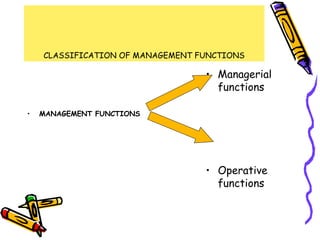
CLASSIFICATION OF MANAGEMENT FUNCTIONS
• MANAGEMENT FUNCTIONS
• Managerial
functions
• Operative
functions
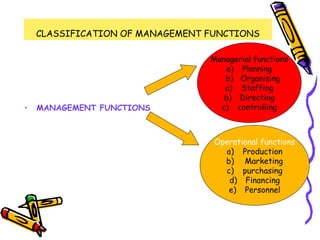
CLASSIFICATION OF MANAGEMENT FUNCTIONS
• MANAGEMENT FUNCTIONS
Managerial functions
a) Planning
b) Organising
a) Staffing
b) Directing
c) controlling
Operational functions
a) Production
b) Marketing
c) purchasing
d) Financing
e) Personnel
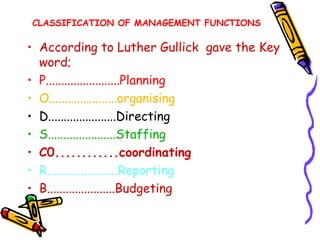
CLASSIFICATION OF MANAGEMENT FUNCTIONS
• According to Luther Gullick gave the Key
word;
• P........................Planning
• O......................organising
• D......................Directing
• S......................Staffing
• C0............coordinating
• R.......................Reporting
• B......................Budgeting
Planning
• Planning is deciding in advance what is to
be done in the future
• According to “Koontz and O ‘Donnell”
Planning is deciding in advance what to do,
how to do it, when to do it and who is to do
it. Planning bridges the gap from where we
are to where we want to go. It makes it
possible for things to occur which would
not otherwise happen”
Features of planning
• Planning seeks to achieve certain objectives.
• Planning is oriented towards the future.
• Planning is a mental exercise
• Planning involves choices from alternatives
• Planning is the basics for all other functions.
• It is a continuous function
• Planning is directed towards efficiency.
Steps in planning
• Collecting information about past
• Defining objectives
• Discovering alternative courses of action.
• Evaluating alternatives.
• Choosing the best alternatives
• Periodic revision and review of plans.
Advantages of planning
• It focuses attention on desired
objectives
• It helps to minimise risk
• It improve efficiency
• It avoid confusions
• It encourage innovation and creativity
• It enables co operation and group work
• It serves as the basis of control.
Limitations of planning
• Lack of accurate information
• Time consuming
• Expensive
• Rigidity due to strict compliance with
plans
• Unwillingness to people change
• External limitations (political )
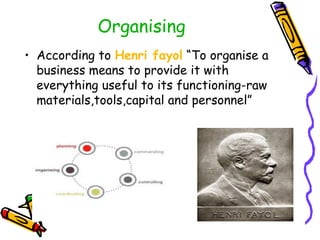
Organising
• According to Henri fayol “To organise a
business means to provide it with
everything useful to its functioning-raw
materials,tools,capital and personnel”
Steps in organising
• Identifying the activities required for
achieving objectives.
• Classifying these activities into convenient
groups
• Assigning the group of activities to
appropriate persons.
• Delegating authority and fixing
responsibilities.
• Coordinating Authority Responsibility
relationship throughout the enterprise.
Importance of organising
• Sound organisation facilitate growth and
diversification
• Optimum use of human resources by matching
work with talent
• Maintain good harmonious structure in the office
• It is a mechanism of management to direct
,controls and coordinates the activities of
enterprise.
Staffing
• It is concerned with the Human
resources of the enterprise.
• It is concerned with
acquiring,developing,utilising,and
maintaining human resources.
• It is a process of matching jobs with
individuals to ensure right man for
the right job.
Definition of staffing
• According to “Koontz and O Donnel”
“The managerial functions of staffing
involves manning the organisational
structure through proper and
effective selection, appraisal and
development of personnel to fill the
roles designed into the structure.
Steps in staffing
• Manpower planning
• Recruitment,selection,placement
• Training and development
• Appraisal ,promotion and transfer
• Employee remuneration
Importance of staffing
• It helps in discovering and obtaining
competent employees for various job.
• It improve the quantity and quality of
output by putting right man for right job.
• It improves job satisfaction of employees
• It reduces cost of personnel by avoiding
wastage of human resource.
• It facilitates the growth and
diversification.
Directing
• It is concerned with the execution of
plans through organised action.
• It is also known as commanding or
actuating
DEFINITION
• “Direction consist of the process and
techniques utilised in using
instructions and making certain that
operations are carried out as
planned”

Function of Management

  • 1.
  • 2.
    CLASSIFICATION OF MANAGEMENTFUNCTIONS • MANAGEMENT FUNCTIONS • Managerial functions • Operative functions
  • 3.
    CLASSIFICATION OF MANAGEMENTFUNCTIONS • MANAGEMENT FUNCTIONS Managerial functions a) Planning b) Organising a) Staffing b) Directing c) controlling Operational functions a) Production b) Marketing c) purchasing d) Financing e) Personnel
  • 4.
    CLASSIFICATION OF MANAGEMENTFUNCTIONS • According to Luther Gullick gave the Key word; • P........................Planning • O......................organising • D......................Directing • S......................Staffing • C0............coordinating • R.......................Reporting • B......................Budgeting
  • 5.
    Planning • Planning isdeciding in advance what is to be done in the future • According to “Koontz and O ‘Donnell” Planning is deciding in advance what to do, how to do it, when to do it and who is to do it. Planning bridges the gap from where we are to where we want to go. It makes it possible for things to occur which would not otherwise happen”
  • 6.
    Features of planning •Planning seeks to achieve certain objectives. • Planning is oriented towards the future. • Planning is a mental exercise • Planning involves choices from alternatives • Planning is the basics for all other functions. • It is a continuous function • Planning is directed towards efficiency.
  • 7.
    Steps in planning •Collecting information about past • Defining objectives • Discovering alternative courses of action. • Evaluating alternatives. • Choosing the best alternatives • Periodic revision and review of plans.
  • 8.
    Advantages of planning •It focuses attention on desired objectives • It helps to minimise risk • It improve efficiency • It avoid confusions • It encourage innovation and creativity • It enables co operation and group work • It serves as the basis of control.
  • 9.
    Limitations of planning •Lack of accurate information • Time consuming • Expensive • Rigidity due to strict compliance with plans • Unwillingness to people change • External limitations (political )
  • 10.
    Organising • According toHenri fayol “To organise a business means to provide it with everything useful to its functioning-raw materials,tools,capital and personnel”
  • 11.
    Steps in organising •Identifying the activities required for achieving objectives. • Classifying these activities into convenient groups • Assigning the group of activities to appropriate persons. • Delegating authority and fixing responsibilities. • Coordinating Authority Responsibility relationship throughout the enterprise.
  • 12.
    Importance of organising •Sound organisation facilitate growth and diversification • Optimum use of human resources by matching work with talent • Maintain good harmonious structure in the office • It is a mechanism of management to direct ,controls and coordinates the activities of enterprise.
  • 13.
    Staffing • It isconcerned with the Human resources of the enterprise. • It is concerned with acquiring,developing,utilising,and maintaining human resources. • It is a process of matching jobs with individuals to ensure right man for the right job.
  • 14.
    Definition of staffing •According to “Koontz and O Donnel” “The managerial functions of staffing involves manning the organisational structure through proper and effective selection, appraisal and development of personnel to fill the roles designed into the structure.
  • 15.
    Steps in staffing •Manpower planning • Recruitment,selection,placement • Training and development • Appraisal ,promotion and transfer • Employee remuneration
  • 16.
    Importance of staffing •It helps in discovering and obtaining competent employees for various job. • It improve the quantity and quality of output by putting right man for right job. • It improves job satisfaction of employees • It reduces cost of personnel by avoiding wastage of human resource. • It facilitates the growth and diversification.
  • 17.
    Directing • It isconcerned with the execution of plans through organised action. • It is also known as commanding or actuating
  • 18.
    DEFINITION • “Direction consistof the process and techniques utilised in using instructions and making certain that operations are carried out as planned”