MANAGEMENT
PRINCIPLES
Dr.Sonia.S
Introduction
Definition:
Harold Koontz defined as, “Management is the art of getting things done through and with people
in formally organized groups. It is the art of creating an environment in which people can perform and
individuals could cooperate towards attaining of group goals.”
George.R.Terry’s point of view, “Management is a distinct process, consisting of planning,
organizing, actuating and controlling, performed to determine and accomplish stated goals by the use of
human beings and other resources.”
NATURE/CHARACTERISTICS OF MANAGEMENT
Management is an activity. It is a process of organized activity
concerned with efficient utilization of resources of production like
men, material, machine, money etc.
Management is a purposeful activity. It is concerned with
the achievement of an objective through its functions. Objectives
may be explicit or implicit.
NATURE/CHARACTERISTICS OF MANAGEMENT
Management concerned with the efforts of a group. Management is
concerned with management of people and not the direction of things. It
motivates the workers to contribute their best.
Management is getting things done. A manager does not do any operating
work himself but gets it done through others.
NATURE/CHARACTERISTICS OF MANAGEMENT
Management applies economic principles. Management is the art
of applying the economic principles that underlie a control of men and
materials in the enterprise under consideration.
Management involves decision-making. It is a decision-making
process and the decisions are involved in all the functions of
management.
NATURE/CHARACTERISTICS OF MANAGEMENT
Management coordinates all activities and resources. It is concerned
with coordination of all activities and resources to attain the specific
objectives.
Management is a universal activity. The techniques and tools of
management are universally applicable.
Management is an integrating process. It integrates the men, materials
and machines for achieving stated objectives.
NATURE/CHARACTERISTICS OF MANAGEMENT
Management is concerned with direction and control. It is concerned with
direction and control of human efforts to attain the specific objectives.
Management is intangible. It is abstract and cannot be seen. It is
evidenced by the quality of organization and through its results.
Management is both science and an art. Management has certain
universally applicable principles, laws etc. Hence, it is a science. It is
also an art, because it is concerned with application of knowledge for the
solution of organizational problems.
NATURE/CHARACTERISTICS OF MANAGEMENT
Management is a profession. It is becoming a profession because there is
established principles of management which being applied in practice.
Management is an inter-disciplinary approach. Management as a body of
discipline takes the help or other social science like psychology, sociology,
engineering, economics, mathematics etc.
Management is dynamic and not static. Management adopts itself to the
social changes and also introduces innovation in methodology.
SCOPE OF MANAGEMENT
• Production Management
• Marketing Management
• Financial Management
• Personnel Management
SCOPE OF MANAGEMENT
Production Management. Production function so as to produce the right goods in right quantity
at the right time and at the right cost. It consists of the following activities.
• Designing the product
• Location and layout of plant and building
• Operations of purchase and storage of materials
• Planning and control of factory operations
• Repairs and maintenance
• Inventory control and quality control
• Research and development etc.
SCOPE OF MANAGEMENT
Marketing Management. It refers to the identification of consumer’s needs and supplying them
the goods and services, which can satisfy those, wants. The activities are as follows:
• Marketing Research to determine the needs and expectations of consumers
• Planning and developing suitable products
• Setting appropriate prices
• Selecting the right channels of distribution
• Promotional activities like advertising and salesmanship to communicate with the
customers.
SCOPE OF MANAGEMENT
Financial Management. Financial management seeks to ensure the right
amount and type of funds to business at the right time and at reasonable
cost. The activities are as follows:
• Estimate the volume of funds requires for long term and short term
needs of business
• Selecting the appropriate sources of funds
• Raising the required funds at the right time
• Ensuring proper utilization and allocation of raised funds
• Administration of earnings.
SCOPE OF MANAGEMENT
Personnel Management. It involves planning, organizing, directing and controlling the
procurement, development, compensation, maintenance etc. of the human resources in an
enterprise. It consists of the following activities:
• Manpower planning
• Recruitment
• Selection
• Training and Development
• Performance Appraisal
• Compensation and promotion
• Employee services and benefits
• Maintaining personnel records etc.
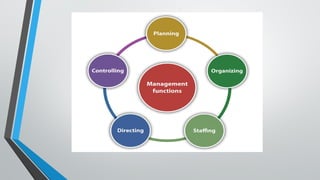
Management Functions
• The Management function comprises coordination, reporting, and
budgeting, and hence the controlling function can be broken into
these three separate functions. Based upon these seven functions,
Luther Gulick coined the word POSDCORB, which generally
represents the initials of these seven functions i.e. P stands for
Planning, O for Organizing, S for Staffing, D for Directing, Co for
Co-ordination, R for reporting & B for Budgeting.
Management Functions
• Planning
Planning is future-oriented and determines an organization’s direction. It is a
rational and systematic way of making decisions today that will affect the future
of the company. It is a kind of organized foresight as well as corrective
hindsight. It involves predicting of the future as well as attempting to control
the events. It involves the ability to foresee the effects of current actions in the
long run in the future.
Management Functions
• An effective planning program incorporates the effect of both external as well
as internal factors. The external factors are shortages of resources; both
capital and material, general economic trend as far as interest rates and
inflation are concerned, dynamic technological advancements, increased
governmental regulation regarding community interests, unstable
international political environments, etc.
• The internal factors that affect planning are limited growth opportunities due
to saturation requiring diversification, changing patterns of the workforce,
more complex organizational structures, decentralization, etc
Management Functions
Organizing
• Organizing requires a formal structure of authority and the
direction and flow of such authority through which work
subdivisions are defined, arranged and coordinated so that each
part
relates to the other part in a united and coherent manner so as to
attain the prescribed objectives.
According to Henry Fayol, “To organize a business is to provide it
with everything useful or its functioning i.e. raw material, tools,
capital and personnel’s”.
Management Functions
The function of organizing involves the determination of activities that need to
be done in order to reach the company goals, assigning these activities to the
proper personnel, and delegating the necessary authority to carry out these
activities in a coordinated and cohesive manner.
Management Functions
The function of organizing is concerned with:
1.Identifying the tasks that must be performed and grouping them whenever
necessary
2.Assigning these tasks to the personnel while defining their authority and
responsibility.
3.Delegating this authority to these employees
4.Establishing a relationship between authority and responsibility
5.Coordinating these activities
Management Functions
Staffing
• Staffing is the function of hiring and retaining a suitable work-force for the
enterprise both at managerial as well as non-managerial levels. It involves
the process of recruiting, training, developing, compensating and evaluating
employees and maintaining this workforce with proper incentives and
motivations. Since the human element is the most vital factor in the process
of management, it is important to recruit the right personnel.
Management Functions
According to Kootz & O’Donnell, “Managerial function of staffing involves
manning the organization structure through the proper and effective
selection, appraisal & development of personnel to fill the roles designed in
the structure”.
Management Functions
• Directing
The directing function is concerned with leadership, communication, motivation,
and supervision so that the employees perform their activities in the most efficient
manner possible, in order to achieve the desired goals.
The leadership element involves issuing of instructions and guiding the
subordinates about procedures and methods.
Management Functions
• The communication must be open both ways so that the information can be
passed on to the subordinates and the feedback received from them.
• Motivation is very important since highly motivated people show excellent
performance with less direction from superiors.
Management Functions
Controlling
• The function of control consists of those activities that are undertaken to
ensure that the events do not deviate from the pre-arranged plans. The
activities consist of establishing standards for work performance, measuring
performance and comparing it to these set standards and taking corrective
actions as and when needed, to correct any deviations.
Management Functions
According to Koontz & O’Donnell, “Controlling is the measurement &
correction of performance activities of subordinates in order to make sure
that the enterprise objectives and plans desired to obtain them as being
accomplished”.
The controlling function involves:
a. Establishment of standard performance.
b. Measurement of actual performance.
c. Measuring actual performance with the pre-determined standard and finding
out the deviations.
d. Taking corrective action.
Management Functions
Reporting
• A clear report keeps communication open throughout the entire organisation.
Managers are the linking pin between the management team and their own
employees, who form the constituency.
• Reporting provides insight into the progress and agreements can also be
recorded in this way. Other essential information—such as problems with
employees, new processes, performances interviews and sales figures—is
also made transparent through reporting. Involved parties can also quickly
find archived reports.
Management Functions
Budgeting
• Finance is the lifeblood of any organization. The manager is
responsible for the management, expenditure and control of the
department’s budget and also has to keep an eye on tax details.
• In addition to employee wages, it is the task of the manager to
also properly monitor other expenditures such as materials and
investments. If wasteful spending, overruns, errors or even fraud
are discovered, the manager is responsible for taking action.
LEVELS OF MANAGEMENT
In every company, there is a managerial hierarchy or chain of
command, which consists of several levels of authority. The
number of management levels may differ from company to
company. In a big company the management levels may be
classified into three categories viz.
Top management
Middle management
Supervisory or Operating management
LEVELS OF MANAGEMENT
Top Management. Top management consists of the board of Directors and
the chief executives. Chief executives may be an individual, for example,
Managing Director, General Manager etc., or a group of chairman and
functional executive Directors. Board of directors is accountable to the
shareholders in the annual general meetings of the company. The chief
executive is concerned with the overall management of the company’s
operations. He maintains coordination among different departments/sections
of the company. He also keeps the organizations in harmony with its external
environment.
LEVELS OF MANAGEMENT
Functions
• To analyse and interpret changes in the external environment of the company
• To establish long term corporate plans (goals, policies and strategies) of the company
• To formulate and approve the master budget and departmental budgets
• To design board organization structure
• To appoint departmental heads and key executives
• To provide overall direction and leadership to the company
• To represent the company to the outside world
• To decide the distribution of profits.
LEVELS OF MANAGEMENT
Middle Management
Intermediate Management. Intermediate/upper middle management
comprises departmental or divisional heads. For example, Marketing
Manager, Production Manager, etc. It is also known as departmental or
functional Management. Each divisional or departmental heads are
the overall in charge of their respective division/department. He
performs the usual managerial functions of planning, organizing, staffing,
directing, and controlling in relation to one department.
LEVELS OF MANAGEMENT
Lower middle Management. Lower middle management levels consist of
sectional heads. For example, plant manager, sales manager, branch
manager etc. These executives serve as a link between intermediate or top
management and the operating management.
LEVELS OF MANAGEMENT
Functions of Middle Management
• To interpret and explain the plans and policies formulated by top management
• To monitor and control the operating performance
• To train, motivate and develop supervisory personnel
• To lay down rules and regulations to be followed by supervisory personnel.
LEVELS OF MANAGEMENT
Supervisory/Operating Management. This is the lowest or first level of
management in an organization. It consists of supervisors, foremen, sales
officers, accounts officer, purchase officer etc. They maintain close contacts
with the ranks and white colour workers and supervise day to-day
operations. They serve as the channel of communication between
management and the workforce. They are concerned with the mechanics of
jobs.
LEVELS OF MANAGEMENT
Functions
• To plan day-to-day production within goals laid down by higher officials
• To assign jobs to workers and to make arrangements for their training and
development
• To issue orders and instructions
• To supervise and control workers’ operations and to maintain personal contact with
them
• To arrange materials and tools and to maintain machinery
• To advise and assist workers by explaining work procedures, solving their problems
• To maintain discipline and good human relations among workers
• To report feedback information and workers’ problems to the higher authorities.
LEVELS OF MANAGEMENT
SKILLS OF MANAGERS
By managerial skills, we mean the skills or qualities desired in managers, the possession of which
would enable to act as practicing managers. Following three broad types of managerial skills are very
essential for managers.
• Technical skills
• Human skill or Behavioral skills
• Conceptual skills
LEVELS OF MANAGEMENT
Technical Skills: Technical skills refer to the skill and knowledge, which is
required for performing an operational activity, in the best manner.
Technical skill is an imperative skill for managers at the lower level of
management; because it is actually these people who guide and supervise work
operators under their subordination. For example, mechanics work with tools,
and their supervisors should have the ability to teach them how to use these
tools. Similarly, the teacher, who, before, imparting teaching to pupils in a
particular discipline, must be an expert in that discipline.
LEVELS OF MANAGEMENT
Human Skills or Behavioural Skills. The basic responsibility of every manager is to get
things done by others. In this process, managers need human skills. Human skills refer to
those abilities, which are needed by the manager to effectively deal with subordinates. To
manage, he has to understand their needs, interests and values. He interacts with them,
guides, directs, leads, and motivates them.
LEVELS OF MANAGEMENT
Conceptual Skills. Conceptual skill comprise the ability to see the whole organization and the
inter relationships between its parts. These skills refer to the ability to visualize the entire
picture or to consider a situation in its totality. Such skills help the manager to
conceptualize the environment, to analyse the forces working in a situation and to take a
broad and farsighted view of the organization. Conceptual skills also include the competence to
understand a problem in all its aspects to use original thinking in solving the problem. Such
competence is necessary for rational decision-making.
• Conceptual skill is imperative for top management level, necessary for the middle
management and desirable for the lower level of management.
ROLE OF MANAGERS
• Interpersonal Roles
• Figure head
• Leader
• Liaison
• Informational Roles
• Monitor
• Disseminator
• Spokesman
• Decisional Roles
• Entrepreneur
• Disturbance handler
• Resource allocator
• Negotiator
ROLE OF MANAGERS
Figure head
In this role a manager performs symbolic duties required by the status of his office.
Making speeches, bestowing honors, welcoming official visitors, distributing gifts to retiring
employees are examples of such ceremonial and social duties.
Leader
This role defines the manager relationship with his own subordinates. The manager sets an
example, legitimizes the power of subordinates and brings their needs in accord with those of his
organization.
Liaison
It describes a manager’s relationship with the outsiders. A manager maintain mutually
beneficial relation with other organizations, governments, industry groups, etc.
ROLE OF MANAGERS
Monitor
It implies seeking and receiving information about his organization and external events. An
example is picking up rumors about his organization.
Disseminator
It involves transmitting information and judgments to the members of the organization. The
information relates to internal operations and the external environment. A manager calling
a staff meeting after a business trip is an example of such a role.
Spokesman
In this role, a manager speaks for his organization. He lobbies and defends his enterprise. A
manager addressing the trade union is an example.
ROLE OF MANAGERS
Entrepreneur
•It involves initiating change or acting as a change agent. For example, a manager decides to launch a
feasibility study for setting up a new plant.
Disturbance handler
•This refers to taking charge when the organization faces a problem or crisis. For example, a strike, a feud
between subordinates loss of an important customer. A manager handles conflicts, complaints and
competitive actions.
Resource allocator
•In this role a manager approves budgets and schedules, sets priorities and distributes resources.
Negotiator
•As a negotiator, a manager bargain with suppliers, dealers, trade union, agents, etc. For example, the
manager may negotiate with the union leaders regarding strike issues.

MANAGEMENT PRINCIPLES INTRODUCTION NOTES

  • 1.
  • 2.
    Introduction Definition: Harold Koontz definedas, “Management is the art of getting things done through and with people in formally organized groups. It is the art of creating an environment in which people can perform and individuals could cooperate towards attaining of group goals.” George.R.Terry’s point of view, “Management is a distinct process, consisting of planning, organizing, actuating and controlling, performed to determine and accomplish stated goals by the use of human beings and other resources.”
  • 3.
    NATURE/CHARACTERISTICS OF MANAGEMENT Managementis an activity. It is a process of organized activity concerned with efficient utilization of resources of production like men, material, machine, money etc. Management is a purposeful activity. It is concerned with the achievement of an objective through its functions. Objectives may be explicit or implicit.
  • 4.
    NATURE/CHARACTERISTICS OF MANAGEMENT Managementconcerned with the efforts of a group. Management is concerned with management of people and not the direction of things. It motivates the workers to contribute their best. Management is getting things done. A manager does not do any operating work himself but gets it done through others.
  • 5.
    NATURE/CHARACTERISTICS OF MANAGEMENT Managementapplies economic principles. Management is the art of applying the economic principles that underlie a control of men and materials in the enterprise under consideration. Management involves decision-making. It is a decision-making process and the decisions are involved in all the functions of management.
  • 6.
    NATURE/CHARACTERISTICS OF MANAGEMENT Managementcoordinates all activities and resources. It is concerned with coordination of all activities and resources to attain the specific objectives. Management is a universal activity. The techniques and tools of management are universally applicable. Management is an integrating process. It integrates the men, materials and machines for achieving stated objectives.
  • 7.
    NATURE/CHARACTERISTICS OF MANAGEMENT Managementis concerned with direction and control. It is concerned with direction and control of human efforts to attain the specific objectives. Management is intangible. It is abstract and cannot be seen. It is evidenced by the quality of organization and through its results. Management is both science and an art. Management has certain universally applicable principles, laws etc. Hence, it is a science. It is also an art, because it is concerned with application of knowledge for the solution of organizational problems.
  • 8.
    NATURE/CHARACTERISTICS OF MANAGEMENT Managementis a profession. It is becoming a profession because there is established principles of management which being applied in practice. Management is an inter-disciplinary approach. Management as a body of discipline takes the help or other social science like psychology, sociology, engineering, economics, mathematics etc. Management is dynamic and not static. Management adopts itself to the social changes and also introduces innovation in methodology.
  • 9.
    SCOPE OF MANAGEMENT •Production Management • Marketing Management • Financial Management • Personnel Management
  • 10.
    SCOPE OF MANAGEMENT ProductionManagement. Production function so as to produce the right goods in right quantity at the right time and at the right cost. It consists of the following activities. • Designing the product • Location and layout of plant and building • Operations of purchase and storage of materials • Planning and control of factory operations • Repairs and maintenance • Inventory control and quality control • Research and development etc.
  • 11.
    SCOPE OF MANAGEMENT MarketingManagement. It refers to the identification of consumer’s needs and supplying them the goods and services, which can satisfy those, wants. The activities are as follows: • Marketing Research to determine the needs and expectations of consumers • Planning and developing suitable products • Setting appropriate prices • Selecting the right channels of distribution • Promotional activities like advertising and salesmanship to communicate with the customers.
  • 12.
    SCOPE OF MANAGEMENT FinancialManagement. Financial management seeks to ensure the right amount and type of funds to business at the right time and at reasonable cost. The activities are as follows: • Estimate the volume of funds requires for long term and short term needs of business • Selecting the appropriate sources of funds • Raising the required funds at the right time • Ensuring proper utilization and allocation of raised funds • Administration of earnings.
  • 13.
    SCOPE OF MANAGEMENT PersonnelManagement. It involves planning, organizing, directing and controlling the procurement, development, compensation, maintenance etc. of the human resources in an enterprise. It consists of the following activities: • Manpower planning • Recruitment • Selection • Training and Development • Performance Appraisal • Compensation and promotion • Employee services and benefits • Maintaining personnel records etc.
  • 15.
    Management Functions • TheManagement function comprises coordination, reporting, and budgeting, and hence the controlling function can be broken into these three separate functions. Based upon these seven functions, Luther Gulick coined the word POSDCORB, which generally represents the initials of these seven functions i.e. P stands for Planning, O for Organizing, S for Staffing, D for Directing, Co for Co-ordination, R for reporting & B for Budgeting.
  • 16.
    Management Functions • Planning Planningis future-oriented and determines an organization’s direction. It is a rational and systematic way of making decisions today that will affect the future of the company. It is a kind of organized foresight as well as corrective hindsight. It involves predicting of the future as well as attempting to control the events. It involves the ability to foresee the effects of current actions in the long run in the future.
  • 17.
    Management Functions • Aneffective planning program incorporates the effect of both external as well as internal factors. The external factors are shortages of resources; both capital and material, general economic trend as far as interest rates and inflation are concerned, dynamic technological advancements, increased governmental regulation regarding community interests, unstable international political environments, etc. • The internal factors that affect planning are limited growth opportunities due to saturation requiring diversification, changing patterns of the workforce, more complex organizational structures, decentralization, etc
  • 18.
    Management Functions Organizing • Organizingrequires a formal structure of authority and the direction and flow of such authority through which work subdivisions are defined, arranged and coordinated so that each part relates to the other part in a united and coherent manner so as to attain the prescribed objectives. According to Henry Fayol, “To organize a business is to provide it with everything useful or its functioning i.e. raw material, tools, capital and personnel’s”.
  • 19.
    Management Functions The functionof organizing involves the determination of activities that need to be done in order to reach the company goals, assigning these activities to the proper personnel, and delegating the necessary authority to carry out these activities in a coordinated and cohesive manner.
  • 20.
    Management Functions The functionof organizing is concerned with: 1.Identifying the tasks that must be performed and grouping them whenever necessary 2.Assigning these tasks to the personnel while defining their authority and responsibility. 3.Delegating this authority to these employees 4.Establishing a relationship between authority and responsibility 5.Coordinating these activities
  • 21.
    Management Functions Staffing • Staffingis the function of hiring and retaining a suitable work-force for the enterprise both at managerial as well as non-managerial levels. It involves the process of recruiting, training, developing, compensating and evaluating employees and maintaining this workforce with proper incentives and motivations. Since the human element is the most vital factor in the process of management, it is important to recruit the right personnel.
  • 22.
    Management Functions According toKootz & O’Donnell, “Managerial function of staffing involves manning the organization structure through the proper and effective selection, appraisal & development of personnel to fill the roles designed in the structure”.
  • 23.
    Management Functions • Directing Thedirecting function is concerned with leadership, communication, motivation, and supervision so that the employees perform their activities in the most efficient manner possible, in order to achieve the desired goals. The leadership element involves issuing of instructions and guiding the subordinates about procedures and methods.
  • 24.
    Management Functions • Thecommunication must be open both ways so that the information can be passed on to the subordinates and the feedback received from them. • Motivation is very important since highly motivated people show excellent performance with less direction from superiors.
  • 25.
    Management Functions Controlling • Thefunction of control consists of those activities that are undertaken to ensure that the events do not deviate from the pre-arranged plans. The activities consist of establishing standards for work performance, measuring performance and comparing it to these set standards and taking corrective actions as and when needed, to correct any deviations.
  • 26.
    Management Functions According toKoontz & O’Donnell, “Controlling is the measurement & correction of performance activities of subordinates in order to make sure that the enterprise objectives and plans desired to obtain them as being accomplished”. The controlling function involves: a. Establishment of standard performance. b. Measurement of actual performance. c. Measuring actual performance with the pre-determined standard and finding out the deviations. d. Taking corrective action.
  • 27.
    Management Functions Reporting • Aclear report keeps communication open throughout the entire organisation. Managers are the linking pin between the management team and their own employees, who form the constituency. • Reporting provides insight into the progress and agreements can also be recorded in this way. Other essential information—such as problems with employees, new processes, performances interviews and sales figures—is also made transparent through reporting. Involved parties can also quickly find archived reports.
  • 28.
    Management Functions Budgeting • Financeis the lifeblood of any organization. The manager is responsible for the management, expenditure and control of the department’s budget and also has to keep an eye on tax details. • In addition to employee wages, it is the task of the manager to also properly monitor other expenditures such as materials and investments. If wasteful spending, overruns, errors or even fraud are discovered, the manager is responsible for taking action.
  • 29.
    LEVELS OF MANAGEMENT Inevery company, there is a managerial hierarchy or chain of command, which consists of several levels of authority. The number of management levels may differ from company to company. In a big company the management levels may be classified into three categories viz. Top management Middle management Supervisory or Operating management
  • 30.
    LEVELS OF MANAGEMENT TopManagement. Top management consists of the board of Directors and the chief executives. Chief executives may be an individual, for example, Managing Director, General Manager etc., or a group of chairman and functional executive Directors. Board of directors is accountable to the shareholders in the annual general meetings of the company. The chief executive is concerned with the overall management of the company’s operations. He maintains coordination among different departments/sections of the company. He also keeps the organizations in harmony with its external environment.
  • 31.
    LEVELS OF MANAGEMENT Functions •To analyse and interpret changes in the external environment of the company • To establish long term corporate plans (goals, policies and strategies) of the company • To formulate and approve the master budget and departmental budgets • To design board organization structure • To appoint departmental heads and key executives • To provide overall direction and leadership to the company • To represent the company to the outside world • To decide the distribution of profits.
  • 32.
    LEVELS OF MANAGEMENT MiddleManagement Intermediate Management. Intermediate/upper middle management comprises departmental or divisional heads. For example, Marketing Manager, Production Manager, etc. It is also known as departmental or functional Management. Each divisional or departmental heads are the overall in charge of their respective division/department. He performs the usual managerial functions of planning, organizing, staffing, directing, and controlling in relation to one department.
  • 33.
    LEVELS OF MANAGEMENT Lowermiddle Management. Lower middle management levels consist of sectional heads. For example, plant manager, sales manager, branch manager etc. These executives serve as a link between intermediate or top management and the operating management.
  • 34.
    LEVELS OF MANAGEMENT Functionsof Middle Management • To interpret and explain the plans and policies formulated by top management • To monitor and control the operating performance • To train, motivate and develop supervisory personnel • To lay down rules and regulations to be followed by supervisory personnel.
  • 35.
    LEVELS OF MANAGEMENT Supervisory/OperatingManagement. This is the lowest or first level of management in an organization. It consists of supervisors, foremen, sales officers, accounts officer, purchase officer etc. They maintain close contacts with the ranks and white colour workers and supervise day to-day operations. They serve as the channel of communication between management and the workforce. They are concerned with the mechanics of jobs.
  • 36.
    LEVELS OF MANAGEMENT Functions •To plan day-to-day production within goals laid down by higher officials • To assign jobs to workers and to make arrangements for their training and development • To issue orders and instructions • To supervise and control workers’ operations and to maintain personal contact with them • To arrange materials and tools and to maintain machinery • To advise and assist workers by explaining work procedures, solving their problems • To maintain discipline and good human relations among workers • To report feedback information and workers’ problems to the higher authorities.
  • 37.
    LEVELS OF MANAGEMENT SKILLSOF MANAGERS By managerial skills, we mean the skills or qualities desired in managers, the possession of which would enable to act as practicing managers. Following three broad types of managerial skills are very essential for managers. • Technical skills • Human skill or Behavioral skills • Conceptual skills
  • 38.
    LEVELS OF MANAGEMENT TechnicalSkills: Technical skills refer to the skill and knowledge, which is required for performing an operational activity, in the best manner. Technical skill is an imperative skill for managers at the lower level of management; because it is actually these people who guide and supervise work operators under their subordination. For example, mechanics work with tools, and their supervisors should have the ability to teach them how to use these tools. Similarly, the teacher, who, before, imparting teaching to pupils in a particular discipline, must be an expert in that discipline.
  • 39.
    LEVELS OF MANAGEMENT HumanSkills or Behavioural Skills. The basic responsibility of every manager is to get things done by others. In this process, managers need human skills. Human skills refer to those abilities, which are needed by the manager to effectively deal with subordinates. To manage, he has to understand their needs, interests and values. He interacts with them, guides, directs, leads, and motivates them.
  • 40.
    LEVELS OF MANAGEMENT ConceptualSkills. Conceptual skill comprise the ability to see the whole organization and the inter relationships between its parts. These skills refer to the ability to visualize the entire picture or to consider a situation in its totality. Such skills help the manager to conceptualize the environment, to analyse the forces working in a situation and to take a broad and farsighted view of the organization. Conceptual skills also include the competence to understand a problem in all its aspects to use original thinking in solving the problem. Such competence is necessary for rational decision-making. • Conceptual skill is imperative for top management level, necessary for the middle management and desirable for the lower level of management.
  • 41.
    ROLE OF MANAGERS •Interpersonal Roles • Figure head • Leader • Liaison • Informational Roles • Monitor • Disseminator • Spokesman • Decisional Roles • Entrepreneur • Disturbance handler • Resource allocator • Negotiator
  • 42.
    ROLE OF MANAGERS Figurehead In this role a manager performs symbolic duties required by the status of his office. Making speeches, bestowing honors, welcoming official visitors, distributing gifts to retiring employees are examples of such ceremonial and social duties. Leader This role defines the manager relationship with his own subordinates. The manager sets an example, legitimizes the power of subordinates and brings their needs in accord with those of his organization. Liaison It describes a manager’s relationship with the outsiders. A manager maintain mutually beneficial relation with other organizations, governments, industry groups, etc.
  • 43.
    ROLE OF MANAGERS Monitor Itimplies seeking and receiving information about his organization and external events. An example is picking up rumors about his organization. Disseminator It involves transmitting information and judgments to the members of the organization. The information relates to internal operations and the external environment. A manager calling a staff meeting after a business trip is an example of such a role. Spokesman In this role, a manager speaks for his organization. He lobbies and defends his enterprise. A manager addressing the trade union is an example.
  • 44.
    ROLE OF MANAGERS Entrepreneur •Itinvolves initiating change or acting as a change agent. For example, a manager decides to launch a feasibility study for setting up a new plant. Disturbance handler •This refers to taking charge when the organization faces a problem or crisis. For example, a strike, a feud between subordinates loss of an important customer. A manager handles conflicts, complaints and competitive actions. Resource allocator •In this role a manager approves budgets and schedules, sets priorities and distributes resources. Negotiator •As a negotiator, a manager bargain with suppliers, dealers, trade union, agents, etc. For example, the manager may negotiate with the union leaders regarding strike issues.