Talent management
BY
DEEPIKA SOROUT
ASSISTANT PROFESSOR
ADVANCED EDUCATIONAL INSTITUTIONS
www.advanced.edu.in
In recent years, talent management has become a
priority for organizations worldwide due to a
shortage in skilled staff, particularly managers.
www.advanced.edu.in
Flow of The PPT
• Meaning of talent management
• Evolution of talent management
• Elements of talent management
• Strategic importance of talent management
• Process of talent management
• Conclusion
www.advanced.edu.in
Talent management
What is Talent?
Talent is the sum of a person’s abilities, his or her
intrinsic gifts, skills, knowledge, experience ,
intelligence, judgment, attitude, character, drive and
his or her ability to learn and grow.
www.advanced.edu.in
Hence ,Talent Management
“ The ability, competency and power of employees within
an organization. The concept is not restricted to recruiting
but also to exploration, development, transition according
to the culture of the organization.”
“ It is a continuous process that involves sourcing, hiring,
developing, retaining and promoting them while meeting
the organization’s requirements simultaneously.”
www.advanced.edu.in
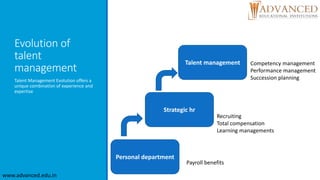
Evolution of
talent
management
Talent Management Evolution offers a
unique combination of experience and
expertise
www.advanced.edu.in
Personal department
Strategic hr
Talent management
Payroll benefits
Recruiting
Total compensation
Learning managements
Competency management
Performance management
Succession planning
Elements of talent management
www.advanced.edu.in
•Employee Development
This must include the manager/team leader who has been adequately
prepared to coach employees/team members to master the essential
skills of the job, particularly the “soft” skills which are often overlooked.
•Performance Management
Begin by creating a safe environment where employees can learn from
their mistakes. Then, provide ongoing feedback—do not wait for the
typical annual performance review.
Continued…
•Career Development
The most effective career development process considers the
talents and motivators of the individual, which ideally would have
been discovered in the selection process.
•Succession Planning
An effective succession plan is integrated with the strategic
requirement of the organization that considers how the stages of
growth will be managed.
www.advanced.edu.in
Strategic Importance of talent
management
• Consideration to the revenue, innovation and organization
effectiveness.
• Cost of lost opportunities, downtime and the replacement costs of
losing critical talent must be analyzed.
• Consequences of wrong kind of managers in the leaders top
management position.
• Investment in talent management is not short term.
• Talent Management is strategic and holistic approach to both HR
and business planning. Continue
www.advanced.edu.in
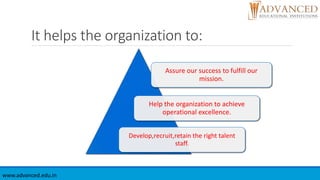
It helps the organization to:
Assure our success to fulfill our
mission.
Help the organization to achieve
operational excellence.
Develop,recruit,retain the right talent
staff.
www.advanced.edu.in
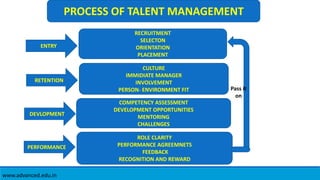
RECRUITMENT
SELECTON
ORIENTATION
PLACEMENT
CULTURE
IMMIDIATE MANAGER
INVOLVEMENT
PERSON- ENVIRONMENT FIT
COMPETENCY ASSESSMENT
DEVELOPMENT OPPORTUNITIES
MENTORING
CHALLENGES
ROLE CLARITY
PERFORMANCE AGREEMNETS
FEEDBACK
RECOGNITION AND REWARD
PROCESS OF TALENT MANAGEMENT
PERFORMANCE
ENTRY
RETENTION
DEVLOPMENT
Pass it
on
www.advanced.edu.in
Conclusion
www.advanced.edu.in
Talent Management" has become one of the most important
buzzwords in Corporate HR and training today. Organizations
know that they must have the best talent in order to succeed in
the hypercompetitive and increasingly complex global economy.
They must manage talent as a critical resource to achieve the best
possible results in the long run.
DEEPIKA SOROUT
deepusorout@gmail.com
Assistant Professor
Advanced Educational Institutions
Advanced Educational Institutions,
70 km Milestone,
Delhi-Mathura Road, Dist. Palwal, Haryana-121105
+91–1275–398400, 302222
www.advanced.edu.in
www.advanced.edu.in

Talent Management

  • 1.
    Talent management BY DEEPIKA SOROUT ASSISTANTPROFESSOR ADVANCED EDUCATIONAL INSTITUTIONS www.advanced.edu.in
  • 2.
    In recent years,talent management has become a priority for organizations worldwide due to a shortage in skilled staff, particularly managers. www.advanced.edu.in
  • 3.
    Flow of ThePPT • Meaning of talent management • Evolution of talent management • Elements of talent management • Strategic importance of talent management • Process of talent management • Conclusion www.advanced.edu.in
  • 4.
    Talent management What isTalent? Talent is the sum of a person’s abilities, his or her intrinsic gifts, skills, knowledge, experience , intelligence, judgment, attitude, character, drive and his or her ability to learn and grow. www.advanced.edu.in
  • 5.
    Hence ,Talent Management “The ability, competency and power of employees within an organization. The concept is not restricted to recruiting but also to exploration, development, transition according to the culture of the organization.” “ It is a continuous process that involves sourcing, hiring, developing, retaining and promoting them while meeting the organization’s requirements simultaneously.” www.advanced.edu.in
  • 6.
    Evolution of talent management Talent ManagementEvolution offers a unique combination of experience and expertise www.advanced.edu.in Personal department Strategic hr Talent management Payroll benefits Recruiting Total compensation Learning managements Competency management Performance management Succession planning
  • 7.
    Elements of talentmanagement www.advanced.edu.in •Employee Development This must include the manager/team leader who has been adequately prepared to coach employees/team members to master the essential skills of the job, particularly the “soft” skills which are often overlooked. •Performance Management Begin by creating a safe environment where employees can learn from their mistakes. Then, provide ongoing feedback—do not wait for the typical annual performance review.
  • 8.
    Continued… •Career Development The mosteffective career development process considers the talents and motivators of the individual, which ideally would have been discovered in the selection process. •Succession Planning An effective succession plan is integrated with the strategic requirement of the organization that considers how the stages of growth will be managed. www.advanced.edu.in
  • 9.
    Strategic Importance oftalent management • Consideration to the revenue, innovation and organization effectiveness. • Cost of lost opportunities, downtime and the replacement costs of losing critical talent must be analyzed. • Consequences of wrong kind of managers in the leaders top management position. • Investment in talent management is not short term. • Talent Management is strategic and holistic approach to both HR and business planning. Continue www.advanced.edu.in
  • 10.
    It helps theorganization to: Assure our success to fulfill our mission. Help the organization to achieve operational excellence. Develop,recruit,retain the right talent staff. www.advanced.edu.in
  • 11.
    RECRUITMENT SELECTON ORIENTATION PLACEMENT CULTURE IMMIDIATE MANAGER INVOLVEMENT PERSON- ENVIRONMENTFIT COMPETENCY ASSESSMENT DEVELOPMENT OPPORTUNITIES MENTORING CHALLENGES ROLE CLARITY PERFORMANCE AGREEMNETS FEEDBACK RECOGNITION AND REWARD PROCESS OF TALENT MANAGEMENT PERFORMANCE ENTRY RETENTION DEVLOPMENT Pass it on www.advanced.edu.in
  • 12.
    Conclusion www.advanced.edu.in Talent Management" hasbecome one of the most important buzzwords in Corporate HR and training today. Organizations know that they must have the best talent in order to succeed in the hypercompetitive and increasingly complex global economy. They must manage talent as a critical resource to achieve the best possible results in the long run.
  • 13.
    DEEPIKA SOROUT deepusorout@gmail.com Assistant Professor AdvancedEducational Institutions Advanced Educational Institutions, 70 km Milestone, Delhi-Mathura Road, Dist. Palwal, Haryana-121105 +91–1275–398400, 302222 www.advanced.edu.in www.advanced.edu.in