
1
STAFFING
2
Human Resource Management
The integration of all processes, programs,
and systems in an organization that ensure
staff are acquired and used in an effective way
3
Human Resource Management (Contd.)
HR is multidisciplinary: It applies the disciplines of
Economics (wages, markets, resources),
Psychology (motivation, satisfaction),
Sociology (organization structure, culture) and
Law (min. wage, labor contracts)
What HR Professionals Do?
HR planning
Recruitment & Selection
Training and development
Compensation & Performance review
Labor relations
4
Human Resource Planning
Assessing Future
Human Resource
Needs
Assessing Current
Human Resources
Developing a
Program to Meet
Needs
5
Human Resource Planning
The process of systematically
reviewing HR requirements to ensure
that the required number of employees,
with the required skills, are available
when they are needed
6
HR Planning
We have found the gap, how do we fill this void?
Internal Labour Supply
Skill Inventory
Succession Planning
Replacement Planning
– Inventory Chart
• Present & Future staffing situations
• Helps in retention & expulsion strategy
External Labour Supply
7
Job Analysis
(Functional Job Analysis, Position analysis questionnaire)
A Basic Human Resource Management Tool
Tasks Responsibilities Duties
Job
Analysis
Job
Descriptions
Job
Specifications
Knowledge Skills Abilities
Human Resource
Planning
Recruitment
Selection
Training and
Development
Performance Appraisal
Compensation and
Benefits
Safety and Health
Employee and Labor
Relations
Legal Considerations
Job Analysis for Teams
8
Definitions
Job - Consists of a group of tasks that must be performed for
an organization to achieve its goals
Position - Collection of tasks and responsibilities performed
by one person; there is a position for every individual in an
organization
Job analysis - Systematic process of determining the skills,
duties, and knowledge required for performing jobs in an
organization (functional job analysis , position analysis
questionnaire)
Analysis of the performance of the work .
Job description – document providing information regarding
tasks, duties, and responsibilities of job
Job specification – minimum qualifications to perform a
particular job
9
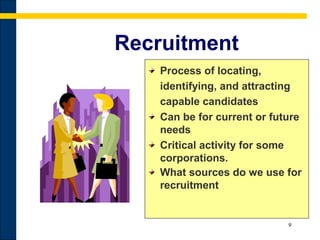
Recruitment
Process of locating,
identifying, and attracting
capable candidates
Can be for current or future
needs
Critical activity for some
corporations.
What sources do we use for
recruitment
10
Sources of Recruitment
11
Recruitment
Sources
Internal
Searches
Employee
Referrals
Voluntary
Applicants
Employment
Agencies Advertisements
School
Placement
12
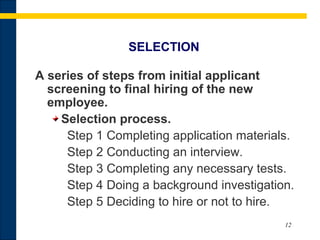
SELECTION
A series of steps from initial applicant
screening to final hiring of the new
employee.
Selection process.
Step 1 Completing application materials.
Step 2 Conducting an interview.
Step 3 Completing any necessary tests.
Step 4 Doing a background investigation.
Step 5 Deciding to hire or not to hire.
13
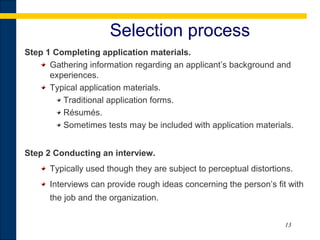
Selection process
Step 1 Completing application materials.
Gathering information regarding an applicant’s background and
experiences.
Typical application materials.
Traditional application forms.
Résumés.
Sometimes tests may be included with application materials.
Step 2 Conducting an interview.
Typically used though they are subject to perceptual distortions.
Interviews can provide rough ideas concerning the person’s fit with
the job and the organization.
14
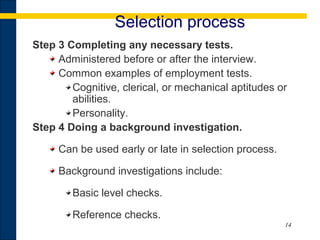
Selection process
Step 3 Completing any necessary tests.
Administered before or after the interview.
Common examples of employment tests.
Cognitive, clerical, or mechanical aptitudes or
abilities.
Personality.
Step 4 Doing a background investigation.
Can be used early or late in selection process.
Background investigations include:
Basic level checks.
Reference checks.
15
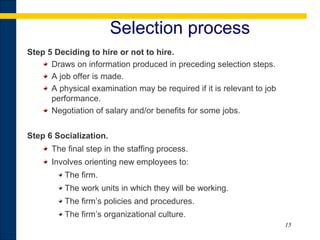
Selection process
Step 5 Deciding to hire or not to hire.
Draws on information produced in preceding selection steps.
A job offer is made.
A physical examination may be required if it is relevant to job
performance.
Negotiation of salary and/or benefits for some jobs.
Step 6 Socialization.
The final step in the staffing process.
Involves orienting new employees to:
The firm.
The work units in which they will be working.
The firm’s policies and procedures.
The firm’s organizational culture.
16
Performance Appraisal
17
Performance Appraisal
The identification, measurement,
and management of human
performance in organizations.
18
Why Conduct Performance Appraisals?
Make decisions about that person's future
with the organization
Identify training requirements
Employee improvement
Pay, promotion, and other personnel
decisions
Research
Validation of selection techniques and criteria
19
A Model of Performance Appraisal
Skills/Activities/Output
Performance Appraisal System
Reward/Training/Punishment
20
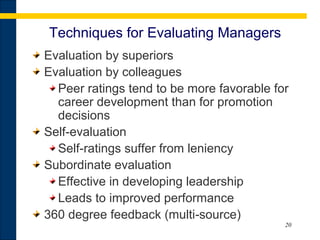
Techniques for Evaluating Managers
Evaluation by superiors
Evaluation by colleagues
Peer ratings tend to be more favorable for
career development than for promotion
decisions
Self evaluation‑
Self ratings suffer from leniency‑
Subordinate evaluation
Effective in developing leadership
Leads to improved performance
360 degree feedback (multi source)‑
21
360° Feedback
The combination of peer,
subordinate, and self-review
22
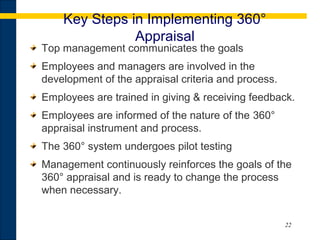
Key Steps in Implementing 360°
Appraisal
Top management communicates the goals
Employees and managers are involved in the
development of the appraisal criteria and process.
Employees are trained in giving & receiving feedback.
Employees are informed of the nature of the 360°
appraisal instrument and process.
The 360° system undergoes pilot testing
Management continuously reinforces the goals of the
360° appraisal and is ready to change the process
when necessary.
23
Measurement Tools
24
Relative and Absolute Judgment
An appraisal format that asks supervisors to
compare an employee's performance to the
performance of other employees doing the same
job.
Relative Judgment
An appraisal format that asks supervisors to make
judgments about an employee’s performance
based solely on performance standards.
Absolute Judgment
25
Rating Methods
Performance rating scales
Supervisors indicate how or to what degree a worker possesses a
relevant job characteristic
Ranking technique
Supervisors list the workers in order from highest to lowest
Paired comparison technique‑
Compares the performance of each worker with that of every other
person in the group
Forced choice technique
Raters are presented with groups of descriptive statements and are
asked to select the phrase in each group that is most descriptive
of the worker being evaluated
26
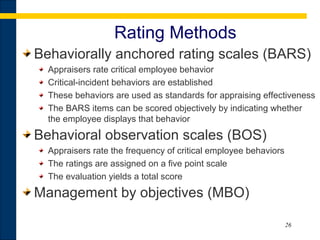
Rating Methods
Behaviorally anchored rating scales (BARS)
Appraisers rate critical employee behavior
Critical incident behaviors are established‑
These behaviors are used as standards for appraising effectiveness
The BARS items can be scored objectively by indicating whether
the employee displays that behavior
Behavioral observation scales (BOS)
Appraisers rate the frequency of critical employee behaviors
The ratings are assigned on a five point scale
The evaluation yields a total score
Management by objectives (MBO)
27
Appraising Managers as Managers
28
Organizational Change
29
Concept of Organizational Change
Defined as adoption of a new idea or behavior
by an organization.
Organizations need to continuously adapt to
new situations if they are to survive and
prosper
30
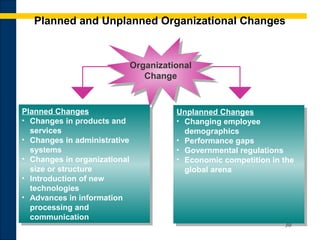
Planned and Unplanned Organizational Changes
Planned Changes
• Changes in products and
services
• Changes in administrative
systems
• Changes in organizational
size or structure
• Introduction of new
technologies
• Advances in information
processing and
communication
Planned Changes
• Changes in products and
services
• Changes in administrative
systems
• Changes in organizational
size or structure
• Introduction of new
technologies
• Advances in information
processing and
communication
Unplanned Changes
• Changing employee
demographics
• Performance gaps
• Governmental regulations
• Economic competition in the
global arena
Unplanned Changes
• Changing employee
demographics
• Performance gaps
• Governmental regulations
• Economic competition in the
global arena
Organizational
Change
31
Forces ForForces For
ChangeChange
WorkforceWorkforce
CompetitionCompetition
WorldWorld
PoliticsPolitics
TechnologyTechnology
SocialSocial
TrendsTrends
EconomicEconomic
ShocksShocks
32
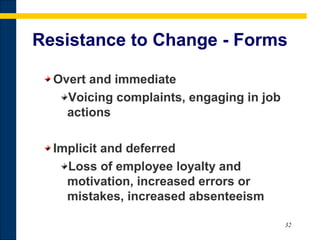
Resistance to Change - Forms
Overt and immediate
Voicing complaints, engaging in job
actions
Implicit and deferred
Loss of employee loyalty and
motivation, increased errors or
mistakes, increased absenteeism
33
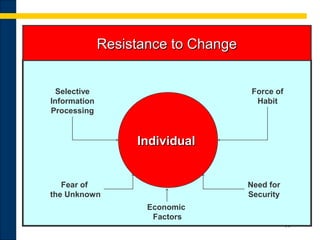
Resistance to ChangeResistance to Change
Selective
Information
Processing
Fear of
the Unknown
Force of
Habit
Need for
Security
Economic
Factors
IndividualIndividual
34
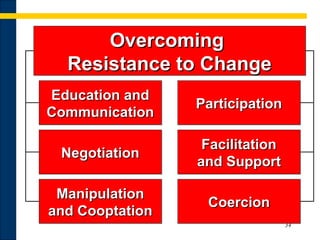
Education andEducation and
CommunicationCommunication
Education andEducation and
CommunicationCommunication
ParticipationParticipationParticipationParticipation
NegotiationNegotiationNegotiationNegotiation
FacilitationFacilitation
and Supportand Support
FacilitationFacilitation
and Supportand Support
CoercionCoercionCoercionCoercion
ManipulationManipulation
and Cooptationand Cooptation
ManipulationManipulation
and Cooptationand Cooptation
OvercomingOvercoming
Resistance to ChangeResistance to Change
OvercomingOvercoming
Resistance to ChangeResistance to Change
35
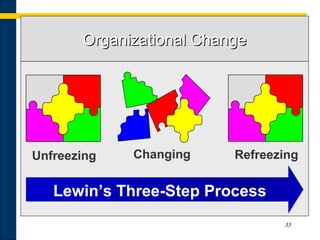
Unfreezing Changing Refreezing
Lewin’s Three-Step Process
Organizational ChangeOrganizational Change
36
Unfreezing the Status QuoUnfreezing the Status QuoUnfreezing the Status QuoUnfreezing the Status Quo
Desired
State
Status
Quo
Restraining
Forces
Driving
Forces
Time
37
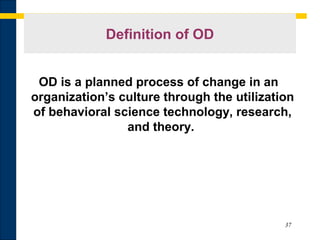
Definition of OD
OD is a planned process of change in an
organization’s culture through the utilization
of behavioral science technology, research,
and theory.
38
Organization Development is...
a systemwide application and transfer of
behavioral science knowledge to the
planned development, improvement, and
reinforcement of the strategies, structures,
and processes that lead to organization
effectiveness.
39
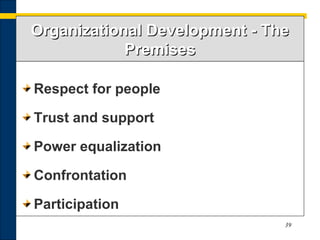
Organizational Development - TheOrganizational Development - The
PremisesPremises
Respect for people
Trust and support
Power equalization
Confrontation
Participation
40
.
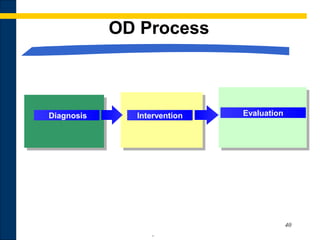
OD Process
Diagnosis Intervention Evaluation
41
OD InterventionsOD Interventions
Intergroup development
Process consultation
Sensitivity training
Third Party Intervention
Survey feedback
Team building
Culture Change
42
Manager Development
On the Job Training
Planned Progression
Job Rotation
Creation of “assistant-to”
Temporary promotion
Committees
Off the Job
Training
Conference
MDPs
Business Simulations
43
Organizational Conflicts
44
Sources of Conflict
Competition for scarce resources
Time pressure
Unreasonable standards, policies, rules or
procedures
Communication breakdowns
Personality clashes
Ambiguous or overlapping jurisdictions
Unrealized expectations
45
Managing Conflicts
Avoidance
Problem solving
Compromise
Forcing
Smoothing
Structural change
46
LEADING

Staffing - management

  • 1.
  • 2.
    2 Human Resource Management Theintegration of all processes, programs, and systems in an organization that ensure staff are acquired and used in an effective way
  • 3.
    3 Human Resource Management(Contd.) HR is multidisciplinary: It applies the disciplines of Economics (wages, markets, resources), Psychology (motivation, satisfaction), Sociology (organization structure, culture) and Law (min. wage, labor contracts) What HR Professionals Do? HR planning Recruitment & Selection Training and development Compensation & Performance review Labor relations
  • 4.
    4 Human Resource Planning AssessingFuture Human Resource Needs Assessing Current Human Resources Developing a Program to Meet Needs
  • 5.
    5 Human Resource Planning Theprocess of systematically reviewing HR requirements to ensure that the required number of employees, with the required skills, are available when they are needed
  • 6.
    6 HR Planning We havefound the gap, how do we fill this void? Internal Labour Supply Skill Inventory Succession Planning Replacement Planning – Inventory Chart • Present & Future staffing situations • Helps in retention & expulsion strategy External Labour Supply
  • 7.
    7 Job Analysis (Functional JobAnalysis, Position analysis questionnaire) A Basic Human Resource Management Tool Tasks Responsibilities Duties Job Analysis Job Descriptions Job Specifications Knowledge Skills Abilities Human Resource Planning Recruitment Selection Training and Development Performance Appraisal Compensation and Benefits Safety and Health Employee and Labor Relations Legal Considerations Job Analysis for Teams
  • 8.
    8 Definitions Job - Consistsof a group of tasks that must be performed for an organization to achieve its goals Position - Collection of tasks and responsibilities performed by one person; there is a position for every individual in an organization Job analysis - Systematic process of determining the skills, duties, and knowledge required for performing jobs in an organization (functional job analysis , position analysis questionnaire) Analysis of the performance of the work . Job description – document providing information regarding tasks, duties, and responsibilities of job Job specification – minimum qualifications to perform a particular job
  • 9.
    9 Recruitment Process of locating, identifying,and attracting capable candidates Can be for current or future needs Critical activity for some corporations. What sources do we use for recruitment
  • 10.
  • 11.
  • 12.
    12 SELECTION A series ofsteps from initial applicant screening to final hiring of the new employee. Selection process. Step 1 Completing application materials. Step 2 Conducting an interview. Step 3 Completing any necessary tests. Step 4 Doing a background investigation. Step 5 Deciding to hire or not to hire.
  • 13.
    13 Selection process Step 1Completing application materials. Gathering information regarding an applicant’s background and experiences. Typical application materials. Traditional application forms. Résumés. Sometimes tests may be included with application materials. Step 2 Conducting an interview. Typically used though they are subject to perceptual distortions. Interviews can provide rough ideas concerning the person’s fit with the job and the organization.
  • 14.
    14 Selection process Step 3Completing any necessary tests. Administered before or after the interview. Common examples of employment tests. Cognitive, clerical, or mechanical aptitudes or abilities. Personality. Step 4 Doing a background investigation. Can be used early or late in selection process. Background investigations include: Basic level checks. Reference checks.
  • 15.
    15 Selection process Step 5Deciding to hire or not to hire. Draws on information produced in preceding selection steps. A job offer is made. A physical examination may be required if it is relevant to job performance. Negotiation of salary and/or benefits for some jobs. Step 6 Socialization. The final step in the staffing process. Involves orienting new employees to: The firm. The work units in which they will be working. The firm’s policies and procedures. The firm’s organizational culture.
  • 16.
  • 17.
    17 Performance Appraisal The identification,measurement, and management of human performance in organizations.
  • 18.
    18 Why Conduct PerformanceAppraisals? Make decisions about that person's future with the organization Identify training requirements Employee improvement Pay, promotion, and other personnel decisions Research Validation of selection techniques and criteria
  • 19.
    19 A Model ofPerformance Appraisal Skills/Activities/Output Performance Appraisal System Reward/Training/Punishment
  • 20.
    20 Techniques for EvaluatingManagers Evaluation by superiors Evaluation by colleagues Peer ratings tend to be more favorable for career development than for promotion decisions Self evaluation‑ Self ratings suffer from leniency‑ Subordinate evaluation Effective in developing leadership Leads to improved performance 360 degree feedback (multi source)‑
  • 21.
    21 360° Feedback The combinationof peer, subordinate, and self-review
  • 22.
    22 Key Steps inImplementing 360° Appraisal Top management communicates the goals Employees and managers are involved in the development of the appraisal criteria and process. Employees are trained in giving & receiving feedback. Employees are informed of the nature of the 360° appraisal instrument and process. The 360° system undergoes pilot testing Management continuously reinforces the goals of the 360° appraisal and is ready to change the process when necessary.
  • 23.
  • 24.
    24 Relative and AbsoluteJudgment An appraisal format that asks supervisors to compare an employee's performance to the performance of other employees doing the same job. Relative Judgment An appraisal format that asks supervisors to make judgments about an employee’s performance based solely on performance standards. Absolute Judgment
  • 25.
    25 Rating Methods Performance ratingscales Supervisors indicate how or to what degree a worker possesses a relevant job characteristic Ranking technique Supervisors list the workers in order from highest to lowest Paired comparison technique‑ Compares the performance of each worker with that of every other person in the group Forced choice technique Raters are presented with groups of descriptive statements and are asked to select the phrase in each group that is most descriptive of the worker being evaluated
  • 26.
    26 Rating Methods Behaviorally anchoredrating scales (BARS) Appraisers rate critical employee behavior Critical incident behaviors are established‑ These behaviors are used as standards for appraising effectiveness The BARS items can be scored objectively by indicating whether the employee displays that behavior Behavioral observation scales (BOS) Appraisers rate the frequency of critical employee behaviors The ratings are assigned on a five point scale The evaluation yields a total score Management by objectives (MBO)
  • 27.
  • 28.
  • 29.
    29 Concept of OrganizationalChange Defined as adoption of a new idea or behavior by an organization. Organizations need to continuously adapt to new situations if they are to survive and prosper
  • 30.
    30 Planned and UnplannedOrganizational Changes Planned Changes • Changes in products and services • Changes in administrative systems • Changes in organizational size or structure • Introduction of new technologies • Advances in information processing and communication Planned Changes • Changes in products and services • Changes in administrative systems • Changes in organizational size or structure • Introduction of new technologies • Advances in information processing and communication Unplanned Changes • Changing employee demographics • Performance gaps • Governmental regulations • Economic competition in the global arena Unplanned Changes • Changing employee demographics • Performance gaps • Governmental regulations • Economic competition in the global arena Organizational Change
  • 31.
  • 32.
    32 Resistance to Change- Forms Overt and immediate Voicing complaints, engaging in job actions Implicit and deferred Loss of employee loyalty and motivation, increased errors or mistakes, increased absenteeism
  • 33.
    33 Resistance to ChangeResistanceto Change Selective Information Processing Fear of the Unknown Force of Habit Need for Security Economic Factors IndividualIndividual
  • 34.
    34 Education andEducation and CommunicationCommunication EducationandEducation and CommunicationCommunication ParticipationParticipationParticipationParticipation NegotiationNegotiationNegotiationNegotiation FacilitationFacilitation and Supportand Support FacilitationFacilitation and Supportand Support CoercionCoercionCoercionCoercion ManipulationManipulation and Cooptationand Cooptation ManipulationManipulation and Cooptationand Cooptation OvercomingOvercoming Resistance to ChangeResistance to Change OvercomingOvercoming Resistance to ChangeResistance to Change
  • 35.
    35 Unfreezing Changing Refreezing Lewin’sThree-Step Process Organizational ChangeOrganizational Change
  • 36.
    36 Unfreezing the StatusQuoUnfreezing the Status QuoUnfreezing the Status QuoUnfreezing the Status Quo Desired State Status Quo Restraining Forces Driving Forces Time
  • 37.
    37 Definition of OD ODis a planned process of change in an organization’s culture through the utilization of behavioral science technology, research, and theory.
  • 38.
    38 Organization Development is... asystemwide application and transfer of behavioral science knowledge to the planned development, improvement, and reinforcement of the strategies, structures, and processes that lead to organization effectiveness.
  • 39.
    39 Organizational Development -TheOrganizational Development - The PremisesPremises Respect for people Trust and support Power equalization Confrontation Participation
  • 40.
  • 41.
    41 OD InterventionsOD Interventions Intergroupdevelopment Process consultation Sensitivity training Third Party Intervention Survey feedback Team building Culture Change
  • 42.
    42 Manager Development On theJob Training Planned Progression Job Rotation Creation of “assistant-to” Temporary promotion Committees Off the Job Training Conference MDPs Business Simulations
  • 43.
  • 44.
    44 Sources of Conflict Competitionfor scarce resources Time pressure Unreasonable standards, policies, rules or procedures Communication breakdowns Personality clashes Ambiguous or overlapping jurisdictions Unrealized expectations
  • 45.
  • 46.