PXRD AND RIETVELD REFINEMENT
By Saurav Chandra Sarma and Dundappa Mumbaraddi
Solid State and Inorganic Chemistry Lab, NCU,
JNCASR
What Rietveld can do..???
• Analysis of the whole diffraction pattern.
• Phase purity and identification.
• Refinement of the structure parameters from diffraction data.
• Quantitative phase analysis.
• Lattice parameters.
• Atomic positions and Occupancies.
• Isotropic and anisotropic thermal vibrations.
• Grain size and micro-strain calculation.
• Magnetic moments (Neutron diffraction).
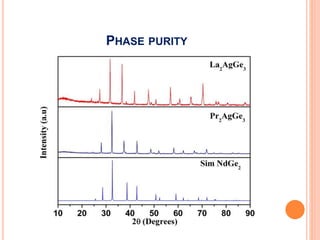
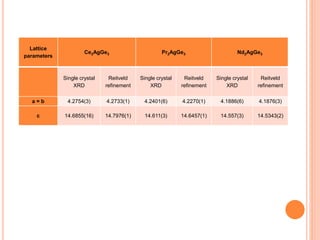
PHASE PURITY
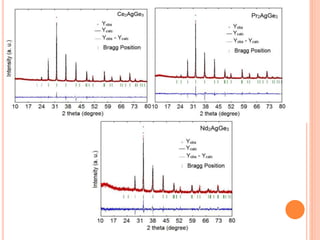
Lattice
parameters
Ce2AgGe3 Pr2AgGe3 Nd2AgGe3
Single crystal
XRD
Reitveld
refinement
Single crystal
XRD
Reitveld
refinement
Single crystal
XRD
Reitveld
refinement
a = b 4.2754(3) 4.2733(1) 4.2401(6) 4.2270(1) 4.1886(6) 4.1876(3)
c 14.6855(16) 14.7976(1) 14.611(3) 14.6457(1) 14.557(3) 14.5343(2)
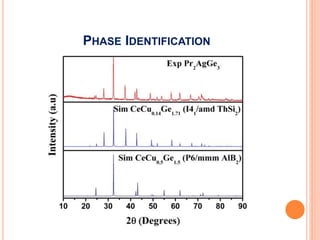
PHASE IDENTIFICATION
What Rietveld can do..???
• Analysis of the whole diffraction pattern.
• Phase purity and identification.
• Refinement of the structure parameters from diffraction data.
• Quantitative phase analysis.
• Lattice parameters.
• Atomic positions and Occupancies.
• Isotropic and anisotropic thermal vibrations.
• Grain size and micro-strain calculation.
• Magnetic moments (Neutron diffraction).
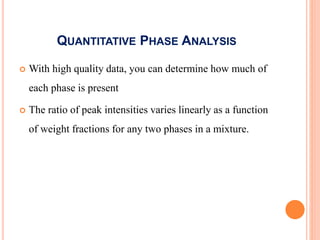
QUANTITATIVE PHASE ANALYSIS
 With high quality data, you can determine how much of
each phase is present
 The ratio of peak intensities varies linearly as a function
of weight fractions for any two phases in a mixture.
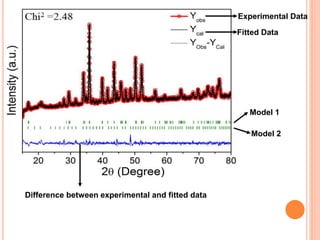
Experimental Data
Fitted Data
Model 1
Model 2
Difference between experimental and fitted data
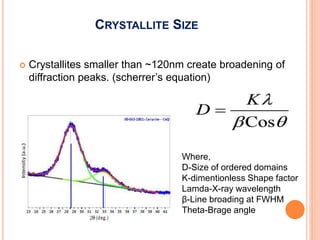
CRYSTALLITE SIZE
 Crystallites smaller than ~120nm create broadening of
diffraction peaks. (scherrer’s equation)
Where,
D-Size of ordered domains
K-dimentionless Shape factor
Lamda-X-ray wavelength
β-Line broading at FWHM
Theta-Brage angle
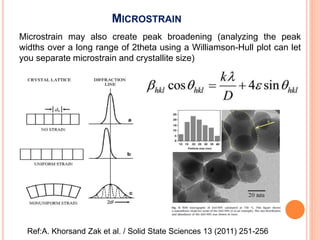
MICROSTRAIN
Ref:A. Khorsand Zak et al. / Solid State Sciences 13 (2011) 251-256
Microstrain may also create peak broadening (analyzing the peak
widths over a long range of 2theta using a Williamson-Hull plot can let
you separate microstrain and crystallite size)
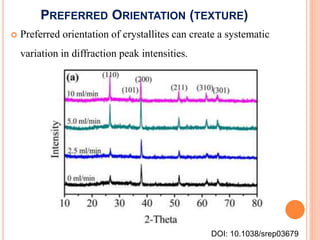
PREFERRED ORIENTATION (TEXTURE)
 Preferred orientation of crystallites can create a systematic
variation in diffraction peak intensities.
DOI: 10.1038/srep03679
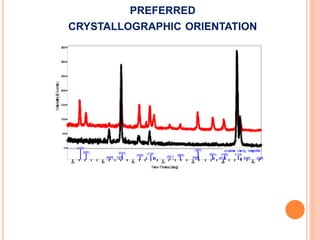
PREFERRED
CRYSTALLOGRAPHIC ORIENTATION
AVAILABLE FREE SOFTWARE
 GSAS- Rietveld refinement of crystal structures
 FullProf- Rietveld refinement of crystal structures
 Rietan- Rietveld refinement of crystal structures
 PowderCell- crystal visualization and simulated
diffraction patterns
 JCryst- stereograms
 PANalytical HighScore Plus
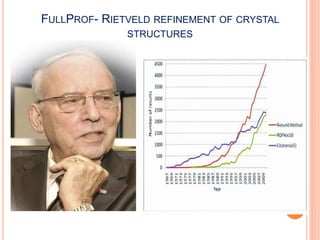
FULLPROF- RIETVELD REFINEMENT OF CRYSTAL
STRUCTURES
REITVELD REFINEMENT USING FULLPROF
SOFTWARE
Necessary files:
 High quality PXRD pattern
.dat file
.xy file
.raw file
 Structural model
.cif (from database)
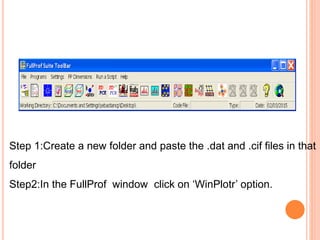
Step 1:Create a new folder and paste the .dat and .cif files in that
folder
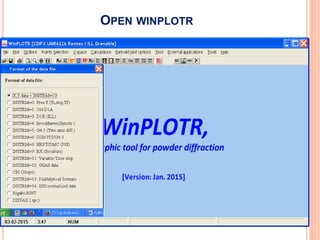
Step2:In the FullProf window click on ‘WinPlotr’ option.
OPEN WINPLOTR
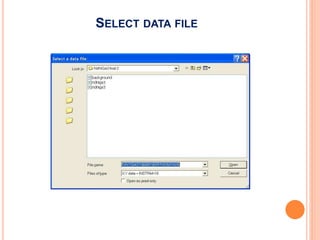
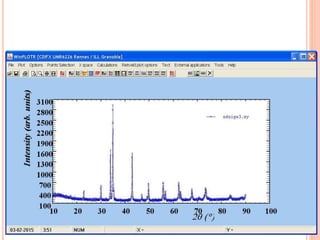
SELECT DATA FILE
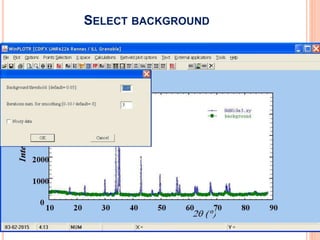
SELECT BACKGROUND
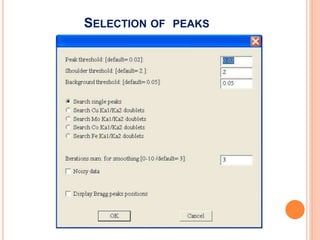
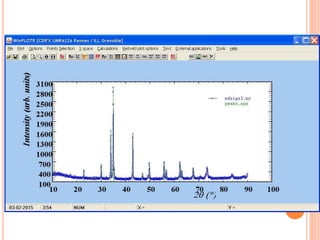
SELECTION OF PEAKS
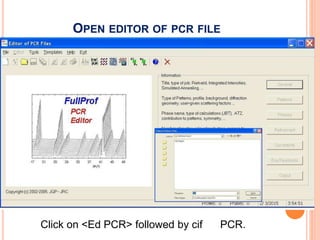
OPEN EDITOR OF PCR FILE
Click on <Ed PCR> followed by cif PCR.
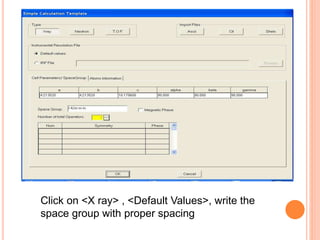
Click on <X ray> , <Default Values>, write the
space group with proper spacing
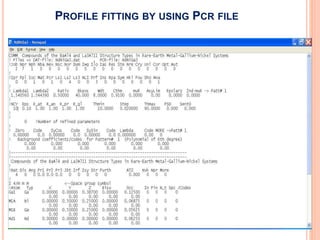
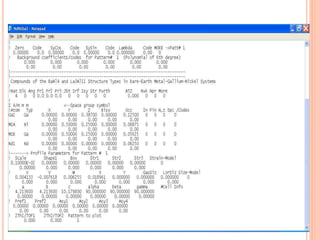
PROFILE FITTING BY USING PCR FILE
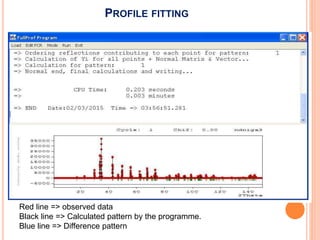
PROFILE FITTING
Red line => observed data
Black line => Calculated pattern by the programme.
Blue line => Difference pattern
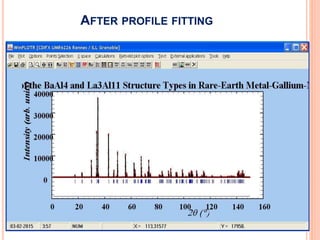
AFTER PROFILE FITTING
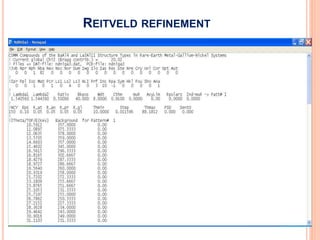
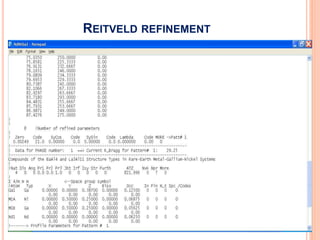
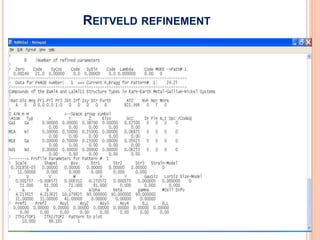
REITVELD REFINEMENT
REITVELD REFINEMENT
REITVELD REFINEMENT
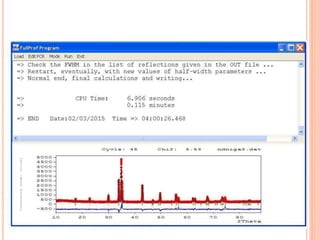
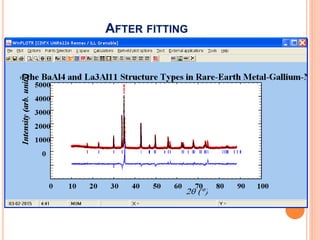
AFTER FITTING
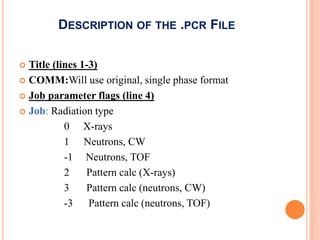
DESCRIPTION OF THE .PCR FILE
 Title (lines 1-3)
 COMM:Will use original, single phase format
 Job parameter flags (line 4)
 Job: Radiation type
0 X-rays
1 Neutrons, CW
-1 Neutrons, TOF
2 Pattern calc (X-rays)
3 Pattern calc (neutrons, CW)
-3 Pattern calc (neutrons, TOF)
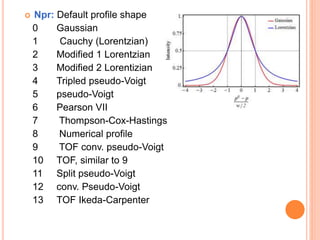
 Npr: Default profile shape
0 Gaussian
1 Cauchy (Lorentzian)
2 Modified 1 Lorentzian
3 Modified 2 Lorentizian
4 Tripled pseudo-Voigt
5 pseudo-Voigt
6 Pearson VII
7 Thompson-Cox-Hastings
8 Numerical profile
9 TOF conv. pseudo-Voigt
10 TOF, similar to 9
11 Split pseudo-Voigt
12 conv. Pseudo-Voigt
13 TOF Ikeda-Carpenter
 Nph:Number of phases
 Nba: Background type
 0 Refine with polynomial
 1 Read from CODFIL.bac
 N >1Linear interpolation
 -1 Refine with Debye+polynomial
 -2 Treated iteratively with Fourier filtering
 -3 Read addition 6 additional polynomial coeffs.
 Nex:Number of regions to exclude
 Nsc:Number of user defined scattering factors
 Nor:Preferred orientation function type
 0 Function No. 1
 1 Function No. 2
 Dum:Control of divergence
 1 If some phases are treated in Profile Matching,
convergence criterion with stand. dev. not applied
 2 Program stopped for local divergence: chi2(i-
cycle+1)>chi2(i-cycle)
 3 Reflections near excluded regions excluded from
Bragg R-factor
 Iwg:Refinement weighting scheme
 0 Standard least squares
 1 Maximum likelihood
 2 Unit weights
 Ilo: Lorentz and polarization corrections
 0 Standard Debye-Scherrer or Bragg Brentano
 1 Flat plate PSD geometry
 -1 Lorentz-polarization correction not performed
 2 Transmission geometry
 3 Special polarization correction
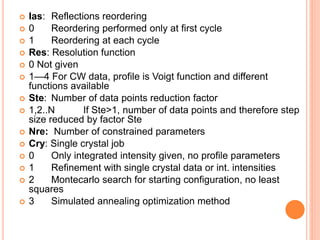
 Ias: Reflections reordering
 0 Reordering performed only at first cycle
 1 Reordering at each cycle
 Res: Resolution function
 0 Not given
 1—4 For CW data, profile is Voigt function and different
functions available
 Ste: Number of data points reduction factor
 1,2..N If Ste>1, number of data points and therefore step
size reduced by factor Ste
 Nre: Number of constrained parameters
 Cry: Single crystal job
 0 Only integrated intensity given, no profile parameters
 1 Refinement with single crystal data or int. intensities
 2 Montecarlo search for starting configuration, no least
squares
 3 Simulated annealing optimization method
 Uni:Scattering variable unit
 0 2θ in degrees
 1 TOF in sec
 2 Energy in keV
 Cor:Intensity correction
0 No correction is applied
1 File with intensity corrections
2 File with empirical function
 Opt:Calculation optimization
0 General procedures used
1 Optimizes calculations to proceed faster
 Aut: Automatic mode for refinement codes
numbering
0 Codewords treated as usual.
1 Codewords treated automatically by program
REFINEMENT OUTPUT CONTROLS (LINE 7)
 Ipr: Profile integrated intensities
 0 No action
 1 Observed and calculated profiles in .out file
 2 Calculated profiles for each phase in n.sub
files
 3 Like 2 but background added to each profile
 Ppl: Types of calc output-I
 0 No action
 1 Line printer plot in .out file
 2 Generates background file
 3 Difference pattern included in .bac file
 Ioc: Types of calc output-II
 0 No action
 1 List of observed and calculated integrated
intensities in .out file
 2 Reflection from 2nd wavelength if different
 Mat:Correlation matrix
 0 No action
 1 Correlation matrix written in .out file
 2 Diagonal of LS matrix printed before inversion
at every cycle
 Pcr: Update of .pcr
 0 after refinement
 1 .pcr re-written with updated parameters
 2 New input file generated called .new
 Ls1:Types of calc output-III
 0 No action
 1 Reflection list before starting cycles written in
.out file
 Ls2:Types of calc output-IV
 0 No action
 1 Corrected data list written in .out file
 4 Plot of diffraction pattern displayed on the
screen at each cycle
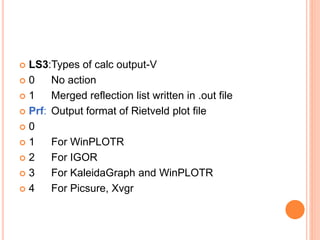
 LS3:Types of calc output-V
 0 No action
 1 Merged reflection list written in .out file
 Prf: Output format of Rietveld plot file
 0
 1 For WinPLOTR
 2 For IGOR
 3 For KaleidaGraph and WinPLOTR
 4 For Picsure, Xvgr
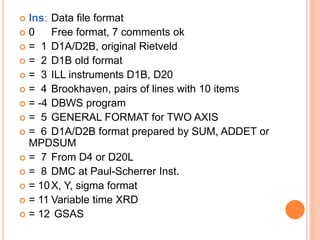
 Ins: Data file format
 0 Free format, 7 comments ok
 = 1 D1A/D2B, original Rietveld
 = 2 D1B old format
 = 3 ILL instruments D1B, D20
 = 4 Brookhaven, pairs of lines with 10 items
 = -4 DBWS program
 = 5 GENERAL FORMAT for TWO AXIS
 = 6 D1A/D2B format prepared by SUM, ADDET or
MPDSUM
 = 7 From D4 or D20L
 = 8 DMC at Paul-Scherrer Inst.
 = 10X, Y, sigma format
 = 11 Variable time XRD
 = 12 GSAS
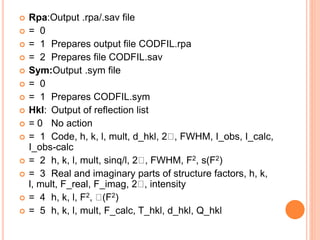
 Rpa:Output .rpa/.sav file
 = 0
 = 1 Prepares output file CODFIL.rpa
 = 2 Prepares file CODFIL.sav
 Sym:Output .sym file
 = 0
 = 1 Prepares CODFIL.sym
 Hkl: Output of reflection list
 = 0 No action
 = 1 Code, h, k, l, mult, d_hkl, 2 , FWHM, I_obs, I_calc,
I_obs-calc
 = 2 h, k, l, mult, sinq/l, 2 , FWHM, F2, s(F2)
 = 3 Real and imaginary parts of structure factors, h, k,
l, mult, F_real, F_imag, 2 , intensity
 = 4 h, k, l, F2, (F2)
 = 5 h, k, l, mult, F_calc, T_hkl, d_hkl, Q_hkl
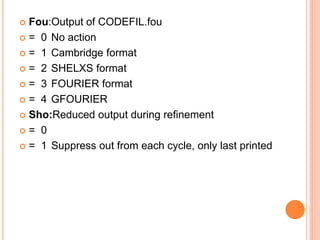
 Fou:Output of CODEFIL.fou
 = 0 No action
 = 1 Cambridge format
 = 2 SHELXS format
 = 3 FOURIER format
 = 4 GFOURIER
 Sho:Reduced output during refinement
 = 0
 = 1 Suppress out from each cycle, only last printed
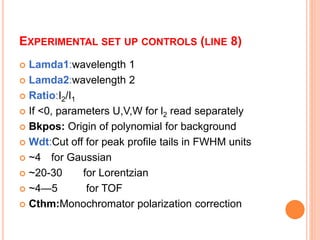
EXPERIMENTAL SET UP CONTROLS (LINE 8)
 Lamda1:wavelength 1
 Lamda2:wavelength 2
 Ratio:I2/I1
 If <0, parameters U,V,W for l2 read separately
 Bkpos: Origin of polynomial for background
 Wdt:Cut off for peak profile tails in FWHM units
 ~4 for Gaussian
 ~20-30 for Lorentzian
 ~4—5 for TOF
 Cthm:Monochromator polarization correction
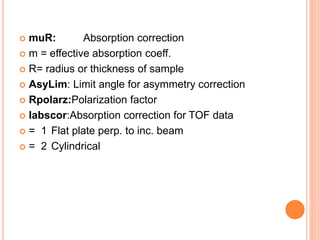
 muR: Absorption correction
 m = effective absorption coeff.
 R= radius or thickness of sample
 AsyLim: Limit angle for asymmetry correction
 Rpolarz:Polarization factor
 Iabscor:Absorption correction for TOF data
 = 1 Flat plate perp. to inc. beam
 = 2 Cylindrical
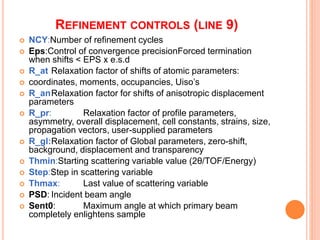
REFINEMENT CONTROLS (LINE 9)
 NCY:Number of refinement cycles
 Eps:Control of convergence precisionForced termination
when shifts < EPS x e.s.d
 R_at Relaxation factor of shifts of atomic parameters:
 coordinates, moments, occupancies, Uiso’s
 R_anRelaxation factor for shifts of anisotropic displacement
parameters
 R_pr: Relaxation factor of profile parameters,
asymmetry, overall displacement, cell constants, strains, size,
propagation vectors, user-supplied parameters
 R_gl:Relaxation factor of Global parameters, zero-shift,
background, displacement and transparency
 Thmin:Starting scattering variable value (2θ/TOF/Energy)
 Step:Step in scattering variable
 Thmax: Last value of scattering variable
 PSD: Incident beam angle
 Sent0: Maximum angle at which primary beam
completely enlightens sample
NUMBER OF REFINED PARAMETERS
 Maxs: Number of refined parameters (one
integer, one line)
REFINEMENT CONTROLS II (LINE 14, REFINABLE)
 Zero: Zero point for T
 Sycos: Systematic shift with cosθ dependence
 Sysin:Systematic 2 shift with sin2θ dependence
 Lambda:Wavelength to be refined
 More: Flag to read micro-absorption
coefficients
 ≠ 0 Line 15 is read to define microabsorption
JASON-HODGES FORMULATION FOR TOF DATA (LINE
16)
 Zerot: Zero shift for thermal neutrons
 Dtt1t: Coeff. #1 for d-spacing calc
 Dtt2t: Coeff. #2 for d-spacing calculation
 x-cross:Position of the center of the crossover
region
 Width:Width of crossover region
REFINEMENT PARAMETERS FOR EACH PHASE (LINE
19)
 Nat: Number of atoms in asymmetric unit
 Dis: Number of distance constraints
 Mom:Number of angle constraints or number of magnetic
moment constraints
 Jbt: Structure factor model and refinement method
 = 0 Rietveld Method
 = 1 Rietveld Method but purely magnetic phases
 = -1 Like 1 but with extra parameters in spherical coordinates
 = 2 Profile matching mode with constant scale factor
 = -2 Like 2 but modulus instead of intensity given in .hkl file
 = 3 Profile matching with constant relative intensities
 = -3 Like 3 but modulus instead of intensity given in .hkl file
 = 4 Intensities of nuclear reflections are calculated from Rigid
body groups
 = 5 Intensities of magnetic reflections calculated from conical
magnetic structures in real space
 = 10 Phase can contain nuclear and magnetic contributions
 = 15 Phase is treated as commensurate modulated crystal
structure
 Pr1, Pr2, Pr3:
 Preferred orientation in reciprocal space for all
three directions
 Irf: Method of reflection generation
 = 0 List of reflections for the phase generated by
space group
 = 1 h, k, l, mult read from .hkl file
 = 2 h, k, l, mult, intensity read from .hkl file
 = 3 h,k,l, mult, F_real, F_imag read from .hkl file
 = 4 list of integrated intensities given as
observations
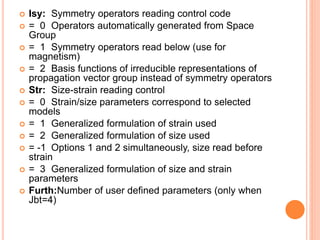
 Isy: Symmetry operators reading control code
 = 0 Operators automatically generated from Space
Group
 = 1 Symmetry operators read below (use for
magnetism)
 = 2 Basis functions of irreducible representations of
propagation vector group instead of symmetry operators
 Str: Size-strain reading control
 = 0 Strain/size parameters correspond to selected
models
 = 1 Generalized formulation of strain used
 = 2 Generalized formulation of size used
 = -1 Options 1 and 2 simultaneously, size read before
strain
 = 3 Generalized formulation of size and strain
parameters
 Furth:Number of user defined parameters (only when
Jbt=4)
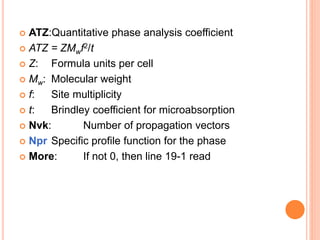
 ATZ:Quantitative phase analysis coefficient
 ATZ = ZMwf2/t
 Z: Formula units per cell
 Mw: Molecular weight
 f: Site multiplicity
 t: Brindley coefficient for microabsorption
 Nvk: Number of propagation vectors
 Npr Specific profile function for the phase
 More: If not 0, then line 19-1 read
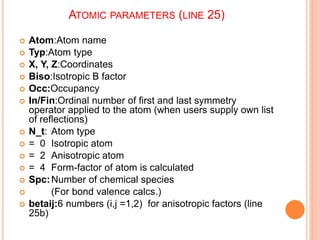
ATOMIC PARAMETERS (LINE 25)
 Atom:Atom name
 Typ:Atom type
 X, Y, Z:Coordinates
 Biso:Isotropic B factor
 Occ:Occupancy
 In/Fin:Ordinal number of first and last symmetry
operator applied to the atom (when users supply own list
of reflections)
 N_t: Atom type
 = 0 Isotropic atom
 = 2 Anisotropic atom
 = 4 Form-factor of atom is calculated
 Spc:Number of chemical species
 (For bond valence calcs.)
 betaij:6 numbers (i,j =1,2) for anisotropic factors (line
25b)
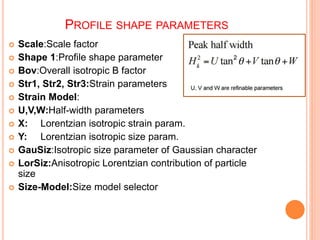
PROFILE SHAPE PARAMETERS
 Scale:Scale factor
 Shape 1:Profile shape parameter
 Bov:Overall isotropic B factor
 Str1, Str2, Str3:Strain parameters
 Strain Model:
 U,V,W:Half-width parameters
 X: Lorentzian isotropic strain param.
 Y: Lorentzian isotropic size param.
 GauSiz:Isotropic size parameter of Gaussian character
 LorSiz:Anisotropic Lorentzian contribution of particle
size
 Size-Model:Size model selector
DATA RANGE PARAMETERS (LAST LINE)
 2Th1/TOF1:First value for x-axis
 2Th2/TOF2:Last value for x-axis
Fullprof Refinement
Fullprof Refinement

Fullprof Refinement

  • 1.
    PXRD AND RIETVELDREFINEMENT By Saurav Chandra Sarma and Dundappa Mumbaraddi Solid State and Inorganic Chemistry Lab, NCU, JNCASR
  • 2.
    What Rietveld cando..??? • Analysis of the whole diffraction pattern. • Phase purity and identification. • Refinement of the structure parameters from diffraction data. • Quantitative phase analysis. • Lattice parameters. • Atomic positions and Occupancies. • Isotropic and anisotropic thermal vibrations. • Grain size and micro-strain calculation. • Magnetic moments (Neutron diffraction).
  • 3.
  • 5.
    Lattice parameters Ce2AgGe3 Pr2AgGe3 Nd2AgGe3 Singlecrystal XRD Reitveld refinement Single crystal XRD Reitveld refinement Single crystal XRD Reitveld refinement a = b 4.2754(3) 4.2733(1) 4.2401(6) 4.2270(1) 4.1886(6) 4.1876(3) c 14.6855(16) 14.7976(1) 14.611(3) 14.6457(1) 14.557(3) 14.5343(2)
  • 6.
  • 7.
    What Rietveld cando..??? • Analysis of the whole diffraction pattern. • Phase purity and identification. • Refinement of the structure parameters from diffraction data. • Quantitative phase analysis. • Lattice parameters. • Atomic positions and Occupancies. • Isotropic and anisotropic thermal vibrations. • Grain size and micro-strain calculation. • Magnetic moments (Neutron diffraction).
  • 8.
    QUANTITATIVE PHASE ANALYSIS With high quality data, you can determine how much of each phase is present  The ratio of peak intensities varies linearly as a function of weight fractions for any two phases in a mixture.
  • 9.
    Experimental Data Fitted Data Model1 Model 2 Difference between experimental and fitted data
  • 10.
    CRYSTALLITE SIZE  Crystallitessmaller than ~120nm create broadening of diffraction peaks. (scherrer’s equation) Where, D-Size of ordered domains K-dimentionless Shape factor Lamda-X-ray wavelength β-Line broading at FWHM Theta-Brage angle
  • 11.
    MICROSTRAIN Ref:A. Khorsand Zaket al. / Solid State Sciences 13 (2011) 251-256 Microstrain may also create peak broadening (analyzing the peak widths over a long range of 2theta using a Williamson-Hull plot can let you separate microstrain and crystallite size)
  • 12.
    PREFERRED ORIENTATION (TEXTURE) Preferred orientation of crystallites can create a systematic variation in diffraction peak intensities. DOI: 10.1038/srep03679
  • 13.
  • 14.
    AVAILABLE FREE SOFTWARE GSAS- Rietveld refinement of crystal structures  FullProf- Rietveld refinement of crystal structures  Rietan- Rietveld refinement of crystal structures  PowderCell- crystal visualization and simulated diffraction patterns  JCryst- stereograms  PANalytical HighScore Plus
  • 15.
    FULLPROF- RIETVELD REFINEMENTOF CRYSTAL STRUCTURES
  • 16.
    REITVELD REFINEMENT USINGFULLPROF SOFTWARE Necessary files:  High quality PXRD pattern .dat file .xy file .raw file  Structural model .cif (from database)
  • 17.
    Step 1:Create anew folder and paste the .dat and .cif files in that folder Step2:In the FullProf window click on ‘WinPlotr’ option.
  • 18.
  • 19.
  • 21.
  • 22.
  • 24.
    OPEN EDITOR OFPCR FILE Click on <Ed PCR> followed by cif PCR.
  • 25.
    Click on <Xray> , <Default Values>, write the space group with proper spacing
  • 26.
    PROFILE FITTING BYUSING PCR FILE
  • 28.
    PROFILE FITTING Red line=> observed data Black line => Calculated pattern by the programme. Blue line => Difference pattern
  • 29.
  • 30.
  • 31.
  • 32.
  • 34.
  • 35.
    DESCRIPTION OF THE.PCR FILE  Title (lines 1-3)  COMM:Will use original, single phase format  Job parameter flags (line 4)  Job: Radiation type 0 X-rays 1 Neutrons, CW -1 Neutrons, TOF 2 Pattern calc (X-rays) 3 Pattern calc (neutrons, CW) -3 Pattern calc (neutrons, TOF)
  • 36.
     Npr: Defaultprofile shape 0 Gaussian 1 Cauchy (Lorentzian) 2 Modified 1 Lorentzian 3 Modified 2 Lorentizian 4 Tripled pseudo-Voigt 5 pseudo-Voigt 6 Pearson VII 7 Thompson-Cox-Hastings 8 Numerical profile 9 TOF conv. pseudo-Voigt 10 TOF, similar to 9 11 Split pseudo-Voigt 12 conv. Pseudo-Voigt 13 TOF Ikeda-Carpenter
  • 37.
     Nph:Number ofphases  Nba: Background type  0 Refine with polynomial  1 Read from CODFIL.bac  N >1Linear interpolation  -1 Refine with Debye+polynomial  -2 Treated iteratively with Fourier filtering  -3 Read addition 6 additional polynomial coeffs.  Nex:Number of regions to exclude  Nsc:Number of user defined scattering factors  Nor:Preferred orientation function type  0 Function No. 1  1 Function No. 2
  • 38.
     Dum:Control ofdivergence  1 If some phases are treated in Profile Matching, convergence criterion with stand. dev. not applied  2 Program stopped for local divergence: chi2(i- cycle+1)>chi2(i-cycle)  3 Reflections near excluded regions excluded from Bragg R-factor  Iwg:Refinement weighting scheme  0 Standard least squares  1 Maximum likelihood  2 Unit weights  Ilo: Lorentz and polarization corrections  0 Standard Debye-Scherrer or Bragg Brentano  1 Flat plate PSD geometry  -1 Lorentz-polarization correction not performed  2 Transmission geometry  3 Special polarization correction
  • 39.
     Ias: Reflectionsreordering  0 Reordering performed only at first cycle  1 Reordering at each cycle  Res: Resolution function  0 Not given  1—4 For CW data, profile is Voigt function and different functions available  Ste: Number of data points reduction factor  1,2..N If Ste>1, number of data points and therefore step size reduced by factor Ste  Nre: Number of constrained parameters  Cry: Single crystal job  0 Only integrated intensity given, no profile parameters  1 Refinement with single crystal data or int. intensities  2 Montecarlo search for starting configuration, no least squares  3 Simulated annealing optimization method
  • 40.
     Uni:Scattering variableunit  0 2θ in degrees  1 TOF in sec  2 Energy in keV  Cor:Intensity correction 0 No correction is applied 1 File with intensity corrections 2 File with empirical function  Opt:Calculation optimization 0 General procedures used 1 Optimizes calculations to proceed faster  Aut: Automatic mode for refinement codes numbering 0 Codewords treated as usual. 1 Codewords treated automatically by program
  • 41.
    REFINEMENT OUTPUT CONTROLS(LINE 7)  Ipr: Profile integrated intensities  0 No action  1 Observed and calculated profiles in .out file  2 Calculated profiles for each phase in n.sub files  3 Like 2 but background added to each profile  Ppl: Types of calc output-I  0 No action  1 Line printer plot in .out file  2 Generates background file  3 Difference pattern included in .bac file
  • 42.
     Ioc: Typesof calc output-II  0 No action  1 List of observed and calculated integrated intensities in .out file  2 Reflection from 2nd wavelength if different  Mat:Correlation matrix  0 No action  1 Correlation matrix written in .out file  2 Diagonal of LS matrix printed before inversion at every cycle
  • 43.
     Pcr: Updateof .pcr  0 after refinement  1 .pcr re-written with updated parameters  2 New input file generated called .new  Ls1:Types of calc output-III  0 No action  1 Reflection list before starting cycles written in .out file  Ls2:Types of calc output-IV  0 No action  1 Corrected data list written in .out file  4 Plot of diffraction pattern displayed on the screen at each cycle
  • 44.
     LS3:Types ofcalc output-V  0 No action  1 Merged reflection list written in .out file  Prf: Output format of Rietveld plot file  0  1 For WinPLOTR  2 For IGOR  3 For KaleidaGraph and WinPLOTR  4 For Picsure, Xvgr
  • 45.
     Ins: Datafile format  0 Free format, 7 comments ok  = 1 D1A/D2B, original Rietveld  = 2 D1B old format  = 3 ILL instruments D1B, D20  = 4 Brookhaven, pairs of lines with 10 items  = -4 DBWS program  = 5 GENERAL FORMAT for TWO AXIS  = 6 D1A/D2B format prepared by SUM, ADDET or MPDSUM  = 7 From D4 or D20L  = 8 DMC at Paul-Scherrer Inst.  = 10X, Y, sigma format  = 11 Variable time XRD  = 12 GSAS
  • 46.
     Rpa:Output .rpa/.savfile  = 0  = 1 Prepares output file CODFIL.rpa  = 2 Prepares file CODFIL.sav  Sym:Output .sym file  = 0  = 1 Prepares CODFIL.sym  Hkl: Output of reflection list  = 0 No action  = 1 Code, h, k, l, mult, d_hkl, 2 , FWHM, I_obs, I_calc, I_obs-calc  = 2 h, k, l, mult, sinq/l, 2 , FWHM, F2, s(F2)  = 3 Real and imaginary parts of structure factors, h, k, l, mult, F_real, F_imag, 2 , intensity  = 4 h, k, l, F2, (F2)  = 5 h, k, l, mult, F_calc, T_hkl, d_hkl, Q_hkl
  • 47.
     Fou:Output ofCODEFIL.fou  = 0 No action  = 1 Cambridge format  = 2 SHELXS format  = 3 FOURIER format  = 4 GFOURIER  Sho:Reduced output during refinement  = 0  = 1 Suppress out from each cycle, only last printed
  • 48.
    EXPERIMENTAL SET UPCONTROLS (LINE 8)  Lamda1:wavelength 1  Lamda2:wavelength 2  Ratio:I2/I1  If <0, parameters U,V,W for l2 read separately  Bkpos: Origin of polynomial for background  Wdt:Cut off for peak profile tails in FWHM units  ~4 for Gaussian  ~20-30 for Lorentzian  ~4—5 for TOF  Cthm:Monochromator polarization correction
  • 49.
     muR: Absorptioncorrection  m = effective absorption coeff.  R= radius or thickness of sample  AsyLim: Limit angle for asymmetry correction  Rpolarz:Polarization factor  Iabscor:Absorption correction for TOF data  = 1 Flat plate perp. to inc. beam  = 2 Cylindrical
  • 50.
    REFINEMENT CONTROLS (LINE9)  NCY:Number of refinement cycles  Eps:Control of convergence precisionForced termination when shifts < EPS x e.s.d  R_at Relaxation factor of shifts of atomic parameters:  coordinates, moments, occupancies, Uiso’s  R_anRelaxation factor for shifts of anisotropic displacement parameters  R_pr: Relaxation factor of profile parameters, asymmetry, overall displacement, cell constants, strains, size, propagation vectors, user-supplied parameters  R_gl:Relaxation factor of Global parameters, zero-shift, background, displacement and transparency  Thmin:Starting scattering variable value (2θ/TOF/Energy)  Step:Step in scattering variable  Thmax: Last value of scattering variable  PSD: Incident beam angle  Sent0: Maximum angle at which primary beam completely enlightens sample
  • 51.
    NUMBER OF REFINEDPARAMETERS  Maxs: Number of refined parameters (one integer, one line)
  • 52.
    REFINEMENT CONTROLS II(LINE 14, REFINABLE)  Zero: Zero point for T  Sycos: Systematic shift with cosθ dependence  Sysin:Systematic 2 shift with sin2θ dependence  Lambda:Wavelength to be refined  More: Flag to read micro-absorption coefficients  ≠ 0 Line 15 is read to define microabsorption
  • 53.
    JASON-HODGES FORMULATION FORTOF DATA (LINE 16)  Zerot: Zero shift for thermal neutrons  Dtt1t: Coeff. #1 for d-spacing calc  Dtt2t: Coeff. #2 for d-spacing calculation  x-cross:Position of the center of the crossover region  Width:Width of crossover region
  • 54.
    REFINEMENT PARAMETERS FOREACH PHASE (LINE 19)  Nat: Number of atoms in asymmetric unit  Dis: Number of distance constraints  Mom:Number of angle constraints or number of magnetic moment constraints  Jbt: Structure factor model and refinement method  = 0 Rietveld Method  = 1 Rietveld Method but purely magnetic phases  = -1 Like 1 but with extra parameters in spherical coordinates  = 2 Profile matching mode with constant scale factor  = -2 Like 2 but modulus instead of intensity given in .hkl file  = 3 Profile matching with constant relative intensities  = -3 Like 3 but modulus instead of intensity given in .hkl file  = 4 Intensities of nuclear reflections are calculated from Rigid body groups  = 5 Intensities of magnetic reflections calculated from conical magnetic structures in real space  = 10 Phase can contain nuclear and magnetic contributions  = 15 Phase is treated as commensurate modulated crystal structure
  • 55.
     Pr1, Pr2,Pr3:  Preferred orientation in reciprocal space for all three directions  Irf: Method of reflection generation  = 0 List of reflections for the phase generated by space group  = 1 h, k, l, mult read from .hkl file  = 2 h, k, l, mult, intensity read from .hkl file  = 3 h,k,l, mult, F_real, F_imag read from .hkl file  = 4 list of integrated intensities given as observations
  • 56.
     Isy: Symmetryoperators reading control code  = 0 Operators automatically generated from Space Group  = 1 Symmetry operators read below (use for magnetism)  = 2 Basis functions of irreducible representations of propagation vector group instead of symmetry operators  Str: Size-strain reading control  = 0 Strain/size parameters correspond to selected models  = 1 Generalized formulation of strain used  = 2 Generalized formulation of size used  = -1 Options 1 and 2 simultaneously, size read before strain  = 3 Generalized formulation of size and strain parameters  Furth:Number of user defined parameters (only when Jbt=4)
  • 57.
     ATZ:Quantitative phaseanalysis coefficient  ATZ = ZMwf2/t  Z: Formula units per cell  Mw: Molecular weight  f: Site multiplicity  t: Brindley coefficient for microabsorption  Nvk: Number of propagation vectors  Npr Specific profile function for the phase  More: If not 0, then line 19-1 read
  • 58.
    ATOMIC PARAMETERS (LINE25)  Atom:Atom name  Typ:Atom type  X, Y, Z:Coordinates  Biso:Isotropic B factor  Occ:Occupancy  In/Fin:Ordinal number of first and last symmetry operator applied to the atom (when users supply own list of reflections)  N_t: Atom type  = 0 Isotropic atom  = 2 Anisotropic atom  = 4 Form-factor of atom is calculated  Spc:Number of chemical species  (For bond valence calcs.)  betaij:6 numbers (i,j =1,2) for anisotropic factors (line 25b)
  • 59.
    PROFILE SHAPE PARAMETERS Scale:Scale factor  Shape 1:Profile shape parameter  Bov:Overall isotropic B factor  Str1, Str2, Str3:Strain parameters  Strain Model:  U,V,W:Half-width parameters  X: Lorentzian isotropic strain param.  Y: Lorentzian isotropic size param.  GauSiz:Isotropic size parameter of Gaussian character  LorSiz:Anisotropic Lorentzian contribution of particle size  Size-Model:Size model selector
  • 60.
    DATA RANGE PARAMETERS(LAST LINE)  2Th1/TOF1:First value for x-axis  2Th2/TOF2:Last value for x-axis