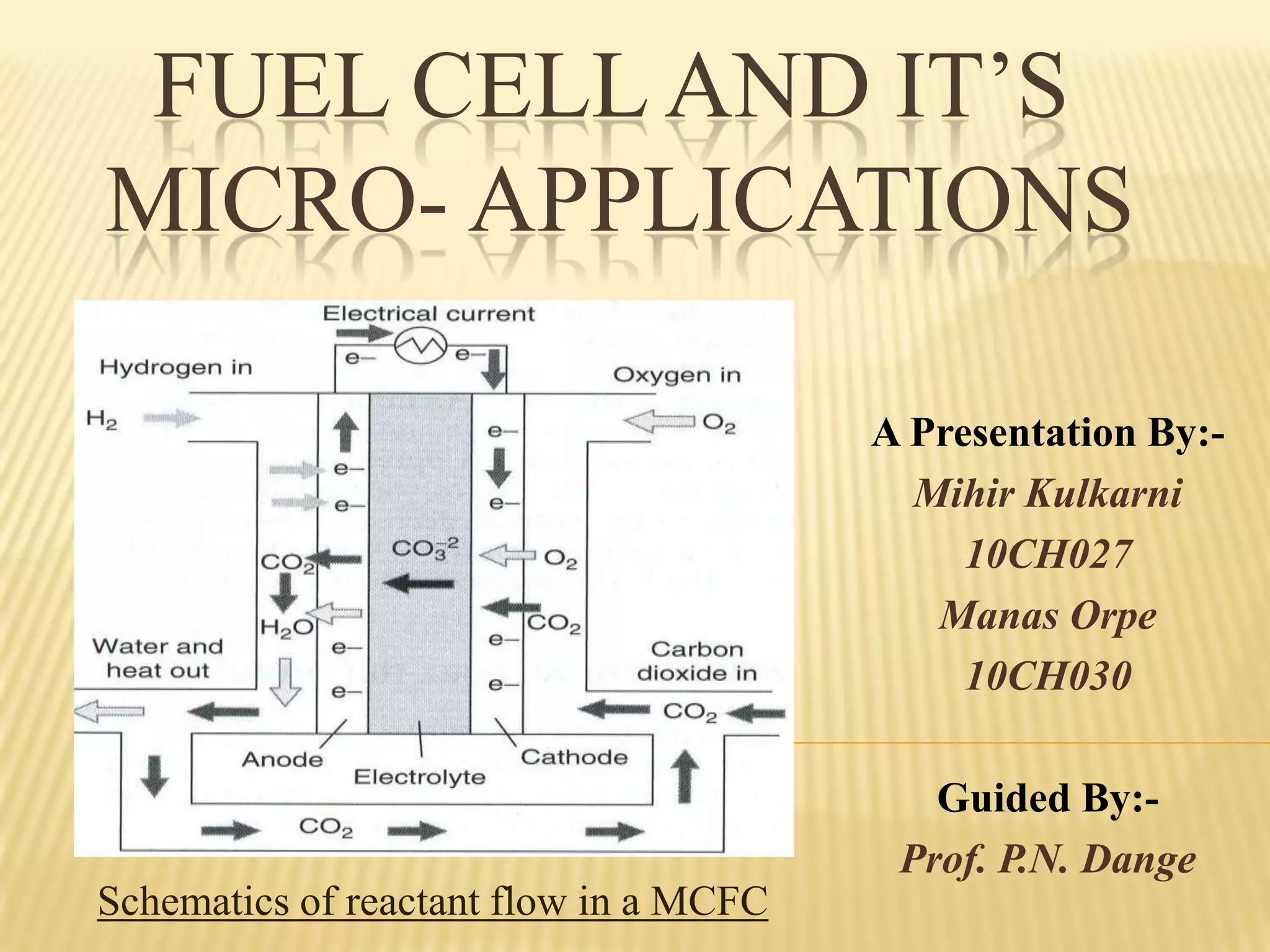
FUEL CELL AND IT’S
MICRO- APPLICATIONS
A Presentation By:-
Mihir Kulkarni
10CH027
Manas Orpe
10CH030
Guided By:-
Prof. P.N. Dange
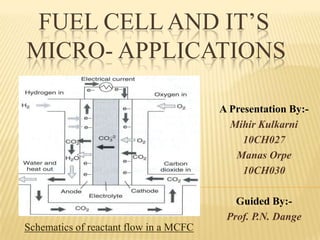
Schematics of reactant flow in a MCFC
WHAT IS A FUEL CELL?
 It is a galvanic cell or electrochemical power
source
 it generates electrical energy with water and heat
as its by-product
 both the reactants and the products are liquids or
gases
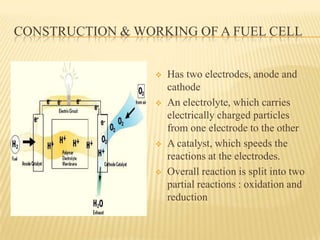
CONSTRUCTION & WORKING OF A FUEL CELL
 Has two electrodes, anode and
cathode
 An electrolyte, which carries
electrically charged particles
from one electrode to the other
 A catalyst, which speeds the
reactions at the electrodes.
 Overall reaction is split into two
partial reactions : oxidation and
reduction
 Process begins when Hydrogen molecules enter anode
 Catalyst coating separates hydrogen’s negatively charged electrons
from the positively charged protons
 Electrolyte allows protons to pass through to cathode, but not
electrons
 Instead electrons are directed through an external circuit which
creates electrical current
 Oxygen molecules pass through cathode
 Oxygen and protons combine with electrons after they have
passed through the external circuit
 Oxygen and protons combine with electrons to produce water and
heat
CONSTRUCTION & WORKING OF A FUEL CELL
TYPES OF FUEL CELL
1] Phosphoric acid fuel cell (PAFC)
 Electrolyte is phosphoric acid
 Efficiency is 40 to 80 percent
 Operating temperature –
150 to 200oC (300 to 400o F)
 Output - up to 200 kW
 PAFCs tolerate a carbon
monoxide concentration of
about 1.5 percent
2] Alkaline fuel cell (AFC)
 Operate on compressed
hydrogen and oxygen.
 Generally use solution of
potassium hydroxide (chemically
KOH) in water as their
electrolyte.
 Efficiency is about 70 percent
 Operating temperature is 150
to 200o C, (about 300 to 400o F)
 Cell output ranges from 300
W to 5 kW.
3] Proton-exchange-membrane fuel cell (PEMFC)
 Work with a polymer electrolyte in
the form of a thin, permeable sheet
 Efficiency is about 40 to 50 percent
 Operating temperature is about 80o C
(about 175o F)
 Cell outputs generally range from 50 to
250 kW.
 Reactions :
Anode (oxidation): H2  2H+ + 2e-
Cathode (reduction): ½ O2 2H+ +2e-  H2O
Overall : H2 + ½ O2  H2O
4] Direct-methanol fuel cell (DMFC)
 Specific content of
chemical energy of about
6 kWh/kg
 Operating temperatures
are in the range
50-120 C,
 Power outputs between
25 watts and 5 kilowatts
 Reactions :
Anode (oxidation) : CH3OH + 60H-  5H2O + 6e- + CO2
Cathode (reduction) : 3/2 O2 + 3H2O + 6e-  6OH-
Overall : CH3OH + 3/2 O2  CO2 + 2H2O
5] Molten-carbonate fuel cell (MCFC)
 Use high-temperature
compounds of salt (like sodium or
magnesium) carbonates
(chemically CO3) as the electrolyte
 Efficiency ranges from 60 to
80 percent
 Operating temperature is about
650o C (1,200 o F)
 Output upto 2 megawatts (MW)
 Reactions :
Overall reaction : CO + ½O2  CO2
Oxidation reaction : CO + CO3
2-  2CO2 + 2e-
Reduction reaction : ½O2 + CO2 + 2e-  CO3
2-
6] Solid-oxide fuel cell (SOFC)
 Use a hard, ceramic compound
of metal (like calcium or
zirconium) oxides (chemically, O2)
as electrolyte
 Efficiency is about 60 percent
 Operating temperatures are
about 1,000o C (about 1,800 o F)
 Cells output is up to 100 kW
 Reactions :
Reduction reaction : ½O2 + 2H+ + 2e-  H2O
Oxidation reaction : H2  2H+ + 2e-
Overall reaction : H2 + ½O2  H2O
APPLICATIONS
 Transportation
 Stationary Power Stations
 Telecommunications
 Micro Power
 Transportation : All major automakers are working to
commercialize a fuel cell car.Automakers and experts speculate
that a fuel cell vehicle will be commercialized by 2010.
 Stationary Power Stations : Over 2,500 fuel cell systems have
been installed all over the world in hospitals, nursing homes,
hotels, office buildings, schools and utility power plants.
 Telecommunications : Due to computers, the Internet and
sophisticated communication networks there is a need for an
incredibly reliable power source. Fuel Cells have been proven to
be 99.999% reliable
APPLICATIONS
APPLICATIONS
 Micro Power :
• Consumer electronics could gain drastically longer
battery power with Fuel Cell technology.
• Cell phones can be powered for 30 days without
recharging.
• Laptops can be powered for 20 hours without
recharging.
ADVANTAGES
 Physical Security
 Reliability
 Efficiency
 Environmental Benefits
 Battery Replacement/Alternative
 Military Applications
ADVANTAGES
 Physical Security : Both central station power generation and
long distance, high voltage power grids can be terrorist targets in
an attempt to cripple our energy infrastructure.
 Reliability : Properly configured fuel cells would result in less
than one minute of down time in a six year period. U.S.
businesses lose $29 Billion a year from computer failures due to
power outages.
 Efficiency : Because no fuel is burned to make energy, fuel cells
are fundamentally more efficient than combustion systems.
ADVANTAGES
 Environmental Benefits : Fuels cells can reduce air pollution
today and offer the possibility of eliminating pollution in the
future.
 Battery Replacement/Alternative : Fuel Cell replacements for
batteries would offer much longer operating life in a packaged of
lighter or equal weight.
 Military Applications : Fuel Cell technology in the military can
help save lives because it reduces telltale heat and noise in
combat.
LIMITATIONS
Economic Problems :
 Manufacturing cost of fuel-cell power plants is very high.
 The most important components of all p.e.m.f.c. and d.m.f.c.’s is
very expensive, about 700 $/m2.
 Total cost of a 5-kW p.e.m.f.c power plant is be about 1200 $/kW.
 In comparison cost of an analogous I.C. engine is 500-1500 $/kW.
LIMITATIONS
The Problem Of Lifetime :
 Satisfactory lifetime for smooth operation.
 3 years lifetime for small plants in portable devices.
 5 years for electric vehicles.
 10 years for large stationary multi-megawatt power plants.
 Samples of single p.e.m.f.c and stacks have been successfully
operated for several thousands of hours.
 But not enough data available for general use of these type of fuel
cells.
RENEWABLE ENERGYACT : FOR INDIA'S FUTURE NEEDS
 Solar water heating to be made mandatory throughout the urban
areas of the country by 2012, in a phased manner.
 Widespread application of co-generation concepts (heat and
power) for lighting, heating and cooling
REFERENCES
 Fuel Cells: From Fundamentals to Applications, S. Srinivasan,
Springer, New York, 2006
 Fuel Cell History Part 1, G. Wand, “Fuel Cell Today” June 16,
2006
 Handbook of Fuel Cells: Fundamentals, Technology, Applications
(four volumes), W. Vielstich, A. Lamm, and H. Gasteiger (editors),
Wiley, Chichester, UK, 2003
 "Confusion and Controversy: Nineteenth-Century Theories of the
Voltaic Pile," pp. 133-157 in F. Bevilacqua and L. Fregonese,
 Nuova Voltiana: Studies on Volta and his Times, vol. 1 (2000)

Fuel cells and their micro applications

  • 1.
    FUEL CELL ANDIT’S MICRO- APPLICATIONS A Presentation By:- Mihir Kulkarni 10CH027 Manas Orpe 10CH030 Guided By:- Prof. P.N. Dange Schematics of reactant flow in a MCFC
  • 2.
    WHAT IS AFUEL CELL?  It is a galvanic cell or electrochemical power source  it generates electrical energy with water and heat as its by-product  both the reactants and the products are liquids or gases
  • 3.
    CONSTRUCTION & WORKINGOF A FUEL CELL  Has two electrodes, anode and cathode  An electrolyte, which carries electrically charged particles from one electrode to the other  A catalyst, which speeds the reactions at the electrodes.  Overall reaction is split into two partial reactions : oxidation and reduction
  • 4.
     Process beginswhen Hydrogen molecules enter anode  Catalyst coating separates hydrogen’s negatively charged electrons from the positively charged protons  Electrolyte allows protons to pass through to cathode, but not electrons  Instead electrons are directed through an external circuit which creates electrical current  Oxygen molecules pass through cathode  Oxygen and protons combine with electrons after they have passed through the external circuit  Oxygen and protons combine with electrons to produce water and heat CONSTRUCTION & WORKING OF A FUEL CELL
  • 5.
    TYPES OF FUELCELL 1] Phosphoric acid fuel cell (PAFC)  Electrolyte is phosphoric acid  Efficiency is 40 to 80 percent  Operating temperature – 150 to 200oC (300 to 400o F)  Output - up to 200 kW  PAFCs tolerate a carbon monoxide concentration of about 1.5 percent
  • 6.
    2] Alkaline fuelcell (AFC)  Operate on compressed hydrogen and oxygen.  Generally use solution of potassium hydroxide (chemically KOH) in water as their electrolyte.  Efficiency is about 70 percent  Operating temperature is 150 to 200o C, (about 300 to 400o F)  Cell output ranges from 300 W to 5 kW.
  • 7.
    3] Proton-exchange-membrane fuelcell (PEMFC)  Work with a polymer electrolyte in the form of a thin, permeable sheet  Efficiency is about 40 to 50 percent  Operating temperature is about 80o C (about 175o F)  Cell outputs generally range from 50 to 250 kW.  Reactions : Anode (oxidation): H2  2H+ + 2e- Cathode (reduction): ½ O2 2H+ +2e-  H2O Overall : H2 + ½ O2  H2O
  • 8.
    4] Direct-methanol fuelcell (DMFC)  Specific content of chemical energy of about 6 kWh/kg  Operating temperatures are in the range 50-120 C,  Power outputs between 25 watts and 5 kilowatts  Reactions : Anode (oxidation) : CH3OH + 60H-  5H2O + 6e- + CO2 Cathode (reduction) : 3/2 O2 + 3H2O + 6e-  6OH- Overall : CH3OH + 3/2 O2  CO2 + 2H2O
  • 9.
    5] Molten-carbonate fuelcell (MCFC)  Use high-temperature compounds of salt (like sodium or magnesium) carbonates (chemically CO3) as the electrolyte  Efficiency ranges from 60 to 80 percent  Operating temperature is about 650o C (1,200 o F)  Output upto 2 megawatts (MW)  Reactions : Overall reaction : CO + ½O2  CO2 Oxidation reaction : CO + CO3 2-  2CO2 + 2e- Reduction reaction : ½O2 + CO2 + 2e-  CO3 2-
  • 10.
    6] Solid-oxide fuelcell (SOFC)  Use a hard, ceramic compound of metal (like calcium or zirconium) oxides (chemically, O2) as electrolyte  Efficiency is about 60 percent  Operating temperatures are about 1,000o C (about 1,800 o F)  Cells output is up to 100 kW  Reactions : Reduction reaction : ½O2 + 2H+ + 2e-  H2O Oxidation reaction : H2  2H+ + 2e- Overall reaction : H2 + ½O2  H2O
  • 11.
    APPLICATIONS  Transportation  StationaryPower Stations  Telecommunications  Micro Power
  • 12.
     Transportation :All major automakers are working to commercialize a fuel cell car.Automakers and experts speculate that a fuel cell vehicle will be commercialized by 2010.  Stationary Power Stations : Over 2,500 fuel cell systems have been installed all over the world in hospitals, nursing homes, hotels, office buildings, schools and utility power plants.  Telecommunications : Due to computers, the Internet and sophisticated communication networks there is a need for an incredibly reliable power source. Fuel Cells have been proven to be 99.999% reliable APPLICATIONS
  • 13.
    APPLICATIONS  Micro Power: • Consumer electronics could gain drastically longer battery power with Fuel Cell technology. • Cell phones can be powered for 30 days without recharging. • Laptops can be powered for 20 hours without recharging.
  • 14.
    ADVANTAGES  Physical Security Reliability  Efficiency  Environmental Benefits  Battery Replacement/Alternative  Military Applications
  • 15.
    ADVANTAGES  Physical Security: Both central station power generation and long distance, high voltage power grids can be terrorist targets in an attempt to cripple our energy infrastructure.  Reliability : Properly configured fuel cells would result in less than one minute of down time in a six year period. U.S. businesses lose $29 Billion a year from computer failures due to power outages.  Efficiency : Because no fuel is burned to make energy, fuel cells are fundamentally more efficient than combustion systems.
  • 16.
    ADVANTAGES  Environmental Benefits: Fuels cells can reduce air pollution today and offer the possibility of eliminating pollution in the future.  Battery Replacement/Alternative : Fuel Cell replacements for batteries would offer much longer operating life in a packaged of lighter or equal weight.  Military Applications : Fuel Cell technology in the military can help save lives because it reduces telltale heat and noise in combat.
  • 17.
    LIMITATIONS Economic Problems : Manufacturing cost of fuel-cell power plants is very high.  The most important components of all p.e.m.f.c. and d.m.f.c.’s is very expensive, about 700 $/m2.  Total cost of a 5-kW p.e.m.f.c power plant is be about 1200 $/kW.  In comparison cost of an analogous I.C. engine is 500-1500 $/kW.
  • 18.
    LIMITATIONS The Problem OfLifetime :  Satisfactory lifetime for smooth operation.  3 years lifetime for small plants in portable devices.  5 years for electric vehicles.  10 years for large stationary multi-megawatt power plants.  Samples of single p.e.m.f.c and stacks have been successfully operated for several thousands of hours.  But not enough data available for general use of these type of fuel cells.
  • 19.
    RENEWABLE ENERGYACT :FOR INDIA'S FUTURE NEEDS  Solar water heating to be made mandatory throughout the urban areas of the country by 2012, in a phased manner.  Widespread application of co-generation concepts (heat and power) for lighting, heating and cooling
  • 20.
    REFERENCES  Fuel Cells:From Fundamentals to Applications, S. Srinivasan, Springer, New York, 2006  Fuel Cell History Part 1, G. Wand, “Fuel Cell Today” June 16, 2006  Handbook of Fuel Cells: Fundamentals, Technology, Applications (four volumes), W. Vielstich, A. Lamm, and H. Gasteiger (editors), Wiley, Chichester, UK, 2003  "Confusion and Controversy: Nineteenth-Century Theories of the Voltaic Pile," pp. 133-157 in F. Bevilacqua and L. Fregonese,  Nuova Voltiana: Studies on Volta and his Times, vol. 1 (2000)