Presentation on
1. Introduction 
2. Design Principle & operation of Fuel Cell. 
3. Types of Fuel Cells. 
4. Comparison of Fuel cell with Battery and IC Engine 
5. Fuel Cell Efficiency. 
6. Advantages and Disadvantages 
7. Application of Fuel Cell. 
8. Recent Development.
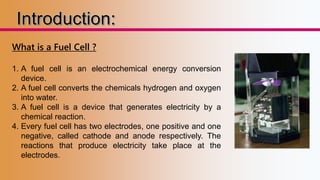
What is a Fuel Cell ? 
1. A fuel cell is an electrochemical energy conversion 
device. 
2. A fuel cell converts the chemicals hydrogen and oxygen 
into water. 
3. A fuel cell is a device that generates electricity by a 
chemical reaction. 
4. Every fuel cell has two electrodes, one positive and one 
negative, called cathode and anode respectively. The 
reactions that produce electricity take place at the 
electrodes.
Why we need Fuel Cells ? 
1. Due to energy crisis all over the world. 
2. Due to the issue of global warming. 
3. Due to the unavailability of different renewable sources at each and 
every place due to geographic condition. 
4. Fuel cell provides an alternate efficient non polluting power source that 
produces no noise and has no moving parts. 
5. It is expected that by 2050 the global energy demand is going to rise by 
2 to 3 times.
The basic principle of the fuel cell is illustrated in the 
figure. 
The core of each fuel cell consists of an electrolyte and 
two electrodes. 
At the negative anode, a fuel such as hydrogen is being 
oxidized, while at the positive cathode, oxygen is reduced. 
Ions are transported through the electrolyte from one side 
to the other. 
Chemistry of fuel cell: 
At Anode:- 2H2 → 4H+ + 4e- 
At Cathode:- O2 + 4H+ + 4e- → 2H2O 
Net Reaction: 2H2 + O2 → 2H2O
Classification of fuel cells is very difficult as several operational variable exists. 
1. Based on the temperature range in which they operate: low temperature(25- 
100), medium temperature (100-500) , high temperature(500-1000) & very 
high temperature(above 1000) 
2. According to the type of electrolyte : aqueous, non aqueous, molten or solid. 
3. According to the physical state of the fuel: Gas(hydrogen, lower hydrocarbons) 
, Liquid(alcohols, hydrazine, higher hydrocarbons), Solid(Metals). 
Another Classification : 
1. Primary fuel cell: Reactants are passed through the cell only once & the 
products of the reaction being discarded. (H 2 – O 2 fuel cell ) 
2. Secondary fuel cell: Reactants are passed through the cell many times 
because they are regenerated by different methods.( Nitric oxide – chlorine 
fuel cell)
Classification based on types of fuel used: 
1. Hydrogen 
2. Fossil Fuel 
3. Ammonia fuel. 
4. Hydrazine fuel.
1. 40% KOH solution as electrolyte (Ion exchange membrane). 
2. The membrane is non permeable to the reactant gases, hydrogen and oxygen, 
which thus prevents them from coming into contact. 
3. The membrane is however , permeable to hydrogen ions which are the current 
carriers in the electrolyte. 
4. The desired properties of an ideal ion exchange membrane electrolyte are: 
a) High ionic conductivity. 
b) Zero electronic conductivity 
c) Low permeability of fuel and oxidant 
d) Low degree of electro-osmosis. 
e) High resistance to dehydration. 
f) High resistance to its oxidation or hydrolysis and, 
g) Mechanical stability
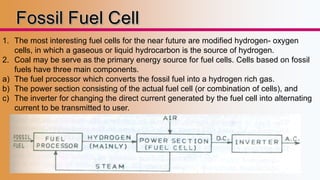
1. The most interesting fuel cells for the near future are modified hydrogen- oxygen 
cells, in which a gaseous or liquid hydrocarbon is the source of hydrogen. 
2. Coal may be serve as the primary energy source for fuel cells. Cells based on fossil 
fuels have three main components. 
a) The fuel processor which converts the fossil fuel into a hydrogen rich gas. 
b) The power section consisting of the actual fuel cell (or combination of cells), and 
c) The inverter for changing the direct current generated by the fuel cell into alternating 
current to be transmitted to user.
1. In this the ammonia gas obtained from the stored liquid is decomposed 
catalytically into hydrogen and nitrogen. 
2. Part of the hydrogen is burned in air to provide the heat required for the 
decomposition. 
3. Other hydrogen is supplied to the negative electrode of the hydrogen cell in 
which potassium hydroxide is used as electrolyte. 
4. The nitrogen produced due to decomposition is an inert gas and plays no roll 
in the cell. 
5. The advantage of ammonia as fuel is that it can be stored in the liquid 
form. 
6. The disadvantage include higher vapour pressure and cell operate 
satisfactory at low temperature.
1. A compact fuel cell for mobile application possibly for vehicle propulsion 
utilizes the liquid hydrazine as a fuel and hydrogen peroxide or air as the 
energy source. 
2. Hydrazine is injected as required into the aqueous potassium hydroxide 
electrolyte to provide the active material at the negative electrode. 
3. The oxygen is either supplied by decomposition or from air. 
4. The electrode is made up of nickel (negative) or silver (positive) as the 
electrochemical catalyst. 
5. The overall cell reaction is the oxidation of hydrazine to water and nitrogen, but 
the discharged e.m.f is similar to that of the hydrogen oxygen cell.
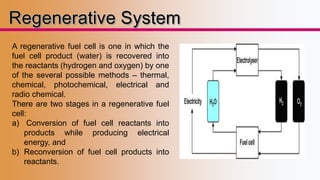
A regenerative fuel cell is one in which the 
fuel cell product (water) is recovered into 
the reactants (hydrogen and oxygen) by one 
of the several possible methods – thermal, 
chemical, photochemical, electrical and 
radio chemical. 
There are two stages in a regenerative fuel 
cell: 
a) Conversion of fuel cell reactants into 
products while producing electrical 
energy, and 
b) Reconversion of fuel cell products into 
reactants.
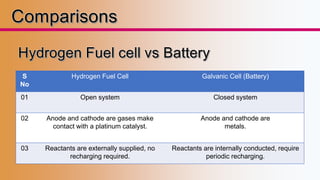
S 
No 
Hydrogen Fuel Cell Galvanic Cell (Battery) 
01 Open system Closed system 
02 Anode and cathode are gases make 
contact with a platinum catalyst. 
Anode and cathode are 
metals. 
03 Reactants are externally supplied, no 
recharging required. 
Reactants are internally conducted, require 
periodic recharging.
S 
No 
Hydrogen Fuel Cell IC Engine 
01 Output is electrical work. Output is mechanical work. 
02 Fuel and oxidant respond 
electrochemically. 
Fuel and oxidant reacts by the 
process of combustion. 
03 Modest to nil pollution produced Use of fossil fuels can generate 
considerable pollution. 
1. Both use hydrogen-rich fuel. 
2. Both employ compressed air as the oxidant. 
3. Both require cooling.
1. 40% efficiency generated, converting methanol to 
hydrogen in reformer 
2. 80% of hydrogen energy content converted to electrical 
energy 
3. 80% efficiency for inverter/motor – Converts electrical to 
mechanical energy 
4. Overall efficiency of 24-32%
1. Fuel cell system are ecofriendly. 
2. High conversion efficiency . 
3. Extremely low emission. 
4. Noise less operations so readily accepted in residential areas. 
5. Availability to use at any location. So less transmission & distribution losses. 
6. No requirements of cooling tower as conventional plants. 
7. Less space require as compared to conventional plants.
1. Higher Initial Cost. 
2. Lower Service Life. 
3. Fuelling fuel cells is still a major problem since the production, transportation, 
distribution and storage of hydrogen is difficult. 
4. The technology is not yet fully developed and few products are available. 
5. Fuel cells are currently very expensive to produce, since most units are hand-made.
The application of the fuel cell may be discussed in the following areas. 
1. Domestic Power 
2. Central Power Station. 
3. Automotive Vehicles. 
4. Special Application
1. LLC, Latham, NY has successfully developed 50 KW power plant. 
2. Fuel cell of capacity 1.5KW is powering houses in Australia. 
3. GAIL is actively involved in establishing fuel infrastructure for fuel cell vehicles 
in India. 
4. CECRI, Karaikudi has developed and tested MCFC stack. 
1. Ministry of NCES 
2. IITs 
3. CSIR labs 
4. BHEL 
5. GAIL 
6. BARC 
7. MIT

Fuel cells

  • 1.
  • 2.
    1. Introduction 2.Design Principle & operation of Fuel Cell. 3. Types of Fuel Cells. 4. Comparison of Fuel cell with Battery and IC Engine 5. Fuel Cell Efficiency. 6. Advantages and Disadvantages 7. Application of Fuel Cell. 8. Recent Development.
  • 3.
    What is aFuel Cell ? 1. A fuel cell is an electrochemical energy conversion device. 2. A fuel cell converts the chemicals hydrogen and oxygen into water. 3. A fuel cell is a device that generates electricity by a chemical reaction. 4. Every fuel cell has two electrodes, one positive and one negative, called cathode and anode respectively. The reactions that produce electricity take place at the electrodes.
  • 4.
    Why we needFuel Cells ? 1. Due to energy crisis all over the world. 2. Due to the issue of global warming. 3. Due to the unavailability of different renewable sources at each and every place due to geographic condition. 4. Fuel cell provides an alternate efficient non polluting power source that produces no noise and has no moving parts. 5. It is expected that by 2050 the global energy demand is going to rise by 2 to 3 times.
  • 5.
    The basic principleof the fuel cell is illustrated in the figure. The core of each fuel cell consists of an electrolyte and two electrodes. At the negative anode, a fuel such as hydrogen is being oxidized, while at the positive cathode, oxygen is reduced. Ions are transported through the electrolyte from one side to the other. Chemistry of fuel cell: At Anode:- 2H2 → 4H+ + 4e- At Cathode:- O2 + 4H+ + 4e- → 2H2O Net Reaction: 2H2 + O2 → 2H2O
  • 6.
    Classification of fuelcells is very difficult as several operational variable exists. 1. Based on the temperature range in which they operate: low temperature(25- 100), medium temperature (100-500) , high temperature(500-1000) & very high temperature(above 1000) 2. According to the type of electrolyte : aqueous, non aqueous, molten or solid. 3. According to the physical state of the fuel: Gas(hydrogen, lower hydrocarbons) , Liquid(alcohols, hydrazine, higher hydrocarbons), Solid(Metals). Another Classification : 1. Primary fuel cell: Reactants are passed through the cell only once & the products of the reaction being discarded. (H 2 – O 2 fuel cell ) 2. Secondary fuel cell: Reactants are passed through the cell many times because they are regenerated by different methods.( Nitric oxide – chlorine fuel cell)
  • 7.
    Classification based ontypes of fuel used: 1. Hydrogen 2. Fossil Fuel 3. Ammonia fuel. 4. Hydrazine fuel.
  • 8.
    1. 40% KOHsolution as electrolyte (Ion exchange membrane). 2. The membrane is non permeable to the reactant gases, hydrogen and oxygen, which thus prevents them from coming into contact. 3. The membrane is however , permeable to hydrogen ions which are the current carriers in the electrolyte. 4. The desired properties of an ideal ion exchange membrane electrolyte are: a) High ionic conductivity. b) Zero electronic conductivity c) Low permeability of fuel and oxidant d) Low degree of electro-osmosis. e) High resistance to dehydration. f) High resistance to its oxidation or hydrolysis and, g) Mechanical stability
  • 9.
    1. The mostinteresting fuel cells for the near future are modified hydrogen- oxygen cells, in which a gaseous or liquid hydrocarbon is the source of hydrogen. 2. Coal may be serve as the primary energy source for fuel cells. Cells based on fossil fuels have three main components. a) The fuel processor which converts the fossil fuel into a hydrogen rich gas. b) The power section consisting of the actual fuel cell (or combination of cells), and c) The inverter for changing the direct current generated by the fuel cell into alternating current to be transmitted to user.
  • 10.
    1. In thisthe ammonia gas obtained from the stored liquid is decomposed catalytically into hydrogen and nitrogen. 2. Part of the hydrogen is burned in air to provide the heat required for the decomposition. 3. Other hydrogen is supplied to the negative electrode of the hydrogen cell in which potassium hydroxide is used as electrolyte. 4. The nitrogen produced due to decomposition is an inert gas and plays no roll in the cell. 5. The advantage of ammonia as fuel is that it can be stored in the liquid form. 6. The disadvantage include higher vapour pressure and cell operate satisfactory at low temperature.
  • 11.
    1. A compactfuel cell for mobile application possibly for vehicle propulsion utilizes the liquid hydrazine as a fuel and hydrogen peroxide or air as the energy source. 2. Hydrazine is injected as required into the aqueous potassium hydroxide electrolyte to provide the active material at the negative electrode. 3. The oxygen is either supplied by decomposition or from air. 4. The electrode is made up of nickel (negative) or silver (positive) as the electrochemical catalyst. 5. The overall cell reaction is the oxidation of hydrazine to water and nitrogen, but the discharged e.m.f is similar to that of the hydrogen oxygen cell.
  • 12.
    A regenerative fuelcell is one in which the fuel cell product (water) is recovered into the reactants (hydrogen and oxygen) by one of the several possible methods – thermal, chemical, photochemical, electrical and radio chemical. There are two stages in a regenerative fuel cell: a) Conversion of fuel cell reactants into products while producing electrical energy, and b) Reconversion of fuel cell products into reactants.
  • 13.
    S No HydrogenFuel Cell Galvanic Cell (Battery) 01 Open system Closed system 02 Anode and cathode are gases make contact with a platinum catalyst. Anode and cathode are metals. 03 Reactants are externally supplied, no recharging required. Reactants are internally conducted, require periodic recharging.
  • 14.
    S No HydrogenFuel Cell IC Engine 01 Output is electrical work. Output is mechanical work. 02 Fuel and oxidant respond electrochemically. Fuel and oxidant reacts by the process of combustion. 03 Modest to nil pollution produced Use of fossil fuels can generate considerable pollution. 1. Both use hydrogen-rich fuel. 2. Both employ compressed air as the oxidant. 3. Both require cooling.
  • 15.
    1. 40% efficiencygenerated, converting methanol to hydrogen in reformer 2. 80% of hydrogen energy content converted to electrical energy 3. 80% efficiency for inverter/motor – Converts electrical to mechanical energy 4. Overall efficiency of 24-32%
  • 16.
    1. Fuel cellsystem are ecofriendly. 2. High conversion efficiency . 3. Extremely low emission. 4. Noise less operations so readily accepted in residential areas. 5. Availability to use at any location. So less transmission & distribution losses. 6. No requirements of cooling tower as conventional plants. 7. Less space require as compared to conventional plants.
  • 17.
    1. Higher InitialCost. 2. Lower Service Life. 3. Fuelling fuel cells is still a major problem since the production, transportation, distribution and storage of hydrogen is difficult. 4. The technology is not yet fully developed and few products are available. 5. Fuel cells are currently very expensive to produce, since most units are hand-made.
  • 18.
    The application ofthe fuel cell may be discussed in the following areas. 1. Domestic Power 2. Central Power Station. 3. Automotive Vehicles. 4. Special Application
  • 19.
    1. LLC, Latham,NY has successfully developed 50 KW power plant. 2. Fuel cell of capacity 1.5KW is powering houses in Australia. 3. GAIL is actively involved in establishing fuel infrastructure for fuel cell vehicles in India. 4. CECRI, Karaikudi has developed and tested MCFC stack. 1. Ministry of NCES 2. IITs 3. CSIR labs 4. BHEL 5. GAIL 6. BARC 7. MIT