THE HORIZON REPORT 2007 EDITION 工教 98  吳信泓 工教 98  林后鍾
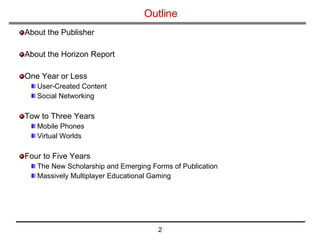
Outline About the Publisher About the Horizon Report One Year or Less User-Created Content Social Networking Tow to Three Years Mobile Phones Virtual Worlds Four to Five Years The New Scholarship and Emerging Forms of Publication Massively Multiplayer Educational Gaming
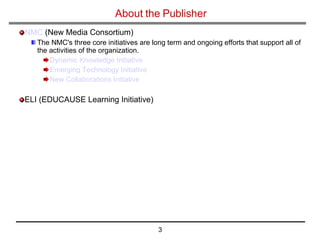
About the Publisher NMC  (New Media Consortium) The NMC's three core initiatives are long term and ongoing efforts that support all of the activities of the organization.  Dynamic Knowledge Initiative   Emerging Technology Initiative   New Collaborations Initiative   ELI (EDUCAUSE Learning Initiative)
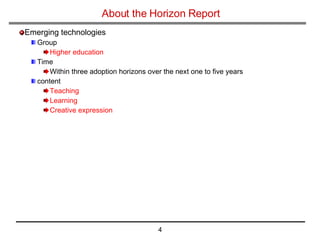
About the Horizon Report Emerging technologies Group Higher education Time  Within three adoption horizons over the next one to five years content Teaching Learning Creative expression
User-Created Content 工教 98  吳信泓
Overview Producing, commenting, and classifying are just as important as the more passive tasks of searching, reading, watching, and listening. Using simple interfaces, visitors can build shared collections of resources.
Overview The social aspects of these audience-centered technologies, firmly established as powerful tools for creative expression, offer great potential to build community in the context of teaching and learning as well. We face a significant challenge as we seek to marshal these techniques in the service of education, as this aspect of the new web turns the traditional view of what a website should be on its head.
Relevance for Teaching, Learning and Creative Expression Using tools for creating and tagging content Tools like  d el.icio.us   and  Flickr   have no classroom boundaries. Examples,  commentary , and  feedback  are all available from a wide audience all the time. Comparing their own work to that of others can give students a valuable perspective on their own abilities and inspire them to try new ideas or techniques. value of these tools for education may lie in their ability to connect people and facilitate work without the need to consult a central technology support center.
Relevance for Teaching, Learning and Creative Expression Applications Create collaborative, student-authored resources. Enable asynchronous public feedback on assignments. Give voice to communities and encourage idea sharing.
Examples weblogs.elearning.ubc.ca/textologies/links.html tags.library.upenn.edu www.zotero.org www.uthtv.com
Flickr
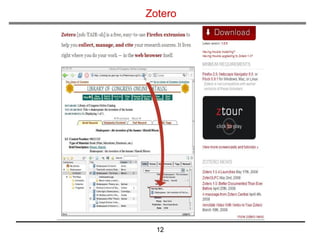
Zotero
Social Networking 工教 98  吳信泓
Social Networking social networking sites facilitate introduction and communication by providing a space for people to connect around a topic of common interest communities of practice as well as social communities.
Overview Conversations that take place in social networking contexts are inherently social The heart of social networking is fostering the kinds of deep connections that occur when common pursuits are shared and discussed Students are tremendously interested insocial networking sites because of the community, the content, and the activities they can do there. Two of the best-known examples,   MySpace   and  Facebook
Overview These sites are frequently customizable and user controlled Social networking is already second nature to many students
Relevance for Teaching, Learning and Creative Expression there are not yet many institutional examples of social networking. there are easily dozens of examples that are familiar to students and used by them on a daily basis; institutional uses will emerge very quickly because these approaches clearly appeal to students. Research and use of these systems are occurring in tandem, and both will contribute to the integration of social networking and education.
Relevance for Teaching, Learning and Creative Expression The selection of available tools is broad, with many open-source options readily available. It is increasingly easy to build social networking functions into any website. Educational tools are already being developed, including single-purpose tools like  CollegeRuled. This is the next step after portals: to harness the power of social networking to build rich, interactive, robust learning communities.
Relevance for Teaching, Learning and Creative Expression Applications Encourage community and self-expression. EX: The University of Pennsylvania Offer immersion in a foreign language environment. EX:MIXXER Extend the impact and life span of conferences and workshops
Examples of Social Networking Facebook - 創辦人是 Mark  Zuckerberg ,他是 哈佛大學 的學生   , 在全球範圍內有一個大學後綴 電子郵箱 的人(如  .edu, .ac.uk 等)都可以註冊  MySpace- 美國 第三受歡迎的網站
Mobile Phones 工教 98  林后鍾
Mobile Phones The convergence of  ubiquitous broadband ,  portable devices , and  tiny computers  has changed our concept of what a phone is meant to be.   The ubiquity of mobile phones, combined with their many capabilities, makes them an  ideal platform  for educational content and activities.
Overview   First highlighted in the  2006 Horizon Report   campus-wide programs individual courses In the next two years, we predict that mobile phones will be accepted tools on campus, as desirable and common as  personal computers . Includes some form of multimedia, instant messaging, web browsing, and email.
Overview More and more content is available for phones Many  websites and blogs  can automatically detect if the browser is housed on a phone and format content accordingly.  New genres of filmmaking and photography  are developing as artists and students experiment with equipment that fits in their pockets.  No longer requires the laptop High speed broadband  combined with the  multifunctionality  of new phones and increased  storage capacity  via removable memory
Relevance for Teaching, Learning, and Creative Expression Phones will include  projection systems Removing the barrier of the small screen Full-size keyboard In education The ability of phones to record data has applications  in fieldwork In the UK , students in  geography class  use cell phones to record data in the field and submit it to the teacher In Australia , a grant-funded project invited  filmmakers  to write and shoot five-minute movies specifically for the mobile phone platform  (see  www.abc.net.au/miniseries  ).
Relevance for Teaching, Learning, and Creative Expression Applications Offer self-paced audio and video tours.   Phones can detect where they are and use that information to deliver relevant information via audio, text, or video.   Deliver  campus-based  services.   Scheduling, networking, emergency updates, and other campus-based information can be delivered quickly and easily.  Encourage creativity and mediamaking.   Students can explore new techniques of creating art and social commentary.
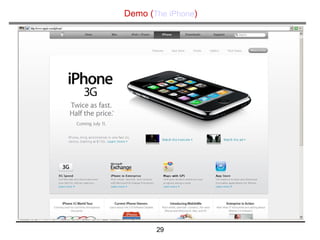
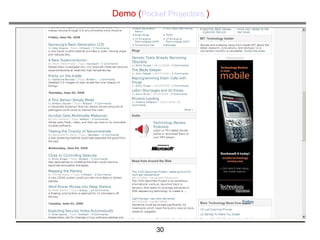
Examples Citizen Journalism: Cell Phones as Media Outlets Citizen Journalism is the practice of ordinary people using mobile devices to capture and upload news items as they happen.  Hamilton College  Vidblinks A project at  Hamilton College  explored the use of rhetorical techniques through cell phone video messages.  The  iPhone   The device, which has but one button, uses an interactive touch screen and combines the functions of an iPod, a phone, a web browser, and a messaging device.  Pocket Projectors   This article describes emerging technology that is likely to put projectors into cell phones before long.
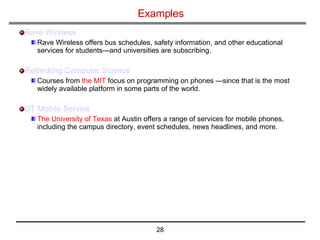
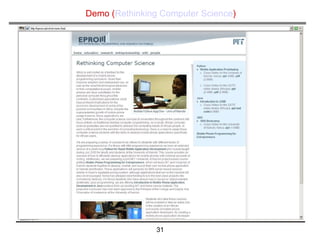
Examples Rave Wireless   Rave Wireless offers bus schedules, safety information, and other educational services for students—and universities are subscribing.  Rethinking Computer Science Courses from  the MIT  focus on programming on phones —since that is the most widely available platform in some parts of the world.  UT Mobile Service   The University of Texas  at Austin offers a range of services for mobile phones, including the campus directory, event schedules, news headlines, and more.
Demo ( The  iPhone )
Demo ( Pocket Projectors   )
Demo ( Rethinking Computer Science )
Virtual Worlds  工教 98  林后鍾
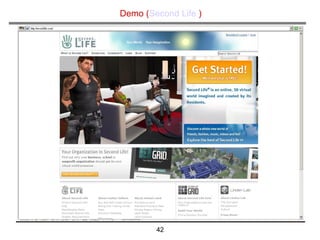
Virtual Worlds  In the last year, virtual worlds has grown considerably. Virtual worlds offer  flexible spaces  for  learning  and  exploration . Second Life.   Campuses and businesses  have established locations in these worlds, much as they were creating websites a dozen years ago.
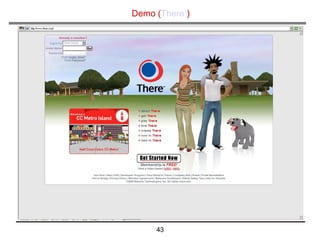
Overview   Virtual worlds are richly immersive and highly scalable  3D environments The most popular virtual worlds are  multi-user spaces Pure virtual worlds like  Second Life  ,  Active Worlds  , or  There  can be applied to any context, as opposed to game worlds, which generally have a  fixed, goal-oriented purpose .
Overview Virtual worlds offer an opportunity for people to interact in a way that conveys  a sense of presence lacking  in other media.  These spaces can be  huge they are growing in popularity because they combine many of the elements that make  Web 2.0   Social networking The ability to share rich media seamlessly The ability to connect with friends A feeling of presence A connection to the community
Overview In education  Courses now meet in Second Life and other locations  training emergency response personnel developing civic participation and leadership skills visualizing real time weather data modeling complex mathematical functions experimenting with architectural models A  consortium of librarians  has built an extensive and growing set of information resources in Second Life.  Courses from English to Chemistry  hold meetings in virtual worlds
Relevance for Teaching, Learning, and Creative Expression Virtual worlds can be used to create very effective  learning spaces Settings can be created to pertain to any subject or area of study The social aspects of virtual worlds These worlds lend themselves to  role playing , allowing learners to temporarily assume the responsibilities of an  astronomer, chemist, or engineer  without incurring real-world consequences. Researchers and ethnographers  have ventured into worlds like  Second Life  to interview and study the inhabitants.
Relevance for Teaching, Learning, and Creative Expression New art forms  are emerging in these spaces  Machinima-  filmmaking using virtual world settings and avatar actors  Educators begin to explore the opportunities offered by virtual worlds  Trinity University   University of Texas at Austin   University of Wisconsin—Madison Bradley University   Seton Hall University
Relevance for Teaching, Learning, and Creative Expression Applications Expand understanding of cultural and societal experiences.   Many virtual worlds offer an opportunity for students to create as well as observe their surroundings.  Experiment with new art forms.   Virtual worlds lend themselves to creative work, blending flat texture design with more sculptural three-dimensional forms. Learn through simulations and role-playing. Simulated problem-solving activities can be planned in custom settings like a hospital room, a power plant, or even an entire town.
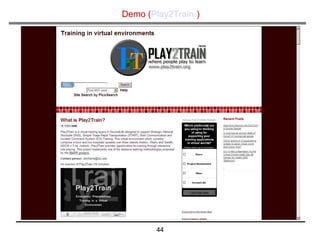
Examples The Adding Machine   This online journal chronicles the progress of an interdisciplinary, inter-institutional production of Elmer Rice’s. Field Research Methods in Second Life Bradley University  offers a course in field research methods in the online virtual world of Second Life.  Oakland Jazz and Blues Club Virtual Reality Project   At the  University of California , Berkeley the Journalism and Architecture schools are collaborating on a project that will recreate the 1940-1950’s environment of the 7th Street music scene.  Play2Train   This bioterroism simulation was built in Second Life and is designed to teach preparedness through role-playing.
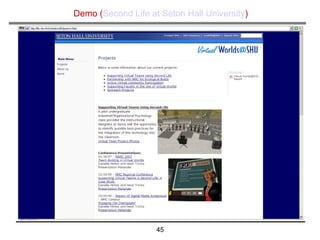
Examples Second Life at Seton Hall University The Teaching, Learning and Technology Center at  Seton Hall University  is exploring the potential of virtual spaces in the high school and college classroom.  Simulations in  Neverwinter  Nights A communications class at the University of Minnesota used a simulation built by modifying the game Neverwinter Nights to practice investigative journalism. The VITAL Lab at Ohio University The Ohio University  Virtual Immersive Technologies for Arts and Learning (VITAL) Lab is a research and development lab dedicated to creating immersive virtual environments to enhance teaching, learning, and training activities.
Demo ( Second Life  )
Demo ( There  )
Demo ( Play2Train   )
Demo ( Second Life at Seton Hall University )
The New Scholarship and Emerging Forms of Publication 工教 98  林后鍾
The new scholarship and Emerging Forms of Publication The processes of  research ,  review ,  publication , and  tenure  are challenged by the same trends. The  audience-generated content  combined with  open-access content models  is changing the way we think about scholarship and publication.
Overview   Both the process and shape of scholarship are changing. Prepublication releases of their work Distribution through nontraditional channels Dynamic visualization of data and results New ways to conduct peer reviews using online collaboration
Overview Blogs and Video clips Academia has been  slow  to recognize and accept them Some scholars worry that blogging may cut into time that would otherwise be used for scholarly research or writing. Blogging scholars  The forum for airing ideas and receiving comments from their colleagues helps them to hone their thinking and explore avenues they might otherwise have overlooked.
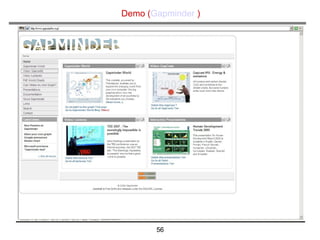
Relevance for Teaching, Learning, and Creative Expression To expand the audience  for scholarship and research Academics can collaborate with a much wider community and easily reach out to experts from related disciplines. Combined with a traditional paper or  embedded  in a less traditional one interactive charts and graphs give us a new way to see information. Emerging forms of publication also have the power to make the  information being conveyed more easily understood. Writers shared editing tools like  Google Docs  and wikis Visualization tools like  Gapminder  bring statistical data to life.
Relevance for Teaching, Learning, and Creative Expression Complications Causing us to regard the traditional book as an  impermanent medium The content of printed matter is perceived as  increasingly ephemeral More and more books are often accompanied by a website, wiki, or other online resource that can communicate new insights as they arise and create and sustain a living community around the concepts entombed in the published material.
Relevance for Teaching, Learning, and Creative Expression Applications Include—and learn from—new voices.   Both books and their authors may benefit from the comments of interested students, colleagues, and members of the public, who in turn will benefit from hearing scholars narrate their process. Control costs and reach wider audiences.   Electronic texts are cheaper and easier to distribute than printed and bound copies. Illustrate and educate using a variety of media.   Disciplines are available that incorporate illustrations both static and animated, video and audio commentary by experts in the field, and graphs that respond to user input.  Combined with new methods of  data visualization ,  mapping, graphing , and  charting , online books are becoming powerful interactive tools for learning.
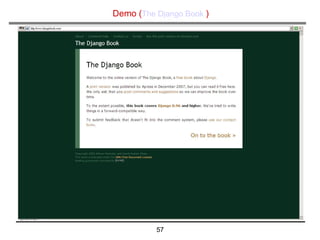
Examples Networked Books  GAM3R 7H30RY  by McKenzie Wark;  The Django Book  by Adrian Holovaty and Jacob Kaplan-Moss.  These two books are online in prepublication format, where readers can add comments that will inform the authors’ work. Both are scheduled for publication in 2007. NINES NINES is a consortium of scholars promoting and exploring new forms of scholarship. Poetess Archive Developed at Miami University, the Poetess Archive provides an extensive bibliography and some full texts. Over the next year, the database will be linked to a visualization tool.  Public Library of Science  The Public Library of Science is committed to making the world’s scientific and medical literature a freely available public resource via a new process of peer-reviewed publishing.
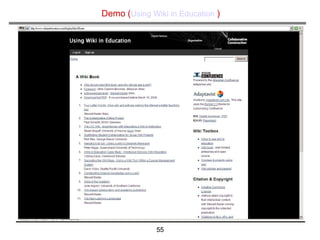
Examples Texas Politics An online textbook developed at the University of Texas at Austin, Texas Politics includes audio and video, commentary, a series of live speakers, and other media as well as traditional text. UO Channel The University of Oregon has a library of video productions online, collected in the UO Channel. Featured programs include lectures, interviews, performances, symposia, documentary productions, and more. Using Wiki in Education  Both a wiki and a published book, Using Wiki in Education explores the ways online publishing can extend the life and usefulness of a scholarly work.
Demo ( Using Wiki in Education  )
Demo ( Gapminder   )
Demo ( The Django Book   )
Massively Multiplayer Educational Gaming 工教 98  林后鍾
Massively Multiplayer Educational Gaming Educators are taking a hard look at one type of serious game,  massively multiplayer educational games . These games are still  time-consuming  and often  expensive to produce . Interest is high and developments in the  open-source .
Overview   One genre that offers interesting potential for education is  massively multiplayer online (MMO) games Bring many players together in activities that are sometimes  collaborative  and sometimes  competitive , generally  goal-oriented , and often tied to a storyline or theme. popular MMOs  MOOs and MUDs (text-based multiplayer environments).  text-based or built on simple graphical interfaces 3D virtual world that is not a requirement
Overview Educational MMOs combine a carefully crafted setting with  specific educational objectives  what makes these games especially  compelling  and  effective   is their multiplayer nature students can work in small or  large groups , or can  pursue goals solo , all in the context of a larger community of player-learners. Role-playing  Mentoring of newer players by more experienced ones Competitive team activities Collaborative world-building
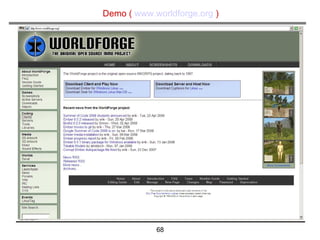
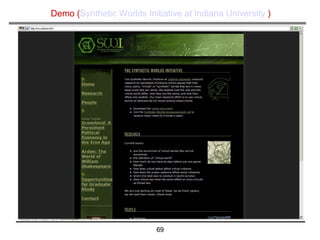
Overview We are now seeing a resurgence of interest in educational MMOs. Synthetic Worlds Initiative at Indiana University   MMO Set in a 3D virtual world About the life and times of  William Shakespeare learn about the customs, language, and events of the time. Successful in lowering the barrier to development of these complex games.  Open- source efforts WorldForge (  www.worldforge.org  ) low-cost engines like Multiverse (  www.multiverse.net  )
Relevance for Teaching, Learning, and Creative Expression It seems clear that games can be effectively applied in many learning contexts. MMOs in the  entertainment  sector have been seen to attract and retain players Increasingly, we know more about how games work and how to apply them to teaching and learning.
Relevance for Teaching, Learning, and Creative Expression Another aspect of MMOs that is of value to the  educational community  is the types of activities they make possible. These games offer opportunities for both  discovery-based  and  goal-oriented  learning, and can be very effective ways to develop  team-building skills . A group must work together to strategize, develop a solution, maximize the various talents of the team members, and execute their plan in concert to succeed.
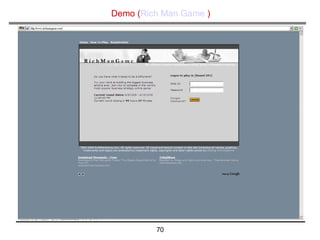
Relevance for Teaching, Learning, and Creative Expression Applications Study foreign language and culture.   MMOs offer the opportunity for virtual immersion, not only in a visual or design sense, but also in reading, writing, listening, and even speaking. Develop leadership and management skills.   Even in non-educational MMOs, leadership and management skills come into play. Practice strategy and apply knowledge competitvely. Multiplayer games offer an opportunity for students to practice what they have learned. Rich Man Game  make business deals and build up their net worth.
Examples Games, Learning, and Society Offered at the University of Wisconsin—Madison, the Games, Learning and Society minor is designed for students who are interested in game design, the impact of games on culture, and gaming in education. Immersive Education Immersive Education, developed at Boston College’s Grid Institute, combines interactive virtual reality and sophisticated digital media with collaborative online course environments and classrooms. Innovation Awards The University of Wisconsin System is encouraging faculty to explore the potential of gaming in education by offering grants for research and development of faculty-designed games.
Examples Synthetic Worlds Initiative The Synthetic Worlds Initiative is a research project at Indiana University whose aim is to promote innovative thinking about virtual worlds. A multiplayer game about the life of Shakespeare and an academic conference embedded in the context of a live-action game are just two of the projects underway now. Thinking Worlds Thinking Worlds is an educational games authoring engine and a community of user-developers; once created, games can be shared within the community.
Demo (  www.worldforge.org  )
Demo ( Synthetic Worlds Initiative at Indiana University   )
Demo ( Rich Man Game  )
分工 信泓 User-Created Content Social Networking 后鍾 Mobile Phones Virtual Worlds The New Scholarship and Emerging Forms of Publication Massively Multiplayer Educational Gaming PPT 製作、整理

thefinalreport

  • 1.
    THE HORIZON REPORT2007 EDITION 工教 98 吳信泓 工教 98 林后鍾
  • 2.
    Outline About thePublisher About the Horizon Report One Year or Less User-Created Content Social Networking Tow to Three Years Mobile Phones Virtual Worlds Four to Five Years The New Scholarship and Emerging Forms of Publication Massively Multiplayer Educational Gaming
  • 3.
    About the PublisherNMC (New Media Consortium) The NMC's three core initiatives are long term and ongoing efforts that support all of the activities of the organization. Dynamic Knowledge Initiative Emerging Technology Initiative New Collaborations Initiative ELI (EDUCAUSE Learning Initiative)
  • 4.
    About the HorizonReport Emerging technologies Group Higher education Time Within three adoption horizons over the next one to five years content Teaching Learning Creative expression
  • 5.
  • 6.
    Overview Producing, commenting,and classifying are just as important as the more passive tasks of searching, reading, watching, and listening. Using simple interfaces, visitors can build shared collections of resources.
  • 7.
    Overview The socialaspects of these audience-centered technologies, firmly established as powerful tools for creative expression, offer great potential to build community in the context of teaching and learning as well. We face a significant challenge as we seek to marshal these techniques in the service of education, as this aspect of the new web turns the traditional view of what a website should be on its head.
  • 8.
    Relevance for Teaching,Learning and Creative Expression Using tools for creating and tagging content Tools like d el.icio.us and Flickr have no classroom boundaries. Examples, commentary , and feedback are all available from a wide audience all the time. Comparing their own work to that of others can give students a valuable perspective on their own abilities and inspire them to try new ideas or techniques. value of these tools for education may lie in their ability to connect people and facilitate work without the need to consult a central technology support center.
  • 9.
    Relevance for Teaching,Learning and Creative Expression Applications Create collaborative, student-authored resources. Enable asynchronous public feedback on assignments. Give voice to communities and encourage idea sharing.
  • 10.
  • 11.
  • 12.
  • 13.
  • 14.
    Social Networking socialnetworking sites facilitate introduction and communication by providing a space for people to connect around a topic of common interest communities of practice as well as social communities.
  • 15.
    Overview Conversations thattake place in social networking contexts are inherently social The heart of social networking is fostering the kinds of deep connections that occur when common pursuits are shared and discussed Students are tremendously interested insocial networking sites because of the community, the content, and the activities they can do there. Two of the best-known examples, MySpace and Facebook
  • 16.
    Overview These sitesare frequently customizable and user controlled Social networking is already second nature to many students
  • 17.
    Relevance for Teaching,Learning and Creative Expression there are not yet many institutional examples of social networking. there are easily dozens of examples that are familiar to students and used by them on a daily basis; institutional uses will emerge very quickly because these approaches clearly appeal to students. Research and use of these systems are occurring in tandem, and both will contribute to the integration of social networking and education.
  • 18.
    Relevance for Teaching,Learning and Creative Expression The selection of available tools is broad, with many open-source options readily available. It is increasingly easy to build social networking functions into any website. Educational tools are already being developed, including single-purpose tools like CollegeRuled. This is the next step after portals: to harness the power of social networking to build rich, interactive, robust learning communities.
  • 19.
    Relevance for Teaching,Learning and Creative Expression Applications Encourage community and self-expression. EX: The University of Pennsylvania Offer immersion in a foreign language environment. EX:MIXXER Extend the impact and life span of conferences and workshops
  • 20.
    Examples of SocialNetworking Facebook - 創辦人是 Mark Zuckerberg ,他是 哈佛大學 的學生 , 在全球範圍內有一個大學後綴 電子郵箱 的人(如 .edu, .ac.uk 等)都可以註冊 MySpace- 美國 第三受歡迎的網站
  • 21.
  • 22.
    Mobile Phones Theconvergence of ubiquitous broadband , portable devices , and tiny computers has changed our concept of what a phone is meant to be. The ubiquity of mobile phones, combined with their many capabilities, makes them an ideal platform for educational content and activities.
  • 23.
    Overview First highlighted in the 2006 Horizon Report campus-wide programs individual courses In the next two years, we predict that mobile phones will be accepted tools on campus, as desirable and common as personal computers . Includes some form of multimedia, instant messaging, web browsing, and email.
  • 24.
    Overview More andmore content is available for phones Many websites and blogs can automatically detect if the browser is housed on a phone and format content accordingly. New genres of filmmaking and photography are developing as artists and students experiment with equipment that fits in their pockets. No longer requires the laptop High speed broadband combined with the multifunctionality of new phones and increased storage capacity via removable memory
  • 25.
    Relevance for Teaching,Learning, and Creative Expression Phones will include projection systems Removing the barrier of the small screen Full-size keyboard In education The ability of phones to record data has applications in fieldwork In the UK , students in geography class use cell phones to record data in the field and submit it to the teacher In Australia , a grant-funded project invited filmmakers to write and shoot five-minute movies specifically for the mobile phone platform (see www.abc.net.au/miniseries ).
  • 26.
    Relevance for Teaching,Learning, and Creative Expression Applications Offer self-paced audio and video tours. Phones can detect where they are and use that information to deliver relevant information via audio, text, or video. Deliver campus-based services. Scheduling, networking, emergency updates, and other campus-based information can be delivered quickly and easily. Encourage creativity and mediamaking. Students can explore new techniques of creating art and social commentary.
  • 27.
    Examples Citizen Journalism:Cell Phones as Media Outlets Citizen Journalism is the practice of ordinary people using mobile devices to capture and upload news items as they happen. Hamilton College Vidblinks A project at Hamilton College explored the use of rhetorical techniques through cell phone video messages. The iPhone The device, which has but one button, uses an interactive touch screen and combines the functions of an iPod, a phone, a web browser, and a messaging device. Pocket Projectors This article describes emerging technology that is likely to put projectors into cell phones before long.
  • 28.
    Examples Rave Wireless Rave Wireless offers bus schedules, safety information, and other educational services for students—and universities are subscribing. Rethinking Computer Science Courses from the MIT focus on programming on phones —since that is the most widely available platform in some parts of the world. UT Mobile Service The University of Texas at Austin offers a range of services for mobile phones, including the campus directory, event schedules, news headlines, and more.
  • 29.
    Demo ( The iPhone )
  • 30.
    Demo ( PocketProjectors )
  • 31.
    Demo ( RethinkingComputer Science )
  • 32.
    Virtual Worlds 工教 98 林后鍾
  • 33.
    Virtual Worlds In the last year, virtual worlds has grown considerably. Virtual worlds offer flexible spaces for learning and exploration . Second Life. Campuses and businesses have established locations in these worlds, much as they were creating websites a dozen years ago.
  • 34.
    Overview Virtual worlds are richly immersive and highly scalable 3D environments The most popular virtual worlds are multi-user spaces Pure virtual worlds like Second Life , Active Worlds , or There can be applied to any context, as opposed to game worlds, which generally have a fixed, goal-oriented purpose .
  • 35.
    Overview Virtual worldsoffer an opportunity for people to interact in a way that conveys a sense of presence lacking in other media. These spaces can be huge they are growing in popularity because they combine many of the elements that make Web 2.0 Social networking The ability to share rich media seamlessly The ability to connect with friends A feeling of presence A connection to the community
  • 36.
    Overview In education Courses now meet in Second Life and other locations training emergency response personnel developing civic participation and leadership skills visualizing real time weather data modeling complex mathematical functions experimenting with architectural models A consortium of librarians has built an extensive and growing set of information resources in Second Life. Courses from English to Chemistry hold meetings in virtual worlds
  • 37.
    Relevance for Teaching,Learning, and Creative Expression Virtual worlds can be used to create very effective learning spaces Settings can be created to pertain to any subject or area of study The social aspects of virtual worlds These worlds lend themselves to role playing , allowing learners to temporarily assume the responsibilities of an astronomer, chemist, or engineer without incurring real-world consequences. Researchers and ethnographers have ventured into worlds like Second Life to interview and study the inhabitants.
  • 38.
    Relevance for Teaching,Learning, and Creative Expression New art forms are emerging in these spaces Machinima- filmmaking using virtual world settings and avatar actors Educators begin to explore the opportunities offered by virtual worlds Trinity University University of Texas at Austin University of Wisconsin—Madison Bradley University Seton Hall University
  • 39.
    Relevance for Teaching,Learning, and Creative Expression Applications Expand understanding of cultural and societal experiences. Many virtual worlds offer an opportunity for students to create as well as observe their surroundings. Experiment with new art forms. Virtual worlds lend themselves to creative work, blending flat texture design with more sculptural three-dimensional forms. Learn through simulations and role-playing. Simulated problem-solving activities can be planned in custom settings like a hospital room, a power plant, or even an entire town.
  • 40.
    Examples The AddingMachine This online journal chronicles the progress of an interdisciplinary, inter-institutional production of Elmer Rice’s. Field Research Methods in Second Life Bradley University offers a course in field research methods in the online virtual world of Second Life. Oakland Jazz and Blues Club Virtual Reality Project At the University of California , Berkeley the Journalism and Architecture schools are collaborating on a project that will recreate the 1940-1950’s environment of the 7th Street music scene. Play2Train This bioterroism simulation was built in Second Life and is designed to teach preparedness through role-playing.
  • 41.
    Examples Second Lifeat Seton Hall University The Teaching, Learning and Technology Center at Seton Hall University is exploring the potential of virtual spaces in the high school and college classroom. Simulations in Neverwinter Nights A communications class at the University of Minnesota used a simulation built by modifying the game Neverwinter Nights to practice investigative journalism. The VITAL Lab at Ohio University The Ohio University Virtual Immersive Technologies for Arts and Learning (VITAL) Lab is a research and development lab dedicated to creating immersive virtual environments to enhance teaching, learning, and training activities.
  • 42.
  • 43.
  • 44.
  • 45.
    Demo ( SecondLife at Seton Hall University )
  • 46.
    The New Scholarshipand Emerging Forms of Publication 工教 98 林后鍾
  • 47.
    The new scholarshipand Emerging Forms of Publication The processes of research , review , publication , and tenure are challenged by the same trends. The audience-generated content combined with open-access content models is changing the way we think about scholarship and publication.
  • 48.
    Overview Both the process and shape of scholarship are changing. Prepublication releases of their work Distribution through nontraditional channels Dynamic visualization of data and results New ways to conduct peer reviews using online collaboration
  • 49.
    Overview Blogs andVideo clips Academia has been slow to recognize and accept them Some scholars worry that blogging may cut into time that would otherwise be used for scholarly research or writing. Blogging scholars The forum for airing ideas and receiving comments from their colleagues helps them to hone their thinking and explore avenues they might otherwise have overlooked.
  • 50.
    Relevance for Teaching,Learning, and Creative Expression To expand the audience for scholarship and research Academics can collaborate with a much wider community and easily reach out to experts from related disciplines. Combined with a traditional paper or embedded in a less traditional one interactive charts and graphs give us a new way to see information. Emerging forms of publication also have the power to make the information being conveyed more easily understood. Writers shared editing tools like Google Docs and wikis Visualization tools like Gapminder bring statistical data to life.
  • 51.
    Relevance for Teaching,Learning, and Creative Expression Complications Causing us to regard the traditional book as an impermanent medium The content of printed matter is perceived as increasingly ephemeral More and more books are often accompanied by a website, wiki, or other online resource that can communicate new insights as they arise and create and sustain a living community around the concepts entombed in the published material.
  • 52.
    Relevance for Teaching,Learning, and Creative Expression Applications Include—and learn from—new voices. Both books and their authors may benefit from the comments of interested students, colleagues, and members of the public, who in turn will benefit from hearing scholars narrate their process. Control costs and reach wider audiences. Electronic texts are cheaper and easier to distribute than printed and bound copies. Illustrate and educate using a variety of media. Disciplines are available that incorporate illustrations both static and animated, video and audio commentary by experts in the field, and graphs that respond to user input. Combined with new methods of data visualization , mapping, graphing , and charting , online books are becoming powerful interactive tools for learning.
  • 53.
    Examples Networked Books GAM3R 7H30RY by McKenzie Wark; The Django Book by Adrian Holovaty and Jacob Kaplan-Moss. These two books are online in prepublication format, where readers can add comments that will inform the authors’ work. Both are scheduled for publication in 2007. NINES NINES is a consortium of scholars promoting and exploring new forms of scholarship. Poetess Archive Developed at Miami University, the Poetess Archive provides an extensive bibliography and some full texts. Over the next year, the database will be linked to a visualization tool. Public Library of Science The Public Library of Science is committed to making the world’s scientific and medical literature a freely available public resource via a new process of peer-reviewed publishing.
  • 54.
    Examples Texas PoliticsAn online textbook developed at the University of Texas at Austin, Texas Politics includes audio and video, commentary, a series of live speakers, and other media as well as traditional text. UO Channel The University of Oregon has a library of video productions online, collected in the UO Channel. Featured programs include lectures, interviews, performances, symposia, documentary productions, and more. Using Wiki in Education Both a wiki and a published book, Using Wiki in Education explores the ways online publishing can extend the life and usefulness of a scholarly work.
  • 55.
    Demo ( UsingWiki in Education )
  • 56.
  • 57.
    Demo ( TheDjango Book )
  • 58.
    Massively Multiplayer EducationalGaming 工教 98 林后鍾
  • 59.
    Massively Multiplayer EducationalGaming Educators are taking a hard look at one type of serious game, massively multiplayer educational games . These games are still time-consuming and often expensive to produce . Interest is high and developments in the open-source .
  • 60.
    Overview One genre that offers interesting potential for education is massively multiplayer online (MMO) games Bring many players together in activities that are sometimes collaborative and sometimes competitive , generally goal-oriented , and often tied to a storyline or theme. popular MMOs MOOs and MUDs (text-based multiplayer environments). text-based or built on simple graphical interfaces 3D virtual world that is not a requirement
  • 61.
    Overview Educational MMOscombine a carefully crafted setting with specific educational objectives what makes these games especially compelling and effective is their multiplayer nature students can work in small or large groups , or can pursue goals solo , all in the context of a larger community of player-learners. Role-playing Mentoring of newer players by more experienced ones Competitive team activities Collaborative world-building
  • 62.
    Overview We arenow seeing a resurgence of interest in educational MMOs. Synthetic Worlds Initiative at Indiana University MMO Set in a 3D virtual world About the life and times of William Shakespeare learn about the customs, language, and events of the time. Successful in lowering the barrier to development of these complex games. Open- source efforts WorldForge ( www.worldforge.org ) low-cost engines like Multiverse ( www.multiverse.net )
  • 63.
    Relevance for Teaching,Learning, and Creative Expression It seems clear that games can be effectively applied in many learning contexts. MMOs in the entertainment sector have been seen to attract and retain players Increasingly, we know more about how games work and how to apply them to teaching and learning.
  • 64.
    Relevance for Teaching,Learning, and Creative Expression Another aspect of MMOs that is of value to the educational community is the types of activities they make possible. These games offer opportunities for both discovery-based and goal-oriented learning, and can be very effective ways to develop team-building skills . A group must work together to strategize, develop a solution, maximize the various talents of the team members, and execute their plan in concert to succeed.
  • 65.
    Relevance for Teaching,Learning, and Creative Expression Applications Study foreign language and culture. MMOs offer the opportunity for virtual immersion, not only in a visual or design sense, but also in reading, writing, listening, and even speaking. Develop leadership and management skills. Even in non-educational MMOs, leadership and management skills come into play. Practice strategy and apply knowledge competitvely. Multiplayer games offer an opportunity for students to practice what they have learned. Rich Man Game make business deals and build up their net worth.
  • 66.
    Examples Games, Learning,and Society Offered at the University of Wisconsin—Madison, the Games, Learning and Society minor is designed for students who are interested in game design, the impact of games on culture, and gaming in education. Immersive Education Immersive Education, developed at Boston College’s Grid Institute, combines interactive virtual reality and sophisticated digital media with collaborative online course environments and classrooms. Innovation Awards The University of Wisconsin System is encouraging faculty to explore the potential of gaming in education by offering grants for research and development of faculty-designed games.
  • 67.
    Examples Synthetic WorldsInitiative The Synthetic Worlds Initiative is a research project at Indiana University whose aim is to promote innovative thinking about virtual worlds. A multiplayer game about the life of Shakespeare and an academic conference embedded in the context of a live-action game are just two of the projects underway now. Thinking Worlds Thinking Worlds is an educational games authoring engine and a community of user-developers; once created, games can be shared within the community.
  • 68.
    Demo ( www.worldforge.org )
  • 69.
    Demo ( SyntheticWorlds Initiative at Indiana University )
  • 70.
    Demo ( RichMan Game )
  • 71.
    分工 信泓 User-CreatedContent Social Networking 后鍾 Mobile Phones Virtual Worlds The New Scholarship and Emerging Forms of Publication Massively Multiplayer Educational Gaming PPT 製作、整理