

June Wall
june@junewall.com.au
@junewall
www.facebook.com/june
wallconsultancy
INTEGRATING DIGITAL
LITERACY AND INQUIRY
LEARNING
Presented at
Eduwebinar Live, Brisbane,
6th March, 2015
© June Wall Consultancy
WHAT
SKILLS,
KNOWLEDGE
AND
ATTITUDES
DO YOU
EXPECT
GRADUATES
TO HAVE?
FROM KNOWLEDGEABLE
TO KNOWLEDGE - ABLE
What excites you
about teaching?
What challenges
you?
What do you do
when you teach
well?
What are the
opportunities for you
as a digital teacher?
How is digital
learning changing
your teaching
practice?
How do you use
technology to
enhance learning?
WHAT KIND OF DIGITAL TEACHER
ARE YOU?
21ST CENTURY LEARNING
Ways of thinking. Creativity, critical thinking,
problem-solving, decision-making and
learning
Ways of working. Communication and
collaboration
Tools for working. Information and
communications technology (ICT) and
information literacy
Skills for living in the world. Citizenship, life
and career, and personal and social
responsibility
http://atc21s.org/index.php/about/what-are-21st-century-skills/
 Inquiry:
 requires critical and creative thinking.
 should guide learners into thinking about their prior knowledge related
to the topic of interest.
 is an active process.
 should go beyond simply finding an answer to engage learners in
questioning, reflection, thinking about how and what they learned, and
ultimately, the next step in the investigative process.
 should relate to the real world and have applications to the life
experiences of learners.
 is a social experience and should engage learners in collaborative
learning. (Pappas 2009)
 engages learners in constructing their own new understandings.
INQUIRY AND 21ST CENTURY SKILLS
“To be digitally literate is to have access to a
broad range of practices and cultural resources
that you are able to apply to digital tools. It
is the ability to make and share meaning
in different modes and formats; to create,
collaborate and communicate effectively and to
understand how and when digital technologies
can best be used to support these processes.”
(Hague & Payton, 2010) Digital Literacy across the Curriculum Available at
http://apo.org.au/research/digital-literacy-across-curriculum
DIGITAL LITERACY
© June Wall Consultancy
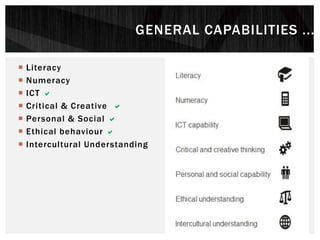
GENERAL CAPABILITIES ...
 Literacy
 Numeracy
 ICT 
 Critical & Creative 
 Personal & Social 
 Ethical behaviour 
 Intercultural Understanding
© June Wall Consultancy
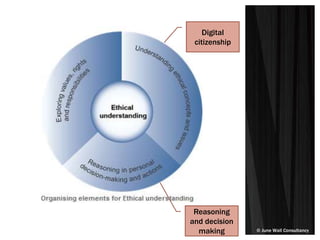
Reasoning
and decision
making
Digital
citizenship
© June Wall Consultancy
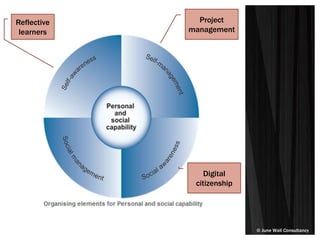
Project
management
Digital
citizenship
Reflective
learners
© June Wall Consultancy
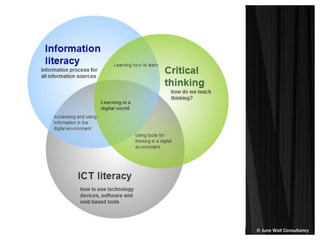
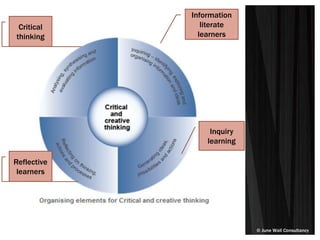
Information
literate
learners
Inquiry
learning
Reflective
learners
Critical
thinking
© June Wall Consultancy
ICT
literacy
Digital citizenship
Information
literacy
Critical
thinking21c
“ENGAGEMENT COMES FROM
"INTERACTIVITY" AND "EMBEDDEDNESS,"
AND THAT THE ELEMENTS THAT CONSTITUTE
THESE TWO COMPONENTS MATCH WITH
GOOD LEARNING DESIGN“
Quinn, Clark (1997?)Engaged learning Retrieved from
http://it.coe.uga.edu/itforum/paper18/paper18.html 1st Oct
2011
© June Wall Consultancy
The question is:
What additional
21c skills do you
want to include
in your unit of
work?
LEARNING
FIRST …
TECHNOLOGY
SUPPORTS
LEARNING
© June Wall Consultancy
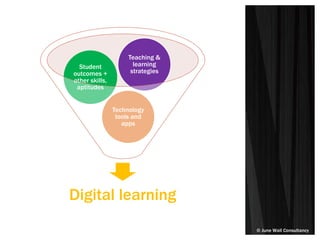
Digital learning
Technology
tools and
apps
Student
outcomes +
other skills,
aptitudes
Teaching &
learning
strategies
 Curriculum Skills:
 Using a digital learning framework, what specific skills are required
for this unit?
 Are there any specific application skills needed? Eg Photoshop?
 Core Inquiry Skills:
 What is the inquiry focus for this unit? Can the required digital skills
be used / taught within this focus area?
 Learning management:
 Whole class?
 Project teams?
 Individuals?
DESIGNING A DIGITAL INQUIRY UNIT
 Attention-Focusing
& Probing
 Measuring and
Counting
 Comparison
 Action
 Problem-Posing
 Reasoning
 Metacognitive
QUESTIONS THAT PROMOTE INQUIRY…
 7 Ws and H
 Why, where, which, what, when, who, what if and how
 KWL
 What do I know?
 What do I want to find out?
 What have I learned?
 KWHLAQ
 What do I know?
 What do I want to know?
 How do I find out?
 What have I learned?
 What action will I take?
 What new questions do I have?
FRAMEWORKS FOR GUIDING QUESTIONS
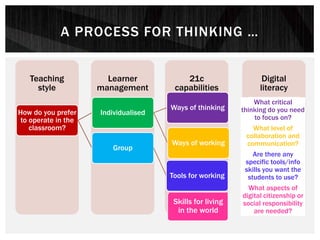
Digital
literacy
21c
capabilities
Learner
management
Teaching
style
How do you prefer
to operate in the
classroom?
Individualised
Ways of thinking
Ways of working
Group
Tools for working
A PROCESS FOR THINKING …
What critical
thinking do you need
to focus on?
What level of
collaboration and
communication?
Are there any
specific tools/info
skills you want the
students to use?
What aspects of
digital citizenship or
social responsibility
are needed?
Skills for living
in the world
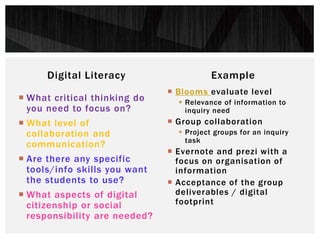
Digital Literacy
 What critical thinking do
you need to focus on?
 What level of
collaboration and
communication?
 Are there any specific
tools/info skills you want
the students to use?
 What aspects of digital
citizenship or social
responsibility are needed?
Example
 Blooms evaluate level
 Relevance of information to
inquiry need
 Group collaboration
 Project groups for an inquiry
task
 Evernote and prezi with a
focus on organisation of
information
 Acceptance of the group
deliverables / digital
footprint
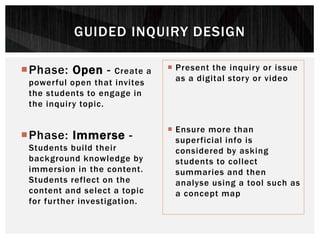
Phase: Open - Create a
powerful open that invites
the students to engage in
the inquiry topic.
Phase: Immerse -
Students build their
background knowledge by
immersion in the content.
Students reflect on the
content and select a topic
for further investigation.
 Present the inquiry or issue
as a digital story or video
 Ensure more than
superficial info is
considered by asking
students to collect
summaries and then
analyse using a tool such as
a concept map
GUIDED INQUIRY DESIGN
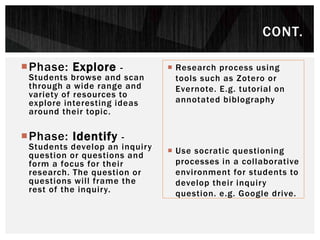
Phase: Explore -
Students browse and scan
through a wide range and
variety of resources to
explore interesting ideas
around their topic.
Phase: Identify -
Students develop an inquiry
question or questions and
form a focus for their
research. The question or
questions will frame the
rest of the inquiry.
 Research process using
tools such as Zotero or
Evernote. E.g. tutorial on
annotated biblography
 Use socratic questioning
processes in a collaborative
environment for students to
develop their inquiry
question. e.g. Google drive.
CONT.
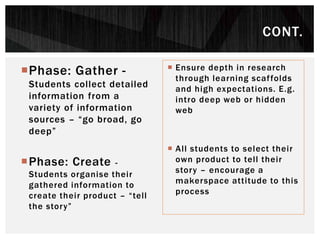
Phase: Gather -
Students collect detailed
information from a
variety of information
sources – “go broad, go
deep”
Phase: Create -
Students organise their
gathered information to
create their product – “tell
the story”
 Ensure depth in research
through learning scaffolds
and high expectations. E.g.
intro deep web or hidden
web
 All students to select their
own product to tell their
story – encourage a
makerspace attitude to this
process
CONT.
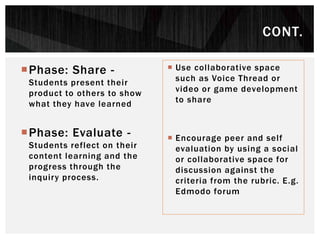
Phase: Share -
Students present their
product to others to show
what they have learned
Phase: Evaluate -
Students reflect on their
content learning and the
progress through the
inquiry process.
 Use collaborative space
such as Voice Thread or
video or game development
to share
 Encourage peer and self
evaluation by using a social
or collaborative space for
discussion against the
criteria from the rubric. E.g.
Edmodo forum
CONT.
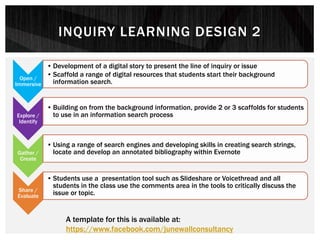
Open /
Immersive
• Development of a digital story to present the line of inquiry or issue
• Scaffold a range of digital resources that students start their background
information search.
Explore /
Identify
• Building on from the background information, provide 2 or 3 scaffolds for students
to use in an information search process
Gather /
Create
• Using a range of search engines and developing skills in creating search strings,
locate and develop an annotated bibliography within Evernote
Share /
Evaluate
• Students use a presentation tool such as Slideshare or Voicethread and all
students in the class use the comments area in the tools to critically discuss the
issue or topic.
INQUIRY LEARNING DESIGN 2
A template for this is available at:
https://www.facebook.com/junewallconsultancy
MY CONTACT DETAILS
june@junewall.com.au
Twitter @junewall
http://www.slideshare.net/junewall/

Integrating digital literacy and inquiry learning

  • 1.
    June Wall june@junewall.com.au @junewall www.facebook.com/june wallconsultancy INTEGRATING DIGITAL LITERACYAND INQUIRY LEARNING Presented at Eduwebinar Live, Brisbane, 6th March, 2015
  • 2.
    © June WallConsultancy WHAT SKILLS, KNOWLEDGE AND ATTITUDES DO YOU EXPECT GRADUATES TO HAVE?
  • 3.
  • 4.
    What excites you aboutteaching? What challenges you? What do you do when you teach well? What are the opportunities for you as a digital teacher? How is digital learning changing your teaching practice? How do you use technology to enhance learning? WHAT KIND OF DIGITAL TEACHER ARE YOU?
  • 5.
    21ST CENTURY LEARNING Waysof thinking. Creativity, critical thinking, problem-solving, decision-making and learning Ways of working. Communication and collaboration Tools for working. Information and communications technology (ICT) and information literacy Skills for living in the world. Citizenship, life and career, and personal and social responsibility http://atc21s.org/index.php/about/what-are-21st-century-skills/
  • 6.
     Inquiry:  requirescritical and creative thinking.  should guide learners into thinking about their prior knowledge related to the topic of interest.  is an active process.  should go beyond simply finding an answer to engage learners in questioning, reflection, thinking about how and what they learned, and ultimately, the next step in the investigative process.  should relate to the real world and have applications to the life experiences of learners.  is a social experience and should engage learners in collaborative learning. (Pappas 2009)  engages learners in constructing their own new understandings. INQUIRY AND 21ST CENTURY SKILLS
  • 7.
    “To be digitallyliterate is to have access to a broad range of practices and cultural resources that you are able to apply to digital tools. It is the ability to make and share meaning in different modes and formats; to create, collaborate and communicate effectively and to understand how and when digital technologies can best be used to support these processes.” (Hague & Payton, 2010) Digital Literacy across the Curriculum Available at http://apo.org.au/research/digital-literacy-across-curriculum DIGITAL LITERACY
  • 8.
    © June WallConsultancy
  • 9.
    GENERAL CAPABILITIES ... Literacy  Numeracy  ICT   Critical & Creative   Personal & Social   Ethical behaviour   Intercultural Understanding
  • 10.
    © June WallConsultancy Reasoning and decision making Digital citizenship
  • 11.
    © June WallConsultancy Project management Digital citizenship Reflective learners
  • 12.
    © June WallConsultancy Information literate learners Inquiry learning Reflective learners Critical thinking
  • 13.
    © June WallConsultancy ICT literacy Digital citizenship Information literacy Critical thinking21c
  • 14.
    “ENGAGEMENT COMES FROM "INTERACTIVITY"AND "EMBEDDEDNESS," AND THAT THE ELEMENTS THAT CONSTITUTE THESE TWO COMPONENTS MATCH WITH GOOD LEARNING DESIGN“ Quinn, Clark (1997?)Engaged learning Retrieved from http://it.coe.uga.edu/itforum/paper18/paper18.html 1st Oct 2011
  • 16.
    © June WallConsultancy The question is: What additional 21c skills do you want to include in your unit of work? LEARNING FIRST … TECHNOLOGY SUPPORTS LEARNING
  • 17.
    © June WallConsultancy Digital learning Technology tools and apps Student outcomes + other skills, aptitudes Teaching & learning strategies
  • 18.
     Curriculum Skills: Using a digital learning framework, what specific skills are required for this unit?  Are there any specific application skills needed? Eg Photoshop?  Core Inquiry Skills:  What is the inquiry focus for this unit? Can the required digital skills be used / taught within this focus area?  Learning management:  Whole class?  Project teams?  Individuals? DESIGNING A DIGITAL INQUIRY UNIT
  • 19.
     Attention-Focusing & Probing Measuring and Counting  Comparison  Action  Problem-Posing  Reasoning  Metacognitive QUESTIONS THAT PROMOTE INQUIRY…
  • 20.
     7 Wsand H  Why, where, which, what, when, who, what if and how  KWL  What do I know?  What do I want to find out?  What have I learned?  KWHLAQ  What do I know?  What do I want to know?  How do I find out?  What have I learned?  What action will I take?  What new questions do I have? FRAMEWORKS FOR GUIDING QUESTIONS
  • 22.
    Digital literacy 21c capabilities Learner management Teaching style How do youprefer to operate in the classroom? Individualised Ways of thinking Ways of working Group Tools for working A PROCESS FOR THINKING … What critical thinking do you need to focus on? What level of collaboration and communication? Are there any specific tools/info skills you want the students to use? What aspects of digital citizenship or social responsibility are needed? Skills for living in the world
  • 23.
    Digital Literacy  Whatcritical thinking do you need to focus on?  What level of collaboration and communication?  Are there any specific tools/info skills you want the students to use?  What aspects of digital citizenship or social responsibility are needed? Example  Blooms evaluate level  Relevance of information to inquiry need  Group collaboration  Project groups for an inquiry task  Evernote and prezi with a focus on organisation of information  Acceptance of the group deliverables / digital footprint
  • 24.
    Phase: Open -Create a powerful open that invites the students to engage in the inquiry topic. Phase: Immerse - Students build their background knowledge by immersion in the content. Students reflect on the content and select a topic for further investigation.  Present the inquiry or issue as a digital story or video  Ensure more than superficial info is considered by asking students to collect summaries and then analyse using a tool such as a concept map GUIDED INQUIRY DESIGN
  • 25.
    Phase: Explore - Studentsbrowse and scan through a wide range and variety of resources to explore interesting ideas around their topic. Phase: Identify - Students develop an inquiry question or questions and form a focus for their research. The question or questions will frame the rest of the inquiry.  Research process using tools such as Zotero or Evernote. E.g. tutorial on annotated biblography  Use socratic questioning processes in a collaborative environment for students to develop their inquiry question. e.g. Google drive. CONT.
  • 26.
    Phase: Gather - Studentscollect detailed information from a variety of information sources – “go broad, go deep” Phase: Create - Students organise their gathered information to create their product – “tell the story”  Ensure depth in research through learning scaffolds and high expectations. E.g. intro deep web or hidden web  All students to select their own product to tell their story – encourage a makerspace attitude to this process CONT.
  • 27.
    Phase: Share - Studentspresent their product to others to show what they have learned Phase: Evaluate - Students reflect on their content learning and the progress through the inquiry process.  Use collaborative space such as Voice Thread or video or game development to share  Encourage peer and self evaluation by using a social or collaborative space for discussion against the criteria from the rubric. E.g. Edmodo forum CONT.
  • 28.
    Open / Immersive • Developmentof a digital story to present the line of inquiry or issue • Scaffold a range of digital resources that students start their background information search. Explore / Identify • Building on from the background information, provide 2 or 3 scaffolds for students to use in an information search process Gather / Create • Using a range of search engines and developing skills in creating search strings, locate and develop an annotated bibliography within Evernote Share / Evaluate • Students use a presentation tool such as Slideshare or Voicethread and all students in the class use the comments area in the tools to critically discuss the issue or topic. INQUIRY LEARNING DESIGN 2 A template for this is available at: https://www.facebook.com/junewallconsultancy
  • 29.
    MY CONTACT DETAILS june@junewall.com.au Twitter@junewall http://www.slideshare.net/junewall/

Editor's Notes

  • #2 Including digital literacy and the general capabilities from the Australian Curriculum are an expectation for every unit of work we teach. How do we embed the range of skills, literacies and aptitudes within the content of the curriculum? This session presents an approach to embedding these literacies within an inquiry learning framework. Reflect and discuss http://www.edudemic.com/wp-content/uploads/2013/07/future-of-learning.png Or http://www.iftf.org/fileadmin/user_upload/images/ourwork/learning_2013map_lg.jpg
  • #4 http://www.youtube.com/watch?v=LeaAHv4UTI8
  • #20 Let’s take a look at your responses. Significant research conducted by Jos Elstgeest and others suggests that adults tend to respond to children’s questions with wordy questions that do not promote critical thinking skills, process skills or problem solving skills. Consider the 7 types of questions offered by Elstgeest. How is it that these questions lead children to seek out answers, to dig deeper, to revisit an activity and revise their understandings?
  • #30 Some links for matrix https://docs.google.com/spreadsheet/ccc?key=0AlYbqkP-KvVCdDctaVJYdE8tb1I0cm5YekUwLUtBMWc&usp=sharing#gid=14