Crop Production Technology-
II (Rabi Crop)
Code- AG-401
Course Credit- 3(2+1)
Submitted to- Dr. Ajeev Kr. Sangwan
Submitted by- Nabanita
Topic- Lentils
INTRODUCTION
 Lentil(Lens culinaris medikus spp. culinaris) also known as Musuro / Masur.
 The name “Lentil” derives from its typical lens-shaped seeds.
 Self- pollinating plant of family Leguminosae having chromosome 2n=14
 Lentil(Lens culinaris) belonging to family Fabaceae. It is one of the world’s oldest crops have
been cultivated in Southwestern Asia since 7000 BC.
 A rabi pulse crop growing extensively in temperate countries like Canada, USA, Turkey, Chile,
etc. and tropical countries like India, Pakistan, Australia, Ethiopia, Nepal, etc.
 Lentil is a nutritious food legume. It is cultivated for its seed and mostly eaten as dal. Dal is
seed that is decorticated and split.
 It contains relatively higher contents of protein, carbohydrate and calories compared to other
legumes and is the most desired crop because of its high average protein content and fast
cooking characteristics in many lentil producing regions.
Biological Distribution
 Order- Fabales
 Family- Fabaceae
 Chromosome no.- 14
 Subfamily- Faboideae
 Genus- Lens
 Species- L. culinaris
 Common name- Masoor, Masur
ECNOMIC IMPORTANCE
• Lower cholesterol.
• Benefit in managing blood-sugar disorders
• Lentils magnesium helps improve the flow of blood, oxygen and nutrients throughout the
body.
• Provide calcium, phosphorus, vitamin-B and iron.
• The husk, bran and dry haulms are good fodder.
• The young pod is used as vegetables. The leaves are acid and bitter.
• Seeds are sweet and cooling, astringent to bowel, diuretic, improves appetite, removes
cough and biliousness.
• Dry seeds contain 24% protein and 59% carbohydrate.
Geographical Distribution
 Lens orientalis is the progenitor species.
 Egypt is its origin.
 The centre of origin for Lens culinaris is the Near East and the species
was first domesticated in the Near East.
 Lentil first spread to the Nile from the Near East to Central Europe and
then to the Indian subcontinent and Mediterranean region.
• India accounts for about 40% of the global production.
• In India, Uttar Pradesh ranks first both in the area and
production followed by MP
.
• Productivity is highest in Bihar followed by West Bengal.
• Uttar Pradesh, Bihar and West Bengal are the states where
95% of the acreage is concentrated.
SOIL AND CLIMATE
Soil-  The suitable soil types are alluvial in Punjab and black cotton soils in Madhya Pradesh.
 Well- drained, loam soils with soils with neutral reactions are best for lentil cultivation.
Acidic soils are not fit for growing lentils.
 Lentils thrive best in soil that has a pH range between 6.0 and 6.5.
Climate-  As the crop requires very cool climate it is cultivated in winter season. It can tolerate severe
winter frost condition also.
 The optimum temperature for growth is 18-300C.
 Its range of cultivation extends to an altitude of 3500m in north-west hills.
 It requires cold temperature during its vegetative growth and warm temperature at the
time of its maturity.
Varieties
State Lentil Varieties
Bihar Plant L 406, PL639, Mallika(K-75), NDL 2, WBL 58, HUL 57, WBL77, Arun(PL
12)
M. P
. & Chandigarh Malika(K-75), IPL-81(Nuri), JL-3,IPL-406, L-4076, IPL316, DPL 62(Sheri)
Haryana Pant L-639, Pant L-4, DPL-15(Priya), Sapna, L-4147, DPL-62(Sheri), Pant L-406
Maharashtra JL 3, IPL 81(Nuri), Pant L 4
Punjab PL-639, LL-147, LH-84-8, L-4147, IPL-406, LL-931, PL7
Uttar Pradesh PL-639, Malika (K-75), NDL-2, DPL-62, IPL-81, IPL-316, L4076, HUL-57, DPL 15
Gujarat Malika(K-75), IPL-81(Nuri), JL-3,IPL-406, L-4076, IPL316, DPL 62(Sheri)
Rajasthan IPL 406(Anguri), Pant L-8(PL-063),DPL-62(Sheri)
Field Preparation
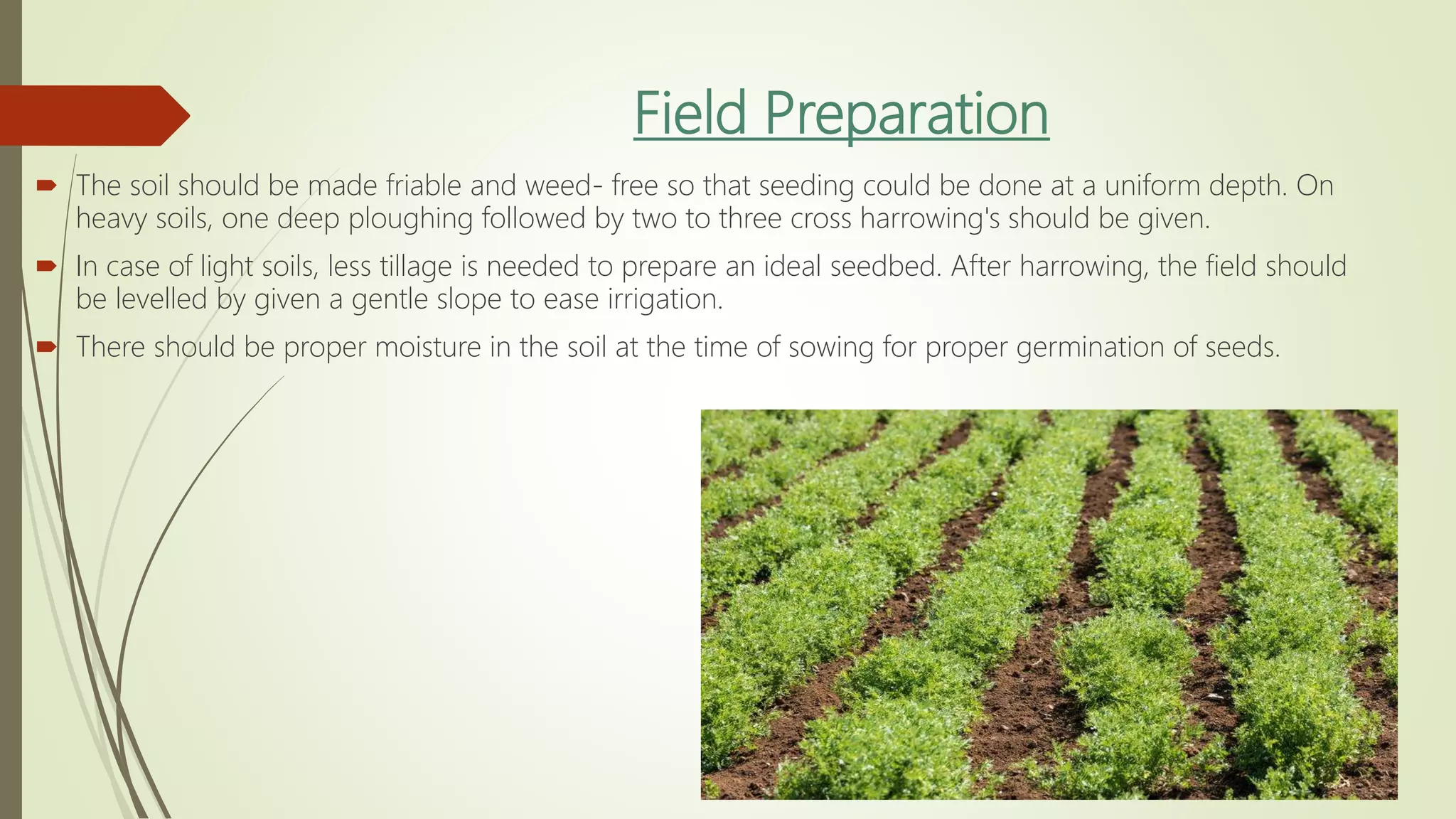
 The soil should be made friable and weed- free so that seeding could be done at a uniform depth. On
heavy soils, one deep ploughing followed by two to three cross harrowing's should be given.
 In case of light soils, less tillage is needed to prepare an ideal seedbed. After harrowing, the field should
be levelled by given a gentle slope to ease irrigation.
 There should be proper moisture in the soil at the time of sowing for proper germination of seeds.
SEED AND SOWING OF LENTIL CROP
 Middle of October is the most suitable time for sowing lentil.
 Delay in planting causes a reduction in yield but the magnitude of reduction is large after 15th Nov.
 The reduction in the yield could be minimized up to a certain extent by relatively closer spacing
and the use of a higher seed rate.
 Sowing should be done in rows 30 cm apart. This could be done either by using a ferti-seed drill
or by seeding behind desi plough.
The optimum seed rate for the normal sown crop is 30-40kg/ ha.
Seed rate should be increased to 50-60kg/ha in case of late
sowing.
Row spacing should also be reduced to 20-25cm in case of the
late sown crop. Lentil seeds should be sown at a shallower
depth(3-4cm).
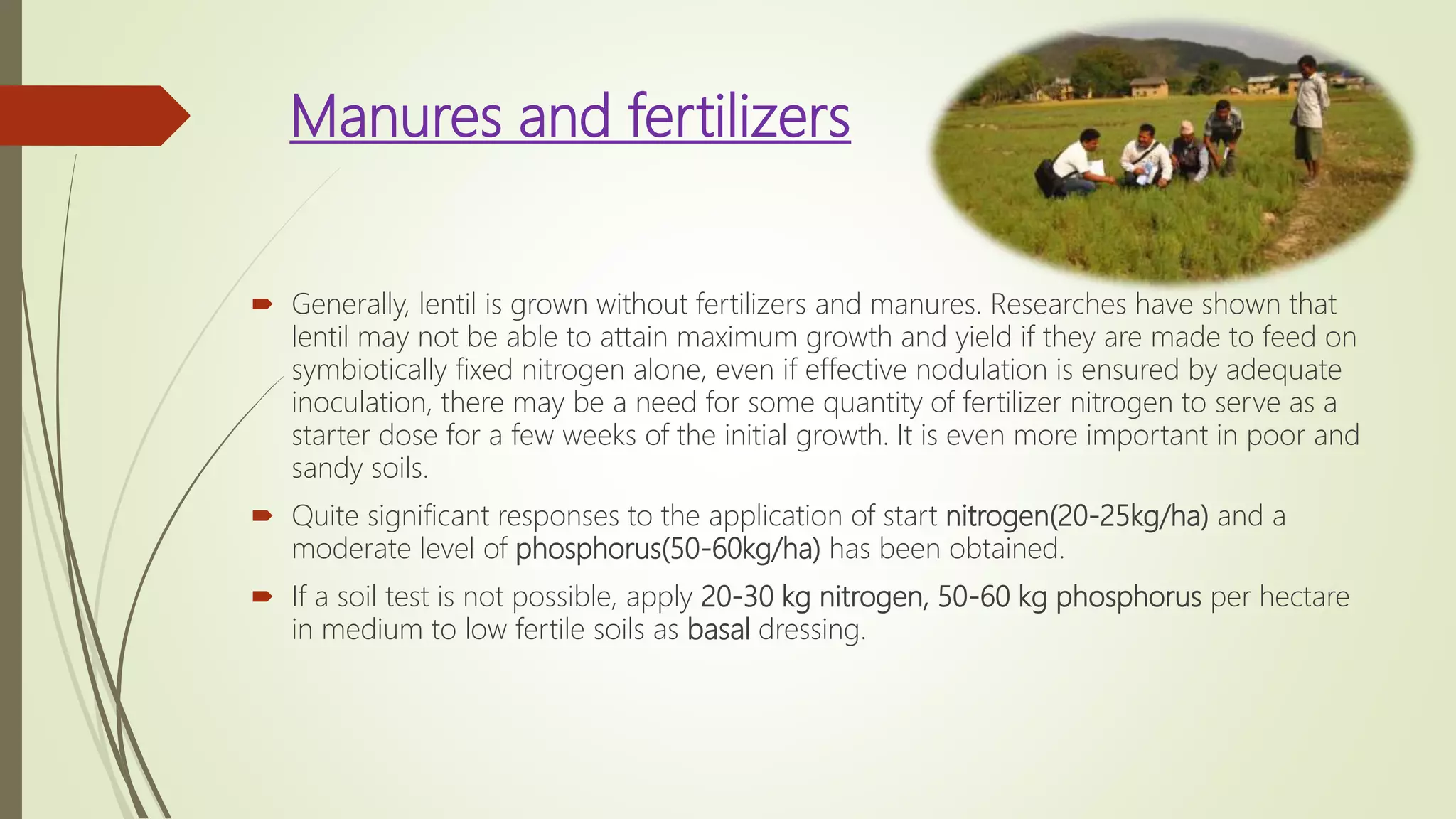
Manures and fertilizers
 Generally, lentil is grown without fertilizers and manures. Researches have shown that
lentil may not be able to attain maximum growth and yield if they are made to feed on
symbiotically fixed nitrogen alone, even if effective nodulation is ensured by adequate
inoculation, there may be a need for some quantity of fertilizer nitrogen to serve as a
starter dose for a few weeks of the initial growth. It is even more important in poor and
sandy soils.
 Quite significant responses to the application of start nitrogen(20-25kg/ha) and a
moderate level of phosphorus(50-60kg/ha) has been obtained.
 If a soil test is not possible, apply 20-30 kg nitrogen, 50-60 kg phosphorus per hectare
in medium to low fertile soils as basal dressing.
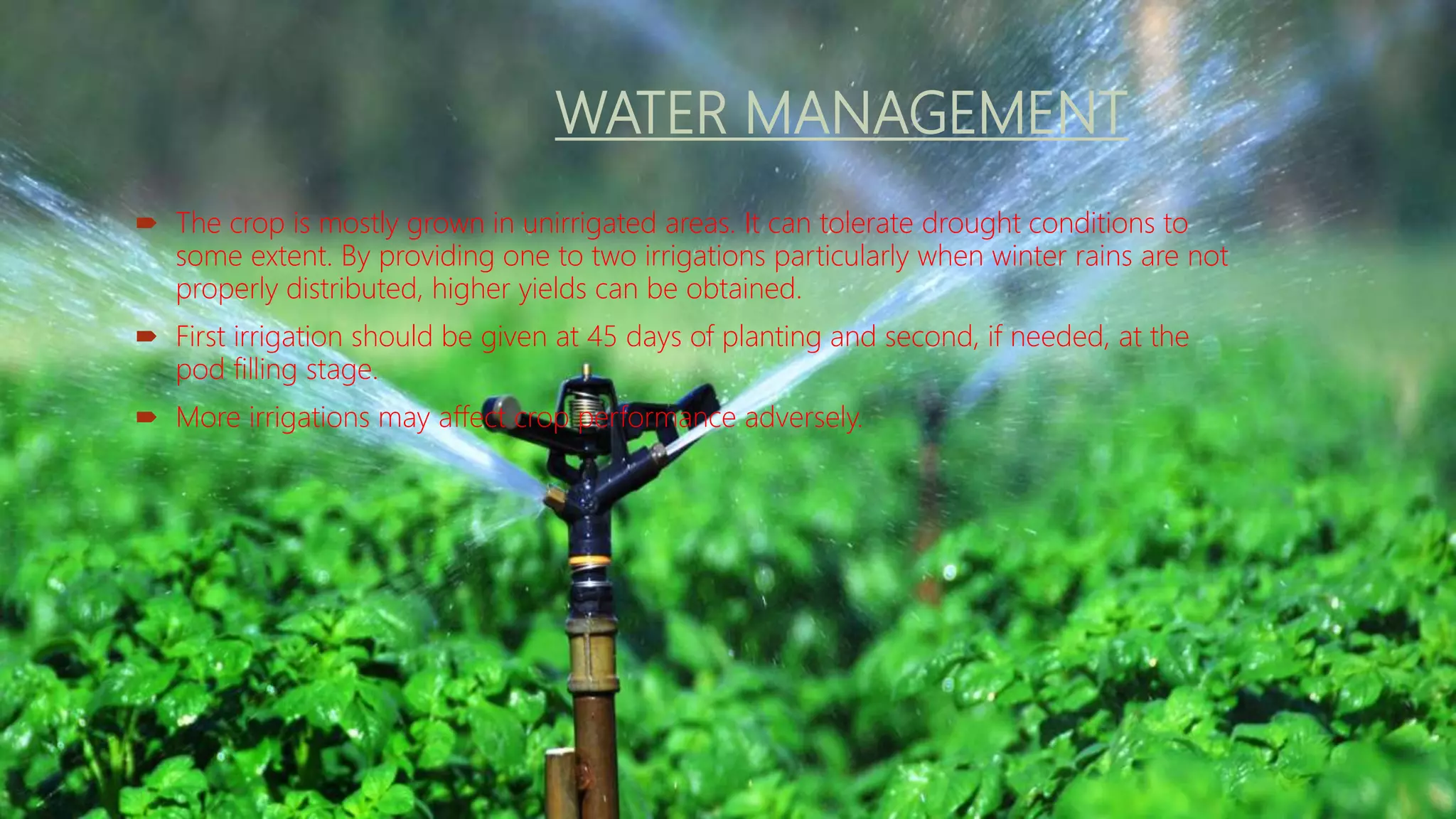
WATER MANAGEMENT
 The crop is mostly grown in unirrigated areas. It can tolerate drought conditions to
some extent. By providing one to two irrigations particularly when winter rains are not
properly distributed, higher yields can be obtained.
 First irrigation should be given at 45 days of planting and second, if needed, at the
pod filling stage.
 More irrigations may affect crop performance adversely.
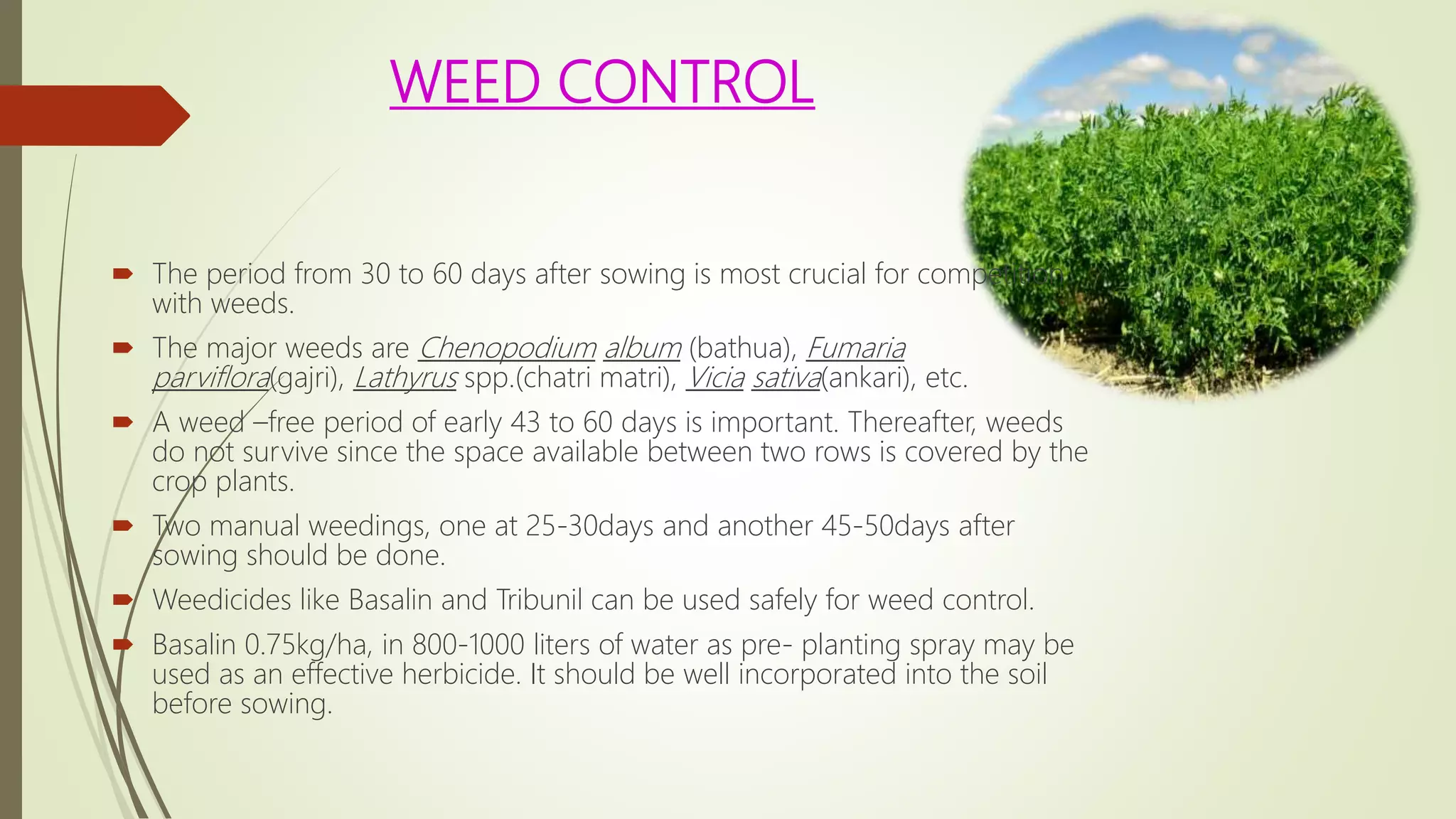
WEED CONTROL
 The period from 30 to 60 days after sowing is most crucial for competition
with weeds.
 The major weeds are Chenopodium album (bathua), Fumaria
parviflora(gajri), Lathyrus spp.(chatri matri), Vicia sativa(ankari), etc.
 A weed –free period of early 43 to 60 days is important. Thereafter, weeds
do not survive since the space available between two rows is covered by the
crop plants.
 Two manual weedings, one at 25-30days and another 45-50days after
sowing should be done.
 Weedicides like Basalin and Tribunil can be used safely for weed control.
 Basalin 0.75kg/ha, in 800-1000 liters of water as pre- planting spray may be
used as an effective herbicide. It should be well incorporated into the soil
before sowing.
DISEASE MANAGEMENT
Seedling Mortality
 Symptoms
 Caused by fungi.
 It appears within a month of sowing when the seedlings start drying up.
 The drying is mainly two types-1. seedling wilt in which seedling first turns
yellow and dry up.
2. collar rot in which seedling collapse while still green and then dry out.
 Control
 It can be reduced by delay planting until mid- November
 Treat the seed with systemic fungicide Carbendazim@2.5g/kg of seed.
 Plant resistant varieties like Pant L-406 etc.
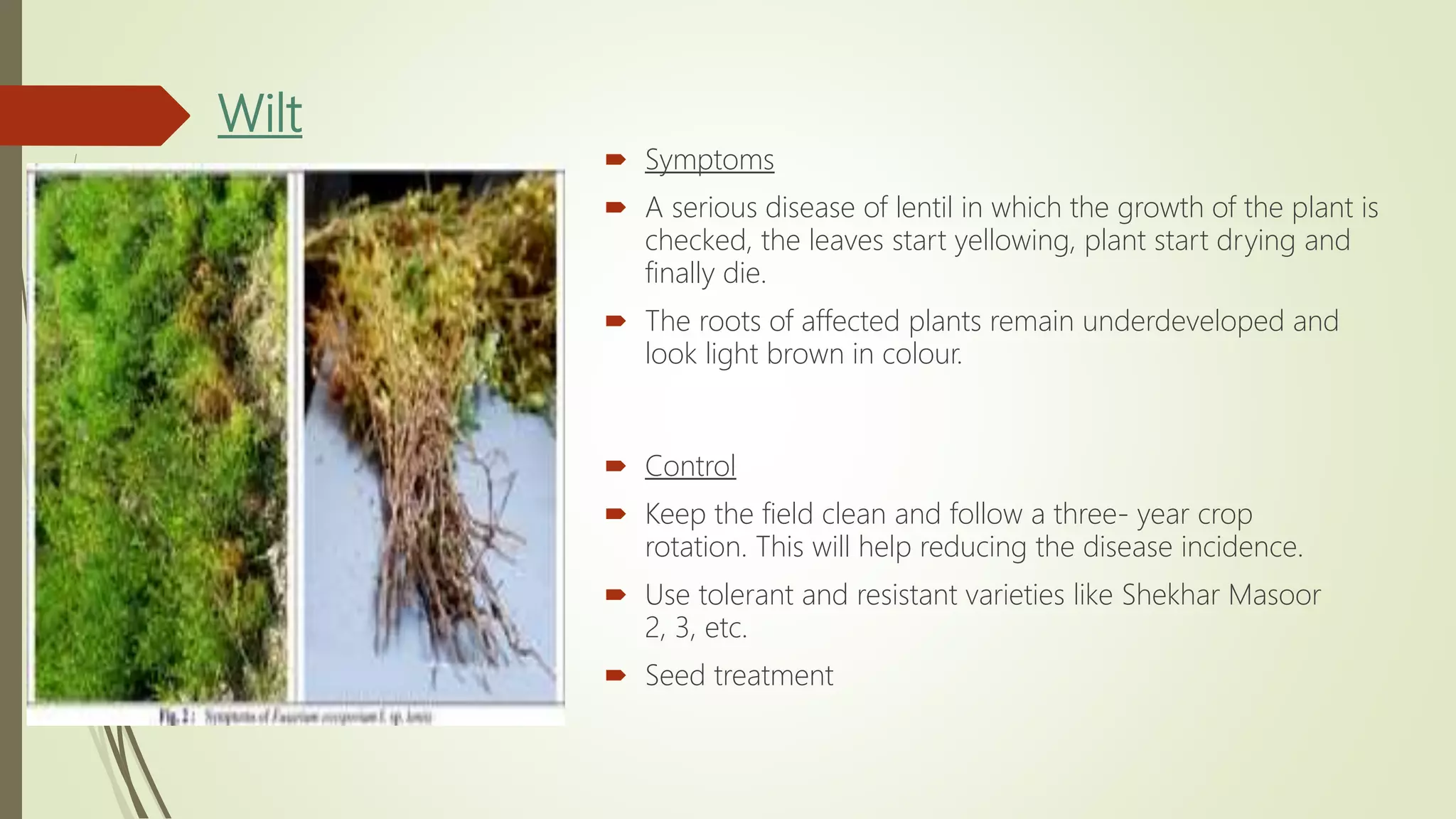
Wilt
 Symptoms
 A serious disease of lentil in which the growth of the plant is
checked, the leaves start yellowing, plant start drying and
finally die.
 The roots of affected plants remain underdeveloped and
look light brown in colour.
 Control
 Keep the field clean and follow a three- year crop
rotation. This will help reducing the disease incidence.
 Use tolerant and resistant varieties like Shekhar Masoor
2, 3, etc.
 Seed treatment
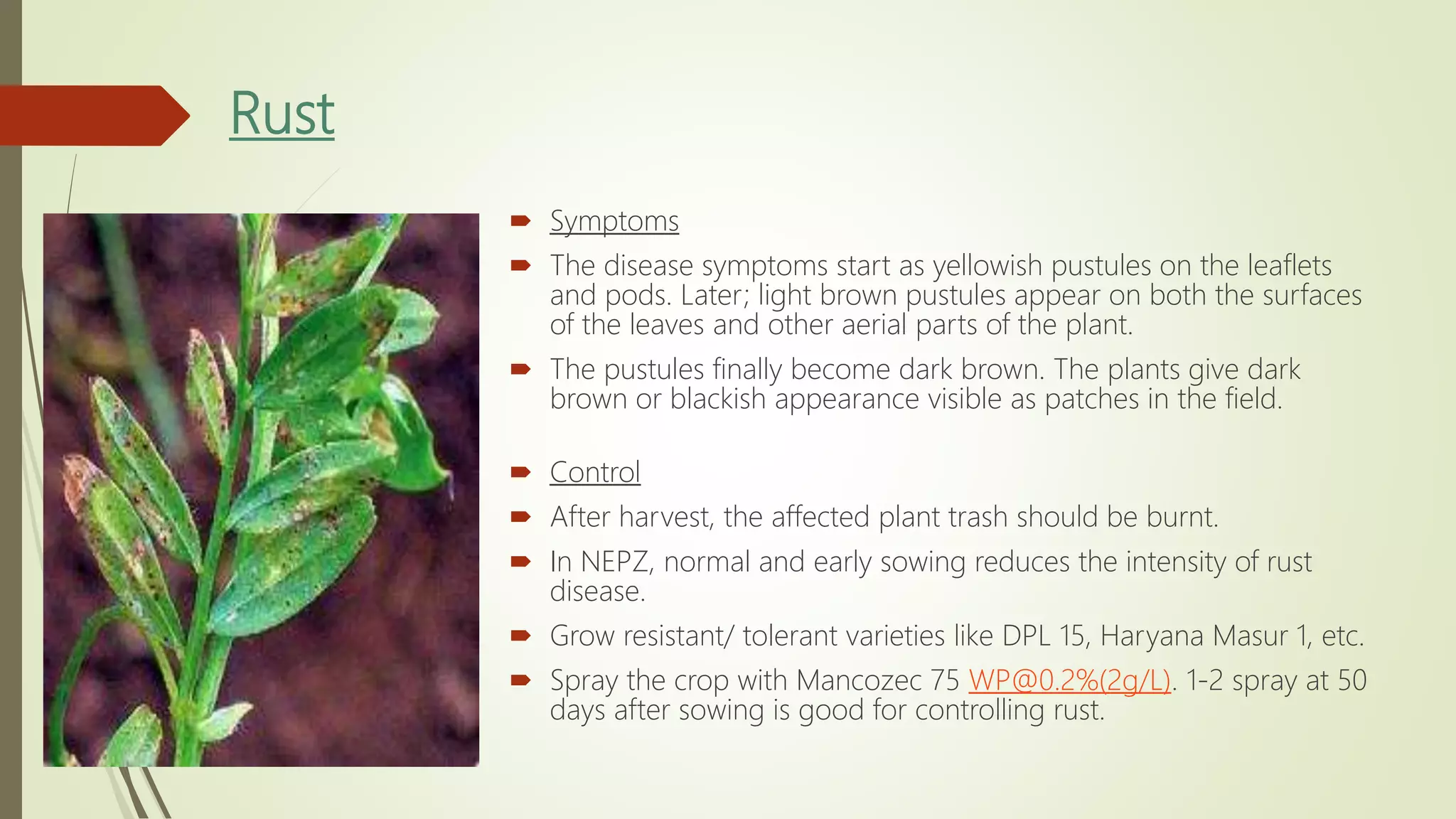
Rust
 Symptoms
 The disease symptoms start as yellowish pustules on the leaflets
and pods. Later; light brown pustules appear on both the surfaces
of the leaves and other aerial parts of the plant.
 The pustules finally become dark brown. The plants give dark
brown or blackish appearance visible as patches in the field.
 Control
 After harvest, the affected plant trash should be burnt.
 In NEPZ, normal and early sowing reduces the intensity of rust
disease.
 Grow resistant/ tolerant varieties like DPL 15, Haryana Masur 1, etc.
 Spray the crop with Mancozec 75 WP@0.2%(2g/L). 1-2 spray at 50
days after sowing is good for controlling rust.
PEST MANAGEMENT
 Symptom-1. The caterpillar defoliates the tender leaves
and also bores the green pods and feeds upon the
ripening grains.
2.Its damages almost all the
pods in case of severs damage but causes nearly 25-30%
annual yield losses in India.
 Control- 1. Spray neem seed extract(5%)@ 50ml/L of
water.
2. Spray of Profenphos 50@ 2ml/L or
Emammectin benzoate 5 SG@ 0.2g/L of water.
Pod borer-
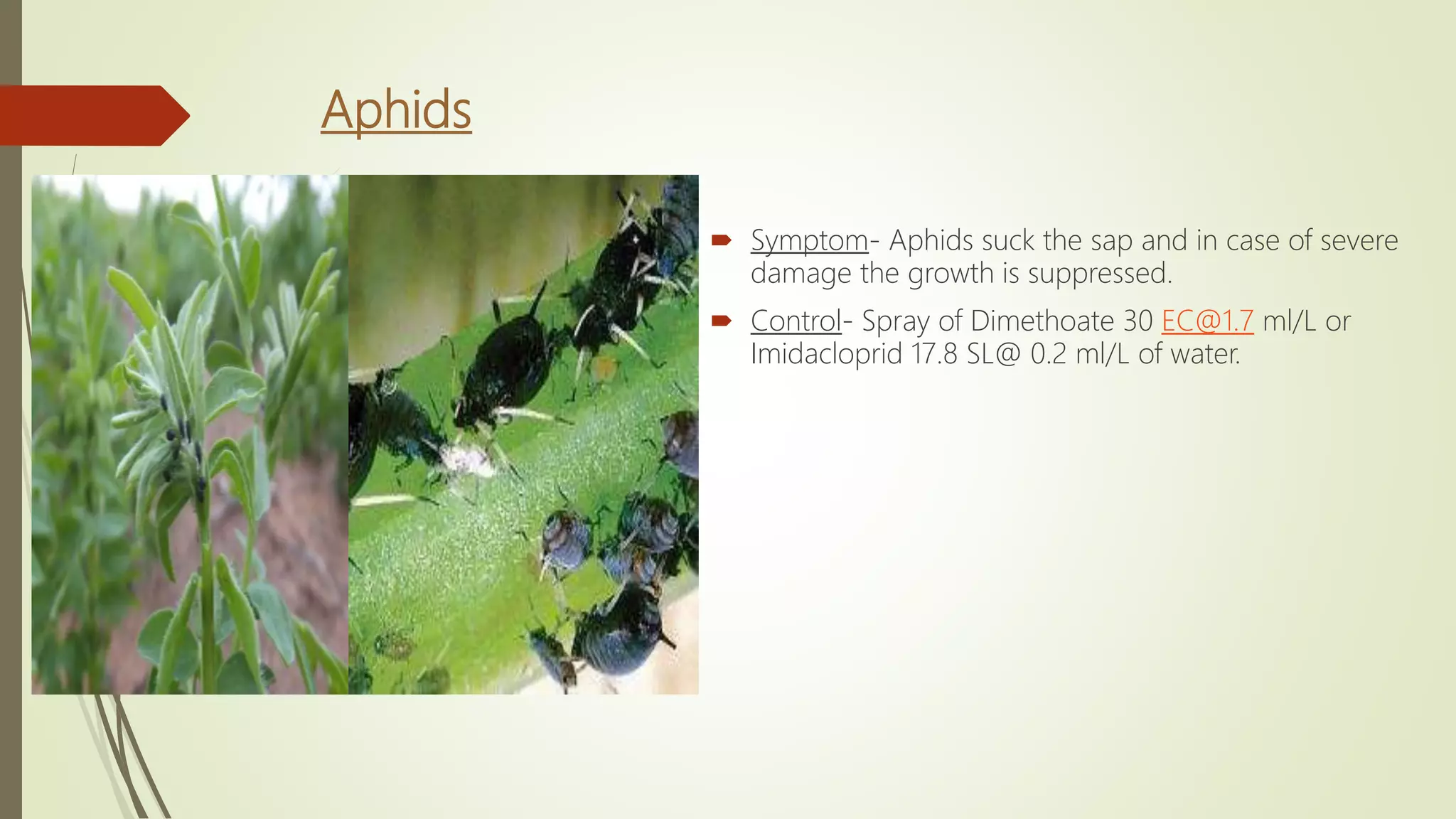
Aphids
 Symptom- Aphids suck the sap and in case of severe
damage the growth is suppressed.
 Control- Spray of Dimethoate 30 EC@1.7 ml/L or
Imidacloprid 17.8 SL@ 0.2 ml/L of water.
HARVESTING AND THRESHING
 Lentil should be harvested when the pods are ripe but the plants have not dead rine. The plants should
not be allowed to become dead ripe otherwise a large quantity of produce may be lost due to shattering.
As such, it would be advantageous to harvest in the morning when dew is there.
 The produce should be allowed to dry completely on the threshing floor before threshing. Threshing is
done either by beating the plants with sticks by trampling under the feet of bullocks. Clean the seed and
dry it in the sun to bring the moisture content down to 12% for safe storage.
YIELD
 A well- managed crop yields about 20-25 quintals of grain per
hectare.
 Seed yields range from 450-675 kg/ha in dry areas, may increase
to 2000kg/ha with irrigation, and yields over 3000kg/ha have been
recorded.
Crop Production Technology-II Lentils.pptx

Crop Production Technology-II Lentils.pptx

  • 1.
    Crop Production Technology- II(Rabi Crop) Code- AG-401 Course Credit- 3(2+1) Submitted to- Dr. Ajeev Kr. Sangwan Submitted by- Nabanita Topic- Lentils
  • 2.
    INTRODUCTION  Lentil(Lens culinarismedikus spp. culinaris) also known as Musuro / Masur.  The name “Lentil” derives from its typical lens-shaped seeds.  Self- pollinating plant of family Leguminosae having chromosome 2n=14  Lentil(Lens culinaris) belonging to family Fabaceae. It is one of the world’s oldest crops have been cultivated in Southwestern Asia since 7000 BC.  A rabi pulse crop growing extensively in temperate countries like Canada, USA, Turkey, Chile, etc. and tropical countries like India, Pakistan, Australia, Ethiopia, Nepal, etc.  Lentil is a nutritious food legume. It is cultivated for its seed and mostly eaten as dal. Dal is seed that is decorticated and split.  It contains relatively higher contents of protein, carbohydrate and calories compared to other legumes and is the most desired crop because of its high average protein content and fast cooking characteristics in many lentil producing regions.
  • 3.
    Biological Distribution  Order-Fabales  Family- Fabaceae  Chromosome no.- 14  Subfamily- Faboideae  Genus- Lens  Species- L. culinaris  Common name- Masoor, Masur
  • 4.
    ECNOMIC IMPORTANCE • Lowercholesterol. • Benefit in managing blood-sugar disorders • Lentils magnesium helps improve the flow of blood, oxygen and nutrients throughout the body. • Provide calcium, phosphorus, vitamin-B and iron. • The husk, bran and dry haulms are good fodder. • The young pod is used as vegetables. The leaves are acid and bitter. • Seeds are sweet and cooling, astringent to bowel, diuretic, improves appetite, removes cough and biliousness. • Dry seeds contain 24% protein and 59% carbohydrate.
  • 5.
    Geographical Distribution  Lensorientalis is the progenitor species.  Egypt is its origin.  The centre of origin for Lens culinaris is the Near East and the species was first domesticated in the Near East.  Lentil first spread to the Nile from the Near East to Central Europe and then to the Indian subcontinent and Mediterranean region. • India accounts for about 40% of the global production. • In India, Uttar Pradesh ranks first both in the area and production followed by MP . • Productivity is highest in Bihar followed by West Bengal. • Uttar Pradesh, Bihar and West Bengal are the states where 95% of the acreage is concentrated.
  • 6.
    SOIL AND CLIMATE Soil- The suitable soil types are alluvial in Punjab and black cotton soils in Madhya Pradesh.  Well- drained, loam soils with soils with neutral reactions are best for lentil cultivation. Acidic soils are not fit for growing lentils.  Lentils thrive best in soil that has a pH range between 6.0 and 6.5. Climate-  As the crop requires very cool climate it is cultivated in winter season. It can tolerate severe winter frost condition also.  The optimum temperature for growth is 18-300C.  Its range of cultivation extends to an altitude of 3500m in north-west hills.  It requires cold temperature during its vegetative growth and warm temperature at the time of its maturity.
  • 7.
    Varieties State Lentil Varieties BiharPlant L 406, PL639, Mallika(K-75), NDL 2, WBL 58, HUL 57, WBL77, Arun(PL 12) M. P . & Chandigarh Malika(K-75), IPL-81(Nuri), JL-3,IPL-406, L-4076, IPL316, DPL 62(Sheri) Haryana Pant L-639, Pant L-4, DPL-15(Priya), Sapna, L-4147, DPL-62(Sheri), Pant L-406 Maharashtra JL 3, IPL 81(Nuri), Pant L 4 Punjab PL-639, LL-147, LH-84-8, L-4147, IPL-406, LL-931, PL7 Uttar Pradesh PL-639, Malika (K-75), NDL-2, DPL-62, IPL-81, IPL-316, L4076, HUL-57, DPL 15 Gujarat Malika(K-75), IPL-81(Nuri), JL-3,IPL-406, L-4076, IPL316, DPL 62(Sheri) Rajasthan IPL 406(Anguri), Pant L-8(PL-063),DPL-62(Sheri)
  • 8.
    Field Preparation  Thesoil should be made friable and weed- free so that seeding could be done at a uniform depth. On heavy soils, one deep ploughing followed by two to three cross harrowing's should be given.  In case of light soils, less tillage is needed to prepare an ideal seedbed. After harrowing, the field should be levelled by given a gentle slope to ease irrigation.  There should be proper moisture in the soil at the time of sowing for proper germination of seeds.
  • 9.
    SEED AND SOWINGOF LENTIL CROP  Middle of October is the most suitable time for sowing lentil.  Delay in planting causes a reduction in yield but the magnitude of reduction is large after 15th Nov.  The reduction in the yield could be minimized up to a certain extent by relatively closer spacing and the use of a higher seed rate.  Sowing should be done in rows 30 cm apart. This could be done either by using a ferti-seed drill or by seeding behind desi plough. The optimum seed rate for the normal sown crop is 30-40kg/ ha. Seed rate should be increased to 50-60kg/ha in case of late sowing. Row spacing should also be reduced to 20-25cm in case of the late sown crop. Lentil seeds should be sown at a shallower depth(3-4cm).
  • 10.
    Manures and fertilizers Generally, lentil is grown without fertilizers and manures. Researches have shown that lentil may not be able to attain maximum growth and yield if they are made to feed on symbiotically fixed nitrogen alone, even if effective nodulation is ensured by adequate inoculation, there may be a need for some quantity of fertilizer nitrogen to serve as a starter dose for a few weeks of the initial growth. It is even more important in poor and sandy soils.  Quite significant responses to the application of start nitrogen(20-25kg/ha) and a moderate level of phosphorus(50-60kg/ha) has been obtained.  If a soil test is not possible, apply 20-30 kg nitrogen, 50-60 kg phosphorus per hectare in medium to low fertile soils as basal dressing.
  • 11.
    WATER MANAGEMENT  Thecrop is mostly grown in unirrigated areas. It can tolerate drought conditions to some extent. By providing one to two irrigations particularly when winter rains are not properly distributed, higher yields can be obtained.  First irrigation should be given at 45 days of planting and second, if needed, at the pod filling stage.  More irrigations may affect crop performance adversely.
  • 12.
    WEED CONTROL  Theperiod from 30 to 60 days after sowing is most crucial for competition with weeds.  The major weeds are Chenopodium album (bathua), Fumaria parviflora(gajri), Lathyrus spp.(chatri matri), Vicia sativa(ankari), etc.  A weed –free period of early 43 to 60 days is important. Thereafter, weeds do not survive since the space available between two rows is covered by the crop plants.  Two manual weedings, one at 25-30days and another 45-50days after sowing should be done.  Weedicides like Basalin and Tribunil can be used safely for weed control.  Basalin 0.75kg/ha, in 800-1000 liters of water as pre- planting spray may be used as an effective herbicide. It should be well incorporated into the soil before sowing.
  • 13.
    DISEASE MANAGEMENT Seedling Mortality Symptoms  Caused by fungi.  It appears within a month of sowing when the seedlings start drying up.  The drying is mainly two types-1. seedling wilt in which seedling first turns yellow and dry up. 2. collar rot in which seedling collapse while still green and then dry out.  Control  It can be reduced by delay planting until mid- November  Treat the seed with systemic fungicide Carbendazim@2.5g/kg of seed.  Plant resistant varieties like Pant L-406 etc.
  • 14.
    Wilt  Symptoms  Aserious disease of lentil in which the growth of the plant is checked, the leaves start yellowing, plant start drying and finally die.  The roots of affected plants remain underdeveloped and look light brown in colour.  Control  Keep the field clean and follow a three- year crop rotation. This will help reducing the disease incidence.  Use tolerant and resistant varieties like Shekhar Masoor 2, 3, etc.  Seed treatment
  • 15.
    Rust  Symptoms  Thedisease symptoms start as yellowish pustules on the leaflets and pods. Later; light brown pustules appear on both the surfaces of the leaves and other aerial parts of the plant.  The pustules finally become dark brown. The plants give dark brown or blackish appearance visible as patches in the field.  Control  After harvest, the affected plant trash should be burnt.  In NEPZ, normal and early sowing reduces the intensity of rust disease.  Grow resistant/ tolerant varieties like DPL 15, Haryana Masur 1, etc.  Spray the crop with Mancozec 75 WP@0.2%(2g/L). 1-2 spray at 50 days after sowing is good for controlling rust.
  • 16.
    PEST MANAGEMENT  Symptom-1.The caterpillar defoliates the tender leaves and also bores the green pods and feeds upon the ripening grains. 2.Its damages almost all the pods in case of severs damage but causes nearly 25-30% annual yield losses in India.  Control- 1. Spray neem seed extract(5%)@ 50ml/L of water. 2. Spray of Profenphos 50@ 2ml/L or Emammectin benzoate 5 SG@ 0.2g/L of water. Pod borer-
  • 17.
    Aphids  Symptom- Aphidssuck the sap and in case of severe damage the growth is suppressed.  Control- Spray of Dimethoate 30 EC@1.7 ml/L or Imidacloprid 17.8 SL@ 0.2 ml/L of water.
  • 18.
    HARVESTING AND THRESHING Lentil should be harvested when the pods are ripe but the plants have not dead rine. The plants should not be allowed to become dead ripe otherwise a large quantity of produce may be lost due to shattering. As such, it would be advantageous to harvest in the morning when dew is there.  The produce should be allowed to dry completely on the threshing floor before threshing. Threshing is done either by beating the plants with sticks by trampling under the feet of bullocks. Clean the seed and dry it in the sun to bring the moisture content down to 12% for safe storage.
  • 19.
    YIELD  A well-managed crop yields about 20-25 quintals of grain per hectare.  Seed yields range from 450-675 kg/ha in dry areas, may increase to 2000kg/ha with irrigation, and yields over 3000kg/ha have been recorded.