Presented by
Pallavi .B.S
B.Tech food science and technology
HISTORY OF COFFEE
Coffee is darkly colored, bitter, slightly acidic and has a
stimulating effect in humans, primarily due to its caffeine
content. It is one of the most popular drinks in the world, and
it can be prepared and presented in a variety of ways (e.g.,
espresso, French press, café latte). It is usually served hot,
although iced coffee is a popular alternative. Coffee is the
second most a traded commodity in the world. The global
popularity of coffee beverages can be attributed to their
delightful flavor and aroma, along with the physiological
effects of caffeine, which is regarded as The most used
pharmacologically active substance in coffee.
coffee was introduced in Ethiopia in the early 15th century
and the story behind it is Some religious groups in Africa
found that their domestic animals, e.g.. cows, sheep etc.
became unusually excited after eating a certain type of fruit.
They noticed behavioural changes in the animals, and
discovered the stimulating flavour of this fruit. Some of its
seeds were accidentally thrown into a fire, resulting in roasted
coffee from which civilisation produced the extract known as
coffee drink.
• Coffee was introduced in India in the year 1600 by
pilgrims from Africa. Large-scale cultivation and
production started in the 1820's.
 At the end of the nineteenth century attempts were
made to produce instant coffee in the usa, however the
production of instant coffee on a small scale only
began in 1930
 This problem was successfully tackled by nestle in
1938, and produced a free- flowing, light-colored
powder composed of 50 % soluble coffee solids and
50 % maltodextrins, retaining a coffee-like flavor
when reconstituted in hot water. This product was
initially introduced in Switzerland, followed by
France, the UK and the USA.
 Although the first known patent for soluble coffee was
awarded in 177,as cited in Nestlé's website (
nestle,2013)
HISTORY IN INDIA
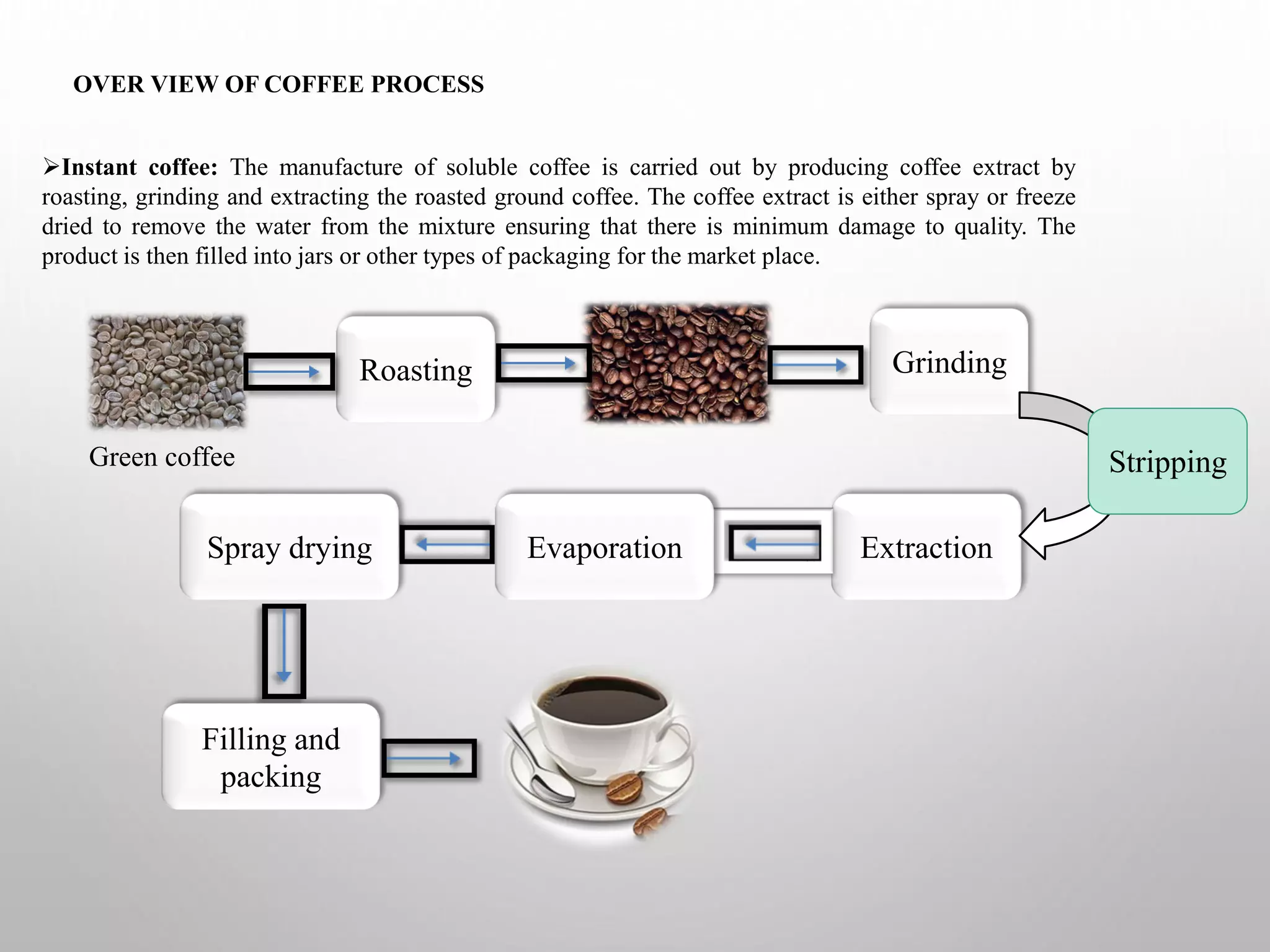
OVER VIEW OF COFFEE PROCESS
Roasting Grinding
ExtractionEvaporationSpray drying
Stripping
Filling and
packing
Green coffee
Instant coffee: The manufacture of soluble coffee is carried out by producing coffee extract by
roasting, grinding and extracting the roasted ground coffee. The coffee extract is either spray or freeze
dried to remove the water from the mixture ensuring that there is minimum damage to quality. The
product is then filled into jars or other types of packaging for the market place.
INTRODUCTION: COFFEE
Composition of the coffee
The chemical composition of the coffee depends
mainly on the species and varieties of coffee used,
and to a lesser extent on other factors e.g..
agricultural practices, time of harvesting, storage
conditions etc.
Component Arabica Robusta
Proteins 11 - 13 11 – 13
Lipids 12 - 18 9 – 13
Caffeine 0.9 - 1.2 1.6 - 2.4
Total
polysaccharides
50 - 55 37 – 47
Trigonelline 1.0 - 1.2 0.6 - 0.75
Chromogenic
acids
5.5 - 8.0 7 – 10
Minerals 3.0 - 4.2 4.0 - 4.5
MAJOR PRODUCER AND EXPORTER
Major coffee producing countries As of 2016, Brazil was the leading grower of coffee beans, producing one-
third of the world total and others includes Vietnam, Colombia, Indonesia, Ethiopia, India, Honduras, Uganda,
Mexico and Guatemala
Major exporting countries: Brazil, Colombia, Vietnam, Germany, Switzerland, Italy, Indonesia, Belgium,
Honduras and Ethiopia
Major coffee exporter in world:
Barbera coffee company Italy
Coffee cabana brazil
Maxwell house united states
Miko coffee Belgium
Nestle (Switzerland)
Neumann gruppe AG (German)
O’coffee - Brazilian estates (brazil)
Ospina coffee company (Colombia)
Simexco daklak ltd (Vietnam)
Starbucks corporation (united states)
Major coffee exporter in India :
1. NKG Jayanti coffee private limited
2. Alana sons limited
3. I.T.C limited
4. Amalgamated bean coffee trading co. ltd
5. NED commodities India private limited
6. TATA coffee ltd.
A. COFFEE PLANT : Coffea canephora
(Predominantly a form known as 'robusta') And C. Arabica.
The coffee tree belongs to the Rubiaceae family.
This cherry grows on perennial evergreen plants, A coffee plant usually starts to produce
flowers three to four years after it is planted. from these flowers the fruits of the plant
(commonly known as coffee cherries) appear. And these cherries after 8 months it will turn
to red are harvested by hand picking and mechanical harvesting method.
Coffee growing regions in India are divide into three categories:
1.Traditional- Karnataka, Kerala and Tamilnaadu
2. Non traditional- Andra Pradesh and Orissa
3.Northen region- Assam, Manipur, Meghalaya, Mizoram, Tripura, Nagaland, and
Arunachala Pradesh
CROP CALLENDER:
JAN FEB MAR APR MAY JUN JUL AUG SEP OCT NOV DEC
INDIA
HARVEST PERIOD BEST HARVEST PERIOD
SHIPPING PERIOD BEST SHIPPING PERIOD
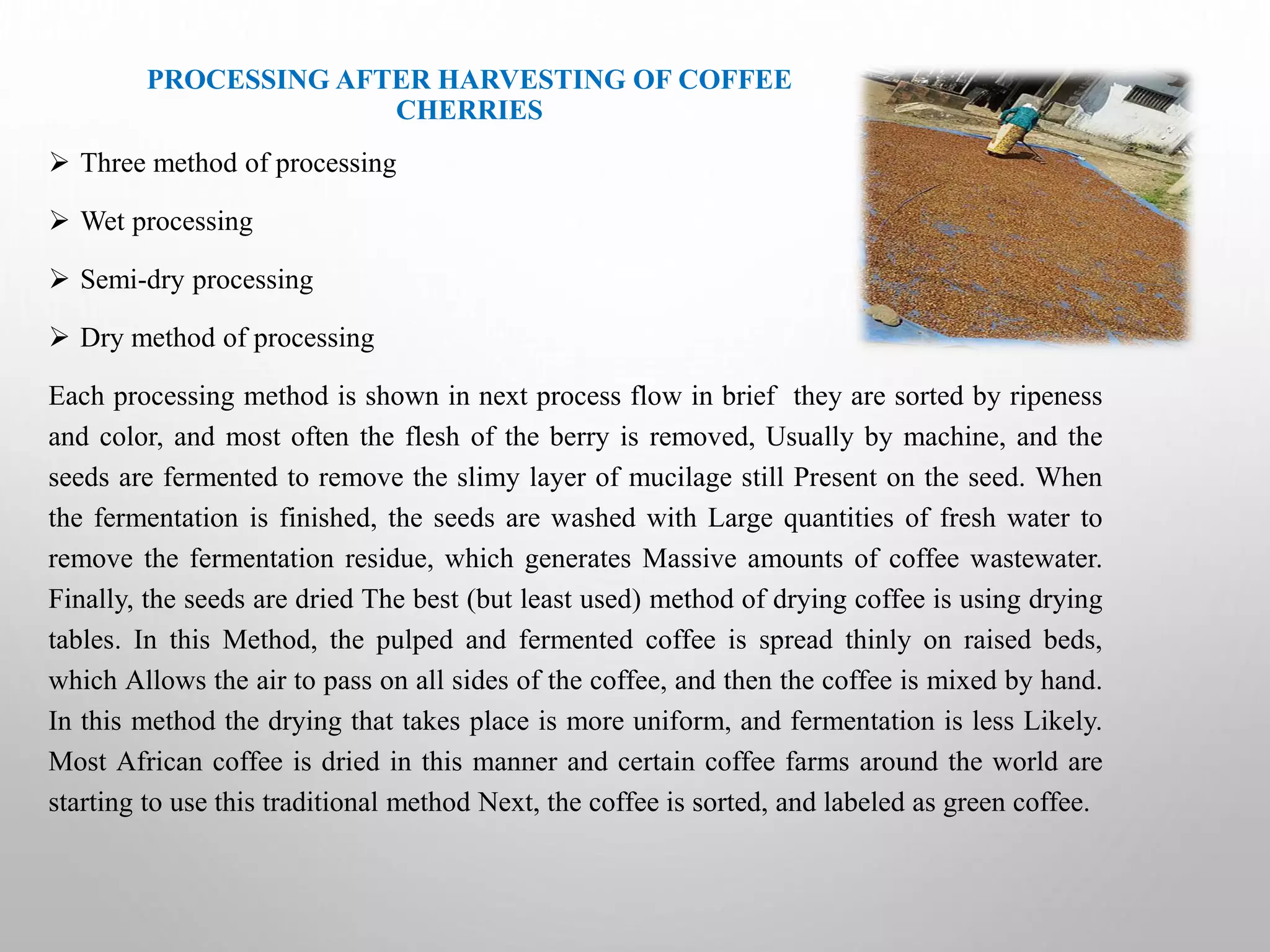
PROCESSING AFTER HARVESTING OF COFFEE
CHERRIES
 Three method of processing
 Wet processing
 Semi-dry processing
 Dry method of processing
Each processing method is shown in next process flow in brief they are sorted by ripeness
and color, and most often the flesh of the berry is removed, Usually by machine, and the
seeds are fermented to remove the slimy layer of mucilage still Present on the seed. When
the fermentation is finished, the seeds are washed with Large quantities of fresh water to
remove the fermentation residue, which generates Massive amounts of coffee wastewater.
Finally, the seeds are dried The best (but least used) method of drying coffee is using drying
tables. In this Method, the pulped and fermented coffee is spread thinly on raised beds,
which Allows the air to pass on all sides of the coffee, and then the coffee is mixed by hand.
In this method the drying that takes place is more uniform, and fermentation is less Likely.
Most African coffee is dried in this manner and certain coffee farms around the world are
starting to use this traditional method Next, the coffee is sorted, and labeled as green coffee.
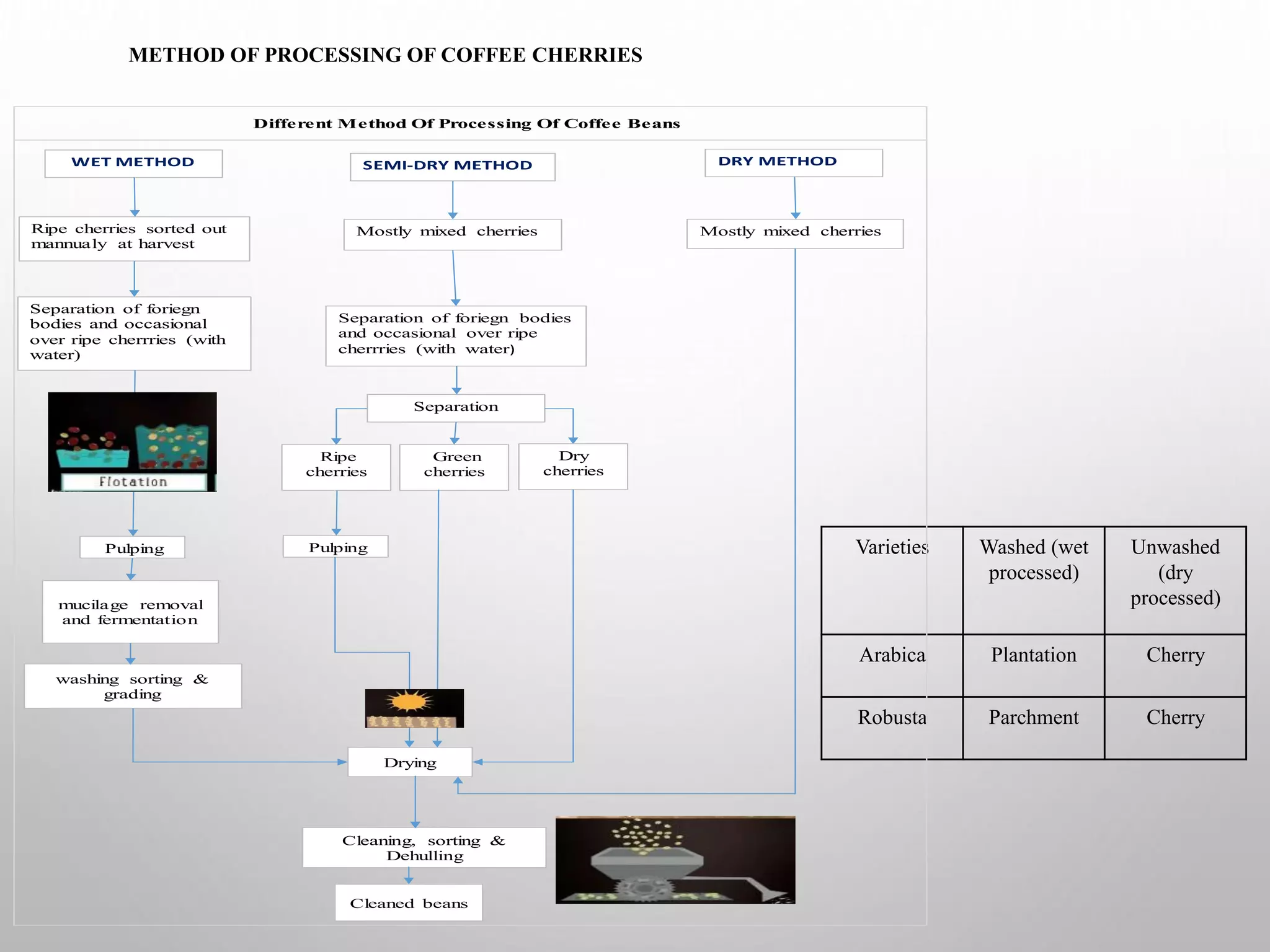
METHOD OF PROCESSING OF COFFEE CHERRIES
Varieties Washed (wet
processed)
Unwashed
(dry
processed)
Arabica Plantation Cherry
Robusta Parchment Cherry
Different Method Of Processing Of Coffee Beans
SEMI-DRY METHODWET METHOD
Ripe cherries sorted out
mannualy at harvest
DRY METHOD
Separation
Mostly mixed cherries
Separation of foriegn
bodies and occasional
over ripe cherrries (with
water)
Mostly mixed cherries
Separation of foriegn bodies
and occasional over ripe
cherrries (with water)
Pulping
Cleaning, sorting &
Dehulling
Drying
washing sorting &
grading
mucilage removal
and fermentation
Ripe
cherries
Green
cherries
Dry
cherries
Pulping
Cleaned beans
Criteria Robusta Coffea canafora Arabica Coffea arabica
Visual beans are small , round and generally
brownish to yellowy green
Generally greenish to blue green
Caffeine 2.3 1.2
Aroma /flavor Bitter in taste Pleasant aroma and taste
Altitude Low land High land
Cost Less expensive than Arabica More expensive
Role Gives body to coffee and have a less
flavor
Gives less body to coffee but have
pleasant flavor
World consumption 70% of world consumes the arabica 30% consumption in world
THE DIFFERENCRE B/W ARABICAAND ROBUSTA
GREEN COFFEE CLEANING
Before roasting, it is necessary to remove the small amount of impurities which may be present in the
green coffee bags delivered by the supplier. The coffee received from the supplier either in bags or in
bulk will be unloaded then taken for cleaning process to remove the impurities like
Bits ( by vibration with particular sieve size for e.g.: 10 mm to remove the bits and plastic and foreign
material)
Husk and dust (cyclonic effect by use of exhaust fan to remove the dust and husk material
Stone (by use of destoner the principle of working is vibration and angle of inclination it leads to
separation of coffee and stones based on density difference.)
Metals all these impurities are removed(magnetic separator: electromagnetic induction principle)
Defective beans are electronically sorted, and the grains graded through screens. A defect in flavour
may develop due to unsuitable green coffee processing practices.
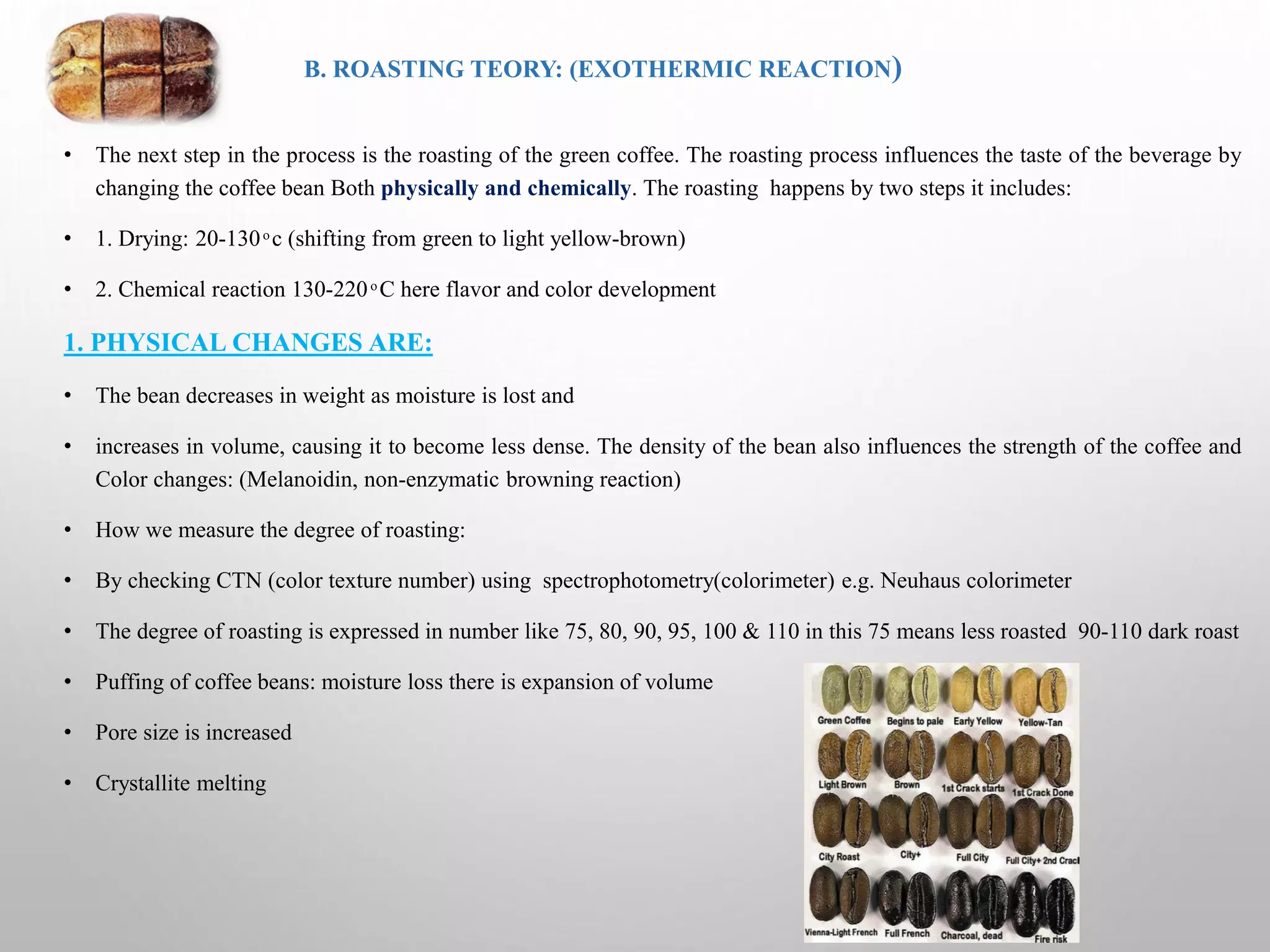
• The next step in the process is the roasting of the green coffee. The roasting process influences the taste of the beverage by
changing the coffee bean Both physically and chemically. The roasting happens by two steps it includes:
• 1. Drying: 20-130 ͦ c (shifting from green to light yellow-brown)
• 2. Chemical reaction 130-220 ͦ C here flavor and color development
1. PHYSICAL CHANGES ARE:
• The bean decreases in weight as moisture is lost and
• increases in volume, causing it to become less dense. The density of the bean also influences the strength of the coffee and
Color changes: (Melanoidin, non-enzymatic browning reaction)
• How we measure the degree of roasting:
• By checking CTN (color texture number) using spectrophotometry(colorimeter) e.g. Neuhaus colorimeter
• The degree of roasting is expressed in number like 75, 80, 90, 95, 100 & 110 in this 75 means less roasted 90-110 dark roast
• Puffing of coffee beans: moisture loss there is expansion of volume
• Pore size is increased
• Crystallite melting
B. ROASTING TEORY: (EXOTHERMIC REACTION)
 CHO get converted in to aroma & Co2 Caramelization: Sugar from bean starts caramelizing, which browns the
sugar & release the aromatic components. Occurring, releases aromatic and acidic compounds - an important step
in the degradation of the bitter tasting particles. Glycosylamine and melanlidins along with carbon dioxide are
the products lending to coffee's dominant taste.
 Pyrolysis: As the temperature inside the coffee bean exceeds 200 degrees Celsius, the water inside the bean
vaporizes. Pressure inside each cell increases as the steam and carbon dioxide try to escape but are sealed in by the
thick, impermeable cell wall and thin film of oil. This endothermic reaction will ultimately change to an exothermic
process as the bean begins to release heat. Thermal breakdown of chemical compounds into simplest form due the
heating – Contributes to roast flavor.
 6-16 mg of Co2 /g of coffee liberates during roasting.
 Density reduces from 1100-1300 to 500-700 kg/m3
2. CHEMICAL CHANGES:
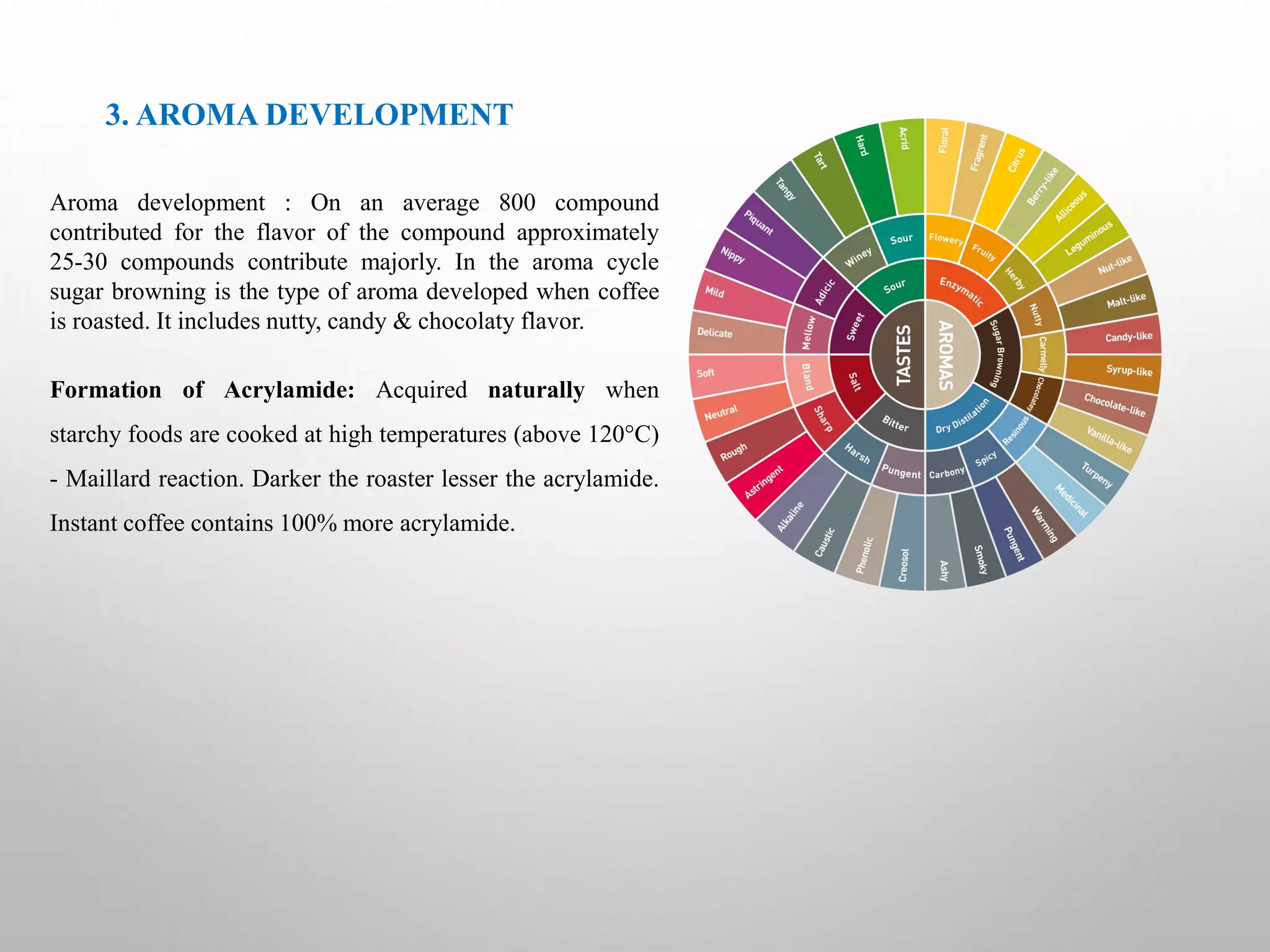
3. AROMA DEVELOPMENT
Aroma development : On an average 800 compound
contributed for the flavor of the compound approximately
25-30 compounds contribute majorly. In the aroma cycle
sugar browning is the type of aroma developed when coffee
is roasted. It includes nutty, candy & chocolaty flavor.
Formation of Acrylamide: Acquired naturally when
starchy foods are cooked at high temperatures (above 120°C)
- Maillard reaction. Darker the roaster lesser the acrylamide.
Instant coffee contains 100% more acrylamide.
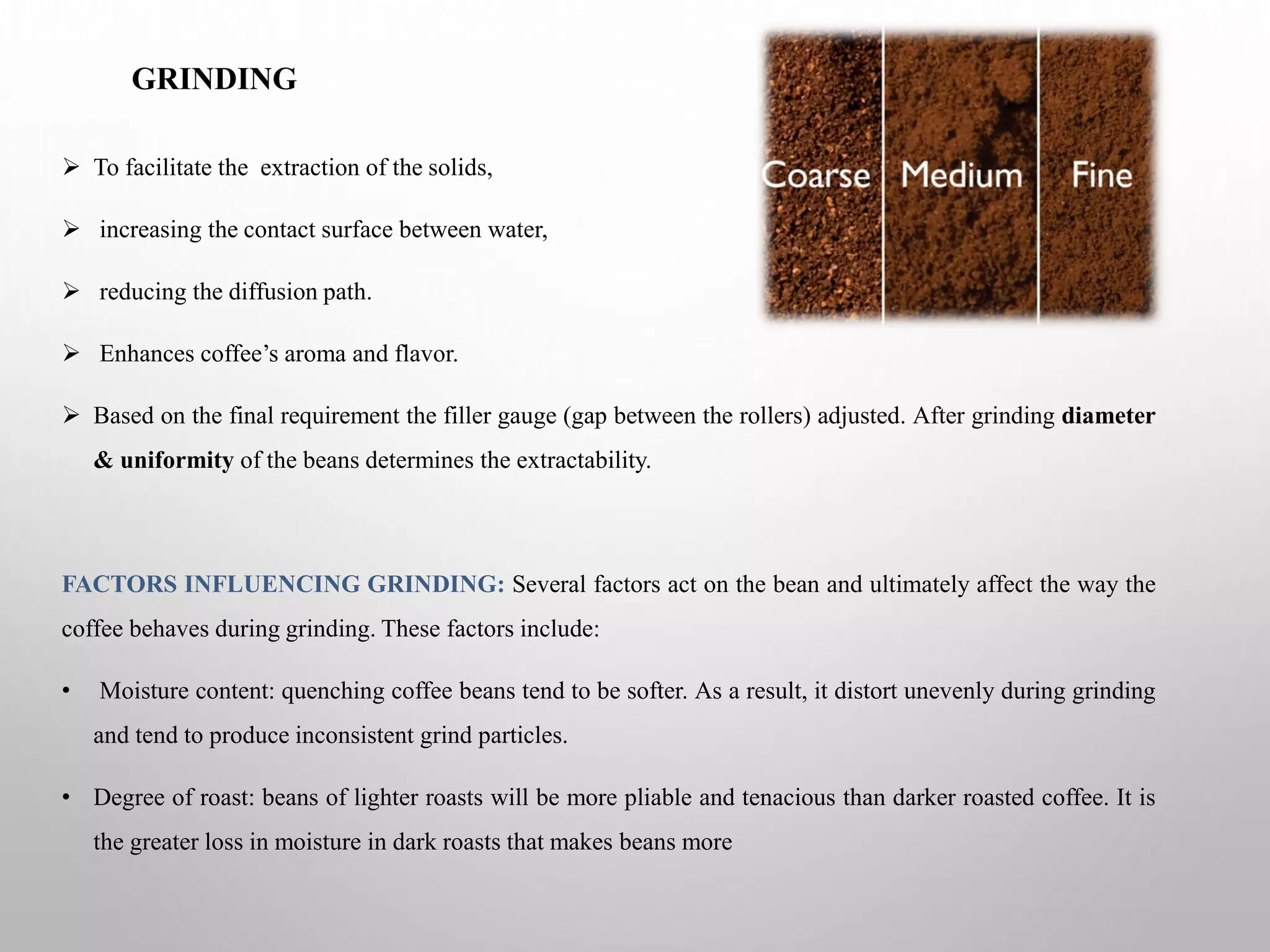
GRINDING
 To facilitate the extraction of the solids,
 increasing the contact surface between water,
 reducing the diffusion path.
 Enhances coffee’s aroma and flavor.
 Based on the final requirement the filler gauge (gap between the rollers) adjusted. After grinding diameter
& uniformity of the beans determines the extractability.
FACTORS INFLUENCING GRINDING: Several factors act on the bean and ultimately affect the way the
coffee behaves during grinding. These factors include:
• Moisture content: quenching coffee beans tend to be softer. As a result, it distort unevenly during grinding
and tend to produce inconsistent grind particles.
• Degree of roast: beans of lighter roasts will be more pliable and tenacious than darker roasted coffee. It is
the greater loss in moisture in dark roasts that makes beans more
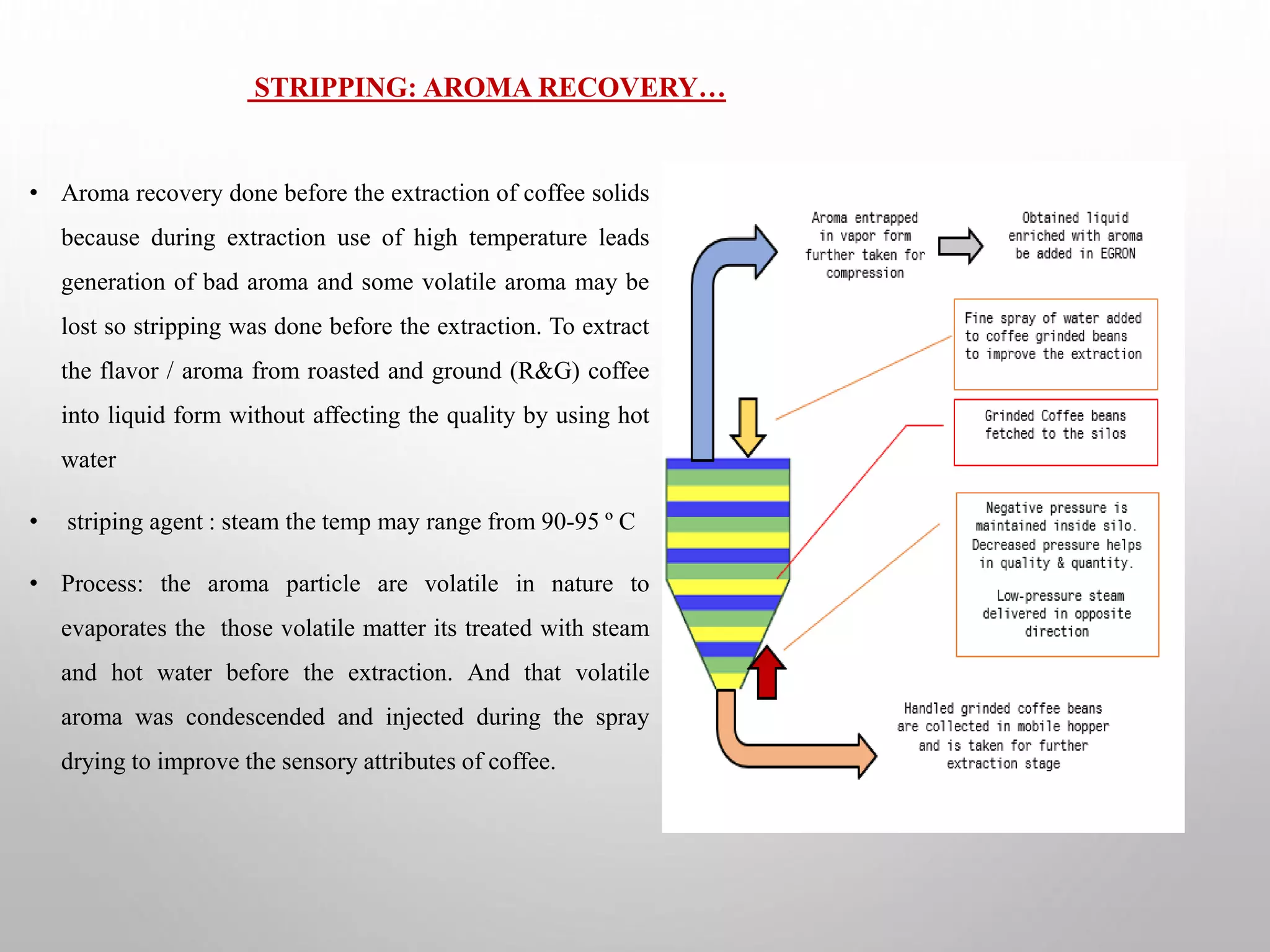
STRIPPING: AROMA RECOVERY…
• Aroma recovery done before the extraction of coffee solids
because during extraction use of high temperature leads
generation of bad aroma and some volatile aroma may be
lost so stripping was done before the extraction. To extract
the flavor / aroma from roasted and ground (R&G) coffee
into liquid form without affecting the quality by using hot
water
• striping agent : steam the temp may range from 90-95 º C
• Process: the aroma particle are volatile in nature to
evaporates the those volatile matter its treated with steam
and hot water before the extraction. And that volatile
aroma was condescended and injected during the spray
drying to improve the sensory attributes of coffee.
• In the particular case of coffee processing, extraction usually refers mobilization of
soluble solids and aroma from roast and ground coffee to produce a coffee extract
Extraction process:
• 1. Penetration of the fluid into the solid
• 2. Solubilisation and/or breakdown of the components
• 3. Transport of solutes within the solid porous microstructure
• 4. Incorporation of the solute from the surface of the solid to the bulk solution.
• 5. Movement of the extract with respect to the solid
• 6. Separation and discharge of the extract
D. EXTRACTION
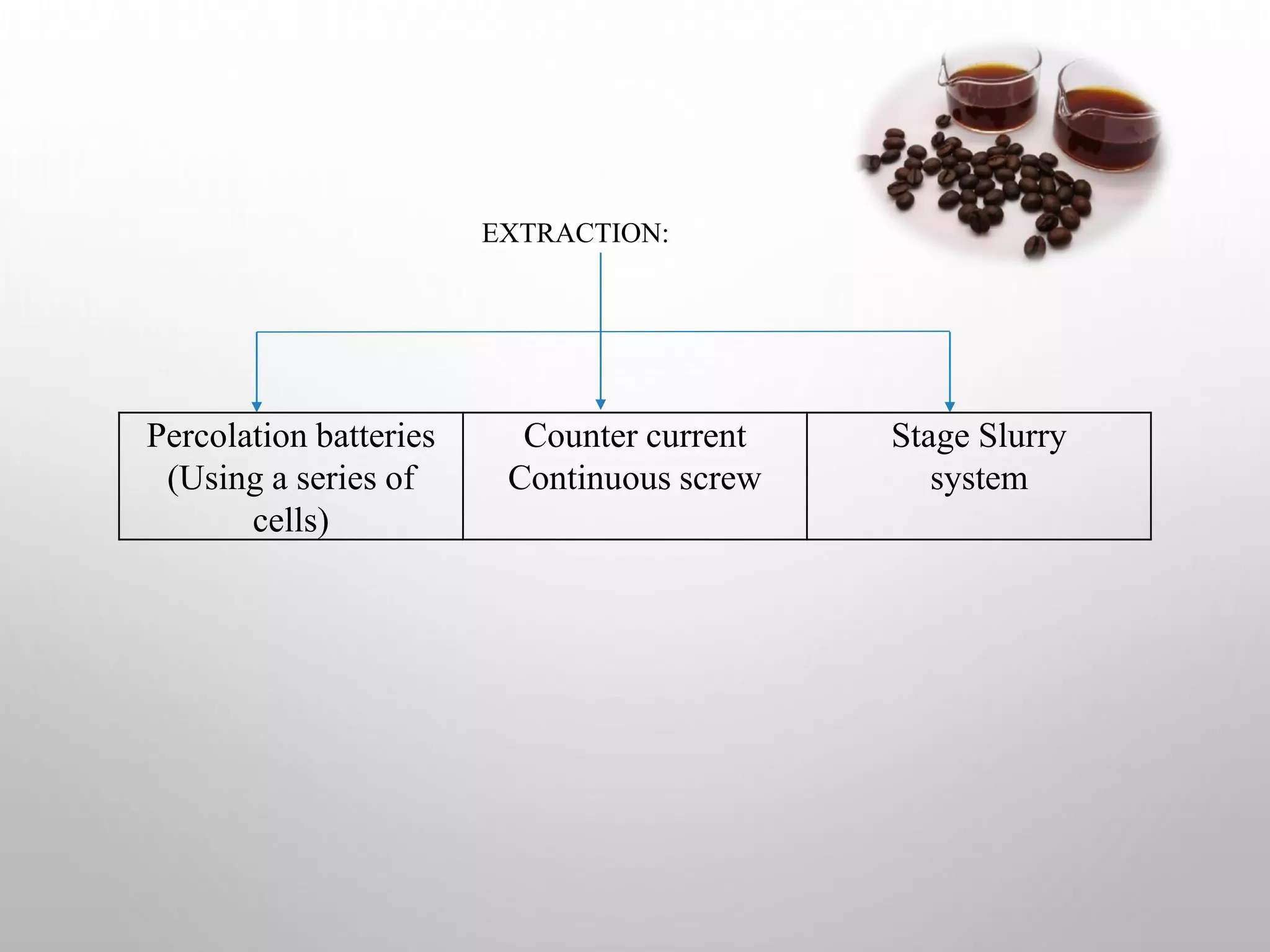
EXTRACTION:
Percolation batteries
(Using a series of
cells)
Counter current
Continuous screw
Stage Slurry
system
EXTRACTION BY PERCOLATION BATTERIES
• Series of percolation batteries connected to one another the roast and ground coffee filled from top of
the cell after filling top lid was closed and then in counter direction the hot water enter from bottom
of the cell and leaves from the top by this movement from one cell to other The solids concentration is
increases gradually and finally we’ll get 10% extract. After extraction they are passed through clarifier
to remove insoluble from the coffee extract. The clarified coffee extract with 10% TC is fed to
evaporator.
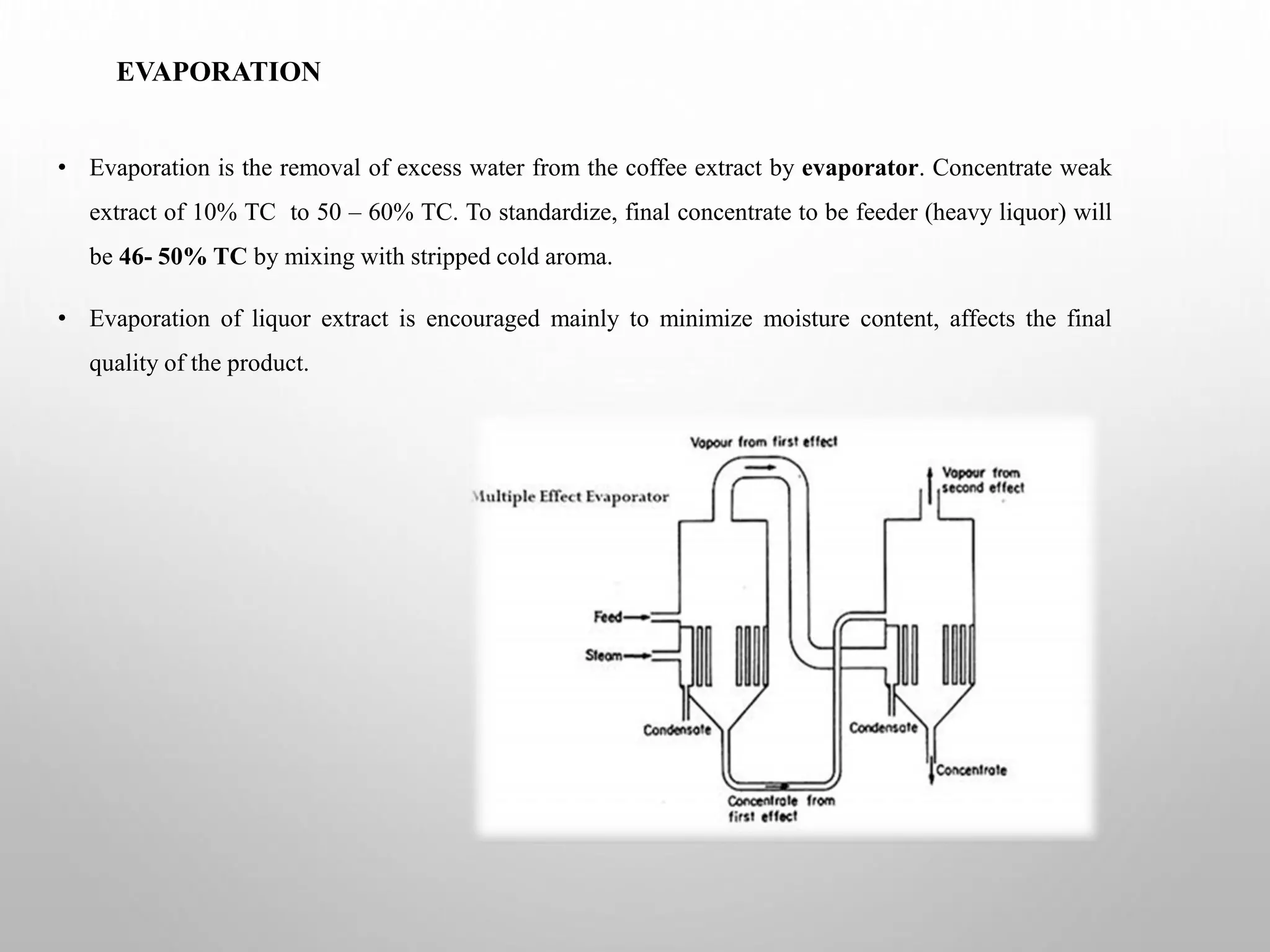
EVAPORATION
• Evaporation is the removal of excess water from the coffee extract by evaporator. Concentrate weak
extract of 10% TC to 50 – 60% TC. To standardize, final concentrate to be feeder (heavy liquor) will
be 46- 50% TC by mixing with stripped cold aroma.
• Evaporation of liquor extract is encouraged mainly to minimize moisture content, affects the final
quality of the product.
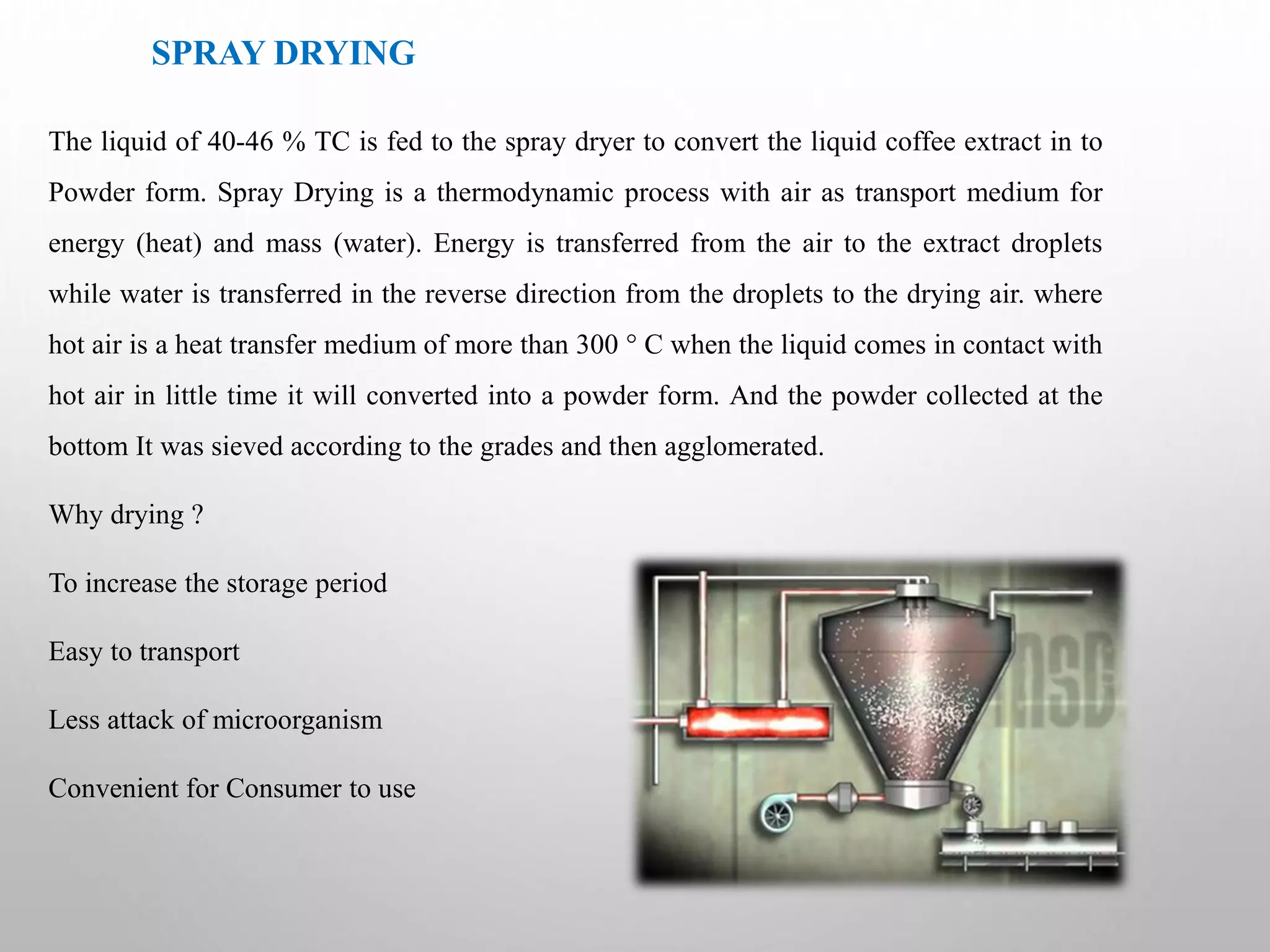
SPRAY DRYING
The liquid of 40-46 % TC is fed to the spray dryer to convert the liquid coffee extract in to
Powder form. Spray Drying is a thermodynamic process with air as transport medium for
energy (heat) and mass (water). Energy is transferred from the air to the extract droplets
while water is transferred in the reverse direction from the droplets to the drying air. where
hot air is a heat transfer medium of more than 300 ° C when the liquid comes in contact with
hot air in little time it will converted into a powder form. And the powder collected at the
bottom It was sieved according to the grades and then agglomerated.
Why drying ?
To increase the storage period
Easy to transport
Less attack of microorganism
Convenient for Consumer to use
Agglomeration
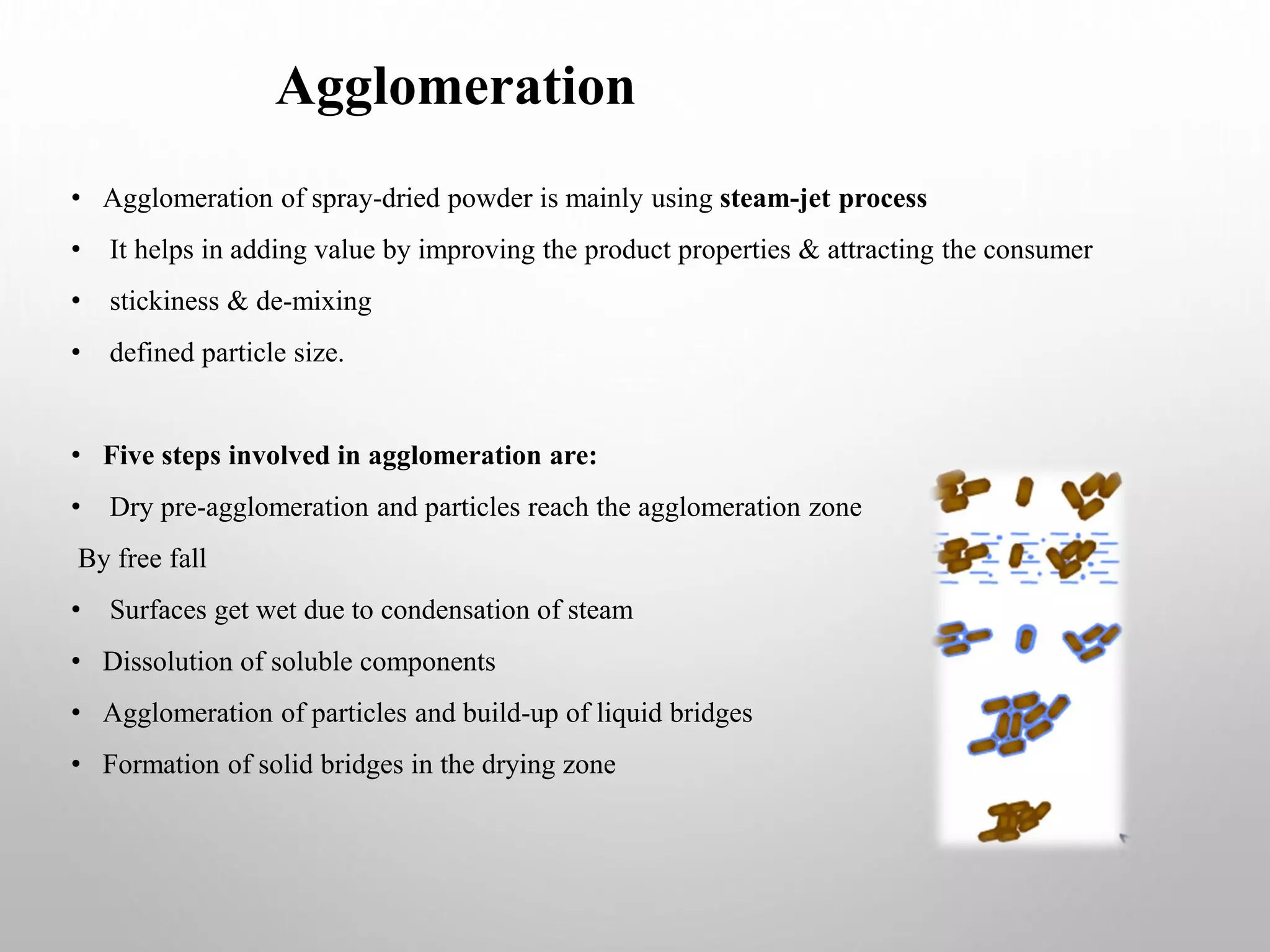
• Agglomeration of spray-dried powder is mainly using steam-jet process
• It helps in adding value by improving the product properties & attracting the consumer
• stickiness & de-mixing
• defined particle size.
• Five steps involved in agglomeration are:
• Dry pre-agglomeration and particles reach the agglomeration zone
By free fall
• Surfaces get wet due to condensation of steam
• Dissolution of soluble components
• Agglomeration of particles and build-up of liquid bridges
• Formation of solid bridges in the drying zone
FILLING AND PACKING
 The packaging material is also called silent sales man because it contain all the necessary
information which producer want to communicate with consumer . After drying the coffee
powder is filled in Packages like sachets, jars and boxes because
1. coffee is hygroscopic in nature
2. Easy to transport
3. Consumer convenience..
START A DAY WITH COFFEE……….
Thank you

Instant coffee manufacturing (what you know about coffee)

  • 1.
    Presented by Pallavi .B.S B.Techfood science and technology
  • 2.
    HISTORY OF COFFEE Coffeeis darkly colored, bitter, slightly acidic and has a stimulating effect in humans, primarily due to its caffeine content. It is one of the most popular drinks in the world, and it can be prepared and presented in a variety of ways (e.g., espresso, French press, café latte). It is usually served hot, although iced coffee is a popular alternative. Coffee is the second most a traded commodity in the world. The global popularity of coffee beverages can be attributed to their delightful flavor and aroma, along with the physiological effects of caffeine, which is regarded as The most used pharmacologically active substance in coffee. coffee was introduced in Ethiopia in the early 15th century and the story behind it is Some religious groups in Africa found that their domestic animals, e.g.. cows, sheep etc. became unusually excited after eating a certain type of fruit. They noticed behavioural changes in the animals, and discovered the stimulating flavour of this fruit. Some of its seeds were accidentally thrown into a fire, resulting in roasted coffee from which civilisation produced the extract known as coffee drink.
  • 3.
    • Coffee wasintroduced in India in the year 1600 by pilgrims from Africa. Large-scale cultivation and production started in the 1820's.  At the end of the nineteenth century attempts were made to produce instant coffee in the usa, however the production of instant coffee on a small scale only began in 1930  This problem was successfully tackled by nestle in 1938, and produced a free- flowing, light-colored powder composed of 50 % soluble coffee solids and 50 % maltodextrins, retaining a coffee-like flavor when reconstituted in hot water. This product was initially introduced in Switzerland, followed by France, the UK and the USA.  Although the first known patent for soluble coffee was awarded in 177,as cited in Nestlé's website ( nestle,2013) HISTORY IN INDIA
  • 4.
    OVER VIEW OFCOFFEE PROCESS Roasting Grinding ExtractionEvaporationSpray drying Stripping Filling and packing Green coffee Instant coffee: The manufacture of soluble coffee is carried out by producing coffee extract by roasting, grinding and extracting the roasted ground coffee. The coffee extract is either spray or freeze dried to remove the water from the mixture ensuring that there is minimum damage to quality. The product is then filled into jars or other types of packaging for the market place.
  • 5.
    INTRODUCTION: COFFEE Composition ofthe coffee The chemical composition of the coffee depends mainly on the species and varieties of coffee used, and to a lesser extent on other factors e.g.. agricultural practices, time of harvesting, storage conditions etc. Component Arabica Robusta Proteins 11 - 13 11 – 13 Lipids 12 - 18 9 – 13 Caffeine 0.9 - 1.2 1.6 - 2.4 Total polysaccharides 50 - 55 37 – 47 Trigonelline 1.0 - 1.2 0.6 - 0.75 Chromogenic acids 5.5 - 8.0 7 – 10 Minerals 3.0 - 4.2 4.0 - 4.5
  • 6.
    MAJOR PRODUCER ANDEXPORTER Major coffee producing countries As of 2016, Brazil was the leading grower of coffee beans, producing one- third of the world total and others includes Vietnam, Colombia, Indonesia, Ethiopia, India, Honduras, Uganda, Mexico and Guatemala Major exporting countries: Brazil, Colombia, Vietnam, Germany, Switzerland, Italy, Indonesia, Belgium, Honduras and Ethiopia Major coffee exporter in world: Barbera coffee company Italy Coffee cabana brazil Maxwell house united states Miko coffee Belgium Nestle (Switzerland) Neumann gruppe AG (German) O’coffee - Brazilian estates (brazil) Ospina coffee company (Colombia) Simexco daklak ltd (Vietnam) Starbucks corporation (united states) Major coffee exporter in India : 1. NKG Jayanti coffee private limited 2. Alana sons limited 3. I.T.C limited 4. Amalgamated bean coffee trading co. ltd 5. NED commodities India private limited 6. TATA coffee ltd.
  • 7.
    A. COFFEE PLANT: Coffea canephora (Predominantly a form known as 'robusta') And C. Arabica. The coffee tree belongs to the Rubiaceae family. This cherry grows on perennial evergreen plants, A coffee plant usually starts to produce flowers three to four years after it is planted. from these flowers the fruits of the plant (commonly known as coffee cherries) appear. And these cherries after 8 months it will turn to red are harvested by hand picking and mechanical harvesting method. Coffee growing regions in India are divide into three categories: 1.Traditional- Karnataka, Kerala and Tamilnaadu 2. Non traditional- Andra Pradesh and Orissa 3.Northen region- Assam, Manipur, Meghalaya, Mizoram, Tripura, Nagaland, and Arunachala Pradesh CROP CALLENDER: JAN FEB MAR APR MAY JUN JUL AUG SEP OCT NOV DEC INDIA HARVEST PERIOD BEST HARVEST PERIOD SHIPPING PERIOD BEST SHIPPING PERIOD
  • 8.
    PROCESSING AFTER HARVESTINGOF COFFEE CHERRIES  Three method of processing  Wet processing  Semi-dry processing  Dry method of processing Each processing method is shown in next process flow in brief they are sorted by ripeness and color, and most often the flesh of the berry is removed, Usually by machine, and the seeds are fermented to remove the slimy layer of mucilage still Present on the seed. When the fermentation is finished, the seeds are washed with Large quantities of fresh water to remove the fermentation residue, which generates Massive amounts of coffee wastewater. Finally, the seeds are dried The best (but least used) method of drying coffee is using drying tables. In this Method, the pulped and fermented coffee is spread thinly on raised beds, which Allows the air to pass on all sides of the coffee, and then the coffee is mixed by hand. In this method the drying that takes place is more uniform, and fermentation is less Likely. Most African coffee is dried in this manner and certain coffee farms around the world are starting to use this traditional method Next, the coffee is sorted, and labeled as green coffee.
  • 9.
    METHOD OF PROCESSINGOF COFFEE CHERRIES Varieties Washed (wet processed) Unwashed (dry processed) Arabica Plantation Cherry Robusta Parchment Cherry Different Method Of Processing Of Coffee Beans SEMI-DRY METHODWET METHOD Ripe cherries sorted out mannualy at harvest DRY METHOD Separation Mostly mixed cherries Separation of foriegn bodies and occasional over ripe cherrries (with water) Mostly mixed cherries Separation of foriegn bodies and occasional over ripe cherrries (with water) Pulping Cleaning, sorting & Dehulling Drying washing sorting & grading mucilage removal and fermentation Ripe cherries Green cherries Dry cherries Pulping Cleaned beans
  • 10.
    Criteria Robusta Coffeacanafora Arabica Coffea arabica Visual beans are small , round and generally brownish to yellowy green Generally greenish to blue green Caffeine 2.3 1.2 Aroma /flavor Bitter in taste Pleasant aroma and taste Altitude Low land High land Cost Less expensive than Arabica More expensive Role Gives body to coffee and have a less flavor Gives less body to coffee but have pleasant flavor World consumption 70% of world consumes the arabica 30% consumption in world THE DIFFERENCRE B/W ARABICAAND ROBUSTA
  • 11.
    GREEN COFFEE CLEANING Beforeroasting, it is necessary to remove the small amount of impurities which may be present in the green coffee bags delivered by the supplier. The coffee received from the supplier either in bags or in bulk will be unloaded then taken for cleaning process to remove the impurities like Bits ( by vibration with particular sieve size for e.g.: 10 mm to remove the bits and plastic and foreign material) Husk and dust (cyclonic effect by use of exhaust fan to remove the dust and husk material Stone (by use of destoner the principle of working is vibration and angle of inclination it leads to separation of coffee and stones based on density difference.) Metals all these impurities are removed(magnetic separator: electromagnetic induction principle) Defective beans are electronically sorted, and the grains graded through screens. A defect in flavour may develop due to unsuitable green coffee processing practices.
  • 12.
    • The nextstep in the process is the roasting of the green coffee. The roasting process influences the taste of the beverage by changing the coffee bean Both physically and chemically. The roasting happens by two steps it includes: • 1. Drying: 20-130 ͦ c (shifting from green to light yellow-brown) • 2. Chemical reaction 130-220 ͦ C here flavor and color development 1. PHYSICAL CHANGES ARE: • The bean decreases in weight as moisture is lost and • increases in volume, causing it to become less dense. The density of the bean also influences the strength of the coffee and Color changes: (Melanoidin, non-enzymatic browning reaction) • How we measure the degree of roasting: • By checking CTN (color texture number) using spectrophotometry(colorimeter) e.g. Neuhaus colorimeter • The degree of roasting is expressed in number like 75, 80, 90, 95, 100 & 110 in this 75 means less roasted 90-110 dark roast • Puffing of coffee beans: moisture loss there is expansion of volume • Pore size is increased • Crystallite melting B. ROASTING TEORY: (EXOTHERMIC REACTION)
  • 13.
     CHO getconverted in to aroma & Co2 Caramelization: Sugar from bean starts caramelizing, which browns the sugar & release the aromatic components. Occurring, releases aromatic and acidic compounds - an important step in the degradation of the bitter tasting particles. Glycosylamine and melanlidins along with carbon dioxide are the products lending to coffee's dominant taste.  Pyrolysis: As the temperature inside the coffee bean exceeds 200 degrees Celsius, the water inside the bean vaporizes. Pressure inside each cell increases as the steam and carbon dioxide try to escape but are sealed in by the thick, impermeable cell wall and thin film of oil. This endothermic reaction will ultimately change to an exothermic process as the bean begins to release heat. Thermal breakdown of chemical compounds into simplest form due the heating – Contributes to roast flavor.  6-16 mg of Co2 /g of coffee liberates during roasting.  Density reduces from 1100-1300 to 500-700 kg/m3 2. CHEMICAL CHANGES:
  • 14.
    3. AROMA DEVELOPMENT Aromadevelopment : On an average 800 compound contributed for the flavor of the compound approximately 25-30 compounds contribute majorly. In the aroma cycle sugar browning is the type of aroma developed when coffee is roasted. It includes nutty, candy & chocolaty flavor. Formation of Acrylamide: Acquired naturally when starchy foods are cooked at high temperatures (above 120°C) - Maillard reaction. Darker the roaster lesser the acrylamide. Instant coffee contains 100% more acrylamide.
  • 15.
    GRINDING  To facilitatethe extraction of the solids,  increasing the contact surface between water,  reducing the diffusion path.  Enhances coffee’s aroma and flavor.  Based on the final requirement the filler gauge (gap between the rollers) adjusted. After grinding diameter & uniformity of the beans determines the extractability. FACTORS INFLUENCING GRINDING: Several factors act on the bean and ultimately affect the way the coffee behaves during grinding. These factors include: • Moisture content: quenching coffee beans tend to be softer. As a result, it distort unevenly during grinding and tend to produce inconsistent grind particles. • Degree of roast: beans of lighter roasts will be more pliable and tenacious than darker roasted coffee. It is the greater loss in moisture in dark roasts that makes beans more
  • 16.
    STRIPPING: AROMA RECOVERY… •Aroma recovery done before the extraction of coffee solids because during extraction use of high temperature leads generation of bad aroma and some volatile aroma may be lost so stripping was done before the extraction. To extract the flavor / aroma from roasted and ground (R&G) coffee into liquid form without affecting the quality by using hot water • striping agent : steam the temp may range from 90-95 º C • Process: the aroma particle are volatile in nature to evaporates the those volatile matter its treated with steam and hot water before the extraction. And that volatile aroma was condescended and injected during the spray drying to improve the sensory attributes of coffee.
  • 17.
    • In theparticular case of coffee processing, extraction usually refers mobilization of soluble solids and aroma from roast and ground coffee to produce a coffee extract Extraction process: • 1. Penetration of the fluid into the solid • 2. Solubilisation and/or breakdown of the components • 3. Transport of solutes within the solid porous microstructure • 4. Incorporation of the solute from the surface of the solid to the bulk solution. • 5. Movement of the extract with respect to the solid • 6. Separation and discharge of the extract D. EXTRACTION
  • 18.
    EXTRACTION: Percolation batteries (Using aseries of cells) Counter current Continuous screw Stage Slurry system
  • 19.
    EXTRACTION BY PERCOLATIONBATTERIES • Series of percolation batteries connected to one another the roast and ground coffee filled from top of the cell after filling top lid was closed and then in counter direction the hot water enter from bottom of the cell and leaves from the top by this movement from one cell to other The solids concentration is increases gradually and finally we’ll get 10% extract. After extraction they are passed through clarifier to remove insoluble from the coffee extract. The clarified coffee extract with 10% TC is fed to evaporator.
  • 20.
    EVAPORATION • Evaporation isthe removal of excess water from the coffee extract by evaporator. Concentrate weak extract of 10% TC to 50 – 60% TC. To standardize, final concentrate to be feeder (heavy liquor) will be 46- 50% TC by mixing with stripped cold aroma. • Evaporation of liquor extract is encouraged mainly to minimize moisture content, affects the final quality of the product.
  • 21.
    SPRAY DRYING The liquidof 40-46 % TC is fed to the spray dryer to convert the liquid coffee extract in to Powder form. Spray Drying is a thermodynamic process with air as transport medium for energy (heat) and mass (water). Energy is transferred from the air to the extract droplets while water is transferred in the reverse direction from the droplets to the drying air. where hot air is a heat transfer medium of more than 300 ° C when the liquid comes in contact with hot air in little time it will converted into a powder form. And the powder collected at the bottom It was sieved according to the grades and then agglomerated. Why drying ? To increase the storage period Easy to transport Less attack of microorganism Convenient for Consumer to use
  • 22.
    Agglomeration • Agglomeration ofspray-dried powder is mainly using steam-jet process • It helps in adding value by improving the product properties & attracting the consumer • stickiness & de-mixing • defined particle size. • Five steps involved in agglomeration are: • Dry pre-agglomeration and particles reach the agglomeration zone By free fall • Surfaces get wet due to condensation of steam • Dissolution of soluble components • Agglomeration of particles and build-up of liquid bridges • Formation of solid bridges in the drying zone
  • 23.
    FILLING AND PACKING The packaging material is also called silent sales man because it contain all the necessary information which producer want to communicate with consumer . After drying the coffee powder is filled in Packages like sachets, jars and boxes because 1. coffee is hygroscopic in nature 2. Easy to transport 3. Consumer convenience..
  • 24.
    START A DAYWITH COFFEE………. Thank you