.
WELCOME
.
WELCOME….!!!!
Presented by
Pallavi B.S
Food science and
technology..
pallavi
CONTENTS
INTRODUCTION
HISTORY
CULTIVATION REQUIREMENT
 NUTRITIONAL COMPOSITION AND BENEFITS
NATIONAL AND INTERNATIONAL SCENARIO
COMMERCIAL VARITIES
COST OF CULTIVATION
PHH
TURMERIC PRODUCTS AND STANDARDS
EXPORT ASPECTS
TURMERIC IN BAKERY
CONTENTS
INTRODUCTION
 . India is the ‘spice bowl’ of the world and according to the
Bureau of Indian Standards, 63 spices, including turmeric, are
grown in the country
 Turmeric the ancient and sacred spice of India known as
‘Indian saffron’ ,”spice of life” and ‘golden spice ‘
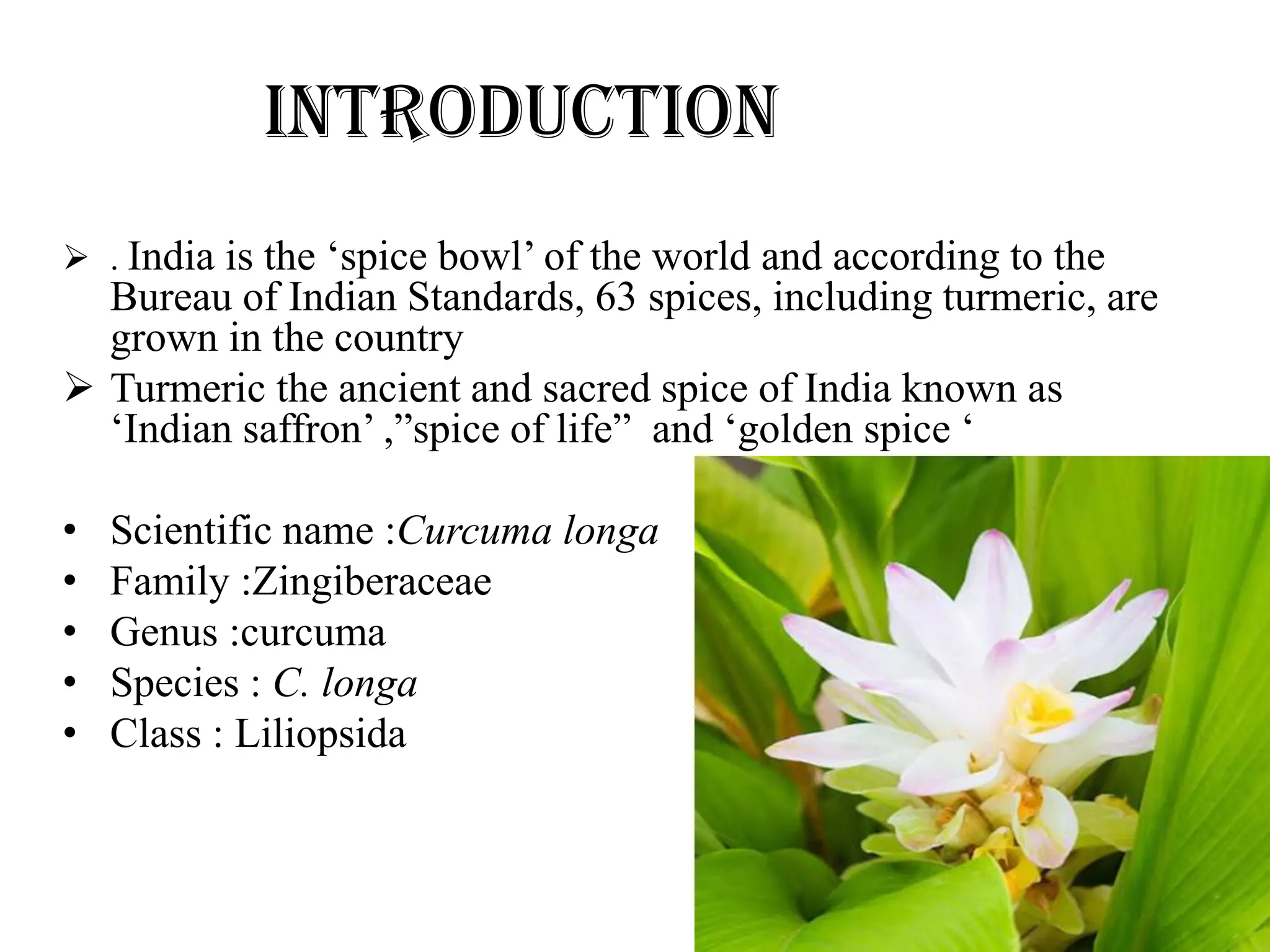
• Scientific name :Curcuma longa
• Family :Zingiberaceae
• Genus :curcuma
• Species : C. longa
• Class : Liliopsida
CONT…
 . It has anti cancer and anti viral activities and hence finds use
in the drug industry and cosmetic industry.
 'Kum-kum', popular with every house wife, is also a by-
product of turmeric.
 It finds a place in offerings on religious and ceremonial
occasions.
 A type of starch is also being extracted from a particular type
of turmeric.
 The increasing demand for natural products as food additives
makes turmeric as ideal produce as a food colourant.
HISTORY OF TURMERIC
• The exact origin of turmeric is unknown but
it is said that it originated in western India. It
has been used in India for 5000 years now.
• Initially, it was cultivated as a dye because
of its bright yellow colour.
• With time people started using it for
cosmetic purposes and then as a medicine.
• Turmeric reached China by 700 AD, East
Africa by 800 AD, West Africa by 1200 AD
and started becoming popular throughout the
world.
• Turmeric is very important spice in India,
which produces nearly entire whole world’s
crop and consumes 80% of it.
R
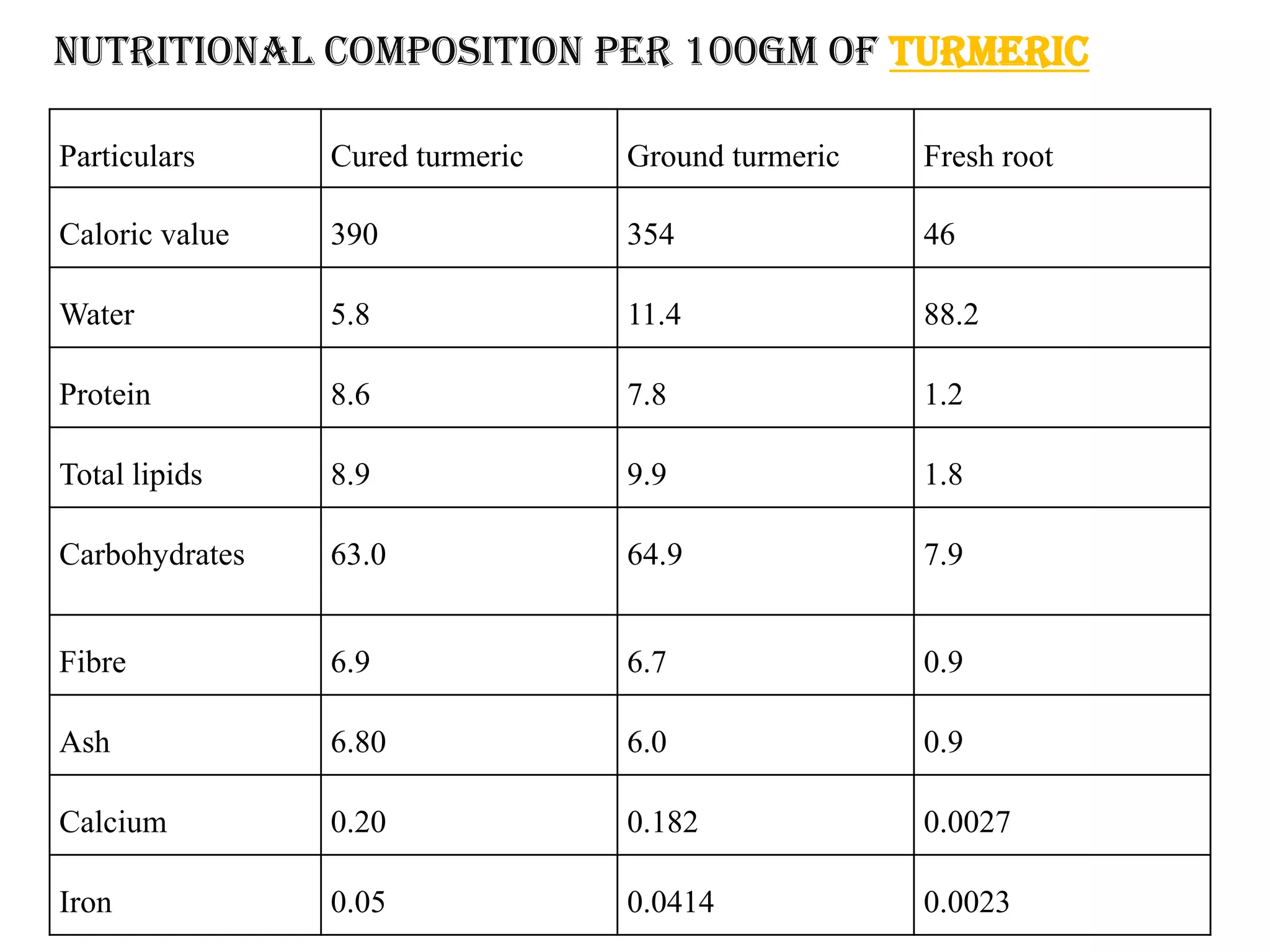
NUTRITIONAL COMPOSITION PER 100gm OF TURMERIC
Particulars Cured turmeric Ground turmeric Fresh root
Caloric value 390 354 46
Water 5.8 11.4 88.2
Protein 8.6 7.8 1.2
Total lipids 8.9 9.9 1.8
Carbohydrates 63.0 64.9 7.9
Fibre 6.9 6.7 0.9
Ash 6.80 6.0 0.9
Calcium 0.20 0.182 0.0027
Iron 0.05 0.0414 0.0023
HEALTH BENEFITS
• Helps to Prevent Cancer
• Eases Arthritis Symptoms
• Soothes Upset Stomach Because turmeric acts as an anti-
inflammatory
• Helps the Heart Stay Healthy
• It’s a Natural Fat Burner
• Helps in Preventing Alzheimer’s
• Treats Depression
• Helps the Skin
• Helps with Diabetes
• Protects Against Free Radical Damage
• Works as an Antiseptic
• Helps Bowel Disorders
• Headache Remedy
• Acts as an Anti-Inflammatory
CONT…..
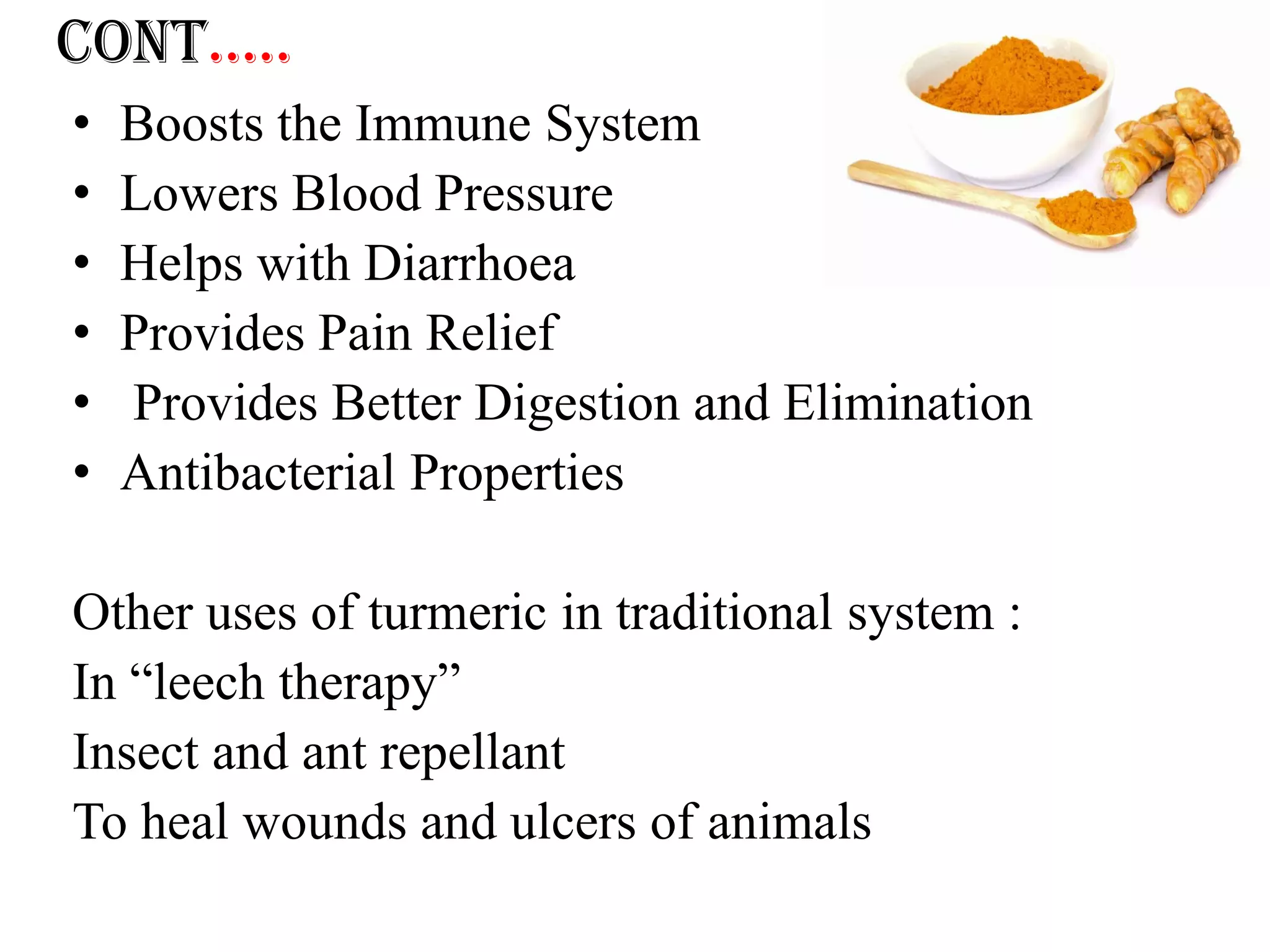
• Boosts the Immune System
• Lowers Blood Pressure
• Helps with Diarrhoea
• Provides Pain Relief
• Provides Better Digestion and Elimination
• Antibacterial Properties
Other uses of turmeric in traditional system :
In “leech therapy”
Insect and ant repellant
To heal wounds and ulcers of animals
International scenario
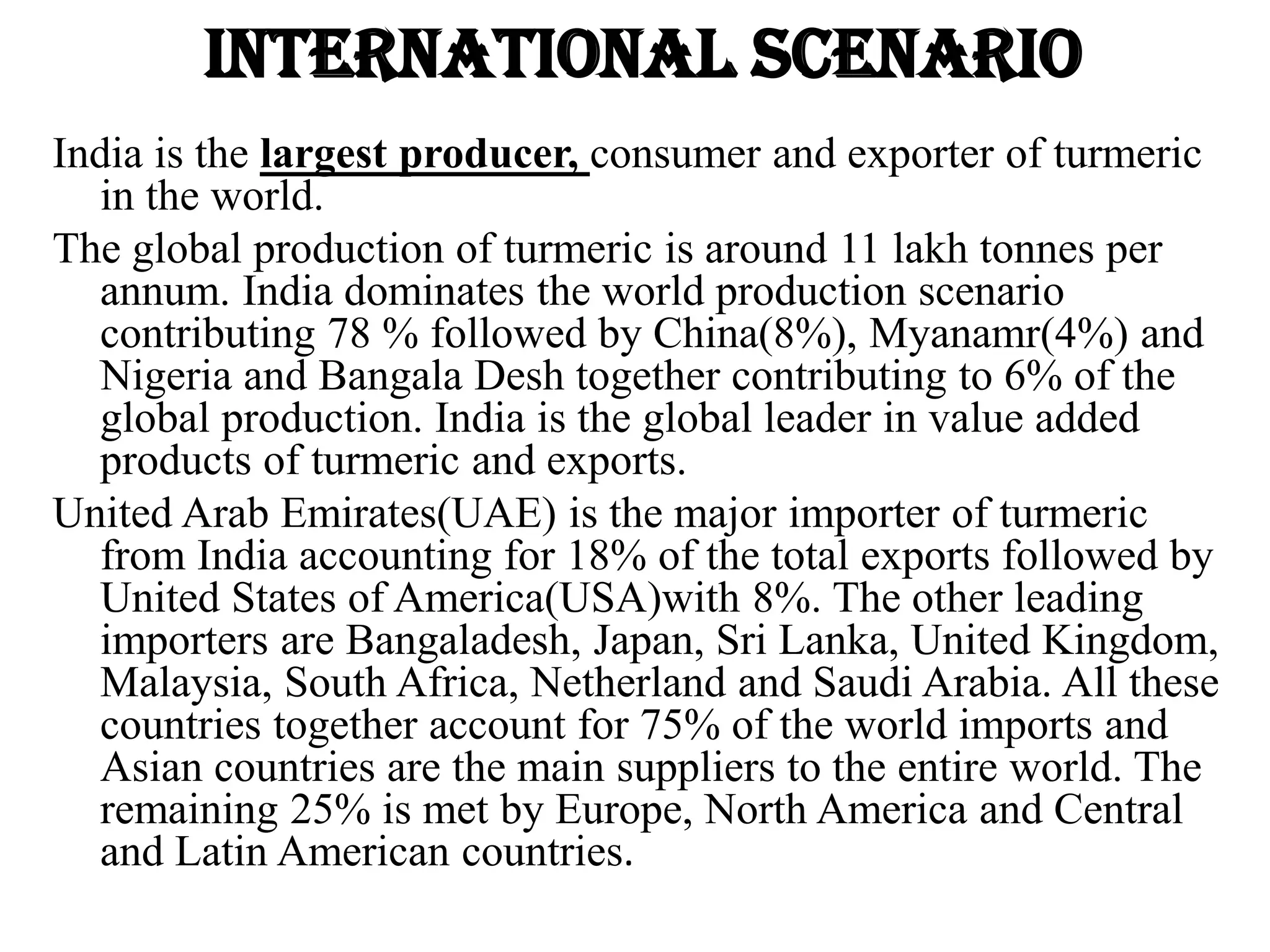
India is the largest producer, consumer and exporter of turmeric
in the world.
The global production of turmeric is around 11 lakh tonnes per
annum. India dominates the world production scenario
contributing 78 % followed by China(8%), Myanamr(4%) and
Nigeria and Bangala Desh together contributing to 6% of the
global production. India is the global leader in value added
products of turmeric and exports.
United Arab Emirates(UAE) is the major importer of turmeric
from India accounting for 18% of the total exports followed by
United States of America(USA)with 8%. The other leading
importers are Bangaladesh, Japan, Sri Lanka, United Kingdom,
Malaysia, South Africa, Netherland and Saudi Arabia. All these
countries together account for 75% of the world imports and
Asian countries are the main suppliers to the entire world. The
remaining 25% is met by Europe, North America and Central
and Latin American countries.
TurmeriC’s role in the
national economy
India is able to earn foreign exchange of more
than Rs 1500-1600million by exporting 50,000
tonnes of turmeric—dry and fresh turmeric,
turmeric powder, curcuminoids, dehydrated
turmeric powder, oils and oleoresins.
Erode the city of Tamil Nadu is the largest
producer of turmeric and is known as yellow
city of India
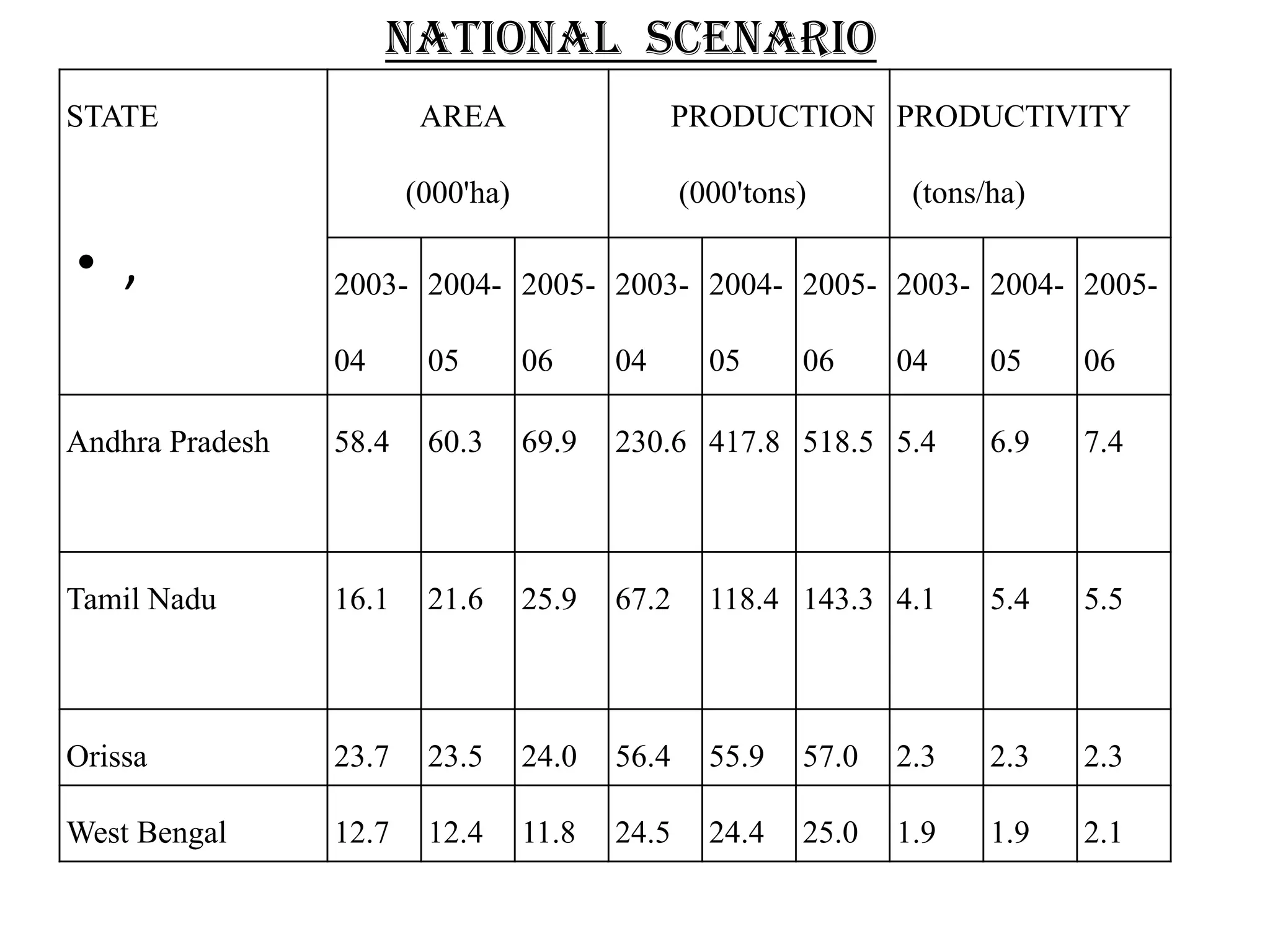
National scenario
STATE AREA
(000'ha)
PRODUCTION
(000'tons)
PRODUCTIVITY
(tons/ha)
2003-
04
2004-
05
2005-
06
2003-
04
2004-
05
2005-
06
2003-
04
2004-
05
2005-
06
Andhra Pradesh 58.4 60.3 69.9 230.6 417.8 518.5 5.4 6.9 7.4
Tamil Nadu 16.1 21.6 25.9 67.2 118.4 143.3 4.1 5.4 5.5
Orissa 23.7 23.5 24.0 56.4 55.9 57.0 2.3 2.3 2.3
West Bengal 12.7 12.4 11.8 24.5 24.4 25.0 1.9 1.9 2.1
• ,
.
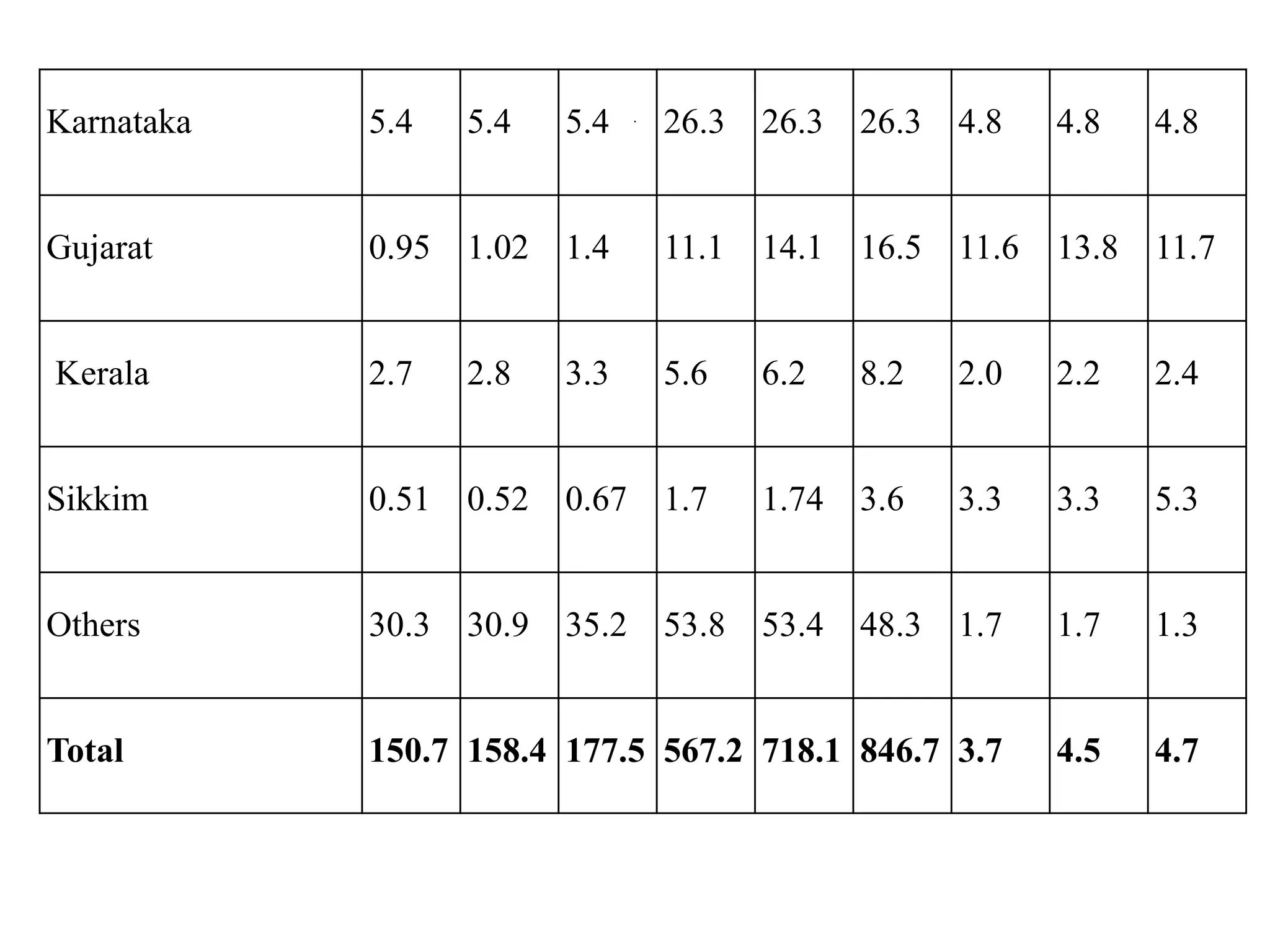
Karnataka 5.4 5.4 5.4 26.3 26.3 26.3 4.8 4.8 4.8
Gujarat 0.95 1.02 1.4 11.1 14.1 16.5 11.6 13.8 11.7
Kerala 2.7 2.8 3.3 5.6 6.2 8.2 2.0 2.2 2.4
Sikkim 0.51 0.52 0.67 1.7 1.74 3.6 3.3 3.3 5.3
Others 30.3 30.9 35.2 53.8 53.4 48.3 1.7 1.7 1.3
Total 150.7 158.4 177.5 567.2 718.1 846.7 3.7 4.5 4.7
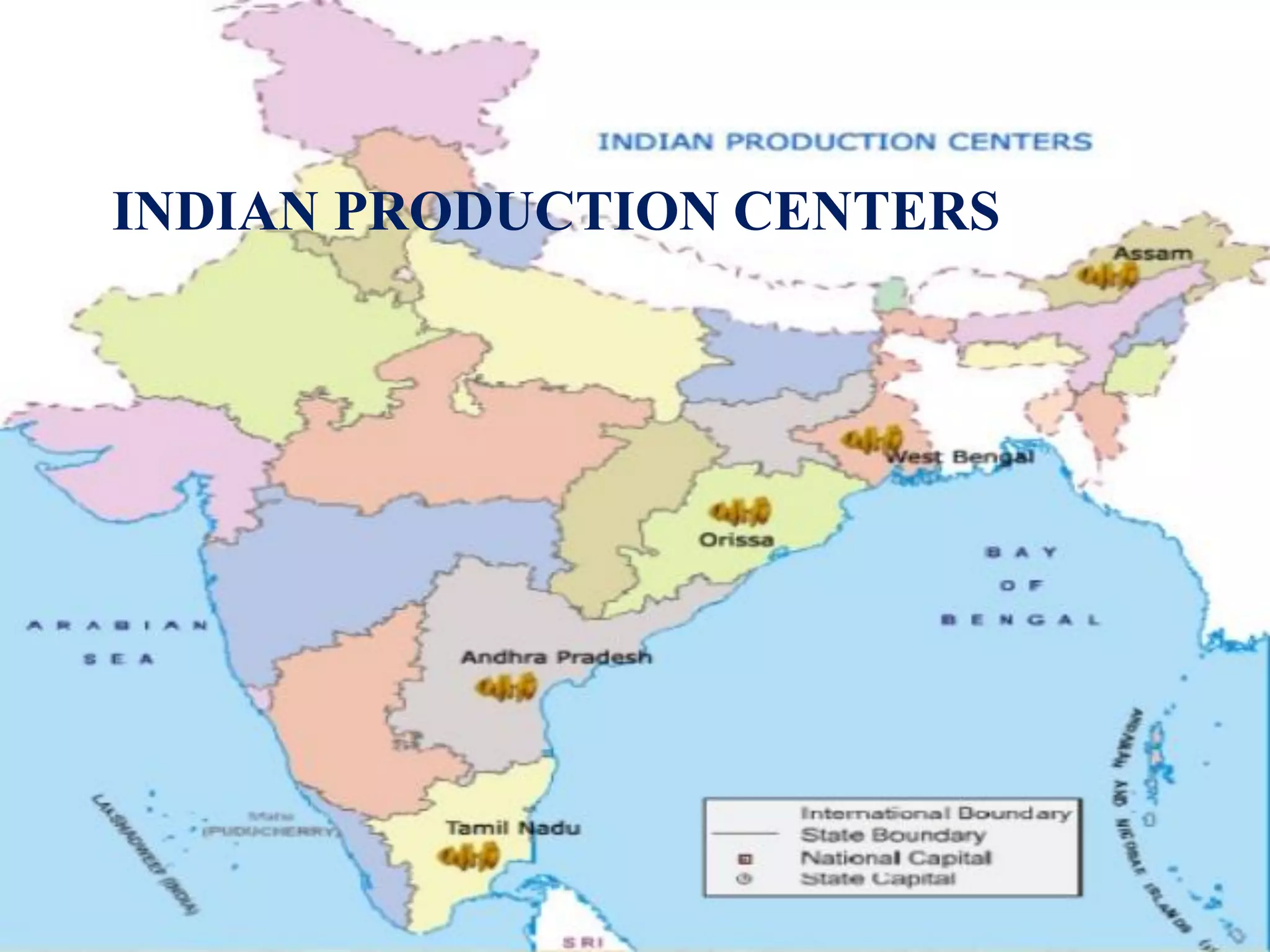
INDIAN PRODUCTION CENTERS
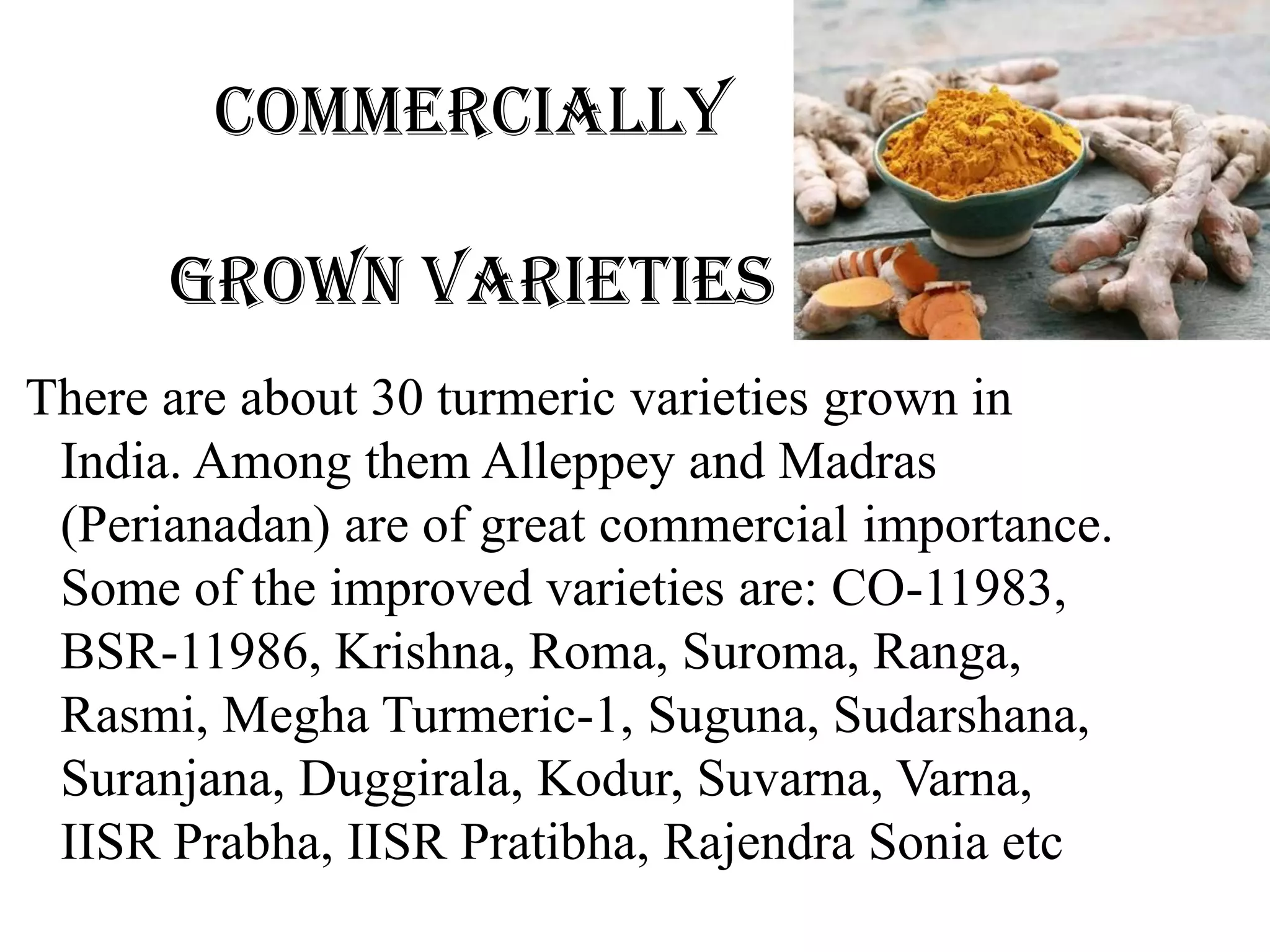
Commercially
grown varieties
There are about 30 turmeric varieties grown in
India. Among them Alleppey and Madras
(Perianadan) are of great commercial importance.
Some of the improved varieties are: CO-11983,
BSR-11986, Krishna, Roma, Suroma, Ranga,
Rasmi, Megha Turmeric-1, Suguna, Sudarshana,
Suranjana, Duggirala, Kodur, Suvarna, Varna,
IISR Prabha, IISR Pratibha, Rajendra Sonia etc
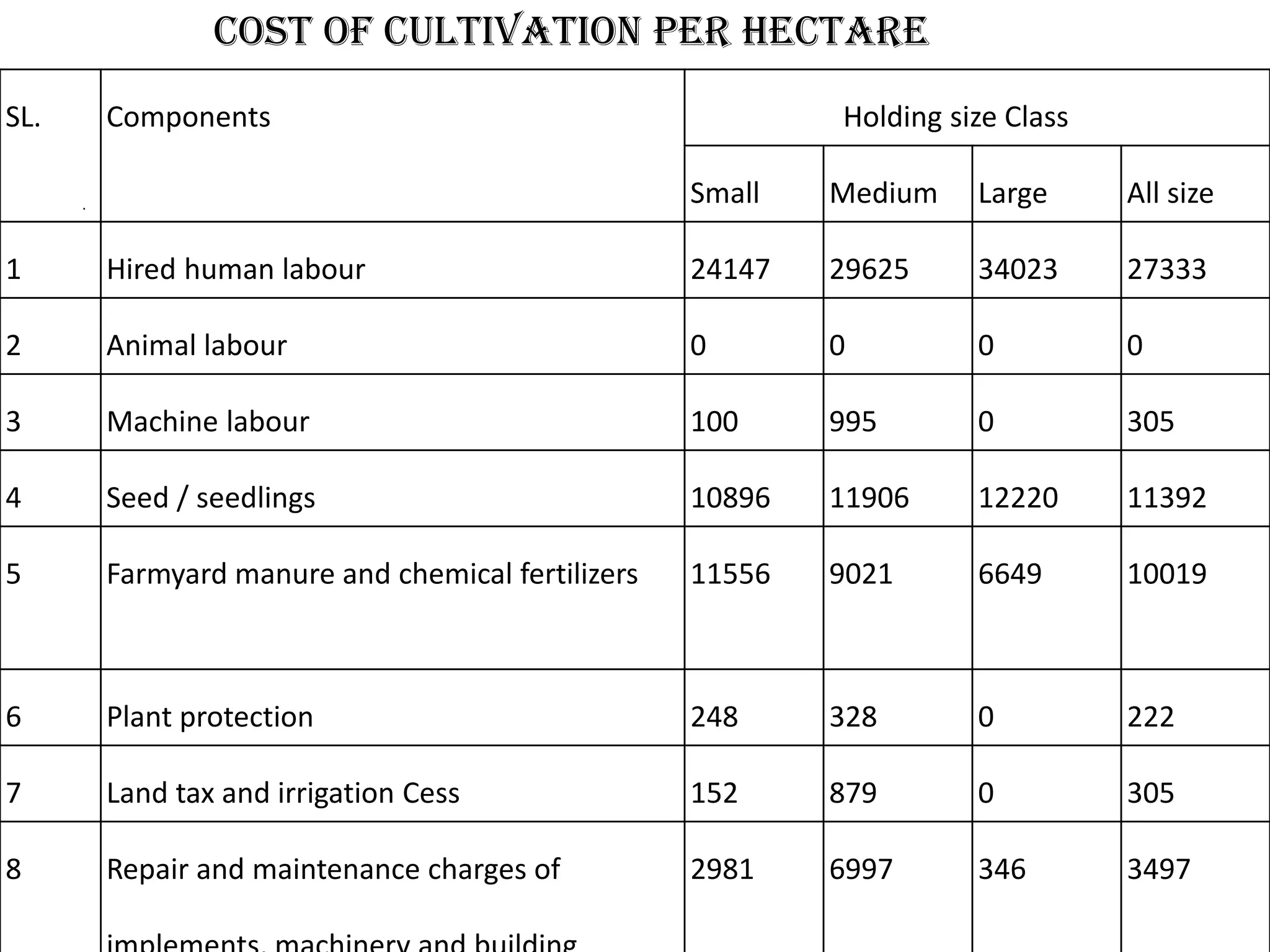
COST OF CULTIVATION per hectare
.
SL. Components Holding size Class
Small Medium Large All size
1 Hired human labour 24147 29625 34023 27333
2 Animal labour 0 0 0 0
3 Machine labour 100 995 0 305
4 Seed / seedlings 10896 11906 12220 11392
5 Farmyard manure and chemical fertilizers 11556 9021 6649 10019
6 Plant protection 248 328 0 222
7 Land tax and irrigation Cess 152 879 0 305
8 Repair and maintenance charges of 2981 6997 346 3497
.
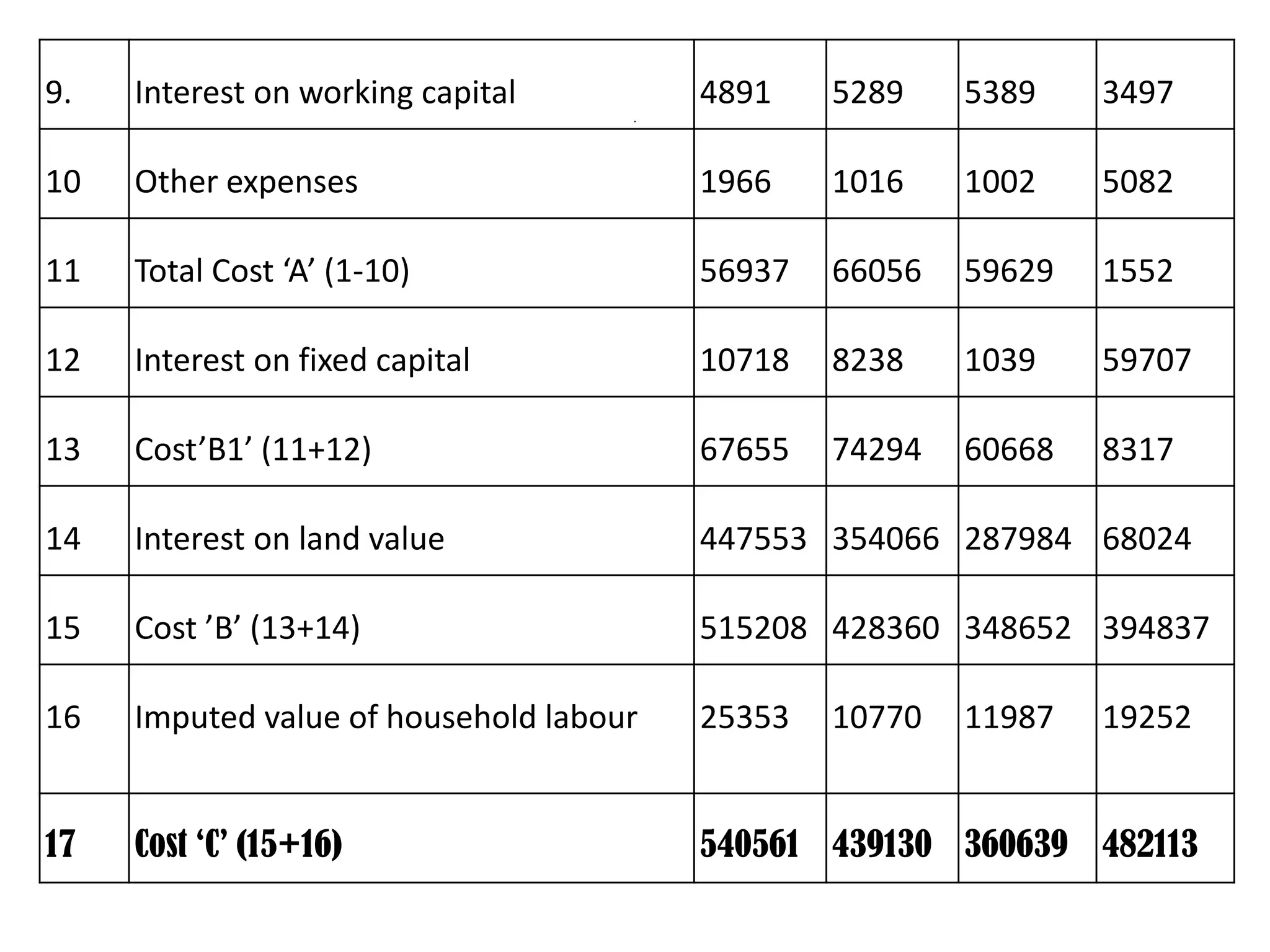
9. Interest on working capital 4891 5289 5389 3497
10 Other expenses 1966 1016 1002 5082
11 Total Cost ‘A’ (1-10) 56937 66056 59629 1552
12 Interest on fixed capital 10718 8238 1039 59707
13 Cost’B1’ (11+12) 67655 74294 60668 8317
14 Interest on land value 447553 354066 287984 68024
15 Cost ’B’ (13+14) 515208 428360 348652 394837
16 Imputed value of household labour 25353 10770 11987 19252
17 Cost ‘C’ (15+16) 540561 439130 360639 482113
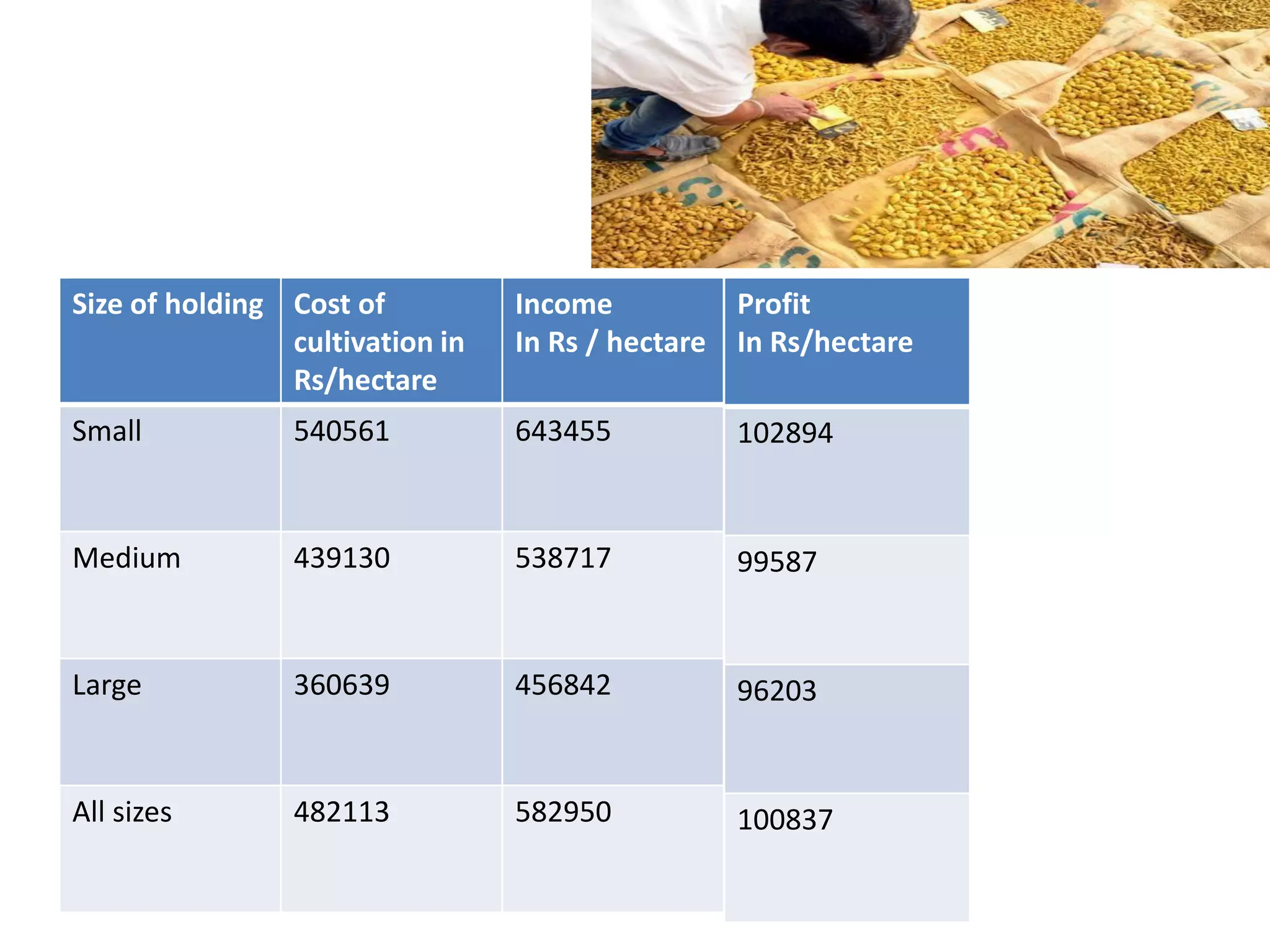
Size of holding Cost of
cultivation in
Rs/hectare
Income
In Rs / hectare
Small 540561 643455
Medium 439130 538717
Large 360639 456842
All sizes 482113 582950
Profit
In Rs/hectare
102894
99587
96203
100837
Cultivation of turmeric in
India
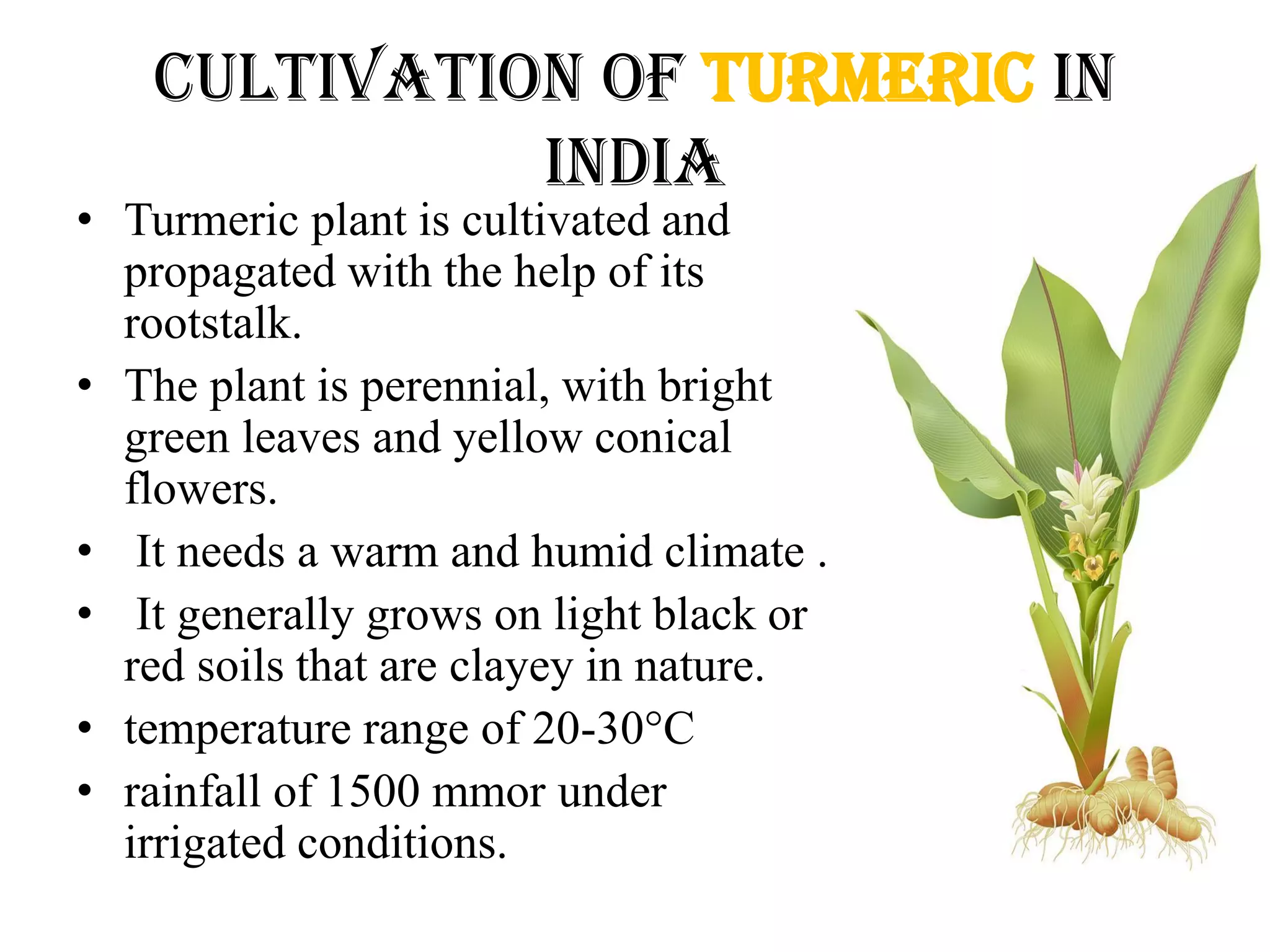
• Turmeric plant is cultivated and
propagated with the help of its
rootstalk.
• The plant is perennial, with bright
green leaves and yellow conical
flowers.
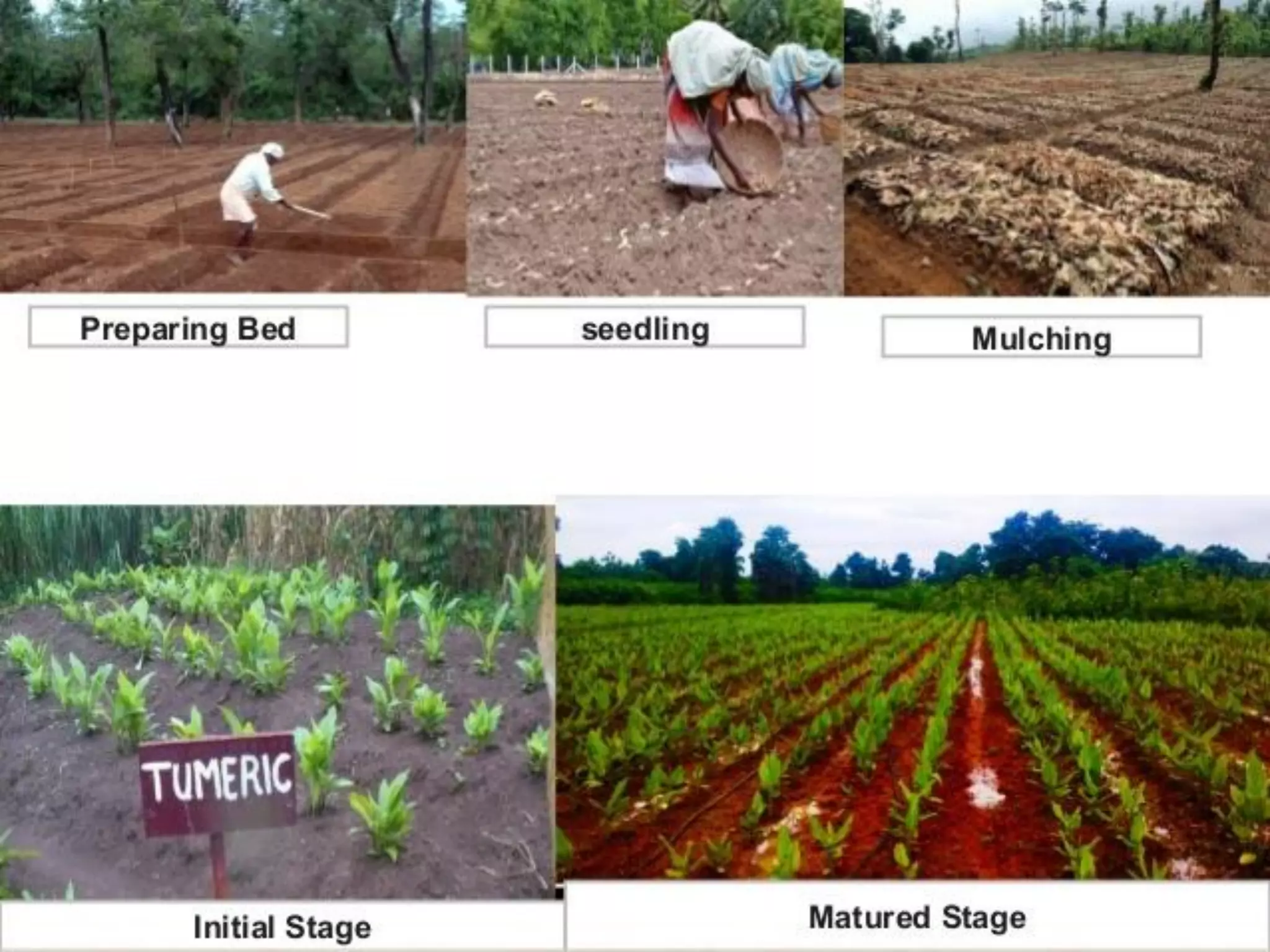
• It needs a warm and humid climate .
• It generally grows on light black or
red soils that are clayey in nature.
• temperature range of 20-30°C
• rainfall of 1500 mmor under
irrigated conditions.
Chain of events (pack house
up to shipment)
.
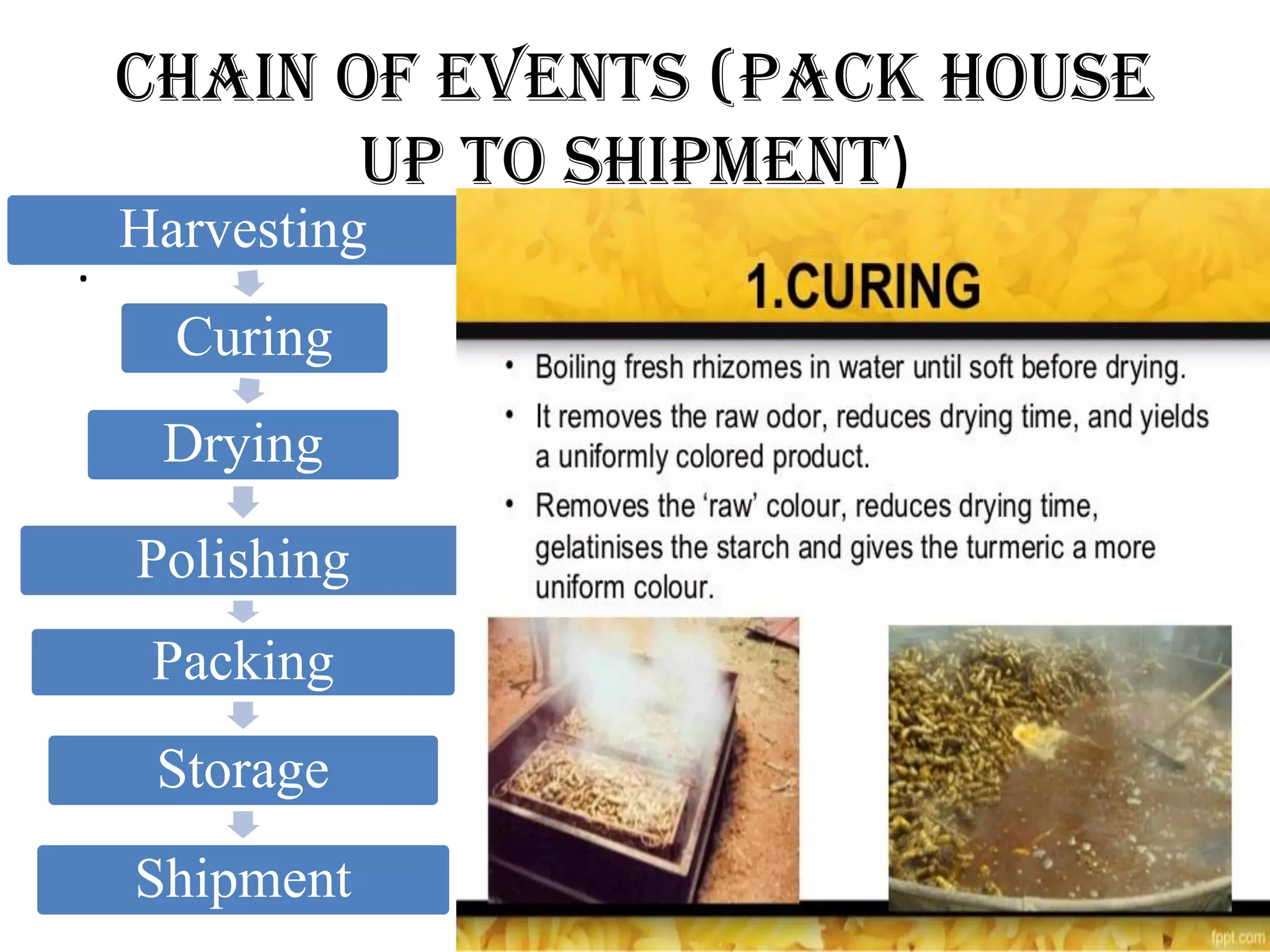
Harvesting
Curing
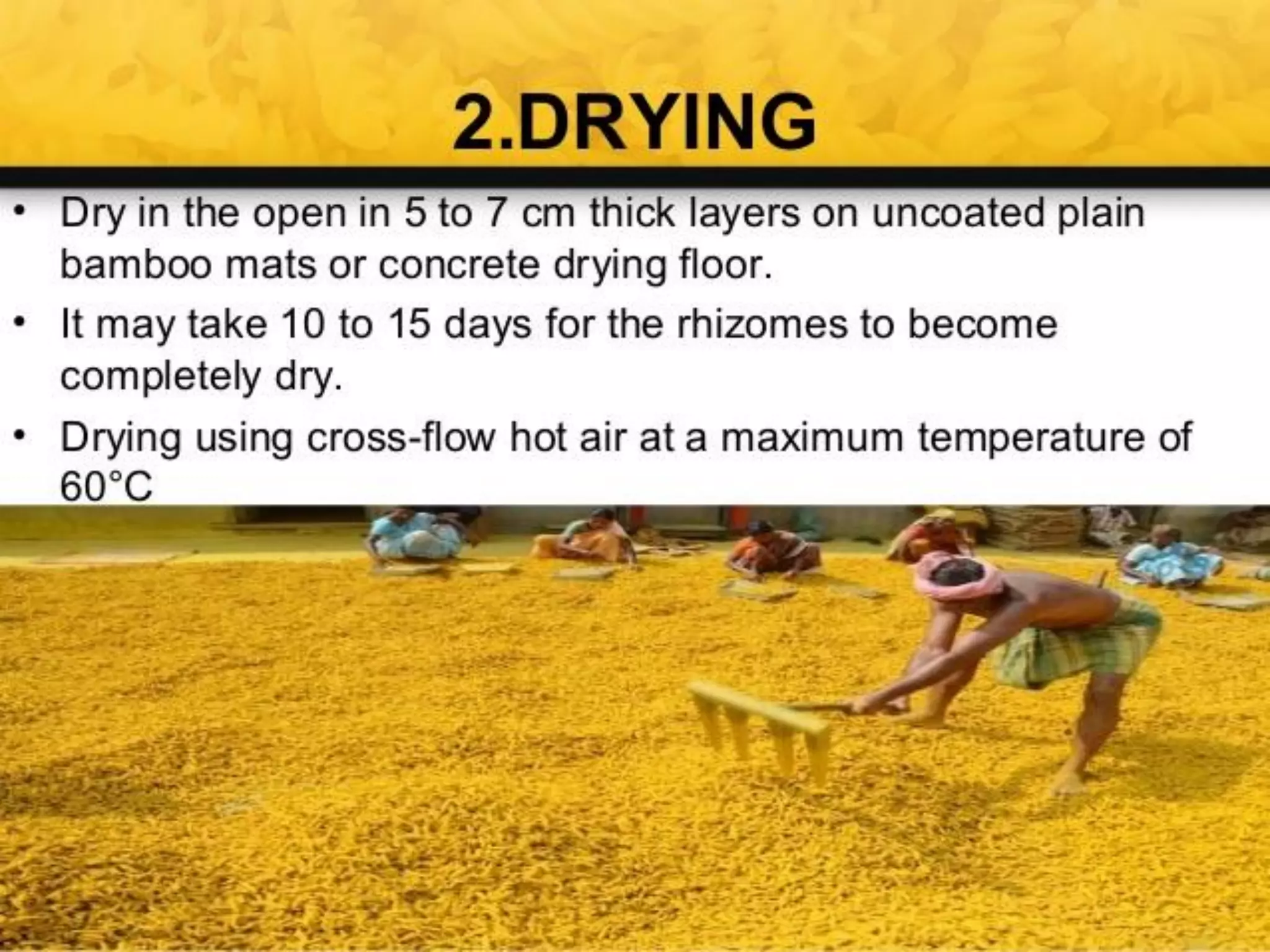
Drying
Polishing
Packing
Storage
Shipment
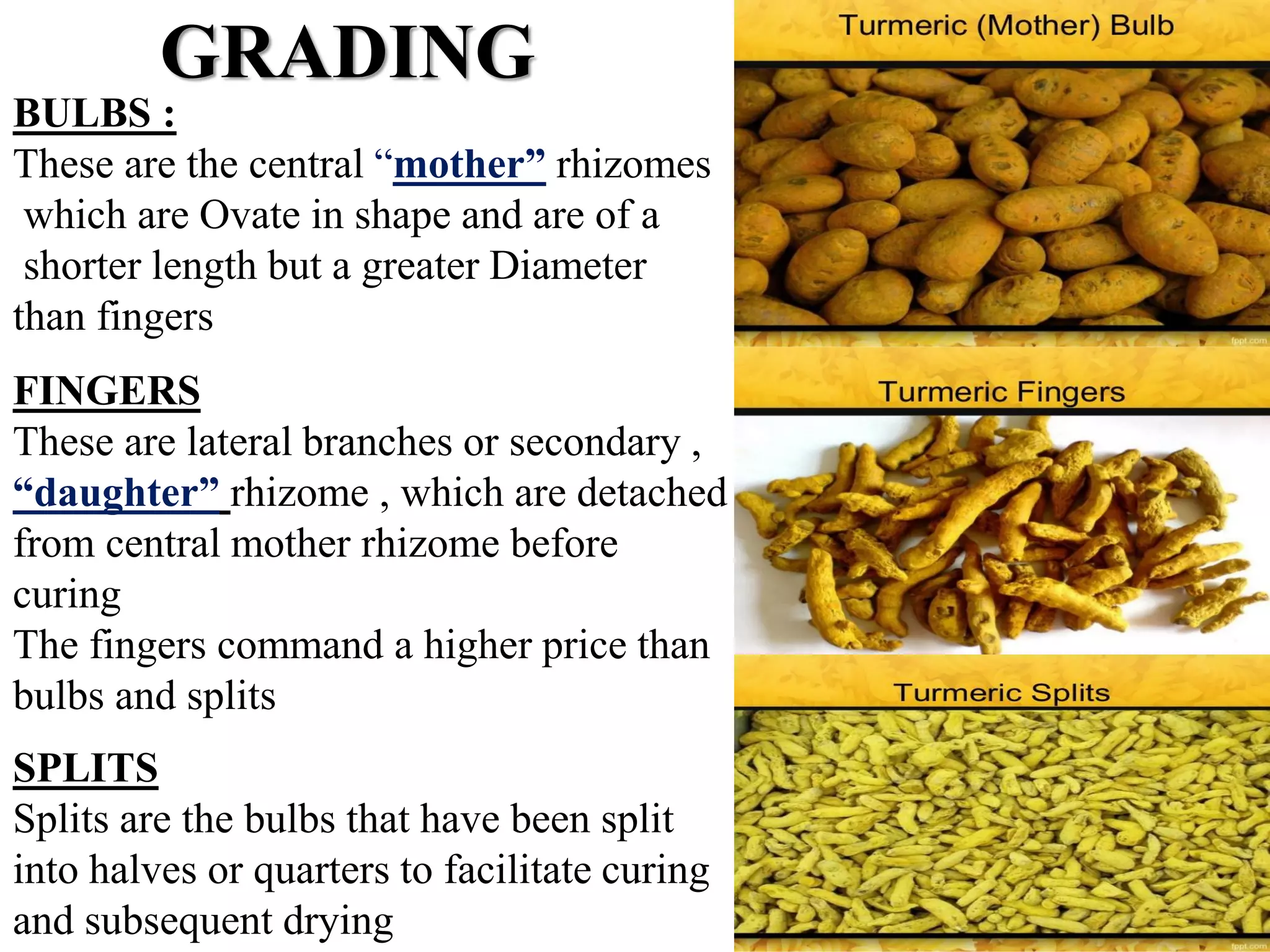
GRADING
BULBS :
These are the central “mother” rhizomes
which are Ovate in shape and are of a
shorter length but a greater Diameter
than fingers
FINGERS
These are lateral branches or secondary ,
“daughter” rhizome , which are detached
from central mother rhizome before
curing
The fingers command a higher price than
bulbs and splits
SPLITS
Splits are the bulbs that have been split
into halves or quarters to facilitate curing
and subsequent drying
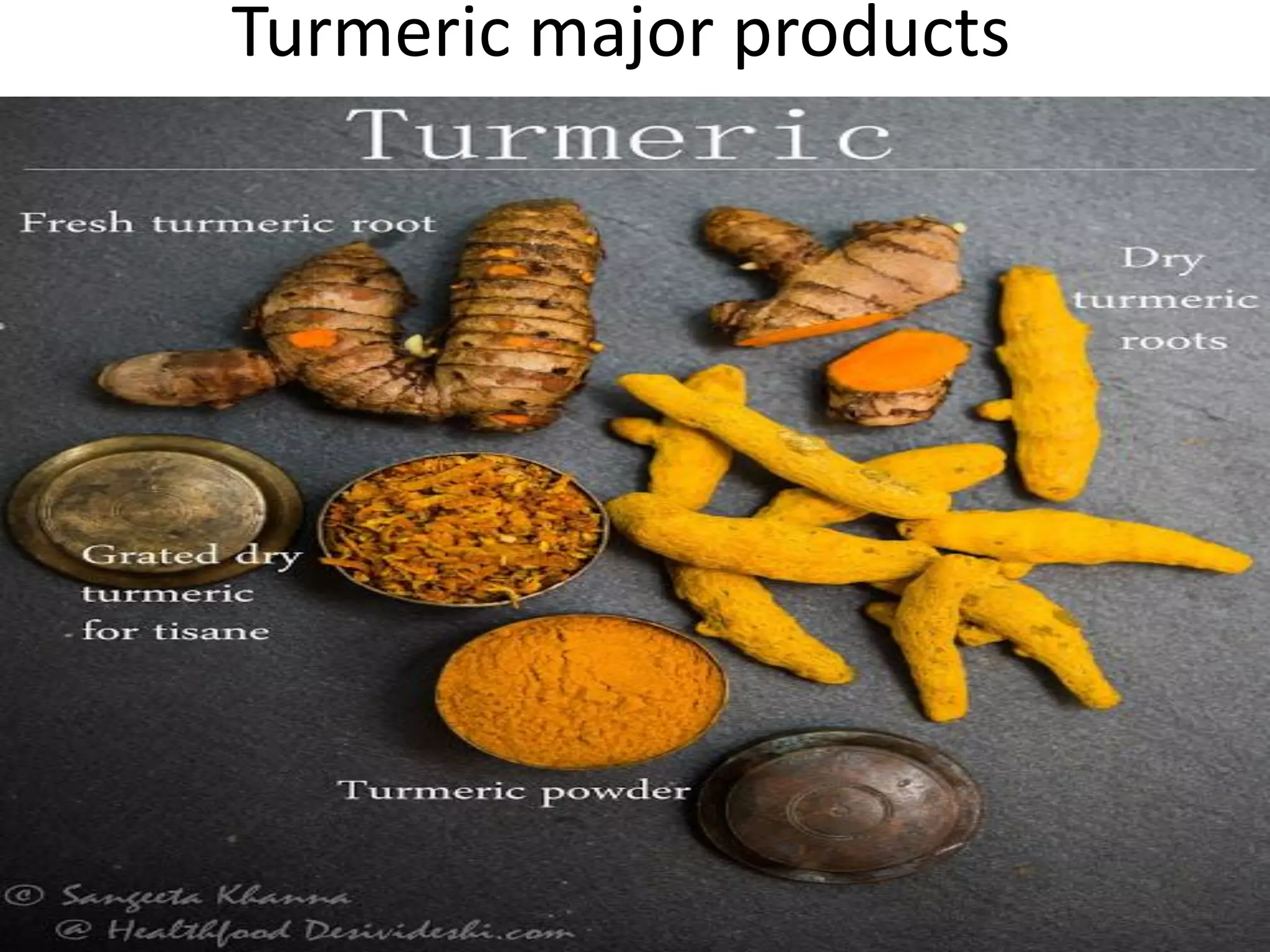
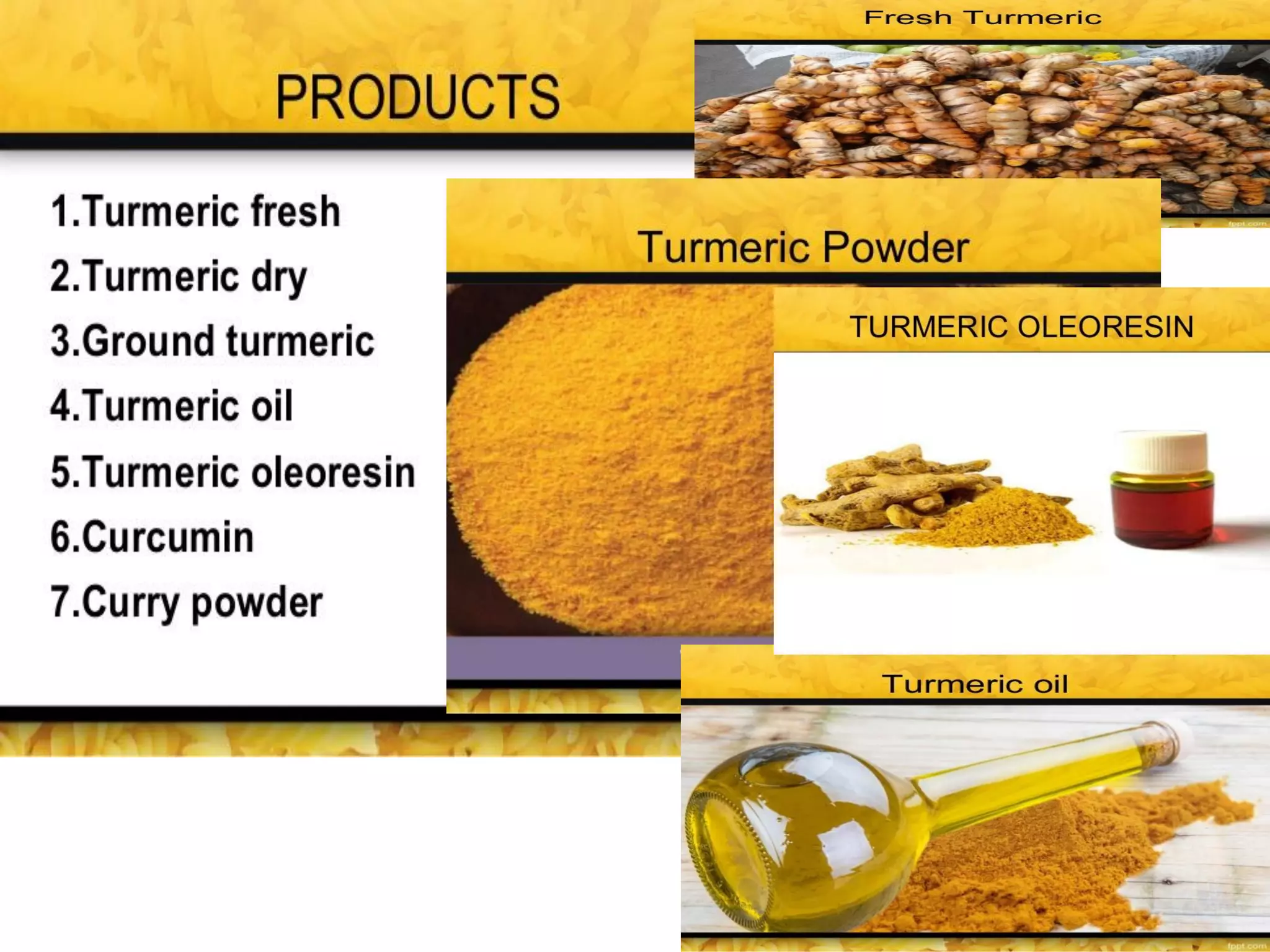
Turmeric major products
PACKAGING
• Dried rhizome and rhizome pieces are packed
in jute sacks , wooden boxes or lined
corrugated cardboard boxes for shipping
• Ground turmeric should be packed in moisture
proof , air tight polyethylene packages should
be sealed and labelled with attractive labels.
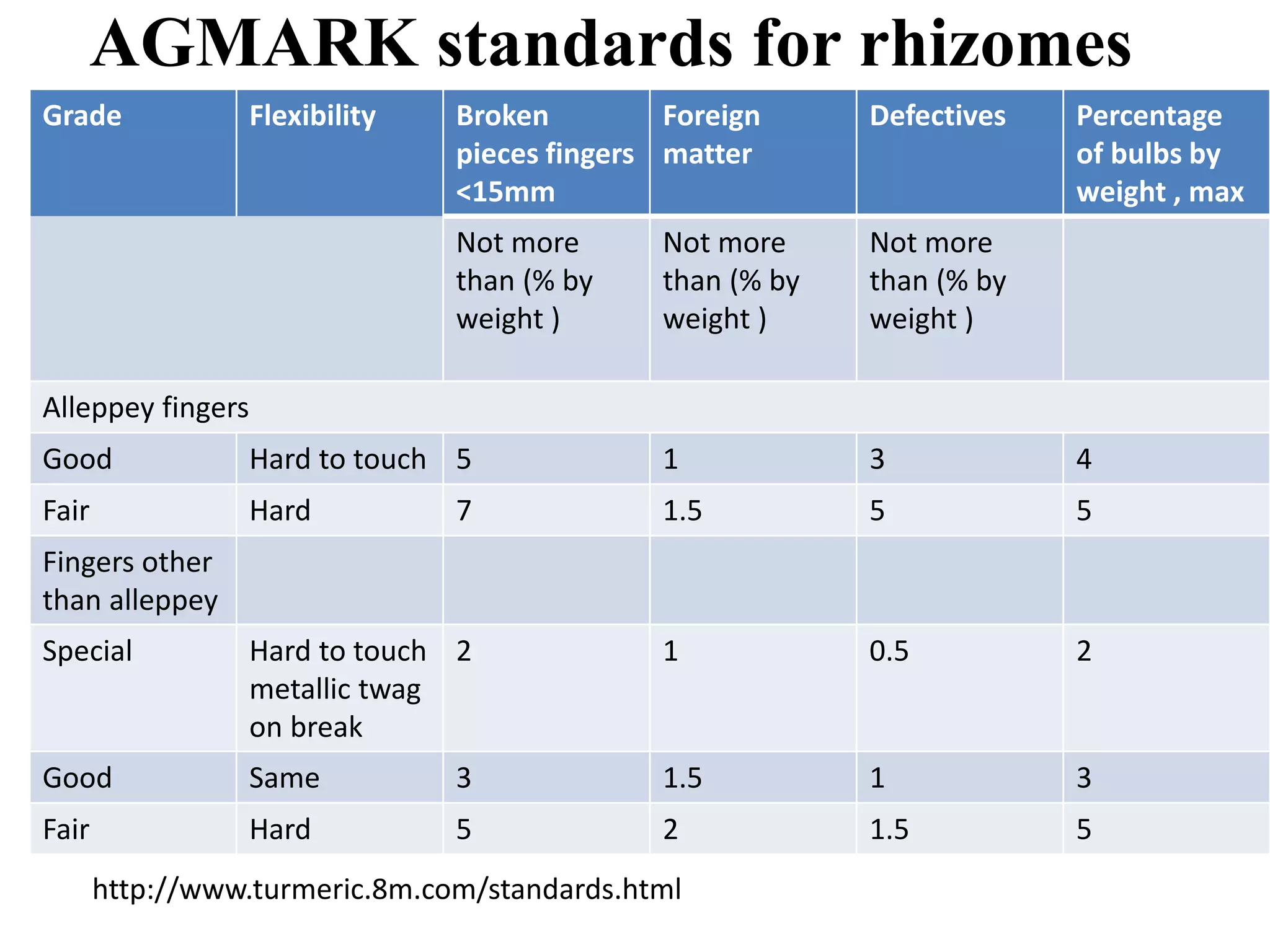
AGMARK standards for rhizomes
Grade Flexibility Broken
pieces fingers
<15mm
Foreign
matter
Defectives Percentage
of bulbs by
weight , max
Not more
than (% by
weight )
Not more
than (% by
weight )
Not more
than (% by
weight )
Alleppey fingers
Good Hard to touch 5 1 3 4
Fair Hard 7 1.5 5 5
Fingers other
than alleppey
Special Hard to touch
metallic twag
on break
2 1 0.5 2
Good Same 3 1.5 1 3
Fair Hard 5 2 1.5 5
http://www.turmeric.8m.com/standards.html
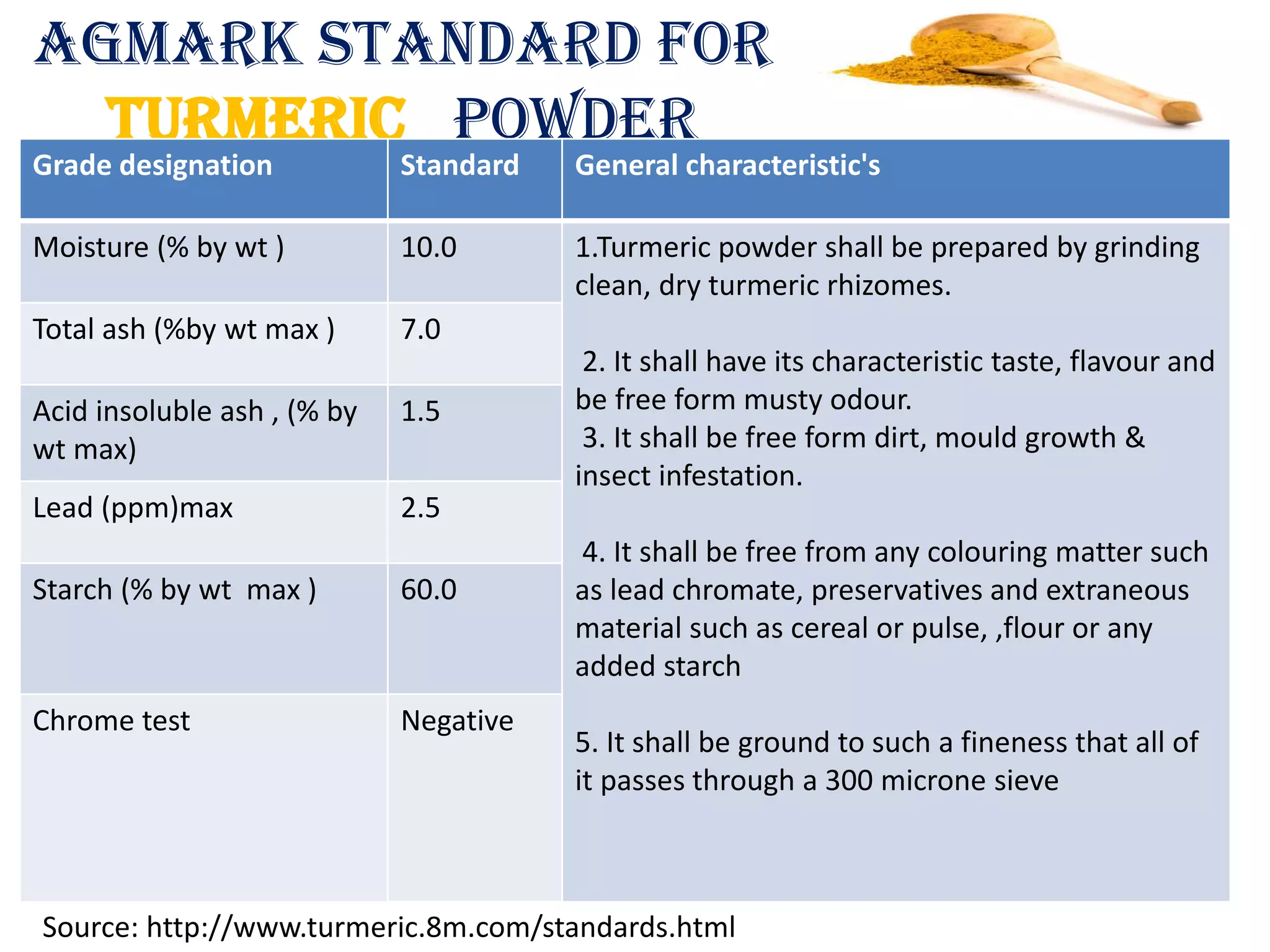
Agmark standard for
turmeriC powder
Grade designation Standard General characteristic's
Moisture (% by wt ) 10.0 1.Turmeric powder shall be prepared by grinding
clean, dry turmeric rhizomes.
2. It shall have its characteristic taste, flavour and
be free form musty odour.
3. It shall be free form dirt, mould growth &
insect infestation.
4. It shall be free from any colouring matter such
as lead chromate, preservatives and extraneous
material such as cereal or pulse, ,flour or any
added starch
5. It shall be ground to such a fineness that all of
it passes through a 300 microne sieve
Total ash (%by wt max ) 7.0
Acid insoluble ash , (% by
wt max)
1.5
Lead (ppm)max 2.5
Starch (% by wt max ) 60.0
Chrome test Negative
Source: http://www.turmeric.8m.com/standards.html
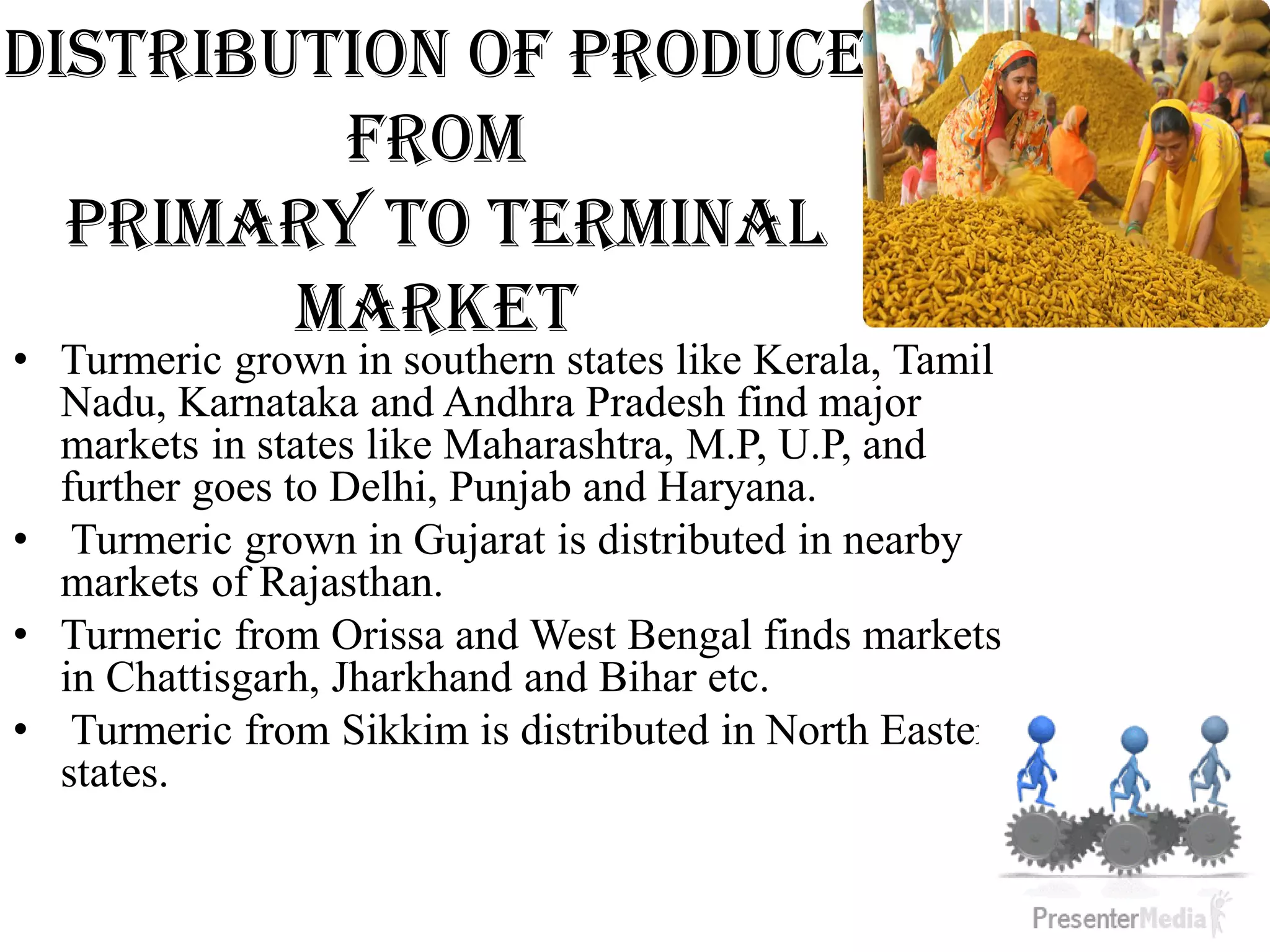
Distribution of produce
from
primary to terminal
market
• Turmeric grown in southern states like Kerala, Tamil
Nadu, Karnataka and Andhra Pradesh find major
markets in states like Maharashtra, M.P, U.P, and
further goes to Delhi, Punjab and Haryana.
• Turmeric grown in Gujarat is distributed in nearby
markets of Rajasthan.
• Turmeric from Orissa and West Bengal finds markets
in Chattisgarh, Jharkhand and Bihar etc.
• Turmeric from Sikkim is distributed in North Eastern
states.
Export
• India has monopoly in turmeric trade at world
level. Although India is the largest producer of
turmeric in the world (846700 tons) but it
exported only 6% of the total production.
India, exported 51500 tons of turmeric during
2006-07. This is substantial compared to
37,644 tons during 2003-04.
Export of turmeric from India
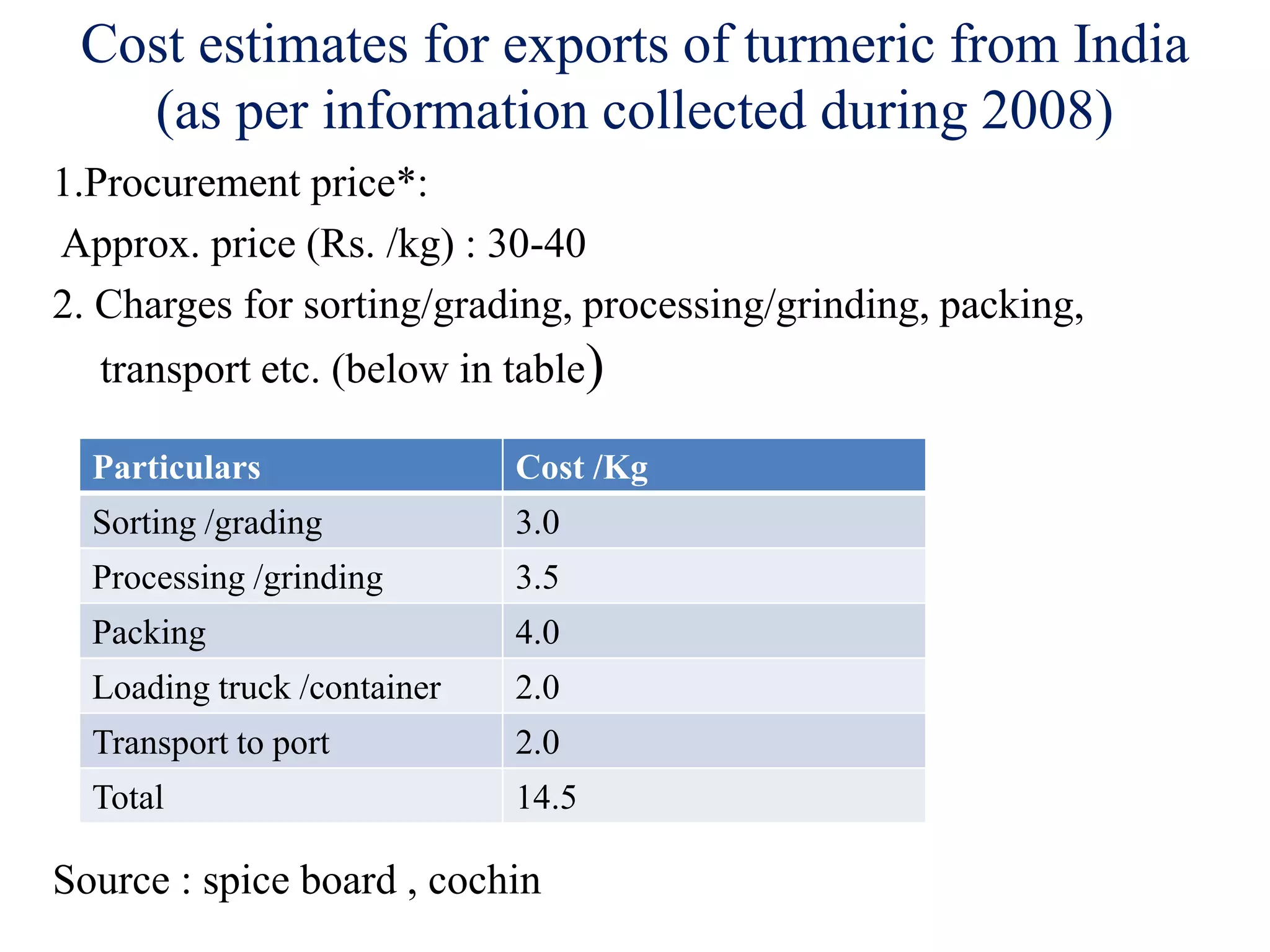
Cost estimates for exports of turmeric from India
(as per information collected during 2008)
1.Procurement price*:
Approx. price (Rs. /kg) : 30-40
2. Charges for sorting/grading, processing/grinding, packing,
transport etc. (below in table)
Source : spice board , cochin
Particulars Cost /Kg
Sorting /grading 3.0
Processing /grinding 3.5
Packing 4.0
Loading truck /container 2.0
Transport to port 2.0
Total 14.5
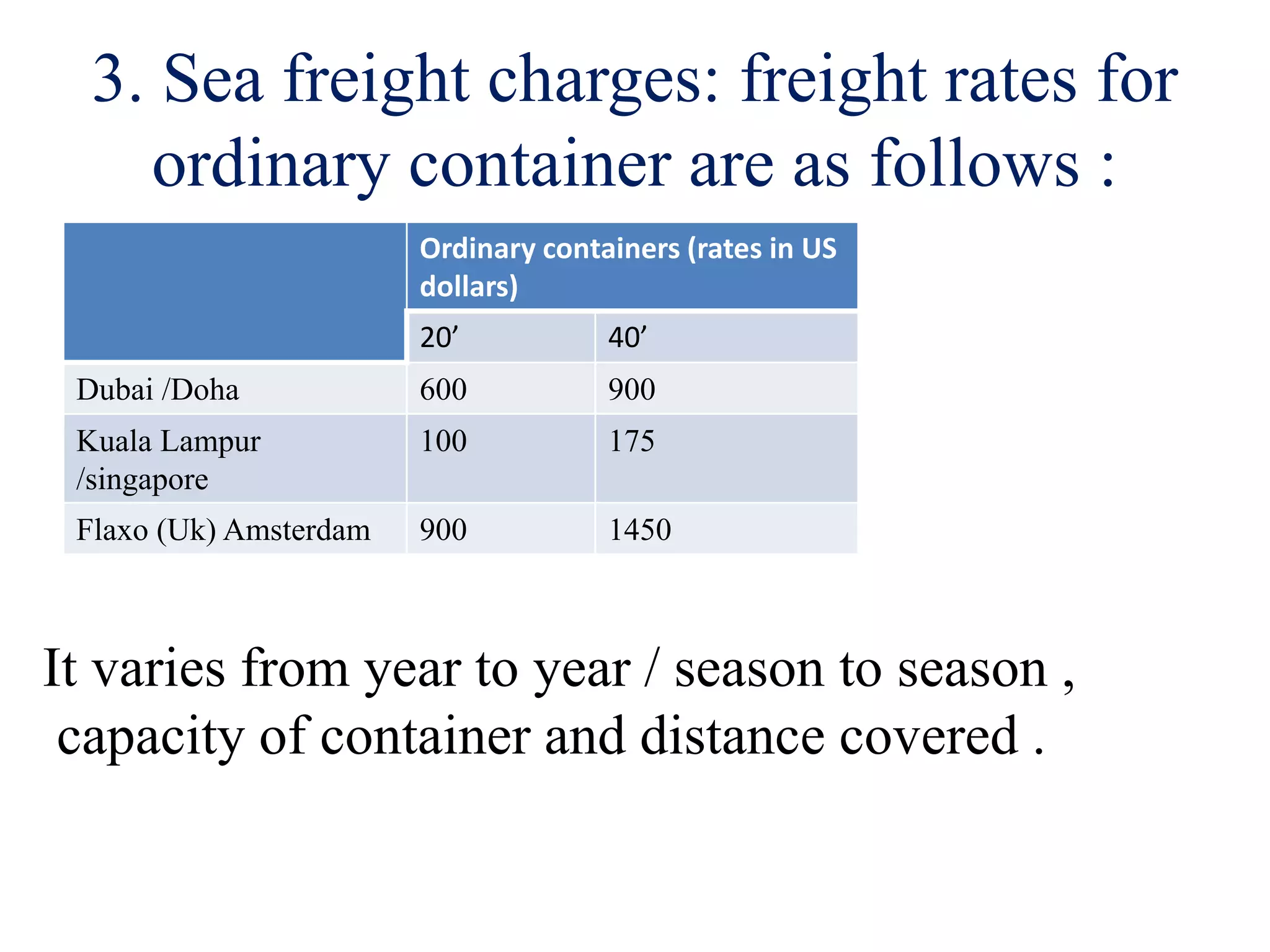
3. Sea freight charges: freight rates for
ordinary container are as follows :
Ordinary containers (rates in US
dollars)
20’ 40’
Dubai /Doha 600 900
Kuala Lampur
/singapore
100 175
Flaxo (Uk) Amsterdam 900 1450
It varies from year to year / season to season ,
capacity of container and distance covered .
Measures for enhancing
competitiveness in exports
• It has to maintain its position with
other future competitors like Indonesia,
China, etc.
• India must enhance its product quality,
cleanliness of fingers, etc..
• India must also improve total
productivity
• area under high yielding cultivars
needs to be increased by supplying
micro tubers multiplied through tissue
culture.
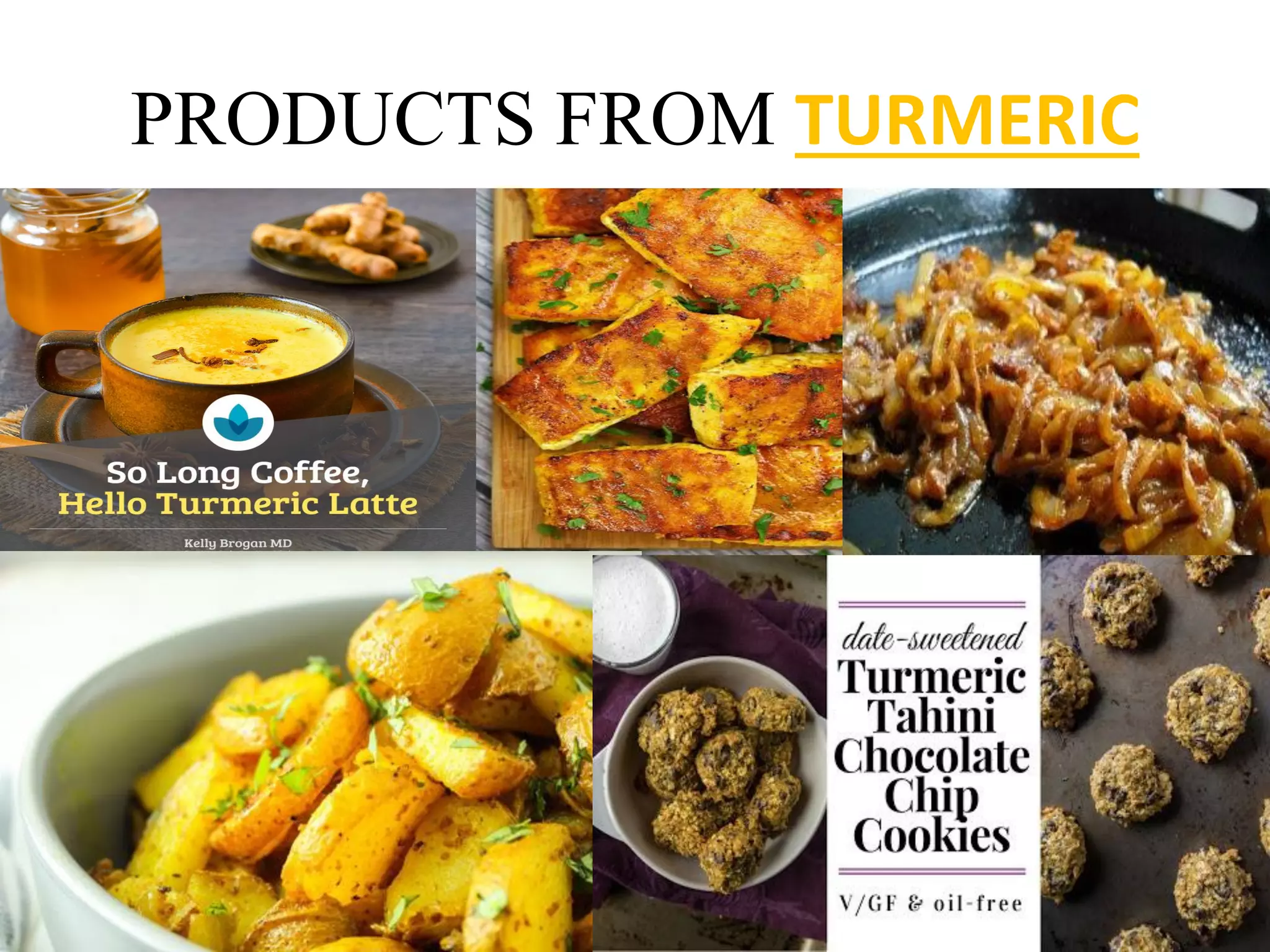
PRODUCTS FROM TURMERIC
TURMERIC IN BAKERY
PRODUCTS
• Today foods are not intended to only satisfy
hunger and to provide necessary nutrients for
humans but, also to prevent nutrition-related
diseases and improve physical and mental well-
being of the consumers.
• In this regard, functional foods play an
outstanding role. Therefore the studies are
designed to examine the effect of addition of
some plant sources as a source of active healthy
components to prepare functional prebiotic
bakery products.
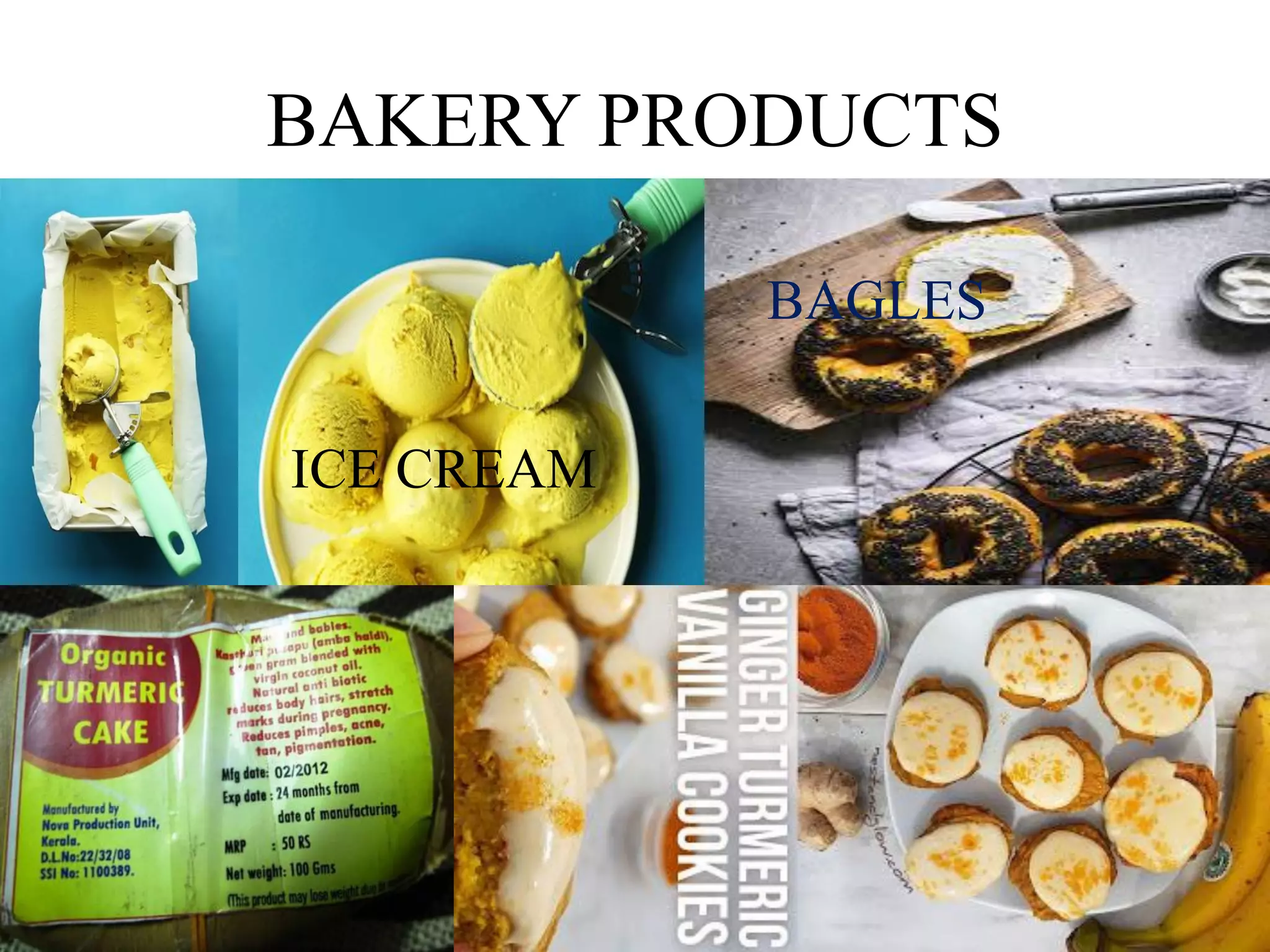
BAKERY PRODUCTS
BAGLES
ICE CREAM
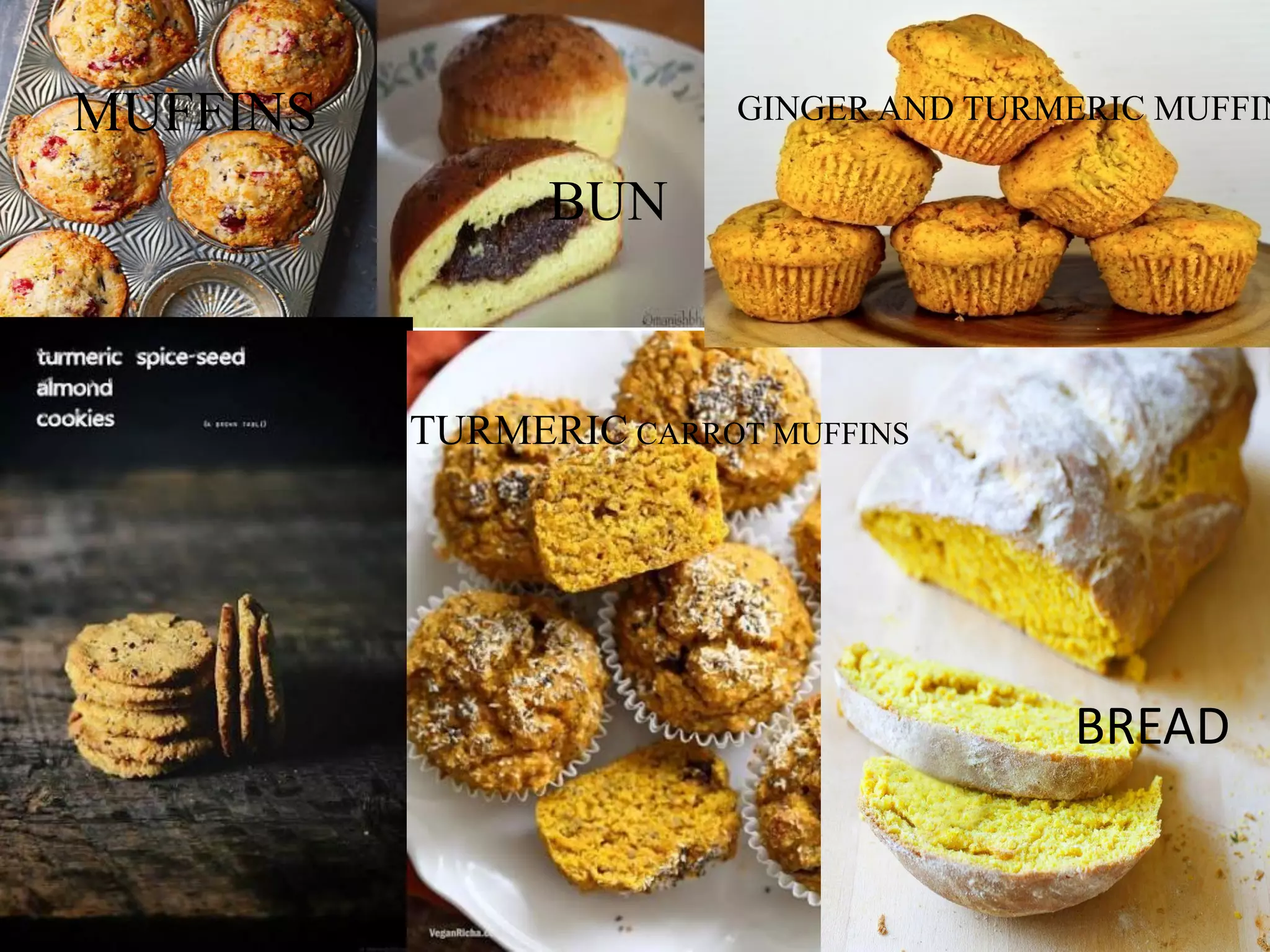
BREAD
GINGER AND TURMERIC MUFFIN
BUN
MUFFINS
TURMERIC CARROT MUFFINS
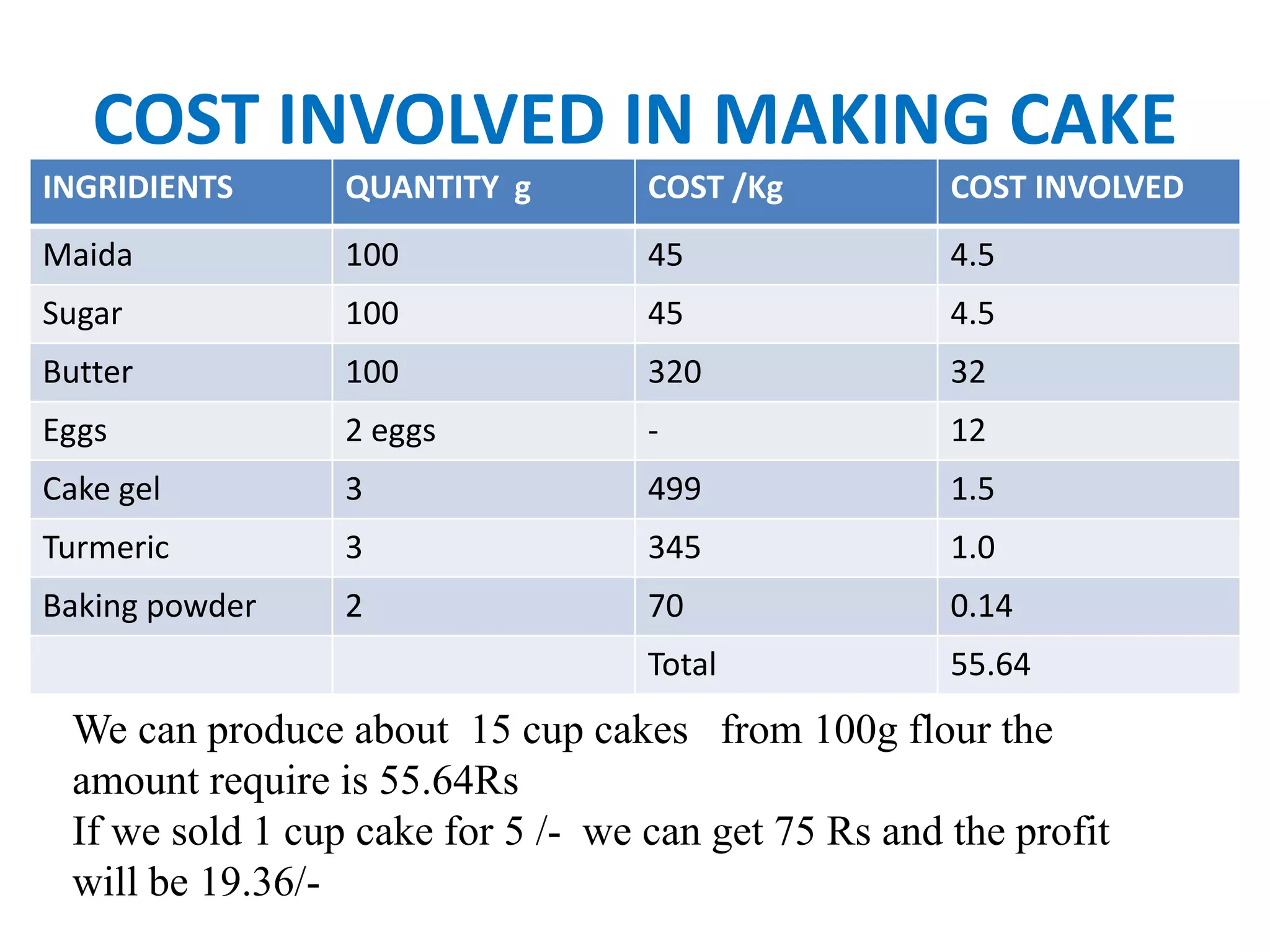
COST INVOLVED IN MAKING CAKE
INGRIDIENTS QUANTITY g COST /Kg COST INVOLVED
Maida 100 45 4.5
Sugar 100 45 4.5
Butter 100 320 32
Eggs 2 eggs - 12
Cake gel 3 499 1.5
Turmeric 3 345 1.0
Baking powder 2 70 0.14
Total 55.64
We can produce about 15 cup cakes from 100g flour the
amount require is 55.64Rs
If we sold 1 cup cake for 5 /- we can get 75 Rs and the profit
will be 19.36/-
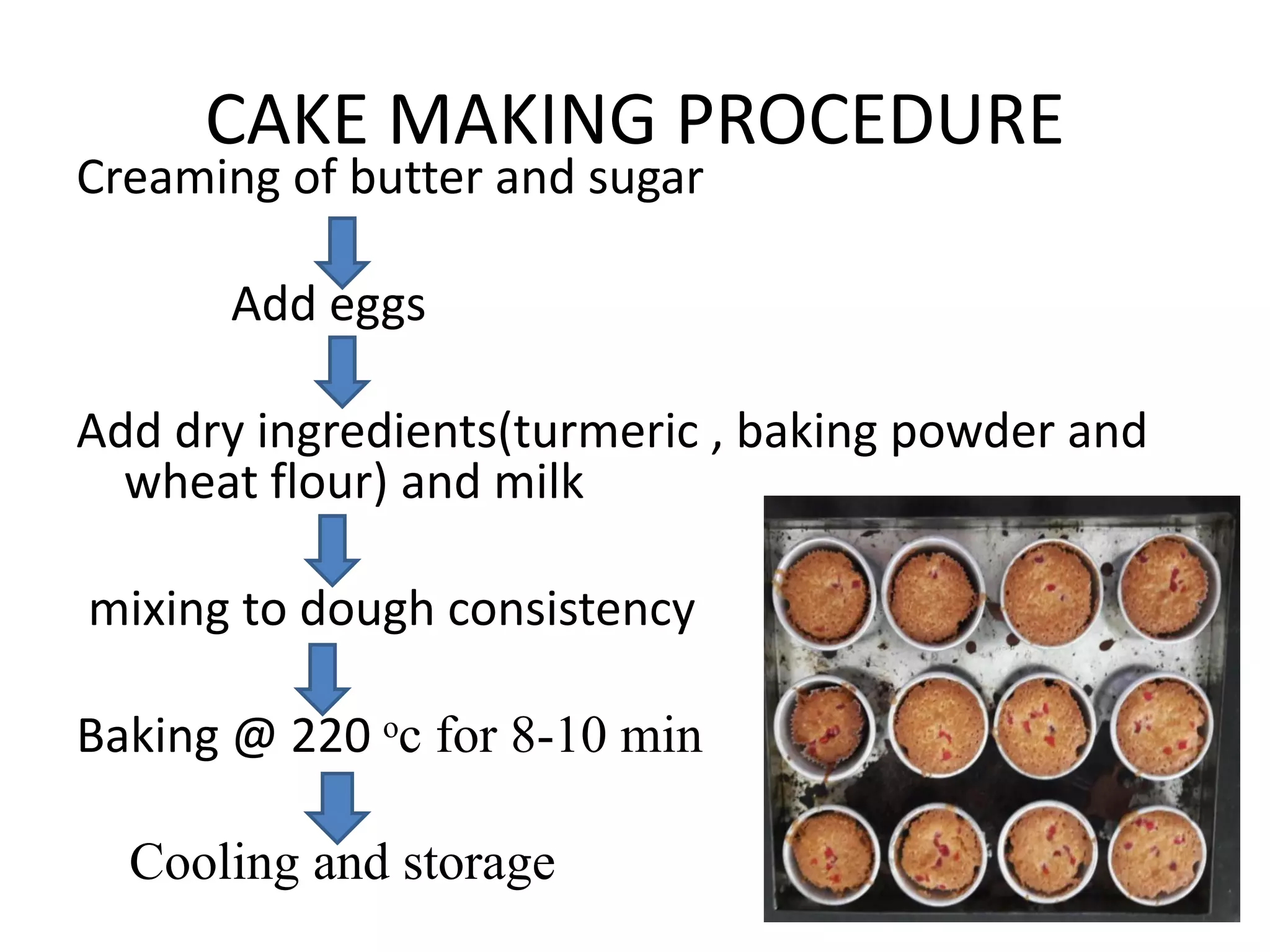
CAKE MAKING PROCEDURE
Creaming of butter and sugar
Add eggs
Add dry ingredients(turmeric , baking powder and
wheat flour) and milk
mixing to dough consistency
Baking @ 220 ᵒc for 8-10 min
Cooling and storage
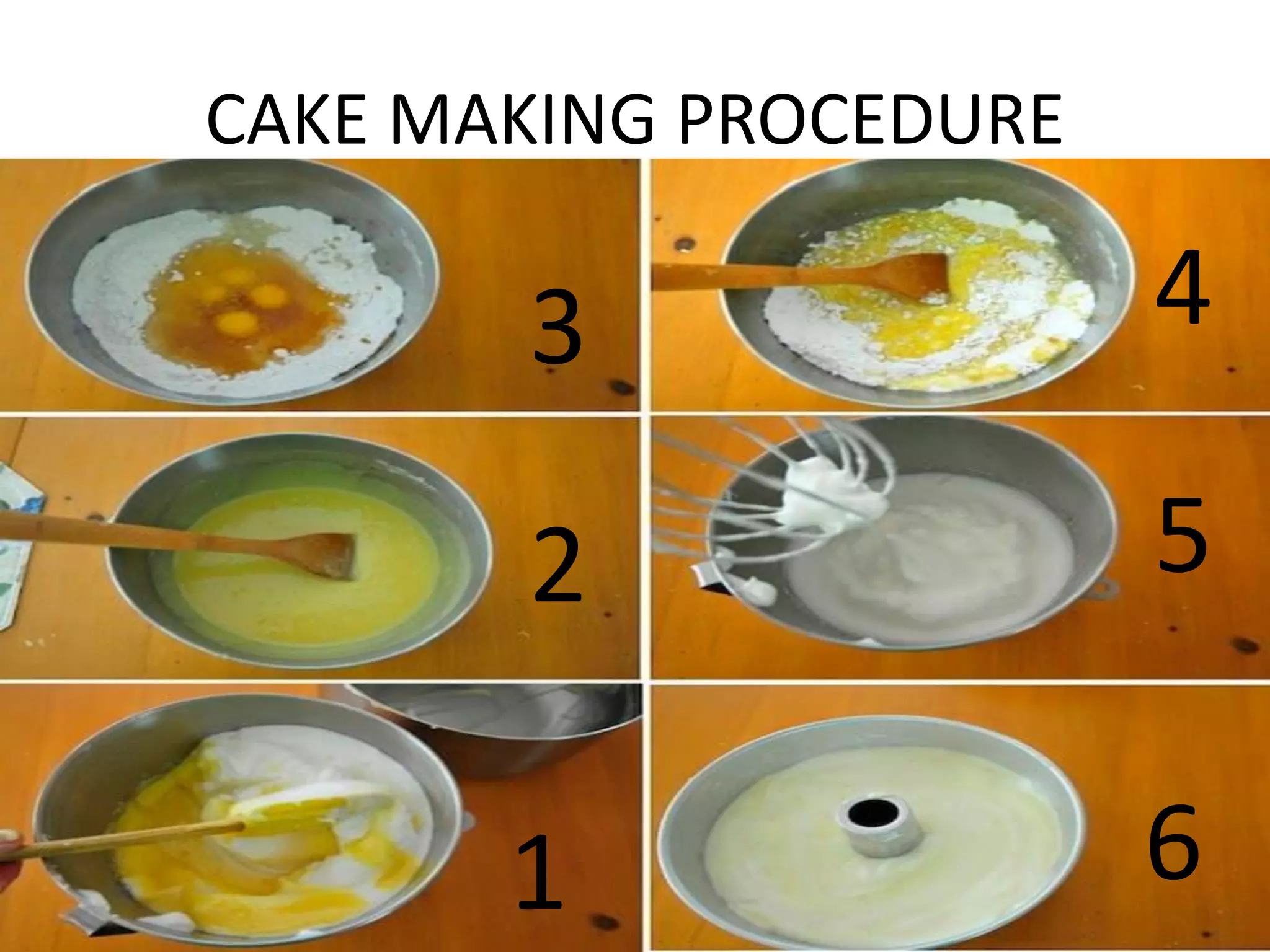
CAKE MAKING PROCEDURE
1
2
3 4
5
6
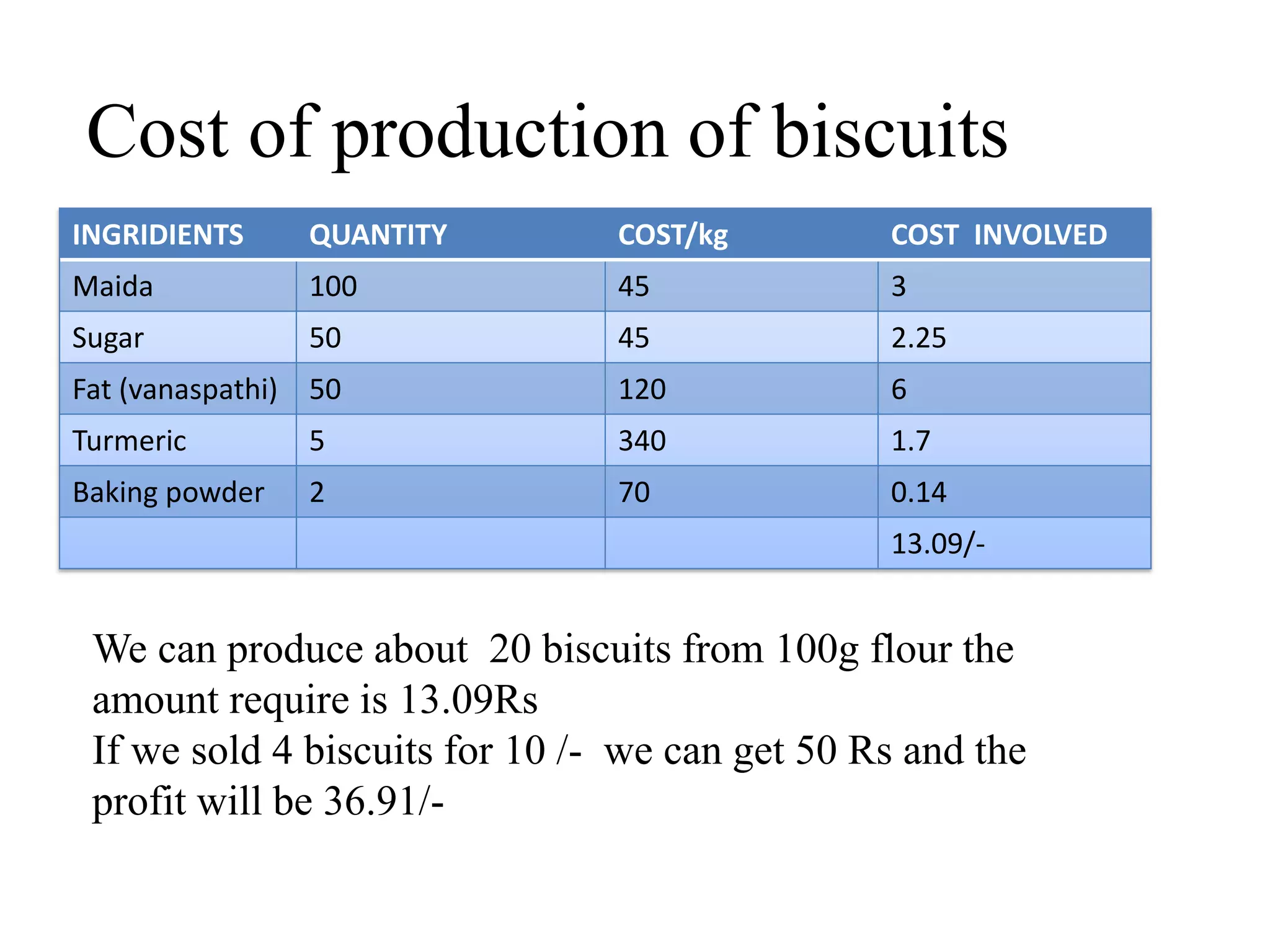
Cost of production of biscuits
INGRIDIENTS QUANTITY COST/kg COST INVOLVED
Maida 100 45 3
Sugar 50 45 2.25
Fat (vanaspathi) 50 120 6
Turmeric 5 340 1.7
Baking powder 2 70 0.14
13.09/-
We can produce about 20 biscuits from 100g flour the
amount require is 13.09Rs
If we sold 4 biscuits for 10 /- we can get 50 Rs and the
profit will be 36.91/-
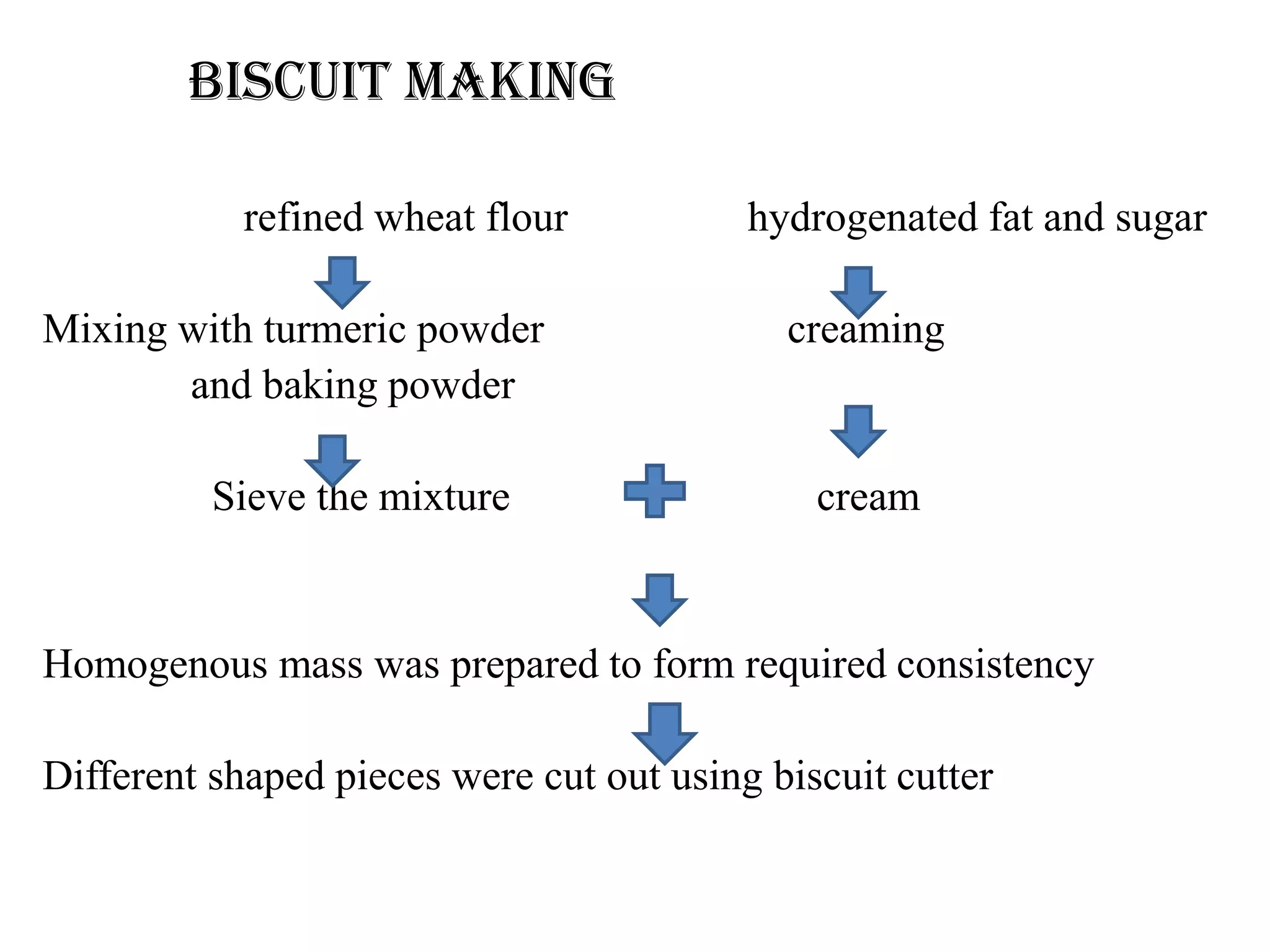
BISCUIT MAKING
refined wheat flour hydrogenated fat and sugar
Mixing with turmeric powder creaming
and baking powder
Sieve the mixture cream
Homogenous mass was prepared to form required consistency
Different shaped pieces were cut out using biscuit cutter
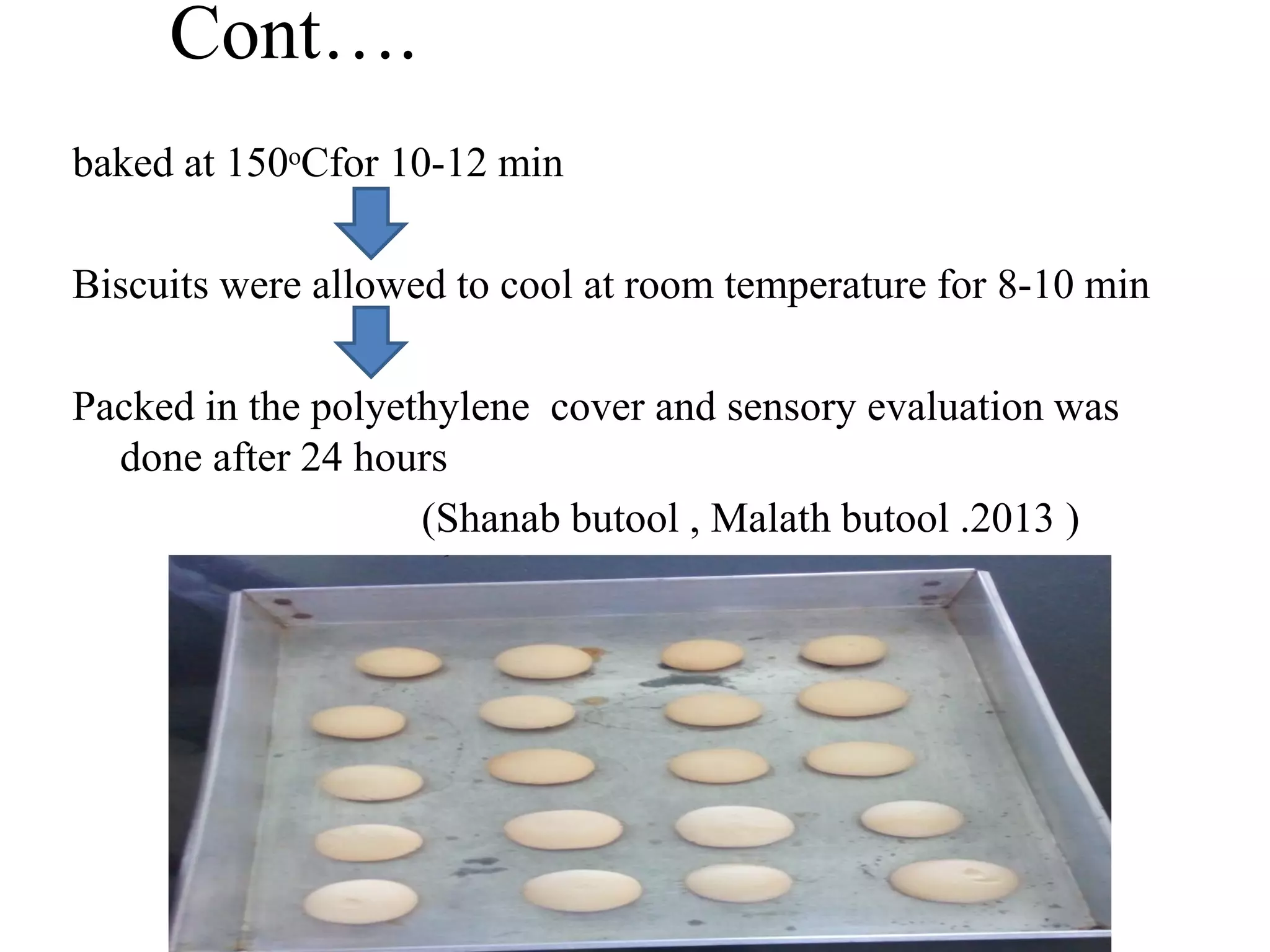
Cont….
baked at 150ᵒCfor 10-12 min
Biscuits were allowed to cool at room temperature for 8-10 min
Packed in the polyethylene cover and sensory evaluation was
done after 24 hours
(Shanab butool , Malath butool .2013 )
Novel products from turmeric
• novel cookies prepared by supplementing with fresh turmeric
flower (Curcuma longa L.) extracts as a value added functional
ingredient
• As the consumers (panellists) are more familiar with the taste
of normal cookies (control batch), this might have hindered
them to accept novel cookies prepared using turmeric flower
extracts.
• Overall, all the formulated cookies were found to be devoid of
any microbial contamination.
• Results generated from this study is envisaged to not only
popularize turmeric flowers as an value added functional food
ingredient in cookies or other bakery based products, but is
also expected to provide a valuable market for formulating
healthy cookies using other flower extracts
ANY
QUESTIONS??????
REFFERENCE
THANK
U....

Turmeric processing and importance in bakery products

  • 1.
  • 2.
  • 3.
    CONTENTS INTRODUCTION HISTORY CULTIVATION REQUIREMENT  NUTRITIONALCOMPOSITION AND BENEFITS NATIONAL AND INTERNATIONAL SCENARIO COMMERCIAL VARITIES COST OF CULTIVATION PHH TURMERIC PRODUCTS AND STANDARDS EXPORT ASPECTS TURMERIC IN BAKERY CONTENTS
  • 4.
    INTRODUCTION  . Indiais the ‘spice bowl’ of the world and according to the Bureau of Indian Standards, 63 spices, including turmeric, are grown in the country  Turmeric the ancient and sacred spice of India known as ‘Indian saffron’ ,”spice of life” and ‘golden spice ‘ • Scientific name :Curcuma longa • Family :Zingiberaceae • Genus :curcuma • Species : C. longa • Class : Liliopsida
  • 5.
    CONT…  . Ithas anti cancer and anti viral activities and hence finds use in the drug industry and cosmetic industry.  'Kum-kum', popular with every house wife, is also a by- product of turmeric.  It finds a place in offerings on religious and ceremonial occasions.  A type of starch is also being extracted from a particular type of turmeric.  The increasing demand for natural products as food additives makes turmeric as ideal produce as a food colourant.
  • 6.
    HISTORY OF TURMERIC •The exact origin of turmeric is unknown but it is said that it originated in western India. It has been used in India for 5000 years now. • Initially, it was cultivated as a dye because of its bright yellow colour. • With time people started using it for cosmetic purposes and then as a medicine. • Turmeric reached China by 700 AD, East Africa by 800 AD, West Africa by 1200 AD and started becoming popular throughout the world. • Turmeric is very important spice in India, which produces nearly entire whole world’s crop and consumes 80% of it.
  • 8.
  • 9.
    NUTRITIONAL COMPOSITION PER100gm OF TURMERIC Particulars Cured turmeric Ground turmeric Fresh root Caloric value 390 354 46 Water 5.8 11.4 88.2 Protein 8.6 7.8 1.2 Total lipids 8.9 9.9 1.8 Carbohydrates 63.0 64.9 7.9 Fibre 6.9 6.7 0.9 Ash 6.80 6.0 0.9 Calcium 0.20 0.182 0.0027 Iron 0.05 0.0414 0.0023
  • 10.
    HEALTH BENEFITS • Helpsto Prevent Cancer • Eases Arthritis Symptoms • Soothes Upset Stomach Because turmeric acts as an anti- inflammatory • Helps the Heart Stay Healthy • It’s a Natural Fat Burner • Helps in Preventing Alzheimer’s • Treats Depression • Helps the Skin • Helps with Diabetes • Protects Against Free Radical Damage • Works as an Antiseptic • Helps Bowel Disorders • Headache Remedy • Acts as an Anti-Inflammatory
  • 11.
    CONT….. • Boosts theImmune System • Lowers Blood Pressure • Helps with Diarrhoea • Provides Pain Relief • Provides Better Digestion and Elimination • Antibacterial Properties Other uses of turmeric in traditional system : In “leech therapy” Insect and ant repellant To heal wounds and ulcers of animals
  • 12.
    International scenario India isthe largest producer, consumer and exporter of turmeric in the world. The global production of turmeric is around 11 lakh tonnes per annum. India dominates the world production scenario contributing 78 % followed by China(8%), Myanamr(4%) and Nigeria and Bangala Desh together contributing to 6% of the global production. India is the global leader in value added products of turmeric and exports. United Arab Emirates(UAE) is the major importer of turmeric from India accounting for 18% of the total exports followed by United States of America(USA)with 8%. The other leading importers are Bangaladesh, Japan, Sri Lanka, United Kingdom, Malaysia, South Africa, Netherland and Saudi Arabia. All these countries together account for 75% of the world imports and Asian countries are the main suppliers to the entire world. The remaining 25% is met by Europe, North America and Central and Latin American countries.
  • 13.
    TurmeriC’s role inthe national economy India is able to earn foreign exchange of more than Rs 1500-1600million by exporting 50,000 tonnes of turmeric—dry and fresh turmeric, turmeric powder, curcuminoids, dehydrated turmeric powder, oils and oleoresins. Erode the city of Tamil Nadu is the largest producer of turmeric and is known as yellow city of India
  • 14.
    National scenario STATE AREA (000'ha) PRODUCTION (000'tons) PRODUCTIVITY (tons/ha) 2003- 04 2004- 05 2005- 06 2003- 04 2004- 05 2005- 06 2003- 04 2004- 05 2005- 06 AndhraPradesh 58.4 60.3 69.9 230.6 417.8 518.5 5.4 6.9 7.4 Tamil Nadu 16.1 21.6 25.9 67.2 118.4 143.3 4.1 5.4 5.5 Orissa 23.7 23.5 24.0 56.4 55.9 57.0 2.3 2.3 2.3 West Bengal 12.7 12.4 11.8 24.5 24.4 25.0 1.9 1.9 2.1 • ,
  • 15.
    . Karnataka 5.4 5.45.4 26.3 26.3 26.3 4.8 4.8 4.8 Gujarat 0.95 1.02 1.4 11.1 14.1 16.5 11.6 13.8 11.7 Kerala 2.7 2.8 3.3 5.6 6.2 8.2 2.0 2.2 2.4 Sikkim 0.51 0.52 0.67 1.7 1.74 3.6 3.3 3.3 5.3 Others 30.3 30.9 35.2 53.8 53.4 48.3 1.7 1.7 1.3 Total 150.7 158.4 177.5 567.2 718.1 846.7 3.7 4.5 4.7
  • 16.
  • 17.
    Commercially grown varieties There areabout 30 turmeric varieties grown in India. Among them Alleppey and Madras (Perianadan) are of great commercial importance. Some of the improved varieties are: CO-11983, BSR-11986, Krishna, Roma, Suroma, Ranga, Rasmi, Megha Turmeric-1, Suguna, Sudarshana, Suranjana, Duggirala, Kodur, Suvarna, Varna, IISR Prabha, IISR Pratibha, Rajendra Sonia etc
  • 18.
    COST OF CULTIVATIONper hectare . SL. Components Holding size Class Small Medium Large All size 1 Hired human labour 24147 29625 34023 27333 2 Animal labour 0 0 0 0 3 Machine labour 100 995 0 305 4 Seed / seedlings 10896 11906 12220 11392 5 Farmyard manure and chemical fertilizers 11556 9021 6649 10019 6 Plant protection 248 328 0 222 7 Land tax and irrigation Cess 152 879 0 305 8 Repair and maintenance charges of 2981 6997 346 3497
  • 19.
    . 9. Interest onworking capital 4891 5289 5389 3497 10 Other expenses 1966 1016 1002 5082 11 Total Cost ‘A’ (1-10) 56937 66056 59629 1552 12 Interest on fixed capital 10718 8238 1039 59707 13 Cost’B1’ (11+12) 67655 74294 60668 8317 14 Interest on land value 447553 354066 287984 68024 15 Cost ’B’ (13+14) 515208 428360 348652 394837 16 Imputed value of household labour 25353 10770 11987 19252 17 Cost ‘C’ (15+16) 540561 439130 360639 482113
  • 20.
    Size of holdingCost of cultivation in Rs/hectare Income In Rs / hectare Small 540561 643455 Medium 439130 538717 Large 360639 456842 All sizes 482113 582950 Profit In Rs/hectare 102894 99587 96203 100837
  • 21.
    Cultivation of turmericin India • Turmeric plant is cultivated and propagated with the help of its rootstalk. • The plant is perennial, with bright green leaves and yellow conical flowers. • It needs a warm and humid climate . • It generally grows on light black or red soils that are clayey in nature. • temperature range of 20-30°C • rainfall of 1500 mmor under irrigated conditions.
  • 23.
    Chain of events(pack house up to shipment) . Harvesting Curing Drying Polishing Packing Storage Shipment
  • 26.
    GRADING BULBS : These arethe central “mother” rhizomes which are Ovate in shape and are of a shorter length but a greater Diameter than fingers FINGERS These are lateral branches or secondary , “daughter” rhizome , which are detached from central mother rhizome before curing The fingers command a higher price than bulbs and splits SPLITS Splits are the bulbs that have been split into halves or quarters to facilitate curing and subsequent drying
  • 27.
  • 28.
    PACKAGING • Dried rhizomeand rhizome pieces are packed in jute sacks , wooden boxes or lined corrugated cardboard boxes for shipping • Ground turmeric should be packed in moisture proof , air tight polyethylene packages should be sealed and labelled with attractive labels.
  • 30.
    AGMARK standards forrhizomes Grade Flexibility Broken pieces fingers <15mm Foreign matter Defectives Percentage of bulbs by weight , max Not more than (% by weight ) Not more than (% by weight ) Not more than (% by weight ) Alleppey fingers Good Hard to touch 5 1 3 4 Fair Hard 7 1.5 5 5 Fingers other than alleppey Special Hard to touch metallic twag on break 2 1 0.5 2 Good Same 3 1.5 1 3 Fair Hard 5 2 1.5 5 http://www.turmeric.8m.com/standards.html
  • 31.
    Agmark standard for turmeriCpowder Grade designation Standard General characteristic's Moisture (% by wt ) 10.0 1.Turmeric powder shall be prepared by grinding clean, dry turmeric rhizomes. 2. It shall have its characteristic taste, flavour and be free form musty odour. 3. It shall be free form dirt, mould growth & insect infestation. 4. It shall be free from any colouring matter such as lead chromate, preservatives and extraneous material such as cereal or pulse, ,flour or any added starch 5. It shall be ground to such a fineness that all of it passes through a 300 microne sieve Total ash (%by wt max ) 7.0 Acid insoluble ash , (% by wt max) 1.5 Lead (ppm)max 2.5 Starch (% by wt max ) 60.0 Chrome test Negative Source: http://www.turmeric.8m.com/standards.html
  • 32.
    Distribution of produce from primaryto terminal market • Turmeric grown in southern states like Kerala, Tamil Nadu, Karnataka and Andhra Pradesh find major markets in states like Maharashtra, M.P, U.P, and further goes to Delhi, Punjab and Haryana. • Turmeric grown in Gujarat is distributed in nearby markets of Rajasthan. • Turmeric from Orissa and West Bengal finds markets in Chattisgarh, Jharkhand and Bihar etc. • Turmeric from Sikkim is distributed in North Eastern states.
  • 33.
    Export • India hasmonopoly in turmeric trade at world level. Although India is the largest producer of turmeric in the world (846700 tons) but it exported only 6% of the total production. India, exported 51500 tons of turmeric during 2006-07. This is substantial compared to 37,644 tons during 2003-04. Export of turmeric from India
  • 34.
    Cost estimates forexports of turmeric from India (as per information collected during 2008) 1.Procurement price*: Approx. price (Rs. /kg) : 30-40 2. Charges for sorting/grading, processing/grinding, packing, transport etc. (below in table) Source : spice board , cochin Particulars Cost /Kg Sorting /grading 3.0 Processing /grinding 3.5 Packing 4.0 Loading truck /container 2.0 Transport to port 2.0 Total 14.5
  • 35.
    3. Sea freightcharges: freight rates for ordinary container are as follows : Ordinary containers (rates in US dollars) 20’ 40’ Dubai /Doha 600 900 Kuala Lampur /singapore 100 175 Flaxo (Uk) Amsterdam 900 1450 It varies from year to year / season to season , capacity of container and distance covered .
  • 36.
    Measures for enhancing competitivenessin exports • It has to maintain its position with other future competitors like Indonesia, China, etc. • India must enhance its product quality, cleanliness of fingers, etc.. • India must also improve total productivity • area under high yielding cultivars needs to be increased by supplying micro tubers multiplied through tissue culture.
  • 37.
  • 38.
    TURMERIC IN BAKERY PRODUCTS •Today foods are not intended to only satisfy hunger and to provide necessary nutrients for humans but, also to prevent nutrition-related diseases and improve physical and mental well- being of the consumers. • In this regard, functional foods play an outstanding role. Therefore the studies are designed to examine the effect of addition of some plant sources as a source of active healthy components to prepare functional prebiotic bakery products.
  • 39.
  • 40.
    BREAD GINGER AND TURMERICMUFFIN BUN MUFFINS TURMERIC CARROT MUFFINS
  • 41.
    COST INVOLVED INMAKING CAKE INGRIDIENTS QUANTITY g COST /Kg COST INVOLVED Maida 100 45 4.5 Sugar 100 45 4.5 Butter 100 320 32 Eggs 2 eggs - 12 Cake gel 3 499 1.5 Turmeric 3 345 1.0 Baking powder 2 70 0.14 Total 55.64 We can produce about 15 cup cakes from 100g flour the amount require is 55.64Rs If we sold 1 cup cake for 5 /- we can get 75 Rs and the profit will be 19.36/-
  • 42.
    CAKE MAKING PROCEDURE Creamingof butter and sugar Add eggs Add dry ingredients(turmeric , baking powder and wheat flour) and milk mixing to dough consistency Baking @ 220 ᵒc for 8-10 min Cooling and storage
  • 43.
  • 44.
    Cost of productionof biscuits INGRIDIENTS QUANTITY COST/kg COST INVOLVED Maida 100 45 3 Sugar 50 45 2.25 Fat (vanaspathi) 50 120 6 Turmeric 5 340 1.7 Baking powder 2 70 0.14 13.09/- We can produce about 20 biscuits from 100g flour the amount require is 13.09Rs If we sold 4 biscuits for 10 /- we can get 50 Rs and the profit will be 36.91/-
  • 45.
    BISCUIT MAKING refined wheatflour hydrogenated fat and sugar Mixing with turmeric powder creaming and baking powder Sieve the mixture cream Homogenous mass was prepared to form required consistency Different shaped pieces were cut out using biscuit cutter
  • 46.
    Cont…. baked at 150ᵒCfor10-12 min Biscuits were allowed to cool at room temperature for 8-10 min Packed in the polyethylene cover and sensory evaluation was done after 24 hours (Shanab butool , Malath butool .2013 )
  • 47.
    Novel products fromturmeric • novel cookies prepared by supplementing with fresh turmeric flower (Curcuma longa L.) extracts as a value added functional ingredient • As the consumers (panellists) are more familiar with the taste of normal cookies (control batch), this might have hindered them to accept novel cookies prepared using turmeric flower extracts. • Overall, all the formulated cookies were found to be devoid of any microbial contamination. • Results generated from this study is envisaged to not only popularize turmeric flowers as an value added functional food ingredient in cookies or other bakery based products, but is also expected to provide a valuable market for formulating healthy cookies using other flower extracts
  • 48.
  • 49.
  • 50.