

eMobility – EV Charging
Executive Summary
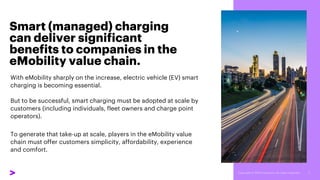
Smart (managed) charging
can deliver significant
benefits to companies in the
eMobility value chain.
With eMobility sharply on the increase, electric vehicle (EV) smart
charging is becoming essential.
But to be successful, smart charging must be adopted at scale by
customers (including individuals, fleet owners and charge point
operators).
To generate that take-up at scale, players in the eMobility value
chain must offer customers simplicity, affordability, experience
and comfort.
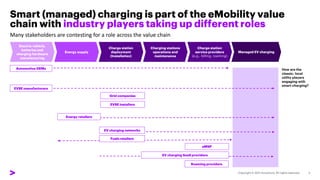
Smart (managed) charging is part of the eMobility value
chain with industry players taking up different roles
Fuels retailers
Automotive OEMs
EV charging networks
Many stakeholders are contesting for a role across the value chain
EVSE manufacturers
Roaming providers
EV charging SaaS providers
Grid companies
Energy retailers
EVSE installers
eMSP
How are the
classic, local
utility players
engaging with
smart charging?
Electric vehicle,
batteries and
charging hardware
manufacturing
Energy supply
Charge station
deployment
(Installation)
Charging stations
operations and
maintenance
Charge station
service providers
(e.g., billing, roaming)
Managed EV charging
eMobility
market trends
by the numbers
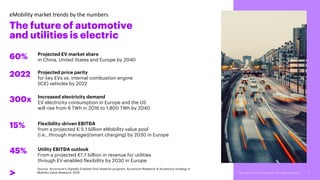
eMobility market trends by the numbers
Projected price parity
for key EVs vs. internal combustion engine
(ICE) vehicles by 2022
Utility EBITDA outlook
From a projected €1.7 billion in revenue for utilities
through EV-enabled flexibility by 2030 in Europe
2022
45%
Projected EV market share
in China, United States and Europe by 2040
60%
Increased electricity demand
EV electricity consumption in Europe and the US
will rise from 6 TWh in 2016 to 1,800 TWh by 2040
300x
15% Flexibility-driven EBITDA
from a projected € 5.1 billion eMobility value pool
(i.e., through managed/smart charging) by 2030 in Europe
The future of automotive
and utilities is electric
Source: Accenture’s Digitally Enabled Grid research program, Accenture Research & Accenture Strategy e-
Mobility Value Research 2019
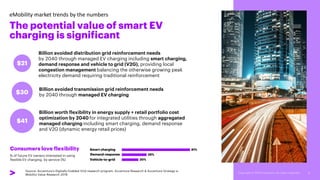
Billion avoided distribution grid reinforcement needs
by 2040 through managed EV charging including smart charging,
demand response and vehicle to grid (V2G), providing local
congestion management balancing the otherwise growing peak
electricity demand requiring traditional reinforcement
$30
$21
Billion avoided transmission grid reinforcement needs
by 2040 through managed EV charging
$41
Billion worth flexibility in energy supply + retail portfolio cost
optimization by 2040 for integrated utilities through aggregated
managed charging including smart charging, demand response
and V2G (dynamic energy retail prices)
Vehicle-to-grid
81%
Demand response
Smart charging
29%
20%
% of future EV owners interested in using
flexible EV charging, by service (%)
Consumers love flexibility
eMobility market trends by the numbers
The potential value of smart EV
charging is significant
Source: Accenture’s Digitally Enabled Grid research program, Accenture Research & Accenture Strategy e-
Mobility Value Research 2019
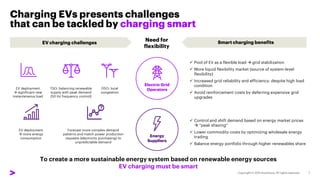
Energy
Suppliers
Charging EVs presents challenges
that can be tackled by charging smart
Forecast more complex demand
patterns and match power production
requests (electricity purchasing) to
unpredictable demand
EV charging challenges Smart charging benefits
DSO: local
congestion
 Control and shift demand based on energy market prices
 “peak shaving”
 Lower commodity costs by optimizing wholesale energy
trading
 Balance energy portfolio through higher renewables share
 Pool of EV as a flexible load  grid stabilization
 More liquid flexibility market (source of system-level
flexibility)
 Increased grid reliability and efficiency; despite high load
condition
 Avoid reinforcement costs by deferring expensive grid
upgrades
Need for
flexibility
Electric Grid
Operators
EV deployment
 significant new
instantaneous load
TSO: balancing renewable
supply with peak demand
(50 Hz frequency control)
EV deployment
 more energy
consumption
To create a more sustainable energy system based on renewable energy sources
EV charging must be smart
EVcharging
mustbesmart
To create a more sustainable energy system
based on renewable energy sources
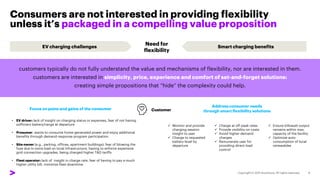
Consumers are not interested in providing flexibility
unless it’s packaged in a compelling value proposition
EV charging challenges Smart charging benefits
Need for
flexibility
customers typically do not fully understand the value and mechanisms of flexibility, nor are interested in them.
customers are interested in simplicity, price, experience and comfort of set-and-forget solutions:
creating simple propositions that “hide” the complexity could help.
• EV driver: lack of insight on charging status or expenses, fear of not having
sufficient battery/range at departure
• Prosumer: wants to consume home-generated power and enjoy additional
benefits through demand-response program participation
• Site owner (e.g., parking, offices, apartment buildings): fear of blowing the
fuse due to extra load on local infrastructure, having to enforce expensive
grid connection upgrades, being charged higher T&D tariffs
• Fleet operator: lack of insight in charge rate, fear of having to pay a much
higher utility bill, minimize fleet downtime
 Ensure killowatt output
remains within max.
capacity of the facility
 Optimize auto-
consumption of local
renewables
Focus on pains and gains of the consumer
Address consumer needs
through smart flexibility solutions
 Charge at off-peak rates
 Provide visibility on costs
 Avoid higher demand
charges
 Remunerate user for
providing direct load
control
 Monitor and provide
charging session
insight to user
 Charge to requested
battery level by
departure
Customer
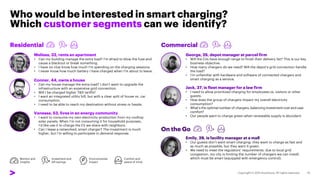
Who would be interested in smart charging?
Which customer segments can we identify?
Melissa, 32, rents an apartment
• Can my building manage the extra load? I’m afraid to blow the fuse and
cause a blackout or break something.
• I have no clue know how much I’m spending on the charging sessions.
• I never know how much battery I have charged when I’m about to leave.
Conner, 44, owns a house
• Can my house manage the extra load? I don’t want to upgrade the
infrastructure with an expensive grid connection.
• Will I be charged higher T&D tariffs?
• I want an integrated utility bill, but with a clear split of house vs. car
consumption.
• I need to be able to reach my destination without stress or hassle.
Vanessa, 53, lives in an energy community
• I want to consume my own electricity production from my rooftop
solar panels. When I’m not consuming it for household purposes,
I’d like use it to charge the EV we share with neighbors.
• Can I lease a networked, smart charger? The investment is much
higher, but I’m willing to participate in demand response.
Residential Commercial
On the Go
George, 25, depot manager at parcel firm
• Will the EVs have enough range to finish their delivery list? This is our key
business objective.
• How many chargers do we need? Will the depot’s grid connection handle
the load?
• I’m unfamiliar with hardware and software of connected chargers and
smart charging as a service.
Jack, 37, is fleet manager for a law firm
• I need to allow prioritized charging for employees vs. visitors or other
guests.
• How does the group of chargers impact my overall electricity
consumption?
• What’s the optimal number of chargers, balancing investment cost and user
comfort?
• Our people want to charge green when renewable supply is abundant.
Emily, 29, is facility manager at a mall
• Our guests don’t want smart charging: they want to charge as fast and
as much as possible, but they want it green.
• We need to meet the regulators’ requirements: due to local grid
congestion, my city is limiting the number of chargers we can install,
which must be smart (equipped with emergency control).
Monitor and
insights
Investment and
bill savings
Environmental
impact
Comfort and
peace of mind
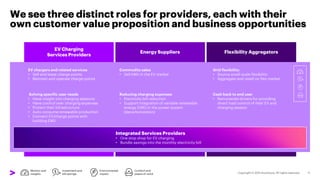
We see three distinct roles for providers, each with their
own customer value proposition and business opportunities
Solving specific user needs
• Have insight into charging sessions
• Have control over charging expenses
• Protect their infrastructure
• Auto-consume renewable production
• Connect EV/charge points with
building EMS
Reducing charging expenses
• Electricity bill reduction
• Support integration of variable renewable
energy (VRE) in the power system
(decarbonization)
Cash back to end user
• Remunerate drivers for providing
direct load control of their EV and
charging session
Integrated Services Providers
• One stop shop for EV charging
• Bundle savings into the monthly electricity bill
Monitor and
insights
Investment and
bill savings
Environmental
impact
Comfort and
peace of mind
EV Charging
Services Providers
Energy Suppliers Flexibility Aggregators
EV chargers and related services
• Sell and lease charge points
• Maintain and operate charge points
Commodity sales
• Sell kWh in the EV market
Grid flexibility:
• Source small-scale flexibility
• Aggregate and resell on flex market
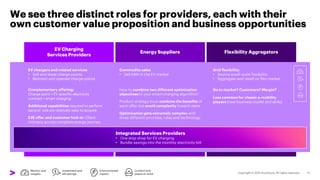
We see three distinct roles for providers, each with their
own customer value proposition and business opportunities
EV chargers and related services
• Sell and lease charge points
• Maintain and operate charge points
EV Charging
Services Providers
Commodity sales
• Sell kWh in the EV market
Energy Suppliers
Grid flexibility:
• Source small-scale flexibility
• Aggregate and resell on flex market
Flexibility Aggregators
Integrated Services Providers
• One stop shop for EV charging
• Bundle savings into the monthly electricity bill
Monitor and
insights
Investment and
bill savings
Environmental
impact
Comfort and
peace of mind
Complementary offering:
Charge point + EV-specific electricity
contract + smart charging
Additional capabilities required to perform
second role are relatively easy to acquire
E2E cffer and customer lock-in: Client
intimacy across complete energy journey
How to combine two different optimization
objectives in your smart charging algorithm?
Optimization gets extremely complex with
three different priorities, rules and technology
Product strategy must combine the benefits of
each offer but avoid complexity toward users
Less common for classic e-mobility
players (new business model and skills)
Go to market? Customers? Margin?
For smart charging, there is no one size that fits everyone
There are very distinct plays for the roles of EV charger services providers,
energy suppliers and aggregators.
Companies starting to create smart charging offerings should develop a
consistent strategy covering:
• The type of optimization they include in their value proposition to the
customer.
• How their own benefits from smart charging and the offer toward their
customers reinforces each other.
• How they will create the business and it capabilities in their company that
matches this offerings, making technology choices that support their needs.
• Which processes and systems they need to implement to bring their value
proposition to life.
What’s next?
Managing Director, Utilities,
Energy Transition Services and
Connected Energy Services
Sanda Tuzlic
Management Consulting, Utilities
Belgium
Maurane Deboutte
About Accenture
Accenture is a global professional services company with leading
capabilities in digital, cloud and security. Combining unmatched
experience and specialized skills across more than 40 industries, we
offer Strategy and Consulting, Interactive, Technology and Operations
services—all powered by the world’s largest network of Advanced
Technology and Intelligent Operations centers. Our 537,000 people
deliver on the promise of technology and human ingenuity every day,
serving clients in more than 120 countries. We embrace the power of
change to create value and shared success for our clients, people,
shareholders, partners and communities.
Visit us at www.accenture.com
Copyright © 2021 Accenture.
Accenture and its logo are trademarks of Accenture.
Contact us

Smart Charging: How to scale adoption

  • 1.
    eMobility – EVCharging Executive Summary
  • 2.
    Smart (managed) charging candeliver significant benefits to companies in the eMobility value chain. With eMobility sharply on the increase, electric vehicle (EV) smart charging is becoming essential. But to be successful, smart charging must be adopted at scale by customers (including individuals, fleet owners and charge point operators). To generate that take-up at scale, players in the eMobility value chain must offer customers simplicity, affordability, experience and comfort.
  • 3.
    Smart (managed) chargingis part of the eMobility value chain with industry players taking up different roles Fuels retailers Automotive OEMs EV charging networks Many stakeholders are contesting for a role across the value chain EVSE manufacturers Roaming providers EV charging SaaS providers Grid companies Energy retailers EVSE installers eMSP How are the classic, local utility players engaging with smart charging? Electric vehicle, batteries and charging hardware manufacturing Energy supply Charge station deployment (Installation) Charging stations operations and maintenance Charge station service providers (e.g., billing, roaming) Managed EV charging
  • 4.
  • 5.
    eMobility market trendsby the numbers Projected price parity for key EVs vs. internal combustion engine (ICE) vehicles by 2022 Utility EBITDA outlook From a projected €1.7 billion in revenue for utilities through EV-enabled flexibility by 2030 in Europe 2022 45% Projected EV market share in China, United States and Europe by 2040 60% Increased electricity demand EV electricity consumption in Europe and the US will rise from 6 TWh in 2016 to 1,800 TWh by 2040 300x 15% Flexibility-driven EBITDA from a projected € 5.1 billion eMobility value pool (i.e., through managed/smart charging) by 2030 in Europe The future of automotive and utilities is electric Source: Accenture’s Digitally Enabled Grid research program, Accenture Research & Accenture Strategy e- Mobility Value Research 2019
  • 6.
    Billion avoided distributiongrid reinforcement needs by 2040 through managed EV charging including smart charging, demand response and vehicle to grid (V2G), providing local congestion management balancing the otherwise growing peak electricity demand requiring traditional reinforcement $30 $21 Billion avoided transmission grid reinforcement needs by 2040 through managed EV charging $41 Billion worth flexibility in energy supply + retail portfolio cost optimization by 2040 for integrated utilities through aggregated managed charging including smart charging, demand response and V2G (dynamic energy retail prices) Vehicle-to-grid 81% Demand response Smart charging 29% 20% % of future EV owners interested in using flexible EV charging, by service (%) Consumers love flexibility eMobility market trends by the numbers The potential value of smart EV charging is significant Source: Accenture’s Digitally Enabled Grid research program, Accenture Research & Accenture Strategy e- Mobility Value Research 2019
  • 7.
    Energy Suppliers Charging EVs presentschallenges that can be tackled by charging smart Forecast more complex demand patterns and match power production requests (electricity purchasing) to unpredictable demand EV charging challenges Smart charging benefits DSO: local congestion  Control and shift demand based on energy market prices  “peak shaving”  Lower commodity costs by optimizing wholesale energy trading  Balance energy portfolio through higher renewables share  Pool of EV as a flexible load  grid stabilization  More liquid flexibility market (source of system-level flexibility)  Increased grid reliability and efficiency; despite high load condition  Avoid reinforcement costs by deferring expensive grid upgrades Need for flexibility Electric Grid Operators EV deployment  significant new instantaneous load TSO: balancing renewable supply with peak demand (50 Hz frequency control) EV deployment  more energy consumption To create a more sustainable energy system based on renewable energy sources EV charging must be smart
  • 8.
    EVcharging mustbesmart To create amore sustainable energy system based on renewable energy sources
  • 9.
    Consumers are notinterested in providing flexibility unless it’s packaged in a compelling value proposition EV charging challenges Smart charging benefits Need for flexibility customers typically do not fully understand the value and mechanisms of flexibility, nor are interested in them. customers are interested in simplicity, price, experience and comfort of set-and-forget solutions: creating simple propositions that “hide” the complexity could help. • EV driver: lack of insight on charging status or expenses, fear of not having sufficient battery/range at departure • Prosumer: wants to consume home-generated power and enjoy additional benefits through demand-response program participation • Site owner (e.g., parking, offices, apartment buildings): fear of blowing the fuse due to extra load on local infrastructure, having to enforce expensive grid connection upgrades, being charged higher T&D tariffs • Fleet operator: lack of insight in charge rate, fear of having to pay a much higher utility bill, minimize fleet downtime  Ensure killowatt output remains within max. capacity of the facility  Optimize auto- consumption of local renewables Focus on pains and gains of the consumer Address consumer needs through smart flexibility solutions  Charge at off-peak rates  Provide visibility on costs  Avoid higher demand charges  Remunerate user for providing direct load control  Monitor and provide charging session insight to user  Charge to requested battery level by departure Customer
  • 10.
    Who would beinterested in smart charging? Which customer segments can we identify? Melissa, 32, rents an apartment • Can my building manage the extra load? I’m afraid to blow the fuse and cause a blackout or break something. • I have no clue know how much I’m spending on the charging sessions. • I never know how much battery I have charged when I’m about to leave. Conner, 44, owns a house • Can my house manage the extra load? I don’t want to upgrade the infrastructure with an expensive grid connection. • Will I be charged higher T&D tariffs? • I want an integrated utility bill, but with a clear split of house vs. car consumption. • I need to be able to reach my destination without stress or hassle. Vanessa, 53, lives in an energy community • I want to consume my own electricity production from my rooftop solar panels. When I’m not consuming it for household purposes, I’d like use it to charge the EV we share with neighbors. • Can I lease a networked, smart charger? The investment is much higher, but I’m willing to participate in demand response. Residential Commercial On the Go George, 25, depot manager at parcel firm • Will the EVs have enough range to finish their delivery list? This is our key business objective. • How many chargers do we need? Will the depot’s grid connection handle the load? • I’m unfamiliar with hardware and software of connected chargers and smart charging as a service. Jack, 37, is fleet manager for a law firm • I need to allow prioritized charging for employees vs. visitors or other guests. • How does the group of chargers impact my overall electricity consumption? • What’s the optimal number of chargers, balancing investment cost and user comfort? • Our people want to charge green when renewable supply is abundant. Emily, 29, is facility manager at a mall • Our guests don’t want smart charging: they want to charge as fast and as much as possible, but they want it green. • We need to meet the regulators’ requirements: due to local grid congestion, my city is limiting the number of chargers we can install, which must be smart (equipped with emergency control). Monitor and insights Investment and bill savings Environmental impact Comfort and peace of mind
  • 11.
    We see threedistinct roles for providers, each with their own customer value proposition and business opportunities Solving specific user needs • Have insight into charging sessions • Have control over charging expenses • Protect their infrastructure • Auto-consume renewable production • Connect EV/charge points with building EMS Reducing charging expenses • Electricity bill reduction • Support integration of variable renewable energy (VRE) in the power system (decarbonization) Cash back to end user • Remunerate drivers for providing direct load control of their EV and charging session Integrated Services Providers • One stop shop for EV charging • Bundle savings into the monthly electricity bill Monitor and insights Investment and bill savings Environmental impact Comfort and peace of mind EV Charging Services Providers Energy Suppliers Flexibility Aggregators EV chargers and related services • Sell and lease charge points • Maintain and operate charge points Commodity sales • Sell kWh in the EV market Grid flexibility: • Source small-scale flexibility • Aggregate and resell on flex market
  • 12.
    We see threedistinct roles for providers, each with their own customer value proposition and business opportunities EV chargers and related services • Sell and lease charge points • Maintain and operate charge points EV Charging Services Providers Commodity sales • Sell kWh in the EV market Energy Suppliers Grid flexibility: • Source small-scale flexibility • Aggregate and resell on flex market Flexibility Aggregators Integrated Services Providers • One stop shop for EV charging • Bundle savings into the monthly electricity bill Monitor and insights Investment and bill savings Environmental impact Comfort and peace of mind Complementary offering: Charge point + EV-specific electricity contract + smart charging Additional capabilities required to perform second role are relatively easy to acquire E2E cffer and customer lock-in: Client intimacy across complete energy journey How to combine two different optimization objectives in your smart charging algorithm? Optimization gets extremely complex with three different priorities, rules and technology Product strategy must combine the benefits of each offer but avoid complexity toward users Less common for classic e-mobility players (new business model and skills) Go to market? Customers? Margin?
  • 13.
    For smart charging,there is no one size that fits everyone There are very distinct plays for the roles of EV charger services providers, energy suppliers and aggregators. Companies starting to create smart charging offerings should develop a consistent strategy covering: • The type of optimization they include in their value proposition to the customer. • How their own benefits from smart charging and the offer toward their customers reinforces each other. • How they will create the business and it capabilities in their company that matches this offerings, making technology choices that support their needs. • Which processes and systems they need to implement to bring their value proposition to life. What’s next?
  • 14.
    Managing Director, Utilities, EnergyTransition Services and Connected Energy Services Sanda Tuzlic Management Consulting, Utilities Belgium Maurane Deboutte About Accenture Accenture is a global professional services company with leading capabilities in digital, cloud and security. Combining unmatched experience and specialized skills across more than 40 industries, we offer Strategy and Consulting, Interactive, Technology and Operations services—all powered by the world’s largest network of Advanced Technology and Intelligent Operations centers. Our 537,000 people deliver on the promise of technology and human ingenuity every day, serving clients in more than 120 countries. We embrace the power of change to create value and shared success for our clients, people, shareholders, partners and communities. Visit us at www.accenture.com Copyright © 2021 Accenture. Accenture and its logo are trademarks of Accenture. Contact us