IN THE NAME OF GOD
By:
Mohammad Reza Jabbari
March 2017
PAPER DETAILS
• Title: Outage Performance of MIMO Free-Space Optical Systems in Gamma-Gamma Fading Channels
• Authors: Hossein Kazemi, Zohreh Mostaani, Murat Uysal and Zabih Ghassemlooy
• Date of Publication: July 2013
• Publisher: Network and Optical Communications (NOC)
• Citation: 10
• Num.Pages : 6
CONTENTS
 History
 Advantage and Disadvantage
 Applications
 Different Topology
 Block Diagram
 Environmental Factors
 Abstract
 Introduction
 Atmospheric Turbulence Channel Model
 System Model
 Outage Probability Analysis
 Numerical Result and Discussion
 Conclusion
1.Introduction to FSO Communication
2. Paper Issue
End
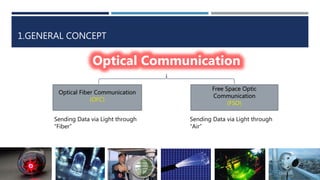
1.GENERAL CONCEPT
Optical Communication
Optical Fiber Communication
(OFC)
Free Space Optic
Communication
(FSO)
Sending Data via Light through
“Air”
Sending Data via Light through
“Fiber”
HISTORY
 In 1790: the Claude Chappe Optical Telegraph
 In 1880: The Bell Photo-phone
 In 1960: Invent of Gas Laser (by Prof. A. Javan)
 In 1998: Reach to bit rate about 2.5 Gbits/sec over 2.5 Km
 In 2001: on of the 10 top of Technology
 In 2006: Reach to bit rate 14 Tbit/s a over 160 km
 ….
ADVANTAGE OF FSO
1. Installation cost is very low (vs Fiber)
2. No licensing require (vs RF)
3. High secure transmission possible (vs RF)
4. Ease of Installation (vs Fiber)
5. Immunity to electromagnetic interference (vs
RF)
6. Support high data rate transmission (vs RF)
7. No side lob (vs RF)
8. Flexible (vs Fiber)
DISADVANTAGE OF FSO
1. Support only Point to point Communication
2. Difficult Alignment
3. High Sensitivity to Environment Factors
7
APPLICATION
1. Last mile access
2. Fiber optic backup
3. High speed video transmission
4. Disaster management and temporary system
5. Satellite communication
6. ….
DIFFERENT TOPOLOGY
1. Point to Multipoint Topology
2. Point to Point Topology
3. Ring with Spurs Topology
4. Mesh Topology
5. Metro Network
BLOCK DIAGRAM
ENVIRONMENTAL FACTORS
1. Absorption
2. Turbulence
3. Atmospheric Attenuation
4. Window Attenuation
5. Scattering
6. Noise
7.Bulding Motion
8. …
Scintillation
PAPER ISSUE
11
Outage Performance of MIMO Free-Space Optical
Systems
in Gamma-Gamma Fading Channels
ABSTRACT
In this paper, we consider a MIMO Free-SpaceOptical (FSO) communication
system over gamma-gamma turbulence channels and derive a closed-form
analytical expression for the outage probability taking into account the effects
of both the inner scale size of optical channel and the aperture averaging. Our
results demonstrate that by increasing the number of transmit and/or receive
apertures, the degrading effect of the inner scale size is effectively reduced by
extracting the spatial diversity gain of the MIMO scheme. We further provide
Monte Carlo simulation results to confirm the validity of the derived expression.
INTRODUCTION
Atmospheric Turbulence Model
Present Log-Normal Distribution
deviates from experimental
results when the turbulence
gets stronger.
Present Gamma-Gamma Distribution
The gamma-gamma distribution is widely
used to model moderate to strong
turbulence conditions
Tsiftsis et al.
derived the bit error rate
(BER)
the effect of inner scale size
in turbulence environment
is not considered.
ATMOSPHERIC TURBULENCE CHANNEL MODEL
• Atmospheric turbulence is characterized by three main parameters:
Inner scale size (𝒍 𝟎) Outer scale Size (𝑳 𝟎) Refraction Parameter (𝑪 𝒏
𝟐)
• pockets of air with constant 𝑪 𝒏
𝟐
form turbulence cells called ”eddies”.
• Small-scale sizes cause the wave to Diffract while the large-scale sizes have a Refractive
• The diffractive and refractive scattering processes result in a randomly changing refractive index called
scintillation.
 To distinguish between different turbulence regimes, the Rytov variance is typically used:
For weak, moderate and strong atmospheric turbulence conditions the corresponding Rytov variances are
respectively determined as 𝛽0
2
< 1, 𝛽0
2
≈ 1 and 𝛽0
2
≫ 1 .
 The corresponding probability density function (pdf) of I is given by:
SYSTEM MODEL
 We consider a MIMO FSO communication with M transmit and N receive apertures.
 The apertures are separated by more than the channel coherence length.
 We consider binary pulse position modulation (BPPM).
Receiver compares the received energy in the first and second half bit intervals
The optical signal power at the ith receive aperture is given by:
OUTAGE PROBABILITY ANALYSIS
 The outage probability at a transmission rate of 𝑅0 is defined as:
 The instantaneous received electrical SNR for BPPM is defined as:
 Without loss of generality, we assume that the equal gain combing (EGC) is employed on the
receive side.
 the corresponding outage probability can be expressed as:
 While no exact distribution is available for the sum of gamma-gamma random variables, we use α-µ
distribution to approximate Ω:
 We need to find the values of unknown parameters µ, α and 𝑤 .
Analytical
Equation
Exact Equation
SIMULATION
RESULTS
19
22.2
dB
15.2
dB
7dB
19.2
dB
13.6
dB
6.4dB
20.8dB
9.8dB
22
CONCLUSION
1.we have investigated the outage probability of MIMO FSO communication systems with M transmit and N
receive apertures over gamma-gamma turbulence-induced fading channels.
2.Based on a robust approximation method via the α-µ distribution, our derived approximate analytical
expression is accurate in general turbulence conditions.
3.We have further shown that the performance degradation effect of the inner scale size can be reduced by
increasing the number of transmit and/or receive apertures of the MIMO scheme.
4. In moderate turbulence conditions, the inner scale effect can be effectively neutralized by using more
transmit and/or receive apertures, while in strong turbulence conditions with the same MIMO system the effect
of inner scale cannot be completely removed.
THE END
23
“Once you stop learning ,you start dying”
Albert Einstein

Free Space Optic Communication (FSO)

  • 1.
    IN THE NAMEOF GOD By: Mohammad Reza Jabbari March 2017
  • 2.
    PAPER DETAILS • Title:Outage Performance of MIMO Free-Space Optical Systems in Gamma-Gamma Fading Channels • Authors: Hossein Kazemi, Zohreh Mostaani, Murat Uysal and Zabih Ghassemlooy • Date of Publication: July 2013 • Publisher: Network and Optical Communications (NOC) • Citation: 10 • Num.Pages : 6
  • 3.
    CONTENTS  History  Advantageand Disadvantage  Applications  Different Topology  Block Diagram  Environmental Factors  Abstract  Introduction  Atmospheric Turbulence Channel Model  System Model  Outage Probability Analysis  Numerical Result and Discussion  Conclusion 1.Introduction to FSO Communication 2. Paper Issue End
  • 4.
    1.GENERAL CONCEPT Optical Communication OpticalFiber Communication (OFC) Free Space Optic Communication (FSO) Sending Data via Light through “Air” Sending Data via Light through “Fiber”
  • 5.
    HISTORY  In 1790:the Claude Chappe Optical Telegraph  In 1880: The Bell Photo-phone  In 1960: Invent of Gas Laser (by Prof. A. Javan)  In 1998: Reach to bit rate about 2.5 Gbits/sec over 2.5 Km  In 2001: on of the 10 top of Technology  In 2006: Reach to bit rate 14 Tbit/s a over 160 km  ….
  • 6.
    ADVANTAGE OF FSO 1.Installation cost is very low (vs Fiber) 2. No licensing require (vs RF) 3. High secure transmission possible (vs RF) 4. Ease of Installation (vs Fiber) 5. Immunity to electromagnetic interference (vs RF) 6. Support high data rate transmission (vs RF) 7. No side lob (vs RF) 8. Flexible (vs Fiber) DISADVANTAGE OF FSO 1. Support only Point to point Communication 2. Difficult Alignment 3. High Sensitivity to Environment Factors
  • 7.
    7 APPLICATION 1. Last mileaccess 2. Fiber optic backup 3. High speed video transmission 4. Disaster management and temporary system 5. Satellite communication 6. ….
  • 8.
    DIFFERENT TOPOLOGY 1. Pointto Multipoint Topology 2. Point to Point Topology 3. Ring with Spurs Topology 4. Mesh Topology 5. Metro Network
  • 9.
  • 10.
    ENVIRONMENTAL FACTORS 1. Absorption 2.Turbulence 3. Atmospheric Attenuation 4. Window Attenuation 5. Scattering 6. Noise 7.Bulding Motion 8. … Scintillation
  • 11.
    PAPER ISSUE 11 Outage Performanceof MIMO Free-Space Optical Systems in Gamma-Gamma Fading Channels
  • 12.
    ABSTRACT In this paper,we consider a MIMO Free-SpaceOptical (FSO) communication system over gamma-gamma turbulence channels and derive a closed-form analytical expression for the outage probability taking into account the effects of both the inner scale size of optical channel and the aperture averaging. Our results demonstrate that by increasing the number of transmit and/or receive apertures, the degrading effect of the inner scale size is effectively reduced by extracting the spatial diversity gain of the MIMO scheme. We further provide Monte Carlo simulation results to confirm the validity of the derived expression.
  • 13.
    INTRODUCTION Atmospheric Turbulence Model PresentLog-Normal Distribution deviates from experimental results when the turbulence gets stronger. Present Gamma-Gamma Distribution The gamma-gamma distribution is widely used to model moderate to strong turbulence conditions Tsiftsis et al. derived the bit error rate (BER) the effect of inner scale size in turbulence environment is not considered.
  • 14.
    ATMOSPHERIC TURBULENCE CHANNELMODEL • Atmospheric turbulence is characterized by three main parameters: Inner scale size (𝒍 𝟎) Outer scale Size (𝑳 𝟎) Refraction Parameter (𝑪 𝒏 𝟐) • pockets of air with constant 𝑪 𝒏 𝟐 form turbulence cells called ”eddies”. • Small-scale sizes cause the wave to Diffract while the large-scale sizes have a Refractive • The diffractive and refractive scattering processes result in a randomly changing refractive index called scintillation.
  • 15.
     To distinguishbetween different turbulence regimes, the Rytov variance is typically used: For weak, moderate and strong atmospheric turbulence conditions the corresponding Rytov variances are respectively determined as 𝛽0 2 < 1, 𝛽0 2 ≈ 1 and 𝛽0 2 ≫ 1 .  The corresponding probability density function (pdf) of I is given by:
  • 16.
    SYSTEM MODEL  Weconsider a MIMO FSO communication with M transmit and N receive apertures.  The apertures are separated by more than the channel coherence length.  We consider binary pulse position modulation (BPPM). Receiver compares the received energy in the first and second half bit intervals The optical signal power at the ith receive aperture is given by:
  • 17.
    OUTAGE PROBABILITY ANALYSIS The outage probability at a transmission rate of 𝑅0 is defined as:  The instantaneous received electrical SNR for BPPM is defined as:  Without loss of generality, we assume that the equal gain combing (EGC) is employed on the receive side.
  • 18.
     the correspondingoutage probability can be expressed as:  While no exact distribution is available for the sum of gamma-gamma random variables, we use α-µ distribution to approximate Ω:  We need to find the values of unknown parameters µ, α and 𝑤 . Analytical Equation Exact Equation
  • 19.
  • 20.
  • 21.
  • 22.
    22 CONCLUSION 1.we have investigatedthe outage probability of MIMO FSO communication systems with M transmit and N receive apertures over gamma-gamma turbulence-induced fading channels. 2.Based on a robust approximation method via the α-µ distribution, our derived approximate analytical expression is accurate in general turbulence conditions. 3.We have further shown that the performance degradation effect of the inner scale size can be reduced by increasing the number of transmit and/or receive apertures of the MIMO scheme. 4. In moderate turbulence conditions, the inner scale effect can be effectively neutralized by using more transmit and/or receive apertures, while in strong turbulence conditions with the same MIMO system the effect of inner scale cannot be completely removed.
  • 23.
    THE END 23 “Once youstop learning ,you start dying” Albert Einstein

Editor's Notes

  • #3 بدست آوردن احتمال خاموشی سیستم¬های مخابرات نوری فضای آزاد چند آنتنه در کانالهای محوشونده گاما-گاما
  • #11 7. 15% ساختمان ها به اندازه بیشتر 4 میلی رادیان – 5% ساختمان ها بیشتر از 6 میلی رادیان- 1% ساختمان ها بیشتر از 10 میلی رادیان جابجایی دارند.
  • #21 در مایمو 2X2 به ترتیب به اندازه 3 و 1.6 دی بی بهبود توان داشتیم. در مایمو 4x4 نیز به اندازه 0.6 دی بی بهبود داشتیم