Physics of Skydiving
By Nick Chapman
What is Skydiving?
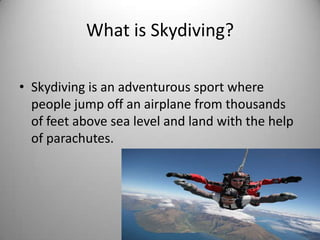
• Skydiving is an adventurous sport where
people jump off an airplane from thousands
of feet above sea level and land with the help
of parachutes.
Skydiving Basics
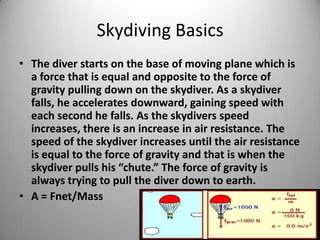
• The diver starts on the base of moving plane which is
a force that is equal and opposite to the force of
gravity pulling down on the skydiver. As a skydiver
falls, he accelerates downward, gaining speed with
each second he falls. As the skydivers speed
increases, there is an increase in air resistance. The
speed of the skydiver increases until the air resistance
is equal to the force of gravity and that is when the
skydiver pulls his “chute.” The force of gravity is
always trying to pull the diver down to earth.
• A = Fnet/Mass
What is Free Fall?
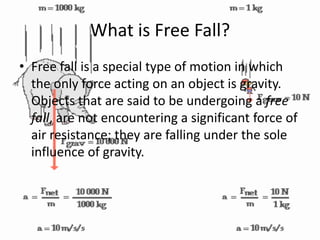
• Free fall is a special type of motion in which
the only force acting on an object is gravity.
Objects that are said to be undergoing a free
fall, are not encountering a significant force of
air resistance; they are falling under the sole
influence of gravity.
Air Resistance in Skydiving
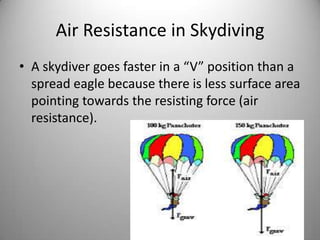
• A skydiver goes faster in a “V” position than a
spread eagle because there is less surface area
pointing towards the resisting force (air
resistance).
Cross Sectional Area and Terminal
Velocity
• Terminal Velocity – the velocity at which drag
force from the air becomes equal to the force
from the weight of an object, and thus the
object no longer accelerates and consequently
velocity remains constant.
• Cross Sectional Area – the intersection of a
figure in a 2-D space with a line, or of a body
in 3-D space with a plane.
Cross Sectional Area and Terminal
Velocity (Continued)
• The greater the object’s (or in this case
diver’s)cross – sectional area and the less its
mass, the lower the terminal velocity and the
sooner it’s reached.
• When a skydiver goes into a spread eagle
position for landing, this increases the cross –
sectional area which in turn slows the skydiver
down.
• This is the reason why a skydiver’s parachute is
curved as it can take on more air resistance than
a square shaped parachute.
Swimming
• Cross – Sectional Area acts similarly in swimming,
some of the best swimmers in the world make
swimming look effortless in the pool, yet this
gracefulness in swimming is designed to prevent
wave – making.
• Swimmers try to reduce their cross – sectional
area to keep their velocity and not slow down. If
a swimmer makes big movements in the water,
then large amounts of water will move and slow
the swimmer down.
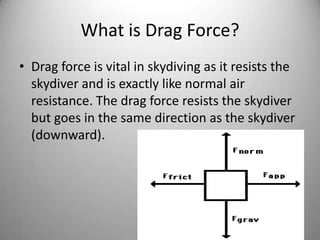
What is Drag Force?
• Drag force is vital in skydiving as it resists the
skydiver and is exactly like normal air
resistance. The drag force resists the skydiver
but goes in the same direction as the skydiver
(downward).
The “Chute”
• Once the terminal velocity is reached, it is still
unsafe to land at that speed. To slow down,
the upward force needs to be greater than the
downward force. Air resistance becomes
greater than gravity when the parachute is
pulled causing her to slow down. The diver
then reaches another terminal velocity in
which case it is safe to land.
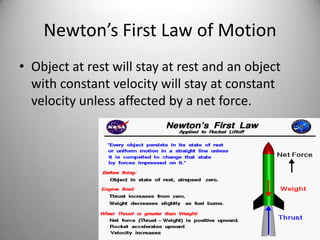
Newton’s First Law of Motion
• Object at rest will stay at rest and an object
with constant velocity will stay at constant
velocity unless affected by a net force.
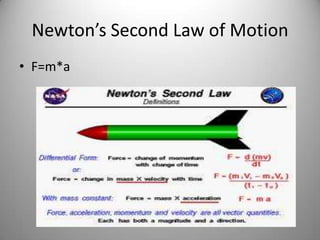
Newton’s Second Law of Motion
• F=m*a
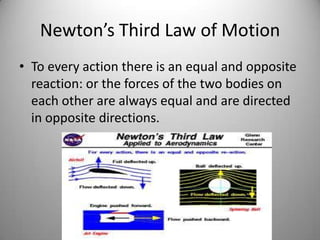
Newton’s Third Law of Motion
• To every action there is an equal and opposite
reaction: or the forces of the two bodies on
each other are always equal and are directed
in opposite directions.
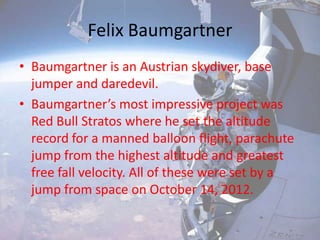
Felix Baumgartner
• Baumgartner is an Austrian skydiver, base
jumper and daredevil.
• Baumgartner’s most impressive project was
Red Bull Stratos where he set the altitude
record for a manned balloon flight, parachute
jump from the highest altitude and greatest
free fall velocity. All of these were set by a
jump from space on October 14, 2012.
Physics of Baumgartner’s Jump
• At the moment Baumgartner jumped, he was
39,068 meters above the surface of the Earth.
To find the gravitational acceleration of
Baumgartner’s jump you use the formula:
• A=GM/R^2
• G is the gravitational constant, A is the
acceleration, M is the mass of the Earth and R
is the distance from the center of the earth to
Baumgartner’s space capsule.
Baumgartner’s jump (continued)
• To find the acceleration, we must find the
distance from the space capsule to the center
of the earth first.
• R = (Radical)(a^2coslatitude)^2 +
(b^2sinlatitude)/(acoslatitude)^2 +
(bcoslatitude)^2
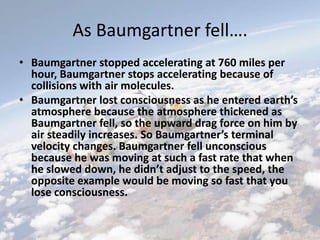
As Baumgartner fell….
• Baumgartner stopped accelerating at 760 miles per
hour, Baumgartner stops accelerating because of
collisions with air molecules.
• Baumgartner lost consciousness as he entered earth’s
atmosphere because the atmosphere thickened as
Baumgartner fell, so the upward drag force on him by
air steadily increases. So Baumgartner’s terminal
velocity changes. Baumgartner fell unconscious
because he was moving at such a fast rate that when
he slowed down, he didn’t adjust to the speed, the
opposite example would be moving so fast that you
lose consciousness.
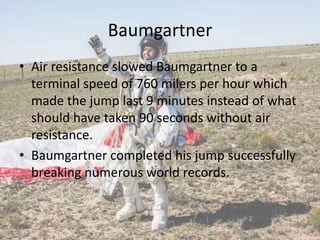
Baumgartner
• Air resistance slowed Baumgartner to a
terminal speed of 760 milers per hour which
made the jump last 9 minutes instead of what
should have taken 90 seconds without air
resistance.
• Baumgartner completed his jump successfully
breaking numerous world records.
Videos/Sources
• http://www.youtube.com/watch?v=FHtvDA0
W34I
Videos/Sources
• http://physicscentral.com/explore/action/surviving1.cfm
• http://news.discovery.com/adventure/extreme-sports/the-science-
behind-felix-baumgartners-128000-foot-skydive.htm
• http://www.youtube.com/watch?v=FHtvDA0W34I
• http://www.youtube.com/watch?v=ur40O6nQHsw
• http://www.physicsclassroom.com/mmedia/newtlaws/sd.cfm
• http://www.jimmo.org/the-physics-of-the-felix-baumgartner-jump/
• http://www.cnn.com/2012/10/23/opinion/urry-skydive-physics
• http://ffden-2.phys.uaf.edu/211.web.stuff/Kuhns/terminal_velocity.htm

Physics of skydiving

  • 1.
  • 2.
    What is Skydiving? •Skydiving is an adventurous sport where people jump off an airplane from thousands of feet above sea level and land with the help of parachutes.
  • 3.
    Skydiving Basics • Thediver starts on the base of moving plane which is a force that is equal and opposite to the force of gravity pulling down on the skydiver. As a skydiver falls, he accelerates downward, gaining speed with each second he falls. As the skydivers speed increases, there is an increase in air resistance. The speed of the skydiver increases until the air resistance is equal to the force of gravity and that is when the skydiver pulls his “chute.” The force of gravity is always trying to pull the diver down to earth. • A = Fnet/Mass
  • 4.
    What is FreeFall? • Free fall is a special type of motion in which the only force acting on an object is gravity. Objects that are said to be undergoing a free fall, are not encountering a significant force of air resistance; they are falling under the sole influence of gravity.
  • 5.
    Air Resistance inSkydiving • A skydiver goes faster in a “V” position than a spread eagle because there is less surface area pointing towards the resisting force (air resistance).
  • 6.
    Cross Sectional Areaand Terminal Velocity • Terminal Velocity – the velocity at which drag force from the air becomes equal to the force from the weight of an object, and thus the object no longer accelerates and consequently velocity remains constant. • Cross Sectional Area – the intersection of a figure in a 2-D space with a line, or of a body in 3-D space with a plane.
  • 7.
    Cross Sectional Areaand Terminal Velocity (Continued) • The greater the object’s (or in this case diver’s)cross – sectional area and the less its mass, the lower the terminal velocity and the sooner it’s reached. • When a skydiver goes into a spread eagle position for landing, this increases the cross – sectional area which in turn slows the skydiver down. • This is the reason why a skydiver’s parachute is curved as it can take on more air resistance than a square shaped parachute.
  • 8.
    Swimming • Cross –Sectional Area acts similarly in swimming, some of the best swimmers in the world make swimming look effortless in the pool, yet this gracefulness in swimming is designed to prevent wave – making. • Swimmers try to reduce their cross – sectional area to keep their velocity and not slow down. If a swimmer makes big movements in the water, then large amounts of water will move and slow the swimmer down.
  • 9.
    What is DragForce? • Drag force is vital in skydiving as it resists the skydiver and is exactly like normal air resistance. The drag force resists the skydiver but goes in the same direction as the skydiver (downward).
  • 10.
    The “Chute” • Oncethe terminal velocity is reached, it is still unsafe to land at that speed. To slow down, the upward force needs to be greater than the downward force. Air resistance becomes greater than gravity when the parachute is pulled causing her to slow down. The diver then reaches another terminal velocity in which case it is safe to land.
  • 11.
    Newton’s First Lawof Motion • Object at rest will stay at rest and an object with constant velocity will stay at constant velocity unless affected by a net force.
  • 12.
    Newton’s Second Lawof Motion • F=m*a
  • 13.
    Newton’s Third Lawof Motion • To every action there is an equal and opposite reaction: or the forces of the two bodies on each other are always equal and are directed in opposite directions.
  • 14.
    Felix Baumgartner • Baumgartneris an Austrian skydiver, base jumper and daredevil. • Baumgartner’s most impressive project was Red Bull Stratos where he set the altitude record for a manned balloon flight, parachute jump from the highest altitude and greatest free fall velocity. All of these were set by a jump from space on October 14, 2012.
  • 15.
    Physics of Baumgartner’sJump • At the moment Baumgartner jumped, he was 39,068 meters above the surface of the Earth. To find the gravitational acceleration of Baumgartner’s jump you use the formula: • A=GM/R^2 • G is the gravitational constant, A is the acceleration, M is the mass of the Earth and R is the distance from the center of the earth to Baumgartner’s space capsule.
  • 16.
    Baumgartner’s jump (continued) •To find the acceleration, we must find the distance from the space capsule to the center of the earth first. • R = (Radical)(a^2coslatitude)^2 + (b^2sinlatitude)/(acoslatitude)^2 + (bcoslatitude)^2
  • 17.
    As Baumgartner fell…. •Baumgartner stopped accelerating at 760 miles per hour, Baumgartner stops accelerating because of collisions with air molecules. • Baumgartner lost consciousness as he entered earth’s atmosphere because the atmosphere thickened as Baumgartner fell, so the upward drag force on him by air steadily increases. So Baumgartner’s terminal velocity changes. Baumgartner fell unconscious because he was moving at such a fast rate that when he slowed down, he didn’t adjust to the speed, the opposite example would be moving so fast that you lose consciousness.
  • 18.
    Baumgartner • Air resistanceslowed Baumgartner to a terminal speed of 760 milers per hour which made the jump last 9 minutes instead of what should have taken 90 seconds without air resistance. • Baumgartner completed his jump successfully breaking numerous world records.
  • 19.
  • 20.
    Videos/Sources • http://physicscentral.com/explore/action/surviving1.cfm • http://news.discovery.com/adventure/extreme-sports/the-science- behind-felix-baumgartners-128000-foot-skydive.htm •http://www.youtube.com/watch?v=FHtvDA0W34I • http://www.youtube.com/watch?v=ur40O6nQHsw • http://www.physicsclassroom.com/mmedia/newtlaws/sd.cfm • http://www.jimmo.org/the-physics-of-the-felix-baumgartner-jump/ • http://www.cnn.com/2012/10/23/opinion/urry-skydive-physics • http://ffden-2.phys.uaf.edu/211.web.stuff/Kuhns/terminal_velocity.htm