An object that the
only force acting on
it is gravity
Mr. P
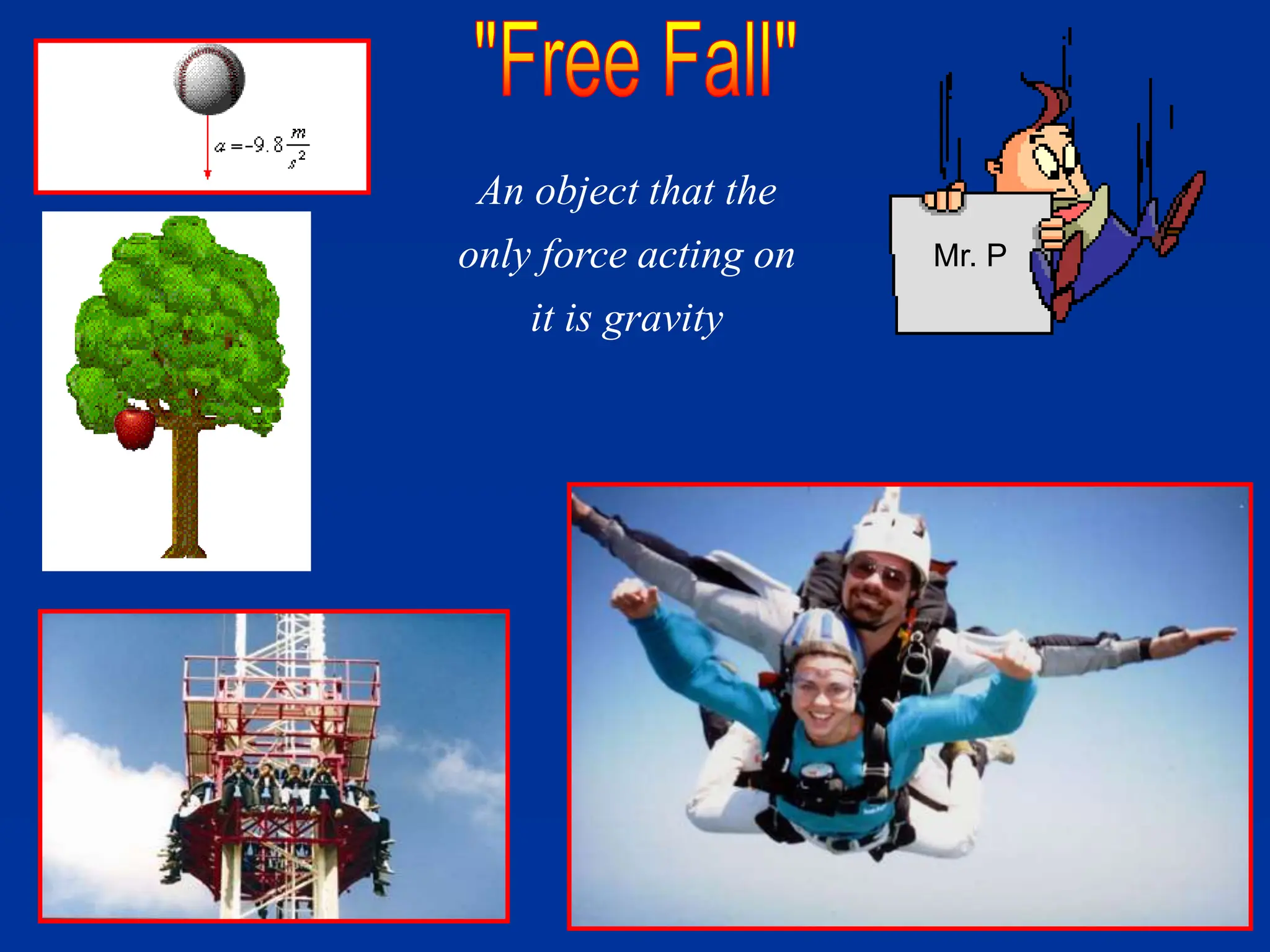
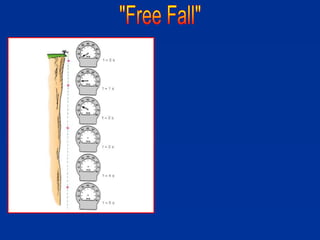
Gravity accelerates all objects down regardless if they are going
up, going down, stopped, or going sideways. An object that the
only force acting on it is gravity is in
Free Fall.
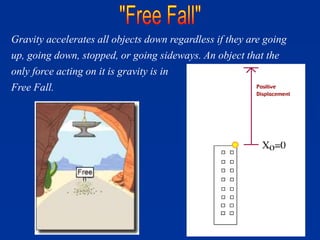
An object is in free fall if the only force acting on it is gravity,
doesn’t happen though, near surface of earth there is air resistance!
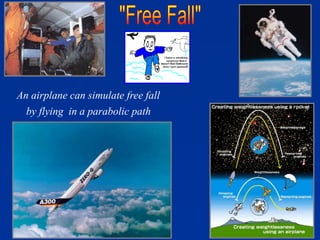
An airplane can simulate free fall
by flying in a parabolic path
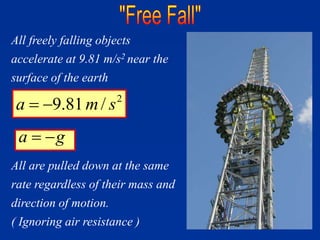
All freely falling objects
accelerate at 9.81 m/s2 near the
surface of the earth
All are pulled down at the same
rate regardless of their mass and
direction of motion.
( Ignoring air resistance )
2
9.81 /
a m s
 
a g
 
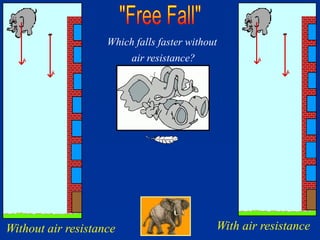
Without air resistance With air resistance
Which falls faster without
air resistance?
http://faculty.rmwc.edu/tmichalik/movies/tree.mpeg
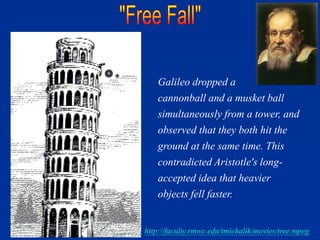
Galileo dropped a
cannonball and a musket ball
simultaneously from a tower, and
observed that they both hit the
ground at the same time. This
contradicted Aristotle's long-
accepted idea that heavier
objects fell faster.
f i
2 2
f i
2
1
i 2
1
f i
2
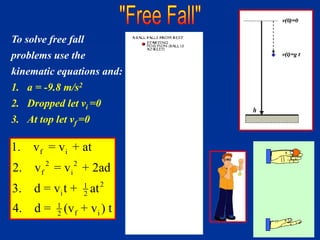
1. v = v + at
2. v = v + 2ad
3. d = v t + at
4. d = (v + v ) t
To solve free fall
problems use the
kinematic equations and:
1. a = -9.8 m/s2
2. Dropped let vi =0
3. At top let vf =0
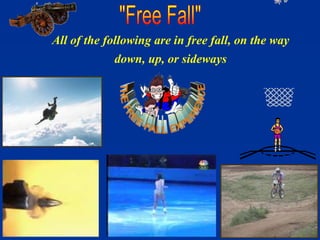
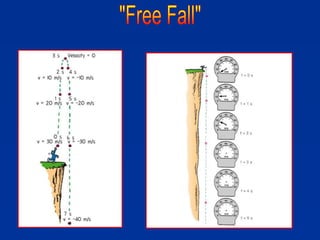
All of the following are in free fall, on the way
down, up, or sideways
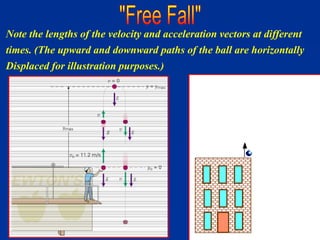
Note the lengths of the velocity and acceleration vectors at different
times. (The upward and downward paths of the ball are horizontally
Displaced for illustration purposes.)
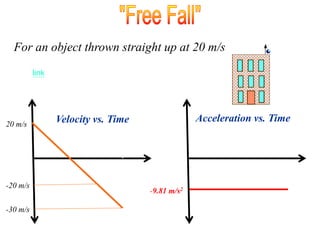
Velocity vs. Time
For an object thrown straight up at 20 m/s
Acceleration vs. Time
-9.81 m/s2
20 m/s
-20 m/s
-30 m/s
link
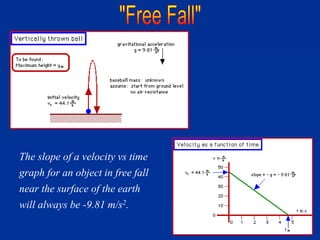
The slope of a velocity vs time
graph for an object in free fall
near the surface of the earth
will always be -9.81 m/s2.
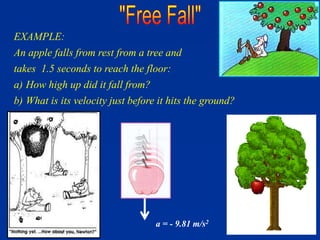
EXAMPLE:
An apple falls from rest from a tree and
takes 1.5 seconds to reach the floor:
a) How high up did it fall from?
b) What is its velocity just before it hits the ground?
a = - 9.81 m/s2
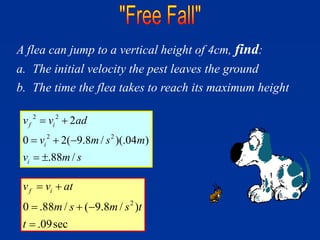
A flea can jump to a vertical height of 4cm, find:
a. The initial velocity the pest leaves the ground
b. The time the flea takes to reach its maximum height
2 2
2 2
2
0 2( 9.8 / )(.04 )
.88 /
f i
i
i
v v ad
v m s m
v m s
 
  
 
2
0 .88 / ( 9.8 / )
.09sec
f i
v v at
m s m s t
t
 
  

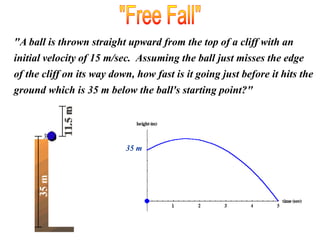
"A ball is thrown straight upward from the top of a cliff with an
initial velocity of 15 m/sec. Assuming the ball just misses the edge
of the cliff on its way down, how fast is it going just before it hits the
ground which is 35 m below the ball's starting point?"
35 m
A construction worker
accidentally drops a brick
from a high scaffold.
a. What is the velocity of the
brick after 4.0 s?
b. How far does the brick fall
during this time?

Free-Fall.ppt

  • 1.
    An object thatthe only force acting on it is gravity Mr. P
  • 2.
    Gravity accelerates allobjects down regardless if they are going up, going down, stopped, or going sideways. An object that the only force acting on it is gravity is in Free Fall.
  • 3.
    An object isin free fall if the only force acting on it is gravity, doesn’t happen though, near surface of earth there is air resistance!
  • 4.
    An airplane cansimulate free fall by flying in a parabolic path
  • 5.
    All freely fallingobjects accelerate at 9.81 m/s2 near the surface of the earth All are pulled down at the same rate regardless of their mass and direction of motion. ( Ignoring air resistance ) 2 9.81 / a m s   a g  
  • 6.
    Without air resistanceWith air resistance Which falls faster without air resistance?
  • 7.
    http://faculty.rmwc.edu/tmichalik/movies/tree.mpeg Galileo dropped a cannonballand a musket ball simultaneously from a tower, and observed that they both hit the ground at the same time. This contradicted Aristotle's long- accepted idea that heavier objects fell faster.
  • 8.
    f i 2 2 fi 2 1 i 2 1 f i 2 1. v = v + at 2. v = v + 2ad 3. d = v t + at 4. d = (v + v ) t To solve free fall problems use the kinematic equations and: 1. a = -9.8 m/s2 2. Dropped let vi =0 3. At top let vf =0
  • 10.
    All of thefollowing are in free fall, on the way down, up, or sideways
  • 11.
    Note the lengthsof the velocity and acceleration vectors at different times. (The upward and downward paths of the ball are horizontally Displaced for illustration purposes.)
  • 12.
    Velocity vs. Time Foran object thrown straight up at 20 m/s Acceleration vs. Time -9.81 m/s2 20 m/s -20 m/s -30 m/s link
  • 14.
    The slope ofa velocity vs time graph for an object in free fall near the surface of the earth will always be -9.81 m/s2.
  • 16.
    EXAMPLE: An apple fallsfrom rest from a tree and takes 1.5 seconds to reach the floor: a) How high up did it fall from? b) What is its velocity just before it hits the ground? a = - 9.81 m/s2
  • 17.
    A flea canjump to a vertical height of 4cm, find: a. The initial velocity the pest leaves the ground b. The time the flea takes to reach its maximum height 2 2 2 2 2 0 2( 9.8 / )(.04 ) .88 / f i i i v v ad v m s m v m s        2 0 .88 / ( 9.8 / ) .09sec f i v v at m s m s t t      
  • 18.
    "A ball isthrown straight upward from the top of a cliff with an initial velocity of 15 m/sec. Assuming the ball just misses the edge of the cliff on its way down, how fast is it going just before it hits the ground which is 35 m below the ball's starting point?" 35 m
  • 20.
    A construction worker accidentallydrops a brick from a high scaffold. a. What is the velocity of the brick after 4.0 s? b. How far does the brick fall during this time?