Presented by:
Ashutosh
Kumar
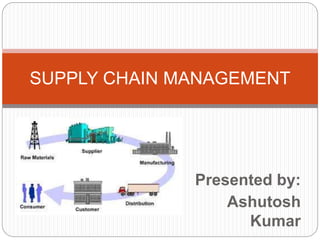
SUPPLY CHAIN MANAGEMENT
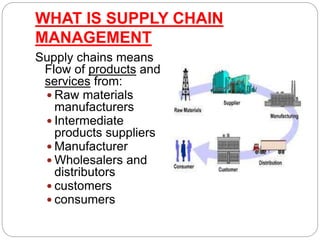
WHAT IS SUPPLY CHAIN
MANAGEMENT
Supply chains means
Flow of products and
services from:
 Raw materials
manufacturers
 Intermediate
products suppliers
 Manufacturer
 Wholesalers and
distributors
 customers
 consumers
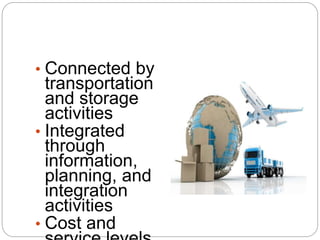
• Connected by
transportation
and storage
activities
• Integrated
through
information,
planning, and
integration
activities
• Cost and
CUSTOMER Vs. CONSUMER
DEFINITION OF SUPPLY CHAIN
The design and management of seamless, value-
added process across organizational boundaries to
meet the real needs of the end customer
Institute for Supply Management
Managing supply and demand, sourcing raw materials
and parts, manufacturing and assembly, warehousing
and inventory tracking, order entry and order
management, distribution across all channels, and
delivery to the customer
The Supply Chain Council
BROAD SECTORS OF INDIAN
ECONOMY & SCM
1.
• Primary sectors:
• Agriculture, forestry and fishing
2.
• Secondary sectors:
• Mining, electricity, gas, water supply &
construction
3.
• Service sectors:
• Business, transport, telecommunication and
personnel services
SECTOR WISE CONTRIBUTION IN
GDP
SAGARMALA PROJECT OF
INDIA
 Sagar Mala project is a strategic and customer-
oriented initiative of the Government of India to
modernize India's Ports so that port-led
development can be augmented and coastlines
can be developed to contribute in India's growth.
 Plan to invest Rs 70,000/- crore to boost trade of
india to overseas countries and coastal district of
india.
 The project has been sanctioned in 31 July 2015.
 It will reduce logistics cost considerably.
SAGARMALA PROJECT
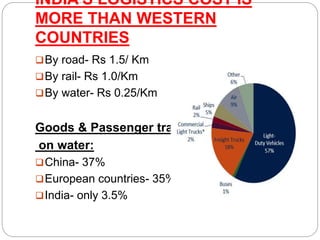
INDIA’S LOGISTICS COST IS
MORE THAN WESTERN
COUNTRIES
By road- Rs 1.5/ Km
By rail- Rs 1.0/Km
By water- Rs 0.25/Km
Goods & Passenger traffic
on water:
China- 37%
European countries- 35%
India- only 3.5%
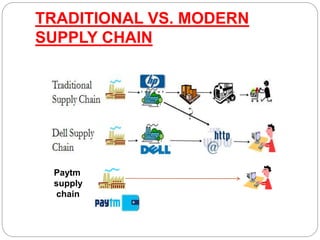
TRADITIONAL VS. MODERN
SUPPLY CHAIN
Paytm
supply
chain
Any
Questions?
THANK YOU!

Supply chain mangement

  • 1.
  • 2.
    WHAT IS SUPPLYCHAIN MANAGEMENT Supply chains means Flow of products and services from:  Raw materials manufacturers  Intermediate products suppliers  Manufacturer  Wholesalers and distributors  customers  consumers
  • 3.
    • Connected by transportation andstorage activities • Integrated through information, planning, and integration activities • Cost and
  • 4.
  • 5.
    DEFINITION OF SUPPLYCHAIN The design and management of seamless, value- added process across organizational boundaries to meet the real needs of the end customer Institute for Supply Management Managing supply and demand, sourcing raw materials and parts, manufacturing and assembly, warehousing and inventory tracking, order entry and order management, distribution across all channels, and delivery to the customer The Supply Chain Council
  • 6.
    BROAD SECTORS OFINDIAN ECONOMY & SCM 1. • Primary sectors: • Agriculture, forestry and fishing 2. • Secondary sectors: • Mining, electricity, gas, water supply & construction 3. • Service sectors: • Business, transport, telecommunication and personnel services
  • 7.
  • 8.
    SAGARMALA PROJECT OF INDIA Sagar Mala project is a strategic and customer- oriented initiative of the Government of India to modernize India's Ports so that port-led development can be augmented and coastlines can be developed to contribute in India's growth.  Plan to invest Rs 70,000/- crore to boost trade of india to overseas countries and coastal district of india.  The project has been sanctioned in 31 July 2015.  It will reduce logistics cost considerably.
  • 9.
  • 10.
    INDIA’S LOGISTICS COSTIS MORE THAN WESTERN COUNTRIES By road- Rs 1.5/ Km By rail- Rs 1.0/Km By water- Rs 0.25/Km Goods & Passenger traffic on water: China- 37% European countries- 35% India- only 3.5%
  • 11.
    TRADITIONAL VS. MODERN SUPPLYCHAIN Paytm supply chain
  • 12.
  • 13.