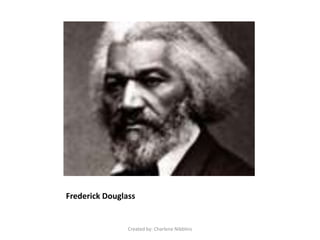
Frederick DouglassCreated by: Charlene Nibblins
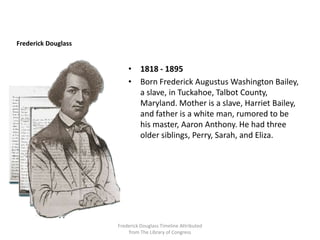
1818 - 1895Born Frederick Augustus Washington Bailey, a slave, in Tuckahoe, Talbot County, Maryland. Mother is a slave, Harriet Bailey, and father is a white man, rumored to be his master, Aaron Anthony. He had three older siblings, Perry, Sarah, and Eliza.Frederick DouglassFrederick Douglass Timeline Attributed from The Library of Congress
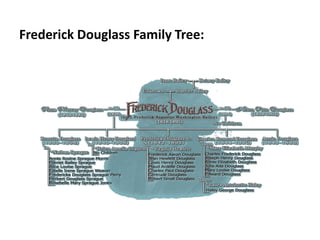
Frederick Douglass Family Tree:
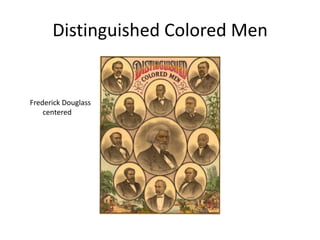
Distinguished Colored MenFrederick Douglass       centered
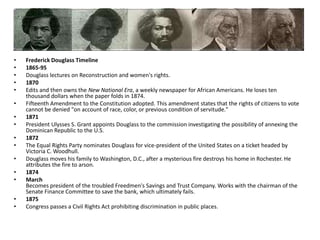
Frederick Douglass Timeline 1818Born Frederick Augustus Washington Bailey, a slave, in Tuckahoe, Talbot County, Maryland. Mother is a slave, Harriet Bailey, and father is a white man, rumored to be his master, Aaron Anthony. He had three older siblings, Perry, Sarah, and Eliza.1819-23Raised by grandmother Betsey Bailey at Holme Hill Farm, where he was born; sees his mother only a few times. 1820Sister Kitty is born. 1822Sister Arianna is born.1824Moves to plantation on Wye River, where he lives with his siblings Perry, Sarah, and Eliza. 1825Sees his mother for the last time.1826His mother dies. Sent to Baltimore to live with Hugh Auld and his wife Sophia. His master, Aaron Anthony, dies late in the year; Frederick becomes the property of Thomas Auld, Anthony's son-in-law. Thomas Auld sends him back to Hugh Auld.
1827Asks Sophia Auld to teach him to read. She does so until Hugh Auld stops them, believing that education makes slaves rebellious.1829-30 Works in shipyard as general assistant; practices reading and writing in secret.1831Reads newspaper article on John Quincy Adams's antislavery petitions in Congress; learns of the abolitionist movement. Buys copy of a compilation of speeches, Caleb Bingham's The Columbian Orator, with which he hones his reading and speaking skills. 1832Sister Sarah is sold to a planter in Mississippi. 1833Sent to St. Michaels, Maryland, where he works for Thomas Auld. Tries to teach other slaves to read until Auld discovers it and stops him. 1834Auld rents him out to farmer Edward Covey, known as a "slave breaker." He is beaten several times and finally fights back. Covey never tries to beat him again. 1835Hired out to work for William Freeland, a Talbot County, Maryland, farmer. Secretly organizes Sunday school and teaches other slaves to read. Frederick Douglass Timeline
Frederick Douglass Timeline1836Makes an escape plan but is discovered, jailed, and then released. He returns to work for Hugh and Sophia Auld in Baltimore and is hired out to work as a caulker in a Baltimore shipyard. The knowledge he gains there helps him escape slavery two years later.1837Joins the East Baltimore Mental Improvement Society, a debating club of free black men. Through the society, he meets a free African-American housekeeper, Anna Murray. 1838September 3 Borrowing papers from a free black sailor, he escapes from slavery to New York and changes his last name to Johnson. September 15Marries Anna Murray. The ceremony is performed by minister James W. C. Pennington, who is also an escaped Maryland slave.The newlyweds move to New Bedford, Massachusetts, where Frederick works as an unskilled laborer. They stay with caterers Mary and Nathan Johnson. Nathan suggests that Frederick take on the last name Douglas, from a character in Sir Walter Scott's poem The Lady of the Lake. He does so, spelling it Douglass. Tries to get job as a caulker, but white workers threaten to quit if he is hired.
Frederick Douglass Timeline1839June 24Daughter Rosetta is born. Douglass subscribes to William Lloyd Garrison's abolitionist weekly The Liberator. Hears Garrison speaking in April. Becomes a licensed preacher for the African Methodist Episcopal Zion Church. 1840October 9Son Lewis Henry is born.1841Speaks at an antislavery meeting in New Bedford, Massachusetts. Abolitionist William C. Coffin talks him into speaking about his life as a slave at a Massachusetts Anti-Slavery Society convention. William Lloyd Garrison follows his remarks with a speech of his own, encouraging Douglass. The Society is impressed and he is hired as a speaker. Douglass becomes closely allied with Garrison and his abolitionist views.1842March 3Son Frederick is born. Meets black abolitionist Charles Lenox Remond. 1843At an antislavery meeting in Pendleton, Indiana, he is beaten by a mob. His right hand is broken in the scuffle and he never fully recovers the use of his hand.
Frederick Douglass Timeline1844October 21Son Charles Remond is born.1845Publishes Narrative of the Life of Frederick Douglass. In it, he reveals details that could lead to his arrest as a fugitive slave. He meets Susan B. Anthony while on a speaking tour. Later he becomes a champion of women's rights. Begins tour of Great Britain and Ireland, lecturing on slavery with abolitionist William Lloyd Garrison. English friends raise money to "purchase" his freedom; Douglass is manumitted after Hugh Auld receives $711.66 in payment. 1847Returns from overseas tour; moves to Rochester, New York. With money raised by English and Irish friends, buys printing press and begins publishing the abolitionist weekly North Star. He continues publishing it until 1851. 1848Participant in first women's rights convention, Seneca Falls, New York. Meets and becomes acquaintance of abolitionist John Brown.Begins sheltering escaped slaves fleeing north on the "underground railroad."Daughter Rosetta is asked to leave school in Rochester because she is African-American; Douglass begins struggle to end segregation in Rochester public schools.
Frederick Douglass Timeline1849 March 22Daughter Annie is born.Hires a tutor to teach his wife, Anna, to read, but the effort is unsuccessful.1851Merges North Star with Gerrit Smith’s Liberty Party Paper tpfpr Frederick Douglass’ Paper (printed until 1860). Agrees with Smith that the Constitution is an antislavery document, reversing his earlier statements that it was proslavery, an opinion shared with William Lloyd Garrison. This change of opinion, as well as some political differences, create a rift between Douglass and Garrison. Douglass begins to assert his independence in the antislavery movement.1852Harriet Beecher Stowe publishes Uncle Tom's Cabin, an antislavery novel. It sells three hundred thousand copies its first year in print and helps galvanize opinions on both sides of the slavery issue. 1855Publication of his second autobiography, My Bondage and My Freedom.1856Becomes friends with Ottilia Assing, a German journalist living in New Jersey. She eventually translates My Bondage and My Freedom into German.1857In the Dred Scott case, the U.S. Supreme Court rules that African Americans are not U.S. citizens and that Congress has no authority to restrict slavery in U.S. territories.
Frederick Douglass Timeline1859John Brown and other abolitionist followers raid the federal arsenal at Harpers Ferry, then in Virginia. He plans to start a slave insurrection and provide refuge for fleeing slaves. Federal troops capture him, and he is eventually tried and hanged. Authorities find a letter from Douglass to Brown. Douglass flees to Canada and then to a planned lecture tour of England to escape arrest on charges of being an accomplice in Brown's raid. 1859-63Begins publishing Douglass' Monthly, first as a supplement to Frederick Douglass' Paper. It becomes an independent publication the following year and is distributed until 1863.1860MarchDaughter Annie dies in Rochester. AprilReturns to the United States and is not charged in the John Brown raid. NovemberAbraham Lincoln is elected president. DecemberSouth Carolina secedes from the Union.1861The Civil War begins.1862Congress abolishes slavery in Washington, D.C.
Frederick Douglass Timeline1863Jan. 1Lincoln's Emancipation Proclamation takes effect, abolishing slavery in the states that are "in rebellion." FebruaryDouglass becomes a recruiter for the 54th Massachusetts Infantry, the first regiment of African-American soldiers; his sons Lewis and Charles join the regiment. Eventually his son Frederick Douglass Jr. becomes an army recruiter also. About 180,000 African Americans serve in the Civil War on the Union side. August 10Meets with President Lincoln to discuss the unequal pay and poor treatment black soldiers receive. 1864August 19Meets with Lincoln again. In case the war is not a total Union victory, Lincoln asks Douglass to prepare an effort to assist slaves escaping to the North. 1865April 14 Lincoln is assassinated. December 18The Thirteenth Amendment to the Constitution, outlawing slavery, is ratified.
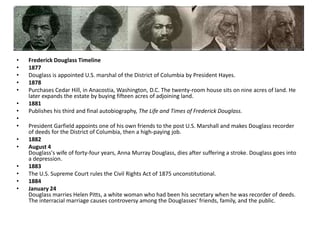
Frederick Douglass Timeline1865-95Douglass lectures on Reconstruction and women's rights.1870Edits and then owns the New National Era, a weekly newspaper for African Americans. He loses ten thousand dollars when the paper folds in 1874. Fifteenth Amendment to the Constitution adopted. This amendment states that the rights of citizens to vote cannot be denied "on account of race, color, or previous condition of servitude." 1871President Ulysses S. Grant appoints Douglass to the commission investigating the possibility of annexing the Dominican Republic to the U.S. 1872The Equal Rights Party nominates Douglass for vice-president of the United States on a ticket headed by Victoria C. Woodhull. Douglass moves his family to Washington, D.C., after a mysterious fire destroys his home in Rochester. He attributes the fire to arson. 1874MarchBecomes president of the troubled Freedmen's Savings and Trust Company. Works with the chairman of the Senate Finance Committee to save the bank, which ultimately fails. 1875Congress passes a Civil Rights Act prohibiting discrimination in public places.
Frederick Douglass Timeline1877Douglass is appointed U.S. marshal of the District of Columbia by President Hayes.1878Purchases Cedar Hill, in Anacostia, Washington, D.C. The twenty-room house sits on nine acres of land. He later expands the estate by buying fifteen acres of adjoining land. 1881Publishes his third and final autobiography, The Life and Times of Frederick Douglass.President Garfield appoints one of his own friends to the post U.S. Marshall and makes Douglass recorder of deeds for the District of Columbia, then a high-paying job. 1882August 4Douglass's wife of forty-four years, Anna Murray Douglass, dies after suffering a stroke. Douglass goes into a depression.1883The U.S. Supreme Court rules the Civil Rights Act of 1875 unconstitutional.1884January 24Douglass marries Helen Pitts, a white woman who had been his secretary when he was recorder of deeds. The interracial marriage causes controversy among the Douglasses' friends, family, and the public.
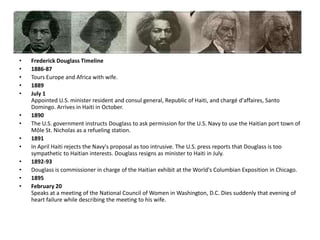
Frederick Douglass Timeline1886-87Tours Europe and Africa with wife.1889July 1Appointed U.S. minister resident and consul general, Republic of Haiti, and chargé d'affaires, Santo Domingo. Arrives in Haiti in October. 1890The U.S. government instructs Douglass to ask permission for the U.S. Navy to use the Haitian port town of Môle St. Nicholas as a refueling station. 1891In April Haiti rejects the Navy's proposal as too intrusive. The U.S. press reports that Douglass is too sympathetic to Haitian interests. Douglass resigns as minister to Haiti in July. 1892-93Douglass is commissioner in charge of the Haitian exhibit at the World's Columbian Exposition in Chicago. 1895February 20Speaks at a meeting of the National Council of Women in Washington, D.C. Dies suddenly that evening of heart failure while describing the meeting to his wife.
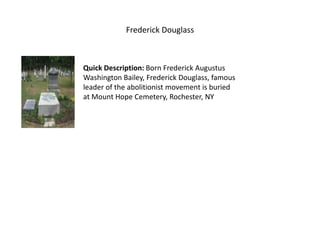
Frederick Douglass Quick Description: Born Frederick Augustus Washington Bailey, Frederick Douglass, famous leader of the abolitionist movement is buried at Mount Hope Cemetery, Rochester, NY
Bibliography of Suggested Web Sites Douglass, Frederick, "The Hypocrisy of Slavery" (speech), at The History Place: Great Speeches, http://www.historyplace.com/speeches/douglass.htm Douglass, Frederick, Narrative of the Life of Frederick Douglass, An American Slave, Written By Himself, (1845), electronic text, at http://www.history.rochester.edu/class/DOUGLASS/duglas11.txt Frederick Douglass National Historic Site, "American Visionaries: Frederick Douglass (exhibit, timeline, etc.), at http://www.cr.nps.gov/museum/exhibits/douglass/ Thomas, Sandra, "Frederick Douglass, ‘Abolitionist/Editor’: A Biography of the Life of Frederick Douglass," at http://www.history.rochester.edu/class/DOUGLASS/home.html Includes Biography, Chronology, and Further Reading.
James Earl Jones reads excerpts from Frederick Douglass' speech The Meaning of July Fourth for the Negro (July 5, 1852). --DemocracyNow: July ... Right click either link to open hyperlinks and view.http://www.bing.com/videos/watch/video/james-earl-jones-reads-frederick-douglass/fa8b77c803ec5ea06a9efa8b77c803ec5ea06a9e-281474827624?q=frederick%20douglasshttp://www.bing.com/videos/video/james-earl-jones-reads-frederick-douglass/fa8b77c803ec5ea06a9efa8b77c803ec5ea06a9e-281474827624?q/frederick%20douglass
The Frederick Douglass Papers at the Library of CongressSpeech, Article, and Book FileAddress by Frederick Douglass,and Poem by A. C. HillsTwo Speeches by Frederick Douglass; West India Emancipation.. And the Dred Scott Decision"The Races"Eulogy of the Late Hon. Wm. Jay"The Constitution of the United States," (photocopy of the title page)"A Lecture on John Brown" - Folder 1 of 2"A Lecture on John Brown" - Folder 2 of 2"Lecture on Pictures" [Title Varies]"Men of Color, to Arms!""Why a Colored Man Should Enlist"Address at a Meeting for the Promotion of Colored Enlistments, Philadelphia"The Mission of the War," Philadelphia - Folder 1 of 2"The Mission of the War," Philadelphia - Folder 2 of 2Speech before the Massachusetts Anti-Slavery Society, Jan. 26, 1864 and May 9, 1865Speech before the American Anti-Slavery Society, The Liberator[On President Lincoln], The Liberator"Abraham Lincoln, a Speech"Lecture on the Inauguration of the Douglass Institute, The LiberatorThe Equality of All Men Before the Law"Abraham Lincoln, a Speech""Composite Nation" (Lecture in the Parker Fraternity Course), Boston - Folder 1 of 3"Composite Nation" (Lecture in the Parker Fraternity Course), Boston - Folder 2 of 3"Composite Nation" (Lecture in the Parker Fraternity Course), Boston - Folder 3 of 3
The Frederick Douglass Papers at the Library of CongressSpeech, Article, and Book File"Do Not Fight Truth and Justice""Massachusetts"Address at the Graves of the Unknown Dead at Arlington, Va."Reminiscences of the Antislavery Conflict as Delivered During the Lecture Season of 72 and 73"Address Delivered by Hon. Frederick Douglass, at the Third Annual Fair of the Tennessee Colored Agricultural and Mechanical AssociationTribute in Memory of William Cooper Nell[The Color Question]Address at the Centennial Celebration of the Abolition Society of PennsylvaniaSpeech before the Mass Meeting of Colored Republicans of the District of ColumbiaOration by Frederick Douglass Delivered on the Occasion of the Unveiling of the Freedmen's Monument in Memory of Abraham Lincoln"A Lecture on Our National Capital," Baltimore, Md. - Folder 1 of 6"A Lecture on Our National Capital," Baltimore, Md. - Folder 2 of 6"A Lecture on Our National Capital," Baltimore, Md. - Folder 3 of 6"A Lecture on Our National Capital," Baltimore, Md. - Folder 4 of 6"A Lecture on Our National Capital," Baltimore, Md. - Folder 5 of 6"A Lecture on Our National Capital," Baltimore, Md. - Folder 6 of 6Speech delivered in Madison Square, New York, Decoration Day"Speech on the Death of William Lloyd Garrison""The Negro Exodus From the Gulf States"Campaign Speeches (3) on Behalf of Alonzo B. Cornell for Governor of New York
The selected sites listed below all relate in some way to Frederick Douglass or the Frederick Douglass Papers. American Visionaries; Frederick Douglass, Online exhibit, Washington, D.C.; National Park Service, 2005. http://www.cr.nps.gov/museum/exhibits/douglass/Documenting the American South. Chapel Hill: University of North Carolina at Chapel Hill, Academic Affairs Library, 1998. http://docsouth.unc.edu/Frederick Douglass National Historic Site. Washington, D.C.: National Park Service, 2001. http://www.nps.gov/frdo/freddoug.htmlFrederick Douglass Papers at Indiana University/Purdue University. Indianapolis: The Trustees of Indiana University, 2000. http://www.iupui.edu/~douglass/University of Virginia Electronic Text Center: Frederick Douglass E-Texts. Charlottesville: University of Virginia, 1992- . Author Index / Douglass, Frederick. http://etext.virginia.edu/subjects/African-American.html
Douglass' Writings"The Cause of the Republican Defeat""The Negro in This Political Campaign""Douglass on the Late Election"Call for the Publication of a Pamphlet Protesting the Exclusion of Colored Citizens' Participation in the World's Columbian ExpositionSpeech Comparing Abolition Movements and Emancipation in Great Britain and the United States"A Plea for the Renomination of General Benjamin Harrison"Lecture on Haiti...[The Effect of the Accession of the Democratic Party to Power]Eulogy at Memorial Services for Lucy StoneThe Reason Why the Colored American Is Not in the World's Columbian ExpositionRemarks at Dedication Ceremonies at the Haitian Pavilion, World's Columbian Exposition, Chicago"Remarks of Frederick Douglass on Bishop Daniel A. Payne"
Frederick Douglass Papers: In His Own WordsThe Narrative of the Life of Frederick Douglass, an American Slave is the 1849 edition of Douglass's first autobiography, originally published in 1845. The electronic edition was originally created as part of the American Memory online collection The Capital and the Bay: Narratives of Washington and the Chesapeake Bay Region, ca. 1600-1925.My Bondage and My Freedom is Douglass's expanded autobiography first published in 1855. The 1857 edition appears as part of The Nineteenth Century in Print, an American Memory collection in collaboration with the University of Michigan's Making of America project. The Life and Times of Frederick Douglass is Douglass's final autobiography, first published in 1881. This electronic edition is from the University of North Carolina at Chapel Hill Libraries' Documenting the American South digitization project, created with support from the National Endowment for the Humanities.
The selected sites listed below all relate in some way to Frederick Douglass or the Frederick Douglass Papers. African American Odyssey. Washington, D.C.: American Memory Project, Library of Congress, 1998. http://memory.loc.gov/ammem/aaohtml/aohome.htmlAfrican American Perspectives: Pamphlets from the Daniel A. P. Murray Collection, 1818-1907. Washington, D.C.: American Memory Project, Library of Congress, 1998. http://memory.loc.gov/ammem/aap/aaphome.htmlAfrican-American Sheet Music, 1850-1920. Washington, D.C.: American Memory Project at Brown University, Library of Congress, 1999. http://memory.loc.gov/ammem/award97/rpbhtml/aasmhome.htmlAmerica's Library: Amazing Americans: Frederick Douglass. Washington, D.C.: Library of Congress, 2000. http://www.americaslibrary.gov/cgi-bin/page.cgi/aa/douglassBorn in Slavery: Slave Narratives from the Federal Writers' Project, 1936-1938. Washington, D.C.: American Memory Project, Library of Congress, 2001. http://memory.loc.gov/ammem/snhtml/snhome.htmlBuilt in America: Historic American Buildings Survey/Historic American Engineering Record, 1933-Present. Washington, D.C.: American Memory Project, Library of Congress, 1998. http://memory.loc.gov/ammem/hhhtml/hhhome.htmlThe Capital and the Bay: Narratives of Washington and the Chesapeake Bay Region, ca. 1600-1925. Washington, D.C.: American Memory Project, Library of Congress, 2001. http://memory.loc.gov/ammem/lhcbhtml.lhcbhome.htmlThe Church in the Southern Black Community, 1780-1925. Washington, D.C.: American Memory Project in collaboration with the University of North Carolina at Chapel Hill, Library of Congress, 2001. http://memory.loc.gov/ammem/award99/ncuhtml/csbchome.htmlFrom Slavery to Freedom: The African-American Pamphlet Collection, 1822-1909. Washington, D.C.: American Memory Project, Library of Congress, 2000. http://memory.loc.gov/ammem/aapchtml/aapchome.htmlThe Nineteenth Century in Print. Washington, D.C.: American Memory Project in collaboration with the University of Michigan, Library of Congress, 2000. http://memory.loc.gov/ammem/ndlpcoop/moahtml/mnchome.html"We'll Sing To Abe Our Song!": Sheet Music about Lincoln, Emancipation, and the Civil War from the Alfred Whital Stern Collection of Lincolniana. Washington, D.C.: American Memory Project, 1999. http://memory.loc.gov/ammem/scsmhtml/scsmhome.htmlWords and Deeds in American History: Selected Documents Celebrating the Manuscript Division's First 100 Years. Washington, D.C.: American Memory, Library of Congress, 1998. http://memory.loc.gov/ammem/mcchtml/corhome.html
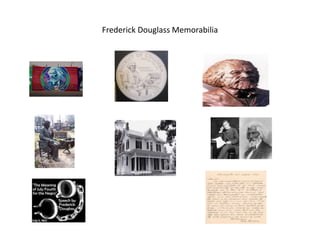
Frederick Douglass Memorabilia
Agitate: Frederick DouglassChildren's Song Lyrics and Sound ClipJonathan Sprout FREDERICK DOUGLASS (1818-95) escaped the master’s whip at the age of 20 when he fled North, disguised as a sailor.  As a strong voice for civil rights, his lecturing and reasoning were so impressive that opponents refused to believe he had been a slave.  A beacon of morality whose vision transcended race and gender, he wrote books and published a newspaper discussing both the evils of slavery and the rights of women.“If there is no struggle, there is no progress.  Those who favor freedom without agitation want crops without plowing ... they want rain without thunder and lightning.”  - Frederick DouglassI once was a slave with a longing for truth,Though books were forbidden to me.At risk to my life, I learned how to read.Thus, would I one day be free.REFRAIN:  I learned to agitate, stir it up, turn it all around.Agitate, shake it loose, get it off the ground.Agitate, shout it out!  Let them hear the sound.  Agitate!I stand here before you as proof of the factThe pain of injustice remains.My brethren in bonds with scars on their backs,Are begging for mercy in chains.REFRAINThere is no progress, if there is no fight.There is no freedom if we do not unite.Nothing matters more, you see,Than claiming our equality.  Agitate!REFRAIN                                                                    My Music\My Playlists\Untitled Playlist.wpl : Right click to open and listen to sample of song
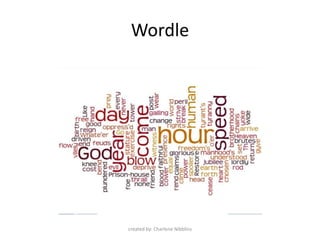
Wordlecreated by: Charlene Nibblins

Frederick douglass 2011

  • 1.
  • 2.
    1818 - 1895BornFrederick Augustus Washington Bailey, a slave, in Tuckahoe, Talbot County, Maryland. Mother is a slave, Harriet Bailey, and father is a white man, rumored to be his master, Aaron Anthony. He had three older siblings, Perry, Sarah, and Eliza.Frederick DouglassFrederick Douglass Timeline Attributed from The Library of Congress
  • 3.
  • 4.
  • 5.
    Frederick Douglass Timeline 1818BornFrederick Augustus Washington Bailey, a slave, in Tuckahoe, Talbot County, Maryland. Mother is a slave, Harriet Bailey, and father is a white man, rumored to be his master, Aaron Anthony. He had three older siblings, Perry, Sarah, and Eliza.1819-23Raised by grandmother Betsey Bailey at Holme Hill Farm, where he was born; sees his mother only a few times. 1820Sister Kitty is born. 1822Sister Arianna is born.1824Moves to plantation on Wye River, where he lives with his siblings Perry, Sarah, and Eliza. 1825Sees his mother for the last time.1826His mother dies. Sent to Baltimore to live with Hugh Auld and his wife Sophia. His master, Aaron Anthony, dies late in the year; Frederick becomes the property of Thomas Auld, Anthony's son-in-law. Thomas Auld sends him back to Hugh Auld.
  • 6.
    1827Asks Sophia Auldto teach him to read. She does so until Hugh Auld stops them, believing that education makes slaves rebellious.1829-30 Works in shipyard as general assistant; practices reading and writing in secret.1831Reads newspaper article on John Quincy Adams's antislavery petitions in Congress; learns of the abolitionist movement. Buys copy of a compilation of speeches, Caleb Bingham's The Columbian Orator, with which he hones his reading and speaking skills. 1832Sister Sarah is sold to a planter in Mississippi. 1833Sent to St. Michaels, Maryland, where he works for Thomas Auld. Tries to teach other slaves to read until Auld discovers it and stops him. 1834Auld rents him out to farmer Edward Covey, known as a "slave breaker." He is beaten several times and finally fights back. Covey never tries to beat him again. 1835Hired out to work for William Freeland, a Talbot County, Maryland, farmer. Secretly organizes Sunday school and teaches other slaves to read. Frederick Douglass Timeline
  • 7.
    Frederick Douglass Timeline1836Makesan escape plan but is discovered, jailed, and then released. He returns to work for Hugh and Sophia Auld in Baltimore and is hired out to work as a caulker in a Baltimore shipyard. The knowledge he gains there helps him escape slavery two years later.1837Joins the East Baltimore Mental Improvement Society, a debating club of free black men. Through the society, he meets a free African-American housekeeper, Anna Murray. 1838September 3 Borrowing papers from a free black sailor, he escapes from slavery to New York and changes his last name to Johnson. September 15Marries Anna Murray. The ceremony is performed by minister James W. C. Pennington, who is also an escaped Maryland slave.The newlyweds move to New Bedford, Massachusetts, where Frederick works as an unskilled laborer. They stay with caterers Mary and Nathan Johnson. Nathan suggests that Frederick take on the last name Douglas, from a character in Sir Walter Scott's poem The Lady of the Lake. He does so, spelling it Douglass. Tries to get job as a caulker, but white workers threaten to quit if he is hired.
  • 8.
    Frederick Douglass Timeline1839June24Daughter Rosetta is born. Douglass subscribes to William Lloyd Garrison's abolitionist weekly The Liberator. Hears Garrison speaking in April. Becomes a licensed preacher for the African Methodist Episcopal Zion Church. 1840October 9Son Lewis Henry is born.1841Speaks at an antislavery meeting in New Bedford, Massachusetts. Abolitionist William C. Coffin talks him into speaking about his life as a slave at a Massachusetts Anti-Slavery Society convention. William Lloyd Garrison follows his remarks with a speech of his own, encouraging Douglass. The Society is impressed and he is hired as a speaker. Douglass becomes closely allied with Garrison and his abolitionist views.1842March 3Son Frederick is born. Meets black abolitionist Charles Lenox Remond. 1843At an antislavery meeting in Pendleton, Indiana, he is beaten by a mob. His right hand is broken in the scuffle and he never fully recovers the use of his hand.
  • 9.
    Frederick Douglass Timeline1844October21Son Charles Remond is born.1845Publishes Narrative of the Life of Frederick Douglass. In it, he reveals details that could lead to his arrest as a fugitive slave. He meets Susan B. Anthony while on a speaking tour. Later he becomes a champion of women's rights. Begins tour of Great Britain and Ireland, lecturing on slavery with abolitionist William Lloyd Garrison. English friends raise money to "purchase" his freedom; Douglass is manumitted after Hugh Auld receives $711.66 in payment. 1847Returns from overseas tour; moves to Rochester, New York. With money raised by English and Irish friends, buys printing press and begins publishing the abolitionist weekly North Star. He continues publishing it until 1851. 1848Participant in first women's rights convention, Seneca Falls, New York. Meets and becomes acquaintance of abolitionist John Brown.Begins sheltering escaped slaves fleeing north on the "underground railroad."Daughter Rosetta is asked to leave school in Rochester because she is African-American; Douglass begins struggle to end segregation in Rochester public schools.
  • 10.
    Frederick Douglass Timeline1849March 22Daughter Annie is born.Hires a tutor to teach his wife, Anna, to read, but the effort is unsuccessful.1851Merges North Star with Gerrit Smith’s Liberty Party Paper tpfpr Frederick Douglass’ Paper (printed until 1860). Agrees with Smith that the Constitution is an antislavery document, reversing his earlier statements that it was proslavery, an opinion shared with William Lloyd Garrison. This change of opinion, as well as some political differences, create a rift between Douglass and Garrison. Douglass begins to assert his independence in the antislavery movement.1852Harriet Beecher Stowe publishes Uncle Tom's Cabin, an antislavery novel. It sells three hundred thousand copies its first year in print and helps galvanize opinions on both sides of the slavery issue. 1855Publication of his second autobiography, My Bondage and My Freedom.1856Becomes friends with Ottilia Assing, a German journalist living in New Jersey. She eventually translates My Bondage and My Freedom into German.1857In the Dred Scott case, the U.S. Supreme Court rules that African Americans are not U.S. citizens and that Congress has no authority to restrict slavery in U.S. territories.
  • 11.
    Frederick Douglass Timeline1859JohnBrown and other abolitionist followers raid the federal arsenal at Harpers Ferry, then in Virginia. He plans to start a slave insurrection and provide refuge for fleeing slaves. Federal troops capture him, and he is eventually tried and hanged. Authorities find a letter from Douglass to Brown. Douglass flees to Canada and then to a planned lecture tour of England to escape arrest on charges of being an accomplice in Brown's raid. 1859-63Begins publishing Douglass' Monthly, first as a supplement to Frederick Douglass' Paper. It becomes an independent publication the following year and is distributed until 1863.1860MarchDaughter Annie dies in Rochester. AprilReturns to the United States and is not charged in the John Brown raid. NovemberAbraham Lincoln is elected president. DecemberSouth Carolina secedes from the Union.1861The Civil War begins.1862Congress abolishes slavery in Washington, D.C.
  • 12.
    Frederick Douglass Timeline1863Jan.1Lincoln's Emancipation Proclamation takes effect, abolishing slavery in the states that are "in rebellion." FebruaryDouglass becomes a recruiter for the 54th Massachusetts Infantry, the first regiment of African-American soldiers; his sons Lewis and Charles join the regiment. Eventually his son Frederick Douglass Jr. becomes an army recruiter also. About 180,000 African Americans serve in the Civil War on the Union side. August 10Meets with President Lincoln to discuss the unequal pay and poor treatment black soldiers receive. 1864August 19Meets with Lincoln again. In case the war is not a total Union victory, Lincoln asks Douglass to prepare an effort to assist slaves escaping to the North. 1865April 14 Lincoln is assassinated. December 18The Thirteenth Amendment to the Constitution, outlawing slavery, is ratified.
  • 13.
    Frederick Douglass Timeline1865-95Douglasslectures on Reconstruction and women's rights.1870Edits and then owns the New National Era, a weekly newspaper for African Americans. He loses ten thousand dollars when the paper folds in 1874. Fifteenth Amendment to the Constitution adopted. This amendment states that the rights of citizens to vote cannot be denied "on account of race, color, or previous condition of servitude." 1871President Ulysses S. Grant appoints Douglass to the commission investigating the possibility of annexing the Dominican Republic to the U.S. 1872The Equal Rights Party nominates Douglass for vice-president of the United States on a ticket headed by Victoria C. Woodhull. Douglass moves his family to Washington, D.C., after a mysterious fire destroys his home in Rochester. He attributes the fire to arson. 1874MarchBecomes president of the troubled Freedmen's Savings and Trust Company. Works with the chairman of the Senate Finance Committee to save the bank, which ultimately fails. 1875Congress passes a Civil Rights Act prohibiting discrimination in public places.
  • 14.
    Frederick Douglass Timeline1877Douglassis appointed U.S. marshal of the District of Columbia by President Hayes.1878Purchases Cedar Hill, in Anacostia, Washington, D.C. The twenty-room house sits on nine acres of land. He later expands the estate by buying fifteen acres of adjoining land. 1881Publishes his third and final autobiography, The Life and Times of Frederick Douglass.President Garfield appoints one of his own friends to the post U.S. Marshall and makes Douglass recorder of deeds for the District of Columbia, then a high-paying job. 1882August 4Douglass's wife of forty-four years, Anna Murray Douglass, dies after suffering a stroke. Douglass goes into a depression.1883The U.S. Supreme Court rules the Civil Rights Act of 1875 unconstitutional.1884January 24Douglass marries Helen Pitts, a white woman who had been his secretary when he was recorder of deeds. The interracial marriage causes controversy among the Douglasses' friends, family, and the public.
  • 15.
    Frederick Douglass Timeline1886-87ToursEurope and Africa with wife.1889July 1Appointed U.S. minister resident and consul general, Republic of Haiti, and chargé d'affaires, Santo Domingo. Arrives in Haiti in October. 1890The U.S. government instructs Douglass to ask permission for the U.S. Navy to use the Haitian port town of Môle St. Nicholas as a refueling station. 1891In April Haiti rejects the Navy's proposal as too intrusive. The U.S. press reports that Douglass is too sympathetic to Haitian interests. Douglass resigns as minister to Haiti in July. 1892-93Douglass is commissioner in charge of the Haitian exhibit at the World's Columbian Exposition in Chicago. 1895February 20Speaks at a meeting of the National Council of Women in Washington, D.C. Dies suddenly that evening of heart failure while describing the meeting to his wife.
  • 16.
    Frederick Douglass QuickDescription: Born Frederick Augustus Washington Bailey, Frederick Douglass, famous leader of the abolitionist movement is buried at Mount Hope Cemetery, Rochester, NY
  • 17.
    Bibliography of SuggestedWeb Sites Douglass, Frederick, "The Hypocrisy of Slavery" (speech), at The History Place: Great Speeches, http://www.historyplace.com/speeches/douglass.htm Douglass, Frederick, Narrative of the Life of Frederick Douglass, An American Slave, Written By Himself, (1845), electronic text, at http://www.history.rochester.edu/class/DOUGLASS/duglas11.txt Frederick Douglass National Historic Site, "American Visionaries: Frederick Douglass (exhibit, timeline, etc.), at http://www.cr.nps.gov/museum/exhibits/douglass/ Thomas, Sandra, "Frederick Douglass, ‘Abolitionist/Editor’: A Biography of the Life of Frederick Douglass," at http://www.history.rochester.edu/class/DOUGLASS/home.html Includes Biography, Chronology, and Further Reading.
  • 18.
    James Earl Jonesreads excerpts from Frederick Douglass' speech The Meaning of July Fourth for the Negro (July 5, 1852). --DemocracyNow: July ... Right click either link to open hyperlinks and view.http://www.bing.com/videos/watch/video/james-earl-jones-reads-frederick-douglass/fa8b77c803ec5ea06a9efa8b77c803ec5ea06a9e-281474827624?q=frederick%20douglasshttp://www.bing.com/videos/video/james-earl-jones-reads-frederick-douglass/fa8b77c803ec5ea06a9efa8b77c803ec5ea06a9e-281474827624?q/frederick%20douglass
  • 19.
    The Frederick DouglassPapers at the Library of CongressSpeech, Article, and Book FileAddress by Frederick Douglass,and Poem by A. C. HillsTwo Speeches by Frederick Douglass; West India Emancipation.. And the Dred Scott Decision"The Races"Eulogy of the Late Hon. Wm. Jay"The Constitution of the United States," (photocopy of the title page)"A Lecture on John Brown" - Folder 1 of 2"A Lecture on John Brown" - Folder 2 of 2"Lecture on Pictures" [Title Varies]"Men of Color, to Arms!""Why a Colored Man Should Enlist"Address at a Meeting for the Promotion of Colored Enlistments, Philadelphia"The Mission of the War," Philadelphia - Folder 1 of 2"The Mission of the War," Philadelphia - Folder 2 of 2Speech before the Massachusetts Anti-Slavery Society, Jan. 26, 1864 and May 9, 1865Speech before the American Anti-Slavery Society, The Liberator[On President Lincoln], The Liberator"Abraham Lincoln, a Speech"Lecture on the Inauguration of the Douglass Institute, The LiberatorThe Equality of All Men Before the Law"Abraham Lincoln, a Speech""Composite Nation" (Lecture in the Parker Fraternity Course), Boston - Folder 1 of 3"Composite Nation" (Lecture in the Parker Fraternity Course), Boston - Folder 2 of 3"Composite Nation" (Lecture in the Parker Fraternity Course), Boston - Folder 3 of 3
  • 20.
    The Frederick DouglassPapers at the Library of CongressSpeech, Article, and Book File"Do Not Fight Truth and Justice""Massachusetts"Address at the Graves of the Unknown Dead at Arlington, Va."Reminiscences of the Antislavery Conflict as Delivered During the Lecture Season of 72 and 73"Address Delivered by Hon. Frederick Douglass, at the Third Annual Fair of the Tennessee Colored Agricultural and Mechanical AssociationTribute in Memory of William Cooper Nell[The Color Question]Address at the Centennial Celebration of the Abolition Society of PennsylvaniaSpeech before the Mass Meeting of Colored Republicans of the District of ColumbiaOration by Frederick Douglass Delivered on the Occasion of the Unveiling of the Freedmen's Monument in Memory of Abraham Lincoln"A Lecture on Our National Capital," Baltimore, Md. - Folder 1 of 6"A Lecture on Our National Capital," Baltimore, Md. - Folder 2 of 6"A Lecture on Our National Capital," Baltimore, Md. - Folder 3 of 6"A Lecture on Our National Capital," Baltimore, Md. - Folder 4 of 6"A Lecture on Our National Capital," Baltimore, Md. - Folder 5 of 6"A Lecture on Our National Capital," Baltimore, Md. - Folder 6 of 6Speech delivered in Madison Square, New York, Decoration Day"Speech on the Death of William Lloyd Garrison""The Negro Exodus From the Gulf States"Campaign Speeches (3) on Behalf of Alonzo B. Cornell for Governor of New York
  • 21.
    The selected siteslisted below all relate in some way to Frederick Douglass or the Frederick Douglass Papers. American Visionaries; Frederick Douglass, Online exhibit, Washington, D.C.; National Park Service, 2005. http://www.cr.nps.gov/museum/exhibits/douglass/Documenting the American South. Chapel Hill: University of North Carolina at Chapel Hill, Academic Affairs Library, 1998. http://docsouth.unc.edu/Frederick Douglass National Historic Site. Washington, D.C.: National Park Service, 2001. http://www.nps.gov/frdo/freddoug.htmlFrederick Douglass Papers at Indiana University/Purdue University. Indianapolis: The Trustees of Indiana University, 2000. http://www.iupui.edu/~douglass/University of Virginia Electronic Text Center: Frederick Douglass E-Texts. Charlottesville: University of Virginia, 1992- . Author Index / Douglass, Frederick. http://etext.virginia.edu/subjects/African-American.html
  • 22.
    Douglass' Writings"The Causeof the Republican Defeat""The Negro in This Political Campaign""Douglass on the Late Election"Call for the Publication of a Pamphlet Protesting the Exclusion of Colored Citizens' Participation in the World's Columbian ExpositionSpeech Comparing Abolition Movements and Emancipation in Great Britain and the United States"A Plea for the Renomination of General Benjamin Harrison"Lecture on Haiti...[The Effect of the Accession of the Democratic Party to Power]Eulogy at Memorial Services for Lucy StoneThe Reason Why the Colored American Is Not in the World's Columbian ExpositionRemarks at Dedication Ceremonies at the Haitian Pavilion, World's Columbian Exposition, Chicago"Remarks of Frederick Douglass on Bishop Daniel A. Payne"
  • 23.
    Frederick Douglass Papers:In His Own WordsThe Narrative of the Life of Frederick Douglass, an American Slave is the 1849 edition of Douglass's first autobiography, originally published in 1845. The electronic edition was originally created as part of the American Memory online collection The Capital and the Bay: Narratives of Washington and the Chesapeake Bay Region, ca. 1600-1925.My Bondage and My Freedom is Douglass's expanded autobiography first published in 1855. The 1857 edition appears as part of The Nineteenth Century in Print, an American Memory collection in collaboration with the University of Michigan's Making of America project. The Life and Times of Frederick Douglass is Douglass's final autobiography, first published in 1881. This electronic edition is from the University of North Carolina at Chapel Hill Libraries' Documenting the American South digitization project, created with support from the National Endowment for the Humanities.
  • 24.
    The selected siteslisted below all relate in some way to Frederick Douglass or the Frederick Douglass Papers. African American Odyssey. Washington, D.C.: American Memory Project, Library of Congress, 1998. http://memory.loc.gov/ammem/aaohtml/aohome.htmlAfrican American Perspectives: Pamphlets from the Daniel A. P. Murray Collection, 1818-1907. Washington, D.C.: American Memory Project, Library of Congress, 1998. http://memory.loc.gov/ammem/aap/aaphome.htmlAfrican-American Sheet Music, 1850-1920. Washington, D.C.: American Memory Project at Brown University, Library of Congress, 1999. http://memory.loc.gov/ammem/award97/rpbhtml/aasmhome.htmlAmerica's Library: Amazing Americans: Frederick Douglass. Washington, D.C.: Library of Congress, 2000. http://www.americaslibrary.gov/cgi-bin/page.cgi/aa/douglassBorn in Slavery: Slave Narratives from the Federal Writers' Project, 1936-1938. Washington, D.C.: American Memory Project, Library of Congress, 2001. http://memory.loc.gov/ammem/snhtml/snhome.htmlBuilt in America: Historic American Buildings Survey/Historic American Engineering Record, 1933-Present. Washington, D.C.: American Memory Project, Library of Congress, 1998. http://memory.loc.gov/ammem/hhhtml/hhhome.htmlThe Capital and the Bay: Narratives of Washington and the Chesapeake Bay Region, ca. 1600-1925. Washington, D.C.: American Memory Project, Library of Congress, 2001. http://memory.loc.gov/ammem/lhcbhtml.lhcbhome.htmlThe Church in the Southern Black Community, 1780-1925. Washington, D.C.: American Memory Project in collaboration with the University of North Carolina at Chapel Hill, Library of Congress, 2001. http://memory.loc.gov/ammem/award99/ncuhtml/csbchome.htmlFrom Slavery to Freedom: The African-American Pamphlet Collection, 1822-1909. Washington, D.C.: American Memory Project, Library of Congress, 2000. http://memory.loc.gov/ammem/aapchtml/aapchome.htmlThe Nineteenth Century in Print. Washington, D.C.: American Memory Project in collaboration with the University of Michigan, Library of Congress, 2000. http://memory.loc.gov/ammem/ndlpcoop/moahtml/mnchome.html"We'll Sing To Abe Our Song!": Sheet Music about Lincoln, Emancipation, and the Civil War from the Alfred Whital Stern Collection of Lincolniana. Washington, D.C.: American Memory Project, 1999. http://memory.loc.gov/ammem/scsmhtml/scsmhome.htmlWords and Deeds in American History: Selected Documents Celebrating the Manuscript Division's First 100 Years. Washington, D.C.: American Memory, Library of Congress, 1998. http://memory.loc.gov/ammem/mcchtml/corhome.html
  • 25.
  • 26.
    Agitate: Frederick DouglassChildren'sSong Lyrics and Sound ClipJonathan Sprout FREDERICK DOUGLASS (1818-95) escaped the master’s whip at the age of 20 when he fled North, disguised as a sailor.  As a strong voice for civil rights, his lecturing and reasoning were so impressive that opponents refused to believe he had been a slave.  A beacon of morality whose vision transcended race and gender, he wrote books and published a newspaper discussing both the evils of slavery and the rights of women.“If there is no struggle, there is no progress.  Those who favor freedom without agitation want crops without plowing ... they want rain without thunder and lightning.”  - Frederick DouglassI once was a slave with a longing for truth,Though books were forbidden to me.At risk to my life, I learned how to read.Thus, would I one day be free.REFRAIN:  I learned to agitate, stir it up, turn it all around.Agitate, shake it loose, get it off the ground.Agitate, shout it out!  Let them hear the sound.  Agitate!I stand here before you as proof of the factThe pain of injustice remains.My brethren in bonds with scars on their backs,Are begging for mercy in chains.REFRAINThere is no progress, if there is no fight.There is no freedom if we do not unite.Nothing matters more, you see,Than claiming our equality.  Agitate!REFRAIN My Music\My Playlists\Untitled Playlist.wpl : Right click to open and listen to sample of song
  • 27.

Editor's Notes

  • #2 Created by: Charlene Nibblins
  • #3 Frederick Douglass Timeline Attributed from The Library of Congress
  • #28 By: Charlene Nibblins