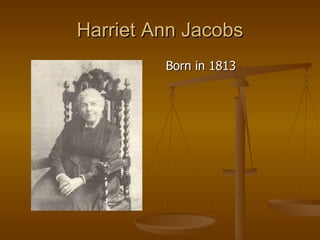
Harriet Ann Jacobs Born in 1813
Pleasant childhood Harriet was born into slavery, but lived with her family in a “comfortable” house throughout her early childhood. This was because not until the age of 6 did she even realize that she was a slave. “When I was six years old, my mother died; and then, for the first time, I learned, by the talk around me, that I was a slave. “ – Harriet Jacobs
Jacobs learns to sew. After her mother’s death, at the age of 6, Jacobs moved in with her Grandmother. Here, her new mistress Margaret taught her how to read and sew.  Both her mistress, and her Grandmother taught her Christian values.
The teacher passes At age 12, Jacobs’ mistress and teacher, Margaret, passed away, and Jacobs and all of her family were willed to the mistress’ niece. The niece was only 5 years old at the time, so the niece’s father became Jacobs’ master.
Sexual abuse Jacobs endured a massive amount of sexual abuse from her new master, Norcom, which is all portrayed in her autobiography. Norcom would not allow Jacobs to marry any men, regardless of their race or slave status.
Samuel Tredwell Sawyer Jacobs began to see a man named Sawyer, an unmarried lawyer. At the age of 15, she became pregnant by him trying to make her master mad so he would sell her and her kids so that the lawyer could purchase them. Jacobs had two children, but her master refused to sell Jacobs or her children.
The escape Jacobs escaped her master when she was 21 with the help of friends. She stayed in friend’s houses throughout the town. Eventually she was forced to stay in a small crawl space for almost seven years in her Grandmother’s attic. Later, she managed to pose as a sailor and escape to the north on a merchant ship.
The North Jacobs was free in the North, but racism still surrounded her. Jacob’s was reunited with her daughter once she reached New York and later her son too.
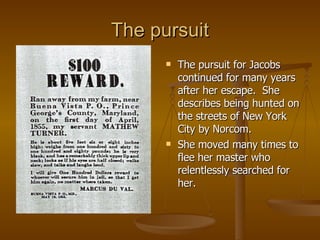
The pursuit The pursuit for Jacobs continued for many years after her escape.  She describes being hunted on the streets of New York City by Norcom. She moved many times to flee her master who relentlessly searched for her.
Freedom In 1852 Jacob’s owner at the time, Norcom’s son-in-law, finally gave in and sold her to someone who gave her immediate freedom in New York. “So I was sold at last! A human being sold in the free city of New York! “ – Harriet Jacobs.
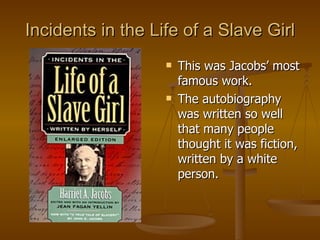
Incidents in the Life of a Slave Girl This was Jacobs’ most famous work. The autobiography was written so well that many people thought it was fiction, written by a white person.
Abolitionist After Jacobs was granted her freedom, she became an avid abolitionist. Jacobs worked with the “North Star”, which was run by Frederick Douglas. In 1861 her autobiography, “Incidents in the life of a slave girl” was published in the United States.
Death Harriet Jacobs passed away when she was 84, in 1897. She helped with civil rights, black education, and slavery refugees until she died.

Harriet Ann Jacobs 2

  • 1.
    Harriet Ann JacobsBorn in 1813
  • 2.
    Pleasant childhood Harrietwas born into slavery, but lived with her family in a “comfortable” house throughout her early childhood. This was because not until the age of 6 did she even realize that she was a slave. “When I was six years old, my mother died; and then, for the first time, I learned, by the talk around me, that I was a slave. “ – Harriet Jacobs
  • 3.
    Jacobs learns tosew. After her mother’s death, at the age of 6, Jacobs moved in with her Grandmother. Here, her new mistress Margaret taught her how to read and sew. Both her mistress, and her Grandmother taught her Christian values.
  • 4.
    The teacher passesAt age 12, Jacobs’ mistress and teacher, Margaret, passed away, and Jacobs and all of her family were willed to the mistress’ niece. The niece was only 5 years old at the time, so the niece’s father became Jacobs’ master.
  • 5.
    Sexual abuse Jacobsendured a massive amount of sexual abuse from her new master, Norcom, which is all portrayed in her autobiography. Norcom would not allow Jacobs to marry any men, regardless of their race or slave status.
  • 6.
    Samuel Tredwell SawyerJacobs began to see a man named Sawyer, an unmarried lawyer. At the age of 15, she became pregnant by him trying to make her master mad so he would sell her and her kids so that the lawyer could purchase them. Jacobs had two children, but her master refused to sell Jacobs or her children.
  • 7.
    The escape Jacobsescaped her master when she was 21 with the help of friends. She stayed in friend’s houses throughout the town. Eventually she was forced to stay in a small crawl space for almost seven years in her Grandmother’s attic. Later, she managed to pose as a sailor and escape to the north on a merchant ship.
  • 8.
    The North Jacobswas free in the North, but racism still surrounded her. Jacob’s was reunited with her daughter once she reached New York and later her son too.
  • 9.
    The pursuit Thepursuit for Jacobs continued for many years after her escape. She describes being hunted on the streets of New York City by Norcom. She moved many times to flee her master who relentlessly searched for her.
  • 10.
    Freedom In 1852Jacob’s owner at the time, Norcom’s son-in-law, finally gave in and sold her to someone who gave her immediate freedom in New York. “So I was sold at last! A human being sold in the free city of New York! “ – Harriet Jacobs.
  • 11.
    Incidents in theLife of a Slave Girl This was Jacobs’ most famous work. The autobiography was written so well that many people thought it was fiction, written by a white person.
  • 12.
    Abolitionist After Jacobswas granted her freedom, she became an avid abolitionist. Jacobs worked with the “North Star”, which was run by Frederick Douglas. In 1861 her autobiography, “Incidents in the life of a slave girl” was published in the United States.
  • 13.
    Death Harriet Jacobspassed away when she was 84, in 1897. She helped with civil rights, black education, and slavery refugees until she died.