Narrative of The
Life of Frederick
Douglass
BY: KATHERINE RIVERA, CHERYL FUNDA, JACCOB BARNES, AND JACK
INTAGLIATO
Cultural/Historical
Context
KATHERINE RIVERA
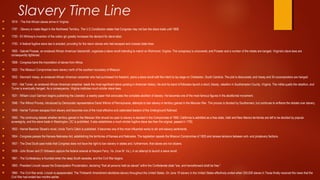
Slavery Time Line
 1619 - The first African slaves arrive in Virginia.
 1787 - Slavery is made illegal in the Northwest Territory. The U.S Constitution states that Congress may not ban the slave trade until 1808.
 1793 - Eli Whitney's invention of the cotton gin greatly increases the demand for slave labor.
 1793 - A federal fugitive slave law is enacted, providing for the return slaves who had escaped and crossed state lines.
 1800 - Gabriel Prosser, an enslaved African American blacksmith, organizes a slave revolt intending to march on Richmond, Virginia. The conspiracy is uncovered, and Prosser and a number of the rebels are hanged. Virginia's slave laws are

consequently tightened.
 1808 - Congress bans the importation of slaves from Africa.
 1820 - The Missouri Compromise bans slavery north of the southern boundary of Missouri.
 1822 - Denmark Vesey, an enslaved African American carpenter who had purchased his freedom, plans a slave revolt with the intent to lay siege on Charleston, South Carolina. The plot is discovered, and Vesey and 34 coconspirators are hanged.
 1831 - Nat Turner, an enslaved African American preacher, leads the most significant slave uprising in American history. He and his band of followers launch a short, bloody, rebellion in Southampton County, Virginia. The militia quells the rebellion, and
Turner is eventually hanged. As a consequence, Virginia institutes much stricter slave laws.
 1831 - William Lloyd Garrison begins publishing the Liberator, a weekly paper that advocates the complete abolition of slavery. He becomes one of the most famous figures in the abolitionist movement.
 1846 - The Wilmot Proviso, introduced by Democratic representative David Wilmot of Pennsylvania, attempts to ban slavery in territory gained in the Mexican War. The proviso is blocked by Southerners, but continues to enflame the debate over slavery.
 1849 - Harriet Tubman escapes from slavery and becomes one of the most effective and celebrated leaders of the Underground Railroad.
 1850 - The continuing debate whether territory gained in the Mexican War should be open to slavery is decided in the Compromise of 1850: California is admitted as a free state, Utah and New Mexico territories are left to be decided by popular
sovereignty, and the slave trade in Washington, DC is prohibited. It also establishes a much stricter fugitive slave law than the original, passed in 1793.
 1852 - Harriet Beecher Stowe's novel, Uncle Tom's Cabin is published. It becomes one of the most influential works to stir anti-slavery sentiments.
 1854 - Congress passes the Kansas-Nebraska Act, establishing the territories of Kansas and Nebraska. The legislation repeals the Missouri Compromise of 1820 and renews tensions between anti- and proslavery factions.
 1857 - The Dred Scott case holds that Congress does not have the right to ban slavery in states and, furthermore, that slaves are not citizens.
 1859 - John Brown and 21 followers capture the federal arsenal at Harpers Ferry, Va. (now W. Va.), in an attempt to launch a slave revolt.
 1861 - The Confederacy is founded when the deep South secedes, and the Civil War begins.
 1863 - President Lincoln issues the Emancipation Proclamation, declaring "that all persons held as slaves" within the Confederate state "are, and henceforward shall be free."
 1865 - The Civil War ends. Lincoln is assassinated. The Thirteenth Amendment abolishes slavery throughout the United States. On June 19 slavery in the United States effectively ended when 250,000 slaves in Texas finally received the news that the
Civil War had ended two months earlier.
Slave Trade Routes
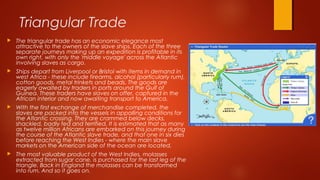
Triangular Trade
 The triangular trade has an economic elegance most
attractive to the owners of the slave ships. Each of the three
separate journeys making up an expedition is profitable in its
own right, with only the 'middle voyage' across the Atlantic
involving slaves as cargo.
 Ships depart from Liverpool or Bristol with items in demand in
west Africa - these include firearms, alcohol (particularly rum),
cotton goods, metal trinkets and beads. The goods are
eagerly awaited by traders in ports around the Gulf of
Guinea. These traders have slaves on offer, captured in the
African interior and now awaiting transport to America.
 With the first exchange of merchandise completed, the
slaves are packed into the vessels in appalling conditions for
the Atlantic crossing. They are crammed below decks,
shackled, badly fed and terrified. It is estimated that as many
as twelve million Africans are embarked on this journey during
the course of the Atlantic slave trade, and that one in six dies
before reaching the West Indies - where the main slave
markets on the American side of the ocean are located.
 The most valuable product of the West Indies, molasses
extracted from sugar cane, is purchased for the last leg of the
triangle. Back in England the molasses can be transformed
into rum. And so it goes on.
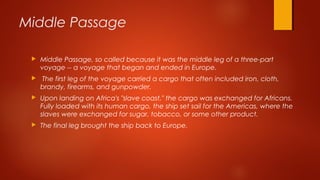
Middle Passage
 Middle Passage, so called because it was the middle leg of a three-part
voyage -- a voyage that began and ended in Europe.
 The first leg of the voyage carried a cargo that often included iron, cloth,
brandy, firearms, and gunpowder.
 Upon landing on Africa's "slave coast," the cargo was exchanged for Africans.
Fully loaded with its human cargo, the ship set sail for the Americas, where the
slaves were exchanged for sugar, tobacco, or some other product.
 The final leg brought the ship back to Europe.
The Journey
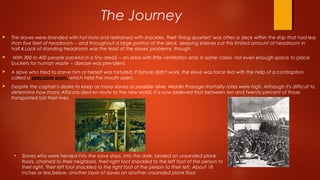
 The slaves were branded with hot irons and restrained with shackles. Their "living quarters" was often a deck within the ship that had less
than five feet of headroom -- and throughout a large portion of the deck, sleeping shelves cut this limited amount of headroom in
half.4 Lack of standing headroom was the least of the slaves' problems, though.
 With 300 to 400 people packed in a tiny area5 -- an area with little ventilation and, in some cases, not even enough space to place
buckets for human waste -- disease was prevalent.
 A slave who tried to starve him or herself was tortured. If torture didn't work, the slave was force fed with the help of a contraption
called a speculum orum, which held the mouth open.
 Despite the captain's desire to keep as many slaves as possible alive, Middle Passage mortality rates were high. Although it's difficult to
determine how many Africans died en route to the new world, it is now believed that between ten and twenty percent of those
transported lost their lives.
• Slaves who were herded into the slave ships, into the dark, landed on unsanded plank
floors, chained to their neighbors, their right foot shackled to the left foot of the person to
their right. Their left foot shackled to the right foot of the person to their left. About 18
inches or less below, another layer of slaves on another unsanded plank floor.
Politics of Slavery
 Slavery has been a major area of disagreement between the northern and southern states ever since the first compromise is
achieved on the issue at the constitutional convention of 1787. It becomes a particularly hot political issue in 1819 during
congressional debates on the application of Missouri for statehood. Settled largely from neighboring Kentucky, Missouri contains
many slaves on the plantations.
 In 1819 a New York congressman, James Tallmadge, proposes an amendment to the Missouri bill to the effect that no further slaves
shall be brought into the state and that children of existing slaves shall be freed at the age of twenty-five. The house of
representatives, with a preponderance of congressmen from the more populous north, passes the Tallmadge amendment. In the
senate, where eleven southern and eleven northern states have two senators each, the amendment fails to win a majority. It is an
issue of great importance since the two new senators of a 'free' or a 'slave' state will tip the existing balance one way or the other.
The impasse is broken by another in the series of practical compromises on this contentious issue.
 It is agreed in 1820 that the district of Maine will be separated from Massachusetts to become an independent free state, the 23rd
in the union.
 Missouri, with its slaves, follows in 1821 as the 24th. The balance is kept in the senate.
 The Missouri Compromise, as the measures of 1820 become known, includes one other clause passed separately by congress. This
legislates in advance for the territory beyond Missouri, stating that no more slave states shall be admitted to the union north of
latitude 36.30 (the continuation of the southern boundary of Missouri).The compromise holds good for the next thirty years, during
which an equal number of new slave and free states enter the union (Arkansas, Florida and Texas in the south, Michigan, Iowa and
Wisconsin in the north).
 In 1849 the issue returns. California applies to join the union as a free state.
 For the first time since 1820 the southern states are in danger of being outvoted in the senate. This time the compromise patched
together is more complex, consisting of five separate agreements passed during 1850. Concessions to the north include the key
issue of Californian admission to the union as a free state; and the banning of the slave trade (but not slavery itself) in the nation's
capital city, Washington, and the surrounding district of Columbia. Concessions to the south are the promise that when New Mexico
and Utah are ready for statehood, they may enter the union either with or without slavery; the federal payment of $10 million dollars
of Texan debt; and new and more stringent Fugitive Slave Laws.
 The Fugitive Slave Laws, passed in 1793, have been a continuing cause of local friction. They allow southern slave owners to reclaim
escaped slaves found in northern states. Northern magistrates have often made a policy of deliberately frustrating the slave owners' legal
rights in this respect. The Fugitive Slave Laws of 1850 attempt to prevent this (though in practice they have the opposite effect, prompting
northern states to pass new laws safeguarding liberty).It is believed by many that the Compromise of 1850 will resolve the thorny issue. It
does nothing of the kind. Within four years the question of Kansas escalates the crisis.
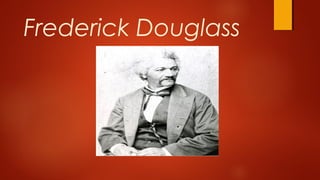
Frederick Douglass
 Born in Maryland around 1818 by the name of Frederick Augustus
Washington Bailey .
 Was a slave until he escaped in 1838.
 The “Narrative in the Life of Frederick Douglass” written by Douglass
describes in detail his life as a slave.
 This presentation will focus on his escape and his life following
slavery.
Introduction
 “I have given the public what I considered very good reasons for
withholding the manner of my escape. In substance these reasons
were, first that such publication at any time during the existence of
slavery might be used by the master against the slave (Douglass).”
Escaping Slavery
“My success was due to address rather than courage,
to good luck rather than bravery. My means of
escape were provided for me by the very men who
were making laws to hold and bind me more securely
in slavery (Douglass).”
 Douglass had a Sailor friend who owned “sailor’s protection”. This
was a document that had an American Eagle in the heading and
described the person who had it in his possession. This had the same
significance as did free papers.
 After obtaining this document, Douglass hopped a train heading
north. He wore sailor attire, and was well versed in the way a sailor
talks due to his time working in a shipyard. During his time on the
train however he was asked to show his papers which could have
been the abrupt end to his escape. Lucky for him the conductor
did not read the description because if he did, Douglass most likely
would have been caught.
The Trip North
“The train was moving at a very high rate of speed for that epoch of
railroad travel, but to my anxious mind it was moving far too slowly.
Minutes were hours, and hours were days (Douglass).”
• Douglass found that there were
a few people on the train that
he actually knew. Only one
person that he recognized
seemed to recognize him back
and, for which he is not sure, the
gentlemen did not call attention
to his escape and left him alone.
• The train took him through
Maryland and Delaware which
were both slave states. This put
Douglass in grave danger of
being captured. After taking a
steam boat to Philadelphia,
Douglass hopped another train
to New York.
NEW YORK
 Douglass arrived in New York less than 24
hours after escaping.
 New York did not turn out to be the safe
haven that Douglass was expecting.
 He was able to find Mr. Ruggles who was an
officer in the Underground Railroad.
 Mr. Ruggles hid Douglass until his
fiancé (a free women) could
come from Baltimore to meet him.
 After getting married, Douglass
and his new wife set out for New
Bedford Massachusetts to start
their new lives together.
 Douglass was under the impression that people needed
slaves to make a profit and live a life of luxury. He was
pleasantly surprised to learn that people in the North
were able to provide for themselves just as well as, if not
better without the use of slaves.
 He learned many trades and worked hard to provide for
him and his wife.
 Douglass did not escape racial inequality in New
Bedford, but it was an improvement from the South, and
something he was determined to overcome.
Life in the North
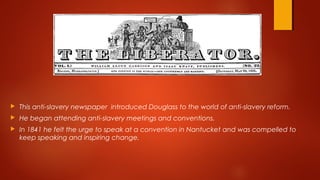
 This anti-slavery newspaper introduced Douglass to the world of anti-slavery reform.
 He began attending anti-slavery meetings and conventions.
 In 1841 he felt the urge to speak at a convention in Nantucket and was compelled to
keep speaking and inspiring change.
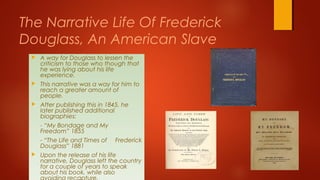
The Narrative Life Of Frederick
Douglass, An American Slave
 A way for Douglass to lessen the
criticism to those who though that
he was lying about his life
experience.
 This narrative was a way for him to
reach a greater amount of
people.
 After publishing this in 1845, he
later published additional
biographies:
- “My Bondage and My
Freedom” 1855
- “The Life and Times of Frederick
Douglass” 1881
 Upon the release of his life
narrative, Douglass left the country
for a couple of years to speak
about his book, while also
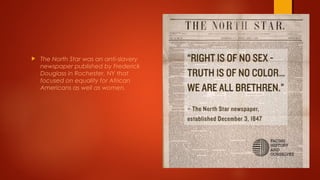
 The North Star was an anti-slavery
newspaper published by Frederick
Douglass in Rochester, NY that
focused on equality for African
Americans as well as women.
“Fourth Of July Speech 1852”
 Strongly supported by Frederick Douglass.
 Was an advisor for Abraham Lincoln.
 Encouraged the use of African Americans as soldiers in the Union
army.
 Led to the abolition of slavery in the United States.
Civil War
 Attended the Seneca Falls Women’s Rights Convention
 Helped found the American Equal Rights Association.
 He believed in Equal Rights for all.
Women’s Rights
 U.S. Marshall for the District of Columbia (1877-1881)
 Registrar of Deeds (1881-1886)
 U.S. Minister to Haiti(1889-1891)
 Charge d’affaires for Santo Domingo (1889-1891)
Political Office
Douglass spent his life fighting for the rights of
humanity. He believed that every one in this country
deserved the right to be treated equally regardless of
gender or race. He was an important leader of Civil
Rights and influenced many activists to follow. He died
of a Heart attack in 1895, but he will forever have a
place in history as a great leader and influence for
change and equality.
If Frederick Douglass was born 150
years later, what kind of impact do
you think he would have on the
society that we live in now? Do you
think that he would be in politics, or
maybe be an educator?
African American
Artistic Movement
OF THE 1800’S
Music
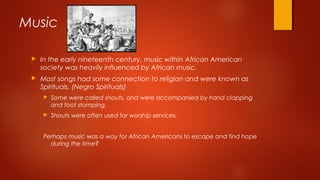
 In the early nineteenth century, music within African American
society was heavily influenced by African music.
 Most songs had some connection to religion and were known as
Spirituals. (Negro Spirituals)
 Some were called shouts, and were accompanied by hand clapping
and foot stomping.
 Shouts were often used for worship services.
Perhaps music was a way for African Americans to escape and find hope
during the time?
Music
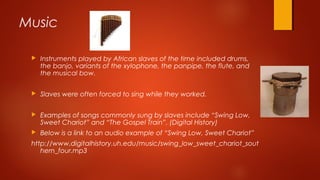
 Instruments played by African slaves of the time included drums,
the banjo, variants of the xylophone, the panpipe, the flute, and
the musical bow.
 Slaves were often forced to sing while they worked.
 Examples of songs commonly sung by slaves include “Swing Low,
Sweet Chariot” and “The Gospel Train”. (Digital History)
 Below is a link to an audio example of “Swing Low, Sweet Chariot”
http://www.digitalhistory.uh.edu/music/swing_low_sweet_chariot_sout
hern_four.mp3
Architecture
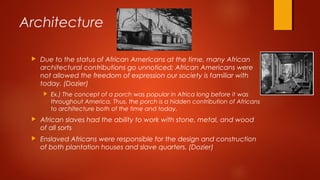
 Due to the status of African Americans at the time, many African
architectural contributions go unnoticed; African Americans were
not allowed the freedom of expression our society is familiar with
today. (Dozier)
 Ex.) The concept of a porch was popular in Africa long before it was
throughout America. Thus, the porch is a hidden contribution of Africans
to architecture both of the time and today.
 African slaves had the ability to work with stone, metal, and wood
of all sorts
 Enslaved Africans were responsible for the design and construction
of both plantation houses and slave quarters. (Dozier)
What do you think the porch being
an African architectural concept
says about African values?
Art
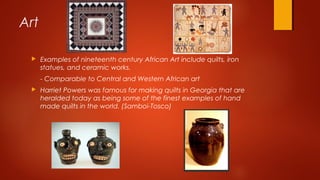
 Examples of nineteenth century African Art include quilts, iron
statues, and ceramic works.
- Comparable to Central and Western African art
 Harriet Powers was famous for making quilts in Georgia that are
heralded today as being some of the finest examples of hand
made quilts in the world. (Samboi-Tosco)
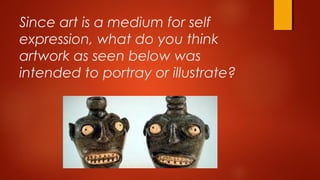
Since art is a medium for self
expression, what do you think
artwork as seen below was
intended to portray or illustrate?
Literary Analysis
“The Narrative of the Life of Frederick Douglass, an American Slave”
was written by Frederick Douglass himself. This narrative tells the story
about Douglass’ whole life. It starts out with Douglass being born into
slavery, and being a slave for a little over two decades. The author
then writes about his later years of being a freed slave and also an
abolitionist for slavery.
Douglass uses a good theme of Christianity throughout his narrative. “I
held my Sabbath school at the house of a free colored man, whose
name I deem it imprudent to mention; for should it be known, it might
embarrass him greatly, though the crime of holding the school was
committed ten years ago” (Douglass 553). As you can see, this would
support the theme for Christianity, because Douglass is describing
where he held Sabbath school, which is the biblical term for Sunday
school.
“The Attack on Christianity in NARRATIVE OF THE LIFE
OF FREDERICK DOUGLASS, AN AMERICAN SLAVE”
takes a closer look of how the theme of Christianity is
perceived in the narrative. “The appendix offers only
the final indications that something inherent in
Christianity inclines its adherents toward an embrace
of slavery, and what that something might be is
suggested in the description of Colonel Lloyd’s
garden”(Peyser 87). What Peyser is referring to here is
Adam and Eve in the Garden of Eden, when they
both eat fruit from the one tree in the garden that
God specifically told them not to eat from, resulting
in punishment from God. “Scarcely a day passed,
during the summer, but that some slave had to take
the lash for stealing the fruit”(Douglass 523). Peyser
does a good job observing the way Douglass
portrays the event and relates it to a biblical story.
Peyser analyzes Colonel Lloyd as a God-like figure. “Perhaps most fundamentally,
the position of both rests on the assumption that the universe is and ought to be
hierarchically structured. Colonel Lloyd, in a word, might very well be seen as
ordering things on earth as they are ordered in heaven, so long as one understands
the dynamics of lordship and submission as the heart of Christianity” (Peyser 87-88).
In Douglass’ narrative, Colonel Lloyd is obviously a master to a multitude of slaves,
and those slaves seem to portray him as a “higher being” so to speak. Peyser,
explains how the universe is hierarchically structured, meaning that God is the ruler
of the world in a Christian’s point of view. He then says how Colonel Lloyd was a
God-like figure to the slaves because he was the ruler of the slaves.
Peyser now brings up the opposite side of Christianity in the narrative. He points out
how Mr. Covey replicates the characteristics of Satan. “That Douglass does indeed
so understand Christian dogma is suggested by the most subtly blasphemous
passage of the Narrative. In the space of one paragraph, the slave-breaking
overseer Mr. Covey is referred to as “the snake” (322) and as one whose “comings
were like a thief in the night” (323). He is thus at once associated with the Satan of
Genesis and with the come-again Christ of 1 Thessalonians.”(Peyser 88). Peyser
seems to be talking about how Douglass uses the symbolism of the snake to show
how sneaky Mr. Covey was, just as Satan was in the Bible when he was disguised as
a snake. Peyser quotes the metaphor, “His comings were like a thief in the night”
(544 Douglass), and uses it as a reference point to 1 Thessalonians 5:2, which states
the same line. He uses a good juxtaposition in regards to what Douglass meant by
the quote above, and what 1 Thessalonians 5:2 meant by it. Douglass was referring
to Satan as the thief in the night, whereas 1 Thessalonians 5:2 was referring to the
coming of God as the thief in the night. Peyser makes a good point when he says,
“While not wholly implausible, this reading requires us to reject the idea that
Douglass really means what he seems to imply, namely that Covey recalls both
Christ and the Devil. It is not hard to see why Covey might do so, for Douglass
describes the overseer in terms that suggest both God’s omnipresence and Satan’s
readiness to strike at every opportunity” (Peyser 88). How could one human being
portray both God and Satan at the same time? Certainly it is not possible to be
able to portray two very distinctively opposite people. This is why Peyser says we
must reject that Mr. Covey recalls both God and Satan.
God and Satan are the two most important parts that make up Christianity.
Douglass does an excellent job portraying both in his narrative, which is what
makes the theme of Christianity so important in this narrative.
Vince Brewton viewed the narrative in a complete different way than Peyser.
He did not get into the Christian theme, but more into respect, and self-making.
“Bold defiance took its place”- “Respect” and Self-Making in Narrative of the Life
of Frederick Douglass, an American Slave” is about Douglass basically raising
himself and finding his purpose. Brewton writes how there have been questions
regarding if some of Douglass’ claims are accurate. “Douglass's biographer
William S. McFeely has raised serious questions about the accuracy of some of
Douglass's claims, but scholarship on the issue of Douglass's factual accounts
remains divided “ (Brewton 706). This means that there is not any evidence to
accuse Douglass of not having accurate claims. With that being said, the main
question to get at is, what does Brewton mean by “Self-Making”? The respect
part is pretty obvious, because Douglass was a very well respected man after he
was free and some of the time he was in slavery. This is what Brewton means by
“Self-Making”, “Douglass has available to him in his repertoire of identity options
the self-made man, the Franklinian owner and proprietor of the self, and if any
person literally realized the conception "self-made" it would be a self-freed slave”
(Brewton 708).
In conclusion, Douglass did a very exquisite job in
using literary elements in his narrative. The most
important element that he used was the theme of
Christianity. The reason for this is because, if Douglass
did not use the theme of Christianity, then he would
not have gained the attention of the abolitionists as
easily.
Works Cited
"Abolitionists and Insurrection Unit - Frederick Douglass "4th of July" (People Speak)." YouTube. YouTube, 18 Feb. 2014.
Web. 6 Feb. 2015. <https://www.youtube.com/watch?v=wkH2Ck-gH0I>.
“Between 1865 and 1925.” Negro Spirituals. Spiritual Workshop, n.d. Web. 03 Feb. 2015.
“Digital History.” Digital History. Digital History, n.d. Web. 04 Feb. 2015.
Dozier, Richard K. “Black Architects have a rich American history.” Black Architects Have A Rich American History.
Florida A&M University, 1997. Web. 04 Feb. 2015.
Douglass, Frederick. "My Escape From Slavery." Page by Page Books. 1 Nov. 1881. Web. 6 Feb. 2015.
"Frederick Douglass." History.com. Ed. Eric Foner and John Garraty. Houghton Mifflin Harcourt Publishing Company,
1991. Web. 6 Feb. 2015. <http://www.history.com/topics/black-history/frederick-douglass>.
Puchner, Martin. "Frederick Douglass." The Norton Anthology of World Literature. Shorter Third ed. New York: W.W.
Norton, 2013. 512-517. Print.
Samboi- Tosco, Kimberly. “Slavery and the Making of America.” Pbs. Pbs, n.d. Web. 04 Feb. 2015.
http://www.pbs.org/wgbh/aia/part1/1p277.html
http://www.pbs.org/wgbh/aia/part1/1i3067.html
http://www.history.com/topics/black-history/slavery
http://www.infoplease.com/timelines/slavery.html
http://www.historyworld.net/wrldhis/PlainTextHistories.asp?ParagraphID=cio
Works Cited
Brewton, Vince. "Bold defiance took its place”- “Respect” and
Self-Making in Narrative of the Life of Frederick Douglass, an
American Slave." 58.3/4 (2005): 703-717. Academic Search Complete.
Web. 6 Feb. 2015.
Peyser, Thomas. "The Attack on Christianity in NARRATIVE OF
THE LIFE OF FREDERICK DOUGLASS, AN AMERICAN SLAVE."
69.2 (2011): 86-89. Academic Search Complete. Web. 6 Feb. 2015.
Puchner, Martin. The Norton Anthology of World Literature.
Shorter Third ed. Vol. 2. New York: W.W. Norton, 2013. 523,544,553.
Print.

Group 1 presentation douglass

  • 1.
    Narrative of The Lifeof Frederick Douglass BY: KATHERINE RIVERA, CHERYL FUNDA, JACCOB BARNES, AND JACK INTAGLIATO
  • 2.
  • 3.
    Slavery Time Line 1619 - The first African slaves arrive in Virginia.  1787 - Slavery is made illegal in the Northwest Territory. The U.S Constitution states that Congress may not ban the slave trade until 1808.  1793 - Eli Whitney's invention of the cotton gin greatly increases the demand for slave labor.  1793 - A federal fugitive slave law is enacted, providing for the return slaves who had escaped and crossed state lines.  1800 - Gabriel Prosser, an enslaved African American blacksmith, organizes a slave revolt intending to march on Richmond, Virginia. The conspiracy is uncovered, and Prosser and a number of the rebels are hanged. Virginia's slave laws are consequently tightened.  1808 - Congress bans the importation of slaves from Africa.  1820 - The Missouri Compromise bans slavery north of the southern boundary of Missouri.  1822 - Denmark Vesey, an enslaved African American carpenter who had purchased his freedom, plans a slave revolt with the intent to lay siege on Charleston, South Carolina. The plot is discovered, and Vesey and 34 coconspirators are hanged.  1831 - Nat Turner, an enslaved African American preacher, leads the most significant slave uprising in American history. He and his band of followers launch a short, bloody, rebellion in Southampton County, Virginia. The militia quells the rebellion, and Turner is eventually hanged. As a consequence, Virginia institutes much stricter slave laws.  1831 - William Lloyd Garrison begins publishing the Liberator, a weekly paper that advocates the complete abolition of slavery. He becomes one of the most famous figures in the abolitionist movement.  1846 - The Wilmot Proviso, introduced by Democratic representative David Wilmot of Pennsylvania, attempts to ban slavery in territory gained in the Mexican War. The proviso is blocked by Southerners, but continues to enflame the debate over slavery.  1849 - Harriet Tubman escapes from slavery and becomes one of the most effective and celebrated leaders of the Underground Railroad.  1850 - The continuing debate whether territory gained in the Mexican War should be open to slavery is decided in the Compromise of 1850: California is admitted as a free state, Utah and New Mexico territories are left to be decided by popular sovereignty, and the slave trade in Washington, DC is prohibited. It also establishes a much stricter fugitive slave law than the original, passed in 1793.  1852 - Harriet Beecher Stowe's novel, Uncle Tom's Cabin is published. It becomes one of the most influential works to stir anti-slavery sentiments.  1854 - Congress passes the Kansas-Nebraska Act, establishing the territories of Kansas and Nebraska. The legislation repeals the Missouri Compromise of 1820 and renews tensions between anti- and proslavery factions.  1857 - The Dred Scott case holds that Congress does not have the right to ban slavery in states and, furthermore, that slaves are not citizens.  1859 - John Brown and 21 followers capture the federal arsenal at Harpers Ferry, Va. (now W. Va.), in an attempt to launch a slave revolt.  1861 - The Confederacy is founded when the deep South secedes, and the Civil War begins.  1863 - President Lincoln issues the Emancipation Proclamation, declaring "that all persons held as slaves" within the Confederate state "are, and henceforward shall be free."  1865 - The Civil War ends. Lincoln is assassinated. The Thirteenth Amendment abolishes slavery throughout the United States. On June 19 slavery in the United States effectively ended when 250,000 slaves in Texas finally received the news that the Civil War had ended two months earlier.
  • 4.
  • 5.
    Triangular Trade  Thetriangular trade has an economic elegance most attractive to the owners of the slave ships. Each of the three separate journeys making up an expedition is profitable in its own right, with only the 'middle voyage' across the Atlantic involving slaves as cargo.  Ships depart from Liverpool or Bristol with items in demand in west Africa - these include firearms, alcohol (particularly rum), cotton goods, metal trinkets and beads. The goods are eagerly awaited by traders in ports around the Gulf of Guinea. These traders have slaves on offer, captured in the African interior and now awaiting transport to America.  With the first exchange of merchandise completed, the slaves are packed into the vessels in appalling conditions for the Atlantic crossing. They are crammed below decks, shackled, badly fed and terrified. It is estimated that as many as twelve million Africans are embarked on this journey during the course of the Atlantic slave trade, and that one in six dies before reaching the West Indies - where the main slave markets on the American side of the ocean are located.  The most valuable product of the West Indies, molasses extracted from sugar cane, is purchased for the last leg of the triangle. Back in England the molasses can be transformed into rum. And so it goes on.
  • 6.
    Middle Passage  MiddlePassage, so called because it was the middle leg of a three-part voyage -- a voyage that began and ended in Europe.  The first leg of the voyage carried a cargo that often included iron, cloth, brandy, firearms, and gunpowder.  Upon landing on Africa's "slave coast," the cargo was exchanged for Africans. Fully loaded with its human cargo, the ship set sail for the Americas, where the slaves were exchanged for sugar, tobacco, or some other product.  The final leg brought the ship back to Europe.
  • 7.
    The Journey  Theslaves were branded with hot irons and restrained with shackles. Their "living quarters" was often a deck within the ship that had less than five feet of headroom -- and throughout a large portion of the deck, sleeping shelves cut this limited amount of headroom in half.4 Lack of standing headroom was the least of the slaves' problems, though.  With 300 to 400 people packed in a tiny area5 -- an area with little ventilation and, in some cases, not even enough space to place buckets for human waste -- disease was prevalent.  A slave who tried to starve him or herself was tortured. If torture didn't work, the slave was force fed with the help of a contraption called a speculum orum, which held the mouth open.  Despite the captain's desire to keep as many slaves as possible alive, Middle Passage mortality rates were high. Although it's difficult to determine how many Africans died en route to the new world, it is now believed that between ten and twenty percent of those transported lost their lives. • Slaves who were herded into the slave ships, into the dark, landed on unsanded plank floors, chained to their neighbors, their right foot shackled to the left foot of the person to their right. Their left foot shackled to the right foot of the person to their left. About 18 inches or less below, another layer of slaves on another unsanded plank floor.
  • 8.
    Politics of Slavery Slavery has been a major area of disagreement between the northern and southern states ever since the first compromise is achieved on the issue at the constitutional convention of 1787. It becomes a particularly hot political issue in 1819 during congressional debates on the application of Missouri for statehood. Settled largely from neighboring Kentucky, Missouri contains many slaves on the plantations.  In 1819 a New York congressman, James Tallmadge, proposes an amendment to the Missouri bill to the effect that no further slaves shall be brought into the state and that children of existing slaves shall be freed at the age of twenty-five. The house of representatives, with a preponderance of congressmen from the more populous north, passes the Tallmadge amendment. In the senate, where eleven southern and eleven northern states have two senators each, the amendment fails to win a majority. It is an issue of great importance since the two new senators of a 'free' or a 'slave' state will tip the existing balance one way or the other. The impasse is broken by another in the series of practical compromises on this contentious issue.  It is agreed in 1820 that the district of Maine will be separated from Massachusetts to become an independent free state, the 23rd in the union.  Missouri, with its slaves, follows in 1821 as the 24th. The balance is kept in the senate.  The Missouri Compromise, as the measures of 1820 become known, includes one other clause passed separately by congress. This legislates in advance for the territory beyond Missouri, stating that no more slave states shall be admitted to the union north of latitude 36.30 (the continuation of the southern boundary of Missouri).The compromise holds good for the next thirty years, during which an equal number of new slave and free states enter the union (Arkansas, Florida and Texas in the south, Michigan, Iowa and Wisconsin in the north).  In 1849 the issue returns. California applies to join the union as a free state.  For the first time since 1820 the southern states are in danger of being outvoted in the senate. This time the compromise patched together is more complex, consisting of five separate agreements passed during 1850. Concessions to the north include the key issue of Californian admission to the union as a free state; and the banning of the slave trade (but not slavery itself) in the nation's capital city, Washington, and the surrounding district of Columbia. Concessions to the south are the promise that when New Mexico and Utah are ready for statehood, they may enter the union either with or without slavery; the federal payment of $10 million dollars of Texan debt; and new and more stringent Fugitive Slave Laws.  The Fugitive Slave Laws, passed in 1793, have been a continuing cause of local friction. They allow southern slave owners to reclaim escaped slaves found in northern states. Northern magistrates have often made a policy of deliberately frustrating the slave owners' legal rights in this respect. The Fugitive Slave Laws of 1850 attempt to prevent this (though in practice they have the opposite effect, prompting northern states to pass new laws safeguarding liberty).It is believed by many that the Compromise of 1850 will resolve the thorny issue. It does nothing of the kind. Within four years the question of Kansas escalates the crisis.
  • 9.
  • 10.
     Born inMaryland around 1818 by the name of Frederick Augustus Washington Bailey .  Was a slave until he escaped in 1838.  The “Narrative in the Life of Frederick Douglass” written by Douglass describes in detail his life as a slave.  This presentation will focus on his escape and his life following slavery. Introduction
  • 11.
     “I havegiven the public what I considered very good reasons for withholding the manner of my escape. In substance these reasons were, first that such publication at any time during the existence of slavery might be used by the master against the slave (Douglass).” Escaping Slavery
  • 12.
    “My success wasdue to address rather than courage, to good luck rather than bravery. My means of escape were provided for me by the very men who were making laws to hold and bind me more securely in slavery (Douglass).”
  • 13.
     Douglass hada Sailor friend who owned “sailor’s protection”. This was a document that had an American Eagle in the heading and described the person who had it in his possession. This had the same significance as did free papers.  After obtaining this document, Douglass hopped a train heading north. He wore sailor attire, and was well versed in the way a sailor talks due to his time working in a shipyard. During his time on the train however he was asked to show his papers which could have been the abrupt end to his escape. Lucky for him the conductor did not read the description because if he did, Douglass most likely would have been caught. The Trip North
  • 14.
    “The train wasmoving at a very high rate of speed for that epoch of railroad travel, but to my anxious mind it was moving far too slowly. Minutes were hours, and hours were days (Douglass).” • Douglass found that there were a few people on the train that he actually knew. Only one person that he recognized seemed to recognize him back and, for which he is not sure, the gentlemen did not call attention to his escape and left him alone. • The train took him through Maryland and Delaware which were both slave states. This put Douglass in grave danger of being captured. After taking a steam boat to Philadelphia, Douglass hopped another train to New York.
  • 15.
    NEW YORK  Douglassarrived in New York less than 24 hours after escaping.  New York did not turn out to be the safe haven that Douglass was expecting.  He was able to find Mr. Ruggles who was an officer in the Underground Railroad.  Mr. Ruggles hid Douglass until his fiancé (a free women) could come from Baltimore to meet him.  After getting married, Douglass and his new wife set out for New Bedford Massachusetts to start their new lives together.
  • 16.
     Douglass wasunder the impression that people needed slaves to make a profit and live a life of luxury. He was pleasantly surprised to learn that people in the North were able to provide for themselves just as well as, if not better without the use of slaves.  He learned many trades and worked hard to provide for him and his wife.  Douglass did not escape racial inequality in New Bedford, but it was an improvement from the South, and something he was determined to overcome. Life in the North
  • 17.
     This anti-slaverynewspaper introduced Douglass to the world of anti-slavery reform.  He began attending anti-slavery meetings and conventions.  In 1841 he felt the urge to speak at a convention in Nantucket and was compelled to keep speaking and inspiring change.
  • 18.
    The Narrative LifeOf Frederick Douglass, An American Slave  A way for Douglass to lessen the criticism to those who though that he was lying about his life experience.  This narrative was a way for him to reach a greater amount of people.  After publishing this in 1845, he later published additional biographies: - “My Bondage and My Freedom” 1855 - “The Life and Times of Frederick Douglass” 1881  Upon the release of his life narrative, Douglass left the country for a couple of years to speak about his book, while also
  • 19.
     The NorthStar was an anti-slavery newspaper published by Frederick Douglass in Rochester, NY that focused on equality for African Americans as well as women.
  • 20.
    “Fourth Of JulySpeech 1852”
  • 21.
     Strongly supportedby Frederick Douglass.  Was an advisor for Abraham Lincoln.  Encouraged the use of African Americans as soldiers in the Union army.  Led to the abolition of slavery in the United States. Civil War
  • 22.
     Attended theSeneca Falls Women’s Rights Convention  Helped found the American Equal Rights Association.  He believed in Equal Rights for all. Women’s Rights
  • 23.
     U.S. Marshallfor the District of Columbia (1877-1881)  Registrar of Deeds (1881-1886)  U.S. Minister to Haiti(1889-1891)  Charge d’affaires for Santo Domingo (1889-1891) Political Office
  • 24.
    Douglass spent hislife fighting for the rights of humanity. He believed that every one in this country deserved the right to be treated equally regardless of gender or race. He was an important leader of Civil Rights and influenced many activists to follow. He died of a Heart attack in 1895, but he will forever have a place in history as a great leader and influence for change and equality.
  • 25.
    If Frederick Douglasswas born 150 years later, what kind of impact do you think he would have on the society that we live in now? Do you think that he would be in politics, or maybe be an educator?
  • 26.
  • 27.
    Music  In theearly nineteenth century, music within African American society was heavily influenced by African music.  Most songs had some connection to religion and were known as Spirituals. (Negro Spirituals)  Some were called shouts, and were accompanied by hand clapping and foot stomping.  Shouts were often used for worship services. Perhaps music was a way for African Americans to escape and find hope during the time?
  • 28.
    Music  Instruments playedby African slaves of the time included drums, the banjo, variants of the xylophone, the panpipe, the flute, and the musical bow.  Slaves were often forced to sing while they worked.  Examples of songs commonly sung by slaves include “Swing Low, Sweet Chariot” and “The Gospel Train”. (Digital History)  Below is a link to an audio example of “Swing Low, Sweet Chariot” http://www.digitalhistory.uh.edu/music/swing_low_sweet_chariot_sout hern_four.mp3
  • 29.
    Architecture  Due tothe status of African Americans at the time, many African architectural contributions go unnoticed; African Americans were not allowed the freedom of expression our society is familiar with today. (Dozier)  Ex.) The concept of a porch was popular in Africa long before it was throughout America. Thus, the porch is a hidden contribution of Africans to architecture both of the time and today.  African slaves had the ability to work with stone, metal, and wood of all sorts  Enslaved Africans were responsible for the design and construction of both plantation houses and slave quarters. (Dozier)
  • 30.
    What do youthink the porch being an African architectural concept says about African values?
  • 31.
    Art  Examples ofnineteenth century African Art include quilts, iron statues, and ceramic works. - Comparable to Central and Western African art  Harriet Powers was famous for making quilts in Georgia that are heralded today as being some of the finest examples of hand made quilts in the world. (Samboi-Tosco)
  • 32.
    Since art isa medium for self expression, what do you think artwork as seen below was intended to portray or illustrate?
  • 33.
    Literary Analysis “The Narrativeof the Life of Frederick Douglass, an American Slave” was written by Frederick Douglass himself. This narrative tells the story about Douglass’ whole life. It starts out with Douglass being born into slavery, and being a slave for a little over two decades. The author then writes about his later years of being a freed slave and also an abolitionist for slavery. Douglass uses a good theme of Christianity throughout his narrative. “I held my Sabbath school at the house of a free colored man, whose name I deem it imprudent to mention; for should it be known, it might embarrass him greatly, though the crime of holding the school was committed ten years ago” (Douglass 553). As you can see, this would support the theme for Christianity, because Douglass is describing where he held Sabbath school, which is the biblical term for Sunday school.
  • 34.
    “The Attack onChristianity in NARRATIVE OF THE LIFE OF FREDERICK DOUGLASS, AN AMERICAN SLAVE” takes a closer look of how the theme of Christianity is perceived in the narrative. “The appendix offers only the final indications that something inherent in Christianity inclines its adherents toward an embrace of slavery, and what that something might be is suggested in the description of Colonel Lloyd’s garden”(Peyser 87). What Peyser is referring to here is Adam and Eve in the Garden of Eden, when they both eat fruit from the one tree in the garden that God specifically told them not to eat from, resulting in punishment from God. “Scarcely a day passed, during the summer, but that some slave had to take the lash for stealing the fruit”(Douglass 523). Peyser does a good job observing the way Douglass portrays the event and relates it to a biblical story.
  • 35.
    Peyser analyzes ColonelLloyd as a God-like figure. “Perhaps most fundamentally, the position of both rests on the assumption that the universe is and ought to be hierarchically structured. Colonel Lloyd, in a word, might very well be seen as ordering things on earth as they are ordered in heaven, so long as one understands the dynamics of lordship and submission as the heart of Christianity” (Peyser 87-88). In Douglass’ narrative, Colonel Lloyd is obviously a master to a multitude of slaves, and those slaves seem to portray him as a “higher being” so to speak. Peyser, explains how the universe is hierarchically structured, meaning that God is the ruler of the world in a Christian’s point of view. He then says how Colonel Lloyd was a God-like figure to the slaves because he was the ruler of the slaves.
  • 36.
    Peyser now bringsup the opposite side of Christianity in the narrative. He points out how Mr. Covey replicates the characteristics of Satan. “That Douglass does indeed so understand Christian dogma is suggested by the most subtly blasphemous passage of the Narrative. In the space of one paragraph, the slave-breaking overseer Mr. Covey is referred to as “the snake” (322) and as one whose “comings were like a thief in the night” (323). He is thus at once associated with the Satan of Genesis and with the come-again Christ of 1 Thessalonians.”(Peyser 88). Peyser seems to be talking about how Douglass uses the symbolism of the snake to show how sneaky Mr. Covey was, just as Satan was in the Bible when he was disguised as a snake. Peyser quotes the metaphor, “His comings were like a thief in the night” (544 Douglass), and uses it as a reference point to 1 Thessalonians 5:2, which states the same line. He uses a good juxtaposition in regards to what Douglass meant by the quote above, and what 1 Thessalonians 5:2 meant by it. Douglass was referring to Satan as the thief in the night, whereas 1 Thessalonians 5:2 was referring to the coming of God as the thief in the night. Peyser makes a good point when he says, “While not wholly implausible, this reading requires us to reject the idea that Douglass really means what he seems to imply, namely that Covey recalls both Christ and the Devil. It is not hard to see why Covey might do so, for Douglass describes the overseer in terms that suggest both God’s omnipresence and Satan’s readiness to strike at every opportunity” (Peyser 88). How could one human being portray both God and Satan at the same time? Certainly it is not possible to be able to portray two very distinctively opposite people. This is why Peyser says we must reject that Mr. Covey recalls both God and Satan.
  • 37.
    God and Satanare the two most important parts that make up Christianity. Douglass does an excellent job portraying both in his narrative, which is what makes the theme of Christianity so important in this narrative. Vince Brewton viewed the narrative in a complete different way than Peyser. He did not get into the Christian theme, but more into respect, and self-making. “Bold defiance took its place”- “Respect” and Self-Making in Narrative of the Life of Frederick Douglass, an American Slave” is about Douglass basically raising himself and finding his purpose. Brewton writes how there have been questions regarding if some of Douglass’ claims are accurate. “Douglass's biographer William S. McFeely has raised serious questions about the accuracy of some of Douglass's claims, but scholarship on the issue of Douglass's factual accounts remains divided “ (Brewton 706). This means that there is not any evidence to accuse Douglass of not having accurate claims. With that being said, the main question to get at is, what does Brewton mean by “Self-Making”? The respect part is pretty obvious, because Douglass was a very well respected man after he was free and some of the time he was in slavery. This is what Brewton means by “Self-Making”, “Douglass has available to him in his repertoire of identity options the self-made man, the Franklinian owner and proprietor of the self, and if any person literally realized the conception "self-made" it would be a self-freed slave” (Brewton 708).
  • 38.
    In conclusion, Douglassdid a very exquisite job in using literary elements in his narrative. The most important element that he used was the theme of Christianity. The reason for this is because, if Douglass did not use the theme of Christianity, then he would not have gained the attention of the abolitionists as easily.
  • 39.
    Works Cited "Abolitionists andInsurrection Unit - Frederick Douglass "4th of July" (People Speak)." YouTube. YouTube, 18 Feb. 2014. Web. 6 Feb. 2015. <https://www.youtube.com/watch?v=wkH2Ck-gH0I>. “Between 1865 and 1925.” Negro Spirituals. Spiritual Workshop, n.d. Web. 03 Feb. 2015. “Digital History.” Digital History. Digital History, n.d. Web. 04 Feb. 2015. Dozier, Richard K. “Black Architects have a rich American history.” Black Architects Have A Rich American History. Florida A&M University, 1997. Web. 04 Feb. 2015. Douglass, Frederick. "My Escape From Slavery." Page by Page Books. 1 Nov. 1881. Web. 6 Feb. 2015. "Frederick Douglass." History.com. Ed. Eric Foner and John Garraty. Houghton Mifflin Harcourt Publishing Company, 1991. Web. 6 Feb. 2015. <http://www.history.com/topics/black-history/frederick-douglass>. Puchner, Martin. "Frederick Douglass." The Norton Anthology of World Literature. Shorter Third ed. New York: W.W. Norton, 2013. 512-517. Print. Samboi- Tosco, Kimberly. “Slavery and the Making of America.” Pbs. Pbs, n.d. Web. 04 Feb. 2015. http://www.pbs.org/wgbh/aia/part1/1p277.html http://www.pbs.org/wgbh/aia/part1/1i3067.html http://www.history.com/topics/black-history/slavery http://www.infoplease.com/timelines/slavery.html http://www.historyworld.net/wrldhis/PlainTextHistories.asp?ParagraphID=cio
  • 40.
    Works Cited Brewton, Vince."Bold defiance took its place”- “Respect” and Self-Making in Narrative of the Life of Frederick Douglass, an American Slave." 58.3/4 (2005): 703-717. Academic Search Complete. Web. 6 Feb. 2015. Peyser, Thomas. "The Attack on Christianity in NARRATIVE OF THE LIFE OF FREDERICK DOUGLASS, AN AMERICAN SLAVE." 69.2 (2011): 86-89. Academic Search Complete. Web. 6 Feb. 2015. Puchner, Martin. The Norton Anthology of World Literature. Shorter Third ed. Vol. 2. New York: W.W. Norton, 2013. 523,544,553. Print.