Fractures Rebekah Fascioli
What is a fracture? A fracture is complete or a partially broken bone. Fractures are very common. Children's bones are much more flexible and don’t break easily. Adult bones are much more easily broken as they are more brittle than children's. Fractures occur when a bone can't withstand the physical force exerted on it.
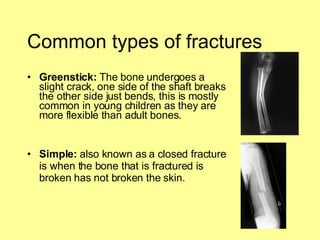
Common types of fractures Greenstick:  The bone undergoes a slight crack, one side of the shaft breaks the other side just bends, this is mostly common in young children as they are more flexible than adult bones. Simple:  also known as a closed fracture is when the bone that is fractured is broken has not broken the skin.
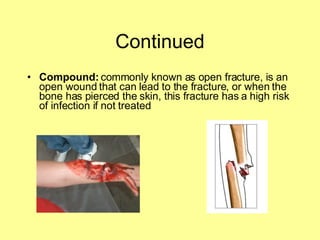
Continued Compound:  commonly known as open fracture, is an open wound that can lead to the fracture, or when the bone has pierced the skin, this fracture has a high risk of infection if not treated
Causes Fractures can be caused by Direct force The bone is broken at the place of impact. Abnormal muscular contraction A strong or sudden muscle contraction Indirect force Breaks in a place far from the area of impact Diseased bone A weak bone
Signs A sign is evidence of presence of a injury or disease. Signs that relate to a fracture include: Exposed bone Deformity  Swelling Redness
Symptoms A symptom is a change in the body that the patient can feel relating to a particular injury. Symptoms can vary, depending on the severity of the fracture. Common symptoms of a fracture include: Pain Bruising Swelling around the area  Bone deformity Inability of use Petruding bone  Numbness
Management Conduct a Primary Survey D- check for danger to yourself, bystanders and the casualty R- assess the responsiveness from the casualty. A- check airways and any signs of life. B- provide breathing C – chest compressions D- using an Automated External Defibrillator This survey reduces risk of injury to other people, provide a thorough examination of the fracture and other possible injuries.
Continued Prevent as little movement at the sight of the fracture. Call medical assistance if not responsive or the fracture is serious. Immobilise the joint near the area of the fracture. Do not attempt to realign or straighten the deformity of the limb. If it is necessary splint the fracture in a way that is comfortable for the victim. Although this is only recommended if medical service can not be available.
Bibliography First Aid, J.Lippmann and D.Natoli, Submariner publication, 2006 Accessed 21/08/08 Human Anatomy and Physiology, E.N.Marieb, K.Hoehn, Pearson Education 2007 Accessed 21/08/08 http://www.webmd.com/osteoporosis/understanding-fractures-basic-information   Accessed 01/09/08 http://www.mayoclinic.com/health/first-aid-fractures/FA00058   Accessed 01/09/08 http://www.nlm.nih.gov/medlineplus/fractures.html   Accessed 25/08/08

Fractures

  • 1.
  • 2.
    What is afracture? A fracture is complete or a partially broken bone. Fractures are very common. Children's bones are much more flexible and don’t break easily. Adult bones are much more easily broken as they are more brittle than children's. Fractures occur when a bone can't withstand the physical force exerted on it.
  • 3.
    Common types offractures Greenstick: The bone undergoes a slight crack, one side of the shaft breaks the other side just bends, this is mostly common in young children as they are more flexible than adult bones. Simple: also known as a closed fracture is when the bone that is fractured is broken has not broken the skin.
  • 4.
    Continued Compound: commonly known as open fracture, is an open wound that can lead to the fracture, or when the bone has pierced the skin, this fracture has a high risk of infection if not treated
  • 5.
    Causes Fractures canbe caused by Direct force The bone is broken at the place of impact. Abnormal muscular contraction A strong or sudden muscle contraction Indirect force Breaks in a place far from the area of impact Diseased bone A weak bone
  • 6.
    Signs A signis evidence of presence of a injury or disease. Signs that relate to a fracture include: Exposed bone Deformity Swelling Redness
  • 7.
    Symptoms A symptomis a change in the body that the patient can feel relating to a particular injury. Symptoms can vary, depending on the severity of the fracture. Common symptoms of a fracture include: Pain Bruising Swelling around the area Bone deformity Inability of use Petruding bone Numbness
  • 8.
    Management Conduct aPrimary Survey D- check for danger to yourself, bystanders and the casualty R- assess the responsiveness from the casualty. A- check airways and any signs of life. B- provide breathing C – chest compressions D- using an Automated External Defibrillator This survey reduces risk of injury to other people, provide a thorough examination of the fracture and other possible injuries.
  • 9.
    Continued Prevent aslittle movement at the sight of the fracture. Call medical assistance if not responsive or the fracture is serious. Immobilise the joint near the area of the fracture. Do not attempt to realign or straighten the deformity of the limb. If it is necessary splint the fracture in a way that is comfortable for the victim. Although this is only recommended if medical service can not be available.
  • 10.
    Bibliography First Aid,J.Lippmann and D.Natoli, Submariner publication, 2006 Accessed 21/08/08 Human Anatomy and Physiology, E.N.Marieb, K.Hoehn, Pearson Education 2007 Accessed 21/08/08 http://www.webmd.com/osteoporosis/understanding-fractures-basic-information Accessed 01/09/08 http://www.mayoclinic.com/health/first-aid-fractures/FA00058 Accessed 01/09/08 http://www.nlm.nih.gov/medlineplus/fractures.html Accessed 25/08/08