Bone Fractures By: Lindsay Anderson Medical Terminology
What is a fracture? “an injury to a bone that causes it to break. Fractures are named to describe the type of damage to the bones.” A fracture will occur when the physical force exerted on the bone is greater than the bone itself.
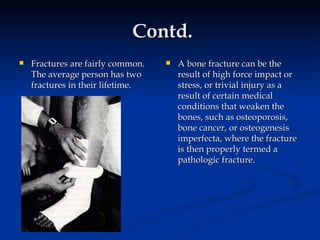
Contd. Fractures are fairly common. The average person has two fractures in their lifetime. A bone fracture can be the result of high force impact or stress, or trivial injury as a result of certain medical conditions that weaken the bones, such as osteoporosis, bone cancer, or osteogenesis imperfecta, where the fracture is then properly termed a pathologic fracture.
3 Examples of Fractures Simple Compound Transverse
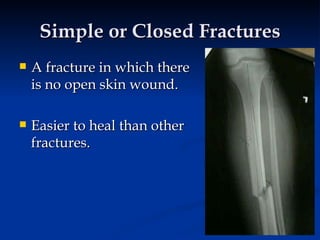
Simple or Closed Fractures A fracture in which there is no open skin wound.  Easier to heal than other fractures.
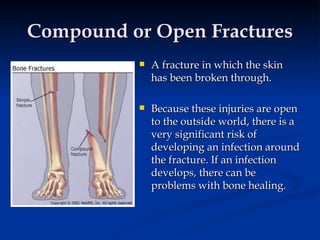
Compound or Open Fractures A fracture in which the skin has been broken through.  Because these injuries are open to the outside world, there is a very significant risk of developing an infection around the fracture. If an infection develops, there can be problems with bone healing.
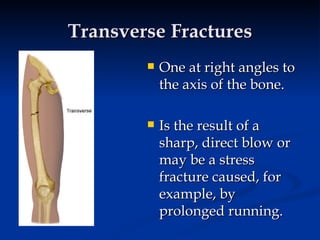
Transverse Fractures One at right angles to the axis of the bone. Is the result of a sharp, direct blow or may be a stress fracture caused, for example, by prolonged running.
Symptoms of a Fracture pain that is usually severe and gets worse with time and movement swelling bruising a limb or joint that is visibly out of place limitation of movement or inability to bear weight numbness and tingling paleness of the injured area
How is a Fracture Diagnosed? The physician makes the diagnosis with physical examination and diagnostic tests.  Diagnostic procedures may include: X-Rays MRI Computed tomography scan (CT scan)
Treatment Splint/cast  - immobilizes the injured area to promote bone alignment and healing to protect the injured area from motion or use. Medication  (for pain control) Traction  - the application of a force to stretch certain parts of the body in a specific direction. Traction consists or pulleys, strings, weights, and a metal frame attached over or on the bed. The purpose of traction is to stretch the muscles and tendons around the broken bone to allow the bone ends to align and heal. Surgery  - required to put certain types of broken bones back into place. Occasionally, internal fixation or external fixation devices are used to hold the bone fragments in place to allow alignment and healing.
Works cited “ Medical Terminology: A Living Language.” 4th edition. Fremgmen & Frucht. 2009.

Fractures

  • 1.
    Bone Fractures By:Lindsay Anderson Medical Terminology
  • 2.
    What is afracture? “an injury to a bone that causes it to break. Fractures are named to describe the type of damage to the bones.” A fracture will occur when the physical force exerted on the bone is greater than the bone itself.
  • 3.
    Contd. Fractures arefairly common. The average person has two fractures in their lifetime. A bone fracture can be the result of high force impact or stress, or trivial injury as a result of certain medical conditions that weaken the bones, such as osteoporosis, bone cancer, or osteogenesis imperfecta, where the fracture is then properly termed a pathologic fracture.
  • 4.
    3 Examples ofFractures Simple Compound Transverse
  • 5.
    Simple or ClosedFractures A fracture in which there is no open skin wound. Easier to heal than other fractures.
  • 6.
    Compound or OpenFractures A fracture in which the skin has been broken through. Because these injuries are open to the outside world, there is a very significant risk of developing an infection around the fracture. If an infection develops, there can be problems with bone healing.
  • 7.
    Transverse Fractures Oneat right angles to the axis of the bone. Is the result of a sharp, direct blow or may be a stress fracture caused, for example, by prolonged running.
  • 8.
    Symptoms of aFracture pain that is usually severe and gets worse with time and movement swelling bruising a limb or joint that is visibly out of place limitation of movement or inability to bear weight numbness and tingling paleness of the injured area
  • 9.
    How is aFracture Diagnosed? The physician makes the diagnosis with physical examination and diagnostic tests. Diagnostic procedures may include: X-Rays MRI Computed tomography scan (CT scan)
  • 10.
    Treatment Splint/cast - immobilizes the injured area to promote bone alignment and healing to protect the injured area from motion or use. Medication (for pain control) Traction - the application of a force to stretch certain parts of the body in a specific direction. Traction consists or pulleys, strings, weights, and a metal frame attached over or on the bed. The purpose of traction is to stretch the muscles and tendons around the broken bone to allow the bone ends to align and heal. Surgery - required to put certain types of broken bones back into place. Occasionally, internal fixation or external fixation devices are used to hold the bone fragments in place to allow alignment and healing.
  • 11.
    Works cited “Medical Terminology: A Living Language.” 4th edition. Fremgmen & Frucht. 2009.