Lukman Salim 
88946
objectives 
 
 Developmental dysplasia of the hip..(DDH) 
 Transient synovitis 
 Septic arthritis 
 Slipped capital femoral epiphysis (SCFE)
Developmental dysplasia of 
 
 The abnormal formation of the hip joint in which the 
the femoral head is not stable within the acetabulum. 
 Epidemiology: 
 The incidence ranges from as low as 1 per 1,000 to 
as high as 34 per 1,000. 
 Common among girls (1:600) compared to boys 
(1:4,000) 
the hip (DDH)
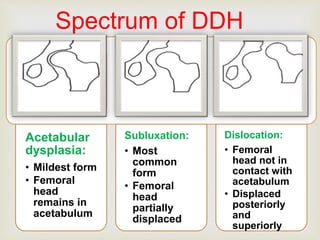
Spectrum of DDH 
 
Acetabular 
dysplasia: 
• Mildest form 
• Femoral 
head 
remains in 
acetabulum 
Subluxation: 
• Most 
common 
form 
• Femoral 
head 
partially 
displaced 
Dislocation: 
• Femoral 
head not in 
contact with 
acetabulum 
• Displaced 
posteriorly 
and 
superiorly
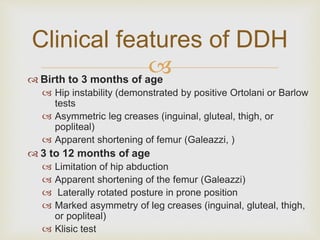
Clinical features of DDH 
 
 Birth to 3 months of age 
 Hip instability (demonstrated by positive Ortolani or Barlow 
tests 
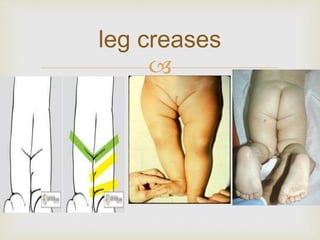
 Asymmetric leg creases (inguinal, gluteal, thigh, or 
popliteal) 
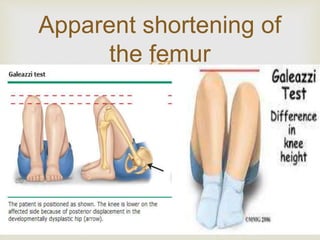
 Apparent shortening of femur (Galeazzi, ) 
 3 to 12 months of age 
 Limitation of hip abduction 
 Apparent shortening of the femur (Galeazzi) 
 Laterally rotated posture in prone position 
 Marked asymmetry of leg creases (inguinal, gluteal, thigh, 
or popliteal) 
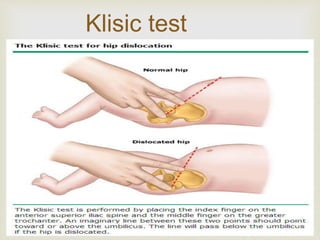
 Klisic test
leg creases 

Apparent shortening of 
the femur 

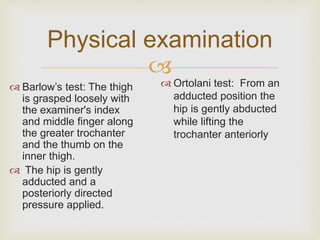
Physical examination 
 
 Ortolani test: From an 
adducted position the 
hip is gently abducted 
while lifting the 
trochanter anteriorly 
 Barlow’s test: The thigh 
is grasped loosely with 
the examiner's index 
and middle finger along 
the greater trochanter 
and the thumb on the 
inner thigh. 
 The hip is gently 
adducted and a 
posteriorly directed 
pressure applied.
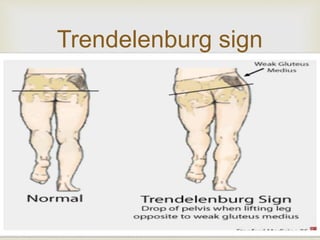
Trendelenburg sign 

Klisic test 

investigation 
 
 Ultrasound 
 Gold standard in first 
2 wks. of age 
 Radiography 
 Gold standard
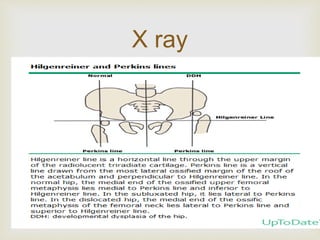
X ray 

X ray 

X ray 

apply 

Managments 
 
Method depends on Age 
Birth to 6 months : 
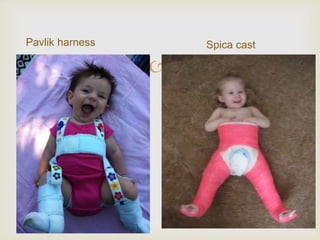
 Double napkins , Pavlik harness or hip spica cast 
6 months – 12 months : 
 Closed reduction and hip spica casts 
12 months – 18 months : 
 Possible closed / possible open reduction 
Above 18 months : 
 Open reduction and Acetabuloplasty 
Above 2 years : 
 Open reduction, acetabulplasty, and femoral 
osteotomy.
Pavlik harness Spica cast 

Transient Synovitis 
 
 Transient synovitis (TS) is the most common cause 
of acute hip pain in children aged 3-10 years 
 affects boys twice as often as girls. 
 Clinical features 
 Limping 
 Pain on thigh or knee 
 Low grade fever 
 Refusing to walk if pain severe 
 Night crying in younger children 
 Infant: unusual crawling 
 Examination: 
 mild restriction of motion, 
especially to abduction 
and internal rotation 
 Tender hip with 
movement. 
 tender to palpation. 
 Log roll!!
 
 investigation 
 CBC: WBC may be slightly elevated. 
 Elevated ESR, CRP 
 Treatments: 
 Bed rest 7-10 days 
 Heat and message 
 If severe pain.. Admission…. Skin traction of the hip to 
reduce intracapsular pressure 
 ibuprofen may shorten the duration of symptoms
Slipped capital femoral 
epiphysis (SCFE) 
 
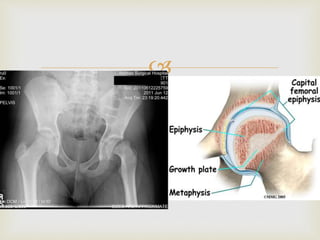
 Displacement of the capital femoral epiphysis from 
the femoral neck through the physeal plate 
 Boys affected more than girls 
 Occur during puberty usually 14-15 years old 
 Risk factors: 
 Obesity 
 Very tall 
 Endocrine problems :hypothyroidism, 
panhypopituitarism, hypogonadism,, growth hormone 
abnormalities

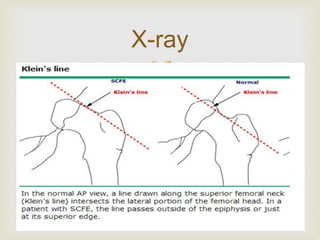
X-ray 

Stable vs unstable 
 
 Stable" SCFEs allow the patient to ambulate with or 
without crutches. 
 "Unstable" SCFEs do not allow the patient to 
ambulate at all; these cases
Clinical presentation 
 
 Sudden, severe pain, limping. 
 Pain in groin and in anterior thigh or knee 
 Leg is externally rotated 
 Leg 1-2cm short 
 Limitation of abduction and internal rotation
complications 
 
 Avascular necrosis 
 Coxa vara: if not reduced>>>> abnormal fusion>>> 
limping 
 another SCFE on the other leg
Treatment 
 
 treatment of slipped capital femoral epiphysis 
(SCFE) is emergent; therefore, early and accurate 
diagnosis is a must 
 Surgical Intervention 
 immediate internal fixation with screws 
 Prophylactic fixation of the unaffected hip in unilateral 
SCFE… in high risk people
Legg-calve- Perthes 
disease 
 
 Coxa plana 
 is avascular necrosis of the proximal femoral head 
resulting from compromised blood supply to this 
area. 
 Occurs in children between the ages of 4 and 10 
years. 
 The male-to-female ratio is 4:1 
 Pathogenesis: blood supply mostly from lateral 
epiphyseal vessels which are susceptible to 
stretching or any pressure from an effusion
Clinical presentation 
 
 Painless onset of limping. 
 Pain in groin, thigh & knee. 
 Pain in movements 
 Decreased ROM, especially abduction and internal 
rotation 
 Trendelenburg test often positive
Treatments 
 
 Mild cases 
 Skin traction 
 minimal weight bearing 
 Severe cases: 
 Containment: keeping the femoral head well seated 
within the acetabulum to retain its normal shape 
 How: by holding hips widely abducted with a splint 
 Surgical : osteotomy
thanks 
 
 Reference 
 http://emedicine.medscape.com/article/1007186- 
overview#showall 
 www.uptodate .com 
 Apley’s system of orthopedics

pediatric hip dioerders

  • 1.
  • 2.
    objectives  Developmental dysplasia of the hip..(DDH)  Transient synovitis  Septic arthritis  Slipped capital femoral epiphysis (SCFE)
  • 3.
    Developmental dysplasia of   The abnormal formation of the hip joint in which the the femoral head is not stable within the acetabulum.  Epidemiology:  The incidence ranges from as low as 1 per 1,000 to as high as 34 per 1,000.  Common among girls (1:600) compared to boys (1:4,000) the hip (DDH)
  • 4.
    Spectrum of DDH  Acetabular dysplasia: • Mildest form • Femoral head remains in acetabulum Subluxation: • Most common form • Femoral head partially displaced Dislocation: • Femoral head not in contact with acetabulum • Displaced posteriorly and superiorly
  • 5.
    Clinical features ofDDH   Birth to 3 months of age  Hip instability (demonstrated by positive Ortolani or Barlow tests  Asymmetric leg creases (inguinal, gluteal, thigh, or popliteal)  Apparent shortening of femur (Galeazzi, )  3 to 12 months of age  Limitation of hip abduction  Apparent shortening of the femur (Galeazzi)  Laterally rotated posture in prone position  Marked asymmetry of leg creases (inguinal, gluteal, thigh, or popliteal)  Klisic test
  • 6.
  • 7.
    Apparent shortening of the femur 
  • 8.
    Physical examination   Ortolani test: From an adducted position the hip is gently abducted while lifting the trochanter anteriorly  Barlow’s test: The thigh is grasped loosely with the examiner's index and middle finger along the greater trochanter and the thumb on the inner thigh.  The hip is gently adducted and a posteriorly directed pressure applied.
  • 9.
  • 10.
  • 11.
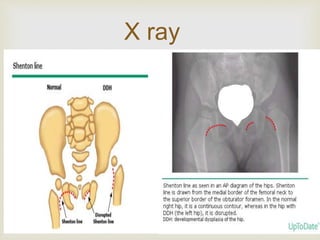
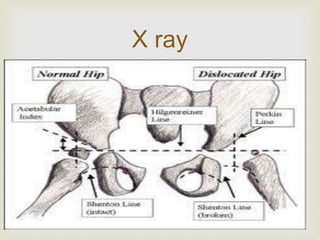
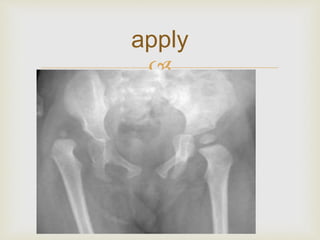
    investigation  Ultrasound  Gold standard in first 2 wks. of age  Radiography  Gold standard
  • 12.
  • 13.
  • 14.
  • 15.
  • 16.
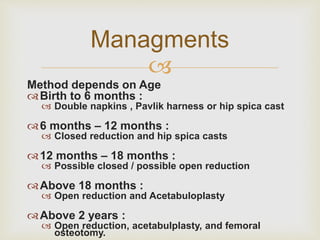
    Managments  Methoddepends on Age Birth to 6 months :  Double napkins , Pavlik harness or hip spica cast 6 months – 12 months :  Closed reduction and hip spica casts 12 months – 18 months :  Possible closed / possible open reduction Above 18 months :  Open reduction and Acetabuloplasty Above 2 years :  Open reduction, acetabulplasty, and femoral osteotomy.
  • 17.
  • 18.
    Transient Synovitis   Transient synovitis (TS) is the most common cause of acute hip pain in children aged 3-10 years  affects boys twice as often as girls.  Clinical features  Limping  Pain on thigh or knee  Low grade fever  Refusing to walk if pain severe  Night crying in younger children  Infant: unusual crawling  Examination:  mild restriction of motion, especially to abduction and internal rotation  Tender hip with movement.  tender to palpation.  Log roll!!
  • 19.
      investigation  CBC: WBC may be slightly elevated.  Elevated ESR, CRP  Treatments:  Bed rest 7-10 days  Heat and message  If severe pain.. Admission…. Skin traction of the hip to reduce intracapsular pressure  ibuprofen may shorten the duration of symptoms
  • 20.
    Slipped capital femoral epiphysis (SCFE)   Displacement of the capital femoral epiphysis from the femoral neck through the physeal plate  Boys affected more than girls  Occur during puberty usually 14-15 years old  Risk factors:  Obesity  Very tall  Endocrine problems :hypothyroidism, panhypopituitarism, hypogonadism,, growth hormone abnormalities
  • 21.
  • 22.
  • 23.
    Stable vs unstable   Stable" SCFEs allow the patient to ambulate with or without crutches.  "Unstable" SCFEs do not allow the patient to ambulate at all; these cases
  • 24.
    Clinical presentation   Sudden, severe pain, limping.  Pain in groin and in anterior thigh or knee  Leg is externally rotated  Leg 1-2cm short  Limitation of abduction and internal rotation
  • 25.
    complications  Avascular necrosis  Coxa vara: if not reduced>>>> abnormal fusion>>> limping  another SCFE on the other leg
  • 26.
    Treatment  treatment of slipped capital femoral epiphysis (SCFE) is emergent; therefore, early and accurate diagnosis is a must  Surgical Intervention  immediate internal fixation with screws  Prophylactic fixation of the unaffected hip in unilateral SCFE… in high risk people
  • 27.
    Legg-calve- Perthes disease   Coxa plana  is avascular necrosis of the proximal femoral head resulting from compromised blood supply to this area.  Occurs in children between the ages of 4 and 10 years.  The male-to-female ratio is 4:1  Pathogenesis: blood supply mostly from lateral epiphyseal vessels which are susceptible to stretching or any pressure from an effusion
  • 28.
    Clinical presentation   Painless onset of limping.  Pain in groin, thigh & knee.  Pain in movements  Decreased ROM, especially abduction and internal rotation  Trendelenburg test often positive
  • 29.
    Treatments  Mild cases  Skin traction  minimal weight bearing  Severe cases:  Containment: keeping the femoral head well seated within the acetabulum to retain its normal shape  How: by holding hips widely abducted with a splint  Surgical : osteotomy
  • 30.
    thanks  Reference  http://emedicine.medscape.com/article/1007186- overview#showall  www.uptodate .com  Apley’s system of orthopedics

Editor's Notes

  • #4 http://www.ncbi.nlm.nih.gov/pmc/articles/PMC3143976/
  • #9 http://www.youtube.com/watch?v=imhI6PLtGLc
  • #19 The most sensitive test for transient synovitis is the log roll, in which the patient lies supine and the examiner gently rolls the involved limb from side to side. This may detect involuntary muscle guarding of one side when compared to the other side. Causes No definitive cause of transient synovitis is known, although the following have been suggested: Patients with transient synovitis often have histories of trauma, which may be a cause or predisposing factor. One study found an increase in viral antibody titers in 67 of 80 patients with transient synovitis. Postvaccine or drug-mediated reactions and an allergic disposition have been cited as possible causes. http://emedicine.medscape.com/article/1007186-overview#showall