Chapter 13 Muscle and Bone Injuries By: Ryan and Connor
Introduction The  musculoskeletal system  is made up of  muscles ,  tendons  and  ligaments , and bones that form the skeleton.  They  provide  the body with  shape ,  form ,  stability , and  movement .
Goals/Objectives Gain fundamental knowledge of anatomy and function of musculoskeletal system  Identify/treat open and closed wounds, as well as painful,  swollen, and deformed extremities
Key Terms  Bone : A dense, hard tissue that forms the skeleton. Dislocation : The displacement of a bone from its normal position at a  joint. Fracture : A break or disruption in bone tissue. Immobilize : To use a splint or other method to keep an injured body  part from moving. Joint : A structure where two or more bones are joined. Ligament : A barbarous band that holds bones together at a joint. Muscle: A tissue that lengthens and shortens to create  movement. Painful, swollen, deformed extremities (PSD  extremity): All injuries to the extremities caused by a force. Skeletal muscles : Muscles that attach to bones. Splint : a device used to immobilize body parts. Sprain : The excessive stretching and tearing of ligaments and other  soft tissue structures at a joint. Strain : The excessive stretching and tearing of muscles and tendons. Tendon : A fibrous band that attaches muscle to bone.
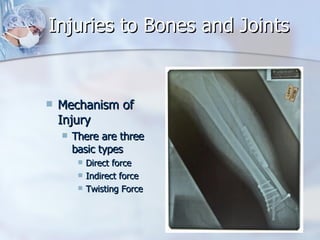
Injuries to Bones and Joints  Mechanism of Injury  There are three basic types  Direct force Indirect force  Twisting Force
Signs and Symptoms  Common signs and symptoms associated with musculoskeletal injuries: Pain and tenderness Swelling Grating Deformity  Bruising (dislocation) Exposed bone ends Joint locked into position Inability to move an affected part
Swelling
Deformity
Bruising
General Care for Bone and Joint Injuries  Remember  proper protection  and  BSI Assess ABC’s  and life-threatening conditions first Summon more  advanced medical personnel
General care for all skeletal injuries  RICE Rest : avoiding movement and activities that cause pain Ice : Apply ice or a cold pack - reduces swelling and eases pain and  discomfort Compression Elevation : raise injured are above heart level to restrict blood flow
Immobilization  Serious skeletal injuries  require immediate immobilization . This  lessens pain ,  prevents further damage ,  reduces risk  of serious  bleeding , reduces the possibility of  loss of circulation  to the injured part,  prevents PSD extremity injuries . Immobilize an injured area with a  splint , a device that maintains an injured  part in place.
Splinting  Splint only if it can be done without causing further pain. Splint an injury in the position you find it. Splint the injured area and the joints above and below the injury site. Check for proper circulation and sensation prior to splinting.
Types of Splints Sling : (made from a triangular bandage)  tied to support an arm, wrist, or hand Cravat : folded triangular bandage used to  hold dressings or splints in place Rigid splints : include boards, metal strips,  and folded plastic or cardboard splints Anatomic splints : refer to the use of the  body as a splint
Shoulder Injuries  -The most frequent injured bone of the shoulder is the clavicle (more so in children than in adults). -Injuries to the shoulder are commonly caused by a fall. -The victim usually feels pain in the shoulder area and it may radiate down the upper arm. -Dislocations also usually result from falls and cause ligaments to tear. -They cause intense pain and usually deformities. -To care for shoulder injuries, first control external bleeding with direct pressure. Splint the shoulder in the position it was found in or which causes the least pain. Check circulation and sensation.
Upper Arm Injuries  -The humerus can be fractured at any point, but is usually at the upper end or in the middle of the bone. Regardless, there will be a danger of  damage to the blood vessels and nerves supplying the entire arm. -To care for upper arm injuries, immobilize the upper arm from the shoulder to the elbow. Control external bleeding with direct pressure. Splint arm to the chest and apply cold if possible. Check circulation and  sensation.
Elbow Injuries  -Like other joints, the elbow is susceptible to sprains, fractures, and dislocations. All are serious because all nerves and blood vessels go through the elbow. -To care for an elbow injury, immobilize elbow in position you find it in. Control external bleeding with direct pressure. Place the arm in a sling  and secure it to chest (if possible, use two cravats). The splint should extend several inches beyond the upper arm and the wrist. Check circulation and sensation.
Forearm, Wrist, and Hand Injuries  Fractures often occur to the radius and ulna as a result of a fall. Hands are especially susceptible to tissue and nerve damage, as well as  blood vessels and bones. To care for these injuries, first control external bleeding with direct pressure. Bandage hand by applying a pressure bandage in a figure- eight  pattern. Support wrist by placing a splint under forearm. Immobilize fingers with soft splints or a roll of gauze. Check circulation and  sensation.
Ankle and Foot Injuries -Injuries to this area are commonly caused by twisting forces and range from minor sprains to fractures an dislocations. To care for ankle and foot injuries, first control external bleeding with direct pressure. Splint by using an air splint, soft splint, or a custom one designed for such injuries. Apply ice or a cold pack. Monitor ABC’s as  well as sensation and mobility of injured area. Summon more advanced  medical personnel.

Muscles And Bones

  • 1.
    Chapter 13 Muscleand Bone Injuries By: Ryan and Connor
  • 2.
    Introduction The musculoskeletal system is made up of muscles , tendons and ligaments , and bones that form the skeleton. They provide the body with shape , form , stability , and movement .
  • 3.
    Goals/Objectives Gain fundamentalknowledge of anatomy and function of musculoskeletal system Identify/treat open and closed wounds, as well as painful, swollen, and deformed extremities
  • 4.
    Key Terms Bone : A dense, hard tissue that forms the skeleton. Dislocation : The displacement of a bone from its normal position at a joint. Fracture : A break or disruption in bone tissue. Immobilize : To use a splint or other method to keep an injured body part from moving. Joint : A structure where two or more bones are joined. Ligament : A barbarous band that holds bones together at a joint. Muscle: A tissue that lengthens and shortens to create movement. Painful, swollen, deformed extremities (PSD extremity): All injuries to the extremities caused by a force. Skeletal muscles : Muscles that attach to bones. Splint : a device used to immobilize body parts. Sprain : The excessive stretching and tearing of ligaments and other soft tissue structures at a joint. Strain : The excessive stretching and tearing of muscles and tendons. Tendon : A fibrous band that attaches muscle to bone.
  • 5.
    Injuries to Bonesand Joints Mechanism of Injury There are three basic types Direct force Indirect force Twisting Force
  • 6.
    Signs and Symptoms Common signs and symptoms associated with musculoskeletal injuries: Pain and tenderness Swelling Grating Deformity Bruising (dislocation) Exposed bone ends Joint locked into position Inability to move an affected part
  • 7.
  • 8.
  • 9.
  • 10.
    General Care forBone and Joint Injuries Remember proper protection and BSI Assess ABC’s and life-threatening conditions first Summon more advanced medical personnel
  • 11.
    General care forall skeletal injuries RICE Rest : avoiding movement and activities that cause pain Ice : Apply ice or a cold pack - reduces swelling and eases pain and discomfort Compression Elevation : raise injured are above heart level to restrict blood flow
  • 12.
    Immobilization Seriousskeletal injuries require immediate immobilization . This lessens pain , prevents further damage , reduces risk of serious bleeding , reduces the possibility of loss of circulation to the injured part, prevents PSD extremity injuries . Immobilize an injured area with a splint , a device that maintains an injured part in place.
  • 13.
    Splinting Splintonly if it can be done without causing further pain. Splint an injury in the position you find it. Splint the injured area and the joints above and below the injury site. Check for proper circulation and sensation prior to splinting.
  • 14.
    Types of SplintsSling : (made from a triangular bandage) tied to support an arm, wrist, or hand Cravat : folded triangular bandage used to hold dressings or splints in place Rigid splints : include boards, metal strips, and folded plastic or cardboard splints Anatomic splints : refer to the use of the body as a splint
  • 15.
    Shoulder Injuries -The most frequent injured bone of the shoulder is the clavicle (more so in children than in adults). -Injuries to the shoulder are commonly caused by a fall. -The victim usually feels pain in the shoulder area and it may radiate down the upper arm. -Dislocations also usually result from falls and cause ligaments to tear. -They cause intense pain and usually deformities. -To care for shoulder injuries, first control external bleeding with direct pressure. Splint the shoulder in the position it was found in or which causes the least pain. Check circulation and sensation.
  • 16.
    Upper Arm Injuries -The humerus can be fractured at any point, but is usually at the upper end or in the middle of the bone. Regardless, there will be a danger of damage to the blood vessels and nerves supplying the entire arm. -To care for upper arm injuries, immobilize the upper arm from the shoulder to the elbow. Control external bleeding with direct pressure. Splint arm to the chest and apply cold if possible. Check circulation and sensation.
  • 17.
    Elbow Injuries -Like other joints, the elbow is susceptible to sprains, fractures, and dislocations. All are serious because all nerves and blood vessels go through the elbow. -To care for an elbow injury, immobilize elbow in position you find it in. Control external bleeding with direct pressure. Place the arm in a sling and secure it to chest (if possible, use two cravats). The splint should extend several inches beyond the upper arm and the wrist. Check circulation and sensation.
  • 18.
    Forearm, Wrist, andHand Injuries Fractures often occur to the radius and ulna as a result of a fall. Hands are especially susceptible to tissue and nerve damage, as well as blood vessels and bones. To care for these injuries, first control external bleeding with direct pressure. Bandage hand by applying a pressure bandage in a figure- eight pattern. Support wrist by placing a splint under forearm. Immobilize fingers with soft splints or a roll of gauze. Check circulation and sensation.
  • 19.
    Ankle and FootInjuries -Injuries to this area are commonly caused by twisting forces and range from minor sprains to fractures an dislocations. To care for ankle and foot injuries, first control external bleeding with direct pressure. Splint by using an air splint, soft splint, or a custom one designed for such injuries. Apply ice or a cold pack. Monitor ABC’s as well as sensation and mobility of injured area. Summon more advanced medical personnel.