10/16/15 1
Fracture and Failure Analyses of
Plastics and Reinforced Plastics
Dr. K. Padmanabhan
Professor & Assistant Director
School of Mechanical & Building Sciences
VIT-University, Vellore-632014
Email: padmanabhan.k@vit.ac.in
10/16/15 2
Definitions
• Fracture is the creation of at least two
surfaces from a body due to the action of
forces.
• Fracture results in the release of stored
elastic energy ( strain energy) and
creation of surfaces with a surface energy.
10/16/15 3
Contents
• Definitions
• Structure of Plastics and Reinforced Plastics
• Property Correlations
• Introduction to Fracture and Fracture Mechanics
• Basics of Failure Theories and Analyses
• Test Specific Failure Characterization
• Application Specific Failure Characterization
• Feedback from Failures and Correlation
• Failure processes, Improved Designs and
Manufacturing
• Summary
10/16/15 4
Structure and Properties
10/16/15 5
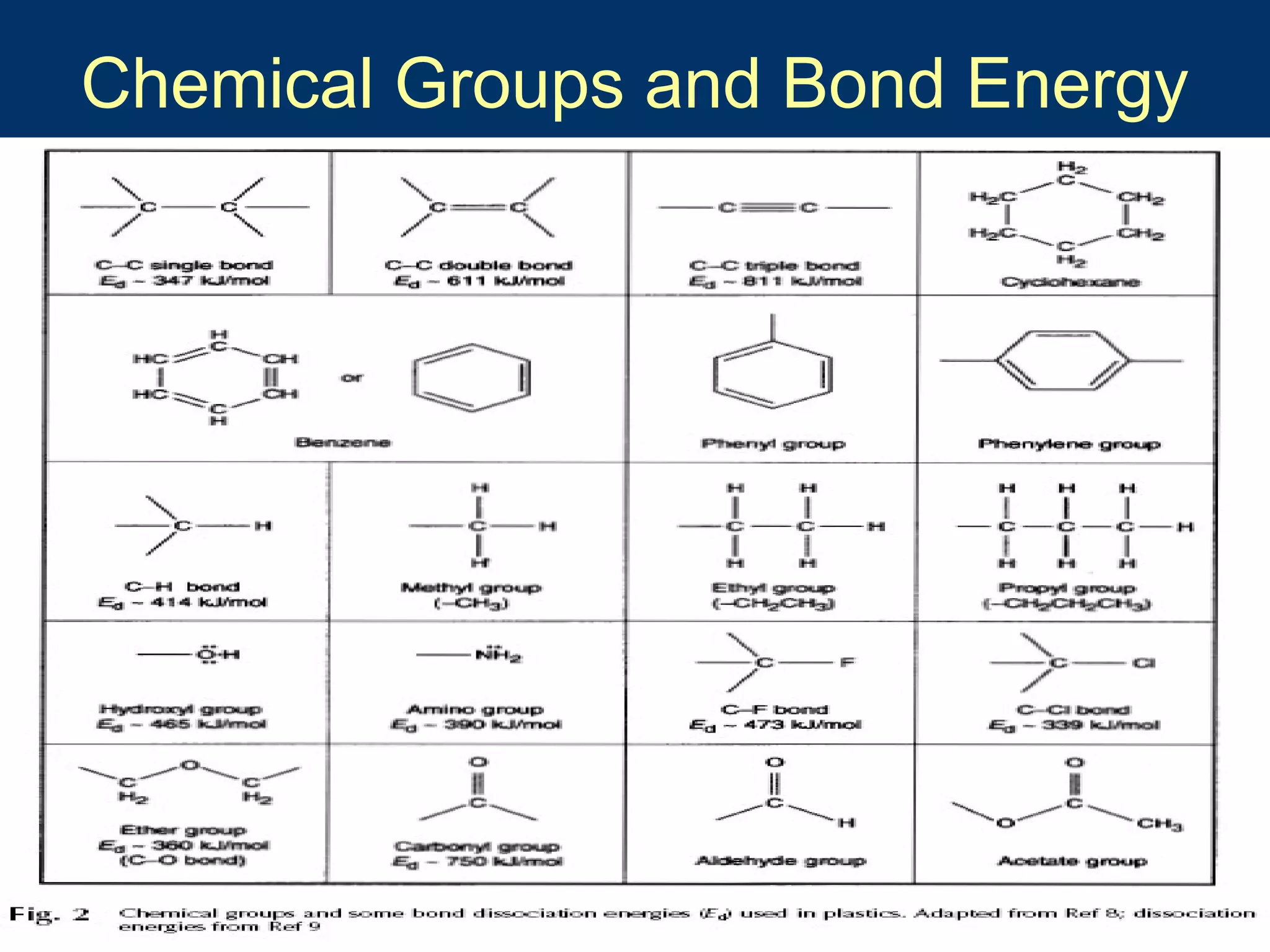
Chemical Groups and Bond Energy
10/16/15 6
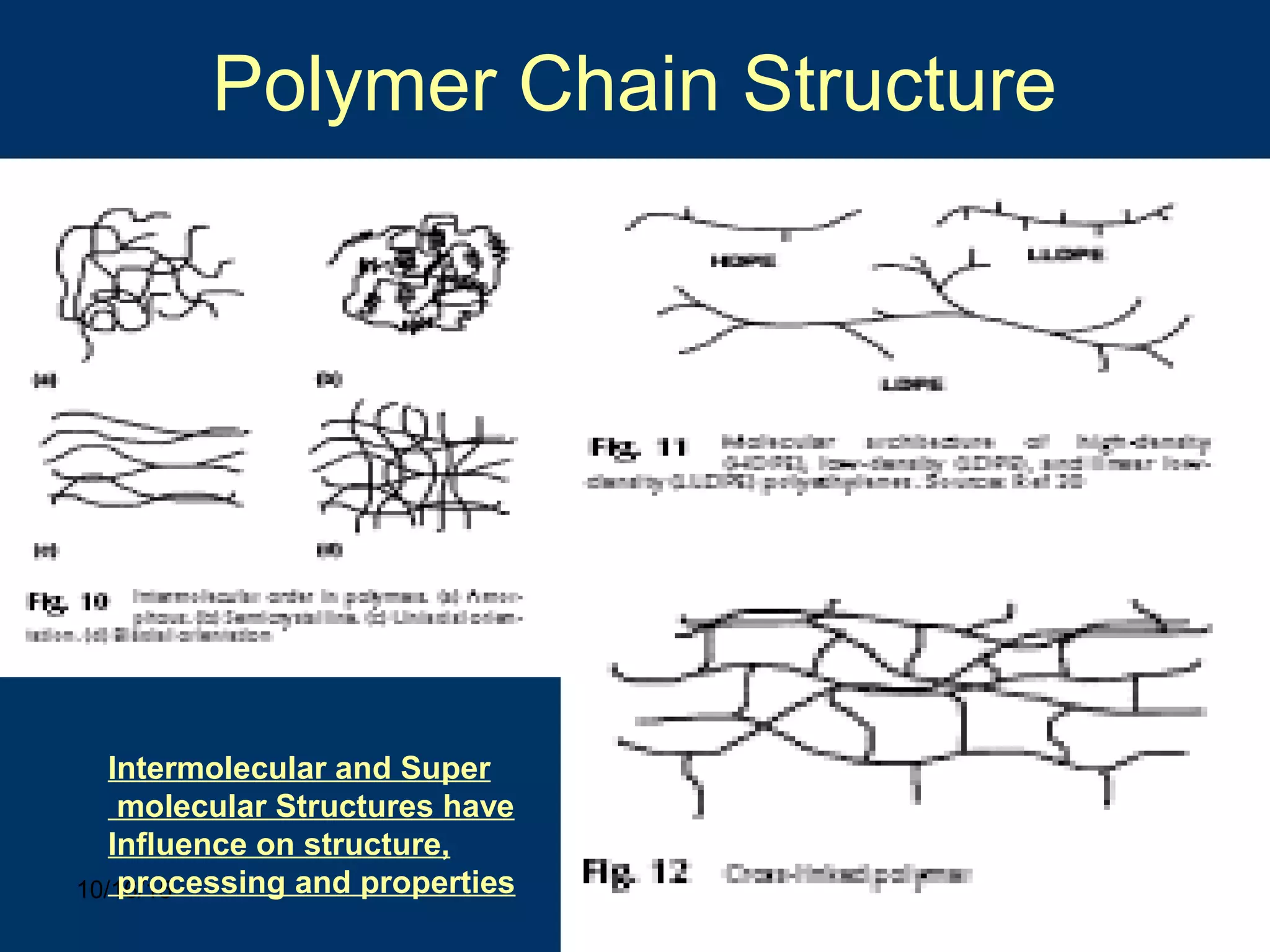
Polymer Chain Structure
Intermolecular and Super
molecular Structures have
Influence on structure,
processing and properties
10/16/15 7
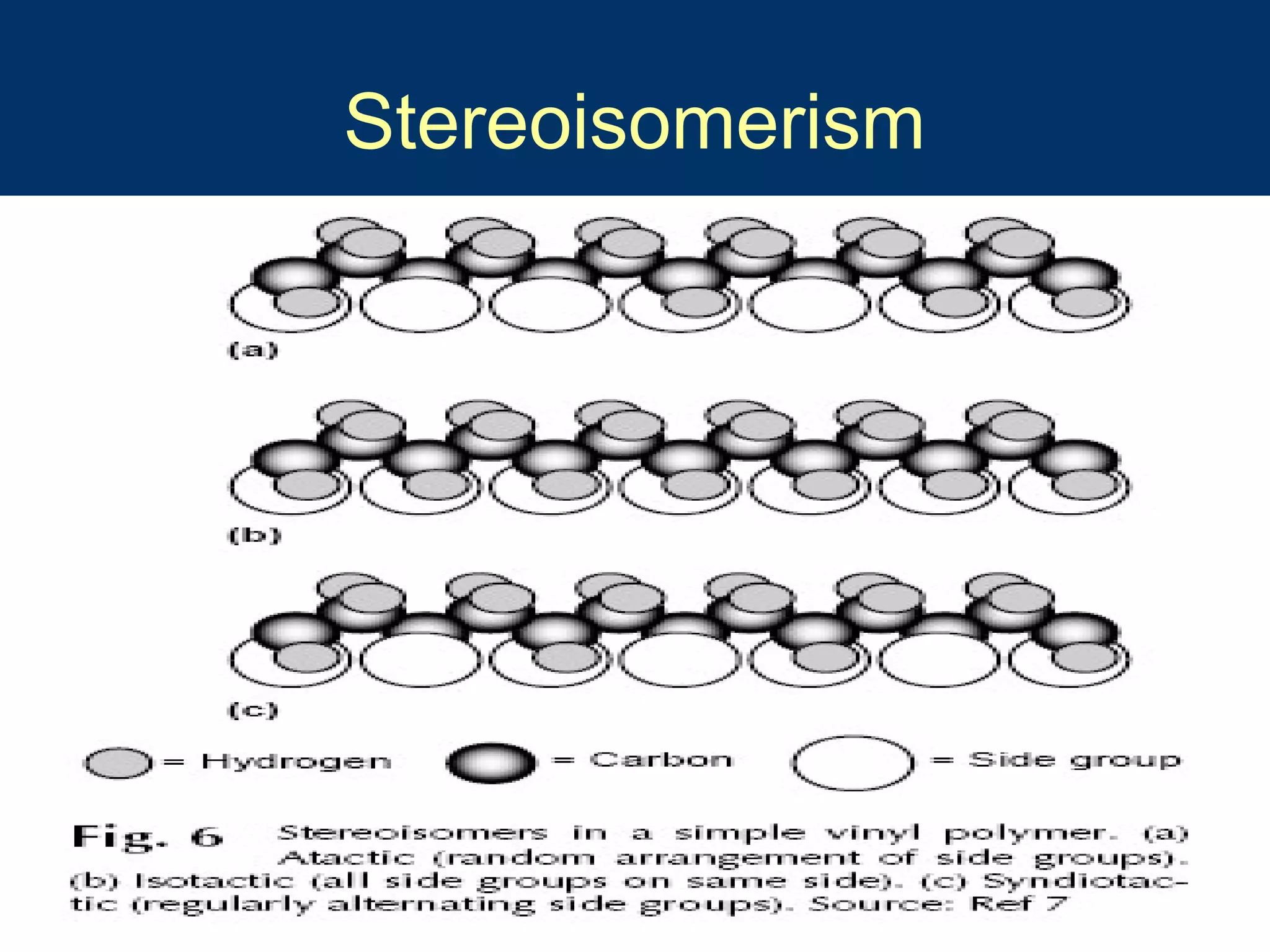
Stereoisomerism
10/16/15 8
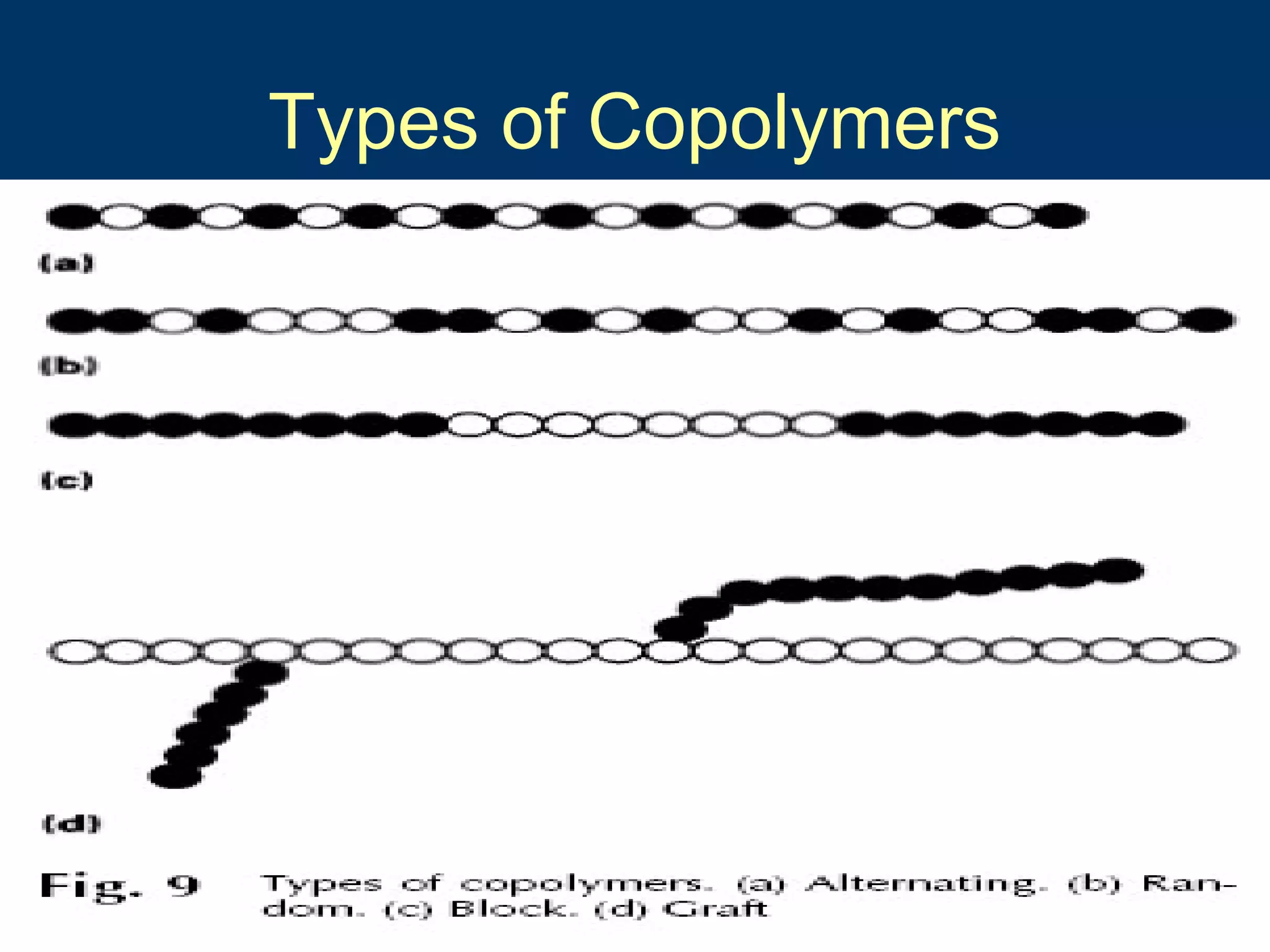
Types of Copolymers
10/16/15 9
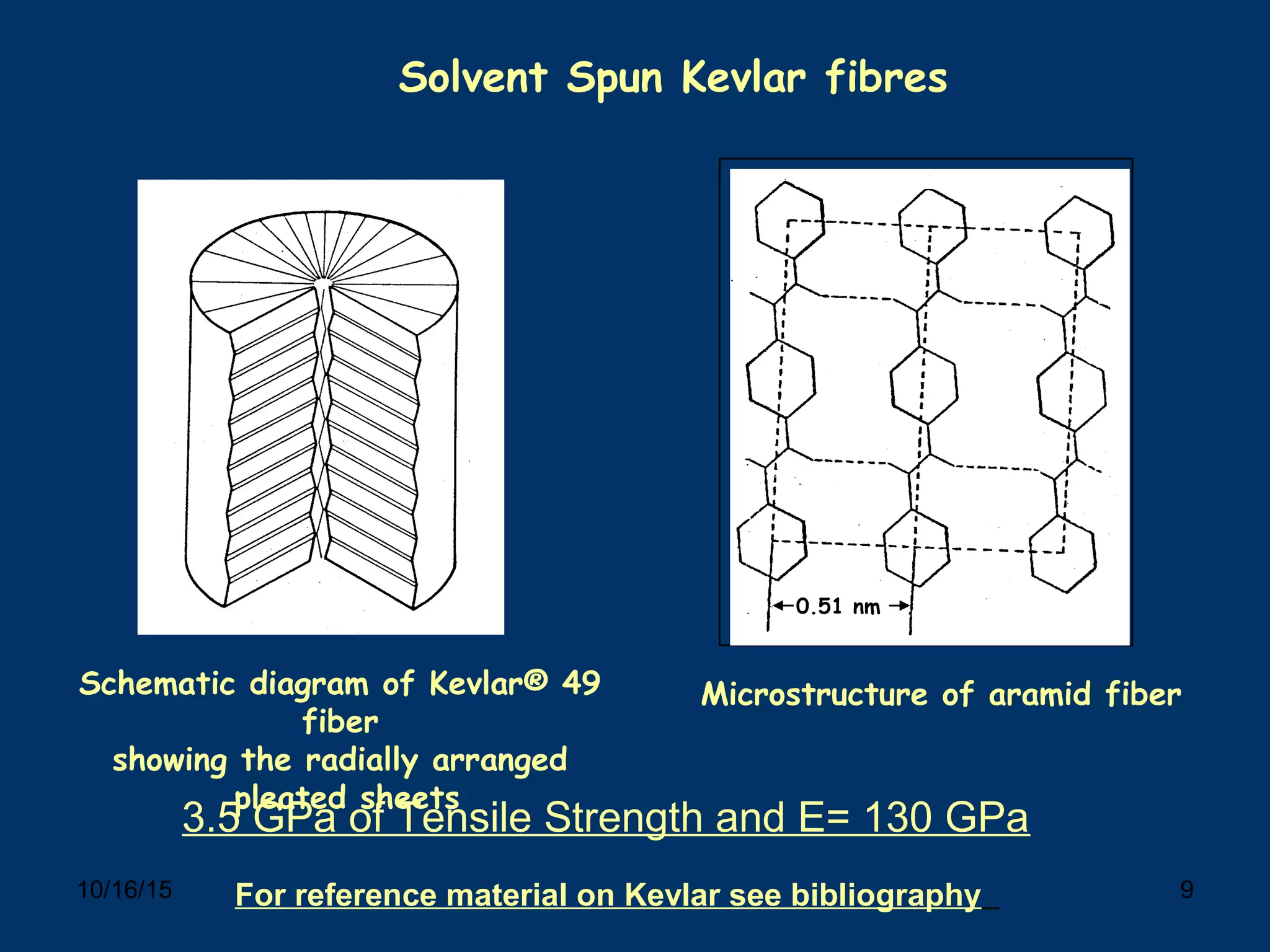
0.51 nm
Schematic diagram of Kevlar® 49
fiber
showing the radially arranged
pleated sheets
Microstructure of aramid fiber
Solvent Spun Kevlar fibres
3.5 GPa of Tensile Strength and E= 130 GPa
For reference material on Kevlar see bibliography
10/16/15 10
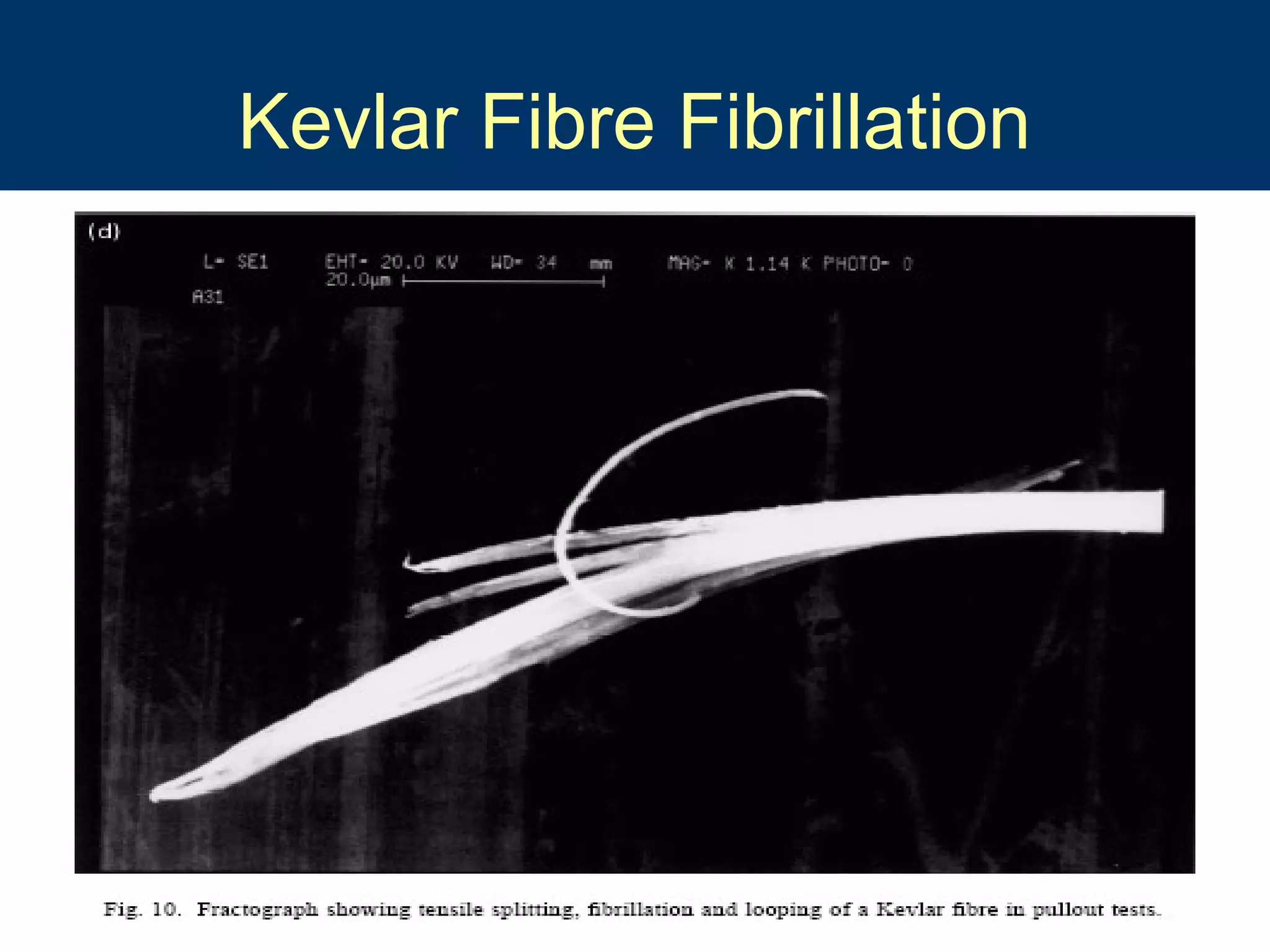
Kevlar Fibre Fibrillation
10/16/15 11
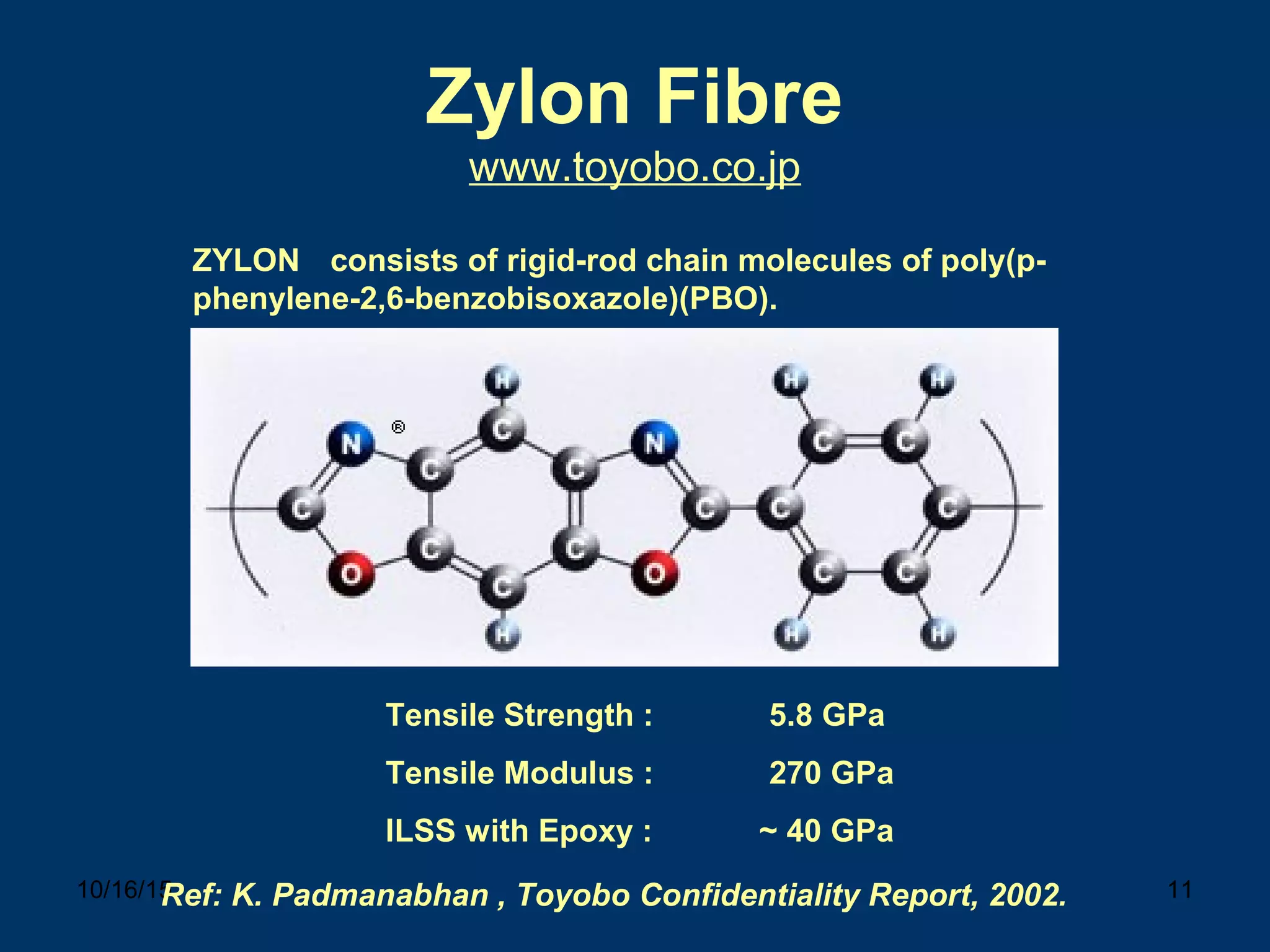
Zylon Fibre
www.toyobo.co.jp
ZYLON consists of rigid-rod chain molecules of poly(p-
phenylene-2,6-benzobisoxazole)(PBO).
Tensile Strength : 5.8 GPa
Tensile Modulus : 270 GPa
ILSS with Epoxy : ~ 40 GPa
Ref: K. Padmanabhan , Toyobo Confidentiality Report, 2002.
10/16/15 12
Types of Foams
• Thermoset, thermoplastic, elastomeric,
ceramic, rock wool, metallic….
• Rigid, semi rigid, flexible….
• Filled and unfilled
• Poisson’s ratio variations
• Auxetic, syntactic …..
• Formed by for example Polyol, MDI
Reactions like in PUF
10/16/15 13
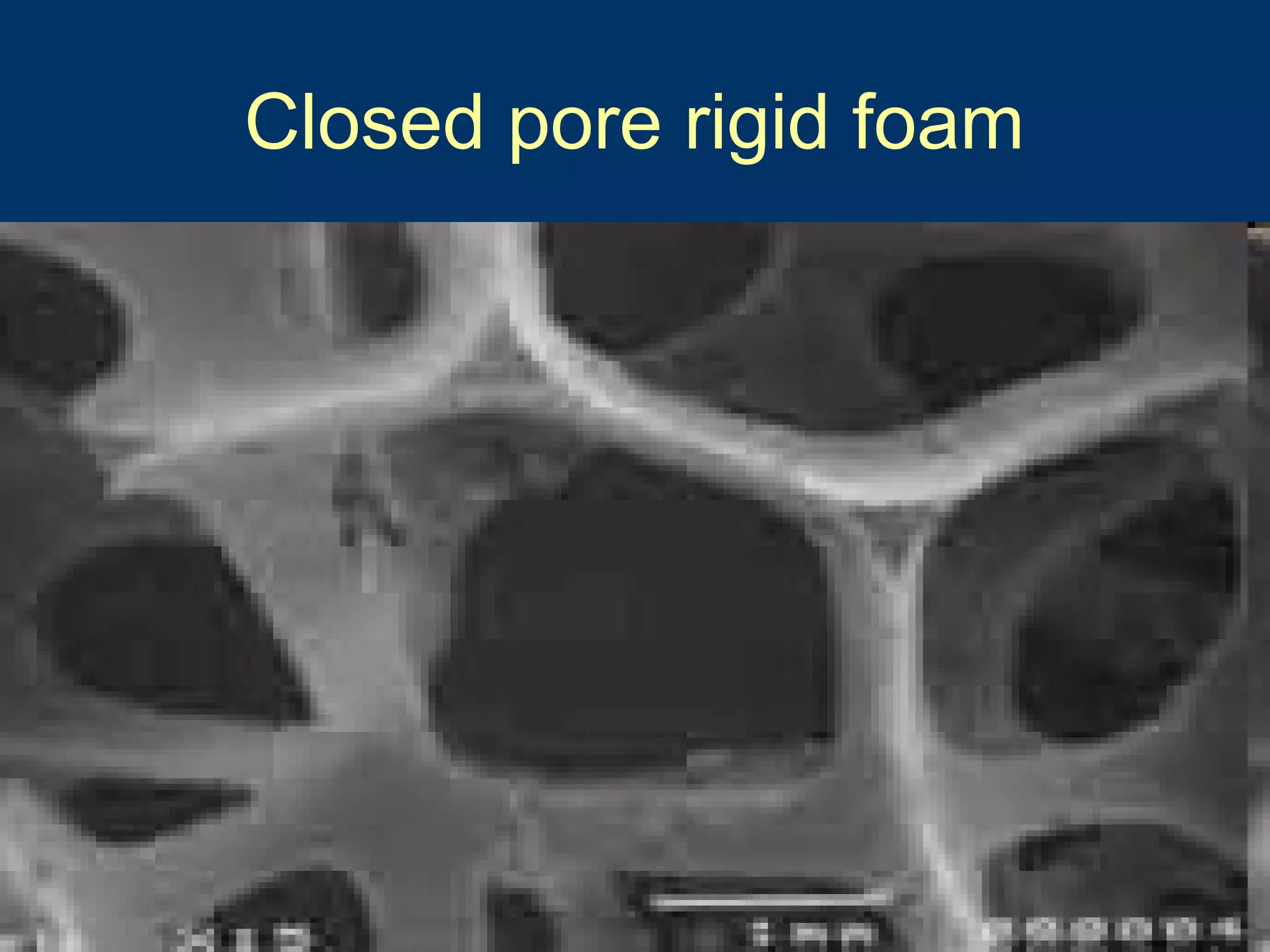
Closed pore rigid foam
10/16/15 14
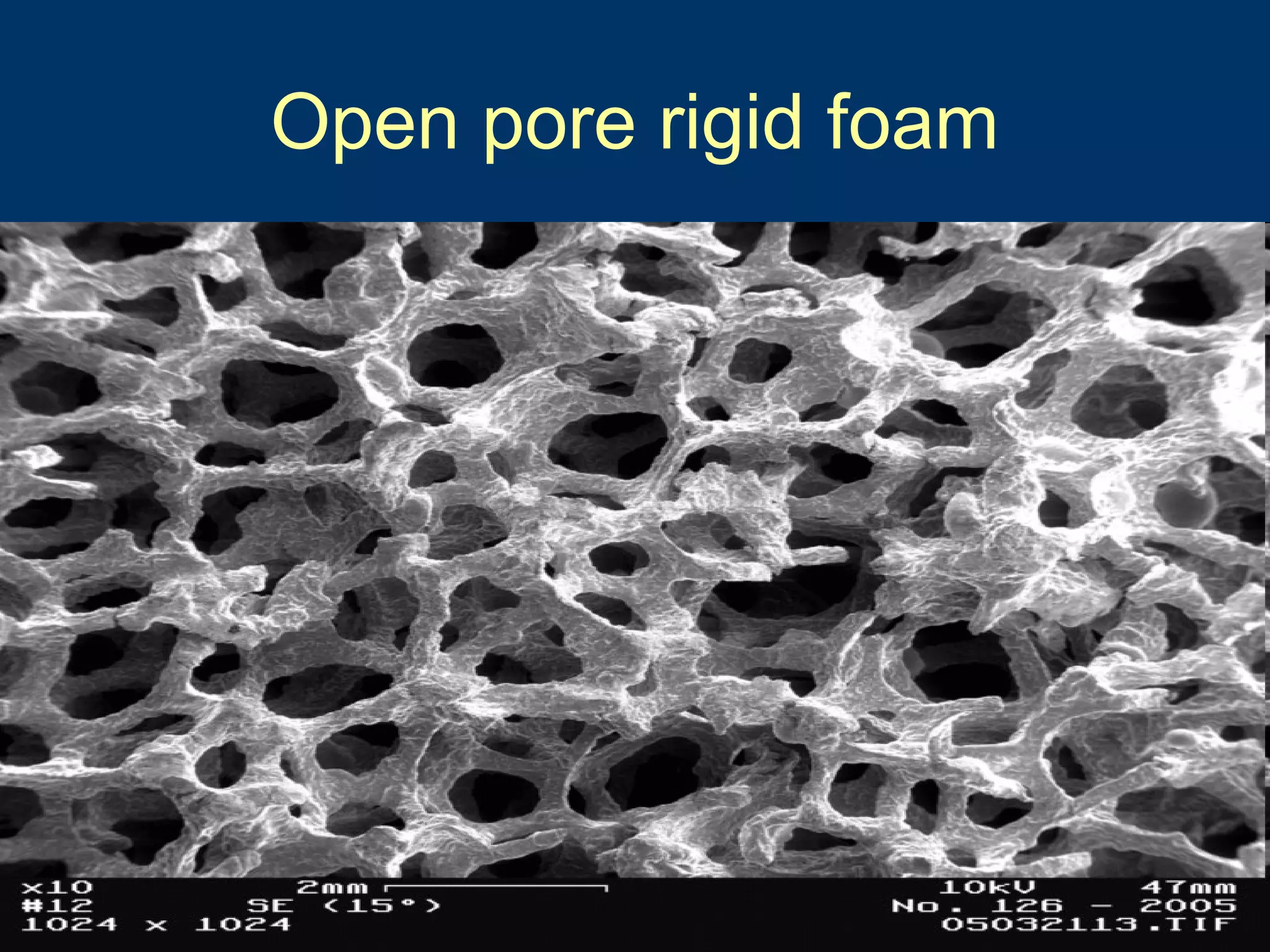
Open pore rigid foam
10/16/15 15
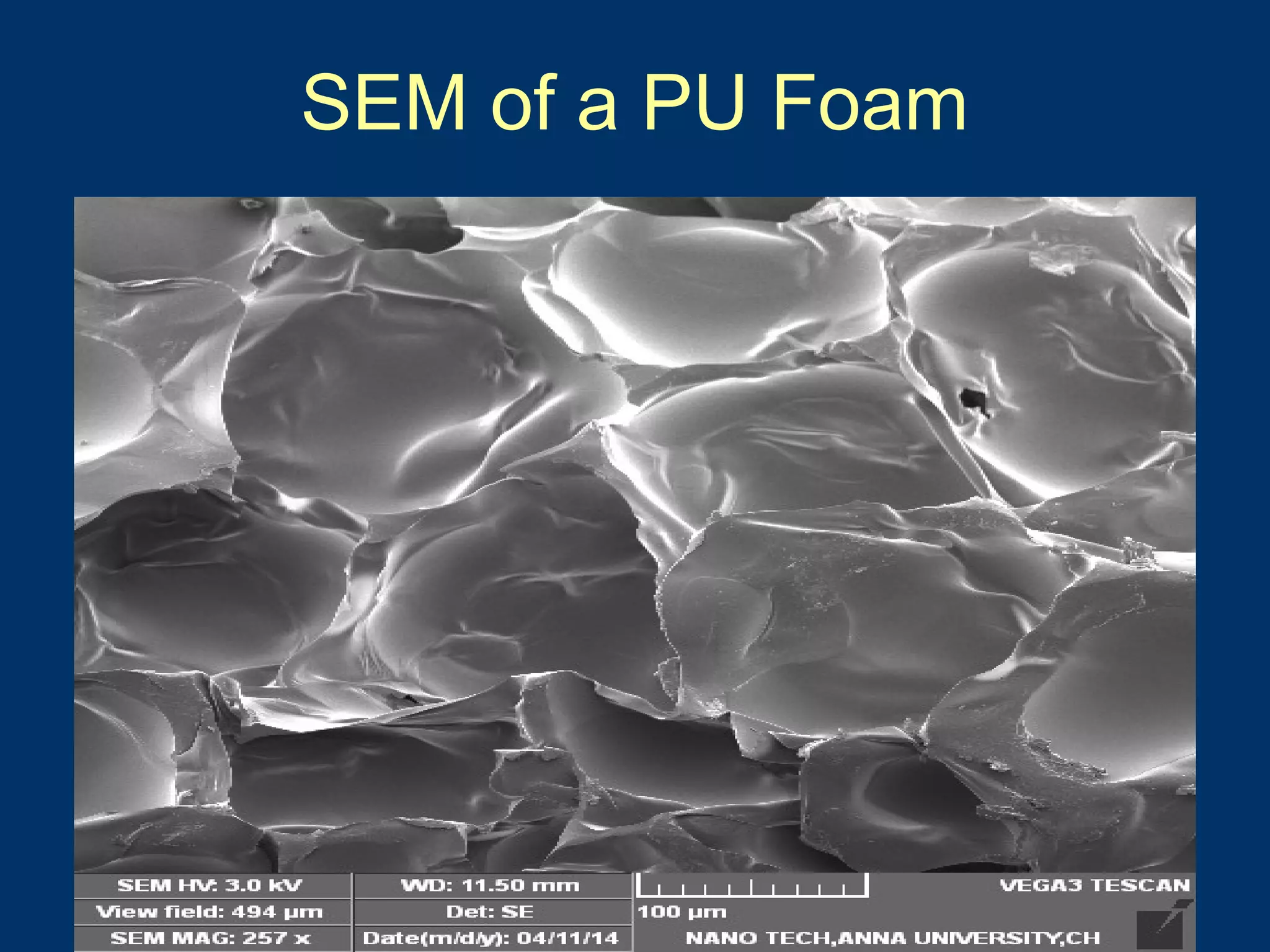
SEM of a PU Foam
10/16/15 16
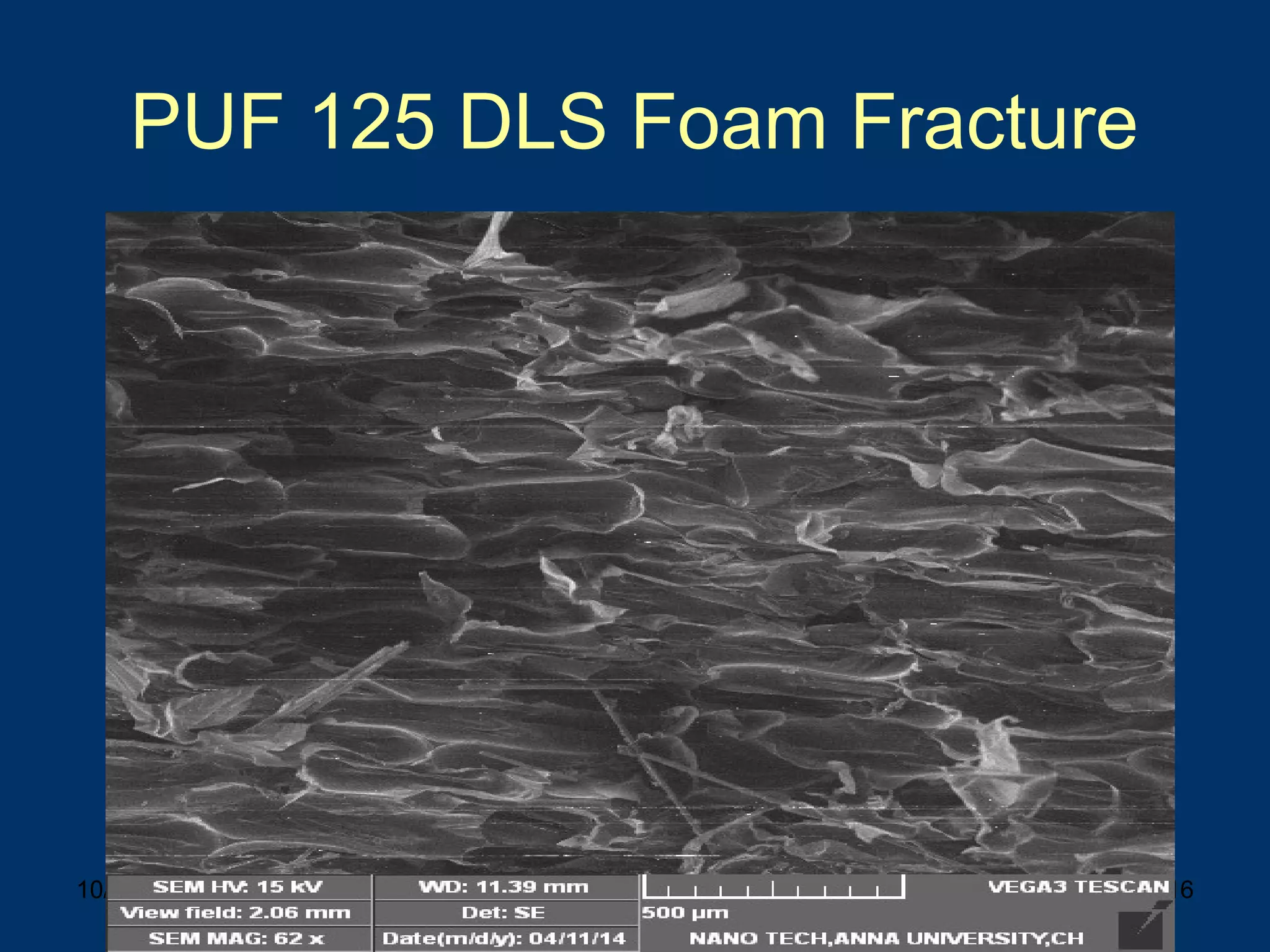
PUF 125 DLS Foam Fracture
10/16/15 17
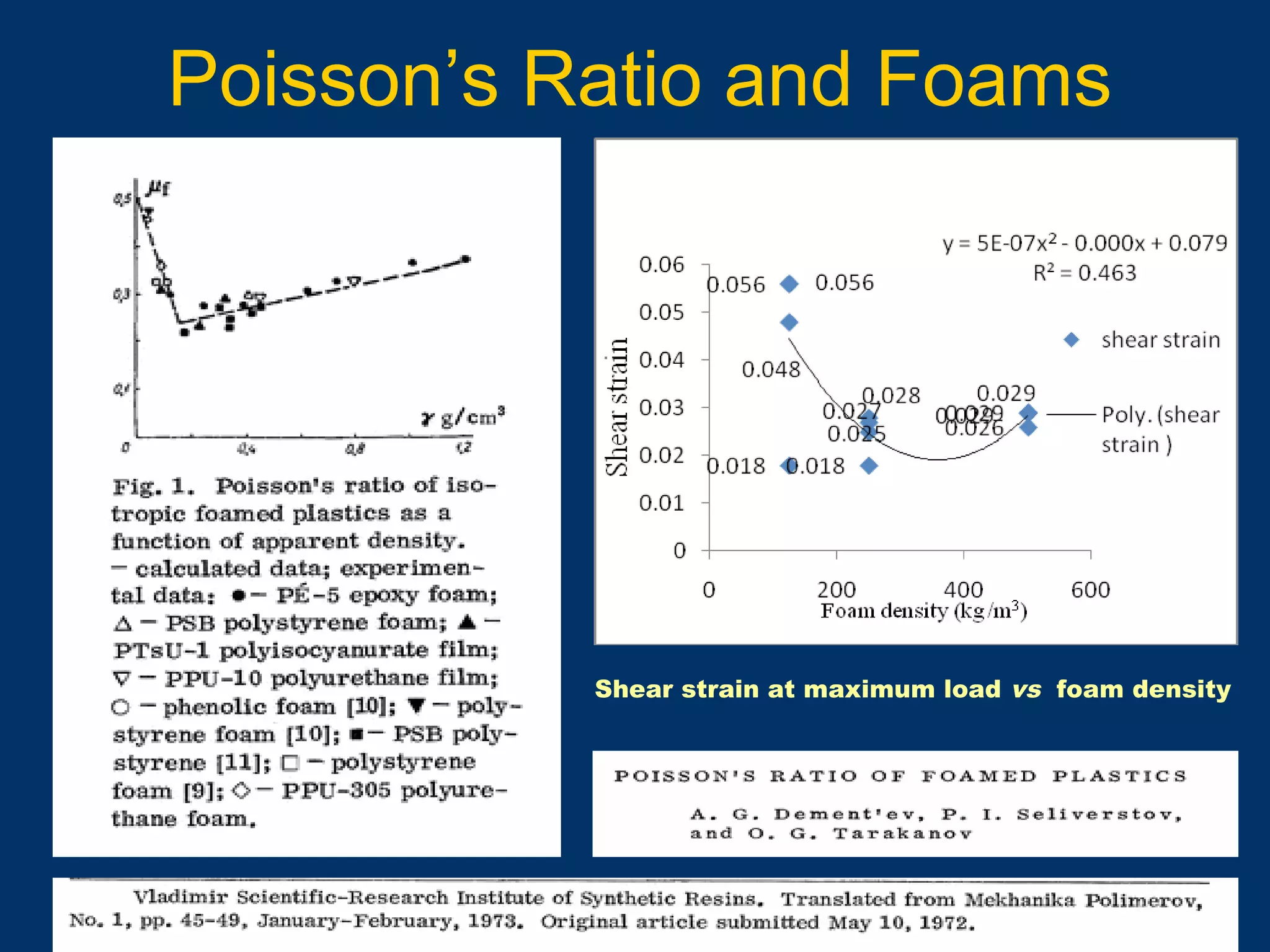
Poisson’s Ratio and Foams
Shear strain at maximum load vs foam density
10/16/15 18
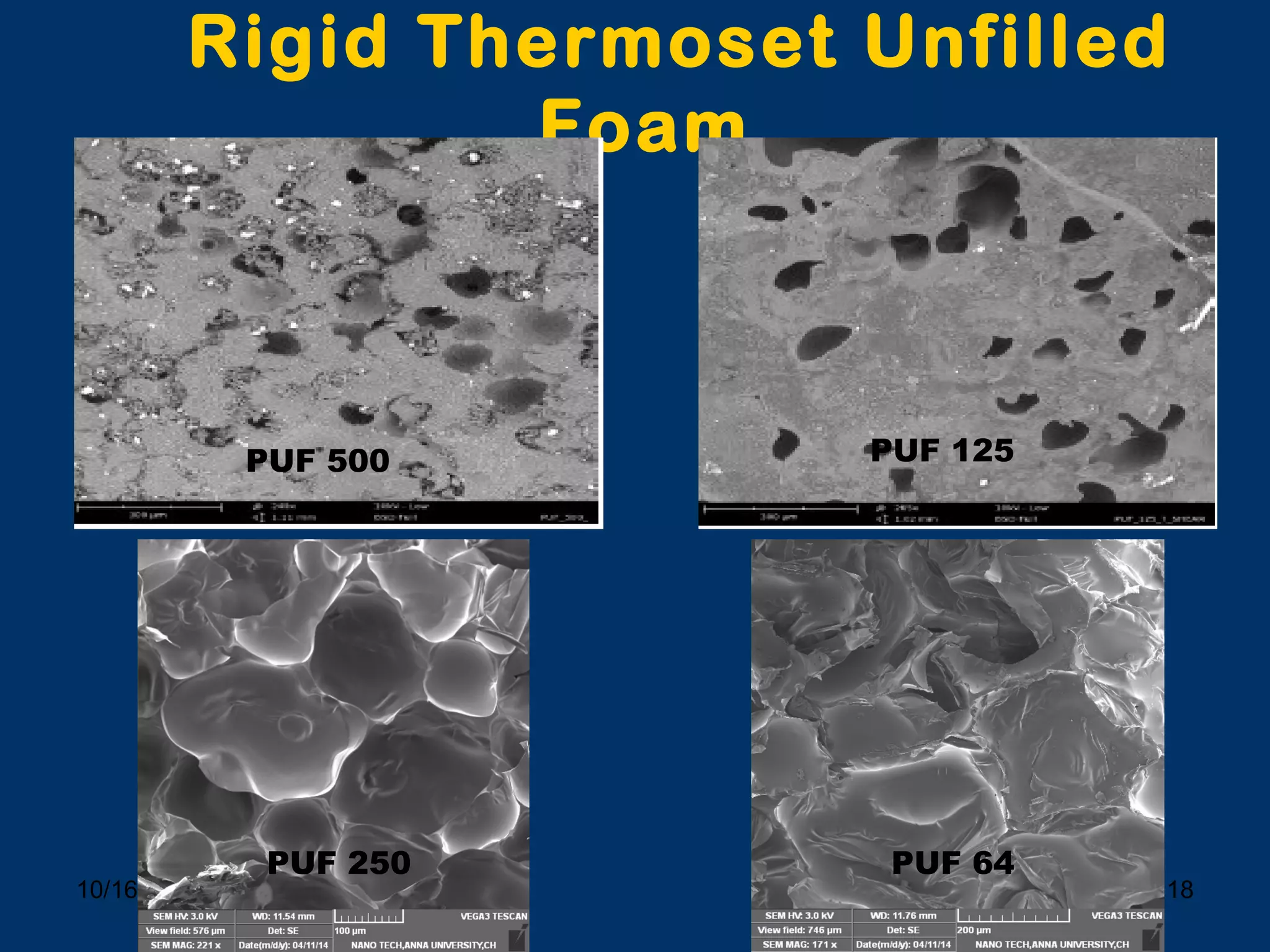
Rigid Thermoset Unfilled
Foam
PUF 500 PUF 125
PUF 250 PUF 64
10/16/15 19
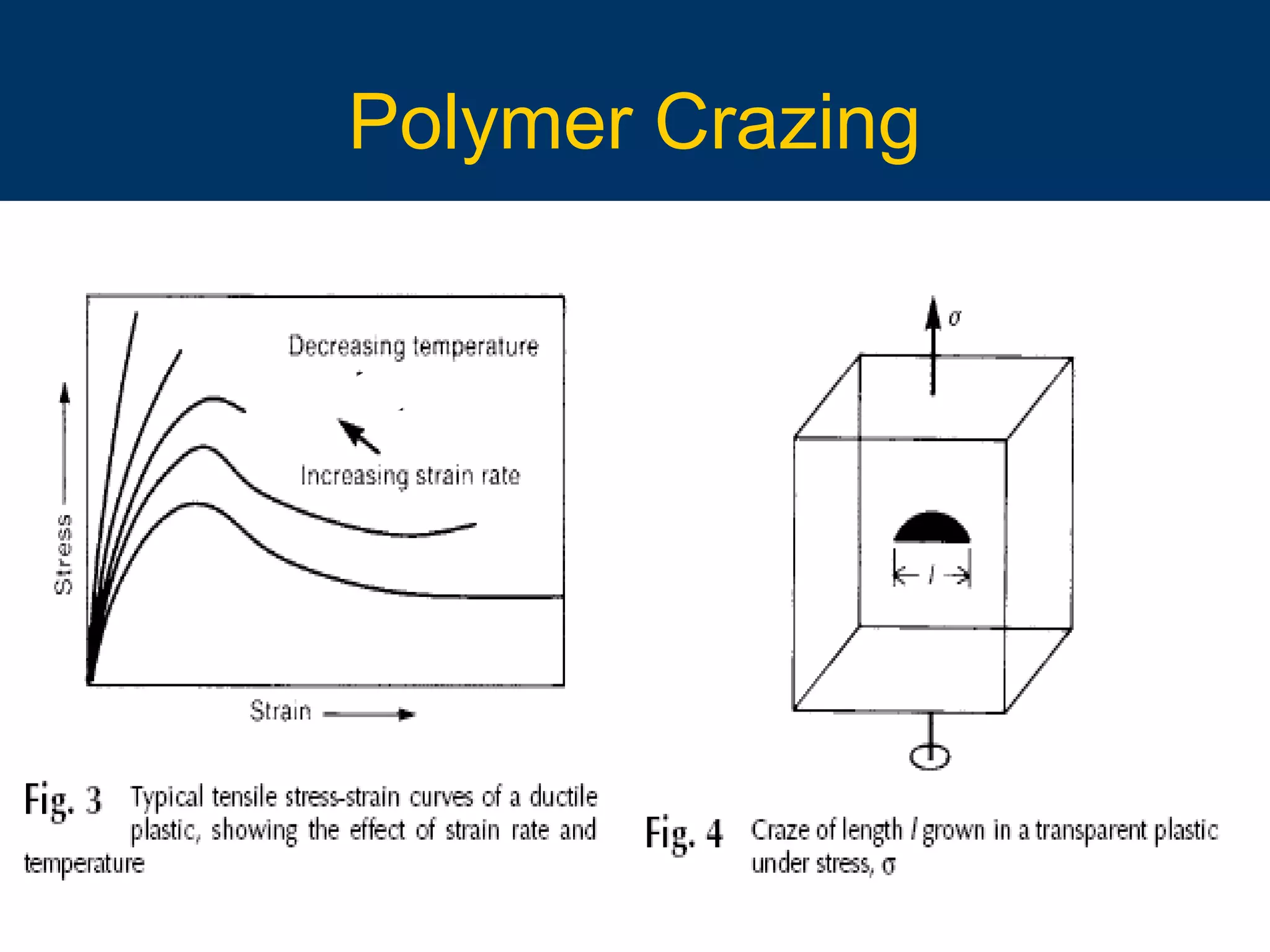
Polymer Crazing
10/16/15 20
Fracture Testing
10/16/15 21
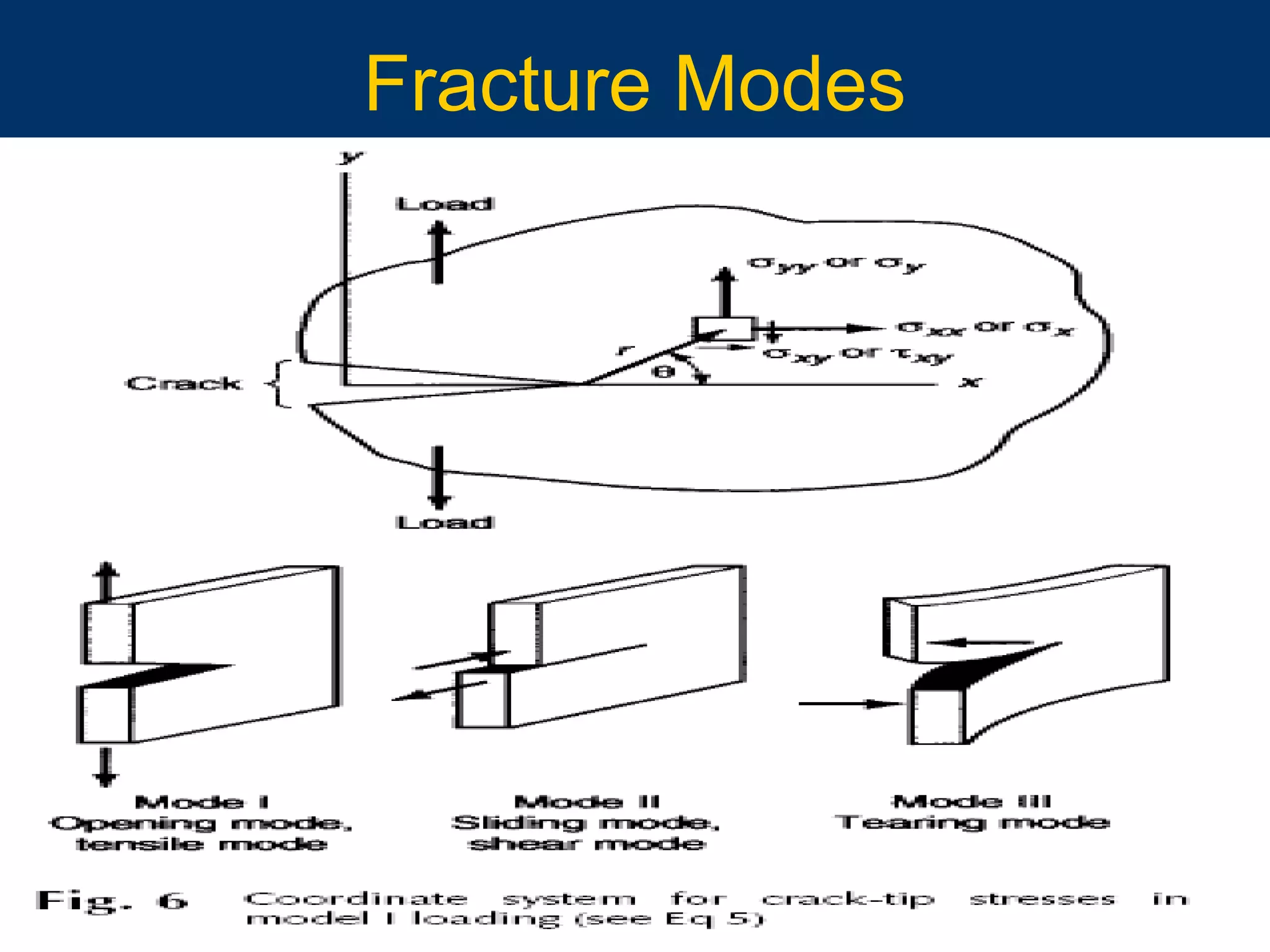
Fracture Modes
10/16/15 22
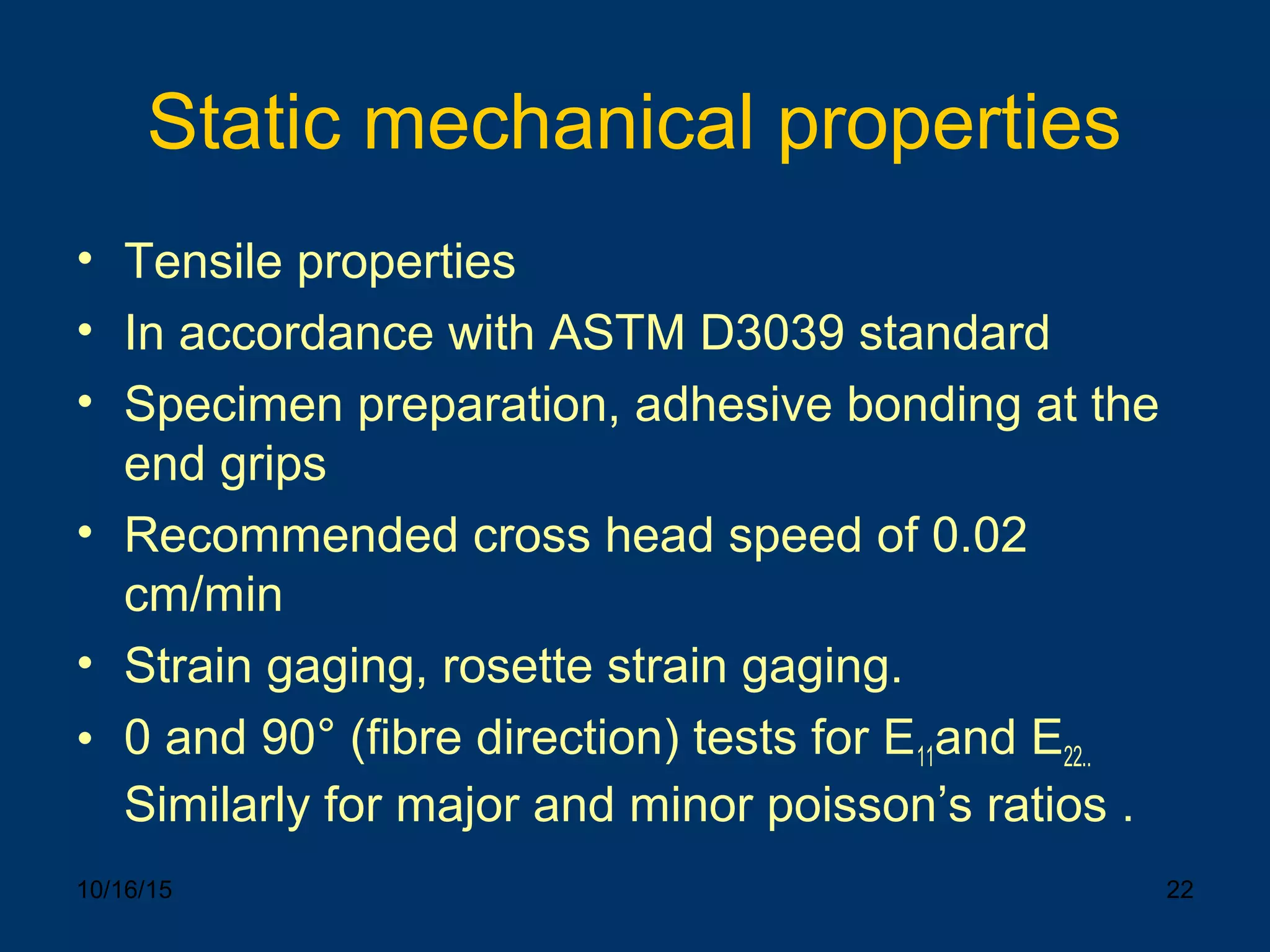
Static mechanical properties
• Tensile properties
• In accordance with ASTM D3039 standard
• Specimen preparation, adhesive bonding at the
end grips
• Recommended cross head speed of 0.02
cm/min
• Strain gaging, rosette strain gaging.
• 0 and 90° (fibre direction) tests for E11and E22..
Similarly for major and minor poisson’s ratios .
10/16/15 23
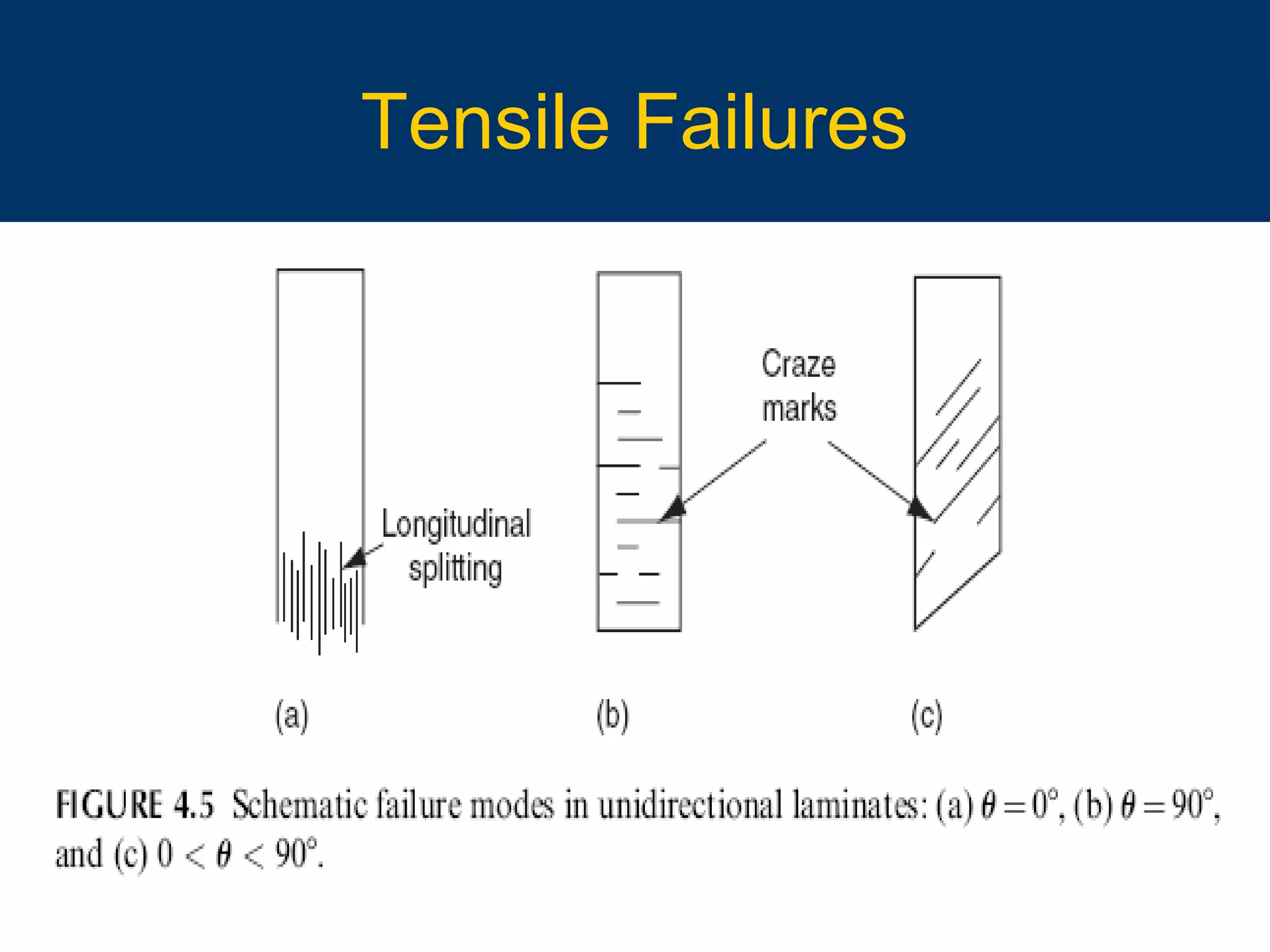
Tensile Failures
10/16/15 24
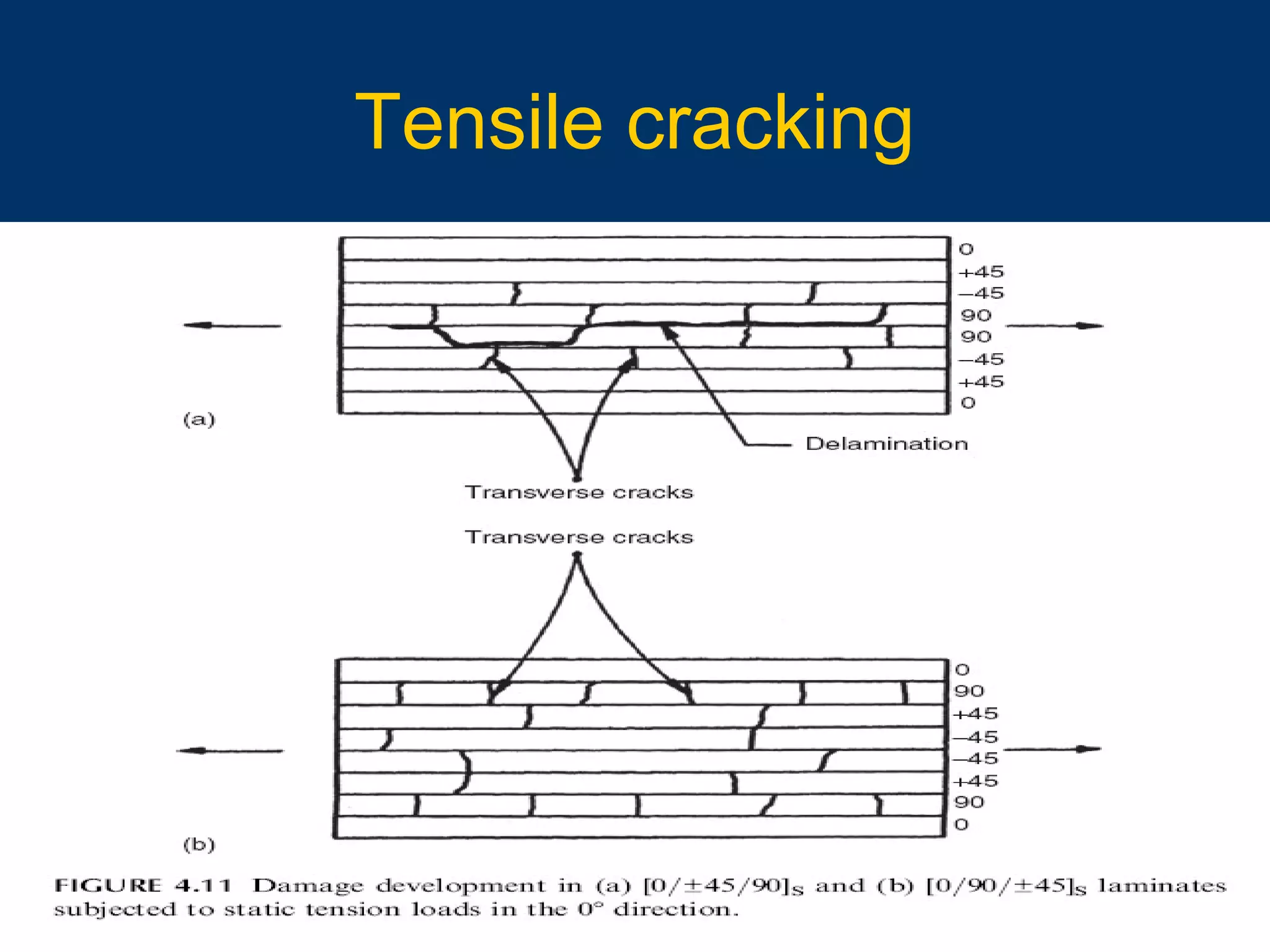
Tensile cracking
10/16/15 25
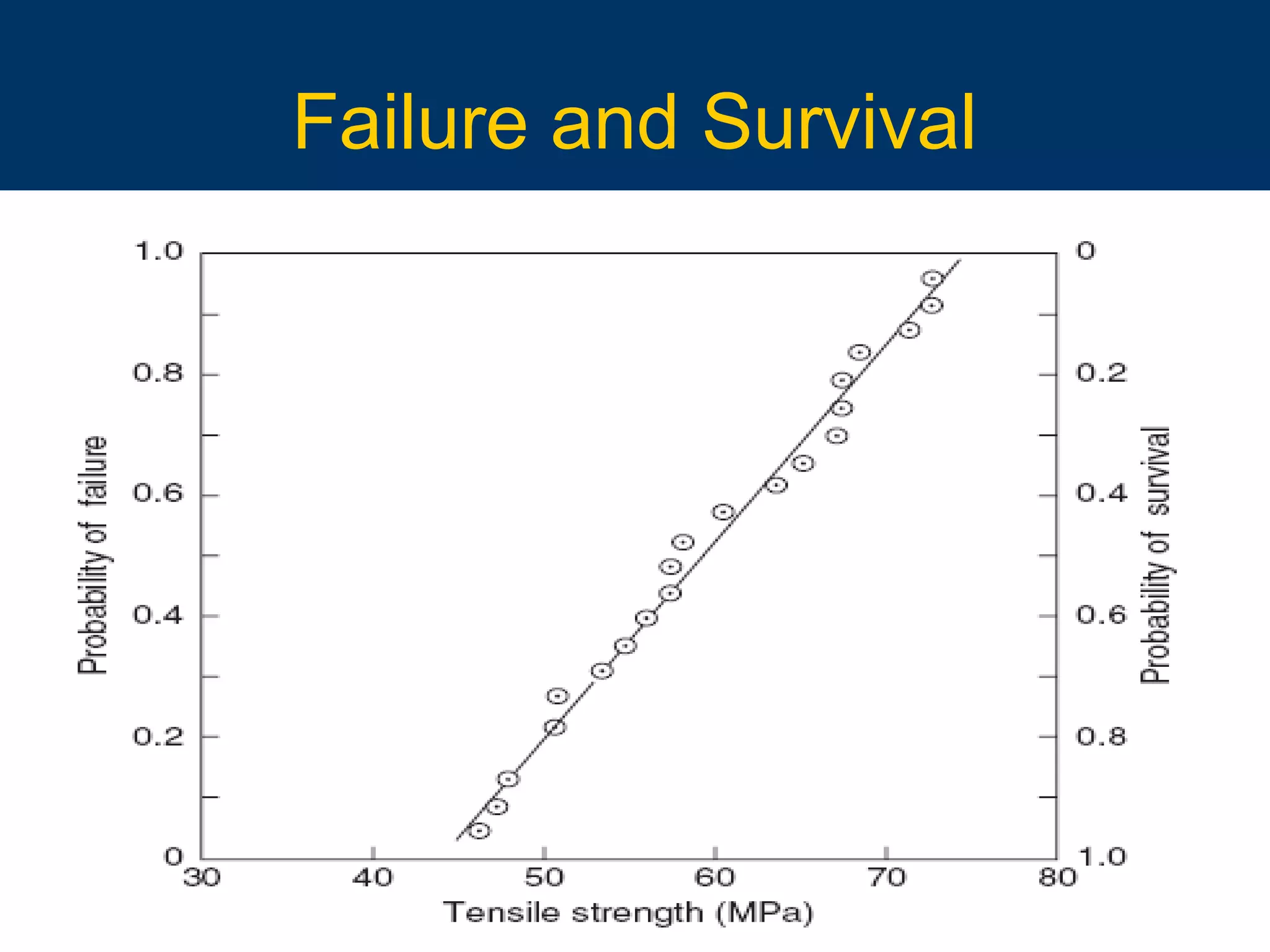
Failure and Survival
10/16/15 26
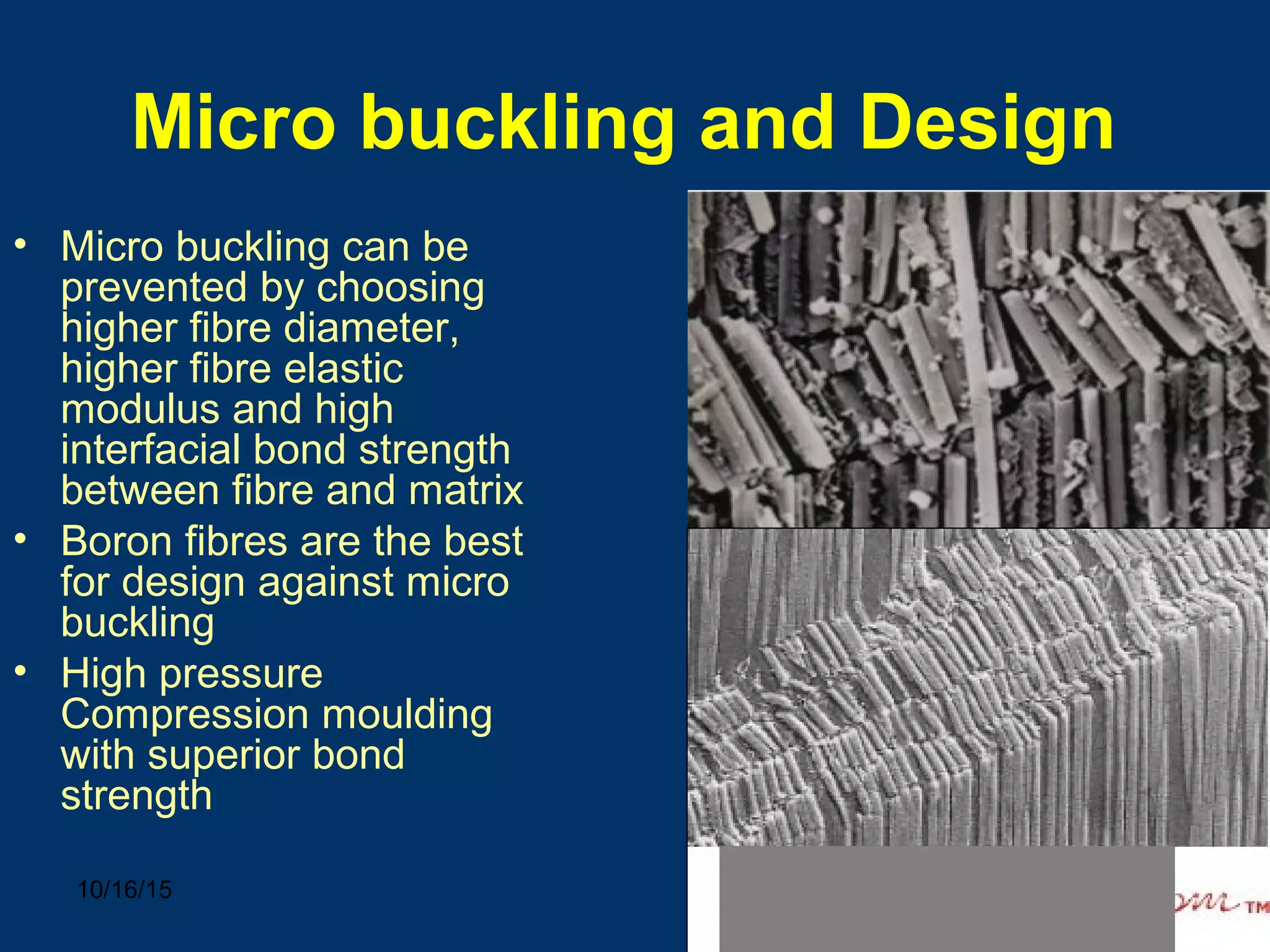
Micro buckling and Design
• Micro buckling can be
prevented by choosing
higher fibre diameter,
higher fibre elastic
modulus and high
interfacial bond strength
between fibre and matrix
• Boron fibres are the best
for design against micro
buckling
• High pressure
Compression moulding
with superior bond
strength
10/16/15 27
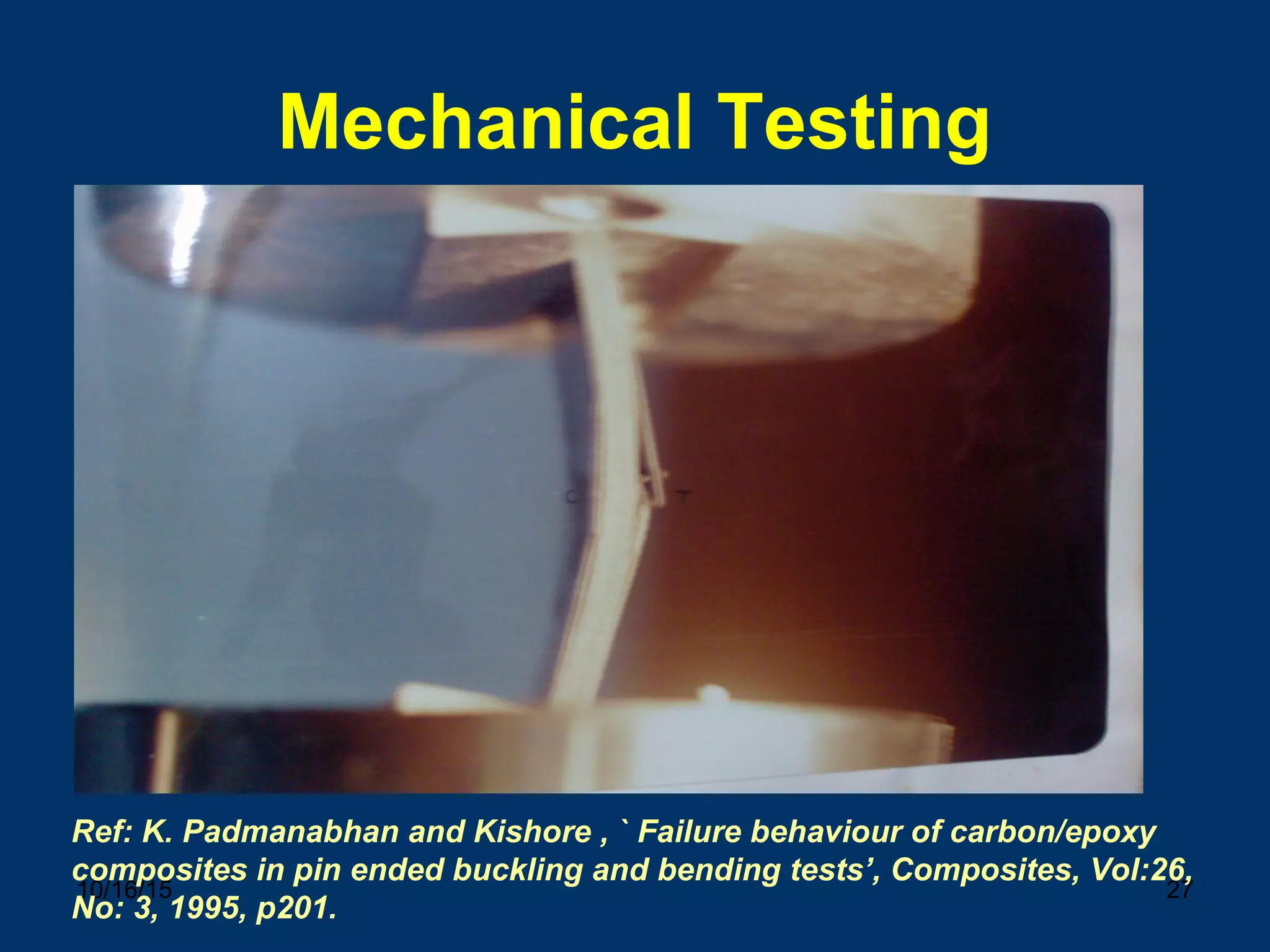
Mechanical Testing
Ref: K. Padmanabhan and Kishore , ` Failure behaviour of carbon/epoxy
composites in pin ended buckling and bending tests’, Composites, Vol:26,
No: 3, 1995, p201.
10/16/15 28
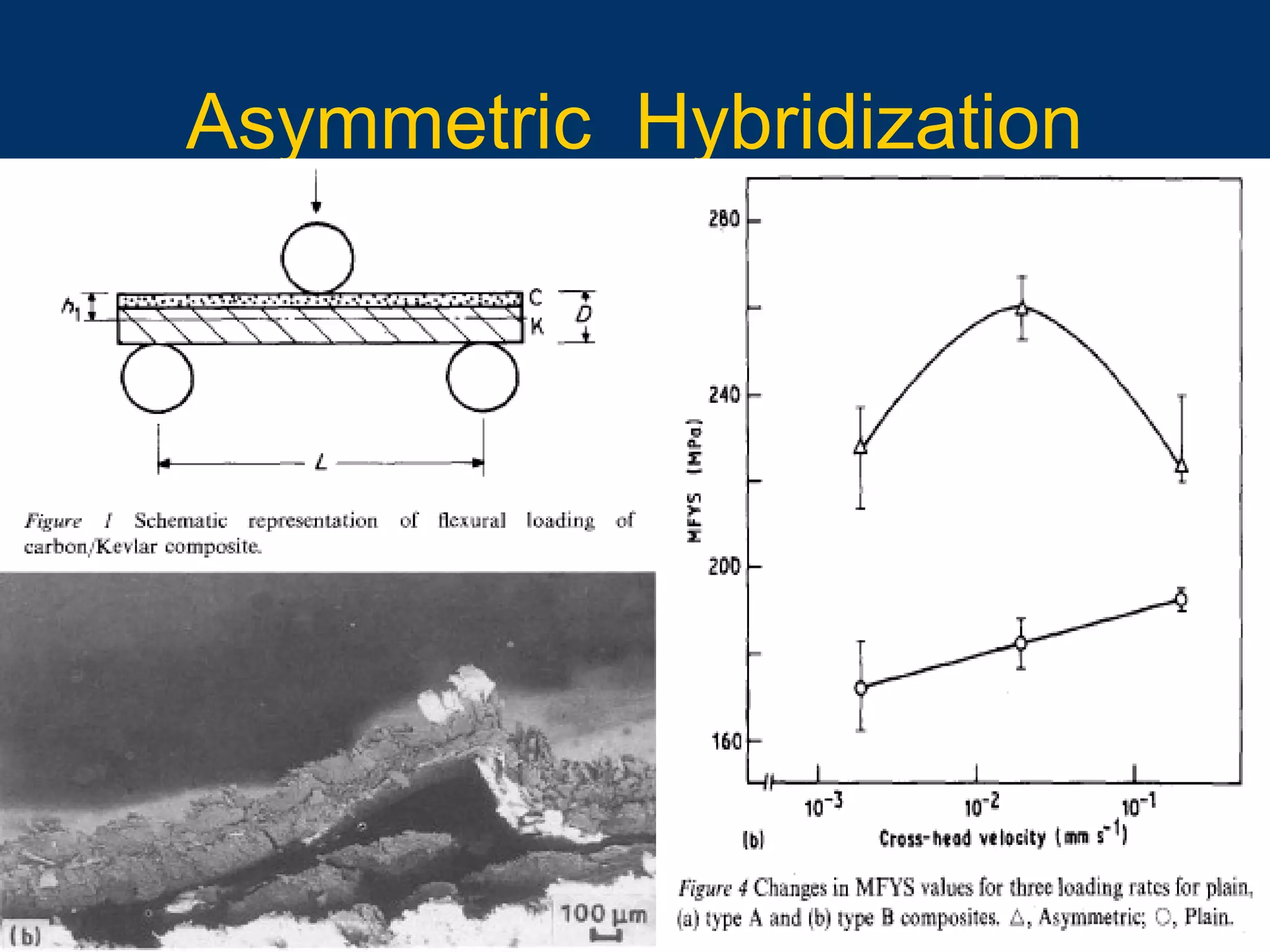
Asymmetric Hybridization
10/16/15 29
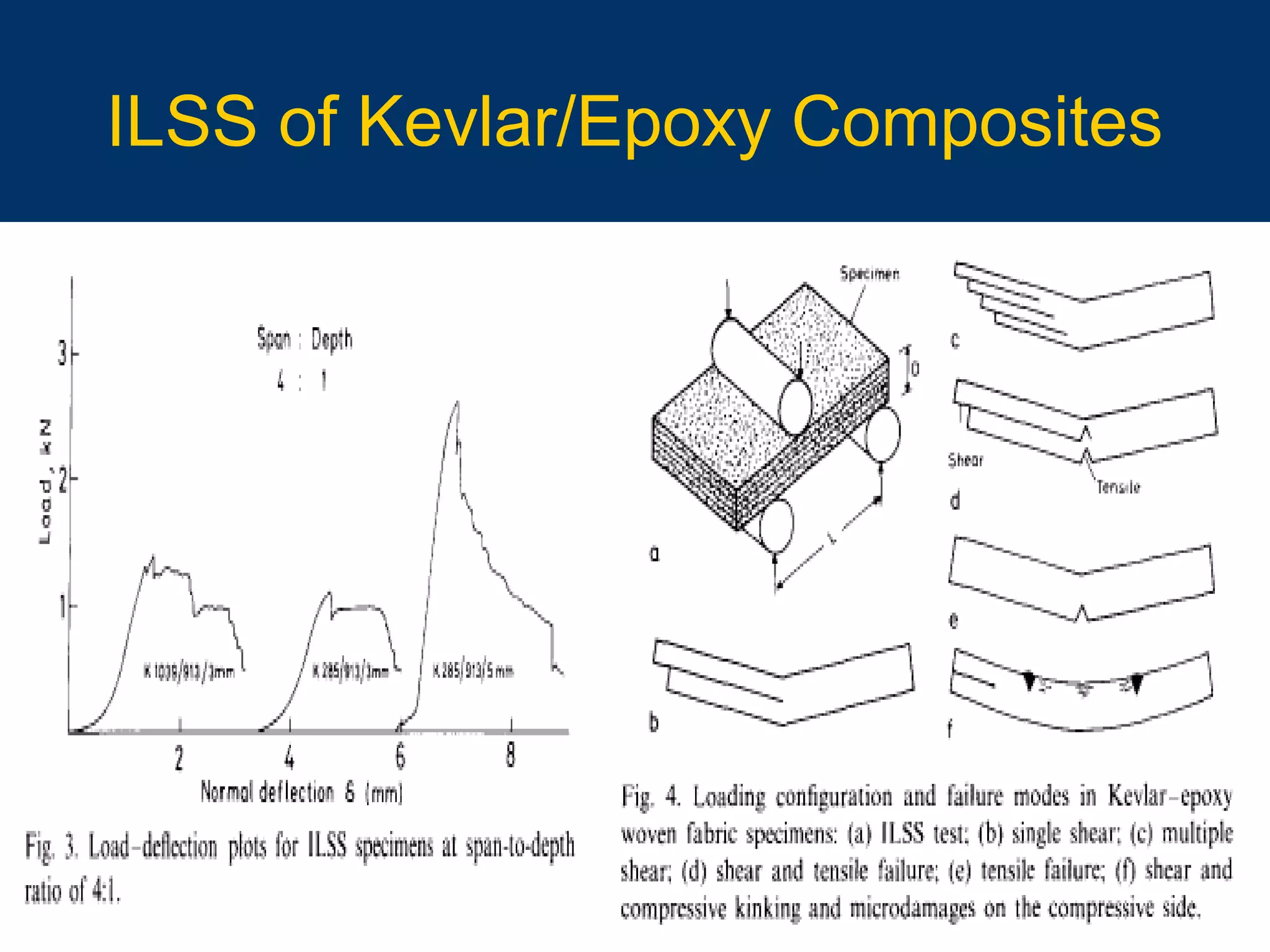
ILSS of Kevlar/Epoxy Composites
10/16/15 30
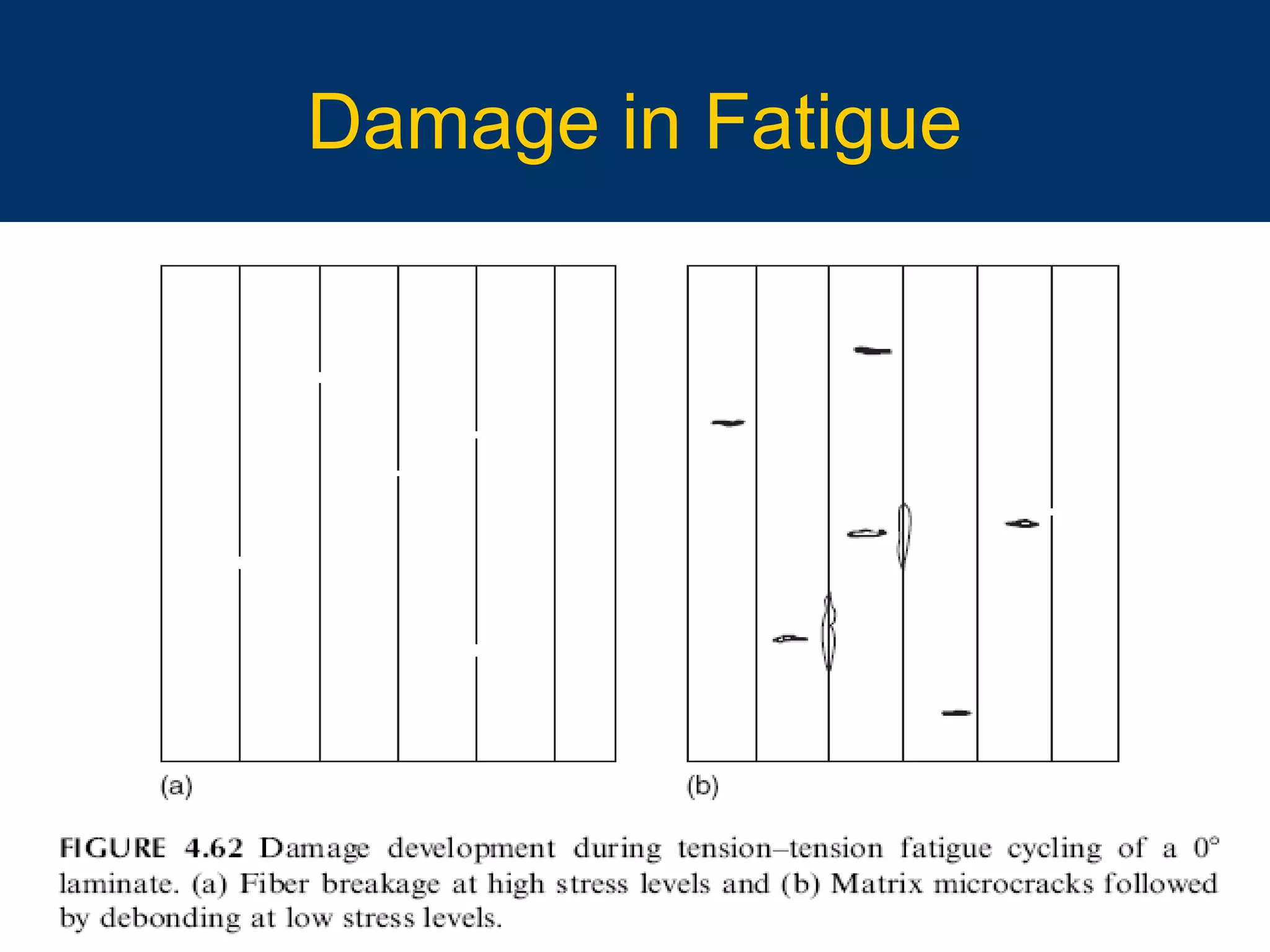
Damage in Fatigue
10/16/15 31
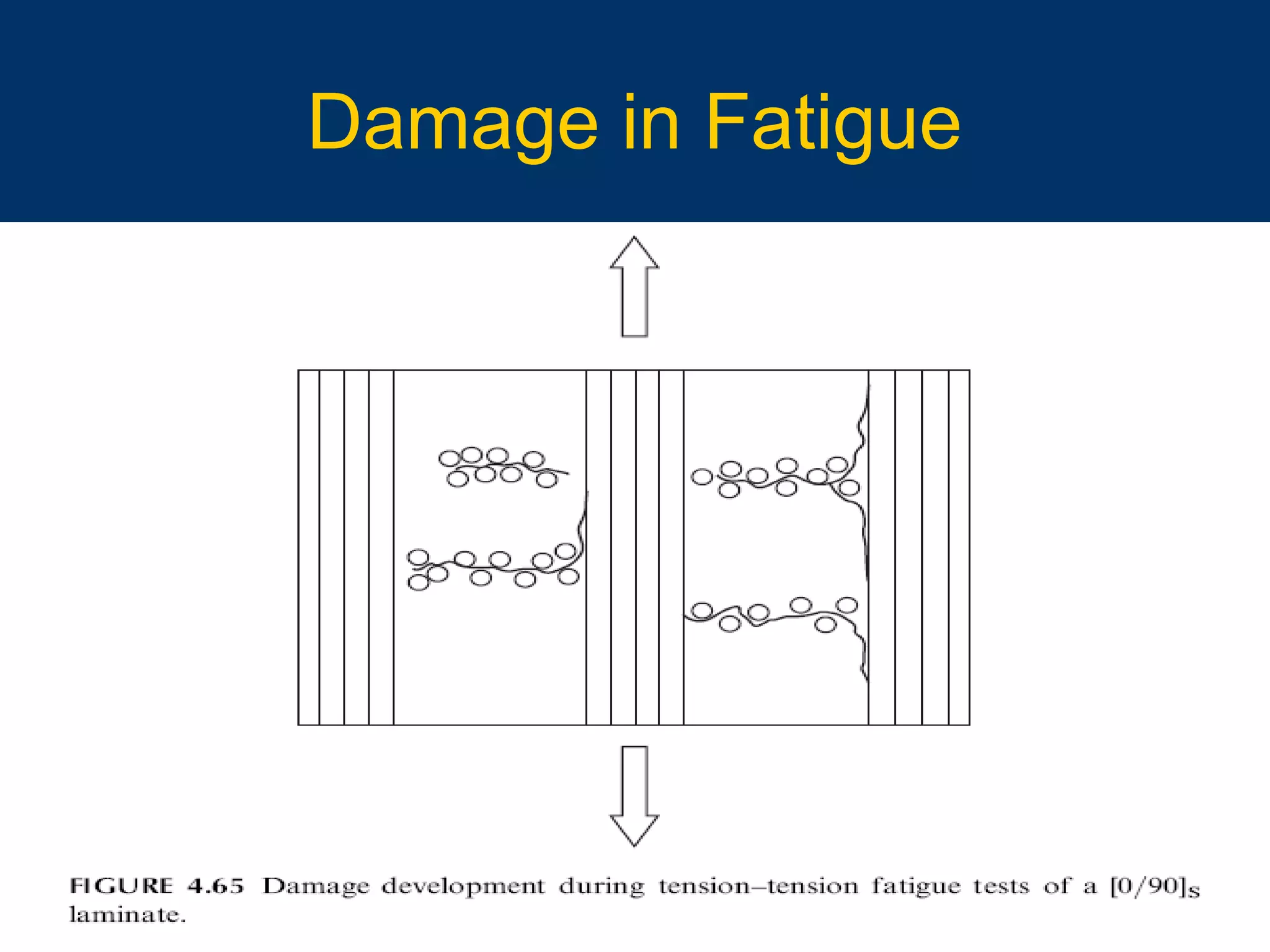
Damage in Fatigue
10/16/15 32
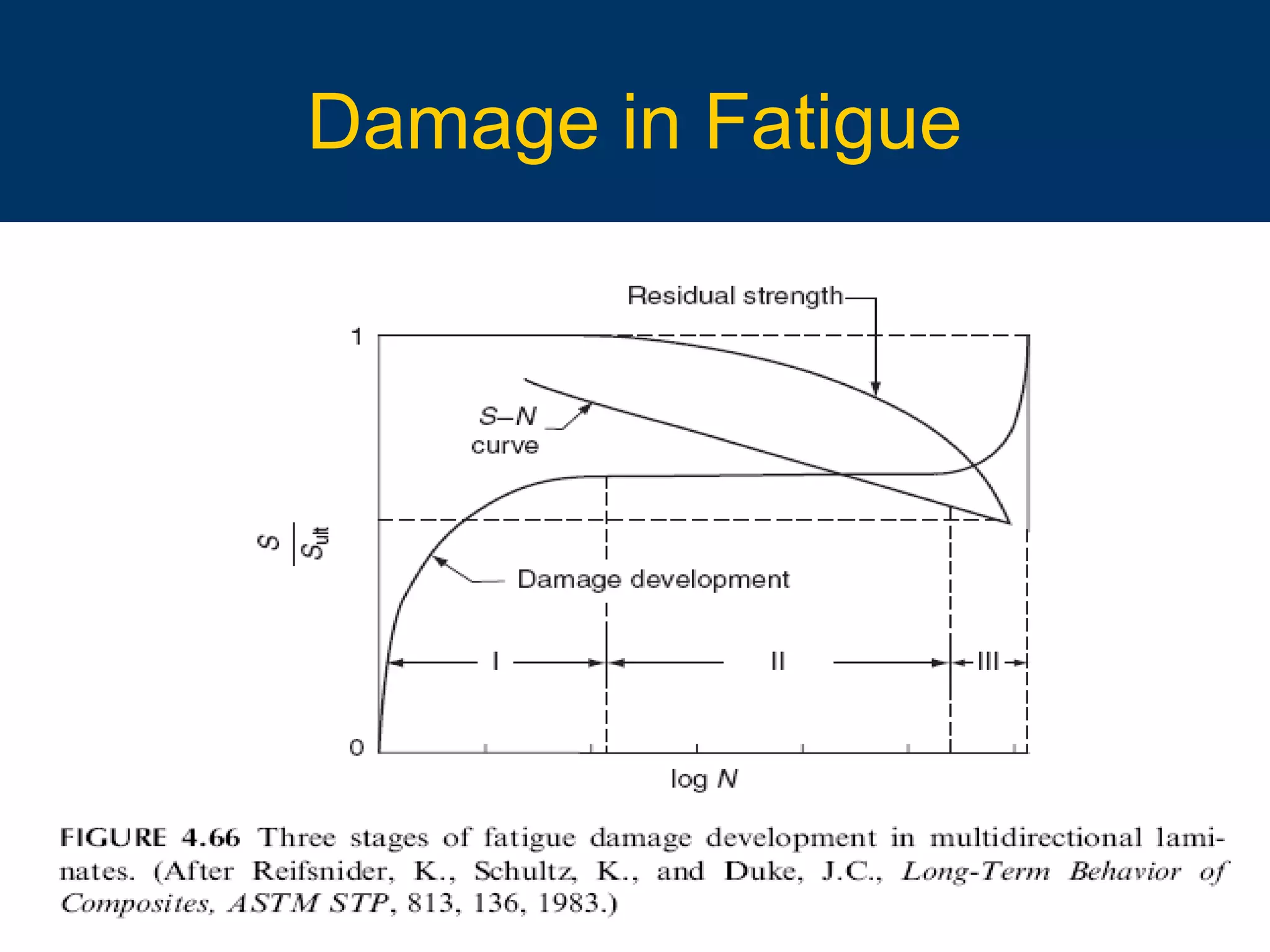
Damage in Fatigue
10/16/15 33
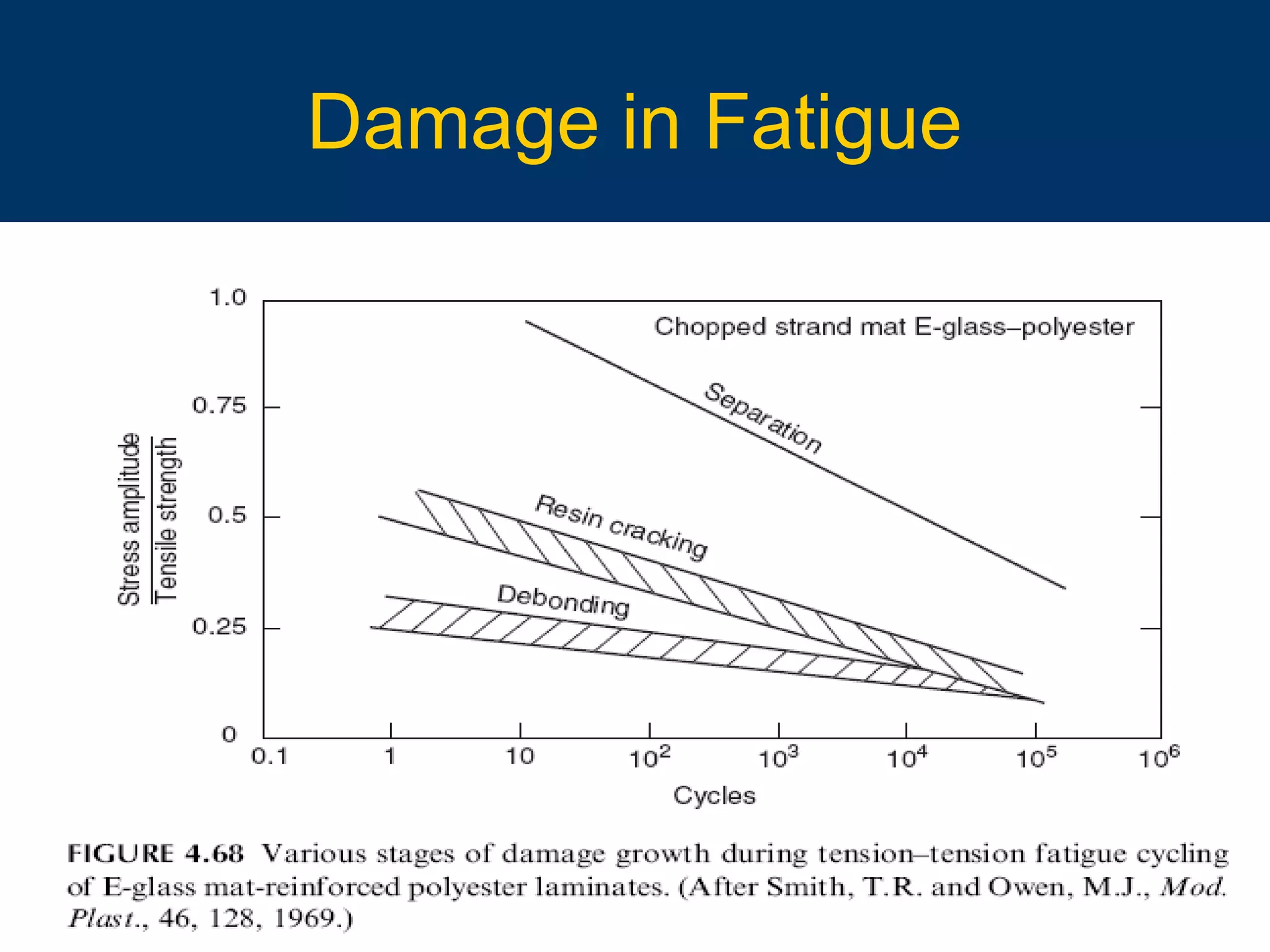
Damage in Fatigue
10/16/15 34
Multiple Cause Fatigue
• Thermomechanical Fatigue
• Fatigue –Vibration Interactions
• Thermal Fatigue with Moisture Attack
• Fatigue after DBT
• Hygrothermal Fatigue
• Creep –Fatigue Interactions.
• Electro-hygrothermo-mechanical Fatigue.
10/16/15 35
Impact Behaviour of Plastics and
Reinforced Plastics
• Izod Impact
• Charpy Impact
• Drop Weight Impact
• Low Velocity Impact Tests
• Repeated Impact Tests
• Medium and High Velocity Impact Tests
• Crashworthiness Tests
• Ballistic Impact Tests.
• Single Point Bird Hits .
10/16/15 36
Tensile Impact
The tensile impact test is a unique test. It is the extensional answer to
crashworthiness. Characterized by gross and fast fibre pull out and interfacial
Fracture, it is very dependent on the interfacial shear stress in UD conditions !
10/16/15 37
Creep of Plastics and FRPs
The regular creep curve of a metal is shown in the left with the creep curve of
A plastic or an FRP shown on the right . The tertiary creep rupture characteristic
Of metals is not prominent in plastics.
10/16/15 38
Fracture Mechanics
10/16/15 39
Fracture Mechanics
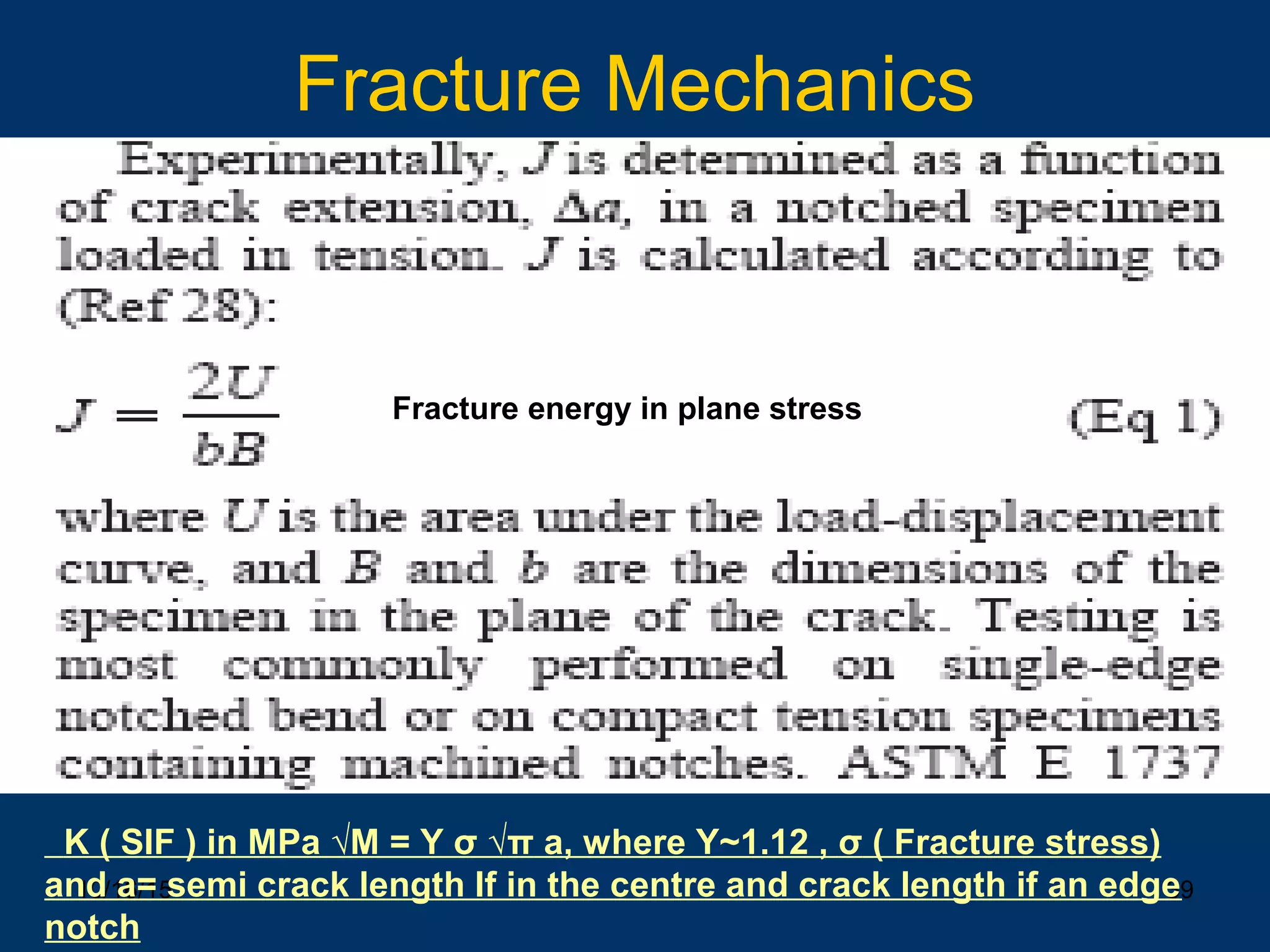
Fracture energy in plane stress
K ( SIF ) in MPa √M = Y σ √π a, where Y~1.12 , σ ( Fracture stress)
and a= semi crack length If in the centre and crack length if an edge
notch
10/16/15 40
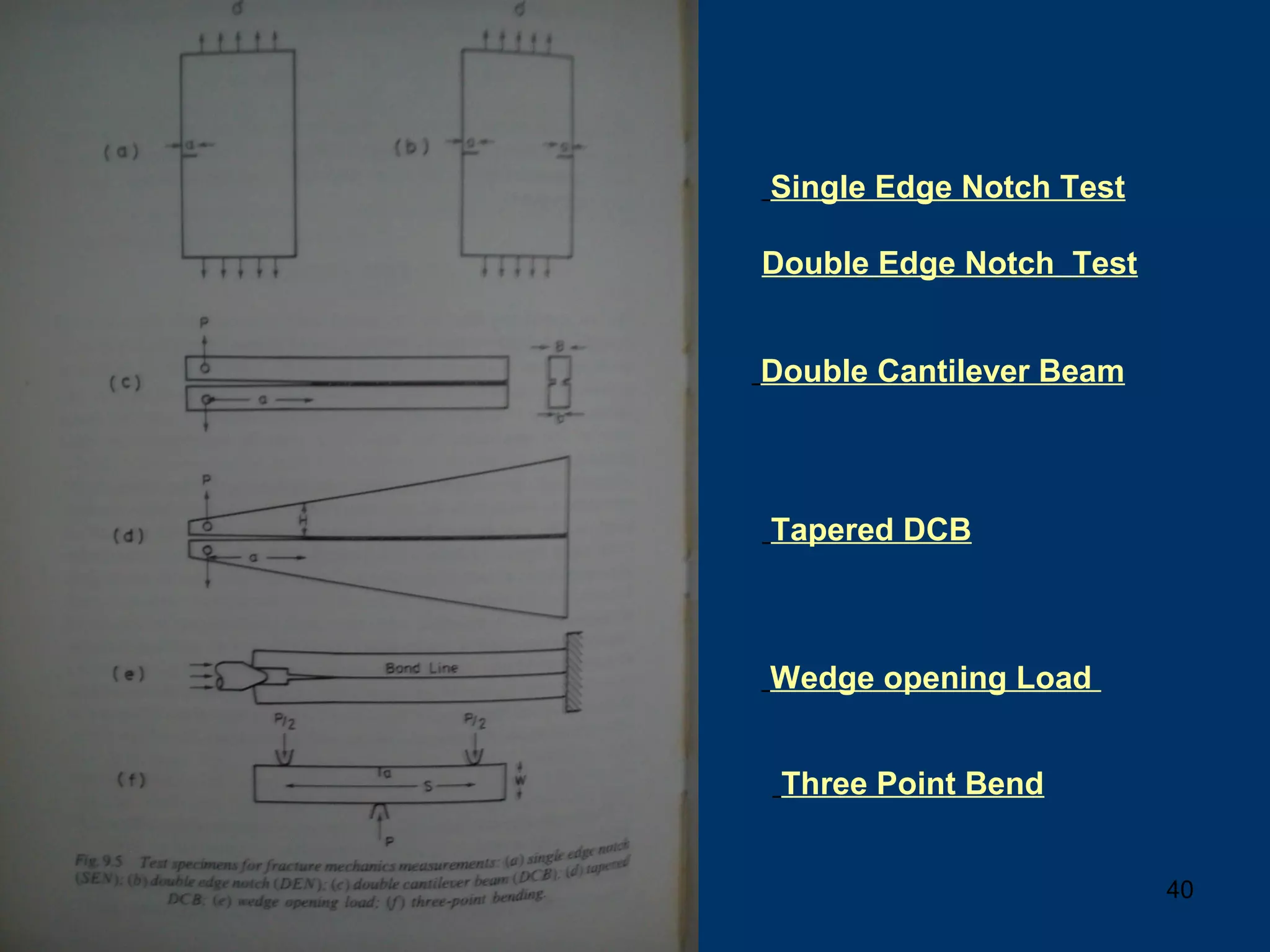
Single Edge Notch Test
Double Edge Notch Test
Double Cantilever Beam
Tapered DCB
Wedge opening Load
Three Point Bend
10/16/15 41
Fracture Mechanics Testing
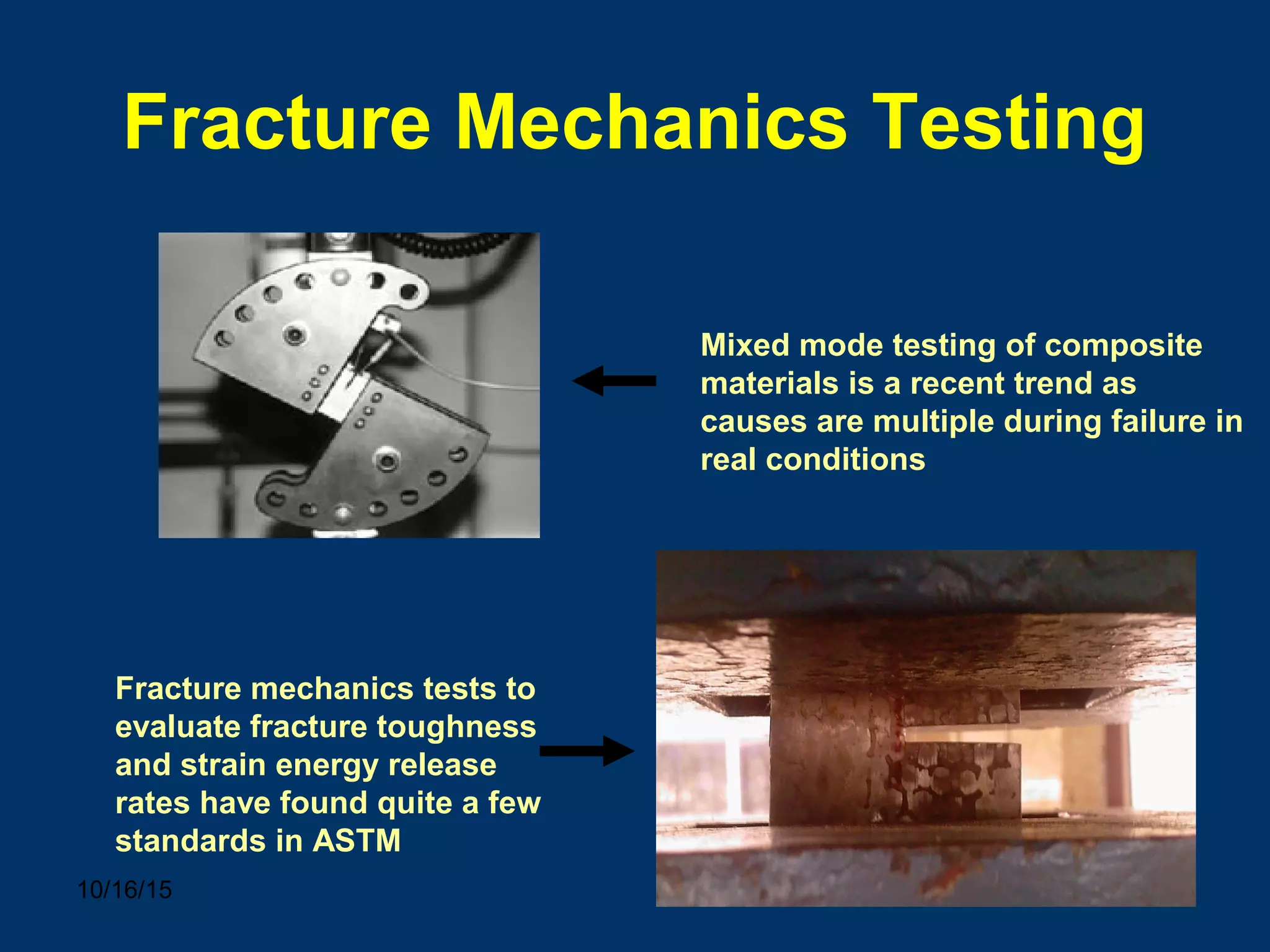
Mixed mode testing of composite
materials is a recent trend as
causes are multiple during failure in
real conditions
Fracture mechanics tests to
evaluate fracture toughness
and strain energy release
rates have found quite a few
standards in ASTM
10/16/15 42
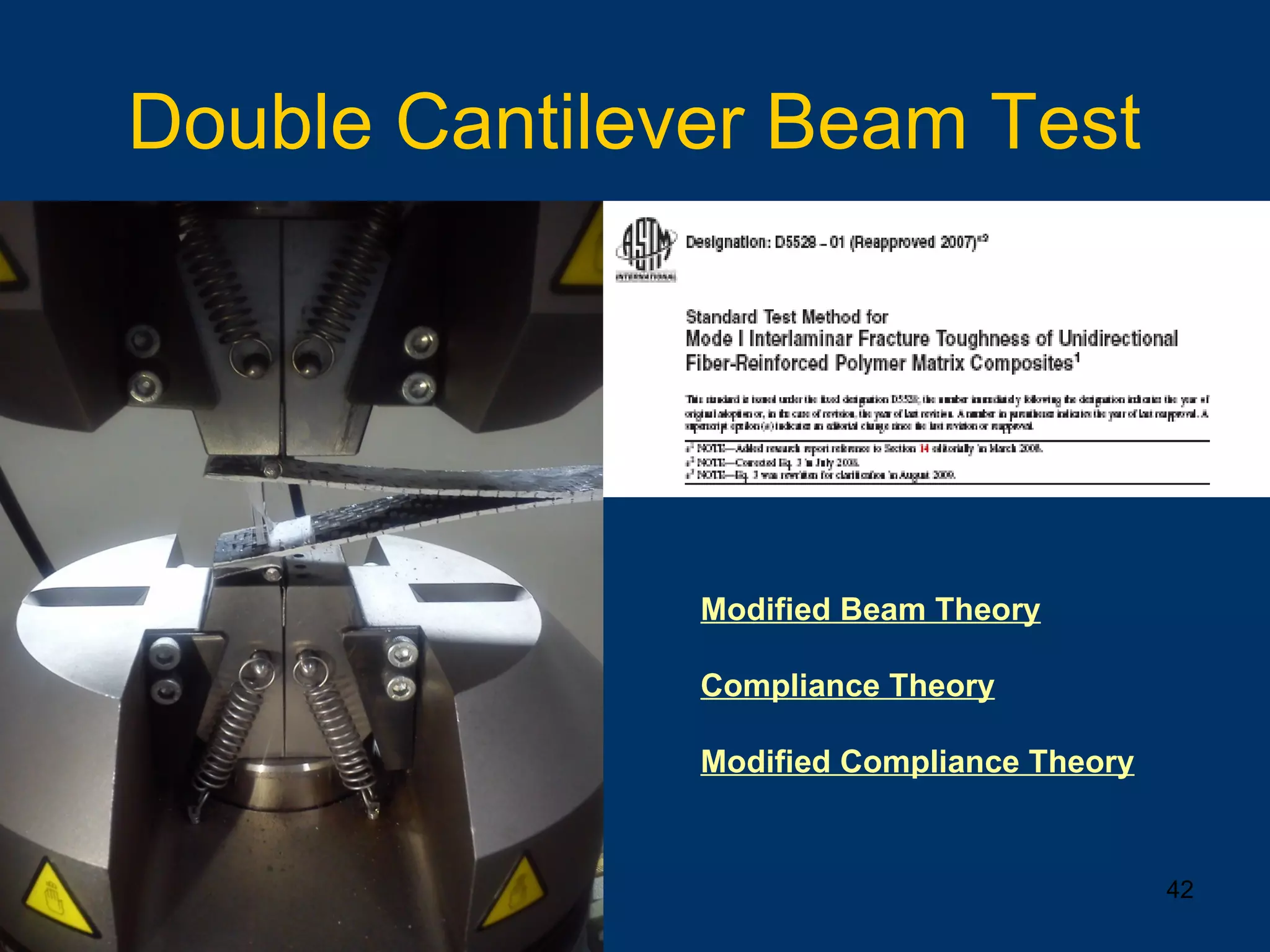
Double Cantilever Beam Test
Modified Beam Theory
Compliance Theory
Modified Compliance Theory
10/16/15 43
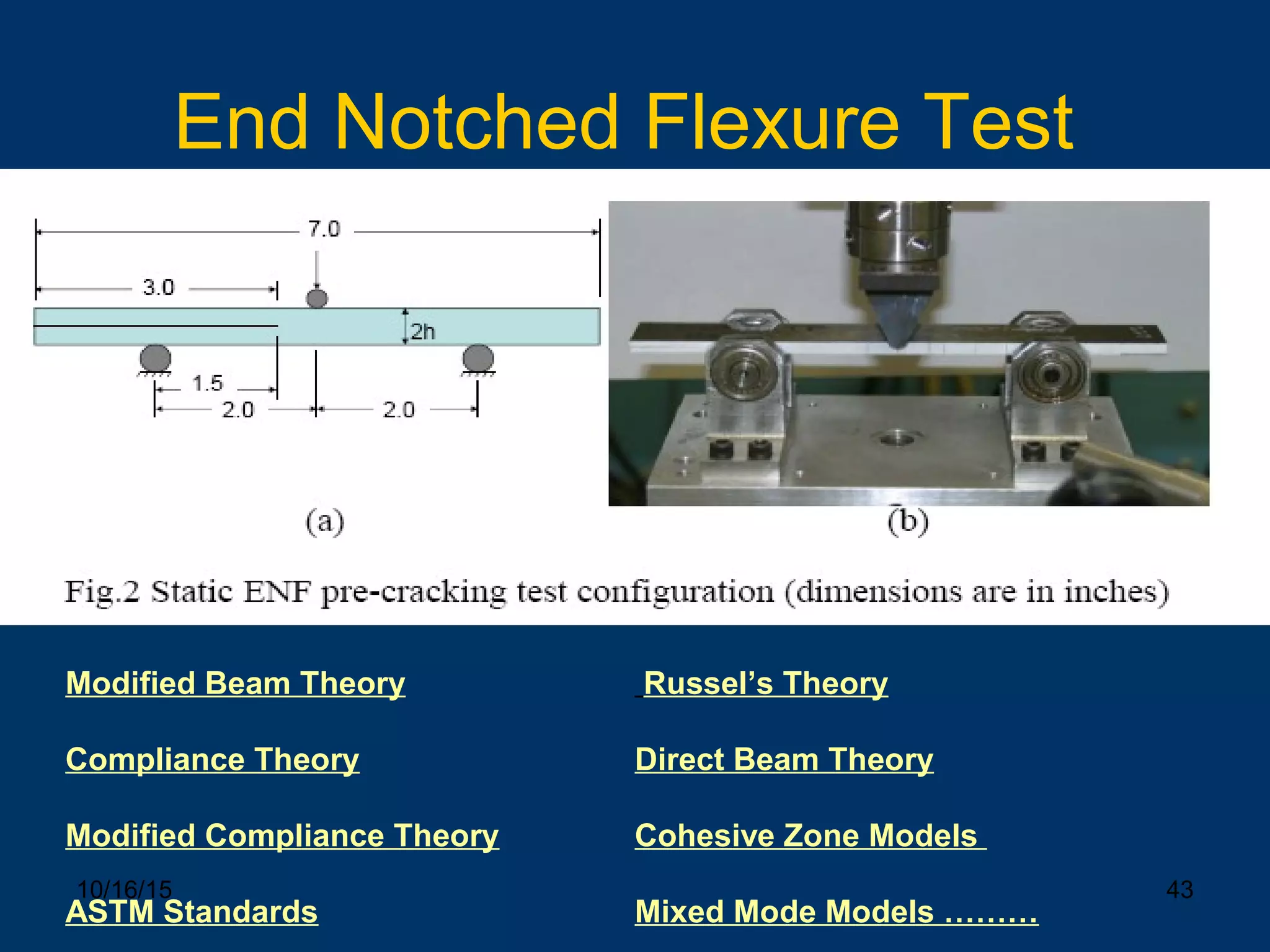
End Notched Flexure Test
Modified Beam Theory
Compliance Theory
Modified Compliance Theory
ASTM Standards
Russel’s Theory
Direct Beam Theory
Cohesive Zone Models
Mixed Mode Models ………
10/16/15 44
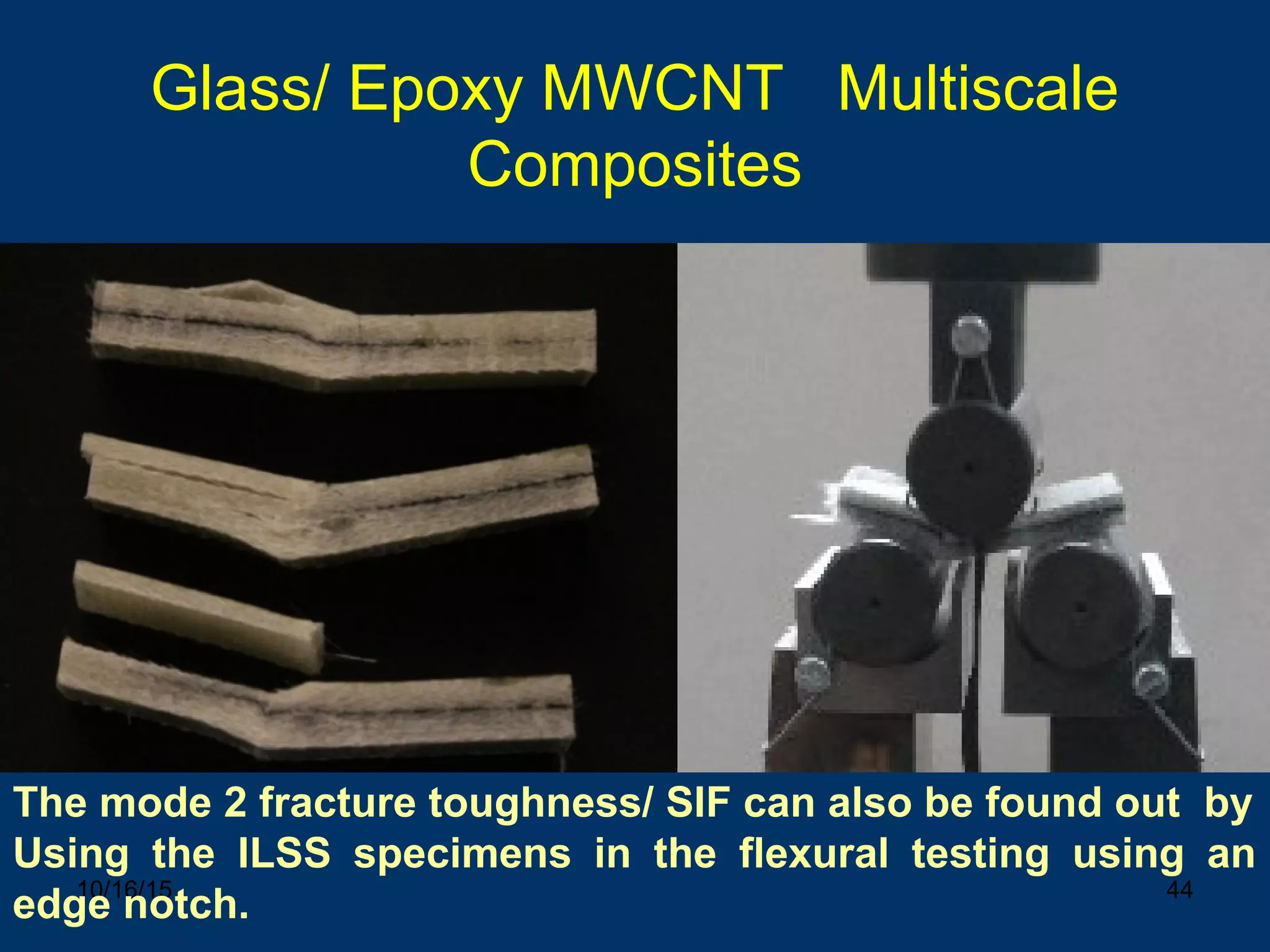
Glass/ Epoxy MWCNT Multiscale
Composites
The mode 2 fracture toughness/ SIF can also be found out by
Using the ILSS specimens in the flexural testing using an
edge notch.
10/16/15 45
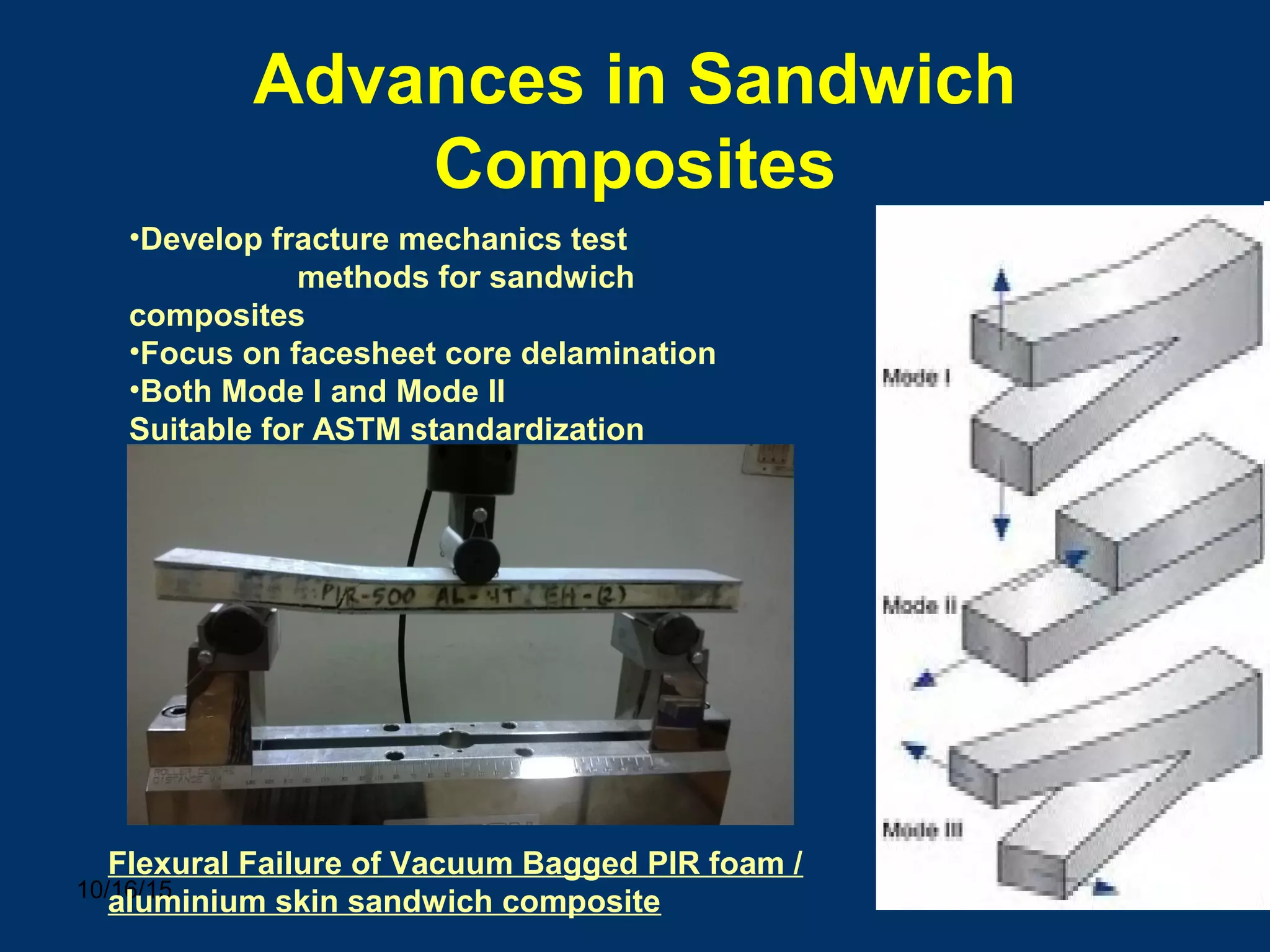
Advances in Sandwich
Composites
•Develop fracture mechanics test
methods for sandwich
composites
•Focus on facesheet core delamination
•Both Mode I and Mode II
Suitable for ASTM standardization
Flexural Failure of Vacuum Bagged PIR foam /
aluminium skin sandwich composite
10/16/15 46
Fractography and Failure Analyses
10/16/15 47
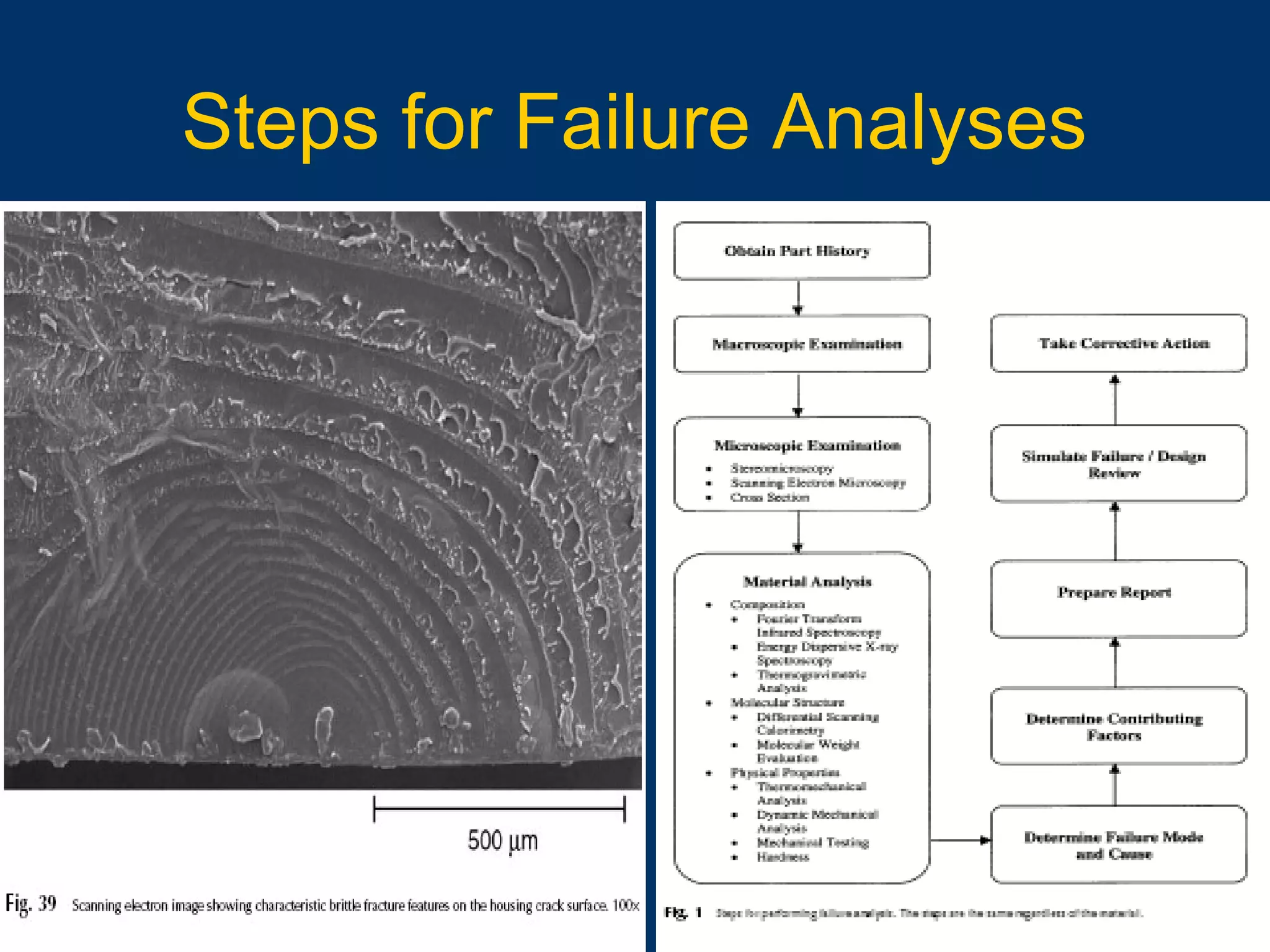
Steps for Failure Analyses
10/16/15 48
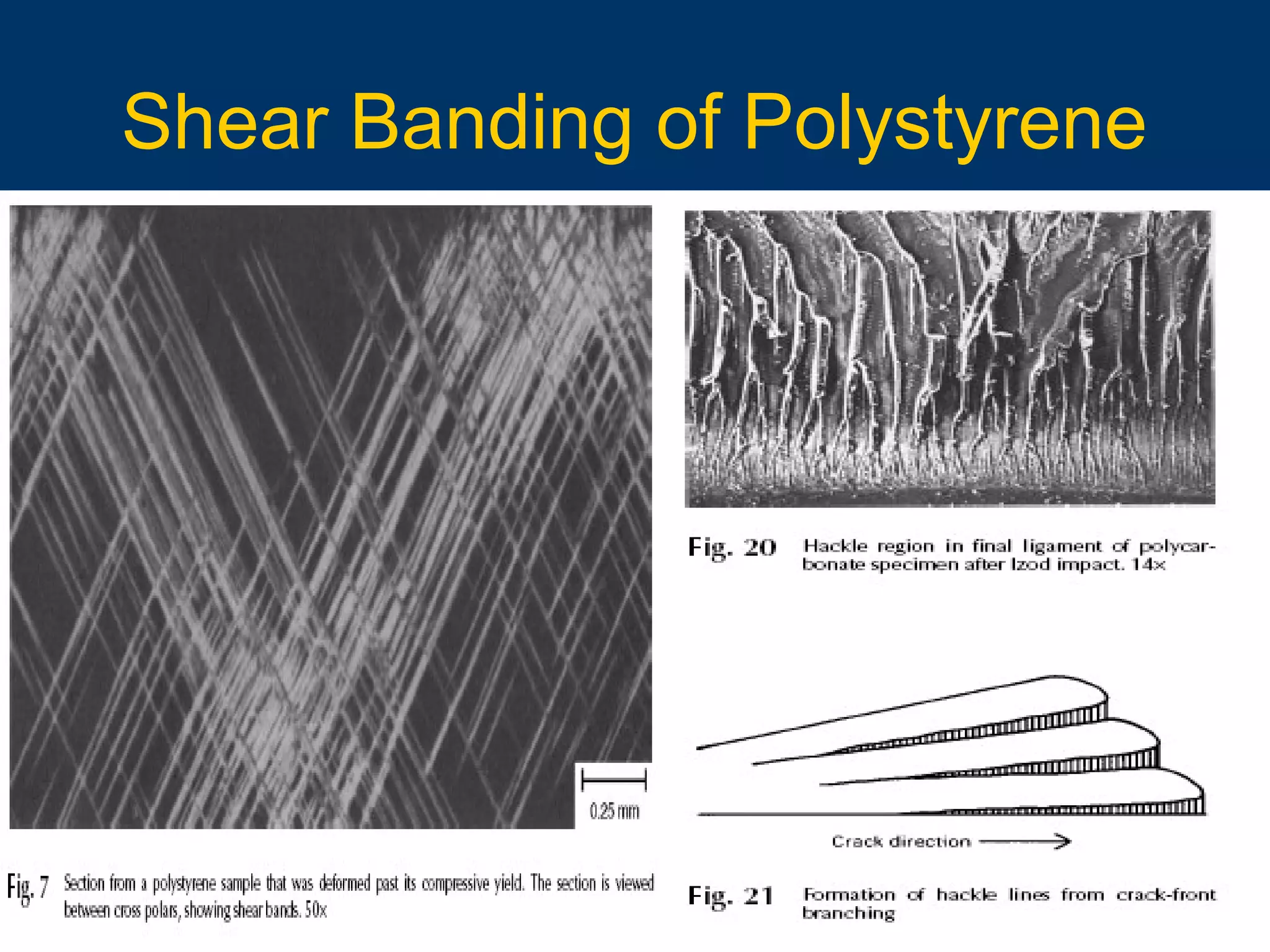
Shear Banding of Polystyrene
10/16/15 49
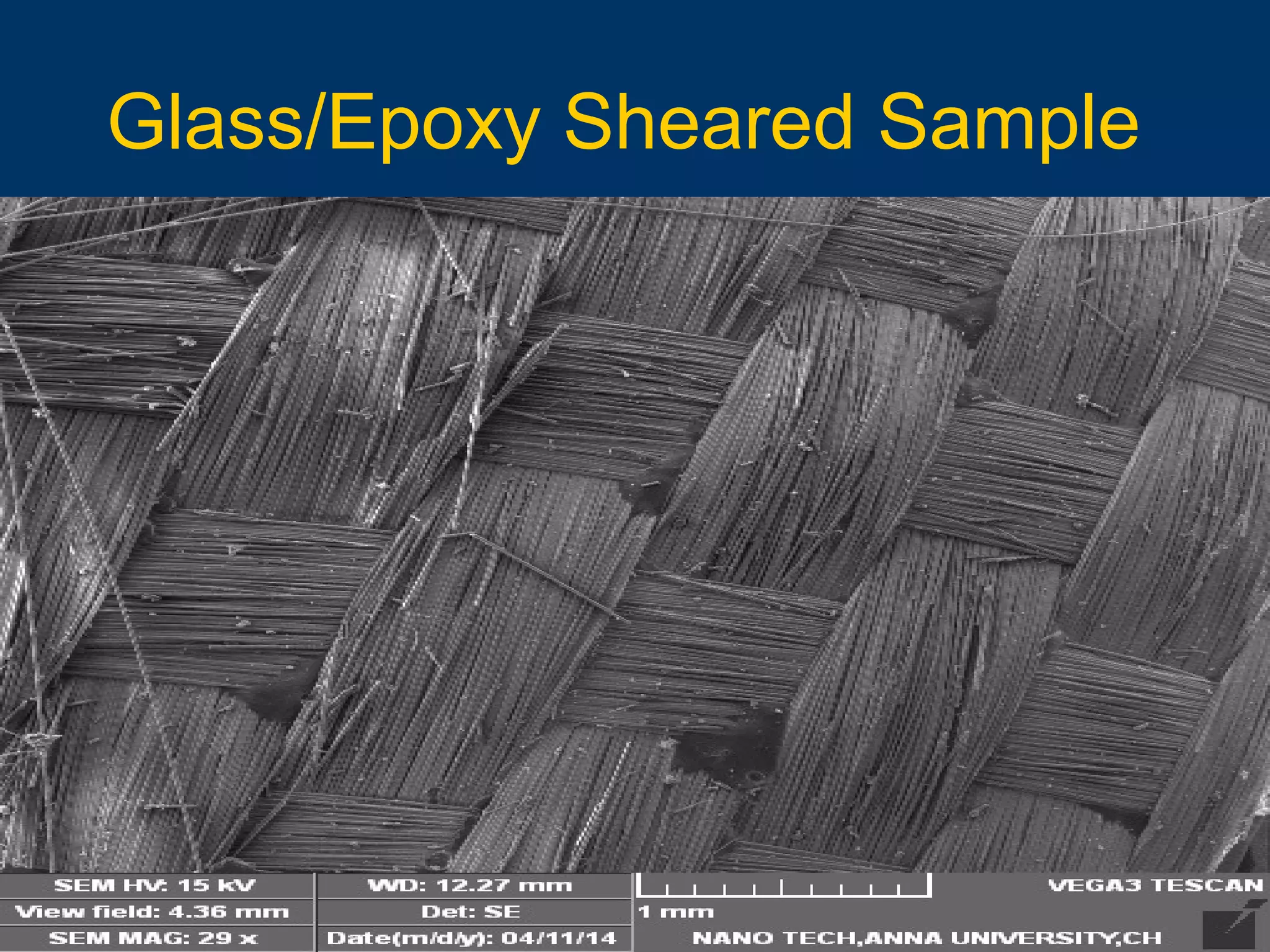
Glass/Epoxy Sheared Sample
10/16/15 50
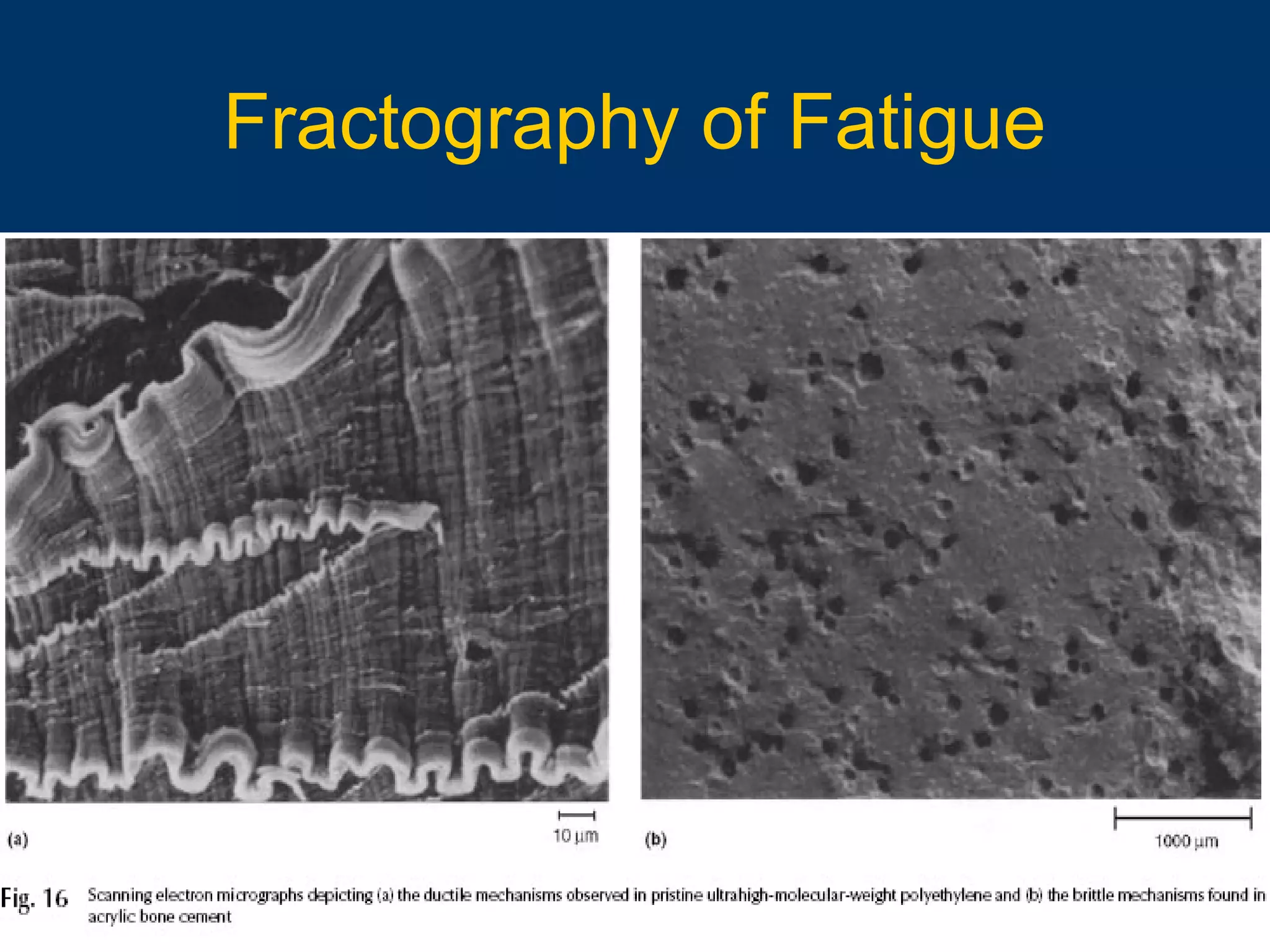
Fractography of Fatigue
10/16/15 51
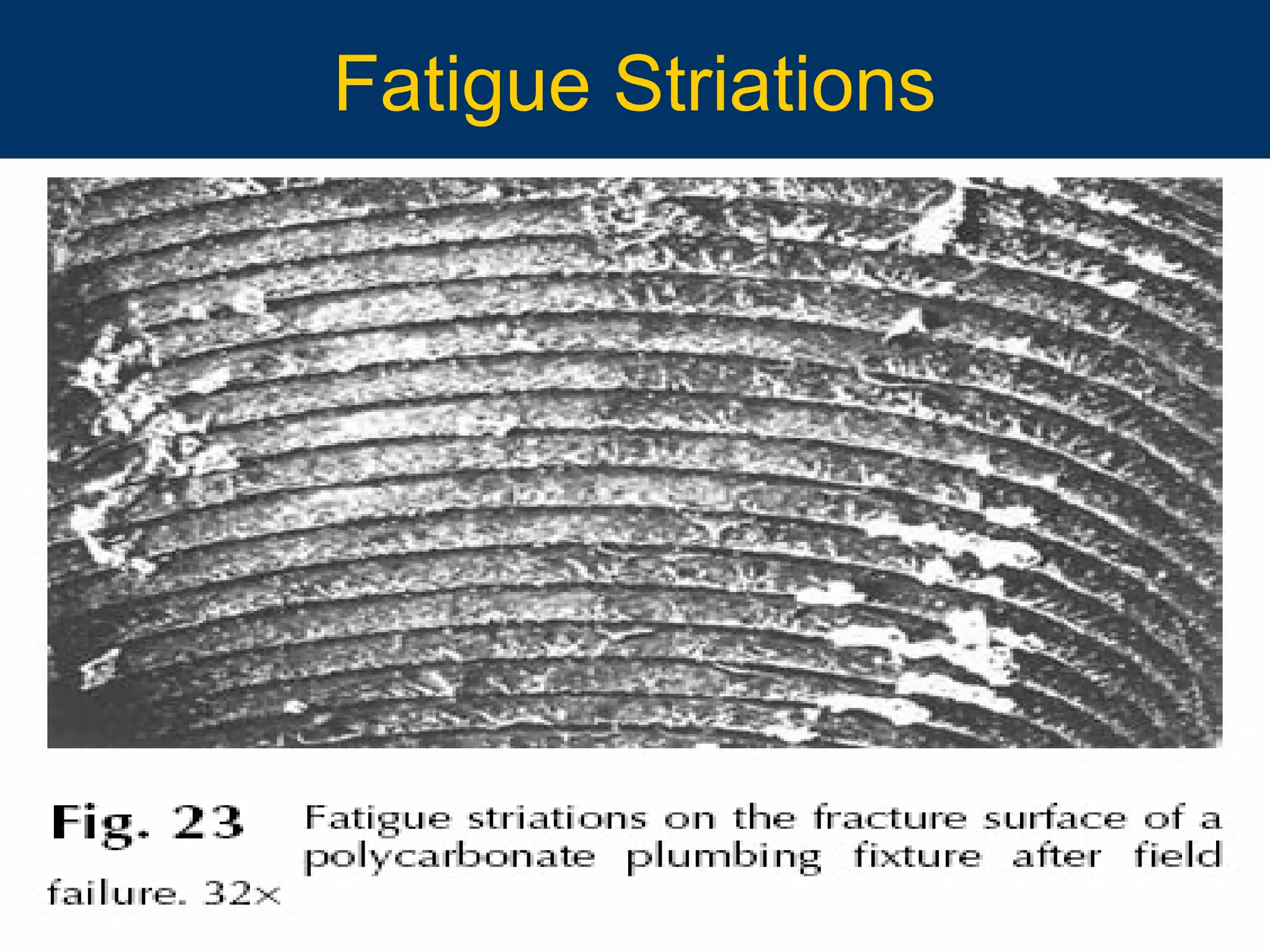
Fatigue Striations
10/16/15 52
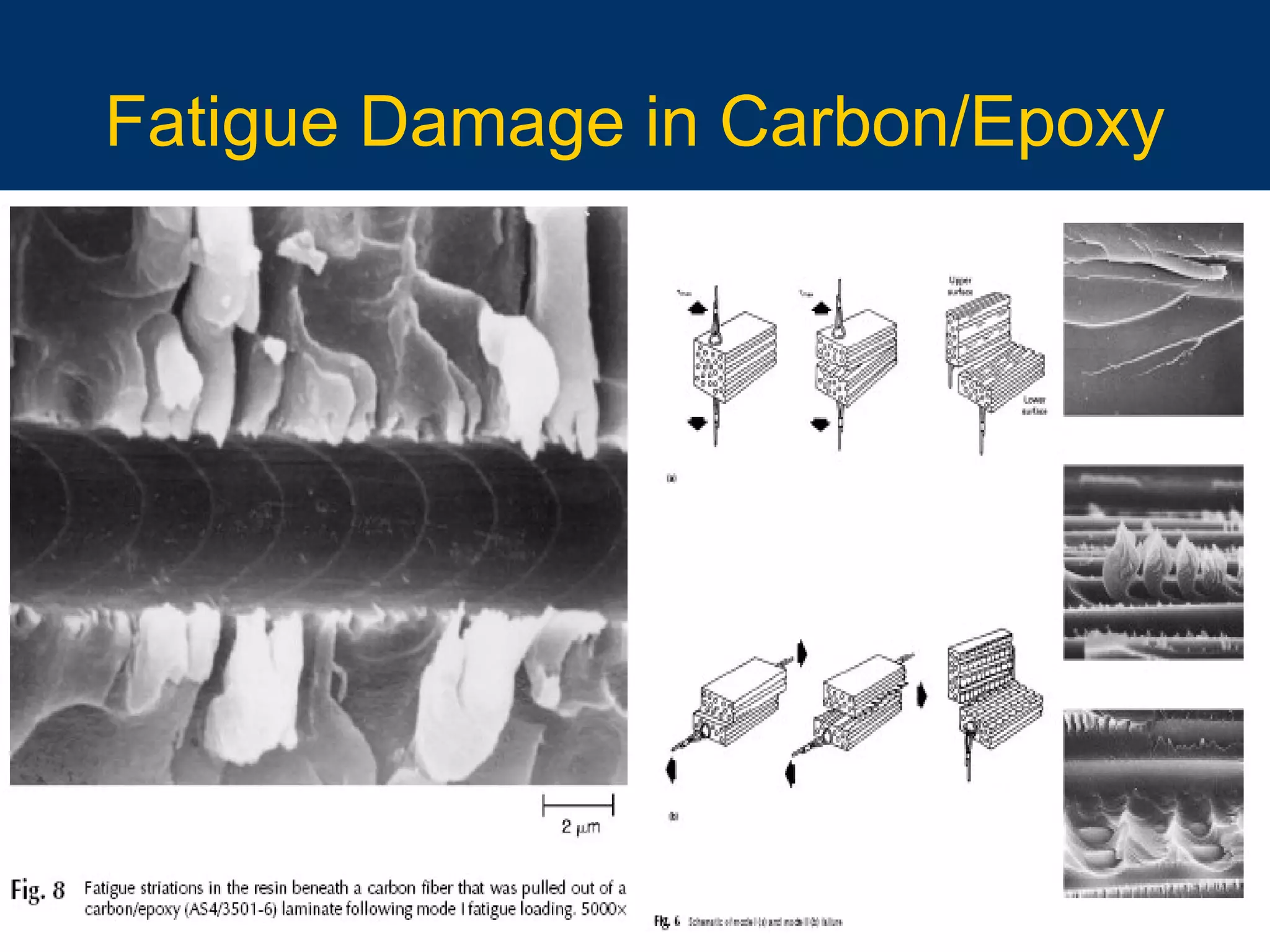
Fatigue Damage in Carbon/Epoxy
10/16/15 53
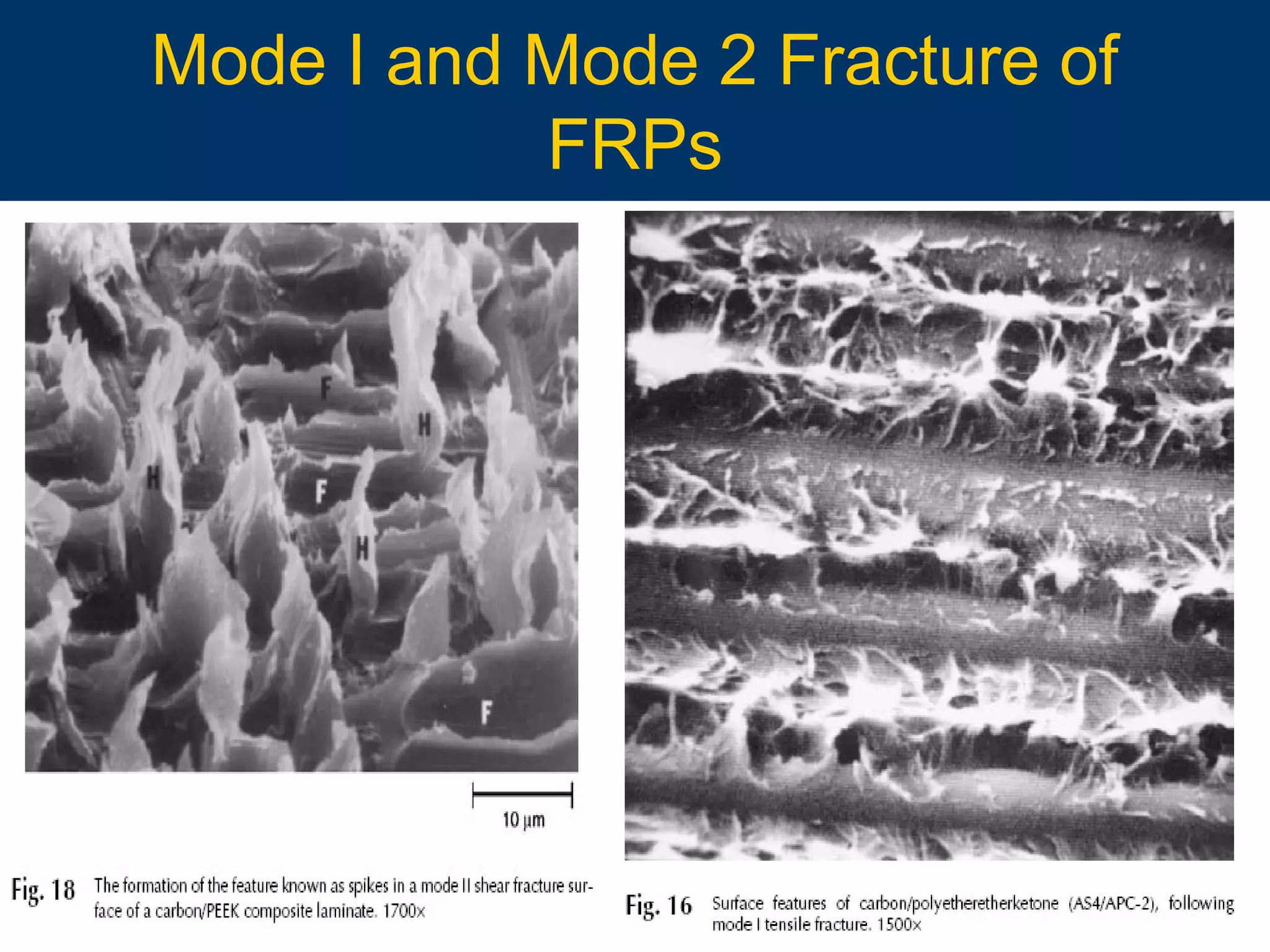
Mode I and Mode 2 Fracture of
FRPs
10/16/15 54
Impact of Epoxy-Polycarbonate Blends
10/16/15 55
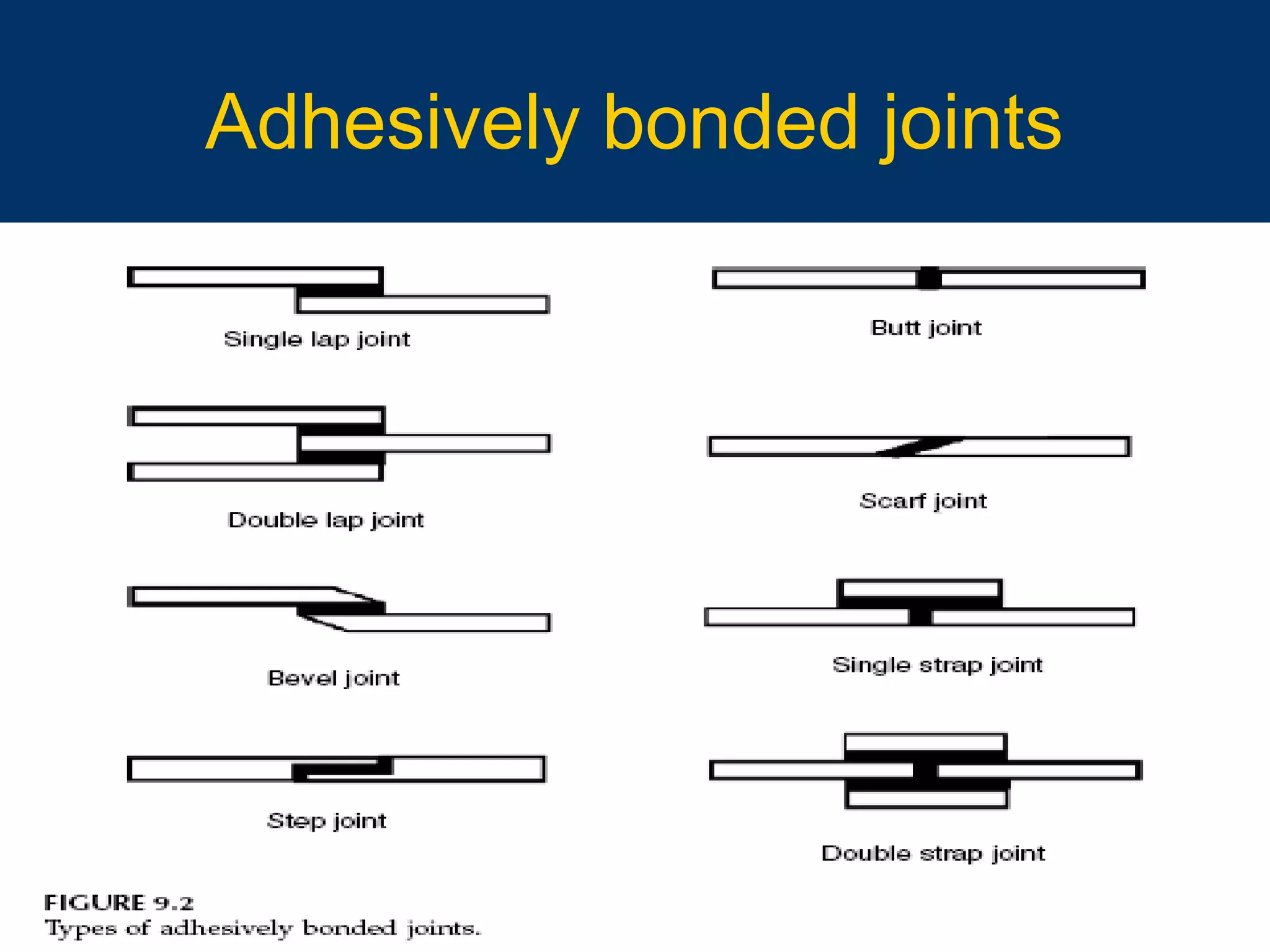
Adhesively bonded joints
10/16/15 56
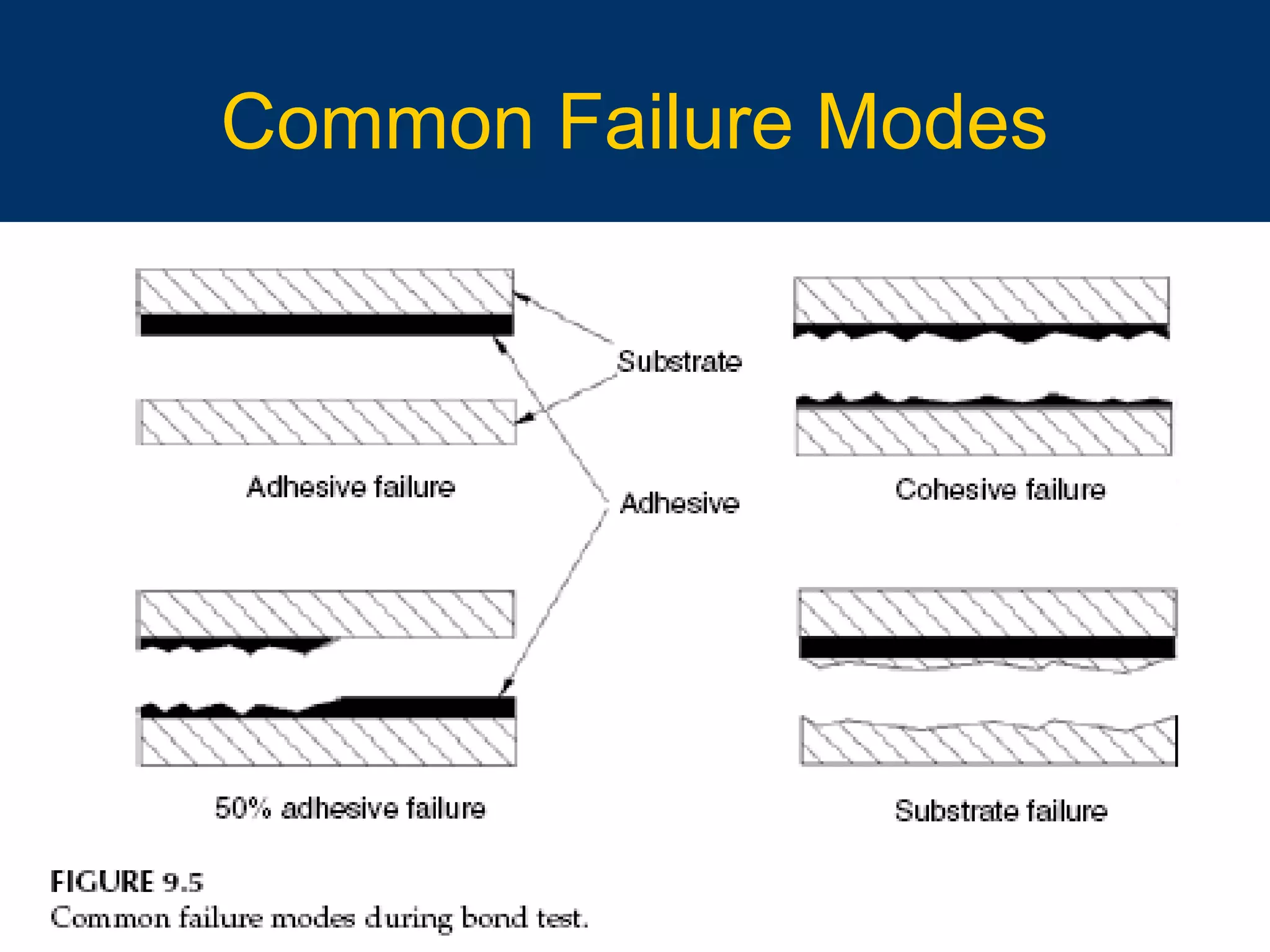
Common Failure Modes
10/16/15 57
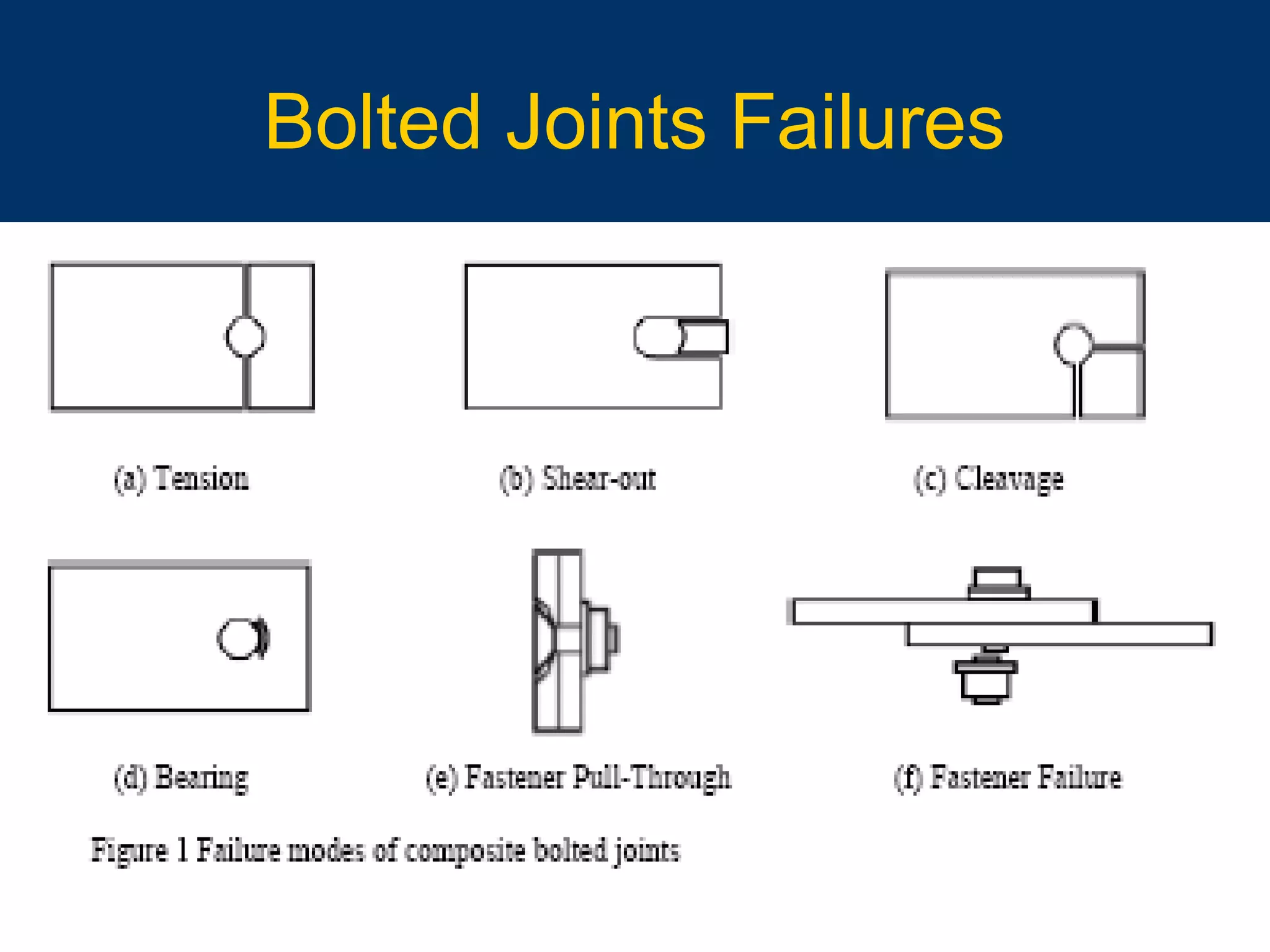
Bolted Joints Failures
10/16/15 58
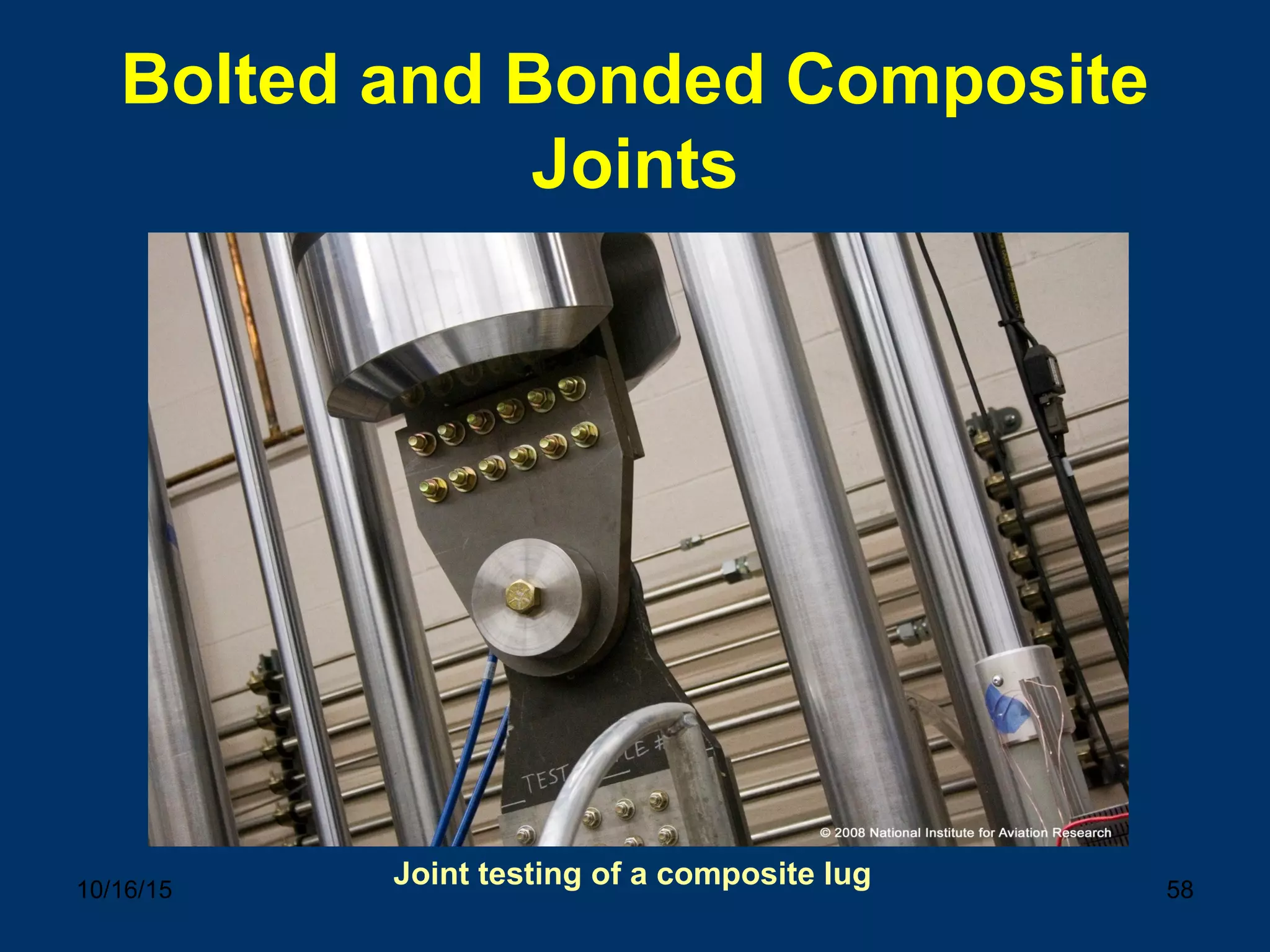
Bolted and Bonded Composite
Joints
Joint testing of a composite lug
10/16/15 59
Natural and Bio Derived Plastics
and Composites
10/16/15 60
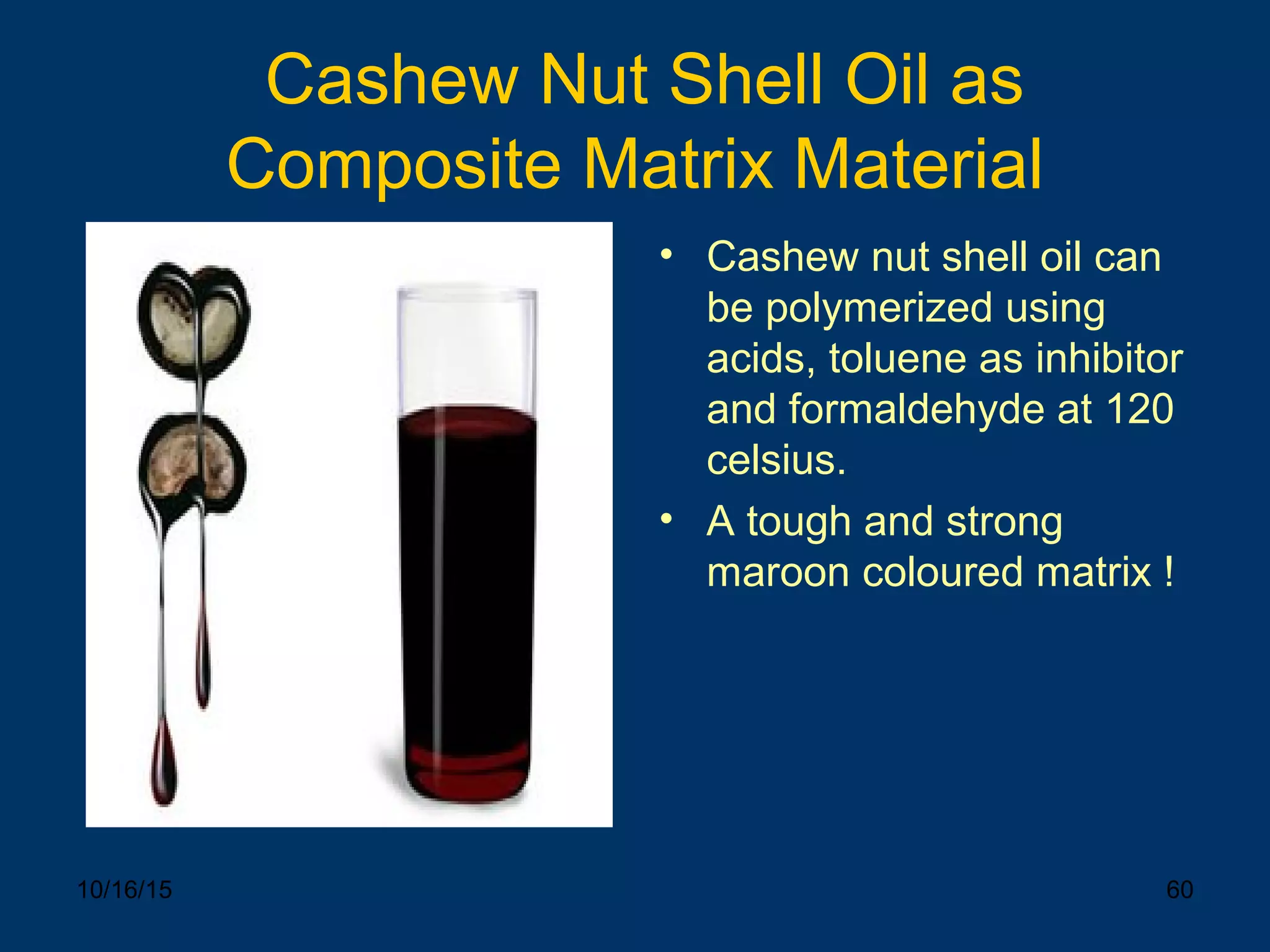
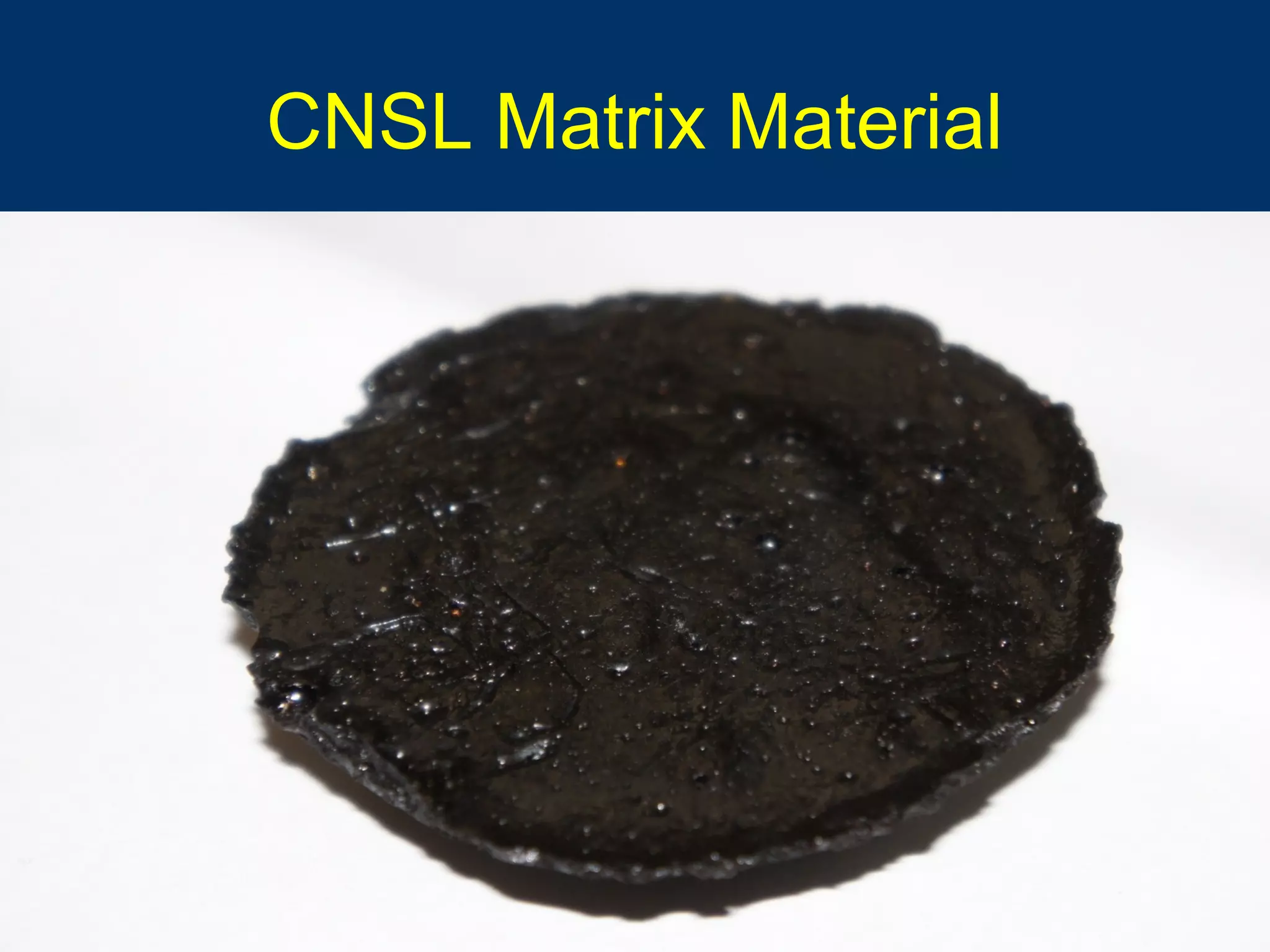
Cashew Nut Shell Oil as
Composite Matrix Material
• Cashew nut shell oil can
be polymerized using
acids, toluene as inhibitor
and formaldehyde at 120
celsius.
• A tough and strong
maroon coloured matrix !
10/16/15 61
CNSL Matrix Material
10/16/15 62
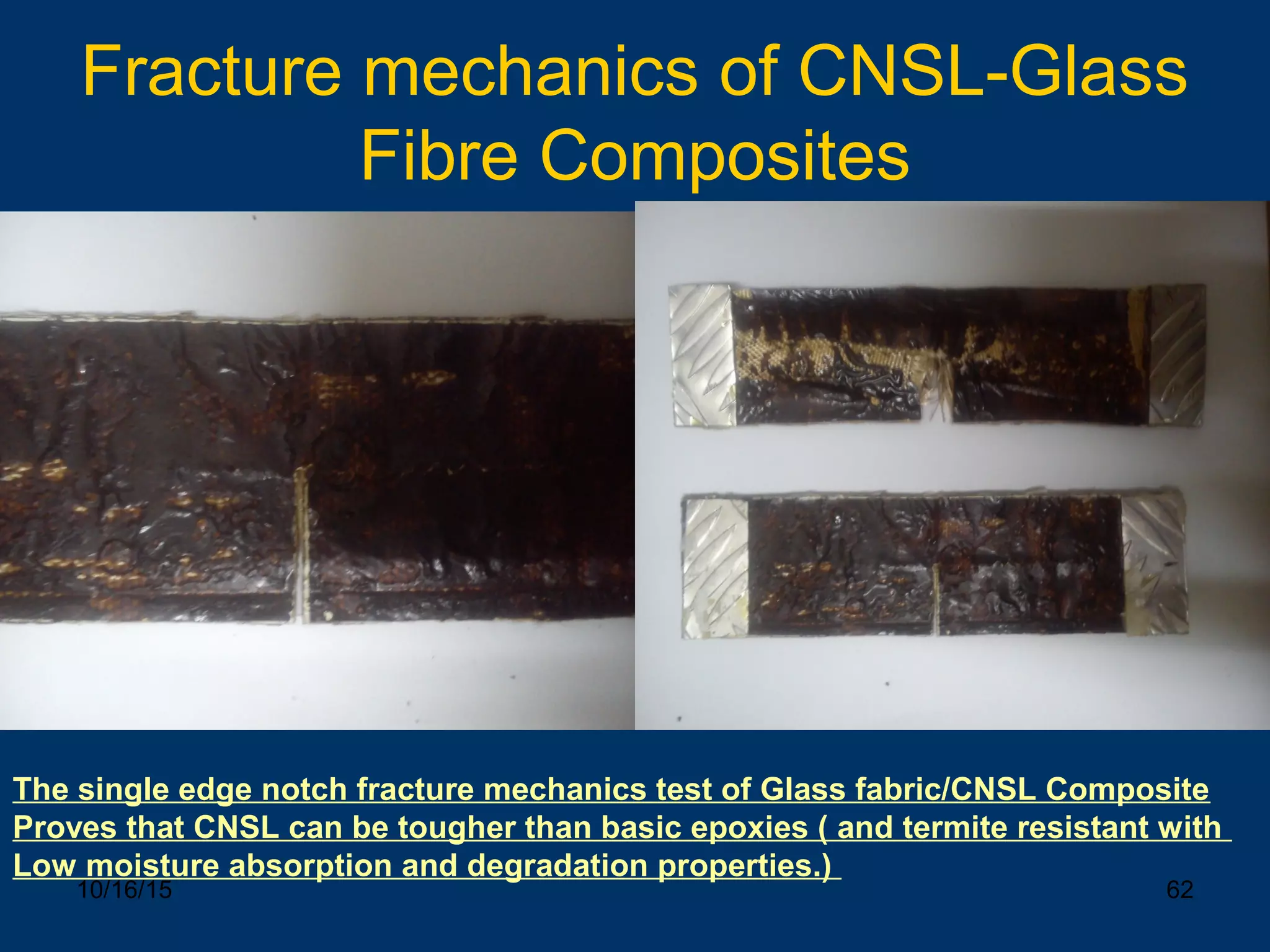
Fracture mechanics of CNSL-Glass
Fibre Composites
The single edge notch fracture mechanics test of Glass fabric/CNSL Composite
Proves that CNSL can be tougher than basic epoxies ( and termite resistant with
Low moisture absorption and degradation properties.)
10/16/15 63
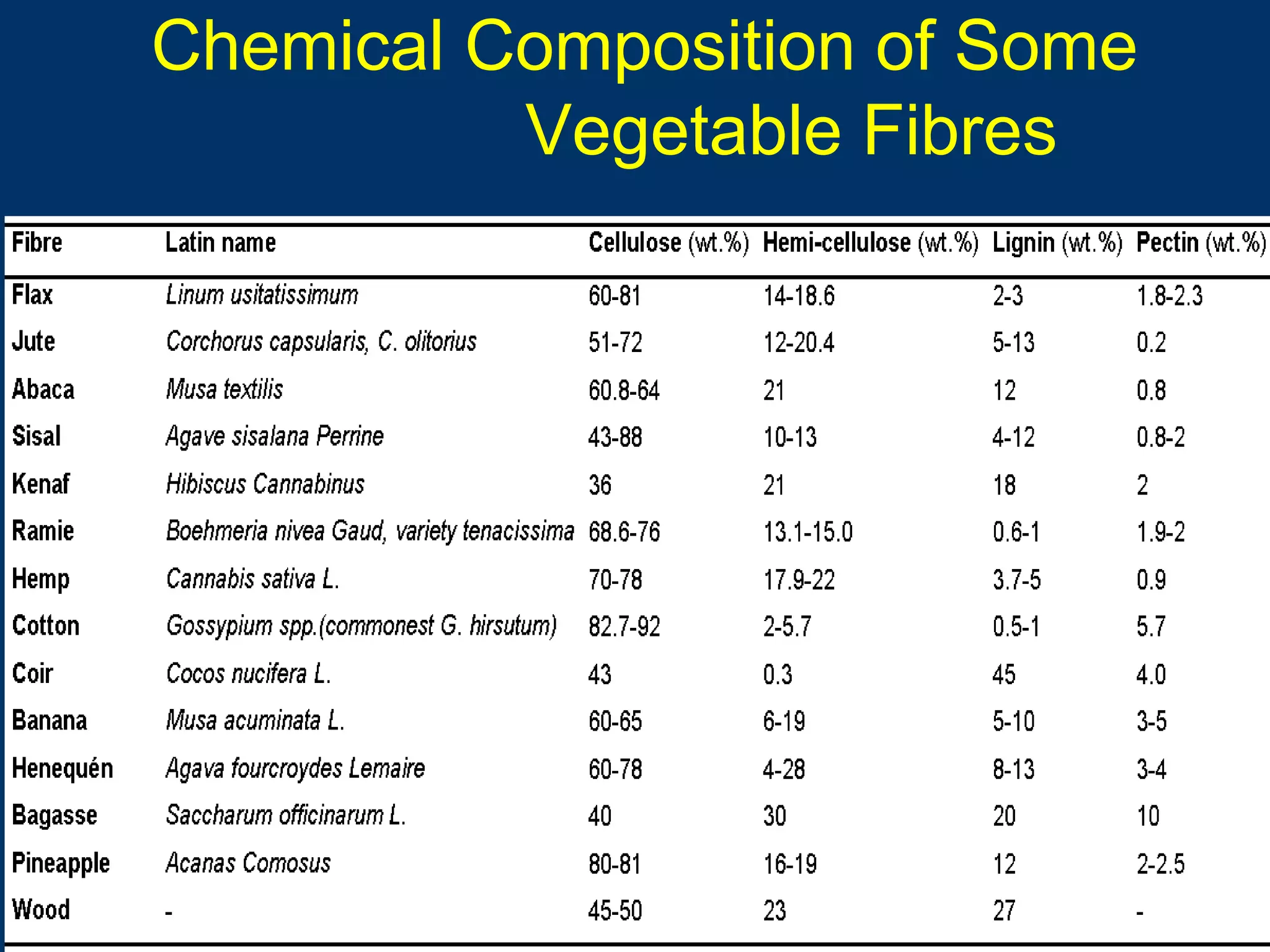
Chemical Composition of Some
Vegetable Fibres
10/16/15 64
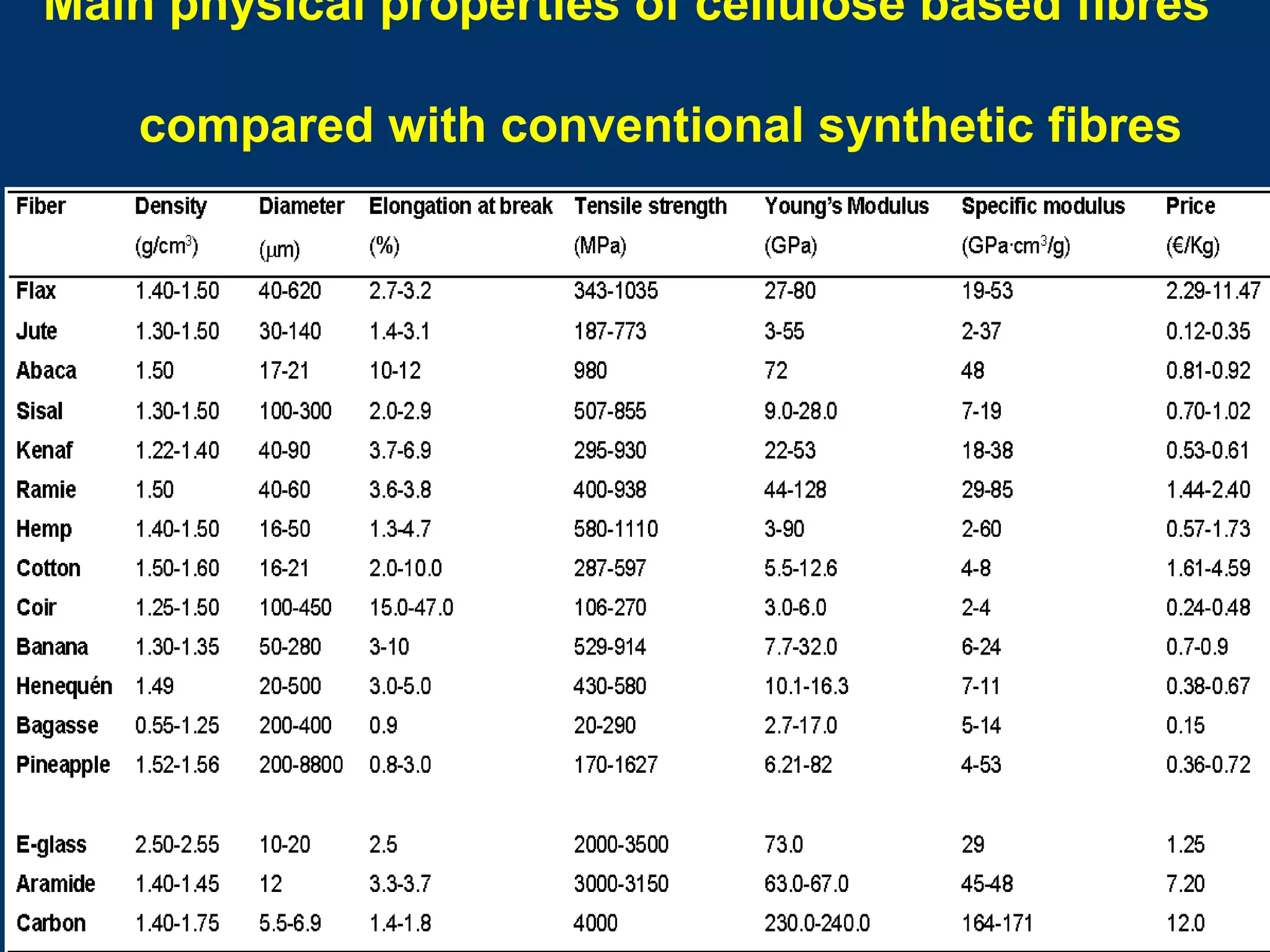
Main physical properties of cellulose based fibres
compared with conventional synthetic fibres
10/16/15 65
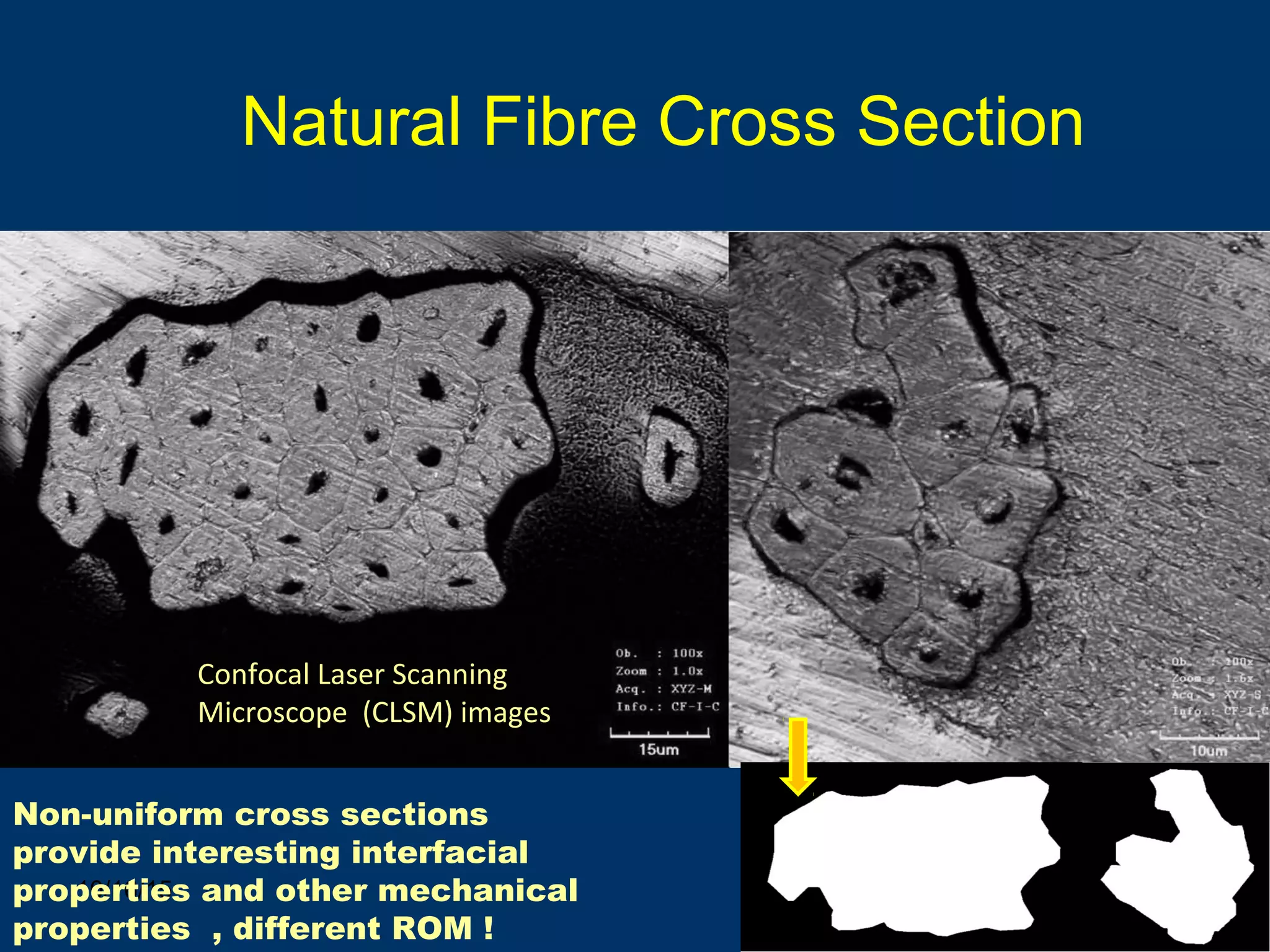
Natural Fibre Cross Section
Confocal Laser Scanning
Microscope (CLSM) images
Non-uniform cross sections
provide interesting interfacial
properties and other mechanical
properties , different ROM !
10/16/15 66
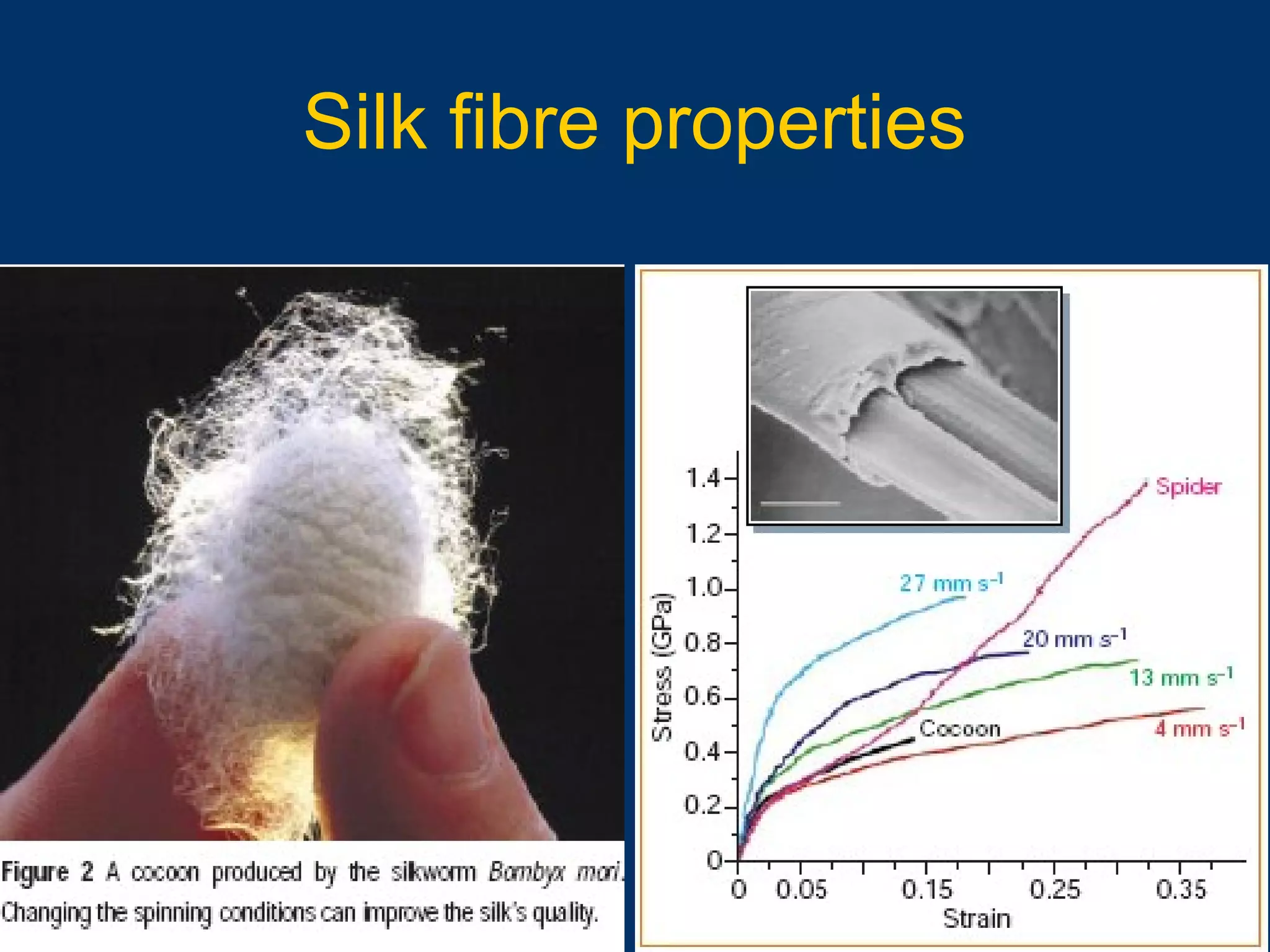
Silk fibre properties
10/16/15 67
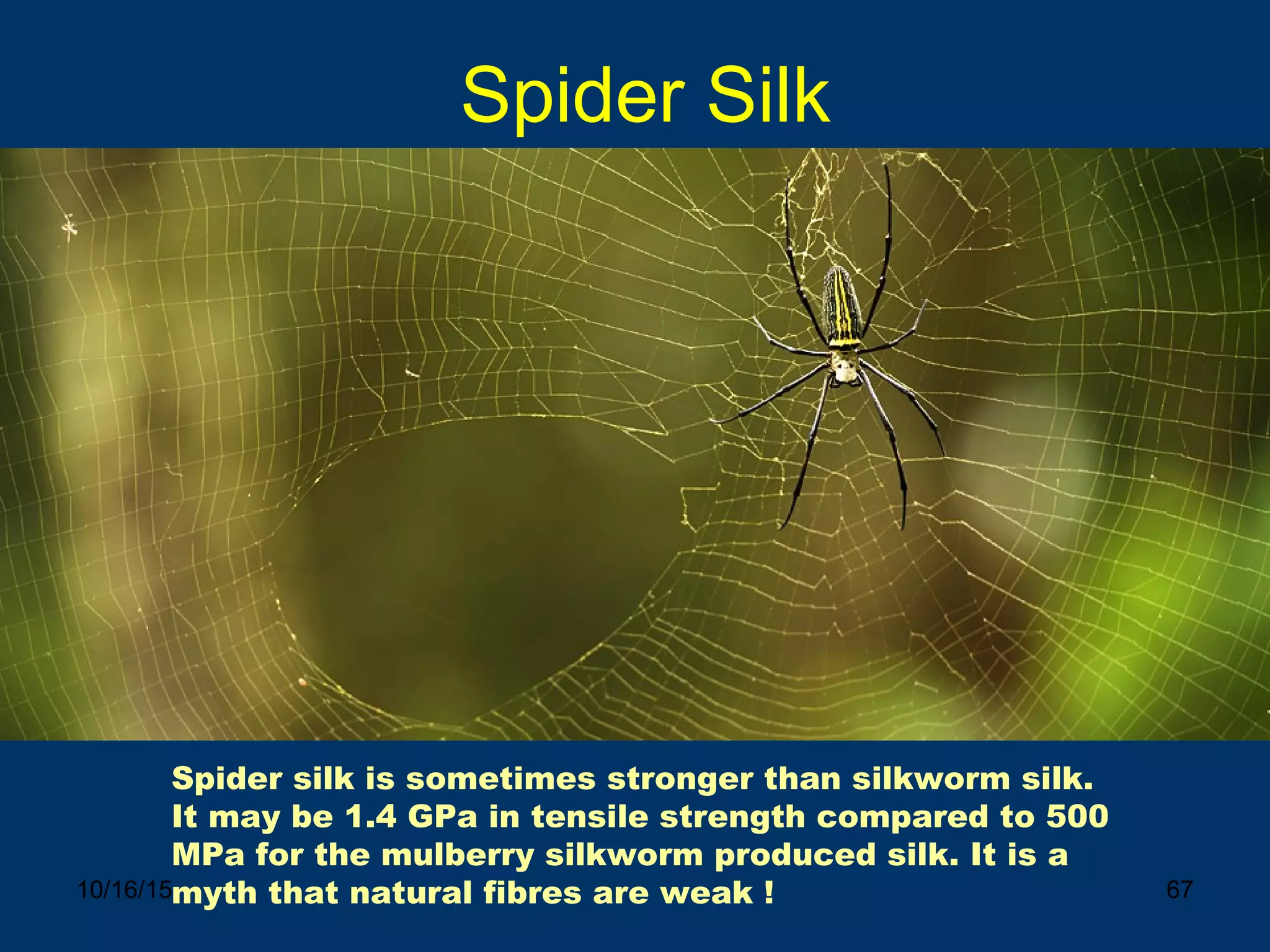
Spider Silk
Spider silk is sometimes stronger than silkworm silk.
It may be 1.4 GPa in tensile strength compared to 500
MPa for the mulberry silkworm produced silk. It is a
myth that natural fibres are weak !
10/16/15 68
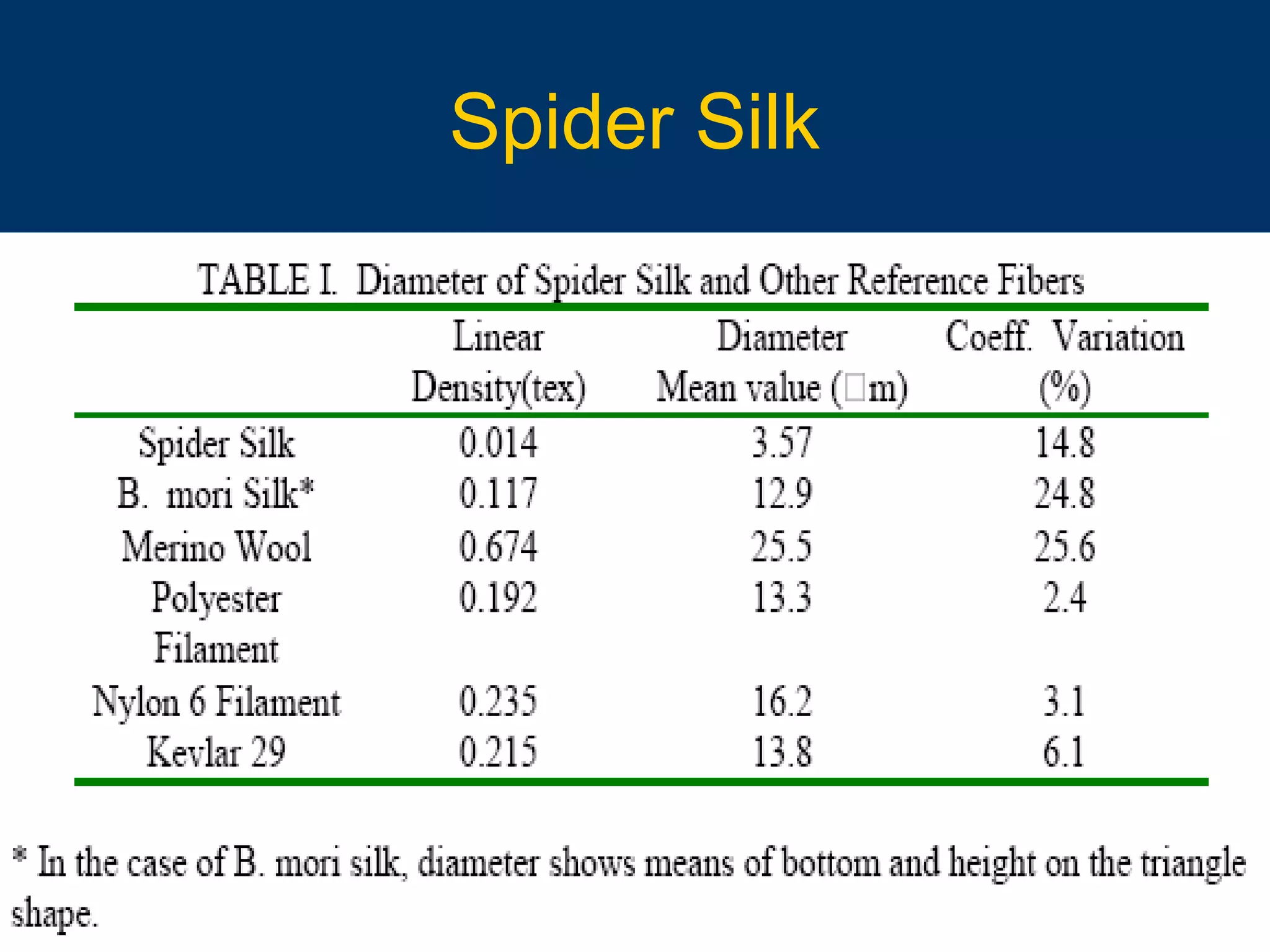
Spider Silk
10/16/15 69
Self Reinforced Natural
Composites
• The same material as the fibre and the
pulp matrix
• The fibre matrix-interface is interesting
• Weight and cost savings
• Interesting Properties !
• Bio derived self reinforced polyethylene
from sugar cane
10/16/15 70
Positive Hybrid Effect
• Synergy in Properties
• Cellulosic Interfaces
• Silane and Other Interfaces
• Shear to Tensile Strength Ratios
• Fracture Behaviour
• Crack tip blunting, Fracture energy
• Underlying Mechanisms
10/16/15 71
Failures and Multiple Causes
• In nature, most of the real environment failures
are due to multiple causes.
• As enough standard procedures are available
for failures due to a single cause, the obvious
move is to develop the understanding as well as
standard procedures for failures due to multiple
causes.
• An understanding of these failures leads to a
better fracture control that aids superior designs
with advanced composite materials and
processing.
10/16/15 72
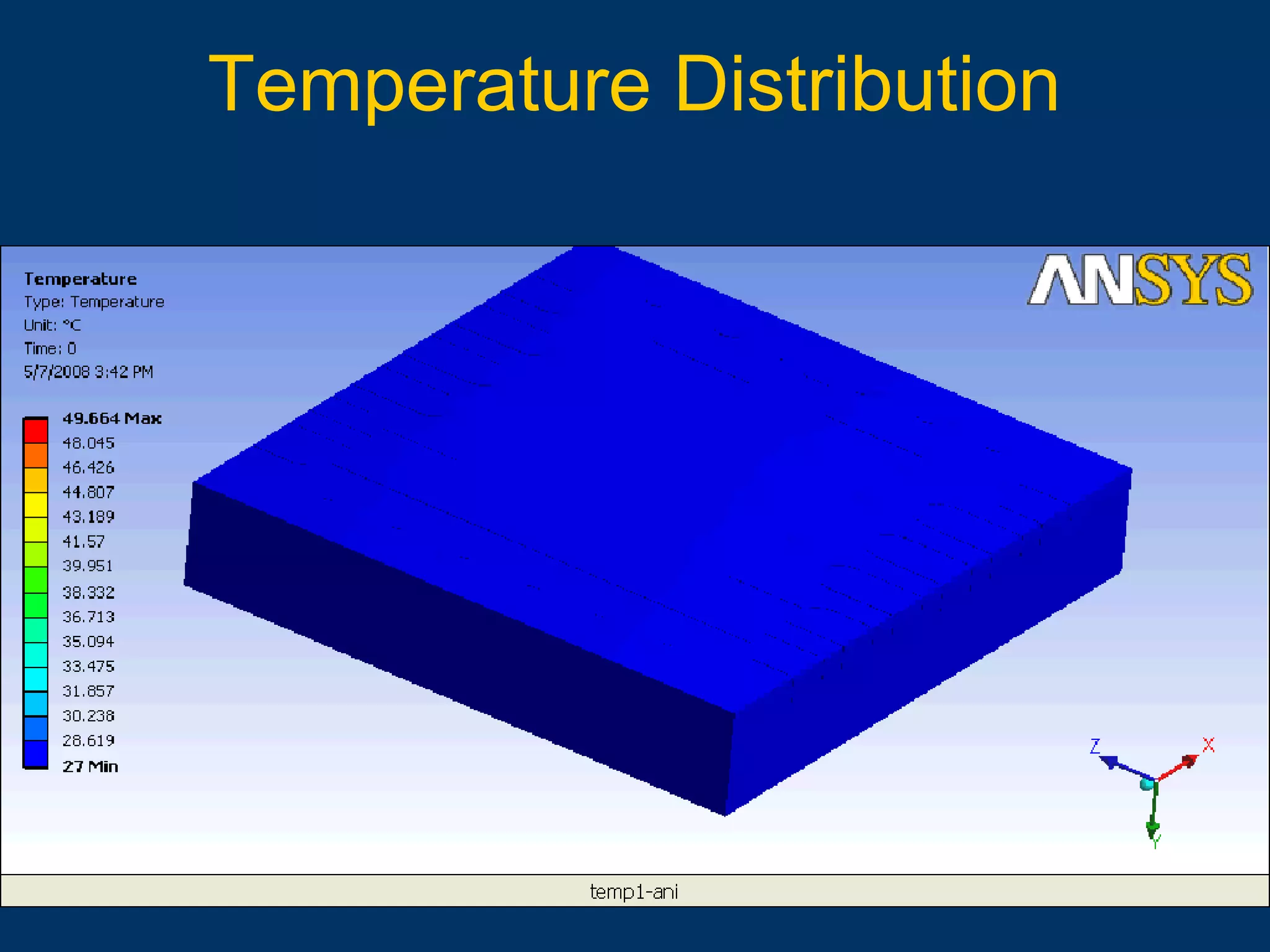
Temperature Distribution
10/16/15 73
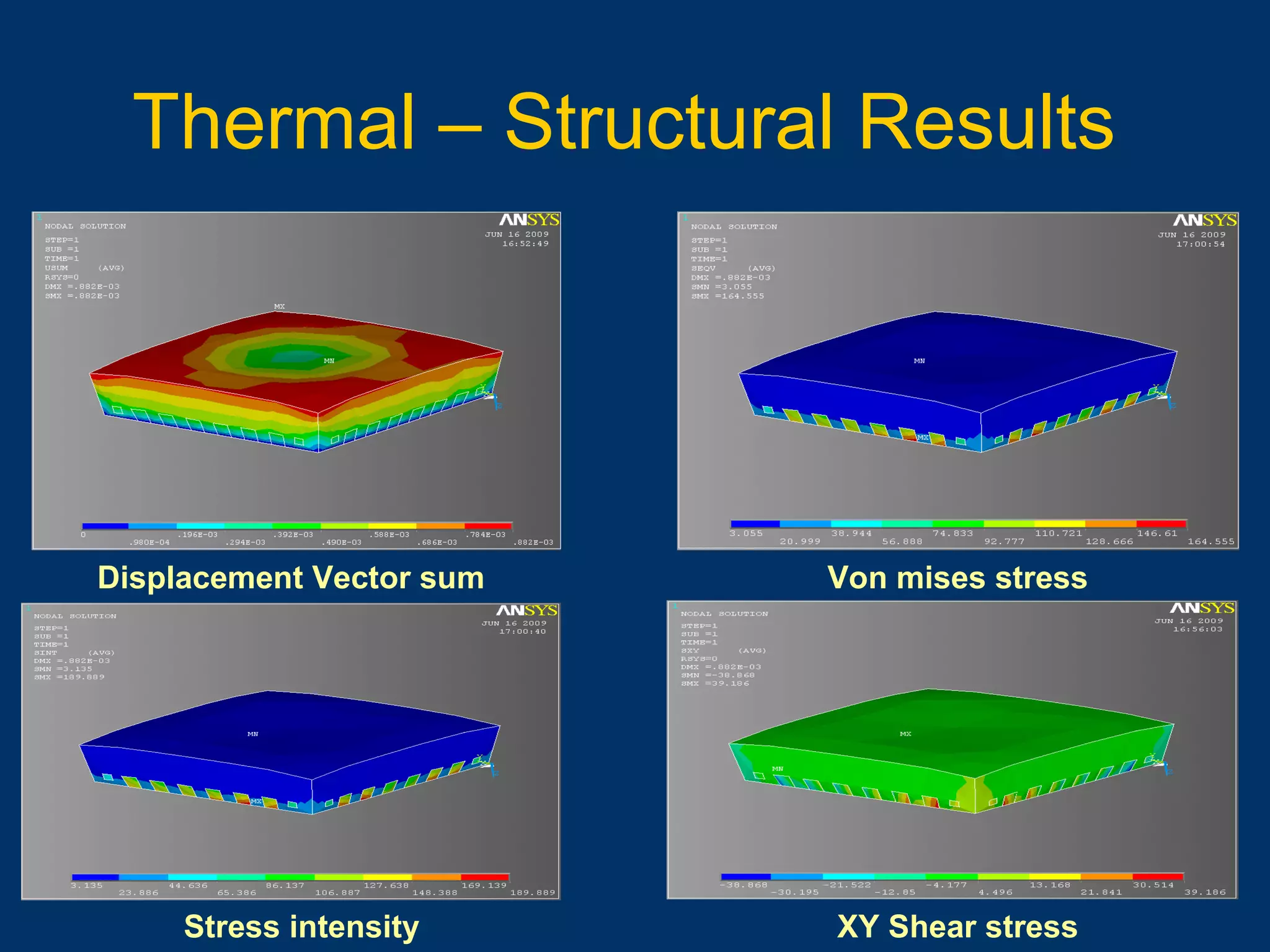
Thermal – Structural Results
Displacement Vector sum Von mises stress
Stress intensity XY Shear stress
10/16/15 74
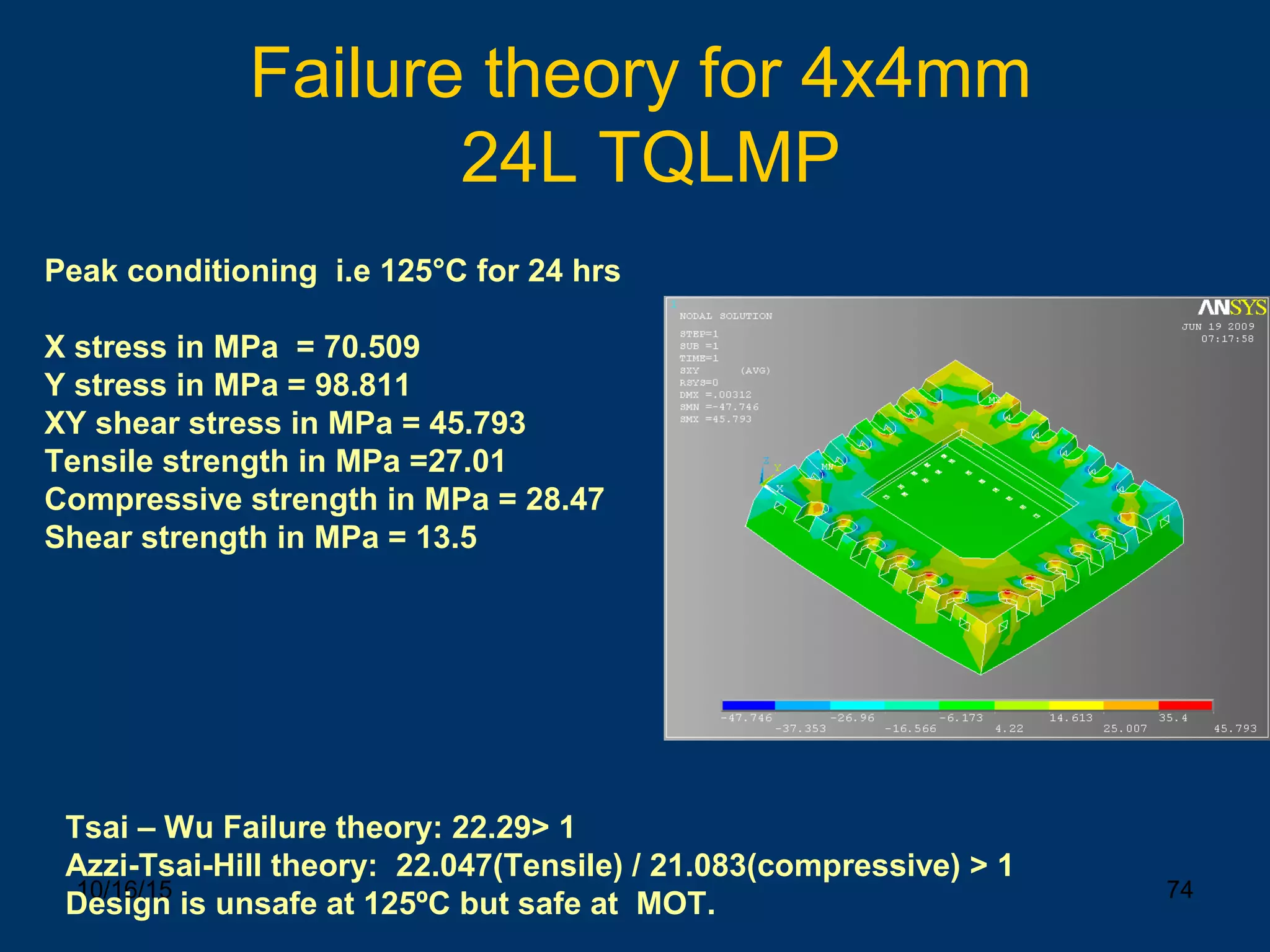
Failure theory for 4x4mm
24L TQLMP
Peak conditioning i.e 125°C for 24 hrs
X stress in MPa = 70.509
Y stress in MPa = 98.811
XY shear stress in MPa = 45.793
Tensile strength in MPa =27.01
Compressive strength in MPa = 28.47
Shear strength in MPa = 13.5
Tsai – Wu Failure theory: 22.29> 1
Azzi-Tsai-Hill theory: 22.047(Tensile) / 21.083(compressive) > 1
Design is unsafe at 125ºC but safe at MOT.
10/16/15 75
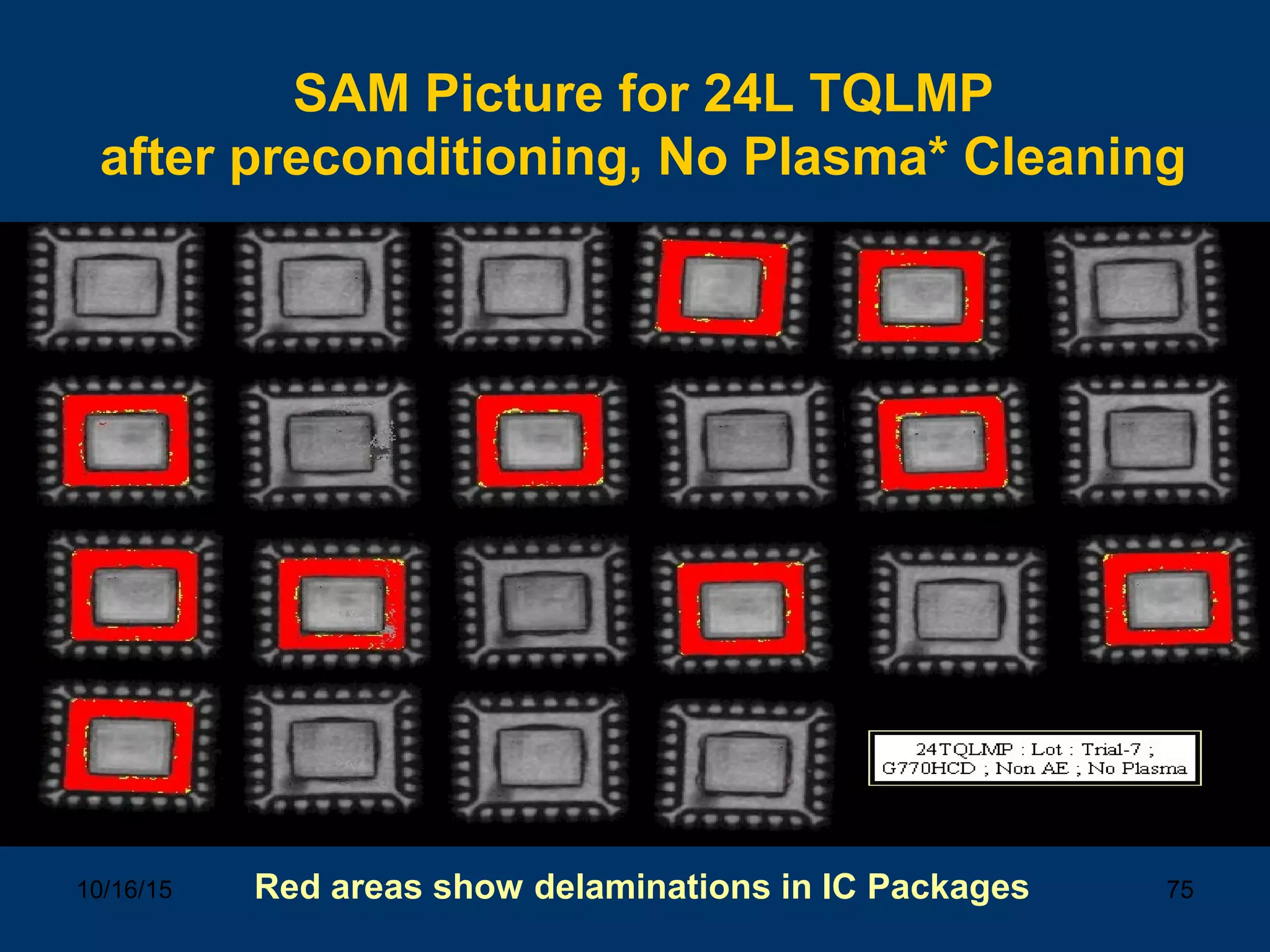
SAM Picture for 24L TQLMP
after preconditioning, No Plasma* Cleaning
Red areas show delaminations in IC Packages
10/16/15 76
Thermal Shock Test (JESD22 –
A106B)
• Purpose of this test is to determine the resistance of the part to
sudden exposures of extreme changes in temperature and alternate
exposures to these extremes as well as its ability to withstand cyclical
stresses
• Here the IC packages are baked in an oven for 125ºC/24 Hrs and the
temperature is spiked to 260ºC for lead free product and 240ºC for
leaded product for 5 to 10 minutes.
• If the baking temperature is higher than the glass transition
temperature at this extreme heat the package tends to delaminate or
fail. This failure or delamination can be viewed using SAM (Scanning
Acoustic Microscopy)
10/16/15 77
Non Destructive Evaluation
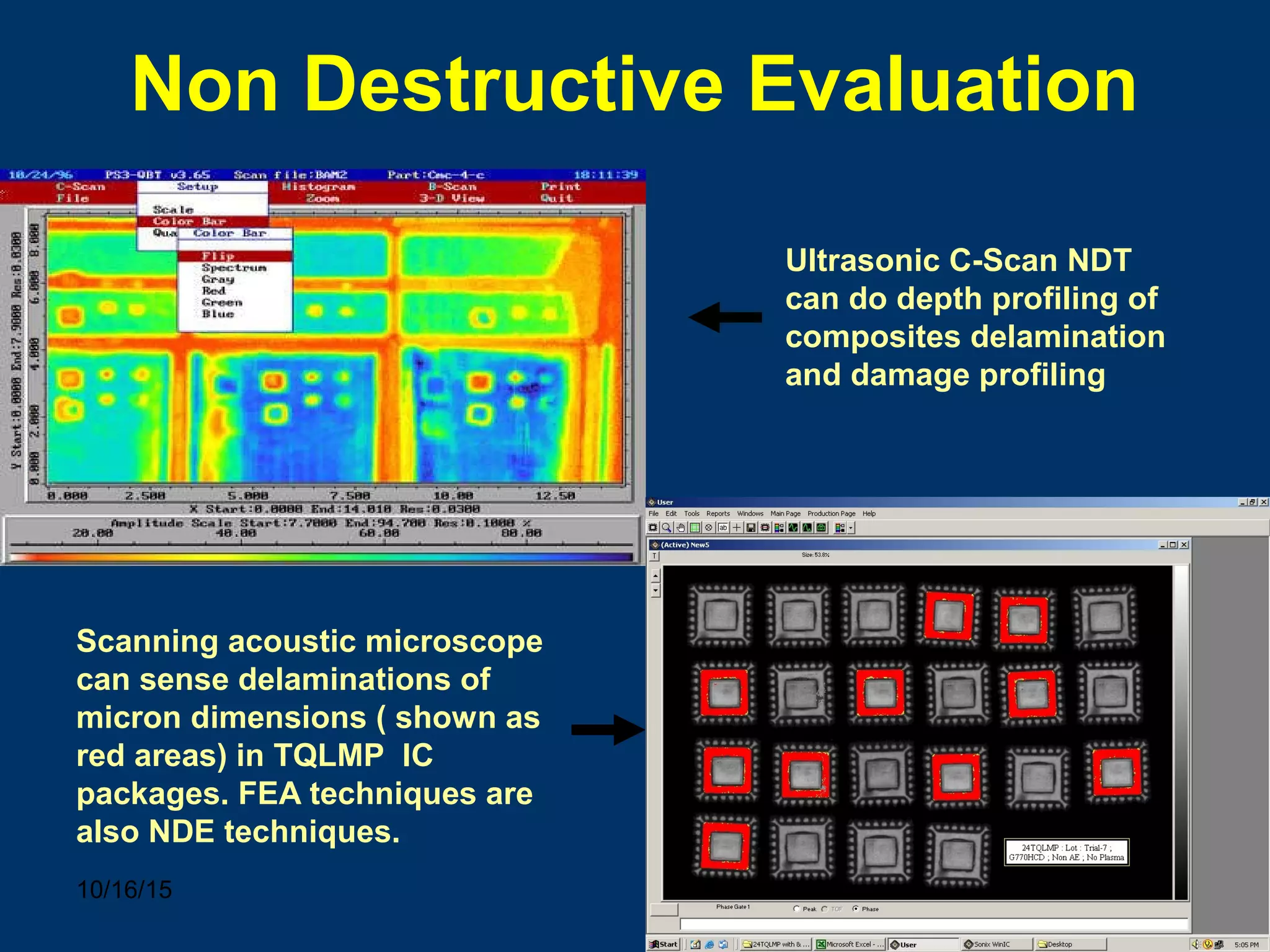
Ultrasonic C-Scan NDT
can do depth profiling of
composites delamination
and damage profiling
Scanning acoustic microscope
can sense delaminations of
micron dimensions ( shown as
red areas) in TQLMP IC
packages. FEA techniques are
also NDE techniques.
10/16/15 78
FEA as an NDT
• Numerical method used for solving
problems that cannot be solved
analytically (e.g., due to complicated
geometry, different materials)
• Well suited to computers
• Originally applied to problems in solid
mechanics
• Other application areas include heat
transfer, fluid flow, electromagnetism
10/16/15 79
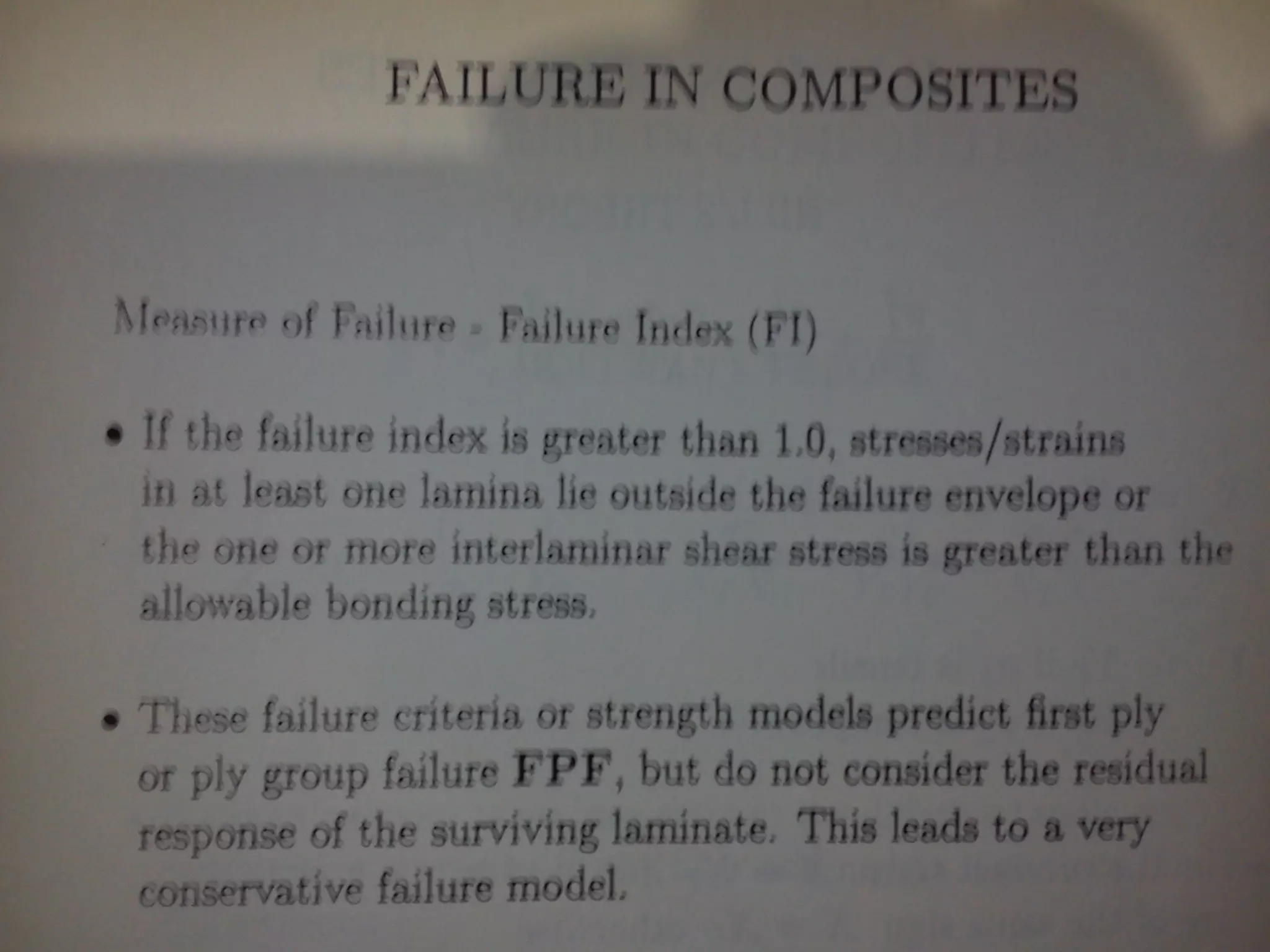
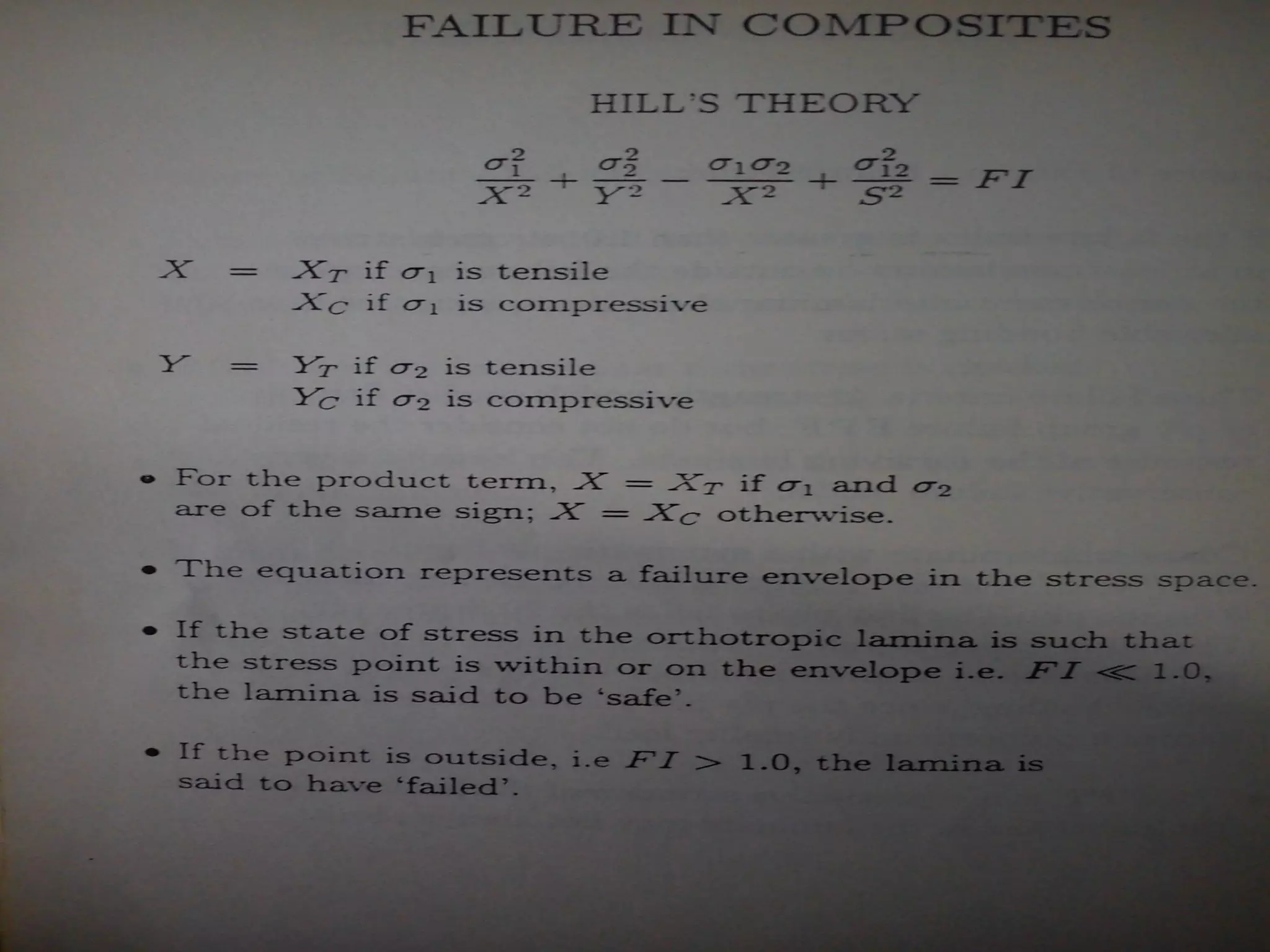
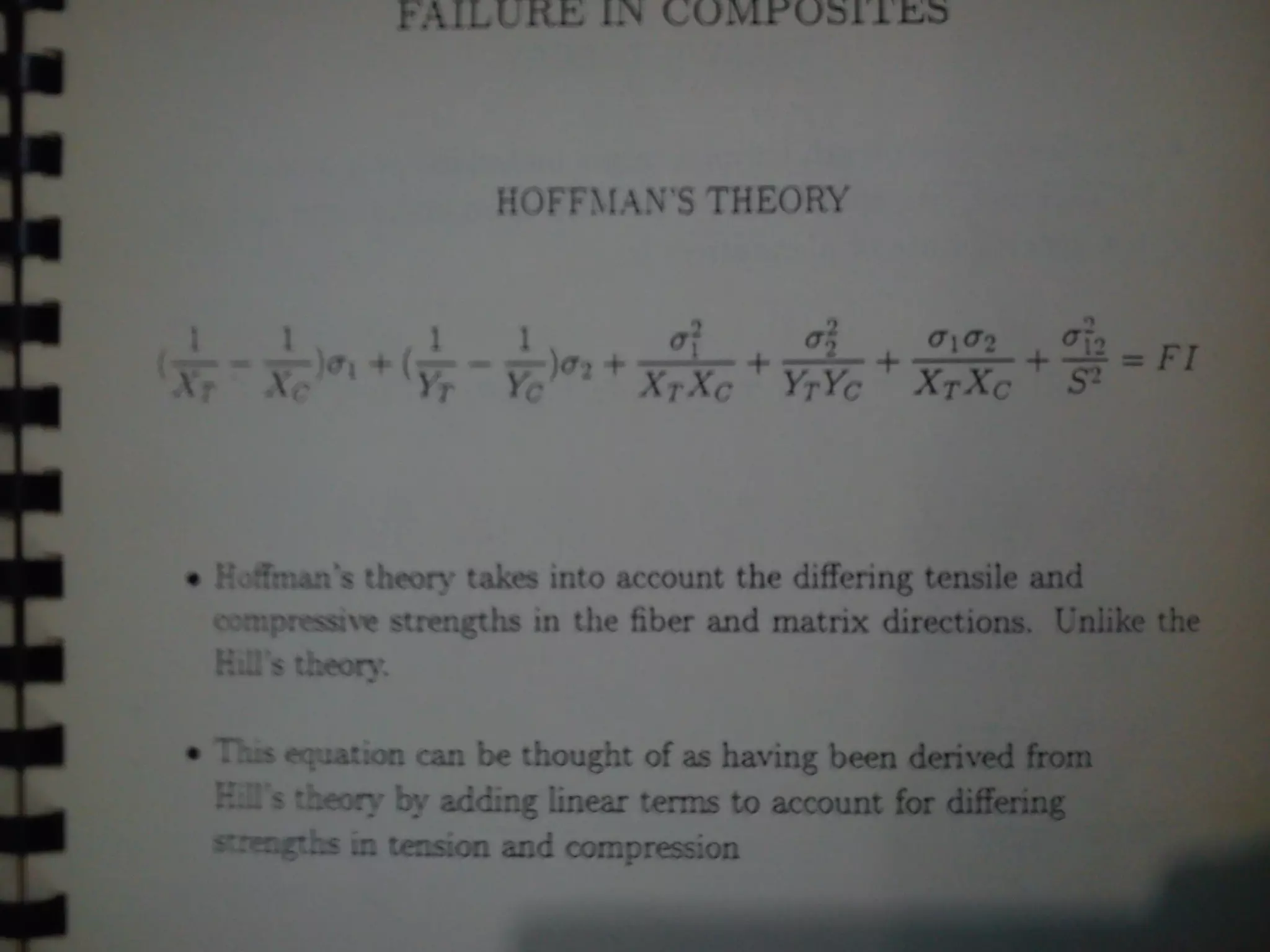
Failure Theories
10/16/15 80
10/16/15 81
10/16/15 82
10/16/15 83
10/16/15 84
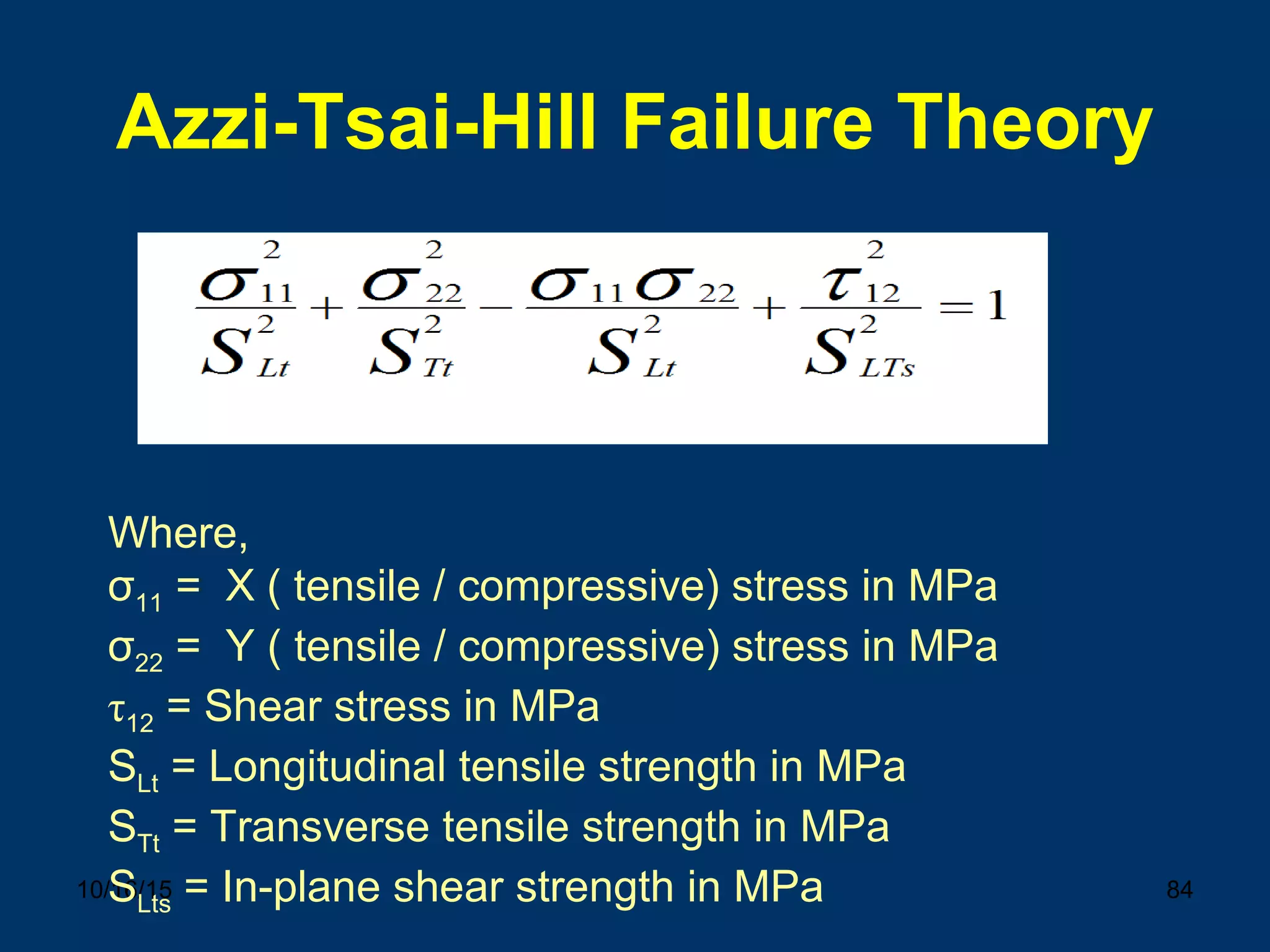
Azzi-Tsai-Hill Failure Theory
Where,
σ11 = X ( tensile / compressive) stress in MPa
σ22 = Y ( tensile / compressive) stress in MPa
τ12 = Shear stress in MPa
SLt = Longitudinal tensile strength in MPa
STt = Transverse tensile strength in MPa
SLts = In-plane shear strength in MPa
10/16/15 85
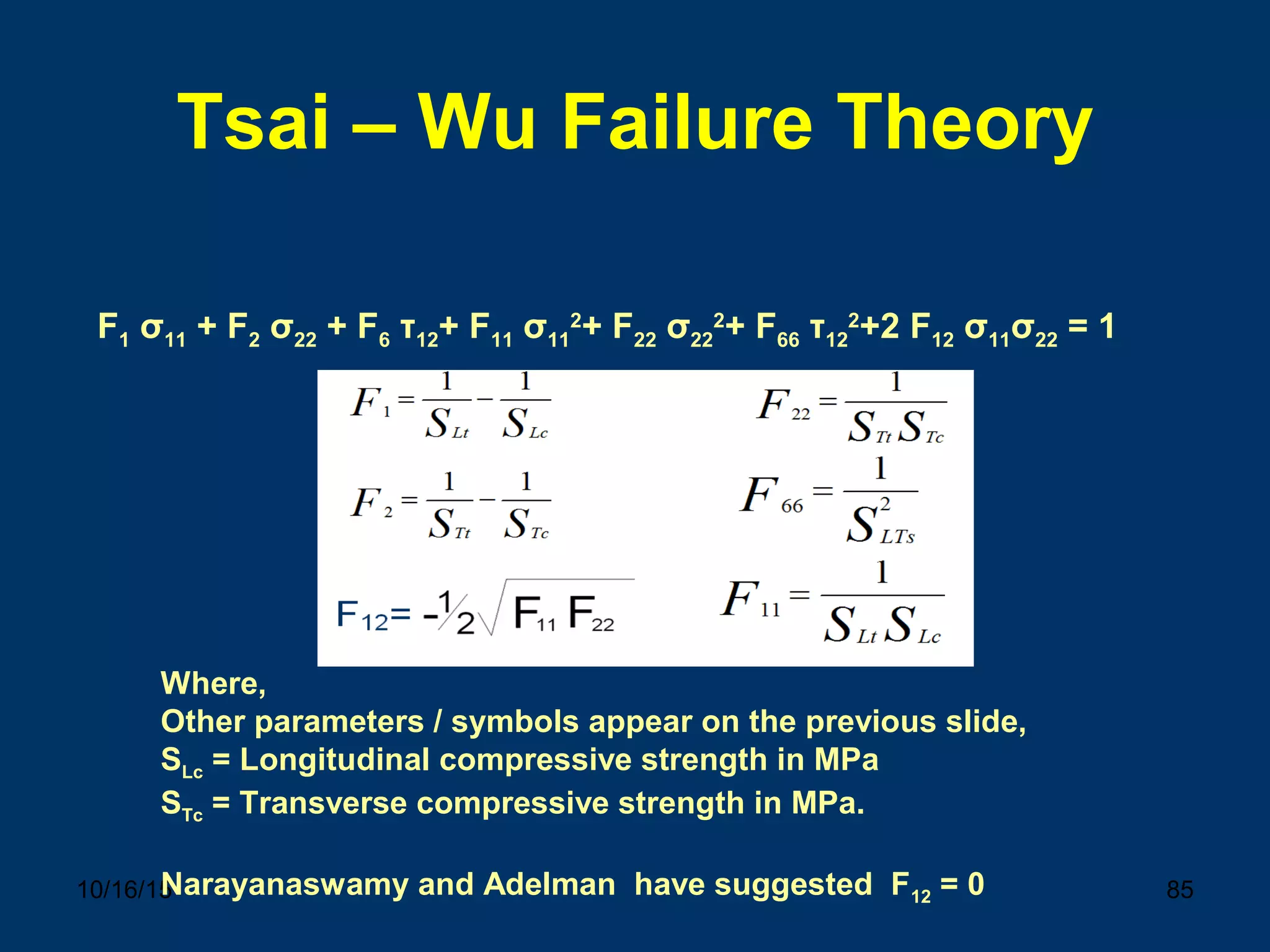
Tsai – Wu Failure Theory
F1 σ11 + F2 σ22 + F6 τ12+ F11 σ11
2
+ F22 σ22
2
+ F66 τ12
2
+2 F12 σ11σ22 = 1
Where,
Other parameters / symbols appear on the previous slide,
SLc = Longitudinal compressive strength in MPa
STc = Transverse compressive strength in MPa.
Narayanaswamy and Adelman have suggested F12 = 0
10/16/15 86
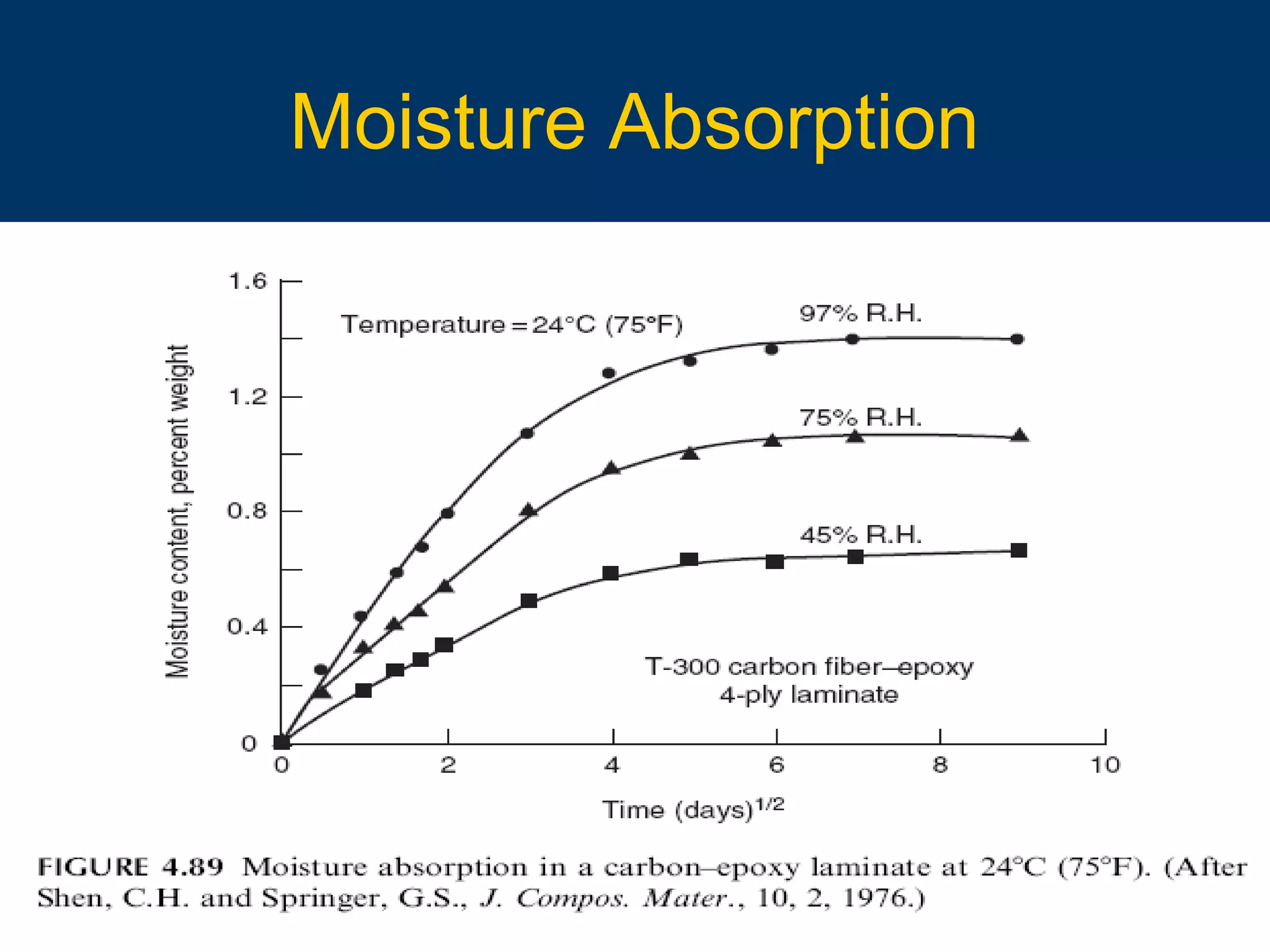
Hygrothermal Behaviour
• Fibre reinforced plastics are known for environmental
attacks that reduce their function.
• Mechanical properties degrade over time !
• Moisture plays havoc at elevated temperatures, in the
presence of voids, defects and in low Tg plastics . So do
UV, IR, alkali , acid and marine environs.
• Diffusion and osmotic pressure are the driving
mechanisms for hygrothermal attack
• Evaluation methods and surface preservation
• Important in marine, biomedical, aeronautical, electronic
and automobile applications
10/16/15 87
Moisture Absorption
10/16/15 88
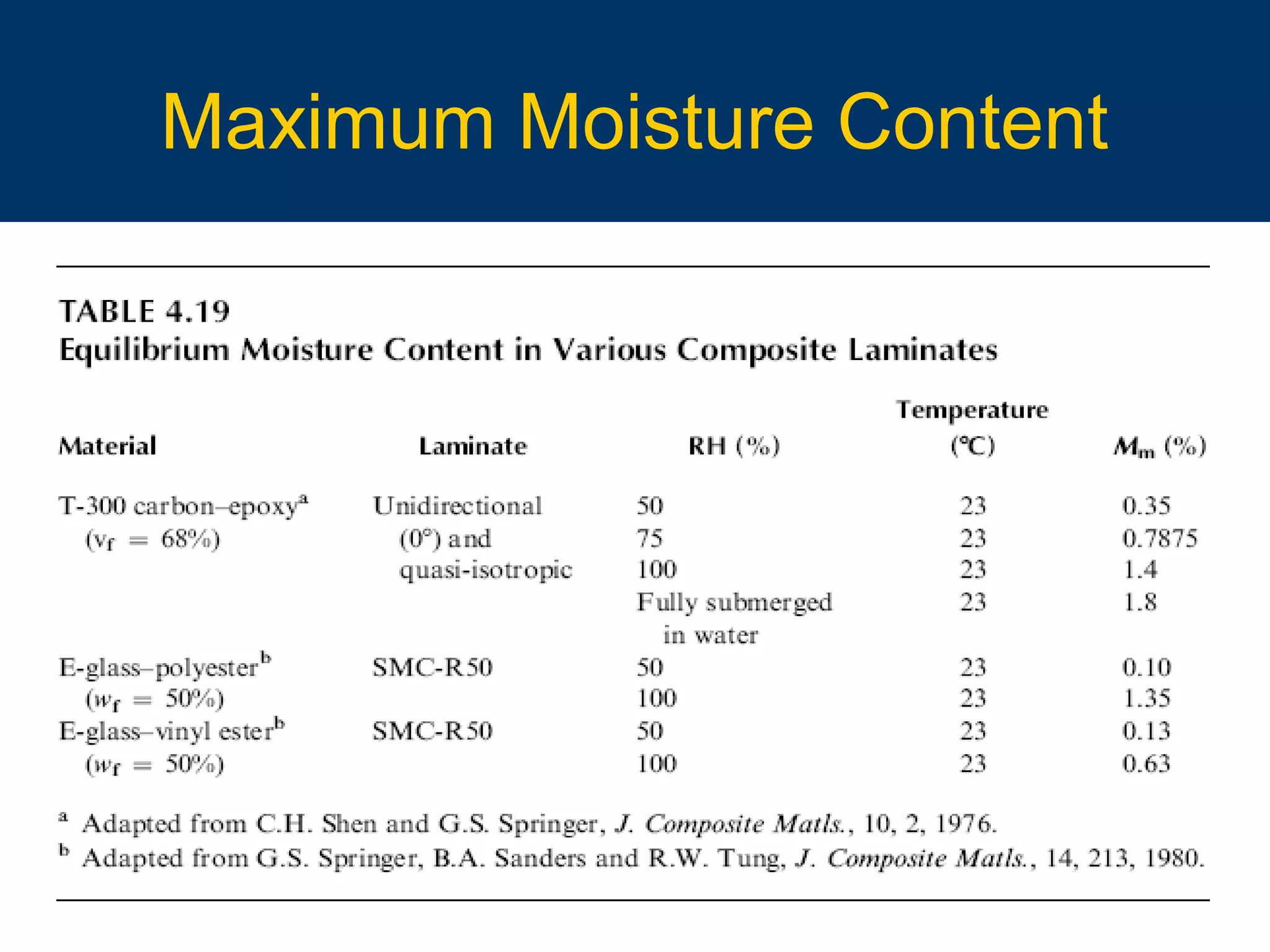
Maximum Moisture Content
10/16/15 89
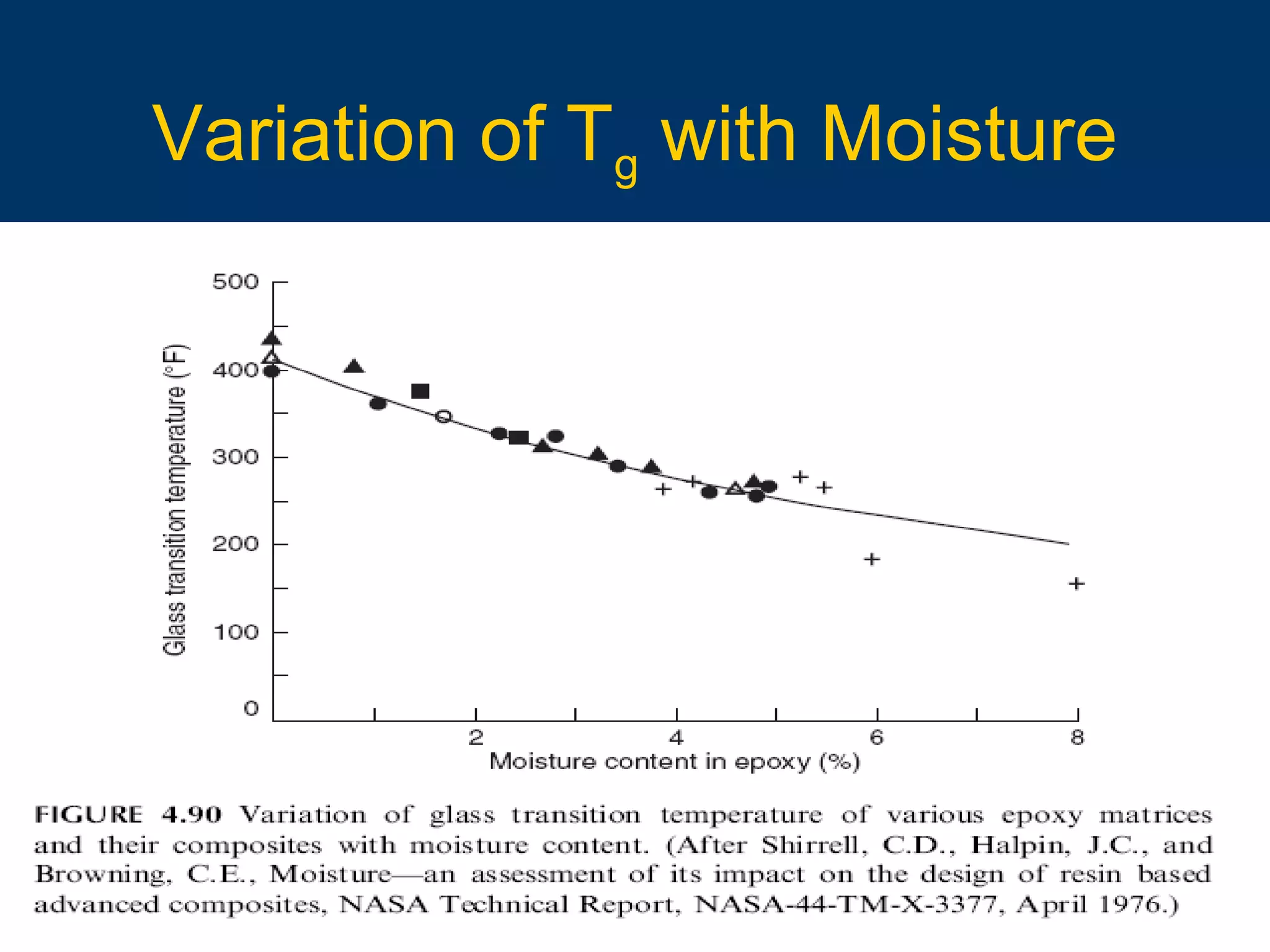
Variation of Tg with Moisture
10/16/15 90
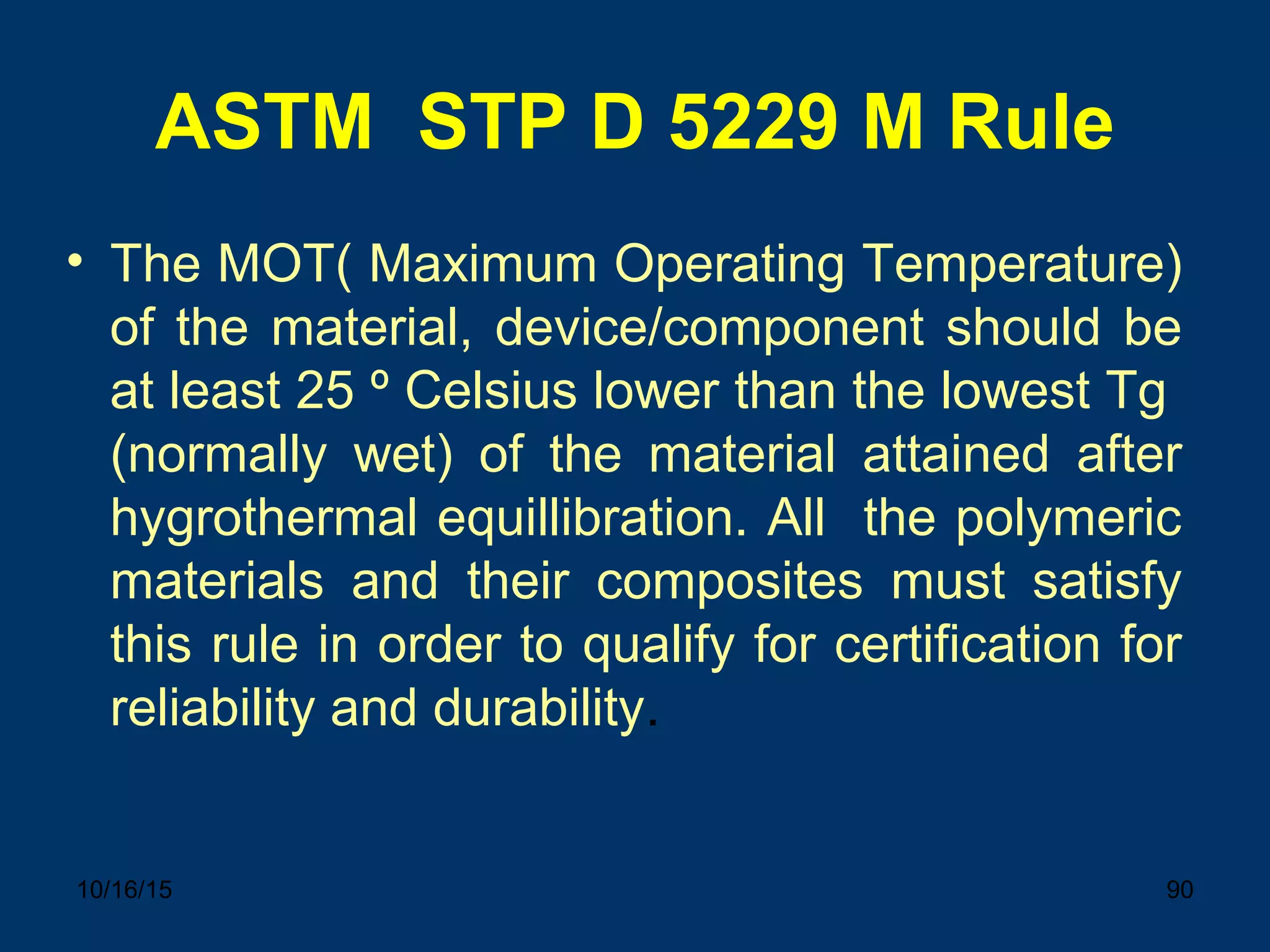
ASTM STP D 5229 M Rule
• The MOT( Maximum Operating Temperature)
of the material, device/component should be
at least 25 º Celsius lower than the lowest Tg
(normally wet) of the material attained after
hygrothermal equillibration. All the polymeric
materials and their composites must satisfy
this rule in order to qualify for certification for
reliability and durability.
10/16/15 91
Current Research
Machining
You start machining a monkey and due to structural change end up with a parrot
And report the properties as that of a monkey ! Machining induced fracture and
failure depends on structure and then the machining parameters. Any
optimization be should based on this truth !
10/16/15 92
Failure Processes and Feedback
10/16/15 93
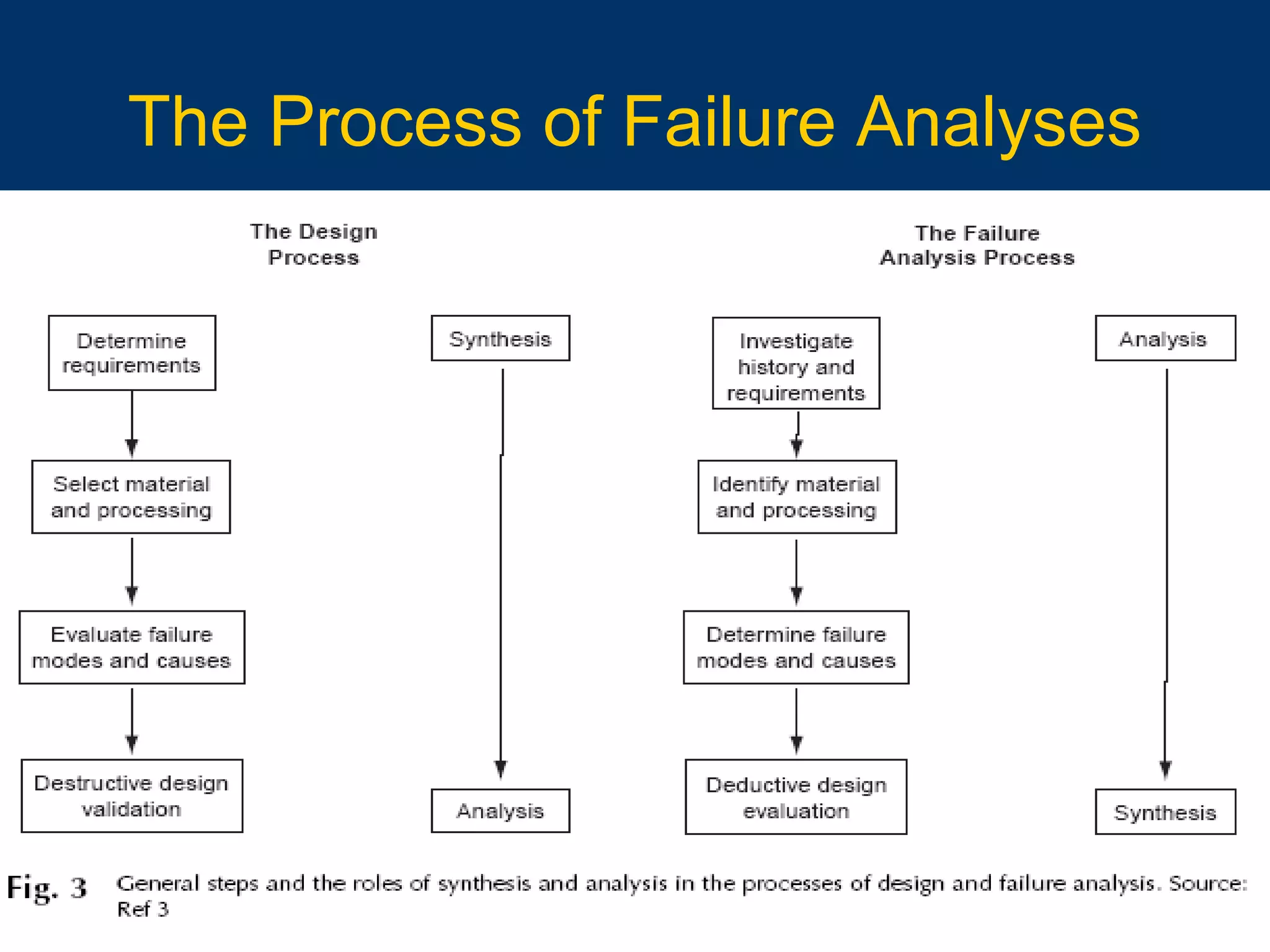
The Process of Failure Analyses
10/16/15 94
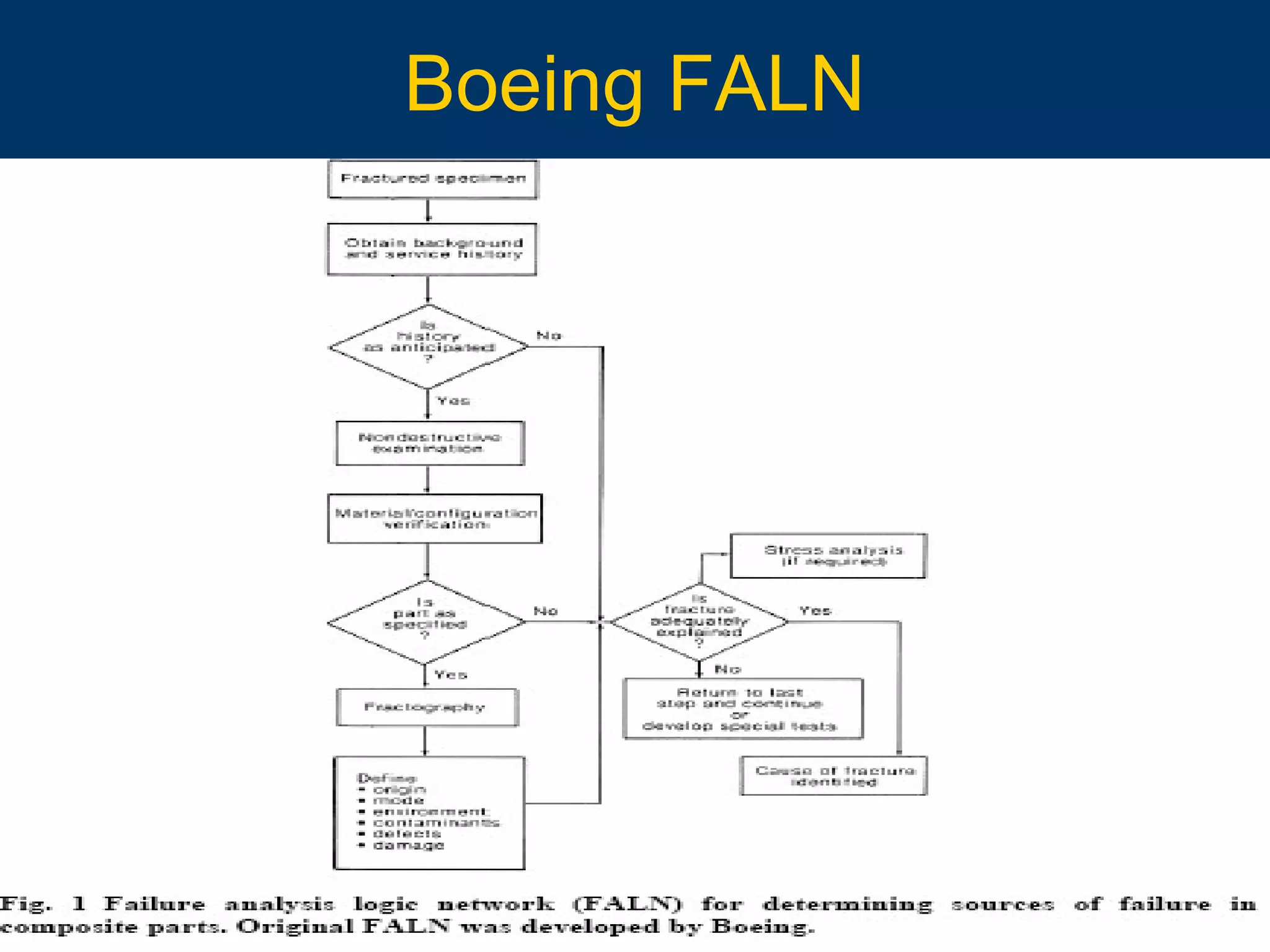
Boeing FALN
10/16/15 95
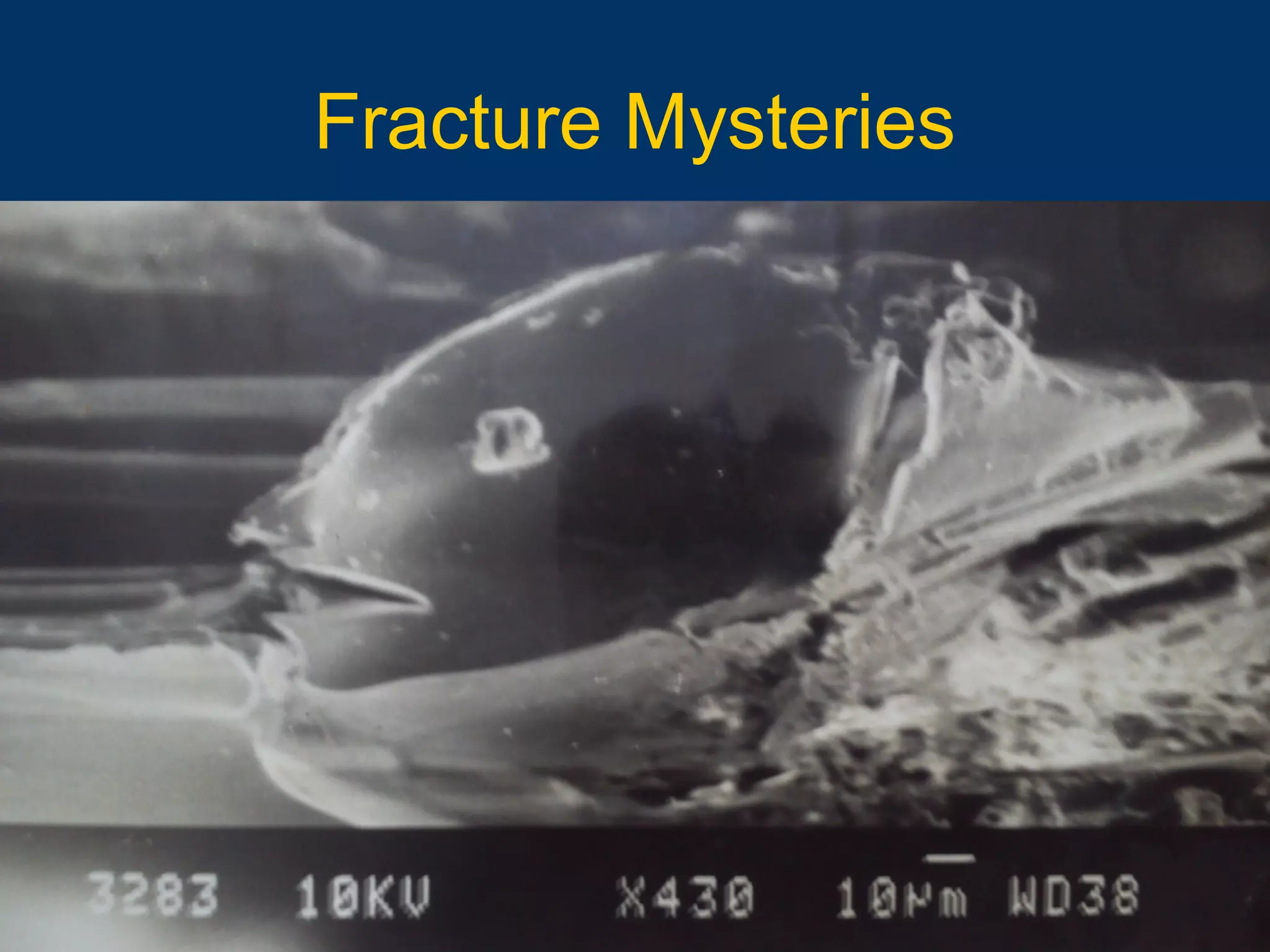
Fracture Mysteries
10/16/15 96
Bibliography
• P,K. Mallick, Fibre reinforced composites, Marcel and
Dekker Inc., New York .
• Derek Hull and T.W. Clyne, ` An Introduction to
composite materials’, Cambridge solid state science
series, 1996.
• E.J. Barbero, `Introduction to composite materials
design’, Taylor and Francis ,MI.
• J.K. Kim and Y.W. Mai, `Engineered interfaces in fibre
reinforced composites ‘, Elsevier, 1998.
• www.wikipedia.org
• Rao Tummala, Microsystems Packaging,McgrawHill.
10/16/15 97
Bibliography
• Sanjay K Mazumdar, Composites Manufacturing, CRC
Press, 2002.
• Geoffrey Pritchard, Reinforced Plastics Durability,
Woodhead publishing,Cambridge, England, 1999.
• ASTM Standards Handbooks Vols: 08.01,08.02 and
08.03, PA, USA.
• www.astm.org
• ANSYS v.14 Analysis Manuals, 2013.
• Rayner M Mayer, Design with Reinforced Plastics,
Design Council, London.
• Characterization and Failure Analysis of Plastics, ASM,
2003, USA.
10/16/15 98
Bibliography
• Padmanabhan Krishnan, Linked In Web Page.
• Introduction to Polymer Science and Chemistry,
Manas Chanda, Taylor and Francis, 2006, USA.
• K. Padmanabhan, S.Subeesh, K. Balaguru and T.
Karthik , ` An Analyses of Reliability and
Hygrothermal Effects in IC packages’, in ANSYS
Users’ Conference CD, 6 & 7 November 2008,
Bangalore. BEST PAPER AWARD
• K. Padmanabhan, D. Sanjay and S Subeesh,` Design
and electro-hygrothermo-mechanical reliability
analyses of a leadless quad IC package’, in the
• PADMANABHAN K, SASHIDARA. S and KISHORE , “ STUDIES ON
FLEXURE OF TWO DIFFERENT WOVEN FABRIC KEVLAR/EPOXY
COMPOSITES.” , MATERIALS FORUM, 15 (1991), p354-359
10/16/15 99
Bibliography
• PADMANABHAN K AND KISHORE, “INFLUENCE OF CIRCULAR DEFECTS
ON THE FLEXURAL STRENGTH OF KEVLAR/EPOXY COMPOSITES.” JL. OF
REINFORCED PLASTICS AND COMPOSITES ( American society of
composites) , VOL: 11 (1992), p 211- 219.
• PADMANABHAN K and KISHORE , ‘ FLEXURAL STUDIES ON ASYMMETRIC
HYBRID KEVLAR/EPOXY COMPOSITES. ‘ JL. MATER. SCI., 27 ( 1992 ) p
4282-4286 .
• PADMANABHAN K, “ FLEXURAL BEHAVIOUR OF UNMODIFIED AND
MODIFIED FIBRE REINFORCED EPOXY BASED COMPOSITES.” JL. OF
INDIAN INSTITUTE OF SCIENCE, 72 (1992) p464-466.
• PADMANABHAN. K AND KISHORE , `LOOPING BEHAVIOUR OF KEVLAR
FIBRES’, SCRIPTA MET et MATER. 28 (1993) p367-370.
• PADMANABHAN K and KISHORE , “ FIBRE MATRIX INTERFACIAL FAILURE
SEQUENCES IN TRANSLAMINAR FLEXURE OF GLASS/EPOXY COMPOSITES.”
JL. MATER. SCI .29 (1994) p 33-38.
10/16/15 100
Bibliography
• PADMANABHAN K and KISHORE, “ ON THE ELASTIC -
PLASTIC BEHAVIOUR OF WOVEN FABRIC KEVLAR/ EPOXY
COMPOSITES ”., INTL. JL OF FRACTURE, VOL:65, No: 3,
(1994) R59-61.
• K PADMANABHAN and KISHORE , “ INTERLAMINAR SHEAR
BEHAVIOUR OF WOVEN FABRIC KEVLAR/ EPOXY
COMPOSITES. IN THREE POINT LOADING” MATER. SCI. &
ENGG. PART A ,197 ( 1995) p113-120
• . M. MATHESWARAN , K PADMANABHAN and KISHORE, “
STATIC AND IMPACT BEHAVIOUR OF THERMOPLASTIC
MODIFIED GLASS/EPOXY COMPOSITES ”. JL. OF MATER.
SCI. LETT. 14 ( 1995) p 951-953.

Fracture and failure analyses of plastics and reinforced plastics

  • 1.
    10/16/15 1 Fracture andFailure Analyses of Plastics and Reinforced Plastics Dr. K. Padmanabhan Professor & Assistant Director School of Mechanical & Building Sciences VIT-University, Vellore-632014 Email: padmanabhan.k@vit.ac.in
  • 2.
    10/16/15 2 Definitions • Fractureis the creation of at least two surfaces from a body due to the action of forces. • Fracture results in the release of stored elastic energy ( strain energy) and creation of surfaces with a surface energy.
  • 3.
    10/16/15 3 Contents • Definitions •Structure of Plastics and Reinforced Plastics • Property Correlations • Introduction to Fracture and Fracture Mechanics • Basics of Failure Theories and Analyses • Test Specific Failure Characterization • Application Specific Failure Characterization • Feedback from Failures and Correlation • Failure processes, Improved Designs and Manufacturing • Summary
  • 4.
  • 5.
  • 6.
    10/16/15 6 Polymer ChainStructure Intermolecular and Super molecular Structures have Influence on structure, processing and properties
  • 7.
  • 8.
  • 9.
    10/16/15 9 0.51 nm Schematicdiagram of Kevlar® 49 fiber showing the radially arranged pleated sheets Microstructure of aramid fiber Solvent Spun Kevlar fibres 3.5 GPa of Tensile Strength and E= 130 GPa For reference material on Kevlar see bibliography
  • 10.
  • 11.
    10/16/15 11 Zylon Fibre www.toyobo.co.jp ZYLONconsists of rigid-rod chain molecules of poly(p- phenylene-2,6-benzobisoxazole)(PBO). Tensile Strength : 5.8 GPa Tensile Modulus : 270 GPa ILSS with Epoxy : ~ 40 GPa Ref: K. Padmanabhan , Toyobo Confidentiality Report, 2002.
  • 12.
    10/16/15 12 Types ofFoams • Thermoset, thermoplastic, elastomeric, ceramic, rock wool, metallic…. • Rigid, semi rigid, flexible…. • Filled and unfilled • Poisson’s ratio variations • Auxetic, syntactic ….. • Formed by for example Polyol, MDI Reactions like in PUF
  • 13.
  • 14.
  • 15.
  • 16.
    10/16/15 16 PUF 125DLS Foam Fracture
  • 17.
    10/16/15 17 Poisson’s Ratioand Foams Shear strain at maximum load vs foam density
  • 18.
    10/16/15 18 Rigid ThermosetUnfilled Foam PUF 500 PUF 125 PUF 250 PUF 64
  • 19.
  • 20.
  • 21.
  • 22.
    10/16/15 22 Static mechanicalproperties • Tensile properties • In accordance with ASTM D3039 standard • Specimen preparation, adhesive bonding at the end grips • Recommended cross head speed of 0.02 cm/min • Strain gaging, rosette strain gaging. • 0 and 90° (fibre direction) tests for E11and E22.. Similarly for major and minor poisson’s ratios .
  • 23.
  • 24.
  • 25.
  • 26.
    10/16/15 26 Micro bucklingand Design • Micro buckling can be prevented by choosing higher fibre diameter, higher fibre elastic modulus and high interfacial bond strength between fibre and matrix • Boron fibres are the best for design against micro buckling • High pressure Compression moulding with superior bond strength
  • 27.
    10/16/15 27 Mechanical Testing Ref:K. Padmanabhan and Kishore , ` Failure behaviour of carbon/epoxy composites in pin ended buckling and bending tests’, Composites, Vol:26, No: 3, 1995, p201.
  • 28.
  • 29.
    10/16/15 29 ILSS ofKevlar/Epoxy Composites
  • 30.
  • 31.
  • 32.
  • 33.
  • 34.
    10/16/15 34 Multiple CauseFatigue • Thermomechanical Fatigue • Fatigue –Vibration Interactions • Thermal Fatigue with Moisture Attack • Fatigue after DBT • Hygrothermal Fatigue • Creep –Fatigue Interactions. • Electro-hygrothermo-mechanical Fatigue.
  • 35.
    10/16/15 35 Impact Behaviourof Plastics and Reinforced Plastics • Izod Impact • Charpy Impact • Drop Weight Impact • Low Velocity Impact Tests • Repeated Impact Tests • Medium and High Velocity Impact Tests • Crashworthiness Tests • Ballistic Impact Tests. • Single Point Bird Hits .
  • 36.
    10/16/15 36 Tensile Impact Thetensile impact test is a unique test. It is the extensional answer to crashworthiness. Characterized by gross and fast fibre pull out and interfacial Fracture, it is very dependent on the interfacial shear stress in UD conditions !
  • 37.
    10/16/15 37 Creep ofPlastics and FRPs The regular creep curve of a metal is shown in the left with the creep curve of A plastic or an FRP shown on the right . The tertiary creep rupture characteristic Of metals is not prominent in plastics.
  • 38.
  • 39.
    10/16/15 39 Fracture Mechanics Fractureenergy in plane stress K ( SIF ) in MPa √M = Y σ √π a, where Y~1.12 , σ ( Fracture stress) and a= semi crack length If in the centre and crack length if an edge notch
  • 40.
    10/16/15 40 Single EdgeNotch Test Double Edge Notch Test Double Cantilever Beam Tapered DCB Wedge opening Load Three Point Bend
  • 41.
    10/16/15 41 Fracture MechanicsTesting Mixed mode testing of composite materials is a recent trend as causes are multiple during failure in real conditions Fracture mechanics tests to evaluate fracture toughness and strain energy release rates have found quite a few standards in ASTM
  • 42.
    10/16/15 42 Double CantileverBeam Test Modified Beam Theory Compliance Theory Modified Compliance Theory
  • 43.
    10/16/15 43 End NotchedFlexure Test Modified Beam Theory Compliance Theory Modified Compliance Theory ASTM Standards Russel’s Theory Direct Beam Theory Cohesive Zone Models Mixed Mode Models ………
  • 44.
    10/16/15 44 Glass/ EpoxyMWCNT Multiscale Composites The mode 2 fracture toughness/ SIF can also be found out by Using the ILSS specimens in the flexural testing using an edge notch.
  • 45.
    10/16/15 45 Advances inSandwich Composites •Develop fracture mechanics test methods for sandwich composites •Focus on facesheet core delamination •Both Mode I and Mode II Suitable for ASTM standardization Flexural Failure of Vacuum Bagged PIR foam / aluminium skin sandwich composite
  • 46.
  • 47.
    10/16/15 47 Steps forFailure Analyses
  • 48.
  • 49.
  • 50.
  • 51.
  • 52.
  • 53.
    10/16/15 53 Mode Iand Mode 2 Fracture of FRPs
  • 54.
    10/16/15 54 Impact ofEpoxy-Polycarbonate Blends
  • 55.
  • 56.
  • 57.
  • 58.
    10/16/15 58 Bolted andBonded Composite Joints Joint testing of a composite lug
  • 59.
    10/16/15 59 Natural andBio Derived Plastics and Composites
  • 60.
    10/16/15 60 Cashew NutShell Oil as Composite Matrix Material • Cashew nut shell oil can be polymerized using acids, toluene as inhibitor and formaldehyde at 120 celsius. • A tough and strong maroon coloured matrix !
  • 61.
  • 62.
    10/16/15 62 Fracture mechanicsof CNSL-Glass Fibre Composites The single edge notch fracture mechanics test of Glass fabric/CNSL Composite Proves that CNSL can be tougher than basic epoxies ( and termite resistant with Low moisture absorption and degradation properties.)
  • 63.
    10/16/15 63 Chemical Compositionof Some Vegetable Fibres
  • 64.
    10/16/15 64 Main physicalproperties of cellulose based fibres compared with conventional synthetic fibres
  • 65.
    10/16/15 65 Natural FibreCross Section Confocal Laser Scanning Microscope (CLSM) images Non-uniform cross sections provide interesting interfacial properties and other mechanical properties , different ROM !
  • 66.
  • 67.
    10/16/15 67 Spider Silk Spidersilk is sometimes stronger than silkworm silk. It may be 1.4 GPa in tensile strength compared to 500 MPa for the mulberry silkworm produced silk. It is a myth that natural fibres are weak !
  • 68.
  • 69.
    10/16/15 69 Self ReinforcedNatural Composites • The same material as the fibre and the pulp matrix • The fibre matrix-interface is interesting • Weight and cost savings • Interesting Properties ! • Bio derived self reinforced polyethylene from sugar cane
  • 70.
    10/16/15 70 Positive HybridEffect • Synergy in Properties • Cellulosic Interfaces • Silane and Other Interfaces • Shear to Tensile Strength Ratios • Fracture Behaviour • Crack tip blunting, Fracture energy • Underlying Mechanisms
  • 71.
    10/16/15 71 Failures andMultiple Causes • In nature, most of the real environment failures are due to multiple causes. • As enough standard procedures are available for failures due to a single cause, the obvious move is to develop the understanding as well as standard procedures for failures due to multiple causes. • An understanding of these failures leads to a better fracture control that aids superior designs with advanced composite materials and processing.
  • 72.
  • 73.
    10/16/15 73 Thermal –Structural Results Displacement Vector sum Von mises stress Stress intensity XY Shear stress
  • 74.
    10/16/15 74 Failure theoryfor 4x4mm 24L TQLMP Peak conditioning i.e 125°C for 24 hrs X stress in MPa = 70.509 Y stress in MPa = 98.811 XY shear stress in MPa = 45.793 Tensile strength in MPa =27.01 Compressive strength in MPa = 28.47 Shear strength in MPa = 13.5 Tsai – Wu Failure theory: 22.29> 1 Azzi-Tsai-Hill theory: 22.047(Tensile) / 21.083(compressive) > 1 Design is unsafe at 125ºC but safe at MOT.
  • 75.
    10/16/15 75 SAM Picturefor 24L TQLMP after preconditioning, No Plasma* Cleaning Red areas show delaminations in IC Packages
  • 76.
    10/16/15 76 Thermal ShockTest (JESD22 – A106B) • Purpose of this test is to determine the resistance of the part to sudden exposures of extreme changes in temperature and alternate exposures to these extremes as well as its ability to withstand cyclical stresses • Here the IC packages are baked in an oven for 125ºC/24 Hrs and the temperature is spiked to 260ºC for lead free product and 240ºC for leaded product for 5 to 10 minutes. • If the baking temperature is higher than the glass transition temperature at this extreme heat the package tends to delaminate or fail. This failure or delamination can be viewed using SAM (Scanning Acoustic Microscopy)
  • 77.
    10/16/15 77 Non DestructiveEvaluation Ultrasonic C-Scan NDT can do depth profiling of composites delamination and damage profiling Scanning acoustic microscope can sense delaminations of micron dimensions ( shown as red areas) in TQLMP IC packages. FEA techniques are also NDE techniques.
  • 78.
    10/16/15 78 FEA asan NDT • Numerical method used for solving problems that cannot be solved analytically (e.g., due to complicated geometry, different materials) • Well suited to computers • Originally applied to problems in solid mechanics • Other application areas include heat transfer, fluid flow, electromagnetism
  • 79.
  • 80.
  • 81.
  • 82.
  • 83.
  • 84.
    10/16/15 84 Azzi-Tsai-Hill FailureTheory Where, σ11 = X ( tensile / compressive) stress in MPa σ22 = Y ( tensile / compressive) stress in MPa τ12 = Shear stress in MPa SLt = Longitudinal tensile strength in MPa STt = Transverse tensile strength in MPa SLts = In-plane shear strength in MPa
  • 85.
    10/16/15 85 Tsai –Wu Failure Theory F1 σ11 + F2 σ22 + F6 τ12+ F11 σ11 2 + F22 σ22 2 + F66 τ12 2 +2 F12 σ11σ22 = 1 Where, Other parameters / symbols appear on the previous slide, SLc = Longitudinal compressive strength in MPa STc = Transverse compressive strength in MPa. Narayanaswamy and Adelman have suggested F12 = 0
  • 86.
    10/16/15 86 Hygrothermal Behaviour •Fibre reinforced plastics are known for environmental attacks that reduce their function. • Mechanical properties degrade over time ! • Moisture plays havoc at elevated temperatures, in the presence of voids, defects and in low Tg plastics . So do UV, IR, alkali , acid and marine environs. • Diffusion and osmotic pressure are the driving mechanisms for hygrothermal attack • Evaluation methods and surface preservation • Important in marine, biomedical, aeronautical, electronic and automobile applications
  • 87.
  • 88.
  • 89.
    10/16/15 89 Variation ofTg with Moisture
  • 90.
    10/16/15 90 ASTM STPD 5229 M Rule • The MOT( Maximum Operating Temperature) of the material, device/component should be at least 25 º Celsius lower than the lowest Tg (normally wet) of the material attained after hygrothermal equillibration. All the polymeric materials and their composites must satisfy this rule in order to qualify for certification for reliability and durability.
  • 91.
    10/16/15 91 Current Research Machining Youstart machining a monkey and due to structural change end up with a parrot And report the properties as that of a monkey ! Machining induced fracture and failure depends on structure and then the machining parameters. Any optimization be should based on this truth !
  • 92.
  • 93.
    10/16/15 93 The Processof Failure Analyses
  • 94.
  • 95.
  • 96.
    10/16/15 96 Bibliography • P,K.Mallick, Fibre reinforced composites, Marcel and Dekker Inc., New York . • Derek Hull and T.W. Clyne, ` An Introduction to composite materials’, Cambridge solid state science series, 1996. • E.J. Barbero, `Introduction to composite materials design’, Taylor and Francis ,MI. • J.K. Kim and Y.W. Mai, `Engineered interfaces in fibre reinforced composites ‘, Elsevier, 1998. • www.wikipedia.org • Rao Tummala, Microsystems Packaging,McgrawHill.
  • 97.
    10/16/15 97 Bibliography • SanjayK Mazumdar, Composites Manufacturing, CRC Press, 2002. • Geoffrey Pritchard, Reinforced Plastics Durability, Woodhead publishing,Cambridge, England, 1999. • ASTM Standards Handbooks Vols: 08.01,08.02 and 08.03, PA, USA. • www.astm.org • ANSYS v.14 Analysis Manuals, 2013. • Rayner M Mayer, Design with Reinforced Plastics, Design Council, London. • Characterization and Failure Analysis of Plastics, ASM, 2003, USA.
  • 98.
    10/16/15 98 Bibliography • PadmanabhanKrishnan, Linked In Web Page. • Introduction to Polymer Science and Chemistry, Manas Chanda, Taylor and Francis, 2006, USA. • K. Padmanabhan, S.Subeesh, K. Balaguru and T. Karthik , ` An Analyses of Reliability and Hygrothermal Effects in IC packages’, in ANSYS Users’ Conference CD, 6 & 7 November 2008, Bangalore. BEST PAPER AWARD • K. Padmanabhan, D. Sanjay and S Subeesh,` Design and electro-hygrothermo-mechanical reliability analyses of a leadless quad IC package’, in the • PADMANABHAN K, SASHIDARA. S and KISHORE , “ STUDIES ON FLEXURE OF TWO DIFFERENT WOVEN FABRIC KEVLAR/EPOXY COMPOSITES.” , MATERIALS FORUM, 15 (1991), p354-359
  • 99.
    10/16/15 99 Bibliography • PADMANABHANK AND KISHORE, “INFLUENCE OF CIRCULAR DEFECTS ON THE FLEXURAL STRENGTH OF KEVLAR/EPOXY COMPOSITES.” JL. OF REINFORCED PLASTICS AND COMPOSITES ( American society of composites) , VOL: 11 (1992), p 211- 219. • PADMANABHAN K and KISHORE , ‘ FLEXURAL STUDIES ON ASYMMETRIC HYBRID KEVLAR/EPOXY COMPOSITES. ‘ JL. MATER. SCI., 27 ( 1992 ) p 4282-4286 . • PADMANABHAN K, “ FLEXURAL BEHAVIOUR OF UNMODIFIED AND MODIFIED FIBRE REINFORCED EPOXY BASED COMPOSITES.” JL. OF INDIAN INSTITUTE OF SCIENCE, 72 (1992) p464-466. • PADMANABHAN. K AND KISHORE , `LOOPING BEHAVIOUR OF KEVLAR FIBRES’, SCRIPTA MET et MATER. 28 (1993) p367-370. • PADMANABHAN K and KISHORE , “ FIBRE MATRIX INTERFACIAL FAILURE SEQUENCES IN TRANSLAMINAR FLEXURE OF GLASS/EPOXY COMPOSITES.” JL. MATER. SCI .29 (1994) p 33-38.
  • 100.
    10/16/15 100 Bibliography • PADMANABHANK and KISHORE, “ ON THE ELASTIC - PLASTIC BEHAVIOUR OF WOVEN FABRIC KEVLAR/ EPOXY COMPOSITES ”., INTL. JL OF FRACTURE, VOL:65, No: 3, (1994) R59-61. • K PADMANABHAN and KISHORE , “ INTERLAMINAR SHEAR BEHAVIOUR OF WOVEN FABRIC KEVLAR/ EPOXY COMPOSITES. IN THREE POINT LOADING” MATER. SCI. & ENGG. PART A ,197 ( 1995) p113-120 • . M. MATHESWARAN , K PADMANABHAN and KISHORE, “ STATIC AND IMPACT BEHAVIOUR OF THERMOPLASTIC MODIFIED GLASS/EPOXY COMPOSITES ”. JL. OF MATER. SCI. LETT. 14 ( 1995) p 951-953.

Editor's Notes

  • #79 Analytical -> exact solution Numerical -> approximate solution