Measurement TechniquesMeasurement Techniques
in Advanced Materialsin Advanced Materials
SystemsSystems
Prof. K. PadmanabhanProf. K. Padmanabhan
SMBSSMBS
VIT-VelloreVIT-Vellore
Email: padmanabhan.k@vit.ac.inEmail: padmanabhan.k@vit.ac.in
Bottom up andBottom up and
Top down Philosophy
ContentsContents
 Advanced Materials SystemsAdvanced Materials Systems
 Design ConsiderationsDesign Considerations
 Advanced Materials Testing (AMT)- The differenceAdvanced Materials Testing (AMT)- The difference
 Fracture, Failure and Fractography of AMFracture, Failure and Fractography of AM
 NDT , FEA and MeasurementsNDT , FEA and Measurements
 Improvement from feedbackImprovement from feedback
 Innovations in AMT, Product testing and DFAInnovations in AMT, Product testing and DFA
 Case Studies and ConclusionsCase Studies and Conclusions
Advanced Materials SystemsAdvanced Materials Systems
 Al-Mg and Mg Alloys and CompositesAl-Mg and Mg Alloys and Composites
 Carbon, Glass, Kevlar, Zylon fibre reinforcedCarbon, Glass, Kevlar, Zylon fibre reinforced
compositescomposites
 Metal –Plastic Composite SystemsMetal –Plastic Composite Systems
 Cermets and their CompositesCermets and their Composites
 Ceramic-Polymer CompositesCeramic-Polymer Composites
 Self Reinforced Composites ( Carbon/Carbon)Self Reinforced Composites ( Carbon/Carbon)
 Super Alloys and Composites.Super Alloys and Composites.
 Hybrids, Super hybrids and SandwichesHybrids, Super hybrids and Sandwiches
DefinitionDefinition
 A composite material is a multi-A composite material is a multi-
component system with at least a matrixcomponent system with at least a matrix
and a reinforcement.and a reinforcement.
 The desired properties must be better thanThe desired properties must be better than
at least one of the constituents.at least one of the constituents.
 The constituents are normally physicallyThe constituents are normally physically
separable , with a line of heterogeneityseparable , with a line of heterogeneity
between them, called the interface.between them, called the interface.
Ford Soybean FRP Car of 1940sFord Soybean FRP Car of 1940s
Picture shows Henry Ford I trying to break The Soybean with
a sledgehammer, rather unsuccessfully. Soybean was made of
steel tubular frame and 14 panels containing phenolic resin and
natural fibres. It was world’s first car with an FRP body –
courtesy Ford Motors
General Design RequirementsGeneral Design Requirements
 Tensile, Compressive, Shear , Flexure and CreepTensile, Compressive, Shear , Flexure and Creep
 Load Control, Position Control and Strain Control.Load Control, Position Control and Strain Control.
 Ductility and Plastic StrainDuctility and Plastic Strain
 Buckling, Collapsibility and CrushingBuckling, Collapsibility and Crushing
 Modularity and FlexibilityModularity and Flexibility
 Crumple Zones and CrashworthinessCrumple Zones and Crashworthiness
 Static and Dynamic Fracture EnergyStatic and Dynamic Fracture Energy
 Impact Strength and ToughnessImpact Strength and Toughness
 Noise Vibrations and HarshnessNoise Vibrations and Harshness
 Fatigue , Hot Wet Fatigue, Acoustic Fatigue, FatigueFatigue , Hot Wet Fatigue, Acoustic Fatigue, Fatigue
after DBTafter DBT
 Statics and Dynamics of Structures and AssembliesStatics and Dynamics of Structures and Assemblies
 Failure Mode Interactions, Multiple Causes of FailureFailure Mode Interactions, Multiple Causes of Failure
 Multi FunctionalityMulti Functionality
Design RequirementsDesign Requirements
-Materials-Materials
 Material IndexMaterial Index
 Merit IndexMerit Index
 Structural IndexStructural Index
 Shape FactorsShape Factors
 Mechanically Efficient ShapesMechanically Efficient Shapes
 Specific PropertiesSpecific Properties
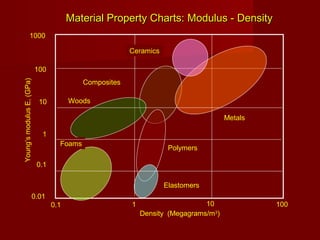
Material Property Charts: Modulus - DensityMaterial Property Charts: Modulus - Density
0.1
10
1
100
Metals
Polymers
Elastomers
Ceramics
Woods
Composites
Foams
0.01
1000
1000.1 1 10
Density (Megagrams/m3
)
Young’smodulusE,(GPa)
Design RequirementsDesign Requirements
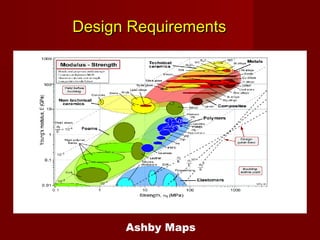
Ashby Maps
Design RequirementsDesign Requirements
- FRP Composites- FRP Composites
 Specific PropertiesSpecific Properties
 Fracture ToughnessFracture Toughness
 Dynamic Fracture ToughnessDynamic Fracture Toughness
 Damage ToleranceDamage Tolerance
 Hygrothermal DurabilityHygrothermal Durability
 Overall Reliability ( Hot Wet Fatigue)Overall Reliability ( Hot Wet Fatigue)
 DFM, DFA and DFMAE.DFM, DFA and DFMAE.
 Disposability and SafetyDisposability and Safety
 Recycleability, Recoverability and ReuseRecycleability, Recoverability and Reuse
 Plastics Waste to Fuel ConversionPlastics Waste to Fuel Conversion
Micromechanics is whereMicromechanics is where
design begins !design begins !
Design is defined
as the complete
information
required to
produce a
product or
render service
-
Anonymous
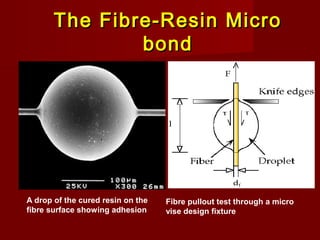
The Fibre-Resin MicroThe Fibre-Resin Micro
bondbond
A drop of the cured resin on the
fibre surface showing adhesion
Fibre pullout test through a micro
vise design fixture
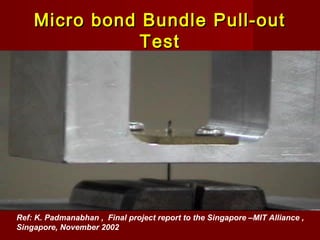
Micro bond Bundle Pull-outMicro bond Bundle Pull-out
TestTest
Ref: K. Padmanabhan , Final project report to the Singapore –MIT Alliance ,
Singapore, November 2002
Interface TestsInterface Tests
 Single fibre pullout testSingle fibre pullout test
 Single fibre push out test, brittle materialsSingle fibre push out test, brittle materials
 Micro bond single fibre pullout testMicro bond single fibre pullout test
 Multiple fibre pullout test and Micro bondMultiple fibre pullout test and Micro bond
multiple fibre pullout test, Statisticallymultiple fibre pullout test, Statistically
averaged results, More precise, Lessaveraged results, More precise, Less
difficult, Mesomechanical in nature.difficult, Mesomechanical in nature.
 Interlaminar shear strength test, ILSS.Interlaminar shear strength test, ILSS.
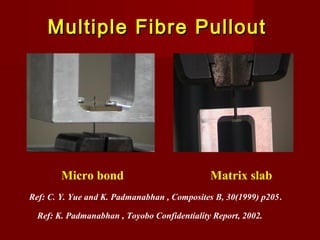
Multiple Fibre PulloutMultiple Fibre Pullout
Ref: K. Padmanabhan , Toyobo Confidentiality Report, 2002.
Ref: C. Y. Yue and K. Padmanabhan , Composites B, 30(1999) p205.
Micro bond Matrix slab
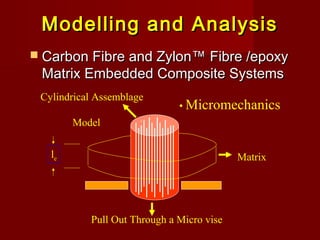
Modelling and AnalysisModelling and Analysis
 Carbon Fibre and ZylonCarbon Fibre and Zylon™™ Fibre /epoxyFibre /epoxy
Matrix Embedded Composite SystemsMatrix Embedded Composite Systems
Cylindrical Assemblage
Model
Matrix
Pull Out Through a Micro vise
• Micromechanics
le
Interfacial ParametersInterfacial Parameters
 Interfacial shear strength,Interfacial shear strength,ττ
 Interfacial frictional stress, τInterfacial frictional stress, τff
 Fibre/matrix coefficient of friction, µFibre/matrix coefficient of friction, µ
 Matrix shrinkage pressure, PMatrix shrinkage pressure, Poo
 Pressure due to Poisson expansion, pPressure due to Poisson expansion, paa
 Contact pressureContact pressure
 Interfacial wearInterfacial wear
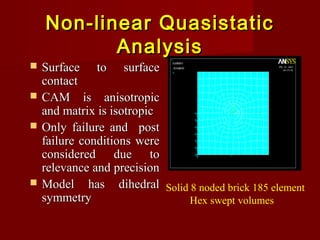
Non-linear QuasistaticNon-linear Quasistatic
AnalysisAnalysis
 Surface to surfaceSurface to surface
contactcontact
 CAM is anisotropicCAM is anisotropic
and matrix is isotropicand matrix is isotropic
 Only failure and postOnly failure and post
failure conditions werefailure conditions were
considered due toconsidered due to
relevance and precisionrelevance and precision
 Model has dihedralModel has dihedral
symmetrysymmetry
Solid 8 noded brick 185 element
Hex swept volumes
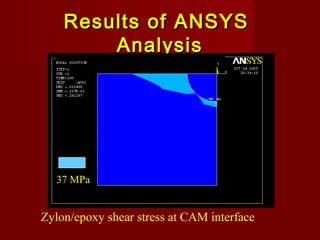
Results of ANSYSResults of ANSYS
AnalysisAnalysis
37 MPa
Zylon/epoxy shear stress at CAM interface
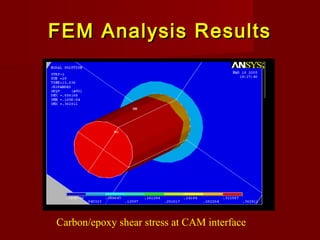
FEM Analysis ResultsFEM Analysis Results
Carbon/epoxy shear stress at CAM interface
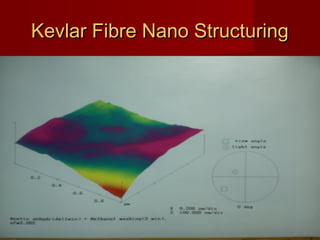
Nano Structuring of KevlarNano Structuring of Kevlar
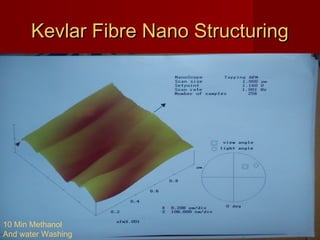
Kevlar Fibre Nano StructuringKevlar Fibre Nano Structuring
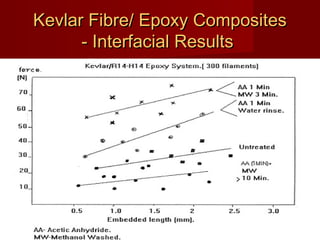
10 Min Methanol
And water Washing
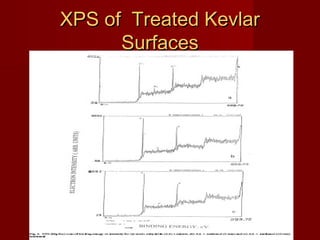
XPS of Treated KevlarXPS of Treated Kevlar
SurfacesSurfaces
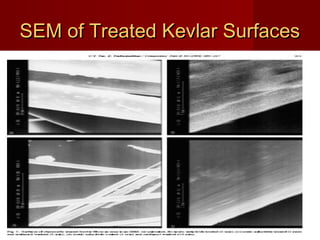
SEM of Treated Kevlar SurfacesSEM of Treated Kevlar Surfaces
Kevlar Fibre/ Epoxy CompositesKevlar Fibre/ Epoxy Composites
- Interfacial Results- Interfacial Results
Static mechanical propertiesStatic mechanical properties
 Tensile propertiesTensile properties
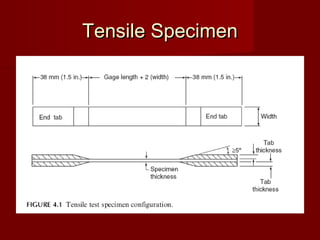
 In accordance with ASTM D3039 standardIn accordance with ASTM D3039 standard
 Specimen preparation, adhesive bonding at theSpecimen preparation, adhesive bonding at the
end gripsend grips
 Recommended cross head speed of 0.02Recommended cross head speed of 0.02
cm/mincm/min
 Strain gaging, rosette strain gaging.Strain gaging, rosette strain gaging.
 0 and 900 and 90° (fibre direction) tests for E° (fibre direction) tests for E1111and Eand E22..22..
Similarly for major and minor poisson’s ratios .Similarly for major and minor poisson’s ratios .
Tensile SpecimenTensile Specimen
Tensile propertiesTensile properties
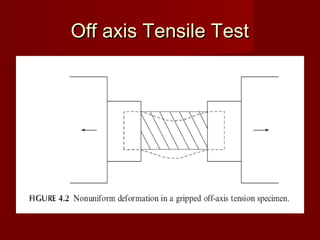
 Off axis tensile tests for extensional stressOff axis tensile tests for extensional stress
and in plane shear stress evaluation.and in plane shear stress evaluation.
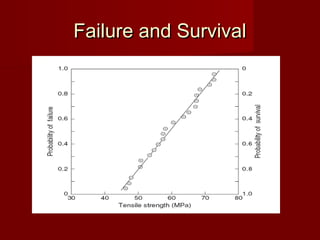
 Statistical conceptsStatistical concepts
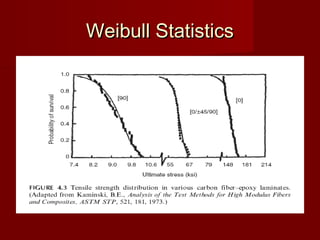
 Normal and weibull distribution, locationNormal and weibull distribution, location
parameter and weibull shape parameter.parameter and weibull shape parameter.
 Probability of failure and probability ofProbability of failure and probability of
survival.survival.
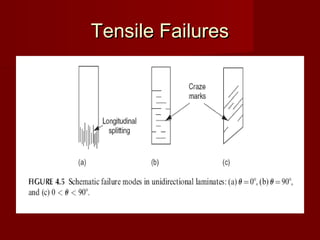
 Longitudinal splitting, transverse cracking,Longitudinal splitting, transverse cracking,
angled cracking….angled cracking….
Off axis Tensile TestOff axis Tensile Test
Weibull StatisticsWeibull Statistics
Failure and SurvivalFailure and Survival
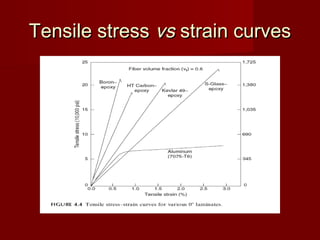
Tensile stressTensile stress vsvs strain curvesstrain curves
Tensile FailuresTensile Failures
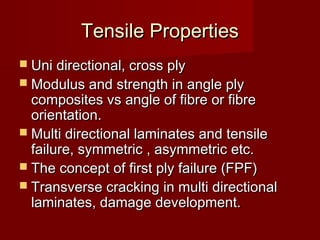
Tensile PropertiesTensile Properties
 Uni directional, cross plyUni directional, cross ply
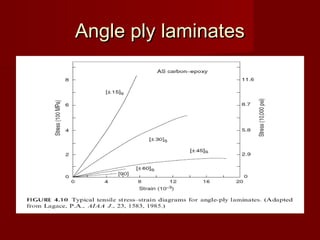
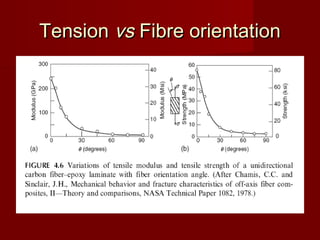
 Modulus and strength in angle plyModulus and strength in angle ply
composites vs angle of fibre or fibrecomposites vs angle of fibre or fibre
orientation.orientation.
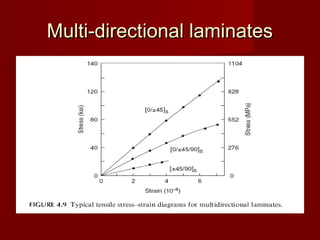
 Multi directional laminates and tensileMulti directional laminates and tensile
failure, symmetric , asymmetric etc.failure, symmetric , asymmetric etc.
 The concept of first ply failure (FPF)The concept of first ply failure (FPF)
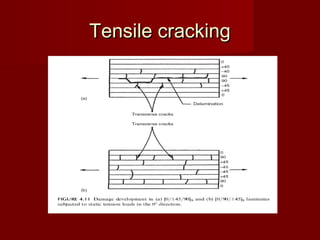
 Transverse cracking in multi directionalTransverse cracking in multi directional
laminates, damage development.laminates, damage development.
TensionTension vsvs Fibre orientationFibre orientation
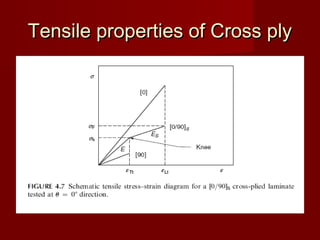
Tensile properties of Cross plyTensile properties of Cross ply
Multi-directional laminatesMulti-directional laminates
Angle ply laminatesAngle ply laminates
Tensile crackingTensile cracking
Tensile PropertiesTensile Properties
 Tensile properties of woven fabricTensile properties of woven fabric
composites.composites.
 Transverse microcracking in woven fabricTransverse microcracking in woven fabric
compositescomposites
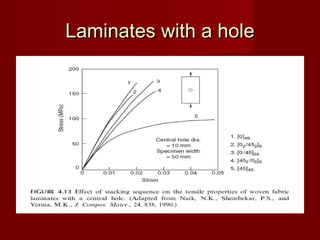
 Laminates with holes, effect of stackingLaminates with holes, effect of stacking
sequencesequence
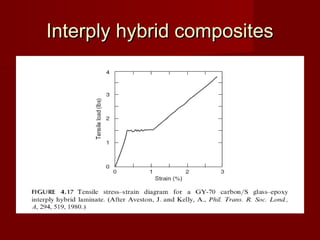
 Sheet moulding ( Crazing, transverseSheet moulding ( Crazing, transverse
cracking, fibre matrix shear failure ) andcracking, fibre matrix shear failure ) and
interply hybrid composites.interply hybrid composites.
Laminates with a holeLaminates with a hole
Interply hybrid compositesInterply hybrid composites
Compressive propertiesCompressive properties
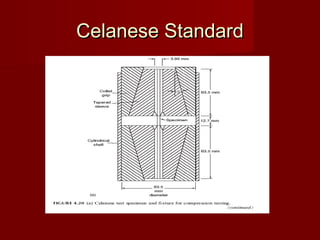
 Celanese test rigCelanese test rig
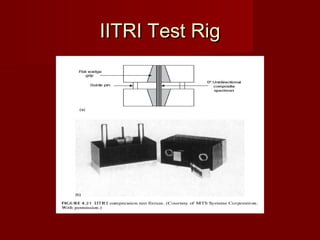
 IITRI test rigIITRI test rig
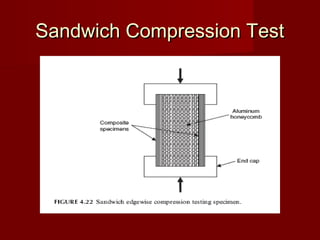
 Sandwich edge wise compression testSandwich edge wise compression test
 ComparisonsComparisons
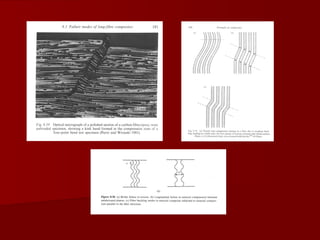
 Buckling and microbuckling of compositesBuckling and microbuckling of composites
and fibres.and fibres.
 Types of failuresTypes of failures
Celanese StandardCelanese Standard
IITRI Test RigIITRI Test Rig
Sandwich Compression TestSandwich Compression Test
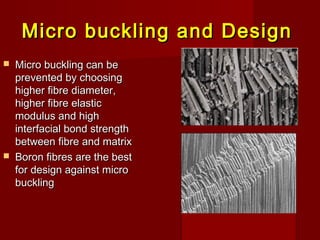
Micro buckling and DesignMicro buckling and Design
 Micro buckling can beMicro buckling can be
prevented by choosingprevented by choosing
higher fibre diameter,higher fibre diameter,
higher fibre elastichigher fibre elastic
modulus and highmodulus and high
interfacial bond strengthinterfacial bond strength
between fibre and matrixbetween fibre and matrix
 Boron fibres are the bestBoron fibres are the best
for design against microfor design against micro
bucklingbuckling
CompressibilityCompressibility
 The compressive strength of single fibers is very difficult toThe compressive strength of single fibers is very difficult to
measure and is usually inferred from the behavior of compositesmeasure and is usually inferred from the behavior of composites
including the fibers.including the fibers.
 Euler buckling is one possible mode of compressive failure: itEuler buckling is one possible mode of compressive failure: it
occurs when a fiber under compression becomes unstable againstoccurs when a fiber under compression becomes unstable against
lateral movement of its central region.lateral movement of its central region.
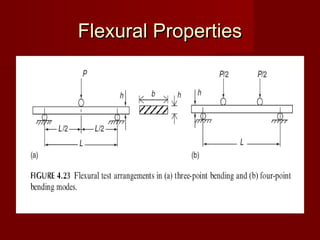
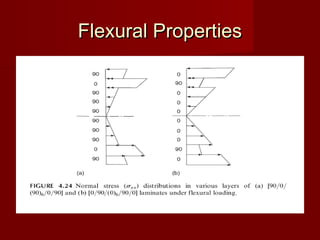
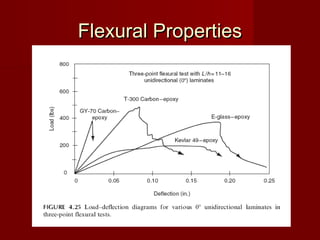
Flexural PropertiesFlexural Properties
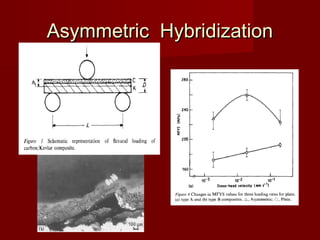
Asymmetric HybridizationAsymmetric Hybridization
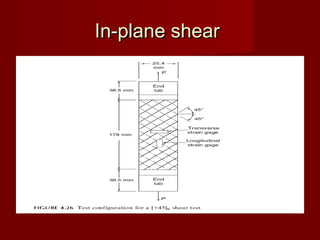
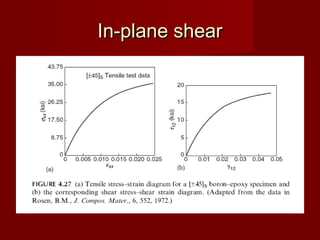
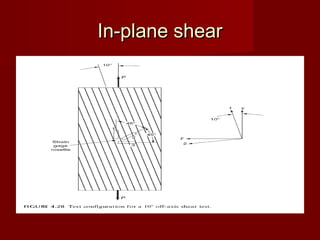
In-plane shearIn-plane shear
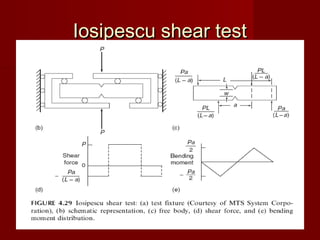
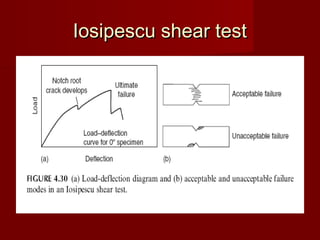
Iosipescu shear testIosipescu shear test
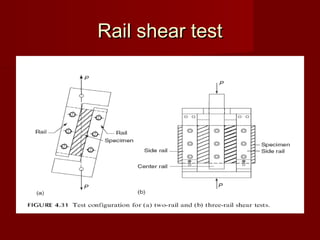
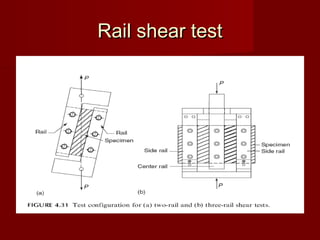
Rail shear testRail shear test
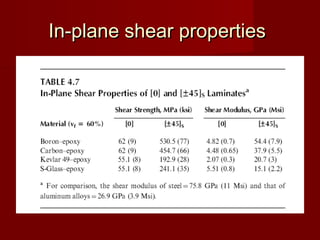
In-plane shear propertiesIn-plane shear properties
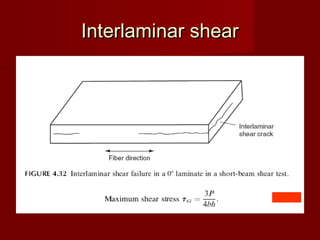
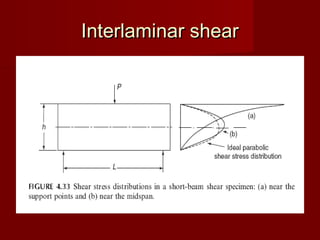
Interlaminar shearInterlaminar shear
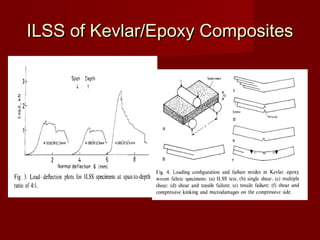
ILSS of Kevlar/Epoxy CompositesILSS of Kevlar/Epoxy Composites
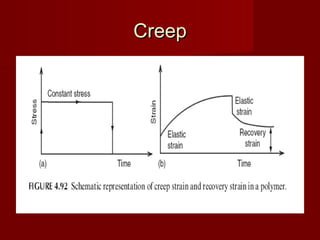
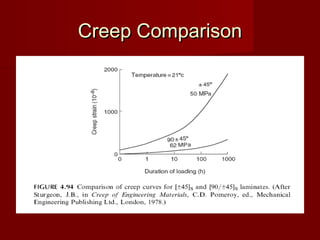
CreepCreep
Creep ComparisonCreep Comparison
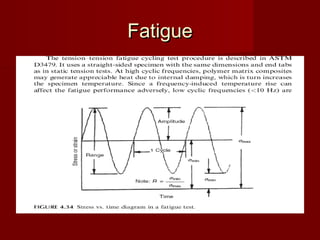
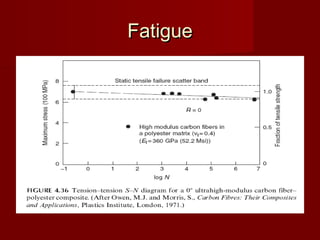
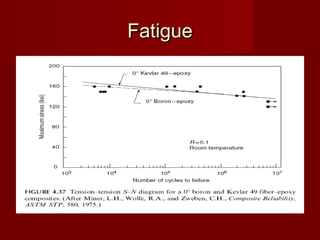
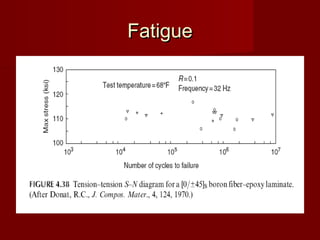
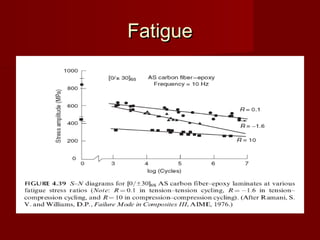
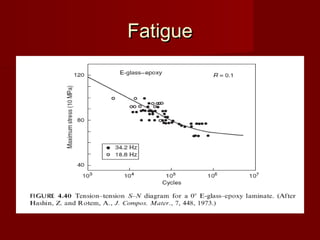
FatigueFatigue
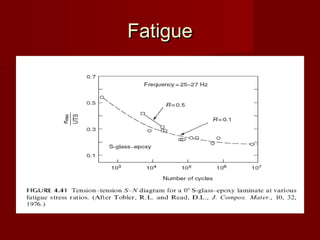
FatigueFatigue
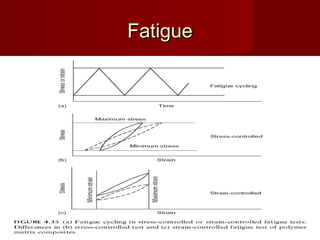
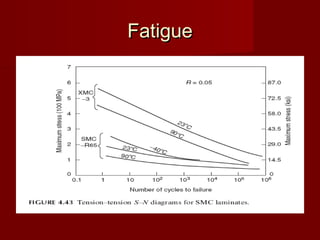
FatigueFatigue
FatigueFatigue
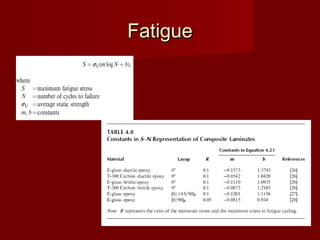
FatigueFatigue
FatigueFatigue
FatigueFatigue
FatigueFatigue
FatigueFatigue
FatigueFatigue
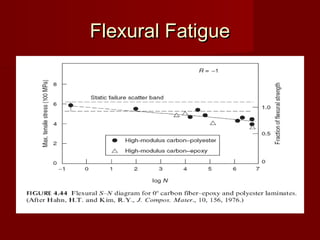
Flexural FatigueFlexural Fatigue
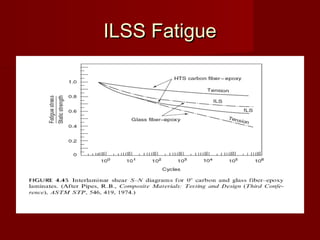
ILSS FatigueILSS Fatigue
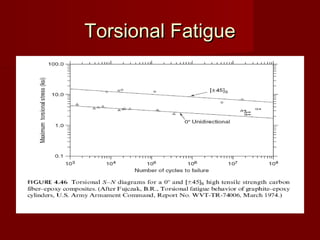
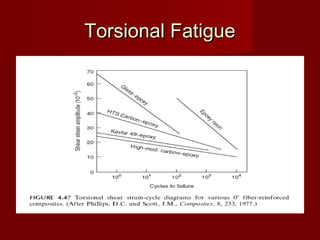
Torsional FatigueTorsional Fatigue
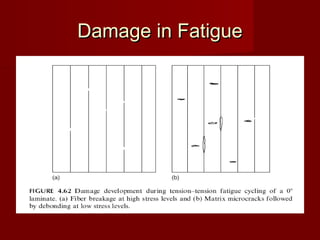
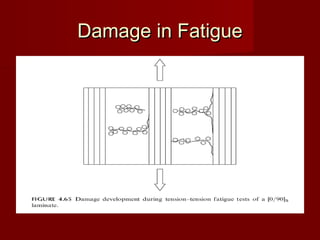
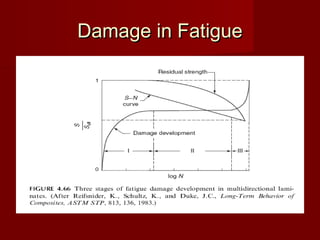
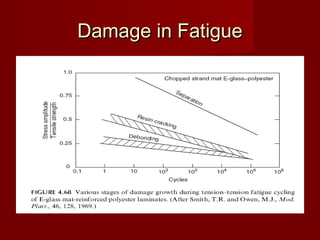
Damage in FatigueDamage in Fatigue
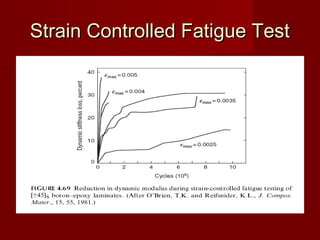
Strain Controlled Fatigue TestStrain Controlled Fatigue Test
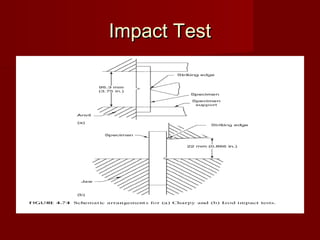
Impact TestImpact Test
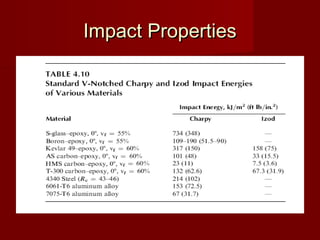
Impact PropertiesImpact Properties
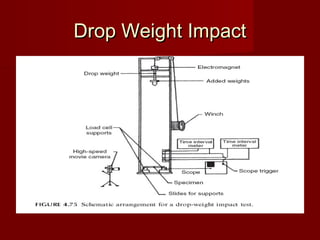
Drop Weight ImpactDrop Weight Impact
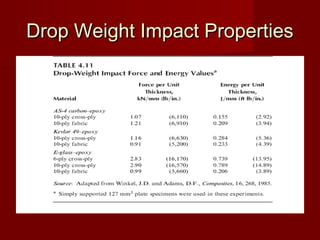
Drop Weight Impact PropertiesDrop Weight Impact Properties
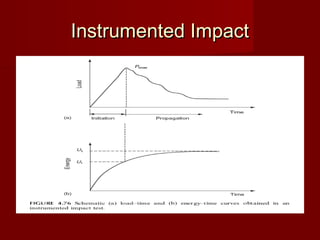
Instrumented ImpactInstrumented Impact
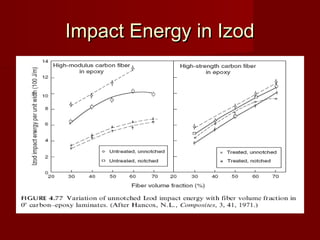
Impact Energy in IzodImpact Energy in Izod
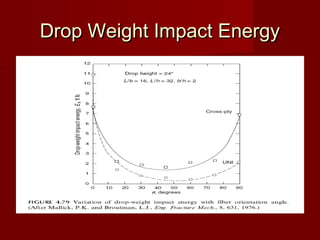
Drop Weight Impact EnergyDrop Weight Impact Energy
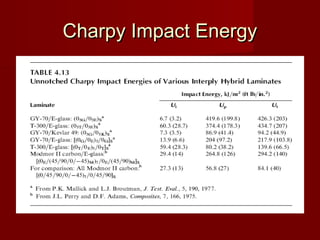
Charpy Impact EnergyCharpy Impact Energy
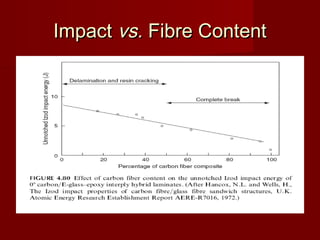
ImpactImpact vs.vs. Fibre ContentFibre Content
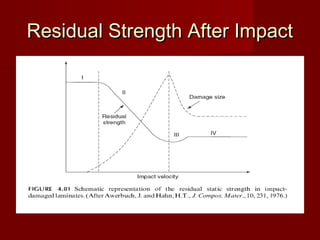
Residual Strength After ImpactResidual Strength After Impact
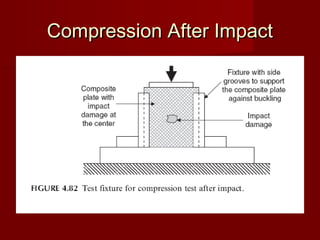
Compression After ImpactCompression After Impact
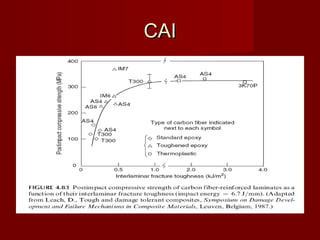
CAICAI
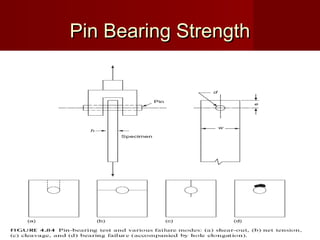
Pin Bearing StrengthPin Bearing Strength
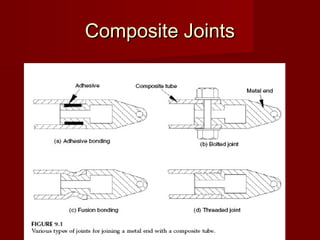
Composite JointsComposite Joints
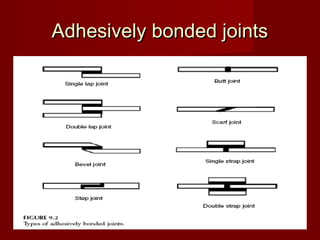
Adhesively bonded jointsAdhesively bonded joints
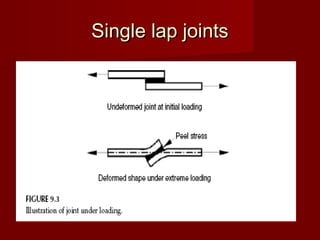
Single lap jointsSingle lap joints
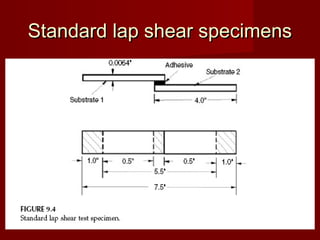
Standard lap shear specimensStandard lap shear specimens
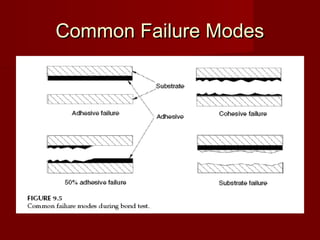
Common Failure ModesCommon Failure Modes
Hygrothermal BehaviourHygrothermal Behaviour
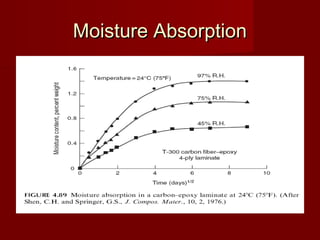
 Fibre reinforced plastics are known forFibre reinforced plastics are known for
environmental attacks that reduce their function.environmental attacks that reduce their function.
 Mechanical properties degrade over time !Mechanical properties degrade over time !
 Moisture plays havoc at elevated temperatures,Moisture plays havoc at elevated temperatures,
in the presence of voids, defects and in low Tin the presence of voids, defects and in low Tgg
plastics .plastics .
 Diffusion and osmotic pressure are the drivingDiffusion and osmotic pressure are the driving
mechanisms for hygrothermal attackmechanisms for hygrothermal attack
 Evaluation methods and surface preservationEvaluation methods and surface preservation
 Important in marine, biomedical, aeronautical,Important in marine, biomedical, aeronautical,
electronic and automobile applicationselectronic and automobile applications
Moisture AbsorptionMoisture Absorption
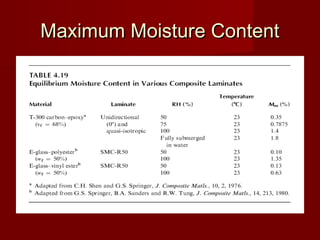
Maximum Moisture ContentMaximum Moisture Content
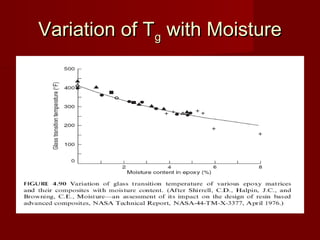
Variation of TVariation of Tgg with Moisturewith Moisture
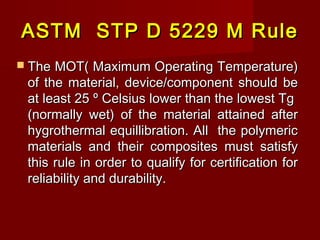
ASTM STP D 5229 M RuleASTM STP D 5229 M Rule
 The MOT( Maximum Operating Temperature)The MOT( Maximum Operating Temperature)
of the material, device/component should beof the material, device/component should be
at least 25at least 25 ºº Celsius lower than the lowest TgCelsius lower than the lowest Tg
(normally wet) of the material attained after(normally wet) of the material attained after
hygrothermal equillibration. All the polymerichygrothermal equillibration. All the polymeric
materials and their composites must satisfymaterials and their composites must satisfy
this rule in order to qualify for certification forthis rule in order to qualify for certification for
reliability and durability.reliability and durability.
Failures and Multiple CausesFailures and Multiple Causes
 In nature, most of the real environment failuresIn nature, most of the real environment failures
are due to multiple causes.are due to multiple causes.
 As enough standard procedures are availableAs enough standard procedures are available
for failures due to a single cause, the obviousfor failures due to a single cause, the obvious
move is to develop the understanding as well asmove is to develop the understanding as well as
standard procedures for failures due to multiplestandard procedures for failures due to multiple
causes.causes.
 An understanding of these failures leads to aAn understanding of these failures leads to a
better fracture control that aids superior designsbetter fracture control that aids superior designs
with advanced composite materialswith advanced composite materials
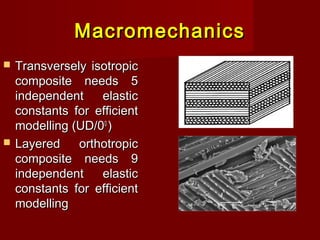
MacromechanicsMacromechanics
 Transversely isotropicTransversely isotropic
composite needs 5composite needs 5
independent elasticindependent elastic
constants for efficientconstants for efficient
modelling (UD/0modelling (UD/000
))
 Layered orthotropicLayered orthotropic
composite needs 9composite needs 9
independent elasticindependent elastic
constants for efficientconstants for efficient
modellingmodelling
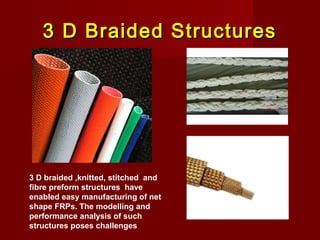
3 D Braided Structures3 D Braided Structures
3 D braided ,knitted, stitched and
fibre preform structures have
enabled easy manufacturing of net
shape FRPs. The modelling and
performance analysis of such
structures poses challenges
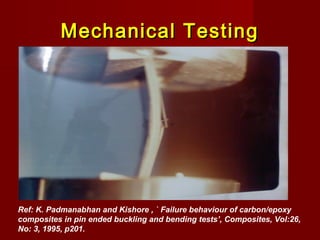
Mechanical TestingMechanical Testing
Ref: K. Padmanabhan and Kishore , ` Failure behaviour of carbon/epoxy
composites in pin ended buckling and bending tests’, Composites, Vol:26,
No: 3, 1995, p201.
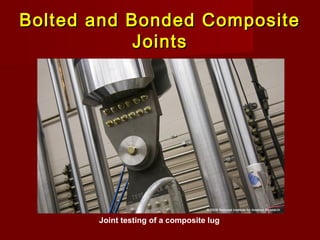
Bolted and Bonded CompositeBolted and Bonded Composite
JointsJoints
Joint testing of a composite lug
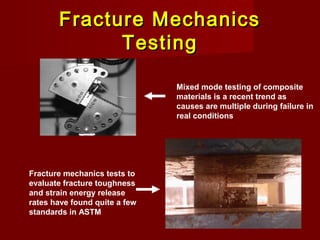
Fracture MechanicsFracture Mechanics
TestingTesting
Mixed mode testing of composite
materials is a recent trend as
causes are multiple during failure in
real conditions
Fracture mechanics tests to
evaluate fracture toughness
and strain energy release
rates have found quite a few
standards in ASTM
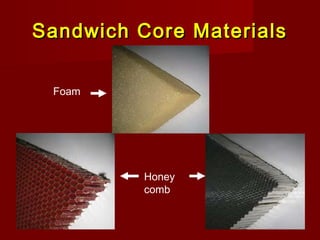
Sandwich Core MaterialsSandwich Core Materials
Foam
Honey
comb
Types of FoamsTypes of Foams
 Thermoset, thermoplastic, elastomeric,Thermoset, thermoplastic, elastomeric,
ceramic, rock wool, metallic….ceramic, rock wool, metallic….
 Rigid, semi rigid, flexible….Rigid, semi rigid, flexible….
 Filled and unfilledFilled and unfilled
 Poisson’s ratio variationsPoisson’s ratio variations
 Auxetic, syntactic …..Auxetic, syntactic …..
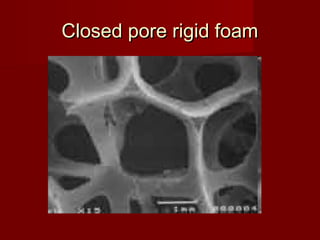
Closed pore rigid foamClosed pore rigid foam
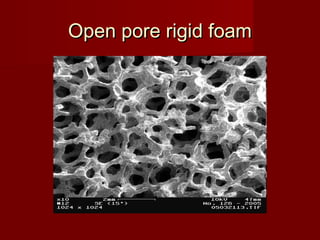
Open pore rigid foamOpen pore rigid foam
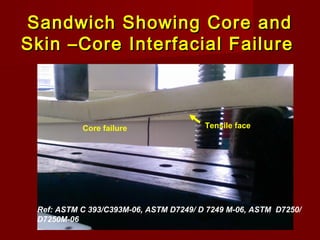
Sandwich Showing Core andSandwich Showing Core and
Skin –Core Interfacial FailureSkin –Core Interfacial Failure
Tensile faceCore failure
Ref: ASTM C 393/C393M-06, ASTM D7249/ D 7249 M-06, ASTM D7250/
D7250M-06
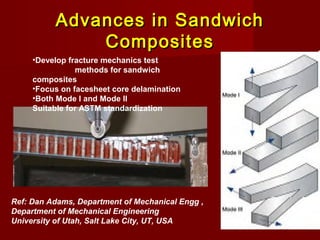
Advances in SandwichAdvances in Sandwich
CompositesComposites
•Develop fracture mechanics test
methods for sandwich
composites
•Focus on facesheet core delamination
•Both Mode I and Mode II
Suitable for ASTM standardization
Ref: Dan Adams, Department of Mechanical Engg ,
Department of Mechanical Engineering
University of Utah, Salt Lake City, UT, USA
Ductile Brittle Transition
And Fatigue
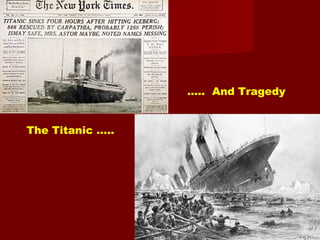
The Titanic …..
….. And Tragedy
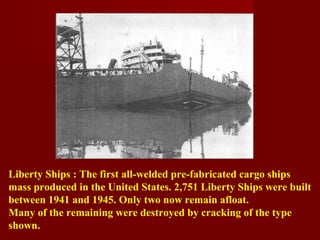
Liberty Ships : The first all-welded pre-fabricated cargo ships
mass produced in the United States. 2,751 Liberty Ships were built
between 1941 and 1945. Only two now remain afloat.
Many of the remaining were destroyed by cracking of the type
shown.
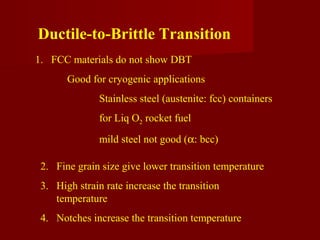
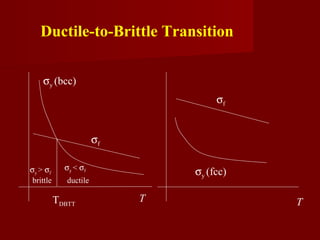
Ductile-to-Brittle Transition
1. FCC materials do not show DBT
Good for cryogenic applications
Stainless steel (austenite: fcc) containers
for Liq O2 rocket fuel
mild steel not good (α: bcc)
2. Fine grain size give lower transition temperature
3. High strain rate increase the transition
temperature
4. Notches increase the transition temperature
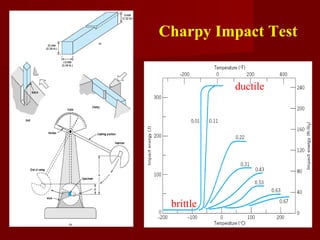
Charpy Impact Test
ductile
brittle
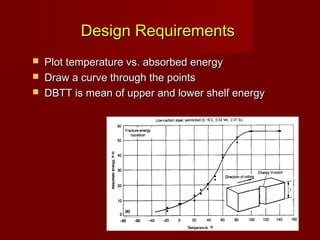
 Plot temperature vs. absorbed energyPlot temperature vs. absorbed energy
 Draw a curve through the pointsDraw a curve through the points
 DBTT is mean of upper and lower shelf energyDBTT is mean of upper and lower shelf energy
Design RequirementsDesign Requirements
Ductile-to-Brittle Transition
σy (bcc)
TTDBTT
σy (fcc)
T
σf
σf
σy < σf
ductilebrittle
σy > σf
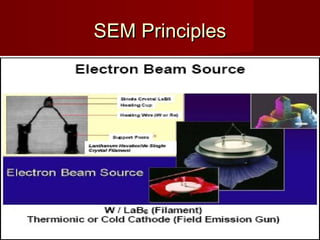
SEM PrinciplesSEM Principles
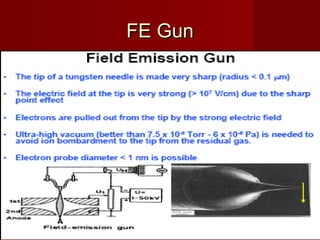
FE GunFE Gun
Electron BeamElectron Beam
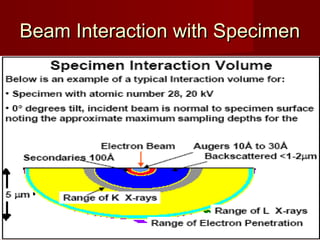
Beam Interaction with SpecimenBeam Interaction with Specimen
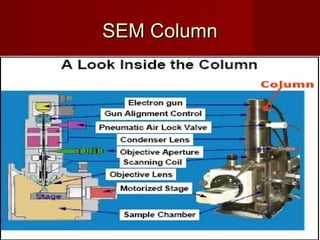
SEM ColumnSEM Column
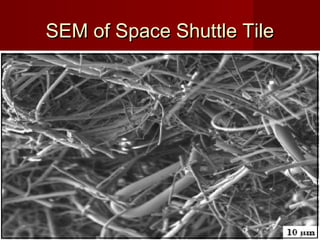
SEM of Space Shuttle TileSEM of Space Shuttle Tile
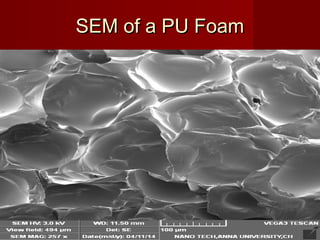
SEM of a PU FoamSEM of a PU Foam
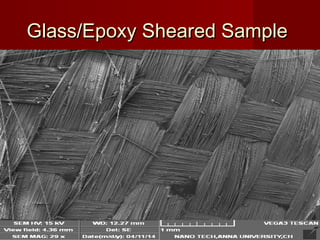
Glass/Epoxy Sheared SampleGlass/Epoxy Sheared Sample
Ultrasonic TechniquesUltrasonic Techniques
Ultrasonic MethodsUltrasonic Methods
 A non destructive techniqueA non destructive technique
 High frequency waves are usedHigh frequency waves are used
 Flaw, blowhole, defect, delaminationFlaw, blowhole, defect, delamination
detectiondetection
 Sound velocity and attenuation areSound velocity and attenuation are
different in different materialsdifferent in different materials
 Reflection at flaw interfacesReflection at flaw interfaces
 Partial reflection at some interfaces likePartial reflection at some interfaces like
inclusions.inclusions.
Ultrasonic inspectionUltrasonic inspection
 Reflection from interfacesReflection from interfaces
 Time of transit of sound waves.Time of transit of sound waves.
 Attenuation of sound waves in a materialAttenuation of sound waves in a material
 Range of 0.1 to 25 MHzRange of 0.1 to 25 MHz
 They are mechanical vibrationsThey are mechanical vibrations
 Also detect bond characteristics, grainAlso detect bond characteristics, grain
size, corrosion, thickness, elasticsize, corrosion, thickness, elastic
constants.constants.
Basic EquipmentBasic Equipment
 An electronic signal generator produces burstsAn electronic signal generator produces bursts
of alternating voltageof alternating voltage
 A transducer that emits ultrasonic waves whenA transducer that emits ultrasonic waves when
bursts of alternating voltages are appliedbursts of alternating voltages are applied
 A couplant to transfer energy to test pieceA couplant to transfer energy to test piece
 A couplant to transfer output of acoustic energyA couplant to transfer output of acoustic energy
from the test piece to the transducerfrom the test piece to the transducer
 The transducers can be separate or oneThe transducers can be separate or one
( Sending and Receiving )( Sending and Receiving )
 Signal amplifierSignal amplifier
 Output recorder like chart, scope, TFT etc..Output recorder like chart, scope, TFT etc..
 Timer for control of various components ofTimer for control of various components of
systemssystems
Wave PropagationWave Propagation
 Longitudinal Waves ( Compression,Longitudinal Waves ( Compression,
Rarefaction)Rarefaction)
 Transverse Waves ( Shear Waves )Transverse Waves ( Shear Waves )
 Surface Waves ( Raleigh Waves )Surface Waves ( Raleigh Waves )
 Plate Waves or Lamb WavesPlate Waves or Lamb Waves
 Two types of Lamb Waves: dilational orTwo types of Lamb Waves: dilational or
symmetric, Asymmetrical or bendingsymmetric, Asymmetrical or bending
Variables in InspectionVariables in Inspection
 The frequency chosen depending on flaw sizesThe frequency chosen depending on flaw sizes
and detection requirementsand detection requirements
 Acoustic Impedance ( % reflected and notAcoustic Impedance ( % reflected and not
transmitted), attenuation.transmitted), attenuation.
 Angle of incidence, critical angle, modeAngle of incidence, critical angle, mode
conversion and Snell’s lawconversion and Snell’s law
 Two critical angles due to mode conversionTwo critical angles due to mode conversion
 Beam intensity , scattering, energy absorptionBeam intensity , scattering, energy absorption
due to heating.due to heating.
 Diffraction of sound waves, beam spreading andDiffraction of sound waves, beam spreading and
beam diameter.beam diameter.
Inspection MethodsInspection Methods
 Pulse- Echo Method, continuous throughPulse- Echo Method, continuous through
transmission scanning.transmission scanning.
 A Scan- display of amplitude vs time,A Scan- display of amplitude vs time,
quantitative display of signal amplitudes andquantitative display of signal amplitudes and
time of flight data.time of flight data.
 B Scan-time of flight again, relative depth ofB Scan-time of flight again, relative depth of
flaws, size, location over line on test pieceflaws, size, location over line on test piece
 C Scan-Signal amplitudes over an area of theC Scan-Signal amplitudes over an area of the
test pieces, quantitative, plan view of the testtest pieces, quantitative, plan view of the test
piece , indication of flaw depth.piece , indication of flaw depth.
FEA as an NDTFEA as an NDT
 Numerical methodNumerical method used for solvingused for solving
problems that cannot be solvedproblems that cannot be solved
analytically (e.g., due to complicatedanalytically (e.g., due to complicated
geometry, different materials)geometry, different materials)
 Well suited to computersWell suited to computers
 Originally applied to problems in solidOriginally applied to problems in solid
mechanicsmechanics
 Other application areas include heatOther application areas include heat
transfer, fluid flow, electromagnetismtransfer, fluid flow, electromagnetism
Finite Element Method PhasesFinite Element Method Phases
 PreprocessingPreprocessing
– GeometryGeometry
– Modelling analysis typeModelling analysis type
– Material propertiesMaterial properties
– MeshMesh
– Boundary conditionsBoundary conditions
 SolutionSolution
– Solve linear or nonlinear algebraic equationsSolve linear or nonlinear algebraic equations
simultaneously to obtain nodal resultssimultaneously to obtain nodal results
(displacements, temperatures etc.)(displacements, temperatures etc.)
 PostprocessingPostprocessing
– Obtain other results (stresses, heat fluxes)Obtain other results (stresses, heat fluxes)
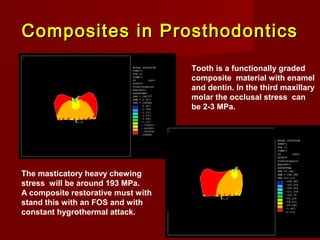
Composites in ProsthodonticsComposites in Prosthodontics
Tooth is a functionally graded
composite material with enamel
and dentin. In the third maxillary
molar the occlusal stress can
be 2-3 MPa.
The masticatory heavy chewing
stress will be around 193 MPa.
A composite restorative must with
stand this with an FOS and with
constant hygrothermal attack.
Multi Scale Composites forMulti Scale Composites for
DentistryDentistry
 Bis GMA, UDMA, Methacrylic Esters containBis GMA, UDMA, Methacrylic Esters contain
glassy particles that are mostly less than 1glassy particles that are mostly less than 1
micron in sizemicron in size
 Esters and acrylates/ceramic filler (bariumEsters and acrylates/ceramic filler (barium
alumina silica glass, glassy microfillers, 0.1 toalumina silica glass, glassy microfillers, 0.1 to
10 microns size) restorative composites.10 microns size) restorative composites.
 Multi scale composites are also useful asMulti scale composites are also useful as
luting cements, crown and bridge materialsluting cements, crown and bridge materials
and cements and veneer materialsand cements and veneer materials..
Wear Data for RestorativesWear Data for Restoratives
 Aesthetics, Shade, ReliabilityAesthetics, Shade, Reliability
 Most of the composites show a logarithmic wearMost of the composites show a logarithmic wear
rate, linear wear rate is unwelcome !rate, linear wear rate is unwelcome !
 Wear of less than 200 microns in 10 years isWear of less than 200 microns in 10 years is
acceptable.acceptable.
 Wear volume will be 0.5 to 0.8 cu. mm perWear volume will be 0.5 to 0.8 cu. mm per
annum, enamelannum, enamel vsvs restoratives.restoratives.
 Coeff of Friction is ~ 0.1 to 0.35.Coeff of Friction is ~ 0.1 to 0.35.
Case Study : Vibration of CompositeCase Study : Vibration of Composite
PlatesPlates
 Vibration studies in composites areVibration studies in composites are
important as the composites areimportant as the composites are
increasingly being used in automotive,increasingly being used in automotive,
aerospace and wind energy applications.aerospace and wind energy applications.
 The combined effect of vibrations andThe combined effect of vibrations and
fatigue can degrade a composite furtherfatigue can degrade a composite further
that is already hygrothermal in affinity.that is already hygrothermal in affinity.
 The different modes of vibrations areThe different modes of vibrations are
discussed here.discussed here.
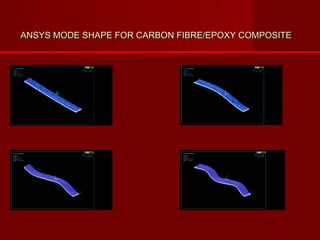
ANSYS MODE SHAPE FOR CARBON FIBRE/EPOXY COMPOSITEANSYS MODE SHAPE FOR CARBON FIBRE/EPOXY COMPOSITE
(a) First mode shape (b) second mode shape
(c) Third mode shape (d) Fourth mode shape
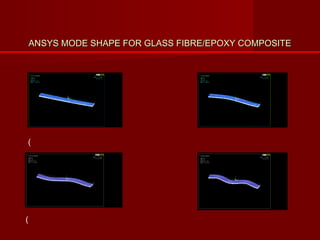
ANSYS MODE SHAPE FOR GLASS FIBRE/EPOXY COMPOSITEANSYS MODE SHAPE FOR GLASS FIBRE/EPOXY COMPOSITE
(a) First mode shape (b) second mode shape
(c) Third mode shape (d) Fourth mode shape
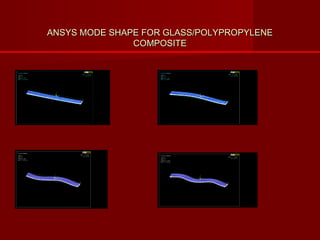
ANSYS MODE SHAPE FOR GLASS/POLYPROPYLENEANSYS MODE SHAPE FOR GLASS/POLYPROPYLENE
COMPOSITECOMPOSITE
(a) First mode shape (b) second mode shape
(c) Third mode shape (d) Fourth mode shape
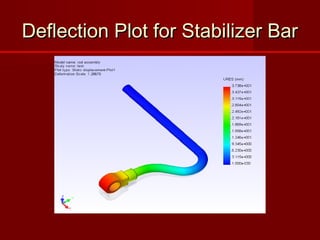
Case Study : Stabilizer Bars forCase Study : Stabilizer Bars for
Four WheelersFour Wheelers
Anti-roll stabilizer bars for four wheelers. Fatigue life
of the stabilizer bars was estimated for qualification.
Deflection Plot for Stabilizer BarDeflection Plot for Stabilizer Bar
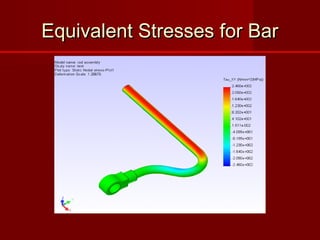
Equivalent Stresses for BarEquivalent Stresses for Bar
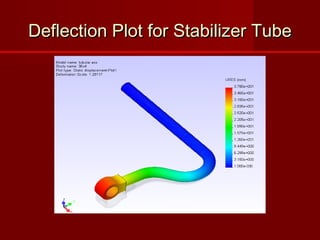
Deflection Plot for Stabilizer TubeDeflection Plot for Stabilizer Tube
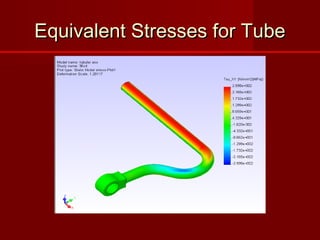
Equivalent Stresses for TubeEquivalent Stresses for Tube
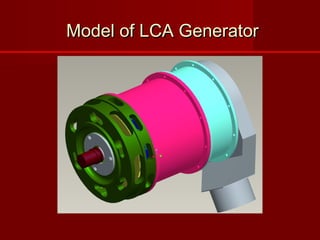
Case Study : LCA GeneratorCase Study : LCA Generator
 The study deals with modeling, analysis and performanceThe study deals with modeling, analysis and performance
evaluation of 5kW DC generator assembly. The complete solidevaluation of 5kW DC generator assembly. The complete solid
model of the generator with its accessories was modelled usingmodel of the generator with its accessories was modelled using
Pro-Engineer. This paper deals with the structural analysis ofPro-Engineer. This paper deals with the structural analysis of
the DC generator casing to find stress and deflection in thethe DC generator casing to find stress and deflection in the
generator casing due to load factor of 9g to which it isgenerator casing due to load factor of 9g to which it is
designed. The effect of vibration of generator casing anddesigned. The effect of vibration of generator casing and
hollow shaft with mounting are investigated through detailedhollow shaft with mounting are investigated through detailed
finite element analysis. The bending and torsional naturalfinite element analysis. The bending and torsional natural
frequencies of the hollow shaft are estimated to find thefrequencies of the hollow shaft are estimated to find the
critical speeds. Torsional frequency of the hollow shaft iscritical speeds. Torsional frequency of the hollow shaft is
estimated by considering the mass moment of inertias of theestimated by considering the mass moment of inertias of the
rotating masses. For critical speed analysis of the hollow shaft,rotating masses. For critical speed analysis of the hollow shaft,
it is considered as simply supported beam with the requiredit is considered as simply supported beam with the required
masses and inertias. Then the influence of the critical speedsmasses and inertias. Then the influence of the critical speeds
due to the casing stiffness is found out analyzing the casingdue to the casing stiffness is found out analyzing the casing
with the shaft together.with the shaft together.
Model of LCA GeneratorModel of LCA Generator
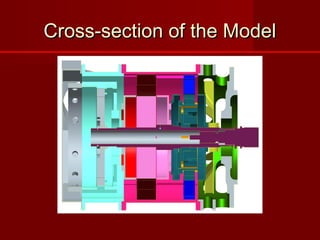
Cross-section of the ModelCross-section of the Model
Total Deflection at 9gTotal Deflection at 9g
Maximum deflection of the generator will be 4.761 microns, with-in limits !
Von Mises Stresses at 9gVon Mises Stresses at 9g
A stress of about 6.756 MPa is much lesser than the Yield Stress of the material
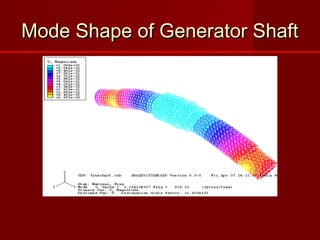
Mode Shape of Generator ShaftMode Shape of Generator Shaft
Mode shape corresponding to the flexural critical speed (54,972 rpm)
(using solid element TET10 approximation)
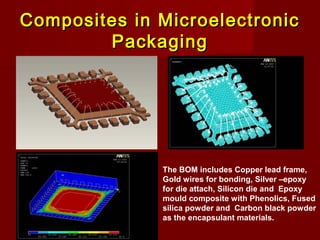
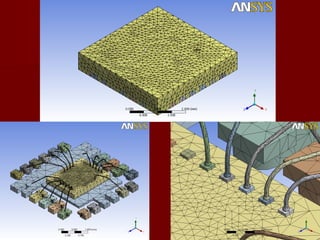
Composites in MicroelectronicComposites in Microelectronic
PackagingPackaging
The BOM includes Copper lead frame,
Gold wires for bonding, Silver –epoxy
for die attach, Silicon die and Epoxy
mould composite with Phenolics, Fused
silica powder and Carbon black powder
as the encapsulant materials.
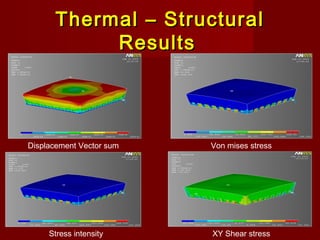
Thermal – StructuralThermal – Structural
ResultsResults
Displacement Vector sum Von mises stress
Stress intensity XY Shear stress
Thermal Shock Test (JESD22 –Thermal Shock Test (JESD22 –
A106B)A106B)
 Purpose of this test is tPurpose of this test is to determine the resistance of the part too determine the resistance of the part to
sudden exposures of extreme changes in temperature and alternatesudden exposures of extreme changes in temperature and alternate
exposures to these extremes as well as its ability to withstand cyclicalexposures to these extremes as well as its ability to withstand cyclical
stressesstresses
 Here the IC packages are baked in an oven for 125Here the IC packages are baked in an oven for 125ºC/24 Hrs and theºC/24 Hrs and the
temperature is spiked to 260ºC for lead free product and 240ºC fortemperature is spiked to 260ºC for lead free product and 240ºC for
leaded product for 5 to 10 minutes.leaded product for 5 to 10 minutes.
 If the baking temperature is higher than the glass transitionIf the baking temperature is higher than the glass transition
temperature at this extreme heat the package tends to delaminate ortemperature at this extreme heat the package tends to delaminate or
fail. This failure or delamination can be viewed using SAM (Scanningfail. This failure or delamination can be viewed using SAM (Scanning
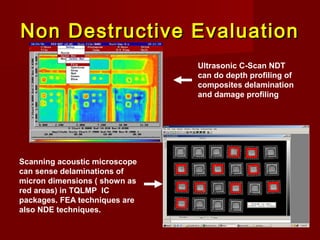
Non Destructive EvaluationNon Destructive Evaluation
Ultrasonic C-Scan NDT
can do depth profiling of
composites delamination
and damage profiling
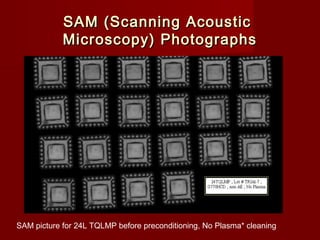
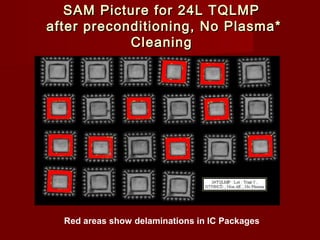
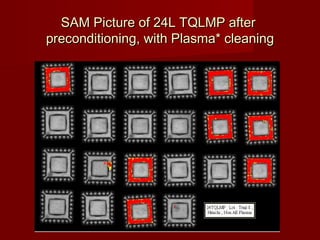
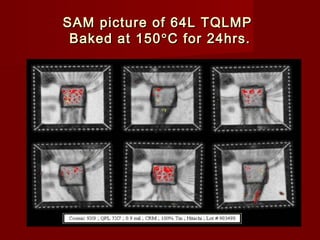
Scanning acoustic microscope
can sense delaminations of
micron dimensions ( shown as
red areas) in TQLMP IC
packages. FEA techniques are
also NDE techniques.
SAM (Scanning AcousticSAM (Scanning Acoustic
Microscopy) PhotographsMicroscopy) Photographs
SAM picture for 24L TQLMP before preconditioning, No Plasma* cleaning
SAM Picture for 24L TQLMPSAM Picture for 24L TQLMP
after preconditioning, No Plasma*after preconditioning, No Plasma*
CleaningCleaning
Red areas show delaminations in IC Packages
SAM Picture of 24L TQLMP afterSAM Picture of 24L TQLMP after
preconditioning, with Plasma* cleaningpreconditioning, with Plasma* cleaning
SAM picture of 64L TQLMPSAM picture of 64L TQLMP
Baked at 150Baked at 150°°C for 24hrs.C for 24hrs.
Design For AssemblyDesign For Assembly
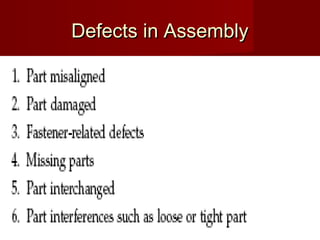
Defects in AssemblyDefects in Assembly
Human ErrorsHuman Errors
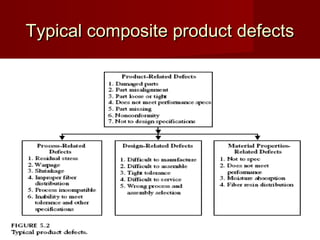
Typical composite product defectsTypical composite product defects
Minimizing DefectsMinimizing Defects
A Bamboo BicycleA Bamboo Bicycle
Composites in WindComposites in Wind
EnergyEnergy
www.suzlon.com , www.ge.com
Vestas RRB
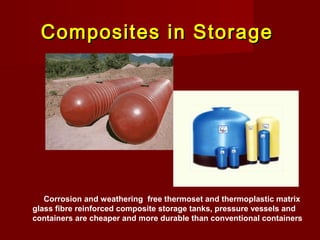
Composites in StorageComposites in Storage
Corrosion and weathering free thermoset and thermoplastic matrix
glass fibre reinforced composite storage tanks, pressure vessels and
containers are cheaper and more durable than conventional containers
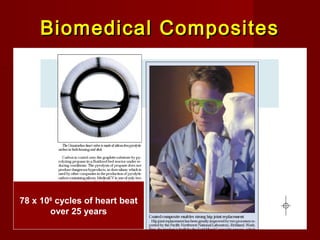
Biomedical CompositesBiomedical Composites
s
75X106
cyles of heart beat78 x 106
cycles of heart beat
over 25 years
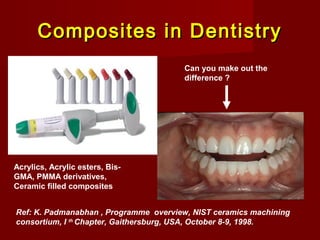
Composites in DentistryComposites in Dentistry
Acrylics, Acrylic esters, Bis-
GMA, PMMA derivatives,
Ceramic filled composites
Can you make out the
difference ?
Ref: K. Padmanabhan , Programme overview, NIST ceramics machining
consortium, I th
Chapter, Gaithersburg, USA, October 8-9, 1998.
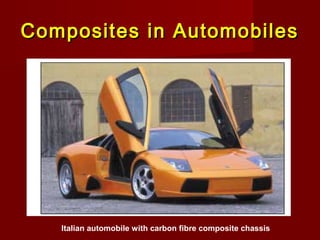
Composites in AutomobilesComposites in Automobiles
Italian automobile with carbon fibre composite chassis
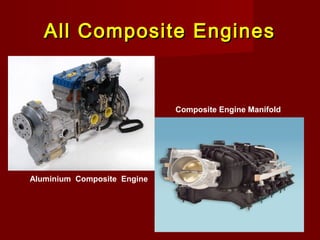
All Composite EnginesAll Composite Engines
Aluminium Composite Engine
Composite Engine Manifold
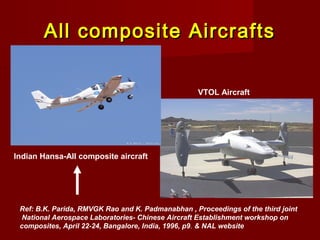
All composite AircraftsAll composite Aircrafts
Indian Hansa-All composite aircraft
VTOL Aircraft
Ref: B.K. Parida, RMVGK Rao and K. Padmanabhan , Proceedings of the third joint
National Aerospace Laboratories- Chinese Aircraft Establishment workshop on
composites, April 22-24, Bangalore, India, 1996, p9. & NAL website
Composites - Sports & LeisureComposites - Sports & Leisure
Carbon fibre-nylon matrix – rigid foam
tennis racquet
Composite Yatch
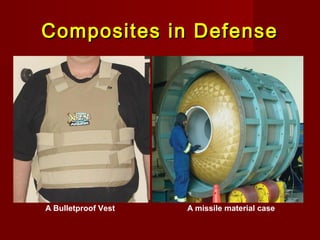
Composites in DefenseComposites in Defense
A Bulletproof Vest A missile material case
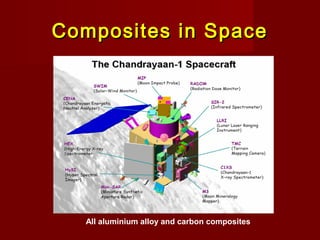
Composites in SpaceComposites in Space
All aluminium alloy and carbon composites
Science is TrueScience is True
Don’t be mislead by facts !Don’t be mislead by facts !
-Murphy’s Law-Murphy’s Law
BibliographyBibliography
 P,K. Mallick, Fibre reinforced composites, Marcel andP,K. Mallick, Fibre reinforced composites, Marcel and
Dekker Inc., New York .Dekker Inc., New York .
 Derek Hull and T.W. Clyne, ` An Introduction toDerek Hull and T.W. Clyne, ` An Introduction to
composite materials’, Cambridge solid state sciencecomposite materials’, Cambridge solid state science
series, 1996.series, 1996.
 E.J. Barbero, `Introduction to composite materialsE.J. Barbero, `Introduction to composite materials
design’, Taylor and Francis ,MI.design’, Taylor and Francis ,MI.
 J.K. Kim and Y.W. Mai, `Engineered interfaces in fibreJ.K. Kim and Y.W. Mai, `Engineered interfaces in fibre
reinforced composites ‘, Elsevier, 1998.reinforced composites ‘, Elsevier, 1998.
 www.wikipedia.orgwww.wikipedia.org
 Rao Tummala, Microsystems Packaging,McgrawHill.Rao Tummala, Microsystems Packaging,McgrawHill.
BibliographyBibliography
 Sanjay K Mazumdar, Composites Manufacturing, CRCSanjay K Mazumdar, Composites Manufacturing, CRC
Press, 2002.Press, 2002.
 Geoffrey Pritchard, Reinforced Plastics Durability,Geoffrey Pritchard, Reinforced Plastics Durability,
Woodhead publishing,Cambridge, England, 1999.Woodhead publishing,Cambridge, England, 1999.
 Skinner’s Science of Dental Materials , R.W. Phillips, ASkinner’s Science of Dental Materials , R.W. Phillips, A
Prism India ed, 1994.Prism India ed, 1994.
 ASTM Standards Handbooks Vols: 08.01,08.02 andASTM Standards Handbooks Vols: 08.01,08.02 and
08.03, PA, USA.08.03, PA, USA.
 www.astm.orgwww.astm.org
 ANSYS v.14 Analysis Manuals, 2014.ANSYS v.14 Analysis Manuals, 2014.
 Rayner M Mayer, Design with Reinforced Plastics,Rayner M Mayer, Design with Reinforced Plastics,
Design Council, London.Design Council, London.
BibliographyBibliography
 K. Padmanabhan, S.Subeesh, K. Balaguru and T.K. Padmanabhan, S.Subeesh, K. Balaguru and T.
Karthik , ` 3D Modelling and Failure Analyses of ICKarthik , ` 3D Modelling and Failure Analyses of IC
packages’, in ANSYS Users’ Conference CD, 6 & 7packages’, in ANSYS Users’ Conference CD, 6 & 7
November 2008, Bangalore.November 2008, Bangalore.
 K. Padmanabhan, S.Subeesh, K. Balaguru and T.K. Padmanabhan, S.Subeesh, K. Balaguru and T.
Karthik , ` An Analyses of Reliability andKarthik , ` An Analyses of Reliability and
Hygrothermal Effects in IC packages’, in ANSYSHygrothermal Effects in IC packages’, in ANSYS
Users’ Conference CD, 6 & 7 November 2008,Users’ Conference CD, 6 & 7 November 2008,
Bangalore.Bangalore. BEST PAPER AWARDBEST PAPER AWARD
 K. Padmanabhan, D. Sanjay and S Subeesh,` DesignK. Padmanabhan, D. Sanjay and S Subeesh,` Design
and electro-hygrothermo-mechanical reliabilityand electro-hygrothermo-mechanical reliability
analyses of a leadless quad IC package’, in theanalyses of a leadless quad IC package’, in the
BibliographyBibliography
 ASTM D3039, Standard test method for tensileASTM D3039, Standard test method for tensile
properties of polymer matrix compositeproperties of polymer matrix composite
materials,materials, Annual book of ASTM standards,Annual book of ASTM standards,
Philadelphia.Philadelphia.
 ASTM D790-03, Standard test method forASTM D790-03, Standard test method for
flexural properties of unreinforced andflexural properties of unreinforced and
electrical Insulating Materials, Annual book ofelectrical Insulating Materials, Annual book of
ASTM standards. Philadelphia.ASTM standards. Philadelphia.
 ASTM D256, Standard test methods forASTM D256, Standard test methods for
determining the Izod pendulum impactdetermining the Izod pendulum impact
resistance of plastics, Annual book of ASTMresistance of plastics, Annual book of ASTM
standards, Philadelphia.standards, Philadelphia.
எப்பொபொருள் எத்தன்மைமைத் தொயினுமை் அப்பொபொருள்எப்பொபொருள் எத்தன்மைமைத் தொயினுமை் அப்பொபொருள்
ொமைய்ப்பொபொருள் கொண்பது அறிவொமைய்ப்பொபொருள் கொண்பது அறிவ..
ThirukkuralThirukkural
Athikaaram 36Athikaaram 36
Mei Unarthal -355Mei Unarthal -355

Measurement techniques in advanced materials systems

  • 1.
    Measurement TechniquesMeasurement Techniques inAdvanced Materialsin Advanced Materials SystemsSystems Prof. K. PadmanabhanProf. K. Padmanabhan SMBSSMBS VIT-VelloreVIT-Vellore Email: padmanabhan.k@vit.ac.inEmail: padmanabhan.k@vit.ac.in
  • 2.
    Bottom up andBottomup and Top down Philosophy
  • 3.
    ContentsContents  Advanced MaterialsSystemsAdvanced Materials Systems  Design ConsiderationsDesign Considerations  Advanced Materials Testing (AMT)- The differenceAdvanced Materials Testing (AMT)- The difference  Fracture, Failure and Fractography of AMFracture, Failure and Fractography of AM  NDT , FEA and MeasurementsNDT , FEA and Measurements  Improvement from feedbackImprovement from feedback  Innovations in AMT, Product testing and DFAInnovations in AMT, Product testing and DFA  Case Studies and ConclusionsCase Studies and Conclusions
  • 4.
    Advanced Materials SystemsAdvancedMaterials Systems  Al-Mg and Mg Alloys and CompositesAl-Mg and Mg Alloys and Composites  Carbon, Glass, Kevlar, Zylon fibre reinforcedCarbon, Glass, Kevlar, Zylon fibre reinforced compositescomposites  Metal –Plastic Composite SystemsMetal –Plastic Composite Systems  Cermets and their CompositesCermets and their Composites  Ceramic-Polymer CompositesCeramic-Polymer Composites  Self Reinforced Composites ( Carbon/Carbon)Self Reinforced Composites ( Carbon/Carbon)  Super Alloys and Composites.Super Alloys and Composites.  Hybrids, Super hybrids and SandwichesHybrids, Super hybrids and Sandwiches
  • 5.
    DefinitionDefinition  A compositematerial is a multi-A composite material is a multi- component system with at least a matrixcomponent system with at least a matrix and a reinforcement.and a reinforcement.  The desired properties must be better thanThe desired properties must be better than at least one of the constituents.at least one of the constituents.  The constituents are normally physicallyThe constituents are normally physically separable , with a line of heterogeneityseparable , with a line of heterogeneity between them, called the interface.between them, called the interface.
  • 6.
    Ford Soybean FRPCar of 1940sFord Soybean FRP Car of 1940s Picture shows Henry Ford I trying to break The Soybean with a sledgehammer, rather unsuccessfully. Soybean was made of steel tubular frame and 14 panels containing phenolic resin and natural fibres. It was world’s first car with an FRP body – courtesy Ford Motors
  • 7.
    General Design RequirementsGeneralDesign Requirements  Tensile, Compressive, Shear , Flexure and CreepTensile, Compressive, Shear , Flexure and Creep  Load Control, Position Control and Strain Control.Load Control, Position Control and Strain Control.  Ductility and Plastic StrainDuctility and Plastic Strain  Buckling, Collapsibility and CrushingBuckling, Collapsibility and Crushing  Modularity and FlexibilityModularity and Flexibility  Crumple Zones and CrashworthinessCrumple Zones and Crashworthiness  Static and Dynamic Fracture EnergyStatic and Dynamic Fracture Energy  Impact Strength and ToughnessImpact Strength and Toughness  Noise Vibrations and HarshnessNoise Vibrations and Harshness  Fatigue , Hot Wet Fatigue, Acoustic Fatigue, FatigueFatigue , Hot Wet Fatigue, Acoustic Fatigue, Fatigue after DBTafter DBT  Statics and Dynamics of Structures and AssembliesStatics and Dynamics of Structures and Assemblies  Failure Mode Interactions, Multiple Causes of FailureFailure Mode Interactions, Multiple Causes of Failure  Multi FunctionalityMulti Functionality
  • 8.
    Design RequirementsDesign Requirements -Materials-Materials Material IndexMaterial Index  Merit IndexMerit Index  Structural IndexStructural Index  Shape FactorsShape Factors  Mechanically Efficient ShapesMechanically Efficient Shapes  Specific PropertiesSpecific Properties
  • 9.
    Material Property Charts:Modulus - DensityMaterial Property Charts: Modulus - Density 0.1 10 1 100 Metals Polymers Elastomers Ceramics Woods Composites Foams 0.01 1000 1000.1 1 10 Density (Megagrams/m3 ) Young’smodulusE,(GPa)
  • 10.
  • 11.
    Design RequirementsDesign Requirements -FRP Composites- FRP Composites  Specific PropertiesSpecific Properties  Fracture ToughnessFracture Toughness  Dynamic Fracture ToughnessDynamic Fracture Toughness  Damage ToleranceDamage Tolerance  Hygrothermal DurabilityHygrothermal Durability  Overall Reliability ( Hot Wet Fatigue)Overall Reliability ( Hot Wet Fatigue)  DFM, DFA and DFMAE.DFM, DFA and DFMAE.  Disposability and SafetyDisposability and Safety  Recycleability, Recoverability and ReuseRecycleability, Recoverability and Reuse  Plastics Waste to Fuel ConversionPlastics Waste to Fuel Conversion
  • 12.
    Micromechanics is whereMicromechanicsis where design begins !design begins ! Design is defined as the complete information required to produce a product or render service - Anonymous
  • 13.
    The Fibre-Resin MicroTheFibre-Resin Micro bondbond A drop of the cured resin on the fibre surface showing adhesion Fibre pullout test through a micro vise design fixture
  • 14.
    Micro bond BundlePull-outMicro bond Bundle Pull-out TestTest Ref: K. Padmanabhan , Final project report to the Singapore –MIT Alliance , Singapore, November 2002
  • 15.
    Interface TestsInterface Tests Single fibre pullout testSingle fibre pullout test  Single fibre push out test, brittle materialsSingle fibre push out test, brittle materials  Micro bond single fibre pullout testMicro bond single fibre pullout test  Multiple fibre pullout test and Micro bondMultiple fibre pullout test and Micro bond multiple fibre pullout test, Statisticallymultiple fibre pullout test, Statistically averaged results, More precise, Lessaveraged results, More precise, Less difficult, Mesomechanical in nature.difficult, Mesomechanical in nature.  Interlaminar shear strength test, ILSS.Interlaminar shear strength test, ILSS.
  • 16.
    Multiple Fibre PulloutMultipleFibre Pullout Ref: K. Padmanabhan , Toyobo Confidentiality Report, 2002. Ref: C. Y. Yue and K. Padmanabhan , Composites B, 30(1999) p205. Micro bond Matrix slab
  • 17.
    Modelling and AnalysisModellingand Analysis  Carbon Fibre and ZylonCarbon Fibre and Zylon™™ Fibre /epoxyFibre /epoxy Matrix Embedded Composite SystemsMatrix Embedded Composite Systems Cylindrical Assemblage Model Matrix Pull Out Through a Micro vise • Micromechanics le
  • 18.
    Interfacial ParametersInterfacial Parameters Interfacial shear strength,Interfacial shear strength,ττ  Interfacial frictional stress, τInterfacial frictional stress, τff  Fibre/matrix coefficient of friction, µFibre/matrix coefficient of friction, µ  Matrix shrinkage pressure, PMatrix shrinkage pressure, Poo  Pressure due to Poisson expansion, pPressure due to Poisson expansion, paa  Contact pressureContact pressure  Interfacial wearInterfacial wear
  • 19.
    Non-linear QuasistaticNon-linear Quasistatic AnalysisAnalysis Surface to surfaceSurface to surface contactcontact  CAM is anisotropicCAM is anisotropic and matrix is isotropicand matrix is isotropic  Only failure and postOnly failure and post failure conditions werefailure conditions were considered due toconsidered due to relevance and precisionrelevance and precision  Model has dihedralModel has dihedral symmetrysymmetry Solid 8 noded brick 185 element Hex swept volumes
  • 20.
    Results of ANSYSResultsof ANSYS AnalysisAnalysis 37 MPa Zylon/epoxy shear stress at CAM interface
  • 21.
    FEM Analysis ResultsFEMAnalysis Results Carbon/epoxy shear stress at CAM interface
  • 22.
    Nano Structuring ofKevlarNano Structuring of Kevlar
  • 23.
    Kevlar Fibre NanoStructuringKevlar Fibre Nano Structuring
  • 24.
    Kevlar Fibre NanoStructuringKevlar Fibre Nano Structuring 10 Min Methanol And water Washing
  • 25.
    XPS of TreatedKevlarXPS of Treated Kevlar SurfacesSurfaces
  • 26.
    SEM of TreatedKevlar SurfacesSEM of Treated Kevlar Surfaces
  • 27.
    Kevlar Fibre/ EpoxyCompositesKevlar Fibre/ Epoxy Composites - Interfacial Results- Interfacial Results
  • 28.
    Static mechanical propertiesStaticmechanical properties  Tensile propertiesTensile properties  In accordance with ASTM D3039 standardIn accordance with ASTM D3039 standard  Specimen preparation, adhesive bonding at theSpecimen preparation, adhesive bonding at the end gripsend grips  Recommended cross head speed of 0.02Recommended cross head speed of 0.02 cm/mincm/min  Strain gaging, rosette strain gaging.Strain gaging, rosette strain gaging.  0 and 900 and 90° (fibre direction) tests for E° (fibre direction) tests for E1111and Eand E22..22.. Similarly for major and minor poisson’s ratios .Similarly for major and minor poisson’s ratios .
  • 29.
  • 30.
    Tensile propertiesTensile properties Off axis tensile tests for extensional stressOff axis tensile tests for extensional stress and in plane shear stress evaluation.and in plane shear stress evaluation.  Statistical conceptsStatistical concepts  Normal and weibull distribution, locationNormal and weibull distribution, location parameter and weibull shape parameter.parameter and weibull shape parameter.  Probability of failure and probability ofProbability of failure and probability of survival.survival.  Longitudinal splitting, transverse cracking,Longitudinal splitting, transverse cracking, angled cracking….angled cracking….
  • 31.
    Off axis TensileTestOff axis Tensile Test
  • 32.
  • 33.
  • 34.
    Tensile stressTensile stressvsvs strain curvesstrain curves
  • 35.
  • 36.
    Tensile PropertiesTensile Properties Uni directional, cross plyUni directional, cross ply  Modulus and strength in angle plyModulus and strength in angle ply composites vs angle of fibre or fibrecomposites vs angle of fibre or fibre orientation.orientation.  Multi directional laminates and tensileMulti directional laminates and tensile failure, symmetric , asymmetric etc.failure, symmetric , asymmetric etc.  The concept of first ply failure (FPF)The concept of first ply failure (FPF)  Transverse cracking in multi directionalTransverse cracking in multi directional laminates, damage development.laminates, damage development.
  • 37.
    TensionTension vsvs FibreorientationFibre orientation
  • 38.
    Tensile properties ofCross plyTensile properties of Cross ply
  • 39.
  • 40.
  • 41.
  • 42.
    Tensile PropertiesTensile Properties Tensile properties of woven fabricTensile properties of woven fabric composites.composites.  Transverse microcracking in woven fabricTransverse microcracking in woven fabric compositescomposites  Laminates with holes, effect of stackingLaminates with holes, effect of stacking sequencesequence  Sheet moulding ( Crazing, transverseSheet moulding ( Crazing, transverse cracking, fibre matrix shear failure ) andcracking, fibre matrix shear failure ) and interply hybrid composites.interply hybrid composites.
  • 43.
    Laminates with aholeLaminates with a hole
  • 44.
  • 45.
    Compressive propertiesCompressive properties Celanese test rigCelanese test rig  IITRI test rigIITRI test rig  Sandwich edge wise compression testSandwich edge wise compression test  ComparisonsComparisons  Buckling and microbuckling of compositesBuckling and microbuckling of composites and fibres.and fibres.  Types of failuresTypes of failures
  • 46.
  • 47.
  • 48.
  • 49.
    Micro buckling andDesignMicro buckling and Design  Micro buckling can beMicro buckling can be prevented by choosingprevented by choosing higher fibre diameter,higher fibre diameter, higher fibre elastichigher fibre elastic modulus and highmodulus and high interfacial bond strengthinterfacial bond strength between fibre and matrixbetween fibre and matrix  Boron fibres are the bestBoron fibres are the best for design against microfor design against micro bucklingbuckling
  • 50.
    CompressibilityCompressibility  The compressivestrength of single fibers is very difficult toThe compressive strength of single fibers is very difficult to measure and is usually inferred from the behavior of compositesmeasure and is usually inferred from the behavior of composites including the fibers.including the fibers.  Euler buckling is one possible mode of compressive failure: itEuler buckling is one possible mode of compressive failure: it occurs when a fiber under compression becomes unstable againstoccurs when a fiber under compression becomes unstable against lateral movement of its central region.lateral movement of its central region.
  • 52.
  • 53.
  • 54.
  • 55.
  • 56.
  • 57.
  • 58.
  • 59.
  • 60.
  • 61.
  • 62.
  • 63.
  • 64.
  • 65.
  • 66.
  • 67.
    ILSS of Kevlar/EpoxyCompositesILSS of Kevlar/Epoxy Composites
  • 68.
  • 69.
  • 70.
  • 71.
  • 72.
  • 73.
  • 74.
  • 75.
  • 76.
  • 77.
  • 78.
  • 79.
  • 80.
  • 81.
  • 82.
  • 83.
  • 84.
  • 85.
  • 86.
  • 87.
  • 88.
    Strain Controlled FatigueTestStrain Controlled Fatigue Test
  • 89.
  • 90.
  • 91.
  • 92.
    Drop Weight ImpactPropertiesDrop Weight Impact Properties
  • 93.
  • 94.
    Impact Energy inIzodImpact Energy in Izod
  • 95.
    Drop Weight ImpactEnergyDrop Weight Impact Energy
  • 96.
  • 97.
    ImpactImpact vs.vs. FibreContentFibre Content
  • 98.
    Residual Strength AfterImpactResidual Strength After Impact
  • 99.
  • 100.
  • 101.
    Pin Bearing StrengthPinBearing Strength
  • 102.
  • 103.
  • 104.
  • 105.
    Standard lap shearspecimensStandard lap shear specimens
  • 106.
  • 107.
    Hygrothermal BehaviourHygrothermal Behaviour Fibre reinforced plastics are known forFibre reinforced plastics are known for environmental attacks that reduce their function.environmental attacks that reduce their function.  Mechanical properties degrade over time !Mechanical properties degrade over time !  Moisture plays havoc at elevated temperatures,Moisture plays havoc at elevated temperatures, in the presence of voids, defects and in low Tin the presence of voids, defects and in low Tgg plastics .plastics .  Diffusion and osmotic pressure are the drivingDiffusion and osmotic pressure are the driving mechanisms for hygrothermal attackmechanisms for hygrothermal attack  Evaluation methods and surface preservationEvaluation methods and surface preservation  Important in marine, biomedical, aeronautical,Important in marine, biomedical, aeronautical, electronic and automobile applicationselectronic and automobile applications
  • 108.
  • 109.
  • 110.
    Variation of TVariationof Tgg with Moisturewith Moisture
  • 111.
    ASTM STP D5229 M RuleASTM STP D 5229 M Rule  The MOT( Maximum Operating Temperature)The MOT( Maximum Operating Temperature) of the material, device/component should beof the material, device/component should be at least 25at least 25 ºº Celsius lower than the lowest TgCelsius lower than the lowest Tg (normally wet) of the material attained after(normally wet) of the material attained after hygrothermal equillibration. All the polymerichygrothermal equillibration. All the polymeric materials and their composites must satisfymaterials and their composites must satisfy this rule in order to qualify for certification forthis rule in order to qualify for certification for reliability and durability.reliability and durability.
  • 112.
    Failures and MultipleCausesFailures and Multiple Causes  In nature, most of the real environment failuresIn nature, most of the real environment failures are due to multiple causes.are due to multiple causes.  As enough standard procedures are availableAs enough standard procedures are available for failures due to a single cause, the obviousfor failures due to a single cause, the obvious move is to develop the understanding as well asmove is to develop the understanding as well as standard procedures for failures due to multiplestandard procedures for failures due to multiple causes.causes.  An understanding of these failures leads to aAn understanding of these failures leads to a better fracture control that aids superior designsbetter fracture control that aids superior designs with advanced composite materialswith advanced composite materials
  • 113.
    MacromechanicsMacromechanics  Transversely isotropicTransverselyisotropic composite needs 5composite needs 5 independent elasticindependent elastic constants for efficientconstants for efficient modelling (UD/0modelling (UD/000 ))  Layered orthotropicLayered orthotropic composite needs 9composite needs 9 independent elasticindependent elastic constants for efficientconstants for efficient modellingmodelling
  • 114.
    3 D BraidedStructures3 D Braided Structures 3 D braided ,knitted, stitched and fibre preform structures have enabled easy manufacturing of net shape FRPs. The modelling and performance analysis of such structures poses challenges
  • 115.
    Mechanical TestingMechanical Testing Ref:K. Padmanabhan and Kishore , ` Failure behaviour of carbon/epoxy composites in pin ended buckling and bending tests’, Composites, Vol:26, No: 3, 1995, p201.
  • 116.
    Bolted and BondedCompositeBolted and Bonded Composite JointsJoints Joint testing of a composite lug
  • 117.
    Fracture MechanicsFracture Mechanics TestingTesting Mixedmode testing of composite materials is a recent trend as causes are multiple during failure in real conditions Fracture mechanics tests to evaluate fracture toughness and strain energy release rates have found quite a few standards in ASTM
  • 118.
    Sandwich Core MaterialsSandwichCore Materials Foam Honey comb
  • 119.
    Types of FoamsTypesof Foams  Thermoset, thermoplastic, elastomeric,Thermoset, thermoplastic, elastomeric, ceramic, rock wool, metallic….ceramic, rock wool, metallic….  Rigid, semi rigid, flexible….Rigid, semi rigid, flexible….  Filled and unfilledFilled and unfilled  Poisson’s ratio variationsPoisson’s ratio variations  Auxetic, syntactic …..Auxetic, syntactic …..
  • 120.
    Closed pore rigidfoamClosed pore rigid foam
  • 121.
    Open pore rigidfoamOpen pore rigid foam
  • 122.
    Sandwich Showing CoreandSandwich Showing Core and Skin –Core Interfacial FailureSkin –Core Interfacial Failure Tensile faceCore failure Ref: ASTM C 393/C393M-06, ASTM D7249/ D 7249 M-06, ASTM D7250/ D7250M-06
  • 123.
    Advances in SandwichAdvancesin Sandwich CompositesComposites •Develop fracture mechanics test methods for sandwich composites •Focus on facesheet core delamination •Both Mode I and Mode II Suitable for ASTM standardization Ref: Dan Adams, Department of Mechanical Engg , Department of Mechanical Engineering University of Utah, Salt Lake City, UT, USA
  • 124.
  • 125.
  • 126.
    Liberty Ships :The first all-welded pre-fabricated cargo ships mass produced in the United States. 2,751 Liberty Ships were built between 1941 and 1945. Only two now remain afloat. Many of the remaining were destroyed by cracking of the type shown.
  • 127.
    Ductile-to-Brittle Transition 1. FCCmaterials do not show DBT Good for cryogenic applications Stainless steel (austenite: fcc) containers for Liq O2 rocket fuel mild steel not good (α: bcc) 2. Fine grain size give lower transition temperature 3. High strain rate increase the transition temperature 4. Notches increase the transition temperature
  • 128.
  • 129.
     Plot temperaturevs. absorbed energyPlot temperature vs. absorbed energy  Draw a curve through the pointsDraw a curve through the points  DBTT is mean of upper and lower shelf energyDBTT is mean of upper and lower shelf energy Design RequirementsDesign Requirements
  • 130.
    Ductile-to-Brittle Transition σy (bcc) TTDBTT σy(fcc) T σf σf σy < σf ductilebrittle σy > σf
  • 131.
  • 132.
  • 133.
  • 134.
    Beam Interaction withSpecimenBeam Interaction with Specimen
  • 135.
  • 136.
    SEM of SpaceShuttle TileSEM of Space Shuttle Tile
  • 137.
    SEM of aPU FoamSEM of a PU Foam
  • 138.
  • 139.
  • 140.
    Ultrasonic MethodsUltrasonic Methods A non destructive techniqueA non destructive technique  High frequency waves are usedHigh frequency waves are used  Flaw, blowhole, defect, delaminationFlaw, blowhole, defect, delamination detectiondetection  Sound velocity and attenuation areSound velocity and attenuation are different in different materialsdifferent in different materials  Reflection at flaw interfacesReflection at flaw interfaces  Partial reflection at some interfaces likePartial reflection at some interfaces like inclusions.inclusions.
  • 141.
    Ultrasonic inspectionUltrasonic inspection Reflection from interfacesReflection from interfaces  Time of transit of sound waves.Time of transit of sound waves.  Attenuation of sound waves in a materialAttenuation of sound waves in a material  Range of 0.1 to 25 MHzRange of 0.1 to 25 MHz  They are mechanical vibrationsThey are mechanical vibrations  Also detect bond characteristics, grainAlso detect bond characteristics, grain size, corrosion, thickness, elasticsize, corrosion, thickness, elastic constants.constants.
  • 142.
    Basic EquipmentBasic Equipment An electronic signal generator produces burstsAn electronic signal generator produces bursts of alternating voltageof alternating voltage  A transducer that emits ultrasonic waves whenA transducer that emits ultrasonic waves when bursts of alternating voltages are appliedbursts of alternating voltages are applied  A couplant to transfer energy to test pieceA couplant to transfer energy to test piece  A couplant to transfer output of acoustic energyA couplant to transfer output of acoustic energy from the test piece to the transducerfrom the test piece to the transducer  The transducers can be separate or oneThe transducers can be separate or one ( Sending and Receiving )( Sending and Receiving )  Signal amplifierSignal amplifier  Output recorder like chart, scope, TFT etc..Output recorder like chart, scope, TFT etc..  Timer for control of various components ofTimer for control of various components of systemssystems
  • 143.
    Wave PropagationWave Propagation Longitudinal Waves ( Compression,Longitudinal Waves ( Compression, Rarefaction)Rarefaction)  Transverse Waves ( Shear Waves )Transverse Waves ( Shear Waves )  Surface Waves ( Raleigh Waves )Surface Waves ( Raleigh Waves )  Plate Waves or Lamb WavesPlate Waves or Lamb Waves  Two types of Lamb Waves: dilational orTwo types of Lamb Waves: dilational or symmetric, Asymmetrical or bendingsymmetric, Asymmetrical or bending
  • 144.
    Variables in InspectionVariablesin Inspection  The frequency chosen depending on flaw sizesThe frequency chosen depending on flaw sizes and detection requirementsand detection requirements  Acoustic Impedance ( % reflected and notAcoustic Impedance ( % reflected and not transmitted), attenuation.transmitted), attenuation.  Angle of incidence, critical angle, modeAngle of incidence, critical angle, mode conversion and Snell’s lawconversion and Snell’s law  Two critical angles due to mode conversionTwo critical angles due to mode conversion  Beam intensity , scattering, energy absorptionBeam intensity , scattering, energy absorption due to heating.due to heating.  Diffraction of sound waves, beam spreading andDiffraction of sound waves, beam spreading and beam diameter.beam diameter.
  • 145.
    Inspection MethodsInspection Methods Pulse- Echo Method, continuous throughPulse- Echo Method, continuous through transmission scanning.transmission scanning.  A Scan- display of amplitude vs time,A Scan- display of amplitude vs time, quantitative display of signal amplitudes andquantitative display of signal amplitudes and time of flight data.time of flight data.  B Scan-time of flight again, relative depth ofB Scan-time of flight again, relative depth of flaws, size, location over line on test pieceflaws, size, location over line on test piece  C Scan-Signal amplitudes over an area of theC Scan-Signal amplitudes over an area of the test pieces, quantitative, plan view of the testtest pieces, quantitative, plan view of the test piece , indication of flaw depth.piece , indication of flaw depth.
  • 146.
    FEA as anNDTFEA as an NDT  Numerical methodNumerical method used for solvingused for solving problems that cannot be solvedproblems that cannot be solved analytically (e.g., due to complicatedanalytically (e.g., due to complicated geometry, different materials)geometry, different materials)  Well suited to computersWell suited to computers  Originally applied to problems in solidOriginally applied to problems in solid mechanicsmechanics  Other application areas include heatOther application areas include heat transfer, fluid flow, electromagnetismtransfer, fluid flow, electromagnetism
  • 147.
    Finite Element MethodPhasesFinite Element Method Phases  PreprocessingPreprocessing – GeometryGeometry – Modelling analysis typeModelling analysis type – Material propertiesMaterial properties – MeshMesh – Boundary conditionsBoundary conditions  SolutionSolution – Solve linear or nonlinear algebraic equationsSolve linear or nonlinear algebraic equations simultaneously to obtain nodal resultssimultaneously to obtain nodal results (displacements, temperatures etc.)(displacements, temperatures etc.)  PostprocessingPostprocessing – Obtain other results (stresses, heat fluxes)Obtain other results (stresses, heat fluxes)
  • 148.
    Composites in ProsthodonticsCompositesin Prosthodontics Tooth is a functionally graded composite material with enamel and dentin. In the third maxillary molar the occlusal stress can be 2-3 MPa. The masticatory heavy chewing stress will be around 193 MPa. A composite restorative must with stand this with an FOS and with constant hygrothermal attack.
  • 149.
    Multi Scale CompositesforMulti Scale Composites for DentistryDentistry  Bis GMA, UDMA, Methacrylic Esters containBis GMA, UDMA, Methacrylic Esters contain glassy particles that are mostly less than 1glassy particles that are mostly less than 1 micron in sizemicron in size  Esters and acrylates/ceramic filler (bariumEsters and acrylates/ceramic filler (barium alumina silica glass, glassy microfillers, 0.1 toalumina silica glass, glassy microfillers, 0.1 to 10 microns size) restorative composites.10 microns size) restorative composites.  Multi scale composites are also useful asMulti scale composites are also useful as luting cements, crown and bridge materialsluting cements, crown and bridge materials and cements and veneer materialsand cements and veneer materials..
  • 150.
    Wear Data forRestorativesWear Data for Restoratives  Aesthetics, Shade, ReliabilityAesthetics, Shade, Reliability  Most of the composites show a logarithmic wearMost of the composites show a logarithmic wear rate, linear wear rate is unwelcome !rate, linear wear rate is unwelcome !  Wear of less than 200 microns in 10 years isWear of less than 200 microns in 10 years is acceptable.acceptable.  Wear volume will be 0.5 to 0.8 cu. mm perWear volume will be 0.5 to 0.8 cu. mm per annum, enamelannum, enamel vsvs restoratives.restoratives.  Coeff of Friction is ~ 0.1 to 0.35.Coeff of Friction is ~ 0.1 to 0.35.
  • 151.
    Case Study :Vibration of CompositeCase Study : Vibration of Composite PlatesPlates  Vibration studies in composites areVibration studies in composites are important as the composites areimportant as the composites are increasingly being used in automotive,increasingly being used in automotive, aerospace and wind energy applications.aerospace and wind energy applications.  The combined effect of vibrations andThe combined effect of vibrations and fatigue can degrade a composite furtherfatigue can degrade a composite further that is already hygrothermal in affinity.that is already hygrothermal in affinity.  The different modes of vibrations areThe different modes of vibrations are discussed here.discussed here.
  • 152.
    ANSYS MODE SHAPEFOR CARBON FIBRE/EPOXY COMPOSITEANSYS MODE SHAPE FOR CARBON FIBRE/EPOXY COMPOSITE (a) First mode shape (b) second mode shape (c) Third mode shape (d) Fourth mode shape
  • 153.
    ANSYS MODE SHAPEFOR GLASS FIBRE/EPOXY COMPOSITEANSYS MODE SHAPE FOR GLASS FIBRE/EPOXY COMPOSITE (a) First mode shape (b) second mode shape (c) Third mode shape (d) Fourth mode shape
  • 154.
    ANSYS MODE SHAPEFOR GLASS/POLYPROPYLENEANSYS MODE SHAPE FOR GLASS/POLYPROPYLENE COMPOSITECOMPOSITE (a) First mode shape (b) second mode shape (c) Third mode shape (d) Fourth mode shape
  • 155.
    Case Study :Stabilizer Bars forCase Study : Stabilizer Bars for Four WheelersFour Wheelers Anti-roll stabilizer bars for four wheelers. Fatigue life of the stabilizer bars was estimated for qualification.
  • 156.
    Deflection Plot forStabilizer BarDeflection Plot for Stabilizer Bar
  • 157.
    Equivalent Stresses forBarEquivalent Stresses for Bar
  • 158.
    Deflection Plot forStabilizer TubeDeflection Plot for Stabilizer Tube
  • 159.
    Equivalent Stresses forTubeEquivalent Stresses for Tube
  • 160.
    Case Study :LCA GeneratorCase Study : LCA Generator  The study deals with modeling, analysis and performanceThe study deals with modeling, analysis and performance evaluation of 5kW DC generator assembly. The complete solidevaluation of 5kW DC generator assembly. The complete solid model of the generator with its accessories was modelled usingmodel of the generator with its accessories was modelled using Pro-Engineer. This paper deals with the structural analysis ofPro-Engineer. This paper deals with the structural analysis of the DC generator casing to find stress and deflection in thethe DC generator casing to find stress and deflection in the generator casing due to load factor of 9g to which it isgenerator casing due to load factor of 9g to which it is designed. The effect of vibration of generator casing anddesigned. The effect of vibration of generator casing and hollow shaft with mounting are investigated through detailedhollow shaft with mounting are investigated through detailed finite element analysis. The bending and torsional naturalfinite element analysis. The bending and torsional natural frequencies of the hollow shaft are estimated to find thefrequencies of the hollow shaft are estimated to find the critical speeds. Torsional frequency of the hollow shaft iscritical speeds. Torsional frequency of the hollow shaft is estimated by considering the mass moment of inertias of theestimated by considering the mass moment of inertias of the rotating masses. For critical speed analysis of the hollow shaft,rotating masses. For critical speed analysis of the hollow shaft, it is considered as simply supported beam with the requiredit is considered as simply supported beam with the required masses and inertias. Then the influence of the critical speedsmasses and inertias. Then the influence of the critical speeds due to the casing stiffness is found out analyzing the casingdue to the casing stiffness is found out analyzing the casing with the shaft together.with the shaft together.
  • 161.
    Model of LCAGeneratorModel of LCA Generator
  • 162.
    Cross-section of theModelCross-section of the Model
  • 163.
    Total Deflection at9gTotal Deflection at 9g Maximum deflection of the generator will be 4.761 microns, with-in limits !
  • 164.
    Von Mises Stressesat 9gVon Mises Stresses at 9g A stress of about 6.756 MPa is much lesser than the Yield Stress of the material
  • 165.
    Mode Shape ofGenerator ShaftMode Shape of Generator Shaft Mode shape corresponding to the flexural critical speed (54,972 rpm) (using solid element TET10 approximation)
  • 166.
    Composites in MicroelectronicCompositesin Microelectronic PackagingPackaging The BOM includes Copper lead frame, Gold wires for bonding, Silver –epoxy for die attach, Silicon die and Epoxy mould composite with Phenolics, Fused silica powder and Carbon black powder as the encapsulant materials.
  • 168.
    Thermal – StructuralThermal– Structural ResultsResults Displacement Vector sum Von mises stress Stress intensity XY Shear stress
  • 169.
    Thermal Shock Test(JESD22 –Thermal Shock Test (JESD22 – A106B)A106B)  Purpose of this test is tPurpose of this test is to determine the resistance of the part too determine the resistance of the part to sudden exposures of extreme changes in temperature and alternatesudden exposures of extreme changes in temperature and alternate exposures to these extremes as well as its ability to withstand cyclicalexposures to these extremes as well as its ability to withstand cyclical stressesstresses  Here the IC packages are baked in an oven for 125Here the IC packages are baked in an oven for 125ºC/24 Hrs and theºC/24 Hrs and the temperature is spiked to 260ºC for lead free product and 240ºC fortemperature is spiked to 260ºC for lead free product and 240ºC for leaded product for 5 to 10 minutes.leaded product for 5 to 10 minutes.  If the baking temperature is higher than the glass transitionIf the baking temperature is higher than the glass transition temperature at this extreme heat the package tends to delaminate ortemperature at this extreme heat the package tends to delaminate or fail. This failure or delamination can be viewed using SAM (Scanningfail. This failure or delamination can be viewed using SAM (Scanning
  • 170.
    Non Destructive EvaluationNonDestructive Evaluation Ultrasonic C-Scan NDT can do depth profiling of composites delamination and damage profiling Scanning acoustic microscope can sense delaminations of micron dimensions ( shown as red areas) in TQLMP IC packages. FEA techniques are also NDE techniques.
  • 171.
    SAM (Scanning AcousticSAM(Scanning Acoustic Microscopy) PhotographsMicroscopy) Photographs SAM picture for 24L TQLMP before preconditioning, No Plasma* cleaning
  • 172.
    SAM Picture for24L TQLMPSAM Picture for 24L TQLMP after preconditioning, No Plasma*after preconditioning, No Plasma* CleaningCleaning Red areas show delaminations in IC Packages
  • 173.
    SAM Picture of24L TQLMP afterSAM Picture of 24L TQLMP after preconditioning, with Plasma* cleaningpreconditioning, with Plasma* cleaning
  • 174.
    SAM picture of64L TQLMPSAM picture of 64L TQLMP Baked at 150Baked at 150°°C for 24hrs.C for 24hrs.
  • 175.
  • 176.
  • 177.
  • 178.
    Typical composite productdefectsTypical composite product defects
  • 179.
  • 180.
    A Bamboo BicycleABamboo Bicycle
  • 181.
    Composites in WindCompositesin Wind EnergyEnergy www.suzlon.com , www.ge.com Vestas RRB
  • 182.
    Composites in StorageCompositesin Storage Corrosion and weathering free thermoset and thermoplastic matrix glass fibre reinforced composite storage tanks, pressure vessels and containers are cheaper and more durable than conventional containers
  • 183.
    Biomedical CompositesBiomedical Composites s 75X106 cylesof heart beat78 x 106 cycles of heart beat over 25 years
  • 184.
    Composites in DentistryCompositesin Dentistry Acrylics, Acrylic esters, Bis- GMA, PMMA derivatives, Ceramic filled composites Can you make out the difference ? Ref: K. Padmanabhan , Programme overview, NIST ceramics machining consortium, I th Chapter, Gaithersburg, USA, October 8-9, 1998.
  • 185.
    Composites in AutomobilesCompositesin Automobiles Italian automobile with carbon fibre composite chassis
  • 186.
    All Composite EnginesAllComposite Engines Aluminium Composite Engine Composite Engine Manifold
  • 187.
    All composite AircraftsAllcomposite Aircrafts Indian Hansa-All composite aircraft VTOL Aircraft Ref: B.K. Parida, RMVGK Rao and K. Padmanabhan , Proceedings of the third joint National Aerospace Laboratories- Chinese Aircraft Establishment workshop on composites, April 22-24, Bangalore, India, 1996, p9. & NAL website
  • 188.
    Composites - Sports& LeisureComposites - Sports & Leisure Carbon fibre-nylon matrix – rigid foam tennis racquet Composite Yatch
  • 189.
    Composites in DefenseCompositesin Defense A Bulletproof Vest A missile material case
  • 190.
    Composites in SpaceCompositesin Space All aluminium alloy and carbon composites
  • 191.
    Science is TrueScienceis True Don’t be mislead by facts !Don’t be mislead by facts ! -Murphy’s Law-Murphy’s Law
  • 192.
    BibliographyBibliography  P,K. Mallick,Fibre reinforced composites, Marcel andP,K. Mallick, Fibre reinforced composites, Marcel and Dekker Inc., New York .Dekker Inc., New York .  Derek Hull and T.W. Clyne, ` An Introduction toDerek Hull and T.W. Clyne, ` An Introduction to composite materials’, Cambridge solid state sciencecomposite materials’, Cambridge solid state science series, 1996.series, 1996.  E.J. Barbero, `Introduction to composite materialsE.J. Barbero, `Introduction to composite materials design’, Taylor and Francis ,MI.design’, Taylor and Francis ,MI.  J.K. Kim and Y.W. Mai, `Engineered interfaces in fibreJ.K. Kim and Y.W. Mai, `Engineered interfaces in fibre reinforced composites ‘, Elsevier, 1998.reinforced composites ‘, Elsevier, 1998.  www.wikipedia.orgwww.wikipedia.org  Rao Tummala, Microsystems Packaging,McgrawHill.Rao Tummala, Microsystems Packaging,McgrawHill.
  • 193.
    BibliographyBibliography  Sanjay KMazumdar, Composites Manufacturing, CRCSanjay K Mazumdar, Composites Manufacturing, CRC Press, 2002.Press, 2002.  Geoffrey Pritchard, Reinforced Plastics Durability,Geoffrey Pritchard, Reinforced Plastics Durability, Woodhead publishing,Cambridge, England, 1999.Woodhead publishing,Cambridge, England, 1999.  Skinner’s Science of Dental Materials , R.W. Phillips, ASkinner’s Science of Dental Materials , R.W. Phillips, A Prism India ed, 1994.Prism India ed, 1994.  ASTM Standards Handbooks Vols: 08.01,08.02 andASTM Standards Handbooks Vols: 08.01,08.02 and 08.03, PA, USA.08.03, PA, USA.  www.astm.orgwww.astm.org  ANSYS v.14 Analysis Manuals, 2014.ANSYS v.14 Analysis Manuals, 2014.  Rayner M Mayer, Design with Reinforced Plastics,Rayner M Mayer, Design with Reinforced Plastics, Design Council, London.Design Council, London.
  • 194.
    BibliographyBibliography  K. Padmanabhan,S.Subeesh, K. Balaguru and T.K. Padmanabhan, S.Subeesh, K. Balaguru and T. Karthik , ` 3D Modelling and Failure Analyses of ICKarthik , ` 3D Modelling and Failure Analyses of IC packages’, in ANSYS Users’ Conference CD, 6 & 7packages’, in ANSYS Users’ Conference CD, 6 & 7 November 2008, Bangalore.November 2008, Bangalore.  K. Padmanabhan, S.Subeesh, K. Balaguru and T.K. Padmanabhan, S.Subeesh, K. Balaguru and T. Karthik , ` An Analyses of Reliability andKarthik , ` An Analyses of Reliability and Hygrothermal Effects in IC packages’, in ANSYSHygrothermal Effects in IC packages’, in ANSYS Users’ Conference CD, 6 & 7 November 2008,Users’ Conference CD, 6 & 7 November 2008, Bangalore.Bangalore. BEST PAPER AWARDBEST PAPER AWARD  K. Padmanabhan, D. Sanjay and S Subeesh,` DesignK. Padmanabhan, D. Sanjay and S Subeesh,` Design and electro-hygrothermo-mechanical reliabilityand electro-hygrothermo-mechanical reliability analyses of a leadless quad IC package’, in theanalyses of a leadless quad IC package’, in the
  • 195.
    BibliographyBibliography  ASTM D3039,Standard test method for tensileASTM D3039, Standard test method for tensile properties of polymer matrix compositeproperties of polymer matrix composite materials,materials, Annual book of ASTM standards,Annual book of ASTM standards, Philadelphia.Philadelphia.  ASTM D790-03, Standard test method forASTM D790-03, Standard test method for flexural properties of unreinforced andflexural properties of unreinforced and electrical Insulating Materials, Annual book ofelectrical Insulating Materials, Annual book of ASTM standards. Philadelphia.ASTM standards. Philadelphia.  ASTM D256, Standard test methods forASTM D256, Standard test methods for determining the Izod pendulum impactdetermining the Izod pendulum impact resistance of plastics, Annual book of ASTMresistance of plastics, Annual book of ASTM standards, Philadelphia.standards, Philadelphia.
  • 196.
    எப்பொபொருள் எத்தன்மைமைத் தொயினுமை்அப்பொபொருள்எப்பொபொருள் எத்தன்மைமைத் தொயினுமை் அப்பொபொருள் ொமைய்ப்பொபொருள் கொண்பது அறிவொமைய்ப்பொபொருள் கொண்பது அறிவ.. ThirukkuralThirukkural Athikaaram 36Athikaaram 36 Mei Unarthal -355Mei Unarthal -355

Editor's Notes

  • #10 There is another, better, way to display relationships; the bubble-chart or material property chart. It is central to the optimal selection of materials, as will appear in Unit 2. It is shown in this schematic. Here two properties are plotted: Young’s modulus and density. When this is done it is found that each family of materials occupies a particular area of the plot – metals near the upper right, foams at the lower left, polymers low central, and so on.
  • #147 Analytical -&amp;gt; exact solution Numerical -&amp;gt; approximate solution