Grade 9 MathsFractions Review
The next topic in our Number Unit is fractions.  So I can make sure no-one is left behind, let’s start with some basics (quickly), before we move on to our Grade 9 work.Let’s Review
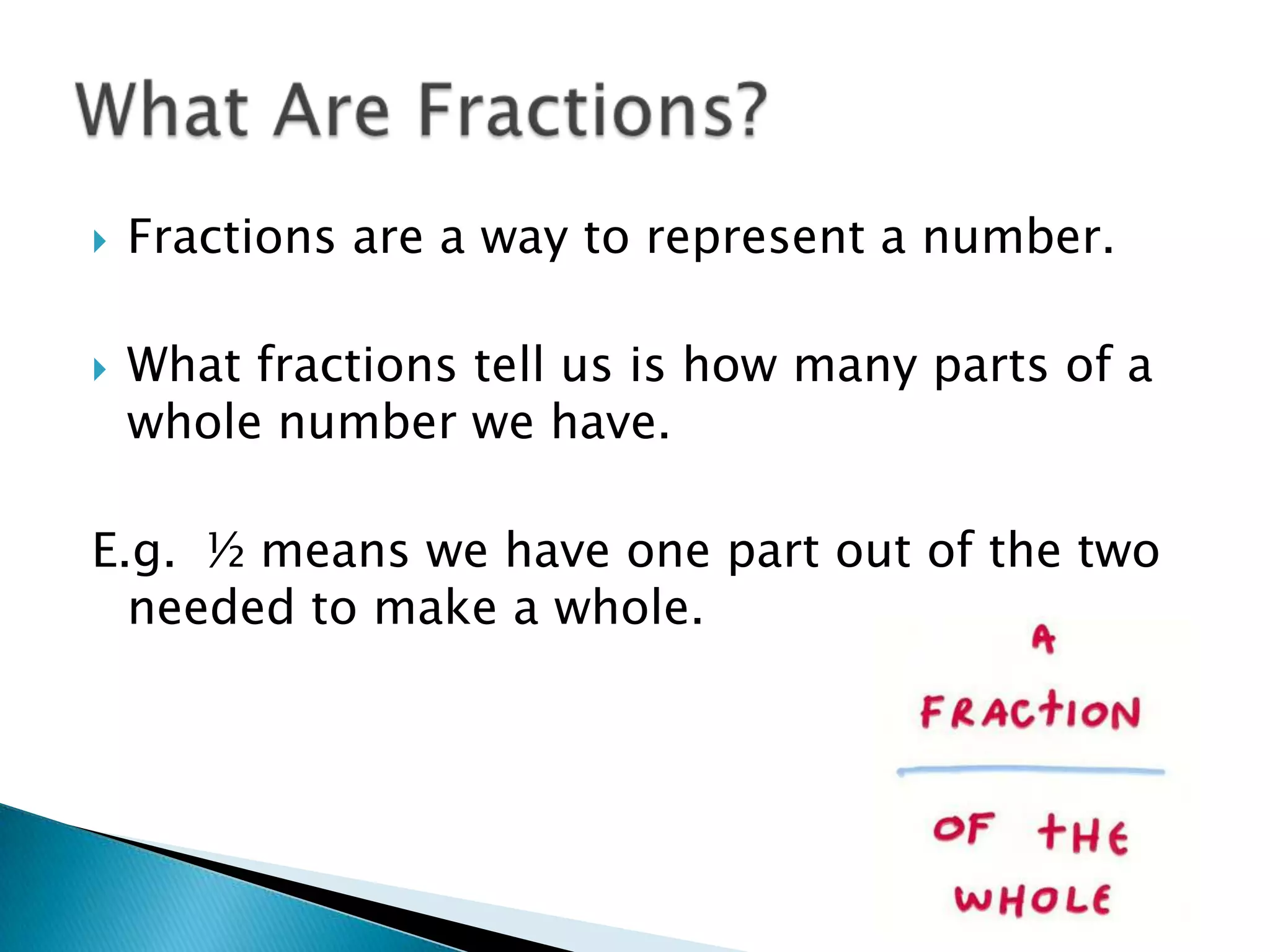
Fractions are a way to represent a number.What fractions tell us is how many parts of a whole number we have.E.g.  ½ means we have one part out of the two needed to make a whole. What Are Fractions?
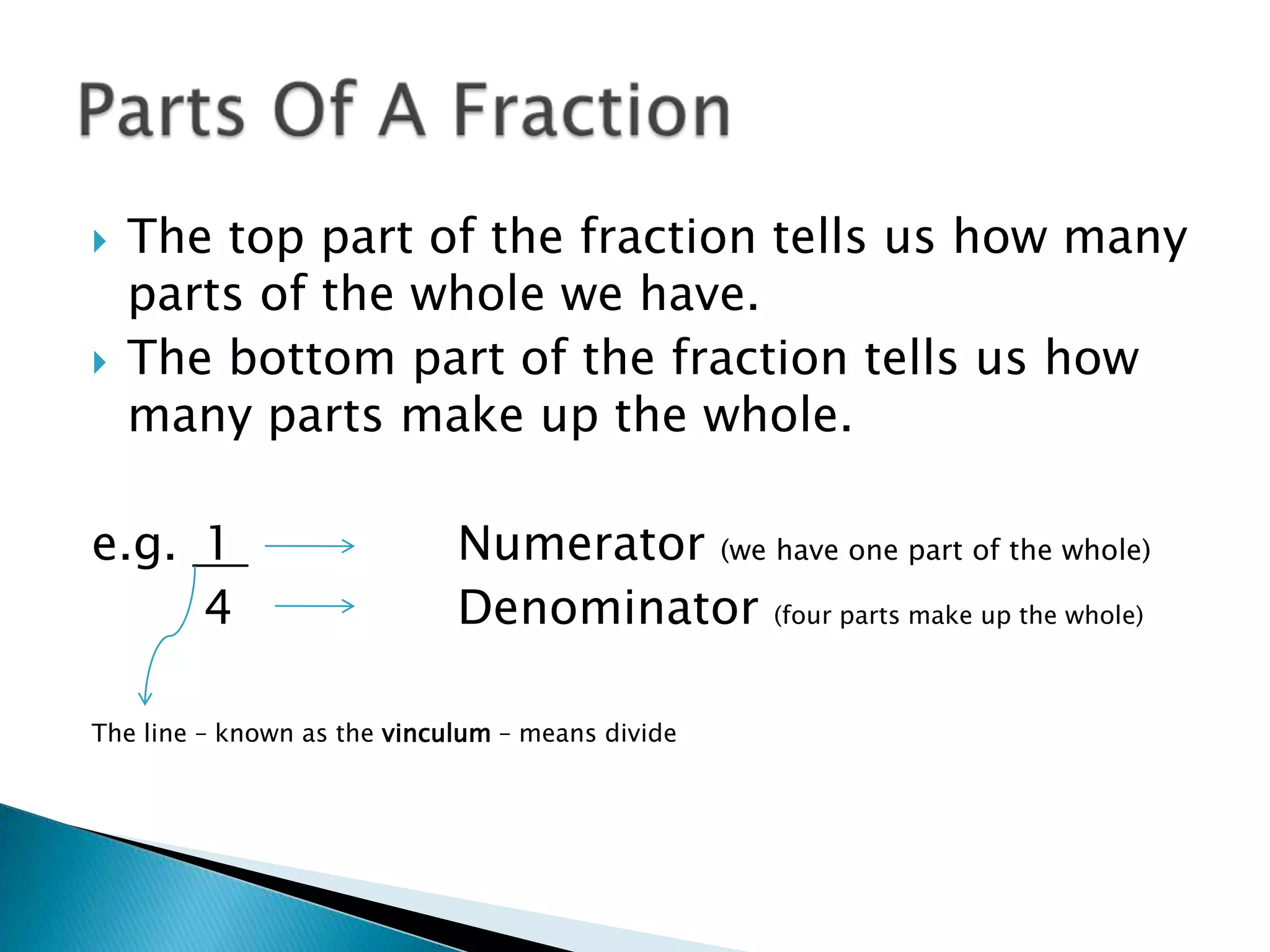
The top part of the fraction tells us how many parts of the whole we have.The bottom part of the fraction tells us how many parts make up the whole.e.g. 	1 		Numerator (we have one part of the whole)		4		Denominator (four parts make up the whole) The line – known as the vinculum – means divideParts Of A Fraction
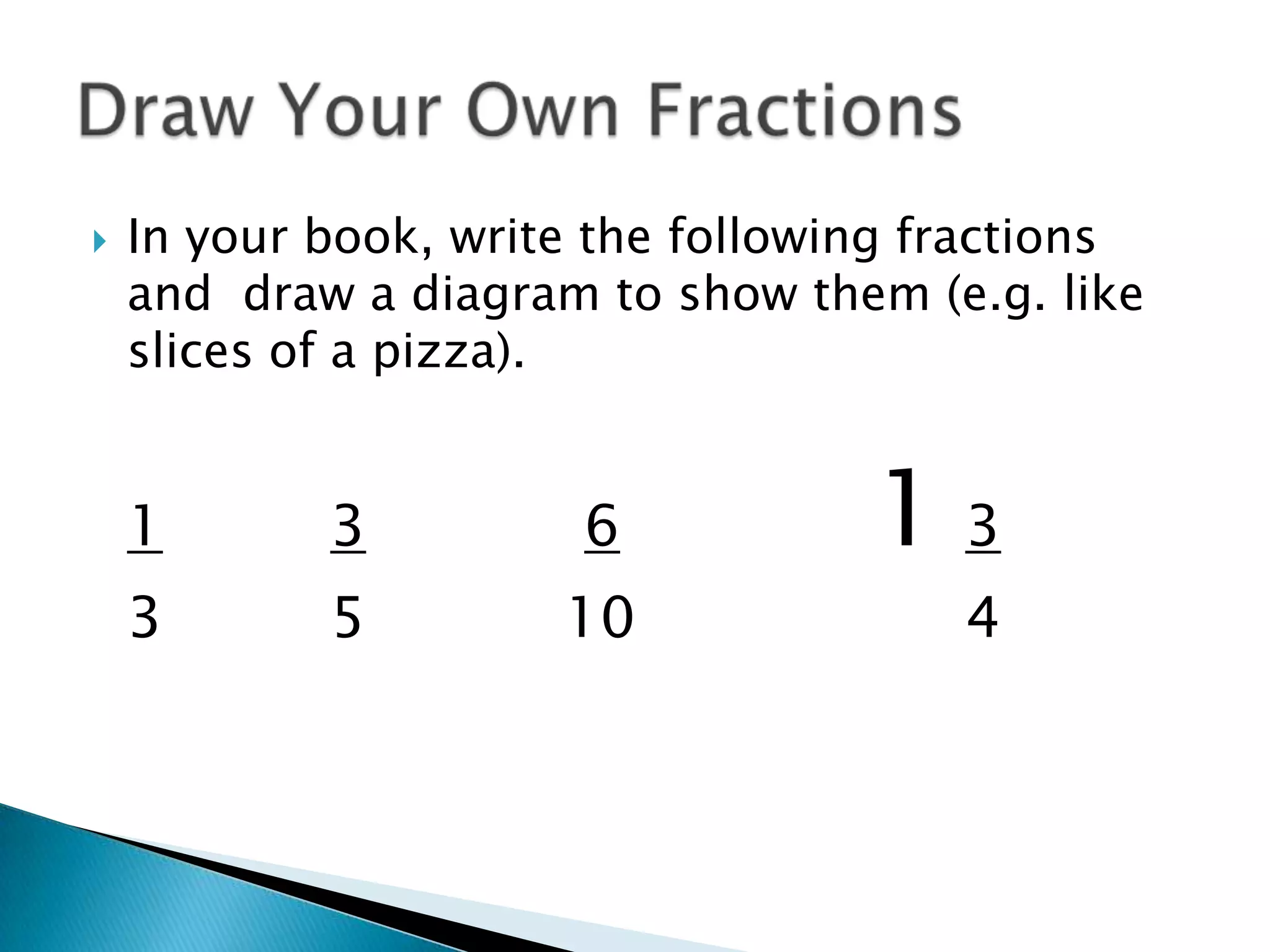
In your book, write the following fractions and  draw a diagram to show them (e.g. like slices of a pizza).13613	3		5	      10		 	4Draw Your Own Fractions
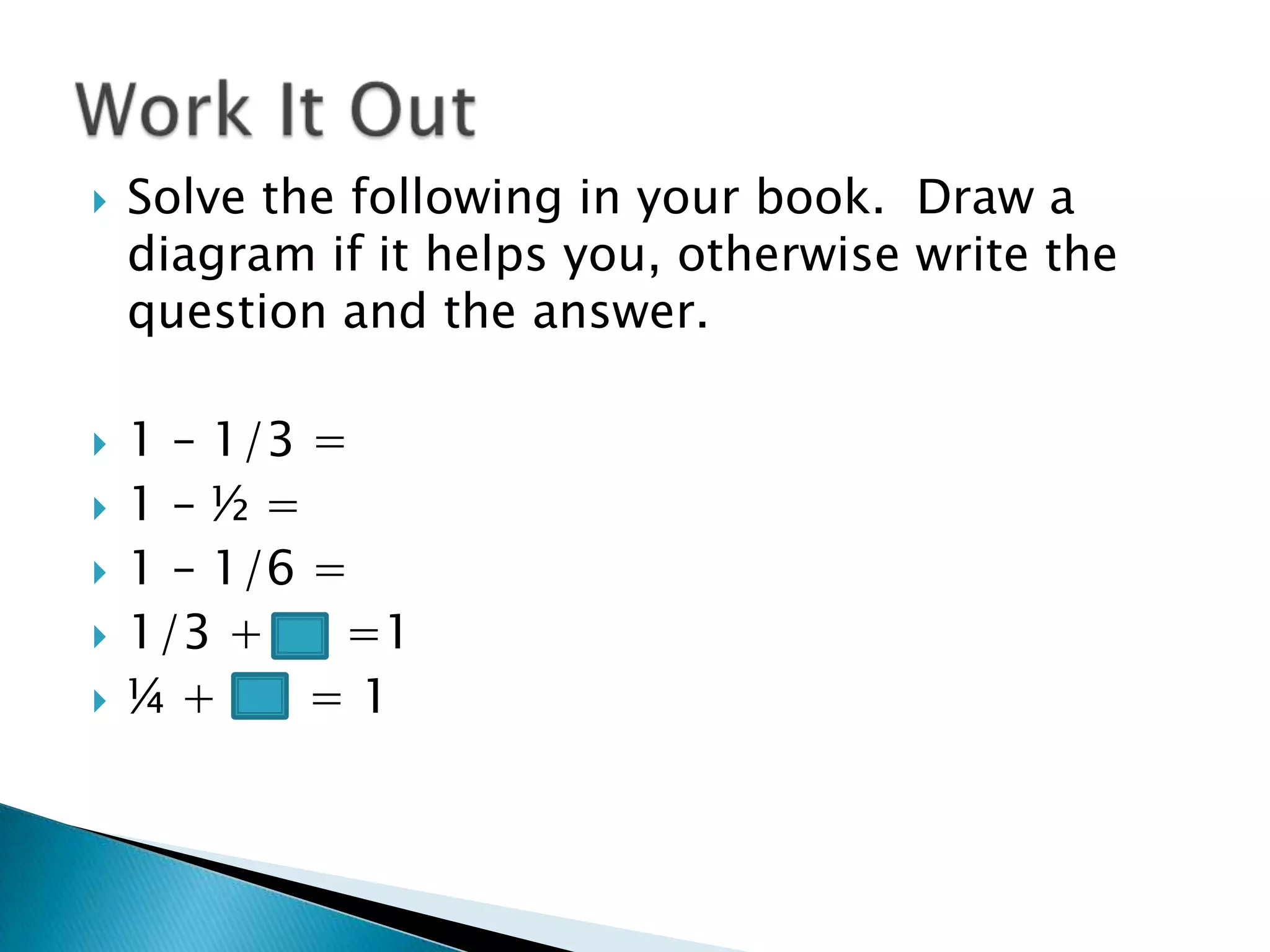
Solve the following in your book.  Draw a diagram if it helps you, otherwise write the question and the answer.1 – 1/3 =1 – ½ =1 – 1/6 =1/3 + 	 =1¼ +      = 1Work It Out
There are 3 types of fractions:Proper, Improper & Mixed NumberTypes of Fractions
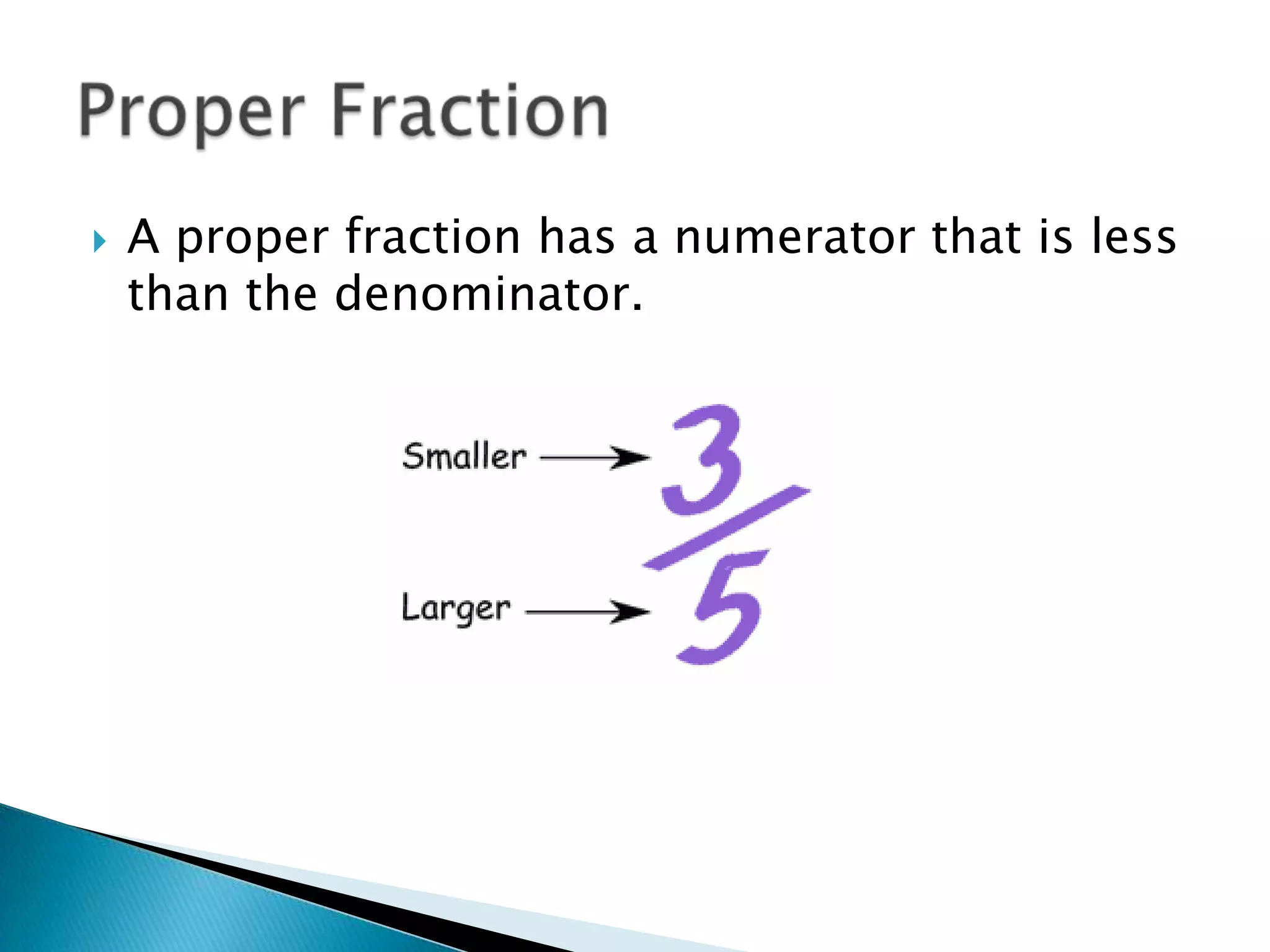
A proper fraction has a numerator that is less than the denominator.Proper Fraction
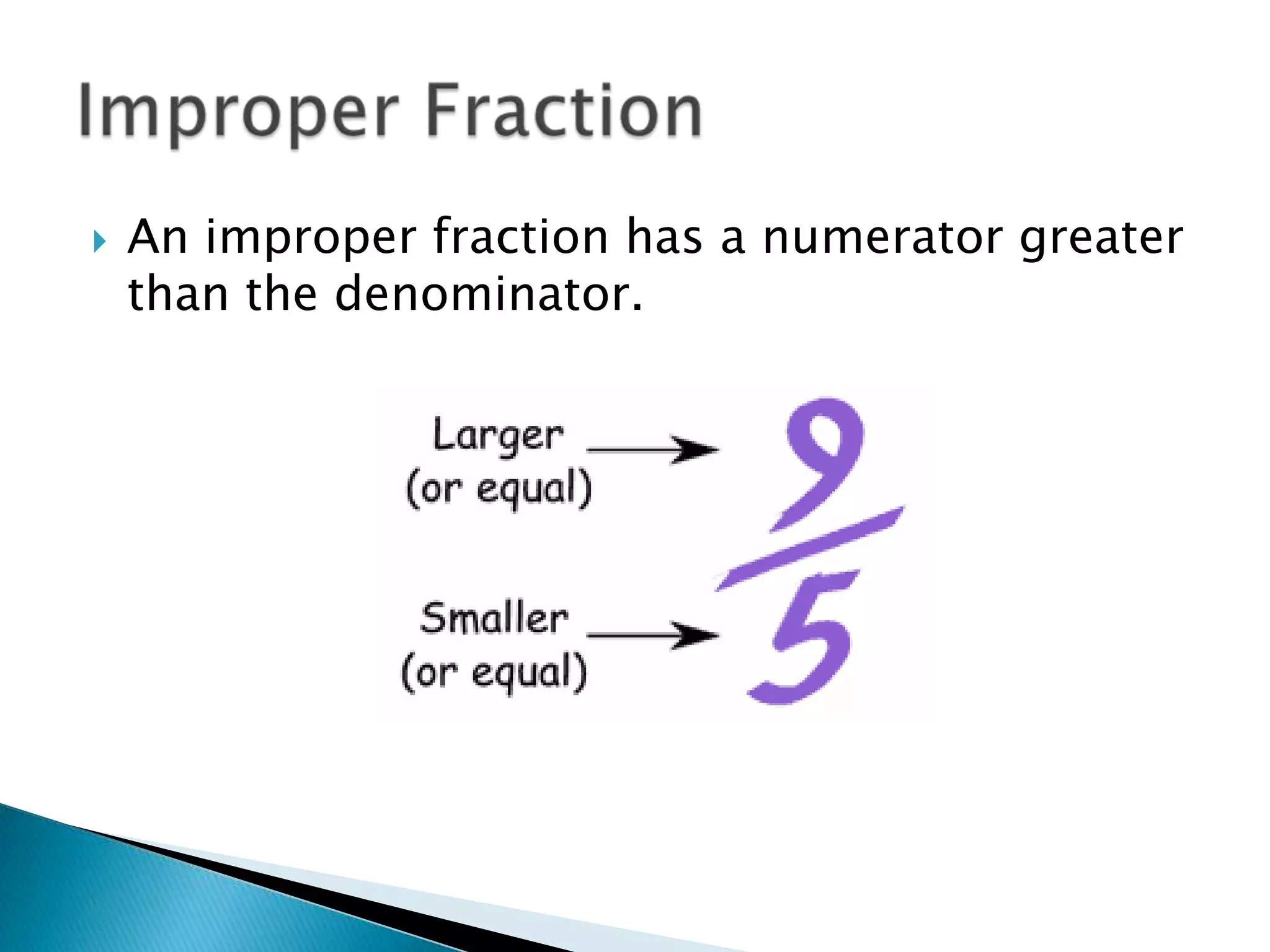
An improper fraction has a numerator greater than the denominator.Improper Fraction
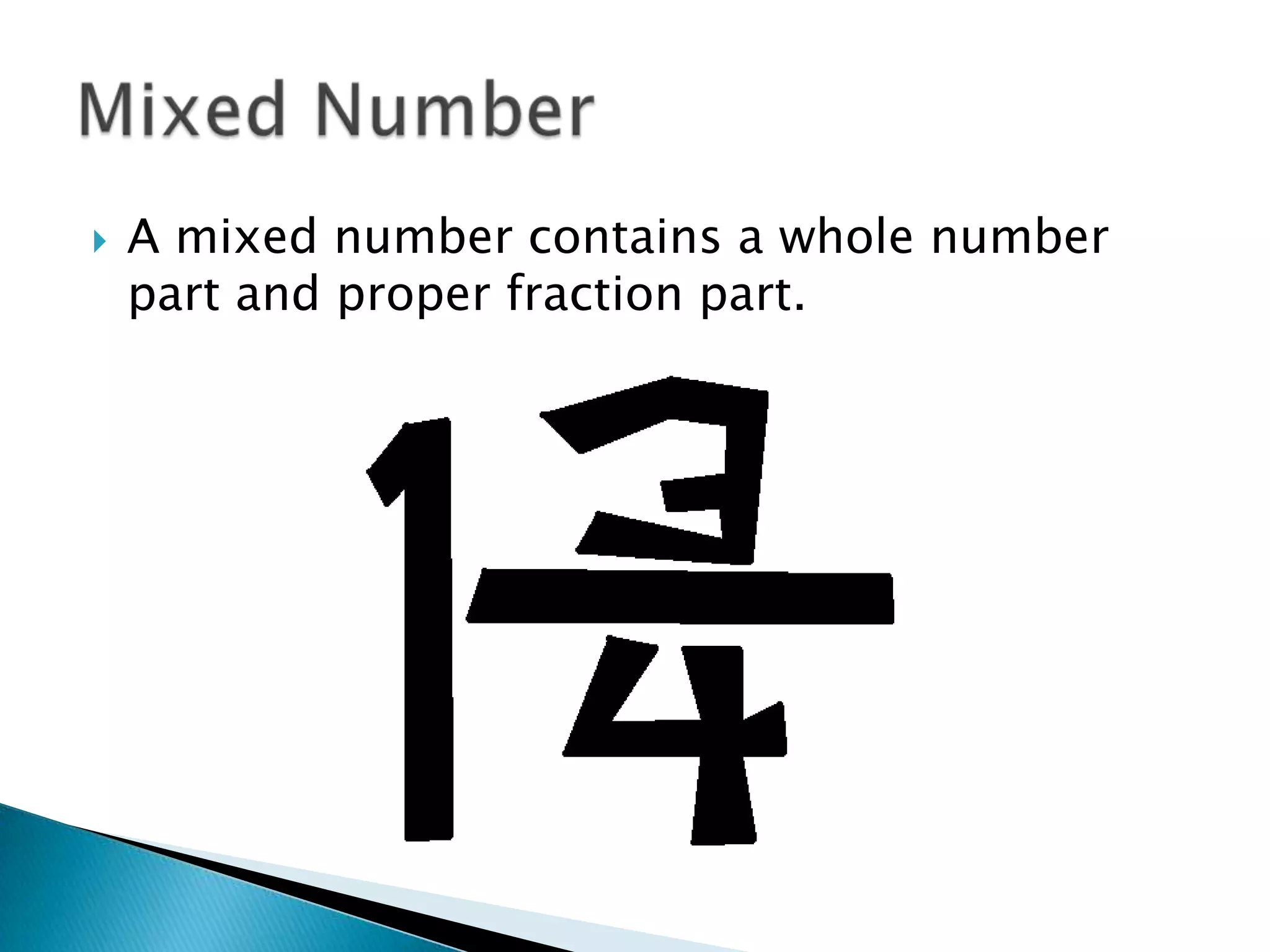
A mixed number contains a whole number part and proper fraction part.Mixed Number
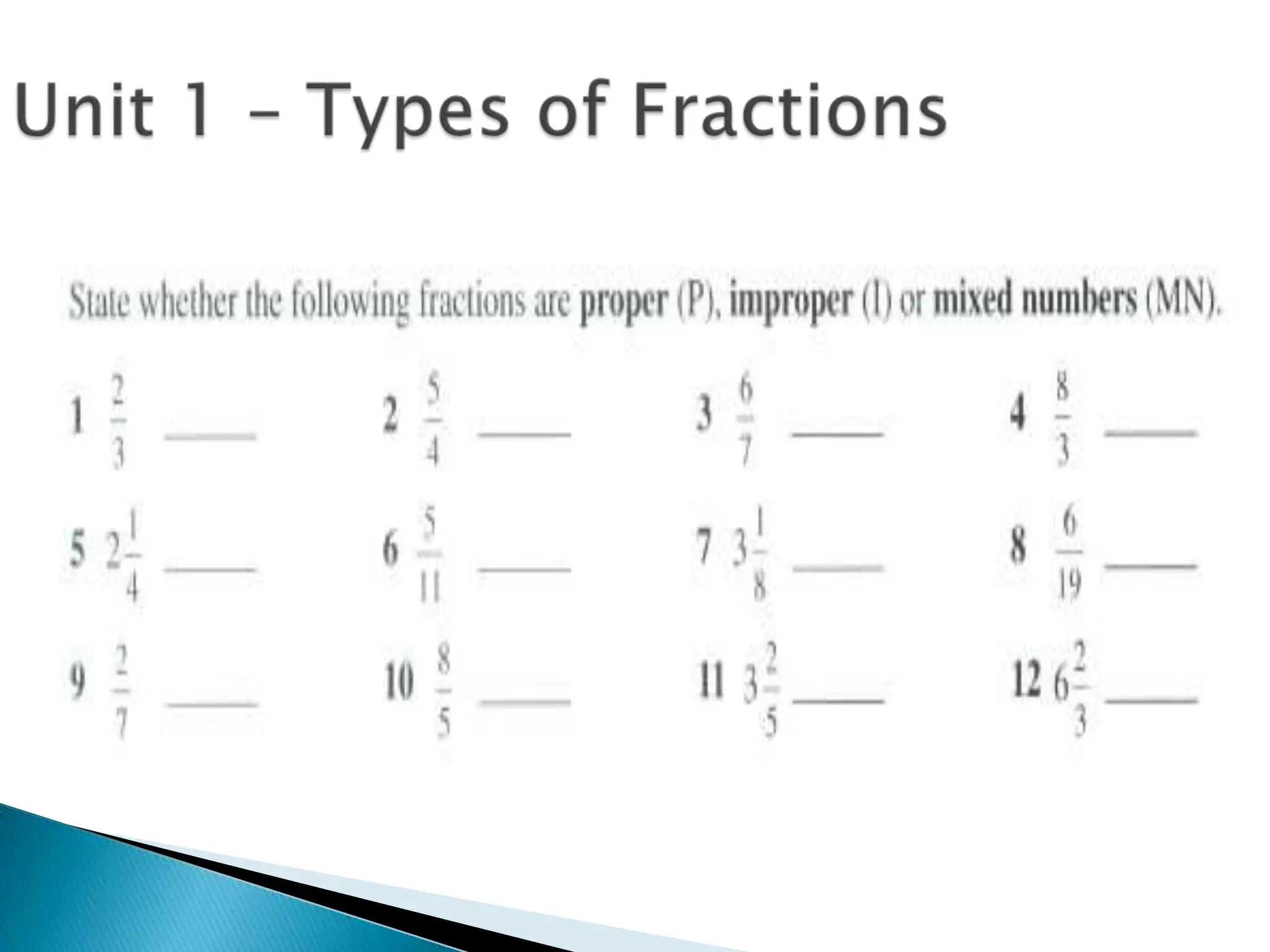
Unit 1 – Types of FractionsAnswer the following in your book – write the question number and your answer as either:P = Proper FractionI – Improper FractionMN = Mixed NumberYour Turn
Unit 1 – Types of Fractions
A proper fraction is in its simplest form when its numerator and denominator are as small as possible (this will get you top marks on tests – and it’s easier to imagine simple fractions).A fraction can be reduced to its simplest form if we divide both the numerator and the denominator by their highest common factor.Simplifying Fractions
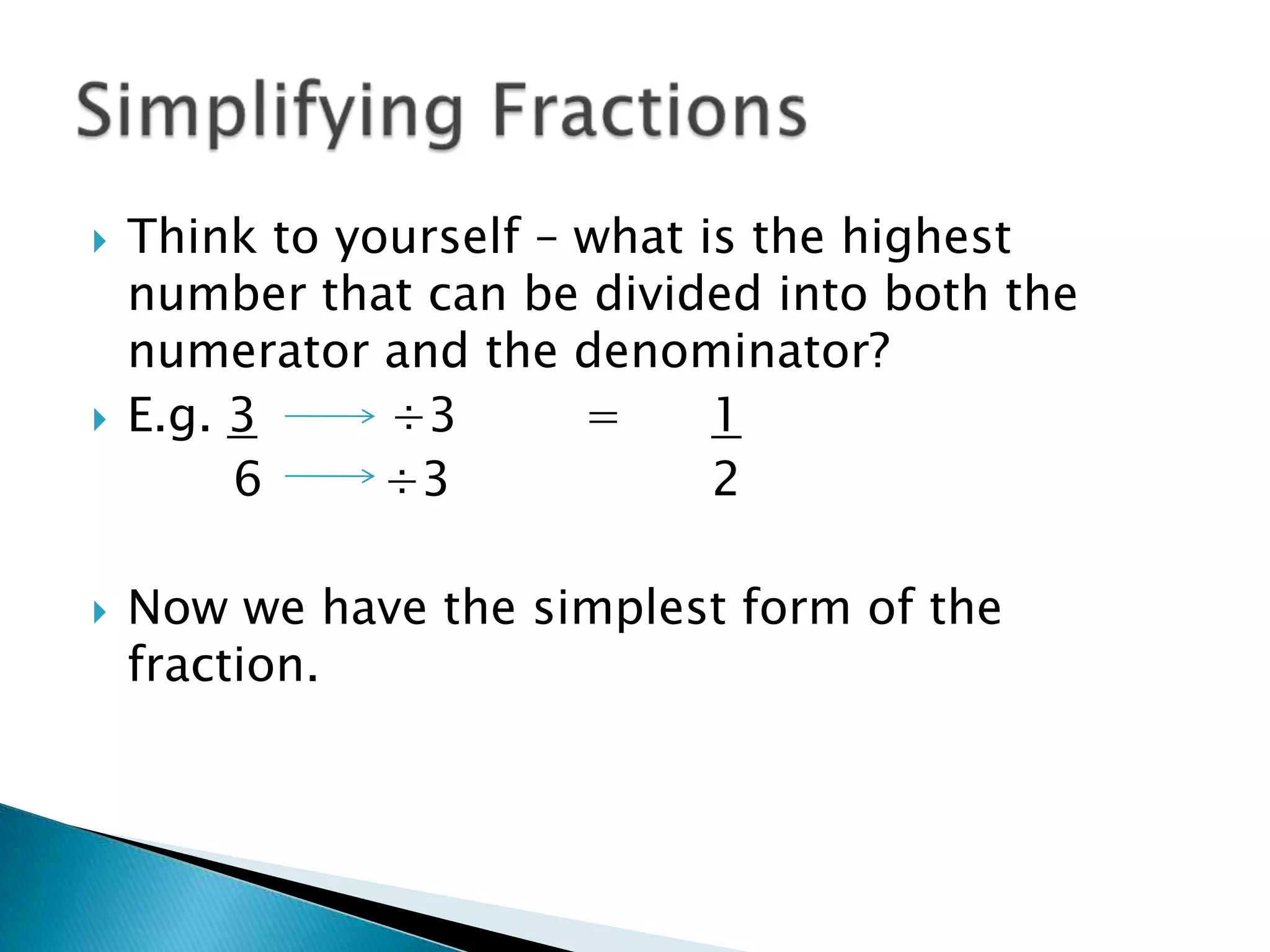
Think to yourself – what is the highest number that can be divided into both the numerator and the denominator?E.g. 3 	    ÷3 	=	1		  6        ÷3			2Now we have the simplest form of the fraction.Simplifying Fractions
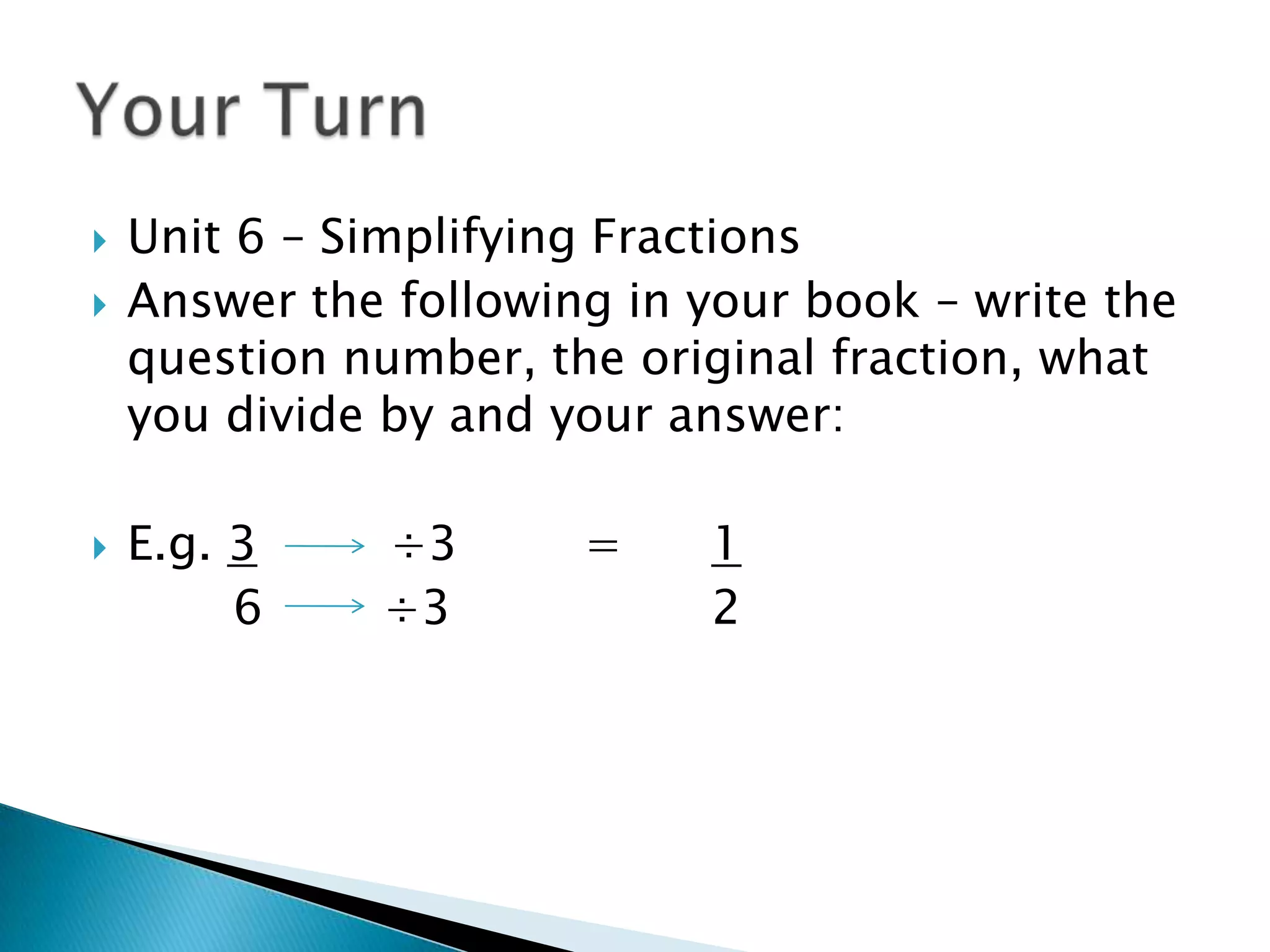
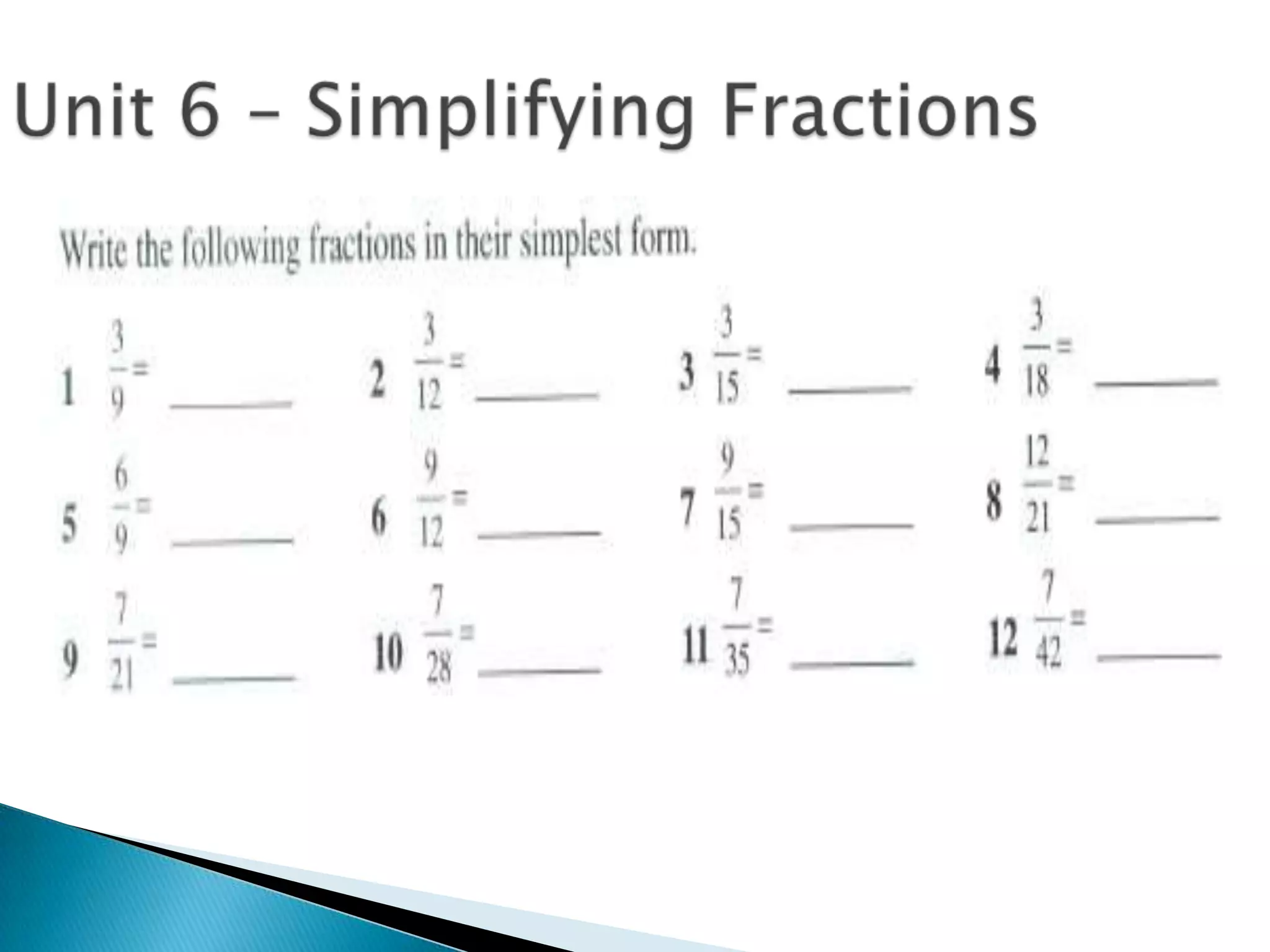
Unit 6 – Simplifying FractionsAnswer the following in your book – write the question number, the original fraction, what you divide by and your answer:E.g. 3 	    ÷3 	=	1		  6        ÷3			2Your Turn
Unit 6 – Simplifying Fractions
Book WorkMaths Quest 9: Exercise 1D Page 25 	Do Question 1 – all problemsMaths Works 9: Exercise 3G Page 51Do Questions 1-10
In order to solve some problems it will be necessary to change fractions from one type to another.It becomes especially important when you try to change a fraction to a decimal or percentage.Converting Fractions
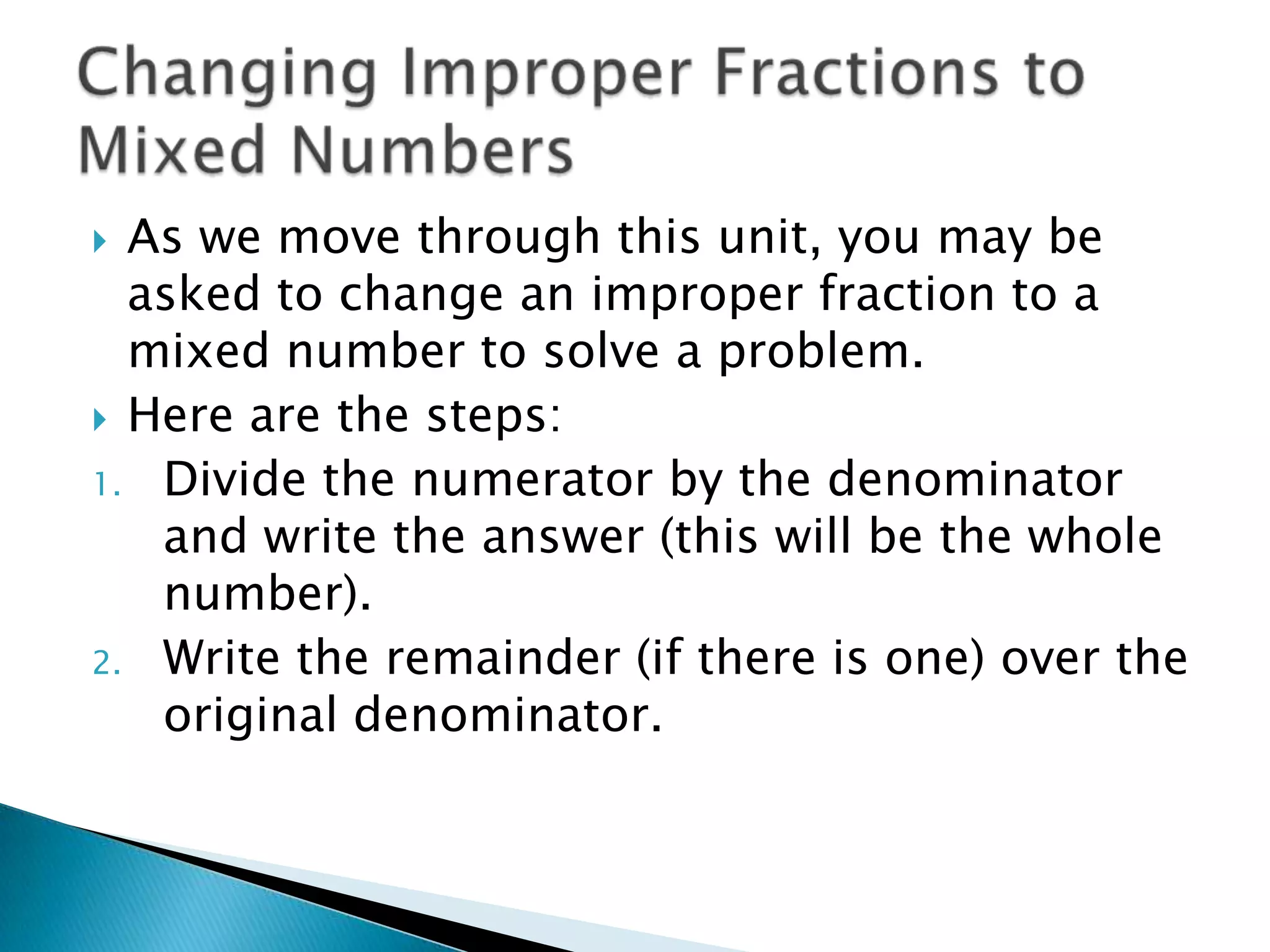
Changing Improper Fractions to Mixed NumbersAs we move through this unit, you may be asked to change an improper fraction to a mixed number to solve a problem.Here are the steps:Divide the numerator by the denominator and write the answer (this will be the whole number).Write the remainder (if there is one) over the original denominator.
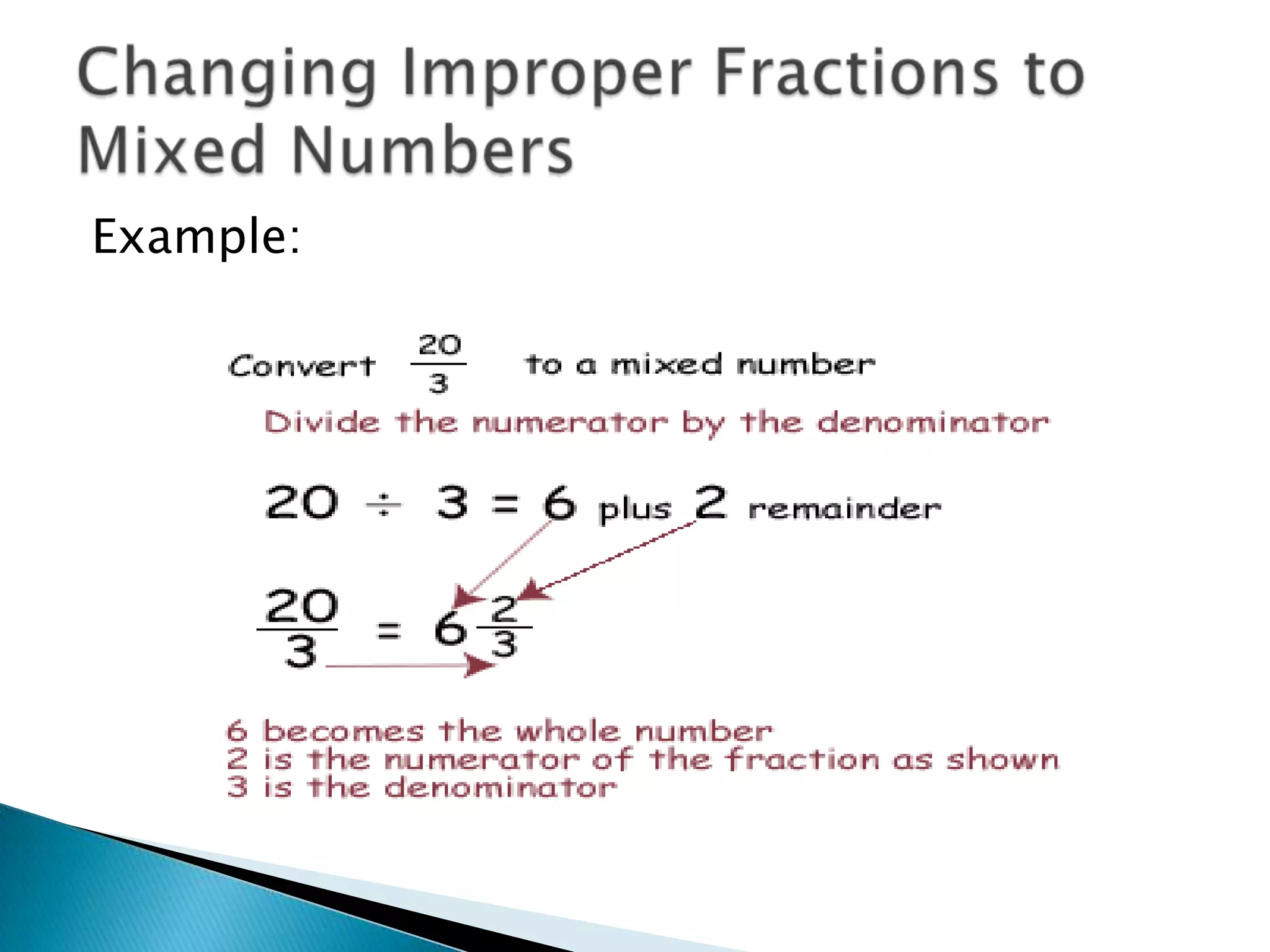
Example:Changing Improper Fractions to Mixed Numbers
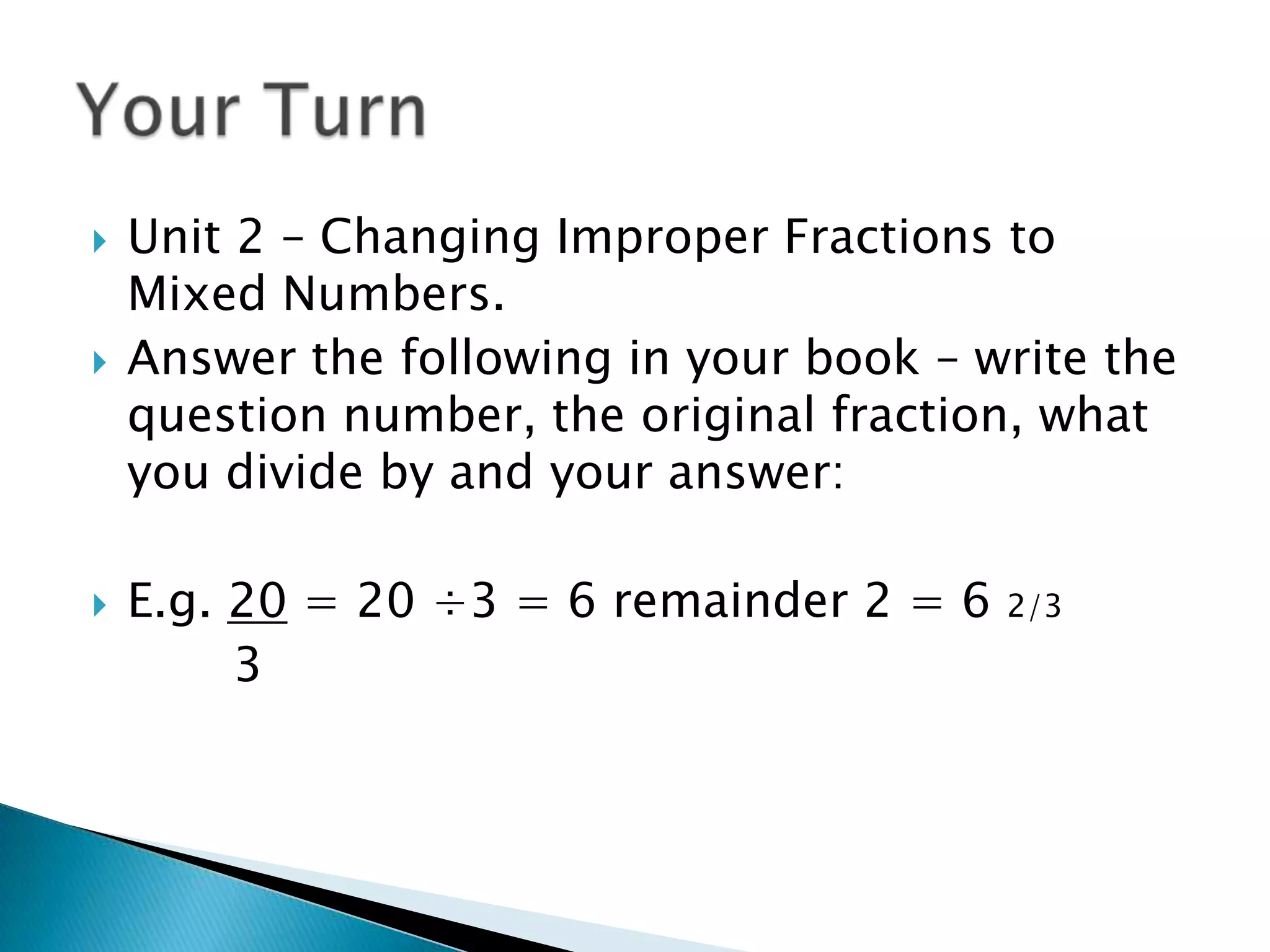
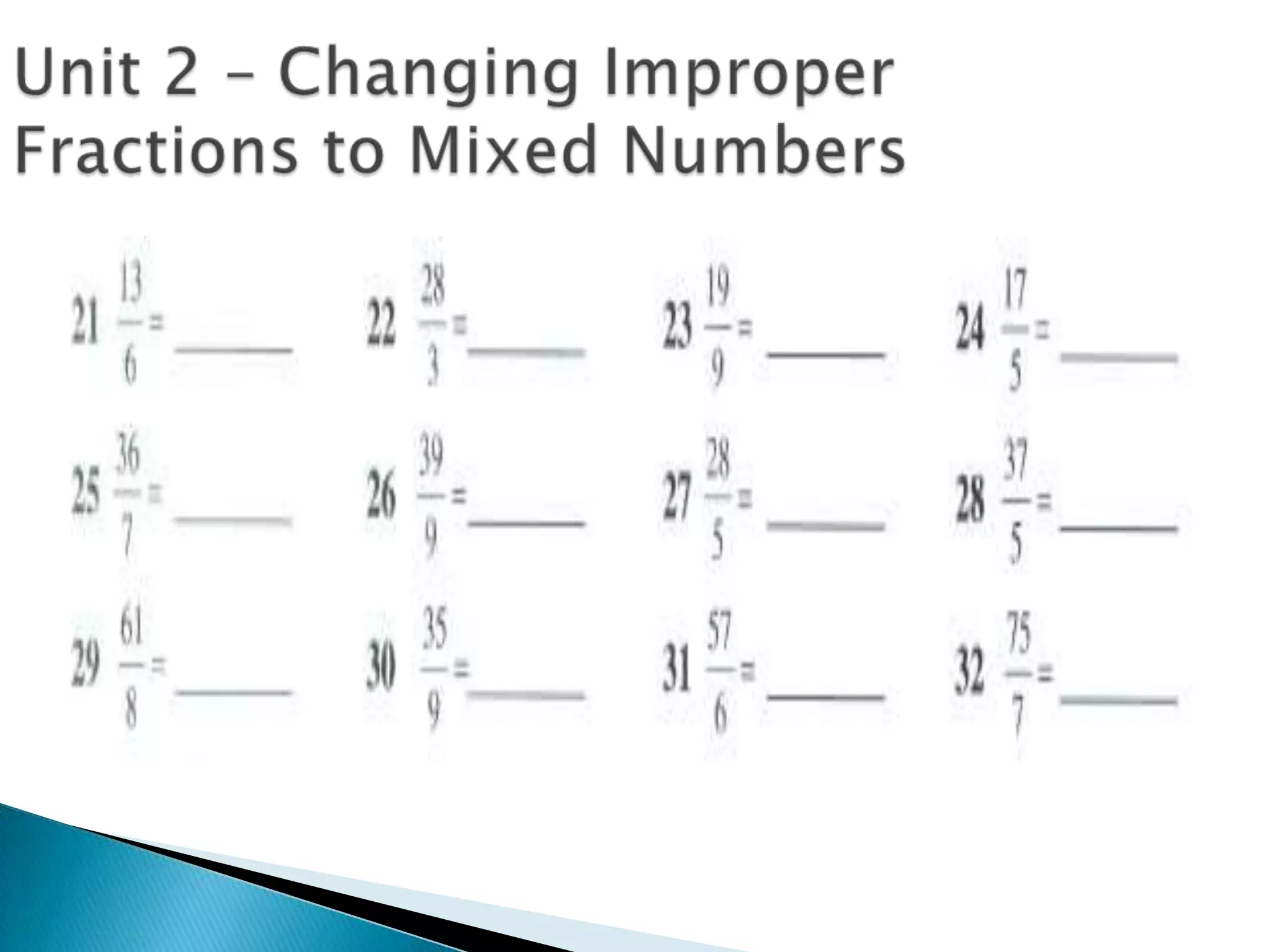
Unit 2 – Changing Improper Fractions to Mixed Numbers.Answer the following in your book – write the question number, the original fraction, what you divide by and your answer:E.g. 20 = 20 ÷3 = 6 remainder 2 = 6 2/3		  3       			Your Turn
Unit 2 – Changing Improper Fractions to Mixed Numbers
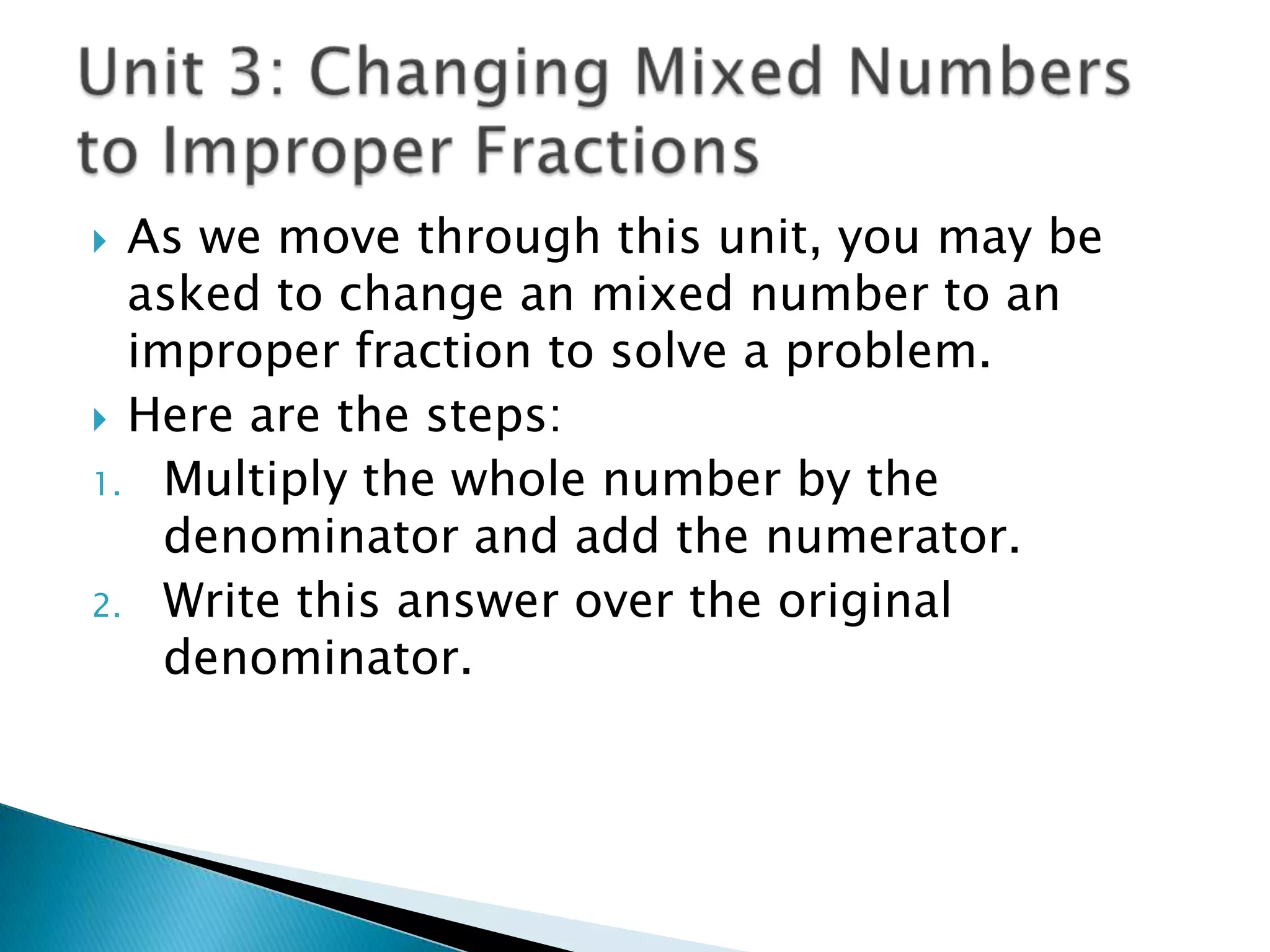
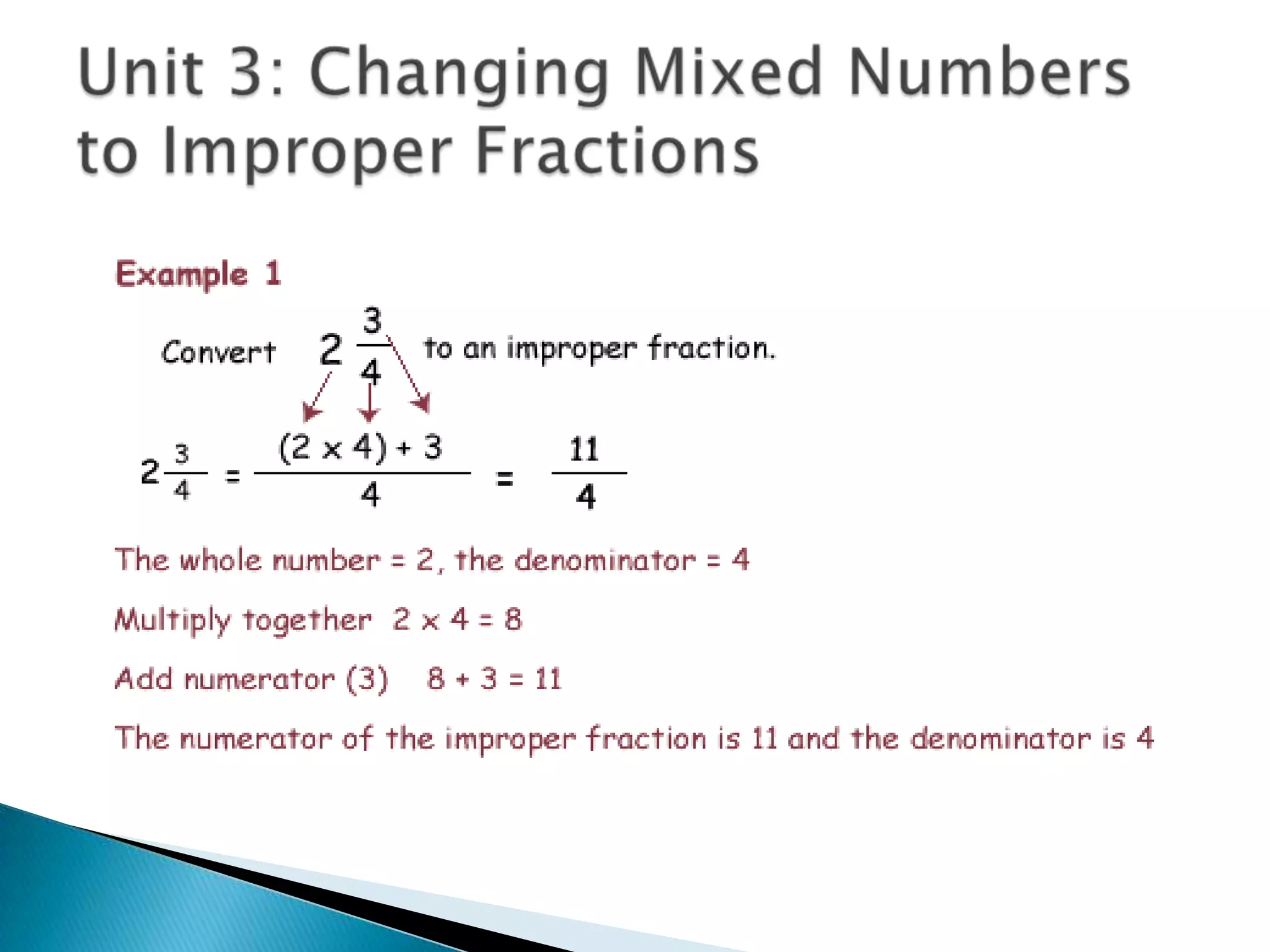
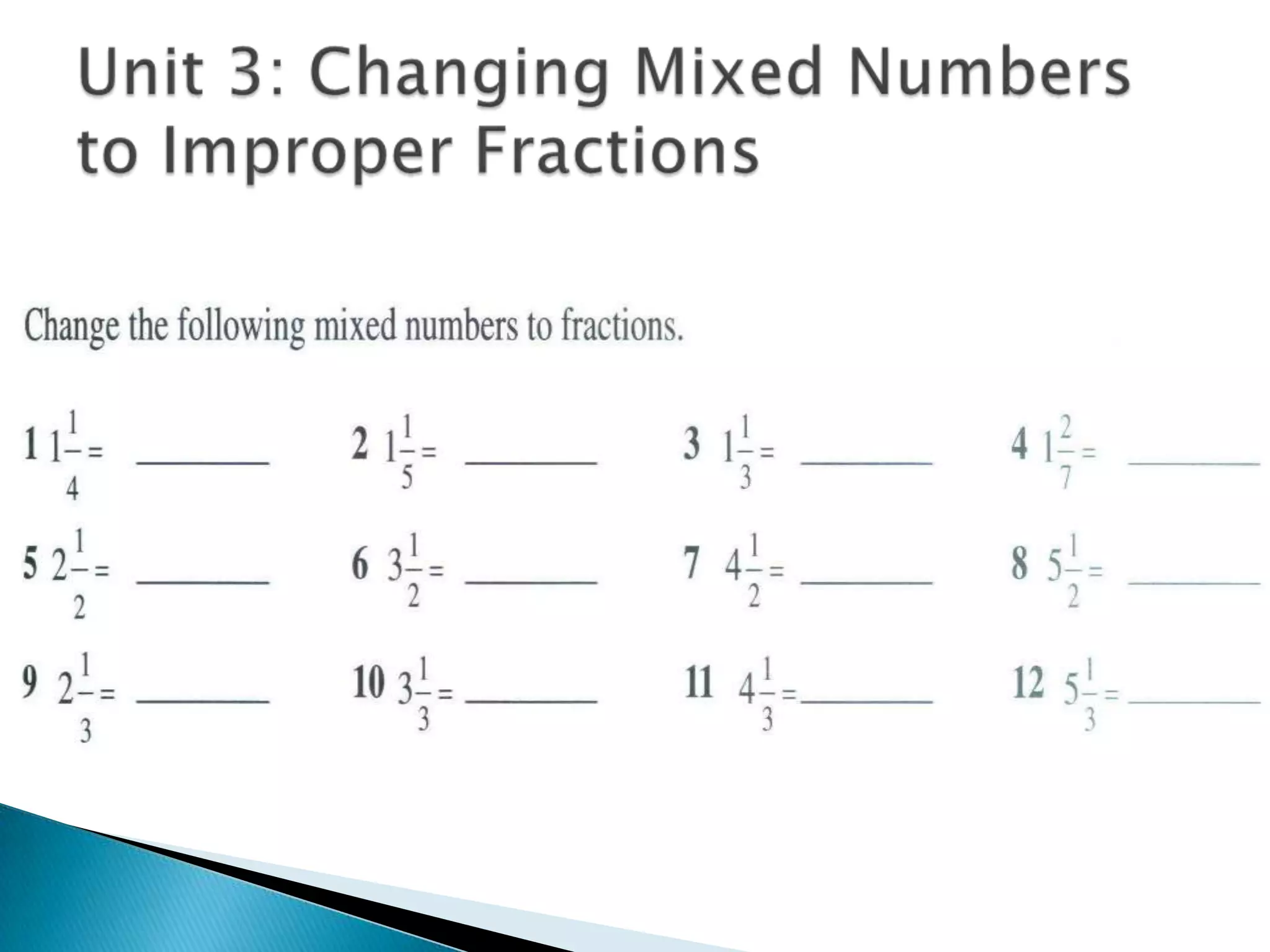
Unit 3: Changing Mixed Numbers to Improper FractionsAs we move through this unit, you may be asked to change an mixed number to an improper fraction to solve a problem.Here are the steps:Multiply the whole number by the denominator and add the numerator.Write this answer over the original denominator.
Unit 3: Changing Mixed Numbers to Improper Fractions
Unit 3 – Changing Mixed Numbers to Improper Fractions. Answer the following in your book – write the question number, the original fraction, what you multiply by and your answer:E.g. 2 ¾  = 2 x 4 + 3 = 11= 11/4 Your Turn
Unit 3: Changing Mixed Numbers to Improper Fractions
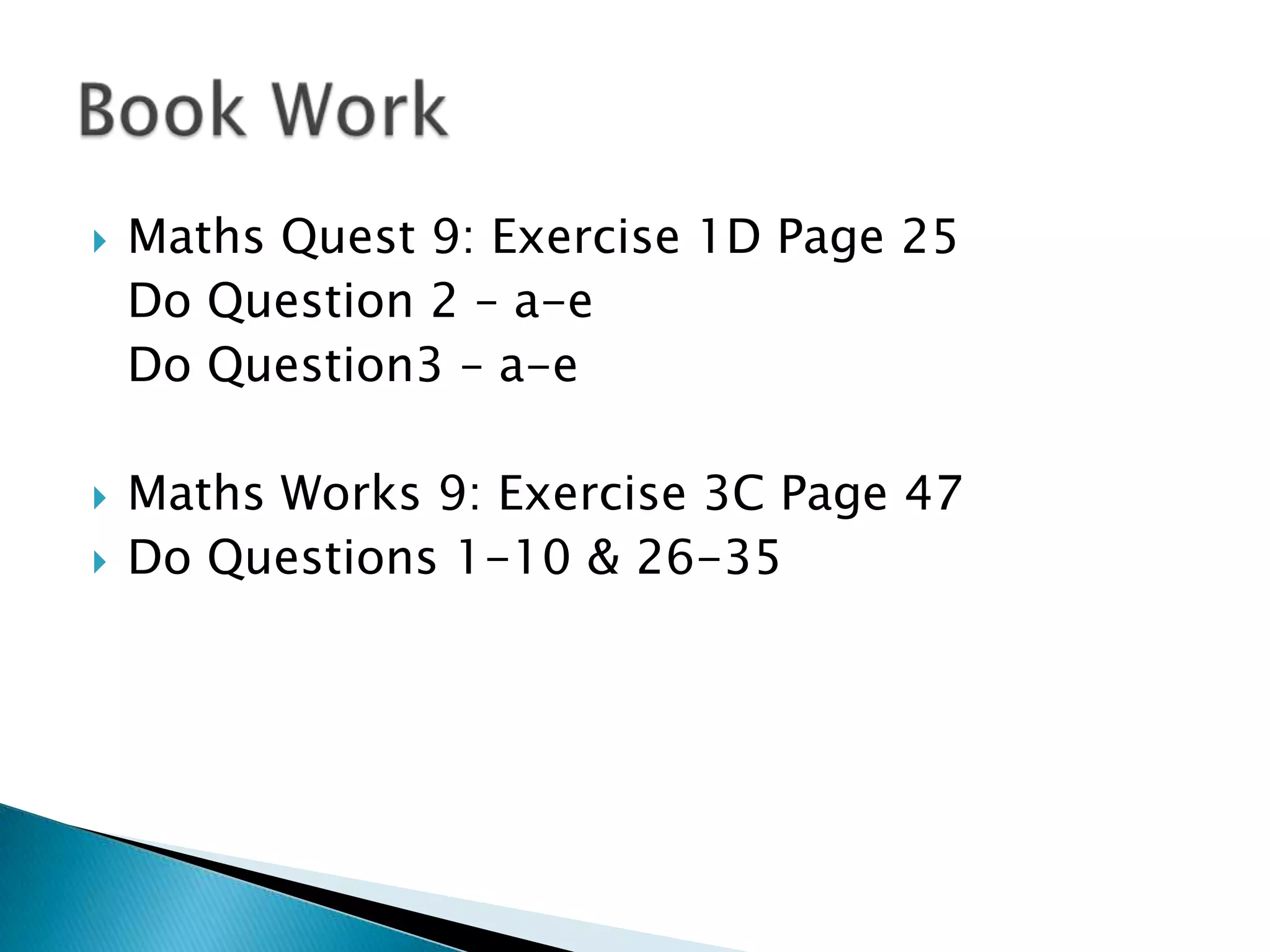
Book WorkMaths Quest 9: Exercise 1D Page 25 	Do Question 2 – a-e	Do Question3 – a-eMaths Works 9: Exercise 3C Page 47Do Questions 1-10 & 26-35
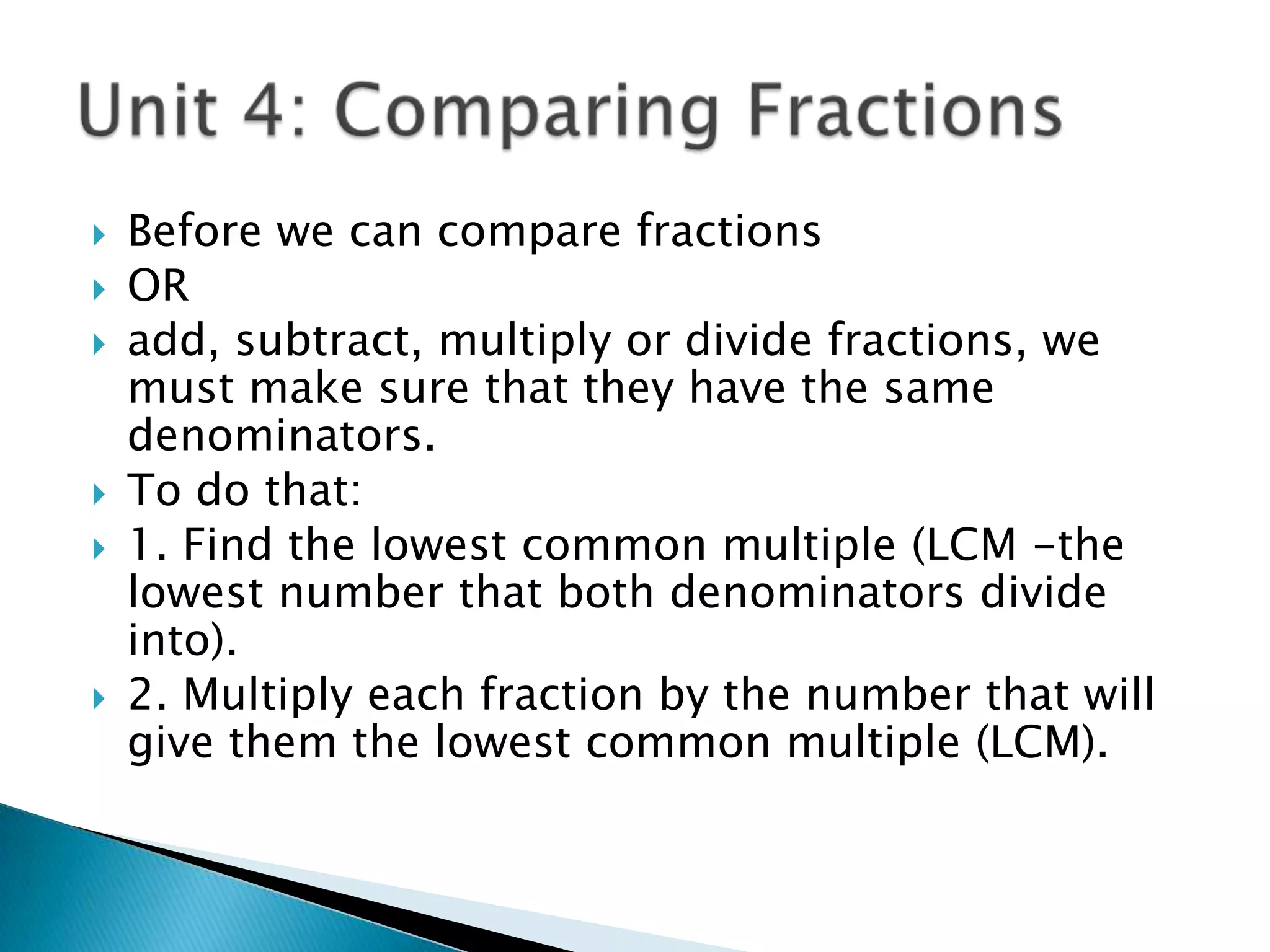
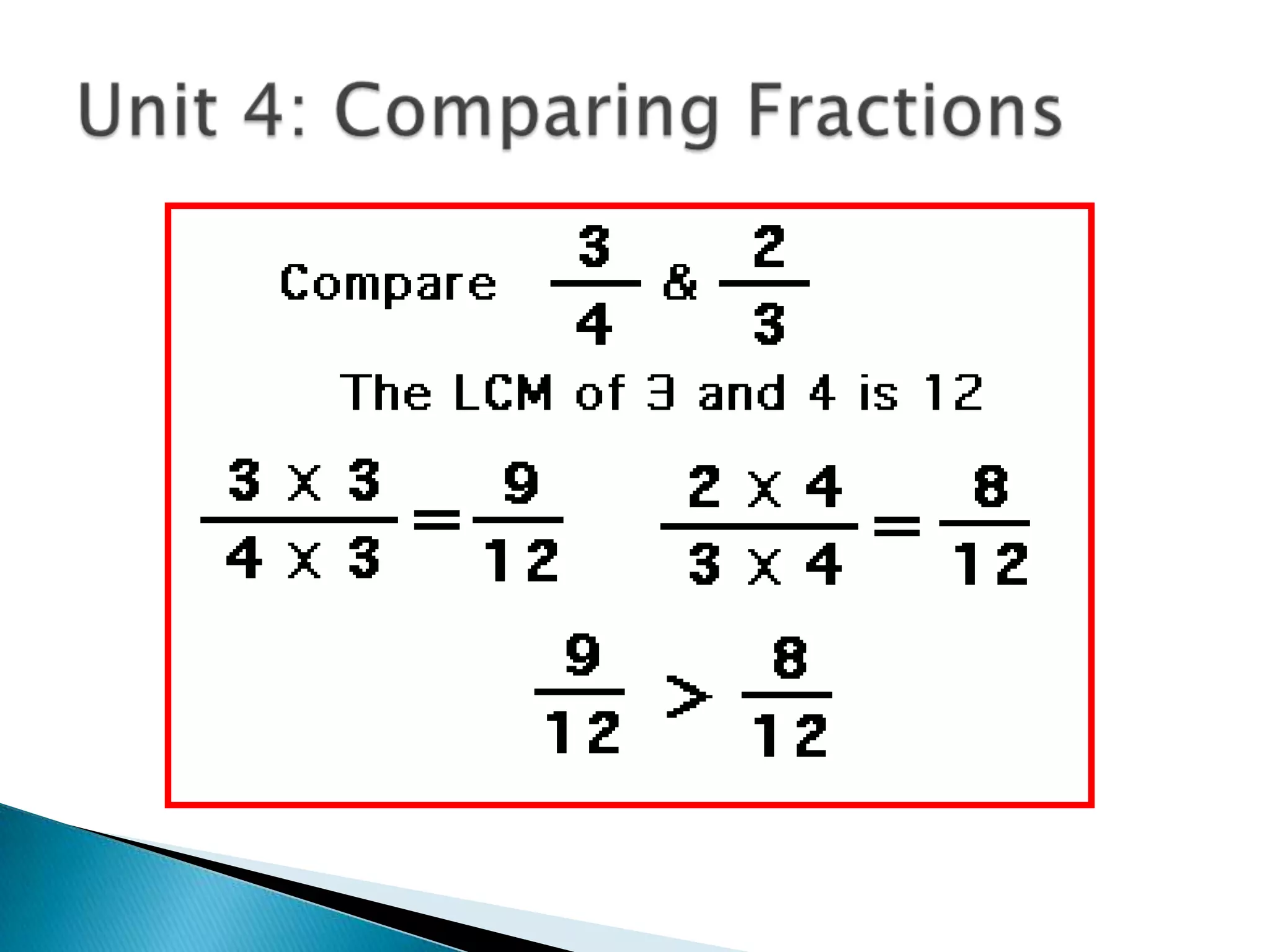
Unit 4: Comparing FractionsBefore we can compare fractions ORadd, subtract, multiply or divide fractions, we must make sure that they have the same denominators.To do that:1. Find the lowest common multiple (LCM -the lowest number that both denominators divide into).2. Multiply each fraction by the number that will give them the lowest common multiple (LCM).
Unit 4: Comparing Fractions
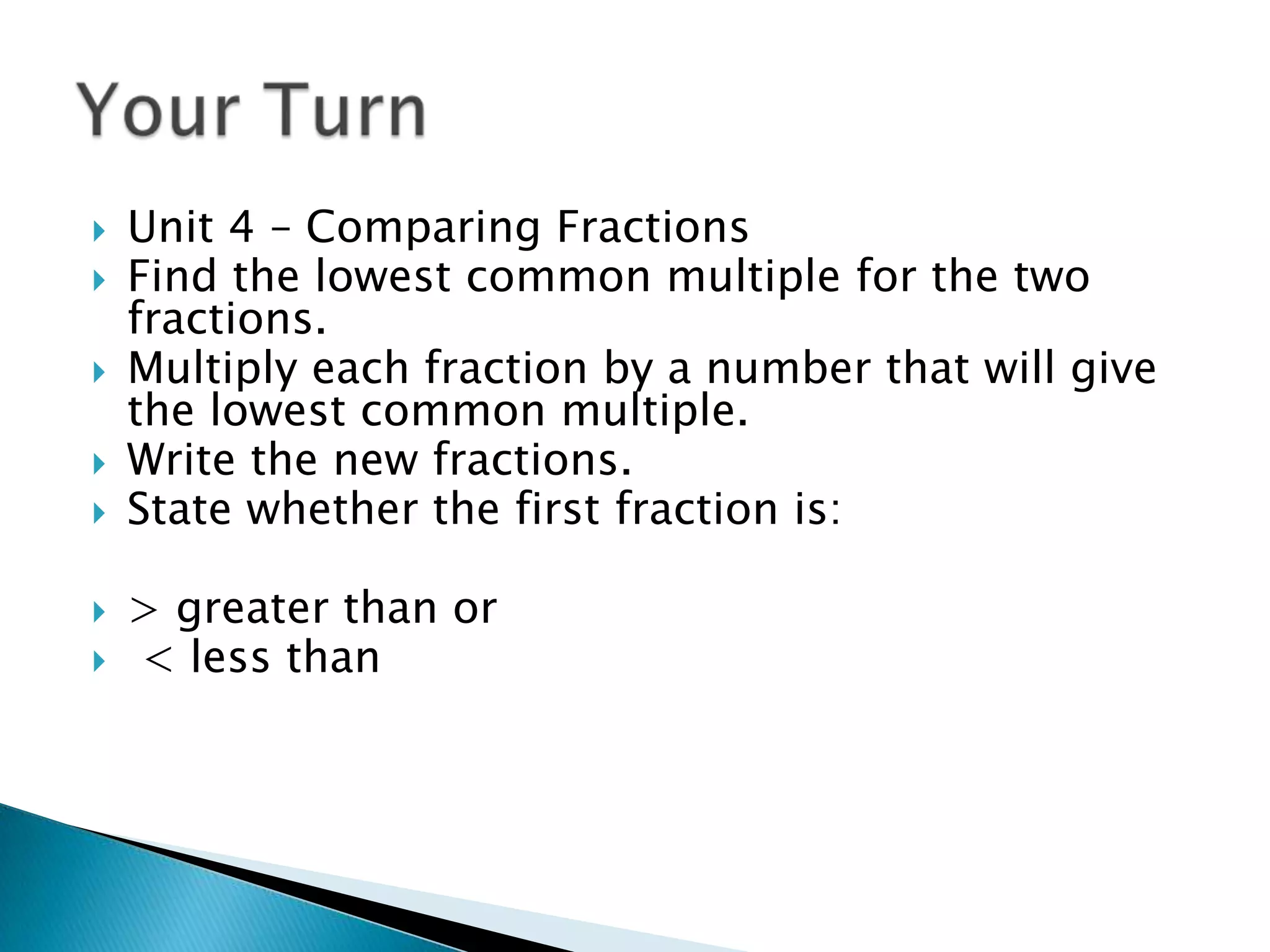
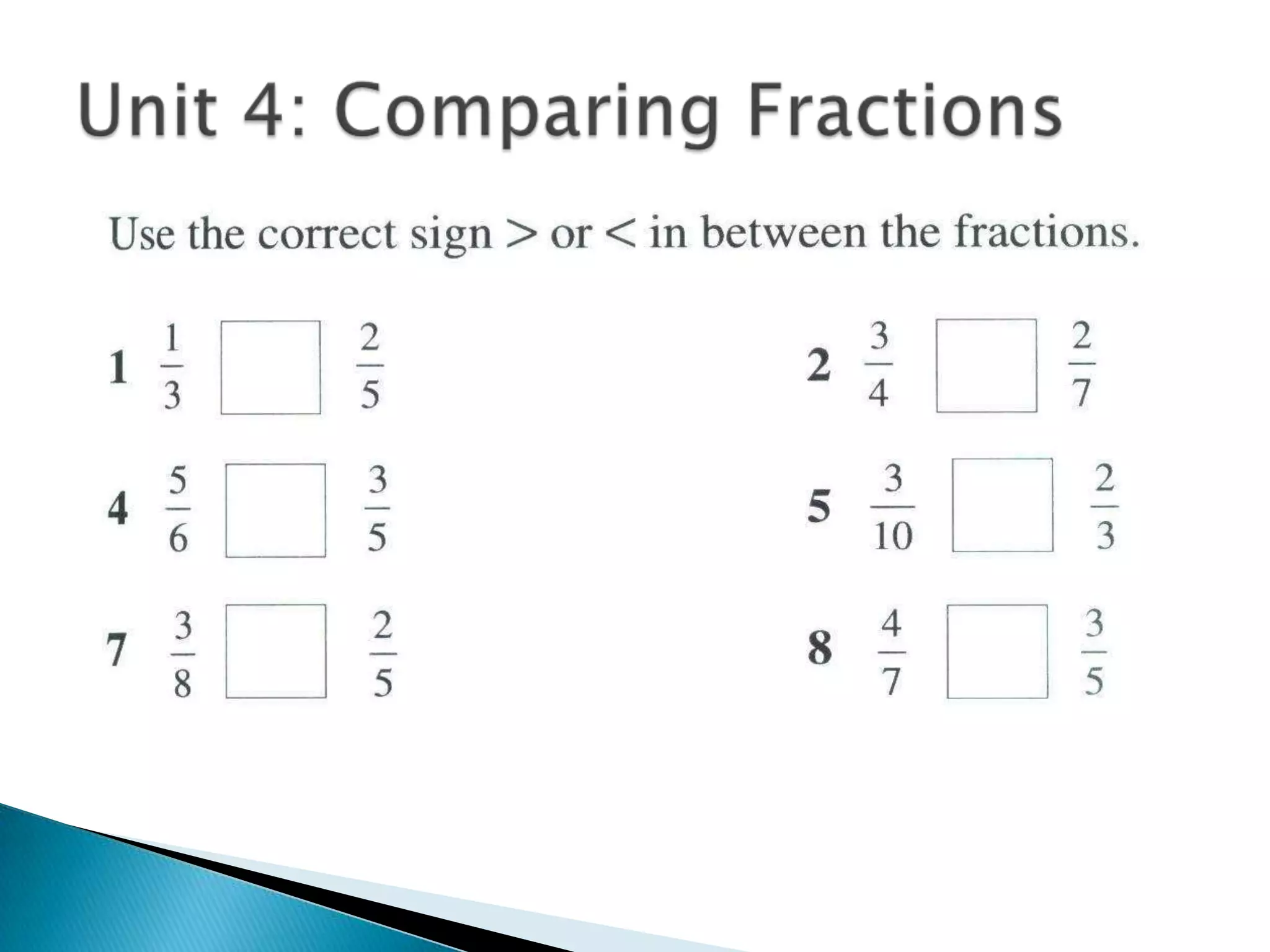
Unit 4 – Comparing FractionsFind the lowest common multiple for the two fractions.Multiply each fraction by a number that will give the lowest common multiple.Write the new fractions.State whether the first fraction is:> greater than or < less thanYour Turn
Unit 4: Comparing Fractions
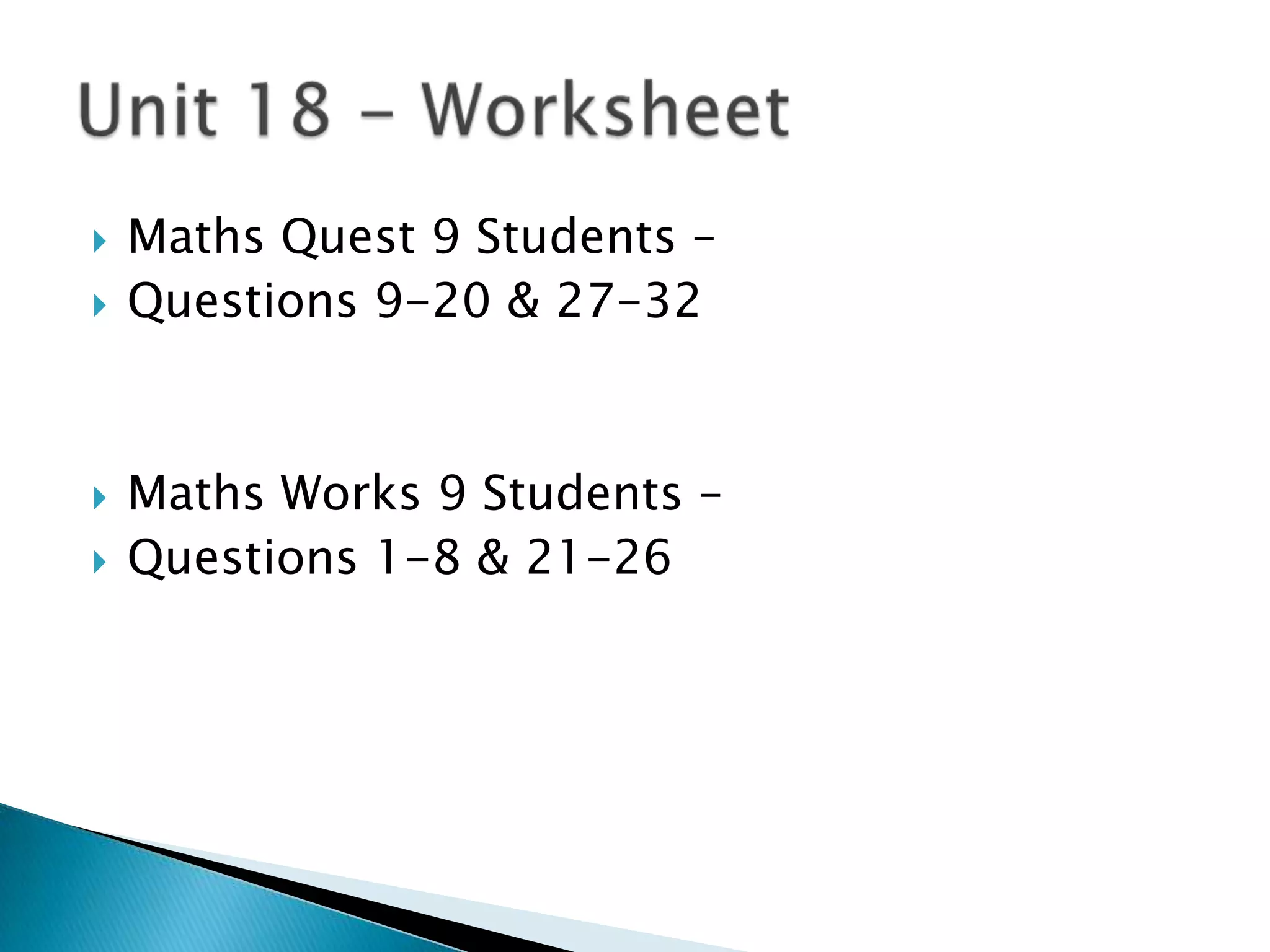
Maths Quest 9 Students – Questions 9-20 & 27-32Maths Works 9 Students –Questions 1-8 & 21-26Unit 18 - Worksheet
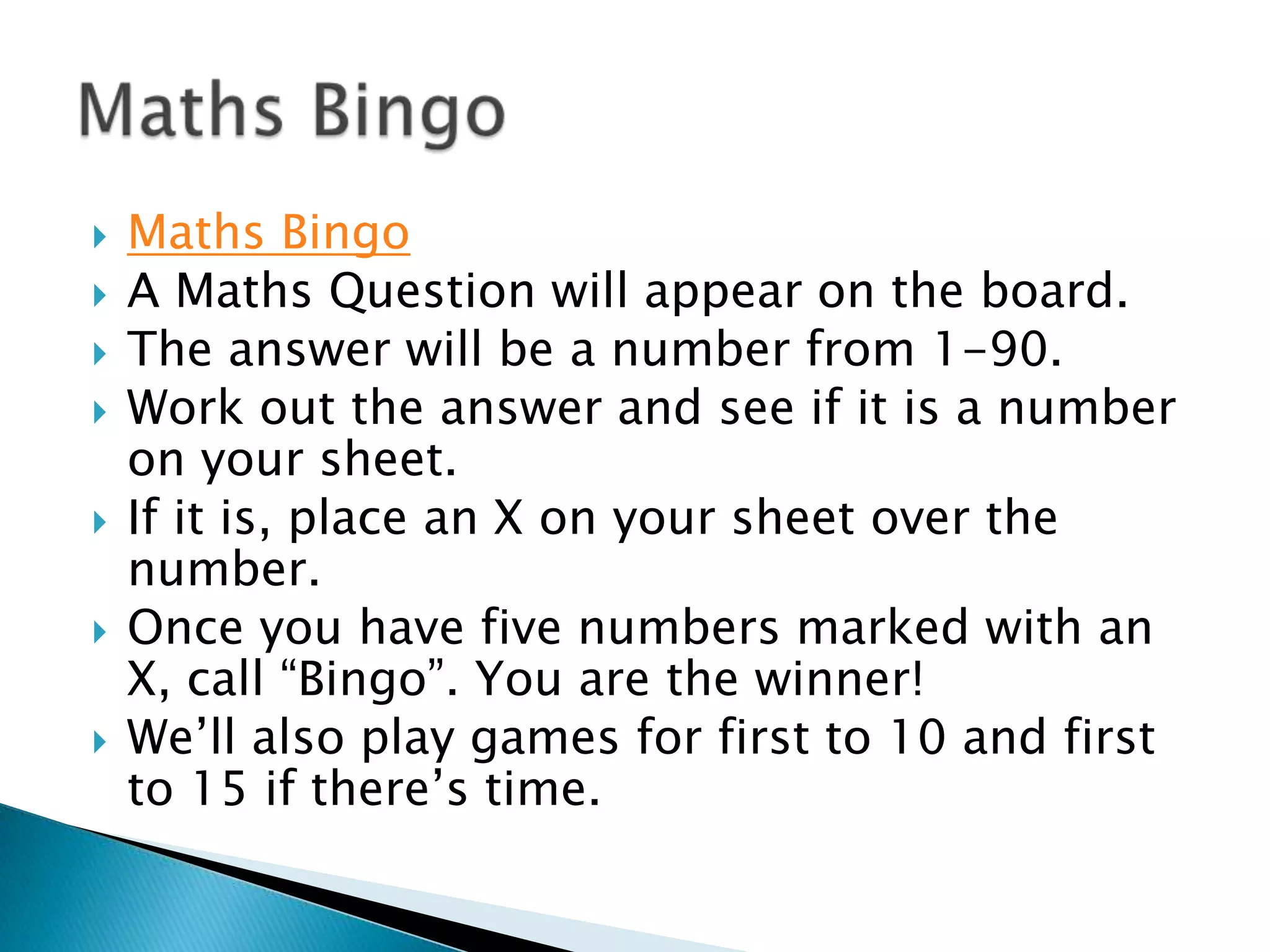
Maths Bingo A Maths Question will appear on the board.The answer will be a number from 1-90.Work out the answer and see if it is a number on your sheet.If it is, place an X on your sheet over the number.Once you have five numbers marked with an X, call “Bingo”. You are the winner!We’ll also play games for first to 10 and first to 15 if there’s time.Maths Bingo

Grade 9 Maths - Fractions 1

  • 1.
  • 2.
    The next topicin our Number Unit is fractions. So I can make sure no-one is left behind, let’s start with some basics (quickly), before we move on to our Grade 9 work.Let’s Review
  • 3.
    Fractions are away to represent a number.What fractions tell us is how many parts of a whole number we have.E.g. ½ means we have one part out of the two needed to make a whole. What Are Fractions?
  • 4.
    The top partof the fraction tells us how many parts of the whole we have.The bottom part of the fraction tells us how many parts make up the whole.e.g. 1 Numerator (we have one part of the whole) 4 Denominator (four parts make up the whole) The line – known as the vinculum – means divideParts Of A Fraction
  • 5.
    In your book,write the following fractions and draw a diagram to show them (e.g. like slices of a pizza).13613 3 5 10 4Draw Your Own Fractions
  • 6.
    Solve the followingin your book. Draw a diagram if it helps you, otherwise write the question and the answer.1 – 1/3 =1 – ½ =1 – 1/6 =1/3 + =1¼ + = 1Work It Out
  • 7.
    There are 3types of fractions:Proper, Improper & Mixed NumberTypes of Fractions
  • 8.
    A proper fractionhas a numerator that is less than the denominator.Proper Fraction
  • 9.
    An improper fractionhas a numerator greater than the denominator.Improper Fraction
  • 10.
    A mixed numbercontains a whole number part and proper fraction part.Mixed Number
  • 11.
    Unit 1 –Types of FractionsAnswer the following in your book – write the question number and your answer as either:P = Proper FractionI – Improper FractionMN = Mixed NumberYour Turn
  • 12.
    Unit 1 –Types of Fractions
  • 13.
    A proper fractionis in its simplest form when its numerator and denominator are as small as possible (this will get you top marks on tests – and it’s easier to imagine simple fractions).A fraction can be reduced to its simplest form if we divide both the numerator and the denominator by their highest common factor.Simplifying Fractions
  • 14.
    Think to yourself– what is the highest number that can be divided into both the numerator and the denominator?E.g. 3 ÷3 = 1 6 ÷3 2Now we have the simplest form of the fraction.Simplifying Fractions
  • 15.
    Unit 6 –Simplifying FractionsAnswer the following in your book – write the question number, the original fraction, what you divide by and your answer:E.g. 3 ÷3 = 1 6 ÷3 2Your Turn
  • 16.
    Unit 6 –Simplifying Fractions
  • 17.
    Book WorkMaths Quest9: Exercise 1D Page 25 Do Question 1 – all problemsMaths Works 9: Exercise 3G Page 51Do Questions 1-10
  • 18.
    In order tosolve some problems it will be necessary to change fractions from one type to another.It becomes especially important when you try to change a fraction to a decimal or percentage.Converting Fractions
  • 19.
    Changing Improper Fractionsto Mixed NumbersAs we move through this unit, you may be asked to change an improper fraction to a mixed number to solve a problem.Here are the steps:Divide the numerator by the denominator and write the answer (this will be the whole number).Write the remainder (if there is one) over the original denominator.
  • 20.
  • 21.
    Unit 2 –Changing Improper Fractions to Mixed Numbers.Answer the following in your book – write the question number, the original fraction, what you divide by and your answer:E.g. 20 = 20 ÷3 = 6 remainder 2 = 6 2/3 3 Your Turn
  • 22.
    Unit 2 –Changing Improper Fractions to Mixed Numbers
  • 23.
    Unit 3: ChangingMixed Numbers to Improper FractionsAs we move through this unit, you may be asked to change an mixed number to an improper fraction to solve a problem.Here are the steps:Multiply the whole number by the denominator and add the numerator.Write this answer over the original denominator.
  • 24.
    Unit 3: ChangingMixed Numbers to Improper Fractions
  • 25.
    Unit 3 –Changing Mixed Numbers to Improper Fractions. Answer the following in your book – write the question number, the original fraction, what you multiply by and your answer:E.g. 2 ¾ = 2 x 4 + 3 = 11= 11/4 Your Turn
  • 26.
    Unit 3: ChangingMixed Numbers to Improper Fractions
  • 27.
    Book WorkMaths Quest9: Exercise 1D Page 25 Do Question 2 – a-e Do Question3 – a-eMaths Works 9: Exercise 3C Page 47Do Questions 1-10 & 26-35
  • 28.
    Unit 4: ComparingFractionsBefore we can compare fractions ORadd, subtract, multiply or divide fractions, we must make sure that they have the same denominators.To do that:1. Find the lowest common multiple (LCM -the lowest number that both denominators divide into).2. Multiply each fraction by the number that will give them the lowest common multiple (LCM).
  • 29.
  • 30.
    Unit 4 –Comparing FractionsFind the lowest common multiple for the two fractions.Multiply each fraction by a number that will give the lowest common multiple.Write the new fractions.State whether the first fraction is:> greater than or < less thanYour Turn
  • 31.
  • 32.
    Maths Quest 9Students – Questions 9-20 & 27-32Maths Works 9 Students –Questions 1-8 & 21-26Unit 18 - Worksheet
  • 33.
    Maths Bingo AMaths Question will appear on the board.The answer will be a number from 1-90.Work out the answer and see if it is a number on your sheet.If it is, place an X on your sheet over the number.Once you have five numbers marked with an X, call “Bingo”. You are the winner!We’ll also play games for first to 10 and first to 15 if there’s time.Maths Bingo

Editor's Notes

  • #19 Start 15/4 Lesson Here. DO IT NOW – simplify 10/12, 12/15, 25/100, 16/24
  • #21 Do another example on the board. Convert 11/4 to a mixed number.
  • #25 Do another example on the board. Change 1 2/5 to an improper fraction.
  • #28 Finish 15/4 lesson here.