Operations of Fractions
and Operations
Complementing
Fractions
WHAT IS FRACTION?
A fraction or a
fractional number
is used to represent
a part of a whole.
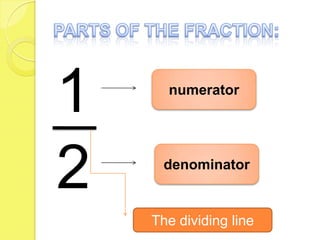
1
2
numerator
denominator
The dividing line
NUMERATOR
 The numerator
tells us how
many of these
equal parts are
being
considered.
2
3
Read as: Three-fourths or
3 out of 4
DENOMINATOR
3
4
 A denominator
lets us know the
number of equal
parts into which
something is
divided.Read as: Three-fourths or
3 out of 4
WHAT ARE THE
IMPORTANCE OF
FRACTION IN OUR
LIVES?
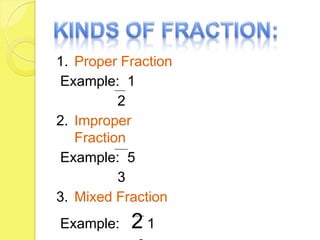
1. Proper Fraction
Example: 1
2
2. Improper
Fraction
Example: 5
3
3. Mixed Fraction
Example: 2 1
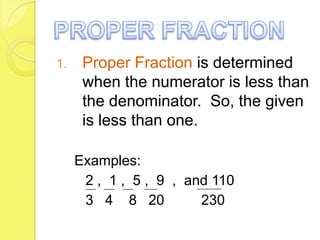
1. Proper Fraction is determined
when the numerator is less than
the denominator. So, the given
is less than one.
Examples:
2 , 1 , 5 , 9 , and 110
3 4 8 20 230
2. Improper Fraction is determined
when the numerator is greater
than the denominator. Thus, the
given is more than one.
Example:
4 7 15 27 30 and 890
3 2 9 16 15 122
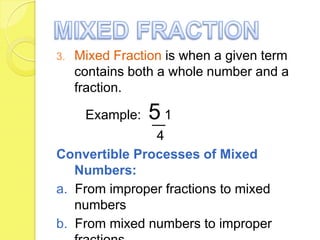
3. Mixed Fraction is when a given term
contains both a whole number and a
fraction.
Example: 5 1
4
Convertible Processes of Mixed
Numbers:
a. From improper fractions to mixed
numbers
b. From mixed numbers to improper
. From improper fractions
to mixed numbers
. From mixed numbers to
improper fractions
 To change an
improper fraction to
mixed number, divide
the denominator into
the numerator. Only
improper fractions
are convertible into
mixed numbers.
 To change a mixed
number to an
improper
fraction, multiply the
denominator into the
whole number, add in
the numerator, and
put over the original
denominator.
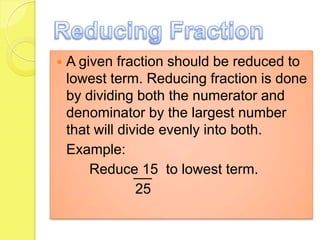
 A given fraction should be reduced to
lowest term. Reducing fraction is done
by dividing both the numerator and
denominator by the largest number
that will divide evenly into both.
Example:
Reduce 15 to lowest term.
25
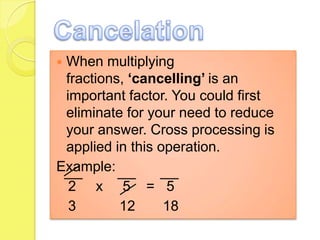
 When multiplying
fractions, „cancelling‟ is an
important factor. You could first
eliminate for your need to reduce
your answer. Cross processing is
applied in this operation.
Example:
2 x 5 = 5
3 12 18
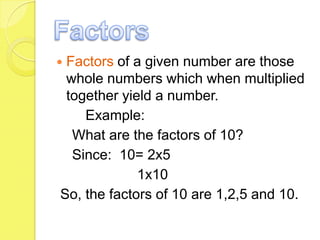
 Factors of a given number are those
whole numbers which when multiplied
together yield a number.
Example:
What are the factors of 10?
Since: 10= 2x5
1x10
So, the factors of 10 are 1,2,5 and 10.
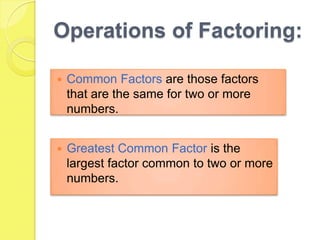
Operations of Factoring:
 Common Factors are those factors
that are the same for two or more
numbers.
 Greatest Common Factor is the
largest factor common to two or more
numbers.
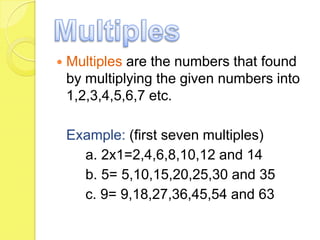
 Multiples are the numbers that found
by multiplying the given numbers into
1,2,3,4,5,6,7 etc.
Example: (first seven multiples)
a. 2x1=2,4,6,8,10,12 and 14
b. 5= 5,10,15,20,25,30 and 35
c. 9= 9,18,27,36,45,54 and 63
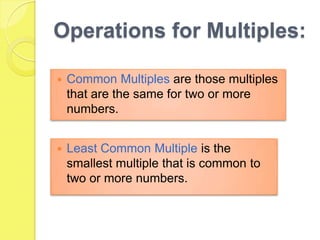
 Common Multiples are those multiples
that are the same for two or more
numbers.
 Least Common Multiple is the
smallest multiple that is common to
two or more numbers.
Operations for Multiples:
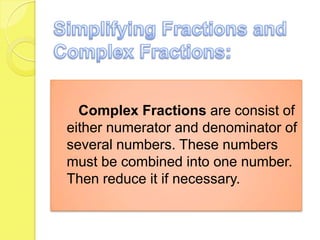
Complex Fractions are consist of
either numerator and denominator of
several numbers. These numbers
must be combined into one number.
Then reduce it if necessary.
“SUCCES IS A DAILY PROCESS”
Thank you for listening
and cooperating 

Fractions (for Demonstration Teaching)

  • 1.
    Operations of Fractions andOperations Complementing Fractions
  • 2.
    WHAT IS FRACTION? Afraction or a fractional number is used to represent a part of a whole.
  • 3.
  • 4.
    NUMERATOR  The numerator tellsus how many of these equal parts are being considered. 2 3 Read as: Three-fourths or 3 out of 4
  • 5.
    DENOMINATOR 3 4  A denominator letsus know the number of equal parts into which something is divided.Read as: Three-fourths or 3 out of 4
  • 6.
    WHAT ARE THE IMPORTANCEOF FRACTION IN OUR LIVES?
  • 7.
    1. Proper Fraction Example:1 2 2. Improper Fraction Example: 5 3 3. Mixed Fraction Example: 2 1
  • 8.
    1. Proper Fractionis determined when the numerator is less than the denominator. So, the given is less than one. Examples: 2 , 1 , 5 , 9 , and 110 3 4 8 20 230
  • 9.
    2. Improper Fractionis determined when the numerator is greater than the denominator. Thus, the given is more than one. Example: 4 7 15 27 30 and 890 3 2 9 16 15 122
  • 10.
    3. Mixed Fractionis when a given term contains both a whole number and a fraction. Example: 5 1 4 Convertible Processes of Mixed Numbers: a. From improper fractions to mixed numbers b. From mixed numbers to improper
  • 11.
    . From improperfractions to mixed numbers . From mixed numbers to improper fractions  To change an improper fraction to mixed number, divide the denominator into the numerator. Only improper fractions are convertible into mixed numbers.  To change a mixed number to an improper fraction, multiply the denominator into the whole number, add in the numerator, and put over the original denominator.
  • 12.
     A givenfraction should be reduced to lowest term. Reducing fraction is done by dividing both the numerator and denominator by the largest number that will divide evenly into both. Example: Reduce 15 to lowest term. 25
  • 13.
     When multiplying fractions,„cancelling‟ is an important factor. You could first eliminate for your need to reduce your answer. Cross processing is applied in this operation. Example: 2 x 5 = 5 3 12 18
  • 14.
     Factors ofa given number are those whole numbers which when multiplied together yield a number. Example: What are the factors of 10? Since: 10= 2x5 1x10 So, the factors of 10 are 1,2,5 and 10.
  • 15.
    Operations of Factoring: Common Factors are those factors that are the same for two or more numbers.  Greatest Common Factor is the largest factor common to two or more numbers.
  • 16.
     Multiples arethe numbers that found by multiplying the given numbers into 1,2,3,4,5,6,7 etc. Example: (first seven multiples) a. 2x1=2,4,6,8,10,12 and 14 b. 5= 5,10,15,20,25,30 and 35 c. 9= 9,18,27,36,45,54 and 63
  • 17.
     Common Multiplesare those multiples that are the same for two or more numbers.  Least Common Multiple is the smallest multiple that is common to two or more numbers. Operations for Multiples:
  • 18.
    Complex Fractions areconsist of either numerator and denominator of several numbers. These numbers must be combined into one number. Then reduce it if necessary.
  • 19.
    “SUCCES IS ADAILY PROCESS” Thank you for listening and cooperating 

Editor's Notes

  • #7 GAME: Throw then count! The teacher will ask two students to oppose one another. The two will throw the dice then what the dice indicates will be consisting the fraction and the teacher will indicate what operation to use. The two students will compete one another to answer the problem first. The first to answer will get the chip 
  • #12 The next move is the solving of problems.. Use the white board..
  • #13 Have the solutions on the board.
  • #15 yield- stop resisting numberAsk them to give numbers that could be factorized..Give this example: Factors of 24: since 24: 1x24 2x12 3x8 4x6
  • #16 Perform the operations on the board.
  • #18 Examples should be done in the whiteboard.
  • #19 Operations should be done in the board.