PRIME AND
COMPOSITE
NUMBERS
Let’s watch!
Let’s Define:
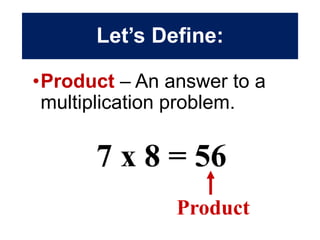
•Product – An answer to a
multiplication problem.
7 x 8 = 56
Product
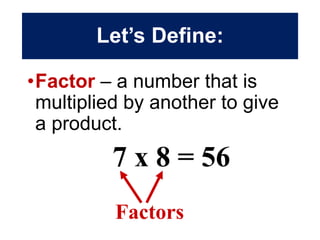
•Factor – a number that is
multiplied by another to give
a product.
7 x 8 = 56
Factors
Let’s Define:
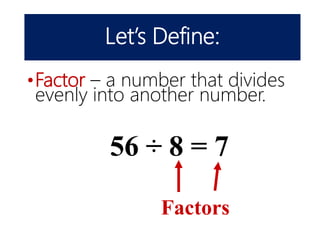
•Factor – a number that divides
evenly into another number.
56 ÷ 8 = 7
Factors
Let’s Define:
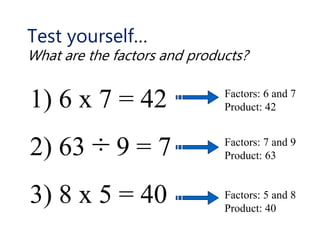
Test yourself…
What are the factors and products?
1) 6 x 7 = 42
2) 63 ÷ 9 = 7
3) 8 x 5 = 40
Factors: 6 and 7
Product: 42
Factors: 7 and 9
Product: 63
Factors: 5 and 8
Product: 40
PRIME AND
COMPOSITE
NUMBERS
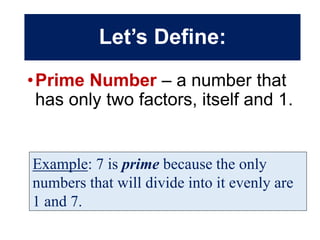
Example: 7 is prime because the only
numbers that will divide into it evenly are
1 and 7.
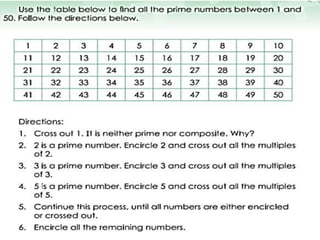
•Prime Number – a number that
has only two factors, itself and 1.
Let’s Define:
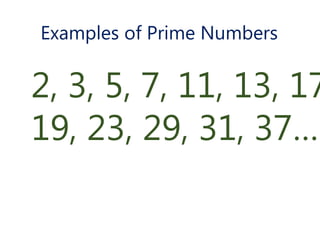
Examples of Prime Numbers
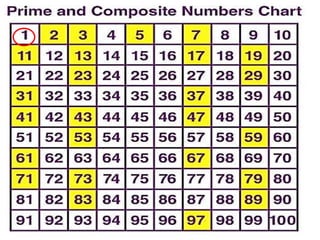
2, 3, 5, 7, 11, 13, 17
19, 23, 29, 31, 37…
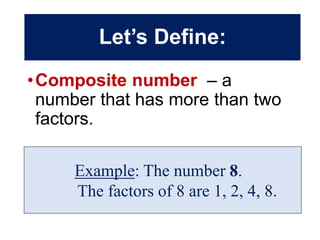
Example: The number 8.
The factors of 8 are 1, 2, 4, 8.
•Composite number – a
number that has more than two
factors.
Let’s Define:
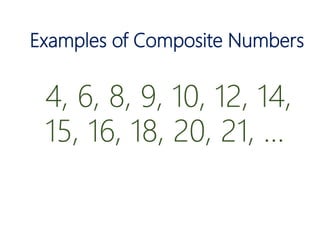
Examples of Composite Numbers
4, 6, 8, 9, 10, 12, 14,
15, 16, 18, 20, 21, …
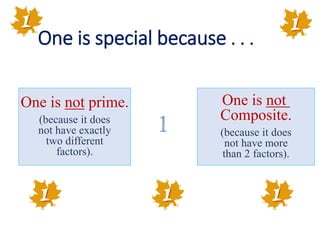
One is special because . . .
One is not prime.
(because it does
not have exactly
two different
factors).
One is not
Composite.
(because it does
not have more
than 2 factors).
One is special because . . .
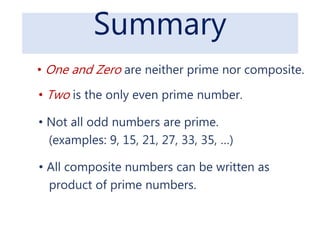
Summary
• One and Zero are neither prime nor composite.
• Two is the only even prime number.
• Not all odd numbers are prime.
(examples: 9, 15, 21, 27, 33, 35, …)
• All composite numbers can be written as
product of prime numbers.
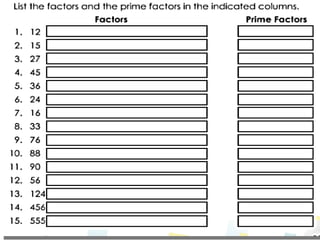
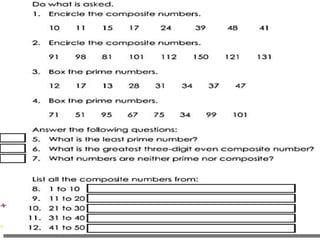
LET’S TRY!
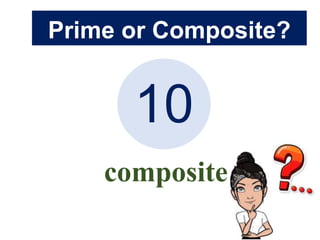
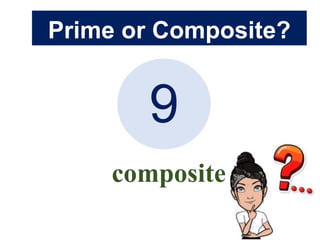
Prime or Composite?
10
composite
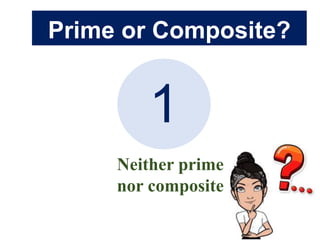
Prime or Composite?
1
Neither prime
nor composite
Prime or Composite?
9
composite
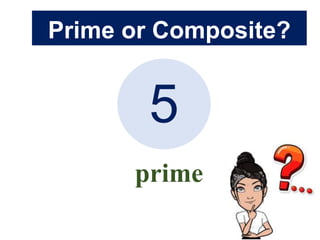
Prime or Composite?
5
prime
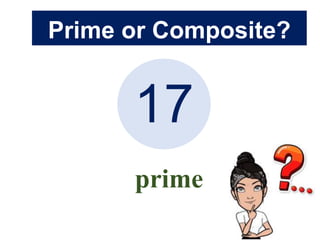
Prime or Composite?
17
prime
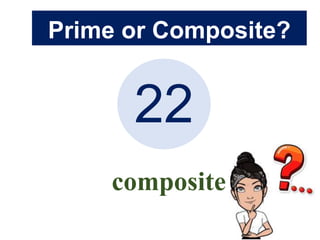
Prime or Composite?
22
composite
Prime or Composite?
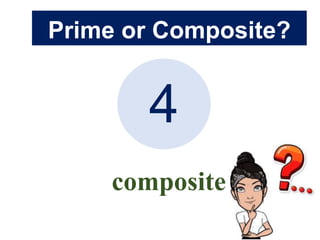
4
composite
Prime or Composite?
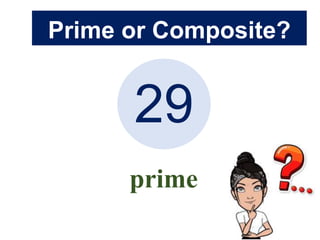
29
prime
Prime or Composite?
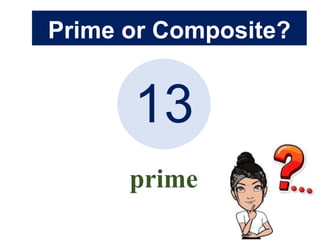
13
prime
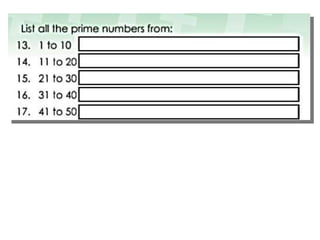
Let’s have some more
exercises!
The End

PRIME AND COMPOSITE NUMBERS.ppt