ADDITION AND SUBTRACTION IS FUN!
By Stephanie Underhill
HOW TO TEACH IT- LESSON
 Have students write either on the board or do on a
  mini white board or on an ipad write problems and
  have them add
 Have the students work in groups to make up their
  own problems for fellow students to solve.
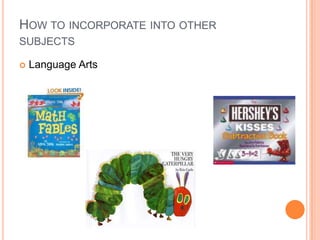
HOW TO INCORPORATE INTO OTHER
SUBJECTS

   Language Arts
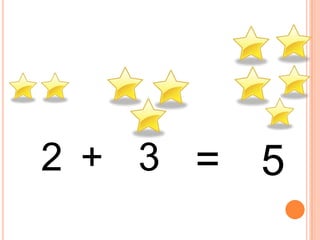
2 + 3 =   5
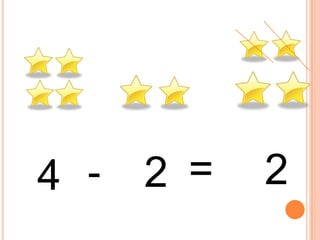
4 -   2 =   2
TECHNOLOGIES USED
 Kidspiration
 http://www.coolmath-games.com/
       They can play games on this site
   http://www.teachervision.fen.com/addition/teacher-
    resources/34522.html
       I will use this to find worksheets for my students
 Textbook online, textbook websites
 Computers
       Power point
   Ipad/ipod touch
       White board app
ELL
 Give them a word bank on tests
 Give them extra time on tests

 Have peers help the students who need help

 Textbooks in their native language as a reference

 Speak some words in their own language
UDL INTEGRATION
 I would give them extra time on tests.
 Work with peers if needed.

 Give them time to ask questions

 Accommodate according to their IEP

 Give them the use of calculators if needed.
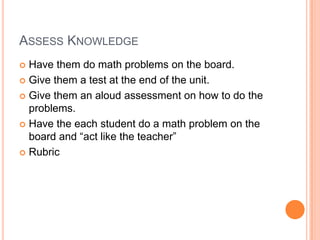
ASSESS KNOWLEDGE
 Have them do math problems on the board.
 Give them a test at the end of the unit.

 Give them an aloud assessment on how to do the
  problems.
 Have the each student do a math problem on the
  board and “act like the teacher”
 Rubric
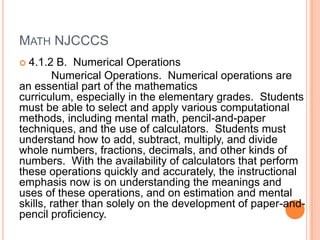
MATH NJCCCS
 4.1.2 B. Numerical Operations
        Numerical Operations. Numerical operations are
an essential part of the mathematics
curriculum, especially in the elementary grades. Students
must be able to select and apply various computational
methods, including mental math, pencil-and-paper
techniques, and the use of calculators. Students must
understand how to add, subtract, multiply, and divide
whole numbers, fractions, decimals, and other kinds of
numbers. With the availability of calculators that perform
these operations quickly and accurately, the instructional
emphasis now is on understanding the meanings and
uses of these operations, and on estimation and mental
skills, rather than solely on the development of paper-and-
pencil proficiency.
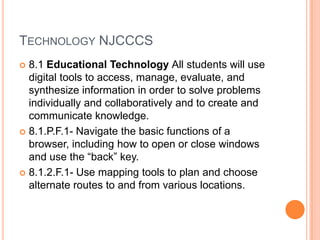
TECHNOLOGY NJCCCS
 8.1 Educational Technology All students will use
  digital tools to access, manage, evaluate, and
  synthesize information in order to solve problems
  individually and collaboratively and to create and
  communicate knowledge.
 8.1.P.F.1- Navigate the basic functions of a
  browser, including how to open or close windows
  and use the “back” key.
 8.1.2.F.1- Use mapping tools to plan and choose
  alternate routes to and from various locations.
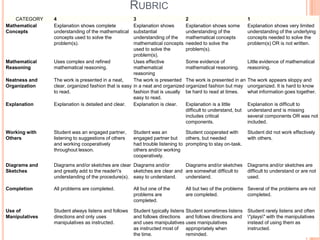
RUBRIC
    CATEGORY    4                                     3                       2                              1
Mathematical    Explanation shows complete            Explanation shows       Explanation shows some         Explanation shows very limited
Concepts        understanding of the mathematical     substantial             understanding of the           understanding of the underlying
                concepts used to solve the            understanding of the    mathematical concepts          concepts needed to solve the
                problem(s).                           mathematical concepts needed to solve the              problem(s) OR is not written.
                                                      used to solve the       problem(s).
                                                      problem(s).
Mathematical    Uses complex and refined              Uses effective          Some evidence of               Little evidence of mathematical
Reasoning       mathematical reasoning.               mathematical            mathematical reasoning.        reasoning.
                                                      reasoning
Neatness and    The work is presented in a neat,      The work is presented The work is presented in an      The work appears sloppy and
Organization    clear, organized fashion that is easy in a neat and organized organized fashion but may      unorganized. It is hard to know
                to read.                              fashion that is usually be hard to read at times.      what information goes together.
                                                      easy to read.
Explanation     Explanation is detailed and clear.    Explanation is clear.   Explanation is a little        Explanation is difficult to
                                                                              difficult to understand, but   understand and is missing
                                                                              includes critical              several components OR was not
                                                                              components.                    included.

Working with    Student was an engaged partner,      Student was an           Student cooperated with        Student did not work effectively
Others          listening to suggestions of others   engaged partner but      others, but needed             with others.
                and working cooperatively            had trouble listening to prompting to stay on-task.
                throughout lesson.                   others and/or working
                                                     cooperatively.
Diagrams and    Diagrams and/or sketches are clear Diagrams and/or        Diagrams and/or sketches           Diagrams and/or sketches are
Sketches        and greatly add to the reader's   sketches are clear and are somewhat difficult to          difficult to understand or are not
                understanding of the procedure(s). easy to understand.    understand.                        used.

Completion      All problems are completed.          All but one of the      All but two of the problems Several of the problems are not
                                                     problems are            are completed.              completed.
                                                     completed.

Use of          Student always listens and follows   Student typically listens Student sometimes listens     Student rarely listens and often
Manipulatives   directions and only uses             and follows directions and follows directions and       "plays" with the manipulatives
                manipulatives as instructed.         and uses manipulatives uses manipulatives               instead of using them as
                                                     as instructed most of appropriately when                instructed.
                                                     the time.                 reminded.
REFERENCES
 http://rubistar.4teachers.org/

 NJCCCS Website

 http://blog.richmond.edu/openwidelookinside/arc
  hives/3121
 http://www.coolmath-games.com/

 http://blog.richmond.edu/openwidelookinside/arc
  hives/3121
   http://whatkidsshouldread.com/childrens-books/the-very-
    hungry-caterpillar-written-by-eric-carle/

Mathematics is fun! power point

  • 1.
    ADDITION AND SUBTRACTIONIS FUN! By Stephanie Underhill
  • 2.
    HOW TO TEACHIT- LESSON  Have students write either on the board or do on a mini white board or on an ipad write problems and have them add  Have the students work in groups to make up their own problems for fellow students to solve.
  • 3.
    HOW TO INCORPORATEINTO OTHER SUBJECTS  Language Arts
  • 4.
    2 + 3= 5
  • 5.
    4 - 2 = 2
  • 6.
    TECHNOLOGIES USED  Kidspiration http://www.coolmath-games.com/  They can play games on this site  http://www.teachervision.fen.com/addition/teacher- resources/34522.html  I will use this to find worksheets for my students  Textbook online, textbook websites  Computers  Power point  Ipad/ipod touch  White board app
  • 7.
    ELL  Give thema word bank on tests  Give them extra time on tests  Have peers help the students who need help  Textbooks in their native language as a reference  Speak some words in their own language
  • 8.
    UDL INTEGRATION  Iwould give them extra time on tests.  Work with peers if needed.  Give them time to ask questions  Accommodate according to their IEP  Give them the use of calculators if needed.
  • 9.
    ASSESS KNOWLEDGE  Havethem do math problems on the board.  Give them a test at the end of the unit.  Give them an aloud assessment on how to do the problems.  Have the each student do a math problem on the board and “act like the teacher”  Rubric
  • 10.
    MATH NJCCCS  4.1.2B. Numerical Operations Numerical Operations. Numerical operations are an essential part of the mathematics curriculum, especially in the elementary grades. Students must be able to select and apply various computational methods, including mental math, pencil-and-paper techniques, and the use of calculators. Students must understand how to add, subtract, multiply, and divide whole numbers, fractions, decimals, and other kinds of numbers. With the availability of calculators that perform these operations quickly and accurately, the instructional emphasis now is on understanding the meanings and uses of these operations, and on estimation and mental skills, rather than solely on the development of paper-and- pencil proficiency.
  • 11.
    TECHNOLOGY NJCCCS  8.1Educational Technology All students will use digital tools to access, manage, evaluate, and synthesize information in order to solve problems individually and collaboratively and to create and communicate knowledge.  8.1.P.F.1- Navigate the basic functions of a browser, including how to open or close windows and use the “back” key.  8.1.2.F.1- Use mapping tools to plan and choose alternate routes to and from various locations.
  • 12.
    RUBRIC CATEGORY 4 3 2 1 Mathematical Explanation shows complete Explanation shows Explanation shows some Explanation shows very limited Concepts understanding of the mathematical substantial understanding of the understanding of the underlying concepts used to solve the understanding of the mathematical concepts concepts needed to solve the problem(s). mathematical concepts needed to solve the problem(s) OR is not written. used to solve the problem(s). problem(s). Mathematical Uses complex and refined Uses effective Some evidence of Little evidence of mathematical Reasoning mathematical reasoning. mathematical mathematical reasoning. reasoning. reasoning Neatness and The work is presented in a neat, The work is presented The work is presented in an The work appears sloppy and Organization clear, organized fashion that is easy in a neat and organized organized fashion but may unorganized. It is hard to know to read. fashion that is usually be hard to read at times. what information goes together. easy to read. Explanation Explanation is detailed and clear. Explanation is clear. Explanation is a little Explanation is difficult to difficult to understand, but understand and is missing includes critical several components OR was not components. included. Working with Student was an engaged partner, Student was an Student cooperated with Student did not work effectively Others listening to suggestions of others engaged partner but others, but needed with others. and working cooperatively had trouble listening to prompting to stay on-task. throughout lesson. others and/or working cooperatively. Diagrams and Diagrams and/or sketches are clear Diagrams and/or Diagrams and/or sketches Diagrams and/or sketches are Sketches and greatly add to the reader's sketches are clear and are somewhat difficult to difficult to understand or are not understanding of the procedure(s). easy to understand. understand. used. Completion All problems are completed. All but one of the All but two of the problems Several of the problems are not problems are are completed. completed. completed. Use of Student always listens and follows Student typically listens Student sometimes listens Student rarely listens and often Manipulatives directions and only uses and follows directions and follows directions and "plays" with the manipulatives manipulatives as instructed. and uses manipulatives uses manipulatives instead of using them as as instructed most of appropriately when instructed. the time. reminded.
  • 13.
    REFERENCES  http://rubistar.4teachers.org/  NJCCCSWebsite  http://blog.richmond.edu/openwidelookinside/arc hives/3121  http://www.coolmath-games.com/  http://blog.richmond.edu/openwidelookinside/arc hives/3121  http://whatkidsshouldread.com/childrens-books/the-very- hungry-caterpillar-written-by-eric-carle/