Vegetation in India By Snehal Bhargava VI-B
Vegetation of India can be divided into five types  Due to varied climatic conditions, India has a wide range of natural vegetation. Tropical evergreen forests  Tropical deciduous forests  Tropical thorn forests and scrubs  Mountain forests  Mangrove forests
TROPICAL RAIN FOREST Tropical Rain Forests occur in the areas which receive heavy rainfall.  They are so dense that sunlight doesn’t reach the ground.  Many species of trees are found in these forests, which shed their leaves at different times of the year. As a result, they always appear green and are called  evergreen forest. Important trees found in these forests are  mahogany, ebony and rosewood .  Andaman and Nicobar Islands, parts of North-Eastern states and a narrow strip of the Western slope of the Western Ghats are home of these forests.
TROPICAL RAIN FOREST
TROPICAL DECIDUOUS FORESTS Large part of India has this type of forest.  These forests are also called  monsoon forests.   They are less dense. They  shed  their leaves at a particular time of the year.  Important trees of these forests are  sal, teak, peepal, neem and shisham .  They are found in Madhya Pradesh, Uttar Pradesh, Bihar, Jharkhand, Chhattisgarh, Orissa, and in parts of Maharashtra.
TROPICAL DECIDUOUS FORESTS
TROPICAL DECIDUOUS FORESTS- Trees  shed  their leaves at a particular time of the year.
Tropical thorn forests and scrubs  This type of vegetation is found in dry areas.  The leaves are in the form of spines to reduce the loss of water.  Cactus, khair, babool, keekar  are important trees/ plant of these area. They are found in the states of Rajasthan, Punjab, Haryana, Eastern slopes of Western Ghats and Gujarat.
Tropical thorn forests and scrubs
MOUNTAIN VEGETATION A wide range of species is found in the mountains according to the variation in height.  With increase in height, the temperature falls.  At a height between 1500 metres and 2500 metres most of the trees are conical in shape. These trees are called coniferous trees.  Chir, Pine and Deodar  are important trees of these forests.
MOUNTAIN VEGETATION
MOUNTAIN VEGETATION
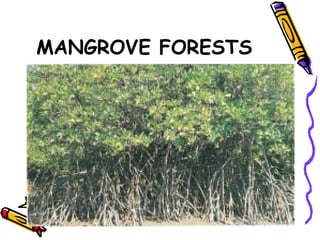
MANGROVE FORESTS These forests can survive in  saline water . They are found mainly in  Sunderbans  in West Bengal and in the  Andaman and Nicobar Islands .  Sundari  is a well-known species of trees in mangrove forests after which  Sunderbans  have been named.
MANGROVE FORESTS
WHY ARE FORESTS NECESSARY? Forests are very useful for us. They perform various functions.  Plants release oxygen that we breathe and absorb  carbon dioxide .  The roots of the plants bind the soil; thus, they control soil erosion.  Forests provide us with timber for furniture, fuel wood, fodder, medicinal plants and herbs, lac, honey, gum, etc.  Forests are the natural habitat of wild life.
USES OF FORESTS
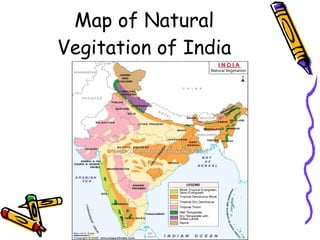
Map of Natural Vegitation of India
Thanks

Vegetation in india

  • 1.
    Vegetation in IndiaBy Snehal Bhargava VI-B
  • 2.
    Vegetation of Indiacan be divided into five types Due to varied climatic conditions, India has a wide range of natural vegetation. Tropical evergreen forests Tropical deciduous forests Tropical thorn forests and scrubs Mountain forests Mangrove forests
  • 3.
    TROPICAL RAIN FORESTTropical Rain Forests occur in the areas which receive heavy rainfall. They are so dense that sunlight doesn’t reach the ground. Many species of trees are found in these forests, which shed their leaves at different times of the year. As a result, they always appear green and are called evergreen forest. Important trees found in these forests are mahogany, ebony and rosewood . Andaman and Nicobar Islands, parts of North-Eastern states and a narrow strip of the Western slope of the Western Ghats are home of these forests.
  • 4.
  • 5.
    TROPICAL DECIDUOUS FORESTSLarge part of India has this type of forest. These forests are also called monsoon forests. They are less dense. They shed their leaves at a particular time of the year. Important trees of these forests are sal, teak, peepal, neem and shisham . They are found in Madhya Pradesh, Uttar Pradesh, Bihar, Jharkhand, Chhattisgarh, Orissa, and in parts of Maharashtra.
  • 6.
  • 7.
    TROPICAL DECIDUOUS FORESTS-Trees shed their leaves at a particular time of the year.
  • 8.
    Tropical thorn forestsand scrubs This type of vegetation is found in dry areas. The leaves are in the form of spines to reduce the loss of water. Cactus, khair, babool, keekar are important trees/ plant of these area. They are found in the states of Rajasthan, Punjab, Haryana, Eastern slopes of Western Ghats and Gujarat.
  • 9.
  • 10.
    MOUNTAIN VEGETATION Awide range of species is found in the mountains according to the variation in height. With increase in height, the temperature falls. At a height between 1500 metres and 2500 metres most of the trees are conical in shape. These trees are called coniferous trees. Chir, Pine and Deodar are important trees of these forests.
  • 11.
  • 12.
  • 13.
    MANGROVE FORESTS Theseforests can survive in saline water . They are found mainly in Sunderbans in West Bengal and in the Andaman and Nicobar Islands . Sundari is a well-known species of trees in mangrove forests after which Sunderbans have been named.
  • 14.
  • 15.
    WHY ARE FORESTSNECESSARY? Forests are very useful for us. They perform various functions. Plants release oxygen that we breathe and absorb carbon dioxide . The roots of the plants bind the soil; thus, they control soil erosion. Forests provide us with timber for furniture, fuel wood, fodder, medicinal plants and herbs, lac, honey, gum, etc. Forests are the natural habitat of wild life.
  • 16.
  • 17.
    Map of NaturalVegitation of India
  • 18.