Four stage drug development: scaleup
studies And Commercialization.
PRESENTED BY:
GANESH PATIL
REG NO:PE/2022/301
M.S.PHARMACEUTICS
DEPARTMENT, NIPER HYDERABAD.
Contents
Introduction
overview of stages in the drug development process
Stage 1: Pre-formulation
Stage 2: Prototype Development
Stage 3: Biological Aspects
Stage 4: Scale Up Studies and Commercialization
Introduction
 Drug development is a complex process that involves several stages, from initial
discovery of a potential drug target to approval and commercialization of a new
drug.
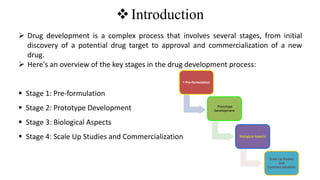
 Here's an overview of the key stages in the drug development process:
 Stage 1: Pre-formulation
 Stage 2: Prototype Development
 Stage 3: Biological Aspects
 Stage 4: Scale Up Studies and Commercialization
 Pre-formulation
Prototype
Development
Biological Aspects
Scale Up Studies
and
Commercialization
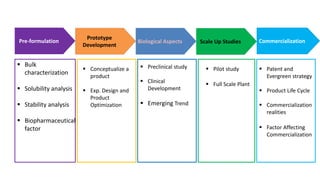
Pre-formulation
Prototype
Development
Biological Aspects Scale Up Studies Commercialization
 Bulk
characterization
 Solubility analysis
 Stability analysis
 Biopharmaceutical
factor
 Preclinical study
 Clinical
Development
 Emerging Trend
 Conceptualize a
product
 Exp. Design and
Product
Optimization
 Patent and
Evergreen strategy
 Product Life Cycle
 Commercialization
realities
 Factor Affecting
Commercialization
 Pilot study
 Full Scale Plant
Stage 1: PRE-FORMULATION
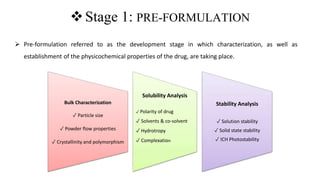
 Pre-formulation referred to as the development stage in which characterization, as well as
establishment of the physicochemical properties of the drug, are taking place.
Bulk Characterization
✓ Particle size
✓ Powder flow properties
✓ Crystallinity and polymorphism
Solubility Analysis
✓ Polarity of drug
✓ Solvents & co-solvent
✓ Hydrotropy
✓ Complexation
Stability Analysis
✓ Solution stability
✓ Solid state stability
✓ ICH Photostability
Stage 2:Prototype Development
IDEA CONCEPT
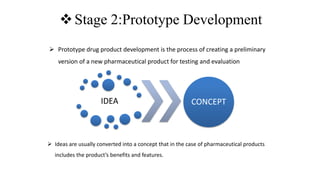
 Prototype drug product development is the process of creating a preliminary
version of a new pharmaceutical product for testing and evaluation
 Ideas are usually converted into a concept that in the case of pharmaceutical products
includes the product’s benefits and features.
Stage 2: Prototype Development
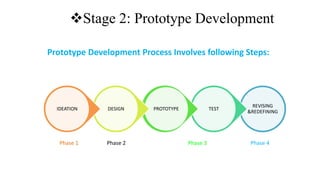
REVISING
&REDEFINING
TEST
PROTOTYPE
DESIGN
IDEATION
Prototype Development Process Involves following Steps:
Phase 1 Phase 2 Phase 3 Phase 4
Stage 2: Prototype Development
 Conceptualize a product:
• Aspects regarding the active pharmaceutical ingredients (APIs) and their chemical nature are covered.
• Safety and efficacy concerns during the preclinical and the clinical stages of drug developments are
also discussed in addition to the issues of regulation and intellectual property.
• Pharmaceutical chemists and formulators typically tend to modify the drug’s chemical, physical,
economic, and biological characteristics by following the technique of salt conversion of drug
substances E.g.
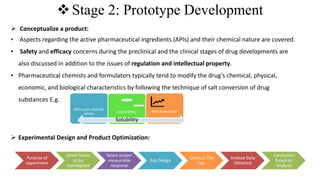
 Experimental Design and Product Optimization:
With cyclic aliphatic
amine DICLOFENAC With Sodium Salt
Solubility
Purpose of
experiment
Select factor
to be
investigated
Select proper
measurable
response
Exp.Design
Conduct The
Exp.
Analyze Data
Obtained
Conclusion
Based on
Analysis
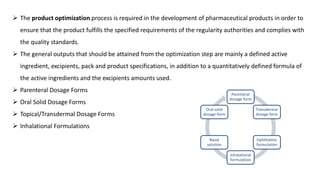
 The product optimization process is required in the development of pharmaceutical products in order to
ensure that the product fulfills the specified requirements of the regularity authorities and complies with
the quality standards.
 The general outputs that should be attained from the optimization step are mainly a defined active
ingredient, excipients, pack and product specifications, in addition to a quantitatively defined formula of
the active ingredients and the excipients amounts used.
 Parenteral Dosage Forms
 Oral Solid Dosage Forms
 Topical/Transdermal Dosage Forms
 Inhalational Formulations
Parenteral
dosage form
Transdermal
dosage form
Ophthalmic
formulation
Inhalational
formulation
Nasal
solution
Oral solid
dosage form
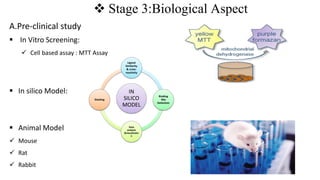
 Stage 3:Biological Aspect
A.Pre-clinical study
 In Vitro Screening:
 Cell based assay : MTT Assay
 In silico Model:
 Animal Model
 Mouse
 Rat
 Rabbit
IN
SILICO
MODEL
Ligand
Similarity
& cross-
reactivity
Binding
Site
Detection
Data
analysis
&visualizatio
n
Docking
Stage 3:Biological Aspect
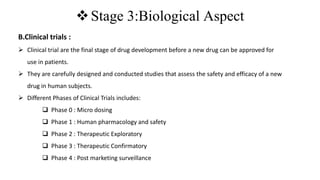
B.Clinical trials :
 Clinical trial are the final stage of drug development before a new drug can be approved for
use in patients.
 They are carefully designed and conducted studies that assess the safety and efficacy of a new
drug in human subjects.
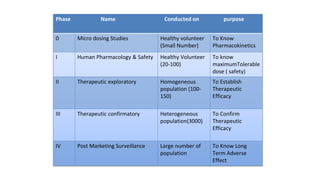
 Different Phases of Clinical Trials includes:
 Phase 0 : Micro dosing
 Phase 1 : Human pharmacology and safety
 Phase 2 : Therapeutic Exploratory
 Phase 3 : Therapeutic Confirmatory
 Phase 4 : Post marketing surveillance
Phase Name Conducted on purpose
0 Micro dosing Studies Healthy volunteer
(Small Number)
To Know
Pharmacokinetics
I Human Pharmacology & Safety Healthy Volunteer
(20-100)
To know
maximumTolerable
dose ( safety)
II Therapeutic exploratory Homogeneous
population (100-
150)
To Establish
Therapeutic
Efficacy
III Therapeutic confirmatory Heterogeneous
population(3000)
To Confirm
Therapeutic
Efficacy
IV Post Marketing Surveillance Large number of
population
To Know Long
Term Adverse
Effect
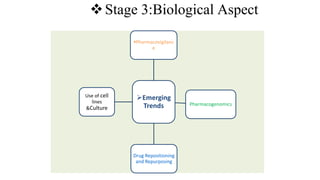
Stage 3:Biological Aspect
Emerging
Trends
Pharmacovigilanc
e
Pharmacogenomics
Drug Repositioning
and Repurposing
Use of cell
lines
&Culture
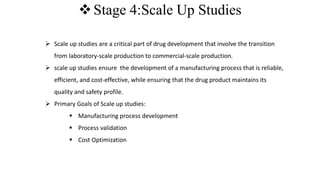
Stage 4:Scale Up Studies
 Scale up studies are a critical part of drug development that involve the transition
from laboratory-scale production to commercial-scale production.
 scale up studies ensure the development of a manufacturing process that is reliable,
efficient, and cost-effective, while ensuring that the drug product maintains its
quality and safety profile.
 Primary Goals of Scale up studies:
 Manufacturing process development
 Process validation
 Cost Optimization
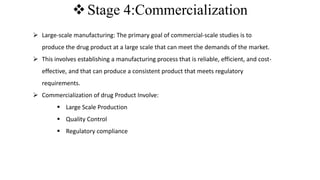
Stage 4:Commercialization
 Large-scale manufacturing: The primary goal of commercial-scale studies is to
produce the drug product at a large scale that can meet the demands of the market.
 This involves establishing a manufacturing process that is reliable, efficient, and cost-
effective, and that can produce a consistent product that meets regulatory
requirements.
 Commercialization of drug Product Involve:
 Large Scale Production
 Quality Control
 Regulatory compliance
References
 Basant Amarji1 , Sara Nidal Abed2 et.al,2018.’ Four Stages of Pharmaceutical Product
Development: Pre formulation, Prototype Development and Scale-Up, Biological Aspects, and
Commercialization’ chapter 18,(638-650)
 Gobind Rai Garg, Sparsh Gupta, Review of pharmacology.16th edition 2022 oct; page no.11-12
 Deore AB, dhumane JR, wagh HV, Sonawane RB, The Stages of Drug Discovery and Development
Process. Asian Journal of Pharmaceutical Research and Development. 2019; 7(6):62-67
Four Stage Drug Development.

Four Stage Drug Development.

  • 1.
    Four stage drugdevelopment: scaleup studies And Commercialization. PRESENTED BY: GANESH PATIL REG NO:PE/2022/301 M.S.PHARMACEUTICS DEPARTMENT, NIPER HYDERABAD.
  • 2.
    Contents Introduction overview of stagesin the drug development process Stage 1: Pre-formulation Stage 2: Prototype Development Stage 3: Biological Aspects Stage 4: Scale Up Studies and Commercialization
  • 3.
    Introduction  Drug developmentis a complex process that involves several stages, from initial discovery of a potential drug target to approval and commercialization of a new drug.  Here's an overview of the key stages in the drug development process:  Stage 1: Pre-formulation  Stage 2: Prototype Development  Stage 3: Biological Aspects  Stage 4: Scale Up Studies and Commercialization  Pre-formulation Prototype Development Biological Aspects Scale Up Studies and Commercialization
  • 4.
    Pre-formulation Prototype Development Biological Aspects ScaleUp Studies Commercialization  Bulk characterization  Solubility analysis  Stability analysis  Biopharmaceutical factor  Preclinical study  Clinical Development  Emerging Trend  Conceptualize a product  Exp. Design and Product Optimization  Patent and Evergreen strategy  Product Life Cycle  Commercialization realities  Factor Affecting Commercialization  Pilot study  Full Scale Plant
  • 5.
    Stage 1: PRE-FORMULATION Pre-formulation referred to as the development stage in which characterization, as well as establishment of the physicochemical properties of the drug, are taking place. Bulk Characterization ✓ Particle size ✓ Powder flow properties ✓ Crystallinity and polymorphism Solubility Analysis ✓ Polarity of drug ✓ Solvents & co-solvent ✓ Hydrotropy ✓ Complexation Stability Analysis ✓ Solution stability ✓ Solid state stability ✓ ICH Photostability
  • 6.
    Stage 2:Prototype Development IDEACONCEPT  Prototype drug product development is the process of creating a preliminary version of a new pharmaceutical product for testing and evaluation  Ideas are usually converted into a concept that in the case of pharmaceutical products includes the product’s benefits and features.
  • 7.
    Stage 2: PrototypeDevelopment REVISING &REDEFINING TEST PROTOTYPE DESIGN IDEATION Prototype Development Process Involves following Steps: Phase 1 Phase 2 Phase 3 Phase 4
  • 8.
    Stage 2: PrototypeDevelopment  Conceptualize a product: • Aspects regarding the active pharmaceutical ingredients (APIs) and their chemical nature are covered. • Safety and efficacy concerns during the preclinical and the clinical stages of drug developments are also discussed in addition to the issues of regulation and intellectual property. • Pharmaceutical chemists and formulators typically tend to modify the drug’s chemical, physical, economic, and biological characteristics by following the technique of salt conversion of drug substances E.g.  Experimental Design and Product Optimization: With cyclic aliphatic amine DICLOFENAC With Sodium Salt Solubility Purpose of experiment Select factor to be investigated Select proper measurable response Exp.Design Conduct The Exp. Analyze Data Obtained Conclusion Based on Analysis
  • 9.
     The productoptimization process is required in the development of pharmaceutical products in order to ensure that the product fulfills the specified requirements of the regularity authorities and complies with the quality standards.  The general outputs that should be attained from the optimization step are mainly a defined active ingredient, excipients, pack and product specifications, in addition to a quantitatively defined formula of the active ingredients and the excipients amounts used.  Parenteral Dosage Forms  Oral Solid Dosage Forms  Topical/Transdermal Dosage Forms  Inhalational Formulations Parenteral dosage form Transdermal dosage form Ophthalmic formulation Inhalational formulation Nasal solution Oral solid dosage form
  • 10.
     Stage 3:BiologicalAspect A.Pre-clinical study  In Vitro Screening:  Cell based assay : MTT Assay  In silico Model:  Animal Model  Mouse  Rat  Rabbit IN SILICO MODEL Ligand Similarity & cross- reactivity Binding Site Detection Data analysis &visualizatio n Docking
  • 11.
    Stage 3:Biological Aspect B.Clinicaltrials :  Clinical trial are the final stage of drug development before a new drug can be approved for use in patients.  They are carefully designed and conducted studies that assess the safety and efficacy of a new drug in human subjects.  Different Phases of Clinical Trials includes:  Phase 0 : Micro dosing  Phase 1 : Human pharmacology and safety  Phase 2 : Therapeutic Exploratory  Phase 3 : Therapeutic Confirmatory  Phase 4 : Post marketing surveillance
  • 12.
    Phase Name Conductedon purpose 0 Micro dosing Studies Healthy volunteer (Small Number) To Know Pharmacokinetics I Human Pharmacology & Safety Healthy Volunteer (20-100) To know maximumTolerable dose ( safety) II Therapeutic exploratory Homogeneous population (100- 150) To Establish Therapeutic Efficacy III Therapeutic confirmatory Heterogeneous population(3000) To Confirm Therapeutic Efficacy IV Post Marketing Surveillance Large number of population To Know Long Term Adverse Effect
  • 13.
  • 14.
    Stage 4:Scale UpStudies  Scale up studies are a critical part of drug development that involve the transition from laboratory-scale production to commercial-scale production.  scale up studies ensure the development of a manufacturing process that is reliable, efficient, and cost-effective, while ensuring that the drug product maintains its quality and safety profile.  Primary Goals of Scale up studies:  Manufacturing process development  Process validation  Cost Optimization
  • 15.
    Stage 4:Commercialization  Large-scalemanufacturing: The primary goal of commercial-scale studies is to produce the drug product at a large scale that can meet the demands of the market.  This involves establishing a manufacturing process that is reliable, efficient, and cost- effective, and that can produce a consistent product that meets regulatory requirements.  Commercialization of drug Product Involve:  Large Scale Production  Quality Control  Regulatory compliance
  • 16.
    References  Basant Amarji1, Sara Nidal Abed2 et.al,2018.’ Four Stages of Pharmaceutical Product Development: Pre formulation, Prototype Development and Scale-Up, Biological Aspects, and Commercialization’ chapter 18,(638-650)  Gobind Rai Garg, Sparsh Gupta, Review of pharmacology.16th edition 2022 oct; page no.11-12  Deore AB, dhumane JR, wagh HV, Sonawane RB, The Stages of Drug Discovery and Development Process. Asian Journal of Pharmaceutical Research and Development. 2019; 7(6):62-67