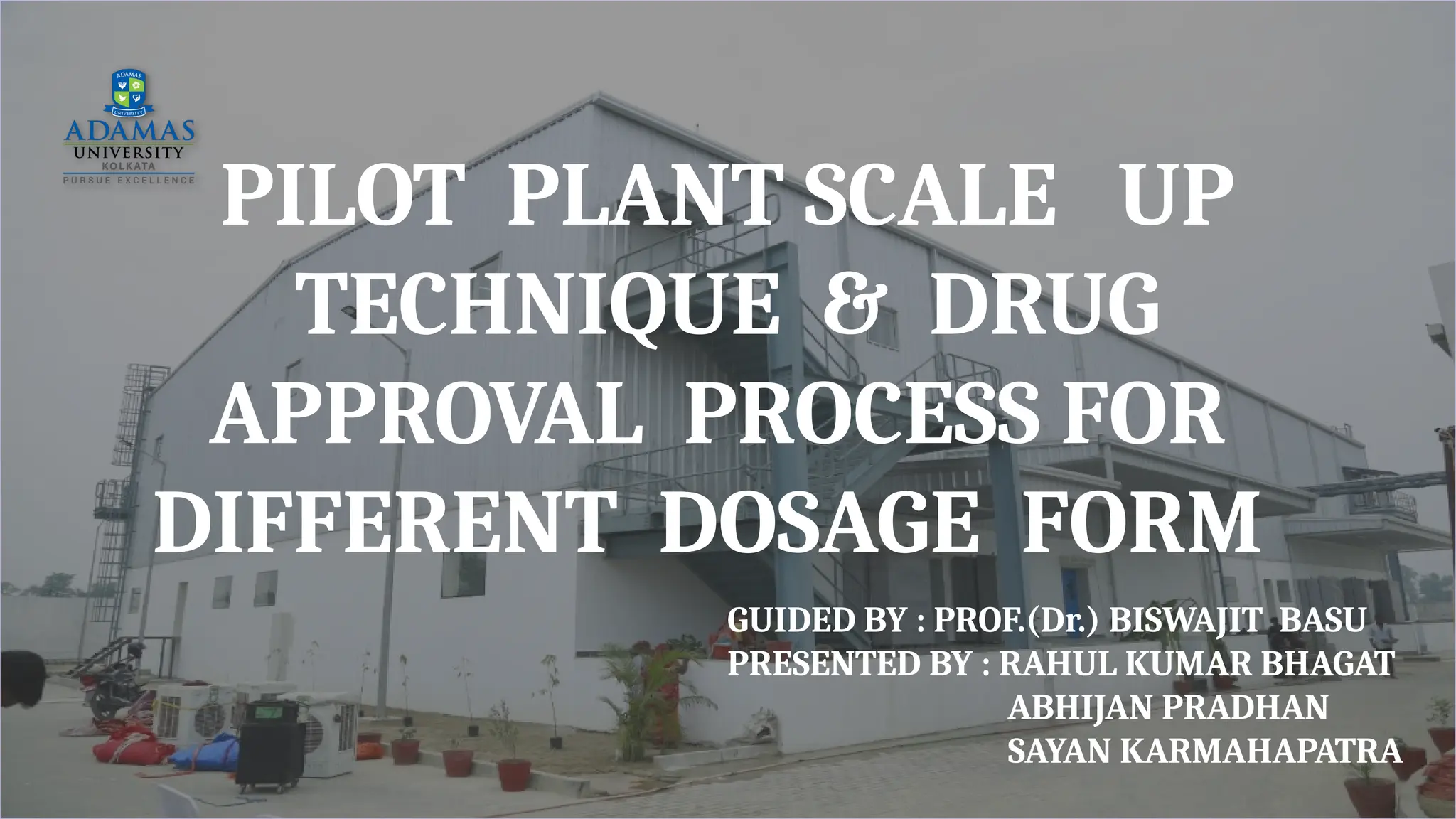
PILOT PLANT SCALE UP
TECHNIQUE & DRUG
APPROVAL PROCESS FOR
DIFFERENT DOSAGE FORM
GUIDED BY : PROF.(Dr.) BISWAJIT BASU
PRESENTED BY : RAHUL KUMAR BHAGAT
ABHIJAN PRADHAN
SAYAN KARMAHAPATRA
TABLE OF CONTENT
TOPIC PAGE NO.
 Introduction
 Calibration of glassware in pharmaceuticals
 Preformulation
 Pilot Plant Scale Up
 Manufacturing procedure of different dosage form
 Drug approval process
 Conclusion
 Reference
INTRODUCTION
In pharmaceutical development, the pilot plant scale-up process transforms small
lab-scale drug formulations into larger, production-ready batches. This step ensures
the manufacturing process is consistent, safe, and able to maintain product quality
on a commercial scale.
Alongside scale-up, the drug approval process—regulated by agencies like the FDA
or EMA—assesses a drug’s safety, efficacy, and quality before it reaches the market.
Each dosage form, such as tablets, injectables, or topical products, has specific
testing and regulatory standards, ensuring that every form meets rigorous health and
safety requirements.
Calibration of Glassware in Pharmaceuticals
Common glassware to calibrate includes volumetric flask , burettes ,
pipettes , graduated cylinder and beakers.
For example : Calibration of Volumetric Flask
1. Clean and rinse three 25 or 50 mL volumetric flasks with acetone (2-3
rinses, ~2 mL each). Let acetone evaporate and label each flask.
2. Weigh each empty flask with stopper; record weights.
3. Pour deionized water into a beaker, measure its temperature, and use the
density table to find water density. Fill each flask to the fill line with water,
weigh, and record.
4. Return water to beaker. Rinse flasks with acetone and repeat steps 2-3
until you have three mass measurements per flask.
Calibration of Glassware in pharmaceutical cont.
5. Calculate each flask's water volume and find the mean for each.
The volume of an object if the mass and density are known:
The density of water can vary slightly depending on the temperature. At around 25°C
(77°F), the density of water is approximately 0.99602 g/cm³.
Pre-formulation
• It is defined as the phase of research and development in which
pre-formulation studies characterize physical and chemical
properties of a drug molecule in order to develop safe , effective
and stable dosage form.
• The meaning of pre-formulation refers to the steps to be
undertaken before formulation.
Preformulation cont.
 Physiochemical parameter
1. Organoleptic properties
2. Bulk characterization studies:
a) Crystallinity and polymorphism
b) Hygroscopicity
c) Fine particle characterization
d) Powder flow properties
3. Solubility analysis:
a) pH solubility profile
b) pKa determination
c) Partition coefficient
d) Dissolution studies
e) Common ion effect
4. Stability analysis:
a) Solution stability
b) Solid state stability
Pilot Plant Scale Up
• Pilot plant: - It is the part of the pharmaceutical industry
whereas lab scale formula is transformed into a viable
product by development practical procedure of
manufacture.
• Scale-up: - The art for designing of prototype using the
data obtained from the pilot plant model.
Objectives
Avoidance of the problems associated with the scale-up.
 Production and process controls guidelines preparation.
 To identify the critical features of the process
 Preparation and providing of Master Manufacturing
Formula for manufacturing.
 Evaluation and Validation for process and equipment.
 Examination of the formula to assess the batch stability.
Pilot Plant Layout
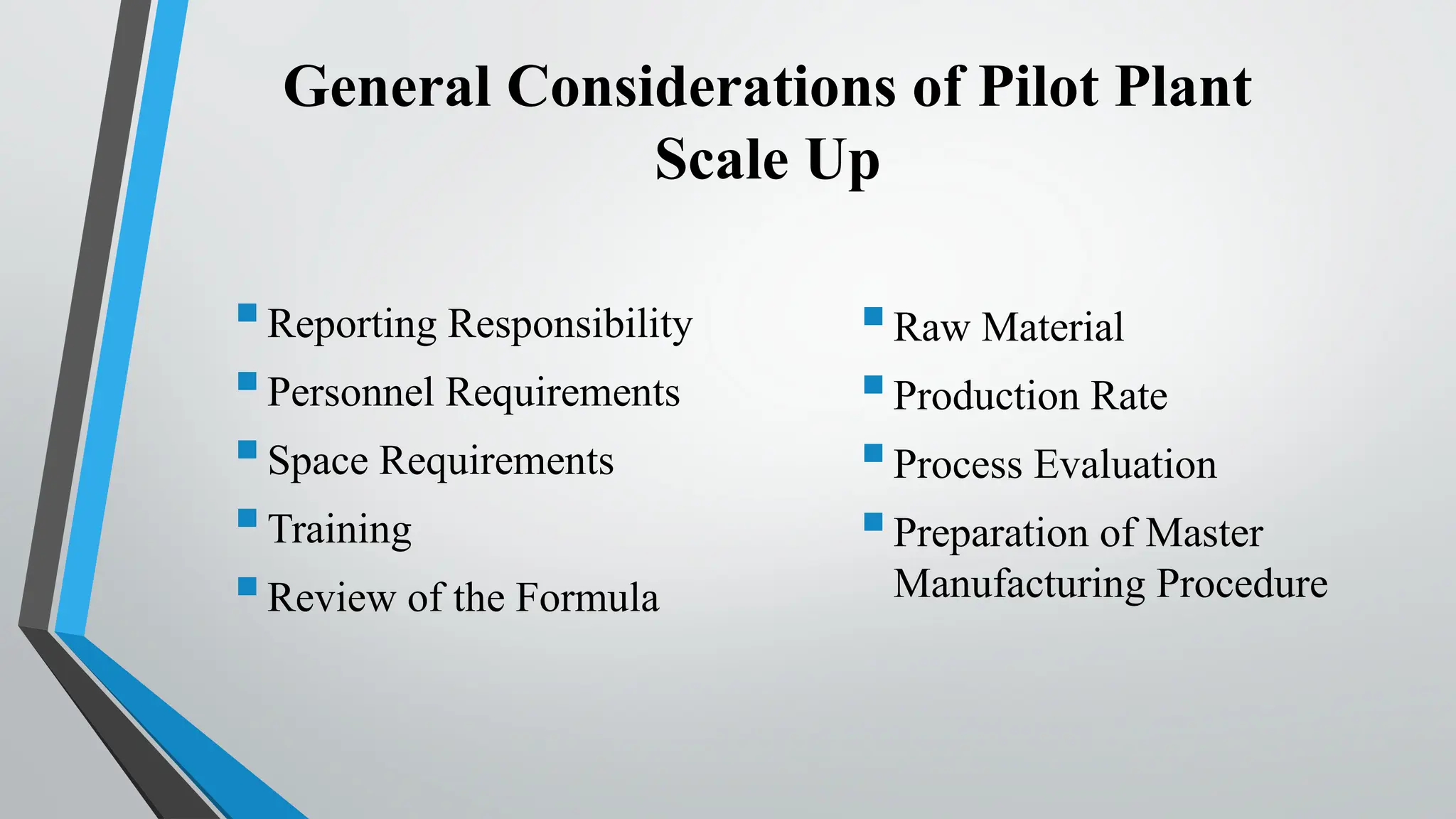
General Considerations of Pilot Plant
Scale Up
Reporting Responsibility
Personnel Requirements
Space Requirements
Training
Review of the Formula
Raw Material
Production Rate
Process Evaluation
Preparation of Master
Manufacturing Procedure
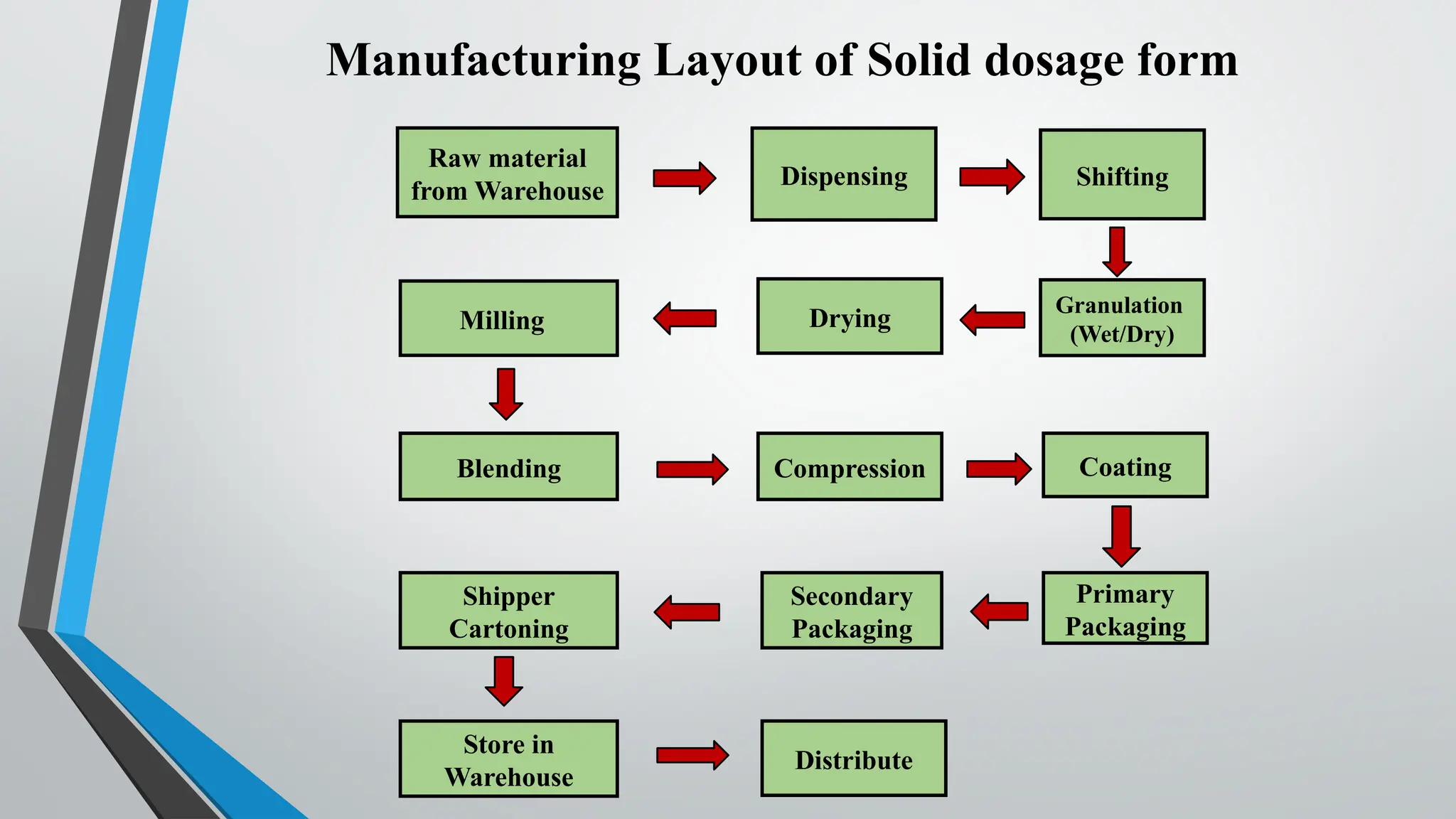
Manufacturing Layout of Solid dosage form
Raw material
from Warehouse
Shifting
Dispensing
Granulation
(Wet/Dry)
Drying
Milling
Blending Compression Coating
Primary
Packaging
Secondary
Packaging
Shipper
Cartoning
Store in
Warehouse
Distribute
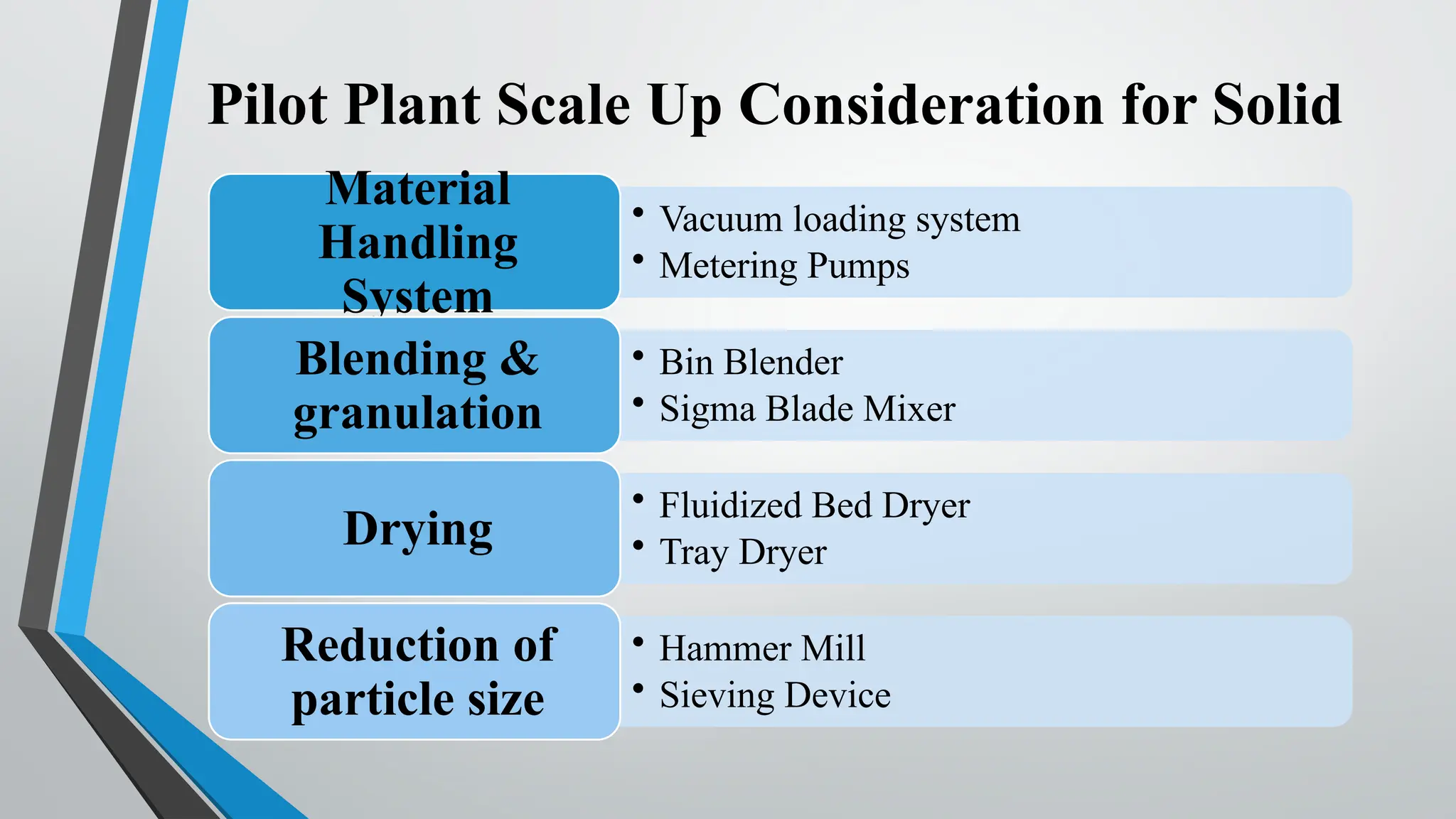
Pilot Plant Scale Up Consideration for Solid
• Vacuum loading system
• Metering Pumps
Material
Handling
System
• Bin Blender
• Sigma Blade Mixer
Blending &
granulation
• Fluidized Bed Dryer
• Tray Dryer
Drying
• Hammer Mill
• Sieving Device
Reduction of
particle size
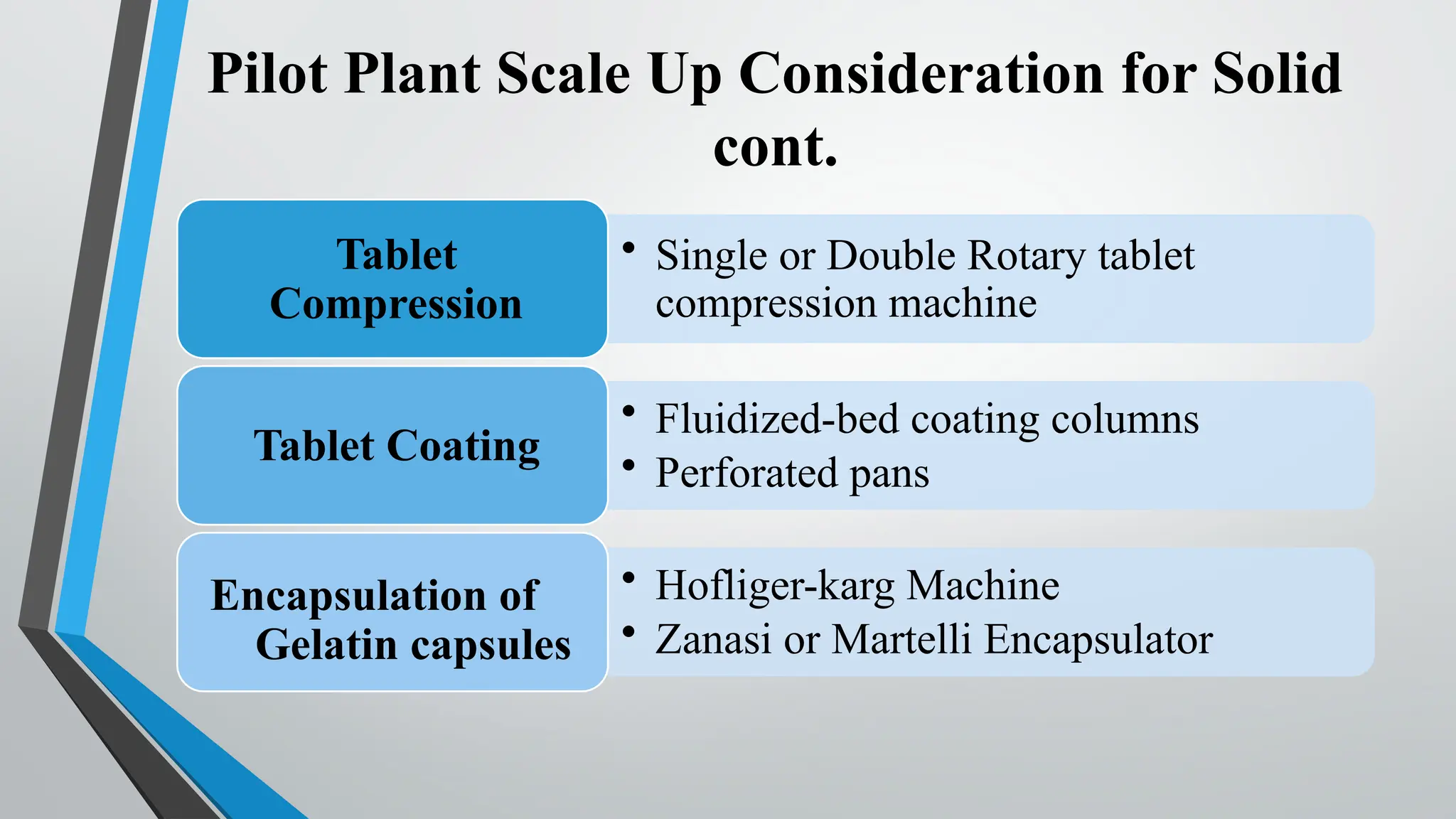
Pilot Plant Scale Up Consideration for Solid
cont.
• Single or Double Rotary tablet
compression machine
Tablet
Compression
• Fluidized-bed coating columns
• Perforated pans
Tablet Coating
• Hofliger-karg Machine
• Zanasi or Martelli Encapsulator
Encapsulation of
Gelatin capsules
Parameters observed
For Example lets take
Fluidized Bed Dryer
Optimum
Load
Air Flow
Rate
Inlet Air
Temperature
Humidity of
incoming air
Manufacturing Layout of Liquid dosage form
API EXCIPIENT
SOLVENT
HOMOGENIzER
FILTER
FILLING
&
PACKAGING
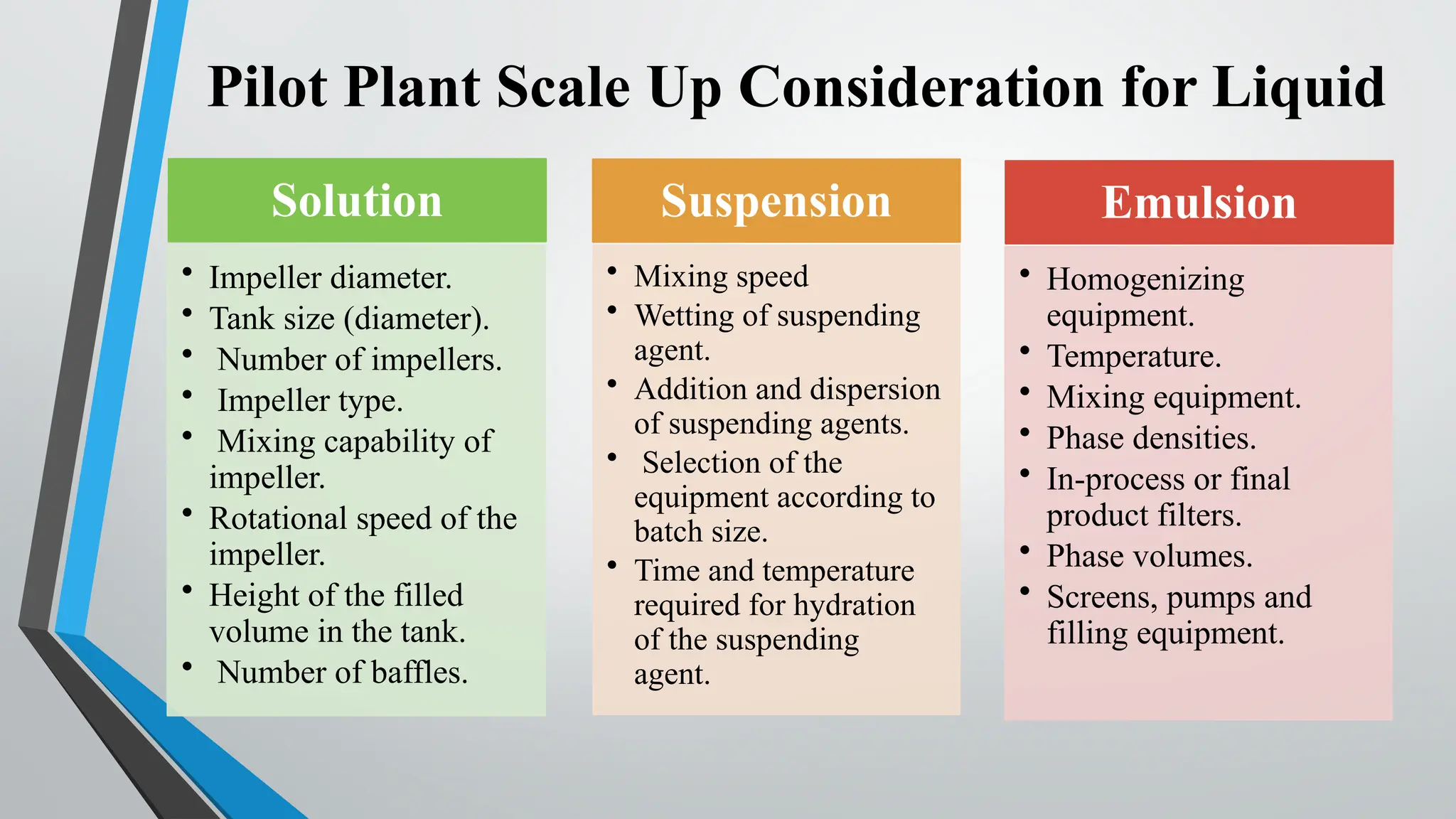
Pilot Plant Scale Up Consideration for Liquid
Solution
• Impeller diameter.
• Tank size (diameter).
• Number of impellers.
• Impeller type.
• Mixing capability of
impeller.
• Rotational speed of the
impeller.
• Height of the filled
volume in the tank.
• Number of baffles.
Suspension
• Mixing speed
• Wetting of suspending
agent.
• Addition and dispersion
of suspending agents.
• Selection of the
equipment according to
batch size.
• Time and temperature
required for hydration
of the suspending
agent.
Emulsion
• Homogenizing
equipment.
• Temperature.
• Mixing equipment.
• Phase densities.
• In-process or final
product filters.
• Phase volumes.
• Screens, pumps and
filling equipment.
Manufacturing Layout of Sterile dosage form
Raw
material
preparation
Formulation
Preparation
Filtration Sterilization
Filling &
Sealing
STERILIZATION:-
 Autoclaving
 Aseptic Filtration
 Radiation Sterilization
 Dry Heat Sterilization
Drug Approval Process
Stages of Drug Approval:-
1) Submission of Clinical Trial application for evaluating safety and
efficacy.
2) Requirements for permission of new drugs approval.
3) Post approval changes in biological products: quality, safety and
efficacy documents.
4) Preparation of the quality information for drug submission for new drug
approval.
Applicant
IND application filling to CDSCO
Application to Ethical
Committee
Examination by New Drug division
Detail review by IND committee
Recommendation to DCGI
IND application Approved
Clinical Trial started
Application for New Drug
Registration to CDSCO
Review by DCGI
Report to Ethical Committee
License is granted
Refused to grant license
If completed
If not
CONCLUSION
In conclusion, the pilot plant scale-up process and the drug approval process for different
dosage forms are integral to the successful development and commercialization of
pharmaceutical products. The scale-up process bridges the gap between laboratory-scale
research and full-scale production, ensuring reproducibility, safety, and compliance with
regulatory standards. It involves meticulous planning, validation, and optimization of
processes to address challenges like equipment differences, process parameters, and
material characteristics.
Similarly, the drug approval process ensures that only safe, effective, and high-quality
drugs reach the market. It involves rigorous testing, documentation, and compliance with
guidelines set by regulatory agencies such as the FDA, EMA, or others. Each dosage form
—whether oral, topical, parenteral, or novel delivery systems—presents unique challenges,
and the processes must be tailored accordingly.
By integrating robust scale-up techniques with thorough regulatory compliance, the
pharmaceutical industry ensures that innovative drugs are delivered to patients efficiently
and safely, contributing to global health and wellbeing.
REFERENCE
Thank you

Pilot plant scale up technique in pharmaceutical

  • 1.
    PILOT PLANT SCALEUP TECHNIQUE & DRUG APPROVAL PROCESS FOR DIFFERENT DOSAGE FORM GUIDED BY : PROF.(Dr.) BISWAJIT BASU PRESENTED BY : RAHUL KUMAR BHAGAT ABHIJAN PRADHAN SAYAN KARMAHAPATRA
  • 2.
    TABLE OF CONTENT TOPICPAGE NO.  Introduction  Calibration of glassware in pharmaceuticals  Preformulation  Pilot Plant Scale Up  Manufacturing procedure of different dosage form  Drug approval process  Conclusion  Reference
  • 3.
    INTRODUCTION In pharmaceutical development,the pilot plant scale-up process transforms small lab-scale drug formulations into larger, production-ready batches. This step ensures the manufacturing process is consistent, safe, and able to maintain product quality on a commercial scale. Alongside scale-up, the drug approval process—regulated by agencies like the FDA or EMA—assesses a drug’s safety, efficacy, and quality before it reaches the market. Each dosage form, such as tablets, injectables, or topical products, has specific testing and regulatory standards, ensuring that every form meets rigorous health and safety requirements.
  • 4.
    Calibration of Glasswarein Pharmaceuticals Common glassware to calibrate includes volumetric flask , burettes , pipettes , graduated cylinder and beakers. For example : Calibration of Volumetric Flask 1. Clean and rinse three 25 or 50 mL volumetric flasks with acetone (2-3 rinses, ~2 mL each). Let acetone evaporate and label each flask. 2. Weigh each empty flask with stopper; record weights. 3. Pour deionized water into a beaker, measure its temperature, and use the density table to find water density. Fill each flask to the fill line with water, weigh, and record. 4. Return water to beaker. Rinse flasks with acetone and repeat steps 2-3 until you have three mass measurements per flask.
  • 5.
    Calibration of Glasswarein pharmaceutical cont. 5. Calculate each flask's water volume and find the mean for each. The volume of an object if the mass and density are known: The density of water can vary slightly depending on the temperature. At around 25°C (77°F), the density of water is approximately 0.99602 g/cm³.
  • 6.
    Pre-formulation • It isdefined as the phase of research and development in which pre-formulation studies characterize physical and chemical properties of a drug molecule in order to develop safe , effective and stable dosage form. • The meaning of pre-formulation refers to the steps to be undertaken before formulation.
  • 7.
    Preformulation cont.  Physiochemicalparameter 1. Organoleptic properties 2. Bulk characterization studies: a) Crystallinity and polymorphism b) Hygroscopicity c) Fine particle characterization d) Powder flow properties 3. Solubility analysis: a) pH solubility profile b) pKa determination c) Partition coefficient d) Dissolution studies e) Common ion effect 4. Stability analysis: a) Solution stability b) Solid state stability
  • 8.
    Pilot Plant ScaleUp • Pilot plant: - It is the part of the pharmaceutical industry whereas lab scale formula is transformed into a viable product by development practical procedure of manufacture. • Scale-up: - The art for designing of prototype using the data obtained from the pilot plant model.
  • 9.
    Objectives Avoidance of theproblems associated with the scale-up.  Production and process controls guidelines preparation.  To identify the critical features of the process  Preparation and providing of Master Manufacturing Formula for manufacturing.  Evaluation and Validation for process and equipment.  Examination of the formula to assess the batch stability.
  • 10.
  • 11.
    General Considerations ofPilot Plant Scale Up Reporting Responsibility Personnel Requirements Space Requirements Training Review of the Formula Raw Material Production Rate Process Evaluation Preparation of Master Manufacturing Procedure
  • 12.
    Manufacturing Layout ofSolid dosage form Raw material from Warehouse Shifting Dispensing Granulation (Wet/Dry) Drying Milling Blending Compression Coating Primary Packaging Secondary Packaging Shipper Cartoning Store in Warehouse Distribute
  • 13.
    Pilot Plant ScaleUp Consideration for Solid • Vacuum loading system • Metering Pumps Material Handling System • Bin Blender • Sigma Blade Mixer Blending & granulation • Fluidized Bed Dryer • Tray Dryer Drying • Hammer Mill • Sieving Device Reduction of particle size
  • 14.
    Pilot Plant ScaleUp Consideration for Solid cont. • Single or Double Rotary tablet compression machine Tablet Compression • Fluidized-bed coating columns • Perforated pans Tablet Coating • Hofliger-karg Machine • Zanasi or Martelli Encapsulator Encapsulation of Gelatin capsules
  • 15.
    Parameters observed For Examplelets take Fluidized Bed Dryer Optimum Load Air Flow Rate Inlet Air Temperature Humidity of incoming air
  • 16.
    Manufacturing Layout ofLiquid dosage form API EXCIPIENT SOLVENT HOMOGENIzER FILTER FILLING & PACKAGING
  • 17.
    Pilot Plant ScaleUp Consideration for Liquid Solution • Impeller diameter. • Tank size (diameter). • Number of impellers. • Impeller type. • Mixing capability of impeller. • Rotational speed of the impeller. • Height of the filled volume in the tank. • Number of baffles. Suspension • Mixing speed • Wetting of suspending agent. • Addition and dispersion of suspending agents. • Selection of the equipment according to batch size. • Time and temperature required for hydration of the suspending agent. Emulsion • Homogenizing equipment. • Temperature. • Mixing equipment. • Phase densities. • In-process or final product filters. • Phase volumes. • Screens, pumps and filling equipment.
  • 18.
    Manufacturing Layout ofSterile dosage form Raw material preparation Formulation Preparation Filtration Sterilization Filling & Sealing STERILIZATION:-  Autoclaving  Aseptic Filtration  Radiation Sterilization  Dry Heat Sterilization
  • 19.
    Drug Approval Process Stagesof Drug Approval:- 1) Submission of Clinical Trial application for evaluating safety and efficacy. 2) Requirements for permission of new drugs approval. 3) Post approval changes in biological products: quality, safety and efficacy documents. 4) Preparation of the quality information for drug submission for new drug approval.
  • 20.
    Applicant IND application fillingto CDSCO Application to Ethical Committee Examination by New Drug division Detail review by IND committee Recommendation to DCGI IND application Approved Clinical Trial started Application for New Drug Registration to CDSCO Review by DCGI Report to Ethical Committee License is granted Refused to grant license If completed If not
  • 21.
    CONCLUSION In conclusion, thepilot plant scale-up process and the drug approval process for different dosage forms are integral to the successful development and commercialization of pharmaceutical products. The scale-up process bridges the gap between laboratory-scale research and full-scale production, ensuring reproducibility, safety, and compliance with regulatory standards. It involves meticulous planning, validation, and optimization of processes to address challenges like equipment differences, process parameters, and material characteristics. Similarly, the drug approval process ensures that only safe, effective, and high-quality drugs reach the market. It involves rigorous testing, documentation, and compliance with guidelines set by regulatory agencies such as the FDA, EMA, or others. Each dosage form —whether oral, topical, parenteral, or novel delivery systems—presents unique challenges, and the processes must be tailored accordingly. By integrating robust scale-up techniques with thorough regulatory compliance, the pharmaceutical industry ensures that innovative drugs are delivered to patients efficiently and safely, contributing to global health and wellbeing.
  • 22.
  • 23.