Prof. Shaikh Abusufiyan
Assistant Professor,
AIKTC-School of Pharmacy,
New Panvel-410206
Part-01: Drugs Discovery
and Development
Pharma Learning Forever
At the end of this e-learning session you are able to…
A. Distinguish different phases of drug
development?
B. Discuss drug discovery process.
Copyright @shaikhabusufiyan2021
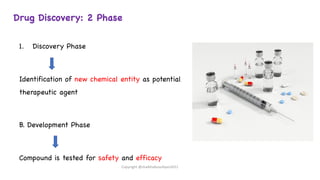
Drug Discovery: 2 Phase
1. Discovery Phase
Identification of new chemical entity as potential
therapeutic agent
B. Development Phase
Compound is tested for safety and efficacy
Copyright @shaikhabusufiyan2021
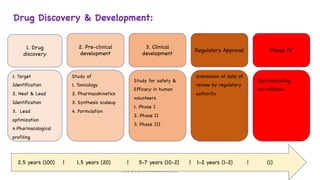
Drug Discovery & Development:
Copyright @shaikhabusufiyan2021
1. Drug
discovery
2. Pre-clinical
development
3. Clinical
development
Regulatory Approval Phase IV
1. Target
Identification
2. Heat & Lead
Identification
3. Lead
optimization
4.Pharmacological
profiling
Study of
1. Toxicology
2. Pharmacokinetics
3. Synthesis scaleup
4. Formulation
Study for safety &
Efficacy in human
volunteers
1. Phase I
2. Phase II
3. Phase III
Submission of data of
review by regulatory
authority
Post-marketing
surveillance
2.5 years (100) | 1.5 years (20) | 5-7 years (10-2) | 1-2 years (1-2) | (1)
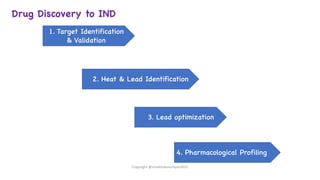
Drug Discovery to IND
1. Target Identification
& Validation
2. Heat & Lead Identification
3. Lead optimization
4. Pharmacological Profiling
Copyright @shaikhabusufiyan2021
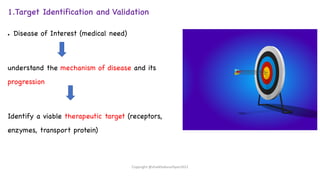
1.Target Identification and Validation
● Disease of Interest (medical need)
understand the mechanism of disease and its
progression
Identify a viable therapeutic target (receptors,
enzymes, transport protein)
Copyright @shaikhabusufiyan2021
Continue….
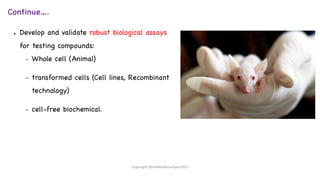
● Develop and validate robust biological assays
for testing compounds:
– Whole cell (Animal)
– transformed cells (Cell lines, Recombinant
technology)
– cell-free biochemical.
Copyright @shaikhabusufiyan2021
Continue….
• The limiting factor
- Emergence of unexpected adverse effects
- Cost and complexity of drug discovery
- Increasing regulatory hurdles.
Copyright @shaikhabusufiyan2021
Q&A
Q.1 What is difference between drug discovery and drug
development process?
Q.2 Enlist the stages of drug discovery
Q.3 What is target identification?
Copyright @shaikhabusufiyan2021
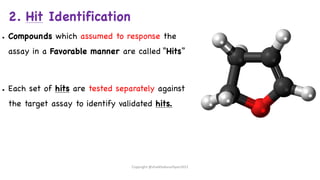
2. Hit Identification
● Compounds which assumed to response the
assay in a Favorable manner are called “Hits”
● Each set of hits are tested separately against
the target assay to identify validated hits.
Copyright @shaikhabusufiyan2021
3. Lead finding
● 2 Process
– Convert hit to lead (H2L)
– Modify existing compounds.
Copyright @shaikhabusufiyan2021
Start with hits and create lead compounds (Hit-to-Lead, H2L)
● Synthesize and test analogues of hits to
optimize certain properties:
– biological activity (potency)
– identify target effects
– selectivity (to avoid side effects or toxicity)
Copyright @shaikhabusufiyan2021
● Use drug design TOOLS:
– To create novel compounds and optimal
compounds
– Computer-aided drug design (CADD)
• Drug design based on medicinal chemistry
experience.
Copyright @shaikhabusufiyan2021
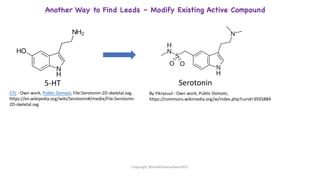
Another Way to Find Leads – Modify Existing Active Compound
5-HT Serotonin
By Yikrazuul - Own work, Public Domain,
https://commons.wikimedia.org/w/index.php?curid=3935884
CYL - Own work, Public Domain, File:Serotonin-2D-skeletal.svg,
https://en.wikipedia.org/wiki/Serotonin#/media/File:Serotonin-
2D-skeletal.svg
Copyright @shaikhabusufiyan2021
Another Way to Find Leads – Modify Existing Active Compound
● Design structural changes and create compounds to:
– Improve biological activity and selectivity for
the target
– Eliminate side effects
– Improve physicochemical properties
– Improve therapeutic index (TI) (effectiveness vs.
unfavourable side effects)
Copyright @shaikhabusufiyan2021
4. Lead Optimization
● Identify optimal compound(s) for preclinical studies with
Favorable parameters:
– synthetic scalability
– in vitro potency and selectivity
– In vivo efficacy in proof of concept and disease
models
– toxicology (dose-ranging toxicology studies in vivo)
– patentability
– In vivo pharmacokinetics (PK: half-life, Cmax, Tmax etc)
– in vitro ADME characterization
– Optimal mode of delivery
Copyright @shaikhabusufiyan2021
Continue….
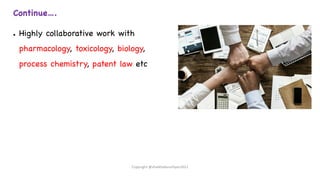
● Highly collaborative work with
pharmacology, toxicology, biology,
process chemistry, patent law etc
Copyright @shaikhabusufiyan2021
Reference:
• H.P Rang. M M Dale, J.M Ritter, R.J Flower, G Henderson.
Pharmacology, Seventh Edition. Elsevier Churchill Livengston
Publication. Page no:726-728.
Copyright @shaikhabusufiyan2021
Disclaimer (Images)
• The images used in this presentation are found from different sources all over the
Internet, and are assumed to be in public domain and are displayed under the fair
use principle for education purpose.
Copyright @ Presentation
• The said presentation is copyright under Copyright @shaikhabusufiyan2021
• The presentation is for education purpose only, don’t use the same for any legal
perspective.
Copyright @shaikhabusufiyan2021
Q&A
Quiz-Attendance/Feedback:
https:/
/forms.gle/SxVD1JfVtZLfuQqi8
Copyright @shaikhabusufiyan2021
Prof. Shaikh Abusufiyan
Assistant Professor,
AIKTC-School of Pharmacy,
New Panvel-410206
Part-02: Drugs Discovery
and Development
Pharma Learning Forever
At the end of this e-learning session you are able to…
A. Demonstrate the knowledge of pre-clinical
drugs development?
B. Distinguish different phases of clinical trials.
Copyright @shaikhabusufiyan2021
Preclinical Developments
• Aim:
• To satisfy all the requirements that have to
be met before a new compound
tested for the first time in humans.
Copyright @shaikhabusufiyan2021
Preclinical Developments
● Basically it consist of 4 types of study of drug:
1. Safety Pharmacology
● To ensure drug has NO obvious hazardous
effect
2. Preliminary toxicology
● Acute oral toxicity tests to determine
MTD
Copyright @shaikhabusufiyan2021
3. Pharmacokinetic testing:
● Asses ADME profile, half life
– It will help to decide dosing
frequency
Copyright @shaikhabusufiyan2021
4. Chemical and Pharmaceutical Feasibility:
● Is it feasible to prepare drug in large
quantities ?
● Feasible to purify in large scale ?
● Is the compound stable in long duration ?
● What’s a optimal/good formulation to
start with ?
Copyright @shaikhabusufiyan2021
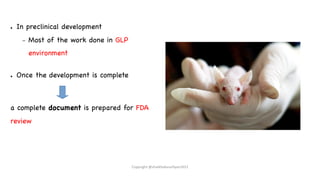
● In preclinical development
– Most of the work done in GLP
environment
● Once the development is complete
a complete document is prepared for FDA
review
Copyright @shaikhabusufiyan2021
Continue..
● Primary goal of preclinical
development
to present data to FDA to allow
initiation of the clinical program:
Copyright @shaikhabusufiyan2021
Continue…
– To justify that the compound exhibits -->
pharmacological activity
– To support the product being -->
reasonably safe for initial use in humans
– To justify exposing --> humans to
reasonable risks
Copyright @shaikhabusufiyan2021
Q&A
Q.1 What is aim of pre-clinical development?
Q.2 Enlist 4 types of studies conducted under pre-clinical
development of drugs.
Q.3 What justification need to be given in the review
document submitted to FDA before initiation of clinical trial?
Copyright @shaikhabusufiyan2021
● Clinical Trial (Clinical study):
– A systematic study of pharmaceutical product on human subjects ---> (Whether
patients or non patient volunteers)-
– In order to discover or verify
● Clinical, Pharmacological (pharmacodynamics/ pharmacokinetics)
● And adverse effect with the object of determining their safety and efficacy is
called as clinical trials.
Copyright @shaikhabusufiyan2021
Phases of Clinical Trials
Phase Zero (Phase 0)
● It is risky and very dangerous to test IND straightway in
patients.
● Pretrial testing:
done in very small number of people usually fewer than 15
Copyright @shaikhabusufiyan2021
Continue…
● In vitro (Biological fluids) and In vivo testing is done to study:
– potential activity
– acute toxicity
– or Adverse effects
– This part of clinical trial i.e. pre-trial testing --> termed
as phase zero (Phase 0).
Copyright @shaikhabusufiyan2021
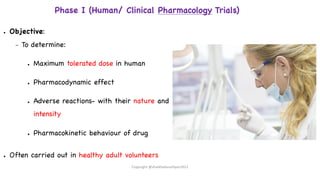
Phase I (Human/ Clinical Pharmacology Trials)
● Objective:
– To determine:
● Maximum tolerated dose in human
● Pharmacodynamic effect
● Adverse reactions- with their nature and
intensity
● Pharmacokinetic behaviour of drug
● Often carried out in healthy adult volunteers
Copyright @shaikhabusufiyan2021
● No of subjects:
– At least 2 subjects --> should be used on each
dose (20 to 100 volunteers)
● No of centres:
– One or two centres with all necessary facility
--> to closely observe and monitor the subjects
● Expertise of investigator:
– Trained in clinical pharmacology
Copyright @shaikhabusufiyan2021
Phase II Exploratory trials
● Objective:
– To determine
● Possible therapeutic use
● Effective dose range
● Further evaluation of safety and pharmacokinetics.
Copyright @shaikhabusufiyan2021
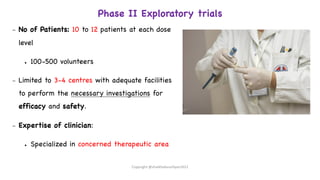
Phase II Exploratory trials
– No of Patients: 10 to 12 patients at each dose
level
● 100-500 volunteers
– Limited to 3-4 centres with adequate facilities
to perform the necessary investigations for
efficacy and safety.
– Expertise of clinician:
● Specialized in concerned therapeutic area
Copyright @shaikhabusufiyan2021
Phase III (Confirmatory trials)
● Objective: to obtain
– Sufficient evidence about the efficacy and safety of drug in
large number of patients
– done in comparison with a standard drug or placebo
– Expertise of clinicians:
● Specialized in the concerned therapeutic areas
● Selection of clinician need approval of the licensing
authority under rule 21 of the Act.
Copyright @shaikhabusufiyan2021
Continue…
– No of Patients: (1000-5000 patients)
● If drug is already approved/
marketed in other countries-
– at least 100 patients distributed
over 3-4 centres
Copyright @shaikhabusufiyan2021
Phase IV
● Study perform
– after marketing of the pharmaceutical product
● It is in the form of:
– Post marketing surveillance (ADR)
– Assessment of
● therapeutic value
● Treatment strategies used
● Safety profile
Copyright @shaikhabusufiyan2021
Phase IV
● Same scientific and ethical
standards --> as applied in pre-
marketing studies.
● It is generally done to explore:
– New indications
– New method of administrations
– New combination
Copyright @shaikhabusufiyan2021
Reference:
• H.P Rang. M M Dale, J.M Ritter, R.J Flower, G Henderson. Pharmacology,
Seventh Edition. Elsevier Churchill Livengston Publication. Page no:726-728.
• Dr. S.P. Agarwal. Good Clinical Practice Guidelines. Archived from
https:/
/cdsco.gov.in/opencms/resources/UploadCDSCOWeb/2018/UploadImmu
nization/Clinical.pdf
Copyright @shaikhabusufiyan2021
Disclaimer (Images)
• The images used in this presentation are found from different sources all over the
Internet, and are assumed to be in public domain and are displayed under the fair
use principle for education purpose.
Copyright @ Presentation
• The said presentation is copyright under Copyright @shaikhabusufiyan2021
• The presentation is for education purpose only, don’t use the same for any legal
perspective.
Copyright @shaikhabusufiyan2021
Q&A
Quiz-Attendance/Feedback:
https:/
/forms.gle/ufPgtpiUfhqVQwbP7
Copyright @shaikhabusufiyan2021
Prof. Shaikh Abusufiyan
Assistant Professor,
AIKTC-School of Pharmacy,
New Panvel-410206
Part-03: Drugs Discovery
and Development
Pharma Learning Forever
At the end of this e-learning session you are able to…
A. Explain history of clinical trials?
B. Discuss its ethics.
Copyright @shaikhabusufiyan2021
History of Clinical Trials
● The Nuremberg Code:
– It is a set of research & ethics principles for human
experimentation set
as a result of the Subsequent Nuremberg Trials at the
end of the Second World War.
Copyright @shaikhabusufiyan2021
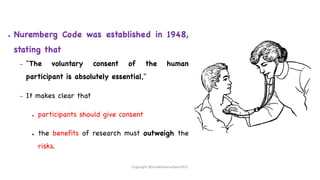
● Nuremberg Code was established in 1948,
stating that
– "The voluntary consent of the human
participant is absolutely essential,"
– It makes clear that
● participants should give consent
● the benefits of research must outweigh the
risks.
Copyright @shaikhabusufiyan2021
History of Clinical Trials...
● Declaration of Helsinki:
– In 1964 the World Medical Association
established recommendations for biomedical
research involving human participants.
– Issues addressed in the Declaration of Helsinki:
● Research with humans should be based on
the results from laboratory and animal
experimentation
Copyright @shaikhabusufiyan2021
Continue..
● Research protocols should be reviewed --> by an
independent committee prior to initiation
● Informed consent from research participants -->
is necessary
● Research should be conducted by
--> medically/scientifically qualified individuals
● Risks should not exceed benefits
Copyright @shaikhabusufiyan2021
History of Clinical Trials...
● Tuskegee Syphilis Study (1932-1972):
– A research project conducted by the U.S. Public
Health Service
600 low-income African-American males were monitored
for 40 years.
– Proven cure (penicillin) available in the 1950s --> but
still the study continued until 1972 with participants
being denied treatment.
Copyright @shaikhabusufiyan2021
–Many participants died of syphilis during the
study.
–The study was stopped in 1973 only after its
existence was publicized and it became a
political embarrassment.
–In 1997 President Clinton apologized to the
study participants and their families.
Copyright @shaikhabusufiyan2021
Q&A
Q.1 What are two key principles of Nuremberg code?
Q.2 Enlist few guidelines of Declaration of Helsinki.
Q.3 What is Tuskegee Syphilis Study (1932-1972)?
Copyright @shaikhabusufiyan2021
● The Belmont Report:
– National Commission for the Protection of Human
Subjects of Biomedical and Behavioral Research prepared
the Belmont Report in 1979.
– It summarize the basic ethical principals identified by
the Commission
Copyright @shaikhabusufiyan2021
Ethical Principles
● Current revision of declaration of Helsinki
● Ethical principles should respect 3 basic elements
namely:
– Justice
– Respect for person
– Beneficence (To maximize benefits & to
minimize harm & wrongs)
– & Non- maleficence (no harm)
Copyright @shaikhabusufiyan2021
● Following principles are to be followed:
1. Essentiality
● Where no alternative is available
● It is necessary for the:
– Advancement of knowledge
– Benefit of all members of human species
– Ecological and environmental benefit
Copyright @shaikhabusufiyan2021
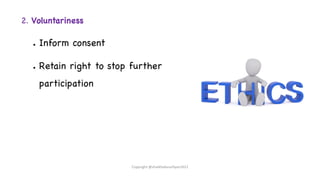
2. Voluntariness
● Inform consent
● Retain right to stop further
participation
Copyright @shaikhabusufiyan2021
3. Non- exploitation
– Research subject is to be remunerated
– Fully appraised of all dangers arising in and out of the research
4. Principle of privacy & Confidentiality
– Identity & records --> kept confidential
– should not be disclosed without valid scientific and legal reasons
Copyright @shaikhabusufiyan2021
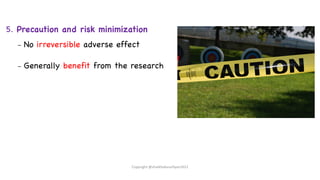
5. Precaution and risk minimization
– No irreversible adverse effect
– Generally benefit from the research
Copyright @shaikhabusufiyan2021
6. Professional competence
– Competent and qualified
– Act with impartiality and total integrity
7. Accountability and transparency
– Experiment conducted in fair, honest and transparent manner
– Full disclosure is to be made to participants
Copyright @shaikhabusufiyan2021
8. Institutional arrangement
9. Public domain
10. Compliance
– All the guidelines are to be duly
complied.
Copyright @shaikhabusufiyan2021
Reference:
• Dr. S.P. Agarwal. Good Clinical Practice Guidelines. Archived from
https:/
/cdsco.gov.in/opencms/resources/UploadCDSCOWeb/2018/UploadImmu
nization/Clinical.pdf
Copyright @shaikhabusufiyan2021
Disclaimer (Images)
• The images used in this presentation are found from different sources all over the
Internet, and are assumed to be in public domain and are displayed under the fair
use principle for education purpose.
Copyright @ Presentation
• The said presentation is copyright under Copyright @shaikhabusufiyan2021
• The presentation is for education purpose only, don’t use the same for any legal
perspective.
Copyright @shaikhabusufiyan2021
Q&A
Quiz-Attendance/Feedback:
https:/
/forms.gle/L33CFLa15Z2Sirho7
Copyright @shaikhabusufiyan2021
Prof. Shaikh Abusufiyan
Assistant Professor,
AIKTC-School of Pharmacy,
New Panvel-410206
Part-04: Drugs Discovery
and Development
Pharma Learning Forever
At the end of this e-learning session you are able to…
A. Demonstrate the knowledge of pre-clinical
drugs development?
B. Distinguish different phases of clinical trials.
Copyright @shaikhabusufiyan2021
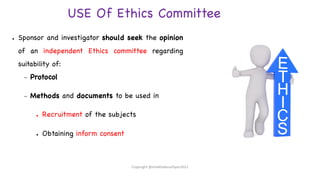
USE Of Ethics Committee
● Sponsor and investigator should seek the opinion
of an independent Ethics committee regarding
suitability of:
– Protocol
– Methods and documents to be used in
● Recruitment of the subjects
● Obtaining inform consent
Copyright @shaikhabusufiyan2021
REPSONSIBILITY OF ETHICAL COMMITTEE:
● Ensure competent review of -->
proposed research protocol prier to
initiation
● Monitoring for compliance of ethics
Copyright @shaikhabusufiyan2021
REPSONSIBILITY OF ETHICAL COMMITTEE:
● Its further responsibility is defined as:
– To protect dignity, right & well being --> PARTICIPANTS
– To ensure that universal ethical values and international scientific
standards are expressed
– Development and education of a research community responsible for local
health care requirement.
Copyright @shaikhabusufiyan2021
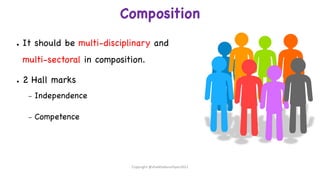
Composition
● It should be multi-disciplinary and
multi-sectoral in composition.
● 2 Hall marks
– Independence
– Competence
Copyright @shaikhabusufiyan2021
● No of persons:
– Should be kept fairly small
–5 to 7 members (12-15 maximum number
recommended)
– Minimum 5 members are required to form
quorum.
Copyright @shaikhabusufiyan2021
● Chairperson:
– Not Head of the same institution
– Preferably be from outside the institution
● Member secretory:
– Belongs to the same institution
– Should conduct the business of the committee
Copyright @shaikhabusufiyan2021
●Other members:
–Should mix of medical/ non medical,
scientific and non scientific persons.
–Including lay public to reflect the
differed view points.
Copyright @shaikhabusufiyan2021
Q&A
Q.1 What are two key principles of Nuremberg code?
Q.2 Enlist few guidelines of Declaration of Helsinki.
Q.3 What is Tuskegee Syphilis Study (1932-1972)?
Copyright @shaikhabusufiyan2021
COMPOSTION
● Chairperson
● 1 to 2 basic medical scientists
(Preferably one pharmacologist)
● 1 to 2 clinicians from various
institutes
● One legal expert
Copyright @shaikhabusufiyan2021
COMPOSTION
● One social scientist/ representative of non
governmental voluntary agency
● One philosopher
● One lay person from community
● Member secretary
● There should be adequate representation of
– Age, gender and community
Copyright @shaikhabusufiyan2021
Terms of reference
● Committee member should be made aware of their role and
responsibilities
● Any change in the regulatory requirement -->
– should be brought to their attention
– They should be kept abreast of all national and international
developments
Copyright @shaikhabusufiyan2021
Continue..
● It also includes the
– Statement on term of appointment
– Duration of term of membership
– Policy for removal, replacement and resignation
Copyright @shaikhabusufiyan2021
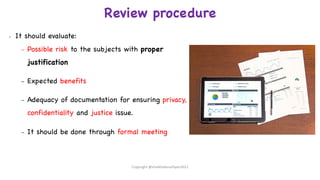
Review procedure
• It should evaluate:
– Possible risk to the subjects with proper
justification
– Expected benefits
– Adequacy of documentation for ensuring privacy,
confidentiality and justice issue.
– It should be done through formal meeting
Copyright @shaikhabusufiyan2021
Submission of application
● The researcher should submit an appropriate application at least 3 weeks in advanced
● The protocol should include:
1. Clear research objectives and rational
2. Recent curriculum vitae of the investigator
3. Subject recruitment procedure
4. Inclusion and exclusion criteria
Copyright @shaikhabusufiyan2021
5. Precise description of methodology of the proposed research
including
– Dosage
– Route of drug administration
– Planned duration of treatment
–Detail of invasive procedure
Copyright @shaikhabusufiyan2021
6. Description of plan to withdraw or withhold standard therapy
7. Plans for statistical analysis
8. Procedure for obtaining inform consent
9. Safety of proposed intervention including results of relevant laboratory
and animal research.
Copyright @shaikhabusufiyan2021
10. For research carrying more than minimal risk
– Account of plans to provide medical therapy
11. Proposed composition and reimbursement of
incidental expenses
12. Storage and maintenance of all data ---->
collected during the trial
Copyright @shaikhabusufiyan2021
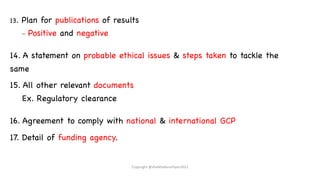
13. Plan for publications of results
– Positive and negative
14. A statement on probable ethical issues & steps taken to tackle the
same
15. All other relevant documents
Ex. Regulatory clearance
16. Agreement to comply with national & international GCP
17. Detail of funding agency.
Copyright @shaikhabusufiyan2021
Reference:
• Dr. S.P. Agarwal. Good Clinical Practice Guidelines. Archived from
https:/
/cdsco.gov.in/opencms/resources/UploadCDSCOWeb/2018/UploadImmu
nization/Clinical.pdf
Copyright @shaikhabusufiyan2021
Disclaimer (Images)
• The images used in this presentation are found from different sources all over the
Internet, and are assumed to be in public domain and are displayed under the fair
use principle for education purpose.
Copyright @ Presentation
• The said presentation is copyright under Copyright @shaikhabusufiyan2021
• The presentation is for education purpose only, don’t use the same for any legal
perspective.
Copyright @shaikhabusufiyan2021
Q&A
Quiz-Attendance/Feedback:
https:/
/forms.gle/L33CFLa15Z2Sirho7
Copyright @shaikhabusufiyan2021
Prof. Shaikh Abusufiyan
Assistant Professor,
AIKTC-School of Pharmacy,
New Panvel-410206
Part-05: Drugs Discovery
and Development
Pharma Learning Forever
At the end of this e-learning session you are able to…
A. Discuss decision making process and
interim review of ethical committee?
B. Explain GCP guidelines.
Copyright @shaikhabusufiyan2021
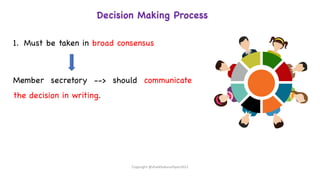
Decision Making Process
1. Must be taken in broad consensus
Member secretory --> should communicate
the decision in writing.
Copyright @shaikhabusufiyan2021
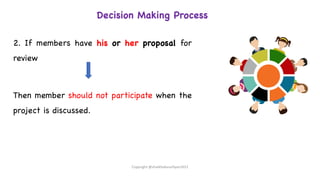
Decision Making Process
2. If members have his or her proposal for
review
Then member should not participate when the
project is discussed.
Copyright @shaikhabusufiyan2021
Continue….
3. Negative decisions
Always supported by clear defined reasons.
Copyright @shaikhabusufiyan2021
4. IEC may reverse its positive decisions
In the event of receiving information that may
adversely affect the risk-benefit ratio.
5. Discontinuation of trial should be ordered:
– If goal of trial is already being achieved
– Or it gives unequivocal results
Copyright @shaikhabusufiyan2021
6. Premature termination:
– Notification with reason for
termination
– Summary of results conducted till
date
Copyright @shaikhabusufiyan2021
7. The following circumstances require the matter to be
brought to the IEC:
– Amendment to protocol
– Unexpected adverse events
– Any new information that may influence the
conduct of the study
Copyright @shaikhabusufiyan2021
8. If necessary --> applicant invited to present protocol
9. Subject experts may be invited
– to offer their views
– But should not take part in decision making
– However, Opinion must be recorded
– Minutes of Meeting should be recorded --> which should be
approved and signed by the chairperson.
Copyright @shaikhabusufiyan2021
Interim Review
● Shall be decided by IEC instead of waiting for
schedule date of meeting
● This can be done for the following reasons:
– Re-examination of proposal already
examined by the IEC
– Research study of a minor nature
– Urgent proposal of national interest
Copyright @shaikhabusufiyan2021
Record Keeping
● Record should be maintain for at least a period
of 5 years for the following:
– The composition of IEC
– The curriculum vitae
– SOP
Copyright @shaikhabusufiyan2021
Continue…
– National and international guidelines
– Copies of protocol, data collection formats,
investigational broacher
– All the correspondence with IEC
– Agenda & Minutes of IEC meeting
Copyright @shaikhabusufiyan2021
• Copies of decisions --> communicated
to applicants.
• Record of all notification issued -->
for premature termination of a study
with summary of reasons.
• Final report of the study --> including
microfilm, CDs & video recording.
Copyright @shaikhabusufiyan2021
Q&A
Q.1 In which cases IAEC can discontinue the trial?
Q.2 When interim review is necessary?
Q.3 Enlist few records that is to be maintain for conduct
of trial?
Copyright @shaikhabusufiyan2021
Special consideration
● Shall be given for research involving:
– Children
– Pregnant and lactating women
– Vulnerable subjects
Copyright @shaikhabusufiyan2021
Good Clinical Practice (GCP)
● It is an international quality standard provided
by ICH
an international body that defines standards for
clinical trials.
which governments can transpose into regulations.
Copyright @shaikhabusufiyan2021
Continue..
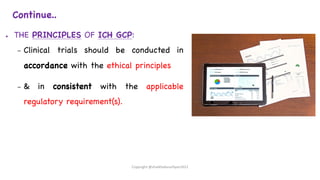
● THE PRINCIPLES OF ICH GCP:
– Clinical trials should be conducted in
accordance with the ethical principles
– & in consistent with the applicable
regulatory requirement(s).
Copyright @shaikhabusufiyan2021
Continue….
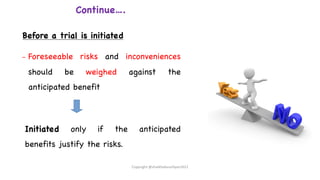
Before a trial is initiated
– Foreseeable risks and inconveniences
should be weighed against the
anticipated benefit
Initiated only if the anticipated
benefits justify the risks.
Copyright @shaikhabusufiyan2021
● The rights, safety and well-being of the trial subjects --> are the
most important considerations.
● and should prevail --> over interest of science and society.
● The available nonclinical and clinical information on an investigational
product --> should be adequate to support the proposed clinical trial.
Copyright @shaikhabusufiyan2021
● It should be scientifically sound and described in a clear, detailed protocol.
● Should be conducted in compliance with the protocol that received prior approval
of independent ethics committee (IEC).
● The medical care given and medical decisions made on behalf of subjects
should always be the responsibility of a qualified physician
Copyright @shaikhabusufiyan2021
● Each individual involved in conducting a trial --> should be qualified by
education, training and experience
● Informed consent --> should be obtained from every subject
Copyright @shaikhabusufiyan2021
● All clinical trial information should be recorded, handled and stored in
a way that
allows its accurate reporting, interpretation and verification
• The confidentiality of records that could identify subjects should be
protected in accordance with the applicable regulatory requirement(s).
Copyright @shaikhabusufiyan2021
• Investigational products should be manufactured,
handled and stored in accordance with GMP.
● They should be used in accordance with the approved
protocol.
● The Systems with procedures that assure the quality
of every aspect of the trial should be implemented.
Copyright @shaikhabusufiyan2021
Disclaimer (Images)
• The images used in this presentation are found from different sources all over the
Internet, and are assumed to be in public domain and are displayed under the fair
use principle for education purpose.
Copyright @ Presentation
• The said presentation is copyright under Copyright @shaikhabusufiyan2021
• The presentation is for education purpose only, don’t use the same for any legal
perspective.
Reference:
• Dr. S.P. Agarwal. Good Clinical Practice Guidelines. Archived from
https:/
/cdsco.gov.in/opencms/resources/UploadCDSCOWeb/2018/UploadImmu
nization/Clinical.pdf
Copyright @shaikhabusufiyan2021
Q&A
Quiz-Attendance/Feedback:
https:/
/forms.gle/L33CFLa15Z2Sirho7
Copyright @shaikhabusufiyan2021

Drug discovery and development

  • 1.
    Prof. Shaikh Abusufiyan AssistantProfessor, AIKTC-School of Pharmacy, New Panvel-410206 Part-01: Drugs Discovery and Development Pharma Learning Forever
  • 2.
    At the endof this e-learning session you are able to… A. Distinguish different phases of drug development? B. Discuss drug discovery process. Copyright @shaikhabusufiyan2021
  • 3.
    Drug Discovery: 2Phase 1. Discovery Phase Identification of new chemical entity as potential therapeutic agent B. Development Phase Compound is tested for safety and efficacy Copyright @shaikhabusufiyan2021
  • 4.
    Drug Discovery &Development: Copyright @shaikhabusufiyan2021 1. Drug discovery 2. Pre-clinical development 3. Clinical development Regulatory Approval Phase IV 1. Target Identification 2. Heat & Lead Identification 3. Lead optimization 4.Pharmacological profiling Study of 1. Toxicology 2. Pharmacokinetics 3. Synthesis scaleup 4. Formulation Study for safety & Efficacy in human volunteers 1. Phase I 2. Phase II 3. Phase III Submission of data of review by regulatory authority Post-marketing surveillance 2.5 years (100) | 1.5 years (20) | 5-7 years (10-2) | 1-2 years (1-2) | (1)
  • 5.
    Drug Discovery toIND 1. Target Identification & Validation 2. Heat & Lead Identification 3. Lead optimization 4. Pharmacological Profiling Copyright @shaikhabusufiyan2021
  • 6.
    1.Target Identification andValidation ● Disease of Interest (medical need) understand the mechanism of disease and its progression Identify a viable therapeutic target (receptors, enzymes, transport protein) Copyright @shaikhabusufiyan2021
  • 7.
    Continue…. ● Develop andvalidate robust biological assays for testing compounds: – Whole cell (Animal) – transformed cells (Cell lines, Recombinant technology) – cell-free biochemical. Copyright @shaikhabusufiyan2021
  • 8.
    Continue…. • The limitingfactor - Emergence of unexpected adverse effects - Cost and complexity of drug discovery - Increasing regulatory hurdles. Copyright @shaikhabusufiyan2021
  • 9.
    Q&A Q.1 What isdifference between drug discovery and drug development process? Q.2 Enlist the stages of drug discovery Q.3 What is target identification? Copyright @shaikhabusufiyan2021
  • 10.
    2. Hit Identification ●Compounds which assumed to response the assay in a Favorable manner are called “Hits” ● Each set of hits are tested separately against the target assay to identify validated hits. Copyright @shaikhabusufiyan2021
  • 11.
    3. Lead finding ●2 Process – Convert hit to lead (H2L) – Modify existing compounds. Copyright @shaikhabusufiyan2021
  • 12.
    Start with hitsand create lead compounds (Hit-to-Lead, H2L) ● Synthesize and test analogues of hits to optimize certain properties: – biological activity (potency) – identify target effects – selectivity (to avoid side effects or toxicity) Copyright @shaikhabusufiyan2021
  • 13.
    ● Use drugdesign TOOLS: – To create novel compounds and optimal compounds – Computer-aided drug design (CADD) • Drug design based on medicinal chemistry experience. Copyright @shaikhabusufiyan2021
  • 14.
    Another Way toFind Leads – Modify Existing Active Compound 5-HT Serotonin By Yikrazuul - Own work, Public Domain, https://commons.wikimedia.org/w/index.php?curid=3935884 CYL - Own work, Public Domain, File:Serotonin-2D-skeletal.svg, https://en.wikipedia.org/wiki/Serotonin#/media/File:Serotonin- 2D-skeletal.svg Copyright @shaikhabusufiyan2021
  • 15.
    Another Way toFind Leads – Modify Existing Active Compound ● Design structural changes and create compounds to: – Improve biological activity and selectivity for the target – Eliminate side effects – Improve physicochemical properties – Improve therapeutic index (TI) (effectiveness vs. unfavourable side effects) Copyright @shaikhabusufiyan2021
  • 16.
    4. Lead Optimization ●Identify optimal compound(s) for preclinical studies with Favorable parameters: – synthetic scalability – in vitro potency and selectivity – In vivo efficacy in proof of concept and disease models – toxicology (dose-ranging toxicology studies in vivo) – patentability – In vivo pharmacokinetics (PK: half-life, Cmax, Tmax etc) – in vitro ADME characterization – Optimal mode of delivery Copyright @shaikhabusufiyan2021
  • 17.
    Continue…. ● Highly collaborativework with pharmacology, toxicology, biology, process chemistry, patent law etc Copyright @shaikhabusufiyan2021
  • 18.
    Reference: • H.P Rang.M M Dale, J.M Ritter, R.J Flower, G Henderson. Pharmacology, Seventh Edition. Elsevier Churchill Livengston Publication. Page no:726-728. Copyright @shaikhabusufiyan2021
  • 19.
    Disclaimer (Images) • Theimages used in this presentation are found from different sources all over the Internet, and are assumed to be in public domain and are displayed under the fair use principle for education purpose. Copyright @ Presentation • The said presentation is copyright under Copyright @shaikhabusufiyan2021 • The presentation is for education purpose only, don’t use the same for any legal perspective.
  • 20.
  • 21.
  • 22.
    Prof. Shaikh Abusufiyan AssistantProfessor, AIKTC-School of Pharmacy, New Panvel-410206 Part-02: Drugs Discovery and Development Pharma Learning Forever
  • 23.
    At the endof this e-learning session you are able to… A. Demonstrate the knowledge of pre-clinical drugs development? B. Distinguish different phases of clinical trials. Copyright @shaikhabusufiyan2021
  • 24.
    Preclinical Developments • Aim: •To satisfy all the requirements that have to be met before a new compound tested for the first time in humans. Copyright @shaikhabusufiyan2021
  • 25.
    Preclinical Developments ● Basicallyit consist of 4 types of study of drug: 1. Safety Pharmacology ● To ensure drug has NO obvious hazardous effect 2. Preliminary toxicology ● Acute oral toxicity tests to determine MTD Copyright @shaikhabusufiyan2021
  • 26.
    3. Pharmacokinetic testing: ●Asses ADME profile, half life – It will help to decide dosing frequency Copyright @shaikhabusufiyan2021
  • 27.
    4. Chemical andPharmaceutical Feasibility: ● Is it feasible to prepare drug in large quantities ? ● Feasible to purify in large scale ? ● Is the compound stable in long duration ? ● What’s a optimal/good formulation to start with ? Copyright @shaikhabusufiyan2021
  • 28.
    ● In preclinicaldevelopment – Most of the work done in GLP environment ● Once the development is complete a complete document is prepared for FDA review Copyright @shaikhabusufiyan2021
  • 29.
    Continue.. ● Primary goalof preclinical development to present data to FDA to allow initiation of the clinical program: Copyright @shaikhabusufiyan2021
  • 30.
    Continue… – To justifythat the compound exhibits --> pharmacological activity – To support the product being --> reasonably safe for initial use in humans – To justify exposing --> humans to reasonable risks Copyright @shaikhabusufiyan2021
  • 31.
    Q&A Q.1 What isaim of pre-clinical development? Q.2 Enlist 4 types of studies conducted under pre-clinical development of drugs. Q.3 What justification need to be given in the review document submitted to FDA before initiation of clinical trial? Copyright @shaikhabusufiyan2021
  • 32.
    ● Clinical Trial(Clinical study): – A systematic study of pharmaceutical product on human subjects ---> (Whether patients or non patient volunteers)- – In order to discover or verify ● Clinical, Pharmacological (pharmacodynamics/ pharmacokinetics) ● And adverse effect with the object of determining their safety and efficacy is called as clinical trials. Copyright @shaikhabusufiyan2021 Phases of Clinical Trials
  • 33.
    Phase Zero (Phase0) ● It is risky and very dangerous to test IND straightway in patients. ● Pretrial testing: done in very small number of people usually fewer than 15 Copyright @shaikhabusufiyan2021
  • 34.
    Continue… ● In vitro(Biological fluids) and In vivo testing is done to study: – potential activity – acute toxicity – or Adverse effects – This part of clinical trial i.e. pre-trial testing --> termed as phase zero (Phase 0). Copyright @shaikhabusufiyan2021
  • 35.
    Phase I (Human/Clinical Pharmacology Trials) ● Objective: – To determine: ● Maximum tolerated dose in human ● Pharmacodynamic effect ● Adverse reactions- with their nature and intensity ● Pharmacokinetic behaviour of drug ● Often carried out in healthy adult volunteers Copyright @shaikhabusufiyan2021
  • 36.
    ● No ofsubjects: – At least 2 subjects --> should be used on each dose (20 to 100 volunteers) ● No of centres: – One or two centres with all necessary facility --> to closely observe and monitor the subjects ● Expertise of investigator: – Trained in clinical pharmacology Copyright @shaikhabusufiyan2021
  • 37.
    Phase II Exploratorytrials ● Objective: – To determine ● Possible therapeutic use ● Effective dose range ● Further evaluation of safety and pharmacokinetics. Copyright @shaikhabusufiyan2021
  • 38.
    Phase II Exploratorytrials – No of Patients: 10 to 12 patients at each dose level ● 100-500 volunteers – Limited to 3-4 centres with adequate facilities to perform the necessary investigations for efficacy and safety. – Expertise of clinician: ● Specialized in concerned therapeutic area Copyright @shaikhabusufiyan2021
  • 39.
    Phase III (Confirmatorytrials) ● Objective: to obtain – Sufficient evidence about the efficacy and safety of drug in large number of patients – done in comparison with a standard drug or placebo – Expertise of clinicians: ● Specialized in the concerned therapeutic areas ● Selection of clinician need approval of the licensing authority under rule 21 of the Act. Copyright @shaikhabusufiyan2021
  • 40.
    Continue… – No ofPatients: (1000-5000 patients) ● If drug is already approved/ marketed in other countries- – at least 100 patients distributed over 3-4 centres Copyright @shaikhabusufiyan2021
  • 41.
    Phase IV ● Studyperform – after marketing of the pharmaceutical product ● It is in the form of: – Post marketing surveillance (ADR) – Assessment of ● therapeutic value ● Treatment strategies used ● Safety profile Copyright @shaikhabusufiyan2021
  • 42.
    Phase IV ● Samescientific and ethical standards --> as applied in pre- marketing studies. ● It is generally done to explore: – New indications – New method of administrations – New combination Copyright @shaikhabusufiyan2021
  • 43.
    Reference: • H.P Rang.M M Dale, J.M Ritter, R.J Flower, G Henderson. Pharmacology, Seventh Edition. Elsevier Churchill Livengston Publication. Page no:726-728. • Dr. S.P. Agarwal. Good Clinical Practice Guidelines. Archived from https:/ /cdsco.gov.in/opencms/resources/UploadCDSCOWeb/2018/UploadImmu nization/Clinical.pdf Copyright @shaikhabusufiyan2021
  • 44.
    Disclaimer (Images) • Theimages used in this presentation are found from different sources all over the Internet, and are assumed to be in public domain and are displayed under the fair use principle for education purpose. Copyright @ Presentation • The said presentation is copyright under Copyright @shaikhabusufiyan2021 • The presentation is for education purpose only, don’t use the same for any legal perspective.
  • 45.
  • 46.
  • 47.
    Prof. Shaikh Abusufiyan AssistantProfessor, AIKTC-School of Pharmacy, New Panvel-410206 Part-03: Drugs Discovery and Development Pharma Learning Forever
  • 48.
    At the endof this e-learning session you are able to… A. Explain history of clinical trials? B. Discuss its ethics. Copyright @shaikhabusufiyan2021
  • 49.
    History of ClinicalTrials ● The Nuremberg Code: – It is a set of research & ethics principles for human experimentation set as a result of the Subsequent Nuremberg Trials at the end of the Second World War. Copyright @shaikhabusufiyan2021
  • 50.
    ● Nuremberg Codewas established in 1948, stating that – "The voluntary consent of the human participant is absolutely essential," – It makes clear that ● participants should give consent ● the benefits of research must outweigh the risks. Copyright @shaikhabusufiyan2021
  • 51.
    History of ClinicalTrials... ● Declaration of Helsinki: – In 1964 the World Medical Association established recommendations for biomedical research involving human participants. – Issues addressed in the Declaration of Helsinki: ● Research with humans should be based on the results from laboratory and animal experimentation Copyright @shaikhabusufiyan2021
  • 52.
    Continue.. ● Research protocolsshould be reviewed --> by an independent committee prior to initiation ● Informed consent from research participants --> is necessary ● Research should be conducted by --> medically/scientifically qualified individuals ● Risks should not exceed benefits Copyright @shaikhabusufiyan2021
  • 53.
    History of ClinicalTrials... ● Tuskegee Syphilis Study (1932-1972): – A research project conducted by the U.S. Public Health Service 600 low-income African-American males were monitored for 40 years. – Proven cure (penicillin) available in the 1950s --> but still the study continued until 1972 with participants being denied treatment. Copyright @shaikhabusufiyan2021
  • 54.
    –Many participants diedof syphilis during the study. –The study was stopped in 1973 only after its existence was publicized and it became a political embarrassment. –In 1997 President Clinton apologized to the study participants and their families. Copyright @shaikhabusufiyan2021
  • 55.
    Q&A Q.1 What aretwo key principles of Nuremberg code? Q.2 Enlist few guidelines of Declaration of Helsinki. Q.3 What is Tuskegee Syphilis Study (1932-1972)? Copyright @shaikhabusufiyan2021
  • 56.
    ● The BelmontReport: – National Commission for the Protection of Human Subjects of Biomedical and Behavioral Research prepared the Belmont Report in 1979. – It summarize the basic ethical principals identified by the Commission Copyright @shaikhabusufiyan2021
  • 57.
    Ethical Principles ● Currentrevision of declaration of Helsinki ● Ethical principles should respect 3 basic elements namely: – Justice – Respect for person – Beneficence (To maximize benefits & to minimize harm & wrongs) – & Non- maleficence (no harm) Copyright @shaikhabusufiyan2021
  • 58.
    ● Following principlesare to be followed: 1. Essentiality ● Where no alternative is available ● It is necessary for the: – Advancement of knowledge – Benefit of all members of human species – Ecological and environmental benefit Copyright @shaikhabusufiyan2021
  • 59.
    2. Voluntariness ● Informconsent ● Retain right to stop further participation Copyright @shaikhabusufiyan2021
  • 60.
    3. Non- exploitation –Research subject is to be remunerated – Fully appraised of all dangers arising in and out of the research 4. Principle of privacy & Confidentiality – Identity & records --> kept confidential – should not be disclosed without valid scientific and legal reasons Copyright @shaikhabusufiyan2021
  • 61.
    5. Precaution andrisk minimization – No irreversible adverse effect – Generally benefit from the research Copyright @shaikhabusufiyan2021
  • 62.
    6. Professional competence –Competent and qualified – Act with impartiality and total integrity 7. Accountability and transparency – Experiment conducted in fair, honest and transparent manner – Full disclosure is to be made to participants Copyright @shaikhabusufiyan2021
  • 63.
    8. Institutional arrangement 9.Public domain 10. Compliance – All the guidelines are to be duly complied. Copyright @shaikhabusufiyan2021
  • 64.
    Reference: • Dr. S.P.Agarwal. Good Clinical Practice Guidelines. Archived from https:/ /cdsco.gov.in/opencms/resources/UploadCDSCOWeb/2018/UploadImmu nization/Clinical.pdf Copyright @shaikhabusufiyan2021
  • 65.
    Disclaimer (Images) • Theimages used in this presentation are found from different sources all over the Internet, and are assumed to be in public domain and are displayed under the fair use principle for education purpose. Copyright @ Presentation • The said presentation is copyright under Copyright @shaikhabusufiyan2021 • The presentation is for education purpose only, don’t use the same for any legal perspective.
  • 66.
  • 67.
  • 68.
    Prof. Shaikh Abusufiyan AssistantProfessor, AIKTC-School of Pharmacy, New Panvel-410206 Part-04: Drugs Discovery and Development Pharma Learning Forever
  • 69.
    At the endof this e-learning session you are able to… A. Demonstrate the knowledge of pre-clinical drugs development? B. Distinguish different phases of clinical trials. Copyright @shaikhabusufiyan2021
  • 70.
    USE Of EthicsCommittee ● Sponsor and investigator should seek the opinion of an independent Ethics committee regarding suitability of: – Protocol – Methods and documents to be used in ● Recruitment of the subjects ● Obtaining inform consent Copyright @shaikhabusufiyan2021
  • 71.
    REPSONSIBILITY OF ETHICALCOMMITTEE: ● Ensure competent review of --> proposed research protocol prier to initiation ● Monitoring for compliance of ethics Copyright @shaikhabusufiyan2021
  • 72.
    REPSONSIBILITY OF ETHICALCOMMITTEE: ● Its further responsibility is defined as: – To protect dignity, right & well being --> PARTICIPANTS – To ensure that universal ethical values and international scientific standards are expressed – Development and education of a research community responsible for local health care requirement. Copyright @shaikhabusufiyan2021
  • 73.
    Composition ● It shouldbe multi-disciplinary and multi-sectoral in composition. ● 2 Hall marks – Independence – Competence Copyright @shaikhabusufiyan2021
  • 74.
    ● No ofpersons: – Should be kept fairly small –5 to 7 members (12-15 maximum number recommended) – Minimum 5 members are required to form quorum. Copyright @shaikhabusufiyan2021
  • 75.
    ● Chairperson: – NotHead of the same institution – Preferably be from outside the institution ● Member secretory: – Belongs to the same institution – Should conduct the business of the committee Copyright @shaikhabusufiyan2021
  • 76.
    ●Other members: –Should mixof medical/ non medical, scientific and non scientific persons. –Including lay public to reflect the differed view points. Copyright @shaikhabusufiyan2021
  • 77.
    Q&A Q.1 What aretwo key principles of Nuremberg code? Q.2 Enlist few guidelines of Declaration of Helsinki. Q.3 What is Tuskegee Syphilis Study (1932-1972)? Copyright @shaikhabusufiyan2021
  • 78.
    COMPOSTION ● Chairperson ● 1to 2 basic medical scientists (Preferably one pharmacologist) ● 1 to 2 clinicians from various institutes ● One legal expert Copyright @shaikhabusufiyan2021
  • 79.
    COMPOSTION ● One socialscientist/ representative of non governmental voluntary agency ● One philosopher ● One lay person from community ● Member secretary ● There should be adequate representation of – Age, gender and community Copyright @shaikhabusufiyan2021
  • 80.
    Terms of reference ●Committee member should be made aware of their role and responsibilities ● Any change in the regulatory requirement --> – should be brought to their attention – They should be kept abreast of all national and international developments Copyright @shaikhabusufiyan2021
  • 81.
    Continue.. ● It alsoincludes the – Statement on term of appointment – Duration of term of membership – Policy for removal, replacement and resignation Copyright @shaikhabusufiyan2021
  • 82.
    Review procedure • Itshould evaluate: – Possible risk to the subjects with proper justification – Expected benefits – Adequacy of documentation for ensuring privacy, confidentiality and justice issue. – It should be done through formal meeting Copyright @shaikhabusufiyan2021
  • 83.
    Submission of application ●The researcher should submit an appropriate application at least 3 weeks in advanced ● The protocol should include: 1. Clear research objectives and rational 2. Recent curriculum vitae of the investigator 3. Subject recruitment procedure 4. Inclusion and exclusion criteria Copyright @shaikhabusufiyan2021
  • 84.
    5. Precise descriptionof methodology of the proposed research including – Dosage – Route of drug administration – Planned duration of treatment –Detail of invasive procedure Copyright @shaikhabusufiyan2021
  • 85.
    6. Description ofplan to withdraw or withhold standard therapy 7. Plans for statistical analysis 8. Procedure for obtaining inform consent 9. Safety of proposed intervention including results of relevant laboratory and animal research. Copyright @shaikhabusufiyan2021
  • 86.
    10. For researchcarrying more than minimal risk – Account of plans to provide medical therapy 11. Proposed composition and reimbursement of incidental expenses 12. Storage and maintenance of all data ----> collected during the trial Copyright @shaikhabusufiyan2021
  • 87.
    13. Plan forpublications of results – Positive and negative 14. A statement on probable ethical issues & steps taken to tackle the same 15. All other relevant documents Ex. Regulatory clearance 16. Agreement to comply with national & international GCP 17. Detail of funding agency. Copyright @shaikhabusufiyan2021
  • 88.
    Reference: • Dr. S.P.Agarwal. Good Clinical Practice Guidelines. Archived from https:/ /cdsco.gov.in/opencms/resources/UploadCDSCOWeb/2018/UploadImmu nization/Clinical.pdf Copyright @shaikhabusufiyan2021
  • 89.
    Disclaimer (Images) • Theimages used in this presentation are found from different sources all over the Internet, and are assumed to be in public domain and are displayed under the fair use principle for education purpose. Copyright @ Presentation • The said presentation is copyright under Copyright @shaikhabusufiyan2021 • The presentation is for education purpose only, don’t use the same for any legal perspective.
  • 90.
  • 91.
  • 92.
    Prof. Shaikh Abusufiyan AssistantProfessor, AIKTC-School of Pharmacy, New Panvel-410206 Part-05: Drugs Discovery and Development Pharma Learning Forever
  • 93.
    At the endof this e-learning session you are able to… A. Discuss decision making process and interim review of ethical committee? B. Explain GCP guidelines. Copyright @shaikhabusufiyan2021
  • 94.
    Decision Making Process 1.Must be taken in broad consensus Member secretory --> should communicate the decision in writing. Copyright @shaikhabusufiyan2021
  • 95.
    Decision Making Process 2.If members have his or her proposal for review Then member should not participate when the project is discussed. Copyright @shaikhabusufiyan2021
  • 96.
    Continue…. 3. Negative decisions Alwayssupported by clear defined reasons. Copyright @shaikhabusufiyan2021
  • 97.
    4. IEC mayreverse its positive decisions In the event of receiving information that may adversely affect the risk-benefit ratio. 5. Discontinuation of trial should be ordered: – If goal of trial is already being achieved – Or it gives unequivocal results Copyright @shaikhabusufiyan2021
  • 98.
    6. Premature termination: –Notification with reason for termination – Summary of results conducted till date Copyright @shaikhabusufiyan2021
  • 99.
    7. The followingcircumstances require the matter to be brought to the IEC: – Amendment to protocol – Unexpected adverse events – Any new information that may influence the conduct of the study Copyright @shaikhabusufiyan2021
  • 100.
    8. If necessary--> applicant invited to present protocol 9. Subject experts may be invited – to offer their views – But should not take part in decision making – However, Opinion must be recorded – Minutes of Meeting should be recorded --> which should be approved and signed by the chairperson. Copyright @shaikhabusufiyan2021
  • 101.
    Interim Review ● Shallbe decided by IEC instead of waiting for schedule date of meeting ● This can be done for the following reasons: – Re-examination of proposal already examined by the IEC – Research study of a minor nature – Urgent proposal of national interest Copyright @shaikhabusufiyan2021
  • 102.
    Record Keeping ● Recordshould be maintain for at least a period of 5 years for the following: – The composition of IEC – The curriculum vitae – SOP Copyright @shaikhabusufiyan2021
  • 103.
    Continue… – National andinternational guidelines – Copies of protocol, data collection formats, investigational broacher – All the correspondence with IEC – Agenda & Minutes of IEC meeting Copyright @shaikhabusufiyan2021
  • 104.
    • Copies ofdecisions --> communicated to applicants. • Record of all notification issued --> for premature termination of a study with summary of reasons. • Final report of the study --> including microfilm, CDs & video recording. Copyright @shaikhabusufiyan2021
  • 105.
    Q&A Q.1 In whichcases IAEC can discontinue the trial? Q.2 When interim review is necessary? Q.3 Enlist few records that is to be maintain for conduct of trial? Copyright @shaikhabusufiyan2021
  • 106.
    Special consideration ● Shallbe given for research involving: – Children – Pregnant and lactating women – Vulnerable subjects Copyright @shaikhabusufiyan2021
  • 107.
    Good Clinical Practice(GCP) ● It is an international quality standard provided by ICH an international body that defines standards for clinical trials. which governments can transpose into regulations. Copyright @shaikhabusufiyan2021
  • 108.
    Continue.. ● THE PRINCIPLESOF ICH GCP: – Clinical trials should be conducted in accordance with the ethical principles – & in consistent with the applicable regulatory requirement(s). Copyright @shaikhabusufiyan2021
  • 109.
    Continue…. Before a trialis initiated – Foreseeable risks and inconveniences should be weighed against the anticipated benefit Initiated only if the anticipated benefits justify the risks. Copyright @shaikhabusufiyan2021
  • 110.
    ● The rights,safety and well-being of the trial subjects --> are the most important considerations. ● and should prevail --> over interest of science and society. ● The available nonclinical and clinical information on an investigational product --> should be adequate to support the proposed clinical trial. Copyright @shaikhabusufiyan2021
  • 111.
    ● It shouldbe scientifically sound and described in a clear, detailed protocol. ● Should be conducted in compliance with the protocol that received prior approval of independent ethics committee (IEC). ● The medical care given and medical decisions made on behalf of subjects should always be the responsibility of a qualified physician Copyright @shaikhabusufiyan2021
  • 112.
    ● Each individualinvolved in conducting a trial --> should be qualified by education, training and experience ● Informed consent --> should be obtained from every subject Copyright @shaikhabusufiyan2021
  • 113.
    ● All clinicaltrial information should be recorded, handled and stored in a way that allows its accurate reporting, interpretation and verification • The confidentiality of records that could identify subjects should be protected in accordance with the applicable regulatory requirement(s). Copyright @shaikhabusufiyan2021
  • 114.
    • Investigational productsshould be manufactured, handled and stored in accordance with GMP. ● They should be used in accordance with the approved protocol. ● The Systems with procedures that assure the quality of every aspect of the trial should be implemented. Copyright @shaikhabusufiyan2021
  • 115.
    Disclaimer (Images) • Theimages used in this presentation are found from different sources all over the Internet, and are assumed to be in public domain and are displayed under the fair use principle for education purpose. Copyright @ Presentation • The said presentation is copyright under Copyright @shaikhabusufiyan2021 • The presentation is for education purpose only, don’t use the same for any legal perspective.
  • 116.
    Reference: • Dr. S.P.Agarwal. Good Clinical Practice Guidelines. Archived from https:/ /cdsco.gov.in/opencms/resources/UploadCDSCOWeb/2018/UploadImmu nization/Clinical.pdf Copyright @shaikhabusufiyan2021
  • 117.
  • 118.