FED VS FASTED STATE
Presented by
Karandeep kaur R Rai
M.Pharm II Sem (Pharmaceutics)
SKB College of Pharmacy
 The presence of food may affect drug absorption via a variety of
mechanisms;
 by impacting GI tract physiology (e.g. food- induced changes in gastric
emptying time, gastric pH, intestinal fluid composition, hepatic blood flow),
 drug solubility and dissolution,
 and drug permeation
 For example, lipophilic drugs often show increased systemic exposure with
food, and this phenomenon is attributable to improved solubilization due to
higher bile salt and lipid concentrations.
 Negative food effects are mostly seen for hydrophilic drugs, where food
impedes permeation .
 One of the frequently used approaches to assess the effect of food on oral drug
absorption involves animal studies .
 However, due to the fact that physiological factors are species dependent, the
magnitude of food effect for a given compound across species is usually
different, thus complicating the prediction of food effects in humans.
 One alternative to animal experiments is to simulate food
effects in humans using physiologically based absorption
models.
 Considering that these models are built based on a prior
knowledge of GI physiology in the fasted and fed states, they
are able to describe the kinetics of drug transit, dissolution,
and absorption on the basis of drug- specific features such as
permeability, biorelevant solubility, ionization constant(s),
dose, metabolism and distribution data, etc.
 Gastroplus™ default physiology parameters, which differ
between fasted and fed states
 GastroPlus™ (version 8.0) interpretation of changes in human physiology
between fasted and fed states
Physiological parameter Fasted Fed
Stomach pH 1.3 4.9
Stomach transit time (h) 0.25 1.00
Stomach volume (mL) 50 1000
Duodenum pH 6.0 5.4
Jejunum 1 pH 6.2 5.4
Jejunum 2 pH 6.4 6.0
Hepatic blood flow (L/min) 1.5 2.0
 Several studies have confirmed the usefulness of the in silico modeling
approach to assess food effects on oral drug absorption.
 For example, the GastroPlus™ absorption model is used to predict plasma profiles
in fed, fasted, and/or high- fat conditions for six model compounds.
 Biorelevant solubilities were measured in different media:
 simulated human gastric fluid for the fasted and fed state,
 simulated human intestinal fluid for the fasted, fed, and high- fat state,
 simulated human colonic fluid for the upper and the lower colon.
 The effect of food was simulated by changing physiological parameters and inserting
the relevant solubility data into the appropriate ACAT compartments (stomach,
intestine, and colon).
 The food effect for each drug was estimated by comparing AUC or C max between
fasted, fed, and/or high- fat conditions.
 Predicted and observed plasma concentration- time profiles and food
effects were compared for a range of doses to assess the accuracy of the
simulations.
 The applied method was able to accurately distinguish
between minor and significant food effects.
 Therefore, it was concluded that biorelevant solubility tests, in
conjunction with physiologically based absorption modeling,
can be used to predict food effects caused by solubility and
dissolution rate limitations, and/or degradation.
 However, it was stressed that the accuracy of a generated
drug- specific absorption model needs to be carefully verified
before proceeding to predict the effect of food.
An important issue emphasized from different studies is related
to the formulation- dependent food effects.
Zhang et al. (2011) incorporated gastric emptying time and
different drug in vivo solubilities under fasted and fed states into
the generated CBZ absorption model and observed that
Co-administration of
CBZ IR suspension with
food resulted in
decreased Cmax and
prolonged tmax due to a
prolonged gastric
emptying time
Co-administration of IR
tablet with XR capsules
with food resulted in
increased Cmax and
earlier tmax
 A possible explaination was that the presence of high fat meal
induced the increase in bile salt conc in the g.i tract ,thus
enhances the dissolution rate of low soluble CBZ from IR tablets
and XR capsules.
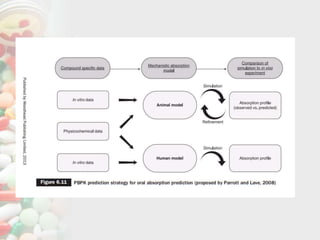
 Jones et al. developed a novel strategy for predicting human
pharmacokinetics in fasted and fed states, by using PBPK
(physiologically based pharmacokinetic) absorption modelling
across different species.
 The proposed strategy implies that the absorption models are
first generated for the selected preclinical species (e.g. mouse,
rat, dog, monkey) on the basis of data generated during drug
research and preclinical development, and
 afterwards verified thoroughly by comparing the simulation
outcomes with the results of in vivo animal studies.
 If the prediction was proven to be accurate, then the same in
vitro absorption parameters and the same assumptions can be
used to predict human pharmacokinetics.
 However, if the animal model was incomplete, further
refinement of the model is needed in order to provide more
accurate simulations in humans.
Reference:
• Computer aided applications in pharmaceutical
technology, first edition, Jelena Djuris, Woodhead
Publishing .
Fed vs Fasted state KKR